Sceptical is likely to return to England in a bid for sprint honours at the top level following his narrow defeat in the Diamond Jubilee Stakes at Royal Ascot.
Denis Hogan’s highly-progressive four-year-old was cut down only in the dying strides when a close third to Hello Youmzain in Saturday’s Group One over six furlongs after leading in the final furlong under Frankie Dettori.
Hogan will look at the Darley July Cup and the Coolmore Nunthorpe Stakes for his unlikely stable star. Sceptical showed he can mix it with the very best after his whirlwind rise from maiden winner in November to being the highest-rated speedster in Ireland, with four wins on the bounce before his Royal Ascot adventure.
“It was bitter sweet, I suppose,” said Hogan.
“It could have been a brilliant day, but it was still a great day in fairness.
“He did himself proud and he’ll be back again.
“We’ll see about the July Cup and Nunthorpe. He’s in the Greenlands next Sunday (at the Curragh), but I’d imagine that will come too soon.
“We’ll give him a chance, because he’s been busy enough.”
Hogan could still be represented in the Group Two Weatherbys Ireland Greenlands Stakes with Make A Challenge if ground conditions are suitable.
Make A Challenge powered to victory in the Listed Sole Power Sprint Stakes at Naas on Saturday, on only his second start since he finished fifth to Donjuan Triumphant in the Qipco British Champions Sprint Stakes at Ascot in October.
“Make A Challenge went super at Naas, and if it’s on the slow side he could go to the Greenlands,” said the County Tipperary trainer.
When urban planning experts imagine what European cities will be like 30 years from now, they don’t have sci-fi visions of flying cars or pneumatic tubes shooting people across town.
Instead, they dream of urban centers that are very similar to today’s but where public space is employed in a radically different way.
Structurally, streets, avenues and boulevards remain the same, but empty of most of the cars that fill them today. The place of cars is taken by pedestrians, cyclists and electric buses, while gardens, playgrounds and restaurant terraces occupy former parking spots.
Advocates of this vision of urban living say it promises a better quality of life — but even if it didn’t, it may soon become the norm in Europe if Brussels hopes to achieve its goal of bringing greenhouse gas emissions down to net zero by 2050.
Coronavirus-related lockdowns led to a dramatic drop in air pollution levels in Europe’s cities.
There is also pressure on cities to do something about nitrogen dioxide (NO2) emitted by cars — a factor in global warming as well as the toxic smog that kills thousands every year.
“While most vehicle kilometers are racked up on motorways, air pollution is disproportionately higher in cities because you’re in stop-start traffic,†explained Julia Poliscanova, senior director for vehicles and e-mobility at the NGO Transport & Environment. “You end up having higher per-mile consumption and emissions.â€
That reality was brought into stark relief this year when coronavirus-related lockdowns led to a dramatic drop in air pollution levels in Europe’s cities.
Restrictions on private car use contributed to NO2 levels in Barcelona dropping by 55 percent in March compared with those registered a year earlier, according to the European Environment Agency. In Milan, the average concentration of NO2 fell by 24 percent within four weeks of lockdown.
“COVID-19 showed many people what it’s like to live in a city with clean air, a glimpse of what the future could be like,†said Poliscanova.
The mobility expert indicated that the challenge now — and looking forward toward the 2050 climate neutrality target — is keeping emissions low as activity returns to urban centers. In order to square that circle, policymakers may need to forget a century of spatial planning that prioritized cars and instead reserve streets for pedestrians and cyclists.
“Cities need to be inconvenient for cars, but convenient for emissions-free movement,†said Poliscanova.
The Groningen model
The Dutch city of Groningen pioneered that approach back in the 1970s. As cars began to clog the streets, the local government bucked the trend that led other municipalities to ram motorways through city centers and instead opted for kicking the vehicles out.
The city was divided into four sections, and while pedestrians and cyclists were allowed to move freely, cars were prohibited from crossing between zones and forced to take an exterior ring road that made motorized transit time-consuming — and annoying.
Today two-thirds of all commuting in Groningen is done by bike, and the model set by the city is an inspiration for others looking to reduce traffic and slash emissions. Similar schemes have been adopted in Utrecht, Ghent and, most recently, Brussels, where car access within the central Pentagon area has been restricted since last month.
Bart Dhondt, the Brussels municipality’s alderman for mobility, explained that 60 areas across the Brussels region have been defined as potential zones for prioritized, low-emission mobility.
The center of Paris during lockdown | Bertrand Guay/AFP via Getty Images
“Our vision is that drivers use ring roads to go around — and not cut through — parts of the city,†said Dhondt. “The goal is to let people have good air quality and the freedom to walk, play and ride their bike at ease.â€
Dhondt said that other communes within the city of Brussels are expected to enact similar systems, and that if progress remains consistent, he not only hopes the capital’s notoriously high emissions would be slashed by 2050, but that Brussels would become a “cyclist city†within 30 years.
“Some electric car transport will be necessary for those who are elderly or disabled … but my dream is that half the commutes be made by bike by that point.â€
Downtown village living
In their drive to cut emissions, some European cities are banning “dirty†vehicles altogether.
As part of its Clean Air Action plan, Amsterdam will ban diesel cars that are 15 years or older from traveling the Dutch capital’s A10 ring road by year’s end. By 2030 all forms of transport in the city, including cars and motorbikes, will have to be emissions-free.
In Rome, Mayor Virginia Raggi has also announced plans to ban diesel cars from the city center by 2024, while Madrid’s zero-emissions zone already bars diesel vehicles made prior to 2006.
Berlin is quickly revamping its streets in hopes of creating more lanes for cyclists | Maja Hitij/Getty Images
In other metropolitan centers, however, city leaders are addressing climate neutrality by proposing fundamental changes to how residents live.
As part of her 2020 reelection campaign, Paris Mayor Anne Hidalgo unveiled a ville du quart d’heure — or “15-minute city†— a plan that envisions hyper-local neighborhood life in which every resident can find everything they need within a 15-minute walking or biking radius of their home. The concept, which essentially encourages urbanites to live in their neighborhoods as if they were self-sufficient villages, was developed by Hidalgo’s adviser, smart cities specialist Carlos Moreno.
“The current rhythm of life in most cities is incompatible with achieving climate neutrality by 2050,†Moreno told POLITICO. “In order to reduce our emissions as drastically as must be done, we need to radically transform our lifestyle.â€
The empty streets of Barcelona during the pandemic | David Ramos/Getty Images
“Low carbon mobility must be the key, but we must also question long commutes in general,†he said. “If we want people to develop a sense of solidarity and recover a sense of integration where they live, we must let their lives play out in short distances, that allow them to develop new lifestyles based on smaller carbon footprints.â€
Poliscanova said that whatever the urban planning model, it’s clear that the common vision of Europe’s cities three decades from now involves “lots and lots of space for walking where cars used to be parked, bikes everywhere, public transport, and maybe some shared electric cars that could even suck up surplus renewable energy while plugged into the grid.â€
“Everything we need to make cities emissions-free has already been invented. All we need are politicians with the courage to push away polluting cars and put these measures into effect,†she added.
Astronaut John Glenn was wary about trusting a computer.
It was 1962, early in the computer age, and a room-sized machine had calculated the flight path for his upcoming orbit of Earth — the first for an American. But Glenn wasn’t willing to entrust his life to a newfangled machine that might make a mistake.
The astronaut requested that mathematician Katherine Johnson double-check the computer’s numbers, as recounted in the book Hidden Figures. “If she says they’re good,†Glenn reportedly said, “then I’m ready to go.†Johnson determined that the computer, an IBM 7090, was correct, and Glenn’s voyage became a celebrated milestone of spaceflight (SN: 3/3/62, p. 131).
A computer that is even slightly error-prone can doom a calculation. Imagine a computer with 99 percent accuracy. Most of the time the computer tells you 1+1=2. But once every 100 calculations, it flubs: 1+1=3. Now, multiply that error rate by the billions or trillions of calculations per second possible in a typical modern computer. For complex computations, a small probability for error can quickly generate a nonsense answer. If NASA had been relying on a computer that glitchy, Glenn would have been right to be anxious.
U.S. astronaut John Glenn was wary of making his 1962 voyage into space until mathematician Katherine Johnson (left) checked and confirmed the flight path calculations made by the IBM 7090 computer (one shown, right). Quantum computers of the future will be highly susceptible to mistakes, so to make their calculations trustworthy, the machines will need to correct their own errors.From left: Bob Nye/NASA; NASA
Luckily, modern computers are very reliable. But the era of a new breed of powerful calculator is dawning. Scientists expect quantum computers to one day solve problems vastly too complex for standard computers (SN: 7/8/17, p. 28).
Current versions are relatively wimpy, but with improvements, quantum computers have the potential to search enormous databases at lightning speed, or quickly factor huge numbers that would take a normal computer longer than the age of the universe. The machines could calculate the properties of intricate molecules or unlock the secrets of complicated chemical reactions. That kind of power could speed up the discovery of lifesaving drugs or help slash energy requirements for intensive industrial processes such as fertilizer production.
But there’s a catch: Unlike today’s reliable conventional computers, quantum computers must grapple with major error woes. And the quantum calculations scientists envision are complex enough to be impossible to redo by hand, as Johnson did for Glenn’s ambitious flight.
If errors aren’t brought under control, scientists’ high hopes for quantum computers could come crashing down to Earth.
Fragile qubits
Conventional computers — which physicists call classical computers to distinguish them from the quantum variety — are resistant to errors. In a classical hard drive, for example, the data are stored in bits, 0s or 1s that are represented by magnetized regions consisting of many atoms. That large group of atoms offers a built-in redundancy that makes classical bits resilient. Jostling one of the bit’s atoms won’t change the overall magnetization of the bit and its corresponding value of 0 or 1.
But quantum bits — or qubits — are inherently fragile. They are made from sensitive substances such as individual atoms, electrons trapped within tiny chunks of silicon called quantum dots, or small bits of superconducting material, which conducts electricity without resistance. Errors can creep in as qubits interact with their environment, potentially including electromagnetic fields, heat or stray atoms or molecules. If a single atom that represents a qubit gets jostled, the information the qubit was storing is lost.
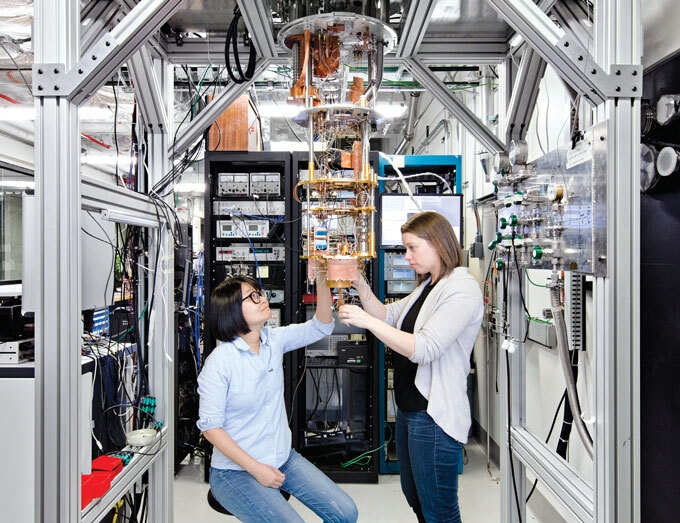
IBM researchers Hanhee Paik (left) and Sarah Sheldon (right) work on a quantum computer that is cooled by a hanging dilution refrigerator. IBM has made 18 quantum computers available for use online, and all grapple with errors.IBM Research
Additionally, each step of a calculation has a significant chance of introducing error. As a result, for complex calculations, “the output will be garbage,†says quantum physicist Barbara Terhal of the research center QuTech in Delft, Netherlands.
Before quantum computers can reach their much-hyped potential, scientists will need to master new tactics for fixing errors, an area of research called quantum error correction. The idea behind many of these schemes is to combine multiple error-prone qubits to form one more reliable qubit. The technique battles what seems to be a natural tendency of the universe — quantum things eventually lose their quantumness through interactions with their surroundings, a relentless process known as decoherence.
“It’s like fighting erosion,†says Ken Brown, a quantum engineer at Duke University. But quantum error correction provides a way to control the seemingly uncontrollable.
Trustworthy journalism comes at a price.
Scientists and journalists share a core belief in questioning, observing and verifying to reach the truth. Science News reports on crucial research and discovery across science disciplines. We need your financial support to make it happen – every contribution makes a difference.
Quantum computers gain their power from the special rules that govern qubits. Unlike classical bits, which have a value of either 0 or 1, qubits can take on an intermediate state called a superposition, meaning they hold a value of 0 and 1 at the same time. Additionally, two qubits can be entangled, with their values linked as if they are one entity, despite sitting on opposite ends of a computer chip.
These unusual properties give quantum computers their game-changing method of calculation. Different possible solutions to a problem can be considered simultaneously, with the wrong answers canceling one another out and the right one being amplified. That allows the computer to quickly converge on the correct solution without needing to check each possibility individually.
The concept of quantum computers began gaining steam in the 1990s, when MIT mathematician Peter Shor, then at AT&T Bell Laboratories in Murray Hill, N.J., discovered that quantum computers could quickly factor large numbers (SN Online: 4/10/14). That was a scary prospect for computer security experts, because the fact that such a task is difficult is essential to the way computers encrypt sensitive information. Suddenly, scientists urgently needed to know if quantum computers could become reality.
Shor’s idea was theoretical; no one had demonstrated that it could be done in practice. Qubits might be too temperamental for quantum computers to ever gain the upper hand. “It may be that the whole difference in the computational power depends on this extreme accuracy, and if you don’t have this extreme accuracy, then this computational power disappears,†says theoretical computer scientist Dorit Aharonov of Hebrew University of Jerusalem.
But soon, scientists began coming up with error-correction schemes that theoretically could fix the mistakes that slip into quantum calculations and put quantum computers on more solid footing.
For classical computers, correcting errors, if they do occur, is straightforward. One simple scheme goes like this: If your bit is a 1, just copy that three times for 111. Likewise, 0 becomes 000. If one of those bits is accidentally flipped — say, 111 turns into 110, the three bits will no longer match, indicating an error. By taking the majority, you can determine which bit is wrong and fix it.
But for quantum computers, the picture is more complex, for several reasons. First, a principle of quantum mechanics called the no-cloning theorem says that it’s impossible to copy an arbitrary quantum state, so qubits can’t be duplicated.
Secondly, making measurements to check the values of qubits wipes their quantum properties. If a qubit is in a superposition of 0 and 1, measuring its value will destroy that superposition. It’s like opening the box that contains Schrödinger’s cat. This imaginary feline of quantum physics is famously both dead and alive when the box is closed, but opening it results in a cat that’s entirely dead or entirely alive, no longer in both states at once (SN: 6/25/16, p. 9).
So schemes for quantum error correction apply some work-arounds. Rather than making outright measurements of qubits to check for errors — opening the box on Schrödinger’s cat — scientists perform indirect measurements, which “measure what error occurred, but leave the actual information [that] you want to maintain untouched and unmeasured,†Aharonov says. For example, scientists can check if the values of two qubits agree with one another without measuring their values. It’s like checking whether two cats in boxes are in the same state of existence without determining whether they’re both alive or both dead.
And rather than directly copying qubits, error-correction schemes store data in a redundant way, with information spread over multiple entangled qubits, collectively known as a logical qubit. When individual qubits are combined in this way, the collective becomes more powerful than the sum of its parts. It’s a bit like a colony of ants. Each individual ant is relatively weak, but together, they create a vibrant superorganism.
Those logical qubits become the error-resistant qubits of the final computer. If your program requires 10 qubits to run, that means it needs 10 logical qubits — which could require a quantum computer with hundreds or even hundreds of thousands of the original, error-prone physical qubits. To run a really complex quantum computation, millions of physical qubits may be necessary — more plentiful than the ants that discovered a slice of last night’s pizza on the kitchen counter.
Creating that more powerful, superorganism-like qubit is the next big step in quantum error correction. Physicists have begun putting together some of the pieces needed, and hope for success in the next few years.
Scratching the surface
Massive excitement accompanied last year’s biggest quantum computing milestone: quantum supremacy. Achieved by Google researchers in October 2019, it marked the first time a quantum computer was able to solve a problem that is impossible for any classical computer (SN Online: 10/23/19). But the need for error correction means there’s still a long way to go before quantum computers hit their stride.
Sure, Google’s computer was able to solve a problem in 200 seconds that the company claimed would have taken the best classical computer 10,000 years. But the task, related to the generation of random numbers, wasn’t useful enough to revolutionize computing. And it was still based on relatively imprecise qubits. That won’t cut it for the most tantalizing and complex tasks, like faster database searches. “We need a very small error rate … to run these long algorithms, and you only get those with error correction in place,†says physicist and computer scientist Hartmut Neven, leader of Google’s quantum efforts.
So Neven and colleagues have set their sights on an error-correction technique called the surface code. The most buzzed-about scheme for error correction, the surface code is ideal for superconducting quantum computers, like the ones being built by companies including Google and IBM (the same company whose pioneering classical computer helped put John Glenn into space). The code is designed for qubits that are arranged in a 2-D grid in which each qubit is directly connected to neighboring qubits. That, conveniently, is the way superconducting quantum computers are typically laid out.
Google’s 54-qubit chip, called Sycamore, was used to demonstrate quantum supremacy. Now researchers want to use upgraded versions of the chip to perform error correction.Google
As in an ant colony with workers and soldiers, the surface code requires that different qubits have different jobs. Some are data qubits, which store information, and others are helper qubits, called ancillas. Measurements of the ancillas allow for checking and correcting of errors without destroying the information stored in the data qubits. The data and ancilla qubits together make up one logical qubit with, hopefully, a lower error rate. The more data and ancilla qubits that make up each logical qubit, the more errors that can be detected and corrected.
In 2015, Google researchers and colleagues performed a simplified version of the surface code, using nine qubits arranged in a line. That setup, reported in Nature, could correct a type of error called a bit-flip error, akin to a 0 going to a 1. A second type of error, a phase flip, is unique to quantum computers, and effectively inserts a negative sign into the mathematical expression describing the qubit’s state.
Now, researchers are tackling both types of errors simultaneously. Andreas Wallraff, a physicist at ETH Zurich, and colleagues showed that they could detect bit- and phase-flip errors using a seven-qubit computer. They could not yet correct those errors, but they could pinpoint cases where errors occurred and would have ruined a calculation, the team reported in a paper published June 8 in Nature Physics. That’s an intermediate step toward fixing such errors.
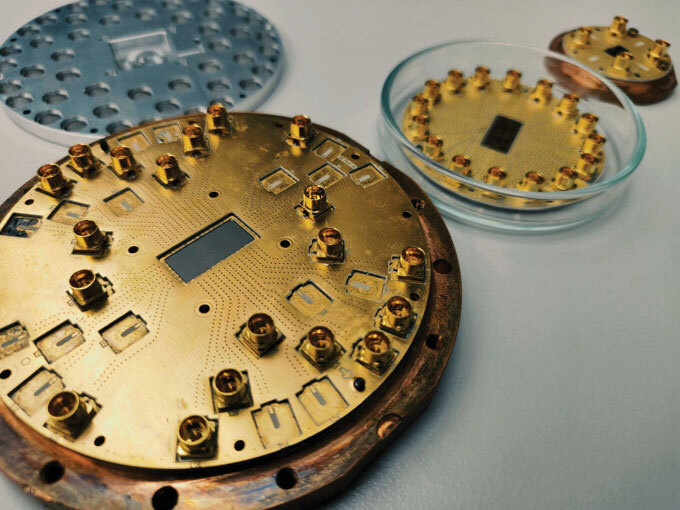
Researchers from ETH Zurich recently used a seven-qubit chip (like the one in the foreground above) to demonstrate a simple error-detection scheme.Quantum Device Lab/ETH Zurich
But to move forward, researchers need to scale up. The minimum number of qubits needed to do the real-deal surface code is 17. With that, a small improvement in the error rate could be achieved, theoretically. But in practice, it will probably require 49 qubits before there’s any clear boost to the logical qubit’s performance. That level of error correction should noticeably extend the time before errors overtake the qubit. With the largest quantum computers now reaching 50 or more physical qubits, quantum error correction is almost within reach.
IBM is also working to build a better qubit. In addition to the errors that accrue while calculating, mistakes can occur when preparing the qubits, or reading out the results, says physicist Antonio Córcoles of IBM’s Thomas J. Watson Research Center in Yorktown Heights, N.Y. He and colleagues demonstrated that they could detect errors made when preparing the qubits, the process of setting their initial values, the team reported in 2017 in Physical Review Letters. Córcoles looks forward to a qubit that can recover from all these sorts of errors. “Even if it’s only a single logical qubit — that will be a major breakthrough,†Córcoles says.
In the meantime, IBM, Google and other companies still aim to make their computers useful for specific applications where errors aren’t deal breakers: simulating certain chemical reactions, for example, or enhancing artificial intelligence. But the teams continue to chase the error-corrected future of quantum computing.
It’s been a long slog to get to the point where doing error correction is even conceivable. Scientists have been slowly building up the computers, qubit by qubit, since the 1990s. One thing is for sure: “Error correction seems to be really hard for anybody who gives it a serious try,†Wallraff says. “Lots of work is being put into it and creating the right amount of progress seems to take some time.â€
On the threshold
For error correction to work, the original, physical qubits must stay below a certain level of flakiness, called a threshold. Above this critical number, “error correction is just going to make life worse,†Terhal says. Different error-correction schemes have different thresholds. One reason the surface code is so popular is that it has a high threshold for error. It can tolerate relatively fallible qubits.
Imagine you’re really bad at arithmetic. To sum up a sequence of numbers, you might try adding them up several times, and picking the result that came up most often.
Let’s say you do the calculation three times, and two out of three of your calculations agree. You’d assume the correct solution was the one that came up twice. But what if you were so error-prone that you accidentally picked the one that didn’t agree? Trying to correct your errors could then do more harm than good, Terhal says.
Sign Up For the Latest from Science News
Headlines and summaries of the latest Science News articles, delivered to your inbox
The error-correction method scientists choose must not introduce more errors than it corrects, and it must correct errors faster than they pop up. But according to a concept known as the threshold theorem, discovered in the 1990s, below a certain error rate, error correction can be helpful. It won’t introduce more errors than it corrects. That discovery bolstered the prospects for quantum computers.
“The fact that one can actually hope to get below this threshold is one of the main reasons why people started to think that these computers could be realistic,†says Aharonov, one of several researchers who developed the threshold theorem.
The surface code’s threshold demands qubits that err a bit less than 1 percent of the time. Scientists recently reached that milestone with some types of qubits, raising hopes that the surface code can be made to work in real computers.
Getting clever
But the surface code has a problem: To improve the ability to correct errors, each logical qubit needs to be made of many individual physical qubits, like a populous ant colony. And scientists will need many of these superorganism-style logical qubits, meaning millions of physical qubits, to do many interesting computations.
Since quantum computers currently top out at fewer than 100 qubits (SN: 3/31/18, p. 13), the days of million-qubit computers are far in the future. So some researchers are looking at a method of error correction that wouldn’t require oodles of qubits.
“Everybody’s very excited, but there’s these questions about, ‘How long is it going to take to scale up to the stage where we’ll have really robust computations?’ †says physicist Robert Schoelkopf of Yale University. “Our point of view is that actually you can make this task much easier, but you have to be a little bit more clever and a little bit more flexible about the way you’re building these systems.â€
Schoelkopf and colleagues use small, superconducting microwave cavities that allow particles of light, or photons, to bounce back and forth within. The numbers of photons within the cavities serve as qubits that encode the data. For example, two photons bouncing around in the cavity might represent a qubit with a value of 0, and four qubits might indicate a value of 1. In these systems, the main type of error that can occur is the loss of a photon. Superconducting chips interface with those cavities and are used to perform operations on the qubits and scout for errors. Checking whether the number of photons is even or odd can detect that type of error without destroying the data.
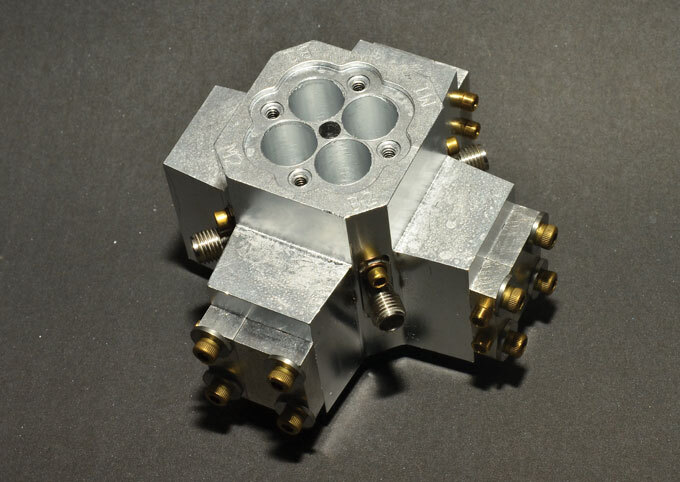
A block of aluminum with four cylindrical cavities has four qubits. A qubit’s value is encoded in the number of photons bouncing back and forth within a cavity. The device, built by researchers at Yale University, allows for error correction without the huge numbers of qubits other schemes require.Kevin Chou
“To me,†Aharonov says, “whether you actually can correct errors is part of a bigger issue.†The physics that occurs on small scales is vastly different from what we experience in our daily lives. Quantum mechanics seems to allow for a totally new kind of computation. Error correction is key to understanding whether that dramatically more powerful type of calculation is truly possible.
Scientists believe that quantum computers will prove themselves to be fundamentally different than the computer that helped Glenn make it into orbit during the space race. This time, the moon shot is to show that hunch is right.
Former High Court Justice Dyson Heydon sexually harassed six female judges’ associates, an independent inquiry has found.
High Court Chief Justice Susan Kiefel said in a statement on Monday the court was “ashamed that this could have happened at the High Court of Australia”.
An investigation report by former inspector-general of intelligence and security Dr Vivienne Thom has been provided to the six complainants and Justice Heydon.
The court was advised in 2019 of allegations of sexual harassment against the former judge.
Former High Court Justice Dyson Heydon. (9News)
“The investigation found that six former court staff members who were judges’ associates were harassed by the former justice,” Justice Kiefel said.
“The findings are of extreme concern to me, my fellow justices, our chief executive and the staff of the court.
She said a sincere apology had been given to the six women, who had made difficult decisions to come forward with their complaints.
Until now the court has not spoken publicly about the investigation.
A number of women requested confidentiality.                                                 Â
“The court now confirms that the subject of the investigation was the Honourable Dyson Heydon AC QC,” Justice Kiefel said.
“We ask that the media respect the privacy of the complainants.”
Mr Heydon told the Sydney Morning Herald via his lawyers Speed and Stacey: “Any allegation of predatory behaviour or breaches of the law is categorically denied by our client.”
“Our client says that if any conduct of his has caused offence, that result was inadvertent and unintended and he apologises for any offence caused.”
Among the allegations reported by the Herald, Mr Heydon inappropriately touched women at functions and took young associates back to his chambers and his accommodation where he harassed them.
The investigation also made six recommendations which have been acted on:
* A human resources policy relevant to the personal staff of justices
* Better induction process for associates
* A support person for associates, who can act as a conduit to the chief executive and principal registrar
* Clarification that confidentiality requirements for associates relate only to the work of the court
* Associates are not obliged to attend social functions.
Justice Kiefel said the court had taken a close look at its policies and processes.
“There is no place for sexual harassment in any workplace,” Justice Kiefel said.
Justice Heydon was on the bench from 2003 to 2013 and led a royal commission into union misconduct.
LONDON, June 22 — Archaeologists have discovered a wide circle of deep shafts surrounding an ancient settlement close to Stonehenge, opening up new lines of investigation into the origins and meaning of the mysterious, prehistoric monument.
The stone circle at Stonehenge, whose purpose remains unknown to scientists despite decades of research, is one of Britain’s most famous landmarks and a draw to tourists and people in search of spiritual connections with nature.
Let our news meet your inbox. The news and stories that matters, delivered weekday mornings.
The new discovery, described as “astonishing” by a team of archaeologists from multiple universities who took part in the project, shows a circle of shafts, 1.2 miles (2 km) in diameter, surrounding the settlement of Durrington Walls.
The site is located about 2 miles northeast of Stonehenge on Salisbury Plain, and evidence suggests the shafts date back to the same period, some 4,500 years ago.
“This is an unprecedented find of major significance within the U.K.,” said Vincent Gaffney, one of the archaeologists leading the project.
“Key researchers on Stonehenge and its landscape have been taken aback by the scale of the structure and the fact that it hadn’t been discovered until now so close to Stonehenge,” he said.
Gaffney said the circle of shafts, each about 10 metres (33 ft) wide and 5 metres deep, demonstrated the desire of Neolithic communities to record their belief systems in ways and at a scale that researchers had never anticipated.
The discovery was made without the need for excavations, using remote sensing technology and sampling.
NEW DELHI (AP) — The world saw the largest daily increases yet in coronavirus cases, with infections soaring in India’s rural villages after migrant workers fled major cities.
India’s coronavirus caseload climbed by nearly 15,000 as of Monday to 425,282, with more than 13,000 deaths, the health ministry reported.
After easing the nationwide lockdown, the Indian government has run special trains to return thousands of migrant workers to their natal villages in recent weeks. Nearly 90% of India’s poorest districts have cases, though the outbreak remains centered in Delhi, Maharashtra and Tamil Nadu states, which are home to major cities.
Infections slowed in China and South Korea, suggesting some progress in stemming their newest outbreaks. But despite clear headway in containing the virus in regions that suffered early outbreaks, globally the number of new virus cases has soared in recent days. In Brazil, Iraq, India and the United States, hospitals are scrambling to cope.
Nearly 9 million people have been infected by the new coronavirus and more than 468,000 people have died, according to figures compiled by Johns Hopkins University. Experts say the actual numbers are much higher, given limits to testing and the presumed large share of asymptomatic cases.
ASSOCIATED PRESS
A doctor checks the temperature of a man in Mumbai, India, on June 20, 2020.Â
In a grim reminder of the pandemic’s ubiquitous reach, Philippine officials said Saudi Arabia’s king had asked that the remains of 282 Filipino workers who perished in recent months in the oil-rich kingdom be repatriated within three days. They died of varied causes, but virus restrictions delayed repatriations.
Labor Secretary Silvestre Bello III said the Philippine government asked that the deadline be extended and that the bodies of about 50 Filipinos who died of COVID-19 be buried in Saudi Arabia.
The Philippines has reported more than 30,000 infections and 1,169 deaths, among the highest in Southeast Asia. It is struggling to help bring home tens of thousands of Filipinos who have lost their work abroad.
In Pakistan, infections are accelerating and hospitals are having to turn away patients, with new cases up to 6,800 a day in mid-June. The government has relaxed pandemic restrictions, hoping to salvage a near-collapsed economy as the number of people living in poverty has risen to 40%, up from 30% of the population of 220 million people.
In Iraq, masked workers were setting up makeshift coronavirus wards in Baghdad’s vast exhibition grounds as a long-dreaded spike in infections strained its overstretched hospitals, battered by years of conflict and poor infrastructure.
Late Sunday, the World Health Organization reported the largest single-day increase in coronavirus cases by its count, at more than 183,000 new cases in the latest 24 hours. Brazil tallied 54,771 and the U.S. was next at 36,617, the UN health agency said. India reported more than 15,400.
Experts say rising case counts reflect multiple factors including more testing and spreading infections. More than two-thirds of the new deaths were reported in the Americas.
Still, in East Asia there were signs of progress, as South Korea reported 17 new cases, the first time its daily increase fell to under 20 in nearly a month.
The recent outbreak has been centered around Seoul, the capital, where the mayor warned stronger social distancing measures may be reimposed if the daily new cases don’t fall below an average of 30 in the next three days.
“If Seoul gets penetrated (by the virus), the entire Republic of Korea gets penetrated,†Mayor Park Won-soon said, using the country’s formal name. He said the basic reproduction number of virus carriers, or number of infections caused by an individual, rose to nearly 1.8 between April 30 and June 11. Any number above 1 indicates a growing epidemic.Â
ASSOCIATED PRESS
People wearing face masks to help protect against the spread of the new coronavirus pray while maintaining social distancing during a service at the Chogyesa temple in South Korea on June 22, 2020.Â
A rise in cases among people arriving from South Asia prompted a halt to new visas for travelers from Pakistan and Bangladesh.
Elsewhere in Asia, Beijing’s increase was in single digits for the first time in eight days. It reported nine cases.
But Australia’s Victoria state reported 16 new cases of the coronavirus as it tries to bring an outbreak there under control. The number of cases there is the highest in two months, accounting for more than 80% of Australia’s new cases over the past week.
In the United States, experts say the resurgence in infections there is not a so-called “second wave†but a continuation of the first wave of outbreaks as the number of cases plateaus.
New cases are dipping in some parts of the country while rising mainly in the the South, West and Midwest, swamping hospitals in some areas.
The coronavirus has killed about 120,000 people nationwide. More than 30,000 cases were reported on Friday and Saturday, with the daily totals their highest since May 1.
In New York City, the worst affected area so far, efforts to stop the pandemic’s spread through contact tracing are being hampered by the reluctance of many people to provide information to tracers.
The New York Times reported only 35% of the 5,347 city residents who tested positive or were presumed positive for COVID-19 in the first two weeks of the contact tracing program gave information about their close contacts.
But Dr. Ted Long, head of New York City’s new Test and Trace Corps, defended the program, saying 69% of the people who complete an interview provide contacts.
The city will hit a turning point Monday: allowing New Yorkers to dine out for the first time in three months, though only at outdoor tables. Shoppers can browse, shaggy heads get haircuts and kids climb playground monkey bars, instead of their apartment walls.
Office workers will be allowed to resume their commutes, though many won’t yet.
Larry Silverstein, the 89-year-old World Trade Center developer, said he couldn’t wait.
Returning to office life and in-person teamwork brings “a joy, a fulfillment, such a sense of being able to function,†he said.
“I went through 9/11. I remember people telling me we were never going to be able to get people to come back to lower Manhattan,†said Silverstein, who leased the twin towers six weeks before the 2001 terror attacks destroyed them. “Never bet against New York, because New York always comes back, bigger and better than ever before.â€
Associated Press journalists from around the world contributed. Kurtenbach reported from Bangkok.
A HuffPost Guide To Coronavirus
Calling all HuffPost superfans!
Sign up for membership to become a founding member and help shape HuffPost’s next chapter
Black culture is undoubtedly the most popular form of entertainment throughout the world. From music to fashion, it has permeated all areas of life, transcending issues including class and religion.
Whether it is the underground rave scene of New Delhi, where the emcees switch up their flows like a taxi driver in central London changes lanes during rush hour, or one of the many jazz venues scattered across Europe, where guests jovially bop their heads to the rhythm in unison – as if it was choreographed – Black culture has changed the globe for the better.
Without it, rock ‘n’ roll would not exist. Not to mention jazz, hip-hop and grime. Which begets the questions, why do Black creatives still face racism and what can they do to achieve systemic changes in the entertainment industry?
‘Exploited’
Awate, one of the UK’s most talented hip-hop artists, told Al Jazeera that racism affected every part of his life, including his career.
Born in Saudi Arabia to Eritrean parents and raised in north London from the age of two, Awate entered the entertainment industry with his debut album Happiness.
He is the first musician to be awarded a residency for the British Library’s nationwide project, Unlocking Our Sound Heritage. He recently completed the project after spending five months using the institute’s vast sound archive to create a long-form musical piece, exploring migration and diaspora.
But he said racism has held him and many of his peers back.
“The music industry exists because of us, because of Black art. But we’re exploited,” Awate told Al Jazeera.
“Racism impacts every part of my life. So, of course, it’s hindered my career. I’ve been refused entry to gigs where I was performing because the bouncers didn’t believe that I was on the roster,” he said.
Boycott
Earlier this month, the hashtag #BlackoutTuesday dominated social media feeds as part of a campaign initially sparked by two Black women, Jamila Thomas and Brianna Agyemang, who work for Atlantic Records and Platoon respectively.Â
The pair coined the initiative, #TheShowMustBePaused, and called on the music industry to acknowledge the exponential profits that it has made from Black artists and to recognise its responsibility to empower Black communities.
Important record labels, streaming services and social media users participated in what evolved into a virtual campaign, with many posting black squares on their social media accounts in solidarity, while pausing their online activity for a day to reflect on the death of an unarmed Black man, George Floyd, at the hands of a white policeman in the US.
Awate, however, boycotted it and called on his fellow Black musicians to unionise instead, describing the event as nothing more than “virtue-signalling” by the important labels.
“The initial campaign was well-intentioned. The lack of diversity in the music industry is ridiculous. Not to mention the racism and exploitation. But the companies that took part in the initiative aren’t doing anything to change this,” Awate said.
“The labels are just waiting for the next poor and traumatised Black kid on the conveyor belt to scoop up and offer a 360-degree-slave deal, while getting them to perpetuate the same Black stereotypes that oppress us,” he said.
“First and foremost, the labels need to protect Black artists and challenge systemic racism. That’s why I called on artists to unionise, as everything depends on us. For example, too many young Black artists are going on tour without financial or mental health support,” he said.
Racial privilege
Some artists have chosen to recognise their racial privilege. Eminem, for example, said in his song White America in 2002: “Let’s do the math. If I was Black, I would’ve sold half. I ain’t have to graduate from Lincoln High School to know that”.
Meanwhile, Black American rapper, Mos Def, on his track The Rape Over in 2004, said hip-hop was run by the “old white men” who occupy corporate America, while claiming that Black artists have allowed themselves to be exploited, so that they could be successful and “cash in”.
Awate said he wants systemic change, which is why he chose not to participate in Blackout Tuesday. The small daily aggressions that he experiences cause him considerable frustration, but he sees it as just the symptoms of a bigger problem, he said.
“I want to see a call for structural change in music, football and all other industries, including the police and prison industrial complex. The media tend to focus on the trivial incidents, like white people mesmerised by our afros and trying to grab our hair. But it’s much bigger than that. When you think about rock ‘n’ roll, who do you think of? Elvis Presley? But rock ‘n’ roll is Black music!”
Tangible effect
Adam Elliott-Cooper is an academic, focusing on policing and anti-racism movements at the University of Greenwich in south London. He acknowledged the importance of Black people being properly accredited for their cultural contributions, but is unsure whether it will have a tangible effect against racism.
Anti-racism protests held across Europe (2:08)
“I see racism as a mode of governance. It’s a system of control focused on maximising profits. Whether we acknowledge that Black people have made substantive contributions to culture or not, I’m dubious about whether that would have an effect on the need to use violence to uphold the racial order,” Elliott-Cooper told Al Jazeera.
Like Awate, Elliott-Cooper thinks Black artists should unionise.
“One way for Black artists to increase their power is unionising. That way, if record labels are exploiting them, they can go on strike. They’d have stronger negotiating power and could also use different forms of industrial action and resistance. It’s one way to erode the power and influence of the multinational corporations which dominate the music industry.”
Last week, a number of short films aired on Channel 4, one of the UK’s popular television channels, every weekday as part of the Take Your Knee Off My Neck series in response to the killing of Floyd. The films explored the effect that Floyd’s death had on Black Britons.
Lucy Pilkington was one of two executive producers for the series, which attempts to reckon with the historic trauma of British slavery and racism, while striking an optimistic tone about the future during a galvanising historical moment.
She said the industry’s diversity figures have improved from when she started her career more than 20 years ago. However, she acknowledged that a lot more work still needed to be done.
“There’s more people in senior positions from diverse backgrounds. But we need more diversity across the board, especially at the independent production companies. However, more funding is needed to achieve this and it needs to be ring-fenced,” Lucy told Al Jazeera.
The morning started perfectly. I was done with a new feature even before I finished my coffee. My productivity was soaring high. At that time, I didn’t know that it was too good to be true.
It took the problem only a few hours to surface. However, finding the root of the issue required much more time. The fix required the rest of the day. I was a beginner back then. With this, I have learned an important lesson about lists in Python for life.
Does this sound familiar? It happens with everyone, but it is always better to learn from other people’s mistake. In this post, I have collected seven of them, which can save you countless hours of debugging.
Since Python is not a purely functional language like Haskell, functions can make side effects. Strictly speaking, this is not a mistake, but it is easy to unintentionally mess things up. The example below demonstrates the issue.
In Python, objects are reference types. So when you pass a list as an argument, a reference is passed instead of the value. This implies that if you alter them in a function, the changes will be reflected outside.
This can lead to some very nasty surprises and hours of debugging. (See my introduction.) Watch out for these and save yourself the trouble early.
2. Function calls in default arguments
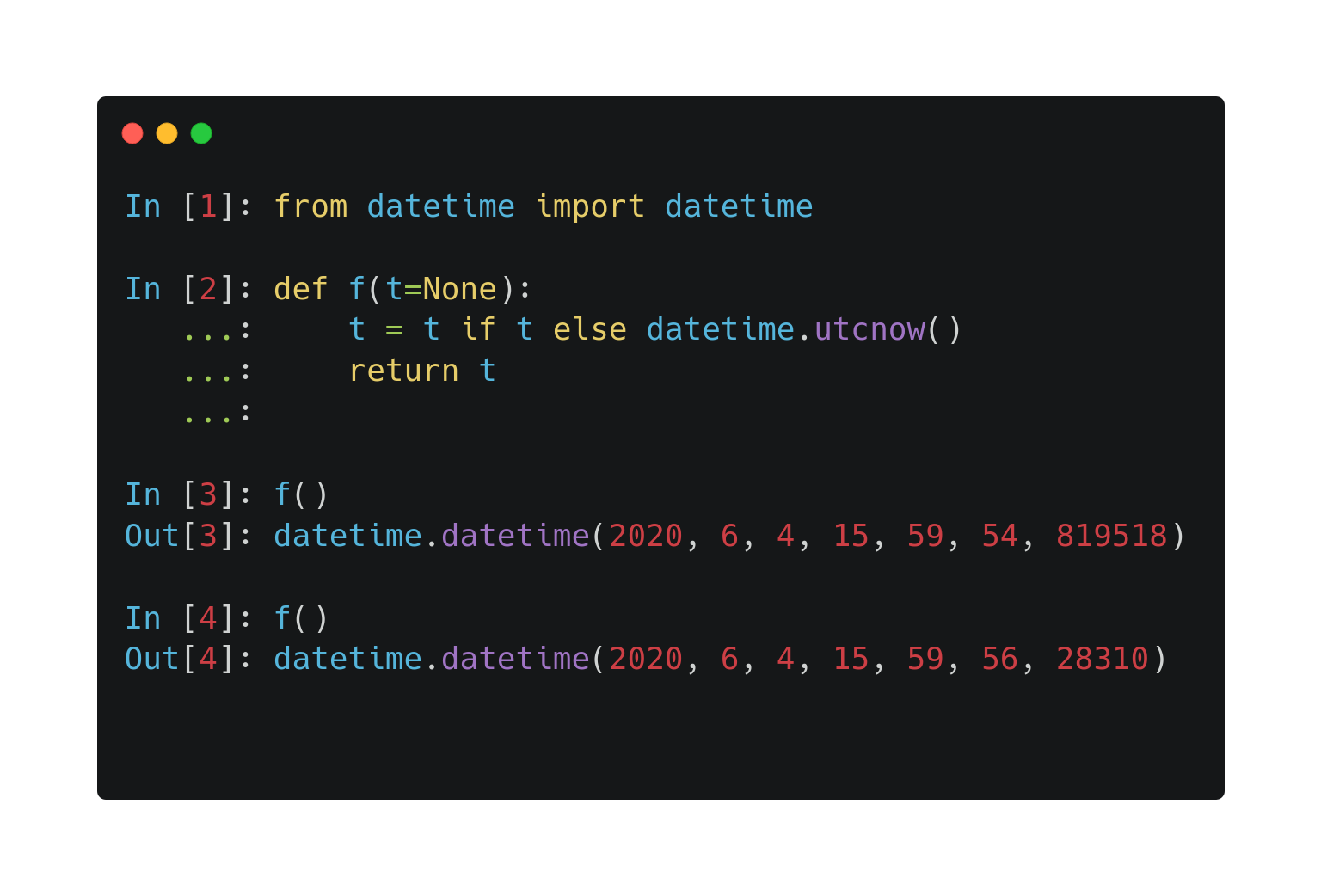
Default arguments can be tricky to use sometimes. Take a look at the following.
Why is the return value same for every call? The reason is that Python evaluates the expressions in default arguments when the function is defined. If you want to dynamically generate default arguments, you can do the following.
3. Mutable default arguments
This problem is a combination of the above two. Have you ever encountered the following scenario?
There are two things happening here.
Python evaluates the expression [] when the function is defined. (This is equivalent of calling list().)
The reference of this object is bound to the argument. Thus, whenever you call the function, the same object will be used.
So, using mutable objects as default arguments is not a good idea. You should never do that.
4. Unintended reference assignments
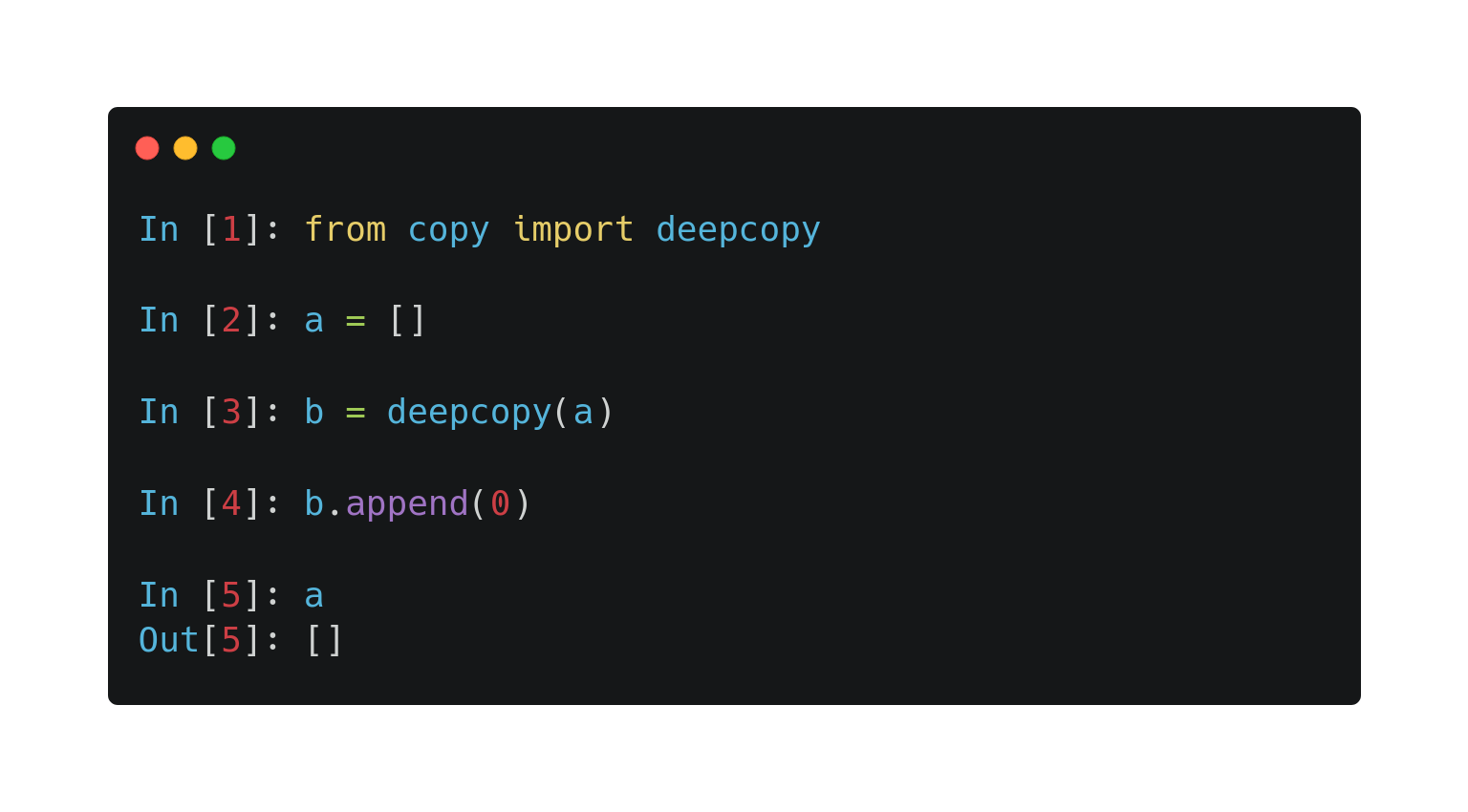
As we have seen, every object is a reference type in Python. This can cause some confusion besides passing them to functions. See this following example:
When you execute b = a, you actually store the reference of a. Thus, a and b points to the same object. To solve this, you should use the built-in deepcopy function. This recursively copies all value type attributes to the new variable.
If you try the same with integers instead of list, everything behaves like you would expect. The reason is that integer types are immutable, so you overwrite the reference when you change them.
5. from something import *
I know, we all did this at one point. There are several disadvantages of this.
First, functions in different namespaces can have the same name, causing confusion throughout your code base.
Second, when you import a module in Python, all code in that module will be executed. This can significantly slow things down if there are lots of submodules to import. So, if you only import NumPy to generate random numbers, you are probably better off with
than
6. Joining paths with string concatenation
Suppose that you have to open a file called data.csv from the folder given by the variable data_folder. How should determine the file path? If you are doing
then you are not doing it right. This would not work on Windows for instance. You might not experience yourself, but your colleagues using different development setups will feel the pain for sure.
To solve this, you should either use pathlib, Python’s built in tool, or simply the os.path.join function:
7. Low test coverage
This is a high level issue. Especially when you are a beginner, the benefits of unit testing is not clear. However, every seasoned developer can tell you that it is absolutely essential. Working with untested code is like playing whack-a-mole: fix one bug, introduce another.
Avoiding this starts from the very beginning of your project. As soon as you add a feature (or a function even), you should write test cases to validate the implementation. There are several great libraries for this, for example the built-in unittest or the very popular pytest.
You should seriously invest time into testing your code. It might take some time to do that, but it is a long term investment. You will save much more time of debugging.
The FIA has released details of the latest changes to the Formula 1 sporting regulations as the sport prepares for the return of racing in Austria next month under COVID-19 restrictions.
The updates were formally passed by the World Motor Sport Council on Friday and officially published by the FIA on Saturday morning.
FIA KEEPS OPTIONS OPEN
The FIA has given no specific details of how podium ceremonies will work for closed races but has kept its options open by stating that for closed races “the procedure for the podium ceremony will be detailed in event notes issued by the race director.â€
The podium ceremony will follow established procedures for open events that feature spectators. There are however no immediate plans to open Grand Prix up to the public.
GRID PROCEDURES TWEAKED
One of the main changes is that the grid procedures have been tweaked to allow for social distancing.
Teams are only allowed to have 40 personnel on the grid. The number equates to exactly half the total head count that they are now allowed to take to races.
The pit exit now closes 20 minutes before the start rather than the usual 30 minutes.
Cars will have to have their tyres fitted five minutes before the start rather than three, and at that signal “team personnel and equipment trolleys must commence leaving the grid.â€
A new rule states “when the three-minute signal is shown, no more than sixteen team personnel for each competitor are permitted on the grid.â€
The remaining crew members will have to leave before the 15-second signal while the new five-minute tyres fitted rule will also apply to race resumptions following red flag periods.
ALLOCATIONS SHOWN BE MADE KNOWN
The curfew has been shortened to eight hours on Thursday and Friday to allow teams to work an extra hour. This is to compensate for the altered garage working practices teams are deploying due to social distancing procedures.
Pirelli’s request to have more flexibility in terms of the timing of tyre allocations in the context of a fluid calendar has now been formally agreed.
Previously, the tyre supplier had to nominate its compound choices 15 weeks before flyaway races and nine weeks before European events.
Those requirements have been deleted, and the rules now say that the allocations should be made known “unless otherwise determined by the FIA and with the agreement of the supplier, no less than two weeks prior to each eventâ€.
FIXED ALLOCATION FOR DRIVERS
Drivers will be given the same allocation. Teams will no longer choose how many sets of each compound their drivers will have for each weekend. The fixed allocation is two sets of hard, three of mediums, and eight softs.
The provision for compulsory running of extra experimental tyres has been tweaked and will now take place in the first 30 minutes of FP2 instead of the last 30 minutes.
The FIA has also allowed for any travel issues stewards may face in getting to a race, allowing them to work remotely.
The aero testing restrictions teams have been given a chance to do some work on their 2022 packages this year. This is only in relation to improving their brake systems as other 2022 aero work will have to wait until 1 January 2021.
This content has been created as part of our freelancer relief programme. We are supporting journalists and freelance writers impacted by the economic slowdown caused by #lockdownlife.
If you are a freelancer looking to contribute to The South African, read more here.
Justin Bieber has strongly denied an allegation of sexual assault in a series of tweets shared on Sunday.
The singer responded after a woman, who identified herself only as Danielle, claimed that she met the star on 9 March 2014, when she was 21 and he was 20, at a music event in Austin, Texas.
In a since-deleted tweet from an account that has also now been removed, she alleged that Bieber invited her back to the Four Seasons hotel, the location of the alleged incident.
The allegation was initially denied by Alison Kaye, the general manager of Scooter Braun’s SB Projects, who represents Bieber.Â
SIPA USA/PA ImagesJustin Bieber
The singer has since tweeted that “this story is factually impossible†and said he will be “working with Twitter and authorities to take legal actionâ€.
“I don’t normally address things as I have dealt with random accusations my entire career but after talking with my wife and team I have decided to speak up on an issue tonight,†Bieber wrote.
“Rumors are rumors but sexual abuse is something I don’t take lightly,†he continued. “I wanted to speak out right away but out of respect to so many victims who deal with these issues daily I wanted to make sure I gathered the facts before I made any statement.
“In the past 24 hours a new Twitter appeared that told a story of myself involved with sexual abuse on March 9, 2014 in Austin Texas at the Four seasons hotel. I want to be clear. There is no truth to this story. In fact as I will soon show I was never present at that location,†said Bieber.
“As her story told I did surprise a crowd in Austin at Sxsw where I appeared on stage with my then assistant side stage and sang a few songs. What this person did not know was that I attended that show with my then gf Selena Gomez.â€
Bieber followed this up by sharing photos, receipts and emails, which he says show that he was never at the Four Seasons, but stayed at an AirBnb in Austin on 9 March, and at the Westin hotel the following night.Â
“Every claim of sexual abuse should be taken very seriously and this is why my response was needed,†he wrote. “However this story is factually impossible and that is why I will be working with Twitter and authorities to take legal action.â€
See all of Bieber’s tweets below:
I don’t normally address things as I have dealt with random accusations my entire career but after talking with my wife and team I have decided to speak up on an issue tonight.
Rumors are rumors but sexual abuse is something I don’t take lightly. I wanted to speak out right away but out of respect to so many victims who deal with these issues daily I wanted to make sure I gathered the facts before I made any statement.
In the past 24 hours a new Twitter appeared that told a story of myself involved with sexual abuse on March 9, 2014 in Austin Texas at the Four seasons hotel. I want to be clear. There is no truth to this story. In fact as I will soon show I was never present at that location.
As her story told I did surprise a crowd in Austin at Sxsw where I appeared on stage with my then assistant side stage and sang a few songs. What this person did not know was that I attended that show with my then gf Selena Gomez
These photos clearly show me on stage with my assistant sidestage and the other with both of us in the streets of Austin afterwards on March 9 2014 pic.twitter.com/WlC6KAvJOZ
Furthermore I stayed with Selena and our friends at an airbnb on the 9th and on the 10th stayed at a Westin because our hotel reservation at LÀ Quinta and not the four seasons was messed up. Here are the receipts for the hotel on the 10th pic.twitter.com/hLNHnvJ6XS
We have also confirmed with the Four Seasons regional manager that I was never on property on the 9th of March 2014 and never a guest on the 9th or the 10th and I welcome all press to inquire with them if needed or wanted.
The Pics I showed of me and Selena march 9 in Austin should make it clear that we were together that night and went from the venue to our Airbnb and never went to the four seasons. This is our airbnb receipt where we crashed with our friends pic.twitter.com/4ZDIqjeCIQ
On march 10th selena left for work and I stayed at the Westin as the receipts clearly showed with my friends nick and john before I left town. Once again not at the four seasons. We booked it for a couple days to stay for the defjam show but I bailed on the 11th to head back home pic.twitter.com/Ku15SCYz91
Every claim of sexual abuse should be taken very seriously and this is why my response was needed. However this story is factually impossible and that is why I will be working with twitter and authorities to take legal action.
We use cookies on our website to give you the most relevant experience by remembering your preferences and repeat visits. By clicking “Accept”, you consent to the use of ALL the cookies.
This website uses cookies to improve your experience while you navigate through the website. Out of these, the cookies that are categorized as necessary are stored on your browser as they are essential for the working of basic functionalities of the website. We also use third-party cookies that help us analyze and understand how you use this website. These cookies will be stored in your browser only with your consent. You also have the option to opt-out of these cookies. But opting out of some of these cookies may affect your browsing experience.
Necessary cookies are absolutely essential for the website to function properly. These cookies ensure basic functionalities and security features of the website, anonymously.
Cookie
Duration
Description
cookielawinfo-checbox-analytics
11 months
This cookie is set by GDPR Cookie Consent plugin. The cookie is used to store the user consent for the cookies in the category "Analytics".
cookielawinfo-checbox-functional
11 months
The cookie is set by GDPR cookie consent to record the user consent for the cookies in the category "Functional".
cookielawinfo-checbox-others
11 months
This cookie is set by GDPR Cookie Consent plugin. The cookie is used to store the user consent for the cookies in the category "Other.
cookielawinfo-checkbox-necessary
11 months
This cookie is set by GDPR Cookie Consent plugin. The cookies is used to store the user consent for the cookies in the category "Necessary".
cookielawinfo-checkbox-performance
11 months
This cookie is set by GDPR Cookie Consent plugin. The cookie is used to store the user consent for the cookies in the category "Performance".
viewed_cookie_policy
11 months
The cookie is set by the GDPR Cookie Consent plugin and is used to store whether or not user has consented to the use of cookies. It does not store any personal data.
Functional cookies help to perform certain functionalities like sharing the content of the website on social media platforms, collect feedbacks, and other third-party features.
Performance cookies are used to understand and analyze the key performance indexes of the website which helps in delivering a better user experience for the visitors.
Analytical cookies are used to understand how visitors interact with the website. These cookies help provide information on metrics the number of visitors, bounce rate, traffic source, etc.
Advertisement cookies are used to provide visitors with relevant ads and marketing campaigns. These cookies track visitors across websites and collect information to provide customized ads.