George Floyd’s younger brother has called for peace and condemned the violence that has erupted at protests across the country, triggered by his death while in police custody.
Terrence Floyd told ABC News that he is “outraged” that his 46-year-old brother died after a white police officer in Minneapolis pinned him to the ground for more than eight minutes last Monday.
But Terrence Floyd urged protesters to stay calm and “channel your anger elsewhere” because his brother was “about peace.”
He said he wants Derek Chauvin, the officer who knelt on George Floyd’s neck, to face first-degree murder charges and the other three officers involved to be charged. Chauvin was charged with third-degree murder as well as manslaughter on Friday. He and the other officers have all been fired.
“I’m outraged too,” Terrence Floyd said. “Sometimes I get angry. I want to bust some heads too. I want to go crazy. My brother wasn’t about that. My brother was about peace.”
The artist Celos paints a mural in Downtown Los Angeles on May 30, 2020 in protest against the death of George Floyd. Apu Gomes/AFP via Getty Images
Referring to the destruction seen in some cities where protests have taken place, he added: “All of this is not necessary because if his own family and blood is not doing it, then why are you?”
Terrence Floyd also said that he is planning to visit the spot where his brother died on Monday. The past week has been “hard,” he said, adding: “I’m still a little numb to it.”
His comments come after Benjamin Crump, the attorney representing the Floyd family, said heightened charges are warranted for Chauvin because the former officer and George Floyd had interacted prior to last Monday’s deadly encounter.
“We believe [Chauvin] knew who George Floyd was,” Crump said during CBS News’ Face the Nation on Sunday morning.
At least 4,400 people have been arrested over days of protests, according to a tally by the Associated Press, for reasons ranging from stealing to breaking curfews.
Two entirely different ways of “weighing” the cosmos are producing disparate results. If more precise measurements fail to resolve the discrepancy, physicists may have to revise the standard model of cosmology, our best description of the universe.
“If this really is a glimpse of the standard model breaking down, that would be potentially revolutionary,” says astronomer Hendrik Hildebrandt of the Ruhr University Bochum in Germany.
Similar concerns over the correctness of the standard model have been raised over the past few years by two independent calculations of the so-called Hubble constant, or the rate at which the universe is expanding today. Those two measurements also disagreed, creating what has been called the Hubble tension.
The new discrepancy — called the sigma-eight tension — involves measuring the density of matter in the universe and the degree to which it is clumped up, as opposed to being uniformly distributed. The result is encapsulated in a parameter called sigma-eight. To calculate sigma-eight, Hildebrandt and his colleagues turned to an effect called weak gravitational lensing, in which the light from distant galaxies is bent ever so slightly toward our telescopes because of the gravitational pull from matter that lies between the galaxies and Earth.
The resulting distortion is so small that it barely changes the shape of an individual galaxy. But if you take an average of the shapes of tens of thousands of galaxies in a patch of sky, a signal of weak lensing pops out. Presuming that galaxies should be randomly oriented with respect to Earth, their average shape should be nearly circular—without weak lensing, that is. But thanks to the mild distortions from this effect, the average shape instead veers toward the elliptical.
The astronomers used this signal to estimate the amount and distribution of intervening matter (both normal and dark varieties) along the lines of sight to various galaxy-rich regions across a large patch of the sky. In other words, they managed to measure matter’s cosmic density.
But doing so precisely requires one more piece of information: the distance to each individual galaxy being studied. Normally, astronomers calculate the distance to another galaxy by finding its spectroscopic redshift—the amount by which the galaxy’s light is shifted toward the longer wavelengths of the red side of the spectrum. The greater the redshift, the farther away the object.
Measuring individual spectroscopic redshifts, however, is extremely inefficient when dealing with millions of galaxies. So Hildebrandt’s team turned to something called photometric redshift, which involves taking multiple images of the same patch of sky in different wavelengths, spanning the optical and near-infrared ranges. The researchers used those images to estimate the redshift of individual galaxies in each one. “They’re not as good as the traditional spectroscopic redshift,” Hildebrandt says. “But they’re much more efficient in terms of telescope time.”
For its entire analysis, the team used high-resolution images of hundreds of square degrees of the sky (the full moon is about half a degree across) in nine wavelength bands—four optical and five near-infrared. These observations of about 15 million galaxies were collected by the European Southern Observatory’s Kilo-Degree Survey (KiDS) and VISTA Kilo-Degree Infrared Galaxy Survey (VIKING) using two small telescopes at the organization’s Paranal Observatory in Chile.
The VIKING data bolstered the KiDS data set by providing multiple observations of the same region of the sky in near-infrared wavelengths. The greater the distances of a galaxy, the higher the speed at which it is receding from us. This causes more of a galaxy’s light to be redshifted into the near-infrared range, so relying solely on optical observations is not enough. Infrared measurements capture a greater amount of the light from such galaxies, leading to better estimates of their photometric redshift.
To ensure that photometric redshifts are as accurate as possible, these observations were calibrated against spectroscopic redshift measurements of a few of the same galaxies made with the more massive eight-meter Very Large Telescope at Paranal and the 10-meter Keck telescopes on Mauna Kea in Hawaii.
Astrophysicist and Nobel laureate Adam Riess of Johns Hopkins University approves of the efforts of the KiDS researchers. “Their latest results use infrared data, which probably does a better job of tracing the mass of the lenses and getting reliable photometric redshifts,” he says.
Using the combined data, covering about 350 square degrees of the sky, the astronomers estimated sigma-eight.The value they found conflicts with a sigma-eight figure calculated using the European Space Agency’s Planck satellite’s observations of the cosmic microwave background (CMB)—the earliest observable light in the universe, which was emitted about 380,000 years after the big bang. Planck mapped the variations in the temperature and polarization of the CMB from point to point in the sky. Cosmologists can employ the map to calculate the sigma-eight value for the early universe. Using the standard model of cosmology (which says that the cosmos is made of about 5 percent ordinary matter, 27 percent dark matter and 68 percent dark energy), they can then extrapolate across more than 13 billion years of cosmic evolution to estimate the present-day value for sigma-eight.
Herein lies the tension. Hildebrandt’s weak-lensing study estimates sigma-eight to be about 0.74, whereas the Planck data provides a value of about 0.81. “There is about a 1 percent chance or so that this [tension] is a statistical fluctuation,” Hildebrandt says. Statistical fluctuations are random noise in data that can mimic actual signals and can disappear with more data. “This is not something to completely lose sleep over.”
Not yet anyway. It is also possible a systematic error lurks in the calculations of one or both of the teams. After the researchers identify any such errors, the discrepancy could go away.
Or it may not do so, which has been the case with the Hubble tension. As astronomical measurements have become more precise, the statistical significance of the Hubble tension has only grown, inflicting sleepless nights on more than a few anxious theorists.”Something very similar might happen with our sigma-eight discrepancy,” Hildebrandt says. “We don’t know.”
Riess, who leads one of the teams estimating the Hubble constant using measurements of supernovae in the nearby universe, likens the sigma-eight tension to a “little brother or sister of the Hubble tension.” That discrepancy is now considered statistically significant, with less than a one-in-3.5-million chance of being a fluke. The sigma-eight tension, with its one-in-100 chance of being a statistical aberration, is where the Hubble tension was a few years ago. “So [it is] less significant but worth keeping an eye on for a possible connection,” Riess says.
If the sigma-eight tension ascends to the same level of statistical relevance as the Hubble tension, the pressure to reevaluate the standard model of cosmology could become too enormous to ignore. At that point, cosmologists may be forced to invoke new physics to bring the Planck estimates in line with the direct measurements of the parameters of the present-day universe. “That will be the exciting alternative,” Hildebrandt says.
Potential “new physics” fixes to the standard model could involve changing the amount and nature of dark energy or dark matter—or both—as well as tweaks to how they interact with each other and with normal matter, among other more exotic modifications. “Some theoretical solutions to tinker with the cosmological model to fix the Hubble constant tension make this [sigma-eight tension] worse. Some make it better,” Riess says.
Hildebrandt agrees that there is no obvious solution in sight. “If there was a compelling model, maybe people would jump on that bandwagon,” he says. “But at the moment, I don’t think there is. It’s really on us observers to improve the significance [of the sigma-eight tension] or disprove it.”
HONG KONG (AP) — Hong Kong police rejected an application Monday for an annual candlelight vigil marking the anniversary this week of the 1989 Tiananmen Square crackdown, as residents rushed to apply for passports that could allow them to move to the United Kingdom.
Throngs of people lined up at DHL courier outlets across the city, many to send documents to the U.K. to apply for or renew what is known as a British National (Overseas) passport.
“My BNO passport expired in 2004, but at the time I didn’t renew it because I trusted China,†said 40-year-old Peter Chan, who works in asset management and waited in line for more than two hours.
Chan said he was worried about political and security issues in Hong Kong stemming from an upcoming national security law as well as a push by the semi-autonomous territory’s legislature to enact a bill that would make it illegal to insult the Chinese national anthem.
Even though there is rising anti-immigrant and anti-Asian sentiment in the U.K., “it’s still better than Hong Kong,†he said.
“In Hong Kong, you never know what will happen tomorrow,†Chan said.Â
ASSOCIATED PRESS
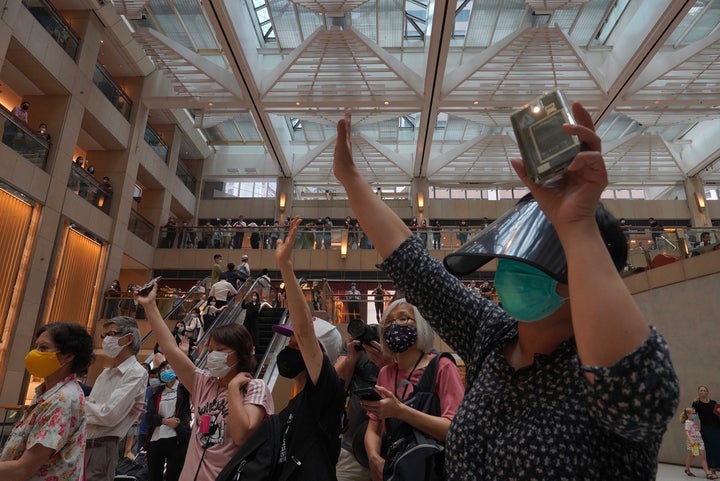
Protesters wave a Hong Kong colonial flag in a shopping mall during a protest against China’s national security legislation for the city, in Hong Kong, on May 29, 2020.Â
It would be the first time in 30 years that the candlelight vigil, which draws a huge crowd to an outdoor space, is not held in Hong Kong. The vigil marks the deadly military crackdown on pro-democracy protesters in Beijing’s Tiananmen Square on June 4, 1989.
The police, in a letter to organizers, said it would violate coronavirus social distancing rules that ban gatherings of more than eight people.
Organizer Lee Cheuk-yan, chair of the Hong Kong Alliance in Support of Patriotic Democratic Movements of China, expressed disappointment and urged people to light candles individually and observe a moment of silence.
Amnesty International said authorities should facilitate a socially distanced vigil rather than ban it.
“COVID-19 must not be used as an excuse to stifle freedom of expression,†said Joshua Rosenzweig, the group’s deputy director for East and Southeast Asia. “With this ban, and a disastrous national security law looming, it is not clear if Hong Kong’s Tiananmen vigil will ever be allowed to take place again.â€
Hong Kong has reported five local infections of the coronavirus in the last two days, breaking a nearly two-week streak of no new cases outside of those brought in from abroad.
The rush to apply for passports came after Britain said last week that it might allow holders of the document to stay in the country for a year or more. The proposal came after China’s legislature decided it would enact a national security law for Hong Kong.
The move is aimed at clamping down on a pro-democracy movement that has at times resulted in violent clashes between protesters and the police. Critics say the law erodes the “one country, two systems†framework that promised Hong Kong freedoms not found in mainland China for 50 years.
Protesters demonstrated against the security law during lunchtime Monday at a luxury shopping mall in the Central business district, shouting pro-democracy slogans.
ASSOCIATED PRESS
Protesters gesture with five fingers, signifying the “Five demands – not one less” in a shopping mall during a protest against China’s national security legislation for the city, in Hong Kong, on June 1, 2020.Â
The British National (Overseas) passport, which was issued to Hong Kongers when it was a British colony, allows them to visit the country for an extended period but falls short of offering them citizenship rights.
Currently, BNO passport holders can remain in the U.K. as visitors for six months without a visa. But Britain’s plan to allow them to stay in the U.K. for a longer period could include options that offer a path to citizenship, according to British Home Secretary Priti Patel.
In Hong Kong’s eastern district of Quarry Bay, Vanessa Tai was among more than 40 people who stood in line at a DHL service point, many holding envelopes with application documents.
Tai, 24, said the BNO passport is a Plan B for Hong Kongers who are worried about losing their freedoms as China strengthens its control over the city.
“If I had a choice, I’d rather work and live in Hong Kong. I hadn’t considered emigrating or working overseas before this,†she said. “Nowadays, my family and I are seeking an alternative, just in case.â€
As of February, nearly 350,000 Hong Kong residents held BNO passports, although the U.K. government estimated that there are 2.9 million people in the city of 7.5 million who are eligible for the passport.
Calling all HuffPost superfans!
Sign up for membership to become a founding member and help shape HuffPost’s next chapter
A clear night sky offers an ever-changing display of fascinating objects to see — stars, constellations, and bright planets, often the moon, and sometimes special events like meteor showers. Observing the night sky can be done with no special equipment, although a sky map can be very useful. Binoculars or a good beginner telescope will enhance some experiences and bring some otherwise invisible objects into view. You can also use astronomy apps and software to make your observing easier, and use our Satellite Tracker page powered by N2YO.com to find out when to see the International Space Station and other satellites. Below, find out what’s up in the night sky tonight (Planets Visible Now, Moon Phases, Observing Highlights This Month) plus other resources (Skywatching Terms, Night Sky Observing Tips and Further Reading).
The night sky is more than just the moon and stars, if you know when and where to look. (Image credit: Karl Tate/SPACE.com)
Monthly skywatching information is provided to Space.com by Chris Vaughan of Starry Night Education, the leader in space science curriculum solutions. Follow Starry Night on Twitter @StarryNightEdu and Chris at @Astrogeoguy.
Editor’s note: If you have an amazing skywatching photo you’d like to share for a possible story or image gallery, you can send images and comments in to spacephotos@futurenet.com.
Night Sky Guides:
Calendar of Observing Highlights
Monday, June 1 pre-dawn—Jupiter and Saturn Bracket a Globular Cluster
In the southern sky in the hours before dawn on the opening days of June, the globular star cluster Messier 75 will be positioned below and between the bright gas giant planets Jupiter and Saturn. In the dark, moonless sky before morning twilight begins, the magnitude 9.2 cluster should be visible in binoculars (red circle) and backyard telescopes as a small, fuzzy patch located approximately 1.5 finger widths below (or 1.5 degrees to the celestial south of) the two much brighter planets.Â
Wednesday, June 3 evening—Mercury at Greatest Eastern Elongation
In the western sky on the evening of Thursday, June 4, Mercury (orbit shown as red curve) will reach its widest separation, 24 degrees east of the Sun, for the current apparition. (Observers in eastern Asia and Australia will see Mercury’s greatest elongation after sunset there on Thursday, June 4.) With Mercury sitting above the evening ecliptic (green line), this appearance of the planet will offer good views for Northern Hemisphere observers and poor views for observers in the Southern Hemisphere. The optimal viewing times at mid-northern latitudes fall between 9:15 and 10 p.m. local time. Viewed in a telescope (inset) the planet will exhibit a waning half-illuminated phase.
Thursday, June 4 from 11:22 to 13:52 GMT—Double Shadow Transit on Jupiter
From time to time, the small, round, black shadows cast by Jupiter’s four Galilean moons can be seen in amateur telescopes as they cross (or transit) the planet’s disk for several hours. On Thursday, June 4, observers on the west coast of North America and across the Pacific Ocean region can see a double shadow transit event. At 11:21 GMT, Europa’s smaller shadow will join Ganymede’s larger shadow already in transit. Ganymede’s shadow will move off the planet at 13:52 GMT, leaving Europa’s shadow to complete its crossing just before 14:06 GMT. The Great Red Spot will be visible on Jupiter during the latter stages of the event.
Friday, June 5 at 19:12 GMT—Full Strawberry Moon and Penumbral Lunar Eclipse
The moon will reach its full phase at 3:12 p.m. EDT (or 19:12 GMT) on Friday, June, 5. The June full moon, colloquially known as the Strawberry Moon, Mead Moon, Rose Moon, or Hot Moon, always shines in or near the stars of southern Ophiuchus, the Serpent-Bearer. This full moon will be accompanied by a penumbral lunar eclipse between 17:46 and 21:04 GMT. At greatest eclipse at 19:25 GMT, the moon will have only dipped about halfway into the Earth’s northern penumbral shadow, barely darkening the moon’s southern limb. The entire eclipse will be visible from most of Africa, the Middle East, central Asia, and most of Australia. Observers in the Americas will not see any portion of the eclipse—except along the eastern edge of South America, where the moon will rise as the eclipse is ending.
Saturday, June 6 evening—The Big Dipper as a Star Pointer
In early June the Big Dipper asterism, part of the larger constellation of Ursa Major, sits high in the northwestern sky after dusk. When viewed while facing northeast, the dipper’s bowl opens on the right, towards its Little Dipper counterpart. Its handle extends upward. A line extended from Merak through Dubhe, the stars which mark the bowl’s outer base and rim, respectively, will arrive at medium-bright Polaris, the North Star. Continue the arc of the dipper’s bent handle and “Arc to Arcturus”, the bright orange star in Böotes. Continuing that arc farther lets you “Spike to Spica”, the brightest star in Virgo. A line extended from Mizar at the bend of the handle and diagonally through the dipper’s bowl stars, will “Cast to Castor” in Gemini.
Monday, June 8 pre-dawn—Waning Moon near Jupiter and Saturn
The moon’s monthly trip past the morning planets begins on Monday, June 8 in the southern sky during the hours before sunrise. The waning gibbous moon will sit a palm’s width to the lower right (or 6.5 degrees to the celestial southwest) of very bright, white Jupiter and somewhat dimmer, yellowish Saturn. The trio will offer a lovely photo opportunity when composed with some interesting scenery.Â
Tuesday, June 9 pre-dawn—Gibbous Moon near Saturn and Jupiter
After 24 hours of motion, the waning gibbous moon will take up a position less than fist’s diameter to the lower left (or 8 degrees to the celestial east) of bright Jupiter—with dimmer, yellowish Saturn above and between them. The trio will cross the sky together in the post-midnight hours, and will offer another lovely photo opportunity when composed with an interesting landscape.
Thursday, June 11 from 14:33 to 16:40 GMT—Double Shadow Transit and Great Red Spot on Jupiter
From time to time, the small, round, black shadows cast by Jupiter’s four Galilean moons can be seen in amateur telescopes as they cross (or transit) the planet’s disk for a few hours. On Thursday, June 11, observers in the western Pacific Ocean Region can see a double shadow transit. At 14:33 GMT, Ganymede’s larger shadow will join Europa’s smaller shadow already in transit. 127 minutes later Europa’s shadow will move off the planet at 16:40 GMT, leaving Ganymede’s shadow to complete its crossing at 17:54 GMT. The Great Red Spot will also be transiting during the event.Â
Friday, June 12 pre-dawn—Red Mars Passes Blue Neptune
In the southeastern pre-dawn sky on the mornings surrounding Friday, June 12, the faster orbital motion of reddish Mars (red line with dates:times) will carry it past distant, dim, and blue-tinted Neptune. At closest approach, Neptune will sit 1.5 degrees above (to the north of) Mars, allowing both planets to appear together in the field of view of amateur telescopes (red circle), although magnitude -0.19 Mars will shine nearly 1700 times brighter than magnitude 7.9 Neptune!
In the southeastern sky in the hours before dawn on Saturday, June 13, the waning half-illuminated moon will pass four finger widths to the lower left (or 4.5 degrees to the celestial southeast) of Mars. The duo will fit into the field of view of binoculars (red circle) and will make a nice photo opportunity when composed with some interesting landscape.
The moon will reach its last quarter phase at 2:24 a.m. EDT, or 6:24 GMT, on Saturday, June 13. At last quarter, the moon always rises around midnight and remains visible in the southern sky during morning daylight. At last quarter, the relative positions of the Earth, sun, and moon cause us to see the moon half-illuminated—on its western (left-hand) side. At last quarter, the moon is also positioned ahead of the Earth in our trip around the sun. About 3½ hours later, Earth will occupy that same location in space. After this phase, the waning moon will traverse the final quarter of its orbit around the earth, on the way to new moon.
Sunday, June 14 overnight—Asteroid Pallas Passes the Coathangar Cluster
In the evening sky on the evenings surrounding Sunday, June 14, the orbital motion (red path with labeled dates:times) of the main belt asteroid designated (2) Pallas will take it 1.5 finger widths to the upper left (or 1.5 degrees to the celestial north) of the Coathangar Cluster in the constellation of Vulpecula. Also considered an asterism, the Coathangar is an easy target for binoculars—located midway between the bright stars Vega and Altair. The magnitude 8.94 asteroid and most of the cluster’s stars will appear together in the field of view of backyard telescopes at low magnification (red circle).
Wednesday, June 17 before dawn—Crescent Moon near Uranus
In the eastern sky before dawn on Wednesday, June 17, the slender crescent of the old moon will pass less than a palm’s width below (or 5 degrees to the celestial southeast of) Uranus. The blue-green, magnitude 5.8 ice giant planet will be visible in telescopes and binoculars (red circle), especially for observers at southerly latitudes, where the surrounding sky will be darker.Â
Thursday, June 18 from 18:33 to 19:13 GMT—Double Shadow Transit on Jupiter
From time to time, the small, round, black shadows cast by Jupiter’s four Galilean moons can be seen in amateur telescopes as they cross (or transit) the planet’s disk for several hours. On Thursday, June 18, observers across Asia can see a double shadow transit. At 18:33 GMT, Ganymede’s larger shadow will join Europa’s smaller shadow already in transit. 40 minutes later Europa’s shadow will move off the planet at 19:13 GMT, leaving Ganymede’s shadow to complete its crossing hours later.Â
Friday, June 19 before sunrise—Crescent Moon meets Venus
For about an hour before sunrise on Friday, June 19, the very slim crescent of the old moon will sit very close to the bright planet Venus. Look for the pair just above the east-northeastern horizon. The moon and Venus will fit together in the field of view of binoculars and backyard telescopes (red circle) and will make a nice widefield photograph when composed with foreground scenery. Observers in the Azores, the Canary Islands, northern and eastern Canada, Greenland, and the northern parts of Europe, Russia, and Mongolia can see the moon occult Venus between 07:20 and 08:07 GMT.
On Saturday, June 20 at 5:54 p.m. EDT, or 21:44 GMT, the sun will reach its northernmost declination for the year, resulting in the longest daylight hours of the year for the Northern Hemisphere and the shortest daylight hours of the year for the Southern Hemisphere. The solstice marks the beginning of the summer season in the Northern Hemisphere, and winter in the Southern Hemisphere.
Sunday, June 21 at 6:41 GMT—New Moon and Annular Solar Eclipse
At its new phase on Sunday, June 21 at 2:41 a.m. EDT, or 6:41 GMT, the moon will be travelling between the Earth and the sun. Since sunlight is only shining on the side of the moon aimed away from us, and the moon is in the same region of the sky as the sun, the moon is normally hidden from view everywhere on Earth for about a day. But this new moon will occur 6.2 days past apogee, resulting in a thin-ringed annular solar eclipse visible across central Africa and southern Asia. The path of totality for this eclipse will commence at 04:48 GMT in central Africa. Greatest eclipse, with 98.8% of the sun blocked by the moon, will occur for 38 seconds at 06:40:05 GMT in northeastern India, with the sun at an altitude of 83°. After crossing southern China and a final landfall over Taiwan, the moon’s shadow will sweep across the Philippine Sea and Pacific Ocean, narrowly missing Guam ten minutes before sunset. The partial eclipse will be visible throughout eastern Africa, southern Europe and the Middle East, most of Asia, and Southeast Asia. The eclipse will be live streamed. Proper solar filters will be required to view any portion of this eclipse in person.
Tuesday, June 23 pre-dawn—Neptune Reverses Direction
On Tuesday, June 23, distant blue Neptune will cease its regular eastward orbital motion through the background stars (red path) and begin a retrograde loop that will last until late November. On this date, you’ll find the blue-green, magnitude 7.9 planet in eastern Aquarius, sitting a palm’s width to the upper right (or 6.5 degrees to the west) of Mars and 3.5 degrees east of the medium-bright star Phi Aquarii. During the coming months, Neptune will move toward that star.Â
Tuesday, June 23 after dusk—Crescent Moon Buzzes the Beehive Cluster
In the west-northwestern sky after dusk on Tuesday, June 23, the young crescent moon’s orbital motion (green line) will carry it closely past the northern edge of the large open star cluster known as the Beehive, or Messier 44, in the constellation of Cancer, the Crab. Observers in the Central and Mountain Time zones will be able to see the moon and the cluster while they are higher in the sky. The moon encounters this cluster frequently because the Beehive is located only 1 degree north of the ecliptic (green line). The reduced brightness of the crescent moon should allow you to see the cluster’s stars and the moon in the field of view of your binoculars (red circle).
Saturday, June 27 evening—The Summer Triangle Arrives
After dusk in late June, Vega, Deneb, and Altair are the first stars to appear in the darkening eastern sky. Those three bright, white stars form the Summer Triangle asterism—an annual feature of the summer sky that remains visible until the end of December! The highest and most easterly of the trio is Vega, in Lyra. At magnitude 0.03, Vega is the brightest star in the summer sky, mainly due to its relative proximity to the sun – it’s only 25 light-years distant. Magnitude 0.75 Altair, in Aquila, occupies the southern corner of the triangle. Altair is 17 light-years from the sun. By contrast, Deneb, which shines somewhat less brightly at magnitude 1.25, is a staggering 2,600 light-years away from us; but it ranks so high in visible brightness because of its greater intrinsic luminosity. The Milky Way passes between Vega and Altair and through Deneb, which sits high overhead as dawn begins to break.
The moon will reach its first quarter phase on Sunday, June 28 at 4:16 a.m. EDT, or 8:16 GMT. At that time, the relative positions of the Earth, sun, and moon will cause us to see the moon half-illuminated—on its eastern (right-hand) side. Sunlight striking the moon at a shallow angle produces spectacularly illuminated landscapes along the pole-to-pole terminator line that separates the lit and dark hemispheres. First quarter moons always rise around noon and set at midnight, so they are visible starting in the afternoon hours. The term “first quarter” refers not to the moon’s appearance, but the fact that our natural satellite has now completed one quarter of its orbit around Earth, counting from the last new moon.
During the first half of June, Mercury will be easily visible low in the western post-sunset sky. Peak visibility will occur on June 3-4 when the swift planet will reach its greatest eastern elongation at an angular separation of 24° from the sun. On those dates, Mercury will reside among the stars of Gemini and will set shortly before 11 p.m. local time. The optimal viewing times at mid-northern latitudes fall between 9:15 and 10 p.m. local time. Mercury’s position above (i.e., north of) a moderately dipping evening ecliptic will make June’s appearance a good one for Northern Hemisphere observers, but a poor one for observers in the Southern Hemisphere. For most of June Mercury will be moving towards Earth as it prepares for inferior conjunction at month-end. Telescope views of the planet will reveal a waning phase that drops from 43% illuminated on June 1 to a slim crescent by mid-month, while its apparent disk size will grow daily and its visual magnitude will decrease from magnitude 0.2 to 3.0.
Venus will encounter the sun at inferior conjunction on June 3, and then enter the eastern pre-dawn sky among the stars of Taurus – but its position below the shallow morning ecliptic will make the planet a challenge to see against the bright morning sky until mid-month. On June 24, Venus will complete a retrograde loop and begin to travel east on a trajectory that will carry it through the Hyades cluster in early July. The planet will brighten to magnitude -4.66 at the end of June. Viewed in a telescope, Venus will exhibit a waxing crescent phase and an apparent disk diameter that shrinks from 58 to 43.5 arc-seconds. An hour before sunrise on June 19, the very slim crescent moon will rise with Venus, making a spectacular widefield photograph opportunity. The duo will be close enough to appear together in the field of view of binoculars and backyard telescopes. Observers in the Azores, the Canary Islands, northern and eastern Canada, Greenland, and the northern parts of Europe, Russia, and Mongolia can see the moon occult Venus between 07:20 and 08:07 GMT.
Mars will begin June shining at magnitude -0.02 and moving rapidly prograde through the stars of eastern Aquarius. All month long the planet will rise between about 1 and 2 a.m. local time and it will be easily visible in the lower third of the southeastern pre-dawn sky until almost sunrise. On June 24, the Red Planet will cross into southern Pisces. As the distance between Earth and Mars decreases, Mars will continuously increase in brightness, reaching magnitude -0.49 at month-end. Viewed in a telescope during June, Mars will exhibit an 85% illuminated disk that will grow from 9.3 to 11.4 arc-seconds. On June 12-13, Mars will pass 1.75 degrees to the south of Neptune – but the waning last quarter moon located nearby will make seeing that distant planet more difficult.
During June, Jupiter will shine very brightly from midnight to dawn while moving retrograde west through the stars of eastern Sagittarius, less than a handful of degrees northwest of the globular cluster Messier 75. Jupiter’s slowly increasing visual magnitude, from -2.57 to -2.72 during June, will allow it to remain easily visible until sunrise. Dimmer Saturn, positioned only 5 to 6 degrees to the east of Jupiter all year, will chase Jupiter across the sky. The two planets will be rather low in the sky for mid-latitude observers, but southerly observers will have a higher, better view of them. Throughout June, telescope views of Jupiter’s disk will show it growing from 44.71 to 47.25 arc-seconds as Earth’s distance from the giant planet decreases. Several Jovian moon shadow transit events will be visible from different parts of the world during June. The shadows of Europa and Ganymede will cross simultaneously with the Great Red Spot on June 4 and on June 11, and Io and Ganymede’s shadows will cross together on June 18. The waning gibbous moon will hop past Jupiter on June 8-9, making a lovely binoculars sight and a photo opportunity with nearby Saturn.Â
During June, Saturn will be traveling retrograde westward through the stars of western Capricornus, approximately 5-6 degrees to the east of much brighter Jupiter and just 2-3 degrees north of the globular cluster Messier 75. The Ringed Planet will be observable from the wee hours until almost dawn. The low morning ecliptic in the Northern Hemisphere will keep Saturn in the lower part in the sky, but southerly observers will have a better view of it. Throughout June, Saturn’s disk and rings will grow slightly larger in telescopes. They’ll reach maximum apparent size at opposition in July. The waning gibbous moon will pass to the south of Saturn and Jupiter on June 8 and 9, making a lovely binoculars sight and photo opportunity.
Uranus will spend June in the eastern predawn sky among the stars of southern Aries. The blue-green, magnitude 5.85 planet will be difficult to observe until later in the month, when its larger angular separation from the sun will surround the planet with a darker sky. Even then, the shallow morning ecliptic will keep Uranus too low in the sky for decent views from mid-northern latitudes. A 14% illuminated old crescent moon will pass less than 5 degrees below Uranus on June 17.
During June, Neptune will be observable for several hours before dawn in the southeastern sky among the stars of eastern Aquarius. On June 24, the magnitude 7.9 planet will cease its eastward motion and commence a retrograde loop that will last until late November. The shallow morning ecliptic will keep the dim, distant planet in the lower third of the sky during June. On the mornings surrounding June 13, Mars will pass within 1.5 degrees to the south of Neptune, allowing the red and blue planets to appear together in the field of view of a telescope with a widefield eyepiece. The waning last quarter moon will join the two planets on June 13.
Skywatching Terms
Gibbous: Used to describe a planet or moon that is more than 50% illuminated.
Asterism: A noteworthy or striking pattern of stars within a larger constellation.
Degrees (measuring the sky): The sky is 360 degrees all the way around, which means roughly 180 degrees from horizon to horizon. It’s easy to measure distances between objects: Your fist on an outstretched arm covers about 10 degrees of sky, while a finger covers about one degree.
Visual Magnitude: This is the astronomer’s scale for measuring the brightness of objects in the sky. The dimmest object visible in the night sky under perfectly dark conditions is about magnitude 6.5. Brighter stars are magnitude 2 or 1. The brightest objects get negative numbers. Venus can be as bright as magnitude minus 4.9. The full moon is minus 12.7 and the sun is minus 26.8.
Terminator: The boundary on the moon between sunlight and shadow.
Zenith: The point in the sky directly overhead. Â
Night Sky Observing Tips
Adjust to the dark: If you wish to observe faint objects, such as meteors or dim stars, give your eyes at least 15 minutes to adjust to the darkness.
Light Pollution: Even from a big city, one can see the moon, a handful of bright stars and sometimes the brightest planets. But to fully enjoy the heavens — especially a meteor shower, the constellations, or to see the amazing swath across the sky that represents our view toward the center of the Milky Way Galaxy — rural areas are best for night sky viewing. If you’re stuck in a city or suburban area, a building can be used to block ambient light (or moonlight) to help reveal fainter objects. If you’re in the suburbs, simply turning off outdoor lights can help.
Prepare for skywatching: If you plan to be out for more than a few minutes, and it’s not a warm summer evening, dress warmer than you think necessary. An hour of observing a winter meteor shower can chill you to the bone. A blanket or lounge chair will prove much more comfortable than standing or sitting in a chair and craning your neck to see overhead.
Daytime skywatching: When Venus is visible (that is, not in front of or behind the sun) it can often be spotted during the day. But you’ll need to know where to look. A sky map is helpful. When the sun has large sunspots, they can be seen without a telescope. However, it’s unsafe to look at the sun without protective eyewear. See our video on how to safely observe the sun, or our safe sunwatching infographic.
More than 200 travel and hospitality firms have now called on the government to change planned quarantine rules, which they say are unworkable and deeply damaging to their industry.
The companies have joined the aviation industry in a growing backlash against rules due to be introduced from 8 June. All visitors and returning travellers entering the UK will have to quarantine for 14 days and face spot checks and fines for breaching isolation.
Firms say the announcement of plans has already hit sales in the sector. Companies have instead proposed, in a letter to the home secretary, Priti Patel, the creation of “airbridges†allowing travel between the UK and countries where coronavirus has been controlled and the risks are low. The potential of such airbridges was mooted by the transport secretary, Grant Shapps, but appears to have been now dismissed by government.
The originator of the letter, George Morgan-Grenville, the chief executive of the tour operator Red Savannah, said: “This is not just a group of company bosses complaining but employees from bottom to top calling for the quarantine plans to be quashed. The extent of their pain is deeply worrying for our economy and our country.â€
The firms say that there was now “a glimmer of hope†that some portion of the most lucrative summer season could be salvaged but quarantine would deter all travel and likely see other countries impose reciprocal regimes on UK visitors.
Signatories include hoteliers and restaurant businesses including Claridges, The Ritz, and The Connaught, as well as travel firms such as Kuoni, Travelbag, Cosmos and Inghams.
The letter lashes out at the government for ignoring calls from the sector to impose quarantine restrictions early in the crisis, before Covid-19 was widespread, and failing to adjudicate on how struggling firms should manage customer bookings. It says: “The government has been woefully slow to react and has procrastinated to the point of absurdity in terms of either providing support for, or ruling against, the concept of refund credit notes.â€
The firms have also called on the Foreign & Commonwealth Office to review its blanket advice against all non-essential travel, which has prevented bookings of possible future holidays.
Sign up to the daily Business Today email or follow Guardian Business on Twitter at @BusinessDesk
A number of Conservative MPs have now demanded that the government reviews its plan, including the Commons transport select committee chair Huw Merriman, who called for the wholesale rule to be ditched and replaced with measures such as air-bridges, compulsory PPE and temperature testing at airports.
Last month the aviation industry and airlines warned that the plans would extend the economic damage from Covid-19. Airlines UK, which speaks for major carriers operating here, said the plans “made no senseâ€. The Airport Operators Association said the quarantine move was “simplistic†and would have very serious economic and social consequences.
In the southern sky in the hours before dawn on the opening days of June, the globular star cluster Messier 75 will be positioned below and between the bright gas giant planets Jupiter and Saturn. In the dark, moonless sky before morning twilight begins, the magnitude 9.2 cluster should be visible in binoculars (red circle) and backyard telescopes as a small, fuzzy patch located approximately 1.5 finger widths below (or 1.5 degrees to the celestial south of) the two much brighter planets.
Wednesday, June 3 evening—Mercury at Greatest Eastern Elongation
In the western sky on the evening of Thursday, June 4, Mercury (orbit shown as red curve) will reach its widest separation, 24 degrees east of the Sun, for the current apparition. (Observers in eastern Asia and Australia will see Mercury’s greatest elongation after sunset there on Thursday, June 4.) With Mercury sitting above the evening ecliptic (green line), this appearance of the planet will offer good views for Northern Hemisphere observers and poor views for observers in the Southern Hemisphere. The optimal viewing times at mid-northern latitudes fall between 9:15 and 10 p.m. local time. Viewed in a telescope (inset) the planet will exhibit a waning half-illuminated phase.
Thursday, June 4 from 11:22 to 13:52 GMT—Double Shadow Transit on Jupiter
From time to time, the small, round, black shadows cast by Jupiter’s four Galilean moons can be seen in amateur telescopes as they cross (or transit) the planet’s disk for several hours. On Thursday, June 4, observers on the west coast of North America and across the Pacific Ocean region can see a double shadow transit event. At 11:21 GMT, Europa’s smaller shadow will join Ganymede’s larger shadow already in transit. Ganymede’s shadow will move off the planet at 13:52 GMT, leaving Europa’s shadow to complete its crossing just before 14:06 GMT. The Great Red Spot will be visible on Jupiter during the latter stages of the event.
Friday, June 5 at 19:12 GMT—Full Strawberry Moon and Penumbral Lunar Eclipse
The moon will reach its full phase at 3:12 p.m. EDT (or 19:12 GMT) on Friday, June, 5. The June full moon, colloquially known as the Strawberry Moon, Mead Moon, Rose Moon, or Hot Moon, always shines in or near the stars of southern Ophiuchus, the Serpent-Bearer. This full moon will be accompanied by a penumbral lunar eclipse between 17:46 and 21:04 GMT. At greatest eclipse at 19:25 GMT, the moon will have only dipped about halfway into the Earth’s northern penumbral shadow, barely darkening the moon’s southern limb. The entire eclipse will be visible from most of Africa, the Middle East, central Asia, and most of Australia. Observers in the Americas will not see any portion of the eclipse—except along the eastern edge of South America, where the moon will rise as the eclipse is ending.
Saturday, June 6 evening—The Big Dipper as a Star Pointer
In early June the Big Dipper asterism, part of the larger constellation of Ursa Major, sits high in the northwestern sky after dusk. When viewed while facing northeast, the dipper’s bowl opens on the right, towards its Little Dipper counterpart. Its handle extends upward. A line extended from Merak through Dubhe, the stars which mark the bowl’s outer base and rim, respectively, will arrive at medium-bright Polaris, the North Star. Continue the arc of the dipper’s bent handle and “Arc to Arcturus”, the bright orange star in Böotes. Continuing that arc farther lets you “Spike to Spica”, the brightest star in Virgo. A line extended from Mizar at the bend of the handle and diagonally through the dipper’s bowl stars, will “Cast to Castor” in Gemini.Â
Monday, June 8 pre-dawn—Waning Moon near Jupiter and Saturn
The moon’s monthly trip past the morning planets begins on Monday, June 8 in the southern sky during the hours before sunrise. The waning gibbous moon will sit a palm’s width to the lower right (or 6.5 degrees to the celestial southwest) of very bright, white Jupiter and somewhat dimmer, yellowish Saturn. The trio will offer a lovely photo opportunity when composed with some interesting scenery.
Tuesday, June 9 pre-dawn—Gibbous Moon near Saturn and Jupiter
After 24 hours of motion, the waning gibbous moon will take up a position less than fist’s diameter to the lower left (or 8 degrees to the celestial east) of bright Jupiter—with dimmer, yellowish Saturn above and between them. The trio will cross the sky together in the post-midnight hours, and will offer another lovely photo opportunity when composed with an interesting landscape.
Thursday, June 11 from 14:33 to 16:40 GMT—Double Shadow Transit and Great Red Spot on Jupiter
From time to time, the small, round, black shadows cast by Jupiter’s four Galilean moons can be seen in amateur telescopes as they cross (or transit) the planet’s disk for a few hours. On Thursday, June 11, observers in the western Pacific Ocean Region can see a double shadow transit. At 14:33 GMT, Ganymede’s larger shadow will join Europa’s smaller shadow already in transit. 127 minutes later Europa’s shadow will move off the planet at 16:40 GMT, leaving Ganymede’s shadow to complete its crossing at 17:54 GMT. The Great Red Spot will also be transiting during the event.
Friday, June 12 pre-dawn—Red Mars Passes Blue Neptune
In the southeastern pre-dawn sky on the mornings surrounding Friday, June 12, the faster orbital motion of reddish Mars (red line with dates:times) will carry it past distant, dim, and blue-tinted Neptune. At closest approach, Neptune will sit 1.5 degrees above (to the north of) Mars, allowing both planets to appear together in the field of view of amateur telescopes (red circle), although magnitude -0.19 Mars will shine nearly 1700 times brighter than magnitude 7.9 Neptune!
In the southeastern sky in the hours before dawn on Saturday, June 13, the waning half-illuminated moon will pass four finger widths to the lower left (or 4.5 degrees to the celestial southeast) of Mars. The duo will fit into the field of view of binoculars (red circle) and will make a nice photo opportunity when composed with some interesting landscape.
The moon will reach its last quarter phase at 2:24 a.m. EDT, or 6:24 GMT, on Saturday, June 13. At last quarter, the moon always rises around midnight and remains visible in the southern sky during morning daylight. At last quarter, the relative positions of the Earth, sun, and moon cause us to see the moon half-illuminated—on its western (left-hand) side. At last quarter, the moon is also positioned ahead of the Earth in our trip around the sun. About 3½ hours later, Earth will occupy that same location in space. After this phase, the waning moon will traverse the final quarter of its orbit around the earth, on the way to new moon.
Sunday, June 14 overnight—Asteroid Pallas Passes the Coathangar Cluster
In the evening sky on the evenings surrounding Sunday, June 14, the orbital motion (red path with labeled dates:times) of the main belt asteroid designated (2) Pallas will take it 1.5 finger widths to the upper left (or 1.5 degrees to the celestial north) of the Coathangar Cluster in the constellation of Vulpecula. Also considered an asterism, the Coathangar is an easy target for binoculars—located midway between the bright stars Vega and Altair. The magnitude 8.94 asteroid and most of the cluster’s stars will appear together in the field of view of backyard telescopes at low magnification (red circle).
Wednesday, June 17 before dawn—Crescent Moon near Uranus
In the eastern sky before dawn on Wednesday, June 17, the slender crescent of the old moon will pass less than a palm’s width below (or 5 degrees to the celestial southeast of) Uranus. The blue-green, magnitude 5.8 ice giant planet will be visible in telescopes and binoculars (red circle), especially for observers at southerly latitudes, where the surrounding sky will be darker.
Thursday, June 18 from 18:33 to 19:13 GMT—Double Shadow Transit on Jupiter
From time to time, the small, round, black shadows cast by Jupiter’s four Galilean moons can be seen in amateur telescopes as they cross (or transit) the planet’s disk for several hours. On Thursday, June 18, observers across Asia can see a double shadow transit. At 18:33 GMT, Ganymede’s larger shadow will join Europa’s smaller shadow already in transit. 40 minutes later Europa’s shadow will move off the planet at 19:13 GMT, leaving Ganymede’s shadow to complete its crossing hours later.
Friday, June 19 before sunrise—Crescent Moon meets Venus
For about an hour before sunrise on Friday, June 19, the very slim crescent of the old moon will sit very close to the bright planet Venus. Look for the pair just above the east-northeastern horizon. The moon and Venus will fit together in the field of view of binoculars and backyard telescopes (red circle) and will make a nice widefield photograph when composed with foreground scenery. Observers in the Azores, the Canary Islands, northern and eastern Canada, Greenland, and the northern parts of Europe, Russia, and Mongolia can see the moon occult Venus between 07:20 and 08:07 GMT.
On Saturday, June 20 at 5:54 p.m. EDT, or 21:44 GMT, the sun will reach its northernmost declination for the year, resulting in the longest daylight hours of the year for the Northern Hemisphere and the shortest daylight hours of the year for the Southern Hemisphere. The solstice marks the beginning of the summer season in the Northern Hemisphere, and winter in the Southern Hemisphere.
Sunday, June 21 at 6:41 GMT—New Moon and Annular Solar Eclipse
At its new phase on Sunday, June 21 at 2:41 a.m. EDT, or 6:41 GMT, the moon will be travelling between the Earth and the sun. Since sunlight is only shining on the side of the moon aimed away from us, and the moon is in the same region of the sky as the sun, the moon is normally hidden from view everywhere on Earth for about a day. But this new moon will occur 6.2 days past apogee, resulting in a thin-ringed annular solar eclipse visible across central Africa and southern Asia. The path of totality for this eclipse will commence at 04:48 GMT in central Africa. Greatest eclipse, with 98.8% of the sun blocked by the moon, will occur for 38 seconds at 06:40:05 GMT in northeastern India, with the sun at an altitude of 83°. After crossing southern China and a final landfall over Taiwan, the moon’s shadow will sweep across the Philippine Sea and Pacific Ocean, narrowly missing Guam ten minutes before sunset. The partial eclipse will be visible throughout eastern Africa, southern Europe and the Middle East, most of Asia, and Southeast Asia. The eclipse will be live streamed. Proper solar filters will be required to view any portion of this eclipse in person.
Tuesday, June 23 pre-dawn—Neptune Reverses Direction
On Tuesday, June 23, distant blue Neptune will cease its regular eastward orbital motion through the background stars (red path) and begin a retrograde loop that will last until late November. On this date, you’ll find the blue-green, magnitude 7.9 planet in eastern Aquarius, sitting a palm’s width to the upper right (or 6.5 degrees to the west) of Mars and 3.5 degrees east of the medium-bright star Phi Aquarii. During the coming months, Neptune will move toward that star.
Tuesday, June 23 after dusk—Crescent Moon Buzzes the Beehive Cluster
In the west-northwestern sky after dusk on Tuesday, June 23, the young crescent moon’s orbital motion (green line) will carry it closely past the northern edge of the large open star cluster known as the Beehive, or Messier 44, in the constellation of Cancer, the Crab. Observers in the Central and Mountain Time zones will be able to see the moon and the cluster while they are higher in the sky. The moon encounters this cluster frequently because the Beehive is located only 1 degree north of the ecliptic (green line). The reduced brightness of the crescent moon should allow you to see the cluster’s stars and the moon in the field of view of your binoculars (red circle).
Saturday, June 27 evening—The Summer Triangle Arrives
After dusk in late June, Vega, Deneb, and Altair are the first stars to appear in the darkening eastern sky. Those three bright, white stars form the Summer Triangle asterism—an annual feature of the summer sky that remains visible until the end of December! The highest and most easterly of the trio is Vega, in Lyra. At magnitude 0.03, Vega is the brightest star in the summer sky, mainly due to its relative proximity to the sun – it’s only 25 light-years distant. Magnitude 0.75 Altair, in Aquila, occupies the southern corner of the triangle. Altair is 17 light-years from the sun. By contrast, Deneb, which shines somewhat less brightly at magnitude 1.25, is a staggering 2,600 light-years away from us; but it ranks so high in visible brightness because of its greater intrinsic luminosity. The Milky Way passes between Vega and Altair and through Deneb, which sits high overhead as dawn begins to break.
The moon will reach its first quarter phase on Sunday, June 28 at 4:16 a.m. EDT, or 8:16 GMT. At that time, the relative positions of the Earth, sun, and moon will cause us to see the moon half-illuminated—on its eastern (right-hand) side. Sunlight striking the moon at a shallow angle produces spectacularly illuminated landscapes along the pole-to-pole terminator line that separates the lit and dark hemispheres. First quarter moons always rise around noon and set at midnight, so they are visible starting in the afternoon hours. The term “first quarter” refers not to the moon’s appearance, but the fact that our natural satellite has now completed one quarter of its orbit around Earth, counting from the last new moon.
I’m sure many of you have seen how a magician makes something or someone appear to vanish, only to make that thing or person reappear a short time later . . . usually in a completely different location.  Well, that’s the kind of vanishing act that the planet Venus has just pulled off.  After dominating our western evening sky during the first half of this year, the brightest planet suddenly left the scene on June 3rd, only to quickly reassert itself in the eastern morning sky.  But the evening sky will not be devoid of a bright planet for too long, as Jupiter and Saturn come up over the east-southeast horizon before midnight at the start of the month and will be well placed for viewing by late evening as the month comes to a close. And before Jupiter and Saturn take the title as this summer’s planetary dynamic duo of the evening, Mercury will serve as the lone early evening planet for the first 10 days of the month, sharing the spotlight with the Gemini Twins, Pollux and Castor.  Meanwhile, Mars continues to approach Earth and continues to slowly ramp-up in brilliance; the combination of its increasing luster and fiery hue call attention to it for anyone outdoors during the predawn hours. Â
In our schedule, remember that when measuring the angular separation between two celestial objects, your clenched fist held at arm’s length measures roughly 10-degrees.  Here, we present a schedule below which provides some of the best planet viewing times as well directing you as to where to look to see them.
During the first half of June, Mercury will be easily visible low in the western post-sunset sky. Peak visibility will occur on June 3-4 when the swift planet will reach its greatest eastern elongation at an angular separation of 24° from the sun. On those dates, Mercury will reside among the stars of Gemini and will set shortly before 11 p.m. local time. The optimal viewing times at mid-northern latitudes fall between 9:15 and 10 p.m. local time. Mercury’s position above (i.e., north of) a moderately dipping evening ecliptic will make June’s appearance a good one for Northern Hemisphere observers, but a poor one for observers in the Southern Hemisphere. For most of June Mercury will be moving towards Earth as it prepares for inferior conjunction at month-end. Telescope views of the planet will reveal a waning phase that drops from 43% illuminated on June 1 to a slim crescent by mid-month, while its apparent disk size will grow daily and its visual magnitude will decrease from magnitude 0.2 to 3.0. (Image credit: Starry Night)
Mercury begins the month shining at magnitude +0.1 low in the west-northwest after sunset, in the midst of an excellent evening apparition. Â The planet seems unusually prominent because it outshines two bright stars above it, Castor and Pollux, which represent the starry eyes of the Gemini twins. Â In a few more days Mercury dives back into the sun’s glare. Â You probably won’t see it after the 11th when it will appear only about one-third as bright as it was ten days earlier. Â It will pass between the Earth and sun (inferior conjunction) on June 30th.
Venus
Venus will encounter the sun at inferior conjunction on June 3, and then enter the eastern pre-dawn sky among the stars of Taurus – but its position below the shallow morning ecliptic will make the planet a challenge to see against the bright morning sky until mid-month. On June 24, Venus will complete a retrograde loop and begin to travel east on a trajectory that will carry it through the Hyades cluster in early July. The planet will brighten to magnitude -4.66 at the end of June. Viewed in a telescope, Venus will exhibit a waxing crescent phase and an apparent disk diameter that shrinks from 58 to 43.5 arc-seconds. An hour before sunrise on June 19, the very slim crescent moon will rise with Venus, making a spectacular widefield photograph opportunity. The duo will be close enough to appear together in the field of view of binoculars and backyard telescopes. Observers in the Azores, the Canary Islands, northern and eastern Canada, Greenland, and the northern parts of Europe, Russia, and Mongolia can see the moon occult Venus between 07:20 and 08:07 GMT. (Image credit: Starry Night)
Venus reaches inferior conjunction on June 3rd at 2 p.m. EDT, when it grazes just past the sun only 0.2° from its upper limb.  This is an analog of the Transits of Venus of June 8, 2004 and June 6, 2012, but it results only in a very near miss this time. How soon after inferior conjunction can you first glimpse Venus in the dawn?  On June 6th, it rises just 15 minutes before the sun as seen from latitude 40° north and is probably visible only in binoculars.  Can you make out the hair-line crescent with horns extending a little more than halfway around?  Vaulting out of the sunrise glow, the interval between Venus-rise and sunrise increases very rapidly.  It’s about 45 minutes by June 12th and almost 2 hours by month’s end.  On June 19th, look very low above the east-northeast horizon about 45 minutes before sunrise for brilliant Venus (magnitude -4.5) and the narrow sliver of a waning crescent moon less than two days from new. For a given location on Earth, Venus either disappears or reappears behind the moon with the sun below the horizon on average once every 21 years. And across parts of eastern New York and New England, Venus will be positioned behind the moon (an occultation) as they rise; Venus emerging into view from behind the moon’s dark limb some minutes later, though they will be barely above the horizon.  From the Canadian Maritimes, they’re a bit higher, but Venus’s emergence comes within minutes of sunrise (use binoculars). Elsewhere in the US and Canada, Venus will be visible within a degree or two to the upper right of the moon. By month’s end, you may have noticed that the orange 1st-magnitude star Aldebaran is now emerging into view about 4½° below Venus.  Binoculars in early dawn may also show that Venus is about to enter into the midst of the V-shaped Hyades star cluster.
Earth
Earth arrives at the June solstice on the 20th. The sun arrives at that point where it is farthest north of the celestial equator, at 5:44 p.m. EDT. Â Summer officially begins in the Northern Hemisphere and winter begins in the Southern Hemisphere.Â
Mars
Mars will begin June shining at magnitude -0.02 and moving rapidly prograde through the stars of eastern Aquarius. All month long the planet will rise between about 1 and 2 a.m. local time and it will be easily visible in the lower third of the southeastern pre-dawn sky until almost sunrise. On June 24, the Red Planet will cross into southern Pisces. As the distance between Earth and Mars decreases, Mars will continuously increase in brightness, reaching magnitude -0.49 at month-end. Viewed in a telescope during June, Mars will exhibit an 85% illuminated disk that will grow from 9.3 to 11.4 arc-seconds. On June 12-13, Mars will pass 1.75 degrees to the south of Neptune—but the waning last quarter moon located nearby will make seeing that distant planet more difficult. (Image credit: Starry Night)
As its distance from Earth during June decreases from 94 million to 76 million miles, will correspondingly brighten from 0 to -0.5 magnitude. As the month closes, its disk will have grown big enough for a first few surface features to be glimpsed in medium-sized telescopes at morning twilight (when Mars has climbed reasonably high).  During the early morning hours of June 13th, Mars will be that very bright orange-yellow “star” hovering about 4° to the upper right of the last quarter moon.
Jupiter
During June, Jupiter will shine very brightly from midnight to dawn while moving retrograde west through the stars of eastern Sagittarius, less than a handful of degrees northwest of the globular cluster Messier 75. Jupiter’s slowly increasing visual magnitude, from -2.57 to -2.72 during June, will allow it to remain easily visible until sunrise. Dimmer Saturn, positioned only 5 to 6 degrees to the east of Jupiter all year, will chase Jupiter across the sky. The two planets will be rather low in the sky for mid-latitude observers, but southerly observers will have a higher, better view of them. Throughout June, telescope views of Jupiter’s disk will show it growing from 44.71 to 47.25 arc-seconds as Earth’s distance from the giant planet decreases. Several Jovian moon shadow transit events will be visible from different parts of the world during June. The shadows of Europa and Ganymede will cross simultaneously with the Great Red Spot on June 4 and on June 11, and Io and Ganymede’s shadows will cross together on June 18. The waning gibbous moon will hop past Jupiter on June 8-9, making a lovely binoculars sight and a photo opportunity with nearby Saturn. (Image credit: Starry Night)
Jupiter rises in the southeast about three hours after sunset at the beginning of June. Â But by month’s it’s rising less than an hour after sunset and shines through the fading twilight. Â Jupiter is approaching a July 14th opposition.
Saturn
During June, Saturn will be traveling retrograde westward through the stars of western Capricornus, approximately 5-6 degrees to the east of much brighter Jupiter and just 2-3 degrees north of the globular cluster Messier 75. The Ringed Planet will be observable from the wee hours until almost dawn. The low morning ecliptic in the Northern Hemisphere will keep Saturn in the lower part in the sky, but southerly observers will have a better view of it. Throughout June, Saturn’s disk and rings will grow slightly larger in telescopes. They’ll reach maximum apparent size at opposition in July. The waning gibbous moon will pass to the south of Saturn and Jupiter on June 8 and 9, making a lovely binoculars sight and photo opportunity. (Image credit: Starry Night)
Saturn trails behind Jupiter by about 20 minutes. A couple of hours after they rise both planets are fairly well up in the southeast and both are crossing the southern meridian between midnight and dawn. Late on the evening of June 8th, Jupiter and Saturn team up with the waning gibbous moon. Jupiter will be 7° to the upper right of the moon, while Saturn sits less than 4° directly above the moon. The gap separating the two giant planets has widened slightly to 5°.
Ohio Rep. Joyce Beatty was pepper-sprayed by police in Columbus on Saturday during a protest decrying police brutality and demanding justice for George Floyd, who died in Minneapolis after an officer knelt on his neck.Â
Beatty, who is Black, denounced the violence perpetrated by both demonstrators and police in Columbus and elsewhere in the aftermath of Floyd’s death.
“We have to somehow make sure that we get the word out that you cannot come in and tear up buildings,†said Beatty, a Democrat. “When you break windows and destroy businesses and people get hurt, that’s not going to resolve the problem of why George Floyd died.â€
Beatty said in an earlier interview that she’d attended the protest to stand “in solidarity†with demonstrators.Â
“You know, I’m a grandmother, I’m an elected official, but I’m a black woman first and I felt the pain,†she told NBC 4.
Beatty was with Columbus City Council President Shannon Hardin and Kevin Boyce, a member of the Franklin County Board of Commissioners, when she was pepper-sprayed by police.
Columbus Dispatch photojournalist Kyle Robertson captured the violent encounter in a series of photos, which he shared on Twitter.Â
Here is a 38 photo sequence of what happen this morning with Joyce Beatty, Shannon Hardin, Kevin Boyce, protesters and Columbus Police. pic.twitter.com/ZZEd6MfJCh
Watch when Democratic Rep. Joyce Beatty was pepper sprayed by Columbus, Ohio, police during protests Saturday afternoon over the death of George Floyd https://t.co/Q6C4wFAb7gpic.twitter.com/2i5fEGjxuh
Dominic Manecke, a spokesman for Beatty, told CNNÂ the lawmaker had been trying to mediate between demonstrators and police when she was pepper-sprayed.Â
“People are angry. Tensions are very high and she went down there as a voice of reason. She has a very good connection with the community and was trying to be a mediator,†Manecke said, adding that Beatty got caught in a “melee†as tensions flared between the two sides.
Following the incident, Beatty, Hardin and Boyce urged calm in a video posted to Twitter.Â
“Too much force is not the answer to this,†Beatty said.Â
Just want to let folks know that when @RepBeatty@VoteBoyce and I were down at the protest we did get sprayed with mace or pepper spray. We are all ok, and we want to encourage folks, both police and protestors, to stay calm. pic.twitter.com/RDQ1p4YDRY
In Columbus on Sunday, hundreds took to the streets again for what was largely a peaceful demonstration. At around 8 p.m., two hours before the city’s curfew was set to kick in, Columbus police ordered protesters ― some of whom threw water bottles at officers ― to disperse immediately. Officers then used wooden projectiles and tear gas against demonstrators, WOSU Public Media reported.Â
Protestors were raising their arms. Police warned protestors to disperse. Water bottles were thrown then the police fired back. pic.twitter.com/YRGEAW7BlY
— Paige Southwick Pfleger (@PaigePfleger) June 1, 2020
Calling all HuffPost superfans!
Sign up for membership to become a founding member and help shape HuffPost’s next chapter
We use cookies on our website to give you the most relevant experience by remembering your preferences and repeat visits. By clicking “Accept”, you consent to the use of ALL the cookies.
This website uses cookies to improve your experience while you navigate through the website. Out of these, the cookies that are categorized as necessary are stored on your browser as they are essential for the working of basic functionalities of the website. We also use third-party cookies that help us analyze and understand how you use this website. These cookies will be stored in your browser only with your consent. You also have the option to opt-out of these cookies. But opting out of some of these cookies may affect your browsing experience.
Necessary cookies are absolutely essential for the website to function properly. These cookies ensure basic functionalities and security features of the website, anonymously.
Cookie
Duration
Description
cookielawinfo-checbox-analytics
11 months
This cookie is set by GDPR Cookie Consent plugin. The cookie is used to store the user consent for the cookies in the category "Analytics".
cookielawinfo-checbox-functional
11 months
The cookie is set by GDPR cookie consent to record the user consent for the cookies in the category "Functional".
cookielawinfo-checbox-others
11 months
This cookie is set by GDPR Cookie Consent plugin. The cookie is used to store the user consent for the cookies in the category "Other.
cookielawinfo-checkbox-necessary
11 months
This cookie is set by GDPR Cookie Consent plugin. The cookies is used to store the user consent for the cookies in the category "Necessary".
cookielawinfo-checkbox-performance
11 months
This cookie is set by GDPR Cookie Consent plugin. The cookie is used to store the user consent for the cookies in the category "Performance".
viewed_cookie_policy
11 months
The cookie is set by the GDPR Cookie Consent plugin and is used to store whether or not user has consented to the use of cookies. It does not store any personal data.
Functional cookies help to perform certain functionalities like sharing the content of the website on social media platforms, collect feedbacks, and other third-party features.
Performance cookies are used to understand and analyze the key performance indexes of the website which helps in delivering a better user experience for the visitors.
Analytical cookies are used to understand how visitors interact with the website. These cookies help provide information on metrics the number of visitors, bounce rate, traffic source, etc.
Advertisement cookies are used to provide visitors with relevant ads and marketing campaigns. These cookies track visitors across websites and collect information to provide customized ads.




![Night sky, June 2020: What you can see this month [maps]](https://i0.wp.com/cdn.mos.cms.futurecdn.net/jChHbUNTXztPZvPS4qedSA-1200-80.jpg?w=768&ssl=1 "Night sky, June 2020: What you can see this month [maps]")