LONDON — It’s official: Brexit Britain will mean a lot of red tape.
Old “Project Fear” scare stories from the 2016 Remain campaign about masses of customs paperwork and increased costs for traders, as well as restrictions on immigration for vital sectors, are becoming reality.
The government on Monday unveiled a 230-page blueprint detailing the new regulations for hauliers exchanging goods with EU member countries. Businesses will need to submit customs declarations for exports before heading to the border from January 1, and from July 1 for imports.
Hundreds of millions of customs forms will be required each year once the changes are fully brought in, collectively costing firms billions of pounds.
It doesn’t end there. Businesses will have to apply for trader registration numbers and other administrative processes, and trucks on their way to ports might need to be rerouted by government officials to face checks or to avoid getting stuck in traffic jams with other drivers who do not have the correct paperwork.
“It is time for our new start, time for us to embrace a new, global, destiny” — Michael Gove, U.K. government minister
Britain is also set to hire thousands more customs and Border Force staff and build new truck parks and border control posts near ports to undertake the new checks that will be required for goods.
“The publication of the border operating model really brings home the breadth of new processes that goods being transported between the U.K. and EU will be subject to,†said Richard Ballantyne, chief executive of the British Ports Association. “There is a large amount to do, for ports, traders and government, but work is cranking up.â€
Ever the optimist, Cabinet Office Minister Michael Gove told the House of Commons the blueprint would “lay the foundations for the world’s most effective border by 2025, making our country more secure and our citizens safer.”
“The actions that we are taking today are an important step towards readiness for the new opportunities Brexit can bring,” he added. “It is time for our new start, time for us to embrace a new, global, destiny.”
International Trade Secretary Liz Truss was also focused on the “global” argument for Brexit as she launched trade talks with New Zealand on Monday morning as a stepping stone to joining the Comprehensive and Progressive Agreement for Trans-Pacific Partnership.
Meanwhile, a new multimillion-pound advertising campaign will tell British tourists they might need to show a return ticket or prove they have enough cash to get back home before being allowed to enter Europe. Travel insurance could become more expensive, pets will need new documents and roaming charges for using mobile phones in Europe could come back.
Those who championed Brexit as a freedom for Britain from EU red tape are holding the line. “Get ready!†cheered the pro-Brexit Daily Express newspaper about the ad campaign. “£93 million blitz kickstarts Britain’s EU exit.â€
Conservative MPs also made it sound as though new customs barriers with the U.K.’s largest trading partner was what Britain dreamed about all along.
Rob Roberts told the House of Commons: “After all of the predictions of doom and blatant scaremongering from the opposition parties … it’s this word of empowerment that is key for the U.K. to forge a positive way in the world, and from which we must be completely focused on all sides of this house and in every nation of our union.â€
Elsewhere, Home Secretary Priti Patel unveiled more details about the post-Brexit immigration points system the Vote Leave campaign promised back in 2016. Under the plans, there will be special visas for some professions, while so-called unskilled workers will have no route to settle in the U.K.
Britain’s Home Secretary Priti Patel | Tolga Akmen/AFP via Getty Images
Campaigners were outraged to find that despite plans for a health and care visa, numerous frontline care home jobs will not be included in the points system. The charity Age UK branded it a “care visa in name only.â€
But Downing Street said the government wanted bosses in the care sector to recruit people already in the U.K., including EU nationals, using new funding for training and development. “Our independent migration advisers have said that immigration is not the sole answer here,†a spokesman said.
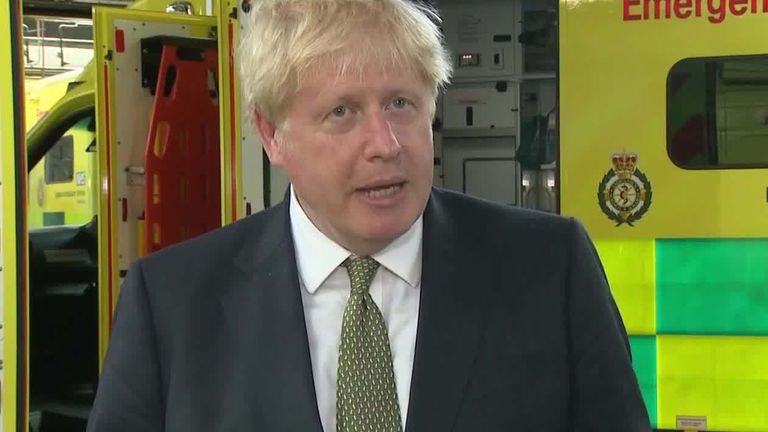
Prime Minister Boris Johnson reassured voters: “Although of course we are going to be taking back control and we are controlling our immigration system, we’re not going to be simply slamming the gates and stopping anybody anywhere coming into this country.â€
Northern Ireland midfielder Mark Sykes has scored for Oxford United during his dream outing at Wembley in the League One play-off final.
he right-sided midfielder started against Wycombe, who didn’t include his international team-mate Paul Smyth in their match-day squad.
And he marked what he had last week called a ‘dream’ match at Wembley with a goal.
Wycombe had led at half-time thanks to a goal from their trademark corner routine, as Anthony Stewart got on the end of a wicked Joe Jacobson set-piece.
Oxford, who were the fancied side before the game, hit back after the break through Sykes’ second league goal for the club.
There may have been a slice of fortune as what looked like a cross drifted over Wycombe goalkeeper Ryan Allsop and into the top corner.
Watch it here:
From Mourneview to Wembley! 👊🏼 Five years ago he was writing on Facebook about a dream of playing at England’s famous stadium, now Mark Sykes has scored for Oxford in the League One play-off final at Wembley. pic.twitter.com/GVPRH5yO9u
Before last week’s semi-final win over Portsmouth, Sykes had told the Belfast Telegraph:
“A few weeks ago a memory came up on Facebook that five years ago I had written ‘Imagine being able to play at Wembley…’ I would have been 17 then and I remember thinking that I could do it one day.â€
Hong Kong Disneyland will close again on Wednesday to comply with a government-directed rollback of public activities in the region after an increase in coronavirus infections, the Walt Disney Company said on Monday. Disney called the closing of the theme park “temporary†and said its resort hotels at the Lantau Island complex would remain open.
With attendance of 6.5 million last year and an estimated 5,000 employees, Hong Kong Disneyland is the smallest park in Disney’s portfolio. Shutting it down again means little for the company’s bottom line. In fact, the theme park and resort hotel property has lost money for the last five years. Losses totaled about $13.5 million last year. Pro-democracy demonstrations in the city have resulted in a sharp decline in tourism.
But it is re-closing at a highly awkward time for Disney. Over the weekend, Disney executives in Florida cited the smooth reopening of Hong Kong Disneyland and other Disney parks in Asia as evidence that the company’s largest resort, Walt Disney World, could reopen safely, even as coronavirus cases in Florida surge to alarming levels. On Monday, Florida officials reported 12,624 new infections, one of the largest daily jumps in the state since the pandemic began.
Hong Kong Disneyland, 53 percent of which is owned by the local government (with Disney controlling the balance), initially closed because of the virus on Jan. 26. It reopened on June 18 with limited capacity and other safety measures, including temperature checks for visitors and employees. The 14-year-old complex includes three hotels with more than 1,700 total rooms. Attendance has been very light since it reopened.
In re-closing Hong Kong Disneyland, Disney is complying with government restrictions announced on Monday by Carrie Lam, the territory’s chief executive, after local health authorities reported 52 new cases of coronavirus. (Since late January, Hong Kong has reported 1,522 cases.) The park’s closure was “required by the government and health authorities in line with prevention efforts taking place across Hong Kong,†Disney said.
Gyms, mahjong parlors and cinemas will also close on Wednesday. Hong Kong also prohibited all dining inside restaurants every evening from 6 p.m. Health officials said the territory’s new spate of cases was mainly connected to taxi drivers, restaurants and nursing homes.
Shanghai Disneyland reopened on May 11. A pair of Disney parks in Japan, Tokyo Disneyland and Tokyo DisneySea, reopened on July 1.
Disney also plans to reopen two more Florida theme parks, Epcot and Hollywood Studios, on Wednesday, a decision that has been greeted by enthusiasm from many fans and extreme dismay by others, including some Disney workers. Disney World, which attracted more than 50 million visitors last year, has recalled roughly 20,000 furloughed union employees for its phased reopening, which includes an array of safety protocols.
County and state officials in Florida approved Disney World’s reopening plan. NBCUniversal reopened its three theme parks in central Florida more than a month ago.
“Covid is here, and we have a responsibility to figure out the best approach to safely operate in this new normal,†Josh D’Amaro, Disney’s theme park chairman, said in an interview last week. “Businesses across the country are open, whether it’s a local pizza shop in Orlando or an airline taking on new guests.â€
But authorities in California have slowed down the entertainment company’s plan to reopen the Disneyland Resort in Anaheim. After an increase in coronavirus cases in California and an outcry from some Disneyland workers about safety, Gov. Gavin Newsom made it clear that he would not give theme parks in the state a green light to reopen in time for Disneyland to come back online this Friday, as Disney had hoped.
“We have a very strong spirituality, so she was there and took my hand and told me that I will get out of this, to take care of my people,” he said.
Five days after his mother’s passing, his father died, too. Tseremeywá, his head shaved in a traditional display of mourning, hopes he can fulfill his mother’s instruction to lead his Xavante people out of Covid-19.
Now recovering from his own battle with the coronavirus, Tseremeywá’s first step was to try to get his people to stop listening to Brazil’s President Jair Bolsonaro.
“I would like Jair Bolsonaro to stop talking stupid nonsense. The doctors have to prescribe, not the President,” Tseremeywá tells me over a video call from his home in the Brazilian state of Mato Grosso. “With this fascist, anti-indigenous, anti-poor government, it did not take prevention seriously. It did not prepare, ignoring that the government is by the people, for the people.”
His thread made no mention of the more than 72,000 dead and nearly 2 million infections, second only to the US, but instead focused on the economy.
“Millions of jobs destroyed, tens of millions without income and a country on the brink of recession,” he tweeted as he called for families to “depoliticize” the pandemic after so much “misinformation was used as a weapon.”
A century ago, when British explorer Percy Fawcett disappeared in the thick jungle of Mato Grosso searching for the Lost City of Z, Tseremeywá’s Xavante had this edge of the Amazon to themselves.
Even today, they had hoped that the coronavirus would stay away from Xavante territory, Lucio Terowa’a, secretary of the Federation of Indigenous Peoples and Organizations of Mato Grosso, told CNN earlier.
But with the area now surrounded by cattle ranches and massive farms, many of which supply soybeans to the United States and China, there was no avoiding the outside world and its pandemic.
It was a soybean trucker who unwittingly brought the coronavirus to this region before dying. Once it touched the indigenous people, the virus burned through a population already struggling with vulnerable immune systems, diabetes, deep mistrust of the outside world and a way of communal living that makes social distancing nearly impossible.
Tseremeywá and his people do have an ally in the mayor of Barra do Garças, Roberto Angelo De Farias, who fears the virus is out of control.
“It’s like a bomb,” he said. “Today is 200, tomorrow 1,000, 2,000, 3,000. Because they don’t do isolation, they keep doing their ceremonies from ancient times. And my suggestion for the President, and the minister, and embraced by the deputies and senators, that we would build a field hospital.”
According to Brazil’s official numbers, 13,801 of the nation’s 850,000 indigenous people are infected with the coronavirus and 491 have been killed, but given the dire lack of testing, those numbers are unlikely to reflect the true toll.
As the pandemic spread, Brazil’s Congress passed a bill that would provide clean water, disinfectant and hospital beds for this country’s 850,000 indigenous natives but those efforts were vetoed by Bolsonaro.
So many groups have to rely on charitable neighbors, NGOs or donations from strangers to help flatten their frightening Covid-19 curve.
“Our youth are becoming orphans,” says Clarêncio Urepariwe, now running a campaign to raise enough money to buy oxygen for his Xavante village.
“We are not only losing our fathers, but we are becoming orphans of knowledge, of wisdom, of life and culture itself. We are losing our elders and they are taking our way of life with them.”
In the three years since the death in prison of Nobel peace laureate Liu Xiaobo, the ruling Chinese Communist Party has succeeded in suppressing free speech and public dissent to unprecedented levels, fellow activists said on Monday.
Activists’ group the Liu Xiaobo Association said that even Liu didn’t imagine quite how fast Beijing would move to exert direct control over Hong Kong, where a draconian security law was imposed on the city on June 30.
“Liu Xiaobo expressed his love for Hong Kong many times during his lifetime,” the group said in a statement on Monday, the third anniversary of Liu’s death from advanced liver cancer at the No. 1 China Medical University Hospital in the northeastern city of Shenyang, under tight security.
At the time of his death at the age of 61, Liu had been serving an 11-year jail term for “incitement to subvert state power,” linked to his online writings promoting democracy and constitutional government.
That charge, which is typically used to target peaceful critics of Beijing, was recently introduced into Hong Kong despite promises that the city would retain a separate legal jurisdiction and traditional freedoms of speech and association after the 1997 handover to China.
Liu’s best-known work as co-author was Charter 08, a document that was signed by more than 300 prominent scholars, writers, and rights activists around the country.
In the document, the former literature professor called for concerned Chinese citizens to rally to bring about change, citing an increasing loss of control by the Communist Party and heightened hostility between the authorities and ordinary people.
Liu’s late diagnosis, and the refusal of the ruling Chinese Communist Party to allow him to go overseas on medical parole, sparked widespread public anger.
“Hong Kong was the last bastion of freedom of speech and the only Chinese city where one could still commemorate the 1989 Tiananmen massacre,” the statement said.
“It must have been hard for Liu to predict quite how fast the Communist Party would colonize Hong Kong and make it like mainland China,” it said.
A Charter 08 co-author in the northern Chinese city of Taiyuan who declined to be named, said that many people still remember Liu silently in China.
“I don’t know much about Liu Xiaobo,” the man said. “Lots of people know his name, of course.”
“Today, on the third anniversary of his death while serving time as a political prisoner, I feel as if there is no hope, no future, in this political environment,” he said.
‘An erudite, gentle man’
Liu’s friend and fellow activist Ma Qiang said Liu had once controversially written that China could do with “300 years of colonization,” so it could catch up with Hong Kong politically.
“What Xiaobo actually said was that Hong Kong, having once been a British colony, had ended up with a social structure and civic consciousness that was completely different to that of mainland China,” Ma said.
“The civic consciousness of the people of Hong Kong formed a modern civilization that became a part of international mainstream,” he said. “China, however, remained stuck with its [older] class system and its agricultural system, and couldn’t extricate itself.”
“I met Liu Xiaobo in about 1999, when he had just gotten out of ‘re-education through labor,’ when a mutual friend asked for my help installing his computer,” Ma recalled.
“He was the quintessential scholar; an erudite and gentle man, who also had a sense of humor. It was a pleasure to interact with him,” he said.
Beijing-based rights activist Hu Jia said people might manage to commemorate Liu, whose ashes were buried at sea by the authorities in a secretive ceremony, by going to the seashore, but would need to be careful not to be caught, as previous seashore commemorations had resulted in detentions by the state security police.
“The main thing is a seashore memorial,” Hu told RFA. “If you live in mainland China, you could do that alone, although on a sensitive date like today, it’s possible that there will be police patrolling the seashore in [the northeastern city of] Dalian.”
“Even if you post something to your WeChat friends, you could be targeted by the authorities,” he warned. “I saw that someone had posted today without mentioning his name; they just talked about a third anniversary, a seashore offering, a candle, and an empty chair.”
Long, nonviolent struggle
Liu was awarded the 2010 Nobel Peace Prize “for his long and nonviolent struggle for fundamental human rights in China” in a decision that infuriated Beijing, which said he had broken Chinese law. During the Nobel Peace Prize ceremony in Oslo, he was represented by an empty chair.
Beijing cut off trade ties with Norway in the wake of the award, and placed Liu’s wife, the poet and photographer Liu Xia, under house arrest for eight years from the date the award was announced.
Liu Xia, who has been living in Germany since 2018, has suffered from severe mental health problems as a result of her treatment at the hands of the authorities.
Liu said in 2019 that she and Liu Xiaobo had little chance to speak to each other in the weeks before his death, and that she was having trouble accepting his loss.
Reported by Qiao Long for RFA’s Mandarin Service. Translated and edited by Luisetta Mudie.
California is battling a huge coronavirus outbreak in its state prisons, with thousands of inmates in facilities across the region infected.
Advocates and attorneys long warned that living conditions in the overcrowded institutions would prove fertile ground for the virus. Families and rights organizations say the state botched its response to the pandemic, failing to curb the spread of the virus and provide basic care and protections for prisoners.
Here’s what you need to know:
How bad is the crisis?
As of 13 July, the California department of corrections and rehabilitation (CDCR) had reported 6,289 coronavirus cases and 33 deaths among incarcerated people, and 1,243 staff members had tested positive for the virus. Almost 4,000 half of the total cases were listed as “resolvedâ€, bringing the number of active infections to 2,438 .
CDCR reported the first infection of a prisoner in late March. By that time, several prison staffers had already tested positive. The first large outbreaks occurred at the California Institutions for Men and Women (CIM and CIW) in the city of Chino, about an hour’s drive from Los Angeles, but they have since spread across the state. In San Quentin state prison, California’s oldest correctional facility, 1,455 people, or more than one in three inmates, have tested positive, according to the CDCR.
The majority of cases have been concentrated in 10 of CDCR’s 35 facilities:
The California Institution for Men
California Institute for Women
Avenal state prison
Los Angeles state prison
Chuckawalla Valley state prison
San Quentin state prison
Corcoran state prisons
The California Rehabilitation Center
California correctional center
California correctional institute
In addition to the risks to incarcerated people, staff, and their families, the outbreaks in prisons in more rural areas are catalyzing concerns about hospital and ICU capacity. As of 10 July, 91 incarcerated people were being treated in outside hospitals, according to CDCR. In new Covid-19 hot spots like Imperial county and Riverside county (where Chuckawalla Valley state prison is located), this combination of community and prison spread threatens to overwhelm local hospital systems.
“We can’t act like prisons don’t exist and people don’t come in and out of them,†said Michael Bien, an attorney who’s been representing inmates in the years-long lawsuit focused on reducing the California prison population. “Many of these prisons are in places where there are no hospital resources and those areas can be overwhelmed very quickly.â€
As the US reported its first positive Covid-19 cases and states began to ban group gatherings and mandate social distancing in March, criminal justice reform advocates and attorneys began warning that the conditions in many correctional facilities could lead to a rapid spread of the virus.
Many California prisons are filled beyond capacity, with buildings poorly ventilated, tiers that are just a few feet wide, shared bathroom facilities, and dense dormitory-style housing units filled with rows of bunk beds. Social distancing in prison, advocates warned, was near impossible.
Meanwhile, incarcerated people are at higher risk of physical and mental health challenges than the general public, according to the US Office of Disease Prevention and Health Promotion, while inmates have long complained about substandard care and few correctional facilities are equipped to address the specific health needs of people over 50.
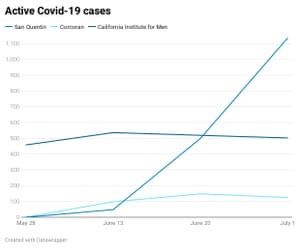
At the end of May, for example, 121 prisoners who were considered at high- risk of infection were transferred from CIM to San Quentin and 66 were transferred to Corcoran. Before the transfer, San Quentin had zero positive cases and Corcoran had one.
Within three weeks of the transfer, the prisons had nearly 500 and 150 cases respectively. Then in June, inmates from San Quentin were sent to the California correctional center (CCC) in Lassen County. Within a week, cases in CCC shot from zero to 210.
The transfers, Assemblyman Marc Levine said at a state senate hearing, were “the worst prison health screw-up in state historyâ€.
The California governor, Gavin Newsom, has acknowledged that the transfer was a catalyst for the outbreaks and says he is working with prison officials and healthcare experts to decrease the populations in San Quentin and throughout the California prison system.
“It’s been incredibly frustrating that we had someone make the decision to transfer a few patients from one prison – Chino – into San Quentin and that decision created the chain of events that we’re now addressing,†Newsom said during a 9 July news conference.
“All of us are now accountable to addressing this issue in a forthright manner.â€
What has been the impact within prisons?
CDCR has implemented several efforts to enforce social distancing measures and limit the spread of the virus within facilities. It cancelled all visitation to prisons and began the expedited parole of almost 3,500 people with less than 30 days on their sentences. It curbed the movement of prisoners within facilities. And it mandated face masks for correctional officers and suspended intake from county jails on three occasions.
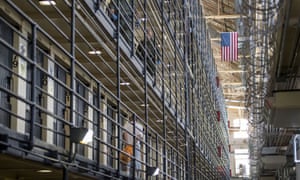
The California Institution For Men in Chino, California. Photograph: Ed Crisostomo/AP
But inmates, correctional officers, and prison medical personnel have all complained about the lack of protective and hygiene supplies such as masks, gloves, hand sanitizer and soap.
This situation is exceptionally worrisome for those with a high risk of complications if they develop Covid-19. Almost 40% of CDCR inmates have at least one condition – be it hypertension, cancer, or diabetes – that makes them vulnerable to severe illness from Covid-19, according to court filings.
Some prisoners who have tested positive say they feel they’re being punished. “This shit is driving me insane!†Rashea Gianunzio’s husband, who contracted Covid-19 in Corcoran, wrote in early June. “I feel like I’m being punished and haven’t been outside in three weeks and haven’t had fresh air in what feels like forever. I think I’m losing my mind.â€
Many prisoners have said the uncertainty around transfers, worries about being put in lockdown and the lack of communication with loved ones is adding to the existing stress of long-term incarceration.
“I’ve only been able to talk to my family through unofficial means, and I didn’t have it in me to tell them that I was being transferred,†a young man incarcerated in San Quentin told the Guardian. He requested anonymity for fear of being punished for speaking to the press and was one of 50 men scheduled to be transferred from San Quentin to North Kern state prison in Delano, California. “The fact that the prison administration would juggle my body from place to place rather than set me free does something to my soul and makes me feel like I don’t have value,†he added.
Prison staff have complained they are exhausted. “Our staff are being put into a dangerous position and are being mandated and drafted to work additional shifts day after day until we are physically and emotionally exhausted,†said Karen Franklin, a nurse in San Quentin, during a 1 July senate hearing.
Covid-19 cases at California prisons over two weeks. Illustration: Guardian Design
“We sleep in our cars because we know that we are not in the position to safely drive. And when we inform our supervisors of our exhaustion we are threatened with advert actions,†she said.
On 1 June, about 20 people began a hunger strike in protest of the poor conditions inside San Quentin.
And what about outside?
Many family members of people who have contracted Covid-19 in prison are deeply concerned. Several families report being unable to connect with prison leadership for status updates on their loved ones and many now rely on letters for updates.
“No one from the prison ever called me about my son,†said Donella Hodges, whose 31-year old son has been incarcerated in Corcoran since 2013 and told his mother about his 7 June Covid-19 diagnosis in a letter. “When he told me that he tested positive, I began to call the counselors, the supervisors, and the chaplain. Everybody started hanging up in my face,†she said.
Several families have formed support groups on social media to share information, offer words of encouragement, and lambast the state’s response to Covid-19 inside its prisons.
An inmate walks to his cell as corrections officers patrol at San Quentin in 2016. Photograph: Bloomberg/Bloomberg via Getty Images
“You hear about these horrors in prison and now it’s happening to us,†said Emelia O’Brien, whose husband, Sean O’Brien, is serving a life sentence in Corcoran and tested positive for Covid-19 in early June. “Having a person that you love in prison and not being able to do anything to help them is a helpless feeling because you know that they’re in pain and they’re suffering.â€
What can the state do to ease the crisis?
Since the first positive cases were reported, local legislators and public health officials have been calling on Newsom to ease the density in the state’s overpopulated prisons by granting more clemencies and creating a pathway for mass releases that would prioritize inmates over 60 and those with pre-existing conditions.
“Newsom doesn’t have some magic wand that he could use to completely prevent anyone in prison from contracting Covid, but there’s so much stuff he could have done in the short and long term,†said Anoop Prasad, a staff attorney with Advancing Justice – Asian Law Caucus, a civil rights and legal advocacy organization.
“Newsom and the CDCR need to depopulate our prisons safely because Covid is not going away anytime soon and there’s no long term plan to deal with this,†he continued, echoing the position of advocacy groups across the state.
Since early March, CDCR has reduced its population by more than 8,000 people through coronavirus-induced expedited paroles and the suspension of transfers from county jails. And on 16 June, it announced an estimated 3,500 prisoners would be eligible for a program that would allow people with 180 days or less left on their sentences to serve the remaining time in “community supervisionâ€. It is unclear, however, how many inmates will meet all of the criteria for relief.
Still, as of 10 June, 30 of 35 California correctional institutions are filled over capacity, according to recent court filings. And organizers and lawyers have decried the fact that the measures have left out the majority of state inmates over 65 years of age, since anyone in prison for a violent or serious felony, domestic violence, or who would have to register as a sex offender upon release did not qualify for the initial rounds of relief. They note that according to a 2017 United States Sentencing Commission report that evaluated this elderly population in federal prisons, the reincarceration rate was less than 10% and that many have families who are ready to care for them.
“The narrative about violent crime has been used to prevent the possibility of saving lives,†said Emily Harris, policy director for the Ella Baker Center for Human Rights. “This is the moment that those who have been working to get people out of prison for years have feared. These outbreaks reinforce why the path that California has taken – to lock people up – is not the answer to public safety, health or our wellbeing.â€
In a late March response to an emergency motion calling for the expedited release of thousand of incarcerated people, the state said it could not enact mass releases due to “the impact on already strained communities [where] community hospitals, social services and safety nets and other infrastructure are highly stressed, struggling mightily to address the current needs of the communityâ€.
In addition, Newsom has pointed at the issue of adequate post-release housing as a factor that makes mass releases difficult.
On 10 July, prison officials announced three initiatives that they say will lead to the release of up to 8,000 people by the end of August.
The first effort expands upon a program that allows people with 180 days or fewer on their sentences to serve the remaining time in home confinement. This program now includes people who are incarcerated for what the state describes as serious felonies.
The second move is the immediate review of cases of those incarcerated at eight prisons with large “high-risk†populations.
Finally, the state will launch a one-time initiative wherein almost 95% of the prison population will receive a credit shortening their sentences by three months. For 3,100 people, the credit will allow their release when the program begins on 1 August.
Face coverings must be worn in shops and supermarkets in England from Friday 24 July, Boris Johnson has announced.
Enforcement will be carried out by police – not retail staff – and anyone failing to wear a face covering while shopping will be subject to a fine of up to £100, or £50 if paid within 14 days.
The rules to tackle coronavirus will be the same as those currently applicable on public transport in England, which means children under 11 and people with certain disabilities will be exempt.
Image: People who flout the rule face a £100 fine
The wearing of face coverings became compulsory in Scotland last week and around 120 countries – including Germany, Spain, Italy and Greece – now require coverings to be worn in public places.
Announcing the move, a Number 10 spokesperson said: “There is growing evidence that wearing a face covering in an enclosed space helps protect individuals and those around them from coronavirus.
“The prime minister has been clear that people should be wearing face coverings in shops and we will make this mandatory from July 24.”
The decision, due to be outlined by Health Secretary Matt Hancock in a Commons statement on Tuesday afternoon, follows four days of conflicting statements from ministers and demands from opposition MPs for clarity.
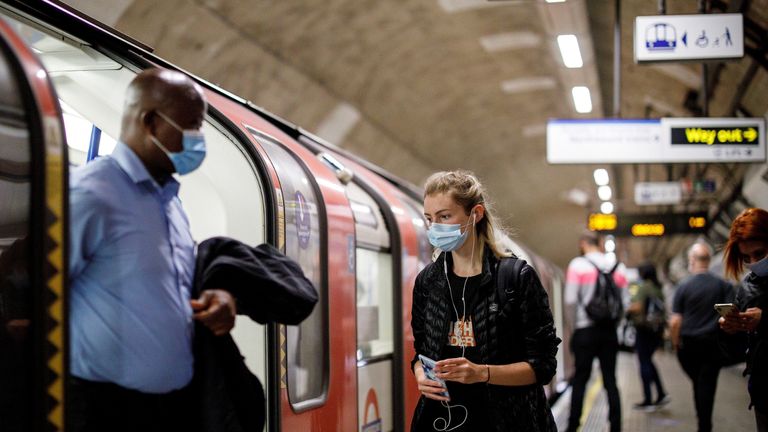
Image: The rule is already in place on public transport in England
Responding to the announcement confirming mandatory face coverings, shadow health secretary Jon Ashworth said: “The government has been slow and muddled again over face coverings.
“Given the government’s own guidance issued on 11 May advised in favour of face masks, many will ask why yet again have ministers been slow in making a decision in this pandemic, and why it’ll take another 11 days before these new guidelines to come into force.”
London mayor Sadiq Khan went further and called the government’s “confused communications” on the subject a “disgrace”.
“We can’t afford to wait another day and the government should bring this policy in immediately – further delay risks lives,” he urged.
And the British Chambers of Commerce’s co-executive director Claire Walker said: “Businesses need clarity on the approach to the wearing of face coverings that is consistent and supported by public health evidence.
“Shops and other indoor businesses need to know what the new rules are as soon as possible.
“Updated guidance, including on enforcement, should be issued swiftly so firms can maintain their COVID-secure status and continue their operations successfully.”
PM: ‘Important to wear face masks in shops’
In his most recent statement on face coverings, 12 hours before the official confirmation by Number 10, Mr Johnson said: “I think that as throughout this crisis people have shown amazing sensitivity towards other people and understanding of the needs to get the virus down by doing things cooperatively.
“I think wearing masks is one of them. In a confined space what you’re doing is you’re protecting other people from the transmission that you might be giving to other people.
“And they in turn they’re are protecting you. It’s a mutual thing. People do see the value of it.”
But just one day earlier, Michael Gove suggested masks in shops should not be mandatory, saying he believed shoppers should be encouraged to wear them, but he believed in “people’s good sense”.
And Home Secretary Priti Patel was pictured meeting her French counterpart indoors without wearing a mask over the weekend – despite being seen wearing one speaking to him outdoors on the same day – sparking claims ministers were sending mixed messages.
Image: Priti Patel switched between wearing and not wearing a mask
Since 11 May, government guidance has advised the public to wear face coverings in enclosed public spaces, where they may come into contact with people they would not usually meet.
The use of face coverings became mandatory on public transport in England from 15 June.
Although Mr Hancock will confirm that the government guidance will be updated to make the wearing of face coverings in shops and supermarkets compulsory, he will say that guidance for other settings will be kept under review.
Regulations will be made under the Public Health (Control of Disease) Act 1984. While shop employees should encourage compliance, the government said retailers and businesses will not be expected to enforce the policy.
The Nasdaq hit a fresh intraday record as investors cheered signs of progress in COVID-19 vaccine development and an upbeat start to the second-quarter earnings season by PepsiCo.
Tennessee Gov. Bill Lee (R) signed an extreme bill into law on Monday banning abortion as early as six weeks into pregnancy ― before many people even know they are pregnant.Â
Lee signed the legislation on Facebook Live, calling it a historic moment and characterizing the bill as “the most conservative, pro-life†piece of legislation in the country. “Life is precious and everything that is precious is worth protecting; we know that in Tennessee,†he said. Â
The ban was in effect for less than an hour before a federal court blocked it.Â
The legislation, approved by the state legislature in the middle of the night on June 19, was the first abortion ban to be passed since the coronavirus pandemic began. It prohibits abortions once a doctor can detect cardiac activity in an embryo, which typically happens at around six weeks into a pregnancy. While anti-abortion groups call such measures “fetal heartbeat†bans, medical professionals say that is a misleading and inaccurate term. Legal challenges have also blocked similar legislation in other states.
Tennessee’s law also prohibits the procedure if the doctor is aware the decision is motivated by the race or sex of the fetus, or a diagnosis of Down syndrome.
The Center for Reproductive Rights, the American Civil Liberties Union, Planned Parenthood Federation of America and the American Civil Liberties Union of Tennessee filed an emergency lawsuit challenging the ban in court as soon as the legislature passed it.
On Monday, a federal district court in Tennessee issued a temporary restraining order to block the law from going into effect. U.S. District Judge William Campbell wrote that the court was “bound by the Supreme Court holdings prohibiting undue burdens on the availability of pre-viability abortions.â€
Tennessee’s ban is blatantly unconstitutional, Jessica Sklarsky, senior staff attorney at the Center for Reproductive Rights, said in a statement. “It is unconscionable that — in the middle of a public health crisis and a national reckoning on systemic racism — lawmakers are focused on trying to eliminate access to abortion,†she said. “Tennessee should stop attacking reproductive healthcare and instead work to implement policies that will help marginalized communities. This law does the exact opposite.â€
The abortion ban comes a few months after Lee attempted to halt abortion services in the state due to the coronavirus pandemic.
Tennessee was one of 12 states that classified abortion as a nonessential medical procedure, arguing that abortion clinics should stop seeing patients to conserve personal protective equipment for coronavirus cases. The state was sued and the ban was overturned.
Calling all HuffPost superfans!
Sign up for membership to become a founding member and help shape HuffPost’s next chapter
NEW YORK (AP) — One or more victims of Jeffrey Epstein will tell a judge Tuesday that his ex-girlfriend should be denied bail on charges that she recruited teenage girls for him to sexually abuse in the 1990s, prosecutors said Monday.
Prosecutors made the revelation in court papers as they argued there is no reason to free British socialite Ghislaine Maxwell on bail.
They also revealed new details about Maxwell’s July 2 arrest at a $1 million New Hampshire estate she purchased in December, saying FBI agents had to bust into her residence after she failed to cooperate.
“As the agents approached the front door to the main house, they announced themselves as FBI agents and directed the defendant to open the door,†prosecutors wrote. “Through a window, the agents saw the defendant ignore the direction to open the door and, instead, try to flee to another room in the house, quickly shutting a door behind her.â€
The government said agents were forced to break through the door to arrest Maxwell, who was in an interior room in the home. Prosecutors also revealed that Maxwell had been guarded at the home by a security company staffed with former members of the British military.
The descriptions were made as prosecutors sought to boost arguments that the 58-year-old citizen of the U.S., the United Kingdom and France should remain behind bars until trial. They said she had the money, the means and the incentive to flee since she could face many years in prison, if convicted.
Prosecutors told a Manhattan federal judge in court papers that at least one woman and possibly more were expected to exercise their right to appear at Tuesday’s hearing and ask that Maxwell be detained until trial. And they also revealed that additional individuals have offered the government evidence to support its case since Maxwell’s arrest.
“The Government is deeply concerned that if the defendant is bailed, the victims will be denied justice in this case,†prosecutors wrote.
They also revealed that two of three women who alleged they were recruited by Maxwell to be sexually abused by Epstein had never spoken to law enforcement authorities until last year.
The filing came a day before an arraignment and bail hearing for Maxwell, who has been held for the last week at a federal jail in Brooklyn.
On Friday, her lawyers filed arguments that said she’s being made a scapegoat after Epstein killed himself in a Manhattan lockup last August. They said she should be freed on $5 million bail with electronic monitoring.
Calling all HuffPost superfans!
Sign up for membership to become a founding member and help shape HuffPost’s next chapter
We use cookies on our website to give you the most relevant experience by remembering your preferences and repeat visits. By clicking “Accept”, you consent to the use of ALL the cookies.
This website uses cookies to improve your experience while you navigate through the website. Out of these, the cookies that are categorized as necessary are stored on your browser as they are essential for the working of basic functionalities of the website. We also use third-party cookies that help us analyze and understand how you use this website. These cookies will be stored in your browser only with your consent. You also have the option to opt-out of these cookies. But opting out of some of these cookies may affect your browsing experience.
Necessary cookies are absolutely essential for the website to function properly. These cookies ensure basic functionalities and security features of the website, anonymously.
Cookie
Duration
Description
cookielawinfo-checbox-analytics
11 months
This cookie is set by GDPR Cookie Consent plugin. The cookie is used to store the user consent for the cookies in the category "Analytics".
cookielawinfo-checbox-functional
11 months
The cookie is set by GDPR cookie consent to record the user consent for the cookies in the category "Functional".
cookielawinfo-checbox-others
11 months
This cookie is set by GDPR Cookie Consent plugin. The cookie is used to store the user consent for the cookies in the category "Other.
cookielawinfo-checkbox-necessary
11 months
This cookie is set by GDPR Cookie Consent plugin. The cookies is used to store the user consent for the cookies in the category "Necessary".
cookielawinfo-checkbox-performance
11 months
This cookie is set by GDPR Cookie Consent plugin. The cookie is used to store the user consent for the cookies in the category "Performance".
viewed_cookie_policy
11 months
The cookie is set by the GDPR Cookie Consent plugin and is used to store whether or not user has consented to the use of cookies. It does not store any personal data.
Functional cookies help to perform certain functionalities like sharing the content of the website on social media platforms, collect feedbacks, and other third-party features.
Performance cookies are used to understand and analyze the key performance indexes of the website which helps in delivering a better user experience for the visitors.
Analytical cookies are used to understand how visitors interact with the website. These cookies help provide information on metrics the number of visitors, bounce rate, traffic source, etc.
Advertisement cookies are used to provide visitors with relevant ads and marketing campaigns. These cookies track visitors across websites and collect information to provide customized ads.