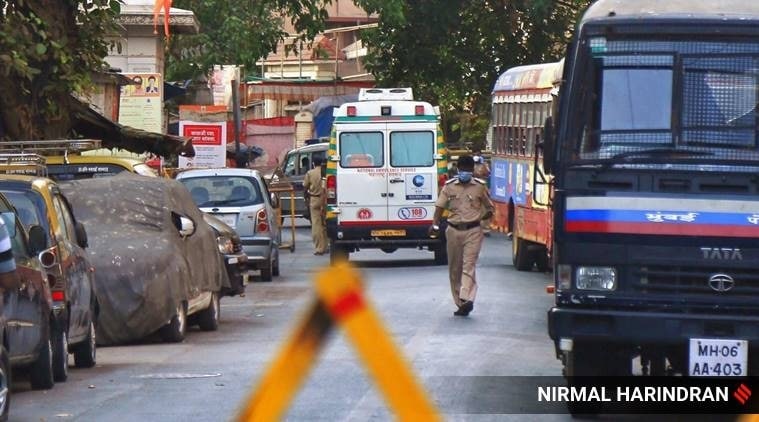
Those seeking to come to AP from other states in private vehicles should obtain an e-pass through the government’s ‘Spandana’ web portal and undergo medical tests. (Representational)
As the COVID-19 lockdown 5.0 came into effect on Monday, the Andhra Pradesh government has decided not to unlock its borders yet for inter-state movement of vehicles and people.
State Director General of Police D G Sawang said in a release that restrictions on inter-state movement of people would remain in force “till a further decision is taken.â€
Those seeking to come to AP from other states in private vehicles should obtain an e-pass through the government’s ‘Spandana’ web portal and undergo medical tests.
“Those seeking to come from less coronavirus-affected states will be sent to home quarantine and those from highly- affected states will be sent to institutional quarantine for seven days. After that, if they test positive for COVID-19, they will be sent to hospital or, if negative, for home quarantine for further seven days,†the DGP said.
“The prohibitory orders will continue at the inter-state borders till the government comes out with clear orders,†Sawang added. Meanwhile, State Covid Nodal Officer Arja Srikanth said people coming to AP by trains from other states would be tested at the railway stations or district reception centres.
“Those coming from foreign countries will have to necessarily go for government or paid quarantine for 14 days,†Srikanth said in a release.
Part of a park directly across the street from the White House went up in flames and many of America’s biggest cities were under curfew orders and the watchful eyes of National Guard troops overnight as police again clashed with demonstrators protesting the death of George Floyd in Minneapolis police custody.
Many large marches and demonstrations across the country were peaceful six days after Floyd, an African American man, died pleading for his life as a white officer pinned his neck to the ground.
Former Minneapolis police Officer Derek Chauvin is charged with third-degree murder and second-degree manslaughter in Floyd’s death. State Attorney General Keith Ellison will prosecute any cases, Gov. Tim Walz announced Sunday after Floyd’s family and Minneapolis-area legislators asked that the case be taken out of the hands of local prosecutors.
Violence and looting overshadowed many peaceful protests. More than 4,400 people were arrested in relation to the demonstrations across the country this weekend, according to a tally by The Associated Press. Arrests ranged from breaking curfews to blocking highways and theft.
Related
In Washington, D.C., New York, Philadelphia and other major cities, fires raged, looters romped and police vehicles came under attack.
A small National Park Service building was in flames in Lafayette Square Park in the nation’s capital but was put out by the D.C. fire department.NBC News’ Garrett Haake reported that the flames could easily be seen from the White House. A blaze in the basement of the 205-year-old St. John’s Episcopal Church, known as the Church of the Presidents, across from the White House, was also extinguished, NBC Washington reported citing fire officials.
Multiple fires burned in the Union Square and Midtown areas of Manhattan, city officials told NBC News as thousands of protesters remained in the streets Sunday night. One of those arrested in New York was Chiara de Blasio, Mayor Bill de Blasio’s daughter, who was taken into custody Saturday, a senior law enforcement official told NBC News. She has since been released, the official said.
Protesters smashed the windshields of numerous police vehicles in West Philadelphia and at least five officers were injured Sunday after having been struck by rocks, bricks and other projectiles, NBC Philadelphia reported. Police broke up some of the crowds by firing tear gas canisters and nonlethal ammunition.
At least nine fires were reported in Santa Monica, California, a tony coastal retreat west of Los Angeles, Fire Chief Judah Mitchell said. NBC News cameras captured people hauling looted merchandise out of stores in trash cans.
Washington State Gov. Jay Inslee called on the National Guard to expand its presence in the state on Sunday in response to “destructive protests and looting.” The decision will allow unarmed troops to be deployed in response to requests from local governments.
The Morning Rundown
Get a head start on the morning’s top stories.
The governor had already authorized at least 600 troops to help in Seattle and Bellevue earlier in the weekend.
And in Minneapolis, where the incident that sparked the week of national violence took place on May 25, a semitrailer barreled through a crowd of peaceful protesters with its horn blaring Sunday along an interstate highway through the city, witnesses and authorities said.
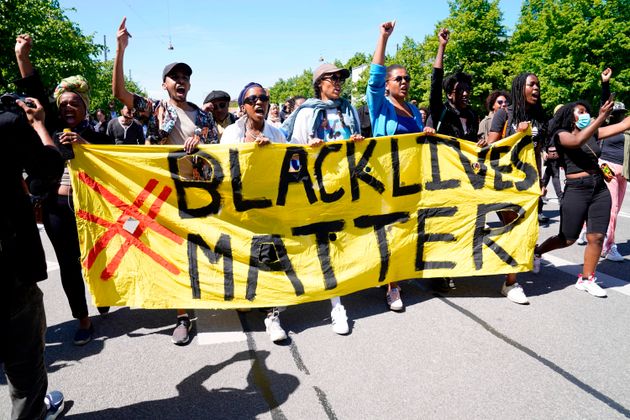
Authorities called the truck driver’s actions “very disturbing,” accusing the driver of “inciting a crowd of peaceful demonstrators” as they marched along Interstate 35, shouting “Black Lives Matter” and “Justice for George.”
Chanting “no justice, no peace” and “prosecute the police,” more protesters began showing up near the scene as the area’s curfew went into effect at 8 p.m.
Authorities began firing tear gas canisters a few minutes later. The crowd started to scatter and clear out, some of the doubled over and crying as they ran.
A short time before the truck rumbled through the crowd, Jasmine Howell, 27, told NBC News that she hoped the march would remain peaceful, but “you never know — it can turn so bad with just one thing.”
“This is a peaceful protest,” Howell said. “Silence can be powerful. That’s the message we’re trying to portray as far as unity, power and organization.”
She added: “I hope I wake up to tomorrow to good news and not bad.”
While protests in Minneapolis have gradually become less violent in the last two days, demonstrations gathered strength elsewhere, and many of America’s major cities remained under curfew orders Sunday night as National Guard forces watched and patrolled.
Guard members remained in the streets ahead of a curfew resuming at 8 p.m. as large protests continued Sunday in several cities in Los Angeles County, including Huntington Beach and Santa Monica, where looters ransacked businesses block by block.
Dramatic images of intense protests Saturday night showed demonstrators overtaking buses, setting multiple police cars on fire and shattering windows at dozens of businesses in downtown Los Angeles.
In Denver, Police Chief Paul Pazen said Sunday that dozens of police officers have been injured in the past week, one of whom remained in the hospital Sunday after having struck by a vehicle.
Several Chicago streets and transit routes remained closed Sunday as police and Guard units prepared for what they expected to be more protests as night fell. The trail of some of the protests Saturday night could be tracked by the procession of broken windows, graffiti and destruction of some of the city’s most popular shops, NBC Chicago reported Sunday.
Full coverage of George Floyd’s death and protests around the country
Atlanta Mayor Keisha Lance Bottoms announced Sunday that two police officers had been fired in connection with their involvement in the arrests of college students who were recorded on video being pulled from their car. Three officers were put on desk duty pending an investigation, Bottoms and Police Chief Erika Shields said at a news conference.
“I am genuinely sorry,” Shields said. “This is not what we are about.”
Viral video of New York police kneeling with demonstrators Sunday dramatically documented the cracks that have formed in the thin blue line of America’s law enforcement agencies as some officers denounced Floyd’s death and sometimes joined the protests.
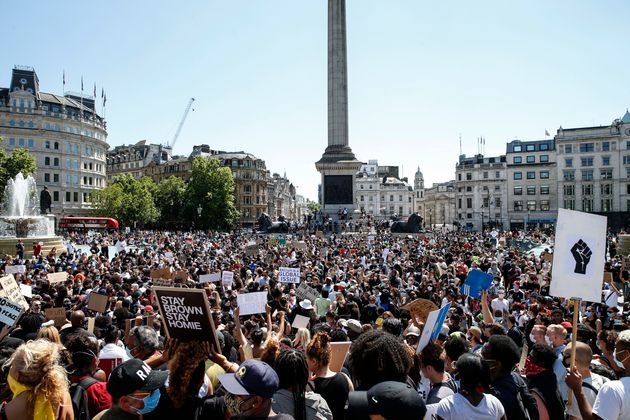
Meanwhile, the demonstrations began spreading around the world over the weekend. Hundreds of people gathered Sunday in Trafalgar Square in London, where protesters shouted “Say his name” and held signs reading “I can’t breathe,” Floyd’s last words.
Demonstrators gather at Trafalgar Square in London on Sunday, May 31, 2020, protest the death of George Floyd in Minneapolis police custody. Hollie Adams / Getty Images
At least three more protests were planned in London over the next week, including one outside the U.S. Embassy.
Thousands of protesters gathered outside the U.S. Embassy in Berlin on Saturday, some holding signs that read “Black Lives Matter,” “Justice for George Floyd” and “I Can’t Breathe.”
The coronavirus may invade the brain, according to doctors who performed brain scans on a COVID–19 patient who lost her ability to taste and smell.
The unnamed 25-year-old radiographer was working on a COVID-19 ward when she developed a mild dry cough that lasted for a day, according to a case study published in the journal JAMA Neurology. She then developed a severe loss of smell and taste. Doctors looked inside the woman’s nose but found no problems, and her chest scans were clear.
But an MRI brain scan revealed changes in adjacent areas to the nose and olfactory nerves, wrote Dr. Letterio S. Politi, of the IstitutoClinicoHumanitas and Humanitas University in Milan, Italy, and colleagues. As a disruption of these senses is a symptom of COVID-19, the woman was tested for the coronavirus. Her results can back positive.
After 28 days, doctors performed a follow-up MRI scan and the signs of problems had eased. She later recovered from anosmia.
The team also performed brain scans on two other COVID-19 patients with anosmia 12 and 25 days after their symptoms started, but found no issues.
Given the fact the woman had COVID-19, it is unlikely the findings were be the result of another condition, the team wrote. As such, the case is thought to be the first report of a COVID-19 patient showing a change in signalling “compatible with viral brain invasion” of the outer layer of the cerebrum linked to olfaction, they said.
Judging by the scans, the team “speculate that SARS-CoV-2 might invade the brain” through the olfactory system and result in problems with smell and taste. But the doctors said further research is needed to confirm the hypothesis.
The study was published the same day as a review of research related to neurological problems in patients with coronaviruses, the family of pathogens which the bug which causes COVID-19 is a member of. The team at the Yale School of Medicine found the most common neurological problems in COVID-19 patients are the loss of smell and taste, as well as headaches. However, others have been reported to experience stroke, issues with consciousness, seizures, and brain damage, known as encephalopathy. The findings were also published in JAMA Neurology.
Dr Tim Nicholson, clinical senior lecturer and honorary consultant neuropsychiatrist at King’s College London, U.K. who was not involved in the study, said in a statement that by showing changes in the structure of brain regions involved with detecting smells and taste that improved over time, the paper provides evidence that losing these faculties “might be due to direct brain invasion by the virus” rather than changes to the lining of the nose.
But Nicholson said: “As it is only a single case caution is needed in extrapolating this to other cases but it adds interesting supportive data and indicates a method of investigating the cause of this interesting and common symptom of COVID-19.”
Dr. Michael Zandi, consultant neurologist at the National Hospital for Neurology and Neurosurgery, U.K. who also wasn’t involved in the paper, said in a statement “the temporary nature of the changes is reassuring.”
Zandi said: “Detailed clinical studies of the brain in individuals who have had SARS-CoV-2 infection, including brain imaging, spinal fluid and blood analysis, and study of pathological specimens including post-mortem where available will help us understand what exactly is going on and help us treat those with serious brain and nerve involvement.”
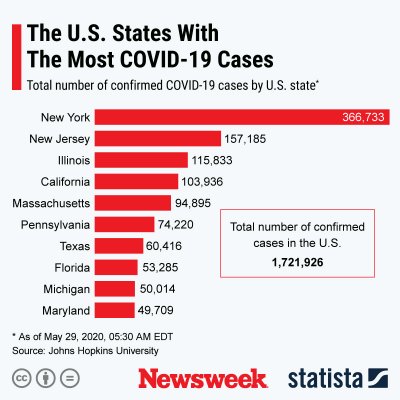
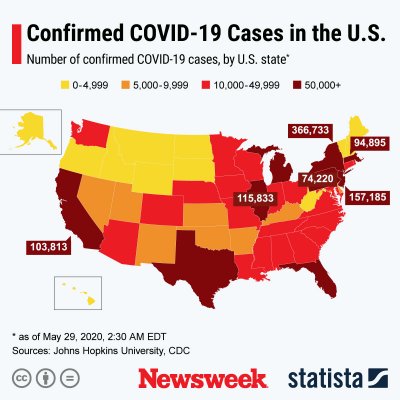
As the graph by Statista below shows, the U.S. is the country with the most known COVID-19 cases.
1 of 3
U.S. states with the highest number of confirmed COVID-19 cases. STATISTA
U.S. states with the highest number of confirmed COVID-19 cases. STATISTA The spread of COVID-19 cases across the U.S. STATISTA This graphic from Statista shows the countries with the most confirmed COVID-19 cases as of May 29. Statista
Hollie Adams via Getty ImagesPolice officers block a road close to the U.S. Embassy in London, where protesters gathered in support of the demonstrations in dozens of American cities.
Thousands of anti-racism campaigners around the world staged demonstrations on Sunday, acting in solidarity with Americans protesting police violence after George Floyd, a Black man, died after a white police officer kneeled on his neck for nearly nine minutes last week.
Demonstrators in London marched across the city after gathering in Trafalgar Square, where they kneeled en masse in honour of Floyd, before heading across the Thames to protest near the US embassy in Battersea.
Onlookers cheered and drivers honked horns from passing cars as the protesters chanted “say his name†and “Black lives matter.†At one point, four men climbed on top of a bus stop to lead the chants, before getting down on one knee in silence and encouraging the others to do the same.
Hollie Adams via Getty ImagesA Black Lives Matter march at Trafalgar Square in London on Sunday.
One demonstrator said the protests were “very important because it is sending a clear message that we have had enough racial injustice in our country.â€
Isabelle Orsini, 20, is originally from New York and now lives in Kensington. She told the Press Association news agency: “The US obviously has a much deeper and darker history of black discrimination compared to the UK. The reason people are so angry is because this is reopening wounds that go back hundreds of years. It is very important that we do whatever it takes to tell our government that racism will not be tolerated.â€
Protesters also marched to Grenfell Tower where 72 residents, most of whom were non-white, died in 2017.Â
Hundreds of people gathered for a similar demonstration in Manchester and chanted “Black lives matter.â€Â
Hundreds have taken to the streets in Manchester to protest over the death of George Floyd in Minneapolis pic.twitter.com/vmBmXbHHz9
— BBC Radio Manchester (@BBCRadioManc) May 31, 2020
Floyd’s death has also captured attention in Germany. On Sunday, the country’s top-selling Bild newspaper carried the headline “This killer-cop set America ablaze†and said that demonstrations in the US looked like “scenes like out of a civil war.â€
In Berlin, several hundred demonstrators staged a rally outside the US embassy, with posters bearing “Justice for George Floyd,†“Stop killing us†and “Who’s neckst.â€Â
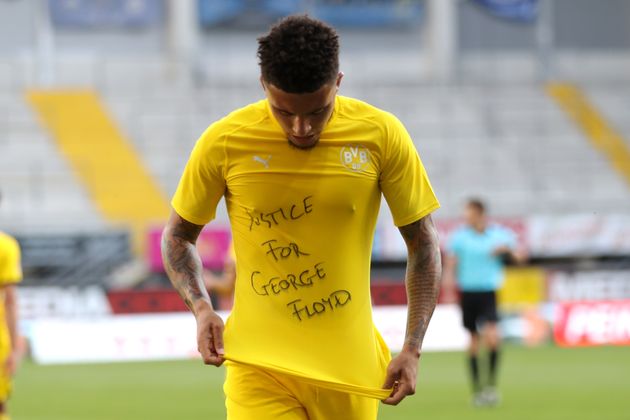
LARS BARON via Getty ImagesDortmund’s English midfielder Jadon Sancho shows a “Justice for George Floyd” shirt after scoring his team’s second goal during a Bundesliga match on Sunday.
Sports stars across Europe also joined the protests. Footballer Jadon Sancho, who plays for Borussia Dortmund in Germany, as well as England, revealed a “Justice for George Floyd†T-shirt after scoring his first goal since Germany’s top league, the Bundesliga, started up again after being halted due to coronavirus concerns. The south London-born player received a yellow card for taking his top off on the field.Â
At a separate match, Borussia Monchengladbach’s Marcus Thuram took a knee after scoring in Sunday’s win against Union Berlin, echoing former NFL player Colin Kaepernick’s protest against police brutality.Â
In a rare foray into US domestic affairs, Canadian Prime Minister Justin Trudeau said Canadians were watching the events in America “with shock and with horror,†HuffPost Canada reported.
“Anti-Black racism, racism is real. It’s in the United States, but it’s also in Canada. And we know people are facing systemic discrimination, unconscious bias, and anti-Black racism every single day,†Trudeau said in a statement on Friday.Â
“I call on all Canadians, whether it’s anti-Black racism or anti-Asian racism or racism discrimination of any type, to stand together in solidarity,†he continued, “to be there for each other and know just how deeply people are being affected by what we see on the news these past few days.â€
The UK’s Foreign Secretary Dominic Raab avoided responding to President Donald Trump’s incendiary reaction to the demonstrations that started in Minneapolis. Raab told the BBC’s Andrew Marr Show that he has “long kept to the self-imposed guidance not to comment on what President Trump says or indeed other world leaders, it is not really what my job is.â€Â
In Denmark, around 2,000 people gathered peacefully to protest outside the US embassy in Copenhagen on Saturday. The Local reports the crowd then marched toward Christiansborg Palace, holding up signs emblazoned with “Justice for George Floyd.â€Â
IDA GULDBAEK ARENTSEN via Getty ImagesA Black Lives Matter demonstration in front of the U.S. Embassy in Copenhagen on Saturday.
Italy remains in a partial lockdown but protesters gathered outside the US consulate in Milan on Thursday holding signs reading “I can’t breathe†and “stop killing black people.†Local media reported that the protesters simulated suffocation by gripping their hands around their necks.Â
In Mexico, people left flowers at a display commemorating Floyd on a security barrier outside the US Embassy in Mexico City on Saturday. In a similar scene, people lit candles in front of the US consulate in Krakow, Poland, on Sunday.
New home construction and major renovation projects could be boosted through cash grants under a federal government coronavirus recovery plan.
The ailing entertainment sector is also likely to receive stimulus, with the focus shifting from economy-wide packages to targeted assistance.
Prime Minister Scott Morrison confirmed the government was considering giving householders cash grants for home renovations.
Prime Minister Scott Morrison has said the federal government could give cash boosts to home renovators as part of its economic coronavirus recovery plan. (AAP Image/Joel Carrett) NO ARCHIVING (AAP)
“We are more interested in the larger projects and new home builds and things like that,” he told 2GB on Monday.
“We are looking at a bit of drop off in that current home building that’s going on. That’s not good for tradies and not good for jobs.”
He said it would be important any construction industry measures helped local tradies rather than major contractors.
Treasurer Josh Frydenberg said an announcement would be made soon, with the government conscious of long supply chains associated with building.
A decision on the boost is expected to be announced imminently. (AAP Image/Joel Carrett) (AAP)
“It’s not just the sparky and the plumber and the carpenter on the building site, it’s also the timber mill,” he told reporters in Melbourne.
“It’s also the appliance manufacturer for the new kitchen. It’s also those who help with the materials that go into the bathroom.”
Labor frontbencher Bill Shorten is wary of the details.
“If you offer a free grant for the price of say $5000 dollars, then normally what happens is the cost of whatever you’re providing the grant for goes up by $5000,” he told Sky News.
Larger construction projects and new home builds and renovations are in the sights of the government for the possible cash grant. (Fairfax Media)
Mr Morrison said he had been in talks with key entertainment sector figures over the weekend.
“One of the challenges is going to be that the entertainment sector will find it difficult to get capital moving again because they’ve had to draw down on it so significantly,” he said.
The government has copped heavy criticism from Labor for not doing more to help the arts sector through the crisis.
The opposition has been calling for a specific package with many missing out on JobKeeper wage subsidies.
But the treasurer said many arts workers were benefiting from the scheme.
Meanwhile, Mr Frydenberg says the market is anticipating negative growth in the March quarter when the latest national accounts figures are released on Wednesday.
He said bushfires and the onset of coronavirus restrictions were behind the expected fall.
“The Australian economy’s been remarkably resilient,” Mr Frydenberg.
“We went into the crisis from a position of great strength and that’s going to help us out of this crisis.”
Level 3 of lockdown is a different kettle of fish, isn’t it? What is believed to be South Africa’s first drive-thru strip club experience has opened its doors in Port Elizabeth on Monday, offering beer and snacks alongside the racy dance routines of the performers at Candy’s.
A drive-thru strip club in South Africa?
At 10:00 on Monday, the Walmer-based business invited locals to come and sample the innovative experience. Charl Muller, who owns the venue, told local publication The Heraldthat he is doing everything possible to ensure that his staff can work in a safe and hygienic environment:
“This will provide some fun and at the same time help these girls to earn some much-needed money after a long time sitting at home. We’ll have six girls on at a time and each customer, relaxing in [their] car, can enjoy two songs and a great experience. We’ll keep it clean and professional as far as COVID-19 is concerned.â€
How does a drive-thru strip club work?
The plans are something of a jaw-dropper. Schools are shut and many businesses remain on the scrapheap, yet here we have pole-dancers offering customers a Monday morning ‘pint and a peek’. But how, exactly, will Candy’s provide such a physical service in the age of coronavirus?
The dancers will strip as per their normal routine, but they’re now required to wear face masks.
All workers at Candy’s will be required to socially distance and have their temperatures taken daily.
They will perform on outdoor stages, in an enclosed partition which drivers can park-up next to.
Between 10:00 – 17:00, patrons will be able to buy coffee and snacks from the in-house cafe.
It’ll cost R250 to take-in a live show, and that won’t include the cost of your refreshments.
Adapting to change
Although the concept sounds a little crazy, it’s been particularly successful in America. Drive-through strip clubs have been thriving since lockdown began, as the contentious industry finds new ways to survive.
Establishments like Candy’s will always have their critics, but they are still a business with employees who desperately need to make money. The game may have changed, but the hustle remains the same…
Under normal circumstances, Joseph R. Biden Jr. might have delivered a speech on race in America on Sunday, covered by a press corps following him around the country. He might have visited Minneapolis or another city torn by violence. He might have summoned reporters to the front of his plane to critique President Trump’s leadership of a nation in crisis.
But at a moment that is emerging as a critical test for both Mr. Biden and Mr. Trump, the presumptive Democratic candidate for president is constrained by the limitations of a pandemic that has confined him to his home in Wilmington, Del., for the past three months.
Until now, Mr. Biden has sought to make the best of his circumstances with remote speeches, fund-raisers and interviews over Zoom, and digital advertisements.
Yet the president’s struggles are providing Mr. Biden with an opportunity to show an anxious nation how he might lead during these twin crises of civil unrest and a health emergency that has killed more than 100,000 Americans. The question is whether he can do this largely from the confines of his home or whether the moment has come to join other Americans — Mr. Trump among them — who have begun venturing into the world, to make his case to voters to oust a sitting president.
Mr. Biden may be thinking that moment has come. On Sunday, his announced schedule consisted only of delivering recorded remarks to a virtual rally in Maryland. But late in the day the former vice president made an unannounced tour of businesses in downtown Wilmington damaged during protests. On Monday he will meet with community leaders there.
Presidential campaigns can be defined by moments like this. Bill Clinton made a dramatic trip to Los Angeles, its streets empty and smoke still lingering in the air, after the riots of 1992. It was a high-risk move, providing images of Mr. Clinton touring the ruins of strip malls in Koreatown, playing basketball in what was called South-Central, and speaking at the First African Methodist Episcopal Church. He went on to defeat President George Bush six months later.
A visit by Mr. Biden to Minneapolis, or any of the other many American cities that were convulsed by protests and riots over the weekend, would be complicated because of the Covid-19 pandemic. Mr. Biden has broken his quarantine only twice for public appearances: the trip downtown on Sunday, and a visit on Memorial Day to lay a wreath at a veterans’ memorial.
But as tensions have mounted since the death of a black man, George Floyd, in the custody of Minneapolis police officers last Monday, Mr. Biden has raised, at least somewhat, his national profile — to the relief of some Democrats who fear he has had slipped off the radar screen in the midst of an epidemic that has riveted the nation.
He delivered remarks about the plight of black Americans on Friday, the day after Minneapolis was roiled by demonstrations. He issued a statement late Saturday night as looting and fires swept American cities, supporting the protesters while condemning the violence. He called Mr. Floyd’s family.
“He’s been present,†said Lis Smith, who was a senior adviser to the presidential campaign of Pete Buttigieg, the former mayor of South Bend, Ind. “I don’t think it matters to people whether he’s giving an address from his home or from behind a podium. No one in the cities facing unrest is sitting around thinking that the thing that could make this all better is having a presidential candidate in town stoking the fires.â€
The challenges of this moment would be daunting for any candidate. And even Democrats who admire Mr. Biden have long worried about his political skills and fortitude. He is 77 and given to verbal missteps.
Can Mr. Biden give the nation hope and reassurance, and demonstrate how he might lead the country through a period of racial turmoil? Can he address a country’s fears in the midst of a pandemic that has sickened 1.7 million Americans and gutted the economy?
And can he navigate what has historically been a fault line for the Democratic Party, speaking at once to aggrieved African-Americans and others enraged by the death of Mr. Floyd while not alienating white blue-collar voters who prioritize law and order and have fled the Democratic Party for Mr. Trump?
For Mr. Biden, the risks of staying in political isolation are likely to escalate as these twin crises play out. He is competing for attention not only with Mr. Trump but also with Democratic leaders in Congress and mayors and governors. CNN did not provide live coverage of his remarks about Mr. Floyd on Friday as its correspondents waited for Mr. Trump to show up in the Rose Garden to talk about China and the World Health Organization.
And while Mr. Biden has self-quarantined in deference to stay-at-home directives by health officials — and to his own vulnerability to the disease, given his age — Mr. Trump has made it clear that he wants to return to something approaching a normal campaign and will resume in-person fund-raisers in June.
Still, for the time being, there are some benefits to Mr. Biden’s surgical approach to the campaign. Less is sometimes more in politics, particularly for a candidate who does not have the platform of public office.
Mr. Biden’s short but stark appearance on Friday showed that when he does step onto a large platform, his appearances can be powerful and effective. In this case, it set up a sharp contrast with Mr. Trump’s terse news conference at the White House, where he initially made no mention of the events engulfing the nation.
Mr. Biden was able to draw another contrast with Mr. Trump last Wednesday night as he paid tribute in a video to the 100,000 Americans who have died of Covid-19. Mr. Trump has struggled to seem empathetic as the nation confronted this grim milestone.
And as this long spring churns on, Mr. Biden’s confinement has freed him of the trappings of the modern campaign, its days packed with expensive and time-consuming rallies and chartered jets, which often seem a throwback to a predigital era. It has spared Mr. Biden the 14-hour days that can be exhausting even for a candidate half his age.
He is able to spend far less money by staying off the road, no small matter as he confronts an incumbent with a $187 million general election cash advantage. His isolation has allowed him to accelerate hiring that was constrained during the primaries by the campaign’s money shortage.
The virus crisis has taken him a little out of the spotlight — probably not a bad thing, given his propensity for saying the wrong thing — and focused attention on Mr. Trump as he struggles to manage a deadly pandemic and civil unrest across the nation.
“It’s fine — it’s more than fine,†said Rahm Emanuel, the former Democratic mayor of Chicago who was chief of staff to former President Barack Obama. “This is a race of Trump versus Trump, and Trump is losing.â€
Scott Reed, a Republican consultant who managed the 1996 presidential campaign of Bob Dole, said Mr. Biden’s situation was reminiscent of the challenge Mr. Dole faced after capturing the nomination in April 1996 and then having to fill time, and attract attention, for four months until the convention. But this, he said, is playing more to Mr. Biden’s advantage.
“The basement strategy may become the new front porch strategy,†Mr. Reed said. “He may have found a new way to skin the cat.â€
That is not to say that Mr. Biden would have chosen to spend the months leading to the convention in seclusion at his home rather than on the campaign trail. The former vice president has considerable work to do to energize liberals and younger voters. But it is far from clear whether he can do that without showing up and engaging those voters face to face. More broadly, Mr. Biden faces the challenge of building enthusiasm for his candidacy, something Mr. Trump enjoys from his devoted base.
Potentially most damaging, the pandemic is almost certain to impede the ability of surrogates and campaign volunteers to go door to door building up support.
“The virus is really hurting the ability of Joe Biden — his entire campaign and people outside his campaign — to mobilize,†said Jeff Weaver, a senior adviser to Senator Bernie Sanders, whom Mr. Biden defeated in the primaries. “Candidates for public office should be out among the people. Biden can’t be there. Surrogates can’t be there. You can’t have people knocking on doors.â€
A critical question now is whether Mr. Biden and his campaign have the agility to make the most of this moment. Fund-raising was always going to be a big priority for Mr. Biden during this interregnum. The fact that he is not traveling should spare the campaign the overhead of the lavish events, with food and open bars, that donors expect these days.
“There are a lot of upsides for him,†Ms. Smith said. “The way we run presidential campaigns in 2020 is inefficient, outdated and expensive.â€
For the past four years, Mr. Trump has been an inescapable public presence, from Twitter to television to rallies. By contrast, two former presidents — George W. Bush and Mr. Obama — made rare forays onto the public stage in recent weeks. Mr. Bush posted a video appealing for partisan unity around the coronavirus, and Mr. Obama spoke to graduating high school seniors.
That drew a flurry of attention, the same way Mr. Biden’s carefully chosen outings have won him notice over these past 10 days.
The digital technology of quarantine and his pick-your-moments schedule may have carried him through his low-profile spring.
But the campaign seems to have moved to its next chapter, as the nation confronts yet another crisis, and Mr. Trump struggles to find his bearings. For Mr. Biden, this could be an opportunity to step up and demonstrate how he, as president, would fill what many Democrats (and some Republicans) see as a void in leadership in the White House. That might be a hard case to make from a basement.
A hand sanitizing wipe station is seen next to the slot machines at the Mohegan Sun casino on May 21. Connecticut’s two federally recognized tribes said they’re planning to reopen parts of their casinos on June 1, despite Gov. Ned Lamont saying it’s too early and dangerous.
Mary Altaffer/AP
hide caption
toggle caption
Mary Altaffer/AP
A hand sanitizing wipe station is seen next to the slot machines at the Mohegan Sun casino on May 21. Connecticut’s two federally recognized tribes said they’re planning to reopen parts of their casinos on June 1, despite Gov. Ned Lamont saying it’s too early and dangerous.
Mary Altaffer/AP
Tribal casinos in Connecticut reopening on Monday in defiance of state leadership. They are the latest to make that decision.
Two weeks ago, Viejas Casino & Resort in Alpine, Calif., was part of a wave of tribal gaming facilities to resume operations in that state even after Gov. Gavin Newsom wrote a letter trying to dissuade them.
Now, Foxwoods Resort Casino and Mohegan Sun are touting “limited” re-openings despite Connecticut Gov. Ned Lamont saying he thinks it’s too early for them to do so.
“I think the idea of opening up on June 1 is early,” Lamont said. “It’s earlier than Las Vegas, it’s earlier than any of our regional casinos want to do. I’d like to have more time.”
Officials at Foxwoods were confident ahead of the June 1 reopening, particularly because the tribe’s safety plan calls for 25% occupancy across the casino’s more than 9 million square feet.
“We feel like we’ve put forward a plan to mitigate the risk,” said Rodney Butler, chairman of the Mashantucket Pequot tribal nation, the tribe that runs Foxwoods. “Don’t go with the perception of what casinos were. Let’s focus on what we’re doing, and you have to come and see it.”
Foxwoods patrons will have their temperatures checked at the door and will be required to wear masks. Ten miles west of Foxwoods, Mohegan Sun is instituting similar safety guidelines. Also, players at table games will be separated by plexiglass. Dice will reportedly be disinfected after each roll.
The Connecticut gaming facilities are the first to reopen in a part of the country hit hard by the coronavirus. More than 3,800 state residents have died from COVID-19. In addition to the Connecticut and California reopenings, the Detroit Free Press reports that several tribal casinos in Michigan are following suit.
The University of Chicago Press postponed 18 titles from its spring lineup to September. “Our thinking was that between the temporary closure of bookstores and the distracted state of the media and the consumer marketplace, they would have a better shot at reaching a broad audience that way,†said Elizabeth Branch Dyson, the press’s executive editor.
Other publishers have been reluctant to reschedule release dates, since there’s no guarantee that things will be better in the fall. Even if more bookstores reopen, customers may still be wary of them, and the economic fallout could worsen.
“Where are you going to move a book to? You’re going to move it to the fall, where you have the election and all these spring books that have moved?†said Morgan Entrekin, publisher and chief executive of Grove Atlantic, which has postponed just a few titles. “All the decisions we make are guesswork. None of us know what we’re doing.â€
For authors with a big international audience, changing a release date gets even more complicated.
When Europa Editions decided to push back the publication of Ferrante’s novel “The Lying Life of Adults†from June to September, it scrambled to get two dozen international publishers on board. Europa had already printed 150,000 copies of the English translation by Ann Goldstein, and fans of Ms. Ferrante’s “My Brilliant Friend†books likely would have relished the chance to read her latest while sheltering in place. But her publisher decided against publishing the novel when many independent stores are still closed.
“It felt like it would have been a betrayal of the booksellers that have done so much for her,†said Michael Reynolds, Europa’s editor in chief.
Despite widespread bookstore closures, book sales haven’t cratered. Print sales so far this year are flat compared with the same period last year, suggesting that readers are still buying, according to NPD BookScan.
Updated May 28, 2020
My state is reopening. Is it safe to go out?
States are reopening bit by bit. This means that more public spaces are available for use and more and more businesses are being allowed to open again. The federal government is largely leaving the decision up to states, and some state leaders are leaving the decision up to local authorities. Even if you aren’t being told to stay at home, it’s still a good idea to limit trips outside and your interaction with other people.
What’s the risk of catching coronavirus from a surface?
Touching contaminated objects and then infecting ourselves with the germs is not typically how the virus spreads. But it can happen. A number of studies of flu, rhinovirus, coronavirus and other microbes have shown that respiratory illnesses, including the new coronavirus, can spread by touching contaminated surfaces, particularly in places like day care centers, offices and hospitals. But a long chain of events has to happen for the disease to spread that way. The best way to protect yourself from coronavirus — whether it’s surface transmission or close human contact — is still social distancing, washing your hands, not touching your face and wearing masks.
What are the symptoms of coronavirus?
Common symptoms include fever, a dry cough, fatigue and difficulty breathing or shortness of breath. Some of these symptoms overlap with those of the flu, making detection difficult, but runny noses and stuffy sinuses are less common. The C.D.C. has also added chills, muscle pain, sore throat, headache and a new loss of the sense of taste or smell as symptoms to look out for. Most people fall ill five to seven days after exposure, but symptoms may appear in as few as two days or as many as 14 days.
How can I protect myself while flying?
If air travel is unavoidable, there are some steps you can take to protect yourself. Most important: Wash your hands often, and stop touching your face. If possible, choose a window seat. A study from Emory University found that during flu season, the safest place to sit on a plane is by a window, as people sitting in window seats had less contact with potentially sick people. Disinfect hard surfaces. When you get to your seat and your hands are clean, use disinfecting wipes to clean the hard surfaces at your seat like the head and arm rest, the seatbelt buckle, the remote, screen, seat back pocket and the tray table. If the seat is hard and nonporous or leather or pleather, you can wipe that down, too. (Using wipes on upholstered seats could lead to a wet seat and spreading of germs rather than killing them.)
How many people have lost their jobs due to coronavirus in the U.S.?
More than 40 million people — the equivalent of 1 in 4 U.S. workers — have filed for unemployment benefits since the pandemic took hold. One in five who were working in February reported losing a job or being furloughed in March or the beginning of April, data from a Federal Reserve survey released on May 14 showed, and that pain was highly concentrated among low earners. Fully 39 percent of former workers living in a household earning $40,000 or less lost work, compared with 13 percent in those making more than $100,000, a Fed official said.
Is ‘Covid toe’ a symptom of the disease?
There is an uptick in people reporting symptoms of chilblains, which are painful red or purple lesions that typically appear in the winter on fingers or toes. The lesions are emerging as yet another symptom of infection with the new coronavirus. Chilblains are caused by inflammation in small blood vessels in reaction to cold or damp conditions, but they are usually common in the coldest winter months. Federal health officials do not include toe lesions in the list of coronavirus symptoms, but some dermatologists are pushing for a change, saying so-called Covid toe should be sufficient grounds for testing.
Should I wear a mask?
The C.D.C. has recommended that all Americans wear cloth masks if they go out in public. This is a shift in federal guidance reflecting new concerns that the coronavirus is being spread by infected people who have no symptoms. Until now, the C.D.C., like the W.H.O., has advised that ordinary people don’t need to wear masks unless they are sick and coughing. Part of the reason was to preserve medical-grade masks for health care workers who desperately need them at a time when they are in continuously short supply. Masks don’t replace hand washing and social distancing.
What should I do if I feel sick?
If you’ve been exposed to the coronavirus or think you have, and have a fever or symptoms like a cough or difficulty breathing, call a doctor. They should give you advice on whether you should be tested, how to get tested, and how to seek medical treatment without potentially infecting or exposing others.
How can I help?
Charity Navigator, which evaluates charities using a numbers-based system, has a running list of nonprofits working in communities affected by the outbreak. You can give blood through the American Red Cross, and World Central Kitchen has stepped in to distribute meals in major cities.
Well-known writers, like Suzanne Collins, the author of “The Hunger Games,†as well as John Grisham and Stephen King, are weathering the crisis, since their fans snap up their books and can often find them at big-box stores that have remained open.
Hair salons, spas and beauty retailers are continuing to help couples prepare for their weddings, even though most have been forced to temporarily close because of the coronavirus. Some are offering services like online tutorials and Instagram Live chats that feature tips from experts.
The couple, who pushed back their wedding date to Sept. 24 from May 22, were able to ask questions and talk about their concerns with the company’s lead makeup artist. “The session reinspired me about my wedding,†Ms. Warner said. “It reminded me I’m still having a celebration.â€
If you’re looking for some advice, and can’t get it in-person, here are a few new virtual offerings from beauty brands and experts.
Shared Experience
Engaged couples can tune into “I Do with Beautycounter,†a 30-minute bimonthly Instagram Live series hosted by the skin care and makeup brand. Three couples are invited to join the virtual chat with Christy Coleman, a makeup artist and the company’s chief artistic officer, about skin care and makeup tips. Other couples are able to view the live chat and ask their questions in the comments.
“These were big wedding months,†Ms. Coleman said. “We wanted to find ways to help couples prepare at home. This is something fun and engaging they can experience together while getting hands-on help with preparing their skin.â€
Couples eager to have their questions and concerns addressed by Ms. Coleman live can send a one- to two-minute video stating their skin care and makeup wedding goals. Three couples will be chosen per episode to be featured in the live chat. Email Ido@beautycounter.com for more information. The next episodes will be live on June 19 and 26 at 4:30 p.m. Eastern time.
Preparation: Whether you’re a featured couple on the show or watching it live, you’ll want to “have a clean face, a mirror and forward-facing lighting from a desk lamp,†Ms. Coleman said. “Don’t go for overhead or backlighting as these create shadows. You want to be able to see your skin up close in the best light possible.†Also, have some of your favorite products in front of you so you can follow along.
Advice: Ms. Coleman suggested taking a self-care moment together the night before with a hydrating or detoxing mask so your skin is clean and fresh the following day.
Beauty Matchmaking
Katelyn McCullough, who describes herself as a wedding-beauty matchmaker, owns Elwynn + Cass, a beauty concierge service that focuses on connecting brides, grooms and wedding party members with the right hair and makeup artist, at no extra fee.
“Most clients email me what they’re looking for or we do a 15- to 20-minute consultation on the phone,†said Ms. McCullough, whose company is based in San Diego. Last year she matched 500 clients with beauty pros. “Once I understand what you want, I recommend three or four options, which includes prices, years of experience, the artist’s bio and examples of their work.â€
Ms. McCullough said about half of her business clients, who she charges a referral fee, are livestreaming their sessions or doing their consultations virtually.
“The artist is with you every step of the way, explaining how to achieve the look you want and helping you through any issues you might run into in real time,†she said.
An added bonus: No travel expenses are needed if the makeup artist you love lives in Seattle but your wedding is in Maine. For virtual or in-person hair or makeup services, the prices, which varies depending on the stylist or makeup artist you choose, range from $85-$200 per hour. For more information email: info@elwynnandcass.com
Preparation: “Before your trial, send me a list of products you use and what your skin type and hair texture is,†Ms. McCullough said. “That way the artist can be prepared for you. If you don’t know, the artist should be available to give you 10 minutes to talk it through and make suggestions.â€
Advice: When choosing your stylists or makeup artist, Ms. McCullough advises selecting someone who you think you would get along with. “It’s just as important as their skill,†she said. “You’re supposed to have fun and feel comfortable.â€
In April, Huda Beauty, a global beauty band, started a complementary, one-on-one virtual consultation program. Three different types of pro-artist sessions are offered: a 15-minute product consult, for example lash application or lip color advice; 30-minute technique (think contouring or smoky eye training); and a 60-minute â€get ready with me†session, which allows you to be supervised through your wedding-day look.
“This opportunity gives us a chance to provide our in-house pro-artists with new responsibilities while serving our social community,†said Huda Kattan, the founder and chief executive of Huda Beauty. The goal of the program, she said, was to support both the consumer and the company’s employees. “Sessions are tailored around your needs so you get the most out of it.â€
To reserve a spot go to hudabeauty.com, click the “book your virtual consultation†link, and choose the type of appointment you want to make and with which artist. Once you’ve picked an available time and date you’ll receive an email confirmation and a link to a web conference, which will connect you with your artist.
Preparation: To have time to practice your look, Ms. Kattan suggests scheduling one or two appointments for sessions at least a month before your actual wedding day.
Advice: “Show your artist photos of your dress, your bridal party dresses, and the environment,†Ms. Kattan said. “And discuss your lighting. Lighting is everything and the artists will make sure your makeup is on-point no matter where you’re captured.â€
Workshops
Brittany Lo, the founder and chief executive of Beautini, a bridal beauty company based in New York, has created six, 10-minute beauty video tutorials. Among the skills being taught: how to create skin that glows, perfectly blend your eye shadow, apply lashes, and achieve a natural look.
“Once I learned people were homebound, I wanted to teach techniques to engaged couples so they’d have the confidence to do their own makeup for events leading up to their wedding,†Ms. Lo said. “It’s important people feel empowered rather than overwhelmed. Looking and feeling beautiful can mean everything to someone.â€
Preparation: “Bring photos of yourself that you love and hate — this is all about visual communication,†Ms. Lo said. “What’s a natural or glam look to you may not be to someone else, so it’s important that everyone is visually on the same page.â€
Updated May 28, 2020
My state is reopening. Is it safe to go out?
States are reopening bit by bit. This means that more public spaces are available for use and more and more businesses are being allowed to open again. The federal government is largely leaving the decision up to states, and some state leaders are leaving the decision up to local authorities. Even if you aren’t being told to stay at home, it’s still a good idea to limit trips outside and your interaction with other people.
What’s the risk of catching coronavirus from a surface?
Touching contaminated objects and then infecting ourselves with the germs is not typically how the virus spreads. But it can happen. A number of studies of flu, rhinovirus, coronavirus and other microbes have shown that respiratory illnesses, including the new coronavirus, can spread by touching contaminated surfaces, particularly in places like day care centers, offices and hospitals. But a long chain of events has to happen for the disease to spread that way. The best way to protect yourself from coronavirus — whether it’s surface transmission or close human contact — is still social distancing, washing your hands, not touching your face and wearing masks.
What are the symptoms of coronavirus?
Common symptoms include fever, a dry cough, fatigue and difficulty breathing or shortness of breath. Some of these symptoms overlap with those of the flu, making detection difficult, but runny noses and stuffy sinuses are less common. The C.D.C. has also added chills, muscle pain, sore throat, headache and a new loss of the sense of taste or smell as symptoms to look out for. Most people fall ill five to seven days after exposure, but symptoms may appear in as few as two days or as many as 14 days.
How can I protect myself while flying?
If air travel is unavoidable, there are some steps you can take to protect yourself. Most important: Wash your hands often, and stop touching your face. If possible, choose a window seat. A study from Emory University found that during flu season, the safest place to sit on a plane is by a window, as people sitting in window seats had less contact with potentially sick people. Disinfect hard surfaces. When you get to your seat and your hands are clean, use disinfecting wipes to clean the hard surfaces at your seat like the head and arm rest, the seatbelt buckle, the remote, screen, seat back pocket and the tray table. If the seat is hard and nonporous or leather or pleather, you can wipe that down, too. (Using wipes on upholstered seats could lead to a wet seat and spreading of germs rather than killing them.)
How many people have lost their jobs due to coronavirus in the U.S.?
More than 40 million people — the equivalent of 1 in 4 U.S. workers — have filed for unemployment benefits since the pandemic took hold. One in five who were working in February reported losing a job or being furloughed in March or the beginning of April, data from a Federal Reserve survey released on May 14 showed, and that pain was highly concentrated among low earners. Fully 39 percent of former workers living in a household earning $40,000 or less lost work, compared with 13 percent in those making more than $100,000, a Fed official said.
Is ‘Covid toe’ a symptom of the disease?
There is an uptick in people reporting symptoms of chilblains, which are painful red or purple lesions that typically appear in the winter on fingers or toes. The lesions are emerging as yet another symptom of infection with the new coronavirus. Chilblains are caused by inflammation in small blood vessels in reaction to cold or damp conditions, but they are usually common in the coldest winter months. Federal health officials do not include toe lesions in the list of coronavirus symptoms, but some dermatologists are pushing for a change, saying so-called Covid toe should be sufficient grounds for testing.
Should I wear a mask?
The C.D.C. has recommended that all Americans wear cloth masks if they go out in public. This is a shift in federal guidance reflecting new concerns that the coronavirus is being spread by infected people who have no symptoms. Until now, the C.D.C., like the W.H.O., has advised that ordinary people don’t need to wear masks unless they are sick and coughing. Part of the reason was to preserve medical-grade masks for health care workers who desperately need them at a time when they are in continuously short supply. Masks don’t replace hand washing and social distancing.
What should I do if I feel sick?
If you’ve been exposed to the coronavirus or think you have, and have a fever or symptoms like a cough or difficulty breathing, call a doctor. They should give you advice on whether you should be tested, how to get tested, and how to seek medical treatment without potentially infecting or exposing others.
How can I help?
Charity Navigator, which evaluates charities using a numbers-based system, has a running list of nonprofits working in communities affected by the outbreak. You can give blood through the American Red Cross, and World Central Kitchen has stepped in to distribute meals in major cities.
Advice: When you’re practicing the tips you’ve learned, wear a T-shirt in the same color and neckline of what you will be wearing at your event or wedding, Ms. Lo said. “This helps visualize how your hair and makeup will truly look on you,†she said.
Bridal and Groom Parties
Recently, Blushington, a makeup service and retailer with multiple locations in New York, Los Angeles and a store in Dallas, started virtual makeup classes and parties where brides, grooms, and their wedding parties can do group interactive lessons with a stylist.
“Couples still want a getting ready party experience,†said Jessica Hamilton, the director of operations and customer experience at Blushington. “They want to feel special and do the same events they would have had before the pandemic started. We wanted to recreate the tradition of getting ready together.â€
Up to 10 people can take a makeup class simultaneously. A 75-minute class is $150 for brides; $75 for grooms. “A natural washout happens when we appear on a computer or phone,†Ms. Hamilton said. “Men’s grooming sessions focus on corrective makeup to counteract lighting issues, and brow and facial hair grooming help.â€
Visit www.blushington.com/virtual-wedding-services, click on the virtual wedding link, fill out an inquiry form and a bridal service coordinator will contact you within 24 hours.
Preparation: “A list of 10 or so items — makeup brushes, foundation, eyelash curler, mascara, beauty blender sponge, setting spray — are sent to guests before their session,†Ms. Hamilton said, “so they will have everything they need in front of them.â€
Advice: “Skin care is just as important for men,†she said. “They should exfoliate the evening before and use a nonirritating after-shave, and face balm, which keeps away redness, bumps and calms skin.â€
We use cookies on our website to give you the most relevant experience by remembering your preferences and repeat visits. By clicking “Accept”, you consent to the use of ALL the cookies.
This website uses cookies to improve your experience while you navigate through the website. Out of these, the cookies that are categorized as necessary are stored on your browser as they are essential for the working of basic functionalities of the website. We also use third-party cookies that help us analyze and understand how you use this website. These cookies will be stored in your browser only with your consent. You also have the option to opt-out of these cookies. But opting out of some of these cookies may affect your browsing experience.
Necessary cookies are absolutely essential for the website to function properly. These cookies ensure basic functionalities and security features of the website, anonymously.
Cookie
Duration
Description
cookielawinfo-checbox-analytics
11 months
This cookie is set by GDPR Cookie Consent plugin. The cookie is used to store the user consent for the cookies in the category "Analytics".
cookielawinfo-checbox-functional
11 months
The cookie is set by GDPR cookie consent to record the user consent for the cookies in the category "Functional".
cookielawinfo-checbox-others
11 months
This cookie is set by GDPR Cookie Consent plugin. The cookie is used to store the user consent for the cookies in the category "Other.
cookielawinfo-checkbox-necessary
11 months
This cookie is set by GDPR Cookie Consent plugin. The cookies is used to store the user consent for the cookies in the category "Necessary".
cookielawinfo-checkbox-performance
11 months
This cookie is set by GDPR Cookie Consent plugin. The cookie is used to store the user consent for the cookies in the category "Performance".
viewed_cookie_policy
11 months
The cookie is set by the GDPR Cookie Consent plugin and is used to store whether or not user has consented to the use of cookies. It does not store any personal data.
Functional cookies help to perform certain functionalities like sharing the content of the website on social media platforms, collect feedbacks, and other third-party features.
Performance cookies are used to understand and analyze the key performance indexes of the website which helps in delivering a better user experience for the visitors.
Analytical cookies are used to understand how visitors interact with the website. These cookies help provide information on metrics the number of visitors, bounce rate, traffic source, etc.
Advertisement cookies are used to provide visitors with relevant ads and marketing campaigns. These cookies track visitors across websites and collect information to provide customized ads.

 Those seeking to come to AP from other states in private vehicles should obtain an e-pass through the government’s ‘Spandana’ web portal and undergo medical tests. (Representational)