President Donald Trump’s former chief of staff John Kelly on Thursday stood by former Defense Secretary Jim Mattis’s searing rebuke of the president’s handling of the nationwide unrest and fact-checked Trump’s “nasty†claim that he fired Mattis.Â
“The president did not fire him. He did not ask for his resignation,†Kelly said in an interview with The Washington Post. “The president has clearly forgotten how it actually happened or is confused. The president tweeted a very positive tweet about Jim until he started to see on Fox News their interpretation of his letter. Then he got nasty. Jim Mattis is an honorable man.â€
Mattis ― a retired Marine general who cited differences in views with Trump when he resigned as defense secretary in 2018 ― on Wednesday made a statement condemning Trump’s divisive and inflammatory actions as the nation is rocked by protests over the May 25 police killing of George Floyd in Minneapolis and the cases of many other Black victims of police violence. He is one of several former military leaders to speak out following Trump’s stunning declaration on Monday that he would deploy military troops to respond to the nationwide protests.
“Donald Trump is the first president in my lifetime who does not try to unite the American people — does not even pretend to try. Instead, he tries to divide us,†Mattis wrote in a statement published by The Atlantic.
He put the nationwide crisis down as “the consequences of three years without mature leadership†and Trump’s “deliberate effort†to divide people, and he urged that Americans “reject and hold accountable those in office who would make a mockery of our Constitution.â€
Trump responded with a Twitter outburst, declaring Mattis to be “the world’s most overrated General†and claiming, “I asked for his letter of resignation, & felt great about it.â€
Probably the only thing Barack Obama & I have in common is that we both had the honor of firing Jim Mattis, the world’s most overrated General. I asked for his letter of resignation, & felt great about it. His nickname was “Chaosâ€, which I didn’t like, & changed to “Mad Dog 
— Donald J. Trump (@realDonaldTrump) June 4, 2020
…His primary strength was not military, but rather personal public relations. I gave him a new life, things to do, and battles to win, but he seldom “brought home the baconâ€. I didn’t like his “leadership†style or much else about him, and many others agree. Glad he is gone!
— Donald J. Trump (@realDonaldTrump) June 4, 2020
Though Wednesday’s rebuke marks the first time Mattis has made a public denunciation of the president, tensions between Kelly and Trump were widely reported during his time as chief of staff. Kelly, also a retired Marine Corps general, has broken with Trump on several issues since leaving the administration and faced the president’s wrath earlier this year when he spoke out about impeachment.
Calling all HuffPost superfans!
Sign up for membership to become a founding member and help shape HuffPost’s next chapter
Sara Ali Khan’s fans come forward in support after backlash over ‘All Lives Matter’ post
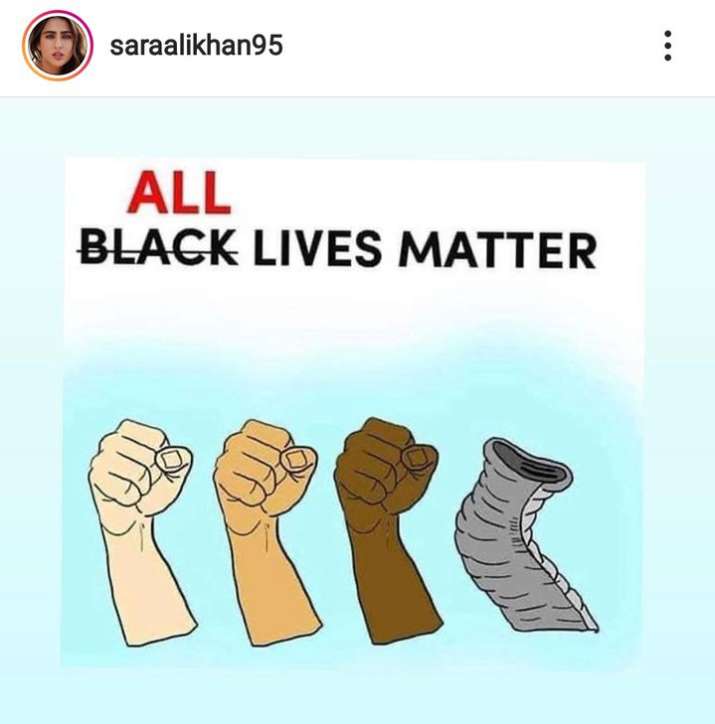
Currently, the world is fighting many battles simultaneously. From shocking incidents of inhumanity with a pregnant elephant in Kerala to battle against racism with George Floyd’s death in the United States, many grave have come to light lately. Many celebrities have come forward and expressed their disappointment about what is happening in the world, Actress Sara Ali Khan also shared a post on Instagram to express her disappointment over the elephant’s death and George Floyd’s death. She shared a picture with the hands of people with different skin colors and a trunk of an elephant along with the message, “All Lives Matter.” The illustration showed the word ‘Black’ cut and written ‘All’ in place of it, stressing that every life matters.
Sara Ali Khan’s post earned backlash soon after she posted it. Netizens were unhappy that the actress has ‘belittle’ the movement of ‘Black lives matter’ and accused her of not following what she has written. Post the heavy trolling, Sara deleted the post from social media.
Image Source : TWITTER
Sara Ali Khan Instagram post
Now, the actress fans have come forward in support of her and shared that her thought was ‘correct’. One Twitter user wrote, “Isme galat kya tha!! When she said “all lives matter”. Everyone is equal & every life is important. I support Sara Ali Khan.” Another said, “How does this make no sense? How does this post can make you to question her education? How does is this prove that she is another product of nepotism? People are illogical and baseless. #SaraAliKhan is nowhere wrong.” Check out more reactions here-
Can pple stop trolling #SaraAliKhan I C nothing wrong & seriously stop being so intolerant. In the artwork the “ALL” means “EVERY” life matters frm humans2 Animals2 birds2 plants. V r against the atrocities towards black & also against the atrocities towards animals.
— ಸದಾಸಿವಂ ಅಥಾನಿ (@Jc20053242) June 4, 2020
#SaraAliKhan Finally some celebrity made sensible comment. Every life matter inspite of caste, creed, colour, religion, rich, poor, animal every single soul.Whether it is Sadhu, George Floyd, or pregnant elephant . 🙏🙏 pic.twitter.com/2fgmNu9B36
— Deeksha Thakur (@thakur_deekshaa) June 4, 2020
After Kangana Ranaut we have another bollywood actress Sara Ali Khan taking the right stand. Both Are sensible actresses in Bollywood. #SaraAliKhan
— Narendra Modi fan (@narendramodi177) June 4, 2020
How does this make no sense? How does this post can make you to question her education? How does is this prove that she is another product of nepotism? People are illogical and baseless.#SaraAliKhan is nowhere wrong. pic.twitter.com/djXfcaotTD
Why somuch backlashes against #SaraAlikhan for her Insta post? She wasn’t wrong at first place because yes All lives matter! Hindu lives matter , Muslim lives matter , Migrant lives matter , Blacks live matter and poor lives matter .
#SaraAliKhan posted a pic, acc to which every fuckin’ life matter, whether it’s b/w or Human /animal. Every fuckin’ life matters. ❤️ Life includes evry living. Call it plant, animal or human. So why just focusing on black? Ppl still somehow find -ve in everything. Why ppl. Why??? pic.twitter.com/ud9j5GdBXg
On Thursday, Sara Ali Khan treated fans with a cute childhood photo of hers on Instagram. The picture shows little Sara flashing an adorable smile with her thumb in her mouth. She, undoubtedly, look the cutest in the post.
On the work front, Sara Ali Khan has completed the shoot of her next film, David Dhawan’s Coolie No. 1, before the outspread of coronavirus. She will be seen opposite Varun Dhawan in the film. She had begun preparations for Akshay Kumar and Dhanush starrer Atrangi Re and was supposed to begin the shoot when the lockdown was announced.
Protesters in cities across the U.S. hit the streets for a 10th straight night Thursday just hours after George Floyd’s family condemned the “pandemic of racism and discrimination†at a memorial service for the man who died while a police officer kneeled on his neck for nearly nine minutes.
When the two-hour service was over and Floyd’s coffin was wheeled out of the sanctuary at North Central University in Minneapolis, the thousand or so waiting outside broke into chants of “We can’t breathe†and “No justice, no peace. Prosecute the police!
In New York City, the site of some of the biggest protests against police brutality, thousands gathered peacefully in the afternoon at Cadman Plaza in Brooklyn to remember Floyd. Later, dozens of protesters gathering at Washington Square Park in Manhattan while police watched warily from the periphery.
Demonstrators sit as they gather during a protest at the Lincoln Memorial on June 4, 2020.Carlos Barria / Reuters
Hundreds more marched across the Brooklyn Bridge in a massive show of mourning for Floyd, 46, who died May 25 while in Minneapolis police custody.
Just about everybody appeared to be heeding organizers’ warnings to wear masks although admonitions to social distance fell by the wayside as the marchers crossed the best known bridge in a crowded city where more than 20,000 people have died from the coronavirus.
Outside Manhattan’s Bellevue Hospital, doctors and other health care workers who have been lauded for weeks for their efforts to combat the coronavirus pandemic, returned the favor by gathering outside and taking a knee in support of the Black Lives Matter movement.
Let our news meet your inbox. The news and stories that matters, delivered weekday mornings.
“This protest means so much to me, how we all came together as one in the hospital for this cause,” mortuary technician Robert Almanzar said.
In Washington, workers continued to wall off more of the White House complex to keep demonstrators at bay, and by Thursday they had extended new fencing down 17th Street from Pennsylvania Avenue to Constitution Avenue.
The reinforced fence-building went into overdrive after demonstrators breached a temporary barrier last Friday, prompting the Secret Service to rush President Donald Trump to a bunker inside the White House for his safety.
When asked by NBC News why the additional fencing was necessary. White House Deputy Press Secretary Judd Deere replied, “The White House does not comment on security protocols and decisions.â€
Metropolitan Police Chief Peter Newsham said the department was preparing for big numbers of “peaceful demonstrators coming to exercise their First Amendment rights†on Saturday.
“We have a lot of public open source information to suggest that the event on this upcoming Saturday may be one of the largest that we’ve had in the city,†he said.
Rain falls over a peaceful protest against police brutality and the death of George Floyd near Lafayette Park and the White House, on June 4, 2020.Drew Angerer / Getty Images
Still, in a sign that tensions might be easing, NBC News first reported Thursday that some of the more than 1,600 active-duty soldiers who were called to the nation’s capital in case Trump invoked the Insurrection Act to deal with demonstrators may soon go back to their bases.
Large protests were also being planned for Saturday in Los Angeles, where in recent days the police have come under criticism for cracking down hard on demonstrators after several troubling videos have worked their way onto the internet.
In Chicago, another city where relations between the local police and African-Americans have long been fraught, Mayor Lori Lightfoot denounced vigilantism after groups of white man with baseball bats who were seen Wednesday night patrolling the streets of Bridgeport, a once Irish-enclave that was the home of the Daley political family.
“I absolutely support neighbors being vigilant as to what’s going on on the streets and in their blocks,†Lightfoot said. “But taking up arms, that leads to chaos and we’re not supporting vigilantism in the city of Chicago under any circumstances.â€
In Atlanta, Mayor Keisha Lance Bottoms took to the streets with demonstrators marching Thursday through downtown.
“We are gathered to honor those who have died,†Bottoms said. “Their lives mattered. And I’m out here to tell you that you all matter to me.â€
Elsewhere Thursday, protesters were camped out in front of police stations and municipal buildings from Asheville, North Carolina, to Anaheim, California.
A large group of demonstrators crowd gathered outside Seattle’s City Hall while protest organizers were meeting inside with police and city officials.
The campaign to re-elect President Trump pulled SpaceX, NASA and astronauts and their families into a campaign video that appeared to violate the space agency’s advertising regulations.
The video, released on Wednesday, was the latest effort by the president to parlay his stewardship of American space policy into an upbeat campaign issue. It included shots of two NASA astronauts, Robert L. Behnken and Douglas G. Hurley, who blasted off on Saturday aboard a SpaceX rocket, the first time astronauts have headed to orbit from the United States since 2011.
The campaign removed the video from YouTube on Thursday evening, but not before more than 4,000 people signed a Change.org petition that sought to “Stop Donald Trump politicizing SpaceX and NASA accomplishments.â€
Karen L. Nyberg, a retired astronaut who is married to Mr. Hurley, posted a message on Twitter that said she and her 10-year-old son should be off limits to political campaigns.
Titled “Make Space Great Again,†the campaign video, almost three minutes long, intercut between President John F. Kennedy’s 1962 speech setting the goal of a moon landing by the end of the decade, video footage of the Apollo 11 mission, a 2018 speech by President Trump promising new space achievements and Saturday’s launch.
NASA makes its images and videos freely available for news organizations and noncommercial uses. But advertising requests are handled much more strictly. While the regulations do not explicitly mention political campaigns, they state, “As a government agency, NASA will not promote or endorse or appear to promote or endorse a commercial product, service or activity.â€
The regulations also state, “Astronauts or employees who are currently employed by NASA cannot have their names, likenesses or other personality traits displayed in any advertisements or marketing material.â€
Neither SpaceX, NASA nor the Trump campaign replied to emails asking for comment Thursday night.
Unlike his predecessors, who generally emphasized support by both Republicans and Democrats for the space program, President Trump has cast NASA in more partisan terms.
After the launch, he gave a celebratory speech at the Kennedy Space Center in Florida during which he thanked a list of politicians for their support of NASA — all Republicans. During the address, he also portrayed the space program as moribund when he took office in 2017 and gave himself credit for reviving NASA’s human spaceflight program.
“When I first came into office three and a half years ago, NASA had lost its way,†he said. He criticized the Obama administration, saying it “presided over the closing of the space shuttle.â€
It was shepherded by Charles F. Bolden Jr., a retired United States Marine Corps major general who served as NASA administrator during the Obama administration, and often encountered resistance from Republicans in Congress who criticized commercial crew and shifted money away to other programs.
The current administrator, Jim Bridenstine, invited Mr. Bolden to the launch and lauded the prior administrator’s efforts in getting commercial crew started.
Mr. Bolden said that he did have doubts at the start of his time at NASA that companies like SpaceX were capable of launching humans.
“I just didn’t think they could do it,†he said.
SpaceX already had a contract for taking cargo to the space station, signed under President George W. Bush. “And they demonstrated over time that they were pretty good,†Mr. Bolden said.
He also gave credit to the Trump administration for continuing along this path. “As I told Jim Bridenstine,†Mr. Bolden said, “whatever happens on your watch, take credit for it.â€
Mr. Bolden said that he was “a little upset, as I imagine most people who are affiliated with NASA were,†about the campaign video.
But, he added, “Anybody who is surprised hasn’t been paying attention.â€
The Health Department announced 816 more confirmed Covid-19 deaths, one day after officials reported a toll of 1,092 deaths, which was more than double the highest previous toll reported in a single day. Officials said an additional 1,033 suspected Covid-19 deaths were awaiting confirmation, suggesting daily tolls would remain high. Newly confirmed coronavirus cases also continued to rise by record amounts, with 4,442 reported Thursday.
Assistant Health Secretary Hugo López-Gatell sought to allay fears over the new numbers, saying that daily deaths had peaked 17 May. He said many of the Covid-19 deaths reported this week actually occurred in May but were not tallied until now because of backlogs in reporting or testing.
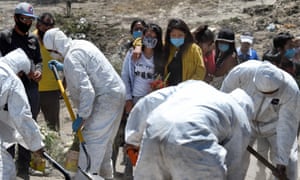
Aerial view of graves being dug to meet the demand of deceased people at the Municipal Pantheon of Valle de Chalco in State of Mexico on 4 June 2020. Photograph: Alfredo Estrella/AFP/Getty Images
But with total deaths standing at 12,545, he acknowledged the pandemic could wind up costing as many as 35,000 lives in Mexico, local media reported.
Experts said the reason for this week’s sudden jump in deaths was attributable to a number of factors, including confirmation and inclusion of deaths stretching back as far as 25 days. But the country is also passing through the pandemics most critical moment with a dramatically increasing number of confirmed and suspected infections.
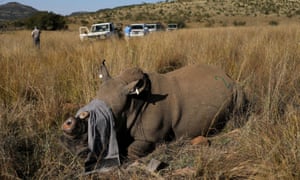
South Africa has dehorned dozens of rhinos in three popular game parks, aiming to prevent armed poachers taking advantage of empty parks to kill them for their horns.
The exercise in Pilanesburg National Park and the Mafikeng and Botsalano game reserves – all northwest of Johannesburg – leaves the rhinos with horn rumps too small for poachers to bother with, Nico Jacobs, helicopter pilot and founding member of non-profit Rhino 911 told Reuters.
As Jacobs flew a helicopter over Pilanesburg last month with Reuters journalists, they spotted a lioness eating the carcass of a rhino that had been poached days earlier. Experts fear the absence of tourists may already have spurred a poaching spike.
A rhino that has been dehorned in an effort to deter poaching lies on the ground, amid the spread of the coronavirus, at the Pilanesberg Game Reserve in North West Province, South Africa, 12 May 2020. Photograph: Siphiwe Sibeko/Reuters
On Monday, scientists published a study showing that humans are causing mass extinction on a scale unseen since a meteor wiped out the land dinosaurs 65 million years ago, the sixth large-scale extinction in Earth’s history.
Decades of hunting and habitat loss have reduced Rhino numbers to about 27,000 today, according to the International Rhino Foundation. A poaching surge has wiped out thousands in the past three years.
Rhino horn sells for $60,000 a kilogram, more than cocaine or gold. In East Asia, it is used in medicinal potions, despite containing the same key component as human fingernails.
Dehorning is controversial, especially as it makes male rhinos vulnerable in fights. But they are not essential for survival, and, like fingernails, they grow back.
As Brazil’s toll passed Italy’s, President Jair Bolsonaro cracked jokes in a 45 minute Facebook broadcast with foreign policy adviser Filipe Martins.
During the broadcast, Bolsonaro barely mentioned victims of the virus, choosing instead to attack his political enemies, as well as the protestors who have been mobilising against him. He called demonstrators “addicts†and “criminals†and “foolsâ€.
Despite the worsening situation in Brazil, many parts of the region are moving towards reopening, against the advice of most medical experts.
Miguel Lago, the director of Brazil’s Institute for Health Policy Studies, said reopening was a mistake that was likely to cause an explosion of infections and pile further pressure on hospitals that were already struggling to cope with the pandemic.
“I am very worried … We are going to witness hospitals collapsing in almost every state,†Lago warned. “I think the worst is still to come.â€
Coronavirus cases have now been detected in more than 70% of Brazilian cities, with the south-eastern states of Rio and São Paulo particularly badly hit.
In Brazil, in an online broadcast shortly before the numbers were released, Brazil’s president Jair Bolsonaro made almost no mention of the victims but continued to publicly attack efforts to slow the advance of coronavirus with quarantine measures and social distancing.
“We can’t go on like this. Nobody can take it anymore,†Bolsonaro said of the shutdown efforts being implemented by state governors and mayors across Brazil. “The collateral impact will be far greater than those people who unfortunately lost their lives because of these last three months here,†Bolsonaro said.
The numbers – which came after Mexico reported a record daily tally of more than 1,000 deaths on Wednesday – reinforced fears that Latin America’s two biggest economies, and other countries in the region, were facing a bleak few months.
Brazil’s death toll overtakes Italy’s to become third-highest worldwide
Brazil’s total COVID-19 death toll blew past that of Italy on Thursday, as the Health Ministry reported 1,437 deaths in the last 24 hours and 30,925 additional coronavirus cases.
The Latin American nation has now reported 34,021 deaths from the coronavirus, trailing only the United States and the United Kingdom.
Virus patients with high blood pressure twice as likely to die: study
Patients with high blood pressure admitted to hospital with coronavirus infections are twice as likely to die as those without the condition, researchers said on Friday.
For in-patients with the virus who had stopped taking medication for high blood pressure, the risk of dying doubled again, they reported in the European Heart Journal.
“It is important that patients with high blood pressure realise that they are at increased risk of dying from Covid-19,†said senior author Fei Li, a cardiologist at Xijing Hospital in Xian, China.
For the study, researchers in China and Ireland retroactively examined cases admitted to Huoshenshan Hospital in Wuhan between 5 February and 15 March.
Nearly 30% – 850 patients – had a history of hypertension, another term for high blood pressure. 4% of those patients died, compared with just over one percent of the 2,027 patients without hypertension.
After adjusting for age, sex and other medical conditions, the researchers calculated that having high blood pressure increased the risk of dying two-fold.
Mexico’s health ministry reported a record 4,442 additional cases of the novel coronavirus in the country on Thursday, and 816 more deaths, bringing the total to 105,680 cases and 12,545 deaths.
Workers bury an alleged victim of Covid-19 at the Municipal Pantheon of Valle de Chalco, State of Mexico on 4 June 2020. Photograph: Alfredo Estrella/AFP/Getty Images
Argentina extended on Thursday a mandatory lockdown in Buenos Aires, the capital, and some other parts of the country until 28 June, as confirmed coronavirus cases continue to rise, surpassing 20,000 earlier in the day.
The three-week extension of the lockdown, which had been due to expire June 7, will impact the capital city, the province of Buenos Aires and some other areas that account for the highest concentration of confirmed infections, President Alberto Fernandez said during a press conference. The rest of the country will move to a phase of “mandatory and preventive social distancing.â€
The next phase will include new permissions, including outdoor exercise during certain hours in the city of Buenos Aires, which has the highest concentration of cases, officials said.
Argentina recorded 929 new infections on Thursday, one of the highest daily counts since the pandemic began. The country has 20,197 cases, mostly in the city Buenos Aires and the province of Buenos Aires. The death toll is at 608.
“Our results are still good, but we have not yet overcome the problem,†Fernandez said.
Argentina has been under mandatory lockdown since March 20, though officials already relaxed restrictions in some areas of the country. Argentina has a commercial flight ban until 1 September, one of the world’s strictest travel measures during the pandemic.
Men ride a motorcycle in Buenos Aires, Argentina. Photograph: Marcelo Endelli/Getty Images
Death of man after face mask arrest shines light on Mexican police brutality
Mexicans have responded with outrage after a man was found beaten to death hours after he was arrested by police officers for not wearing a face mask in public.
Giovanni López, a 30-year-old bricklayer, was detained on 4 May by municipal police officers in the town of Ixtlahuacán de Los Membrillos near Guadalajara.
Video of the incident emerged on Wednesday, and shows the police officers with assault rifles forcing López into a police pickup truck as bystanders plead for his release.
Sergio Beltrán-GarcÃa (@ssbeltran)
COPS MURDERED GIOVANNI
Giovanni López, 30yo day laborer arrested for not wearing a mask, criminalised by cops and brutally beaten to death bc he belongs to the Mexican racialized underclass.
“Just for not a wearing a mask?†asks one witness, incredulously.
“He was resisting,†answers an officer.
López’s relatives went looking for him at the police station, but were told he had been taken to a public hospital in Guadalajara. When they reached the hospital they found his dead body.
He had a bullet would in his foot, and an autopsy later revealed that he died of a blunt trauma to the head.
China reported five new Covid-19 cases and three new asymptomatic infections for June 4, the health commission said on Friday.
The National Health Commission said all five of the new cases were imported, involving travellers from overseas. For 3 June, China had reported one confirmed case and four asymptomatic cases.
Chinese women wear protective masks and costume as they dance for exercise outside a luxury shopping mall on 4 June 2020 in Beijing. Photograph: Kevin Frayer/Getty Images
China does not count asymptomatic cases, people who test positive for the coronavirus but do not exhibit Covid-19 symptoms, as confirmed infections.
The total number of infections in China stands at 83,027. The death toll remained unchanged at 4,634.
Covid-19 causing 10,000 dementia deaths beyond infections, research says
Hannah Devlin
There were almost 10,000 unexplained extra deaths among people with dementia in April, according to official figures that have prompted alarm about the severe impact of social isolation on people with the condition.
The data, from the Office for National Statistics, reveals that, beyond deaths directly linked to Covid-19, there were 83% more deaths from dementia than usual in April, with charities warning that a reduction in essential medical care and family visits were taking a devastating toll.
“It’s horrendous that people with dementia have been dying in their thousands,†said Kate Lee, chief executive officer at Alzheimer’s Society. “We’ve already seen the devastating effect of coronavirus on people with dementia who catch it, but our [research] reveals that the threat of the virus extends far beyond that.â€
New Zealand tiptoes towards elimination of coronavirus
Charlotte Graham McLay reports from Wellington:
As health officials announce each new day of no new Covid-19 cases, social media explodes with New Zealanders celebrating the news.
“That feeling like you got away with something that seemed impossible and you can’t quite believe it even though you want to believe it,†wrote one, on Twitter. “But for an entire country.â€
Twenty-two New Zealanders have died of Covid-19, ; thousands have lost their jobs and the nation’s largest export sector, tourism, lies in tatters. But as New Zealanders look to the hundreds of thousands of deaths recorded in other countries, there is a sense that the rest of the world faced a different pandemic, the disastrous scale of which never fully arrived here.
Now, providing there are no new and unexpected cases to marr the country’s 13-day streak of zero fresh instances of Covid-19, scientists say they expect to be able to declare next week that the virus has been eliminated from New Zealand – making it the first country among the OECD group of wealthy nations, and the first country that has recorded more than 100 cases to make such a statement, analysts said.
Remdesivir: Ebola drug endorsed as a coronavirus treatment in Australia
The antiviral drug remdesivir has been recommended for the treatment of Covid-19 patients in Australia, by the national taskforce bringing together the country’s peak health groups.
The National Covid-19 Clinical Evidence Taskforce said Australian doctors treating adults with moderate, severe or critical Covid-19 should consider using the drug to aid recovery times. The antiviral drug is the first medication to be recommended as a considered treatment for patients treated in hospital after contracting coronavirus.
Originally developed for the treatment of Ebola, clinical trials have shown remdesivir may improve recovery time for people with moderate to critical Covid-19 symptoms. The taskforce’s executive director, Associate Professor Julian Elliott, said while it was early days it was a significant step forward.
“This is the first information we have that a drug has a beneficial effect as a treatment for Covid-19,†he said.
“The preliminary data published so far from two clinical trials indicate that it can reduce the time for someone to recover from Covid-19.
“However, we do not yet have definitive information that remdesivir will reduce the risk of dying from the disease.â€
Cuomo: Protesters have ‘civic duty’ to get tested for the virus
The thousands of people protesting the death of George Floyd have a “civic duty†to be tested for the coronavirus and help New York avoid a spike in new cases as it slowly restarts its economy, Governor Andrew Cuomo said Thursday.
There’s widespread concern that people packing in tightly for demonstrations, sometimes without faces coverings, could lead to more Covid-19 cases.Cuomo was particularly concerned about daily mass demonstrations in New York City, which is poised to relax some restrictions amid an intense, monthslong effort to tame the outbreak.
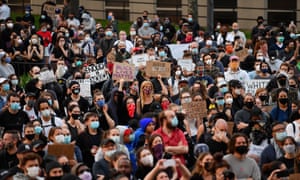
Protestors hold up placards and raise their arms during a “Black Lives Matter†demonstration over the death of George Floyd by a Minneapolis police officer, at Brooklyn Borough Hall on 1 June 2020 in New York. Photograph: Angela Weiss/AFP/Getty Images
“If you were at a protest, go get a test, please,â€Cuomo said at his daily briefing. “The protesters have a civic duty here also. Be responsible, get a test.â€
An estimated 20,000 people have demonstrated in New York City alone, the governor said, as he expanded the state’s testing criteria to include people who attended recent protests across the state. Around 30,000 have protested across the state.
“New York City had the highest number of protesters,†Cuomo said. “We have to be smart.â€
South Africa sees record rise in coronavirus cases
South Africahas recorded 3,267 coronavirus cases in 24 hours, the biggest increase since the pandemic hit the country.
The country now has a total of 40,792 infections, the health ministry said. It saw a rise of 56 deaths, bring the total to 848.
More than half of the cases are in the Western Cape region where health services are under pressure.
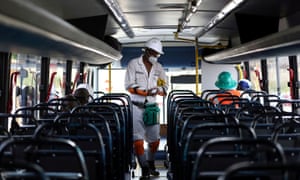
A mine worker wearing a face masks boards a bus ahead of his shift, amid a nationwide coronavirus lockdown, at a mine of Sibanye-Stillwater company in Carletonville, South Africa, 19 May 2020. Photograph: Siphiwe Sibeko/Reuters
South Africa is the sub-Saharan African country hardest hit by the pandemic. President Cyril Ramaphosa on March 27 ordered South Africans to observe a lockdown aimed at slowing the disease’s spread.
The move sharply limited people’s freedom of movement while slowing an economy already in recession. But Ramaphosa has gradually eased the lockdown measures and allowed most of the economy to restart.
Hello and welcome to today’s live global coverage of the coronavirus pandemic with me, Helen Sullivan.
As always, I welcome your questions, comments and tips on Twitter @helenrsullivan or email: helen.sullivan[at]theguardian.com.
South Africa, which has the highest number of coronavirus cases on the continent, has recorded a record increase in confirmed infections, with more than 3,000 in 24 hours. More than half of all cases are in the Western Cape province. The country imposed a strict, nationwide lockdown that included the banning of alcohol and cigarette sales, but has since eased restrictions.
Meanwhile in New York, where an estimated 30,000 people joined demonstrations following the death of George Floyd, governor Andrew Cuomo has urged protestors to get tested for coronavirus. “I’m not a nervous Nellie, I’m just looking at the numbers,†he said. “Many wear masks. But there is no social distancing. Police are in their face … If you were at a protest, get a test, please.â€
Here are the key developments from the last few hours:
South Africa sees record rise in coronavirus cases. South Africahas recorded 3,267 coronavirus cases in 24 hours, the biggest increase since the pandemic hit the country. Africa’s biggest industrial power now has a total of 40,792 infections, the health ministry said. It saw a rise of 56 deaths, bring the total to 848. More than half of the cases are in the Western Cape region where health services are under pressure.
New York governor, Andrew Cuomo, urged protestors to get tested for coronavirus, saying several days and nights of demonstrations in the state after the killing of George Floyd could accelerate the spread. He noted that an estimated 30,000 people have protested in the state.
Turkey announces weekend lockdown in 15 cities. Turkeywill impose a weekend lockdown in 15 cities as part of efforts to prevent the spread of the novel coronavirus, the interior ministry said.In a statement, the ministry said bakeries and certain shops could operate during the lockdown.Turkey has had 167,410 Covid-19 cases, according to Johns Hopkins University.
The UK unveiled a $2bn (£1.5bn) fund aimed at ensuring poorer countries can access doses of a potential coronavirus vaccine. The announcement was made at the third Gavi vaccine alliance replenishment summit, a virtual pledging event that raised $8.8bn.
The UK’s transport secretary, has announced that face coverings will be mandatory on public transport in England from 15 June. Grant Shapps added that people can be refused permission to travel if they do not comply and could be fined.
Low Covid-19 figures for Africa are “broadly accurateâ€, the World Health Organization’s director for Africa, Dr Matshidiso Moeti, has said. There were concerns that low levels of testing, poor infrastructure and a lack of cooperation from some governments may be disguising the true extent of the disease’s spread.
US pandemic jobless claims passed 42 million after another 1.9 million people filed for unemployment benefits last week. The pace of layoffs has slowed dramatically from its peak of 6.6m at the start of April as states begin to relax quarantines. Last week was the ninth consecutive week of declines.
Welcome to Declassified, a weekly column looking at the lighter side of politics.
(Important note: I’m not a doctor but I do have terrible handwriting.)
In the words of the great philosopher Billy Ocean, “When the going gets tough, the tough get going.”
And so this week we were treated to the (non) sight of U.S. President Donald Trump hiding in a bunker underneath the White House to avoid protesters furious at the death of George Floyd. The lights were off and someone was home, which is the exact opposite of what people normally say about Trump.
It didn’t take long for the president to have a large fence erected around the White House perimeter, which means he finally got that wall he always promised (and all U.S. territory south of 1600 Pennsylvania Avenue has now been ceded to Mexico).
Meanwhile in the U.K., the government has scrapped its coronavirus press conference on weekends after claiming too few people tuned in to watch it on TV. Yes, it seems vital public health information has to compete with “The X Factor” and soap operas for it to have actual meaning.
But there has been some good news this week — as long as you are the Phantom of the Opera, Zorro, Hannibal Lecter, Catwoman or Jason Voorhees from “Friday the 13th.”
According to scientists from Harvard University, the coronavirus could be spread during sex so couples should put on masks before getting down to it. The researchers ranked different sexual scenarios, based on how likely you are to catch coronavirus during them. Sex with people within a household, and with people from other households, were ranked as “high risk” activities.
Of course what we really need in these tough times is some positive news for all of us, and we sure aren’t getting it from Dr. Michael Greger. His new book, “How to Survive a Pandemic,†warns that a virus emanating from overcrowded and unsanitary chicken farms has the potential to wipe out, er, half of humanity. He ranks COVID-19 as a weedy two or three on the scale of pandemics, and “The Big One, the typhoon to end all typhoons, will be 100 times worse when it comes, a Category Five.”
So congratulations to Bob Behnken and Doug Hurley, who boarded a Space X flight and headed to the International Space Station, where presumably life is less awful than it is down here on Earth.
CAPTION COMPETITION
European Commission President Ursula von der Leyen
Thanks for all the entries. Here’s the best from our post bag (there’s no prize except for the gift of laughter, which I think we can all agree is far more valuable than cash or booze).
“If I drive like this to Durham do you think anyone would notice?” by David Spence
LONDON — A time of crisis, former U.K. Prime Minister Gordon Brown once said, is “no time for a novice.†If that’s the case, then coronavirus came at a bad moment for Boris Johnson’s Cabinet.
Despite the Conservative Party having been in power for 10 years, the average member of the ministerial team leading the U.K. through its worst public health crisis in a century has just 19 months of Cabinet-level experience. Fourteen out of the 22 have been in Cabinet less than a year, and only one — the influential Whitehall fixer Michael Gove — is a veteran of David Cameron’s first Cabinet a decade ago.
Such inexperience is unusual in a government led by the same party for so long. One of the main causes? Brexit. The Tory Party’s civil war over EU membership and the Brexit deal ended or derailed the political careers of a string of senior politicians who in less fractious times would — in all likelihood — still be in top jobs.
But while Tory MPs and former ministers have expressed disquiet at the “sheer inexperience of the Cabinet†(as the conservative commentator Simon Heffer put it in the New Statesman) others question whether experience is everything. After all, the minister who, opinion polls say, is doing the best job in the eyes of the public is Chancellor Rishi Sunak, with just four months of Cabinet-level experience under his belt. And with huge economic and social changes predicted post-pandemic, fresh perspective might be just what’s needed.
But with the government’s actions during this crisis likely to be scrutinized intensely over the coming months, defining Johnson’s premiership and chances of eventual reelection, questions will continue to be asked about whether he was wise to put his faith in a new-look team at the top.
“We’ve interviewed a lot of former ministers and they always say that going into the job, in whatever conditions, is like moving onto a fast-moving treadmill,†said historian Catherine Haddon, senior fellow at the Institute for Government think tank. “It’s a huge learning curve whenever you take on the job. If you take on the job in crisis conditions, those pressures are going to be far greater.â€
‘Groupthink’
For the government’s critics, the danger of an inexperienced Cabinet is that it invests too much power in too small a team: namely Johnson, his chief adviser Dominic Cummings and a few trusted allies from the former Vote Leave campaign. That concentration of power and strategizing can lead to good ideas not being heard, and bad ideas not being checked.
“The issue is that new Cabinet ministers rarely want to challenge groupthink or indeed the prime minister,†said one former secretary of state, speaking on condition of anonymity. “And you need that to stop mistakes being made.â€
An editorial in the Financial Times last week — in the wake of the scandal surrounding Cummings’ alleged breaches of lockdown rules — accused Johnson of presiding over “a bunker of close allies surrounded by a lightweight, supine and largely ineffectual Cabinet chosen mainly for their commitment to Brexit or their loyalty to Mr Johnson.â€
It is not just the relationships within the top team but those with a department that can be tricky in the early days of a Cabinet minister’s tenure, said Haddon. “Knowing how everyone around you — private office, permanent secretary, your department — can help you, that’s really important,” she said. “A crisis is only going to increase the learning curve.â€
But experience isn’t everything, she added: “More important than experience is the ability of a minister to actually learn, and learn rapidly, about their department, about their policy areas, and how to do the job. If you can do that no amount of experience is going to make up for that.”
Or, as one government aide put it, “experience and years served” didn’t help Theresa May and her Cabinet secure a Brexit deal or win a parliamentary majority — as Johnson et al. managed in less than a year.
Big beasts on the back benches Â
It’s also not unusual, of course, for governments to have totally inexperienced Cabinets when a new party (or parties) takes power after a long time in the wilderness. Cameron’s 2010 coalition or Tony Blair’s 1997 government had next to no actual governing experience anywhere in their ranks (although neither faced a situation as serious as the coronavirus in their first year).
But the inexperience of Johnson’s Cabinet is unusual for a party that has been in power for so long. Brown’s 2010 Labour Cabinet had four ministers — including the prime minister himself — who were in Cabinet in 2000. Margaret Thatcher’s 1990 Cabinet had three veterans of 1980, including the prime minister and her deputy. Among Johnson’s team, Gove stands alone of the original 2010 team.
The other Tory big beasts of the 2010s — most of them former Remainers — have either left front-line politics, or been consigned to the back benches.
The influential Cabinet Office minister has more than seven years of full Cabinet service under his belt, twice as much as the next-most experienced figures, Liz Truss and Natalie Evans. Six members of the Cabinet, including Sunak and Culture Secretary Oliver Dowden, have just four months of Cabinet experience, accrued since their appointments in February. Another eight — including prominent figures like Business Secretary Alok Sharma, Defense Secretary Ben Wallace and Communities Secretary Robert Jenrick — secured their first full Cabinet jobs under Johnson, who became prime minister in July last year (with two years’ Cabinet experience as foreign secretary from 2016 to 2018).
Meanwhile, the other Tory big beasts of the 2010s — most of them former Remainers — have either left front-line politics, or been consigned to the back benches.
Cameron quit parliament after the referendum; George Osborne left to become editor of the Evening Standard; May went to the back benches after failing to secure support for her Brexit deal last year; and Jeremy Hunt suffered the same fate after coming second to Johnson in the Tory leadership race.
A number of ex-Cabinet and ex-junior minister Remainers ousted by Johnson — like Hunt, Greg Clark, Mel Stride, Tobias Ellwood and Caroline Nokes — are now plying their trade as chairs of parliament’s scrutinizing select committees. Tellingly, of the 22 Conservative MPs that chair these committees, 16 are ex-Remainers and 11 used to serve in government. Under Johnson, they had nowhere else to go.
Cabinet aides pointed out that some of Johnson’s team of ministers — such as Grant Shapps and Brandon Lewis — have previously held positions that allowed them to attend Cabinet, while not being full Cabinet ministers. Others have had alternative experience at the pinnacle of government; Dowden, for instance, served as Cameron’s deputy chief of staff before becoming an MP in 2015.
As for Gove, his exceptional level of experience (relatively speaking) has seen him rewarded with several key roles at the heart of the government machine as it responds to the pandemic. This week it was announced he will be chairing a new Cabinet committee — known as C-19 Operations — which will be responsible for putting into action the instructions of another new committee — C-19 Strategy — that will be chaired by Johnson.
The role mirrors the one Gove held during the government’s preparations for a possible no-deal Brexit last year. The fact he has made himself so valuable to Johnson despite betraying him during a previous Tory leadership contest in 2016 goes to show how useful it can be to have a minister with deep knowledge of how Whitehall operates.
Experience, it seems, counts for something after all.
Just because summer has unofficially begun doesn’t mean summer travel should be starting up anytime soon. At this stage of the coronavirus pandemic, public health experts still do not recommend nonessential travel, and that includes flying.
“It is important to avoid air travel because it inherently involves spending time in places where others have passed through every day such as airports, public restrooms, and of course airplanes,†said Sachin Nagrani, a physician and medical director for the telemedicine and house call provider Heal.
Nevertheless, passengers are flying in the U.S. On Wednesday, the Transportation Security Administration screened 304,436 people at American airports. (On the same weekday one year ago, that number was more than 2.3 million, so air travel is still significantly down.)
If you must take a flight at this time, there are ways to mitigate the risks and help protect your health and safety and that of your fellow travelers. Below, Nagrani and Jeremy Tarr, digital editorial director of Fodor’s Travel, share their guidance for safe air travel right now.
Prepare for it to feel different.
“I think everyone needs to realize that it’s going to be very, very different than what they’re used to,†said Tarr. “It’s going to feel weird, it might feel uncomfortable, and, depending on the person, it might feel really scary.â€
Still, he added, most airlines are making an effort to keep passengers feeling safe and are receptive to concerns.
“Research what your airline has done before you book your flight and especially before you board,†he suggested.
Choose a safe transit method to the airport.
“If you must fly, consider your local travel method to and from the airport and any rules that the airport may have instituted for safety, such as modified pick-up and drop-off procedures, which can be found on the airport website,†Nagrani advised.
If possible, drive yourself to the airport or have someone in your household drop you off. You can take car services like Uber and Lyft, which require drivers and passengers to wear face masks, but you may want to wipe down your surroundings. Public transit is less costly but exposes you to more risk.
Wear a mask at all times.
To slow the spread of the virus, public officials advise wearing a mask in public spaces, including airports and airplanes. Most airlines mandate that passengers wear masks for the duration of their flights, and many airports require them inside the terminal.
“Wear a mask at all times, unless told by TSA or some other official to lower it for identification purposes,†Tarr advised. It may not be the most comfortable accessory for long periods of time, but this is an important way to protect the safety of you and your fellow travelers.
Bring your own provisions.
To minimize risk, airlines have severely limited their food and beverage services, so be sure to fill your water bottle at the airport to stay hydrated on board. Consider taking some vitamin C and other immune-boosting vitamins or nutrients before the journey, too.
Many airport shops and restaurants are still closed, so you may also want to bring your own snacks from home for your travels.
SOPA Images via Getty Images
A sign reminding passengers to stay six feet apart at a screening checkpoint at Orlando International Airport on May 21, 2020.Â
Social distance as best you can.
“Airports were never particularly fun, and now they’re even worse. But the key is to follow the same protocols you do pretty much everywhere else right now,†Tarr noted. “Keep your distance, and if someone else isn’t keeping their distance, politely say something.â€
Plexiglass partitions between passengers and crew are more common, and there are some changes in the security processes, like more staggered lanes and spacing between individuals.
Practice social distancing to the best of your ability at the gate and throughout the boarding process, which may be a little different as well.
“One thing you’ll most likely experience is that planes are being boarded from the rear to ensure that passengers limit interactions with one another,†said Tarr.
Brace for close quarters.
While there are significantly fewer people flying right now, there are also fewer flights and routes in service, so planes aren’t as empty as they looked in mid-March.
In fact, some passengers on recent flights have complained on Twitter about the number of people on board. If you’re concerned about in-flight spacing, you can discuss your options with airline employees.
“Talk to the flight crew and to see what can be arranged,†said Tarr. “United is sending alerts to passengers 24 hours in advance if their flight hits 70% capacity and is allowing you to choose a different flight.â€
Clean your hands frequently.
The TSA is now allowing each passenger to carry one 12-oz. container of hand sanitizer through security, so you’ll be able to disinfect your hands frequently. Many airports also have sanitizer stations in the terminals.
Tarr also recommends proper hand-washing at the airport. “I know airport bathrooms are often shockingly, revoltingly disgusting ― but most of them have sensors for soap and water,†he said.
Limit touching surfaces.
“Before travel, consider checking in online and downloading a boarding pass for low-touch experience,†Nagrani advised. Avoid touching any surfaces unless needed.
You can also cut down on the risk of touching surfaces by wearing gloves, but the CDC guidance doesn’t deem them necessary.
Wipe down your seat area.
You don’t have to go full-on Naomi Campbell, but it doesn’t hurt to wipe down your seat area when you board a flight.
Many airlines have shared ways they’re stepping up their cleaning procedures, with measures like high-grade disinfectant, more frequent cleanings and electrostatic spraying.
Keep up with the latest guidelines.
As experts learn more about the novel coronavirus and the disease it causes, guidelines change.
Check for updates on the CDC’s list of considerations for potential travelers as you make decisions regarding your excursions.
The European Commission aims to make eating habits across the Continent more sustainable.
The cheeseburgers of 2030 won’t be the same as they are today — or at least that’s Brussels’ plan.Â
The European Commission’s recently unveiled Farm to Fork strategy aims to change eating habits across the Continent over the next decade to make the agri-food system more sustainable.
It includes a set of legislative proposals and the targets that, at least on paper, would make European food healthier, more nutritious and more plant-based — and consumer choices more conscious.Â
As the name suggests, the Commission’s program will affect the whole food supply chain — from how food is grown and cultivated to the final meal on European plates. But what does it mean in practice? POLITICO looked into what the EU’s ideal burger of the future might look like, if the strategy gets implemented.
MILAN — Ask the hundreds of protesters who donned orange high-vis jackets and gathered in squares across Italy over the past week why they’re there and you’ll get as many different answers.
Some are angry with Prime Minister Giuseppe Conte and his government’s handling of the coronavirus crisis. Others are worried about vaccines, which they say inject mercury into people’s veins, or the judiciary system, or 5G wireless technology. Some say the country’s lockdown measures have left them struggling to make ends meet.
What unites them is a sense of anger — and a charismatic figurehead, Antonio Pappalardo, a former carabinieri known to his followers as “the general.â€
At a rally in Rome to mark Italy’s Republic Day on June 2, Pappalardo wore a bright orange tie and energetically led the crowd in chants of liberta, liberta, liberta! The former general drew on a mix of populist and nationalist catchphrases. He promised to give power back to the people. He insulted the government. And he railed against “fake news†and criticism from politicians and high-profile figures including Vasco Rossi, one of Italy’s most famous rock stars.
In the crowd, people shouted, “no to Bill Gates’ vaccine†and “5G is killing us all,†and hugged each other at the general’s insistence that COVID-19 is not a real threat. Few wore masks, and Pappalardo called out those who did, saying, “I cannot look a woman in the face without knowing if she’s beautiful or ugly.”
“I am ashamed of them and their lack of respect for all the victims, for those who have lost loved ones” — Cristina Longhini, pharmacist
Pappalardo, who is 73, served briefly in the Italian parliament in the early 1990s, then stood in a number of elections in the 2000s before he founded the Gilet Arancioni, or Orange Jackets, last year.
The inspiration for the movement struck Pappalardo in 2019 after a meeting with Didier Tauzin, a former French general with close ties to France’s Yellow Jackets movement. “When we met, we said that together we could revolutionize Europe,†Pappalardo told POLITICO.
It took a pandemic, but the combustible mix of frustration and fear across a broad cross-section of the Italian population has put Pappalardo on the political map.
The Orange Jackets have three main goals, he said. First, unseat the Conte government, which he accuses of having destroyed the country economy by confining Italians’ to their homes for months “without reason.â€
Second, take Italy out of the European Union and ditch the euro. And third, spread the message that COVID-19 — which Pappalardo dismisses as no more than a “bad flu†— is being used as an excuse for abuses of power.
The fledgling movement has been met with harsh criticism from across the political spectrum.
“I am ashamed of them and their lack of respect for all the victims, for those who have lost loved ones,” said Cristina Longhini, a young pharmacist from Bergamo whose father died of COVID-19.
“According to the Orange Jackets, are we crying over something that didn’t happen?†she said. “Our lives have been destroyed.â€
In Milan, which also saw Orange Jacket protests this week, the left-wing mayor Giuseppe Sala called the rally “an act of irresponsibility†while the city is still in a “difficult situation.â€
Denying the pandemic should be a crime, Luca Zaia, the far-right governor of Veneto, said in a television broadcast this week, likening Papparlardo’s statements to Holocaust denial.
“I am for freedom of thought, but there is a limit beyond which you cannot go,†the League politician said.
A protester takes a selfie at an Orange Jacket rally in Rome on June 2 | Vincenzo Pinto/AFP via Getty Images
Far-right leaders Matteo Salvini and Giorgia Meloni, the head of Fratelli d’Italia, have trod a little more carefully. Just hours before Pappalardo took the stage in Rome, they had appeared on the same square to protest the Conte government, drawing on much of the same anger that is mobilizing people to put on orange jackets.
Meloni, the leader of the far-right Brothers of Italy, has made clear that her party has nothing to do with the movement, but speaking to La Repubblica made sure to note “we understand the strong social unease of the people.†Salvini, meanwhile, has condemned rebukes of President Sergio Mattarella, saying people should be “ashamed,” but stopped short of linking those statements to the movement itself or speaking out against it.
For his part, Pappalardo says he’s not seeking acceptance from any party, and that the only thing that interests him is giving voice to the people.
“People are enthusiastic, and finally someone is saying the things that everyone is thinking,†he said. “They treat me worse than a mobster, worse than [Mafia boss] Toto Riina, especially the communists, but I’m stronger than ever.”
We use cookies on our website to give you the most relevant experience by remembering your preferences and repeat visits. By clicking “Accept”, you consent to the use of ALL the cookies.
This website uses cookies to improve your experience while you navigate through the website. Out of these, the cookies that are categorized as necessary are stored on your browser as they are essential for the working of basic functionalities of the website. We also use third-party cookies that help us analyze and understand how you use this website. These cookies will be stored in your browser only with your consent. You also have the option to opt-out of these cookies. But opting out of some of these cookies may affect your browsing experience.
Necessary cookies are absolutely essential for the website to function properly. These cookies ensure basic functionalities and security features of the website, anonymously.
Cookie
Duration
Description
cookielawinfo-checbox-analytics
11 months
This cookie is set by GDPR Cookie Consent plugin. The cookie is used to store the user consent for the cookies in the category "Analytics".
cookielawinfo-checbox-functional
11 months
The cookie is set by GDPR cookie consent to record the user consent for the cookies in the category "Functional".
cookielawinfo-checbox-others
11 months
This cookie is set by GDPR Cookie Consent plugin. The cookie is used to store the user consent for the cookies in the category "Other.
cookielawinfo-checkbox-necessary
11 months
This cookie is set by GDPR Cookie Consent plugin. The cookies is used to store the user consent for the cookies in the category "Necessary".
cookielawinfo-checkbox-performance
11 months
This cookie is set by GDPR Cookie Consent plugin. The cookie is used to store the user consent for the cookies in the category "Performance".
viewed_cookie_policy
11 months
The cookie is set by the GDPR Cookie Consent plugin and is used to store whether or not user has consented to the use of cookies. It does not store any personal data.
Functional cookies help to perform certain functionalities like sharing the content of the website on social media platforms, collect feedbacks, and other third-party features.
Performance cookies are used to understand and analyze the key performance indexes of the website which helps in delivering a better user experience for the visitors.
Analytical cookies are used to understand how visitors interact with the website. These cookies help provide information on metrics the number of visitors, bounce rate, traffic source, etc.
Advertisement cookies are used to provide visitors with relevant ads and marketing campaigns. These cookies track visitors across websites and collect information to provide customized ads.