A disciplinary panel at Australia’s University of Queensland has suspended an outspoken student activist who criticized Beijing’s influence at the university and took part in protests in support of Hong Kong.
“I’ve been expelled from The University of Queensland for two years as a reprisal for my activism criticizing the Chinese government,” Drew Pavlou said via his Twitter account on Friday. “Will launch immediate appeal.”
“The University of Queensland has expelled me, an Australian student, for attacking the Chinese government’s human rights record,” he said. “Twenty per cent of their revenue comes from China, so my pro-Hong Kong activism threatened their business model.”
Pavlou, who is a democratically elected UQ Senator, said he would take his case “all the way to the Supreme Court.”
He said the suspension period covered his entire tenure on the UQ Senate.
There were signs on Friday that the university may already be seeking to distance itself from the disciplinary council.
UQ chancellor Peter Varghese issued a statement saying he had concerns about the decision.
“I was today advised about the outcome of the disciplinary action against Mr Pavlou,” he said in comments reported by The Australian newspaper.
“There are aspects of the findings and the severity of the penalty which personally concern me [and] I have decided to convene an out-of-session meeting of UQ’s Senate next week to discuss the matter.”
‘Kangaroo court’
Varghese’s statement came after Pavlou’s lawyer, barrister Tony Morris QC walked out of the disciplinary panel hearing last week, saying it was a “kangaroo court.â€
Morris said the panel had refused to hand over documents allegedly supporting the case against Pavlou.
The university’s disciplinary panel alleged that Pavlou, a 20-year-old student of English and philosophy, had harmed UQ’s reputation, engaged in intimidating and disrespectful conduct, and disrupted the running of the university, among other charges.
Pavlou — who suffers from depression — faced 11 allegations of misconduct, including activities that the authorities say breached its integrity and harassment policies and the student charter.
Pavlou earlier said the authorities had presented as “evidence” of his alleged misconduct social media comments he made regarding the pro-democracy movement in Hong Kong, in which he claimed to be speaking “on behalf of the university” following his election as student representative to the university senate.
Pavlou has also reported being physically attacked by Chinese Communist Party supporters during a campus brawl at UQ sparked by Chinese students’ opposition to a Hong Kong protest-related activity.
According to UQ, Pavlou also allegedly placed a sign on the UQ Confucius Institute — a cultural organization embedded in campuses around the world and directly staffed and controlled by the Chinese government — in March, declaring it was a “biohazard” amid the coronavirus epidemic, according to a post he made on Facebook.
Pavlou says he is being singled out because of his specific criticisms of UQ’s relationship with China, as well as his support for the Hong Kong pro-democracy movement and for the Turkic Uyghur ethnic group, who have been subjected to mass incarceration in “re-education” camps by the CCP.
Pavlou also burned a copy of the collected works of Chinese President Xi Jinping outside the Chinese consulate in Brisbane.
‘Silent Invasion’ felt in Australia
Xu Jie, the Chinese Consul General in Brisbane, has previously accused Pavlou of engaging in “anti-China separatist activities.” China’s Global Times tabloid newspaper, published by Communist Party paper the People’s Daily, has made similar claims.
Xu was awarded the post of visiting professor by UQ vice president Peter Hoj on July 12, 2019, a move which also drew criticism from Pavlou at the time.
Canberra last year said it would crack down on suspected Chinese Communist Party influencers in the country following the introduction of new laws targeting activities by lobbyists and agents of foreign governments in June 2018, and later denied a passport to a top Chinese businessman.
Australian author and professor of public ethics Clive Hamilton’s book, Silent Invasion: China’s Influence in Australia, was initially turned down by three publishers citing fears of reprisals from Beijing before being published in 2018.
Hamilton’s book argues that Australia’s elites, and parts of the country’s large Chinese-Australian diaspora, have been mobilized by Beijing to gain access to politicians, limit academic freedom, intimidate critics, gather information for Chinese intelligence agencies, and organize protests against Australian government policy.
According to Reuters, the Chinese Communist Party was behind a massive cyber attack on the Australian national parliament ahead of May’s general election.
The agency cited the country’s cyber intelligence agency, the Australian Signals Directorate (ASD), as saying that Beijing was responsible for the attack on the parliament and the three largest political parties, and that it had originated with the Ministry of State Security in Beijing. The findings were initially kept secret to avoid damaging trade ties.
Reported by RFA’s Mandarin and Cantonese Services. Edited by Luisetta Mudie.
“There was nowhere in the oath where we said we were pledging to die at the end of the day. And there is nowhere in the oath where we said if it’s hot, I am going to put my hand up without having any protective equipment. You cannot send us to war with no protective equipment,†says Fikile Dikolomela-Lengene, a nurse and the deputy of the Young Nurses Indaba Trade Union.Â
Dikolomela-Lengene was referring to an oath nurses take when they enter the profession when speaking about being equipped with information and personal protective equipment (PPE) to deal with Covid-19 patients as the country prepares to go to level three of the lockdown. Â
Level three will see many industries, schools and churches reopening and this is likely to ramp up the number of Covid-19 cases. In a tweet on Tuesday, Minister of Health Zweli Mkhize said the lockdown — which commenced on March 27 — has helped to flatten the curve and bought time to prepare health services for the pandemic.Â
The lockdown helped to flatten the curve and gave us time to prepare health services.
Dikolomela-Lengene said the union doubts the readiness of the health sector, questioning whether nurses had been sufficiently trained. “It does not help not to give them PPE if you do not show them guidance on how to wear it and take it off. We cannot take it that every nurse worker knows. Remember, this pandemic is not in any book. How we deal with it is coming from a point of figuring out as we go. Nurses are not equipped. They are not ready.â€Â
Cassim Lekhoathi, the general secretary of the Democratic Nursing Organisation of South Africa, said their members in various facilities in Gauteng are complaining that they do not have enough personal protective equipment and in some cases managers are forcing them to do work without it.Â
“Other managers use draconian tactics such as issuing warning letters to staff for refusing to work without PPE, which is deplorable to say the least,†he said.Â
Besides equipment, Dikolomela-Lengene said there is a reluctance to test nurses in the public sector. The union is pushing for every nurse to know their status because they could spread the virus to people in their care.
Nurses the M&G spoke to in Gauteng said they had personal protective equipment but their main problems were not being tested for Covid-19 and not being told what is happening in the facilities where they work.
A nurse who works at a teaching hospital in Pretoria said they have equipment and are prepared for the pandemic, but there is a lack of transparency regarding nurses contracting Covid-19.
The nurse said they were not told about a colleague who contracted the virus from a patient. “We just hear it in passing that in a certain ward there was a nurse who got this.â€Â
The nurse said a ward is reserved for Covid-19 patients, but other units in the hospital are functioning as they did before the outbreak and the virus could spread from patients to nurses — and from nurses to other nurses.
“They refuse to test us,†the nurse said, explaining that they get screened and have their temperature checked when they enter the hospital. When someone deals with a patient who has tested positive and asks to be tested, they are told: “But you do not look sick, just go and isolate yourself and you will come back to work.â€Â Â
The nurse said if they are sick for one day they have to provide a sick note, which was not the case before Covid-19.Â
Another nurse in Pretoria said: “I feel like we are ready and equipped, but you will never know, but according to our understanding, we are.â€Â
The Gauteng department of health said: “We have adequate PPE in the province and continue to procure,†adding that it had confidence in the health workers. “Training and learning in the field of medicine is always ongoing.â€Â
On testing the department said it had conducted a baseline testing of all health workers in April and that it was not aware of complaints about nurses not being testing.Â
Tshegofatso Mathe is an Adamela Trust business reporter at the Mail & Guardian
Medical workers deserve huge applause and gratitude for putting their lives on the line to save others during the pandemic. Despite making huge sacrifices, these doctors and their families would also like to say “thank you” to those who are also making a difference on the frontlines.
“A third country, the United Kingdom, will not dictate the conditions of access to our market for British goods, services, data or for workers and businesses,” Michel Barnier said | Kenzo Tribouillard/AFP via Getty Images
An agreement by the end of the year will be ‘very difficult, but it is possible,’ EU negotiator says.
“The British have not understood, or they do not want to understand, that Brexit has consequences for them,†EU chief Brexit negotiator Michel Barnier said in a punchy reaction to recent public statements by his British counterpart David Frost.
Speaking to German radio Deutschlandfunk Friday morning, Barnier demanded “more realism in London in the near future if they want an orderly agreement to withdraw from the single market and the customs union.â€
U.K. chief negotiator David Frost told MPs on the House of Commons’ Brexit committee Wednesday that Brussels’ negotiating mandate would “need to evolve†in order for an agreement to be reached, or else the U.K. would walk away from negotiations.
Barnier said Friday that such changes are “out of question.â€
“I would remind you that the United Kingdom is leaving the internal market and the customs union … it’s not us leaving the United Kingdom,†he said. “A third country, the United Kingdom, will not dictate the conditions of access to our market for British goods, services, data or for workers and businesses … We remain sovereign. This is my mandate.â€
Speaking about the contentious issue of a so-called level playing field for common environmental, labor or competition rules — paramount for the EU and anathema to the U.K. — Barnier said: “What astonishes me a lot about the British position is that Prime Minister Johnson himself acknowledged [the need for rules of fair competition] in the Political Declaration [on the future relationship] he signed. We negotiated this with him and with David Frost in October, step by step, line by line and comma by comma.â€
He added that reaching a deal before the end of the year will be “very difficult, but it is possible.â€
But he warned: “We wish to conclude a partnership and balanced agreement with this great, friendly, neighboring and allied country … But that will never be at the expense of the single market, European consumers and European business, as the British are trying to achieve.â€
Daughter: “Mummy, what’s that smell?†Mother: “It’s nature, darling.†Daughter: “It’s like all the birds are wearing perfume.â€
You notice these things when you’re young, or still capable of retaining a childlike sense of wonder, or you find yourself, as I do one day, in an enchanted forest while great stretches of the country are burning.
You notice nature’s perfume and all its physical, fairy-tale qualities. You see giant mountain ash soaring 70 metres up into the light, along with blackwoods, candlebarks, stringybarks and every kind of tree fern growing at right angles out of the wire grass and undergrowth. You smell a wet forest of needles and frass, of nutrient-rich soil, rotting wood and creeping moss, and as you smell and see all this, you feel – or, at least, I do – that you’re sensing it for the first time, perhaps even the last.
I happened to be in the Yarra State Forest in central Victoria when I heard that daughter’s question to her mother, although it sounded to me more like a supplication. Mummy, what’s that smell?
It was early in the new year and I was bathed in more greens than I could count or identify – jade, lime, olive, bottle, emerald – all of nature’s special effects on display. Meanwhile, to the east, west, north and south of me, tens of thousands of people were being evacuated, towns were being engulfed by rolling waves of flame, smoke and radiant heat; lives, homes and treasured keepsakes were being lost, more than one billion animals were being vaporised – dying creatures everywhere – and birds, tens of millions of king parrots, crimson rosellas, lorikeets, kookaburras, whip birds, bower birds, every type of wattlebird, black cockatoos, white cockatoos, galahs, were dropping from the heavens.
It seems like a lifetime ago now, these events that many of us could never have imagined occurring: the very cycle of life on fire and the Australian bush – that place of primal, mythical power in our consciousness, filled with all its shades of colour and light, alive to the music that had been scored and produced by the songbirds of the world for millions of years – about to fall into a deathly hush.
During this past black summer, like most of us, I’d choked on smoke, sweltered in unbearable heat, feared for a multitude of friends, sat transfixed to the news and my bushfire emergency apps, changed and re-changed travel plans, grappled with my own fear, grief, trauma and incandescent rage. And all this before a pestilence had begun sweeping the world and upending our lives in new unthinkable ways.
Over the summer I’d also read a number of books (what else was there to do when going outside was a health hazard?) including The Overstory by Richard Powers, which had got me thinking about trees and forests in new ways. Not just the basic facts of how they create soil, store and cycle water, trade nutrients, generate humidity, build weather systems, and conjure up the very miracle we call photosynthesis. Not just the elemental truth of how they breed, feed and shelter all creatures great and small, even – as the Buddha once said – the axeman who comes to destroy them.
Not just because they play host to hundreds of thousands of species of insects and millions of microbes and invertebrates, while also providing us with fats, sugars, waxes and wonder drugs, along with cradles, coffins, cabinets, balconies and homes. I’d understood something of that already, but what I’d never understood before was how trees actually communicate with each other, through the air and via an underground trading system of roots, bacteria and fungal threads that has come to be known as the Wood Wide Web.
First Nations people have always known – or intuited – this mysterious information flow. They’ve had a dialogue with nature for tens of thousands of years because, in their cosmology, the earth was never mindless or impersonal, it was a sentient life force woven into everything. Humans lived on the land, but the land also lived and breathed inside us, and there was moral reciprocity to this relationship. The mountains talked, the rivers whispered, the land remembered, and this dialogue with the natural world was far more than a matter of physical survival. It was a source of emotional and spiritual sustenance, one that we – in our industrial, urban hunger – had failed to register.
This was what Artemisa Xakriabá, the 19-year-old climate activist from Brazil, was speaking to at a climate strike in New York last year: “We, the Indigenous Peoples, are the children of nature so we fight for our Mother Earth because the fight for Mother Earth is the mother of all fights. We are fighting for your lives. We are fighting for our lives.â€
And now, in this fearful Australian summer – which was about to morph into a different but equally fearful autumn – I was discovering, through my reading of Richard Powers’ The Overstory, alongside Peter Wohlleben’s The Hidden Life of Trees, what scientists had long been investigating: the ways in which the earth speaks. Roots and plants link together through a subterranean network of living fungal threads called mycorrhiza; trees pool resources, feed each other, build immune systems, keep their young and sick alive, forge alliances, deter attacks and send warnings to other trees. And they operate at frequencies way too low for us to hear, co-operating through a secret language of scent and electrical signalling.
“One reason that many of us fail to understand trees is that they live on a different time scale than us,†observed renowned conservationist and former Australian of the Year Tim Flannery in the foreword to Wohlleben’s book. “One of the oldest trees on Earth, a spruce in Sweden, is more than 9500 years old … Creatures with such a luxury of time on their hands can afford to take things at a leisurely pace.
The electrical impulses that pass through the roots of trees, for example, move at the slow rate of one third of an inch per second. But why, you might ask, do trees pass electrical impulses through their tissues at all? The answer is that trees need to communicate, and electrical impulses are just one of their many means of communication.â€
Flannery also argued that trees used their sense of smell and taste for communication. If a giraffe starts nibbling, say, an African acacia, the tree will release a chemical into the air that signals an imminent threat. As the chemical wafts through the air and reaches other trees, these trees “smell†it and are warned of the danger. Even before the giraffe reaches them, the trees have begun manufacturing toxic chemicals as a defence.
“But the most astonishing thing about trees,†Flannery wrote, “is how social they are. The trees in a forest care for each other, sometimes even going so far as to nourish the stump of a felled tree for centuries after it was cut down by feeding it sugars and other nutrients, and so keeping it alive.â€
Wilderness in the Great Otway National Park in Victoria. “One of our main tasks now … is to understand this moment, what it might require of us,” says American writer Rebecca Solnit. Credit:Getty Images
I thought of all this as I heard that little girl’s question in the Victorian forest. I thought about the firestorms that were roaring across ridges and valleys, climbing over mountains and destroying communities with Hiroshima-like heat, incinerating millions of hectares across five states and 91 local government areas.
I thought of the Gondwana rainforests near where I’d once lived in northern NSW – all those brushbox, turpentine and coachwood that had never burnt and should never have been burning – and I thought, too, of the estimated 15 billion trees that had been cleared in the Murray-Darling Basin since white settlement, and how loggers – right now – are taking their chainsaws into burnt and unburnt native forests for pulp and woodchip, even though the evidence shows overwhelmingly that logged forests burn at much higher severity than those left alone.
“Loggers are demanding access to national parks to cut burnt trees, not understanding the very forests they’ve been working in and the fact that they’re already starting to resprout,†Professor David Lindenmayer from the Australian National University’s College of Science tells Good Weekend.
“[Yes] the trees have been burnt, but the trees have not been killed. The tree ferns have been burnt but they haven’t been killed and they’ll start throwing out fronds, and the same with the palms. And there’s a seedbank in the soil, so even though the leaf litter has been burnt and the soil has been burnt, the smoke and the fire associated with these burns will trigger a pulse of germination as well as a pulse of resprouting and regrowing.
“That’s why it it’s really important often to leave these ecoystems to recover, rather than responding to the call of the timber industry to cut them down because they’re burnt.â€
I had another thought, too, a strange one. I remembered a Roald Dahl book I’d read in my childhood called The Sound Machine, in which the protagonist, a man called Klausner, takes an axe to a tree and sinks it into the wood flesh. At that same moment, through his earphones, he hears a low-pitched screaming coming from the tree, which then turns into a heart-rending sob.
He touches the edges of the tear in the wood and says, “Tree … oh tree … I am sorry … I am sorry.â€
ANU professor David Lindenmayer says it’s vital bushfire-ravaged ecosystems are left alone to recover.Credit:Sitthixay Ditthavong
We mourn the people, animals and places we’ve known and loved, but, perhaps, we also mourn the things we’ve never known, the things we’ve never understood were ours to lose.
Like 50 per cent of the people on this planet (over the next few decades it will become 75 per cent), I have lived most of my life in the city. Despite the privileges of growing up in a physically blessed metropolis such as Sydney, I was never exposed to a true nature-based childhood, certainly not one that harmonised me to the seasons, or reminded me of how, in David Attenborough’s words, “We depend upon the natural world for every mouthful of food we eat and every lungful of air we breathe.â€
The world’s most prominent natural historian hadn’t understood this himself when he first started studying biology in the 1940s. Nor had The Hidden Life of Trees author Peter Wohlleben, who, decades later, began working as a forester in Germany before coming to understand the secrets a forest can reveal. “When I began my professional career as a forester,†he wrote, “I knew about as much about the hidden life of trees as a butcher knows about the emotional life of animals.â€
But we know now that everything depends on everything else, that the world is an interdependent living system, much as British scientist James Lovelock described when he first developed his Gaia theory in the early 1960s. A potoroo (along with other marsupials) feeds on a truffle which grows on the roots of a tree. No tree, no truffle. No truffle, no potoroo. No potoroo, no ecosystem. Similarly, a virus jumps from a wet animal market in China and, within months, the world we’d known is no longer.
“The entire range of living matter on Earth, from whales to viruses and from oaks to algae, could be regarded as constituting a single living entity capable of maintaining the Earth’s atmosphere to suit its overall needs and endowed with faculties and powers far beyond those of its constituent parts,†Lovelock wrote in 1979 in his book Gaia: A New Look at Life on Earth. And then, more than a quarter of a century later in a speech in Paris: “We have to stop thinking of human needs and rights alone. Let us be brave and see that the real threat comes from the living earth, which we have harmed and is now at war with us.â€
So choose your point of entry into this story. I chose forests and birds. I could have chosen soaring temperatures, choking oceans, dying rivers, melting ice caps, rising sea levels, disappearing wetlands, bleaching coral reefs, putrefying air, multiplying freak weather events, the unravelling of entire ecoystems.
This “great, spoked, wild, woven-together place beyond replacingâ€, as Richard Powers wrote when describing this planet that has been here for 4.5 billion years, and which we have managed to nearly destroy in 50. We didn’t do this because we wanted to, but because we didn’t understand, or refused to understand, that in reshaping the Earth as a global industrial economy, we would be severing our kinship from nature. And that nature, being what she is, would ultimately fight back.
For months I could barely bring myself to write this story. What use another account when so much had already been written, often brave and beautifully penned testaments to a hellscape summer? How to give voice to a grief that seemed to go well beyond the personal, well beyond all our broken, traumatised communities and destroyed habitats, right down deep into something like the very essence of life itself?
As I listen now to David Ritter, chief executive of Greenpeace Australia, I can almost hear the earth crying to be rescued, and all our children and grandchildren with it. “The first thing you notice in the morning is breath,†he tells me on a day fires are raging out of control in the Namadgi National Park, south of Canberra, and temperatures are climbing to 45 degrees in western Sydney. “And it is the first thing you look for in your own child when they’re born. Apart from those two breaths, breaths that you notice in life are those that are shared by life itself.
“So they’re the breaths that you take when you are in the ocean, or the breaths that you take when you are out of the city. They are the breaths that you take when you can smell the scent of the soil, or the scent of the flowers, or the rising of eucalyptus in this country.
“There is a feeling that you have when the soil is underneath and the sand is – as the brochures say – between your toes … that is not replaceable, that is not redeemable through all the multiple moments of distraction that we fill our days with. At the heart of the crisis of the species and of civilisation is just that deep alienation from that thing which is the source of us and also at the heart of all we love.â€
In December last year, Ritter’s seven-year-old daughter asked him if she would now need to wear a mask for the rest of her life. Not long afterwards, her older sister beseeched him, “Daddy, they rescue all the animals first, don’t they?†Ritter hesitated, then told her, “No, they don’t.â€
Ritter has degrees in law, history and politics, and is the author of The Coal Truth, a blistering indictment on how the coal industry has distorted Australia’s democratic institutions. At this moment, however, during our interview, he weeps softly as he talks about the collapsing fabric of life, and the failure of both our major political parties to protect us from this.
“I can remember the smell of spring, I can remember the smell of October in the [Perth] foothills where I grew up. And that’s gone. All of those things that we turn to – the eternals – ‘to everything there is a season, turn, turn, turn’ … those things are unravelling as we speak. And the thing that I find just so extraordinary about the likes of [Scott] Morrison and [Anthony] Albanese is that they’re still not reading the signs. If they think this is bad, things can get so very much worse, and will, if we don’t act. You ask about the middle of the night – it’s that unravelling of things.
“The feeling you have when the soil is underneath your toes … is not redeemable through all the multiple distractions we fill our days with.â€
David Ritter, Greenpeace Australia chief executive.
“The conditions for catastrophic fires were created by rising emissions, the number one driver of rising emissions is the coal industry and there is no plan for phasing out domestic coal-burning power stations in Australia. There is no plan for dealing with the coal export industry in Australia.â€
This still seems vitally important to say, despite the deadly pathogen we are having to grapple with: that in the past half-century, we humans – according to the WWF’s 2018 Living Planet report – have managed to see off as much as 60 per cent of the world’s mammals, birds, reptiles and amphibians, while placing one million plant and animal species under threat of extinction. Through the impact of human activities we have killed half the world’s coral reefs. We have cleared half the world’s tropical forests. We have polluted the oceans, shrunk the Arctic and Antarctic summer ice, caused droughts, heatwaves, desertification, fires, floodings and storms, along with water and food shortages, on an unprecedented scale.
And what elicits so much rage and despair – for people like Ritter, for millions of striking schoolchildren around the world, for the millions of dedicated, exhausted activists who have so often been pilloried for their efforts, for the hundreds of millions of others facing environmental catastrophe – is that we have been warned, repeatedly.
In 1960, American geochemist Charles Keeling concluded after years of research that human activity – mainly deforestation and the burning of fossil fuels – was causing dangerous build-ups of carbon dioxide in the atmosphere. Two years later, American conservationist Rachel Carson published her era-defining book Silent Spring, cautioning that we were contaminating the natural world – indeed, ourselves – with our indiscriminate use of synthetic pesticides, mainly for single-crop farming.
Silent Spring became the inspiration for the ecology movement and, of course, it was attacked mercilessly by the chemical industry and its lobbyists. Carson was denounced – among other things – as a communist sympathiser and “a spinster with an affinity for catsâ€.
Then, in 1972, the Club of Rome – an international association of leading scientists, economists, former heads of state and business leaders – published itsLimits to Growth report, predicting widespread environmental collapse unless we curbed our appetite for ceaseless economic growth.
In the succeeding decades, scientists sounded further warnings, as did long-silenced indigenous voices, land experts, flora and fauna experts, cultural experts and men such as Nicholas Stern, a former World Bank chief economist, who predicted in 2006 a $9 trillion hit to the global economy unless we dramatically reduced carbon emissions. Two years later, Ross Garnaut, one of Australia’s pre-eminent economists, forecast more frequent and devastating fires by 2020 if we failed to reverse course. “If you ignore the science when you build a bridge, the bridge falls down,†he told the ABC in January this year, just as his dire predictions were being realised.
The Styx Valley in southern Tasmania and wildness in Victoria.Credit:Getty Images;Â Alamy; AAP
World: “There is no way we can shut everything down in order to lower emissions, slow climate change and protect the environment.â€
Mother Nature: “Here’s a virus. Practise.†(Anonymous)
I began writing this story in drought and fire. I paused for a while as the floods came and, then, once the floods had passed and the contagion had arrived, I paused again, this time to consider what it is that actually makes a life worth living.
I thought about my family, friends and neighbours, and about the astonishing array of beauty and suffering there is in this world. I thought about what work is worth doing and what makes for a meaningful life.
I thought about some of the ideas in American academic Theodore Roszak’s 1992 book The Voice of the Earth, and how it might be that many of the ailments people are bringing to their doctors and therapists – their “agonies of body and spirit†– are, in fact, a planetary emergency registering in the most intimate parts of ourselves. “The earth hurts,†he wrote, “and we hurt with it.â€
I thought also about how grief claims you when you least expect it, but that, as American writer Terry Tempest Williams says, it also “dares us to love once moreâ€.
So, yes, I’d begun writing this story watching my country on fire, witnessing all the illusions of certainty being exposed, and recognising – not for the first time – how everything we love in this world, we also lose. But as I sit here now in my social isolation, staring into a forest that was saved last summer by a miraculously shifting wind, my main thoughts are: When will I curl up on the couch with my daughters again? Will I be able to hug my 91-year-old mother before she dies? What will happen now to the hundreds of millions of people left destitute around the world?
I don’t know how we as a country are meant to deal with so much trauma in such a short space of time, but at the beginning of this summer, all I wanted to do was speak to a bottomless, righteous rage: rage against our political class. Rage against the fossil fuel industry, the loggers, land clearers and water diverters. Rage towards all the sneering ideologues who – for reasons best known to themselves – have done everything they can to not just belittle science, but to scorn and dismiss the thoughtful, dedicated scientists who would prefer anything than to be proven right about climate change. Rage for all the squandered years when we might have done more to reduce our vulnerability to climate change.
But global catastrophe has a way of making rage alone look churlish and decidedly unhelpful, especially when measured against the countless displays of heroism from frontline workers, and all the random acts of kindness we have witnessed from complete strangers.
“One of our main tasks now,†observed American writer Rebecca Solnit recently – “especially those of us who are not sick, are not frontline workers, and are not dealing with other economic or housing difficulties – is to understand this moment, what it might require of us, and what it might make possible. Change is not only possible, we are swept away by it. We ourselves change as our priorities shift, as intensified awareness of mortality makes us wake up to our own lives and the preciousness of life.
“Even our definition of ‘we’ might change as we are separated from schoolmates or co-workers, sharing this new reality with strangers. Our sense of self generally comes from the world around us, and right now we are finding another version of who we are.â€
We are also finding another version of the world around us. Just to drink in joyful images of endangered leatherback turtles returning to Thailand’s southern beaches, Kashmiri goats wandering the streets of northern Wales, tiny shoals of fish swarming in the canals of Venice, not to mention wondrously clear skies above Beijing, New Delhi and Los Angeles, is to see how suddenly reduced carbon emissions can help the natural world repair.
And not before time, because, while the coronavirus has collapsed economies and disordered societies in ways none of us have ever witnessed before, climate change still remains the greatest threat to our future.
“If we do not turn the tide on climate change,†Christiana Figueres, the former United Nations Executive Secretary for Climate Change, tells Good Weekend, “we will be seeing the spread of current diseases to geographic areas that weren’t there before and we will likely be seeing the eruption of new diseases because of the change in temperature. And we are totally unprepared for that. The other piece that worries me a lot is that, predictably, we have this eruption of a new disease and we will have the very tragic fatalities that we’re already seeing, but it is predictable that we will be able to gain control over this and run the clock back on it.
“That is not true of climate change. Once we get to certain tipping points – if we get to those tipping points – and those tipping points begin in 2030 if we don’t cut emissions down to half [by then] … then we walk into a world in which you have this cascade of tipping points of many different ecosystems that makes the increase of the impact irreversible.â€
Between 2010 and 2016, Figueres led the negotiations to reach what became the most important climate accord in history – the 2015 Paris Agreement, which established a legally binding framework for an internationally co-ordinated approach to climate change, one requiring all countries to set ambitious targets to limit global warming to 1.5 degrees Celsius above pre-industrial levels. Figueres saw, firsthand, what countries could do when they collaborate.
Now, in an interview in Sydney after receiving a gold medal for human rights from the Sydney Peace Foundation, the co-author of the recently published The Future We Choose makes the case for how the global community can respond to the threats from both climate change and COVID-19.
“There are many similarities between the two,†the Costa Rican-born diplomat says. “One is the big lesson that there is no such thing as a passport or national border when it comes to global issues. A border or a passport is just irrelevant, as it is for climate. The other thing is that we can actually change our behaviour, even in the short term.
“That’s very interesting, because everybody would argue that behaviour change takes a long time. Yet everybody has changed their behaviour. Like that,†she says, clicking her fingers. “It’s also interesting as a reminder that in order to deal with global issues, it cannot be single, isolated efforts in this city, that state or that country. It requires global co-operation in order to bring it under control.â€
Two years after the Paris climate talks concluded, the Intergovernmental Panel on Climate Change (IPCC) – the UN body responsible for assessing climate change-related science – called for a revolutionary overhaul of our entire way of life in order to avoid warming of the planet beyond 1.5 degrees Celsius. That would mean a transformation of every sector of the economy – starting now – including how we generate electricity, capture carbon, manage the land, run our transport system, mobilise finance, build and sustain our urban infrastructure, and change our eating habits (less meat, more plant-based diets).
Former UN Executive Secretary for Climate Change, Christiana Figueres. “Australia has huge potential to be the major [clean] energy generator and power of large parts of the Pacific.â€Credit:Dominic Lorrimer
No one would deny the enormity of these challenges, particularly for a country such as Australia whose reliance on fossil fuel exports has grown exponentially since the oil shocks of the 1970s. Today, Australia is the largest coal (and liquefied natural gas) exporter in the world and, on a per capita basis – according to the International Energy Agency (IEA) – the second-highest emitter of fossil fuels in the world, second only to Saudi Arabia and higher than the United States.
According to the Climate Council – an Australian non-profit organisation comprising some of the country’s leading climate scientists and policy experts – Australia would, therefore, need to leave 90 per cent of its coal in the ground if it was to play its part in limiting global warming to no more than 2 degrees Celsius. That idea causes near apoplexy for those wedded to the idea that Australia is economically doomed without a fossil fuel-reliant export industry. According to the Climate Council, however, limiting global warming to this amount – a goal Australia shares with 194 other countries – opens up new and rich opportunities for the Australian economy.
“For example, many of Australia’s coal-fired power plants are inefficient and nearing the end of their lifetimes,†a Climate Council report stated in 2015, “while concurrently the costs of renewable energy technologies such as rooftop solar and wind continue to fall. Work by ClimateWorks Australia and the Australian National University shows Australia can decarbonise the economy with little or no cost through energy efficiency, low-carbon electricity (renewables, nuclear and carbon capture and storage), and electrification and fuel switching (from petrol to electricity or biofuel).â€
According to a study by the Australian Energy Market Operator released in April, Australia already has the technical capability to safely run three-quarters of its power grid from wind and solar within five years, if necessary changes to the way we operate and regulate our electricity markets are put into effect.
Add to that the fact that a global movement – inspired by youth-led climate strikes – has seen banks, sovereign wealth funds, global asset managers, insurance companies, pension funds and cities around the world divest a staggering $US11 trillion from the fossil fuel industry in the past six years, and the economics of fossil fuels has never looked more dubious. And that was before the coronavirus pandemic triggered an unprecedented collapse in demand for fossil fuels, prompting the IEA to conclude that renewable energy was the only resilient and economically viable energy source for the future.
As the Climate Council pointed out in a further report in 2017: “Australian businesses are becoming world leaders in climate change action. In fact, Australia has the highest value of fossil fuel divestments per capita of any developed nation on the planet. Many of Australia’s financial institutions have joined the movement, with 53 banks and credit unions in Australia having publicly divested from fossil fuels.†(Only last month, investors demanded that energy giant Woodside commit to bolder targets in limiting direct emissions and end-user emissions.)
Around the world there are signs of progress. India, for example, has emerged in recent years as a global leader in the renewable energy market. Costa Rica has pledged to become 100 per cent renewable by 2021. Britain last year declared “an environment and climate emergency†and passed laws committing the country to net zero emissions by 2050. Germany has pledged to end its reliance on polluting coal power stations by 2038.
The pressures are growing and they present Australia with new ways to imagine itself in the wake of the devastating fires and global pandemic. As this story was going to print, the Morrison government was unveiling a “technology investment roadmap†that seemed to be backing away from coal but not carbon, and relying instead on a major expansion of the country’s gas industry over the next few decades, despite the dramatically falling gas and oil prices caused by the pandemic. It also flagged the importance of negative emissions technologies like carbon capture and storage, but without any emissions trading scheme or pledge to achieve net zero emissions by 2050, the target set by the Paris Agreement. The federal government – unlike the state governments – still refuses to commit to this target.
In a dramatically altered global energy landscape, should we remain wedded to any non-renewable sources of energy, be they coal or gas, or should we choose the kind of future that Christiana Figueres, the former United Nations climate change executive, sees as our destiny?
“This is a huge opportunity,†Figueres tells Good Weekend, “to make a major turnaround and realise that Australia is definitely a very vulnerable country [to climate change]. But it is also incredibly blessed with many of the resources to solve this problem. I understand that Australia only emits 1.3 per cent of global emissions, but luckily the benefits of addressing climate change will not be capped to their relative percentage point of emissions. If Australia were only in for 1.3 per cent of the benefits, then maybe it’s not worthwhile. But Australia can benefit 100 per cent from the turning around of this policy because of the huge potential that Australia has to be the major [clean] energy generator and power of large parts of the Pacific.â€
The Styx Valley in southern Tasmania. Without climate action
by 2030, “we walk into a world in which you have this cascade of tipping points of many different ecosystems,†says former UN
climate chief Christiana Figueres.Credit:Alamy
Last month, The New York Times published a glowing account of how Australia and New Zealand had managed to suppress the coronavirus, thus far. The newspaper’s Australian bureau chief Damien Cave extolled the virtues of both countries’ leaders, Scott Morrison, a conservative Christian, and Jacinda Ardern, the “darling of the leftâ€, for offering a model for recovery that elevated bipartisanship and respect for scientific expertise over narrow-minded political point scoring. He noted, by comparison, the chaos that had marked the Trump administration’s approach to the pandemic.
“It all started with scientists,†Cave wrote. “In Australia, as soon as China released the genetic code for the coronavirus in early January, pathologists in public health laboratories started sharing plans for tests. In every state and territory, they jumped ahead of politicians.â€
For decades, scientists (and business leaders, regulators and the community at large) have been ahead of politicians on the issue of climate change, but unlike with COVID-19, scientists’ warnings have often been derided in Australia by those seeking to weaponise climate policy. Yet as Christiana Figueres and co-author Tom Rivett-Carnac point out in their book The Future We Choose, “The science of climate change is not a belief, a religion, or a political ideology. It presents facts that are measurable and verifiable.â€
They argue that if we don’t act to cut emissions – by half over the next decade, then to net zero emissions by 2050 – we will have reached a point of no return. The Great Barrier Reef will have become “the largest aquatic cemetery in the worldâ€. Summer Arctic sea ice will have vanished, coastal cities around the world will have been inundated by rising waters, the maps of the world will have been re-drawn, and hundreds of millions of environmental refugees will be scouring the earth for higher ground.
But there is an alternative world they invite us to conceive, one which climate scientists, climate justice groups, think tanks, activist movements, the European Union, the UN (through organisations such as Earth Champions) have been advocating for years, and which New York Congresswoman Alexandria Ocasio-Cortez gave voice to last year when introducing the Green New Deal resolution to the US Congress.
Notwithstanding the enormous challenges, it is a world where we thank fossil fuels for the economic riches they’ve given us, then bid them goodbye. It is a world where almost all our energy requirements come from renewable sources and where 900 million hectares across the world have been reforested, where single-use plastics have been banned, where depleted topsoils have been restored, and where unsustainable farming practices have been replaced with methods that regenerate the soil. It is a world where the industrial slaughter of animals has been checked, where coral farming has returned damaged reefs to something close to their original state, where people take public transport, ride bicycles or share electrical cars, and where every building, certainly in Australia, has a rooftop solar panel, a rainwater tank and a vegetable or flower garden.
Artist Allana Beltran protesting against the logging of an old-growth forest in southern Tasmania in 2007. “I was ready to sacrifice myself to this cause,†she said. Credit:AAP
Just over a decade ago, on a mild Australian summer morning, I entered the Styx Valley – or Valley of the Giants – in southern Tasmania for the first time. In front of me was a prehistoric wilderness of eucalyptus regnans, the tallest hardwood trees in the world, towering above a forest floor blanketed in bracken and soft ferns. Among those trees was a mighty regnan known as “Gandalf’s Staffâ€, soaring nearly 85 metres into the sky, a girth roughly the size of a cliff face.
Five years earlier, this patch of pristine rainforest had been the scene of a remarkable international protest after having been earmarked for destruction. Activists had gathered to establish the Global Rescue Station – a tree-sit suspended just underneath the crown of Gandalf’s Staff. Ben Morrow had been among the protesters. “It was a beautiful place to live,†he told me. “I was there for about eight months and at one time I slept on a platform 75 metres off the ground. I had black cockatoos flying around me.â€
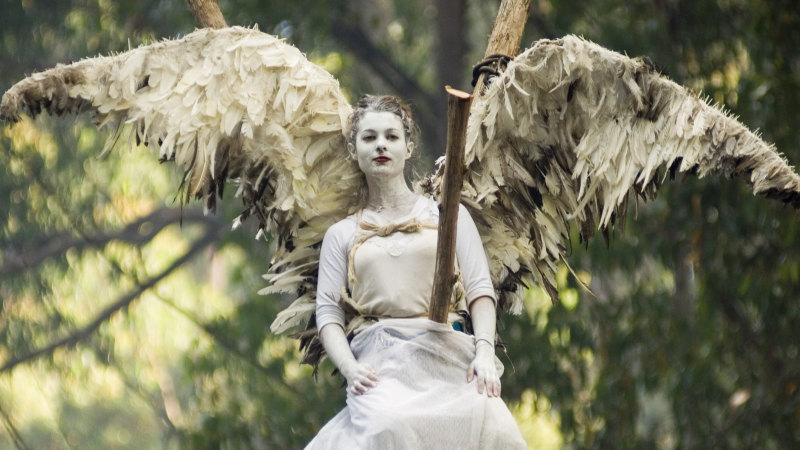
A few years later, Morrow took part in another protest, this time in the lower Weld Valley, to try to protect old-growth forests from being clear-felled. That’s where he met his future partner, Allana Beltran, a visual artist, who was about to enter Tasmanian folklore by attaching herself to a giant tripod at the entrance to the forest, wearing wings of white cockatoo feathers and a long white curtain wrapped around her waist, and her face painted white.
She became known as the Angel of the Forest after police arrested her and charged her with committing a nuisance and failing to obey a police instruction. “I did it because I thought it would look beautiful,†she told me at the time, “and if I was going to be arrested as a visual artist, I wanted to make a visual statement … I was praying for the forests and for people to realise what they are doing. I was ready to sacrifice myself to this cause. I was ready to stand up for these ancient forests.â€
Activists in “Gandalf’s Staffâ€, an 85-metre hardwood tree in southern Tasmania’s Valley of the Giants.Credit:AAP
I have often asked myself since then, and more so today: “What would I do for nature? What is the single best thing I could do for tomorrow’s world?†Would I stand before a tree that had survived the epochs, only to now be facing the logger’s chainsaw? Would I lift a finger for, say, the endangered sandpiper who, for millions of years, has been refining its 13,000-kilometre flight path from the Arctic Circle to the coastal wetlands of Toondah Harbour in Queensland’s Southern Moreton Bay, only to find its mudflats slated for a marina and 3000-apartment residential complex?
Would I stop buying my oranges from California and buy them instead from my local farmers’ market because I finally understand how the worst aspects of globalisation have caused a catastrophic race to the bottom: for people, cultures and environments everywhere?
Would I choose now – wherever possible – only the work that helps bring people together and builds community? Would I scale down, slow down and simplify my life and live by Henry David Thoreau’s credo: “Beware all enterprises that require new clothes�
Would I start loving this stricken earth in ways I never have before because, in this time of terror, sickness and forced seclusion, I have come to appreciate, at long last, how the planet’s interests and ours are the same, that all our fates are bound together?
Nature is speaking to us very loudly right now. We’d do well to listen.
India might not be overwhelmed by desert locusts because their current resting spots in UP, MP and Maharashtra do not provide ideal breeding grounds. Nevertheless, the country should not lower its guard as new swarms are expected to reach West Rajasthan by early July, said Keith Cressman, FAO’s Secretary of The Commission for Controlling Desert Locust in South West Asia.
The new swarms will come from the Eastern part of Africa.
Cressman, who has been studying the movement of desert locusts for years in FAO and is one of its foremost experts on the pest and its behaviour, said that desert locusts aren’t very happy being in Central and Northern India as it isn’t their ideal breeding ground and will return to the familiar terrain of west Rajasthan as soon as monsoon reaches there.
He was speaking at a webinar on Locust Attack in Collaboration with Centre for Science and Environment (CSE). India is battling one of the worst desert locust outbreak in recent times. The crop-destroying swarms first attacked Rajasthan and have now spread to Punjab, Madhya Pradesh, Uttar Pradesh and even Maharashtra.
The latest locust attack across the world, which many are counting as amongst the worst in last several years, has passed the ‘outbreak’ stage and reached the stage of ‘upsurge’.
Unless controlled effectively could reach the ‘plague’ stage when it could create havoc on crop and vegetation in several countries including India.
Cressman said Southern India does not need to worry about locusts, as the current East-West and West to East wind pattern will hold on the locusts in Central and Northern parts of the country.
He also discounted the possibility of locusts attacking urban Centres such as Delhi as there isn’t much to eat in urban centres.
“Locusts don’t like eating concrete and cement and hence they at best will fly over urban centres without causing much damage,†Cressman said.
He said though locusts attack have significant impact on crops and could damage livelihood of farmers in a big way, causing panic and dramatizing the situation in media does not help.
“Rajasthan to me has be extra careful as it will have to cope with locusts returning from UP and MP in search of ideal breeding grounds and also new waves that is expected to reach its western parts,†Cressman said.
He said the locusts’ swarms would henceforth follow the trajectory of monsoon winds over South-Asia that will determine its journey path from the Horn of Africa.
Cressman complimented India for having a very comprehensive and old locusts control programme and said that the problem would not have been so acute had the monsoons not extended their stay in India well into November which never allowed them to retreat back.
He also advised farmers in India not to spray chemicals by themselves and advocated active involvement of state agencies as they have right knowledge and chemicals to undertake such large-scale containment operations.
“When such large scale upsurge takes place of locusts only solution is chemical spaying but farmers too can do somethings like digging trenches around their field as when the locusts are in their hopper stage they can fall into them which then can be buried. Banging of utensils or making large sound is also an effective method to scare them,†Cressman said.
However, he said the downside of banging utensils or making large sound is that it scatters the swarms which them makes difficult to control through chemicals.
The FAO representative also had a word of caution for extensive use of drones to spray chemicals to kill locusts, which India is planning to do in a big way. Cressman said drones have not been so far used for such kind of extensive chemical spraying to kill locusts anywhere in the world and hence there should caution and the drones themselves have limited capacity to hold chemicals.
Sunita Narain, Director General for Centre for Science and Environment and eminent environmentalist who chaired the webinar said that there is a direct linkage between the locust attack and climate change and we need global leadership to address as we leave in an inter-connected world.
Has there ever been a more unsettling sight than Matt Hancock, laughing? Nominally, it was because Kay Burley had asked him why track and trace was being rolled out so fast, when it didn’t appear to be ready. One minute we were calling him too slow, he wheezed. And the next we were calling him too fast! HAHAHAHA. Oh, my sides.Â
Whatever it was coursing through his noisy face, it definitely wasn’t mirth. He looked as if he had been taught to laugh by the goats that had unaccountably raised him, and was trying it out for the first time. But that isn’t the question. “Will track and trace be ready?†isn’t even the question, since given any opportunity to outsource a complex and vital process to a monolithic and incompetent services company, the government will take it, and we have to make our peace with that.Â
The question is: will any of us obey it? Someone calls up, tells you you have had contact with an infected person, but won’t tell you who it was. It is no different from the system with STIs, they say, except it is really different, because you could normally at least narrow down who had given you gonorrhoea, or if you couldn’t, you could take your quarantine on the chin. You can get a test, but even if it is negative, you still have to stay in isolation. You might think you have had coronavirus, you might even have tested positive for it in the past but, building in the uncertainties around immunity, that makes no difference.
Simple thought-experiments, such as “What would Dominic Cummings do?â€, yield a hard: “Bugger that for a game of soldiers.†It takes a very particular set of attributes to be able to ask others, in a convincing and compelling way, to do their duty. It would be boring to list them all when it is plain that no one in government has any of them.Â
Probably the only way this is salvageable is for the cabinet to lead by example: all declare themselves quarantined, following track-and-trace instructions, constantly, one fortnight rolling into the next. Maybe get someone else, such as the opposition, to step in and govern for a bit. It’s quite an ask, but, in the national interest, worth it.Â
Senior Palestinian officials, such as Fatah Secretary General Jibril Rajoub, insist that the decision is strategic and sincere. Yet many are doubting the decision because it seems to come with little planning and almost no details are available. It is being argued that the decision by the Fatah-dominated the PLO goes in line with Fatah’s practice of making decisions and then making adjustments as they are implemented.
PLO Executive Committee member Hanan Ashrawi agrees that Palestinian President Mahmoud Abbas’ announcement on May 20 means a shift toward the PLO, but feels that the latter needs to be reformed and revitalized. “That’s been the plan of the Palestine National Council and Palestine Central Council for some time. But this needs the reform and revitalization of the PLO and its institutions, including elections, and a readjustment of its relationship to the Palestinian Authority.â€Â
Ashrawi noted that a “lot has to be done if the political and representative mandate of the PLO is to be fully exercised to lead to national liberation and sovereignty.â€
Ziad Abuzayyad, a former Palestinian minister, says that to enact the Palestinian president’s new decision, efforts must include a strategy to empower the PLO. “Our people are more militant than their leadership and any decision or act that addresses and goes along with the dignity and national aspirations of the people gains support and popularity. The demand to shift from the PA to the PLO and empower the PLO with appropriate representation of all the national and Islamic factions is now at the top of the people’s agenda.â€
Riyad Mansour, the head of the Palestinian mission to the United Nations, noted in a phone interview with Al-Monitor that the PLO is well represented legally in every UN decision since it was recognized by the international organization in 1975. “We make sure that every decision made at the UN references the PLO as the sole and legitimate representative of the Palestinian people.â€
Mansour said that when Palestine was made an observer state in 2012, “We added a line that this will not change the role of the PLO.†Mansour predicts that when a sovereign and independent state of Palestine comes into being, the PLO could become a sort of ruling party. “For us, the model of our future is that of Algeria and South Africa, where their liberation movements — the National Liberation Front, and the African National Congress — became the ruling party once liberation happened.â€Â
Mansour added that a powerful global lobby is forming to stand up to the possibility of an Israeli annexation. “This has been one of the easiest tasks we have undertaken because in the post-World War II era there is a worldwide consensus against the unilateral acquisition of land under the sole justification of power and might. Annexation would violate the UN Charter, international law and the Security Council [resolutions] including UNSC 2334.â€
Fadi Elsalameen, a senior fellow at the Washington-based American Security Project, told Al-Monitor that it is too early to make predictions. “The PLO as a representative of the Palestinian people is more popular that the PA, but the question is whether President Abbas is willing to have others in the PLO share with him the decision-making process or not.â€
Khaled Elgindy, a senior fellow at the Middle East Institute, told Al-Monitor that it is reasonable to expect the PA to become weaker, not only due to the severing of ties with Israel but also because of matters like the loss of funding in recent years, the ongoing split with Hamas and the PA’s loss of its raison d’etre. “What has allowed the PA to survive more than two decades beyond its expiration date was the expectation that it would someday transform into a fully sovereign state. Now that a sovereign Palestinian state is no longer in the cards, thanks to the [US Middle East peace] plan and the apparent triumph of Israeli annexationists, the case for maintaining the PA becomes much harder to make,†Elgindy explained.
Noor Imam, a Amman-based lawyer and  a member of the Palestine National Council, told Al-Monitor that regardless of what happens, the PLO will be the reference point. “The PA was the result of the Oslo process, but the PLO as the legitimate representative of the Palestinian people will be around until liberation takes place.â€
In an ironic twist, the elevation of the PLO could be a godsend for some prospective Palestinian leaders who are waiting to occupy the three major posts that Abbas occupies as president, head of Fatah and chairman of the PLO. The more revolutionary leaders will see new opportunities in the latter two posts, irrespective of what Arabs and the international community might want in the president of Palestine.
Some 13 million Palestinians are spread between five million living in the West Bank and Gaza and eight million in the diaspora. If the suspension of coordination with Israel continues and the Palestinian government weakens, the PLO must be revitalized and reformed so it can truly represent everyone. To that end, the priority must be given to unity, which means finding a way to include large factions like Hamas.
While a shift to the PLO is still being discussed, the regional ramifications of such an eventuality have not been widely discussed. Will the Palestinian leadership return to one of the Arab capitals? Will it work to improve its relations with this or that Arab country in return for having its headquarters there? What will this mean to the relationship between Palestine and the world outside? If the current process continues these questions  will need to be answered.
The order came after Twitter labelled Trump’s tweets about mail in ballots for containing potentially misleading information. Social media companies have denied they censor conservative speech.
PRESIDENT TRUMP DENIES HIS TWEET WAS INCORRECT
During the press briefing, President Trump denied that his tweet was incorrect as he was referring to people taking other voters ballots in what he called ballot harvesting.
Trump said, “The censorship and bias is a threat to freedom itself. Imagine if your phone company silenced or edited your conversation. Social media companies have vastly more power and more reach than any phone company in the United States.â€
WHAT IS SECTION 230?
Under Section 230, internet companies have broad immunity from liability for the content their users post on their platforms. The draft order would open the door for the Commerce Department and the Federal Communications Commission to reinterpret the law and allow the Federal Trade Commission to create a tool for users to report bias online.
According to the order, the National Telecommunication and Information Administration has 60 days to file a petition for rule making with the FCC. Upon receiving the petition, the Trump administration is asking that the FCC reinterpret parts of Section 230 and decide what it means for a platform not to be acting in “good faith†under the provision.
The order directs government agencies to review the amount of federal dollars it spends on online platforms as well.
SOCIAL MEDIA COMPANIES RESPONSE TO THE EXECUTIVE ORDER
Social media companies have denied they censor conservative speech, but Twitter’s fact checking of Trump’s tweets have reignited a debate about whether they’re neutral platforms or publishers. Twitter and Facebook have said they don’t want to be an arbiter of truth.
GOOGLE
A Google spokeswoman said the company’s content policies have no political bias.
“We have clear content policies and we enforce them without regard to political viewpoint,†the spokeswoman said. Our platforms have empowered a wide range of people and organisations from across the political spectrum, giving them a voice and new ways to reach their audiences. Undermining Section 230 in this way would hurt America’s economy and its global leadership on internet freedom.â€
TWITTER
Twitter addressed the order in a tweet Thursday night.
“This EO is a reactionary and politicized approach to a landmark law. Section230 protects American innovation and freedom of expression, and it’s underpinned by democratic values. Attempts to unilaterally erode it threaten the future of online speech and Internet freedoms.â€
FACEBOOK
Facebook said it was a platform for diverse views and that its rules apply to everyone.
“Repealing or limiting section 230 will have the opposite effect. It will restrict more speech online, not less. By exposing companies to potential liability for everything that billions of people around the world say, this would penalise companies that choose to allow controversial speech and encourage platforms to censor anything that might offend anyone,†a Facebook spokesperson said in a statement.
This content has been created as part of our freelancer relief programme. We are supporting journalists and freelance writers impacted by the economic slowdown caused by #lockdownlife.
If you are a freelancer looking to contribute to The South African, read more here.
We use cookies on our website to give you the most relevant experience by remembering your preferences and repeat visits. By clicking “Accept”, you consent to the use of ALL the cookies.
This website uses cookies to improve your experience while you navigate through the website. Out of these, the cookies that are categorized as necessary are stored on your browser as they are essential for the working of basic functionalities of the website. We also use third-party cookies that help us analyze and understand how you use this website. These cookies will be stored in your browser only with your consent. You also have the option to opt-out of these cookies. But opting out of some of these cookies may affect your browsing experience.
Necessary cookies are absolutely essential for the website to function properly. These cookies ensure basic functionalities and security features of the website, anonymously.
Cookie
Duration
Description
cookielawinfo-checbox-analytics
11 months
This cookie is set by GDPR Cookie Consent plugin. The cookie is used to store the user consent for the cookies in the category "Analytics".
cookielawinfo-checbox-functional
11 months
The cookie is set by GDPR cookie consent to record the user consent for the cookies in the category "Functional".
cookielawinfo-checbox-others
11 months
This cookie is set by GDPR Cookie Consent plugin. The cookie is used to store the user consent for the cookies in the category "Other.
cookielawinfo-checkbox-necessary
11 months
This cookie is set by GDPR Cookie Consent plugin. The cookies is used to store the user consent for the cookies in the category "Necessary".
cookielawinfo-checkbox-performance
11 months
This cookie is set by GDPR Cookie Consent plugin. The cookie is used to store the user consent for the cookies in the category "Performance".
viewed_cookie_policy
11 months
The cookie is set by the GDPR Cookie Consent plugin and is used to store whether or not user has consented to the use of cookies. It does not store any personal data.
Functional cookies help to perform certain functionalities like sharing the content of the website on social media platforms, collect feedbacks, and other third-party features.
Performance cookies are used to understand and analyze the key performance indexes of the website which helps in delivering a better user experience for the visitors.
Analytical cookies are used to understand how visitors interact with the website. These cookies help provide information on metrics the number of visitors, bounce rate, traffic source, etc.
Advertisement cookies are used to provide visitors with relevant ads and marketing campaigns. These cookies track visitors across websites and collect information to provide customized ads.




![Former UN Executive Secretary for Climate Change, Christiana Figueres. "Australia has huge potential to be the major [clean] energy generator and power of large parts of the Pacific.â€](https://static.ffx.io/images/$zoom_0.267%2C$multiply_2.7195%2C$ratio_1.776846%2C$width_1059%2C$x_0%2C$y_384/t_crop_custom/q_62%2Cf_auto/8beaf24b9193622bbf41c3648fe8b440da451483)


