Friday, April 24, 2026

NYC Mayor Bill De Blasio Blames Protesters After Police Vans Plow Through Crowd

Responding to videos showing two police vans plowing into a crowd of protesters in Brooklyn on Saturday, New York City Mayor Bill de Blasio said that the demonstrators — and not police — had behaved inappropriately and bore the brunt of the blame for the incident.

The footage “is upsetting, and I wish the officers hadn’t done that,” de Blasio said during a press conference Saturday night as protests raged in New York and dozens of other cities nationwide in response to the police killing of George Floyd. “But I also understood that they didn’t start this situation. The situation was started by a group of protesters converging on a police vehicle, attacking that vehicle.” 

Videos of the incident, which was shared widely on social media, show a New York City Police Department van in the middle of a road, a barricade in front of it. A crowd of demonstrators stands in front of the vehicle, some of whom appear to throw objects at it. One person is seen approaching the vehicle from behind to toss what appears to be a trash bag onto the van, while another person runs up to the driver’s side of the vehicle before dashing away. 

Another NYPD van then arrives, driving past the first van straight into a group of demonstrators. The first van is seen then to suddenly accelerate, pushing the barricade into protesters.  

De Blasio said it was “inappropriate for protesters to surround a police vehicle and threaten police officers. That’s wrong on its face and that hasn’t happened in the history of protest in this city.”

Videos of the incident do not show people surrounding either van.

The mayor was skewered on social media for mischaracterizing the incident.

De Blasio said he wasn’t “going to blame officers who were trying to deal with an absolutely impossible situation. The folks who were converging on that police car did the wrong thing to begin with, and they created an untenable situation.”

“I wish the officers had found a different approach,” de Blasio continued, but added that “if those protesters had just gotten out of the way and not created an attempt to surround that vehicle, we would not be talking about this.” 

Rep. Alexandria Ocasio-Cortez (D-N.Y.) lambasted de Blasio’s remarks as “unacceptable.” 

“As mayor, this police department is under your leadership. This moment demands leadership & accountability from each of us. Defending and making excuses for NYPD running SUVs into crowds was wrong,” she wrote on Twitter.

NYC Council Speaker Corey Johnson also condemned the police action.

“This is outrageous. Driving police vehicles into crowds of protestors is not deescalation. Shoving and beating nonviolent people is not deescalation. If NYPD’s intent is to keep folks safe, this isn’t it,” he tweeted. 

Tens of thousands of people took to the streets in cities across the U.S. on Saturday to protest Floyd’s death. He was accused by a store clerk of paying for cigarettes with a counterfeit $20 bill, and died after a Minneapolis police officer knelt on his neck for several minutes despite Floyd repeatedly telling him “I cannot breathe.” 

The demonstrations, some of which turned violent, have been met with increasingly heavy-handed police crackdowns, with officers using tear gas and rubber bullets to disperse crowds. At least 1,600 people have been arrested nationwide since Thursday. 

In Brooklyn, HuffPost reporter Christopher Mathias, who was covering the protests there, was arrested on Saturday night despite clearly identifying himself as press.

Reporter Phoebe Leila Barghouty said she saw the NYPD  “violently arresting” Mathias, “aggressively” grabbing him and turning him “over on either a car or a barricade to zip tie.” He was released early Sunday.


Source by [author_name]

Coronavirus: What sporting events are affected by the pandemic?

The outbreak of the novel coronavirus, which as of May 30 has killed more than 369,000 people globally, has affected sporting events across the world.

As the number of confirmed coronavirus cases worldwide has surged past 6 million, major sporting events have been cancelled or postponed.

The most significant one that was due to take place in Japan this summer was the Tokyo 2020 Olympics.

More:

However, the International Olympic Committee and Japan’s Prime Minister Shinzo Abe have postponed the event to next year, where it will now take place from July 23 to August 8, 2021.

Football

In South Korea, the football league season restarted on May 8 after several weeks of postponement, with reigning champions Jeonbuk Motors hosting Suwon Bluewings in an empty World Cup Stadium in Jeonju.

In Germany, the top-flight Bundesliga resumed its season on May 16 behind closed doors after a two-month hiatus. 

The English Premier League and Italy’s Serie A are set to resume in June after a near three-month suspension, officials said on May 28.

The Major League Soccer (MLS) top-tier football league in the US has extended its postponement of matches in the country until at least June 8 due to the coronavirus pandemic.

On April 12, the Confederation of African Football (CAF) announced the postponement of the two-legged semi-finals of the African Champions League that were supposed to take place in May.

“In light of growing concerns and evolving nature on COVID-19 (that has led to a) lockdown in most countries, the CAF Emergency Committee has decided to postpone the matches until further notice,” a statement said.

The CONCACAF (Confederation of North, Central American and Caribbean Association Football) Nations League Finals, which were scheduled for June 4 to June 7, have been suspended. The finals, due to be contested by Costa Rica, Honduras, Mexico and the United States and held in the Houston and Dallas areas of Texas, will be rescheduled for a later date in venues to be determined.

Football in Russia has also been suspended. The Russian Football Union agreed to immediately suspend all competitions at a meeting on March 17.

The postponed Belgian Cup final has been rescheduled for August 1. That is one week before the start of the league’s next season.

The African Nations Championship 2020  tournament scheduled for April in Cameroon has been postponed indefinitely, the African Football Federation said in a statement on March 17.

This year’s Copa America has been postponed until 2021, the South American Football Confederation (CONMEBOL) said on March 17. The 12-team tournament had originally been scheduled to take place from June 12 to July 12 in Colombia and Argentina.

The Euro 2020 tournament has been postponed until 2021, European football’s governing body UEFA said in a statement on March 17. UEFA said that the 24-team tournament, which was due to be staged in 12 nations across the continent from June 12 to July 12 this year, would now take place from June 11 to July 11, 2021. 

On April 23, UEFA also postponed the Euro 2021 Women’s championship, and it will now be played in England from July 6 to July 31, in the same venues that were originally proposed to host the event. 

The women’s football league in England has been cancelled.

Europa League match between Inter Milan and Ludogorets was played in an empty stadium in Milan, Italy [Emilio Andreoli/Reuters]

UEFA on April 1 suspended all Champions League and Europa League matches “until further notice”.

All national team games scheduled for June have also been postponed.

FIFA and the Asian Football Confederation have agreed to postpone the Asian World Cup qualifying matches in March and June.

New seasons in the Chinese and Japanese professional leagues have been postponed.

Asian Champions League matches involving Chinese clubs Guangzhou Evergrande, Shanghai Shenhua and Shanghai SIPG have been postponed. The start of the knockout rounds has been moved back to September.

The Confederation of African Football has postponed two rounds of the 2021 Africa Cup of Nations qualifiers scheduled for March 25-31.

An exhibition match between Mexico and Colombia on May 30 at Denver has been cancelled.

The rest of the Dutch football league has been cancelled and leading team Ajax will not be declared the champion.

Marathons

The London Marathon, which was scheduled to take place on April 26, has been postponed until October 4.

The Boston Marathon, originally scheduled for April 20 and later postponed for five months, has been cancelled for the first time in its 124-year history. 

Organisers said on May 28, that they instead will stage a “virtual event” in which participants who verify that they ran 26.2 miles on their own will receive their finisher’s medal.

Amsterdam, Paris and Barcelona marathons have also been postponed. 

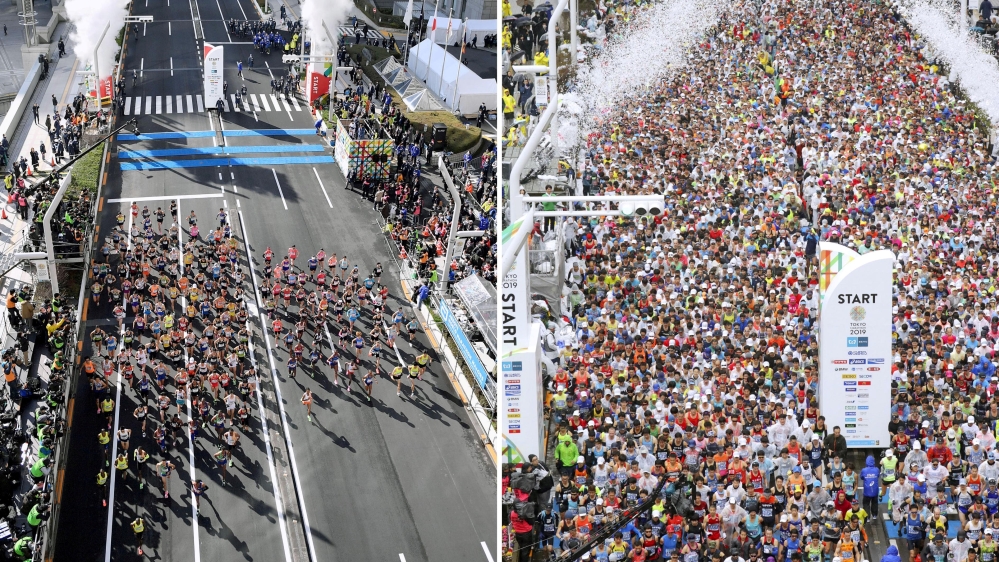
In Japan on March 1, the Tokyo Marathon, which usually attracts 300,000 participants, was restricted to only 200 elite runners.

Runners start at the Tokyo Marathon in Tokyo, Japan

Combination photos show how runners fill the street at the start of the Tokyo Marathon 2019 in Tokyo, Japan in this March 3, 2019, right, and runners start at the Tokyo Marathon 2020 in Tokyo, Japan on March 1, 2020 [Kyodo/via Reuters]

Olympic Games

The International Olympic Committee and Japan’s Prime Minister Shinzo Abe have concluded the Tokyo 2020 Olympics must be postponed.    

The decision was made after holding out for weeks as local organisers and the IOC came under increasing pressure from athletes, national Olympic bodies and sports federations.

The event will now take place from July 23 to August 8, 2021. 

Athletics

The traditional Berlin athletics meeting, ISTAF, will not take place without spectators later this year if coronavirus restrictions remain in place, organisers have said. The 79th edition of the event is scheduled for September 13, but meeting director Martin Seeber said he is planning a potential cancellation and wants a decision by mid-June.

The World Athletics Championships scheduled to take place in Oregon in August 2021 have been pushed back to July 2022 to avoid clashing with the rescheduled Olympic Games, the sport’s governing body said on April 8. 

The Diamond League postponed its first five meetings of the 2020 season due to be held in April and May in Qatar, China, Stockholm, Naples and Rabat.

World Athletics said in a statement that it “approved the new dates this week after extensive discussions with the sport’s stakeholders.”

The World Athletics Indoor Championships, scheduled for Nanjing from March 13-15, have been postponed until next year.

Formula One

Formula One plans to start its season behind closed doors in Austria from July 3-5, followed by the British Grand Prix at Silverstone under similar conditions, but has yet to publish a revised calendar.

The Hungarian Formula One Grand Prix, which was scheduled originally for August 2, can only take place without spectators, organisers said.

The Dutch Grand Prix will have to wait one more year to return to the Formula One circuit after organisers said the race postponed due to the coronavirus pandemic will not take place in 2020.

The race – the fourth to be cancelled this year - at the seaside circuit would have been the country’s first since 1985.

The Azerbaijan Grand Prix scheduled for June 7 has been postponed. 

Formula One cancelled the season-opening Australian GP after a McLaren team member contracted the coronavirus. The race was scheduled to take place on March 15. 

The Bahrain Grand Prix and the Vietnam Grand Prix have been postponed. Those events were first scheduled to take place on March 20-22 and April 3-5 respectively.

Sports Pictures of the Year

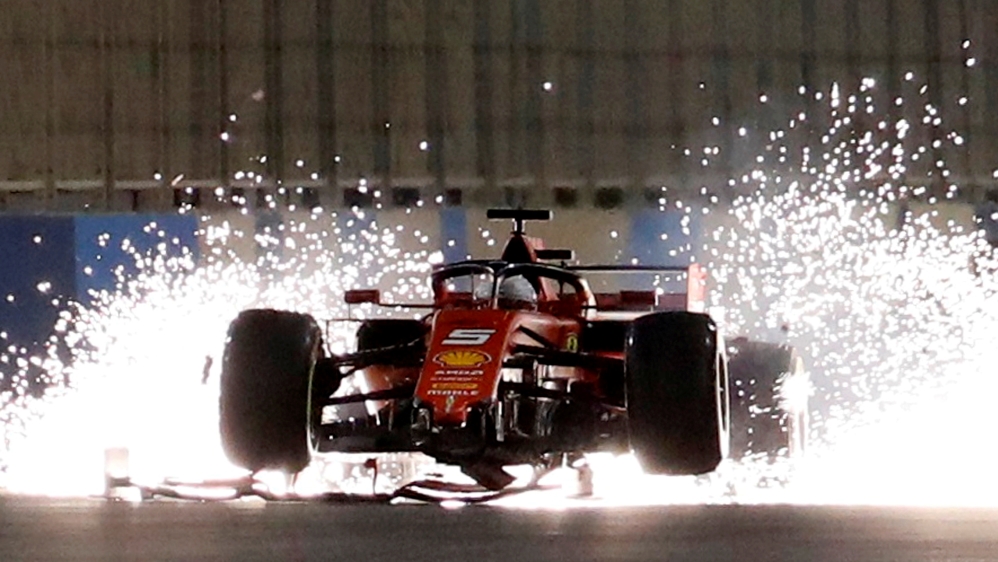
The Bahrain Grand Prix in Manama was due to be held without fans before organisers decided to postpone the race [File: Thaier Al-Sudani/Reuters]

The Chinese Grand Prix in Shanghai, which was scheduled to take place on April 19, was also postponed. 

The Monaco Grand Prix scheduled for May 21 was cancelled by the organisers on March 19. 

Formula One Canadian Grand Prix organisers announced on April 7 that the race in Montreal that was supposed to kick off the 2020 World Championship calendar will be postponed until further notice. 

The French Grand Prix scheduled for June 28 at Le Castellet has been cancelled due to the COVID-19 pandemic, organisers said on April 27.

Racing

The Indianapolis 500 scheduled for May 24 has been postponed until August 23 and will not run on Memorial Day weekend for the first time since 1946.

The French MotoGP initially scheduled for May 15-17 in Le Mans, was postponed because of the “ongoing coronavirus outbreak”, organisers announced on April 2.

Tennis

The International Tennis Federation (ITF) said 900 tournaments across all its circuits had been postponed and that it was furloughing half its staff.

The 2020 Wimbledon tennis championships have been cancelled because of the coronavirus pandemic, the All England Club announced on April 1.

It is the first time the championships, due to take place between June 28 and July 11, have been called off since World War II.

The professional tennis tour – men’s and women’s – has been suspended until June 7, with all clay-court tournaments in Europe cancelled. ATP and WTA rankings have been frozen until further notice. 

The French Open has been postponed until September 20 – October 4, organisers said on March 17. The clay-court major was originally scheduled to be played from May 24-June 7.

There was also disappointment for tennis fans in California as the BNP Paribas Open in Indian Wells was cancelled.

Also cancelled were the Xi’an Open, scheduled for April 13 to 19, and Kunming Open, pencilled for April 27 to May 3. Both events were to take place in China.

Boxing

The world boxing heavyweight title fight between Briton Anthony Joshua and the IBF’s mandatory challenger Kubrat Pulev of Bulgaria originally scheduled for June 20 has been postponed, promoters said.

The Tokyo Olympic boxing qualifiers for Asia and Oceania were moved to Jordan from China.

However, the European, American and final world qualifying boxing tournaments for the Olympic Games have been suspended, the International Olympic Committee said.

Briton Anthony Joshua’s world heavyweight title defence against Bulgarian Kubrat Pulev would probably take place at the end of the year instead of June 20 at Tottenham Hotspur’s stadium in London as scheduled.


Football matches resume in Costa Rica as virus curbs ease

Basketball

Europe’s top two club basketball competitions have terminated the current season without naming any winners due to the COVID-19 pandemic, organisers EuroLeague Basketball said on May 25. 

“Having explored every possible option, the Executive Board has made the decision to cancel the 2019-20 EuroLeague and EuroCup,” the organising body said on its official Twitter account.

The 2020-21 EuroLeague and EuroCup seasons will start on October 1 and September 30 respectively, said the statement, which added that the same 18 teams that contested this season’s EuroLeague would also compete in the next campaign.

“Without a doubt, this is the most difficult decision we have had to take in our 20-year history,” said EuroLeague’s president and chief executive Jordi Bertomeu.

On May 19, the German basketball league (BBL) has been given permission by the regional Bavarian government to conclude its season   with a 10-team tournament in Munich’s Audi Dome in the first weekend of June.

The National Basketball Association (NBA) said on March 11 that it was suspending the season until further notice after a Utah Jazz player tested positive for the virus.

The WNBA draft will be a virtual event this year. The women’s league announced that its draft will still be held on April 17 as originally scheduled, but without players, fans or media in attendance due to the coronavirus pandemic.

The Women’s National Basketball Association (WNBA) postponed the 2020 regular season as coronavirus continues spreading rapidly across the US and the world.

“As developments continue to emerge around the COVID-19 pandemic, including the extension of the social distancing guidelines in the United States through April 30, the WNBA will postpone the start of its training camps and the tip of the regular season originally scheduled for May 15,” the WNBA Commissioner Cathy Engelbert said in a statement late Friday.

“While the league continues to use this time to conduct scenario-planning regarding new start dates and innovative formats, our guiding principle will continue to be the health and safety of the players, fans and employees,” she added.

Rugby

World Rugby’s governing body announced on May 15 it has postponed all test matches scheduled for July due to travel curbs and health protocols implemented to halt the spread of the novel coronavirus.

It was too early to determine whether matches in the November window would be affected at this stage, it added, with a decision contingent on advice from governments and health organisations.

In France, the country’s rugby federation said on March 13 that it was suspending all of its competitions due to the outbreak.

At least three Six Nations matches have been postponed.

The women’s Six Nations game between Scotland and France was postponed after a Scottish player tested positive for coronavirus.

The Singapore and Hong Kong legs of the World Rugby Sevens Series have been postponed from April to October.

MotoGP

The opening two rounds of the season in Qatar, which were scheduled for March 6-8, did not go ahead. The Thailand race, due to be held on March 22, has been postponed.

April rounds in Texas and Argentina have been pushed back to November. 

The Spanish Grand Prix scheduled for May 3 has also been postponed. It is the fifth MotoGP race to be cancelled or postponed due to the coronavirus. 

Table tennis

The world championships in Busan, South Korea, have been pushed back provisionally from March to June. 

The April 21 to 26 World Tour Japan Open in Kitakyushu has been postponed.

Golf

On May 14, the PGA Tour said testing for the novel coronavirus and daily temperature checks will be a mandatory feature of the return of professional golf in the US on June 11 with the Charles Schwab Challenge in Fort Worth, Texas. 

The Saudi Ladies International, the first women’s professional golf event to be staged in Saudi Arabia, has been rescheduled for October 8-11 after it was postponed due to the coronavirus pandemic, organisers have confirmed.

The 2020 Masters Tournament has been provisionally rescheduled for November 12-15, Augusta National Golf Club has said.

The 149th Open Championship due to be played at Royal St George’s from July 16-19 has been cancelled. “The R&A has decided to cancel The Open in 2020 due to the current Covid-19 pandemic,” the governing body said in a statement, adding that “the Championship will next be played at Royal St George’s in 2021”.

South Korea women golf

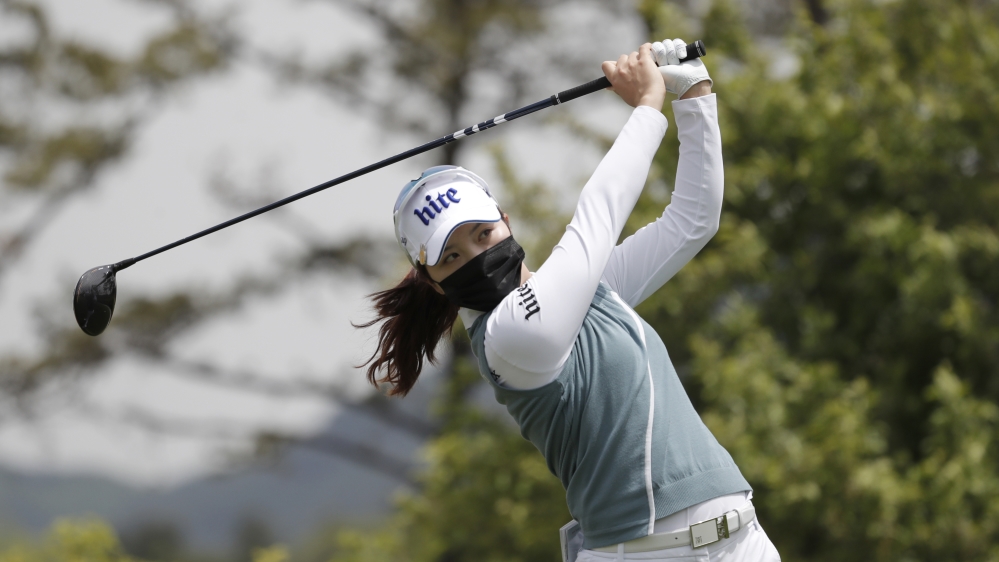
The KLPGA Championship at the Lakewood Country Club in Yangju, South Korea was held without spectators [Lee Jin-man/AP]

The Trophee Hassan II in Morocco from June 4-7 was postponed and the Scandinavian Mixed tournament in Stockholm was cancelled and will now be played in 2021.

The Honda LPGA Thailand event and the HSBC Women’s World Championship in Singapore have been cancelled.

The Maybank Championship in Kuala Lumpur and the China Open have been postponed.

The Indian and China opens have both been postponed.

The Evian Masters women’s golf tournament has been moved to August.

The Dubai Duty Free Irish Open announced on March 30 that it would be postponed due to the ongoing coronavirus pandemic. The European Tour confirmed that the event, scheduled for 28-31 May at Mount Juliet, has been postponed following “consultation with all stakeholders”.

The US Women’s Open at Champions Golf Club in Houston has been postponed from the end of spring to mid-December.

Cycling

The road cycling European championships scheduled for September in the Italian province of Trentino have been postponed by a year, the Union Europeenne de Cyclisme (UEC) said on May 3.

The three-week Tour de France, scheduled for June 27, will now start on August 29 and will finish on September 20.

The Tour could not start as scheduled in the Riviera city of Nice because French President Emmanuel Macron cancelled all public events with large crowds through mid-July in response to the coronavirus pandemic.

Top one-day cycling races Paris-Roubaix and Liege-Bastogne-Liege have been postponed, organisers said on March 17. Paris-Roubaix and Liege-Bastogne-Liege, which were due to be held on April 12 and 26 respectively, are two of the five “Monument” races of the cycling calendar with the Tour of Flanders, Milan-Sanremo and the Tour of Lombardy.

The Tour of Flanders and Milan-Sanremo have already been postponed. A new date has yet to be set for the races.

The final two stages of the UAE Tour were cancelled after two Italian participants tested positive for the coronavirus.

Four teams have pulled out of several cycling races in Italy.

The Giro d’Italia start on May 9 in Budapest has been postponed. A new start date will not be determined until at least April 3.

Meanwhile, British Cycling will furlough around a third of its staff in April and May due to the financial impact of the pandemic. 

On April 13, the Turkish Cycling Federation announced all cycling competitions to be held in Turkey until June have been postponed.

All scheduled activities until June 6 are postponed to a later date because of the coronavirus pandemic. New racing calendar will be announced later, the federation said in a statement.

Baseball

The final qualification tournament for the Olympics in Taiwan has been postponed from April to June.

South Korea’s professional league reopened its new season on May 5 in empty stadiums after more than a month-long delay.

Major League Baseball (MLB), the US’s professional baseball league, suspended its “spring training”, a period in the off-season that features practices and exhibition games that allow trainers to test new players on different teams.

The MLB also delayed its opening day, which was scheduled for March 26. 

MLB games scheduled to be played in Mexico City and San Juan, Puerto Rico, are cancelled. 

corona social cards


NCAA

The National Collegiate Athletic Association (NCAA) cancelled scheduled games for both men and women on Thursday afternoon.

The NCAA organises all sports for athletes in university, an important league that showcases young talent to recruiters for professional sports in the US. 

The cancellation extends to all championships scheduled in the spring, including hockey, baseball and lacrosse.

Cricket

England’s two-match test series in Sri Lanka, which has been postponed and rescheduled for January next year, Sri Lanka Cricket (SLC) CEO Ashley de Silva said. England were scheduled to play tests in Galle and Colombo in March before the coronavirus outbreak.

The men’s Cricket World Cup Challenge League A, scheduled to begin on March 16 in Malaysia, has been postponed.

The start of the Indian Premier League T20 tournament (March 29) was postponed until April 15.

The Pakistan Cricket Board announced that Pakistan Super League matches in Karachi will be played with no spectators in the stadium.

England’s two-match test series in Sri Lanka scheduled to start on March 19 was postponed.

Australia’s proposed test tour of Bangladesh in June has been postponed and both boards will work together to find new dates to reschedule the series.

Judo

The International Judo Federation cancelled all Olympic qualification events through to the end of April.

Weightlifting

The Asian Championships, scheduled to take place in Uzbekistan from April 16 to 25, have been cancelled.


Coronavirus: S Korea baseball league reopens in empty stadiums

Winter sports

The International Ski Federation cancelled the final races of the men’s Alpine skiing World Cup.

The World Cup finals in Cortina were cancelled along with the last three women’s races in Are.

The women’s world ice hockey championships in Canada were cancelled.

The Ice Hockey World Championship scheduled for Switzerland in May was cancelled.

The speed skating world championships in Seoul were postponed until at least October.

The March 16-22 world figure skating championships in Montreal were cancelled.

The Kontinental Hockey League (KHL) has cancelled the remainder of its season after temporarily suspending its playoffs.

Australian Rules

The AFL game between St Kilda Saints and Port Adelaide Power scheduled for May 31 in China has been moved to Melbourne.

NHL 

The National Hockey League, primarily based in the US but with teams from Canada, suspended its season indefinitely on March 12. 

Wrestling

The Asian Olympic qualifying event from March 27-29 was moved from Xi’an, China to Bishkek, Kyrgyzstan.

On February 29, Kyrgyzstan withdrew as host.

Horse racing 

The Dubai World Cup, one of the world’s richest horse races and a premier annual sporting event in the United Arab Emirates, scheduled for March 28, has been postponed to next year, Dubai’s government media office tweeted on March 22.

The 146th running of the Kentucky Derby has been moved to September 5. It will be the first time the world-renowned horse race will not run on the first Saturday in May since 1945, when it was moved because of World World II.

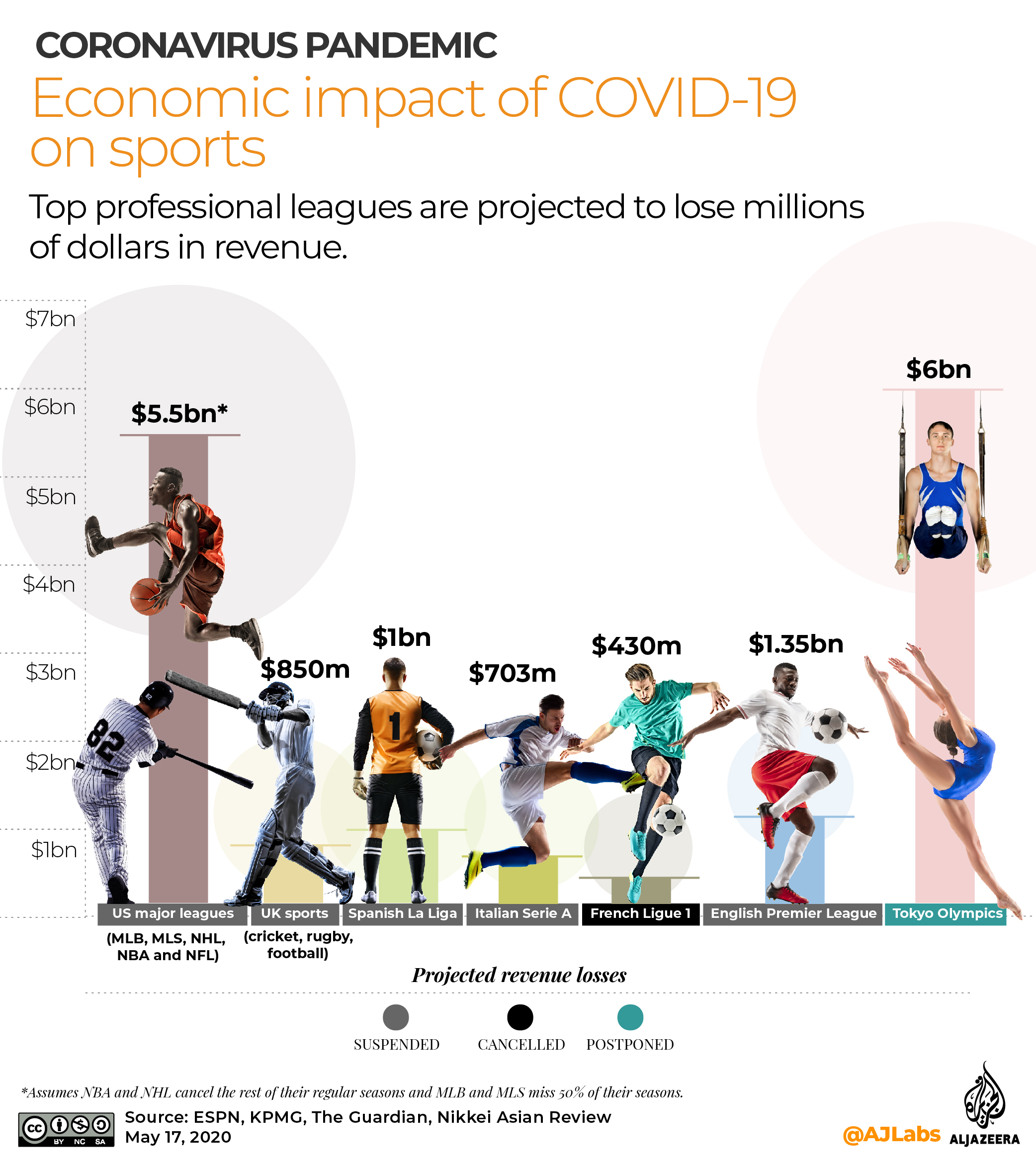
INTERACTIVE: Economic impact of COVID19 - May 17 2020

Estimated revenue losses of various sports [Alia Chughtai/Al Jazeera]

Badminton

The final qualification tournament in Taiwan for the Olympics was put back from April to June 17-21, while the March 22-26 qualification event in Arizona was postponed.

Japan’s professional league postponed the start of the season.

Badminton’s Thomas and Uber Cup Finals being staged in Aarhus, Denmark, have been postponed from May 16-24 to August 15-23.

The biennial event features national teams.

The 2021 badminton World Championships will move from its August slot and begin in late November to avoid a clash with the rescheduled Tokyo Olympics next year, the game’s governing body said on May 1.

The tournament will be held from November 29 to December 5 in the Spanish city of Huelva, the Badminton World Federation (BWF) said in a statement.

Sumo

The Summer Grand Sumo Tournament has been postponed by two weeks from its scheduled May 10 start due to concerns over the coronavirus, according to the Japan Sumo Association.

The annual 15-day tournament at Tokyo’s Ryogoku Kokugikan is one of the six major sumo contests held in Japan every year. The Tokyo tournament is now scheduled to start on May 24, with the next competition to be held in Aichi Prefecture also delayed for two weeks.

Paralympics

The postponed Paralympic Games will run from August 24-September 5, 2021.

Canoeing

All events originally scheduled for May, including the Paracanoe World Championships, canoe sprint Olympic qualifiers, and the ICF canoe sprint World Cup have been cancelled.

Pre-Olympic canoe slalom training camps in Tokyo in May, June and July have all been cancelled.

The opening two ICF canoe slalom World Cups, set for June in Italy and France, have been postponed.

Swimming

The short course world championships, scheduled for December in Abu Dhabi, will now be staged from December 13-18, 2021, in the United Arab Emirates. 

The 2021 aquatics world championships in Fukuoka, Japan, will now be held from May 13-29, 2022, swimming’s governing body FINA said in a statement on May 4.

Canada’s Tokyo Olympic and Paralympic swimming trials have been rescheduled for next April, Swimming Canada said.

The trials, originally set for March 30 to April 5 in Toronto, were postponed on March 13 as part of efforts to control the spread of the novel coronavirus. They were rescheduled after the International Olympic Committee and Japan organisers postponed the 2020 Summer Games for one year.

The meet will be held at the same venue, the Toronto Pan Am Sports centre, but will be condensed into a five-day program from the seven days originally planned.


Source link

How Republicans Became The Party Of Death Panels

The phrase “death panels” became part of America’s political vocabulary in 2009, when Republicans were trying to stop the legislation that eventually became the Affordable Care Act.

Although the details of the argument evolved over time, the gist was always the same: “Obamacare” would ration treatments for society’s most vulnerable members, like the disabled and the elderly, because their lives wouldn’t be deemed worth the expense of saving.

The claim was so outrageous that Politifact named it the “lie of the year.” 

Now another national debate is taking place. It’s about how to open up businesses in the country amid a coronavirus pandemic that has already killed more than 102,000 people, many of them elderly and unwell, and is sure to kill many more.

There are difficult trade-offs and ambiguous medical evidence to weigh. But on one side of the argument is a group of people who act as if ― and occasionally even say ― that returning to normality requires tolerating mass deaths among some of society’s most vulnerable groups.

And wouldn’t you know it? It’s the same crowd that was screaming about the specter of death panels a decade ago.

Political opportunism helps to explain the apparent shift. In 2009, Republicans and conservatives were trying to block legislation from then-President Barack Obama. Now they are trying to promote and defend President Donald Trump, who has been agitating to end social distancing to open businesses and revive the economy.

But upon closer inspection, the conservative positions then and now have a common theme. It’s about whose lives deserve the protection of government programs. And whose don’t.

Death Panels In The Age Of Obamacare

The death panel concept first got attention in July 2009, when Elizabeth McCaughey, an analyst and former lieutenant governor of New York, told a conservative radio host she had discovered an explosive feature of the Democratic health care proposal Congress was considering. 

The proposal, she said, “would make it mandatory ― absolutely require ― that every five years people in Medicare have a required counseling session that will tell them how to end their life sooner.”

McCaughey, already notorious for dishonest attacks on President Bill Clinton from a decade before, was engaging in wild distortion. The provision merely required that Medicare pay for counseling sessions on how to write advance directives. That way, physicians would be able to carve out the time for seniors who wanted help making decisions about end-of-life care in the future. 

Among the provision’s chief proponents was Sen. Johnny Isakson (R-Ga.), who thought the incendiary portrayals of it were “nuts.”

But McCaughey’s claim fit the broader narrative about health care reform that the right was constructing ― namely, that the proposed legislation would limit care for the medically vulnerable. Soon Sarah Palin, the former Alaska governor and 2008 GOP vice presidential candidate, made her own version of the argument.

“Government health care will not reduce the cost; it will simply refuse to pay the cost,” she posted on her Facebook page. “And who will suffer the most when they ration care? The sick, the elderly, and the disabled, of course.”

Palin, who has a child with Down syndrome, went on to say, “The America I know and love is not one in which my parents or my baby with Down Syndrome will have to stand in front of Obama’s ‘death panel’ so his bureaucrats can decide, based on a subjective judgment of their ‘level of productivity in society,’ whether they are worthy of health care. Such a system is downright evil.”

Palin was and remains a beloved figure to many parents with special needs children. But her claim about the health care legislation was as off-base as McCaughey’s. 

The closest thing to what Palin was describing was a proposed commission on Medicare spending. But it was hardly a “death panel.” Its job was to make broad changes in how the program paid for medical services, not sit in judgment of individual patients or their merits. 

That didn’t stop Republicans in Congress from warning that legislation would “pull the plug on Grandma,” lead to “government-encouraged euthanasia” and result in the elderly getting “put to death by their government.”

These attacks were especially galling to reform proponents because it was the opposite of what they were trying to do. 

A primary goal was to help people likely to struggle with medical bills because of their physical condition or finances ― which is why, for example, Democrats wanted to prohibit insurers from denying policies to people with pre-existing conditions and to improve coverage of prescription drugs for seniors.

They succeeded. The Affordable Care Act, for all of its inadequacies and flaws, helped tens of millions of those Americans get care. A big reason Republican efforts to repeal the law failed was that it would have rolled back this progress.

Among those who fought hardest against the Republicans’ repeal efforts were organizations representing people with disabilities, people with serious diseases and the elderly.

They understood that the death panel charge had always been a lie ― that it was Obamacare’s opponents, not its supporters, who were threatening the medically vulnerable.

Death Panels In The Age Of Coronavirus

Now there’s a new debate, about the effect of COVID-19 on public health and the economy ― and how to respond.

Although scientists are still learning about the novel coronavirus and its effects, they have known from the beginning that the groups most likely to suffer severe, life-threatening symptoms are the elderly and people with serious underlying medical conditions.

Back in March, this epidemiological reality prompted Dan Patrick, the Republican lieutenant governor of Texas and a prominent Trump supporter, to suggest that risking the health of people in his generation (he just turned 70) was a worthwhile price for allowing businesses to return to operating normally.

“Those of us who are 70-plus, we’ll take care of ourselves, but don’t sacrifice the country,” he said, adding that he was “not living in fear of COVID-19. What I’m living in fear of is what’s happening to this country.”

Glenn Beck, the conservative pundit, made a similar case on his radio show: “I would rather have my children stay home and all of us who are over 50 go in and keep this economy going and working, even if we all get sick,” said Beck, who is 56. “I would rather die than kill the country. ’Cause it’s not the economy that’s dying, it’s the country.”

Another conservative pundit, Ben Shapiro, was even more direct: “If somebody who is 81 dies of COVID-19, that is not the same thing as somebody who is 30 dying of COVID-19,” Shapiro said, adding later, “If grandma dies in a nursing home at age 81, that’s tragic and it’s terrible, also the life expectancy in the United States is 80, so that is not the same thing.”

Statements like these are just rhetoric. But they are consistent with a long-standing approach to policy ― promoted by conservatives, implemented by Republicans ― in which protecting the elderly and the frail has been a secondary priority, at best.

Just to take one example, experts have warned for years that underpaid, overworked staff and weak inspection regimens put nursing home residents at greater risk of infection. But since taking office, the Trump administration has been rolling back safety regulations. As recently as three weeks ago, even as COVID-19 was continuing to ravage nursing homes, administration officials were defending that effort. 

More recently, some prominent Republicans have seemed less than concerned about the plight of another vulnerable group in this crisis: workers at meatpacking plants. They, too, would be suffering less with more testing, protective gear, attention to their working conditions and leeway to stay home if they are at higher risk.

But in Iowa last month, conservative Republican Gov. Kim Reynolds resisted calls to shut down plants with severe coronavirus outbreaks. Patience Roggensack, the conservative chief justice of the Wisconsin Supreme Court, questioned the state’s shutdown order because the big spike in illness was among meatpacking workers (often immigrants), and not and “the regular folks.”

Reynolds’ rationale on the meatpacking plants and the Wisconsin court’s thinking on the stay-at-home order, like the logic behind the broader push from some conservatives to ease social distancing rules, is that the costs of lockdown are too severe. Sacrificing the well-being of some more vulnerable populations is necessary, this argument goes, in order to alleviate the hardships on the rest of the population.

Those hardships are real. People who can’t pay their bills go hungry, lose their homes and can’t pay their medical bills. That is why even public health experts want to come up with smart, careful ways to relax pandemic restrictions.

But a severe economic downturn was inevitable because people scared of the virus aren’t going to engage in commercial activity like they did before. The actual choice policymakers face is whether or not to have the government provide for the population during this crisis ― by guaranteeing that people have money, food, housing and health insurance. 

And once again it is a subset of conservatives and Republicans resisting these steps, by seeking to end extensions of unemployment benefits and fighting aid to state and local governments that would finance other public services.

The generous explanation for these positions is that Republicans and their supporters have a principled opposition to government, for reasons that are philosophical, practical or both. The not-so-generous explanation is the suffering of vulnerable populations, such as the elderly and meatpacking plant workers, simply doesn’t matter that much. 

Either way, it’s a lot more like a death panel than anything Democrats and their supporters ever tried.

A HuffPost Guide To Coronavirus


Source link

Massive U.S. Protests Raise Fears Of New Coronavirus Outbreaks

LOS ANGELES (AP) — The mayor of Atlanta, one of dozens of U.S. cities hit by massive protests in recent days, has a message for demonstrators: “If you were out protesting last night, you probably need to go get a COVID test this week.”

As more beaches, churches, schools and businesses reopened worldwide, civil unrest in the United States over repeated racial injustice is raising fears of new coronavirus outbreaks in a country that has seen more infections and deaths than anywhere else in the world.

Atlanta Mayor Keisha Lance Bottoms warned that “there is still a pandemic in America that’s killing black and brown people at higher numbers.”

Violent protests over the death of George Floyd have shaken the country from New York City to Minneapolis, from Atlanta to Los Angeles. Some protests have turned into riots and clashes with police, leaving stores burned and torched cars in the streets. City officials have ordered overnight curfews to quell the violence.


Protesters rally Saturday, May 30, 2020, in Las Vegas, over the death of George Floyd, a Black man who was in police custody in Minneapolis. (AP Photo/John Locher)

Floyd, a black man, died on May 25 in Minneapolis after a white police officer pressed a knee into his neck. It was the latest in a series of deaths of black men and women at the hands of police in America.

Health experts fear that silent carriers of the virus who have no symptoms could unwittingly infect others at protests where people are packed cheek to jowl, many without masks.

“Whether they’re fired up or not, that doesn’t prevent them from getting the virus,” said Bradley Pollock, chairman of the Department of Public Health Sciences at the University of California, Davis.

The U.S. has seen over 1.7 million infections and nearly 104,000 deaths in the pandemic, which has disproportionately affected racial minorities in a nation that does not have universal health care.

After another night of unrest in Minneapolis, the Minnesota health commissioner warned that the protests are almost certain to fuel new infections.

“We have two crises that are sandwiched on top of one other,” Minneapolis Mayor Jacob Frey said.

Even for the many protesters wearing masks, those don’t guarantee protection. The U.S. Centers for Disease Control and Prevention says cloth masks keep infected people from spreading the virus but are not designed to protect wearers from getting it.

On Sunday, many Americans were returning to in-person church services for the first time in many weeks as some emergency measures are lifted and mosques reopened across the Middle East, but in countries from India to Colombia the number of new infection was still on the rise.

In Europe, unions in Paris flouted a ban on large gatherings Saturday to protest the dire conditions facing workers in the country illegally. Police used tear gas to disperse the crowds and said they had banned the march due to health risks. 

Hong Kong police have used tear gas, pepper spray and rubber bullets to break up protests in recent weeks. A ban on gatherings of more than eight people has been extended to June 4, the day of an annual candlelight vigil to mark the Chinese military’s 1989 crackdown on pro-democracy demonstrators in Beijing’s Tiananmen Square.

More than 6 million infections have been reported worldwide, with nearly 370,000 deaths, according to a tally by Johns Hopkins University. The true death toll is believed to be significantly higher, with experts saying many victims died of the virus without ever being tested.

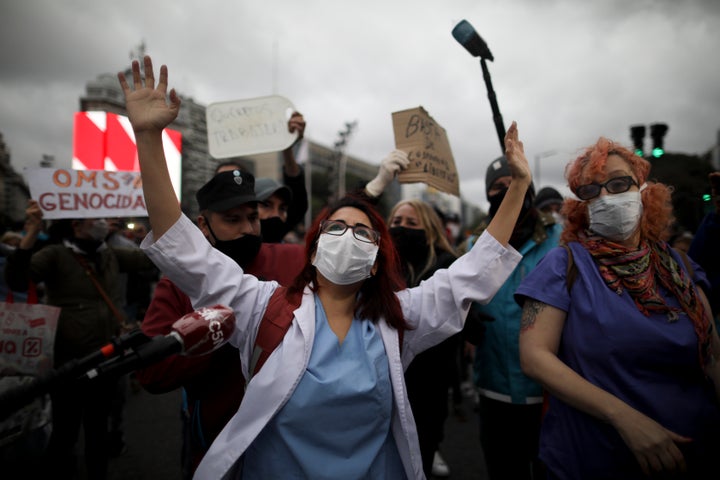
Doctors, front, demonstrate in favor of the government-ordered lockdown to help curb the spread of the new coronavirus while


Doctors, front, demonstrate in favor of the government-ordered lockdown to help curb the spread of the new coronavirus while dueling protesters demand an end to the lockdown, in Buenos Aires, Argentina, Saturday, May 30, 2020. (AP Photo/Natacha Pisarenko)

The situation worsened Sunday in India, where new daily cases topped 8,000 for the first time and 193 more deaths were reported. India still is easing restrictions on shops and public transport in more states beginning Monday, although subways and schools will remain closed.

In Saudi Arabia, tens of thousands of mosques reopened Sunday for the first time in more than two months, but Islam’s holiest site in Mecca remained closed. In Jerusalem, throngs of worshippers waited outside the Al-Aqsa Mosque before it reopened. Many wore surgical masks and waited for temperature checks as they entered.

In Bogota, the capital of Colombia, authorities were locking down an area of nearly 1.5 million people as cases continue to rise.

Mayor Claudia Lopez said no one in the working-class Kennedy area — inaugurated by late U.S. President John F. Kennedy in 1961 — will be allowed out, except to seek food or medical care or in case of an emergency. Factories that had been allowed to operate must close. The area has reported more nearly 2,500 infections and hospitals are reaching their limits.

Elite sporting events will be allowed to resume in England starting Monday, but without spectators, paving the way for the planned June 17 return of the Premier League, the world’s richest soccer competition.

But England’s deputy chief medical officer Jonathan Van-Tam warned that the situation remained precarious. Britain has seen nearly 38,500 deaths in the pandemic, the second-highest number of confirmed virus deaths after the United States.

“I believe this is also a very dangerous moment,” he said. “We have to get this right.”

Pope Francis, meanwhile, cautioned against pessimism as people emerge from coronavirus lockdowns.

During Mass in St. Peter’s Basilica to mark Pentecost Sunday, Francis noted a tendency to say that “nothing will be the same.” That kind of thinking, Francis said, guarantees that “the one thing that certainly does not return is hope.”

Seewer reported from Toledo, Ohio. AP reporters from around the world contributed to this report.


Source by [author_name]

Vivo X50 series: Release date, price, news and rumours

0

Vivo’s premium flagship smartphones have always focused on their cameras. The X series flagship especially has always been one of the best devices when it comes to the camera. 

The company’s current X series lineup consists of X30 series and the X27 series in recent years. Their successor will be the Vivo X50, which has already been teased on Weibo. 


Source link

Economy on course for full-year contraction this fiscal; recovery from COVID-19 disruptions remain clouded: DBS Bank – Firstpost

0

New Delhi: The Indian economy is on course for a full-year contraction this fiscal, as recovery prospects from COVID-19 related disruptions remain “clouded”, according to DBS Bank India economist Radhika Rao.

The comments came amid the release of key data that showed India’s GDP growth tumbling to 3.1 percent in the March quarter–the slowest pace since the global financial crisis more than a decade back.

In 2019-20, the Indian economy grew by 4.2 percent, the slowest in 11 years.

Commenting on the GDP data, Rao said, “Headline growth was firmer than consensus, but was constrained by data collection issues, including unavailability of earnings for many sectors. This keeps the door open for downward revision to this growth rate”.

Stating that the 2Q20 (April-June) will provide a clearer picture of the economic slump during the lockdown, Rao said, adding “recovery prospects in FY21 remain clouded and the economy is on course for a full-year contraction this year”.

According to DBS, consumer discretionary sectors, production and services are likely to take longer to recover.

“Drivers of agricultural output will be watched closely as much hope rests on the sector to provide a counterbalancing effect, especially monsoon strength, as kharif sowing will get underway,” DBS said in a research note.

Meanwhile, the government on Saturday said a phased exit would begin on 1 June  from the over-two-months-long nationwide lockdown.

Announcing the new guidelines, the Union Home Ministry said a complete lockdown would continue till 30 June in areas identified as COVID-19 containment zones across the country, but restrictions would be lifted in a phased manner at other places after the ongoing fourth phase, ending this Sunday.

“As the country goes to a post-pandemic situation, among all the priorities we have, health recovery will be very important. Risks of a second wave should be monitored closely, as regional experience attests, which can potentially not only extend movement restrictions but also carry significant economic impact.

“It is encouraging that states can have a bigger say in this regard, as subject to local conditions, part of the community can be opened up whilst few of the metros where the count continues to rise, higher vigilance can be maintained,” Rao said.

The Health Ministry said all precautions must be taken while “living with the new normal” of COVID-19, as it stressed on strict adherence to physical distancing and use of face covers at public places by everyone while also following personal and social hygiene standards.

Updated Date: May 31, 2020 17:06:19 IST

Tags :

Agricultural Output,

Consumer Discretionary Sectors,

Containment Zones,

Coronavirus,

COVID-19,

Data Collection Issues,

DBS Bank India,

Economic Slump,

Economy,

Ercices,

Financial Crisis,

GDP Data,

Headline Growth,

Home Ministry,

Kharif Sowing,

Lockdown,

Manufacturings,

Monsoon Strength,

NewsTracker,

Physical Distancing,

Radhika Rao


Source link

For all his woes, at least Sunak does not need to worry about stagflation | Larry Elliott

News that Rishi Sunak is planning a summer mini-budget conjures up memories of the 1970s when chancellors were constantly forced to respond to the latest economic crisis.

Sunak is finding out what it was like to be Tony Barber or Denis Healey, who ran the treasury from 1970 to 1979. To be sure, that decade seems to be a more relevant reference point than the 16 years between 1992 and 2008 when the economy expanded continuously and inflation was low. That now looks like an aberration rather than the start of a new golden age.

As was the case when Barber and Healey were announcing their emergency packages, Rolls-Royce, one of the UK’s biggest manufacturers, is struggling. Ministers are contemplating taking a stake in strategically important companies to stop them going bust. Sunak is forever popping up to announce the latest changes to his furlough scheme amid fears of mass unemployment. There is bitter argument over Europe and much loathing of the occupant of the White House. Substitute power cuts for social distancing rules, the three-day week for the lockdown, and Richard Nixon for Donald Trump and the picture seems complete.

Not quite, though. For the full 1970s experience, there needs to be stagflation – weak or falling activity combined with rapidly rising prices – of the sort that gripped most western economies after the oil price rocketed in 1973. Even though inflation is currently low, there are economists who think there is a real possibility of it happening.

Here’s how a potential stagflation scenario unfolds. At the moment, demand for goods and services is weak because people have been confined to their homes and can only spend their money on essentials or by shopping online. But money is cheap and plentiful, while the government’s wage subsidies – mirrored by similar schemes in other countries – have protected incomes. The result will be a splurge of pent-up spending once the pandemic is over.

Consumers will find, however, that the supply of goods and services has been hit badly by the lockdown. Firms will either have gone bust or will be operating for the foreseeable future under rules that will limit their capacity. Demand will exceed supply, and with too much money chasing too few goods inflation will go up. Workers will respond to higher prices by seeking higher pay and a wage-price spiral will ensue. Growth is weak but upward pressure on the cost of living is strong. Bingo: stagflation.

As Rob Carnell, an economist at ING bank has pointed out, a bit of 1970s-style stagflation would not be a bad thing in the current circumstances because it would inflate away the real value of record levels of both private and public borrowing. “With debt ratios hitting previously unimaginable highs, it could be an outcome to grab with both hands, not to recoil from in horror,” Carnell says.

But as he also points out, this is not not an especially likely scenario. Much the same argument was made at the time of the global financial crisis a decade ago, when it was said that the vast amount of money creation undertaken by central banks through quantitative easing – the buying of bonds in return for cash – would end in the sort of hyper-inflation seen in Germany in the 1920s.

As it turns out, central banks have spent most of the past decade concerned that inflation is too low rather than too high. Fears that the steady fall in unemployment would enable workers to pursue inflationary wage claims have proved unfounded. A decade of QE and ultra-low interest rates did lead to stagflation, but not the sort that was expected. Wages stagnated but the price of assets – commodities, shares, bonds and property – all inflated.

The early stages of the current crisis suggest history might repeat itself. Financial markets have, so far, been the real beneficiaries of central bank activism that dwarfs anything seen in 2008-09. The Federal Reserve, the US central bank, has been unable to prevent 40 million Americans filing jobless claims in the past two months, but it has succeeded in boosting share prices on Wall Street.

For a classic wage-price spiral to develop, two things would need to happen. Firstly, employees would have to see their living standards eroded. Secondly, they would need to be able to do something about it.

Without question, millions of people around the world are going to feel poorer as a result of Covid-19. Even those benefiting from the furlough scheme in the UK will have taken a 20% pay cut all the time they remain off work, and there will be plenty of workers – including many of the self-employed – who will be even worse off. It is not just the supply side of the economy that will take a hit: demand will be softer as well.

Sign up to the daily Business Today email or follow Guardian Business on Twitter at @BusinessDesk

In the 1970s, workers were in a much better position to do something about the squeeze on their incomes than they are today. Manufacturing accounted for more of the economy and trade union membership was high in Britain’s factories. Many industries were state owned and domestic suppliers were more shielded from foreign competition. There was no such thing as the gig economy. Ted Heath’s government introduced threshold agreements under which workers were guaranteed wage rises when inflation rose above a certain level.

Unions are weaker than they were in the 1970s and employers ar stronger. Sunak could use his mini-budget to push through an above-inflation increase in the minimum wage but will be under pressure from business not to do so. Unemployment is about to rocket and the threat of being laid off will mean whatever limited bargaining power workers have will be reduced. It’s hard to see where stagflation comes from.

Source link

What’s on TV: Sunday, June 7

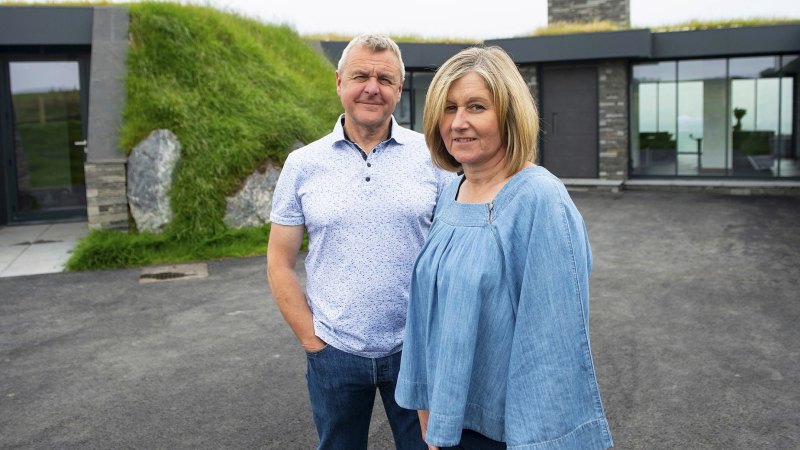
“Good grief, what a wild, magnificent, brutal place to build a house,” exclaims Kevin McCloud.

Source by [author_name]

Distance education can be better than the traditional classroom

As South African schools get ready to reopen – or not, depending on the outcome of the latest shenanigans involving teachers’ unions and others – parents are on the horns of a dilemma.

Do they send their children back to the classroom (presuming the reopening happens reasonably soon) and risk them being infected? Or do they keep them at home and opt for distance learning or home schooling instead?

And if the decision is to keep the kids at home for at least the remainder of this year, are parents going to do justice to them academically?  

A quick digression here. Distance learning and home schooling are not the same thing. The Australians, who know a thing or two about distance learning having founded the famous Alice Springs-based School of the Air for outback children in the early 1950s, define it thus: home schooling is when you make, or buy, your own curriculum, says Rebecca English, a professor at Queensland University of Technology. Distance learning is when parents facilitate a curriculum of study that is already in place and applied uniformly across a specified area.

Many learners perform better away from class

But back to the point of whether parents can do justice to children academically by keeping them at home. According to preliminary studies coming out of the Australian state of Victoria, many learners have actually performed better in the distance education environment than in the traditional classroom.

Victoria’s education minister, Gayle Tierney, said last week that there were many instances during lockdown of students who were ‘disengaged’ during traditional schooling suddenly becoming ‘reengaged’ during distance learning.

Students who had previously been underperforming in the classroom environment had unexpectedly taken to the new approach imposed upon them by the shutdown of the school system and were now returning better-than-expected results, the minister noted during a briefing.

“Every principal I have spoken to, every teacher, talks about students who have reengaged,” she said. “Students who disengaged at school seven weeks ago (prior to the start of lockdown) are now embracing their learning.”

She will now be ordering an independent inquiry into what distance education concepts can be incorporated into the usual school programme, and a summit of education leaders will be held next month to discuss the issue.  

WEF also finds distance learning is effective

Meanwhile, information published by the World Economic Forum (WEF) indicates there is evidence that learning online can be more effective in a number of ways.

Some research shows that, on average, students retain 25-60% more material when learning online compared to only 8-10% in a classroom.

This is mostly due to the students being able to learn faster online. E-learning requires 40-60% less time to learn than in a traditional classroom setting because students can learn at their own pace, going back and re-reading, skipping, or accelerating through concepts as they choose.

Effectiveness varies by age group

“Nevertheless, the effectiveness of online learning varies amongst age groups. The general consensus on children, especially younger ones, is that a structured environment is required, because kids are more easily distracted,” the WEF says.

“To get the full benefit of online learning, there needs to be a concerted effort to provide this structure and go beyond replicating a physical class/lecture through video capabilities, instead, using a range of collaboration tools and engagement methods that promote inclusion, personalisation and intelligence.”

Since studies have shown that children extensively use their senses to learn, making learning fun and effective through use of technology is crucial, says Mrinal Mohit of BYJU, an Indian educational technology and online tutoring firm which is now the world’s most highly valued education tech company.

“Over a period, we have observed that clever integration of games has demonstrated higher engagement and increased motivation towards learning, especially among younger students, making them truly fall in love with learning”, he says.


Source link

Georgia student, son of 2 first responders, creates lifesaving COVID-19 equipment

When Kentez Craig was a teenager, he was riding in the car with his father one day when they came upon a vehicle on fire along the side of the road. Craig’s dad, a paramedic, pulled the car to a stop and rushed out to help.

It was the kind of act that didn’t surprise Craig. He grew up listening to his parents, both paramedics, tell stories of responding to burning buildings and crushed cars. They instilled in him the importance of serving one’s community and never panicking in a crisis.

Seven years later, Craig’s dad, Kenneth, is working as an emergency room paramedic, now on the front lines of the coronavirus crisis in Georgia. Craig is a graduate student at Georgia Tech’s school of mechanical engineering.

Watching the pandemic ravage Atlanta, Craig said his parents’ devotion to public service inspired him to take action. Together with a small team of Georgia Tech faculty and students, he has spent the past two months working to design and build critical protective gear and medical equipment to help first responders battle COVID-19.

“I saw nothing better I could do to give back to people like my mom, my dad — who have been working in emergency services — and first responders on the real front lines of this,” Craig told NBC News.

Kentez Craig.Kentez Craig

Over the past few weeks, Craig’s team has provided thousands of face shields to medical facilities across the country, as well as roughly 200 intubation boxes, a protective barrier that shields health care workers from respiratory droplets when intubating patients, to Atlanta-area hospitals. And the face shield design they created has been used to produce nearly 2 million of them.

“If I had fireworks, I would have set them off,” said Kari Love, program director for infection prevention at Emory Healthcare, recalling its first delivery of face shields created at Georgia Tech. “It was an amazing feeling to see the smiles on the faces of the Emory staff who were receiving them.”

Stepping up

The project began in mid-March as Atlanta was becoming a COVID-19 hot spot. An email circulated around Georgia Tech faculty members: What could they do to help?

Chris Saldana, an associate professor of mechanical engineering at Georgia Tech, connected with an Emory Healthcare staff member through a mutual colleague, and they discussed what personal protective equipment the hospital needed. The most pressing need: face shields, plastic coverings that protect health care workers from respiratory droplets and extend the life of N95 masks.

“When we were talking with health care workers, we realized that the need was in the order of millions, and the need was in the order of weeks, if not days,” Saldana said.

After talking with Love and other health care professionals, Saldana gathered a team of Georgia Tech faculty members and student volunteers to get to work on a design for a face shield that could be built quickly but also easily mass produced to help with the national supply.

“Being a university, we’re very nimble. We can jump on the machines fairly quickly and actually produce components,” Saldana said.

Georgia Tech is home to one of the most robust student-run engineering makerspaces in the country, the Flowers Invention Studio, which Craig helps run during the school year. When Craig heard Saldana was looking to open the studio to build face shields, he immediately emailed Saldana that he wanted to be involved.

Together, over the course of three days, the team worked around the clock to produce a face shield using a laser cutter and water jet cutter. Craig said the days were long but the team’s camaraderie powered them through.

“It was wild,” Craig said. “We would get there at 7 or 8 in the morning, then look up and it was 5 p.m. You would lose track of time.”

Craig and Saldana (far right) pose with Georgia Tech’s president and faculty in front of the George W. Woodruff School of Mechanical Engineering after receiving a donation from Coca-Cola for 6,000 pounds of plastic to produce face shields.Chris Saldana

Craig, who specializes in water jet machining, said the process is much faster than 3D printing, which some other universities had been using to create face shields.

“Because of the capability we have, we were able to crank out a lot more early on and get them into the hands of health care providers to make sure we got their feedback,” Craig said.

They worked closely with local health care workers at Emory University Hospital and Children’s Healthcare of Atlanta to create a design that was comfortable, easy to clean and fully protective. A nonprofit affiliated with Georgia Tech, the Global Center for Medical Innovation, also provided input to ensure the design was scalable to mass manufacture.

Within one week, the team had built more than 5,000 face shields and personally delivered them to hospitals across Atlanta.

Dr. Jeremy Collins, executive vice chair of anesthesiology at Emory, said the face shields have been “huge” in protecting his colleagues as they treat people with the coronavirus.

“At the start of the pandemic, there was quite a lot of fear and concern that, as anesthesiologists, we were putting our heads into the lion’s mouth because we were the closest to the danger,” Collins said. “We quickly realized we needed to have more coverage on our faces.”

Collins said the unique face shield design is not only fully protective, but also comfortable to wear and durable enough to sustain several weeks of use and rounds of disinfectant.

Dr. Devin Weinberg (left) and Dr. Sean Kelly (right), assistant professors of anesthesia at Emory University Hospital, pose with their first delivery of face shields from Georgia Tech.Jeremy Collins

National impact

Since the first deliveries to Atlanta-area hospitals, Georgia Tech’s unique design has taken off.

In April, after the Food and Drug Administration released an emergency use authorization for the mass production of face shields, the school partnered with manufacturer Siemens to begin mass producing its design. To date, Siemens has supplied the Georgia Emergency Management and Homeland Security Agency with 100,000 face shields to distribute across the state.

GCMI passed the design on to other manufacturers — including Delta, ExxonMobil and Kia Motors — that are now helping produce the shields and distribute them across the country. Large corporations, including Coca-Cola, have donated supplies to manufacture the shields.

Georgia Tech has also posted the design on its rapid response website for open use. Since April 13, the designs have been downloaded roughly 1,400 times, the school said. Saldana estimates there have now been almost 1.8 million face shields delivered to health care workers in the past few weeks.

Proud parents

Craig’s work hasn’t stopped with the face shield. Over the past two months, he’s been involved with multiple COVID-19 projects at Georgia Tech, including an intubation box and ventilator.

Working again with Saldana, Craig helped create a foldable intubation chamber, a clear barrier device that protects health care workers from respiratory droplets while intubating critically ill people who have the coronavirus. More than 100 of the devices have been shipped to Emory University Hospital. Other Atlanta-area hospitals say they are also considering using the boxes, which received FDA emergency use authorization at the end of April.

Collaborating with another Georgia Tech faculty member, Shannon Yee, Craig also created a low-cost, portable emergency ventilator that the team hopes will be a solution for developing countries that are responding to COVID-19.

Prototype of the ventilator Craig helped build with Shannon Yee.Georgia Institute of Technology

“Kentez has been a huge asset for all our efforts,” Saldana said. “He’s one of the most capable in this space. He’s someone you can rely on and has threaded every project that has come out of the Flowers Studio.”

Craig said seeing his work make an impact for health care providers has been “an honor.”

“They’re the silent heroes. They’re looked up to, but I feel like they don’t often get the support they deserve,” Craig said. “If I can make their day a little bit better and a little bit safer, I’m grateful for the opportunity to do such a thing.”

Craig’s parents, Jackie and Kenneth, say they couldn’t be prouder of their son.

“It brings me to tears, joyful tears,” said Jackie, who worked as a paramedic for 27 years. “Whatever joy he’s brought us is far greater than we could have ever given him.”

Kenneth, who currently works as a paramedic at Eastside Medical Center, said he’s “ecstatic” to see his son giving back to the community.

“Words can’t express how proud I am,” Kenneth said. “It makes me feel wonderful because he’s saving my colleagues in the field.”

Craig, who will be pursuing a doctorate in mechanical engineering next year, said the experience of using his passion for engineering to honor his parents was incredibly rewarding.

“It makes you feel honored and like I’m doing something important and worthwhile,” Craig said. “I look forward to any work we get to do in the future, getting back to my email and figuring out what’s next.”

Source link