Saturday, April 25, 2026

Tom Cotton Says Trump Should Deploy U.S. Military To Contain Protests

Sen. Tom Cotton (R-Ark.) says President Donald Trump should deploy the U.S. military to help contain the unrest in major American cities over the Minneapolis police killing of George Floyd.

“If local law enforcement is overwhelmed and needs backup, let’s see how tough these Antifa terrorists are when they’re facing off with the 101st Airborne Division. We need to have zero tolerance for this destruction,” Cotton wrote on Twitter.

Cotton, a U.S. Army veteran, said Trump should invoke the Insurrection Act of 1807, which governs the authority of federal troops during a state of emergency within the U.S. The act was last used by President George H.W. Bush in 1992 during the riots in Los Angeles that followed the acquittal of police officers in the Rodney King beating.

“If necessary, the 10th Mountain, 82nd Airborne, 1st Cav, 3rd Infantry—whatever it takes to restore order. No quarter for insurrectionists, anarchists, rioters, and looters,” Cotton wrote.

Pentagon officials told The Associated Press over the weekend there was no intent to deploy any federal forces to Minnesota unless its governor, Tim Walz, asked for help.

Over 5,000 National Guard troops have been deployed in 15 states and in Washington, D.C., in response to the demonstrations, some of which turned violent and resulted in the looting of many businesses. The troops responded under the direction of state governors. In most states, National Guard troops carry only defensive weapons like batons, but in others the soldiers are armed.

Sending active-duty military troops to U.S. cities in response to the protests would mark an escalation in the use of force by the government. Law enforcement in several cities used batons, tear gas, rubber bullets, and other devices to disperse protesters. One journalist was blinded in one eye after being shot by a rubber bullet; others were arrested.

On Sunday, Amnesty International issued a statement against the use of “excessive force” against U.S. demonstrators protesting police brutality.

Sen. Brian Schatz (D-Hawaii) said he planned to introduce a measure to stop the transfer of military equipment to police departments. Upon taking office in 2017, Trump reversed restrictions his predecessor imposed on what surplus military equipment Pentagon can provide to federal, state, and local law enforcement agencies.

“I will be introducing an amendment to the National Defense Authorization Act to discontinue the program that transfers military weaponry to local police departments,” Schatz tweeted on Sunday.

Former President Barack Obama also spoke out Monday in response to the protests, urging protesters to demonstrate peacefully. 

“The small minority of folks who’ve resorted to violence in various forms, whether out of genuine anger or mere opportunism, are putting innocent people at risk, compounding the destruction of neighborhoods that are often already short on services and investment and detracting from the larger cause,” Obama wrote on Medium. 


Source link

China Steps up Propaganda in Support of National Security Law For Hong Kong

0

The ruling Chinese Communist Party stepped up its international propaganda drive with a celebrity signature campaign in support of draconian sedition laws for Hong Kong, as the city’s police banned the annual candlelight vigil for the victims of the 1989 Tiananmen massacre for the first time since the 1997 handover to Chinese rule.

Pro-Beijing groups in Hong Kong said they had collected three million signatures amid a city-wide campaign in support of the national security law, which will target “actions and activities” deemed subversive, seditious, instigated by foreign forces, or supportive of independence.

In a move widely condemned by foreign governments and rights groups as signaling the end of Hong Kong’s autonomy and status as a separate legal jurisdiction, the law will be imposed on the city, bypassing its Legislative Council (LegCo).

The signatures were collected by pro-Beijing groups and employees of Chinese companies in Hong Kong, government broadcaster RTHK reported.

Some 2,400 singers, actors, and other members of Hong Kong’s entertainment industry, which relies heavily on the mainland Chinese market, have also come out in support of the law.

Signatories included pro-China celebrities like Jackie Chan, Alan Tam, Wong Cho Lam, and Raymond Wong.

The prospect of China’s feared state security police operating in the city to enforce the law has prompted a rush to apply for British National Overseas (BNO) passports offered to residents of Hong Kong by the U.K. ahead of the handover.

Foreign secretary Dominic Raab has said London will make it easier for holders of the controversial passport to settle in the U.K., extending a visa-free permission to live and work in the country from six months to a year, with a possible pathway to citizenship via further extensions.

More than 300,000 Hongkongers are currently eligible for the passport, which entitles them to consular assistance but no citizenship, in a move that London has always said was demanded by Beijing during handover negotiations.

A new front line

Hong Kong political commentator Lam Kei said the city is becoming the front line of a new Cold War between China and Western nations.

“In the battle for freedom and democracy against totalitarianism, Hong Kong is the new front line,” Lam wrote. “The Chinese Communist Party’s breach of its treaty obligations under the Sino-British Joint Declaration isn’t just a problem for the people of Hong Kong.”

“It also shows how unscrupulous Beijing can be when pursuing its goals, and how it will continue to do this in future,” Lam said in a commentary broadcast by RFA’s Cantonese Service.

He said the problems Hong Kong faces now will be played out in Taiwan, southeast Asia, Japan, Australia, New Zealand, and the U.S. in future. “Exercise suspicion,” he wrote.

In a sign that the new law will affect freedom of expression in the city, five university chiefs also publicly expressed their support for the legislation.

The presidents of Hong Kong University, Chinese University (CUHK), Lingnan University, Polytechnic University (Poly U), and Education University said they “understand the need to enact national security laws” in pursuit of social stability and good public order.

During last year’s anti-government protests, Poly U and CUHK saw pitched battles between students and riot police, who fired thousands of rounds of tear gas as they besieged defiant students who erected barricades and flung Molotov cocktails to prevent them from entering the campus.

Rights groups and medics said the situation amounted to a humanitarian crisis, as police detained medical staff trying to help sick and injured protesters.

The presidents of the University of Science and Technology, Baptist University, and City University didn’t sign the statement, however.

Candlelight vigil banned

China’s international propaganda push came as police banned an annual candlelight vigil to remember the Tiananmen massacre that has taken place in Hong Kong ever since 1990.

The Hong Kong Alliance in Support of Patriotic Democratic Movements of China, which organizes the vigil, has called on people to light candles wherever they happen to be, instead.

Police said such a gathering would be a “major threat to public health” amid the coronavirus pandemic.

You Weijie, spokeswoman for the Tiananmen Mothers victims’ group, said she knows the victims will be remembered in Hong Kong, come what may.

“I know that Hong Kong people always support us. As for this June 4, I know the people of Hong Kong will make their own arrangement to commemorate,” she said in comments reported by RTHK.

Reported by Lu Xi and Man Hoi-tsan for RFA’s Mandarin and Cantonese Services. Translated and edited by Luisetta Mudie.


Source link

George Floyd: ‘America in pain’ as weekend rallies grip US – Live

  • The United States was gripped by a weekend of protests over the death of George Floyd, an unarmed black man who died on Monday in police custody in Minneapolis, Minnesota, and police brutality nationwide. 
  • Protesters are demanding all four officers involved be charged in Floyd’s death. So far, only one – white officer Derek Chauvin, who knelt on Floyd’s neck for nearly nine minutes as the black man pleaded, “I can’t breathe” – has been arrested. He was charged on Friday with first-degree murder and manslaughter. 
  • Responding to a demand from protesters and Floyd’s family, Minnesota Attorney General Keith Ellison will lead the prosecution. Ellison, who is black, has vowed to use every resource available to “bring justice” for George Floyd.
  • Those protesting against police brutality have been met, at times, with excessive force by authorities. Two officers were fired over the weekend in Atlanta, Georgia, for pulling two black people out of a car and throwing them to the ground. Videos have shown police targeting angry but peaceful protesters with tear gas and mace. Journalists have also been targeted by police.
  • Protesters have remained undeterred by curfews and the presence of the US National Guard in some cities. Some largely peaceful protests turned violent, with looting and vandalism as the night raged on. 

Latest updates 

Monday, June 1 

14:10 GMT – Where have protests taken place? 

14:09 GMT – Photos from Sunday’s protests against police brutality

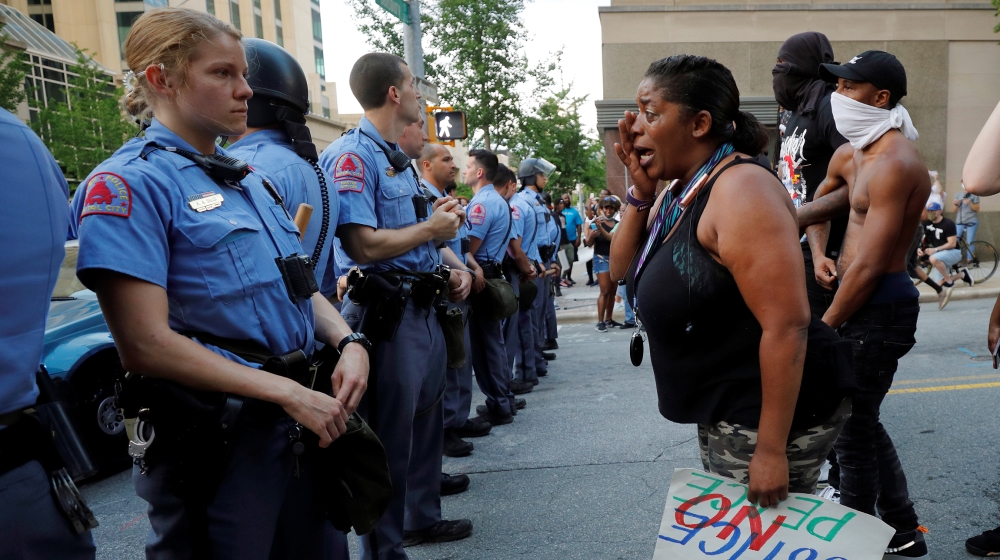
A weeping protester confronts police during nationwide unrest following the death in Minneapolis police custody of George Floyd, in Raleigh, North Carolina, U.S. May 30, 2020. Picture taken May 30, 20

A weeping protester confronts police during nationwide unrest following the death in Minneapolis police custody of George Floyd, in Raleigh, North Carolina [Jonathan Drake/Reuters]


George Floyd: ‘America in pain’ as weekend rallies grip US – Live

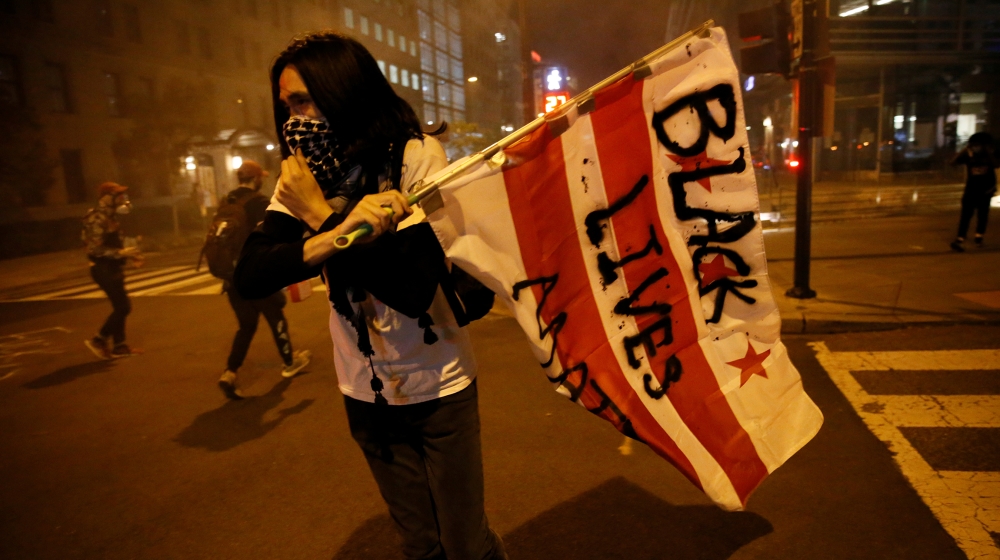
A man holds a flag as police disperse demonstrators during a protest amid nationwide unrest following the death in Minneapolis police custody of George Floyd, in Washington, DC [Jim Bourg/Reuters]


Protesters kneel in front of New York City Police during a march to honor George Floyd in Manhattan on May 31, 2020 in New York City. Protesters demonstrated for the fourth straight night after video

Protesters kneel in front of New York City Police during a march to honour George Floyd in New York City [John Moore/Getty Images/AFP]

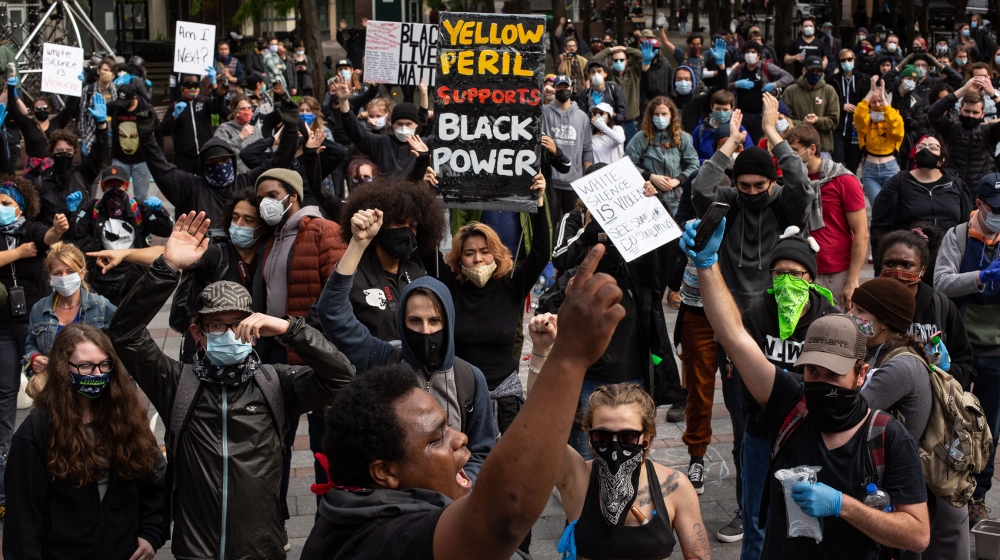
Demonstrators chant during a gathering to protest the recent death of George Floyd on May 31, 2020 in Seattle, Washington. Protests due to the recent death of George Floyd took place in Seattle and it

Demonstrators in Seattle, Washington, chant during a gathering to protest the recent death of George Floyd [David Ryder/Getty Images/AFP]


Demonstrators put their hands behind their heads as they stand in front of San Diego Police in San Diego, California on May 31, 2020, to protest against the death of Minneapolis man George Floyd. Nume

Demonstrators put their hands behind their heads as they stand in front of San Diego Police in San Diego, California [Ariana Dreshler/AFP]


A black man and a white woman hold their hands up in a front of police officers in downtown Long Beach on May 31, 2020 during a protest against the death of George Floyd, an unarmed black man who died

A black man and a white woman hold their hands up in front of police officers in downtown Long Beach, California [Apu Gomes/AFP]

14:00 GMT – Floyd’s family to release findings from independent autopsy

The attorney for George Floyd’s family was set to announce findings Monday of an independent autopsy into his death a week ago after a Minneapolis officer held his knee on Floyd’s neck for eight minutes and 46 seconds.

Floyd, a black man who was in handcuffs at the time, died after the white officer ignored bystander shouts to get off him while also ignoring Floyd’s cries that he couldn’t breathe. His death, captured on citizen video, sparked days of protests in Minneapolis that have spread to cities around the US.

An official autopsy last week said the combined effects of being restrained, potential intoxicants in Floyd’s system and his underlying health issues, including heart disease, likely contributed to his death. There were no other details about intoxicants, and toxicology results can take weeks. In the 911 call that drew police, the caller described the man suspected of paying with counterfeit money as “awfully drunk and he’s not in control of himself.”

The criminal complaint noted that the medical examiner’s report was preliminary, but said the autopsy “revealed no physical findings that support a diagnosis of traumatic asphyxia or strangulation.”

Ben Crump, the attorney representing Floyd’s family, soon announced plans to commission the family’s own autopsy.

13:55 GMT – Truck driver arrested on suspicion of assault

Authorities say the driver of a semitrailer that rolled into the midst of thousands of people marching on a closed Minneapolis freeway in protest over the death of George Floyd has been arrested on suspicion of assault.

Authorities had said it appeared no one was hurt Sunday, but some witnesses said a handful of people who were on Interstate 35W near downtown Minneapolis sought medical attention on their own. Authorities said they could not confirm that.

Minneapolis semi truck

A truck that was driven into a rally protesting the death of George Floyd on the I-35W bridge in Minneapolis, US [Go Nakamura/Reuters] 

The freeway was among many shut down in the Minneapolis area for the second night in a row as officials imposed an 8pm curfew and sought to make it more difficult for protesters to move around.

Bystander video showed the crowd parting seconds before the semi rolled through, then the tanker truck gradually slowed and demonstrators swarmed the truck.

Public Safety Commissioner John Harrington said Sunday that it initially appeared from traffic camera footage that the semitrailer was already on the freeway before barricades were set up at 5pm. State Corrections Commissioner Paul Schnell said at a later briefing, however, that the truck went around a traffic barrier to stay on the road.

Read witness accounts here. 

13:50 GMT – UK PM office: Attacks on journalist ‘very concerning’

United Kingdom Prime Minister Boris Johnson’s spokesman says arrests and assaults on journalists covering protests in the United States are “very concerning.”

James Slack said Monday that “journalists all around the world must be free to do their job and to hold authorities to account without fear of arrest or violence.”

He said the violence of the past few nights was “very alarming”, and noted, “people must be allowed to protest peacefully”.

Slack said, “The footage of George Floyd’s death was deeply distressing and our thoughts are with all those who have been affected.”

Noting that a police officer has been charged with murder, he said “we would hope and expect justice to be done.”

13:45 GMT – Louisville police kill one

The police chief of Louisville, Kentucky, says police officers and US National Guard soldiers enforcing a curfew in Louisville killed a man early Monday when they returned fire after someone in a large group fired at them first.

Louisville Metro Police Chief Steve Conrad confirmed the shooting happened around 12:15am outside a business on West Broadway, where police and the National Guard had been called to break up a large group of people gathering in defiance of the city’s curfew.

Someone fired a shot at them and the officers returned fire, the chief said. It was unclear whether the person killed is the one who fired at the law enforcers, he said.

Protests have erupted in Louisville over the shooting death of Breonna Taylor, a 26-year-old emergency medical technician who was shot eight times by narcotics detectives who knocked down her front door, as well as the death of George Floyd.

____________________________________________________________________

Hello and welcome to Al Jazeera’s continuing coverage of the protests in the US over the deadly arrest of George Floyd in Minneapolis, Minnesota. This is Laurin-Whitney Gottbrath in Louisville, Kentucky. 

Here are a few things to catch up on:

  • George Floyd, an unarmed 46-year-old black man, died on Monday after a white officer used his knee to pin Floyd’s neck to the ground for nearly nine minutes. Floyd can be heard on a bystander video repeatedly pleading with officers, saying “I can’t breathe.” He eventually becomes motionless with the officer’s knee still on his neck. (You can read about the deadly incident here.)

  • The four officers involved in the incident were fired. Derek Chauvin, the white officer who pinned Floyd down, has been arrested and charged with third-degree murder and manslaughter. Protesters demand the three other officers be charged, as well.

  • Protests – some violent – have since erupted nationwide as demonstrators rally for justice for Floyd and all unarmed black people killed by police.

See the updates from Sunday’s protests here. 

Source link

Colosseum reopens to tourists: ‘With so few of us we can enjoy it more’

Alessandra Grimaldi was born in Rome, but until Monday she had only admired the Colosseum from the outside. Along with her six-year-old son, Leonardo, she was among the first group of 14 visitors to enter the ancient amphitheatre as it reopened its doors.

“In my opinion we are in the most beautiful city in the world,” she said. “And now we have an opportunity to visit places in a different way, there are so few of us here we can enjoy it more. Leonardo will soon start learning about Roman history so doing this tour is a must.”

The Colosseum, completed under Emperor Titus in AD80, was among many of Italy’s famous cultural sites, including the Vatican Museums, to come back to life on Monday after being closed for more than three months as a result of the coronavirus pandemic.

And many Romans are making the most of having the city’s landmarks all to themselves: gone are the snake-like queues, street peddlers and ticket touts.


People in face masks visit the Colosseum as it reopens. Photograph: Simona Granati/Corbis/Getty Images

“This is the only silver lining during these dark times,” said Francesco Cipolla, 25, who lives near Rome and was also touring the Colosseum for the first time. “It just feels incredible to be inside this gigantic Roman structure. It’s a time to appreciate all we have. The lack of crowds helps you live the experience more. We are going to the Vatican Museums after this.”

Valentina Illuminati and Gennaro Apicella, both actors, are also enjoying being tourists in their city.

“We’re planning to buy a ticket in the late afternoon so we can enjoy the sunset,” said Illuminati , who has been once before. “We’re not working at the moment so are making the most of what Rome has to offer.” Apicella, who will enter the site for the first time, said: “Now is the time to enjoy the city’s beauty.”

Although the crowd-free sites are good news for residents, the Italian government is scrambling to salvage a tourism sector that accounts for 13% of the country’s GDP and creates thousands of jobs. Restrictions on inter-regional travel will be lifted on Wednesday, the same day Italy opens up its borders to travellers from EU states, allowing people to enter the country without quarantine requirements.

Graph for Italy

Monuments and museums have had to adapt to the post-lockdown era, making sure tourists can visit sites safely while knowing that revenues will be drastically impacted.

Before the pandemic, the Colosseum would hold up to 3,000 people at a time. Now, only groups of 14 can enter, with staff needing to ensure a gap of 15 minutes between each group. Visitors must purchase their tickets online, wear face masks and have their temperature taken before entering. When inside, people must keep at least 1 metre away from each other. Medical staff are on hand in case anyone presents symptoms of the virus.

“We have put so much effort into reopening, so that we could be ready to welcome people and ensure safety, for visitors and staff,” Alfonsina Russo, the director of the Colosseum Archaeological Park, told the Guardian. “Today is an important day … we’re reopening a symbol of Rome and Italy. But it is also a symbol of hope.”

Others major Italian sites to have recently opened their doors include the Leaning Tower of Pisa and the Pompeii archaeological park. Florence’s Uffizi gallery opens on Tuesday.

Italy usually welcomes about 63 million foreign visitors a year, with their arrival essential for the economy even while historically raising concerns about the impact on ancient sites. It will be some time before the sector fully recovers.

But Russo said she hoped the crisis could become an opportunity. “We have a chance now to create a tourism culture that is more sustainable and aware.”

Source link

Google postpones Android 11 ‘Beta Launch Show’ amid protests

0

While tech companies are still experimenting with how to launch products in the age of social distancing, Google has announced that the first Android 11 public beta will arrive on June 3 in a fairly traditional way: a YouTube stream.

Update 6/1: After protests broke out across the U.S. following the death of George Floyd, Google announced on its Android Developers Twitter account that it would be postponing the event, saying “now is not the time to celebrate.” It hasn’t announced when the new date will be but promised to “be back with more on Android 11, soon.”

Our original article, which was published on May 6 when the event was teased, continues below.

As uncovered by Android Police, Google has posted a video teasing the “Android Beta Launch Show,” featuring a voice-over by George Takei, best known for playing Hikaru Sulu in the original Star Trek series. While it’s not clear whether the event will be live or pre-recorded, Google is playing it up as an I/O-style gathering without the stage and the crowds.

The event beta launch show promises “news, updates, and announcements on connectivity, controls, safety, security, productivity, accessibility, and a whole bunch of stuff we’re not ready to tell you about yet.” Takei quips that Google “hopes that doesn’t leak,” a reference to the spoilers that are usually posted by fans before most major tech events.

Google launched the Android 11 developer preview in early February, but it has few consumer features yet. The release will bring support for new screen types, such as foldables and “waterfall” displays, as well as 5G and faster refresh rates, all of which we’ve already seen on third-party phones. Another developer feature that will presumably make it into the final release is notification bubbles that can populate the screen with messages and alerts outside of the notification shade.

You can find information about the Android 11 and the launch at g.co/android11.

Note: When you purchase something after clicking links in our articles, we may earn a small commission. Read our affiliate link policy for more details.


Source link

Sewage could hold the key to stopping new coronavirus outbreaks

0

The ultimate goal is for almost all sewage plants to install these coronavirus early warning systems so as to track the spread of Covid-19.

“It would be the first test line,” said microbiologist Hauke Harms, one of the leaders of the study. “You would start with our measurement and then you would know where to go to look for the reasons. Normally it is a hospital, or I don’t know, a factory where you have an outbreak. And then one would have to test the people.”

The concept seems fairly simple: Sewage contains remnants of the virus from human feces. If those concentrations suddenly jump, sewage plants would detect that and alert authorities to take action and begin targeted testing of the area in question.

The sewage plants in the area of the eastern German city of Leipzig — which can serve populations of between 100,00 and 600,000 people — are among those taking part in the study.

“If it would be possible to have an idea of the concentration of coronavirus in the wastewater, we can calculate the number of infected people in Leipzig and this would be very interesting in the coronavirus strategies,” said Dr. Ulrich Meyer, the technical director of Leipzig’s waterworks.

But in reality, it’s not as straightforward. At Leipzig’s main sewage plant, samples are extracted every two minutes as the wastewater streams through 24 hours a day.

The scientists at Helmholtz acknowledge that finding a small amount of genetic material (or RNA) from the virus in a giant river of waste is a monumental task.

“We have a high, high volume of waste waters and it is a challenge to find the traces of the virus in the waste waters,” said Rene Kallies, a virologist working on the project. “So we have liters and we have to scale it down to microliters to get a sufficient amount for RNA extraction and that’s the challenge.”

Yet, the scientists say they could detect a Covid trace surge within a day and transmit that information to local authorities.

Another challenge, the scientists say, is the current low number of new infections in Germany, which makes finding the virus even more difficult and means that a single infected person could skew test results.

“You may have heard about these super spreaders and there are also super excreters, for instance. People who excrete much more virus than others and of course this gives you a wrong idea about the number of infected people,” Harms said.

Germany has been held up as an example of a country that has successfully fended off the worst ravages of the virus. As of Friday, it had reported more than 182,000 cases of Covid-19 with around 8,400 deaths, significantly lower than other European countries.

While some countries clap for doctors, health workers in Russia face open hostility

Tracing the virus in excrement is not new and German researchers are not the only ones working to try and use sewage as an alarm system. In February, scientists at the Dutch KWR Water Research Institute found the virus in six sewage plants in the country, including one that services the main international airport in Schipol. KWR said it has developed a method to monitor the presence of the virus in sewage and said testing wastewater has clear benefits.

“Whereas the testing of individuals requires individual tests, testing in sewage can give an early indication of the contamination within a whole population,” KWR said on its website.

On Tuesday, it was announced the KWR data will be integrated into the Dutch government’s Covid-19 monitoring dashboard.

The German researchers believe that testing sewage will be one factor in a web of measures to detect outbreaks.

But they acknowledge there are still problems to work out, although they say they are confident the system will be in place and working in the latter half of 2020, in time to help contain a possible second wave of the coronavirus.

“I think we can offer something before the next wave,” Harms said, referring to a working detection system that can be used by states and sewage systems. “So if the next wave is coming in fall or early winter or so, then we should have something.”

Source link

AMD’s Lisa Su was the highest-paid CEO in the S&P 500 last year

0

She is the first woman to top the annual review, compiled by the Associated Press and executive compensation analysis firm Equilar, since it began in 2011
Su earned a total of $58.5 million in 2019 — almost $13 million more than the next-highest paid CEO, Discovery Inc’s (DISCB) David Zaslav, who earned $45.8 million. The study, released last week, examined compensation for CEOs of S&P 500 (SPX) companies who had been in their roles for at least two years as of the end of 2019.
Because the study looked at compensation packages from 2019, the results do not reflect the impacts of the coronavirus pandemic, which has pushed many executives to forgo some or all of their compensation.

Su’s compensation was up sharply from the year prior — she made $13.4 million in 2018 — thanks largely to a one-time, performance-based stock award. In 2019, she earned $1 million in base salary and a $1.2 million performance-based bonus.

After taking the helm at AMD in 2014, Su took a company on the verge of financial ruin and turned it into a top performer in the S&P 500 and a formidable competitor to Intel. The semiconductor company is now creating the technology to power cloud computing and gaming computers.

During 2019 alone, AMD’s stock grew by 156%.

Su’s bold bets helped turn the company around. Her success is a “once-in-a-generation thing,” Rosenblatt Securities managing director Hans Mosesmann said in an interview late last year.
Su is one of a handful of women leading big tech companies and is one among 20 women who made the Equilar list, which featured a total of 329 executives. Also included in that 20 are Lockheed Martin’s (LMT) Marillyn Hewson, General Motors’ (GM) Mary Barra and former IBM (IBM) CEO Ginni Rometty, who stepped down in April.

The study showed median compensation for female executives was $13.9 million, compared to $12.3 million for male executives, though there were far fewer women than men on the list.

More broadly, the study found that median compensation for all executives surveyed reached $12.3 million, up 4.1% from 2018, though the growth rate was slower than the previous two years.

Source link

Why does SpaceX’s historic astronaut flight for NASA have two commanders?

0

SpaceX’s historic crewed mission to space has … two commanders?

Over the weekend, veteran NASA astronauts Bob Behnken and Doug Hurley made history as they launched into space on a SpaceX Crew Dragon capsule as part of the company’s Demo-2 test flight, the first crewed flight to orbit to launch from the U.S.  since NASA’s space shuttle program ended in 2011. The Demo-2 mission launched from NASA’s Kennedy Space Center in Florida on Saturday (May 30) and reached the International Space Station 19 hours later with a smooth docking.


Source link

Impossible Foods forces Nestlé to stop selling ‘Incredible Burgers’ in Europe

0

The District Court in The Hague last week handed down an injunction in favor of the US startup, which is preparing to launch its Impossible Burger in Europe, court papers show.

According to a preliminary ruling, Nestlé infringed upon the Impossible Burger trademark, which was registered in the European Union last year, by calling its product the Incredible Burger. The court said the words “impossible” and “incredible” sound and appear similar, and the overlap could confuse customers.

Nestlé (NSRGF) has been given four weeks to withdraw its “Incredible” products from retailers or face €25,000 ($27,700) a day in fines for each of its 10 subsidiary companies involved in the case.

“We are disappointed by this provisional ruling as it is our belief that anyone should be able to use descriptive terms such as ‘incredible’ that explain the qualities of a product,” Nestlé said in a statement. “We will of course abide by this decision, but in parallel, we will file an appeal,” it added.

Nestlé said it was preparing to launch a new burger recipe using the “Sensational” descriptor. It will apply that name to all products that previously used the word “Incredible” in Europe, including its imitation meat patty, which becomes the “Sensational Burger.” The company uses Awesome Burger branding in the United States.

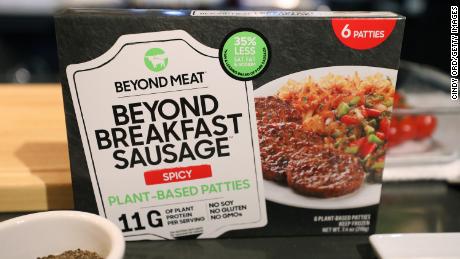
Growing consumption of plant-based proteins has pulled established food producers like Nestlé into the battle for market share, while enabling newcomers like Impossible Foods and Beyond Meat (BYND) to expand rapidly. Impossible Foods secured about $500 million in fresh funding in March, in a sign that investors are betting the trend is here to stay. Meat shortages in the United States linked to disruption caused by the coronavirus pandemic have driven consumption of meat substitutes even higher.

Nestlé approached Impossible Foods in the summer of 2018 to negotiate a possible licensing agreement regarding the Impossible Burger, according to the ruling, which cited legal submissions made by Impossible Foods.

The global food giant announced the launch of the Incredible Burger while these negotiations were still ongoing, raising the suspicion that it is trying to “frustrate the successful launch” of the Impossible Burger in Europe, the court found.

Nestlé, which had previously sought to declare the Impossible Burger trademark invalid, launched its Incredible Burger in Europe in April 2019 under its Garden Gourmet brand. That was followed by the September launch of the Awesome Burger in the United States. According to the judgment, Impossible Foods wrote to Nestlé USA in January 2019 warning that the Incredible Burger infringes on the American Impossible Burger trademark.

Impossible Foods is waiting for European food safety regulators to approve the genetically modified ingredients contained in its burger, according to the judgment. The Impossible Burger contains soy leghemoglobin (heme), a genetically modified yeast, which makes it taste like meat.

The US startup filed similar injunctions against Nestlé in regional German courts last year, but withdrew them after the courts told them they would not be granted.

Impossible Foods said in a statement that it applauds efforts to develop plant-based products but doesn’t want consumers to be confused. “We’re grateful that the court recognized the importance of our trademarks and supported our efforts to protect our brand against incursion from a powerful multinational giant,” said chief legal officer Dana Wagner.

Source link

Herbert Stempel, TV Quiz Show Whistleblower, Dies At 93

NEW YORK (AP) — Herbert Stempel, a fall guy and whistleblower of early television whose confession to deliberately losing on a 1950s quiz show helped drive a national scandal and join his name in history to winning contestant Charles Van Doren, has died age 93.

Stempel’s former wife, Ethel Stempel, told The Associated Press on Sunday that he died at a New York nursing home on April 7. She cited no specific cause of death.

Stempel’s long life was changed and defined by a TV face-off late in 1956, when he and Van Doren smoothly executed a fraudulent display of knowledge, gaps in knowledge and sportsmanship on “Twenty-One,” part of a wave of programs that offered big prizes for trivia experts. Confessions by Stempel and others badly tainted the young medium, helped lead to Congress’ banning what had been technically legal — rigging game shows — and to the cancellation of “Twenty-One” among others.

Interest was revived by the 1994 movie “Quiz Show,” directed by Robert Redford and starring John Turturro as Stempel and Ralph Fiennes as Van Doren, who died last year.

The undoing of “Twenty-One” was set off by declining ratings, and a producer’s refusal to uphold a dirty bargain.

Stempel, born in New York City and the son of Jewish immigrants, would boast of a “retentive memory” that had made him a quiz show star since childhood and a natural for “Twenty-One.” Hosted by Jack Barry, the program placed two contestants in isolation booths on opposite sides of the stage and challenged them on everything from modern sports to Civil War history. Stempel, identified by Barry as a 29-year-old G.I. Bill college student from Queens, had prevailed for six straight weeks and accumulated $69,500. But audiences were apparently bored and advertisers worried. Producer Dan Enright’s solution was to have Stempel lose to a more charismatic opponent, Van Doren, scion of a prominent scholarly family and himself a rising star at Columbia University. Stempel later said he agreed when Enright promised to make him a question consultant for “Twenty-One,” get him an appearance on “The Steve Allen Show” and allow him to compete on a future quiz program.

Stempel and Van Doren were an obvious contrast: The fair-haired and handsome Van Doren, and the relatively plain Stempel, a stocky, dark-haired man with glasses and a flat, nasally accent. Each duly played their parts: looking down, blinking nervously, wiping their foreheads and pretending to think out loud as they responded to such challenges as “Name the three heavyweight champions immediately preceding Joe Louis” and “Name the second, third, fourth, and fifth wives of Henry VIII and describes their fates.”

Stempel retained a wry sense of humor, responding “They all died” when asked about Henry VIII’s wives. But one wrong answer was personally painful: Which movie received the Oscar for best picture in 1955? As Stempel would explain, he knew the winner was “Marty,” the low-key drama starring Ernest Borgnine. He had seen it three times and related to its story of a lonely butcher in New York City. But he was told to guess “On the Waterfront,” the Oscar winner of 1954, and a film, ironically, about a boxer who throws a fight.

With tens of millions looking on, Stempel muttered “I don’t remember” three times, shook his head and weakly guessed, “On the Waterfront?” Upon Van Doren’s eventual victory, the contestants smiled and shook hands at center stage. Stempel, who still had nearly $50,000 in winnings, thanked Barry and the show’s staff for their “kindness” and “courtesy.” Barry in turn praised Stempel’s “courage” and “fighting spirit.”

Van Doren would continue winning for months, and was celebrated in a Time magazine cover story as “TV’s own health-restoring antidote to (Elvis the Pelvis) Presley.” Stempel, meanwhile, found himself shut out entirely. He would acknowledge his decision to speak out wasn’t a matter of conscience, but revenge. When he tried to get back in touch with Enright, he realized that the producer no longer was interested.

“He just completely forgot I ever existed,” Stempel later told the Archive of American Television. “He had a picture of Charles Van Doren in his office when I walked in there and all he could do was praise Charles Van Doren, tell me what a great contestant is.”

Stempel’s public declarations were initially dismissed, but as contestants on other shows made similar statements, authorities began to take action. A grand jury was convened in New York in 1958 and Congressional hearings began the following year, with Stempel and Van Doren both testifying and acknowledging their complicity. Van Doren, who had no further comment on the scandal until a 2009 essay in The New Yorker, was among those given suspended sentences for lying to the grand jury. Stempel would endure being “treated like a pariah” by his relatives and losing much of his prize money in an investment scam.

For years, he lived quietly in Queens with his second wife, Ethel (his first wife, Toby, died in 1980), working as an office manager, public school teacher and on the litigation support unit of the New York City Department of Transportation. He reemerged as a public figure in the 1990s, when “Twenty-One” was featured in a Julian Krainin documentary and in Redford’s movie, for which Stempel served as a consultant. He would say “Quiz Show” distorted his life and personality.

“I was a little miffed at the portrayal. I was showed to be a nerd, a square and a hyper little guy,” he told the Television Academy archive, remembering a humorous encounter with Turturro at a screening. “John walked over to me and he said to me, ‘If you punch me in the nose I would understand why. … And I didn’t want any trouble. I realized he played me over the top and so forth. He’s an actor. He’s told by the director, Redford, to play me in a certain way, and that’s how he played it. And I said, ‘No, John, everything’s cool.’

“And my wife, Ethel, is a very feisty woman, and she said, ‘Step aside, Herb, I want to take a crack at him.’”


Source by [author_name]