You may ask, “Why not use fresh fruit?†You could, but then you’re faced with adjusting the sweetening or making sugar syrup. And you’d need to wait for it to be in season. Opening a can is much easier.
The fruits must be pitted and seedless. They could come from a jar, in which case you should pack them in a plastic bag or container for freezing. Add a liqueur or other spirit for a happy hour sorbet. You can process frozen jarred grapefruit segments with Campari, for example, or oranges with tequila and lime juice. Including alcohol will give the sorbet a somewhat softer texture so don’t overdo it.
Remember that you need time to freeze the fruit before you put it in the food processor, and that the sorbet is best returned to the freezer for a couple of hours to firm up after it has been churned.
Basic Canned Fruit Sorbet
Time 10 minutes plus 12 hours or overnight freezing and 2 hours optional refreezing
Yield About 1 pint
Ingredient A 16-ounce can of fruit, preferably in heavy syrup
1. Place can of fruit in freezer for about 12 hours or longer.
3. Serve at once or transfer to a container and freeze for about 2 hours to firm up.
Variations
Apricot and Amaretto Sorbet Freeze 16 ounces canned apricots. Process with 2 tablespoons Amaretto. Yield: 1 pint.
Piña Colada Sorbet Freeze 20 ounces of crushed pineapple. Process with 3 tablespoons rum and 6 tablespoons chilled cream of coconut. Yield: 1 ½ pints
Black Forest Sundae Freeze 16 ounces pitted Bing cherries and process to make sorbet. Place in the freezer to firm up. Scoop into individual dishes, drizzle with chilled bittersweet chocolate sauce and top with whipped cream. Yield: 4 servings.
Peach Frozen Yogurt Freeze an individual container of peach yogurt, around six ounces, and 8 to 10 ounces canned peaches. Process both together. Yield: About 1 pint.
Tomato Sorbet Freeze a 16-ounce can whole or chopped San Marzano tomatoes. Process with the juice of 1 lime and salt and ground black pepper to taste. Garnish each serving with a sprig of fresh basil. Yield: 1 pint.
NFL Commissioner Roger Goodell on Friday apologized to players for not listening to their concerns regarding racism sooner.
In a video posted to Twitter, Goodell offered his condolences to families who have endured “police brutality,” including George Floyd, a black man who died while in Minneapolis police custody last week; Breonna Taylor, a 26-year-old woman killed during a police raid in Kentucky; and Ahmaud Arbery, who was gunned down while out for a jog in Georgia.
“We, the National Football League, condemn racism and the systematic oppression of black people,” he said. “We, the National Football League, admit we were wrong for not listening to NFL players earlier and encourage all players speak out and peacefully protest.”
We, the NFL, condemn racism and the systematic oppression of Black People. We, the NFL, admit we were wrong for not listening to NFL players earlier and encourage all to speak out and peacefully protest. We, the NFL, believe Black Lives Matter. #InspireChangepic.twitter.com/ENWQP8A0sv
The NFL has been a flashpoint for protests over police violence ever since Colin Kaepernick began kneeling during the National Anthem before games. Kaepernick has since gone unsigned — and emerged as a leading voice in opposition of police violence.
Alicia Victoria Lozano is a Los Angeles-based digital reporter for NBC News.Â
Recall that from Feb. 19 through March 23, as the pandemic grew in intensity, the S&P 500 fell a shattering 34 percent. What turned stocks around was the Fed’s declarations that it would do whatever it took to stabilize financial markets.
The Fed has been following through, with a vast mixture of securities purchases and emergency loan programs that give it the potential to lend in excess of $4.5 trillion, according to an estimate by Oxford Economics. The federal government’s $2 trillion relief program and stimulus from governments and central banks in Europe and Asia have given the economy a boost, but from an extraordinarily low level.
The consensus forecast for the current quarter calls for a decline of more than 30 percent in gross domestic product, according to Bloomberg, followed by a gain of 15 percent in the third quarter. If that sequence is close to correct, the economy will be in miserable shape in the fall, but the recession will be over.
That outlook is helping traders put a positive spin on the economic data that is pouring in. The American economy gained 2.5 million jobs in May, the government reported on Friday morning, a big improvement over the 20.5 million lost in April. Why not emphasize the positive and bid stocks higher?
Well, for one thing, the facts are not all positive. At the moment, tens of millions of Americans are still out of work and the unemployment rate in May was 13.3 percent, higher than in any previous postwar recession, even if better than the 14.7 percent rate of April. Another reason for skepticism is that stock prices are already quite steep, based on standard metrics like price-to-earnings ratios.
That’s not terribly surprising, Mr. Paulsen said, because earnings typically fall sharply in a recession. Today’s prices — and higher ones in the weeks ahead — can be justified by the rock-bottom interest rates in place and by the prospect of increased corporate earnings in the future.
“If the economy really rebounds,†he said, “then stock prices are likely to go higher.â€
WASHINGTON — President Trump was furious when news got out last weekend that as protesters gathered outside the White House he had been rushed to an underground bunker. But now, as crowds keep coming back to demonstrate, the entire White House seems to be turning into one.
Every day, more fences go up and more concrete barriers are put in place as the security perimeter expands farther and farther. The universally recognized symbol of American democracy increasingly looks like a fortress under siege in the heart of the nation’s capital, a Washington version of the Green Zone that sheltered American and Iraqi officials in Baghdad during the worst of the war.
The measures taken over the last week have made the compound occupied by the president, his family and his staff more sealed off from demonstrations but also more removed from the American public. National Guard troops and riot police will certainly withdraw at some point, and White House officials say the barriers will be eventually removed. But history shows that security changes made at the White House in the heat of a momentary perceived threat often become lasting fixtures.
With the capital awash in security forces and much of downtown boarded up, Washington officials bristle at the martial moment and fear that the city is being transformed once more in a way evoking locked-down authoritarian nations instead of an open, pluralistic society.
“Keep in mind that that’s the people’s house,†Mayor Muriel E. Bowser said this week even as she sent Mr. Trump a letter asking him to withdraw extra security forces from the streets. “It’s a sad commentary that the house and its inhabitants have to be walled off.â€
Ms. Bowser sent a signal of her own overnight, dispatching city workers on Friday to paint the words “Black Lives Matter†in giant yellow letters covering the entirety of two blocks of 16th Street leading toward the White House. She also posted a sign renaming the area Black Lives Matter Plaza.
White House officials stressed that the changes were not ordered by Mr. Trump but were made at the direction of the Secret Service based on its assessment of the security situation. Small fires were set as close as a block away from the compound last weekend, including one that did minor damage at the iconic St. John’s Church, and a few protesters penetrated a barricade near the Treasury Department, next door to the White House. The authorities said dozens of law enforcement personnel had been injured in scrapes with protesters.
But while the demonstrations near the White House have been predominantly peaceful, especially as the week has progressed, Mr. Trump shows no discomfort with the increasing security. He has embraced the idea of military units in the streets of the capital, seeing it as a demonstration of strength and berating governors for not using the National Guard more in their states.
“They came in, and this was like a piece of cake,†Mr. Trump said at a news conference at the White House, sheltered behind the new fencing and surrounded by security. “Call in the National Guard. Call me. We will have so many people, more people then you have to dominate the streets. You can’t let what’s happened happen. It’s called dominate the streets.â€
The Secret Service said on Friday that it was closing off the areas beyond the 18-acre White House compound until June 10 but did not explicitly say whether the barriers would then come down. “These closures are in an effort to maintain the necessary security measures surrounding the White House complex, while also allowing for peaceful demonstration,†it said in a statement.
With the demonstrations still ongoing, the White House was bracing for the possibility of hundreds of thousands of protesters descending on Washington on Saturday. The White House declined to discuss the matter on the record. “The White House does not comment on security protocols and decisions,†said Judd Deere, a spokesman.
But another official, speaking on condition of anonymity to discuss security protocols, said there was no intention to make the new fencing and concrete barriers permanent and compared the expanded perimeter to the temporary measures taken when Pope Francis visited President Barack Obama in 2015.
For now, at least, the images are jarring. “The White House is the people’s house,†said Lindsay Chervinsky, a presidential historian at the Institute for Thomas Paine Studies at Iona College. “The American people own it, pay for it and permit the president to live there. The fencing and barriers show that Trump is rejecting his predecessors’ example and instead concealing himself from the American people.â€
Plenty of critics and commentators compared the additional barriers around the White House to the wall he is building along the nation’s southern border, a small-scale manifestation of his desire to wall off outsiders. In this case, the outsiders are not foreigners but fellow Americans.
“If Trump erected more than three miles of fence around the White House, it would exceed the length of his new wall on the southern border,†Anthony Scaramucci, who served briefly as Mr. Trump’s White House communications director before breaking with him, wrote on Twitter. “His bigotry is only exceeded by his incompetence.â€
For now, at least, the new security perimeter has annexed Lafayette Square, a leafy landmark with its signature statue of Andrew Jackson on horseback just north of the White House, where for a couple hundred years city residents, tourists, protesters and cranks have strolled, shouted and speechified.
A new chain-link fence about eight feet tall was first erected this week along the park’s northern edge, forcing the demonstrations farther away from the White House. The fencing has now been extended down 17th Street, along the western side of the White House compound, and about halfway along Constitution Avenue, the southern border of the Ellipse. Concrete barriers have been put behind the fencing in many places. Stacks of fencing segments were piled on 15th Street on Friday for workers to complete the perimeter.
The barriers reflect a radical evolution since the early days of the mansion. Thomas Jefferson, the first president to live eight years in the building, installed a low, wooden and rail fence and later a stone wall, but the grounds were kept open to the public. In 1833, according to the White House Historical Association, the stone wall was cut down and a heavy wrought-iron fence was installed along Pennsylvania Avenue. Ulysses S. Grant expanded the grounds and the iron fencing.
For generations, the public largely had the run of the grounds during daytime, treating it as an open park of sorts. Jackson invited thousands into the mansion itself on his Inauguration Day, a moment of populist mayhem that served as a metaphor for his presidency.
Irritated that visitors were trying to photograph his daughter, Grover Cleveland closed the South Grounds in 1893, and William Howard Taft restricted the North Grounds to certain days in 1913. Still, outsiders managed to wander in from time to time, including one who slipped into the building and watched a movie in the dark with an unsuspecting Franklin D. Roosevelt.
The grounds were closed altogether to the public during World War I and World War II, and the first version of the bunker that Mr. Trump would later be taken to was built under Roosevelt in case of enemy attack. In addition, soldiers camped on the grounds and gun crews were stationed on the roof. But Roosevelt rejected deploying tanks outside the mansion “because it might look as if our democracy was under siege,†as the historian Michael Beschloss noted.
Protests were permitted along Pennsylvania Avenue and in Lafayette Square during the Vietnam War, close enough that Lyndon B. Johnson could hear them chanting, “Hey, hey, L.B.J., how many kids did you kill today?†But in 1995, after a drunken pilot crashed a Cessna 150L onto the South Lawn, a gunman opened fire at the White House from outside the gates and militia members blew up a federal building in Oklahoma City with a truck bomb, Bill Clinton closed Pennsylvania Avenue to vehicle traffic.
The street was further closed to pedestrian traffic for three years after the attacks of Sept. 11, 2001, and the bunker under the White House where George W. Bush was brought during subsequent terror scares has since been upgraded. After intruders made it onto the grounds during Mr. Obama’s presidency, the government designed a more formidable 13-foot steel fence with what the police called “anticlimb and intrusion detection technology†to replace the historic one about half as tall.
As it happens, construction on that new fence began only last year and is not scheduled to be completed until next year.
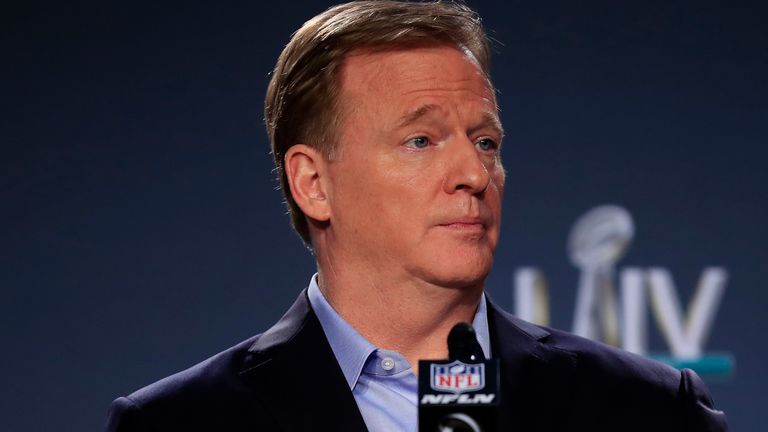
NFL Commissioner Roger Goodell says the league was wrong for not listening to players and is encouraging them to speak out and peacefully protest amid demonstrations across the U.S. over systemic racism in response to the death of George Floyd.
In a video posted to social media Friday, the NFL appears to be trying to make amends for the league’s handling of kneeling protests during the national anthem, led by Colin Kaepernick.
We, the NFL, condemn racism and the systematic oppression of Black People. We, the NFL, admit we were wrong for not listening to NFL players earlier and encourage all to speak out and peacefully protest. We, the NFL, believe Black Lives Matter. #InspireChangepic.twitter.com/ENWQP8A0sv
“We the National Football League condemn racism and the systematic oppression of Black people. We the National Football League admit we were wrong for not listening to NFL players earlier and encourage all to speak out and peacefully protest. We the National Football League believe Black lives matter,†Goodell said in the video.
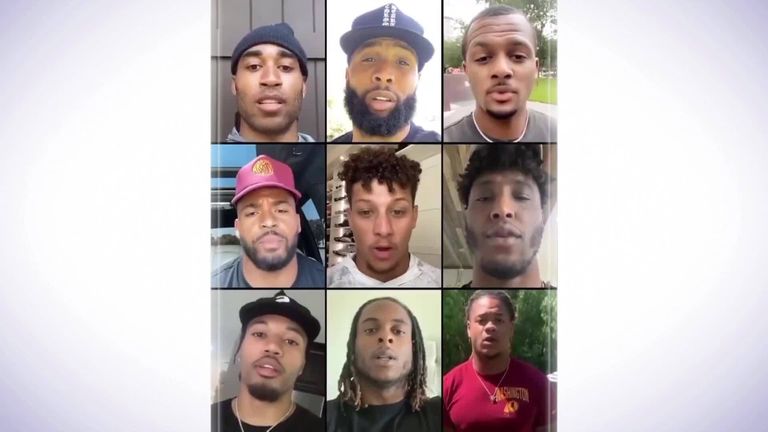
The league also shared a video put out Thursday night in which more than 15 NFL stars said they were asserting their right to peacefully protest and asked the NFL to “admit wrong†in silencing its players.
The league appeared to be responding to its players’ request with Friday’s video.
“I personally protest with you and want to be part of the much-needed change in this country. Without Black players, there would be no National Football League and the protests around the country are emblematic of the centuries of silence, inequality and oppression of Black players coaches, fans and staff,†Goodell said.
“We are listening, I am listening and I will be reaching out to players who have raised their voices and others on how we can improve and go forward for a better and more united NFL family.â€
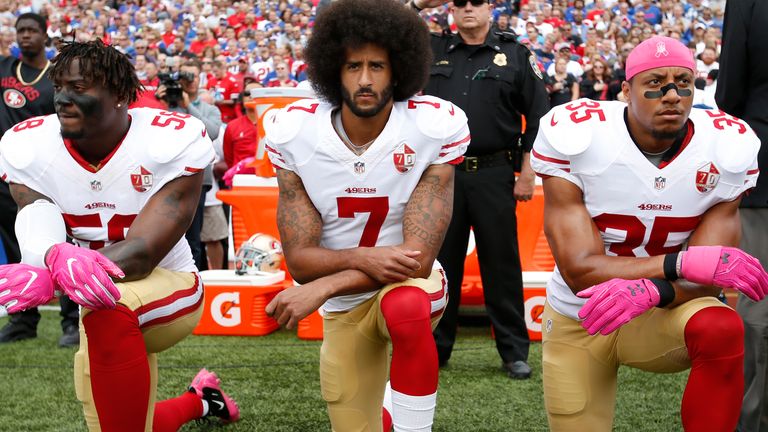
Kaepernick sparked a wave of demonstrations across the league in 2016 after he kneeled during the national anthem to call attention to police brutality and racial inequality. Kaepernick has not played in the NFL since that season and settled a collusion case with the league last year, saying he was blacklisted because of the protests.
The NFL initially released a statement five days after Floyd’s death that did not mention player protests or racism.
Ingram became the industry’s largest wholesaler, shipping books to retailers far more quickly than publishers could.
Mr. Hoffman’s success at Ingram led to his being hired by Waldenbooks. The company was based in Stamford, Conn., and Mr. Hoffman, a sailor, lived about half of every year on a boat docked nearby on Long Island Sound.
In 1989, after the Iranian leader Ayatollah Ruhollah Khomeini made death threats against the writer Salman Rushdie and anyone involved in the publication of his novel “The Satanic Verses,†Mr. Hoffman ordered all copies of the book removed from Waldenbooks shelves. He left employees the option of selling copies from its stockrooms. Other chains followed.
Mr. Hoffman defended his action as protecting his employees.
Soon after making his decision, he wrote an Op-Ed article for The Times. “I have been bombarded by attacks by publishers, authors, the media and customers,†he wrote. “Many are properly concerned at this basic abridgment of the right to by a book. To them, I say: We agree. This is serious. This is wrong.â€
He added, “To them, I also say that the problems of international terrorism are not best solved by a bookstore chain.”
In addition to Ms. Keeling, Mr. Hoffman is survived by his wife, Kathie (Peterson) Hoffman; another daughter, Lori Palermo; a son, Harry; five grandchildren; and five great-grandchildren. His marriage to Norma Jean Olson ended in divorce.
Borders and Waldenbooks had been owned by Kmart but had been spun off into a separate company in 1995. Ultimately, the two chains were hurt by competition from Amazon and other retailers, as well as by management turnover and a failure to move strongly into digital books.
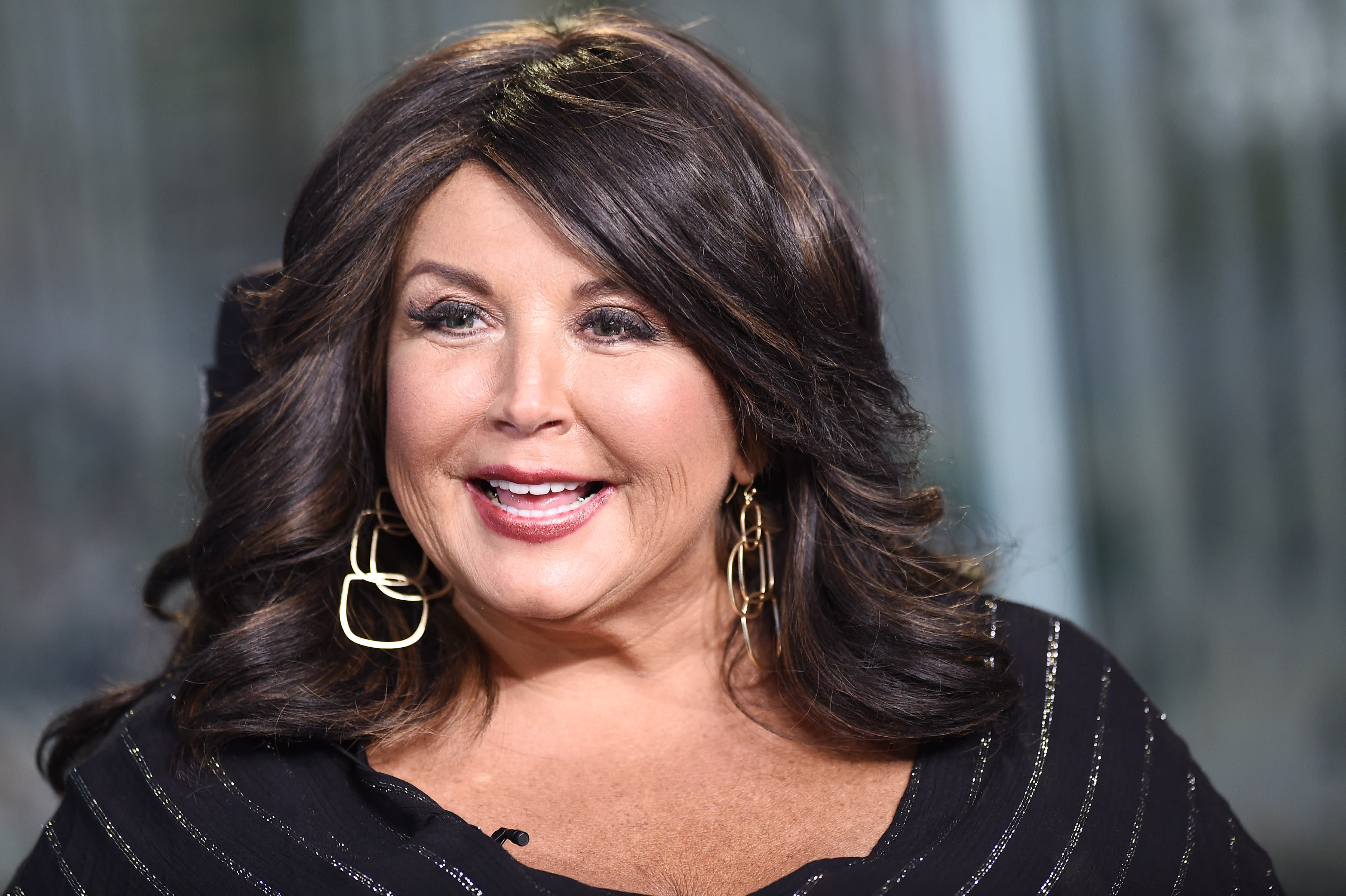
Abby Lee Miller’s Dance Moms spinoff, Abby’s Virtual Dance Off, has been canceled in the wake of racist accusations against the reality TV star, Yahoo Entertainment confirms. Lifetime severed ties entirely with Miller and won’t bring her back for the ninth season of Dance Moms, should it get renewed.
It all started when Miller, 53, posted a black square for Blackout Tuesday to show her support for the Black Lives Matter movement and was called out by a former contestant’s mother. Adriana Smith, whose daughter Kamryn competed on Season 8 last year, claimed Miller made racist remarks to her then 7-year-old during filming.
“A statement from her that sticks in my mind to this day during my time on DMS8 is ‘I know you grew up in the HOOD with only a box of 8 crayons, but I grew up in the Country Club with a box of 64 — don’t be stupid,†Smith wrote.
Smith also claimed Kamryn overheard someone affiliated with the show saying she was included because “they need a sprinkle of color.â€
That prompted another parent to speak out. Camille Bridges told E! News she felt Miller treated her daughter unfairly because of her race. Miller apologized on Thursday.
“I genuinely understand and deeply regret how my words have effected and hurt those around me in the past, particularly those in the Black community,†Miller wrote on social media. “To Kamryn, Adriana, and anyone else I’ve hurt, I am truly sorry.â€
Miller continued, “I realize that racism can come not just from hate, but also from ignorance. No matter the cause, it is harmful, and it is my fault. While I cannot change the past or remove the harm I have done, I promise to educate myself, learn, grow and do better. While I hope to one day earn your forgiveness, I recognize that words alone are not enough. I understand it takes time and genuine change.â€
That apology wasn’t accepted. On Friday, Smith called Miller’s words insincere and explained that the dance instructor never privately reached out.
“My daughter and I have yet to hear directly from Abby Lee Miller. Moreover, she didn’t even bother to tag me or Kamryn in her post,†Smith shared. “What happened to a phone call or at least a personal direct message?â€
Smith continued, “Her failure to appropriately address me and my daughter personally points to the fact that she is disingenuous. … At this point, this is bigger than Kamryn and I. It’s about the potential effect that she has on the future of dance and negative, stereotypical influences on young, aspiring dancers of color.â€
Abby’s Virtual Dance Off was pegged as a pandemic-friendly show set to air 12 episodes this summer. It would have featured dancers from around the country who submitted videos of their moves.
NFL commissioner Roger Goodell: “We were wrong for not listening to NFL players earlier and encourage all to speak out and peacefully protest. We, the NFL, believe Black Lives Matter.”
Last Updated: 06/06/20 12:33am
Roger Goodell said he would be in touch with players who had voiced concerns about the league
The NFL has admitted it was wrong for not listening to player protests about the systematic oppression of black people.
The apology comes after George Floyd, an unarmed black man, died while in police custody in Minneapolis last week, and NFL stars on Thursday sent a passionate video message to the league about racial inequality.
NFL commissioner Roger Goodell said in a video on the NFL twitter page: “It has been a difficult time for our country. In particular, black people in our country.
“First, my condolences to the families of George Floyd, Breonna Taylor, Ahmaud Arbery, and all the families who have endured police brutality.
We, the NFL, condemn racism and the systematic oppression of Black People. We, the NFL, admit we were wrong for not listening to NFL players earlier and encourage all to speak out and peacefully protest. We, the NFL, believe Black Lives Matter. #InspireChangepic.twitter.com/ENWQP8A0sv
“We, the NFL, condemn racism and the systematic oppression of Black People. We, the NFL, admit we were wrong for not listening to NFL players earlier and encourage all to speak out and peacefully protest. We, the NFL, believe Black Lives Matter.
“I personally protest with you and want to be part of the much needed change in this country. Without black players there would be no National Football League and the protests around the country are emblematic of centuries of silence, inequality and oppression of black players, coaches, fans and staff.”
1:08 More than a dozen NFL stars united to send a passionate video message on racial inequality to the League
More than a dozen NFL stars united to send a passionate video message on racial inequality to the League
Goodell also said he would be in touch with individual players who had voiced concerns about the league.
“We are listening, I am listening and I will be reaching out to players who have raised their voices and others on how we can improve and go forward for a better and more united family.”
Brees has apologised for saying he would “never agree with anybody disrespecting the flag,” referring to players kneeling in a pose has become a symbol of the fight for racial justice in the United States.
The kneeling pose has been seen at protests against police brutality in cities across the country in the wake of the death of George Floyd.
Colin Kaepernick has not played in the NFL since the 2016 season
Quarterback Colin Kaepernick kneeled in protest against racial inequality in 2016 while he was on the San Francisco 49ers roster, appearing on NFL sidelines first sitting, and later kneeling, during the customary pre-game airing of the US national anthem.
In 2015, an unassuming-looking Bill Gates came on stage at the TED conference in Vancouver to issue a dire warning.
“If anything kills over 10 million people over the next few decades, it is likely to be a highly infectious virus rather than war,” he told the audience.
His prescient words picked up some coverage at the time, including from the BBC – but largely went unheeded.
But now, the video of this talk has now been viewed more than 64 million times – with many people more interested in the reasons behind that speech than the talk itself.
Some accuse of him of leading a class of global elites. Others believe he is leading efforts to depopulate the world.
Still more accuse him of making vaccines mandatory, or even attempting to implant microchips into people.
The face of public health
“There are myriad conspiracies surrounding Bill Gates,” said Rory Smith, from fact-checkers First Draft News.
“He is this kind of voodoo doll that all these communities are pricking with their own conspiracies. And it is unsurprising he has become the voodoo doll – because he has always been the face of public health.”
Image copyright Getty Images
Image caption
Bill Gates has been the face of public health for over a decade
Much of the content is posted to public Facebook groups, from where it is shared millions of times.
First Draft News has also found that Chinese viral video site TikTok is becoming a new home for such conspiracies.
The BBC’s anti-disinformation team has been researching some of the more outlandish ones.
They include claims that the Bill and Melinda Gates Foundation has tested vaccines on children in Africa and India, leading to thousands of deaths and irreversible injuries. One post even suggested he is facing trial in India.
He is accused of rolling out a tetanus vaccine in Kenya that includes abortion drugs
A video on the website of The New American Magazine’s Facebook page continues with the theme of mass depopulation via vaccines and abortion, and also links Mr Gates to China’s Communist Party. It was shared 6,500 times and viewed 200,000 times.
Meanwhile a video accusing Gates of wanting to microchip people has garnered nearly two million views on YouTube.
Rich and famous
So how did the founder of Microsoft, who has poured billions into global healthcare from the philanthropic foundation he runs with his wife Melinda, become the bogeyman of Covid-19 conspiracy theorists?
Prof Joseph Uscinski, a political scientist at the University of Miami and author of books on conspiracy theories, believes it is simply because he is rich and famous.
“Conspiracy theories are about accusing powerful people of doing terrible things,” he told the BBC. “The theories are basically the same, just the names change.
“Before Bill Gates, it was George Soros and the Koch brothers and the Rothchilds and the Rockefellers.”
And while the majority of conspiracy theories “die on the vine”, the ones that endure are those that offer “big villains and address issues that people care about”.
“It should come as no surprise that rich people and big corporations are being accused of conspiring to put chips in our necks because that is a thing we fear,” he said.
“This has been the ammo of conspiracy theories for a long, long time.”
While he thinks such conspiracies have “no tether to the truth whatsoever”, people still seem to be falling for them.
More than a quarter of all Americans and 44% of Republicans believe that Bill Gates wants to use a Covid-19 vaccine to implant microchips under people’s skin, according to a survey from Yahoo News and YouGov.
Mr Smith thinks that there is often a “kernel of truth” which is taken “way out of context”.
Image copyright Getty Images
Image caption
If conspiracy theories are widely believed, it could affect the uptake of coronavirus vaccines
So, for example, the Bill and Melinda Gates Foundation did fund a study, conducted by the Massachusetts Institute of Technology last year, which looked at the possibility of storing a patient’s vaccination history in a pattern of dye. It would be invisible to the naked eye, and could be delivered under the skin at the same time as a vaccine.
It is difficult to ascertain the root of conspiracy theories – but it’s thought the internet is making them spread further.
“Before the internet, they were self-contained and existed only in their own echo chambers or bubbles within certain communities, but the internet allows them to travel across political lines, between communities, so I think there is much more scope to mainstream conspiracy theories than before the internet,” said Mr Smith.
And, he added, conspiracy theories had particularly flourished during this global pandemic because people were “psychologically vulnerable”.
“This crisis is unprecedented in size and scope and the advice shifts as new studies are published. There are large areas of uncertainty and humans abhor uncertainty,” he said.
To deal with it, individuals resort to something he calls collective sense-making.
“We grab onto any information to inject some sort of sense and order and that is when the rumour mill starts. Conspiracy theories – and notably Bill Gates conspiracy theories – fill these informational vacuums.”
‘Have to laugh’
Image copyright Getty Images
Image caption
Bill Gates and his wife Melinda have not publicly responded to the barrage of false claims
The Bill and Melinda Gates Foundation, which has committed $300m (£240m) to combat Covid-19, has remained sanguine about the barrage of false claims.
In a statement to the BBC it said: “We’re concerned about the conspiracy theories being spread online and the damage they could cause to public health.
“At a time like this, when the the world is facing an unprecedented health and economic crisis, it’s distressing that there are people spreading misinformation when we we should all be looking for ways to collaborate and save lives. Right now, one the best things we can do to stop the spread of Covid-19 is spread the facts.”
In an interview with the BBC, Bill Gates expressed surprise that he had become the figurehead of such theories.
“It is troubling that there is so much craziness. When we develop the vaccine we will want 80 percent of the population to take it and if they have heard it is a plot and we don’t have people willing to take the vaccine that will let the disease continue to kill people.”
I’m kind of surprised some of it is focused on me. We are just giving money away, we write the cheque.. and yes we do think about let’s protect children against disease but it is nothing to do with chips and that type of stuff. You almost have to laugh sometimes.”
We use cookies on our website to give you the most relevant experience by remembering your preferences and repeat visits. By clicking “Accept”, you consent to the use of ALL the cookies.
This website uses cookies to improve your experience while you navigate through the website. Out of these, the cookies that are categorized as necessary are stored on your browser as they are essential for the working of basic functionalities of the website. We also use third-party cookies that help us analyze and understand how you use this website. These cookies will be stored in your browser only with your consent. You also have the option to opt-out of these cookies. But opting out of some of these cookies may affect your browsing experience.
Necessary cookies are absolutely essential for the website to function properly. These cookies ensure basic functionalities and security features of the website, anonymously.
Cookie
Duration
Description
cookielawinfo-checbox-analytics
11 months
This cookie is set by GDPR Cookie Consent plugin. The cookie is used to store the user consent for the cookies in the category "Analytics".
cookielawinfo-checbox-functional
11 months
The cookie is set by GDPR cookie consent to record the user consent for the cookies in the category "Functional".
cookielawinfo-checbox-others
11 months
This cookie is set by GDPR Cookie Consent plugin. The cookie is used to store the user consent for the cookies in the category "Other.
cookielawinfo-checkbox-necessary
11 months
This cookie is set by GDPR Cookie Consent plugin. The cookies is used to store the user consent for the cookies in the category "Necessary".
cookielawinfo-checkbox-performance
11 months
This cookie is set by GDPR Cookie Consent plugin. The cookie is used to store the user consent for the cookies in the category "Performance".
viewed_cookie_policy
11 months
The cookie is set by the GDPR Cookie Consent plugin and is used to store whether or not user has consented to the use of cookies. It does not store any personal data.
Functional cookies help to perform certain functionalities like sharing the content of the website on social media platforms, collect feedbacks, and other third-party features.
Performance cookies are used to understand and analyze the key performance indexes of the website which helps in delivering a better user experience for the visitors.
Analytical cookies are used to understand how visitors interact with the website. These cookies help provide information on metrics the number of visitors, bounce rate, traffic source, etc.
Advertisement cookies are used to provide visitors with relevant ads and marketing campaigns. These cookies track visitors across websites and collect information to provide customized ads.