Thursday, April 23, 2026

Justice Department Says Maine’s 2-Week Quarantine Rule Discriminates Against Tourists

Motels are closed in late April in Old Orchard Beach, Maine, during measures to stem the spread of the coronavirus.

Robert F. Bukaty/AP


hide caption

toggle caption

Robert F. Bukaty/AP

Motels are closed in late April in Old Orchard Beach, Maine, during measures to stem the spread of the coronavirus.

Robert F. Bukaty/AP

Updated at 8:13 p.m. ET

The U.S. Department of Justice is siding with campground and restaurant owners in Maine who sued the state over a two-week self-quarantine policy for out-of-state visitors.

Democratic Gov. Janet Mills imposed the restriction as part the state’s response to the ongoing pandemic. Several other states have imposed similar measures.

In a brief filed on behalf of Bayley’s Campground in Scarborough and other plaintiffs, attorneys with the Department of Justice, including the U.S. attorney for Maine, said the government is getting involved because of its “compelling interest in protecting the public and citizens’ constitutional right to be free from unjustified discrimination on the basis of state residency.”

In this case, the federal attorneys said Maine has likely exceeded the Constitution’s limits by discriminating between Mainers and people from out of state, with respect to the ability to patronize campgrounds and recreational vehicle parks.

The government’s statement noted that the order doesn’t require all nonresidents to go into quarantine. “As far as public safety goes, it is unclear why out-of-state residents may enter Maine to engage in any ‘legal, business, professional, environmental permitting and insurance services,’ for example, but not to patronize a campground or RV park. … If Maine wants to prevent the spread of COVID-19, one would think it would start by preventing outsiders from attending a boardroom meeting, not from pitching a tent.”

In response, Mills said in a statement she is “deeply disappointed and frankly disgusted – that the U.S Department of Justice is making a concerted effort to undermine the health of the people of Maine.”

Mills pointed out that these objections “were never raised when the President and his own task force took steps to limit travel.”

“Maintaining the 14-day quarantine … has never been about anything other than protecting the health and safety of Maine people at a time when millions are expected to flock to our state from COVID-19 hot spots,” Mills said. “I imagine it is for this same reason that so many other governors have enacted similar measures.”

On Friday, the judge rejected a motion for a preliminary injunction against the governor’s orders.

Source link

Greece to allow tourists from Israel, Lebanon

May 29, 2020

Greece will allow tourists from Israel and Lebanon to visit in June.

As of June 15, Greece will allow visitors from Israel, Lebanon and several European countries for its peak summer tourism season, Reuters reported. The Mediterranean country’s economy relies heavily on tourism.

Israel and Lebanon are the only two countries on Greece’s list in the Middle East. Both nations have been praised for their responses to the virus.

Israel received praise for stopping tourism and forcing people to stay home early on. The country also used surveillance technology to track people with the virus.

Lebanon has likewise been lauded for its relatively low numbers of just over 1,100, despite a worsening economic crisis and high population of refugees who lack access to hygiene materials.

Israel has had 16,987 confirmed COVID-19 cases, but only 1,976 remain active. Lebanon has registered only 1,172 cases, with about 400 remaining active.

Greece began a nationwide lockdown to limit the spread of COVID-19 in March, and has registered 2,909 cases. This number is relatively low in the European Union, according to Reuters.


Source link

Twitter is now in completely uncharted waters

0

When Twitter slapped a warning label on one of President Donald Trump’s tweets Friday for “glorifying violence,” it was almost certain that the move — a first for the platform — would escalate tensions with the White House.

But even Twitter may not have guessed that the official White House Twitter account would then choose to repost the same language hours later in an apparent attempt to further test Twitter’s limits. Having already made its position clear, Twitter really only had one option: It added a warning label onto that tweet, too.

The back-to-back incidents capped off a rocky week in which Twitter’s decision to place warning labels on two Trump tweets set off a presidential firestorm that culminated in an executive order that seeks to punish the entire social media industry. Twitter now finds itself in an unprecedented position. For years it was Trump’s favored platform; now Twitter is locked in a war with the president simply for choosing to enforce its policies. Seemingly every tweet on the platform — those from general users and those from Twitter employees — are being scrutinized anew. Republicans are coming after it. Rivals are throwing it under the bus or staying silent. Fact-checking organizations are calling for greater transparency.

And there is no end in sight.

Even as Twitter scrambled to address Trump’s warning to Minneapolis protesters on Friday that “when the looting starts, the shooting starts,” Republican Sen. Ted Cruz was getting ready to call on Attorney General William Barr for a criminal investigation of Twitter. The allegation: Twitter has violated US sanctions by giving Iranian officials a platform for speech.
It’s a reflection of the dizzying number of ways that Twitter has opened itself up to attacks, virtually overnight, because it dared to add “context” to Trump’s claims. Suddenly, Twitter — a platform with far fewer users and far less money than rivals like Facebook and Google — faces the threat of government action, an hourly onslaught of attacks from the President and death threats directed at one employee singled out by Trump and his allies.
Twitter declined to comment for this story beyond referring CNN Business to a blog post on its policies.

An era of inaction comes to an end

When Trump threatened to nuke North Korea, Twitter took no action despite pressure from users. When he attacked four Democratic congresswomen by telling them to “go back and help fix the totally broken and crime infested places from which they came,” Twitter allowed the tweets to stand. When he revived a decades-old conspiracy theory against TV host Joe Scarborough, Twitter said it was “deeply sorry” for the pain the tweets caused — but did nothing.

The company has long sought to walk a tightrope between angering too many users on the left, and too many users on the right. The result was a kind of inaction that primarily benefited Trump. Now, after years of upsetting the people out of power, Twitter has finally resolved to upset the people in power for a change.

“I would not be surprised if the voices in the company that may have been trying to steer towards moderation and trying to find a middle ground have sort of stepped away from that,” said Adam Sharp, the former head of news, government and elections at Twitter.

Nu Wexler, a former spokesman for Twitter, Google and Facebook at various points in his career, said Trump provided Twitter this week with an ideal opportunity to begin enforcing its policies with his tweets about mail-in ballots and “looting” leading to “shooting.”

“If you had to pick a test case to litigate in the court of public opinion, fact-checking a demonstrably false claim about voting and a very specific violent threat are the ones you would pick,” he said.

Still, if the back-and-forth between Twitter and the White House this week is any indication, it may just be the first of many tests to come.

Can’t stop, won’t stop

Twitter can’t stop now; if it does, it would have created a public firestorm and invited a war with Trump for nothing. But the conflict also puts Twitter in a difficult position. The more the company tries to clarify and correct the record with its warning labels, the more it serves Trump’s political interests by playing into his preferred narrative of an antagonistic, partisan media.

Enforcing the rules on Trump doesn’t just create dangers for Twitter whenever it acts on his tweets. It also inherently creates an inverse risk: tweets that go un-checked could be interpreted by some users as implicitly accurate or true. And it exposes the company to unending allegations of hypocrisy and partisanship.

Trump and his allies are all too willing to spotlight any perceived inconsistencies. “This Tweet violated the Twitter Rules about glorifying violence,” read a tweet from the White House account on Friday that cited a post by the Supreme Leader of Iran, Ali Khamenei, on Palestine. “However, @Twitter has determined that it will allow terrorists, dictators, and foreign propagandists to abuse its platform.”
The legal limits of Trump's executive order on social media

Baybars Örsek, the director of the International Fact-Checking Network (IFCN) at the Poynter Institute, said the issue is symptomatic of a deeper problem facing Twitter: Despite its efforts, the company hasn’t communicated clearly enough about how its enforcement works. The IFCN’s members, which include PolitiFact, the Associated Press and dozens of others, are the independent partners behind Facebook’s third-party fact-checking operation. Örsek said neither IFCN nor its members have heard from Twitter.

“Twitter needs to make it a big, transparent process how they decide what to fact check,” said Örsek. “It’s not easy if you have it done as an internal team. People will be asking questions about how are they choosing to do this duty.”

Twitter has been reluctant to reveal too much about its exact workflows when it comes to reviewing speech. The company has published numerous blog posts explaining its general approach to public figures and misinformation. But when pressed for specifics on the fact-checking of Trump’s tweets or its decision-making surrounding Trump’s baseless allegations against Scarborough, CEO Jack Dorsey has preferred to reply with vague platitudes.

It had to be Twitter

If this week proves anything, it’s that any action Twitter might have taken against Trump’s tweets was likely to provoke an extreme reaction. But Twitter is one of the few remaining major tech platforms Trump has not targeted with the levers of government, giving it wider latitude than some others to push back.

Facebook and Google are under active antitrust investigations, which, although by law must be conducted dispassionately and without a view to politics, have been interpreted as inextricably linked to Trump’s frequent outbursts about political bias.

Twitter labeled Trump tweets with a fact check for the first time

Twitter doesn’t have an antitrust problem because there are far larger and more powerful tech companies. So its exposure to regulatory retaliation is comparatively less, and its flexibility to challenge Trump somewhat greater, said Wexler. And for all his bluster, Trump has long depended on Twitter to communicate with millions.

Twitter now has to hope that Trump’s threats — and the executive order he signed this week calling for rethinking legal protections the industry was built on — end up being as toothless as some expect.

At least on that point, Twitter is probably in good company.


Source link

Mississippi mayor ignores calls to resign over comments on George Floyd’s death

A Mississippi mayor who sparked outrage when he said “if you can talk, you can breathe” about the death of George Floyd in Minneapolis police custody is resisting calls to resign, including from his town’s board of aldermen.

“Why in the world would anyone choose to become a #PoliceOfficer in our society today?” Hal Marx, mayor of Petal, about 90 miles southeast of Jackson, tweeted Tuesday, the same day four Minneapolis police officers involved in detaining Floyd were fired.

Floyd, 46, who was black, died in Minneapolis police custody after a white officer, Derek Chauvin, pinned him to the ground and put his knee on his neck for about eight minutes. Chauvin was arrested Friday and charged with third-degree murder and manslaughter.

In a follow-up tweet, Marx said: “If you are talking about the incident in MN, I didn’t see anything unreasonable. If you can say you can’t breathe, you’re breathing. Most likely that man died of overdose or heart attack,” with no evidence. He also said that the police involved were being “crucified.”

Marx’s Twitter account no longer exists, and it was unclear who deactivated it and why.

The Petal Board of Aldermen held a special meeting Thursday night where some residents demanded he resign. The meeting was broadcast live on Facebook.

Alderman Clint Moore led the meeting and read a statement before the board voted unanimously to ask for Marx’s resignation. In Mississippi, an elected official can only be involuntarily removed from office if he or she has committed a felony, according to the Clarion Ledger.

“The city of Petal, Mississippi, and the cities surrounding have grown to be a place where individuals of all walks, backgrounds and beliefs are valued, supported and celebrated,” Moore said. “It is our goal to continue to embrace our diverse community and prosper.”

He said the strides made in the community have been great.

“Petal has become a hometown destination to many due to our excellent school district, safe way of life and community support,” Moore said. “Recently, Mayor Hal Marx has taken to social media and repeatedly made comments that have isolated, enraged and belittled individuals in a way that is unbecoming of our city.

“Furthermore, these remarks have alienated certain groups of our population, which is counter productive to our diverse community. Over the past few days, the vast number of our constituents who have reached out to us showing their disapproval and disdain have made it obvious that we can no longer accept this reality.”

Moore said the board believed Marx was “out of touch with the citizens” and unfit to continue in his capacity as mayor. Moore also said Marx’s comments are not an embodiment of the values that the city stands for and pledged the board would take every action available to ensure that Marx’s future as a leader in Petal is limited.

Moore’s statement drew applause from the audience.

Marx said in response that his wife has often advised him to stay off social media and to watch what he said and had he listened to her, he “probably wouldn’t have had some problems.”

He said he did not think through what he said in his tweets to include sympathy for Floyd and his family.

“What I said, came out in a way that I wish I said it differently,” Marx said. “It wasn’t to minimize that gentleman’s death.”

He said what he meant was that no one knows for sure how Floyd died or what occurred before he was pinned to the ground by a Minneapolis police officer.

“I spoke impulsively before I really looked at the whole picture and my point was simply to say that, in situations like this, a lot of times there’s a rush to judgment on things where things turn out to be differently than what they appear,” he said. “That’s my point. Nothing that I said in my mind was anything racial.”

As Marx spoke, members of the audience shouted over him, with some residents saying this was not his first insensitive or racist remark on social media.

Marx said he declined the request to resign and that he did not believe he did anything that warrants his resignation.

Afterward, the board voted unanimously to ask for Marx’s resignation.

Marx refused and said he does not believe in giving in to bullying and mob mentality.

Marx and Moore did not immediately return requests for comment Friday.

Many residents delivered emotional statements at Thursday’s meeting.

Myla Cox, 17, a student at Brown University, who grew up in Petal, said she faced a stigma at the Ivy League school because she was from Mississippi.

“Everybody looked down on me, everybody saw the type of people that ran my city, specifically you,” she told Marx. “People did a lot of research and they saw your social media and they saw what you said and what you openly didn’t apologize for.”

Cox said she had to work her freshman year to earn the respect of her peers.

“I’m very intelligent and for people to already have this kind of stigma because of words that you’ve said that didn’t at all reflect my opinion infuriates me,” Cox told Marx. “You not taking responsibility for things that you’ve openly said in the past … shows who you are and we do not want you leading.”

Source link

Home schooling boosts parents’ interest in teaching as a career

School closures have turned the UK into a nation of temporary teachers since the coronavirus lockdown – and that may have inspired some people to seek new careers in the classroom, according to a new survey.

Now Teach, the charity co-founded by the former journalist Lucy Kellaway, encourages older workers to change careers, and has found that the lockdown has increased the status of school teachers among the population at large, as parents have come to appreciate the joys of designing scientific experiments that impart knowledge rather than just make a mess in the kitchen.

The survey of 2,000 UK adults found that 3% said they had “been thinking about becoming a teacher and I wasn’t before the coronavirus lockdown”, while a further 5% agreed that they had been “already thinking about becoming a teacher before the coronavirus lockdown but I’m thinking about it more seriously now”.

“The leap in interest in teaching is exactly what I’d hoped would happen during this wretched time,” said Kellaway, who left her post as a columnist at the Financial Times in 2016 and is now an economics teacher at Mossbourne Victoria Park academy in east London.

While 3% might not sound significant, Kellaway points out that across the UK population as a whole that would amount to more than enough recruits to solve any teaching shortages in Britain’s schools for a generation.

Now Teach said it has seen a 70% rise in applications for its training programme between March and May this year, at the height of the lockdown.

One of those, Aisha Singleton, who worked in publishing in Norwich, said: “My previous industry had so many opportunities and I have many great memories of it, but the bottom line is, I don’t feel I’ve really helped anyone.

“When coronavirus broke out, I thought, ‘I want to inspire young people, I want to be giving back.’ This pandemic has given me the final push in that direction.

“When children go back to school in September, they’re going to need support, particularly those from disadvantaged backgrounds.”

The survey found that despite some high-profile complaints, 64% of parents have enjoyed the experience of home schooling and only 9% reported a negative experience – which Kellaway thought might help explain the new attraction of a career in teaching.

The desire to change careers was strongest among workers who are still in full-time employment, according to the survey, rather than those who had been furloughed or were unemployed during the lockdown.

“I co-founded Now Teach four years ago because I hoped there were other professionals out there who, like me, wanted to do something more useful with their lives. The pandemic has made this point more powerfully than I ever could. It has shone a light on the emptiness of some jobs and made people want to do something that really matters,” Kellaway said.

The survey also found that respondents with school-age children – who have spent the past two months home schooling – “overwhelmingly reported increased gratitude to teachers and respect for what they do”, compared with just 4.5% who said their respect had lessened.

This came despite high-profile attacks on teaching unions by some in the media and government, over their concerns about the safe return of pupils into schools.

Source link

Coronavirus latest: at a glance

Key developments in the global coronavirus outbreak today include:

US ‘terminating’ WHO relationship, says Trump

The US president says he is terminating the nation’s relationship with the World Health Organization. Donald Trump, who has previously threatened to withhold funding from the organisation, says the US will redirect the money to other bodies.

Brazil’s death toll surpasses that of Spain

The death toll in Brazil exceeds that of Spain as the country becomes the fifth-worst affected.

Reuters reports that Brazil’s health ministry has said another 1,124 people have died, taking the total number of fatalities to 27,878. That surpasses the 27,121 deaths that researchers at Johns Hopkins University believe Spain has suffered.

Another UK government adviser questions plan to ease lockdown

The UK government is lifting lockdown restrictions too early, another member of its own advisory committee warns.

Sir Jeremy Farrar, the director of the Wellcome Trust and a member of the Scientific Advisory Group for Emergencies (Sage), voices approval of comments made by his Sage colleague Prof John Edmunds, who said the government is “taking risks” by relaxing measures from Monday.

Cummings breached spirit of lockdown, says former PM

Dominic Cummings, a senior Downing Street aide, did not follow the spirit of the UK’s lockdown rules with his actions , the former prime minister Theresa May says.

Her successor, Boris Johnson, has refused to sack Cummings, despite anecdotal evidence lending weight to experts’ concerns his transgressions are harming the country’s public health efforts during an epidemic that has killed tens of thousands of people in the country.

Turkish Muslims return to communal Friday prayers

Worshippers in Turkey hold their first communal Friday prayers in 74 days as the government reopens some mosques.

Prayers are held in the courtyards of selected mosques to minimise the risk of infection. Authorities distribute masks at the entrance to the mosques, spray hand sanitisers, and check temperatures.

Egypt suffers worst day since outbreak began

Egypt’s health ministry registers 1,289 new cases and 34 deaths, marking another record of daily increases on both counts despite stricter curfew rules. The figures bring the total number of fatalities to 879 and confirmed cases to 22,082, of which 5,511 people have recovered.

Known global death toll passes 363,000

The number of people around the world known to have been infected exceeds 5.8 million, according to data compiled by Johns Hopkins University. At least 363,210 people are known to have died.

The US accounts for about 30% of cases, way ahead of Brazil (7.2%), Russia (6.6%), the UK (4.7%), Spain (4.1%) and Italy (4%).

Russia records biggest rise in deaths

Russia suffers its highest daily increase in deaths, with 232 more in 24 hours. That pushes the nationwide total to 4,374. Officials say 8,572 new infections have been confirmed, bringing the national tally to 387,623. Russia has the third highest reported total of cases in the world after the US and Brazil.

Iran sees highest tally of new infections since early April

Iran identifies more new cases in a day than at any time since early April, with 2,819 more people testing positive on Friday.

Kianoush Jahanpour, the Iranian health ministry spokesman, adds that 50 more people have died in the same period, pushing the total death toll from the outbreak to 7,677. Out of 146,668 cases detected so far, 114,931 people have recovered.

South Africa has backlog of nearly 100,000 tests

Health authorities in South Africa say the country has a backlog of nearly 100,000 unprocessed tests as it and other countries on the continent face difficulties in obtaining essential supplies.

“This challenge is caused by the limited availability of test kits globally,” the health ministry says. Priority is given to processing tests from hospital patients and health workers.

Source link

Free daily horoscope, celeb gossip and lucky numbers for 30 May, 2020

CELEBRITIES BORN ON THIS DAY: Benny Goodman, Mel Blanc, Meredith MacRae, Keir Dullea, Brandon Blue, Wynonna Judd, Christine Jorgensen, Michael J. Pollard.

ARIES (March 21-April 19): While you can be quite resistant to change, you may find that you’re unusually keen to implement new ideas, thanks to an energetic vibe. There’s a possibility of an interesting lead, but you may have to rely more on lucky timing than skill. All that said; don’t try to change too much too soon!

Want to know what the future holds? Get a FREE tarot card reading.

TAURUS (April 20-May 20): It’s a day where communications may be a little unreliable and your drive could dip as a result. You might misinterpret a gesture, an offer or some advice. It may even be that the advice/offer won’t address what you really need. Just in case; don’t depend too heavily on others!

GEMINI (May 21-June 20): There may be couple of one-off openings on the work front. Tread carefully here. Select the things which you know you can do. Avoid anything that might require you to be strict or pushy with others in the next few days, since today’s bubbly vibe is not likely to last for long!

CANCER (June 21-July 22): There may be a vague sense of pressure. If there is, then it could involve a project or an interest, but it’s more likely to relate to a recent work related deadline. Your sense of staying- power will be admirable, but only if you can somehow get past the initial stumbling block!

LEO (July 23-Aug. 22): There may be some lively moments on the emotional front, but there’s a strong chance of making a couple of risky decisions when it comes to material matters. Work to your strengths. It’s a day to think ahead and make informed decisions rather than a day to try and impress others!

VIRGO (Aug. 23-Sept. 22): Minor planetary aspects will tend to cast a subtle flavor to the day. There may be some initial tension in a specific relationship. If so, then don’t assume that you’re right and that someone else is wrong over a particular matter: chances are that you’ll both need to give a little!

LIBRA (Sept. 23-Oct. 22): There’s little change in today’s influences. The vibe generally should be settled, to the extent where you’ll feel very clear- headed and on track. Work issues can be dealt with efficiently, and with that in mind, don’t waste the dynamic vibes on the more mundane things: push yourself a little!

SCORPIO (Oct. 23-Nov. 21): A minor but negative Mars/moon aspect will settle in early on. Minor risks with cash or with material matters in general might look safe enough, but do reconsider any transactions. If it’s an old-versus-new choice, then it might be wise to stick with what you know and trust!

SAGITTARIUS (Nov. 22-Dec. 21): An ability to pick up other people’s thoughts and feelings should make this day an easy one in some respects, although an overly pessimistic approach to ongoing issues could initially cause some minor friction. Avoid judgmental statements, or you could test someone’s patience too much!

CAPRICORN (Dec. 22-Jan. 19): It’s a day to take on board any useful signs and signals on the career front. This may involve taking a back seat position for the day. You may not like the idea of a slower pace, but pausing to take a breather will help you to spot something that you might otherwise miss!

AQUARIUS (Jan. 20-Feb. 18): It may be one of those so-so days where nothing really takes off. There may be a vague sense of something brewing in the air; there may be more direct signs of a development or it could even be a feeling that you’re on the verge of something important or big. Give this a day or two to develop further!

PISCES (Feb. 19-March 20): A tactful approach will get you further than an overly harsh or demanding one. Giving other people a little time to come round might appear to be counter-productive, especially if you’re the one shouldering most of the burden, but actually, as a strategy it’s likely to work!

FOR THOSE OF US BORN ON THIS DAY: Happy Birthday! The months ahead will begin a series of practical challenges that will relate to problems with the home or possibly transport arrangements. None of these issues will be too major, but the process of solving them will be important in building your inner confidence. This will also help when an unexpected opportunity requires you to have the self belief to say yes mid-year. Romance may be a little tricky from the summer months to the fall, probably due to extra work commitments. However, the last few months of the year will bring a special event that will cement any relationship and make it much stronger and more secure. Singles are most likely to meet that special someone and have a fantastically romantic time!

CELEBRITY GOSSIP: Vanessa Hudgens may have been fined for creating graffiti with her current love, but the $1,000 penalty will feel worthwhile to Vanessa. The planets suggest that she is feeling extremely loved up right now!

Today’s lucky numbers

ARIES  4, 17, 25, 28, 32, 45

TAURUS  7, 12, 23, 28, 35, 41

GEMINI  9, 14, 20, 36, 42, 47

CANCER  1, 18, 21, 33, 37, 45

LEO  2, 15, 23, 29, 33, 49

VIRGO  7, 13, 27, 34, 41, 45

LIBRA  9, 14, 25, 32, 35, 43

SCORPIO  6, 15, 17, 28, 34, 41

SAGITTARIUS  9, 17, 21, 30, 38, 46

CAPRICORN  3, 7, 12, 25, 33, 49

AQUARIUS  8, 14, 23, 30, 35, 48

PISCES  9, 17, 22, 29, 34, 40

TODAY’S CHINESE PROVERB: A sly rabbit will have three openings to its den.

TODAY’S MOTIVATIONAL QUOTE: The bitterest tears shed over graves are for words left unsaid and deeds left undone. – Harriet Beecher Stowe.

TODAY’S WISDOM FROM AROUND THE WORLD: Use soft words and hard arguments. – English proverb.


Source link

Some Say If Retail Stores Are Open, Churches Should Be Too. Here’s Why It’s Not So Simple.

Conservative Christian activists have largely framed the debate over whether houses of worship should resume in-person worship as a matter of defending religious freedom. But tucked into these arguments about religious liberty, some have also been pushing a claim that doesn’t seem to stand up to scrutiny ― the claim that if businesses like grocery stores, laundromats, and warehouses can safely remain open, churches can do the same.

Health experts say that comparing churches to the essential businesses that remained open throughout the pandemic is misleading, especially as researchers begin to learn more about how SARS-CoV-2, the coronavirus that causes COVID-19, spreads during mass gatherings. Still, these comparisons have been repeated by pastors across the country, as well as law firms that spearhead the conservative Christian legal movement. Last week, President Donald Trump called on governors to reopen houses of worship, calling it an “injustice” that that “liquor stores and abortion clinics” were open when churches were not.

With a slew of churches set to open their doors this weekend, some health experts are warning that these comparisons ignore the fact that worship services are substantially different from gatherings that take place in grocery stores and even in restaurants.

Dr. Dean Winslow, an infectious disease specialist at the Stanford University Medical Center, told HuffPost he’s worried that the tussle over religious liberty during the pandemic is overshadowing genuine public health concerns.

“Decisions around opening churches shouldn’t be a culture war issue,” Winslow said. “SARS-CoV-2 is a lethal pathogen which doesn’t discriminate. Restrictions on large indoor assemblies are meant to save lives.”


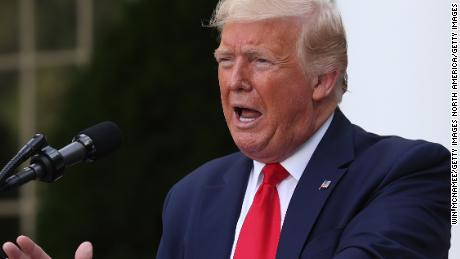
President Donald Trump called on governors to allow houses of worship to reopen during a press conference on May 22. “Some governors have deemed liquor stores and abortion clinics as essential, but have left out houses of worship. It’s not right,” Trump said.

Why Houses Of Worship Are Different

Some studies have suggested that SARS-CoV-2 could potentially spread through tiny, aerosolized respiratory droplets. Aerosolized particles can linger in the air inside poorly ventilated buildings for some time, Winslow said. Loud singing, a common element of religious services, is particularly efficient in producing these aerosolized particles. Winslow pointed to a choir practice that took place in Washington state on March 10, where one sick singer is suspected to have infected 53 people, two of whom died.

The Centers for Disease Control and Prevention published a report earlier this month that suggested the spread of COVID-19 during the Washington choir practice was likely “augmented by the act of singing.”

High-powered speaking, such as what happens during a religious testimony or when people yell out a “Hallelujah,” has also been connected to COVID-19 spread, Neysa Ernst, a nurse manager at the Johns Hopkins Biocontainment Unit, told HuffPost.

In addition, people in houses of worship behave differently toward each other than they would towards strangers they see at grocery stores, Ernst said.

“Before COVID-19 and certainly now in this pandemic, people are usually uncomfortable with others in close physical proximity in places such as grocery stores, liquor stores, laundromats, restaurants, and malls,” Ernst told HuffPost. “Church is a place we are more comfortable in close proximity with people who share a common faith.”

Unlike liquor stores, where the population is transient, religious services can last for more than an hour, which increases the risk of infection. The churchgoing population also generally tends to skew older and, as a result, is more likely to be at risk for complications if they contract the virus. 

At the same time, houses of worship are likely more manageable than concerts and other massive gatherings in stadiums, since people in religious settings tend to be much more controlled and respectful of others nearby, according to Dr. Peter Chin-Hong, an infectious disease specialist at the University of California, San Francisco.

Chin-Hong said that he understands that attending religious services can be therapeutic for people of faith, especially those who are sick and looking for spiritual comfort. He said it’s important not to forget that there are health benefits that people get from going to houses of worship and having their spiritual needs addressed. 

But as a physician, he said he’s concerned that the debates over reopening houses of worship have become “polarized.”

“I’m worried people are just blocking out the science just because they say, ‘Those people don’t get my experience of why I want to go to church,’” Chin-Hong said. “From a scientific perspective, people are just worried that if people forget about protecting themselves, that we’ll see a surge and all the public health measures everyone was so good about, that we’ll lose some of that progress.” 

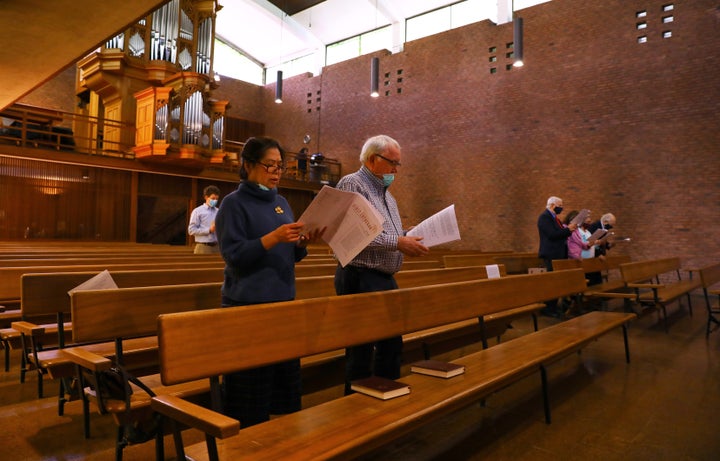
Maria and Siggi Birkis attend a service in the First Lutheran Church in Boston on May 24. They had to make reservations to at


Maria and Siggi Birkis attend a service in the First Lutheran Church in Boston on May 24. They had to make reservations to attend.

How False Comparisons Bolster Religious Liberty Claims

Comparisons between houses of worship and businesses started circulating during some of the earliest public standoffs in the U.S. around in-person worship during the pandemic. Lawyers for Rodney Howard-Browne, the Florida pastor arrested on March 30 for defying local restrictions on church services, lambasted the fact that an Amazon warehouse in the same county was allowed to remain open. Tony Spell, the Louisiana pastor who gained notoriety for repeatedly ignoring local police’s attempts to enforce restrictions on religious services, has been comparing going to church to going to Walmart. 

“If you’re going to persecute our church for staying open, don’t go to Walmart, don’t go to Planned Parenthood, don’t go to the liquor store because you’re a hypocrite,” Spell said during a service on March 29. 

The argument picked up steam in the following weeks, with some conservative Christian legal groups complaining that houses of worship were being unfairly singled out and treated differently from secular businesses. Then, these faulty comparisons began appearing in courts. A federal judge in Kansas issued an order in mid-April arguing that it was unconstitutional for the state to restrict religious services, while allowing other establishments ― airports, offices, production facilities ― to remain open with safety measures. In Kentucky, another federal judge asserted in early May that “if social distancing is good enough for Home Depot and Kroger, it is good enough for in-person religious services.”

The Department of Justice has also waded in to the issue, arguing that allowing gatherings of workers in “retail businesses, including liquor stores, dry cleaners and department stores,” while restricting church meetings amounted to “unlawful discrimination.” 

Despite the CDC’s report on the hazards of singing, the Trump administration removed warnings about restricting singing from the CDC’s guidelines for faith communities on Friday. The updated guidelines also added language stating that the CDC’s recommendations are “not intended to infringe on rights protected by the First Amendment.”

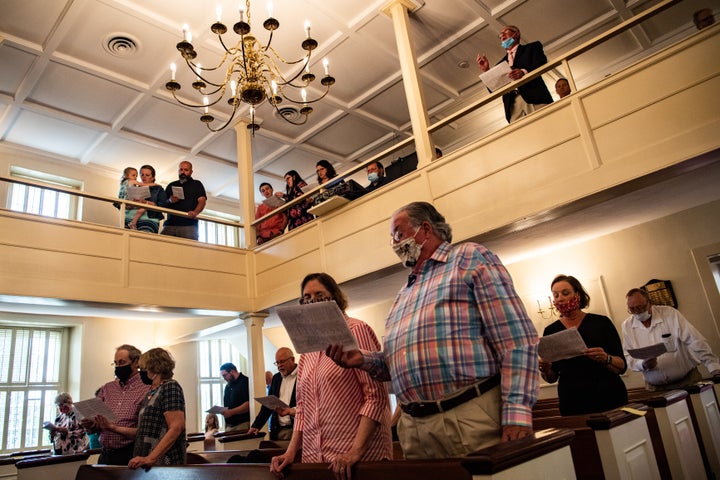
Worshipers participate in a service at Hopeful Baptist Church on Sunday, May 17, in Montpelier, Virginia.


Worshipers participate in a service at Hopeful Baptist Church on Sunday, May 17, in Montpelier, Virginia.

Houses of worship have already started to reopen in parts of the country, many with significant changes in place to try to combat the spread of the virus ― requiring reservations, adding more worship services to reduce crowding, and increasing cleaning efforts.

In California, hundreds of churches plan to reopen on May 31, as part of a campaign led by a Christian legal firm. Some are attempting to abide by guidelines recently put in place by Gov. Gavin Newsom (D) for houses of worship. But others, like Fresno’s Cornerstone Church, are planning to ignore key instructions, such as reducing attendance, claiming that these limits violate religious freedom rights.

“We will be safe,” Cornerstone’s Pastor Pastor Jim Franklin told the Fresno Bee ahead of the reopening this weekend. “We just want to be treated fairly. If a big-box store can do this, so can we.”

Comparing churches to retail stores is like comparing apples to oranges, Winslow said, since certain risky behaviors are much more likely to take place during religious services.

“People are making these false comparisons, saying that Christians are victims and being singled out,” he said. 

As an “enthusiastic” Christian who loves going to church, Winslow said he personally can’t wait to go back. But right now, he said he knows it’s “probably not the smartest thing to do.”

“I would be thinking about going very slowly and very carefully with reopening services,” he said.

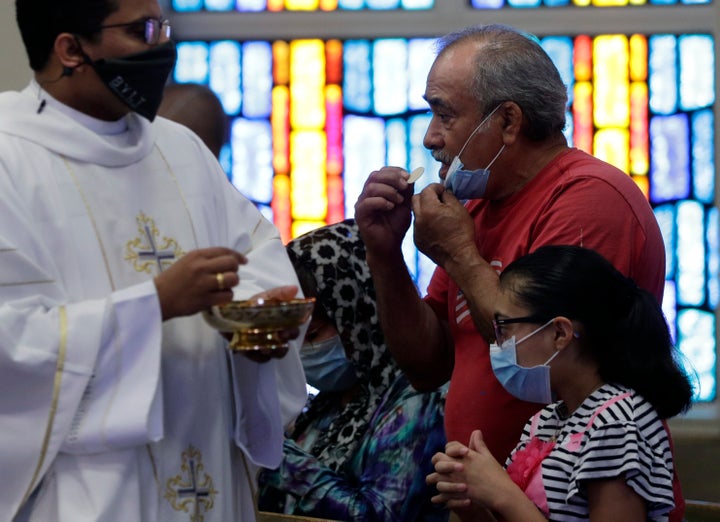
The Rev. Praveen Lakkisettit, left, wears a face mask as he delivers communion to parishioners during an in-person Mass at Ch


The Rev. Praveen Lakkisettit, left, wears a face mask as he delivers communion to parishioners during an in-person Mass at Christ the King Catholic Church in San Antonio, Tuesday, May 19, 2020. 

How To Tell If Your House Of Worship Is Prepared For COVID-19

Chin-Hong suggested that people who are determined to attend services this weekend take some time to evaluate how well their house of worship seems to have understood the risks of COVID-19.

“I think of it as assessing the [house of worship’s] COVID-19 IQ,” Chin-Hong said. “How much do they actually know about COVID-19 and are they being intelligent about reducing the risk for their congregation?”

A house of worship with a good COVID-19 “IQ” would be reducing attendance significantly, disinfecting surfaces and keeping hand sanitizers available, and maybe even doing symptom screenings at the door, Chin-Hong said. They may think about reducing the number of singers in the choir, or ensuring that the choir members are spaced out. It’s also important for people to socially distance from others in the pews behind, in front, and horizontally to where one is sitting, he said. 

Outdoor worship services are the best choice for now, Winslow said. If the service takes place indoors, he believes face masks shouldn’t be optional, as some churches have suggested, but “absolutely mandatory” to reduce the generation of aerosols, Winslow said.

“No one is immune to illness and death from this virus and I would encourage people to focus on that and let science, as much as possible, drive these decisions, particularly about reopening businesses and houses of worship,” he said. “It really should not be a culture wars issue.” 

A HuffPost Guide To Coronavirus


Source link

Pakistan locust invasion ravages crops, orchards

An invasion of locusts has spread across Pakistan, causing damage to crops and orchards and posing a threat to food security in an impoverished Islamic nation already struggling to tackle a virus pandemic that has caused more than 1300 deaths.
Massive swarms of the desert locust, which experts say originates in Africa and is the most destructive of the locust species, began damaging crops in Pakistan last month.
Pakistani officials say an outbreak of desert locusts is spreading across the country posing a threat to food security. (AP)

But the situation worsened this week and authorities began dispatching aircraft and spraying machines filled with pesticides mounted on vehicles to eliminate the insects, which are roughly the length of a finger and fly together by the millions.

Farmers could be seen wading through clouds of the insects as some tried to kill them with sticks.

Chaudhry Asghar, an agriculture officer in the Punjab provincial capital of Multan, said millions of desert locusts had already damaged orchards, crops and vegetables.

“We have intensified efforts to save our crops from any further invasion of locusts,” Syed Fahar Imam, national food security minister, said today. He said the government will buy five more aircraft for spraying crops.

The insects have wreaked havoc on swathes of farmland in eastern Punjab, southern Sindh and southwestern Baluchistan province. They also attacked crops in the northwest bordering Afghanistan.

The locusts have also brought agricultural destruction to neighbouring India, where critics pointed the finger at Pakistan as a new breeding ground for the desert locusts.

Farmers spray insecticide in a mango tree orchard in Muzaffargarh, Pakistan. (AP)

Pakistani officials said no country should blame another for the situation, but all affected countries need to make collective efforts to prevent a possible food crisis in the region.

Farmers say while crops of rabi, a type of grain, were sown in winter and harvested in the spring, locusts are damaging cotton and vegetable crops sown in April.

The National Disaster Management Authority said resources were being mobilised and operations were underway to curb the locust invasion.

In a statement, it said 1150 teams of experts have expanded operations by spraying swarms of desert locusts in 61 districts across the country.

Arrangements were also being made to combat another possible attack of desert locusts expected in July and August.

Source by [author_name]

Quiet Diplomacy or Inaction: Lessons from a Survey Ship Standoff

0

When a Chinese survey ship deployed close to a Malaysian-contracted oil exploration vessel in Malaysian waters in mid-April, tensions in the South China Sea went up a notch. United States and Australia sent warships to the area to send a message to China – that Southeast Asian nations should be free to exploit resources off their own coasts.

Yet Malaysia itself kept its counsel. The government scarcely issued a word of protest over China’s actions. And then, a month after the Chinese ship had arrived, the Malaysian-contracted drillship West Capella returned to port, and China’s Hai Yang Di Zhi 8 went on its way.

Experts say Malaysia’s handling of the standoff underscored its preference for low-key handling of such disputes and to avoid damage to its relationship with China – even as it challenges Beijing’s sweeping claims in the South China Sea at the United Nations.

But questions remain about how durable Malaysia’s quiet diplomacy will be in the face of China, a country intent on pressuring Southeast Asian nations that want to tap resources in areas that lie off their coasts. Areas that China, in defiance of international law, claims for itself.

“Malaysia’s approach is to keep its head down in the hope that China will ignore Malaysia’s operations in the South China Sea,” said Murray Hiebert, a Southeast Asia expert at the Center for Strategic and International Studies in Washington. “No, China is on a roll in the [South China Sea] and I don’t expect that it will leave Malaysia’s oil and gas operations alone.”

Satellite image of the Malaysian-contracted drillship West Capella in the South China Sea, accompanied by the Executive Stride, a resupply vessel, April 22, 2020.
Credit: Planet Labs Inc.

Chinese Survey Ship Sets Sail

China has deployed the Hai Yang Di Zhi 8 in contentious circumstances before. Last year, it was at the center of a months-long standoff with Vietnam at the disputed Vanguard Bank.

This time, it sailed past Vietnam and entered Malaysian waters on April 15 along with an escort of China Coast Guard (CCG) and maritime militia ships. It then commenced a survey right by the West Capella that had been exploring for oil and gas since December. Vessel tracking software revealed the path of the Hai Yang Di Zhi 8, moving back and forth on horizontal and vertical paths indicative of a survey. Meanwhile, the CCG and Chinese maritime militia vessels sailed right next to the West Capella and its resupply ships.

Prashanth Parameswaran, a fellow at the Wilson Center’s Asia program, said the Hai Yang was probably deployed in response to Malaysia’s increasing assertion of its rights to resources on its continental shelf. Malaysia had submitted a claim for an extended continental shelf to the United Nations in December.

That submission prompted China to issue a protest, stating it still held “historic rights” to the entirety of the South China Sea – including areas within the continental shelf limits of Malaysia, Vietnam, and the Philippines. This prompted protests from all those countries. On Tuesday, Indonesia followed suit. Notably it cited a 2016 Permanent Court of Arbitration ruling in response to a case brought by the Philippines that undermined the legal basis of China’s claims in the South China Sea.

Malaysia monitored China’s survey activity with at least one nearby warship and its coastguard throughout the month, vessel tracking software showed. However, Malaysia made few official statements, and was reluctant to acknowledge the campaign as it unfolded. Officials initially stated the survey “did not break any laws.”

Hiebert said this was indicative of Malaysia’s tendency to solve disputes quietly. “Not saying much about China’s bullying of Malaysian naval or oil exploration vessels seems to be Malaysia’s standard operating procedure,” he said. “Privately, Malaysian officials often say ‘What do you expect us to do? Go to war with China with our small navy? We don’t want to disrupt our critical economic ties.”

But Malaysia’s low-key response drew some negative views at home, and according to Parameswaran “provided room for speculation and criticism and made it seem like it was on the backfoot.”

US Sends Ships, Malaysia Opts for Quiet Diplomacy

China’s intimidation campaign attracted international attention.  The U.S. Navy sent ships to the area on four separate occasions – the first on April 18, as the U.S. and Australia launched a joint naval exercise near the site of China’s survey. The U.S. 7th Fleet also sent littoral combat ships three times, stating that, “The Chinese Communist Party must end its pattern of bullying Southeast Asians out of offshore oil, gas, and fisheries.”

Yet it wasn’t clear that Malaysia welcomed the U.S. presence to the area or invited it. Foreign Minister Hishammuddin Hussein released a statement on April 23 that cautioned both sides and urged restraint: “While international law guarantees the freedom of navigation, the presence of warships and vessels in the South China Sea has the potential to increase tensions that in turn may result in miscalculations which may affect peace, security and stability in the region.” The statement also said that Malaysia was in quiet contact with both sides.

Elina Noor, an Associate Professor at the Daniel K. Inouye Asia-Pacific Center for Security Studies, said this was consistent with Malaysia’s stance on disputes in the South China Sea.

“The reality is that Malaysia’s preference has always been to treat the South China Sea dispute out of the public glare and without political posturing,” Noor said.

Luconia Shoals, where the China Coast Guard has kept up a continuous presence around these disputed features within Malaysian waters for years, May 26, 2020.

Luconia Shoals, where the China Coast Guard has kept up a continuous presence around these disputed features within Malaysian waters for years, May 26, 2020.
Credit: Planet Labs Inc.

Tensions Subside, But For How Long?

The West Capella went back to port in the Bay of Brunei on May 12, eight days before its contract was set to expire, and on the same day as the last U.S. naval patrol of the area.

Three days later – the same day as a call between the defense ministers of Malaysia and China — the Hai Yang Di Zhi 8 departed as well, leaving the impression that Malaysia blinked first.

While the area in question remains quiet, China retains a presence elsewhere within Malaysia’s exclusive economic zone. Vessel tracking software on Friday showed a CCG ship numbered 5204 inside the Luconia Shoals in the southernmost part of the Spratly Island chain.

“I don’t think Malaysia’s handling of the West Capella incident changed China’s thinking about operating off Malaysia’s coast,” Hiebert said. “Chinese ships have been lurking off Malaysia’s James Shoal and Luconia Shoals for several years.”

Noor said Malaysia’s stated preference is to continue working through the Association of Southeast Asian Nations on negotiations with China for a Code of Conduct (CoC) to regulate behavior in the South China Sea. Those negotiations began in earnest in 2017, and meant to be complete by 2021.

“However, there is little expectation that the CoC will have any teeth or that it will be abided by” even if it was legally binding, Noor said.

Parameswaran said there would likely be more “continuity than change” in Malaysia’s approach to the South China Sea but without a firmer line toward China, “the risk is that the next crisis may be just around the corner.”


Source link