Ex-Cop Sentenced For Forcing Homeless Man To Lick Public Urinal

0

ASSOCIATED PRESS

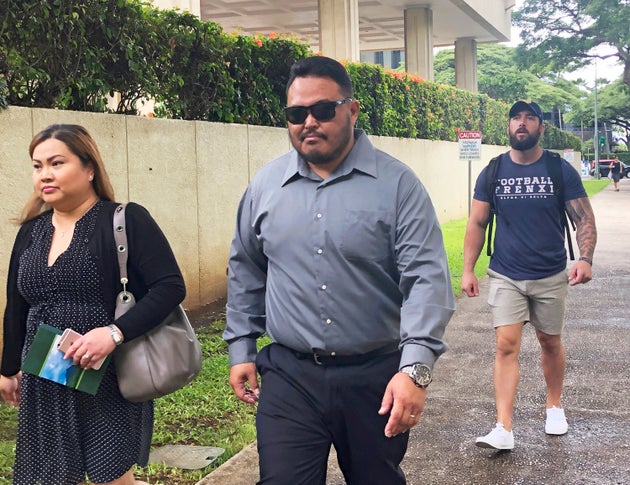
Former Honolulu police officer John Rabago is seen outside a federal court in Honolulu.

A US judge sentenced a former Honolulu police officer Wednesday to four years in prison for forcing a homeless man to lick a public urinal, telling him to imagine someone doing that to his two young daughters.

The homeless man was just as defenseless and powerless as the children of defendant John Rabago, US District Judge Leslie Kobayashi said.

“You took from him his only possession: his dignity as a human being,” Kobayashi said.

Rabago had taken an oath as a police officer to protect and defend but instead took advantage of someone poor and homeless, she said.

Rabago, 44, and another officer had responded to a nuisance complaint in 2018 when they found the homeless man in a stall in a public restroom.

Rabago threatened to beat the man and stuff his face in a toilet if he didn’t lick the urinal, Kobayashi said. He then grabbed the man’s shoulder, held him down and stepped on his legs to keep him on his knees until he licked the urinal, the judge said.

Rabago later told the other officer to delete text messages about the incident, Kobayashi said.

“I’m here to judge you on the worst thing you’ve done in your life,” Kobayashi said. However, she noted that he should not let the act define his future.

Reginald Ramones, the other officer, has also left the department and is scheduled to be sentenced next week. Ramones pleaded guilty to knowing Rabago committed a civil rights violation and not informing authorities about it.

ASSOCIATED PRESS

Former Honolulu police officer Reginald Ramones, seen center last September, is scheduled to be sentenced next week. Ramones pleaded guilty to knowing Rabago committed a civil rights violation and not informing authorities about it.

Assistant US Attorney Tom Brady said Rabago had sometimes been a good officer and ultimately took responsibility by pleading guilty to a pair of civil rights violations in the case, but had initially laughed about the incident and later denied it happened.

“To be homeless, not knowing where your next meal is going to be, to be forced to lick … a dirty urinal by a uniformed police officer. There’s only one word that comes to mind: hopelessness,” Brady said.

Rabago offered his apologies to the victim and his family. “Two years ago I made a decision I’m not proud of,” he said. “My actions changed the course of life for all of us.”

His defense attorney, Megan Kau, said after the hearing that she and Rabago expected a sentence of about three years.

“I think she’s taking the national environment and making him an example,” Kau said about the judge and the protests against racial injustice and police misconduct across the nation.

“This is not the same,” Kau said, noting that Rabago is Filipino American and the victim is white.

Earlier this year, the homeless man filed a lawsuit against the Honolulu Police Department and the city.

“He’s pleasantly surprised that the court punished him appropriately,” his lawyer, Myles Breiner, said. “He was under the impression that they would coddle him and give him a minimum term, a very low sentence.”


Source by [author_name]

Trump should be taking new DACA applications, not just renewals, groups insist

WASHINGTON – The federal government is processing Deferred Action for Childhood Arrivals renewals, but not accepting new applications for the deportation relief program, adding to a mix of confusion over President Donald Trump’s intentions on immigration.

The Supreme Court ruled last month that Trump wrongly tried to shut down DACA, as the Obama-era program is known. But the court ‘s justices also left room for Trump to try another route to kill the program, which Trump has said he’ll do.

Meanwhile, Trump has said he wants to give DACA recipients a path to citizenship through an executive order.

The Center for American Progress, a liberal Washington think tank, insists Trump is not complying fully with the Supreme Court’s decision. CAP said in a statement the ruling requires the administration to restore the entire DACA program, including accepting new DACA applications. The immigrant advocacy group United We Dream has also demanded the administration accept new applications.

In a July 14 letter to Acting Homeland Security Secretary Chad Wolf, a group of U.S. Senators said the recent Supreme Court decision “requires your immediate compliance.”

According to an analysis by the Center for American Progress, more than 300,000 youth are eligible to apply for DACA for the first time.That includes more than 55,000 immigrants who over the last three years have reached age of eligibility for DACA.

Immigration advocates say the court ruling returned DACA to where it was before Trump announced his cancellation on September 5, 2017.

DACA provides qualifying immigrants who lack permanent legal status protection from deportation and allows them to work and study here.

U.S. Citizenship and Immigration Services, the agency that oversees DACA applications, said it is renewing permits from DACA “due to court orders,” but “is not accepting applications from individuals who have never before received” this protection from deportation.

Justice and Homeland Security departments are reviewing the Supreme Court’s decision, said a USCIS spokesman, who spoke on condition he not be named.

USCIS Deputy Director for Political Affairs Joseph Edlow has condemned the Supreme Court ruling, arguing that it lacks a legal basis and that it offers an undeserved “amnesty” to immigrants.

Just over 650,000 undocumented youth are covered by DACA, a dwindling number because many have quit out of fear, have given up or have adjusted their immigration status through marriage or sponsorship from their employers.

Activists and experts consulted by Noticias Telemundo said DACA beneficiaries should continue renewing their permits.

“We anticipate that Trump will try to overturn DACA again, but we don’t know if that decision will comply with what the Supreme Court asked for, or if it will be challenged in court,” said Laurence Benenson, deputy vice president for immigration policy at the National Immigration Forum.

“I think it will be difficult, at this stage of the electoral calendar, for Congress to achieve a great immigration agreement that permanently resolves the situation of the Dreamers,” he added.

The Senate has yet to debate a measure passed by the House of Representatives in 2019 to give legal status to younger immigrants without legal status, who often call themselves Dreamers.

Nathalie Rayes, president of the Latino Victory Fund, stated that, taking into account Trump’s attacks and policies against immigrants, “there is no reason to believe that he will keep his word.”

“The only safeguard we can give Dreamers is to vote for Joe Biden in November,” she added.

An earlier version of this story was first published in Noticias Telemundo.

Follow NBC Latino on Facebook, Twitter and Instagram.

Suzanne Gamboa contributed.


Source link

Australian Woman Jailed Over Bali Policeman’s Death Gets Early Release

0

REUTERS

FILE PHOTO: Australian national Sara Connor arrives at court for the expected verdict in her trial over the death of a police officer at the Denpasar District Court in Bali, Indonesia March 13, 2017. REUTERS/Agung Parameswara

An Australian woman sentenced to four years imprisonment over the death of a policeman in Bali was given early release on Thursday, and was keen to be reunited with family, her lawyer said.

Sara Connor, 49, was jailed in March 2017 together with British man David Taylor for their roles in the death of a traffic policeman, whose body was found on the popular Kuta Beach with neck and head wounds.

Connor was freed 13 months short of her full term due to her good behaviour.

The two, who were a couple, were tried separately and Taylor, who is in his mid 30s, received a six-year term.

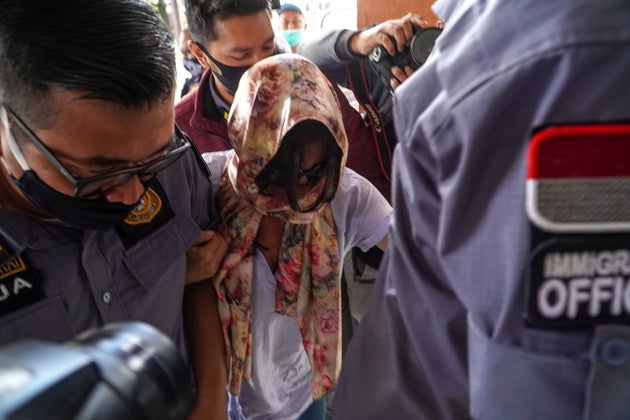
Wearing a headscarf, Connor did not comment as she left the prison surrounded by guards, who helped her through a scrum of photographers and into a vehicle that took her to an immigration facility.

“I think everybody who will be released will be very happy, especially when she wants to meet the family, but I don’t know about the next plan,” said Sienny Karmana, Connor’s lawyer.

via REUTERS

Sara Connor, an-49-year-old Australian woman, who was sentenced to four years imprisonment over the death of a policeman, being escorted by Indonesian Immigration officers after she was given early release in Badung, Bali, Indonesia, July 16, 2020 in this photo taken by Antara Foto. Antara Foto/DP. Herdyanto/ via REUTERS


Karmana added that Connor would return to Australia on Friday.

During a trial that attracted significant attention in Indonesia and Australia, the defendants both denied murder and said a fight broke out over Connor’s missing purse.

Connor had testified that she saw Taylor beating policeman Wayan Sudarsa, but the judge ruled that she had held the victim down while he was being struck.

Writing by Stanley Widianto.


Source by [author_name]

Netflix Appoints Ted Sarandos as Co-Chief Executive

0

Netflix announced a significant leadership change Thursday, appointing Ted Sarandos, the content chief, as its co-chief executive alongside Reed Hastings.

“I am excited to announce that we have appointed Ted Sarandos to be Netflix co-C.E.O. with me, and also elected him to our board of directors,” Mr. Hastings said in a statement. Mr. Sarandos, 55, will continue as head of content.

The change in many ways formalizes Mr. Sarandos’s role in the company. His compensation for the last few years has been equal to that of Mr. Hastings — each received about $30 million in compensation in 2019 — and he has often been the face of Netflix at public events. The move is also a signal of Netflix’s growing reliance on Hollywood.

Mr. Sarandos said he was originally skeptical of Netflix when he was approached to join the company 20 years ago, but agreed to come aboard because of the “persistence” of Mr. Hastings. “I’m excited and honored to have been appointed co-C.E.O. of Netflix,” he said in a statement.

The company that found success by mailing DVDs to subscribers in red envelopes as it took on the once-mighty Blockbuster had transformed itself into a streaming giant mainly by licensing old movies and shows.

In recent years, it has become one of the industry’s most prolific sources of film and TV production. Mr. Sarandos now moves easily within Hollywood’s circles of power, brokering big-budget projects with Martin Scorsese, Will Smith, Shonda Rhimes, Ryan Murphy, Sandra Bullock and Adam Sandler. In short, the company has become more dependent on Mr. Sarandos’s domain: original content.

Mr. Hastings will continue in his role (alongside Mr. Sarandos) and will remain chairman. “In terms of the day-to-day running of Netflix, I do not expect much to change,” Mr. Hastings said. He added that the leadership moves “are part of a long process of succession planning.”

In what appears to be a suggested timeline, Mr. Hastings said he was “committed to Netflix for the long term,” and added, “Here’s to the next decade.”

The streaming service reported a surge of 10.1 million new customers Thursday in its second-quarter results, extending the gains it made the first three months of the year, when the coronavirus pandemic prompted lockdowns across the globe.

The company had forecast the addition of 7.5 million subscribers, and Goldman Sachs predicted 12.5 million in a note last week. It’s likely the rapid growth is a result of more people choosing to subscribe to Netflix because of stay-at-home restrictions.

Indeed, the company expects a much weaker performance in the current quarter and forecast the addition of 2.5 million new subscribers. Investors sold off the stock on that prediction, sending Netflix shares down more than 10 percent in after-hours trading.

Netflix reported that it now has 192.95 million customers worldwide and about 66 million in the United States. That puts the service that much closer to the magical 300 million figure, a loose measure of where investors think Netflix could top out.

Netflix said its slate of new productions was on track last quarter, but that it could see a slowdown in releases for the current period. Blockbusters like “Extraction,” a thriller starring Chris Hemsworth that was released in April, drew in 99 million views in its first four weeks, the company said. Last week, Netflix debuted “The Old Guard,” a smart, humane action epic starring Charlize Theron. Fresh programming is crucial to Netflix’s growth because new shows tend to drive new subscriptions.

The company said it would release several new series and films later this quarter, including Season 2 of “The Umbrella Academy,” and “Enola Holmes,” a period mystery film with Millie Bobbie Brown, a star of the Netflix hit “Stranger Things,” playing the sister of Sherlock Holmes.

Netflix reported nearly $900 million in positive free cash flow this quarter, making it the second-consecutive period in which it had more cash come in the door than go out. Netflix now expects to keep its money for the year and could end up with positive free cash flow for all of 2020, meaning it will finally be profitable on a balance-sheet basis.

Source link

Covid-19 may devastate poorest nations if west does not act, warns UN

The west’s shortsighted response to the impact of Covid-19 could result in 640 million people being infected and 1.7 million killed in the world’s poorest countries, the UN warned.

The direct medical costs of treating 2.2 million patients in hospital critical care beds could amount to an estimated $16.28bn, while the focus on coronavirus could also lead to a diversion of scarce health resources, leading to a further 1.7 million preventable deaths from HIV, TB and malaria.

The findings – prepared for the UN by the economics department at Oxford – are designed as a call to arms as G20 finance ministers prepare to meet this weekend.

UN officials are deeply concerned that as the pandemic recedes in Europe, the impacts of the virus and of the global recession on the world’s poorest are already being forgotten.

Much of the projected poverty worldwide will come from social distancing measures put in place to reduce deaths but liable to devastate local economies.

The UN emergency relief coordinator, Mark Lowcock, warned: “Covid-19 and the associated global recession are about to wreak havoc in fragile and low-income countries. My message is that unless the rich countries and the G20 are prepared to act now we must be prepared for a series of human tragedies more brutal and destructive than any direct impacts in the virus itself. If the virus is free to circle the globe it will undo decades of development work and create a generation’s worth of tragic and exportable problems.”

Lowcock’s warning came as he launched a third appeal for a coronavirus humanitarian response, saying the updated plan needed $10.3bn, up from an initial appeal for $2bn in March.

The appeal is intended to help 63 vulnerable countries and 200 million people, compared with the 108 million that the UN had been planning to target at the start of the year before the epidemic. Some of the money is designed to keep frontline NGOs afloat, as well as cover UN transportation made necessary by the collapse of civilian airlines.

Altogether, the sum represents the single largest appeal ever made in the 75-year history of the UN. Officials are hoping humanitarian aid will be included in the EU seven-year budget framework and in the planned US stimulus budget.

Lowcock said that the first UN appeal in March had so far raised only $1.7bn, and pointed to a decline in generosity from Gulf countries this year. He described the response by most wealthy countries as “grossly inadequate” and “dangerously short-sighted”.

He added: “My message to the G20 is step up now or pay the price later.” The contrast between the effectiveness and energy that went into the global response at the time of the financial crisis in 2008 was striking and dangerous, he said.

He said the overall long-term cost of protecting the poorest 32 countries was $90bn – less than 1% of the cost of the wealthy west’s various stimulus packages – and argued that if the world’s poorest countries were not protected the chances would increase of a second wave of the virus sweeping back into Europe, leading to possible output loss of £1.1tn in the advanced economies.

Overall, he warned the virus might cause the first absolute rise in poverty since 1990, with 70-100 million people pushed into the extreme poverty category of less than $1.90 income a day and a possible doubling of those facing famine.

The Oxford report also suggests that a school shutdown spanning five months could generate learning losses that have a present value of $10tn globally.

Without remediation the average student could face a reduction of $16,000 in earnings over a lifetime in present value terms. At a macro scale, 16% of global investments made in the basic education of the current cohort could go to waste.

Lowcock also said that school closures in turn affected human nutrition, pointing to Nigeria where school closures had reduced the food intake of nearly 7 million children enrolled in the country’s school feeding programme.

The economy of sub-Saharan Africa is predicted to contract by -3.2%; that of the Middle East and central Asia by -4.7%, Latin America and the Caribbean by -9.4% and low- and middle-income countries in Asia by -0.8%, largely swayed by China’s growth projection of 1%.

The UN report said these projections reflected the broadest collapse in per-capita income since 1870. “Nevertheless, these annualised GDP projections fail to capture the extent to which millions of people will experience transient poverty in response to Covid-19. In the absence of social security to smooth this shock, income losses of these magnitudes will have severe consequences for the livelihoods and wellbeing of people.”

Source link

Sculpture Of Black Lives Matter Protester Removed From Edward Colston Plinth In UK

0

A sculpture of a Black Lives Matter protester that was erected to replace a statue of slave trader Edward Colston in the UK’s Bristol has been taken down by authorities. 

The sculpture – which was designed by artist Marc Quinn – showed protester Jen Reid giving the Black Power symbol, as she was pictured doing after the Colston statue was torn down during a march in June. 

But just 24 hours after it was erected on Wednesday, the sculpture – entitled A Surge of Power (Jen Reid) – was removed by Bristol City Council, who said it would be held at a museum until Quinn collected or donated it. 

It comes after Mayor of Bristol Marvin Rees said that it was up for locals to decide what should go on the plinth where Colston once stood. 

“The future of the plinth and what is installed on it must be decided by the people of Bristol,” he said in a statement. 

“This will be critical to building a city that is home to those who are elated at the statue being pulled down, those who sympathise with its removal but are dismayed at how it happened and those who feel that in its removal, they’ve lost a piece of the Bristol they know and therefore themselves.” 

In a tweet, Rees said that anything else put up on the plinth without permission would also be removed. 

Speaking to BBC Radio 5 Live on Thursday, he said the decision was not about taking down a statue of Reid, describing her as a “very impressive woman”. 

“This is about taking down a statue of a London-based artist who came and put it up without permission,” he said. 

Rees said when he spoke to sculptor Marc Quinn, the artist was unaware that the toppling of the Colston statue also caused damage to the grave of Scipio Africanus – a memorial to an enslaved African man. 

“If you’re going to do something, you need to do it with awareness and a full knowledge of the context in which you’re doing it,” Rees said. 

PA

Jen Reid poses in front of her black resin and steel statue titled A Surge of Power (Jen Reid) 2020, by Marc Quinn, where it is installed on the vacant Edward Colston plinth in Bristol city centre.

On Wednesday, Reid – the subject of Quinn’s sculpture – said creating the piece was important “as it helps keep the journey towards racial justice and equity moving”. 

Black lives matter everyday, she said. 

“This sculpture is about making a stand for my mother, for my daughter, for Black people like me. It’s about Black children seeing it up there. 

“It’s something to feel proud of, to have a sense of belonging, because we actually do belong here and we’re not going anywhere.”


Source by [author_name]

What’s behind the wave of mysterious incidents in Iran?

On the 10th anniversary of the discovery of the Stuxnet computer virus, designed by the U.S. and Israel to target Iran’s nuclear program, the Islamic Republic is facing a new wave of unclaimed acts of sabotage. While military and nuclear facilities in Parchin and Natanz have been attacked, this latest wave is not limited to only high-value and sensitive facilities. From a major fire at a port in Bushehr to explosions at a clinic in Tehran and a number of industrial sites across the country, the sudden outbreak of incidents has left the Iranian public bewildered and wondering just what is going on.

Some of these events are likely legitimate accidents, but there are clear signs that foreign intelligence services — namely the CIA and the Mossad — may be involved, and questions about the possible application of cyberwarfare in these attacks will be mulled over in the days and weeks to come. If foreign powers are carrying out acts of sabotage inside Iran, that is likely meant to achieve two primary objectives: to set back and impede Iran’s nuclear program and to give reason for the authorities in Tehran to reconsider their military, nuclear, and regional policies. So far, while Tehran is startled, it also appears undeterred.

Cyber attacks? 

Iranian officials have been guarded in identifying both actors and methods behind the acts of sabotage. This could be simply a case of face-saving and not admitting to yet another humiliating penetration of Iran’s critical infrastructure by foreign intelligence services. In any event, it is too early to say if any of the explosions in Iran were caused by cyber attacks. This, naturally, was an early suspicion after the first detonation at Natanz — the nuclear facility that was famously the target of the Stuxnet virus.

First of all, from a simple cybersecurity perspective, it is very difficult to make lightning strike in the same place twice — especially on a target as secure as a nuclear enrichment facility. To hit the same target twice with a missile, you simply fire at it twice. But a cyber attack relies on the vulnerabilities in the systems being targeted, and given Stuxnet is perhaps the most studied virus of all time, it is inconceivable that Israel, the U.S., or anyone else could have simply used the same exploits. A second cyber attack would need to discover entirely new vulnerabilities — a highly costly endeavor — and would depend on those patched and updated systems being similarly vulnerable.

It is also worth noting that Stuxnet was specifically designed to be “quiet” — the virus did not cause explosions or even enough disruption to indicate tampering to the facility’s scientists. It was carefully calibrated to slowly degrade Natanz’s enrichment capability and cause just enough malfunctioning to make the Iranian government doubt the scientists’ competence. The latest explosions, by contrast, are “loud” — quite literally. If this were a “second Stuxnet,” it would be a radical deviation from the original modus operandi.  

Finally there is the issue of the follow-on explosions. Cyber attacks are not easy to scale up unless they are targeting the same operating system, like Windows XP, which does not lend itself to causing physical explosions. New exploits would need to be developed for each different system targeted, which is not a simple, replicable task. Sneaking a bomb into a country — while not easy — is a much more straightforward task to carry out repeatedly.

Cyber specialists rarely speak in absolutes, and by no means is it impossible that the Iranian explosions are being caused by cyber attacks. Only Iran can perform a forensic examination of the sites of the detonations and make that determination with confidence. It, however, is not likely that these explosions were caused by cyber attacks.

Iran’s bigger worry: Infiltration 

What is evident is that while Iran wants to minimize the significance of these incidents, the U.S. and the Israelis want to inflate it. For example, through their information operations in the media, the Israelis have deliberately floated two scenarios that are bound to create panic inside the Iranian system. The possibility of a cyber attack by Israel is one. The second is that the explosions may have been the result of sabotage carried out by insiders who have been recruited by the Israeli intelligence services. Both scenarios would be hugely embarrassing to Tehran, which is why Iranian officials continue to refuse to admit any foreign-instigated sabotage has taken place. 

The Iranian denials, however, have been less than convincing. In fact, they have only reinforced the impression among the public that foreign actors have been behind at least some of the explosions. The psychological pressures that such popular beliefs put on the Iranian authorities are considerable. In a worst-case scenario, the idea of large-scale infiltration feeds into the narrative that the Islamic Republic is in its dying days and creates more momentum for defections from the ranks of those serving the state.

In addition, there are some important implications about the recent incidents. First, what looks to be a coordinated American-Israeli campaign of sabotage suggest that the Trump administration and the Israelis have concluded that Tehran will not change any of its policies while Donald Trump is in the White House. This is likely why the sabotage campaign has been launched to set Iran’s nuclear and missile programs back as much as possible before Trump leaves office. 

There are two other likely reasons why the U.S. and Israel have decided to act as well. First, to force the Iranians to kick out international nuclear inspectors on charges that they are passing sensitive information to U.S. and Israeli intelligence services, which might be the reason such sabotage attacks are possible in the first place. Were Iran to kick the inspectors out, it would be the end of the 2015 nuclear deal, a goal long sought by both the Trump administration and the Israelis. Second, these acts of sabotage might even be intended to force Iran to retaliate, an event that could easily escalate into a broader military conflict. 

What’s next?

The Iranians, however, are unlikely to retaliate in any major way. They will huff and puff, but ultimately Tehran will bite its tongue and move on. This is also what happened 10 years ago, when the Americans and the Israelis used the Stuxnet computer virus to sabotage Iran’s nuclear program. Tehran basically accepted the losses it incurred and simply continued its nuclear program as before. Something similar may happen now after these latest acts of sabotage. 

For Iran, though, one aspect must be troubling that goes beyond the nuclear issue. The perception that the country is awash with CIA and Mossad agents running around carrying out attacks with impunity undermines the regime in a serious way. It undoubtedly also gives the domestic opposition confidence. This is exactly why the Iranian authorities suddenly decided to execute a former defense official, Reza Askari, on charges of supplying information to the CIA. The hope is to deter anyone from collaborating with foreign intelligence services. 

Deterring the public in such a fashion is a time-tested policy in Iran, but there is a chance of blowback. Excessive punishment, as with the ongoing saga around plans to execute three young men for participating in anti-regime protests, has the potential to unleash more public anger and protests against the regime.

And here lies the toughest challenge for the authorities in Tehran: If the CIA and Mossad were behind these latest attacks, how might they look to escalate this campaign? It seems highly likely that few, if any, of the acts of sabotage so far have been carried out by means of cyber attacks. That means there are Iranians inside the country that are central to the staging of these attacks and involved in physically planting explosives at selected sites. Not only does that signal resourcefulness, but it also suggests unprecedented risk-taking by the U.S. and Israel. If foreign intelligence services can go this far inside Iran, what else might they be able to do? That is surely a matter of the utmost concern for Tehran.


Michael Sexton is a Fellow and the Director of MEI’s Cyber Program. Alex Vatanka is a Senior Fellow and the Director of MEI’s Iran Program. His forthcoming book is The Battle of the Ayatollahs in Iran: The United States, Foreign Policy and Political Rivalry Since 1979 (2021). The views expressed in this piece are their own.

Photo by AMIR KHOLOUSI/ISNA/AFP via Getty Images
Source link

Top Five Shark Cage Diving Hotspots in the World

0

Shark cage diving is the exhilarating experience of diving with the ocean’s apex predators with the protection of a steel cage.

There are only a handful of places where you can reliably see the most infamous predator of them all, the great white shark.

Here are the top five places to dive with great whites in the world.


Top five great white shark diving hotspots

Gansbaai, South Africa

Dubbed the ‘great white capital of the world’, Gansbaai’s large population of sharks congregate between Dyer Island and Geyser rock, creating an ideal situation for those willing to brave the cold waters and come face-to-face with a number of shark species.

In addition to great whites, Mako, tiger, black-tip and blue sharks can all be found in Gansbaai. The local cape fur seal colony provides the sharks with a perfect place to hunt for food, making it arguably the best location for shark cage diving in the world.


Isla de Guadelupe, Mexico

Located roughly 240km off the west coast of Mexico, Isla de Guadelupe is a popular eco-tourism destination because of its diverse marine life and visibility unrivalled by any other location on the list.

Guadelupe Island is the main dive spot to see great whites off the Mexican coast, while the Rivelligegedo Archipelago further up the coast is a hotspot for dolphins, manta rays, humpback whales and a number of shark species.


False Bay, South Africa

False Bay is without a doubt the best place to witness great whites ‘breaching’, the unique hunting technique where they use the element of surprise to catch seals with such force from below that they fly out of the water.

Shark cage diving is popular in the bay, and many operators offer the opportunity to scuba dive within the cage, allowing divers to observe sharks at greater depths for a greater length of time.


Neptune Islands, Australia

Neptune Islands Conservation Park is a safe haven for great whites, who continually face challenges worldwide for survival due to human factors such as shark nets, overfishing and habitat destruction. This is the only place in Australia where shark cage diving is permitted.

Split up into two sets of islands, the Neptunes are characterized by rocky terrain and are home to the largest colony of fur seals in the country. In addition to the impressive ocean life, the islands are also well-known for their terrestrial flora and fauna and include an impressive array of mammals, reptiles and birds.


Farallon islands, United States

Just 30kms from San Francisco’s iconic Golden Gate Bridge, the Farallon Islands are a group of islands in the Pacific Ocean. Known as the ‘Islands of the Dead’ by Native Americans, they have remained largely uninhabited for most of their history, but marine and weather researchers maintain have recently established a small presence.

The islands are closed to the public but the surrounding waters are an excellent place to view great whites due to the large elephant seal colony scattered around its shores, which provide an excellent food source.

Source link

Iran under pressure to halt executions for three protesters

0

Following an Iranian social media campaign that attracted millions of posts under several hashtags, including “no to execution” in Farsi, Iran’s judiciary said on Thursday that the men’s lawyers could appeal their verdicts, despite the ruling, according to Mizan Online, a news agency affiliated with the judiciary.

Allowing the appeal appears to be an unusual concession by authorities to review the Supreme Court’s decision.

In an open letter to the judiciary, lawyers for the three defendants — Amir Hossein Moradi, Saeed Tamjidi and Mohammad Rajabi — said that they had not been given access to documents pertaining to their clients’ cases, according to semi-official Jamaran News which published the letter Wednesday.

The men on death row were convicted of moharebeh — a crime of taking up arms to take lives or property and to create fear in the public — and for participating “in vandalism and arson with the intent to counter the Islamic Republic of Iran” during the November protests last year, according to a statement condemning the sentence by more than a dozen UN human rights experts, including special investigators Javaid Rehman and Agnes Callamard.

US President Donald Trump also weighed in Wednesday, joining campaigners under the English version of the hashtag, #StopExecutionsinIran.

“Three individuals were sentenced to death in Iran for participating in protests. The execution is expected momentarily. Executing these three people sends a terrible signal to the world and should not be done! #StopExecutionsInIran,” Trump tweeted.

The Supreme Court’s ruling Tuesday followed the executions of two Kurdish men, Diaku Rasoulzadeh and Saber Sheikh Abdollah. The men were sentenced over a deadly armed attack in 2010, in which they had repeatedly denied involvement, according to Amnesty International.

“Amnesty International is calling on the UN and its member states to urgently intervene to save the lives of those at risk of execution, and urge Iran to stop using the death penalty to sow fear and silence political opposition,” the organization said in a statement.

Source link

Chuck Woolery, who said ‘everyone is lying’ about COVID-19, reveals son tested positive

The coronavirus has apparently hit close to home for Chuck Woolery. The former game show host, whose controversial tweet that “everyone is lying” about COVID-19 was retweeted by President Donald Trump, revealed one day later his son tested positive. Then his Twitter account disappeared.

To recap, Woolery, 79, caused a stir on Sunday when he tweeted the Centers for Disease Control and Prevention (CDC), media and Democrats are among those who are perpetuating a hoax about COVID-19.

“The most outrageous lies are the ones about Covid 19. Everyone is lying. The CDC, Media, Democrats, our Doctors, not all but most, that we are told to trust. I think it’s all about the election and keeping the economy from coming back, which is about the election. I’m sick of it,” he wrote, without providing any evidence.

The message was retweeted by President Trump subsequently setting off a firestorm. During an interview with CBS News, the president defended retweeting the message: “I reposted a tweet that a lot of people feel. But all I am doing is making a comment. I’m just putting somebody’s voice out there. There are many voices. There are many people that think we shouldn’t do this kind of testing, because all we do, it’s a trap.”

But it seems Woolery’s perspective on the topic quickly changed. On Monday, the original Wheel of Fortune host shared that one of his sons tested positive for COVID-19. 

“To further clarify and add perspective, Covid-19 is real and it is here. My son tested positive for the virus, and I feel for of those suffering and especially for those who have lost loved ones,” he wrote. 

For those looking to verify the tweet themselves, good luck. Two days after the surprising turnaround, Woolery’s account disappeared. It’s unclear if he deleted the account himself, whether Twitter suspended it due to Sunday’s tweet, or if it had something to do with Wednesday’s widespread hack. 

Yahoo Entertainment reached out to a representative for Woolery, who didn’t immediately respond. Twitter did not comment. For now, it’s a mystery.

Read more from Yahoo Entertainment:


Source link