Tuesday, April 28, 2026

Amid Uprisings, Schools Consider Terminating Their Contracts With Police

The number of police officers stationed in schools has increased in recent decades in response to a devastating wave of school shootings like those at Columbine High and Sandy Hook Elementary. But when police walk the halls, Black children are disproportionately arrested, often for low-level offenses, contributing to a cycle called the school-to-prison pipeline.

Now, some activists are hoping that the protests against police brutality and racism roiling the country could be a turning point in efforts to dial back this kind of school security. 

In Minneapolis, where protests exploded after a police officer killed local resident George Floyd, the school board will be voting Tuesday evening on a resolution to cut ties with the police department. Board member Josh Pauly told HuffPost that he has already heard from representatives in school districts in “Arizona, North Carolina, Minnesota, Wisconsin, Washington, Oregon, New York, and Illinois” asking for support in crafting a similar resolution. In Denver, a school board member told HuffPost that he has plans to introduce a comparable resolution as well.

After years of non-stop growth in the number of police in schools, even amid high-profile incidents of police brutality against students, “this conversation feels unprecedented,” said Jonathan Stith, national director of the nonprofit Alliance for Educational Justice, which advocates against the presence of police in schools.

Overall crime in schools has decreased over the last two decades, mirroring larger societal trends, but the amount of security has skyrocketed. In 1997, only 10% of schools employed police officers. By 2017, that number had increased to 58%. 

Members of the Minneapolis Public Schools board announced the proposed resolution last Friday, four days after a white police officer pressed his knee against Floyd’s neck for nearly nine minutes, killing the 46-year-old Black man and sparking a firestorm across the nation. 

The Minneapolis Police Department currently partners with the school district to place 11 officers in schools, costing the district over $1 million, according to Minnesota Public Radio. That contract was up for renewal when Floyd was killed. School board members who already planned to vote no on renewal decided to take it a step further, crafting a resolution that would remove officers from city schools. The local teachers union has endorsed the move.

“MPS cannot align itself with MPD and claim to fight institutional racism. We cannot partner with organizations that do not see the humanity in our students. We cannot be neutral in situations of injustice,” Pauly told HuffPost in an email. “Hopefully this can be a small step towards the dramatic changes that are needed in our city and beyond.”


In the past few years, serious conversations surrounding the impact of police in schools have occurred after high-profile incidents of officers assaulting children, like when a police officer was recorded knocking down a student and dragging her at Spring Valley High School in South Carolina.

But this particular moment feels different, said Stith, whose organization has been organizing around this issue since that 2015 incident. 

“We’re excited and nervous at the same time,” said Stith, who said he has heard from a number of districts looking to take action. “So much research basically says every time a police officer steps into a school, it becomes a prison.”

In Denver, the power of school police officers is already regulated by the district: These cops are not allowed to handcuff students in elementary school. But in the wake of recent events, the school board there may go a step further. 

Board member Tay Anderson told HuffPost that he believes he has the support of the majority of the board to reconsider the district’s contract with Denver police. He wants to see the money the district would typically allocate to the contract go to mental health resources instead.

Anderson graduated from the district’s schools in 2017 and ran for the school board on a promise to eliminate the district’s contract with the police department. But he found it was a touchy issue for some community members, who supported movements like Black Lives Matter but felt it was necessary to keep police patrolling school hallways. He’s hoping that mentality could soon change. 

“We can call cops to our buildings as needed,” Anderson said. “There’s no need to have them for a specific presence in our schools.”

In Chicago, the local teachers union ― one of the largest in the nation ― recently called for the board of education to cancel its $30 million per year contract with Chicago police and direct the money to emergency counseling and support for students in crisis. In 2019, school resource officers, another name for school cops, were caught on video punching, Tasing and dragging a 16-year-old Chicago student down stairs.

Union leaders are pessimistic that their calls will make a difference. The board of education isn’t elected. Members are appointed by the mayor, who union leaders see as in bed with police forces. 

“In a district that is 90% students of color, over 80% free/reduced-price lunch, in a city that is violent, we would prefer trauma supports, social workers, school psychologists,” said Stacy Davis Gates, vice president of the Chicago Teachers Union. 

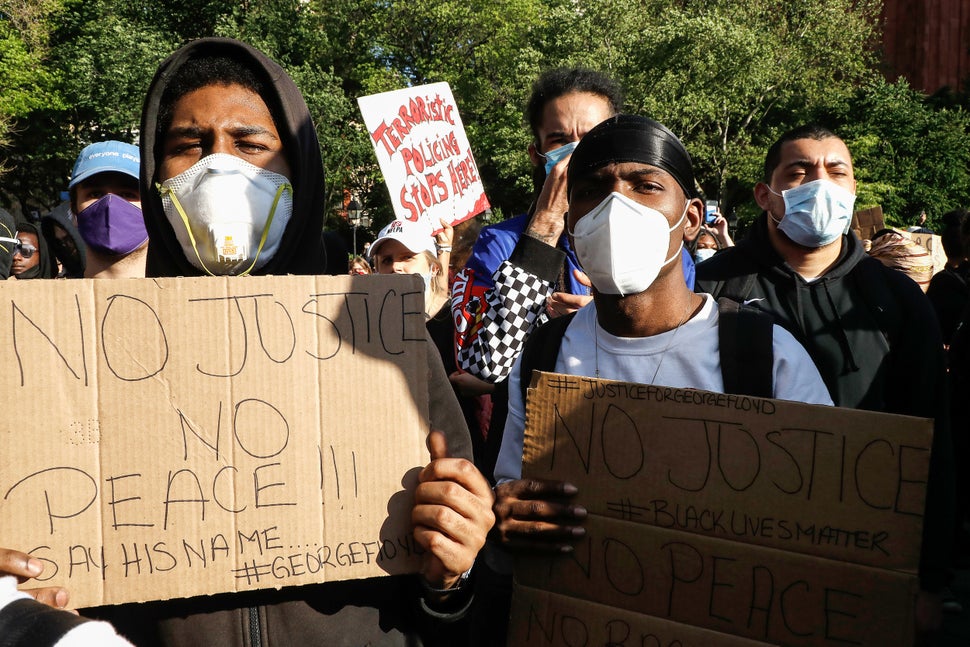
Protesters hold placards in New York's Washington Square Park during a demonstration in response to the killing of George Flo


Protesters hold placards in New York’s Washington Square Park during a demonstration in response to the killing of George Floyd.

The numbers of police officers in schools have spiked in response to devastating school shootings, starting with Columbine in 1999 and most recently in Parkland, Florida, in 2018. Both Democratic and Republican presidential administrations have contributed to that increase. After the Sandy Hook massacre in 2012, President Barack Obama helped funnel federal money to school districts to use for hiring cops. After Parkland, President Donald Trump did the same.

Data shows that Black and brown students often bear the brunt of this increased policing. When cops are in schools, students ― especially Black students ― are more likely to get arrested or referred to local law enforcement, even for low-level offenses like vandalism and fights without a weapon. Black students also more likely than other students to attend schools with more school security officers than mental health workers.

According to Alliance for Educational Justice data, dozens of students have been assaulted by cops in schools over the years. A previous HuffPost investigation found that since September 2011, children have been Tasered by school cops in at least 143 incidents. Last September, a 6-year-old child in Florida was arrested by a school police officer during a temper tantrum. 

Research on whether cops make schools tangibly safer remains mixed. Schools with police officers are more likely to go through regular safety checks and have emergency plans in place. While a 2013 report from the Congressional Research Service noted it makes logical sense that a school cop could deter school shootings, research hasn’t addressed that issue.

The National Association of School Resource Officers (NASRO) is the main organization helping to train cops to work in schools ― but not all districts require officers to attend such training and some offer their own. In 2016, HuffPost attended a weekend of NASRO training and found that most classes focused on preparing officers for rare occurrences, like school shootings or terror attacks. 

The group’s executive director, Mo Canady, maintains that with the proper training, school resource officers can enhance a school community, ideally building positive relationships between students and law enforcement while protecting the school from threats.

“Generalization is unfair to any segment of our population, including members of individual organizations or professions. In other words, we do not believe in forming opinions about any large group based on the behavior of a few members,” said a statement from Canady.

He said that NASRO “abhors racism” and works to tackle racism by providing implicit bias training for officers.

Canady also noted that the Denver and Minneapolis school districts “choose not to send all SROs to NASRO courses but instead provide education from other sources. … It is possible, therefore, that significant policing issues exist in such communities.”

In a statement, Deputy Chief Erick Fors of the Minneapolis Police Department said that the relationships the department has built in schools “were impactful not only for the students and staff, but for the officers who had a calling to work with our youth through mentorship and engagement.” The Denver Police Department did not respond to a request for comment.

Janaan Ahmed, a 17-year-old recent graduate of Minneapolis Public Schools, said that student activists have made clear their disdain for constant policing at school and that they have been questioning why it took another police killing for the issue of school cops to gain momentum in the district. 

Ahmed grew up just blocks away from where 24-year-old Jamar Clark was shot and killed by police officers after a dispute at a party in 2015. Seeing cops in the cafeteria, with a gun and Taser on their belts, can feel menacing, she said, making a normal day at school feel militarized. She said students at her school rarely had relationships with the SROs ― they were too afraid.

“Police are systematically lynching Black and brown people in our neighborhoods and our schools have the audacity to bring police officers in our schools?” Ahmed said. 

According to Canady of NASRO, the goal of school policing programs is to “bridge the gap between law enforcement and youth, building positive relationships that can last lifetimes, while helping to protect schools from a wide variety of threats.”

Indeed, Ahmed said she had seen instances of school cops building positive relationships with students in her district. She pointed to a high school where an SRO doubles as the high school coach, often showing up to community events and mentoring students. He’s someone students look up to. 

But she said that individual could still play a positive role in the school, without a badge. 

“He can still be a community member without representing an institutionally racist system,” said Ahmed. “We are not talking about individual cops, we are talking about an institution.”


Source link

Under duress

0

Coronavirus in Context is a weekly newsletter where we bring you facts that matter about the COVID-19 pandemic and the technology trying to stop its spread. You can subscribe here.

These are dark days for democracy. It hardly feels like the time to address anything other than the brutal murder of George Floyd and the ongoing horrors occurring in the US, but the COVID-19 pandemic is no less dangerous today than it was a week ago.

In fact, the selfish actions of impeached US President Donald Trump have surely exacerbated the pandemic and arrested the science and technology world’s ability to address the virus at the epicenter of infection: the US. 

Credit: Click On Detroit

The STEM world was presented with an opportunity to develop contact-tracing apps and data pipelines for AI systems capable of predicting the spread of COVID-19. It does not appear that there will now be an ethical way to obtain or use this data in the US. 

In light of the US government’s continuing violent assaults on peaceful protesters and those attempting to shelter in their own homes, it is of the utmost importance that the global STEM community does everything in its power to protect the privacy of those peacefully protesting until such a time as democracy is restored to the US. 

Tens of millions of US citizens — and thousands more around the globe in cities such as Berlin and Amsterdam — have risked their lives and safety during a pandemic to stand in solidarity with peaceful US protesters demanding change from an oppressive government.

Impeached president Trump’s abortion of leadership and pathological lack of empathy have likely placed us on the path to a second wave pandemic that threatens to be worse than what we’ve seen so far.

Make no mistake: Impeached president Trump has spat upon the sacrifices made by everyone around the planet who sheltered-in-place, self-quarantined, and socially-distanced for months. And he’s crippled the ability for US STEM workers to do their jobs and fight the virus. 

We were supposed to flatten the curve and develop a vaccine. Instead, people are gathering in some of the most massive crowds ever assembled in public squares around the world because the alternative is worse. 

We are under duress. 

By the numbers

Due to the fact that the bulk of active COVID-19 cases are in the US, current data on the virus is unreliable at best. So we’ll take a look at the timeline for COVID-19 cases so far instead. Source: Worldometers.

154: Days since the first COVID-19 case was reported in Wuhan (December 31st

61: Days since COVID-19 cases breached 1,000,000 globally (April 2nd)

36: Days since COVID-19 cases breached 3,000,000 globally (April 27th)

 1: Days since COVID-19 cases breached 6,000,000 globally (June 1st)

Tweet of the week

What to read

This week we’ll be including links to stories that discuss the ongoing protests and violence in the US. We stand in solidarity with the peaceful protesters. Black Lives Matter.

* Human trials have begun for experimental COVID-19 antibodies, this looks promising. (CNN)
* Sickening conspiracy theories surrounding the death of George Floyd are surging online. (The New York Times)
* Impeached president Trump’s lack of leadership is responsible for worsening the pandemic. (Bloomberg)
* Airlines want to keep flying by leaving the middle seat open. How much is that going to raise your ticket prices? (Market Watch)
* Here’s seven ways to protect your privacy while you’re peacefully protesting.
* Here’s even more advice on protecting your digital privacy while you’re protesting. (Vice)
* 18 videos showing US police and military forces attacking peaceful protesters, members of the press, and helpless activists. There are hundreds more just like these.
* We’re on course for a second wave of COVID-19. Here’s what you need to know. (The Conversation)
* We thought Sweden had the perfect coronavirus response. We were wrong. (Wired)

¯_(ツ)_/¯

No matter how dark the night becomes, the dawn will come. But the fight promises to be a long one.

It’s okay to take a break. It’s okay to play a video game. It’s okay to practice your flute or draw anime characters or binge-watch a really stupid TV show right now. We need to breathe and take breaks so we can endure until the end.

With that in mind, we are going to keep this section going.

In this section, one of our writers will share one weird internet thing they’ve been obsessing over while in lockdown. This week’s comes from TNW’s own Rachel Kaser!

Where I live in Texas, the lockdown has tentatively lifted, but people are still being fairly cautious about going out and doing social activities — myself included. So now that I’ve been spending far more time inside, I’ve found myself enjoying things I would never ordinarily have tried.
In this case, it’s ghost videos. I’m a skeptic about anything paranormal, and don’t really care for horror anything, so this is an entertainment vertical I’ve never indulged in before.

I started watching videos that weren’t ghost-related — I think the original video I watched was about true crime, but apparently that was enough for YouTube’s algorithm to assume I must want to watch “Creepy Ghost Videos That’ll Keep You Up at Night” and other similarly named things.

That led me down the YouTube rabbit hole, and before I knew it, I was a regularly consumer of channels such as Mr. Nightmare (who narrates scary stories of both a paranormal and mundane flavor), Lazy Masquerade (a paranormal and true crime YouTuber), and Nuke’s Top 5 (who’s mostly ghostly content). And until recently, I couldn’t really have told you why I was watching them.

It certainly wasn’t the content bringing me back to these videos. I tried watching other horror YouTubers but they didn’t have the same effect on me. But while I was attempting to sit through an ASMR video (again, boredom does strange things to us), it hit me: These horror YouTubers’ voices and background music, which are clearly intended to be spooky, instead strike me as very soothing and relaxing. One of my favorites on a stressful day is Top5s, the narrator of which has quite possibly the most incongruously calming voice I’ve ever heard.

Take Nuke, the narrator of Nuke’s Top 5, which regularly features ghost videos. Whenever he’s about to play the paranormal money shot, he says “And then things get… truly bizarre” in what I swear is the exact voice my meditation app uses when telling me to breathe in and hold it.

The subject matter does occasionally get in the way of my relaxation — in one Mr Nightmare video, he inserts a scream sound effect at a point in the story when someone screams, which had me throwing my headphones at the ceiling. And I don’t expect anyone else to share my bizarre form of zen. But given the state of the world, I’m glad to have found something that helps me relax, no matter how weird it is.

Adios!

We’ll be back next Tuesday. And every Tuesday after that until the pandemic ends. Because we’re all in this together.

In the meantime, here’s a few links to help you manage the misinformation as the disease hits its peak:

The Center for Disease Control’s myth-busting section on COVID-19

After Recovering from COVID-19, are you immune?

John Hopkins Univeristy COVID-19 myth vs fact
Don’t believe everything you read on social media. Stay healthy and take care of each other,

Tristan

Read next:

How to quickly disable biometrics on your iPhone if you’re arrested

Corona coverage

Read our daily coverage on how the tech industry is responding to the coronavirus and subscribe to our weekly newsletter Coronavirus in Context.

For tips and tricks on working remotely, check out our Growth Quarters articles here or follow us on Twitter.


Source link

Recent Commercial Real Estate Transactions

$3 MILLION

229 Kent Avenue (between Grand and North First Streets)

Brooklyn

This 2,900-square-foot, three-story building in Williamsburg has one vacant retail unit and two two-bedroom apartments, both occupied. The retail space was formerly a bar.

Buyer: Mendel Gold

Seller: Sam Tufnell

Seller’s Brokers: Peter Von Der Ahe, Shaun Riney and Mike Salvatico of the NYM Group at Marcus & Millichap

$7.35 MILLION

2268 31st Street (between 23rd Avenue and Ditmars Boulevard)

Queens

This two-story, 7,668-square-foot building in Astoria was built in 1931. It has been occupied by the Postal Service since 1986 and last changed hands in 1990.

Buyer: LG Astoria

Seller: Ditmars Associates

Brokers: Greg Batista, Todd Cooper and Mark Kaplan of Ripco Real Estate

$4.76 MILLION

323 West 101st Street (between West End Avenue and Riverside Drive)

Manhattan

This three-story, 4,480-square-foot building on the Upper West Side was built in 1905. It has two floor-through two-bedroom units, one garden-level duplex and a basement. It last changed hands in 2015.

Buyers: Teeda Pinyavat, Alan Pinyavat and Nakorn Pinyavat

Sellers: Aaron Chang and Yueh Hwa Chang Chen

Sellers’ Brokers: Brett Weisblum, Eric Roth, Mike Nemirovsky and Tyler Signora of Cushman & Wakefield

$20.87/SQ. FT.

$120,000 approximate annual rent

805 East 139th Street (between Bruckner Boulevard and Walnut Avenue)

The Bronx

Imperfect Foods, which offers a delivery service for cosmetically imperfect produce, signed a lease for a 5,750-square-foot ground-floor industrial space in this building in the South Bronx. Built in 1948, the building is 74,325 square feet. Imperfect Foods is the only tenant.

Tenant: Imperfect Foods

Landlord: Altmark Group

Broker: Andrew Roth of EXR Somerset

Source link

Carole Baskin Awarded Control Of Joe Exotic’s Zoo

Carole Baskin could have a lot more cool cats and kittens in her possession now that a judge has awarded her control of Joe Exotic’s zoo.

On Monday, a federal judge in Oklahoma ruled in favor of Baskin’s Big Cat Rescue Corp. in her trademark and copyright infringement lawsuit against the Greater Wynnewood Development Group, a company once owned by the self-proclaimed “Tiger King,” according to CNN.

The order, which caps a longstanding struggle depicted in the popular Netflix documentary series “Tiger King,” gives Baskin control of about 16 acres in Garvin County, Oklahoma, used for an animal park and its array of big cats.

The order requires Greater Wynnewood Development Group to “vacate the Zoo Land premises within 120 days of service of this Order.” It adds: “Vacation of premises shall also require removal of all zoo animals from the Zoo Land.” 

The order does not specify what should happen to the animals, The Associated Press reported.

Baskin sued Exotic (real name Joseph Maldonado-Passage) for the infringements and won a $1 million civil judgment against him. Monday’s ruling determined that ownership of the zoo was fraudulently transferred to Maldonado-Passage’s mother in an attempt to avoid paying the judgment and awarded the property to Baskin’s Big Cat Rescue.

A lawyer representing Jeff Lowe, the park’s current owner, told CNN the judgment was not unexpected. Lowe will not challenge the ruling, he said.

Instead, Lowe is planning to open a new Tiger King Park in Thackerville, Oklahoma, by the end of the year.

Kitty Block, president and CEO of the Humane Society of the United States, hailed the judge’s decision.

“It is justice for Carole Baskin and accredited sanctuaries that put animal welfare first,” Block said in a statement. “The Humane Society of the United States urges that the animals at GW be transferred to proper sanctuaries so that they will never suffer again at the hands of unqualified hucksters like Jeff Lowe and Joe Exotic who kept and exploited these abused animals in substandard filthy conditions.” 

Maldonado-Passage, currently serving a 22-year federal prison term for killing five tigers and plotting the unsuccessful contract murder of Baskin, had a different reaction on Tuesday morning, according to a tweet sent from his Twitter account.


Source by [author_name]

Amitabh Bachchan, Sonu Sood, Kareena Kapoor Khan to feature in Punjab’s Covid-19 war song

Image Source : INSTAGRAM/ AMITABH BACHCHAN

The song, which also features local boy Sonu Sood alongside Punjab Police poster boy ASI Harjit Singh and TikTok sensation Noor, has been sung by Punjabi music director and singer B. Praak.

As part of the states battle against Covid-19, Punjab Chief Minister Amarinder Singh on Tuesday launched the ‘Mission Fateh’ song featuring Bollywood megastar Amitabh Bachchan, Kareena Kapoor, Gurdass Maan and Harbhajan Singh, besides a star-studded line up of personalities from sports and Punjabi cinema.

Urging everyone to come forward and complement the state’s efforts to save precious lives by disseminating information about the preventive measures, the Chief Minister said that with the cooperation from everyone, Punjab has been successful in controlling the spread of the virus to a great extent.

The war has not ended, he underlined, urging people to remain vigilant and keep following all social distancing norms.

The song, which also features local boy Sonu Sood alongside Punjab Police poster boy ASI Harjit Singh and TikTok sensation Noor, has been sung by Punjabi music director and singer B. Praak.

The song is a unique initiative to give the message of maintaining social distancing, wearing masks while going out and washing hands regularly to achieve ‘Fateh’, or victory, over the pandemic.

Soha Ali Khan, Randeep Hooda and Rannvijay, besides the who’s who of Punjabi film and music industry, including Gippy Grewal, Ammy Virk, Jazzy B, Binnu Dhillon, Pammi Bai, Jasbir Jassi, Rajwir Jawanda, Rubina Bajwa Kulwinder Billa, Karamjit Anmol, Singga, Tarsem Jassar, Lakhwinder Wadali, Harjit Harman, Gurnazar, Babbal Rai, Jaani, Kulraj Randhawa, Shivjot, Happy Raikoti, Afsana Khan, Ninja, Aatish, Tanishq Kaur and Aarushi, featured in the song.

The song, which has also been uploaded on the Facebook page of Amarinder Singh, also featured prominent sports personalities including cricketer Harbhajan Singh, Anjum Moudgill and Avneet Sidhu. Praak has already won accolades for his patriotic song ‘Teri Mitti’.

The song will also be broadcast on various television and radio channels so that the message of collectively fighting the pandemic reaches everyone in Punjab.

Latest News on Coronavirus

Fight against Coronavirus: Full coverage


Source link

Prison visits could resume in July in England and Wales

Families and friends are expected to be able to visit prisoners from July as part of a wider Covid-19 recovery plan for jails in England and Wales, which have been placed under a severely restrictive regime for nearly three months.

Social visits, class-based education and offender behaviour programmes could be reintroduced from next month in line with the wider alert system for the community.

Prisoners and their visitors could be required to wear personal protective equipment (PPE), screens may be used and physical distancing will be required. The government has warned this will happen sooner at some prisons than others, depending on the layout and design of the jail.

The current restrictive regime, which has reduced time spent out of cells to about 30 minutes a day, suspended prison transfers and forced new arrivals to be quarantined for 14 days, has been hailed a success by ministers as deaths and infection rates behind bars have been significantly lower than expected.

However, concerns have been raised over the sustainability of the regime, given the impact it could have on prisoners’ wellbeing. A recent spate of suicides fuelled fears that the regime was having a devastating toll.

As of 5pm on Sunday, 466 inmates across 79 prisons and 923 staff across 105 prisons had tested positive for coronavirus. The figures are not live cases and include those who have recovered.

So far, 23 prisoners and nine staff are known to have died, as well as an prison escort driver and an NHS trust employee working in a secure training centre. There are about 80,000 prisoners across 117 prisons in England and Wales, and approximately 33,000 staff working in public sector prisons.

Epidemics of infectious diseases behave in different ways but the 1918 influenza pandemic that killed more than 50 million people is regarded as a key example of a pandemic that occurred in multiple waves, with the latter more severe than the first. It has been replicated – albeit more mildly – in subsequent flu pandemics.

How and why multiple-wave outbreaks occur, and how subsequent waves of infection can be prevented, has become a staple of epidemiological modelling studies and pandemic preparation, which have looked at everything from social behaviour and health policy to vaccination and the buildup of community immunity, also known as herd immunity.

Is there evidence of coronavirus coming back in a second wave?

This is being watched very carefully. Without a vaccine, and with no widespread immunity to the new disease, one alarm is being sounded by the experience of Singapore, which has seen a sudden resurgence in infections despite being lauded for its early handling of the outbreak.

Although Singapore instituted a strong contact tracing system for its general population, the disease re-emerged in cramped dormitory accommodation used by thousands of foreign workers with inadequate hygiene facilities and shared canteens.

Singapore’s experience, although very specific, has demonstrated the ability of the disease to come back strongly in places where people are in close proximity and its ability to exploit any weakness in public health regimes set up to counter it.

What are experts worried about?

Conventional wisdom among scientists suggests second waves of resistant infections occur after the capacity for treatment and isolation becomes exhausted. In this case the concern is that the social and political consensus supporting lockdowns is being overtaken by public frustration and the urgent need to reopen economies.

The threat declines when susceptibility of the population to the disease falls below a certain threshold or when widespread vaccination becomes available.

In general terms the ratio of susceptible and immune individuals in a population at the end of one wave determines the potential magnitude of a subsequent wave. The worry right now is that with a vaccine still months away, and the real rate of infection only being guessed at, populations worldwide remain highly vulnerable to both resurgence and subsequent waves.

Peter Beaumont

The prisons and probation minister, Lucy Frazer, said: “The decision to introduce restricted regimes across our jails was not taken lightly, and I want to acknowledge the impact of that.

“While safety must remain our paramount concern, the sacrifices of recent months mean we are now in position to consider how to cautiously restart aspects of daily prison life, such as social visits, education and work – with adaptations where necessary to ensure safety.

“This cannot happen in a uniform way across all prisons and decisions will take account of individual circumstances. Inevitably this will mean some prisons move faster than others.” 

She added: “This will not be a straightforward return to normality and local restrictions may need to be reimposed if outbreaks occur.”

The government is working towards moving to alert level three for the wider population in July, meaning a Covid-19 epidemic is in general circulation, when it hopes to further ease some restrictions and distancing measures.

At a similar time, it is hoped some prisons would move to alert level three, under which the highest priority areas of the regime, such as family visits, could start to be reinstated with restrictions.

Prisons will not move to alert level two until there is only evidence of infection in a small number of prisons and the wider community is also moving to level two, meaning Covid-19 is present in the UK but the number of cases and transmission is low.

Frances Crook, chief executive of the Howard League for Penal Reform, said: “We welcome the reintroduction of activities and family contact as prolonged isolation is inhumane and risks mental and physical harm.

“However, the announcement is disingenuous as overcrowding still puts staff and prisoners at risk, and some of the measures are no more than empty promises.”

Source link

Doctor at Whistleblowing Wuhan Hospital Dies After Battle With COVID-19

0

Wuhan doctor Hu Weifeng, a colleague of late whistleblowing doctor Li Wenliang, died of coronavirus on Tuesday, state media reported.

Hu, a urologist who had worked alongside Li at Wuhan Central Hospital, died after a four-month-long battle with COVID-19 and related complications, according to state broadcaster CCTV.

He is the sixth doctor to die of the virus at that hospital since the emergence of the coronavirus pandemic in Wuhan late last year.

Photos of Hu published by the media showed him with darkened skin owing to liver damage caused by the virus.

Hu was first admitted to hospital on Jan. 17, ahead of the Lunar New Year celebrations, and amid the first peak of the Wuhan epidemic.

But his colleagues were reluctant to discuss his death, indicating that it remains a highly politically sensitive topic for the ruling Chinese Communist Party.

Several colleagues declined requests for comment when contacted by RFA on Tuesday.

Earlier this year, the hospital was embroiled in controversy for banning the wearing of face-masks among medical staff not directly involved with the emergency room, intensive care units, or infectious diseases specialty.

Sources said the insistence on using critically ill front-line medical staff as test patients for traditional Chinese medicine treatments for coronavirus has also generated widespread concern.

A health industry insider surnamed Feng said the authorities sometimes avoid listing deaths as being caused by the coronavirus, and put constant political pressure on hospitals not to report fresh coronavirus cases.

She said management at hospitals that report fresh cases are threatened with disciplinary investigations.

Coverups caused deaths

A Wuhan-based academic surnamed Zhou said some doctors had died because of official attempts to cover up the emergence of new cases in Wuhan, which has been officially declared free of new cases.

Zhou said the Wuhan Central Hospital Communist Party secretary Cai Li isn’t a medical professional herself.

“She is a bureaucrat, and all the decisions she has made during this epidemic have been based on orders from higher up,” Zhou said. “This means that if her superiors are under pressure, they can use her as a scapegoat, but if they’re doing OK they won’t give her any trouble.”

Ai Fen, director of the Wuhan Central Hospital ER, was given a stern reprimand after sending information about the early stages of the outbreak to a group of doctors, after she took a photo of a patient’s test results and circled the words “SARS coronavirus” in red.

She alerted colleagues to several cases of the virus, and eight of them were then summoned by police and reprimanded for sharing the information. Among them was opthalmologist Li Wenliang who later died of COVID-19.

Critics, both at home and internationally, have accused the Hubei provincial authorities and the Wuhan municipal government of covering up the fact that the coronavirus that causes COVID-19 could easily be transmitted between human beings.

A Jan. 11 notice issued by the Hubei health commission denied that person-to-person transmission existed, but a March 19 State Supervisory Commission report into the reprimanding of Li Wenliang said human-to-human transmission was known about as early as December.

The Wuhan People’s Congress also knew that the virus was transmissible between people, but gave the go-ahead for the 10,000 Families Banquet at Baibuting, which gave rise to a large cluster of infections, according to a lawsuit filed against the Hubei provincial authorities.

International lawsuits

China could face trillions of dollars in international lawsuits for its handling of the coronavirus pandemic, which first emerged in Wuhan as early as November, according to the London-based Henry Jackson Society.

Nations who are part of the G7 and other governments could sue the ruling Chinese Communist Party for damages to their economies and national infrastructure after the country breached the International Health Regulations, a legally binding international treaty to which China is a signatory, the think-tank said in a report published in April.

Beijing has been accused of providing the World Health Organization (WHO) with “erroneous information” about the number of infections in early January, while failing to ban the trade in wild animals for human consumption.

Chinese health authorities also allowed five million people to leave Wuhan by announcing a lockdown but not immediately implementing it, while also being aware that the coronavirus was spreading between people, critics say.

A University of Southampton study found that the spread of COVID-19 could have been reduced by around 95 percent if the authorities had acted three weeks earlier.

In Washington, a group of Senators and Representatives said they plan to introduce the “Li Wenliang Global Public Health Accountability Act,” which would authorize the president to sanction foreign officials who suppress or distort information about international public health crises, including the Wuhan coronavirus.

Reported by Wong Siu-san and Sing Man for RFA’s Cantonese Service, and by the Mandarin Service. Translated and edited by Luisetta Mudie.


Source link

‘Tiger King’: Carole Baskin gets control of Joe Exotic’s zoo

Carole Baskin scored a major victory in her ongoing feud with Joseph Maldonado-Passage, aka Joe Exotic. On Monday, a federal judge in Oklahoma ruled in favor of Baskin’s Big Cat Rescue Corporation that will allow her to take control of the zoo formerly owned by her nemesis. The order is part of a $1 million trademark judgment Exotic never fully paid.

Baskin and Exotic’s rivalry was documented on Netflix’s megahit, Tiger King. Last year, he was convicted for his involvement in a murder-for-hire plot against Baskin. Exotic was also found guilty of other crimes, including animal abuse, and is serving a 22-year sentence.

The big cat owners’ feud dates back over a decade with their legal war starting in 2011. Baskin sued Exotic for trademark infringement and won. In 2013, he was ordered to pay her $1 million, which didn’t happen. In 2016, Big Cat Rescue sued Exotic’s mother, Shirley M. Schreibvogel, for fraudulent transfer of the G.W. Exotic Animal Memorial Park. This all played out on the docuseries.

In 2019, Schreibvogel acknowledged her role in multiple fraudulent transfers. U.S. District Judge Scott L. Palk’s judgement on Monday sees that Baskin gets control of the 16.4-acre property — plus multiple cabins and vehicles — according to court documents viewed by Yahoo Entertainment.

Exotic’s former zoo has been controlled by Jeff Lowe, another major Tiger King player, who has 120 days to vacate the property. That includes removing all animals. An attorney for Lowe tells CNN they aren’t surprised by the ruling.

“We anticipated Carol Baskin getting the title to the former park that once belonged to Joe Exotic, and we did not challenge her attempts to do so,” Lowe’s lawyer said. “All of Jeff’s focus is on opening the new Tiger King Park in Thackerville, (Oklahoma), which should be opening in the next 120 days.”

Big Cat Rescue acknowledged the Oklahoma judgments on its website and said they are ready to “assist” Lowe should he need to find the animals “new homes.”

“Over a year ago Mr. Lowe announced plans to move the animals to a location in Thackerville, OK that he has been constructing and he claims will be a better facility. He recently stated that he had funds to complete the zoo and a contractor who could complete it in a few months,” it reads. “If the need arises to make other plans to place the animals in new homes, Big Cat Rescue and the animal welfare organizations that have previously successfully placed big cats from large facilities in new homes stand ready to assist.”

Yahoo Entertainment reached out to Baskin for comment, who isn’t issuing an additional statement.

As for Exotic, it’s unknown (yet) if he’s rattled by the fact his former zoo will be controlled by Baskin. He told Variety in April he’s “done with the Carole Baskin saga.” Instead, he has been focusing his efforts on getting a pardon from President Trump.

Read more from Yahoo Entertainment:

Source link

America’s allies look on with horror as violent unrest grips the nation

America’s allies and adversaries can’t believe what they are witnessing unfold in Washington, D.C. — a police officer punching an Australian cameraman and using his shield to strike him in the chest, while another officer uses a baton to hit the correspondent as the news crew attempts to flee.

Violent, chaotic scenes like this have been seen elsewhere around the globe — but other countries are reacting with horror as they are not used to seeing them in the heart of the U.S. capital.

After days of nationwide demonstrations over the death of George Floyd, police were using tear gas, projectiles and mounted officers to forcefully scatter peaceful protesters near the White House, all so President Donald Trump could walk to St. John’s Episcopal Church for a photo opportunity.

“They don’t care; they are being indiscriminate,” Amelia Brace, the correspondent with Australia’s Channel 7, said breathlessly after running from the scene. “They chased us down that street. They were firing these rubber bullets at everyone. There’s tear gas now and we’re surrounded.”

It was not the only recent clash involving police and the protesters, or journalists. On Friday, CNN correspondent Omar Jimenez and the crew working with him were arrested live on air in Minneapolis.

But the sight of officers repeatedly striking a foreign news crew has left many international observers with the sense that this is new, unwelcome territory for the land of the free.

There has been rhetoric and symbolism many regard as authoritarian, with Trump telling police to “dominate the streets” and a Black Hawk military helicopter was dispatched to fly low over the demonstrators in Washington, D.C.

“With all of its shortcomings, the U.S. has stood for many ideals we dearly share,” said Ziya Meral, a senior associate fellow at the Royal United Services Institute, a London-based think tank. “Now we are witnessing an America spiraling down into chaos, poor governance, social friction, poor policing and poor leadership.”

“The city on a hill no longer inspires or shines,” added Meral, who specializes in foreign affairs and Middle East politics, in a reference to President Ronald Reagan’s soaring 1989 farewell address.

Ragıp Soylu, a correspondent with the Middle East Eye news outlet, tweeted wryly, “Congrats, America! You have joined the Middle East nations where you can no longer peacefully protest outside the presidential palaces.”

Police officers wearing riot gear push back demonstrators next to St. John’s Episcopal Church outside of the White House on Monday.Jose Luis Magana / AFP – Getty Images

Craig McPherson, network director of news and public affairs at Australia’s Seven Network, described the “attack” on his news team as “abhorrent” and “nothing short of wanton thuggery.”

He said Australian Prime Minister Scott Morrison has been in touch with his embassy in Washington. NBC News has reached out to Morrison’s office for comment.

On Tuesday, Australian Foreign Minister Marise Payne said in a radio interview that the country has been reviewing the travel advisory for both Washington and Chicago.

Meanwhile, the U.S. Ambassador to Australia attempted to reassure America’s longtime ally that the Trump administration supports freedom of the press.

“Freedom of the press is a right Australians and Americans hold dear. We take treatment of journalists seriously,” Ambassador Arthur B. Culvahouse Jr. said in a statement released on twitter. “We remain steadfast in our commitment to protecting journalists and guaranteeing equal justice under law for all.”

Australia is not the only longtime friend of the U.S. to express alarm over the recent events.

Canadian Prime Minister Justin Trudeau appeared momentarily lost for words when a journalist asked him to comment on Trump’s suggestion that he could deploy military troops across the country, as well as the reports of protesters being tear gassed to make way for a presidential photo opportunity.

After a 20-second pause, Trudeau said that everyone watched in “horror” and “consternation” as to what was happening across the border in the United States.

Josep Borrell, the European Union’s foreign policy chief, told reporters Tuesday that the American authorities should not be “using their capacities in the way,” calling it “an abuse of power” that “has to be denounced.”

A day earlier, the E.U. said that it hopes “all the issues” will be “settled swiftly and in full respect for the rule of law and human rights” — language usually reserved for conflict hot spots such as Yemen, Syria and Ukraine.

And New Zealand Prime Minister Jacinda Ardern said she was “horrified by what we’ve seen.”

Meanwhile, Washington’s adversaries are not wasting an opportunity to criticize the Trump administration.

In particular, there are some in China highlighting what they say is American hypocrisy: The U.S. calling out Beijing’s alleged attempts to curb freedoms in Hong Kong while seen to be trying to do something similar at home.

“How ruthless these U.S. politicians are,” Hu Xijin, the editor-in-chief of the influential state-run Global Times newspaper, wrote in an opinion piece Tuesday.

“They condemned Hong Kong police simply for the latter’s use of tear gas and water cannon against violent rioters,” he said. “The U.S. unrest just began a few days ago, but police already fired shots at protesters before efforts for peaceful dialogue were even made.”

Hong Kong leader Carrie Lam said Tuesday that the disparity showed Trump had been looking at her region “through tinted glasses.”

Mahalia Dobson contributed.


Source link

Protests Captured Unfiltered

0

This article is part of the On Tech newsletter. You can sign up here to receive it weekdays.

I tried to be hopeful about the power of the internet. My colleague Charlie Warzel, a New York Times Opinion writer and a canny interpreter of how the internet molds our behavior, brought the doom.

I wrote on Monday that I was grateful for technology that showed the raw reality of protests provoked by the killing of George Floyd in the custody of the Minneapolis police. Again on Monday night, online hangouts were a place to witness the law enforcement crackdowns of protests that were sometimes marred by violence or looting.

Charlie and I talked about both the critical truth telling that is happening on forums like Twitter and Facebook, and the inescapable downsides of those same online hangouts to spread falsehoods and divide us.

Shira: First, do you agree that bearing witness in this moment of history feels like social media at its most essential?

Charlie: Yes. You’re hearing and seeing a lot from protesters — and it’s unfiltered, from the sources and without gatekeepers. When you see night after night that endless stream of videos online, you can’t hide from it. There’s a raw power in that, and it feels like exactly the point of these internet platforms.

We have had other social movements documented in real time online.

Yeah, I’m wary of casting this as a turning point. The Occupy Wall Street protests a decade ago, protests against police brutality in Ferguson, Mo., and the deadly white nationalist rally in Charlottesville, Va., were widely documented online by participants and observers. There hasn’t been a lot of large-scale change since.

But the collective experience of the last few days does feel new to me as an observer.

(Read Charlie’s latest column on this. “There are no other channels to watch, no distractions. We must bear witness,” he wrote.)

I feel like there’s another “but” coming from you.

Self-broadcast creates an important historical record and serves as a powerful tool to document systemic abuse. BUT, unfortunately, it goes in two directions. When you lose the gatekeepers, you can also lose context of any event or fact, making it easy for anyone to interpret it to fit their worldview.

What I see as hundreds of instances of righteous protest and police escalation might be seen by others as proof of lawlessness and chaos. They’re taking the worst of the protests and using it to sow further division. That’s the nightmare scenario: There are two versions of the world, about everything.

Why does the internet feel toxic?

Hoo boy. This could get dark. The problem is structural. I’m not sure that humans are supposed to be connected at such scale with such ease.

Documentation of the protests shows the upside of that connectivity, but incentive structures online are broken. It feels hard to imagine keeping a version of Twitter, for example, that still feels like Twitter but doesn’t also advantage the loudest, most prolific, shameless and bullying voices.

And these online hangouts, designed as fun publishing experiments, turned themselves into massive advertising platforms at the same time that we uploaded a sizable chunk of our public and political discourse onto them. That’s causing problems that are extremely difficult to fix.

Sounds like your point, essentially, is that there is no escape from seeing the world through a polarized lens — in the media, online and in our own minds.


It can be easy to characterize unhappy employees at big technology companies as entitled whiners. (I’ve done it.)

But pay attention to what’s happening at Facebook right now. Whether employees are right or wrong, many workers at tech companies now feel emboldened to speak out against their bosses and how their companies influence the world. That is the new reality of how tech companies function.

My Times colleagues reported that hundreds of Facebook employees virtually “walked out” of work on Monday to protest the company’s hands-off policies regarding inflammatory posts by President Trump.

Dissent inside of Facebook’s ranks isn’t new. Read this 2016 story by Mike Isaac, who also co-wrote this week’s article on the Facebook walkout, and you’ll see a familiar tale of some employees anxious that Facebook was contributing to divisions among Americans, and that their bosses weren’t doing enough about it.

Still, it has been stunning this week to see Facebook employees going public with their disappointment, not only with the specific decisions about Mr. Trump’s posts, but in some cases also broadly about the harm they believe Facebook is doing in the world.

Employee dissent is complicated. I suspect it can be both empowering and unsettling to work at a company where co-workers barrage one another with debates about their conduct, their political views or corporate policies. At the same time, worker revolts have trained necessary spotlights on sexual misconduct and other types of mistreatment of workers at companies like Uber and Google.

These debates probably wouldn’t happen at a lot of workplaces. But tech company founders never wanted their companies to be normal.

The ethos of tech companies was to encourage employees to feel they were part of a shared mission. When some workers believe the mission is going off the rails, no one should be surprised that they make those feelings known.


  • This is important, and difficult: The Times analyzed security camera footage, bystander video and emergency call recordings to reconstruct the timeline of George Floyd’s death in police custody in Minneapolis. (Please be kind to yourself. The Times’s video analysis is incredibly difficult to watch.)

  • Your usual reminder to be careful about what you see online: A moment of heightened fear and uncertainty has created an opening to resurrect familiar conspiratorial patterns, the Times reporter Davey Alba wrote. On Facebook and Twitter, there are unsubstantiated claims that Floyd’s death was faked, and that a loose movement of far-left anarchists known as antifa has coordinated riots and looting. My colleague writes that such misinformation can undermine legitimate grievances among protesters.

  • Again, on the power and downside of connecting people online: The apparent suicide of a Japanese reality TV star after she was relentlessly harassed online has brought a call for crackdowns on online abuse from people behind anonymous posts. But, as my colleagues Ben Dooley and Hikari Hida reported, some free-speech advocates fear this could chill the internet activism in Japan that has become an increasingly powerful check on the government.

Honey, there is a moose in the swimming pool. (Yes, this was in Canada.)


We want to hear from you. Tell us what you think of this newsletter and what else you’d like us to explore. You can reach us at ontech@nytimes.com.

Get this newsletter in your inbox every weekday; please sign up here.


Source link