Saturday, May 2, 2026

Trump’s ‘this is a great day for Floyd’ remarks slammed: Live

  • Protests continue over police brutality as several cities hold memorials to honour George Floyd, an unarmed Black man who was killed by police in Minneapolis, Minnesota, on May 25. 
  • Twitter has removed President Donald Trump’s campaign tribute video to George Floyd on its platform, citing a copyright complaint.
  • Rights groups in the US have sued the Trump administration, claiming officials violated the civil rights of protesters when it removed peaceful demonstrators outside the White House earlier this week. 
  • Mayor of Washington, DC, called for the withdrawal from the city of military units sent from other states to deal with protesters. She also renamed a section of a street near the White House, “Black Lives Matter Plaza”

Latest updates:

Friday, June 5

19:05 GMT – US Park Police admit ‘mistake’ in saying tear gas wasn’t used on peaceful protesters

US Park Police spokesperson Sergeant Eduardo Delgado admitted on Friday that it was a “mistake” to deny that tear gas was used to disperse peaceful protesters ahead of a controversial photo-op in front of a DC church.

Media reports challenged a Tuesday statement from the Park Police that said tear gas was not used to “secure” the area in downtown DC where Trump took a photo in front of a church that was damaged during protests against police brutality. 

The statement said smoke bombs and pepper spray projectiles were used, but did not consider these to be tear gas. 

“I’m not saying it’s not a tear gas, but I’m just saying we use a pepper ball that shoots a powder”, Delgado  said in an interview with Vox. 

“The point is we admitted to using what we used,” Delgado said. “I think the term ‘tear gas’ doesn’t even matter anymore. It was a mistake on our part for using ‘tear gas’ because we just assumed people would think CS or CN”. 

CS and CN are two common types of tear gas, Vox reported. 

Delgado said the USPP statement was correct in relation to the conduct of the park police. 

17:57 GMT – Remaining National Guard troops in DC to return to home base: reports 

The Pentagon will be sending back the remaining 900 active-duty troops who were sent to the Washington DC area to potentially respond to civil unrest, and they are expected to start heading back to their home bases, a US official told Reuters news agency.

The official, speaking on the condition of anonymity, said the order had been signed by US Defense Secretary Mark Esper and that the troops would be heading back to Fort Bragg in North Carolina and Fort Drum in New York.

The report came after Utah Senator Mike Lee tweeted that DC Mayor Muriel Bowser was ‘kicking’ National Guard troops out of hotels in the US capital. 

17:30 GMT – Minneapolis to ban chokeholds by police

Negotiators for the city of Minneapolis have agreed with the state to ban the use of chokeholds by police, and to require police to report and intervene any time they see an unauthorized use of force by another officer.

The moves are part of a stipulation between the city and the Minnesota Department of Human Rights, which launched a civil rights investigation this week in response to the death of George Floyd in police custody. The City Council is expected to approve the agreement Friday.

The agreement, which will be enforceable in court, would require any officer, regardless of tenure or rank, to immediately report the use of any neck restraint or chokehold from the scene to their commander or their commander’s superiors.

Similarly, any officer who sees another officer commit any unauthorized use of force, including any chokehold or neck restraint, must try to intervene verbally and even physically. If they don’t, they’d be subject to discipline as severe as if they themselves had used the prohibited force.

The agreement also requires authorization from the police chief or a designated deputy chief to use crowd control weapons, including chemical agents, rubber bullets, flash-bangs, batons, and marking rounds. And it requires more timely decisions on disciplining officers.

17:00 GMT – Outrage in Canada after police killing of Indigenous woman

The Nuu-chah-nulth Tribal Council in Canada has called for an independent investigation into the fatal police shooting of Chantel Moore.

Moore, 26, was reportedly killed as police carried out a wellness check in northwestern New Brunswick.

Police say Moore ran out of her home with a knife and threatened the officer who shot her.

According to Canadian media, an ex-boyfriend of Moore called police to do a wellness check on the 26-year-old. He was reportedly concerned because she had been harassed, including by receiving “strange” messages on Facebook.

Quebec’s independent police watchdog group have sent several investigators to the area to determine the circumstances surrounding the shooting.

“The family and community of Chantal need answers as to why she was shot on a health check by the police,” the Nuu-chah-nulth Tribal Council said. “Justice must not wait and every power must be exerted to ensure that justice is served in an appropriate immediate, and respectful way.”

16:30 GMT – Officers suspended after man, 75, is shoved to ground; man remains in serious condition

Two police officers in Buffalo, New York, have been suspended after pushing a 75-year-old man who then fell down and cracked his head.

The video from WFBO of Thursday night’s encounter, which happened near the conclusion of protests over the death of George Floyd in Minnesota, quickly sparked outrage.

It showed an officer pushing a man who approached a line of officers clearing demonstrators from Niagara Square around the time of an 8pm curfew. The man falls backward and hits his head on the pavement. Blood leaks out as officers walk past.

The mayor, Byron Brown, said in a statement that the man, who hasn’t been publicly identified, was in serious condition. A hospital official said he was “alert and oriented”, Erie County Executive Mark Poloncarz tweeted Friday morning.

The district attorney’s office “continues to investigate the incident”, officials said in a news release.

Governor Andrew Cuomo endorsed the suspensions, tweeting that what was seen on video was “wholly unjustified and utterly disgraceful.”

16:25 GMT – Witness: Floyd didn’t resist arrest, tried to defuse things

A man who was with George Floyd on the night he died said his friend did not resist arrest and instead tried to defuse the situation before he ended up handcuffed on the ground and pleading for air as an officer pressed a knee against his neck.

Maurice Lester Hall, a longtime friend of Floyd’s, was a passenger in Floyd’s car when police approached him May 25 as they responded to a call about someone using a forged bill at a shop. Hall told the New York Times that Floyd was trying to show he was not resisting.

“I could hear him pleading, ‘Please, officer, what’s all this for?'” Hall told the newspaper.

Hall is a key witness in the state’s investigation into the four officers who apprehended Floyd. Derek Chauvin, the white officer who continued pressing his knee into Floyd’s neck even after Floyd became motionless, is charged with second-degree murder, third-degree murder and manslaughter. The three other officers are charged with aiding and abetting. All four officers were fired.

15:50 GMT – DC mayor renames street near White House ‘Black Lives Matter Plaza’ 

Muriel Bowser, the mayor of Washington, DC, has renamed a section of a street near the White House “Black Lives Matter Plaza”.  

The move comes just days after peaceful protesters were forcefully cleared to make space for a Trump photo-op. Rights groups, including Black Lives Matter, have sued Trump and several officials with his administration over the incident. 

15:45 GMT – Trump slammed for ‘this is great day’ for George Floyd remarks

President Donald Trump is facing further criticism after making remarks about George Floyd during his news conference on job gans in the US. 

“Hopefully George is looking down right now and saying this is a great thing that’s happening for our country. This is a great day for him. It’s a great day for everybody”, Trump said.

The remarks drew immediate ire from observers and journalists present, who questioned how Floyd would enjoy unemployment numbers after being killed.

Trump finished his news conference without taking questions, a move that observers have also criticised.

US unemployment figures dropped to slightly over 13 percent, new figures from May show.

Trump attributed these figures to his administration’s response to the coronavirus, including pushing states to reopen their economies.

The US has nearly 1.9 million confirmed coronavirus cases. There have have over 108,000 US deaths since the pandemic began spreading in March.

14:50 GMT – Minnesota eyes changes for how police killings are handled

Minnesota’s county attorneys want to give the state attorney general the authority to handle all cases of police-involved deaths.

The Minnesota County Attorneys Association voted Thursday in transferring that power during an emergency meeting, which included Attorney General Keith Ellison. The attorney general is leading the state’s case against the four police officers involved in George Floyd’s death instead of the Hennepin County Attorney’s Office.

State lawmakers would need to pass legislation during this month’s special session to give the attorney general the ongoing authority.

A person holds a placard as demonstrators gather at the Lincoln Memorial during a protest against the death of George Floyd, [Erin Scott/Reuters] 

The county attorneys are also calling on the Legislature to provide additional funding to the state Attorney General’s Office and create a unit within Minnesota Bureau of Criminal Apprehension to investigate police killings of civilians.

“If this is the path the Legislature and governor choose to take, my office will accept the responsibility,” Ellison said. “But it must come with resources sufficient to do the job thoroughly and to do justice in the way Minnesotans have a right to expect.”

Ellison is one of 18 Democratic attorneys general who are asking Congress to grant their offices “clear statutory authority under federal law” to investigate “unconstitutional policing by local police departments” in their respective states, the Star Tribune reported.

14:48 GMT – Large letters spelling out ‘Black Lives Matter’ painted on busy DC street 

Parts of a major Washington, DC, street was blocked off so that large, yellow letters that spell out “Black Lives Matter” could be painted on the road. 

14:40 – Minneapolis City Council prepares to vote on changes to police department

The Minneapolis City Council is preparing to vote on changes to the city’s police department in response to the death of George Floyd.

City leaders and the Minnesota Department of Human Rights are working out an agreement for a temporary restraining order to force some immediate changes and set a timeline for the state’s civil rights investigation into the Minneapolis Police Department.

The council meets Friday afternoon. If the council approves the agreement, the order would require court approval.

The state human rights department opened a civil rights investigation into allegations of racial discrimination by the police department on Tuesday. The investigation into policies, procedures and practices seeks to determine if the force has engaged in systematic discriminatory practices toward people of color and ensure that any such practices are stopped.

14:30 – Slave action block removed in Virginia city’s downtown

A 176-year-old slave auction block has been removed from a Virginia city’s downtown and will be displayed in a museum.

The 800-pound stone was pulled from the ground at a Fredericksburg street corner early Friday after its removal was delayed for months by lawsuits and the coronavirus pandemic, The Free Lance-Star reported.

The weathered stone was sprayed with graffiti twice and chants of “move the block” erupted this week during local demonstrations over the death of George Floyd in Minneapolis, city officials said in a statement announcing the removal.

A local chapter of the NAACP called for the stone’s removal in 2017, saying it was a relic of “a time of hatred and degradation.”

In 2019, the City Council voted for its removal and relocation to the Fredericksburg Area Museum. A judge upheld that decision in February after two businesses near the auction block sued to stop the relocation.

The museum plans to display the knee-high stone in an exhibit chronicling the “movement from slavery to accomplishments by the local African American community.”

14:25 GMT – EU express concerns about policing in US

European Union lawmakers are expressing concern about U.S. police action linked to the death of George Floyd.

The incidents were debated by the EU parliament’s Subcommittee on Human Rights as the protest movement since Floyd’s death gathered pace in Europe and around the world.

Finnish Greens lawmaker Heidi Hautala says “the police should not be there to shoot when some loot. The police should be there to protect, and it is clear that widespread reforms in the law enforcement in the United States are needed.”
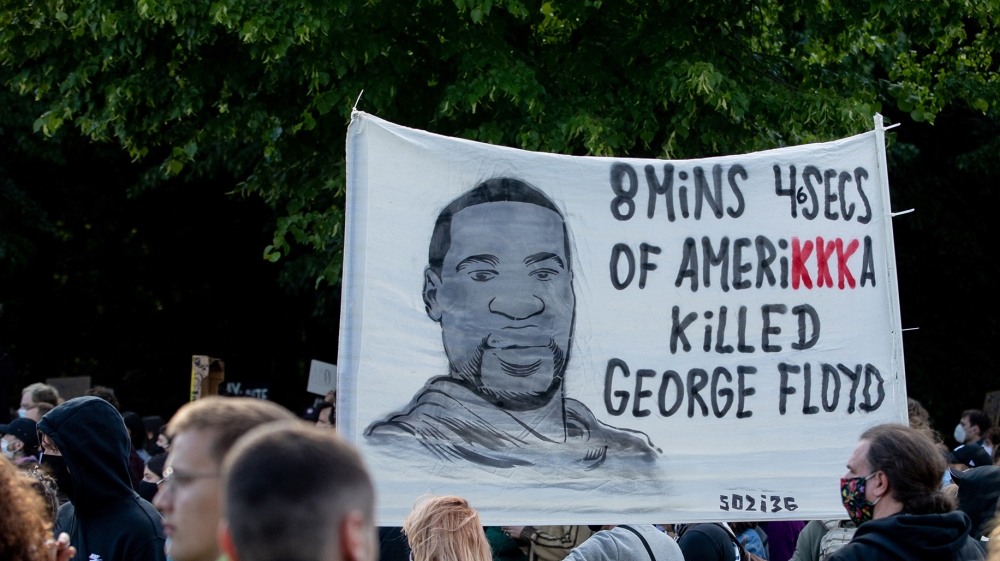
Participants in a rally against the violent death of African-American George Floyd by a white policeman hold a poster in front of the US Embassy with the words

Participants in a rally against police killing of George Floyd by in Berlin, Germany [Christoph Soeder/DPA/AP Photo] 

Irish EU lawmaker Sean Kelly says some of the problem is due to a failure of leadership. He says what happened in the United States is “chilling in the extreme. I think it indicates what can happen when you have poor leadership.

“Leaders can either divide or unite. Good unite. Bad divide. That’s what we see unfortunately in America at the moment.”

Swedish liberal parliamentarian Karin Karlsbro says “America has a long and tragic history on police brutality. At the heart of this lies racism and segregation based on history. This is a systematic problem that needs to be addressed at all levels in the U.S.”

14:20 GMT – Another Confederate statue comes down

The city of Mobile, Alabama, removed a Confederate statue early Friday.

The bronze figure of Admiral Raphael Semmes had become a flashpoint for protests. It was removed from its pedestal after being vandalized this week and before demonstrations announced for Sunday calling for it to be taken down.

The removal of the 120-year-old figure follows days of protests in Alabama and across the nation over killings by police of African Americans.

Semmes was a Confederate commerce raider, sinking Union-allied ships during the Civil War. He later became a “Lost Cause” hero to Southerners who lamented the end of the Confederacy.

The city of Semmes, Alabama, outside Mobile, was incorporated in 2010 and named for him.

14:00 GMT – Alabama police investigating cross burning

Police are investigating a cross burning on a bridge in Macon County.

Macon County Sherriff Andre Brunson says the burning cross was seen on top of a bridge over Interstate 85 on Thursday night. Brunson says deputies arrived and helped extinguish the fire.

John Bolton, a motorist who called 911, told WRBL-TV there was a cross, burning tire and fuel canister.

The sheriff says there are no suspects so far.

13:55 GMT – Twitter blocks Trump campaign video tribute to Floyd

Twitter has blocked a Trump campaign video tribute to George Floyd over a copyright claim, in a move that adds to tensions between the social media platform and the U.S. president, one of its most widely followed users.

The company put a label on a video posted by the @TeamTrump account that said, “This media has been disabled in response to a claim by the copyright owner.” The video was still up on President Donald Trump’s YouTube channel and includes pictures of Floyd, whose death sparked widespread protests, at the start.

“Per our copyright policy, we respond to valid copyright complaints sent to us by a copyright owner or their authorized representatives,” Twitter said in a statement.

The three minute and 45 second clip is a montage of photos and videos of peaceful marches and police officers hugging protesters interspersed with some scenes of burning buildings and vandalism, set to gentle piano music and Trump speaking.

It’s the latest action that Twitter has taken against Trump, who has threatened to retaliate against social media companies.

____________________________________________________________________

Hello and welcome to Al Jazeera’s continuing coverage of the protests in the US over the killing of George Floyd in Minneapolis, Minnesota.

Here are a few things to catch up on:

  • George Floyd, an unarmed 46-year-old Black man, died on May 25 after a white officer used his knee to pin Floyd’s neck to the ground for nearly nine minutes. Floyd can be heard on a bystander video repeatedly pleading with officers, saying: “I can’t breathe.” He eventually lies motionless with the officer’s knee still on his neck. You can read about the deadly incident here.
  • The four officers involved in the incident were fired, and all have been charged. 
  • Protests – some violent – have since erupted nationwide as demonstrators rally for justice for Floyd and all unarmed Black people killed by police.

See the updates from Thursday’s protests here


Source link

OPEC and Russia Are Likely to Extend Oil Production Cuts

IHS Markit, a research firm, estimates that 14 million barrels a day in oil output has been shut off around the world as customers like refiners drastically cut their purchases.

In addition, commodity investors have decided that economic activity is regaining momentum as lockdowns are eased. Friday’s report that U.S. employers hired an additional 2.5 million workers is likely to feed this surge of optimism.

“People want to believe in the positive, whether it is justified or not,” said Amrita Sen, chief oil analyst at Energy Aspects, a market research firm. “Anything OPEC does to extend these cuts, of course, is going to have an impact.”

Analysts warn, though, that prospects for the oil market are likely to remain fragile, with demand difficult to forecast as the number of people infected by the coronavirus continues to grow and new waves of infection cannot be ruled out. This uncertainty is a critical reason Saudi Arabia is moving slowly to adjust production. The Saudis are likely to make moves on a month-to-month basis if not day by day, analysts say.

While demand and supply may be coming into balance, a huge gusher of crude remains in storage tanks and on ships waiting to come back onto the market. In addition, as prices rise, so will the temptation for oil producers inside and outside OPEC to open the taps on wells that they have temporarily shut off. Analysts say this process has already begun in the United States.

  • Updated June 5, 2020

    • How many people have lost their jobs due to coronavirus in the U.S.?

      The unemployment rate fell to 13.3 percent in May, the Labor Department said on June 5, an unexpected improvement in the nation’s job market as hiring rebounded faster than economists expected. Economists had forecast the unemployment rate to increase to as much as 20 percent, after it hit 14.7 percent in April, which was the highest since the government began keeping official statistics after World War II. But the unemployment rate dipped instead, with employers adding 2.5 million jobs, after more than 20 million jobs were lost in April.

    • Will protests set off a second viral wave of coronavirus?

      Mass protests against police brutality that have brought thousands of people onto the streets in cities across America are raising the specter of new coronavirus outbreaks, prompting political leaders, physicians and public health experts to warn that the crowds could cause a surge in cases. While many political leaders affirmed the right of protesters to express themselves, they urged the demonstrators to wear face masks and maintain social distancing, both to protect themselves and to prevent further community spread of the virus. Some infectious disease experts were reassured by the fact that the protests were held outdoors, saying the open air settings could mitigate the risk of transmission.

    • How do we start exercising again without hurting ourselves after months of lockdown?

      Exercise researchers and physicians have some blunt advice for those of us aiming to return to regular exercise now: Start slowly and then rev up your workouts, also slowly. American adults tended to be about 12 percent less active after the stay-at-home mandates began in March than they were in January. But there are steps you can take to ease your way back into regular exercise safely. First, “start at no more than 50 percent of the exercise you were doing before Covid,” says Dr. Monica Rho, the chief of musculoskeletal medicine at the Shirley Ryan AbilityLab in Chicago. Thread in some preparatory squats, too, she advises. “When you haven’t been exercising, you lose muscle mass.” Expect some muscle twinges after these preliminary, post-lockdown sessions, especially a day or two later. But sudden or increasing pain during exercise is a clarion call to stop and return home.

    • My state is reopening. Is it safe to go out?

      States are reopening bit by bit. This means that more public spaces are available for use and more and more businesses are being allowed to open again. The federal government is largely leaving the decision up to states, and some state leaders are leaving the decision up to local authorities. Even if you aren’t being told to stay at home, it’s still a good idea to limit trips outside and your interaction with other people.

    • What’s the risk of catching coronavirus from a surface?

      Touching contaminated objects and then infecting ourselves with the germs is not typically how the virus spreads. But it can happen. A number of studies of flu, rhinovirus, coronavirus and other microbes have shown that respiratory illnesses, including the new coronavirus, can spread by touching contaminated surfaces, particularly in places like day care centers, offices and hospitals. But a long chain of events has to happen for the disease to spread that way. The best way to protect yourself from coronavirus — whether it’s surface transmission or close human contact — is still social distancing, washing your hands, not touching your face and wearing masks.

    • What are the symptoms of coronavirus?

      Common symptoms include fever, a dry cough, fatigue and difficulty breathing or shortness of breath. Some of these symptoms overlap with those of the flu, making detection difficult, but runny noses and stuffy sinuses are less common. The C.D.C. has also added chills, muscle pain, sore throat, headache and a new loss of the sense of taste or smell as symptoms to look out for. Most people fall ill five to seven days after exposure, but symptoms may appear in as few as two days or as many as 14 days.

    • How can I protect myself while flying?

      If air travel is unavoidable, there are some steps you can take to protect yourself. Most important: Wash your hands often, and stop touching your face. If possible, choose a window seat. A study from Emory University found that during flu season, the safest place to sit on a plane is by a window, as people sitting in window seats had less contact with potentially sick people. Disinfect hard surfaces. When you get to your seat and your hands are clean, use disinfecting wipes to clean the hard surfaces at your seat like the head and arm rest, the seatbelt buckle, the remote, screen, seat back pocket and the tray table. If the seat is hard and nonporous or leather or pleather, you can wipe that down, too. (Using wipes on upholstered seats could lead to a wet seat and spreading of germs rather than killing them.)

    • Should I wear a mask?

      The C.D.C. has recommended that all Americans wear cloth masks if they go out in public. This is a shift in federal guidance reflecting new concerns that the coronavirus is being spread by infected people who have no symptoms. Until now, the C.D.C., like the W.H.O., has advised that ordinary people don’t need to wear masks unless they are sick and coughing. Part of the reason was to preserve medical-grade masks for health care workers who desperately need them at a time when they are in continuously short supply. Masks don’t replace hand washing and social distancing.

    • What should I do if I feel sick?

      If you’ve been exposed to the coronavirus or think you have, and have a fever or symptoms like a cough or difficulty breathing, call a doctor. They should give you advice on whether you should be tested, how to get tested, and how to seek medical treatment without potentially infecting or exposing others.


“It’s a precarious perch right now,” with so much oil being held off the market, said Bhushan Bahree, senior director at IHS Markit.

In an effort to preserve discipline, Saudi Arabia, which along with Russia has absorbed the largest cuts, has been pressuring other producers, notably Iraq, to comply with their commitments. The Saudis, analysts say, especially want to bring Iraq — the second-largest producer in OPEC after Saudi Arabia — in line. Iraq agreed to cut its daily output by more than a million barrels in April but is instead trimming by an estimated 400,000 barrels, according to IHS Markit. Nigeria and Kazakhstan are also under pressure to comply with agreed cuts.

Source link

D.C. government dubs intersection where police cleared peaceful protesters ‘Black Lives Matter Plaza’

Although more recent protests have remained mostly peaceful, the White House has grown increasingly fortified in recent days amid and effort to keep demonstrations away from the executive mansion. Protesters have nonetheless gathered near the White House every night this week in groups numbering in the thousands.

The Trump administration has faced significant criticism this week for its decision to use aggressive tactics on Monday to clear Lafayette Park of apparently peaceful protesters so that the president could cross it on foot to visit a historic church where rioters had set a small fire the night before. Trump, holding a Bible, posed briefly for photographs with members of his administration before returning to the White House, a photo opportunity that was widely criticized by religious leaders and a bipartisan swath of lawmakers.

On Friday, in addition to unveiling “Black Lives Matter Plaza,” honoring the national movement aimed at combating systemic racism and police killings of black Americans, the District also teamed up with local artists to adorn a stretch of 16th Street NW in front of the White House in giant yellow lettering bearing the group’s name.

The D.C. chapter of the Black Lives Matter global network quickly rejected the plaza name and street painting as “performative.” The group accused D.C. Mayor Muriel Bowser of attempting to distract from “her active counter organizing to our demands,” which include a reduction of the city’s police budget and the reinvestment of those funds in other community priorities.

While it’s not abnormal for the city to adopt new ceremonial names for streets around the District, such treatment is typically reserved for jabs at despotic foreign governments.

In the most recent high-profile example, residents of D.C.’s Foggy Bottom and West End neighborhoods attempted to rename a stretch of roadway in front of the Saudi Embassy after Jamal Khashoggi, the Washington Post columnist and critic of the Saudi royal family who was murdered in 2018 by Saudi operatives in the country’s Istanbul consulate.

The effort hit a roadblock in the form of a D.C. law barring public spaces “from being named in honor of any person who is alive or has been deceased for less than two years,” according to WTOP.

Earlier that year, the city designated the stretch of Wisconsin Avenue on which the Russian Embassy sits as “Boris Nemtsov Plaza,” in honor of a slain opposition leader.

And several blocks up 16th Street from the newly unveiled “Black Lives Matter Plaza” sits “Andrei Sakharov Plaza,” an homage to one of the best-known dissidents of the Soviet Union in front of the former Soviet Embassy and the current home of the Russian ambassador.

There have been similar efforts to rib foreign governments and honor dissidents with ceremonial street names in the nation’s capital.

Then-President Barack Obama shut down an effort in 2016 to rename the street in front of the Chinese Embassy after an imprisoned Nobel Peace Prize laureate. And in 2015, Sen. Ted Cruz (R-Texas) introduced legislation that would name the street in front of the newly reopened Cuban Embassy about two miles up 16th Street from the White House after a prominent opponent of Fidel Castro’s regime.


Source link

Reddit co-founder quits board over George Floyd

0

Image copyright
Getty Images

Image caption

Reddit co-founder Alexis Ohanian is married to tennis champion Serena Williams

Reddit co-founder Alexis Ohanian has resigned from the tech firm’s board and urged the company to replace him with a black candidate.

The tech entrepreneur has also pledged to use future gains on his Reddit stock to “serve the black community.”

In a series of tweets, he said he was doing it “as a father who needs to be able to answer his black daughter when she asks: ‘What did you do?'”

It follows days of US protests against police brutality and racial inequality.

Mr Ohanian, who is married to black tennis champion Serena Williams, said he would be donating $1m (£800,000) to Know Your Rights Camp, a non-profit started by former NFL quarterback Colin Kaepernick.

“I believe resignation can actually be an act of leadership from people in power right now,” he said in a video. “To everyone fighting to fix our broken nation: do not stop.”

Mr Ohanian founded social media website Reddit 15 years ago with his college roommates Aaron Swartz and Steve Huffman.

He stepped down from daily duties in 2018 but has retained a seat on the company’s board until now.

Reddit promoted its first female board member, Porter Gale, last year.

But the website has come under fire for hosting forums that promote racist content. The company has banned groups like r/blackpeoplehate and alt-right r/MillionDollarExtreme. It has also “quarantined” a pro-Trump forum, r/TheDonald, ensuring that its content does not appear in website searches or recommendations.

Earlier this week, several popular Reddit forums switched their access rights to private, or banned new posts entirely, to protest against the company’s hate speech policies. Ex-chief executive Ellen K Pao also lambasted her former employer in a tweet, saying: “You don’t get to say [Black Lives Matter] when reddit nurtures and monetizes white supremacy and hate all day long.”

More on George Floyd’s death

Source link

Netanyahu’s dilemma over his annexation plan

Jun 5, 2020

Less than a month before the July 1 target date allowing Prime Minister Benjamin Netanyahu to bring up to vote annexation of a significant part of the West Bank, no one has any idea where the country is heading. Netanyahu’s intentions are unclear. He continues to trumpet the historic opportunity afforded by the green light for annexation that President Donald Trump gave Israel in January, but no one knows what Netanyahu really means to do. Will he take advantage of the opportunity offered by the Americans to declare Israeli sovereignty over 30% of the West Bank on July 1? Will he annex a smaller portion of land? Will he delay the move? Will he forgo the whole idea at this time?

Netanyahu is torn between polarized ideologies and the political and security risks entailed in annexation. He is also sorely tempted to go down in the history of Israel’s ideological and political right in a move that would overshadow another historic precedent he set this year in becoming the first incumbent premier to stand criminal trial.

The prime minister faces multiple fronts as he mulls his epic decision. The most familiar is the right wing, where opposition to the move on the part of West Bank settlers and their leaders, as detailed here this week by my colleague Mazal Mualem, is intensifying daily.

On June 4, David Elhayani, the head of the settlers’ umbrella organization Yesha Council, said Trump and his son-in-law Jared Kushner have “shown through the proposal that they are not friends of the State of Israel and do not consider the security and settlement interests of the State of Israel.” Elhayani’s accusation, prompted by the realization that the Trump plan also envisions the establishment of a Palestinian state, set off a storm. Netanyahu lambasted Elhayani for his ingratitude to the US leader. “President Trump is a great friend of the State of Israel. He has led historical moves for the State of Israel,” said Netanyahu. Elhayani, however, was unrepentant and refused to back down.

In fact, it seems as if the settlers’ take on the Trump plan has prompted second thoughts, even by Netanyahu. “Annexation would truly be a historic move,” one of Netanyahu’s associates told Al-Monitor on condition of anonymity. “The question is whether Netanyahu would also go down in history as the person who agreed to the establishment of a Palestinian state west of Jordan by his very acceptance of Trump’s ‘deal of the century.’ This argument is no less convincing than the counterargument,” the associate said.

Several other land mines besides settlers and leaders of the rightist Yamina party also obstruct Netanyahu’s path to annexation. These include vehement European opposition, adamant rejection of the move by some Arab states, among them his allies in the Gulf, the expected response by Jordan’s King Abdullah and the recommendations of Netanyahu’s security chiefs. Then there are the obstacles he faces within his newly installed government from his rival/partner Alternate Prime Minister Benny Gantz and Foreign Minister Gabi Ashkenazi. Luckily for Netanyahu, the duo has also not decided what to do about this explosive issue they have been waffling on for over a year.

Gantz, in his role as defense minister, instructed army chief Lt. Gen. Aviv Kochavi this week to accelerate military preparations for possible implementation of the annexation, prompting criticism within his own center-left political camp. His instructions could mean either that he is “going along” with Netanyahu’s intentions and will not stand in his way or that he foresees a real threat of a meltdown in the Palestinian territories.

Israel’s military planning for 2020 focused on Iran and mainly on dislodging its entrenchment from Syria. In light of the latest developments, the Israel Defense Forces (IDF) could find themselves dealing with friction in the territories and an escalation into an armed confrontation with the Palestinians or a third intifada. Most military experts, former security chiefs and retired generals argue that the annexation would cause more harm than good. Netanyahu himself was of the same mind most of his life and firmly rejected annexation proposals whenever settlers and right-wing leaders raised them. The prime minister is now facing a historic opportunity that is slipping away with Trump’s decline in the polls and the prospects of US president’s possible defeat in November. Netanyahu is asking himself what is preferable: To be the one who drops the ball so close to the goal post or the one who mires Israel in a third intifada while laying the ground for a Palestinian state once again (following his historic 2009 Bar Ilan pledge to allow the founding of a Palestinian state).

Maj. Gen. (res.) Amos Gilad, formerly director of policy and political-military affairs at the Israeli Defense Ministry and a top intelligence officer who conducted Israel’s sensitive ties with Jordan for decades, told Al-Monitor this week that if he were Netanyahu, he would announce that he was immediately “abandoning this horrible annexation plan.” Gilad, a security hawk not known for his leftist political leanings, added that Israel should focus instead on its greatest threat, Iran. “We have a very convenient climate in the West Bank in terms of security. We have defeated terrorism, Jordan provides us with a strategic depth all the way to Iraq, and instead we want to restore the Palestinian issue to center stage. Why do we need this? After all, the army will remain deployed in the Jordan Valley and along the Jordan River in any case. Why go on with this declarative Zionism? Practical Zionism is preferable.”

Netanyahu will have to decide, soon. As he weighs his options, he is undoubtedly taking note of the warning issued this week through Al-Monitor by the United Arab Emirates’ ambassador to Washington, Yousef Al-Otaiba, that annexation would make the region “unstable.” The Emirates are the keystone in a clandestine love affair Netanyahu has been conducting with the Gulf States for years and he must concede there could be something to their warning.

Netanyahu’s main problem is that he cannot read Washington’s true intentions at this point, especially not those of the White House — perhaps because given the current chaos, no one there knows which way Trump will go once the deadline arrives and Israel asks for a go-ahead to carry out annexation. According to several sources very close to Netanyahu, his friends at the White House have not been returning his calls over the past two weeks. A senior diplomatic source familiar with these contacts told Al-Monitor that Kushner and his wife, Ivanka Trump, are not wild about the annexation idea, to put it mildly, given the current state of play. On the other hand, Trump’s influential ambassador to Israel, David Friedman, has no such qualms as he continues to hold intense discussions with the settlers and advocate annexation. Netanyahu will be the one making the final decision, but he would need to receive beforehand clear American guidance.

“Maybe Netanyahu would rather have Trump push aside the whole issue and pull his chestnuts out of the fire for him,” a senior right-wing government minister told Al-Monitor on condition of anonymity. “He could always say that he tried, he wanted to, but circumstances made the annexation impossible.” An unequivocal statement by presidential candidate Joe Biden warning Netanyahu against confronting the United States with a fait accompli just months before the elections would also help Netanyahu recalibrate. “But for that to happen,” one of his associates said on condition of anonymity, “he has to want to change course. Right now, he himself does not know exactly what he wants.”


Source link

Self-driving sector contends its cars can prevent many more crashes than insurance study says

0

(Reuters) – Companies working on self-driving vehicles have criticized an insurance industry study suggesting that only a third of all U.S. road crashes could be prevented by driverless cars, arguing that the study has underestimated the technology’s capabilities.

The study by the Insurance Institute for Highway Safety (IIHS), released on Thursday analyzed 5,000 U.S. crashes and concluded that likely only those caused by driver perception errors and incapacitation could be prevented by self-driving cars.

The autonomous vehicle industry quickly responded that its cars were programmed to prevent a vastly higher number of potential crash causes, including more complex errors caused by drivers making inadequate or incorrect evasive maneuvers.

Taking those design choices into account, autonomous vehicles could avoid some 72% of crashes, said Partners for Automated Vehicle Education, a consortium of self-driving technology companies.

The group in a blog post (here here) on Thursday said it was “fundamentally speculative” to determine crash avoidance rates.

Nevertheless, companies developing self-driving cars for years have touted their ability to vastly reduce crashes, with some, like General Motors Co, calling them a key part in achieving “zero crashes.”

The Alliance for Automotive Innovation, an auto industry group, in a statement said that even reducing traffic fatalities by a third would be something to be proud of, but that its members aim to do more.

Jack Weast, vice president of autonomous vehicle standards at Intel Corp’s Mobileye, in an interview on Friday said the auto industry was assembling a vast list of likely road scenarios and human behavior that every driverless car should be able to navigate safely. Government agencies and insurance companies are part of that process, Weast said.

“Crashes will never be zero until we have no more human drivers on the road,” he said. “But (self-driving cars) can combine physical laws with behavioral studies and do much more than a human driver.”

Reporting by Tina Bellon in New York; Editing by David Gregorio

Source link

The Sea’s Weirdest Creatures, Now in ‘Staggering’ Detail

0

The bizarre life of the sea’s middle depths has long been a challenge to see, study and fathom. The creatures of that realm live under crushing pressures at icy temperatures in pitch darkness. The fluid environment is unbound by gravity and hard surfaces, so natural selection allows for a riotous array of unfamiliar body parts and architectures. By human standards, these organisms are aliens.

Now, a new kind of laser is illuminating some of the most otherworldly life-forms. The soft bodies of the abyssal class are made of mucoid and gelatinous materials — somewhat like jellyfish, only stranger. They feature mazes of translucent parts and gooey structures, including long filaments, mucus housings and fine-mesh filters for gathering food. Recently, in the depths off Western Australia, scientists filmed a gelatinous type known as a siphonophore whose length was estimated at 150 feet — potentially the world’s longest example of oceanic life.

On June 3 in Nature magazine, a team of seven scientists from the Monterey Bay Aquarium Research Institute in California and the Pontifical Catholic University of Chile in Santiago described an imaging device for studying these translucent creatures. It emits a thin fan of laser light that scans through the animals, gathers backscattered rays from the inner flows and tissues, and feeds those gleanings into a computer that visually reconstructs the living organisms in subtle detail. The device, called the DeepPIV imaging system, reveals the insides much as CT scans do for human bodies.

“It’s staggering,” Bruce H. Robison, a marine biologist at MBARI who participated in the research, said of the new technique in an interview. “It’s going to open things up in a really good way.”

The team conducted its explorations off the California coast in Monterey Bay, which features a deep canyon. A robot holding the imager was lowered on a long tether, resulting in the scrutiny of scores of creatures at depths of up to a quarter mile.

Kakani Katija, an engineer at the marine institute and the paper’s lead author, said the new technique would help unveil how the gooey animals do such things as move, feed, procreate and protect themselves. “Now that we have a way to visualize these structures, we can finally understand how they function,” she said.

In the Nature article, the team told of directing the novel device at an abyssal creature known as a giant larvacean, a marvel of nature that can secrete balloon-like mucus feeding structures as wide as three feet. Within a large structure are smaller, fist-size filters that the animals use to gather prey and tiny particles.

Using the new technique, Dr. Katija and her collaborators were able, for the first time, to map the structure of the larvacean’s inner filter, identifying its precise shape and the exact function of its parts. Added computer power let team members turn the visualization into a movie that enabled them to effectively fly through the filter and scrutinize its flows.

Until now, no scientist has had the chance to examine such complicated structures in the deep creatures, Dr. Katija said. Such visualizations, she and her team wrote in their paper, “can shed light on some of nature’s most complex forms.”

The paper’s other authors are Giancarlo Troni, Joost Daniels, Kelly Lance, Rob E. Sherlock, Alana D. Sherman and Dr. Robison. Except for Dr. Troni, an engineer at the Catholic university in Santiago, the researchers work at the California marine institute.

The new technique could — at least potentially — have an enormous impact on marine science, because the world’s oceans are so vast and the denizens of their inky depths so mysterious. Scientists estimate that more than 99 percent of the planet’s biosphere resides in the oceans. Fishermen know its surface waters, but in general, compared to land, the global ocean is unknown.

Dr. Robison has estimated that up to half the creatures of the sea remain undiscovered — mainly the otherworldly ones of the middle depths.

“If an alien civilization came to look at the dominant life form on the planet, they’d be out looking at midwater creatures,” he said in 1994. “In terms of biomass, numbers of individuals, geographical extent — any way you want to slice it — these are the biggest ecological entities on earth. But we know virtually nothing about them.”

Source link

COVID-19 latest: New cases increase by 2 642, deaths now at 908

As we make our way through lockdown level 3, Health Minister Zweli Mkhize warned South Africans who are returning to their workplaces “not to forget basic COVID-19 prevention measures.

COVID-19 update: Friday, 5 June 2020

Health Minister Zweli Mkhize said in a statement that South Africa’s cumulative COVID-19 caseload now stands at 43 434; an increase of 2 642 new cases since Thursday, 4 June 2020.

Unfortunately, an additional 60 deaths were also reported, bringing the total deaths in South Africa to 908. Minister Mkhize confirmed that 23 088 people have recovered from COVID-19. He said:

Regrettably, we report 60 more COVID-19 related deaths: 7 from Gauteng and 53 from Western Cape. This brings the total national deaths to 908. We extend our condolences to the loved ones of the departed and thank the health care workers who treated the deceased.”

Health Minister Zweli Mkhize

To date, there has been two deaths in the 0 to 9 age group, with the bulk of fatalies falling withing the 50 to 59 and 60 to 69 age groups.

Age Deaths Percentage
0 – 9 2 0.2
10 – 19 3 0.3
20 – 29 7 0.8
30 – 39 50 5.5
40 – 49 105 11.6
50 – 59 230 25.3
60 – 69 247 27.2
70 – 79 169 18.6
80 – 89 75 8.3
90 – 99 20 2.2
Gender Distribution
Male % Female % Total
481 427 908

Breakdown of new confirmed COVID-19 cases

New cases, deaths and recoveries by province

The confirmed COVID-19 cases per province is as follows:

Province Total Cases Deaths Recoveries
Gauteng 5 215 40 2 344
Western Cape 28 807 704 16 433
KwaZulu Natal 2 936 55 1 378
Free State 336 9 123
Eastern Cape 5 240 95 2 460
Limpopo 215 3 3
Mpumalanga 169 0 94
North West 409 1 73
Northern Cape 102 1 34
Unallocated 5 0 0

Tests and screening

As of today, a total of 850 871 tests have been conducted, of which 30 196 were done in the last 24 hours. The total number of tests conducted in the private sector stands at 415 742, of which 13 554 were done in the last 24 hours.

In addition,435 129 tests were conducted in the public sector, with 16 642 being done within the last 24 hours.

Global COVID-19 news: Total cases, US protests

At the time of publishing, global figures exceeded 6.7 million confirmed cases – 6 779 216 to be exact – with the death toll now standing at 395 718 and 3 304 561 recoveries.

The USA still has the most confirmed cases as it nears a cumulative of 2 million. Currently: 1 937 833 cases, 110 745 deaths and 715 511 recoveries. The country currently has 17 083 critical cases.

Brazil has the second-most cases, globally, with 621 877 confirmed cases, 34 212 deaths and 288 652 recoveries, while Russia has 449 837 confirmed cases, 5 528 deaths and 212 680 recoveries.


Source link

Canada postpones 5G spectrum auction citing COVID-19

0

FILE PHOTO: 3D-printed objects representing 5G are put on a motherboard in this picture illustration taken April 24, 2020. REUTERS/Dado Ruvic /Illustration/File Photo

OTTAWA (Reuters) – Canada has postponed its 3500MHz spectrum auction process by six months to allow telecoms companies to focus on providing essential services during COVID-19 pandemic, the innovation ministry said in a statement on Friday.

The band is key for telecom companies rolling out fifth generation (5G) mobile networks, which will have speeds fast enough to download a movie to a smartphone in seconds, while allowing businesses to run “smart” factories using connected robots, devices and sensors.

The auction will now be held on June 15, 2021, because Innovation Minister Navdeep Bains wanted “to allow the telecommunications industry to maintain its focus on providing essential services to Canadians during the COVID-19 pandemic,” the statement said.

The auction was initially scheduled to be held in December. Bains said the government will begin the consultation period in August for the 3800MHz band, also key for 5G networks.

Reporting by Steve Scherer in Ottawa and Moira Warburton in Toronto; Editing by Marguerita Choy

Source link

Facebook group a ‘castle’ of self-empowerment for women

The national lockdown was put into place to control the spread of COVID-19 infections in South Africa. However, being under lockdown has posed a threat to the mental well-being of many citizens.

Chante Letania Shanmogum has taken a proactive approach to alleviate this situation, as well as to empower women, through the Girl Code Facebook group.

Girl Code screams women empowerment. The intention of creating this group was to set up a platform for women to encourage, uplift and celebrate one another. Girl Code was created just over two weeks ago and already has close to 18 000 members. The group is administrated by Shanmogum and her cousin Nadine Naidoo.

“Girl Code stands for women. Just one word, women. We believe in uplifting and growing each other with no tolerance for drama, belittling one another or cattiness. The group is more like a castle of self-empowerment for our Queens,” said Shanmogum.

Crowning glory: Girl Code ‘Queens’ support

Group members are referred to as Queens and often post their journeys in life, including their struggles and experiences in the form of testimonies that have made them who they are today. Each inspiring the next to do the same as they stand together lifting each other up and “crowning” one another.

“I felt like we as women just needed a group where we can kick back, relax, go on and learn new things. I wanted Girl Code to be a women’s best friend, a friend that’s always giving you advice,” said Shanmogum.

The ladies on the group often post beauty hacks and skin care routines, but also extends into assisting women career wise and provides an opportunity for growth through networking.

Platform for love and support

On Wednesdays, the groups administrators allow members to post their personal motivation letters to seek employment and employers to post job vacancies within the group. On Fridays, business owners withing the group are allowed to advertise their businesses.

Every three days a “cover girl” is chosen and set as the cover photo of the group as an acknowledgment of a member interacting and this also keeps the platform running and growing.

The group’s fellow creator concluded that she has been overwhelmed by the love and support she’s been receiving.


Source link