Intellasia East Asia News – Scrapped Sino-Japanese question would have demanded a ‘sound and balanced’ answer, HK exam authority says in revealing marking scheme

0

Two months after scrapping a controversial university entrance exam question that asked if Japan did “more good than harm to China” in the first half of the last century, Hong Kong’s exam authority has explained how they intended to grade it.

Responding to pressure from pro-establishment politicians who argued the question misled students into downplaying Japan’s invasion of the country, the authority on Thursday revealed the question’s marking scheme, which demanded a “sound and balanced” answer.

Two versions of the marking scheme were released, including a draft and a revised version created after the firestorm erupted, with both requiring students to provide evidence of harm and good to receive high marks.

Get the latest insights and analysis from our Global Impact newsletter on the big stories originating in China.

The compulsory question asked more than 5,200 candidates who sat the Diploma of Secondary Education (DSE) exam if they agreed Japan “did more good than harm” between 1900 and 1945, and were told to answer by referencing two excerpts of reading material and their own knowledge.

One of the reference materials was a 1905 article on Japan’s plans to receive Chinese students to study law and politics, while the other was a 1912 letter by revolutionary leader Huang Xing, who was seeking financial help from a Japanese politician.

Pro-establishment figures slammed the excerpts provided as “one-sided”, saying they only showed the good Japan did. Shortly after Beijing’s foreign affairs arm in the city issued its own statement blasting the question, the Education Bureau took the unprecedented step of asking the exam body to strike it out, saying there was “no room for discussion”.

Under the marking scheme revealed on Thursday, candidates could only score the full eight points by providing “a sound and balanced answer” that made the case for both sides while effectively using the two excerpts as well as their own knowledge.

Some examples of the “good” which Japan had done included providing “support to the Qing government in its reform efforts”, offering “financial support to the new Chinese regime in 1912″, and strengthening Chinese nationalism via their aggression.

Examples of Japan’s “harm” for China included the “high casualties” caused by the invasion and occupation of the 1930s and 1940s, and the fact that payments owed to Japan for its financial help to the new Chinese regime were “not negotiable and might lead to unfairness”.

The revised version of the marking scheme went further in that it required candidates to “display quality thinking and historical skills” rather than simply recalling the data. It also asked candidates to compare each point of evidence presented before reaching a conclusion, “regardless of what viewpoint” they took.

In a reply to the Post, the exam authorities said the draft version was prepared before the exam took place, while the revised version was prepared afterwards for reference and deliberations by their governing council on whether to scrap the question.

Candidates providing an answer that lacked balance because they relied only on the reading materials or their own knowledge would score just four marks, while a vague answer that ineffectively used the available resources would score two marks or less.

Cheung Wong, a secondary school history teacher and an executive committee member of the pro-democracy Professional Teachers’ Union, said the marking scheme showed there was room for discussion in the question, adding he believed the examples raised for both sides of the question were “fair”.

“By listing out examples from both sides, usually it would suffice for the markers to understand the gist of the [answer],” he said.

But Wong Kam-leung, chair of the pro-establishment Hong Kong Federation of Education Workers, one of the most vocal groups to call for the scrapping of the question, argued the marking scheme had raised “unreasonable” examples that could mislead candidates.

“By saying that ‘Japanese aggression strengthened Chinese nationalism’, it is preposterous and confuses the cause and effect of the incident. How can one say that something so harmful and wrong resulted in something which is good?” Wong asked.

Earlier this month, the High Court dismissed a judicial review application from one of the candidates who challenged the legal basis of the exam authorities’ decision to scrap the question, after finding there was no procedural irregularities or other unfairness in the decision-making process.

https://sg.news.yahoo.com/scrapped-sino-japanese-demanded-sound-160904406.html


Category: Japan


Print This Post

Source link

Intellasia East Asia News – China reports 10 new coronavirus cases in mainland, nearly all imported

0

China reported 10 new confirmed COVID-19 cases for the mainland as of the end of July 16, up from one a day earlier, the country’s national health authority said on Friday.

Nine of the new infections were imported cases, involving travellers from overseas.

Beijing reported no new cases for an 11th consecutive day.

The total number of confirmed COVID-19 infections in mainland China to date is 83,622. The death toll remains unchanged at 4,634.

https://news.yahoo.com/china-reports-10-coronavirus-cases-001748383.html


Category: China


Print This Post

Source link

Intellasia East Asia News – US says options open as China denounces visa ban reports

0

The United States said Thursday all options were open to pressure China, which voiced outrage over reports that President Donald Trump is considering a sweeping visa ban on communist party members.

The New York Times and later The Wall Street Journal reported that Trump is reviewing a proposal to refuse US entry of all members of the ruling partywhich encompasses a who’s who of the political and business elite in the world’s most populous nation.

Secretary of State Mike Pompeo, asked about the reports on Fox News, said the administration was looking at “pushing back against the Chinese Communist Party.”

“We want to make sure we do it in a way that reflects America’s tradition, and there are lots of ideas that are under review by the president and by our team,” he said, without commenting directly.

White House press secretary Kayleigh McEnany said of Trump at a briefing: “He has not ruled out any action with regard to China.”

Chinese foreign ministry spokeswoman Hua Chunying called the reported visa ban idea “very pathetic” for the world’s “strongest power.”

“We hope the US will refrain from doing more things that disdain the basic norms governing international relations and undermine its reputation, credibility and status as a major country,” she told reporters.

Trump has been ramping up pressure on China, repeatedly blaming the Asian power for not preventing the coronavirus pandemic which is taking a heavy toll in the United States months ahead of elections.

Last week the State Department said it would refuse visas for three senior Chinese officials over abuses in the Xinjiang region, where rights groups say more than one million Uighurs and other Turkic Muslims are incarcerated.

But a sweeping ban on members of the Chinese Communist Party would be an extraordinary undertaking, requiring US authorities to step up screening of the three million Chinese who visited each year before the pandemic disrupted travel.

Chinese state media last year said that more than 90 million people belonged to the party, with 35 percent of them “workers and peasants.”

For many Chinese, membership in the 99-year-old party is seen as vital for advancement. Many observers were startled in 2018 to learn that Jack Ma, the billionaire businessperson behind e-commerce titan Alibaba, belonged to the party.

https://sg.news.yahoo.com/us-says-options-open-china-denounces-visa-ban-201331854.html


Category: China


Print This Post

Source link

Intellasia East Asia News – ‘China’s goal is to replace you’: Barr warns leaders of America’s biggest businesses

0

US Attorney general Bill Barr delivered a blistering critique of the Chinese government Thursday and singled out US business leaders as complicit in the country’s rise.

Speaking at the Gerald R. Ford Presidential Museum in Grand Rapids, Michigan, he pointed to tech companies like Apple (AAPL) and Cisco (CSCO), as well as Disney (DIS) as examples of American firms “bowing to Beijing.”

Barr then offered this warning to corporations doing business in China.

“The ultimate ambition of China’s rulers isn’t to trade with the United States. It is to raid the United States,” Barr said. “If you’re an American business leader, appeasing the PRC may bring short term rewards, but in the end the PRC’s goal is to replace you.”

Barr’s comments are the latest salvo in a concerted effort by the Trump administration to ramp up pressure on Beijing, from Hong Kong to national security concerns tied to tech firms TikTok and Huawei.

On Tuesday, the President signed an executive order stripping the city of its special trading status with the US, saying its New National Security law violated China’s “One Country Two Systems” process, and signed into law the bipartisan Hong Kong Autonomy Act that allows for additional imposition of sanctions. That prompted Beijing to threaten retaliation, saying US action “gravely violates international law and basic rules of international relations.”

Meanwhile, the New York Times reported the White House is considering a sweeping travel ban to the US for members of the Chinese Communist Party and their families.

Barr’s address unleashed a new line of attack, calling for some of America’s largest companies to reevaluate their relationship with China. He accused the country’s ruling communist party of corrupt efforts to raid the United States of its economic power, in part, by partnering with and pressuring US firms.

“The People’s Republic of China is now engaged in an economic blitzkrieg an aggressive, orchestrated, whole-of-government and the whole-of -society campaign to seize the commanding heights of the global economy and to surpass the United States, as the world’s preeminent technological superpower,” Barr said.

Specifically, he singled out some of Silicon Valley’s biggest names, saying they had allowed themselves to become “pawns of Chinese influence.”

“American companies such as Cisco (CSCO) helped the Chinese Communist build the Great Firewall of China, the world’s most sophisticated system for internet surveillance, and censorship,” he said. “Over the years, corporations, such as Google (GOOG, GOOGL), Microsoft (MSFT), Yahoo (VZ) and Apple (AAPL) have shown themselves all too willing to collaborate with the CCP.”

In a statement to Yahoo Finance, Cisco Spokesperson Kyrk Storer said, “Cisco builds its products to global standards, and Cisco does not supply equipment to China that is customised in any way to facilitate blocking of access or surveillance of users. The products we supply to China are the same we provide worldwide, and we comply fully with all export control rules applicable to China including those related to human rights.”

Barr’s critique of Apple pointed to the company’s acquiescence to Beijing’s requests during protests in Hong Kong, that included removing news and pro-democracy apps from its App and Music stores, as well a decision to move some of its iCloud data servers to China.

In an email to Yahoo Finance, a spokesperson from Apple revived the company’s prior statement concerning 2018 iCloud data storage move, saying the company elected to comply after China enacted laws requiring that cloud services offered to Chinese citizens be operated by Chinese companies and that Chinese customers’ data be stored in the country.

“While we advocated against iCloud being subject to these laws, we were ultimately unsuccessful,” Apple’s spokesperson wrote. “Our choice was to offer iCloud under the new laws or discontinue offering the service…we felt that discontinuing the service would result in a bad user experience and less data security and privacy for our Chinese customers.”

In addition to big tech, Barr took aim at Hollywood studios including Paramount and Disney, saying “they risk undermining both their own future competitiveness and prosperity.”

He accused Disney of bowing to pressure from Chinese censors after Beijing banned all of its films, following outrage over the 1997 film Kunlun.

“I suspect Walt Disney would be disheartened to see how the company he founded deals with foreign dictatorships today,” Barr said. “After the CCP banned all Disney films in China, the company lobbied hard to regain access and the CEO apologised for Kundun calling it a stupid mistake. Disney then began courting the PRC to open a $5.5 billion theme park in Shanghai. As part of that deal Disney agreed to give the Chinese government officials a role in its management.”

Disney did not immediately respond to a request for comment.

https://finance.yahoo.com/news/chinas-goal-is-to-replace-you-barr-warns-leaders-of-america-biggest-businesses-202355046.html


Category: China


Print This Post

Source link

Want to do everything possible to keep peace for people of India, China: Trump

0

By: PTI | Washington |

Published: July 17, 2020 8:50:56 am


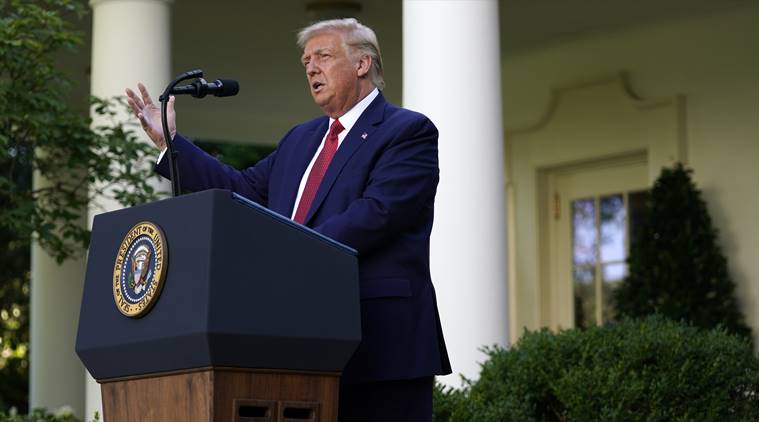
President Donald Trump speaks during a news conference in the Rose Garden of the White House, Tuesday, July 14, 2020, in Washington. (AP Photo/Evan Vucci)

US President Donald Trump has said that he wants to do everything possible to keep peace for the people of India and China, according to his spokesperson.

Over the past several weeks, the Trump administration has come out in support of India against China.

“He (Trump) said I love the people of India and I love the people of China and I want to do everything possible to keep the peace for the people,” White House Press Secretary Kayleigh McEnany told reporters at a news conference here on Thursday.

She was responding to a question on Trump’s message to India, which recently had a standoff with China in eastern Ladakh along the Line of Actual Control.

Earlier in the day, White House Economic Advisor Larry Kudlow described India as a great ally, saying President Trump is a great friend of Prime Minister Narendra Modi.

On Wednesday, Secretary of State Mike Pompeo said that India has been a great partner of the US.

“India has been a great partner. They are an important partner of ours. I have a great relationship with my foreign minister counterpart. We talked frequently about a broad range of issues. We talked about the conflict they had along the border with China. We’ve talked about the risk that emanates from the Chinese telecommunication infrastructure there,” Pompeo told reporters in response to a question.

Travelling in Europe, US National Security Advisor Robert O’Brien told reporters that China has been very aggressive with India.

O’Brien said that India is a democracy and is a great friend of the United States. “Prime Minister Modi and President Trump have a super relationship,” he said.

“In fact, it was the last foreign trip that I took with the president before the COVID-19 crisis hit, was to India, and we had a great reception of the Indian people there. We have a lot in common with them, we speak English, we’re democracies. We’ve got a growing, very strong relationship with India,” O’Brien said.

Welcoming the White House statement, Al Mason, co-chair of the Trump Victory Indian American Finance Committee, said that unlike his predecessor, President Trump has come out openly in support of India.

“Most of the Indian-Americans have observed that every earlier president – be it a Democrat or Republican, like Clinton or Bush Senior or Bush Jr or Obama have been very scared to side with India openly, for fear of hurting China.

“Only President Trump has had the courage to say that “I love India, America respects India”. US stands with India – and that also, to over one billion Indians in India at the Namaste Trump rally held in India? and that too? near India’s neighbour China,” Mason said in a statement.

“And he is consistent in his love for India and Indian-Americans,” he added.

📣 The Indian Express is now on Telegram. Click here to join our channel (@indianexpress) and stay updated with the latest headlines

For all the latest World News, download Indian Express App.

Source link

Intellasia East Asia News – US considers travel ban on millions of China Communist party members

0

The US is reportedly considering imposing travel restrictions on Chinese Communist party members amid a deepening row, with President Donald Trump saying further sanctions were possible and Beijing vowing retaliation.

A draft presidential proclamation would revoke visas for members of the Chinese Communist party as well as their families, according to the New York Times, citing four people familiar with the proposed travel ban that could apply to as many as 92 million party members.

Reuters news agency confirmed the report on Thursday, saying a draft presidential order had been circulated, but deliberations were at an early stage and the issue had not yet been brought to Trump.

The ban would be similar to the 2017 travel ban on Muslim-majority countries in giving the president the ability to prevent foreign nationals deemed “detrimental to the interests” of the US from entering the country.

The White House did not comment on the report on Thursday. On Wednesday, Trump said he had not ruled out additional sanctions on Chinese officials, following his signing of the Hong Kong Autonomy Act, legislation meant to punish Beijing over its recent security law.

The secretary of state, Mike Pompeo, said on Wednesday the US would be placing visa restrictions on “certain employees” of Chinese technology firms including Huawei, but provided no details.

On Thursday, the US attorney general, William Barr, issued a lengthy denunciation of the Chinese party’s strategy to achieve economic, political and cultural domination a strategy he said was being abetted by Hollywood, hi-tech corporations, and US business leaders lobbying on Beijing’s behalf.

He accused China of conducting “economic blitzkriegan aggressive, orchestrated, whole-of-government, and indeed, whole-of-society campaign to seize the commanding heights of the global economy and to surpass the United States as the world’s preeminent superpower.”

“The ultimate ambition of China’s rulers isn’t to trade with the United States. It is to raid the United States. If you are an American business leader, appeasing the PRC may bring short-term rewards. But in the end, the PRC’s goal is to replace you,” Barr said in a speech delivered in Michigan.

He gave two examples of China intervening to change the nationalities of characters in Hollywood movies before they were completed, using Chinese distribution deals as leverage. Beijing objected to a virus in a zombie apocalypse film, World War Z, being shown as originating in China, and a mystic character, the “Ancient One” in the fantasy film, Dr Strange, was changed from being Tibetan to Celtic, to avoid upsetting China, Barr said.

Tensions between the countries have escalated in recent weeks over Hong Kong where Beijing has imposed a sweeping and controversial national security law, as well as over Chinese telecom giant Huawei, seen by the US as a security threat.

Keith Krach, US under secretary for economic affairs, praised the UK for its decision to exclude Huawei from Britain’s 5G networks.

“We all have had experience with bullies and the one thing I know is that they back down when they are confronted and they really back down when you have your friends standing by your side, and the US is prepared to be that friend,” Krach said.

China summoned the US ambassador, Terry Branstad, to make “solemn representations” over the Hong Kong legislation, calling it “gross interference in China’s internal affairs”. A statement from the Chinese foreign ministry said: “China will make the necessary response to the wrong actions of the US, including sanctions against US entities and individuals.”

In a statement late on Wednesday, China’s liaison office in Hong Kong said: “Unreasonable meddling and shameless threats by the United States are typical gangster logic and bullying.

“No external force can stop China’s determination to maintain national sovereignty and security for Hong Kong’s long-term prosperity and stability.”

State mouthpiece the Global Times said in an editorial published on Wednesday night: “The current US administration has an abnormal worship of its own power… To what extent is the US willing to hurt itself to harm Hong Kong? No matter what card the US will play next, China will fight it to the end.”

The two countries are engaged in tit-for-tat sparring over the treatment of respective media outlets, tariffs on goods, sanctions in relation to Xinjiang, Hong Kong and Taiwan, as well as claims over the disputed South China Sea. On Monday, the US state department declared such claims “completely unlawful”, siding with south-east Asian countries against Beijing.

After the US imposed sanctions on Chinese officials involved in alleged human rights violations in Xinjiang, Beijing announced its own set of sanctions on US lawmakers and officials. China has also said that it would sanction US arms firm Lockheed Martin over its role in the latest sale of missiles to Taiwan.

https://www.theguardian.com/world/2020/jul/16/us-considers-travel-ban-on millions-of-china-communist-party-members-report


Category: China


Print This Post

Source link

Bhumi Pednekar on Dolly Kitty Aur Woh Chamakte Sitaare going OTT: I am ok with any platform

Image Source : INSTAGRAM/NETFLIX_IN

Bhumi Pednekar talks about Dolly Kitty Aur Woh Chamakte Sitaare going OTT

Bhumi Pednekar’s upcoming film “Dolly Kitty Aur Woh Chamakte Sitaare” is heading for a digital release. The actress welcomes the decision and says she is okay with any platform being the vehicle of her creative expression. “As an artiste, I only look to entertain the audience every time I am on the screen and I am okay with any platform becoming the vehicle of my creative expression. In this day and age, producers will do what is needed and we must all support each other’s decisions,” Bhumi said.

She said that she feels her upcoming film will reach out to a much larger audience with the decision to release it on an OTT platform.

Directed by Alankrita Shrivastava, “Dolly Kitty Aur Woh Chamakte Sitare” also stars Konkona Sen Sharma.

Bhumi is a huge fan of Konkona’s brilliance and Alankrita’s sensitivity.

” ‘Dolly Kitty…’ is a very special film. Konkona as we know is a phenomenal person and actor, and Alankrita (Srivastava) is a very special director. (Producers) Balaji (Motion Pictures) as an institution has always supported content that has broken barriers. A very big reason why I am this fond of Ekta (Kapoor). So, for me, being a part of this film was a super enriching experience as an actor,” she said.

“I have adored Konkona’s work and it was simply mesmerising for me to see her perform. Our scenes together in the film are exciting and memorable. Alankrita is a very powerful voice in cinema today, she is strong, witty and humane. I’m fortunate that I got the opportunity to creatively collaborate with her. I have learnt a lot from her,” Bhumi said.

The actress is hopeful that audiences worldwide will embrace this powerful film.

“Our film has been winning laurels at international film festivals. We’ve garnered such love and respect. I won awards at international platforms for the film and I’m sure it will be liked by audiences here as well. I’m looking forward to seeing how people react. It was refreshing to play a girl, fresh out of college, waiting to experience life.

Describing her character Kitty as “naive, sweet, ambitious and a survivor”, she added: “The film is full of quirk and a pool of emotions. It has a different narrative and I am excited,” she says.

Bhumi added that the film “celebrates womanhood, sisterhood and all the drama that comes in between with love and work”.

“It very skilfully shows just how complex yet beautiful women are,” she said.


More Bollywood stories and picture galleries

For all latest news and updates, stay tuned to our Facebook page

Fight against Coronavirus: Full coverage


Source link

Intellasia East Asia News – HK leader Carrie Lam pinpoints political impasse as main obstacle to tackling livelihood issues, vows to address this in coming policy speech

0

Hong Kong’s leader has singled out the city’s political impasse as the main obstacle to solving livelihood issues, including housing and education, as she vowed to deal with the problem in her coming policy address.

Carrie Lam Cheng Yuet-ngor also said the city’s shortcomings in its education system represented a political issue rather than a question of resources, lamenting that many students had been arrested over unlawful acts in the past year.

Get the latest insights and analysis from our Global Impact newsletter on the big stories originating in China.

The chief executive’s comments, which appeared to deviate from her staple focus on practical livelihood issues, came in an interview with Hong Kong Open TV broadcast on Thursday night.

City leader Carrie Lam told a local television programme on Thursday night that the shortcomings in Hong Kong’s education system were political in nature. (Xinhua)

In her third and most-recent policy address, delivered four months after the anti-government protests were sparked last June by the now-withdrawn extradition bill, Lam unveiled a blueprint boasting more than 220 initiatives, but none tackled head-on the political storm battering the city.

If the political problems remain unsolved, it would be very difficult for the government to make any moves … So, the coming policy address is inseparable from ‘talking about politics’

Hong Kong Chief Executive Carrie Lam

Housing, welfare and economic issues dominated her speech last October, but Lam conspicuously omitted any reference to protesters’ demands for universal suffrage and an independent inquiry into police’s alleged abuse of power.

In her Thursday interview, Lam admitted she had to address the political turmoil in the city in her next policy speech, expected this October.

She said she would still push ahead with work on housing, education and culture, including “Lantau Tomorrow Vision”, a plan she raised in her 2018 address that would build 1,700 hectares (4,200 acres) of artificial islands for residential and economic development.

But Lam also admitted her attempts at governance had been slowed down, or even “extorted” from her.

“Society has to better understand the principle of ‘one country, two systems’. If you still believe Hong Kong has the right to self-determination … but neglect the need to safeguard national security while maintaining a confrontational attitude forever with the mainland… it is super difficult [to solve the problem],” she said.

“If the political problems remain unsolved, it will be very difficult for the government to make any moves … So, the coming policy address is inseparable from ‘talking about politics’.”

Even so, Lam went on to claim she had already achieved or even outperformed the pledges she made before her election three years ago, proudly pointing to her work in welfare. She did not mention her pledges to “heal the social divide” and “unite our society”.

Over the weekend, candidates who have been active on the protest front lines won big at the opposition’s primary, despite a minister’s warning it could breach the national security law.

The polls were aimed at narrowing down names in the camp to contest the September Legislative Council elections.

Activist Joshua Wong Chi-fung and 15 other primary winners identified themselves as a new “resistance bloc”, reaffirming their defiance of the Hong Kong and Beijing governments.

Lam said she already found it difficult to communicate with traditional incumbent opposition lawmakers, expressing worries that even livelihood policies would be blocked if Legco was further radicalised.

Asked why she had skipped question and answer sessions at Legco despite repeated requests from the pro-democracy camp that she attend, Lam said she told them: “There is no room for reason … it just provides another opportunity for you to put on a show.”

But she refused to comment on whether localists might be barred from running in September’s Legco elections, saying that would be left to the judgment of electoral officers.

Lam, a mother of two, added she felt strongly about the arrest of many students during the months-long civil unrest, and that the city’s education problems were political in nature, expressing hope the sector would reflect on the matter.

Yearly education spending has increased to HK$13 billion (US$1.7 billion) since she took office.

On the potential for a tide of emigration amid social unrest and fears surrounding the new national security law, Lam said it was a personal decision, but she believed Hong Kong still had a bright future and that social stability would soon be restored.

Lam added there was much room for growth in the city’s financial sector thanks to China’s vast market. On top of the recently announced two-way cross-border wealth management pilot scheme, Lam said more such policies were in the pipeline.

https://sg.news.yahoo.com/hong-kong-leader-carrie-lam-150942673.html


Tags:

Category: Hong Kong


Print This Post

Source link

Intellasia East Asia News – HK’s competitive edge blunted by US-China storm

0

Beijing’s tough new security law and President Donald Trump’s order to rescind special trading privileges have blunted Hong Kong’s competitive edge and risk turning the finance hub into just another Chinese city, analysts warn.

Once lauded as an oasis of predictability in Asia, semi-autonomous Hong Kong has been plunged into crisis over the past year, threatening its status as a reliable world-class business centre.

As 2019 came to a close, the city was already deep in recession because of spiralling US-China trade tensions and months of huge, often violent pro-democracy protests.

And the jolts to business sentiment have not let up.

Late last month Beijing blanketed the city in a game-changing anti-subversion law aimed at ending protests against its increasingly authoritarian rule.

Then on Tuesdayin response to that lawTrump announced that Hong Kong would no longer have preferential trade treatment.

He also signed a law that will sanction Chinese and Hong Kong officials responsible for cracking down on dissent.

While analysts and multi-nationals knew the move to strip the city of its trading privileges was coming, some were taken aback by the breadth of the executive order that followed.

“This turned out to be much more wide-ranging and less targeted than I hoped it would beand it looks like Hong Kong will suffer as much as mainland China,” Steve Tsang, director of the SOAS China Institute in London, told AFP.

– Passports, exports and scholarships –

The order ends preferential treatment for Hong Kong passports, revokes licence exceptions for certain exports, suspends Washington’s extradition agreement with the city and stops any joint police training. It also terminates the Fulbright scholar exchange programme.

The sanctions against Chinese officials came from a bill passed with bipartisan supportan illustration of how Beijing’s response to Hong Kong’s protests has united Washington’s bitterly divided politics.

“Hong Kong will now be treated the same as mainland Chinano special privileges, no special economic treatment and no export of sensitive technologies,” Trump said.

Banks have a year-long grace period to stop doing business with Chinese officials deemed to be “primary offenders” in undermining Hong Kong’s autonomy.

“We can see that banks are going through their client lists and those who are sanctioned are also expected to close accounts on their own,” Andy Kwan, director of the ACE Centre for Business and Economic Research, told AFP.

Both China and Hong Kong’s government denounced Washington’s move on Wednesday, vowing some sort of reciprocal response.

That sets the stage for American businesses in either China or Hong Kong to face counter-measures.

“(US) acts are hypocritical and will certainly cause very serious damage to American companies and citizens,” Hong Kong’s government said.

– ‘Nuclear option’ –

While the precise impact of the new restrictions will take time to manifest, Julia Friedlander from the Atlantic Council said the latest measures “erect trade barriers and sever deeply integrated financial ties for Hong Kong with the United States”.

“This will have a devastating impact on Hong Kong as the financial gateway to Western markets and will also, by necessity, raise the profile of mainland Chinese markets for international firms and governments looking to finance global supply chains out of Asia,” she added.

The Trump administration has so far avoided the “nuclear option” that US media report had been discussed within the administrationundermining the Hong Kong dollar’s peg to the greenback.

Pro-Beijing figures in Hong Kong shrugged off the ending of trade privileges.

“It will only drive more Hong Kong people to rely more and more on mainland China for support for our prosperity and stability,” Regina Ip, a leading pro-Beijing lawmaker, told Bloomberg.

Last week, city leader Carrie Lam pointed to the city’s stock market as proof the business community was not worried.

Since Beijing’s national security law was first publicly mooted in late May the Hang Seng index has risen more than 10 percent, aided by an influx of mainland investment.

But it remains one of the world’s worst performers, down 11 percent over the past year, compared with a 2.8 percent gain in MSCI’s index of world stocks, according to Bloomberg News.

Given the huge international investments in Hong Kong, few are predicting a sudden capital flight.

“It will take time and processes will be run before decisions will be made and implemented by multi-nationals with Hong Kong operations,” Tsang said.

But the double-whammy of Beijing’s security law and Trump’s increasingly hardline stance towards Beijing will make Hong Kong less attractive compared with cities such as Shanghai and Shenzhen, he predicted.

“It must raise questions in the minds of international business people as to whether Hong Kong still offers an edge over a competitive mainland city.”

https://news.yahoo.com/hong-kongs-competitive-edge-blunted-us-china-storm-080928926.html


Category: Hong Kong


Print This Post

Source link

‘People Will Die’: Victoria Records 428 New Cases And 3 Deaths As NSW Announces New Restrictions

0

Victoria has recorded 428 new COVID-19 cases and three more deaths in the 24 hours up to 11am Friday, Premier Daniel Andrews confirmed.   

The surge is the state’s largest daily increase since the pandemic began. 

There are 122 people in Victorian hospitals and 31 in intensive care. 

There will be dozens of individuals who will require hospitalisation from these 428 people,” Victoria’s Chief Health Officer Brett Sutton told reporters on Friday. 

“Tragically there will be several who require intensive care support and a number of people will die.”  

Andrews said the state death toll now stands at 32. 

“The details of those individuals is one gentleman in his 80s, one gentleman in his 70s, and a woman in her 80s,” he said of the three new fatalities. 

“I can offer no further information about those three tragedies.” 

The state has been isolated from the rest of the country for more than a week following a fresh outbreak of the disease. The 4.9 million residents in the state capital, Melbourne, have been ordered to stay home except for essential business. 

Australia has been heralded as a global leader in containing COVID-19, its total death toll lower than what the US state of Florida reported on Tuesday (132). Even so, it has seen a surge in new cases, culminating with 10 days of triple-digit gains as of Wednesday.

Australia has so far recorded about 11,043 infections and 113 deaths.

Meanwhile, tough new restrictions in New South Wales will limit indoor venue bookings to 10 people and cap wedding guest lists to 150, authorities announced Friday. 

NSW Premier Gladys Berejiklian said the four-square-metre rule will be enforced in venues, depending on the size of the establishment.  

“It doesn’t matter where you live in New South Wales, the threat is there,” Berejiklian said at a press conference Friday. 

“We are not different from other parts of the world, we are not different from what is happening in Victoria, we are in the middle of a global pandemic.

“Things won’t go back to normal until there’s a vaccine.”   

NSW Health recorded eight new cases in the 24 hours leading up to 11am Friday. There is one person in the ICU with 42 cases now linked to a COVID-19 cluster at the Crossroads Hotel in southwestern Sydney.   

Here are the new rules for NSW:

No more than 20 people to visit households, including parties. 

Pub restrictions extend to all indoor hospitality venues. 

No group bookings of more than 10 people in indoor venues.

Weddings and corporate events are allowed 150 people who must be seated at all times. 

Funerals are allowed 100 people.


Source by [author_name]