NEW DELHI — He has cooked for the Obamas, hosted TV shows with Gordon Ramsay, written 25 culinary books and created sumptuous meals that cost nearly $40,000 each.
But in the past two months, Vikas Khanna, a Michelin-starred chef, has turned his focus to India’s hungry, providing millions of meals to poor Indians who have suffered greatly under the coronavirus lockdown.
Mr. Khanna was born in India and came to New York as an aspiring chef 20 years ago, first paying his dues as a dishwasher and delivery man. As parts of India slid into a humanitarian crisis in recent months, with millions of out-of-work people desperate for food, Mr. Khanna watched the news from his apartment in Manhattan and grew despondent.
“We’ve totally failed our people,†he said in an interview last week. “I wanted to show that solidarity still exists.â€
“My mom lives alone in Amritsar,†he added, “and I thought: What if she needed help and there was no one to help her?â€
Mr. Khanna, 48, is a Hindu, but growing up in Amritsar, a northern Indian city with many Sikhs, he was inspired by the large community kitchens of the Sikh Gurdwaras. They serve meals to anyone who needs them.
As a disabled child with a club foot, he said, “I had no friends, only sympathizers.â€
So he whiled away the hours in the family kitchen with his grandmother, learning to cook.
In early April, he posted an emotional appeal on Twitter, asking people to send him details of those who were desperate for food. Mr. Khanna has a huge following in India, and within hours, he was flooded with replies. But he would soon learn that it wasn’t so simple to reach the hungry.
His first attempt to deliver food to an elder-care home near Bengaluru, the southern Indian city formerly known as Bangalore, fell apart. The deliverer disappeared with more than 2,000 pounds of rice and nearly 900 pounds of lentils.
His search for a reliable partner who could work anywhere in the country led him to the National Disaster Relief Force, which is deployed during emergencies.
Mr. Khanna called the head of the relief force, Satya Narayan Pradhan, after he found out they were already helping distribute food to the poor.
“He said: ‘Can you help me? I live so far away in New York,â€â€™ Mr. Pradhan recalled. “I agreed to help with the logistics wherever our battalions had jurisdiction.â€
Mr. Pradhan, who has had his hands full with a fatal industrial accident this month and a cyclone that killed dozens last week, said their partnership started in New Delhi, with the outreach increasing every day.
“He has been so brave about it,†Mr. Pradhan said of Mr. Khanna. “He’s invested his own funds, even though it must be tough for him. That’s why we want to help him as much as possible.â€
Mr. Khanna said his initiative had distributed more than seven million packets of dry food and cooked meals over the past month in more than a hundred cities in India. The rice companies India Gate and Daawat donated food, and the financial technology giant Paytm recently became a sponsor. HungerBox, a food technology company, offered the use of its industrial kitchens in Mumbai and Noida to cook over 20,000 meals every day.
Though lockdown measures have recently eased somewhat, working through the tight restrictions in India were challenging, and moving goods across state borders and red zones was a logistical nightmare.
Mr. Khanna has been coordinating this enormous exercise from his apartment near the United Nations, where he is sheltering in place. The difference in time zones keeps him up nights to manage the operation.
He was formerly the executive chef at Junoon, which was lauded for its inventive take on traditional Indian cuisine and awarded a Michelin star seven years in a row. Before the coronavirus pandemic, he was making plans to open a new restaurant in New York.
India announced its strict lockdown on March 25. Within hours, millions of migrant workers began streaming out of the cities, desperate to return to their home villages. It was a humanitarian crisis that displayed the inequality in the country in stark detail.
Mr. Khanna’s effort initially began with delivering dry ingredients to organizations — orphanages, old-age homes, leprosy centers and poor neighborhoods. People around the country contacted him by email and Twitter about people with the greatest need, and he figured out a way to get food to them.
Not all his messages are about food deliveries. Mr. Khanna, who is single, now receives so many marriage proposals that he asked on Twitter that they be identified in the email subject line to help filter them out. He said all the proposals were slowing down his relief efforts.
A few weeks ago, Mr. Khanna realized that his effort would not reach a particularly vulnerable group: the hundreds of thousands of migrant workers who had been trapped by the lockdown and now were walking vast distances to get home. Dry food was of no use to them, but a cooked meal would be. He has joined with Bharat Petroleum, one of the biggest gas companies in India, to set up soup kitchens at gas stations along highways.
On Friday, the day before Eid, the end of the Muslim holy month of Ramadan, Mr. Khanna’s team distributed feast kits for more than 200,000 people in Mumbai, with rice, lentils, flour, fruits, vegetables, tea, coffee, spices, sugar, pasta, oil and dried fruit.
The festival has a special place in his heart. As a young chef in Mumbai, he was stuck in the city during the riots of 1992. A Muslim woman sheltered him in her house. “She saved my life,†he said. Ever since, he has fasted for one day during Ramzan, as the festival is known in India.
Mr. Khanna estimates that his relief effort now feeds around 275,000 people each day. He wants to keep going.
“I feel like the past 30 years of my training and my 20-hour workdays have prepared me for this moment,†he said. “This has been the most gratifying two months in my culinary career.â€
Shalini Venugopal Bhagat joined the South Asia bureau of The New York Times in 2014. Previously, she was a writer and producer of news features and documentaries for more than 10 years.
Far from his native Tehran in bucolic West Vancouver, Parviz Tanavoli, the 83-year-old “father of modern Iranian sculpture,†contemplates the fate of his homeland.
“My heart breaks when I see what is happening in Iran now,†says the renowned artist, who divides his time between a life of relative obscurity on Canada’s Pacific coast, and Tehran, where he is referred to simply as “Master Tanavoli.â€
His career has spanned the fall of empires and the dawn of revolutions, patronage by Empress Farah Diba, and the mentoring of hundreds of students, as well as decades of journeys between the Middle East and the West.
“The worst timeâ€
“But this is the worst time I remember,†he relates, “worse than the eight-year war with Iraq.â€
Iran has been devastated, he says, by the twin terrors of COVID-19 and Western sanctions, combined with the dramatic decline in the price of oil.
“People have lost their jobs,†he explains. “They have no work, no income, and the sanctions make it worse.†The government, he says, in spite of endemic corruption, simply doesn’t have the resources to help their citizens. More than 7,000 people have died and over 125,000 cases have been recorded since the country announced its first cases of the novel coronavirus in February.
But as the Iranian people are once again caught in the crossfire of realpolitik, Tanavoli has found a unique way to assist them through his artwork.
Impressed by the stoicism of Iranian health care workers in the face of adversity, and moved by the plight of hospitals that lacked equipment to fight the coronavirus, last month Tanavoli designed a limited edition series of medallions, measuring just over 2 inches by 2 inches, in silver and bronze. A way to draw attention to both the sanctions-plagued public health care system, which was once robust but has “suffered from two years of the worst sanctions under Trump,†and Iranian culture, the medallions sold out in less than a week. Snapped up primarily by members of the Iranian diaspora, they raised over $90,000 for medical aid in Iran. Â
Parviz Tanavoli’s series of silver and bronze medallions. (Photo courtesy of Parviz Tanavoli)
Â
So far the funds have been used to buy an oxygen tank for a hospital in western Tehran, while a team spearheaded by Tanavoli’s daughter, Tandis, a filmmaker in Iran, is liaising with charities to determine the hospitals most in need of assistance.
Tanavoli acknowledges that his effort “can’t help everyone in need,†but says he felt compelled to do something.
In a way the medallions — featuring a nightingale singing in the palm of an outstretched hand and on the flip side, a cypress tree with a dedication to health care workers — are reminiscent of the talismanic objects found at Iranian shrines. The nightingale, he explains, is a “messenger of love†and the cypress tree, a symbol of good health and longevity. The series of scratch-like lines in the background behind the nightingale are particularly evocative of traditional talismans, like the ones Tanavoli encountered as a boy when he travelled to shrines with his father, a restaurateur who catered to Shi’a pilgrims.
Fusing the ancient and the contemporary
As a founder of the mid-century neotraditional Saqqakhaneh art movement in Iran that fused folkloric tradition with contemporary idioms, Tanavoli has spent his career collecting and writing about such objects — as well as locks, tools, and even kitchen utensils — and incorporating them into his artwork. The term Saqqakhaneh — first coined by art critic Karim Emami to describe a group of young avant-garde artists who exhibited at the Third Tehran Biennial in 1962 — refers to the traditional drinking fountains found at shrines to Shi’a martyrs denied water during the battle of Karbala. The grill-like saqqakhaneh, which often have locks and other votive objects attached to them, have been a strong visual influence in Tanavoli’s work. Â
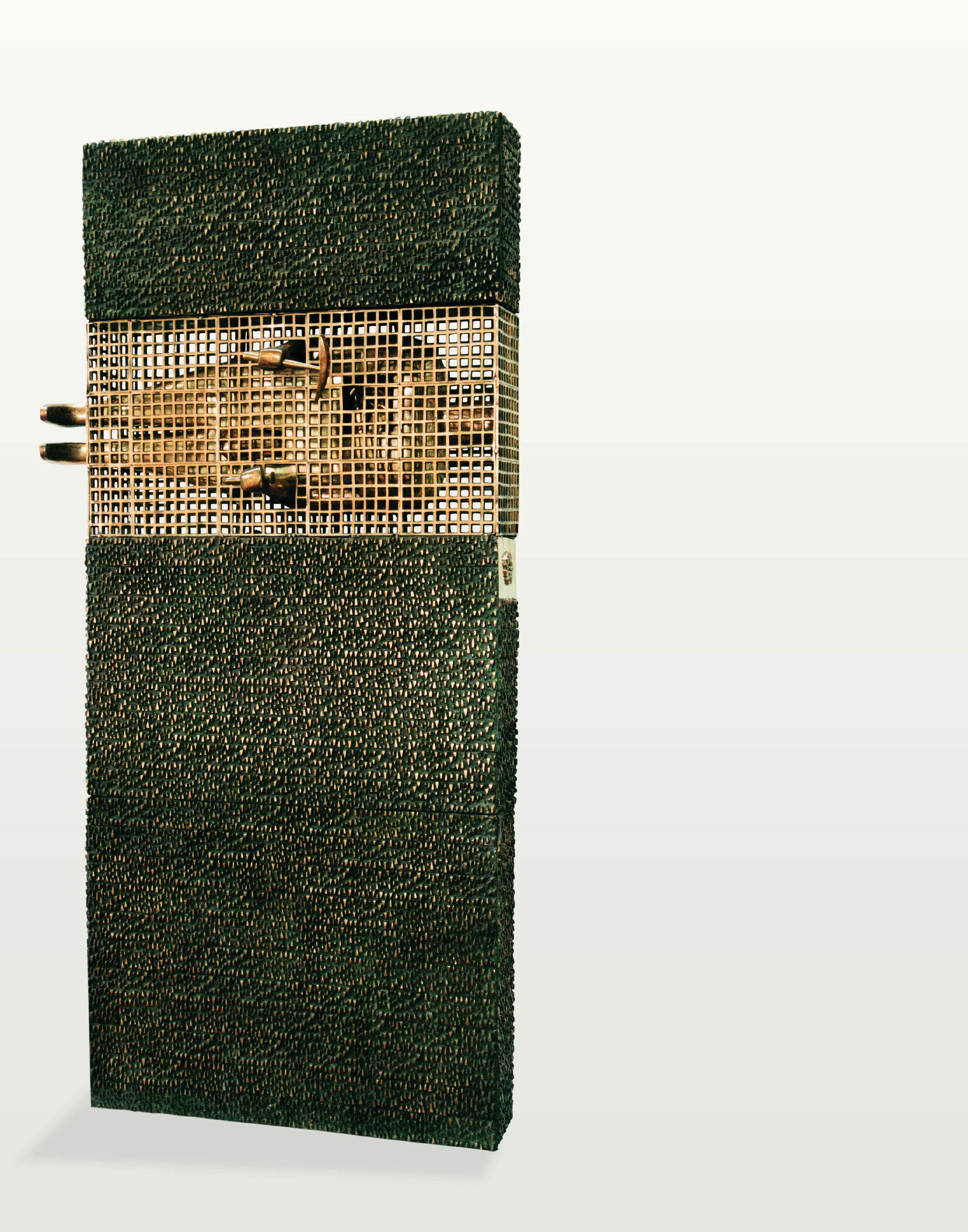
A Shrine of Farad the Mountain Carver, the ancient Persian tale that has inspired Tanavoli’s work for decades, 1975, bronze, 196x45x33 cm. from the Museum of Parviz Tanavoli. (Photo courtesy of Parviz Tanavoli)
Â
“Iranians live with talismans,†the master explains. “For every illness or obstacle there was always a special one. The makers of talismans acted like psychologists today. People would visit shrines and ask them for help, and they would write a ‘prescription’ — an engraving in copper, brass, or silver.â€
The talismans were traditionally body parts like eyes, hands, hearts, or even legs for people who couldn’t walk, relates Tanavoli. For the lovelorn, special images of happy couples or say, a woman sitting on a lion for “strength†would be engraved.
Indeed, there is something of the Sufi mystic in the artist, who admits that his “life changed forever†when he encountered the poet Rumi for the first time at age 16.
Tanavoli quotes a line from one of his favorite poems that could well have inspired his medallion:
I am that bird from the heavens above
To this Earth, I do not belong
Here, for a few fleeting days
Out of my body, I have built a cage
And reads another about nothingness, that speaks to his ongoing sculpture series Heech:
Existence all nothing and All beings nothing … Â
After you die Do you know what shall be? Â
There shall be love and kindness The remainder, nothing
Then there is the famous line: “We came whirling out of nothingness scattering stars like dust.â€
“Rumi,†says Tanavoli, “was my first mentor.â€
Protesting “nothingnessâ€
Tanavoli’s Heech (the word for “nothing†in Farsi) series has evolved into a kind of abstracted progression from his school of Saqqakhaneh, boldly expressing the passion and poetry of calligraphy with a contemporary sensibility, in the form of sculpture and even jewelry. Each new incarnation speaks to a different era in the artist’s trajectory. When it premiered in 1965 Tehran, it was a protest against the “nothingness†of the Iranian commercial art scene that the young artist found too confining in its bourgeois fixation on “prettiness.â€
In 1960, fresh from a scholarship to study in Italy with the likes of Marino Marini, Tanavoli kept a studio on south Tehran’s Pahlavi Avenue called Atelier Kaboud, notable for its giant scrap metal sculpture of a man embracing a deer displayed on the balcony, that would become an artistic hub for young artists and intellectuals. He used found objects from the neighborhood’s foundries, blacksmiths, and welders’ shops, incorporating them into his sculptures, ceramics, and paintings. At the same time, he began collecting devotional objects and carpets. The resulting style, coined by some as “spiritual pop art,†often shocked prevailing mores, but in 1961 it also caught the eye of American patron Abby Weed Grey, in town for an exhibition of Minnesotan artists she had organized through the Iran-America Society.
After Rumi and Empress Farah, Grey, who organized a residency for him at the Minneapolis School of Art in early 1962, would become another mentor and important collector. When Tanavoli returned to Iran two and half years later, he began to prepare for a 1965 exhibition at the aptly named Borghese Gallery that shocked local audiences with the likes of toilet ewers and other everyday objects married to traditional folkloric design and evoked as semi-sacred icons. The gallery had to close when a mob threatened to burn it down. Â
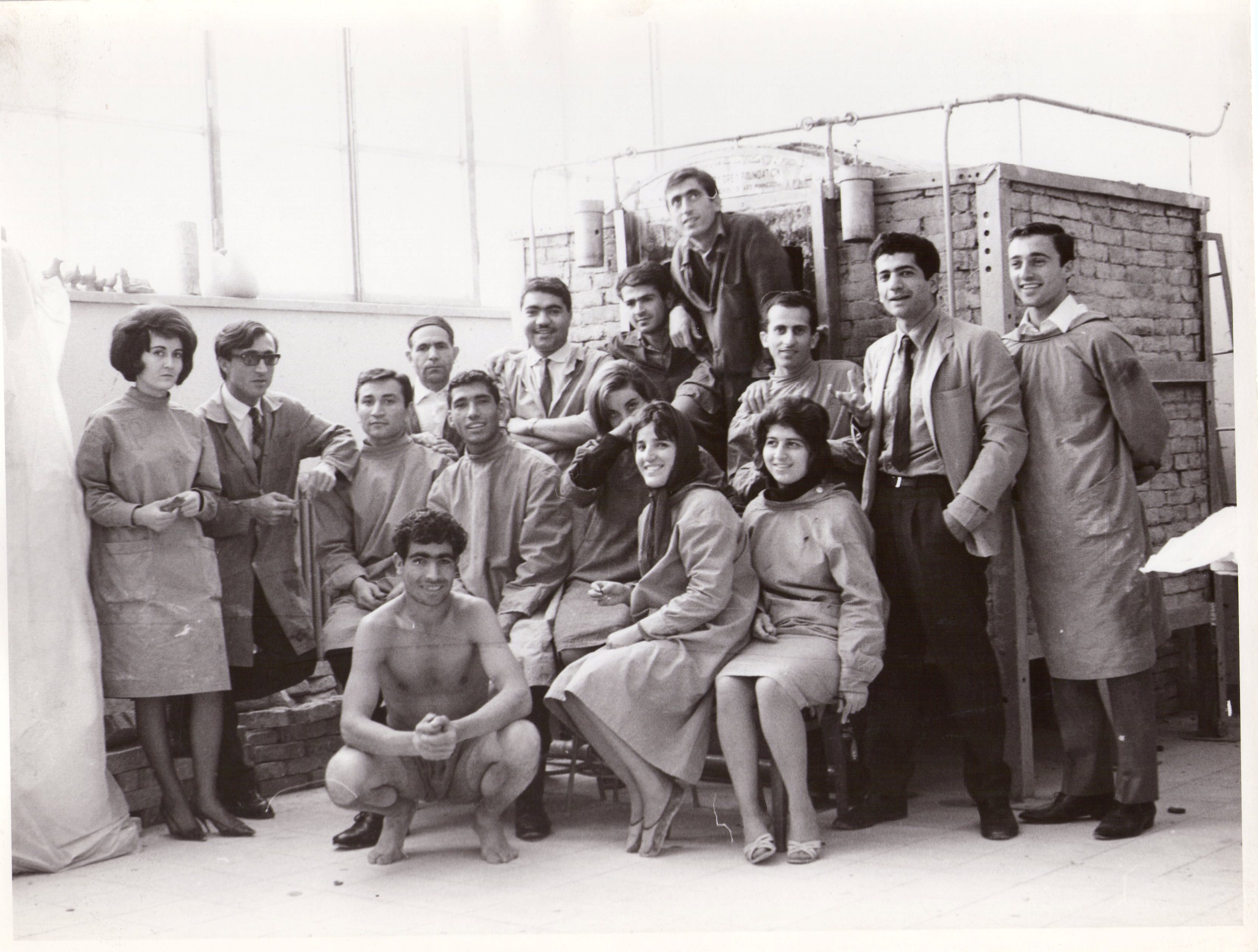
Parviz Tanavoli with students at Tehran University in 1965. (Photo courtesy of Parviz Tanavoli)
Â
Tanavoli himself, through his patronage by Empress Farah, was instrumental in the development of the rich contemporary art scene in Iran. The empress, who was studying architecture in Paris when she met the Shah, “did so much for the art of Iran — and so much for me as an artist,†remembers Tanavoli.†She paved the ground and created a good atmosphere for arts in Iran. I managed to grow up under her and to grow up faster as an artist.â€
Tanavoli was also invited to be on the board of her foundation, advising on the permanent collection at the Tehran Museum of Contemporary Art, which until today still has one of the best collections of Western 20th century art in the region. “The 60s and 70s were really the golden age for the arts in Iran,†he reminisces.
Grey returned to Iran in 1973, on the occasion of a special exhibition of Tanavoli’s Heech sculptures, when she acquired the monumental Heech Tablet, a seven-foot-high bronze statue covered with stylized cuneiform markings, evoking both ancient Persian and Islamic folk motifs. Six years later, Tanavoli’s career was truncated by the 1979 Revolution, and his passport was seized. He used his decade of internal exile to travel to the north of Iran to study and acquire nomadic rugs and textiles and wrote several books on the subject. When his passport was returned in 1989, he emigrated with his young family to Vancouver, but over the past decade has travelled every three months to Tehran, to teach, create, write, and keep abreast of the contemporary art scene.
In 2005, his Heech in a Cage became a protest against prisoners in Guantanamo. In 2016, a 15-foot version in steel was installed at the entrance to the Aga Khan Museum in Toronto. This spring, an even larger version, at 18 feet high, was installed in the courtyard of a new residential tower (designed by architect Chris Dikeakos) in a Vancouver suburb. Commissioned by the prominent Iranian Malekyazdi family’s Millennium Development company, this Heech is now part of the city of Burnaby’s permanent art collection. Not without some irony, considering its name, the unveiling of the sculpture was delayed by the corona crisis, and so it stands alone now in an empty courtyard, contemplating beingness and nothingness in a fusion of Sufism and Sartre. Â
Heech Triomphe, Burnaby, Vancouver. (Photo courtesy of John Gordon)
Â
Vancouver and Tehran
For Tanavoli, whose work has been exhibited at the Tate Modern and the British Museum, the anonymity of Vancouver provides a happy balance with the intensity of Tehran.
“I have a good studio in Tehran,†he recounts, “with many assistants — which I don’t have here. But the peace I have here is impossible in Iran, where life is exciting but turbulent.â€
Indeed, turbulent may be an understatement. After accepting a 2002 offer from the then mayor of Tehran under the rule of reformist Mohammad Khatami to sell his art-filled house and studio (designed in 1967 by architect Kamran Diab — a cousin of Empress Farah) to the city as a museum, he faced a six-year battle with Mahmoud Ahmadinejad. Elected as mayor only a few months after the initial agreement, he called Tanavoli’s work “Western rubbish†and threatened to turn the house into a mosque. The Supreme Court eventually returned his house and artworks to him in 2008, the same year as his sculpture, The Wall (Oh Persepolis), sold for £1.87m at an auction in Dubai, setting a new record for Middle Eastern artists and making him the highest-earning Iranian artist.Â
But now Tanavoli’s two cities, locked in a traveler’s embrace, seem as naturally intertwined as his Heech lovers, with many of his works executed in Iran conceived in the quiet contemplation of his Vancouver studio.
In the Vancouver suburb of Horseshoe Bay where “nothing ever happens†Tanavoli lives the life of a journeyman hermit, rising at dawn for a walk by the sea, before spending hours in his library and studio, sketching, writing, and seeking solace in his extensive collections of textiles and artwork. Â
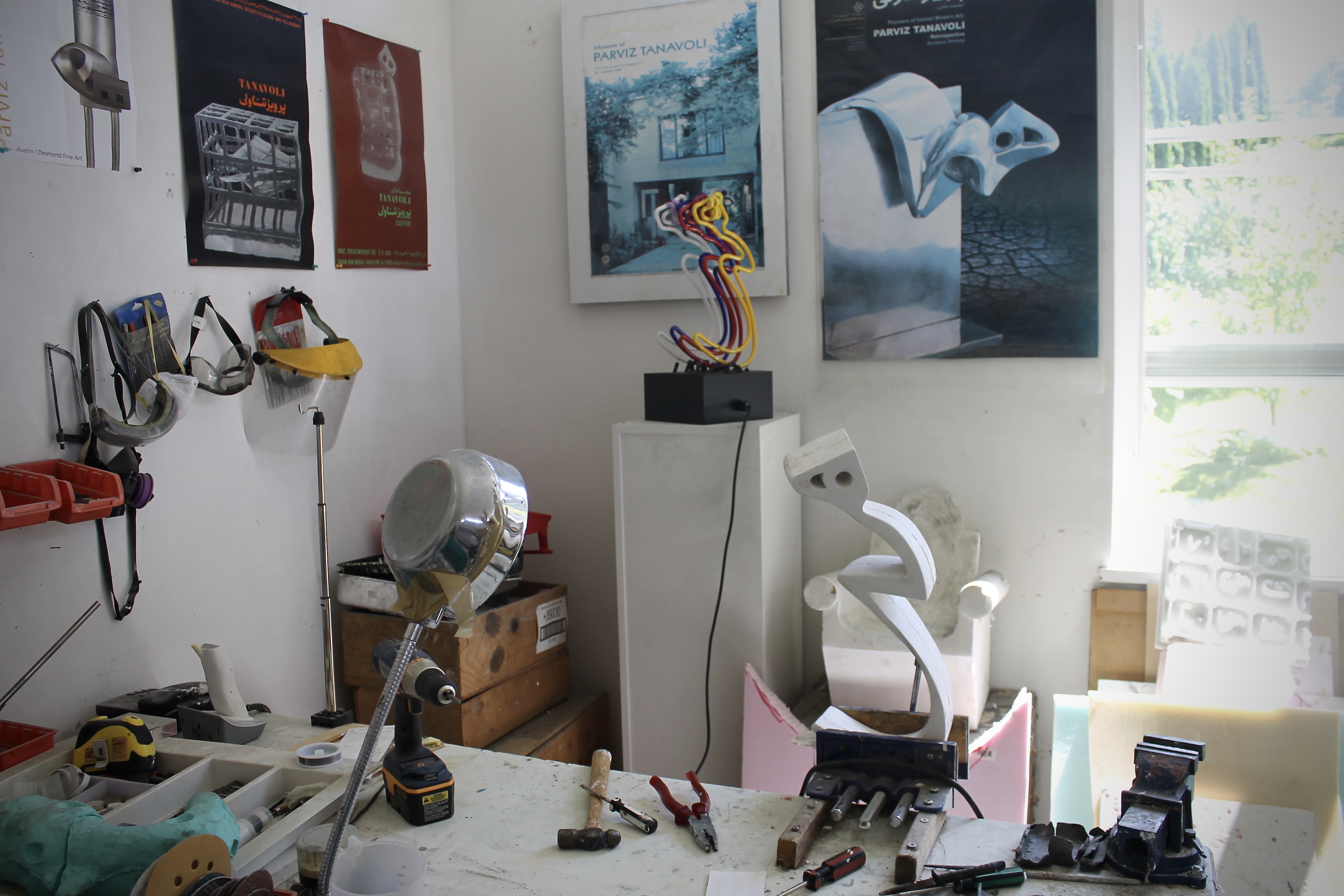
Parviz Tanavoli’s studio in Horseshoe Bay, Vancouver. (Photo by Hadani Ditmars)
Â
Even as he continues to make something out of nothing, Tanavoli’s longing for his homeland — where current pandemic conditions prevent him from travelling — is evident. Contrary to the stereotyped image of Iranians in the West, Tanavoli sees them as a nation of “art lovers.â€
“During 40 years of revolutionary government,†he contends, “contemporary art has flourished — not because of the government, but because of Iranians themselves. They cannot live without art, it’s part of their everyday lives.â€
“When people get married,†he relates, “there is always a list of artworks like rugs and miniatures included in the dowry. Iranians always like to live with art and show it to their friends and guests. In every small apartment you find something interesting that draws you in.â€
While Canada has provided his family with safety and space, there is an emptiness that comes with that. “Here, if you go to a rich man’s house, there’s lots of expensive furniture but nothing that touches you in terms of art.â€
Today artists and intellectuals share in the suffering of their fellow Iranians. The market for art has fallen with people’s incomes and even publication of Tanavoli’s next book has been delayed due to a shortage of ink and paper (although his last book is available from Bloomsbury in London).
Yet artists remain at the forefront of social protest movements, albeit by employing veiled allusions and double meanings in poetry, theater, and visual arts, says Tanavoli. Â
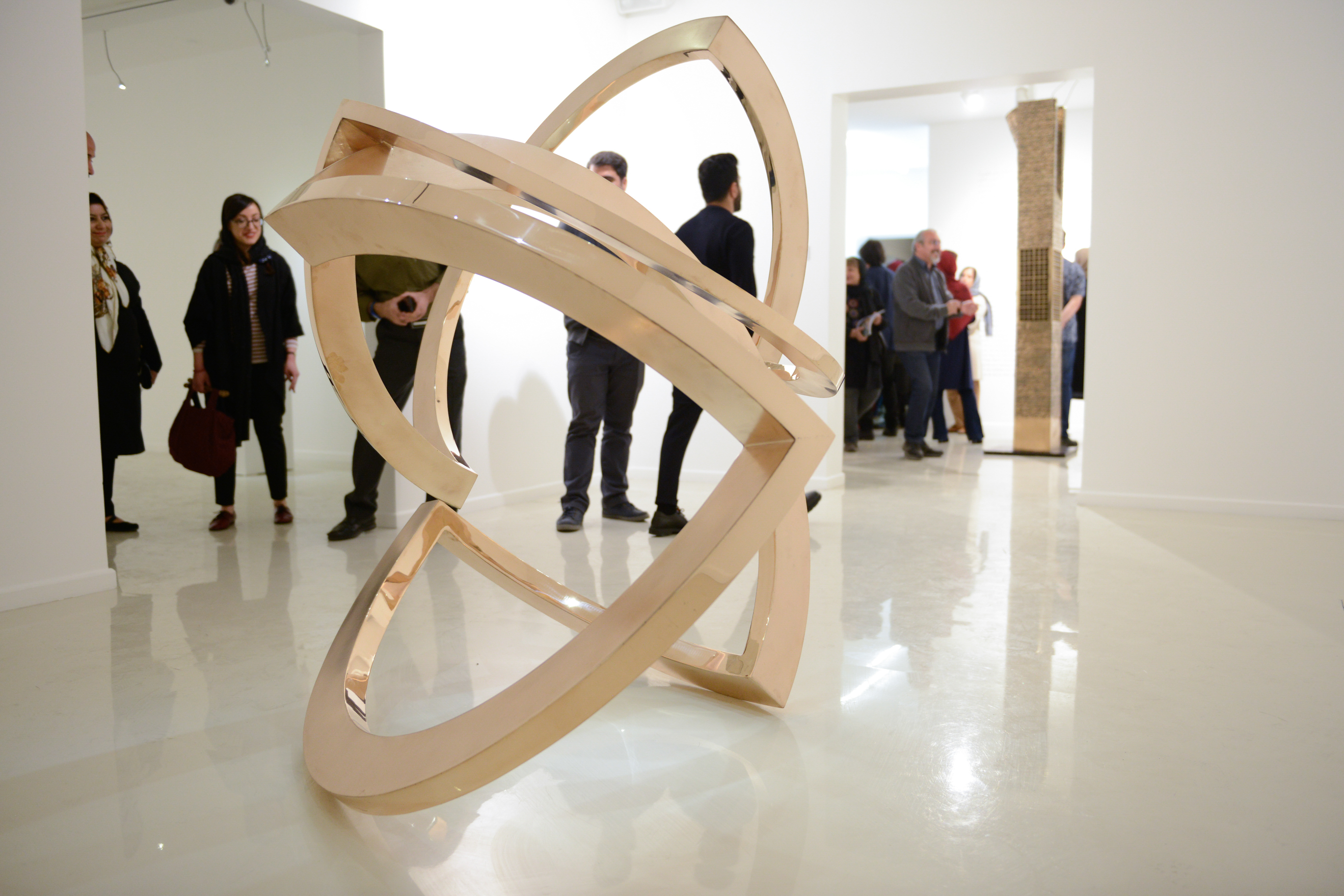
2017 Exhibition Parviz Tanavoli and Atelier Niavaran. (Photo courtesy of Parviz Tanavoli)
Â
“Only a miracle could save things nowâ€
But his homeland is in dire straits, contends the artist.
“I hope there are no crazy wars like in Syria, Iraq, and Afghanistan,†he says. “I
hope the people of Iran are wise enough to take a peaceful route, although it doesn’t depend on the people but on the leaders.â€
While he hopes for an end to the current political deadlock between Iran and the West, he admits that given current circumstances, “Only a miracle could save things now.â€
As for international sanctions on Iran, already lifted by the European Union on humanitarian grounds, Tanavoli hopes that the U.S. and Canada will follow suit, saying “If they don’t, more people will die.â€
“If the world doesn’t respond to Iran’s cry for help, God knows what will happen. There will be a catastrophe.â€
Still Tanavoli sees some silver linings in the current global pandemic, which has forced everyone to engage with one of the main Sufi principles of isolation. “When your brain is not so occupied by the distraction of daily life, the result is a deeper discovery of your own mind and the universe around you.â€
The coronavirus crisis, he says, has shown that “We are all a part of this world and we have to live with each other.†Paraphrasing an old Iranian proverb, he says, “We cannot play just our own sound; if there is a song, we have to sing it together.â€
And like the nightingale on his medallions who bring good tidings, Tanavoli’s art continues to heal the hearts of Iranians — and art lovers — everywhere.
Â
Hadani Ditmars is the author of “Dancing in the No-Fly Zone: A Woman’s Journey Through Iraq,” a past editor at New Internationalist, and has been reporting from the Middle East on culture, society, and politics for two decades. The views expressed in this article are her own.  Â
On Friday, the Transportation Security Administration screened 348,673 people at American airports, the most since travel went into a free-fall in mid-March, likely driven by people traveling ahead of Memorial Day weekend. Still, a year ago, more than 2.7 million people were screened, showing just how far the industry has to come back.
For people who are thinking of flying this summer, or in the months after, air travel will be a far different experience than it was before the coronavirus. The days of casually hopping in a cab or Uber to the airport, then jostling for space in the overhead, are over, at least for the moment. From the curb to the plane, each portion of the journey has new rules and new things to think about.
Here’s what we know about navigating air travel safely now.
What’s the best way to get to the airport?
If someone you have been isolating with can drop you in their own car, that raises the least possible risk. If you need to take a car service like Uber or Lyft, you should remember that those companies are not allowing ride shares (so you can expect to pay more for your ride) and it’s courteous to drivers and passengers who come after you to wipe down the seat and door handle before exiting the car. Uber and Lyft are requiring that all passengers and drivers wear masks. The companies said they are also providing cleaning supplies to as many drivers as possible.
Many airports around the country have changed their drop-off, pickup and parking procedures to encourage people to keep moving. Make sure you know what your airport’s current policies on drop-off and parking are. Most airports have created pages with Covid-19 updates. Many airports have closed their long-term parking lots, but are keeping daily and hourly garages open.
Most airports have adjusted their rules to allow only ticketed passengers and people helping them check in to enter terminals, so take that into account when planning who will accompany you.
Before going to the airport, how should I prepare?
Flying has always been a high-touch exercise so think about all those points and how you can minimize them. Wrapping yourself head to toe in plastic wrap is not really necessary, but you should carry — and use — a mask, wipes and hand sanitizer. Some experts suggest wearing gloves, though the Centers for Disease Control’s guidance suggests they are not necessary.
Most airlines suggest that travelers download their app for touchless boarding, which will minimize the number of times you have to hand over documents or touch screens. Think about whether you want to check a bag or if you can make the trip with a carry-on (experts don’t necessarily think one is better than the other). Some airlines have shut down self-service kiosks and others, like United, have begun rolling out touchless kiosks that allow customers to print bag tags using their own devices to scan a QR code.
What should I expect at the airport?
Lots of cleaning. Airports have been cleaning everything from the floors and surfaces to the air more rigorously. Long Island MacArthur Airport, for example, is using something called Continuous Air and Surface Pathogen Reduction, a system that continuously sanitizes air and surfaces. CASPR attacks pathogens by converting oxygen and moisture into hydrogen peroxide and releasing that into the air. Pittsburgh International recently became the first American airport to use robots with UV-C rays to clean and disinfect the floors in high-traffic areas.
Other airports have increased hand sanitizer stations throughout the airport as well as the regularity with which they are cleaning; in some cases it’s hourly. Many are also requiring all passengers to wear masks.
JetBlue said last week that it has increased the frequency with which it is cleaning surfaces in its airport terminals with a hospital-grade disinfectant. United also said last week that it is working with Cleveland Clinic experts and Clorox to ensure it is using the best cleaning practices.
Many airport shops may be closed, and not all airlines are serving food on flights, so you may want to bring your own food for the plane. Most airports are discouraging the use of cash. You may want to make sure you have a tap-to-pay card or have set up contactless payments like Apple Pay on your phone.
How can I be safe during check in and security?
That’s where your at-home prep comes in. Do as much of the process on your airline’s app as you can. Bring hand sanitizer in case you need to hand over documents or your phone, or if you need to key anything in at a kiosk. Pay attention to the floor markers indicating the proper social distancing. Even though crowds have been thin, maintaining social distancing may be difficult, so wear your mask. Expect T.S.A. agents to be wearing them as well.
T.S.A. has tweaked its security procedures to reduce how much travelers have to handle security bins and to keep agents from touching travelers’ belongings. At the podium, you no longer have to hand your boarding pass to a T.S.A. agent. Instead, you will place your electronic or paper boarding pass on the boarding pass reader yourself. After scanning, you should hold your boarding pass up for an agent to inspect it.
If you have food, don’t put it into your carry on. Put it into a clear plastic bag and then put that bag into a bin. “Separating the food from the carry-on bag lessens the likelihood that a T.S.A. officer will need to open the carry-on bag and remove the food items for a closer inspection,†a T.S.A. announcement on Thursday said. T.S.A. Precheck members do not need to remove items from their bags.
To reduce the number of things that go into the reusable plastic bins, put items, including belts, wallets, keys and phones, into your carry-on bags, rather than into a bin.
If you need to be patted down, T.S.A. officers will change gloves after each pat down.
How can I make it through the boarding scrum?
Ask your airline what its current procedure for boarding is. Southwest, for example, has been having people board in groups of 10, with people only lining up on one side of its boarding poles. United is boarding people by row, with people sitting in the back of the plane boarding after preboarding groups. JetBlue is also implementing back-to-front boarding. Most airlines are boarding fewer people at a time to keep crowds from forming at the gate, on the jet bridge and as people get on the plane. Airlines are also asking people to scan their own boarding passes.
Policies differ by airline, but most airlines are asking passengers to wear masks to board and on flights.
Do I need to wipe down my seat?
Doing a full Naomi Campbell is not necessarily a bad idea, but airlines say they have stepped up the deep cleaning of planes, sometimes between every flight. Delta is using an “electrostatic sprayer,†which releases a mist of disinfectant. American Airlines planes are tidied throughout the day and cleaned for more than six hours every night. Alaska Airlines increased its cleaning procedures between flights. Most airlines have created a Covid-19 page with information about what they are doing to keep passengers safe. This page, in many cases, has detailed information about what kind of cleaning protocols an airline is following.
Do I need to keep my mask on?
Yes, most airlines are asking people to keep them on for the duration of their flight. You should know that the air on the plane is pretty clean: Commercial planes recycle cabin air using High Efficiency Particulate Air (HEPA) filters, so the air might not be fresh, but it is scrubbed. HEPA filters catch 99 percent of airborne microbes, according to the International Air Transportation Association, an industry group.
Masks can be taken off to eat and drink (on airlines that are serving meals). You can bring your own food onto the plane, though Southwest is asking people to eat before traveling. United recently introduced an “all in one†economy snack bag that includes a sanitizer wipe, an 8.5 oz. bottled water, a Stroopwafel and a package of pretzels. It is being passed out during the flight.
Will someone be in the seat next to me?
They might be. Pictures of flights in which every seat seems full have been making the rounds on social media. They are not the norm. On average, flights are carrying about 39 passengers, down from the first two months of the year, when flights were carrying about 85 to 100 passengers.
Airlines for America, an industry lobbying group, says that most flights — about 73 percent — are less than 50 percent full.
Updated June 2, 2020
Will protests set off a second viral wave of coronavirus?
Mass protests against police brutality that have brought thousands of people onto the streets in cities across America are raising the specter of new coronavirus outbreaks, prompting political leaders, physicians and public health experts to warn that the crowds could cause a surge in cases. While many political leaders affirmed the right of protesters to express themselves, they urged the demonstrators to wear face masks and maintain social distancing, both to protect themselves and to prevent further community spread of the virus. Some infectious disease experts were reassured by the fact that the protests were held outdoors, saying the open air settings could mitigate the risk of transmission.
How do we start exercising again without hurting ourselves after months of lockdown?
Exercise researchers and physicians have some blunt advice for those of us aiming to return to regular exercise now: Start slowly and then rev up your workouts, also slowly. American adults tended to be about 12 percent less active after the stay-at-home mandates began in March than they were in January. But there are steps you can take to ease your way back into regular exercise safely. First, “start at no more than 50 percent of the exercise you were doing before Covid,†says Dr. Monica Rho, the chief of musculoskeletal medicine at the Shirley Ryan AbilityLab in Chicago. Thread in some preparatory squats, too, she advises. “When you haven’t been exercising, you lose muscle mass.†Expect some muscle twinges after these preliminary, post-lockdown sessions, especially a day or two later. But sudden or increasing pain during exercise is a clarion call to stop and return home.
My state is reopening. Is it safe to go out?
States are reopening bit by bit. This means that more public spaces are available for use and more and more businesses are being allowed to open again. The federal government is largely leaving the decision up to states, and some state leaders are leaving the decision up to local authorities. Even if you aren’t being told to stay at home, it’s still a good idea to limit trips outside and your interaction with other people.
What’s the risk of catching coronavirus from a surface?
Touching contaminated objects and then infecting ourselves with the germs is not typically how the virus spreads. But it can happen. A number of studies of flu, rhinovirus, coronavirus and other microbes have shown that respiratory illnesses, including the new coronavirus, can spread by touching contaminated surfaces, particularly in places like day care centers, offices and hospitals. But a long chain of events has to happen for the disease to spread that way. The best way to protect yourself from coronavirus — whether it’s surface transmission or close human contact — is still social distancing, washing your hands, not touching your face and wearing masks.
What are the symptoms of coronavirus?
Common symptoms include fever, a dry cough, fatigue and difficulty breathing or shortness of breath. Some of these symptoms overlap with those of the flu, making detection difficult, but runny noses and stuffy sinuses are less common. The C.D.C. has also added chills, muscle pain, sore throat, headache and a new loss of the sense of taste or smell as symptoms to look out for. Most people fall ill five to seven days after exposure, but symptoms may appear in as few as two days or as many as 14 days.
How can I protect myself while flying?
If air travel is unavoidable, there are some steps you can take to protect yourself. Most important: Wash your hands often, and stop touching your face. If possible, choose a window seat. A study from Emory University found that during flu season, the safest place to sit on a plane is by a window, as people sitting in window seats had less contact with potentially sick people. Disinfect hard surfaces. When you get to your seat and your hands are clean, use disinfecting wipes to clean the hard surfaces at your seat like the head and arm rest, the seatbelt buckle, the remote, screen, seat back pocket and the tray table. If the seat is hard and nonporous or leather or pleather, you can wipe that down, too. (Using wipes on upholstered seats could lead to a wet seat and spreading of germs rather than killing them.)
How many people have lost their jobs due to coronavirus in the U.S.?
More than 40 million people — the equivalent of 1 in 4 U.S. workers — have filed for unemployment benefits since the pandemic took hold. One in five who were working in February reported losing a job or being furloughed in March or the beginning of April, data from a Federal Reserve survey released on May 14 showed, and that pain was highly concentrated among low earners. Fully 39 percent of former workers living in a household earning $40,000 or less lost work, compared with 13 percent in those making more than $100,000, a Fed official said.
Should I wear a mask?
The C.D.C. has recommended that all Americans wear cloth masks if they go out in public. This is a shift in federal guidance reflecting new concerns that the coronavirus is being spread by infected people who have no symptoms. Until now, the C.D.C., like the W.H.O., has advised that ordinary people don’t need to wear masks unless they are sick and coughing. Part of the reason was to preserve medical-grade masks for health care workers who desperately need them at a time when they are in continuously short supply. Masks don’t replace hand washing and social distancing.
What should I do if I feel sick?
If you’ve been exposed to the coronavirus or think you have, and have a fever or symptoms like a cough or difficulty breathing, call a doctor. They should give you advice on whether you should be tested, how to get tested, and how to seek medical treatment without potentially infecting or exposing others.
“Airlines are attempting to leave some seats open for distancing between travelers when feasible, but not all circumstances allow for that,†the organization said in a statement this week.
If you are concerned about sitting next to someone and have a choice of airlines, consider their different policies. JetBlue said this week that it will continue to block middle seats on Airbus planes in rows where people aren’t traveling together through July 4, and will block aisle seats on smaller Embraer 190 planes.
Most airlines state on the reservation page what kind of aircraft they will be flying, but if that information is not there, you can enter the information that you do have about a flight, like its departure city, destination and date of travel on a site like ITA Matrix or SeatGuru to find out about the aircraft.
United said this week that it will be limiting advance seat selections “where possible†and allowing customers to take alternative flights when a flight is expected to be more than 70 percent full. The airline will reach out to customers via email 24 hours before their flight to provide rebooking options.
When choosing your seat, if you think you won’t need to get up for the duration of the flight, a window seat is a good idea because people sitting in window seats have less contact with potentially sick people.
Like most people, you probably do not enjoy going to the doctor only to be referred to a specialist in a different practice. Unfortunately, fragmented care is often the reality among people suffering from common mental illnesses such as depression or anxiety. Wouldn’t it be nice to have both your behavioral and physical health needs addressed at the same time and in the same place?
Comprehensive physical and behavioral health care
In medicine, illnesses of the brain are often treated in specialized settings, separate from the rest of medical care. However, we know that there is a strong link between mental illnesses and numerous medical conditions including heart diseases, lung diseases, immune function, and pain. Mental illnesses can cause or exacerbate physical illnesses, but the reverse is true as well: physical illnesses can result in psychological distress or illness through common pathways such as inflammation. Treating mental illnesses in the primary care setting improves access to mental health care and reduces stigma. Although the burden of mental illnesses in primary care settings is high, many primary care physicians do not feel comfortable managing these conditions alone.
What is collaborative care?
Collaborative care is a team-based model of integrated psychiatric and primary care that can treat mental illnesses in the primary care setting. In our practice, a multidisciplinary “teamlet†of a behavioral health coach, a social worker, and a psychiatrist work together in a coordinated fashion to provide treatment to the patient, and to provide recommendations for the patient’s primary care physician. Treatment is truly patient-centered, and the clinicians often use motivational interviewing to help a patient identify and achieve their behavioral health goals. This model of care is time-limited, generally six sessions every other week for 12 weeks, followed by three monthly maintenance sessions.
Collaborative care helps you meet your goals
Patients may enroll in collaborative care to receive treatment for anxiety or depression, to receive treatment for substance use disorders, or to learn skills to manage stress at work or at home. Goals may include increasing physical activity, setting a quit date for smoking, or practicing mindfulness to reduce anxiety. In addition to behavioral health coaching, the teamlet may also connect a patient to resources (financial, support groups, housing) or provide medication recommendations. To ensure that the patient improves during treatment, collaborative care uses patient-reported outcome measures to drive clinical decision-making, such as symptom rating scales.
Collaborative care during COVID-19
The psychological toll of the pandemic on people infected with the virus and their loved ones is profound. The collaborative care team at our institution has adapted to this surge of distress by providing additional support to patients and their families. Through virtual coaching (by phone or video), coaches have broadened their repertoire to provide specific cognitive behavioral therapy (CBT) interventions to address COVID-19 related anxiety and mood symptoms. Patients have access to COVID-19 workbooks, and they may enroll in internet-based CBT modules that focus on managing anxiety or depressive symptoms related to the pandemic.
What else can help me during this pandemic?
Whether collaborative care is offered at your doctor’s practice or not, there are many available resources to help you and your loved ones cope during these difficult times. In addition to the resources available at health.harvard.edu, there are the free and evidence-based COVID Coach mobile application, the free online course Coping during the pandemic, and the free online meditation resources for times of social distancing/COVID-19 — all wonderful tools to support your mental health. Lastly, there is a reason why behavioral health coaching often involves physical activity — it remains one of the best ways to rapidly improve your mood, decrease anxiety, and boost your overall brain health.
CAPE CANAVERAL, Florida (AP) — A SpaceX rocket is ready to boost two NASA astronauts into orbit Wednesday, the first launch of Americans from the U.S. in nearly a decade.
Liftoff is set for 4:33 p.m. EDT from the same spot at Kennedy Space Center where men flew to the moon and the last space shuttle blasted off in 2011.
“This is a big moment in time,†NASA Administrator Jim Bridenstine said on the eve of the launch. “It’s been nine years since we’ve had this opportunity.â€
The launch puts Elon Musk’s SpaceX on the cusp of becoming the first private company to put astronauts in orbit, something achieved by just three countries — Russia, the U.S. and China.
Riding aboard the brand new SpaceX Dragon capsule for the historic flight: veteran NASA astronauts Doug Hurley and Bob Behnken. The test flight will take them to the International Space Station.
“We are ready!†Behnken tweeted Tuesday night.
Bridenstine describes the duo as bold American heroes who are “laying the foundation for a new era in human spaceflight.â€
Wednesday’s weather in Florida has been a concern; it was raining with low clouds in the morning.
NASA pushed ahead with the astronaut launch despite the coronavirus pandemic, but asked spectators to stay at home to lower the risk of spreading the virus. Beaches and parks along Florida’s Space Coast are open again, and local officials and businesses put out a socially distanced welcome mat. Signs on local businesses wished “Godspeed SpaceX.â€
Hours before the launch, cars and RVs lined the causeway in Cape Canaveral, with prime views of the pad.
ASSOCIATED PRESS
The SpaceX Falcon 9, with the Crew Dragon spacecraft on top of the rocket, sits on Launch Pad 39-A on May 25, 2020, at Kennedy Space Center, Fla.Â
President Donald Trump and Vice President Mike Pence are expected to be at Kennedy, where visitors will be limited.
NASA will have input throughout the countdown, but in the end, it will be SpaceX giving the final go — with NASA’s concurrence.
“SpaceX is controlling the vehicle, there’s no fluff about that,†said Norm Knight, a NASA flight operations manager.
Besides good weather at the launch site, SpaceX needs relatively calm waves and wind up the U.S. and Canadian seaboard and across the North Atlantic to Ireland, in case astronauts Hurley and Behnken need to make an emergency splashdown along the route to orbit.
If SpaceX does not launch during Wednesday’s split-second window, the next try would be Saturday.
The last time astronauts launched from Florida was on NASA’s final space shuttle flight in July 2011. Hurley was the pilot of that mission.
Hurley, 53, and Behnken, 49, are both two-time shuttle fliers.
NASA hired SpaceX and Boeing in 2014 to transport astronauts to the space station, after commercial cargo shipments had taken off. Development of SpaceX’s Dragon and Boeing’s Starliner capsules took longer than expected, however, and the U.S. has been paying Russia to launch NASA astronauts in the interim.
The Associated Press Health and Science Department receives support from the Howard Hughes Medical Institute’s Department of Science Education. The AP is solely responsible for all content.
Calling all HuffPost superfans!
Sign up for membership to become a founding member and help shape HuffPost’s next chapter
Satellite imagery of a town in Myanmar’s restive Rakhine state proves that almost 200 homes and other structures were destroyed by fire on May 16, Human Rights Watch said Tuesday.
In a statement, the New York-based NGO called for an impartial investigation into what it called a “mass destruction of residential property†in Let Kar village, a mostly ethnic Rakhine community in Mrauk-U township.
Fighting in the area flared up again in January 2019 between Myanmar’s military, called the Tatmadaw, and the Arakan Army (AA), an insurgent group of ethnic Rakhine rebels. According to HRW, the satellite images show similatity to the Tatmadaw’s arson attacks on Rohingya villages in Rakhine dating back as far as 2012.
RFA reported the incident last week, interviewing a villager who declined to be named, citing security concerns, who said that 194 of the village’s 301 homes and a middle school were set alight by the Tatmadaw. The military denied purposefully torching the buildings and blamed the AA, while AA spokesman Khine Thukha said he would enlist the help of international organizations to investigate.
“The burning of Let Kar village has all the hallmarks of Myanmar military arson on Rohingya villages in recent years,†said Phil Robertson, HRW’s deputy Asia director.
“A credible and impartial investigation is urgently needed to find out what happened, punish those responsible, and provide compensation to villagers harmed,†he said.
The satellite record showed that at 10:30 a.m. on May 16 Let Kar is free of significant damage, however as of 2:12 p.m. fires were raging in buildings there. HRW said that their estimate of 200 buildings engulfed in flames might be an underestimate because the internal damage to buildings is not visible in the imagery.
Witnesses in neighboring Bu Ywat Ma Nyo village, about one kilometer way from Let Kar, Â told local media that they saw soldiers of the Tatmadaw go past their village toward Let Kar at about 2 p.m. on May 16, leaving at about 5 p.m, which corresponds to the imagery.
The neighboring villagers said they heard gunfire and observed flames and smoke along with two drones, one in Let Kar and the other in Bu Ywat Ma Nyo.
HRW interviewed an aid worker from Mrauk-U, who said that after 2 p.m. on May 16, it appeared that there was smoke originating from Let Kar.
“There was no one living there after the fighting last year as [the residents] had fled, but the older people really have nowhere to go now,†he said.
“They had been sheltering in IDP [internally displaced persons] camps in Tein Myo and Bu Ywat Ma Nyo villages and had at least been able to go home and collect their belongings or check their homes from time to time. Now they don’t have anything – it’s very sad.â€
According to HRW, most of Let Kar’s residents residents left the village more than a year ago, when hostilities increased.
“On April 10, 2019, the military raided Let Kar and detained 27 men for questioning about alleged ties to the Arakan Army. By April 22, three of the men had died in custody, attributed to “heart failureâ€Â by the military-owned Myawaddy newspaper,†the HRW statement said.
“No autopsies were performed because the security forces swiftly cremated the bodies. The authorities contested allegations that the men were tortured but refused to investigate the deaths. The 24 others, two of whom are minors, remain detained in Sittwe,†it added.
According to a local source, a former resident of Let Kar entered the village the next day after the attack to inspect the damage, telling the source that at least 194 buildings had been burnt down, including a school and the resident’s former home. The resident and several others went to Let Kar by motorbike, passing 50 Tatmadaw soldiers without being stopped.
Tun Thar Sein, a member of parliament from Rakhine State, confirmed to HRW that the Tatmadaw were in the area and that he and others would urge the government to provide aid and compensation to the residents.
Also on May 17, the Tatmadaw released a statement saying that troops entered the village while on patrol on May 16 after being attacked by the AA. Myanmar’s army also released an aerial image of the burning buildings, most likely taken by one of the drones.
According to the Tatmadaw, the fires were started by the AA, who fled into the mountains after damaging more than 20 houses.
The AA on May 19 denied the accusation in a statement, with spokesperson Khine Thuka asking the media to investigate.
“Myanmar Army is not only accusing unilaterally the Arakan Army of committing the crimes that they have committed but also reporting fabricated news about Lakka’s case on the media belonging to Myanmar Army and their sponsored media. This is just an act of trying to blame the other organization for their crimes,†said the AA statement.
HRW in the statement accused the Tatmadaw of war crimes, saying that under the laws of war, attacks on “civilians and civilian objects, such as homes, are prohibited.â€
The NGO said Myanmar has a responsibility to investigate the alleged crimes and hold its soldiers accountable, in addition to providing compensation and condolence payments to victims.
“Myanmar’s government should not leave the investigation of this incident to the military, which has repeatedly covered up atrocities and exonerated its troops,†Robertson said.
“To ensure a credible investigation, the government should request UN assistance,†he added.
RFA attempted to contact a spokesman for the military for comment but he could not be reached.
RFA also contacted U Zaw Htay from the presidential office’s Reporters Online group, but he did not answer inquiries on the matter.
Tatmadaw said responsible for civilian deaths
Meanwhile, RFA has learned that in another part of Rakhine, in the rural town of Ann, a 51-year old villager was shot and killed by the Tatmadaw in early May.
Sources say that U Aung Thein and three other villagers from the same town were pushing a bamboo raft to the next closest town of Kan Htaung Kyi, when they were unexpectedly fired upon by soldiers stationed at a bridge.
“The three men, including [my husband] were shot as they approached Kazugaing bridge,†U Aung Thein’s wife, who declined to be named, told RFA’s Myanmar Service.
“They say the shooters were government soldiers. We have not yet found the body of [my husband],†she added.
According to U Aung Thein’s wife, since the army has closed the road into the area, she has been unable to bring back her husband’s body.
Reports of villagers disappearing in Rakhine after encountering Tatmadaw troops are becoming increasingly common.
In an unrelated incident, two men from Minbya Township were killed by military troops and their bodies were missing for four months until they were found in a forest, according to a relative of one of the men, who requested anonymity to speak freely.
“There were all kinds of rumors about them,†the relative told RFA.
“Some said they had been detained in an army camp. But at last, their bones and clothes were found on the hill of Shew Kyet Yet pagoda. They were buried in a hole [in the hill],†the relative said.
The relative said when the bodies were discovered, it was impossible to tell which victim was which, so their families had to guess based on the clothes they were wearing.
“Wood cutters found the pieces of bones and told us to come check,†the wife of one of the victims, who requested anonymity for legal reasons told RFA.
“They were buried together in a hole. When they disappeared we notified the police and human rights groups, but there wasn’t any news about them,†she said.
“People are unlawfully arrested and accused of being part of the AA,†said U Myat Tun of the Rakhine Human Rights Protection Group.
“On the other hand, the AA also arrests people and accuses them of being informers for the army. Both sides accuse each other whenever villagers are killed or they disappear,†he said.
AA spokesperson Khine Thukha told RFA, “The government’s army has targeted [and] killed Rakhine civilians, cut out the Internet, enforced a media blackout, and is planning genocide.â€
According to statistics compiled by RFA, there have been 149 civilian deaths and 350 wounded in fighting between the Tatmadaw and AA since the beginning of 2020.
Reported by RFA’s Myanmar Service. Translated by Maung Maung Nyo.
Absent major military escalation by his foreign patrons, Khalifa Hifter has now lost the war he initiated against Libya’s internationally recognized government in Tripoli. The question remains, however, of how to end Libya’s proxy war and restart the necessary political process to bring about sustained peace.
The May 18 capture of Watiya air base by fighters aligned with the Tripoli-based Government of National Accord (GNA) from Hifter’s Libyan National Army (LNA) not only represented a profound strategic loss for Hifter, but also the apparent collapse of his effort to take Tripoli and establish personal rule over all Libya.
Meanwhile, Hifter’s main Middle Eastern backers, Egypt and the UAE, have begun to state quietly that supporting Hifter’s war was a bad bet that they will never make again.
Amid Hifter’s humiliating defeat, his foreign patrons have renewed diplomatic outreach to Aguila Saleh Issa, the speaker of the House of Representatives, Libya’s Tobruk-based Parliament. On April 27, Hifter announced that the UN-brokered Libyan Political Agreement establishing the GNA was “null and void†and declared himself ruler of all Libya. In response, Aguila stated that since Hifter had now lost the war, Russia was supporting him instead.
What happens next?
The main scenarios for Libya in the near term were laid out on May 19 by the UN acting special representative of the secretary-general, Stephanie Williams, in a brutally tough-minded briefing to the UN Security Council. They include the possibility of a last-ditch war effort by Hifter that his air force chief promised would be the “largest aerial campaign in Libyan history†against Turkish targets in the country. On May 26, AFRICOM warned publicly that the newly arrived Russia military aircraft could be providing air support for that — or preparing to seize bases on Libya’s coast, threatening Southern European air security for the long term.
Consistent with their public call for a cease-fire, Russia, the UAE, Egypt, and France for the LNA, and Turkey for the GNA could shut down air attacks by both sides through ceasing to provide the intelligence and guidance needed to make them effective. Each of these countries has repeatedly endorsed a cease-fire since the Jan. 19 Berlin summit sponsored by German Chancellor Angela Merkel, even as they have engaged in rearming their Libyan clients and participated in attacking their Libyan opponents. But despite Russia’s deployments, Turkey is currently seen by the Western countries as the main foreign barrier to a cease-fire, despite its public stance, for obvious reasons: Turkey’s side is now winning and could well retake control of additional Libyan territory if Turkey continues to provide air support (and mercenaries from Syria) for a little while longer. On May 21, Germany, the UK, and France jointly asked Turkey to stand down. U.S. Secretary of State Mike Pompeo reiterated the message to Libyan Prime Minister Fayez al-Serraj the following day. President Donald Trump then made the same point to Turkish President Recep Tayyip Erdogan on May 24.
A sustainable end to the proxy war would have to address arms shipments by land through Egypt and from Sudan involving Russia and/or the UAE, as well as Turkish shipments by sea, and transport by air of military materiel by the principal patrons of the war. It would also have to address the respective parties’ asserted economic interests in Libya, including Turkey backing off from its plans to begin drilling for oil in the eastern Mediterranean in derogation of other — especially Greek — interests.
Any cease-fire deal should include resumption of Libyan oil exports, shut down by Hifter in January to intensify pressure on the GNA. Resumption of these exports would provide renewed hard currency for the country to buy food, medical supplies, and other vital imports.
Stopping the proxy war would help counter the growing COVID-19 humanitarian crisis, exacerbated by rocket attacks on hospitals that have killed doctors and damaged the country’s ability to respond to the pandemic.
A return to the UN roadmap
The UN political roadmap for Libya remains the only realistic path to regain economic viability, political stability, and physical security against terrorists, criminals, and civil conflict. Any short-term deal could enable Libya to generate sufficient revenue to provide the basics to its people. Political stability in even the medium term could put money in the pockets of ordinary Libyans, enable efforts to rebuild national institutions, and distribute revenues to localities to provide services locally, giving every Libyan a stake in the country’s future.
None of this is possible until the foreign actors in the proxy war accept Libya as an independent sovereign country with its own national interests, rather than treating it as a playground for their competing ambitions.
The U.S. could play an important role in achieving an agreement to reinforce the UN process and combat foreign military involvement in domestic Libyan affairs through confidence building measures to assure the foreign patrons that a unified Libyan government would not be dominated by any other foreign state. It is far from certain that Russia, Turkey, Egypt, and the UAE would accept this result rather than one in which they retain competing, if inherently unstable, spheres of influence. But one can at least imagine their accepting some deal so long as their opponents don’t “win†and they don’t “lose.â€
Given his character, history, and intentions, Hifter will do what he can to turn any cease-fire into an opportunity to resupply and restart the war as circumstances permit. Hifter first declared himself in charge of Libya in February 2014. His forces have carried out apparent war crimes. For Hifter, there is no Plan B. Even as he loses support among Libyans, the question of what to do with him remains. Previously, Hifter spent decades in exile in the United States. If his foreign sponsors want to see Libya stabilize, and choose to accept pluralistic solutions rather than winner-takes-all, perhaps one of them could make the humanitarian gesture of providing him a home in a quiet gated community somewhere in the Gulf.
Â
Jonathan M. Winer is a scholar at MEI and has been the U.S. special envoy for Libya, the deputy assistant secretary of state for international law enforcement, and counsel to U.S. Senator John Kerry. The views expressed in this piece are his own.
Photo by Amru Salahuddien/Anadolu Agency via Getty Images
As New York grapples with the COVID-19 outbreak and the city’s shutdown, a small community garden is offering solitude and a sense of belonging. (May 27)
Police in Connecticut say a woman removed her face mask and spit in another shopper’s face after he flouted social distancing measures aimed at slowing the spread of the coronavirus.
Martine Shanchuk told officers she “felt it necessary†during her visit to a Big Y store in Newtown on May 18 to “enforce†its aisle rules herself after a young man started walking the wrong way down a one-way zone, according to a Newtown Police Department report obtained by HuffPost.
When the unidentified man refused to turn around, Shanchuk allegedly “stopped in the aisle to prevent him from continuing down the aisle in the wrong direction,†said police.
Shanchuk “continued to yell at the other individual in the store and that because he was not listening to her she removed her face mask and spit in the males face,†police determined.
Police arrested and charged Shanchuk with one misdemeanor count of second-degree breach of peace, which could carry a six-month jail sentence. She will appear in court on July 7.
A HuffPost Guide To Coronavirus
Calling all HuffPost superfans!
Sign up for membership to become a founding member and help shape HuffPost’s next chapter
We use cookies on our website to give you the most relevant experience by remembering your preferences and repeat visits. By clicking “Accept”, you consent to the use of ALL the cookies.
This website uses cookies to improve your experience while you navigate through the website. Out of these, the cookies that are categorized as necessary are stored on your browser as they are essential for the working of basic functionalities of the website. We also use third-party cookies that help us analyze and understand how you use this website. These cookies will be stored in your browser only with your consent. You also have the option to opt-out of these cookies. But opting out of some of these cookies may affect your browsing experience.
Necessary cookies are absolutely essential for the website to function properly. These cookies ensure basic functionalities and security features of the website, anonymously.
Cookie
Duration
Description
cookielawinfo-checbox-analytics
11 months
This cookie is set by GDPR Cookie Consent plugin. The cookie is used to store the user consent for the cookies in the category "Analytics".
cookielawinfo-checbox-functional
11 months
The cookie is set by GDPR cookie consent to record the user consent for the cookies in the category "Functional".
cookielawinfo-checbox-others
11 months
This cookie is set by GDPR Cookie Consent plugin. The cookie is used to store the user consent for the cookies in the category "Other.
cookielawinfo-checkbox-necessary
11 months
This cookie is set by GDPR Cookie Consent plugin. The cookies is used to store the user consent for the cookies in the category "Necessary".
cookielawinfo-checkbox-performance
11 months
This cookie is set by GDPR Cookie Consent plugin. The cookie is used to store the user consent for the cookies in the category "Performance".
viewed_cookie_policy
11 months
The cookie is set by the GDPR Cookie Consent plugin and is used to store whether or not user has consented to the use of cookies. It does not store any personal data.
Functional cookies help to perform certain functionalities like sharing the content of the website on social media platforms, collect feedbacks, and other third-party features.
Performance cookies are used to understand and analyze the key performance indexes of the website which helps in delivering a better user experience for the visitors.
Analytical cookies are used to understand how visitors interact with the website. These cookies help provide information on metrics the number of visitors, bounce rate, traffic source, etc.
Advertisement cookies are used to provide visitors with relevant ads and marketing campaigns. These cookies track visitors across websites and collect information to provide customized ads.