Sanjana Sanghi thanks fans for warm response to ‘Dil Bechara’ trailer

0

Sanjana Sanghi thanks fans for warm response to ‘Dil Bechara’ trailer

Bollywood newbie Sanjana Sanghi has extended gratitude to the fans for their warm response to the trailer late actor Sushant Singh Rajput’s last film Dil Bechara.

Sanjana turned to Instagram and shared the trailer of the film and thanked the fans for the amazing response to it.

She also wrote “Life, indeed, is seri-real. 2 years ago, July 9th 2018, was the first day of Sushant & Sanjana, becoming Manny & Kizie in front of the camera, on set in Jamshedpur. My life since that day, has never been the same for a second.”

“Kizie & Manny truly believed there never will be a greater love than their’s, but the love all of you, all over the world have shown us? It really does come close.”

“It feels like a long, warm embrace. Thank you for loving, crying and smiling with #DilBecharaTrailer Lekin picture? Abhi baaki hai,” Sanjana said.

The trailer of Sushant and Sanjana upcoming film Dil Bechara has dethroned the highest grossing film of all time Avengers: Endgame’s record of most YouTube likes on a trailer.

Dropped earlier this week, the film’s trailer featuring the late actor alongside Sanjana Sanghi racked up over 5.4 million likes on YouTube within 24 hours of its release.


Source link

India’s Covid-19 Mortality Rate Half of China’s, Pakistan Has Highest Incidence per Million

0

What is happening in India’s neighbourhood? While extensive comparative analysis has been done between Europe and US, precious little has been written on the Covid-19 situation in the Indian sub-continent.

We look at the spread of the pandemic in Pakistan, Afghanistan, China, Myanmar, Bangladesh, Bhutan, Nepal and Sri Lanka and assess where they stand in comparison to India.

PAKISTAN HAS HIGHEST INCIDENCE PER MILLION POPULATION

India, with 7,69,257 cases has the maximum Covid-19 caseload but looking at the Incidence per Million Population – which is a better indicator of the virus’ spread – it becomes clear that Pakistan fares worse.

India, interestingly, has a lower Incidence per Million than even Nepal, Afghanistan and Bangladesh. Yes, its massive population is a factor but then the argument could easily be reversed — despite its huge population, India has managed to contain the virus. The numbers could easily have spiralled out of control but the lockdown and other factors helped keep them in check.

In terms of absolute numbers, Bhutan has just 80 reported cases while Myanmar has only 317! Sri Lanka has also done exceedingly well with just over 2,000 total Covid-19 cases.

India’s cases have grown nearly three-fold (2.89 times) in the last one month (June 8 to July 8). Bangladesh has seen a 2.51 times increase while the corresponding multiple in Pakistan is 2.29.

However, the number of cases reported is directly linked to the number of tests conducted by a country. China has the best ratio of tests per one million population of 62,814. China is followed by Bhutan (34,230) and Nepal (19, 861). India has ramped up its testing and at 7,782 it is better on this count than Pakistan (6,750), Bangladesh (5,416) and Afghanistan (2,009) amongst others.

AFGHANISTAN’S POSITIVITY RATE WORST IN THE WORLD

One of the best parameters to gauge if a country is testing sufficiently is to look at the share of tests returning a positive result – this is known as the Test Positivity Rate.

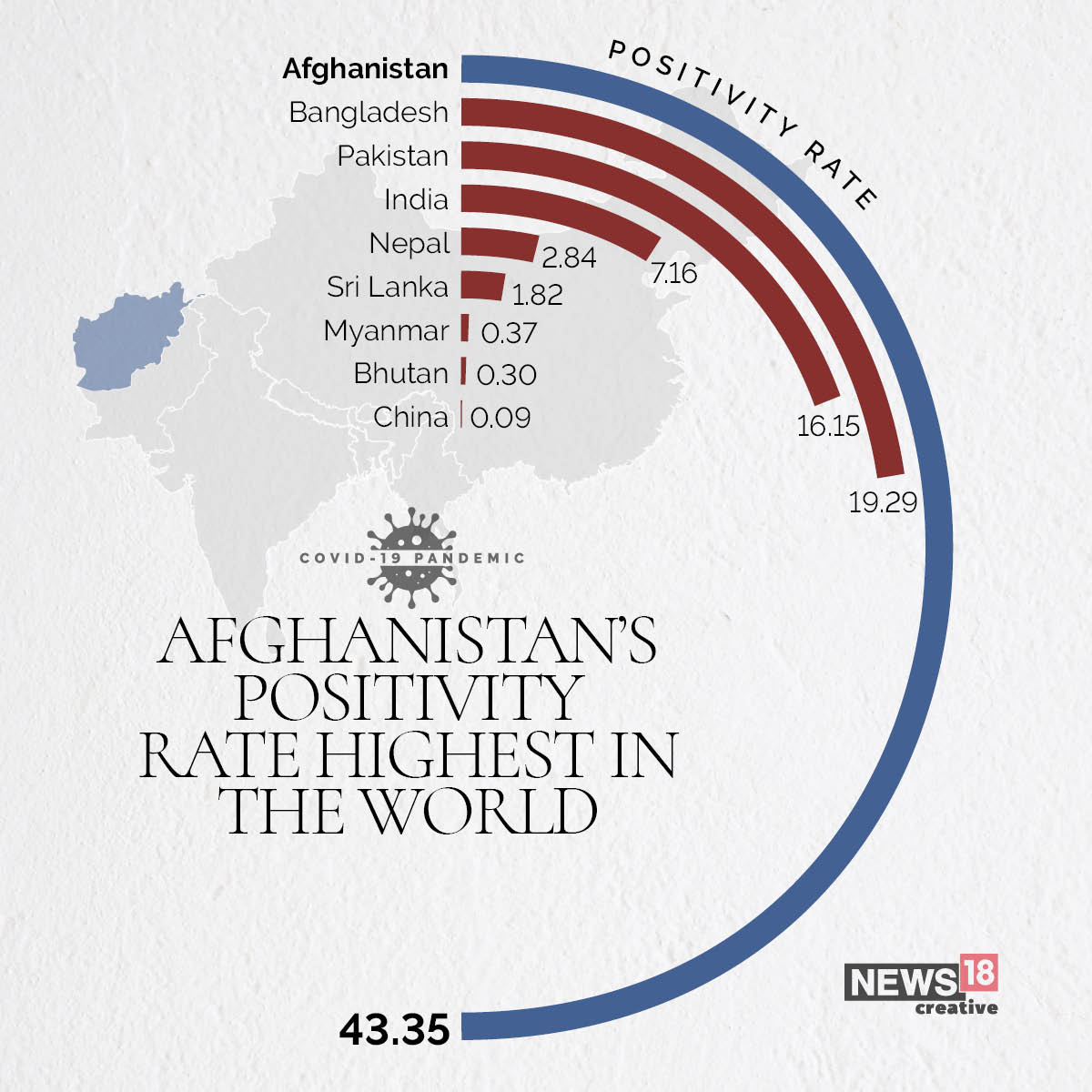
India’s Test Positivity Rate of 7.16% is less than half of Pakistan’s. Bangladesh has a Positivity Rate of almost 20% which means that for every five persons being tested, one is Covid-19 positive.

INDIA & NEIGHBOURS - COVID-19 - 2

Alarmingly, Afghanistan has the worst Positivity Rate of 43.35% not only in the neighbourhood but in the world. This basically means that every second person tested in the country is positive, suggesting that the spread is extreme. Not surprising then that they are also testing poorly.

Myanmar has a population of around 5.5 crores and despite the low testing, it has a very low Positivity Rate of just 0.37%. This suggests that a very minuscule percentage of those being tested have contracted the virus – an indication that the nation has largely been able to contain the spread of Covid-19.

China did extensive testing but many experts have raised doubts over the number of cases being reported by the country.

While the Positivity Rate is an important parameter to understand the spread of the virus in a country, the most significant measures are the Mortality Rate and the Tests Per Death, as nothing is more important than saving lives.

NO DEATHS IN BHUTAN, INDIA’S MORTALITY RATE HALF OF CHINA’S

INDIA & NEIGHBOURS - COVID-19 - 3

Bhutan is amongst the few nations in the world where there has been no casualty due to Covid-19. A sense of community and national solidarity, limited and controlled tourism, public’s trust in the government (the Prime Minister and Health Minister of Bhutan have a background in public health) and well-prepared machinery (the WHO and the Health Ministry undertook a simulation exercise at Paro airport in November 2019 to deal with potential disease outbreaks) are some of the reasons for this amazing feat by the Himalayan nation.

Meanwhile, Myanmar with six deaths, Sri Lanka with 11 and Nepal with 35 have also done a remarkable job in controlling the fatalities.

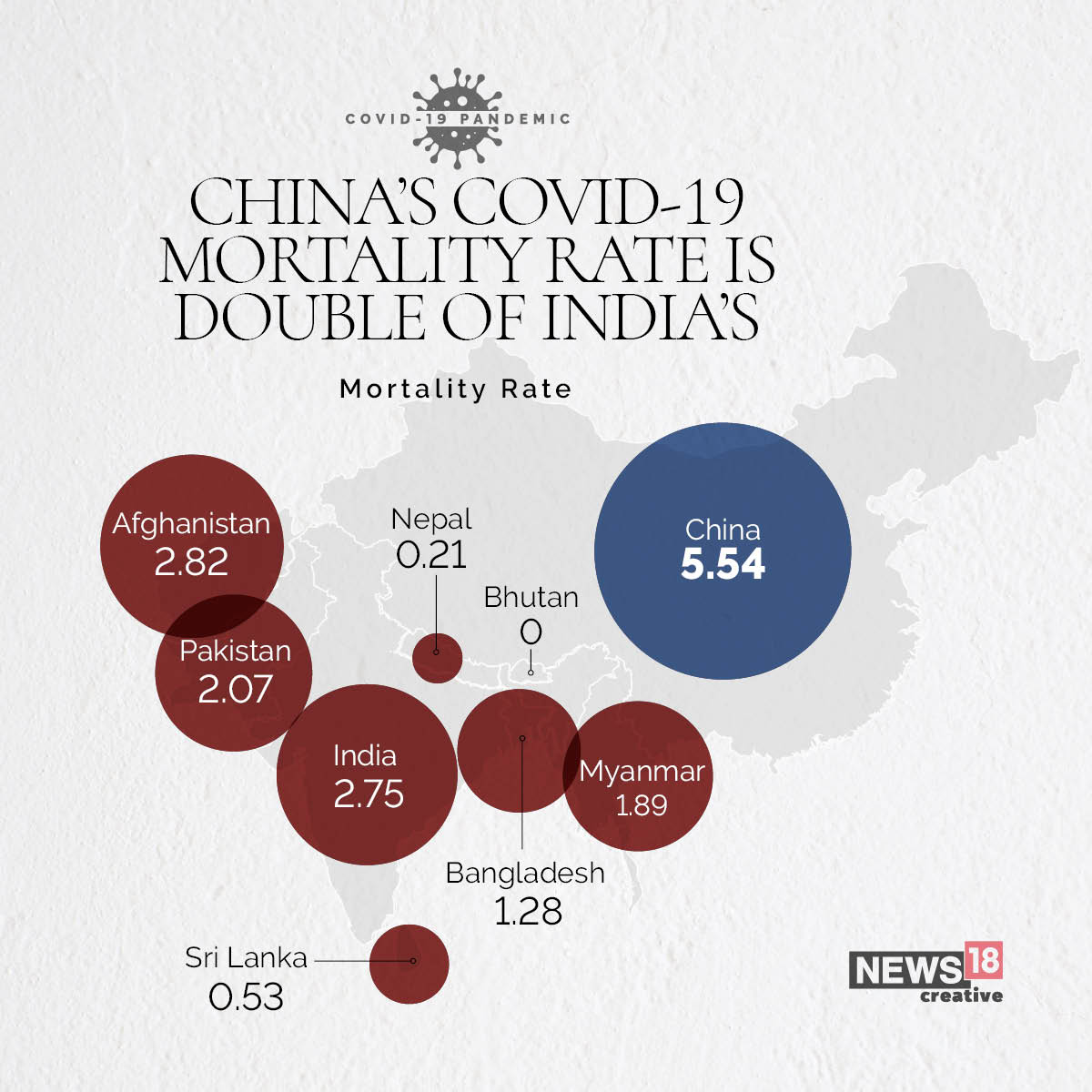
Although the number of cases still continue to rise at a fair rate, Bangladesh has a low Mortality Rate of 1.28%.

India has done a great job in containing the number of fatalities due to Covid-19. The country’s Mortality Rate of 2.75% is less than half of China’s, despite the latter being a totalitarian regime.

In terms of Tests Per Covid-19 Death, India with 508 tests per death, has done better than the likes of Bangladesh (406), Pakistan (299) and Afghanistan (82).

India has not only done well when compared to the richer, developed and advanced Western European nations and US, but given its size, population and other challenges, it also fares favourably in its own neighbourhood.


Source link

Aberdeen striker Sam Cosgrove turns down Guingamp move

0

Last Updated: 10/07/20 7:26am


It is understood Guingamp offered £2.5m to Aberdeen for striker Sam Cosgrove

Aberdeen striker Sam Cosgrove has turned down a move to French side Guingamp.

Sources close to the club have confirmed they received “a significant offer” for the 23-year old striker, believed to be more than £2.5m.

Cosgrove has opted against the move due to the short time-frame required for it to proceed, as well as due to feeling he has more to offer at Pittodrie.

Aberdeen are battling the financial hit caused by the coronavirus pandemic, with players and staff undergoing a process of wage cuts.

Chairman Dave Cormack recently revealed the club is facing up to a potential £10m shortfall in income but confirmed that half of that has already been offset.

Aberdeen begin their 2020/21 Scottish Premiership campaign against Rangers at Pittodrie, live on Sky Sports at 5.30pm on Saturday, August 1.

The Dons then travel to St Johnstone for another Sky Live game the following Saturday at 12.30pm.

A Super 6 for Newcastle?

Do not miss your chance to land the £250,000 jackpot for a sixth time this season on Wednesday. Play for free, entries by 6pm.


Source link

Odisha Removes 5 Districts Including Sambalpur, Deogarh and Nayagarh from Naxal SRE Scheme

0

File photo of Odisha Chief Minister Naveen Patnaik.

The districts which will be out of the SRE are: Angul, Boudh, Sambalpur, Deogarh and Nayagarh, said Director General of Police (DGP) Abhaya.

  • PTI
  • Last Updated: July 10, 2020, 11:41 AM IST

The Odisha government has approved the removal of five districts from the Left Wing Extremism affected Security Related Expenditure (SRE) scheme, a top police officer said.

The districts which will be out of the SRE are: Angul, Boudh, Sambalpur, Deogarh and Nayagarh, said Director General of Police (DGP) Abhaya.

“This recognises improved security situation in these districts. Odisha Police is committed to make the whole of Odisha LWE free,” the DGP said.

Odisha has been experiencing the scourge of Naxal activities for more than three decades. As many as 19 of the 30 districts of Odisha districts were declared as SRE district, sources said.

“Robust security response as well as focused developmental activities have brought about a turn-around in the situation in the state especially in the last few years, said IGP (Operation) Amitabh Thakur.

In April 2018, six districts – Jajpur, Dhenkanal, Keonjhar, Mayurbhanj, Gajapati and Ganjam – were declared as free from Maoist activities and these districts were removed from the Central government sponsored Security Related Expenditure (SRE) Scheme.

The SRE is a Central scheme exclusively meant for capacity building for Maoist affected districts across the country.

With the changing situation, Odisha government has approved the removal five districts namely, Angul, Boudh, Sambalpur, Deogarh and Nayagarh from the SRE scheme.

Therefore, a total of 11 districts of Odisha have so far been assessed to be free of Maoist activities in a span of two years, largely due to the impact of security response and good governance by the state government, the DGP said.

The fizzling out of the Maoist influence in the state is indicative of the growing acceptance by the people to the developmental agenda of the state government and their dis-enchantment towards the obsolete Maoist ideology, the top police officer said.


Source link

India’s Covid-19 Mortality Rate Half of China’s, Pakistan Has Highest Incidence per Million

0

What is happening in India’s neighbourhood? While extensive comparative analysis has been done between Europe and US, precious little has been written on the Covid-19 situation in the Indian sub-continent.

We look at the spread of the pandemic in Pakistan, Afghanistan, China, Myanmar, Bangladesh, Bhutan, Nepal and Sri Lanka and assess where they stand in comparison to India.

PAKISTAN HAS HIGHEST INCIDENCE PER MILLION POPULATION

India, with 7,69,257 cases has the maximum Covid-19 caseload but looking at the Incidence per Million Population – which is a better indicator of the virus’ spread – it becomes clear that Pakistan fares worse.

India, interestingly, has a lower Incidence per Million than even Nepal, Afghanistan and Bangladesh. Yes, its massive population is a factor but then the argument could easily be reversed — despite its huge population, India has managed to contain the virus. The numbers could easily have spiralled out of control but the lockdown and other factors helped keep them in check.

In terms of absolute numbers, Bhutan has just 80 reported cases while Myanmar has only 317! Sri Lanka has also done exceedingly well with just over 2,000 total Covid-19 cases.

India’s cases have grown nearly three-fold (2.89 times) in the last one month (June 8 to July 8). Bangladesh has seen a 2.51 times increase while the corresponding multiple in Pakistan is 2.29.

However, the number of cases reported is directly linked to the number of tests conducted by a country. China has the best ratio of tests per one million population of 62,814. China is followed by Bhutan (34,230) and Nepal (19, 861). India has ramped up its testing and at 7,782 it is better on this count than Pakistan (6,750), Bangladesh (5,416) and Afghanistan (2,009) amongst others.

AFGHANISTAN’S POSITIVITY RATE WORST IN THE WORLD

One of the best parameters to gauge if a country is testing sufficiently is to look at the share of tests returning a positive result – this is known as the Test Positivity Rate.

India’s Test Positivity Rate of 7.16% is less than half of Pakistan’s. Bangladesh has a Positivity Rate of almost 20% which means that for every five persons being tested, one is Covid-19 positive.

INDIA & NEIGHBOURS - COVID-19 - 2

Alarmingly, Afghanistan has the worst Positivity Rate of 43.35% not only in the neighbourhood but in the world. This basically means that every second person tested in the country is positive, suggesting that the spread is extreme. Not surprising then that they are also testing poorly.

Myanmar has a population of around 5.5 crores and despite the low testing, it has a very low Positivity Rate of just 0.37%. This suggests that a very minuscule percentage of those being tested have contracted the virus – an indication that the nation has largely been able to contain the spread of Covid-19.

China did extensive testing but many experts have raised doubts over the number of cases being reported by the country.

While the Positivity Rate is an important parameter to understand the spread of the virus in a country, the most significant measures are the Mortality Rate and the Tests Per Death, as nothing is more important than saving lives.

NO DEATHS IN BHUTAN, INDIA’S MORTALITY RATE HALF OF CHINA’S

INDIA & NEIGHBOURS - COVID-19 - 3

Bhutan is amongst the few nations in the world where there has been no casualty due to Covid-19. A sense of community and national solidarity, limited and controlled tourism, public’s trust in the government (the Prime Minister and Health Minister of Bhutan have a background in public health) and well-prepared machinery (the WHO and the Health Ministry undertook a simulation exercise at Paro airport in November 2019 to deal with potential disease outbreaks) are some of the reasons for this amazing feat by the Himalayan nation.

Meanwhile, Myanmar with six deaths, Sri Lanka with 11 and Nepal with 35 have also done a remarkable job in controlling the fatalities.

Although the number of cases still continue to rise at a fair rate, Bangladesh has a low Mortality Rate of 1.28%.

India has done a great job in containing the number of fatalities due to Covid-19. The country’s Mortality Rate of 2.75% is less than half of China’s, despite the latter being a totalitarian regime.

In terms of Tests Per Covid-19 Death, India with 508 tests per death, has done better than the likes of Bangladesh (406), Pakistan (299) and Afghanistan (82).

India has not only done well when compared to the richer, developed and advanced Western European nations and US, but given its size, population and other challenges, it also fares favourably in its own neighbourhood.


Source link

Ashram Owner in UP’s Shukertal Arrested for Sexually Harassing Children, Forcing Them to Work as Labourers

0

The owner of an ashram in Shukertal was arrested for allegedly sexually harassing four children and forcing them and the others to work as labourers, police said on Friday.

Swami Bhakti Bhushan Govind Maharaj was arrested when he was trying to escape from the ashram, they said.

According to Additional District Magistrate Amit Kumar, a case was registered against the owner and others under IPC sections 323 (voluntarily causing hurt), 377 (unnatural offences), 504 ( intentional insult with intent to provoke breach of the peace) and sections 5/6 of the POCSO Act.

On July 7, a team of childcare helpline and police rescued eight children then and two later. They were aged between seven to ten years and hailed from Tripura, Mizoram and Assam.

They were also produced before the children welfare board. In a medical examination, four of the children were confirmed to be sexual harassed.

Meanwhile, Subdivisional Magistrate Kuldeep Meena recorded their statement.

The district authorities informed the parents of the victims who alleged sexual harassment by Bhushan and claimed that he forced them to lay bricks as part of manual labour.

Bhushan, who established the ashram in 2008, denied the charges against him, claiming he was falsely implicated in case.


Source link

Justice Isa’s wife explains sources of income to FBR

0

ISLAMABAD – Wife of Justice Qazi Faez Isa yesterday appeared before the Federal Board of Revenue (FBR) to explain her source of income through which she had bought properties in London for the period 2003-04 to 2013-14.

On the directions of Supreme Court of Pakistan, the FBR had issued notices to Sarina Isa (wife), Sehar Isa (daughter) and Arslan Isa (son) last week to explain the sources of funds which were used to purchase properties in London.

Following the FBR’s notice, Sarina Isa has appeared before FBR’s Commissioner, International Taxes Zone yesterday and responded to all three notices served on her and her children.

Officials in FBR have confirmed that Sarina Isa appeared before FBR and submitted her detailed written response about her three properties in London.

According to the information, Sarina told the FBR that she had transferred the money to purchase London properties through legal ways. She gave details of transferring money abroad through banks.

Meanwhile, she also disclosed the sources of her income before the FBR. Sarina informed that she had mentioned the details of income in her income tax returns, which was submitted to the FBR. The officials informed that FBR would examine the documents submitted by the wife of Justice Qazi Faez Isa. It could ask for additional documents or details in next few days if needed.

Last month, the wife of Justice Qazi Faez Isa had informed the Supreme Court that she bought the properties between 2003 and 2013 and transferred a total of 700,000 pounds through the Standard Chartered Bank; the money was transferred in her own name. The first property was purchased in her name in 2004 for 236,000 pounds, the second one in 2013 in her and her son’s name for 245,000 pounds, and the third one in her and daughter’s name for 270,000 pounds. She had informed that all these accounts are in her name and not my husband’s name.

It is worth mentioning here that the Supreme Court in June this year threw out the presidential reference against Justice Qazi Faez Isa. However, seven of the 10 judges on the bench also ordered the FBR to seek explanations from the Qazi Faez Isa’s wife and children on the nature and source of funding for three properties in their names in the United Kingdom and submit a report to the SC registrar. The short order directed the FBR to send a notice to the judge’s wife and children within seven days, asking them for the aforesaid explanations about their properties in the UK. The FBR will complete the investigation within 60 days and issue an order within 15 days of the investigation’s conclusion.


Source link

Defence Minister to Unveil 6 Critical Bridges in Jammu and Kashmir Tomorrow

0

File photo of defence minister Rajnath Singh. (PTI)

The Defence Minister will unveil four bridges in Akhnoor sector and two in Jammu-Rajpura area constructed at a cost of Rs 45 crore.

  • IANS
  • Last Updated: July 10, 2020, 11:31 AM IST

Union Defence Minister Rajnath Singh will unveil six critical bridges constructed by the Border Roads Organisation (BRO) in Jammu & Kashmir on Thursday, sources said.

The Defence Minister will unveil four bridges in Akhnoor sector and two in Jammu-Rajpura area constructed at a cost of Rs 45 crore. “All bridges are around 300 to 100 metres approximately,” said a senior Defence Ministry officer.

On Tuesday, Singh held a review meeting with Border Roads Origination (BRO) officials to discuss the improvement of infrastructure near Line of Actual Control with China and Line of Control with Pakistan. The review meeting took place amid the ongoing border tension with China.

“Defence Minister Rajnath Singh reviewed the ongoing projects with DG BRO (Border Roads Organisation) and other senior officials at a meeting in South Block today,” the Ministry of Defence said.

During the meeting, Singh had directed that all border infrastructure to be fast tracked so that movement of forces should not be affected.

BRO Director General Lieutenant General Harpal Singh briefed the minister that since inception the organisation has been a leading road construction agency involved in construction of roads, bridges, tunnels and airfields in remote border areas and have also undertaken construction in friendly foreign countries like Bhutan, Myanmar, and Afghanistan in line with our overall strategic objectives.

The officer also briefed the minister that there has been a major surge in outcomes in BRO in the last few years.

BRO has executed about 30 per cent more works in 2019-20 as compared to 2018-19. The officer said BRO have executed 1,273 kilometres formation cutting, 2,214 kilometres of surfacing, Rs 1,715 crore of permanent works, 2,979 kilometres of major bridges, Rs 689 crore in tunnel works and 2,498 kilometres of re-surfacing in 2019-20.

In the last two years since 2017-18 there has been a surge of 44 per cent in formation cutting, 15 per cent in surfacing, 55 per cent in permanent works, 17 per cent in major bridges and 49 per cent in resurfacing works.

The overall expenditure for 2019-20 was Rs 7,867 crore as compared to Rs 5,458 crore in 2017-18 and Rs 6,859 crores in 2018- 19, the officer explained.

Last month, the government has approved an additional Rs 1,691 crore for highway works by the Border Roads Organisation in Jammu & Kashmir and Uttarakhand.

Further, amid escalated tension between India and China along the Line of Actual Control (LAC), Lt Gen Harpal Singh had made a visit to the under-construction 8.8-km-long Atal Rohtang Tunnel that is set for a September opening.


Source link

Police interrogate five Australian Al Jazeera journalists accused of sedition in Malaysia

Five Australian journalists are being interrogated by Malaysian authorities who have accused them of sedition and defamation after the broadcast of a documentary about migrant workers in Kuala Lumpur during Covid-19.

A week after the broadcast of the Al Jazeera English documentary in Malaysia, the journalists were ordered to attend the police station for questioning on Friday morning.

Malaysian police have told them they are being investigated for sedition, defamation and violation of the country’s Communications and Multimedia Act.

The film documented immigration raids and migrants hiding from officials, events which were covered by the local and international media.

Since the broadcast of Locked Up in Malaysia’s Lockdown on 3 July the documentary team, who are almost all Australian, has been subjected to online abuse and death threats.

Local media and officials say the report was inaccurate, misleading and unfair.

Al Jazeera English
(@AJEnglish)

Detention centres in Kuala Lumpur have become COVID-19 hotspots. @AJ101East asks if Malaysia’s migrant crackdown is putting lives at risk https://t.co/9dQ3NYTNrx pic.twitter.com/OGC71nJmTg


July 4, 2020

Lawyer Hisyam Teh Poh Teik told reporters that the journalists “refute all the charges”.

“There was no intent by Al Jazeera to create any mischief,” he said.

Al Jazeera said: “Al Jazeera is deeply concerned that its staff are now subject to a police investigation.

“Charging journalists for doing their jobs is not the action of a democracy that values free speech. Journalism is not a crime.

“Al Jazeera also has grave concerns about the sustained online harassment its staff are facing. Reporters have been targeted with abusive messages and death threats.

“The personal details of current and former staff have been published online, in a serious breach of privacy which could potentially expose them to great risk both now and in the future.”

The 25-minute film, by the award-winning 101 East documentary strand, examined why Malaysia’s undocumented foreign migrant workers were at risk in the time of Covid-19.

@aj101east
(@AJ101East)

Disease control or discrimination? @AJ101East investigates Malaysia’s crackdown on migrants during the COVID-19 pandemic: https://t.co/2GS8VaIxjP pic.twitter.com/htLMiUfpko


July 3, 2020

Australia’s Media, Entertainment and Arts Alliance has written to the Malaysian high commission urging it to drop the case.

“Since the broadcast, Al Jazeera personnel in Malaysia have been targeted in a sustained campaign of online abuse (‘trolling’),” the union said.

“They have received death threats and, in an extreme threat to their safety, they have been subjected to ‘doxing’ – the disclosure of their personnel details on social media platforms in order to enable and provoke further harassment, threats and intimidation. A source used in the story has even been pursued through the use of a ‘wanted’ notice.

“The documentary acknowledged Malaysia’s success in containing the Covid‐19 virus. The Al Jazeera crew repeatedly sought Malaysian government input and responses for inclusion in the news story but were repeatedly rebuffed. The documentary featured material that had been reported on by other media outlets, including the South China Morning Post.”

The Malaysian defence minister, Ismail Sabri Yaakob, called on Al Jazeera to apologise to Malaysians, saying allegations of racism and discrimination against undocumented migrants were untrue.

Rights groups have expressed alarm at an intensified crackdown on critical voices under the government of Muhyiddin Yassin, who was named prime minister by the king in March, following the collapse of the multiracial reformist coalition that had been elected two years earlier.

Over recent months, prominent journalists, NGO workers, opposition figures and members of the public have faced investigations or charges.

Among them is Steven Gan, editor of the online news platform Malaysiakini, who could face jail time for contempt of court charges over comments posted on the website by internet users, which were apparently critical of the judiciary. Shawn Crispin of the Committee to Protect Journalists said the trial, which begins next week, “reeks of a witch hunt”.

Legal experts have also criticised a decision by officials to investigate Boo Su-Lyn, editor of the health news portal CodeBlue, under the Official Secrets Act. A probe was launched after Boo Su-Lyn published the findings of an independent investigation into a hospital fire that killed six patients in 2016, which she says had been declassified.

Activists have also been pulled in for questioning by police, as have politicians. In one case, Hannah Yeoh, a former women, family and community development minister, was questioned after raised concerns over the new government’s commitment to tackling child marriage. She later said she had handed over her usernames and passwords to police.

Just last week, a 57-year-old man was fined around $470 for posting insulting remarks about the country’s health minister, despite the court noting that his comments were not malicious or excessive. He could face prison if he fails to pay the fine.

The increased use of the country’s notoriously broad laws – including the Sedition Act and the Communications and Multimedia Act – have added to fears that the country is returning to the repression of previous governments.

The Guardian has approached Malaysia’s high commission in Canberra for comment.


Source link

Japan’s weird ‘no screaming’ rule as theme parks reopen

0

Thrill seekers in Japan will soon get to enjoy their favourite roller coasters again now that amusement parks around the country are reopening.

But there’s one request they might struggle with: No screaming.

Thrill seekers in Japan will soon get to enjoy their favourite roller coasters again but won’t be allowed to scream on rides. (Tomohiro Ohsumi/Getty Images)

Many of the items are to be expected, recommending increased sanitising measures, regular body temperature checks and face mask use while emphasising the importance of social distancing.

But some items will likely take visitors by surprise. Namely, a suggestion that theme parks encourage visitors riding outdoor attractions, including roller coasters, to avoid shouting or cheering — a tough ask, given how wild some of the country’s rides are.

The guidelines also say that if it’s difficult for some employees to wear masks due to the nature of their work — for example entertainers, such as haunted house staff — they should keep at least one metre away from visitors.

Customer service may also be compromised, note the guidelines, as conversations should be kept as short as possible.

“As a new style of customer service, even when you’re wearing a mask, you can use a combination of smiley eyes, hand gestures, etc., to communicate with visitors,” says one of the suggestions.

The guidelines were issued by the East and West Japan Theme Park Associations, which are made up of more than 30 major amusement park operators in Japan, including Oriental Land Company (operator of Tokyo Disneyland and DisneySea) and Universal Studios Japan.

Aside from the published guidelines, some amusement parks have implemented their own rules.

Fuji-Q Highland, a theme park at the foot of Fuji Mountain that’s famous for its haunted house experience, is only opening its outdoor attractions and only allowing entry to visitors living in Yamanashi, Nagano, Niigata and Shizuoka prefectures.
Major theme parks in Japan have been closed since as early as February to combat the spread of COVID-19. Though some Japanese theme parks are beginning to welcome guests again, Tokyo Disneyland and Universal Japan have yet to announce reopening dates.

Source by [author_name]