Friday, April 24, 2026

They’re famous for their investments. But Warren Buffett and Masa Son keep striking out

0

SoftBank (SFTBF) has been hit hard by the huge drop in the share prices of public companies in its portfolio such as Uber (UBER) and Slack (WORK), as well as the massive haircut in valuations of private unicorn startups like WeWork, DoorDash and Indian hotel company Oyo.
Meanwhile, Berkshire Hathaway (BRKB) has had notable misfires of its own, such as scandal-ridden bank Wells Fargo (WFC) and struggling food giant Kraft Heinz (KHC).
Berkshire also disclosed last Friday that it dumped nearly all its stake in investment bank Goldman Sachs (GS), which has been hit hard this year in the broader market turmoil.
Buffett also made a huge bet on the airline sector in recent years — only to disclose at Berkshire Hathaway’s annual shareholder meeting that the company sold off its entire stake in Delta (DAL), Southwest (LUV), American (AAL) and United (UAL) as a result of the Covid-19 pandemic.

To their credit, both CEOs have been candid and contrite about some of their investing mishaps.

Buffett said at the shareholder meeting earlier this month that it was a mistake to invest in airlines and that it could take years for the sector to recover from the coronavirus-induced travel slowdown.

For his part, Son said during an earnings conference call this week that SoftBank’s investment in WeWork was a failure. He even went as far to say that he was “foolish” and “made the wrong decision.”

Son added that there could be more pain ahead for SoftBank investments in its flagship Vision Fund, predicting that 15 out of its 88 current holdings could go bankrupt. While he didn’t name specific firms, he did say most of SottBank’s more troubled investments are relatively small.

Buffett and Son lagging the market over the past few years

The investing misfortunes of Buffett and Son are one reason why the shares of their own companies have languished lately.

Berkshire Hathaway’s stock is down 23% so far in 2020. The company’s first quarter results included a $50 billion loss, the biggest in the company’s history. And the stock’s gain of about 20% over the past five years is nearly half the return of the S&P 500 over the same time frame.
SoftBank has fared better this year, with a loss of just 2%. But it has also lagged the S&P 500 — as well as the Nasdaq — over the past five years.
Of course, both men have had some notable investing successes recently. SoftBank has a more than 25% stake in Chinese e-commerce and cloud giant Alibaba (BABA) while Berkshire has a nearly 6% position in Apple (AAPL), making the iPhone manufacturer Berkshire’s largest holding.
SoftBank loses Jack Ma from its board and posts worst loss ever

Neither Alibaba nor Apple is an undiscovered gem. Those companies are among the most valuable in the world and are top positions in many passive global index exchange-traded funds and actively managed mutual funds and hedge funds.

SoftBank certainly deserves credit for first investing $20 million in Alibaba in 2000. That stake is now worth more than $140 billion.

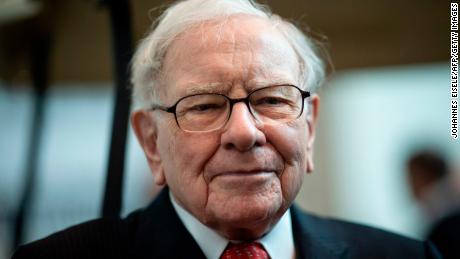
Buffett, who typically shuns tech stocks, didn’t invest in Apple until 2016, but he’s made a killing on it. His initial $1 billion investment is now worth about $78 billion, which includes not just market returns but Berkshire’s steady additions to its stake over the past four years.

Still, there are now some signs of a possible fissure between SoftBank and Alibaba founder Jack Ma. SoftBank said Monday that Ma will be leaving its board after a nearly 13-year stint as a SoftBank director.

It just goes to show that Son and Buffett — both being multi-billionaires — can make the same market mistakes as the rest of us. And their occasional stock picking failures are probably all the more reason why most investors should just stick to ETFs.

After all, Buffett himself has repeatedly said that after he passes away, his plan is to have a trustee invest 90% of his wife’s inheritance in a low-cost S&P 500 index fund — not Berkshire Hathaway or any other individual stock.

CNN’s Sherisse Pham contributed to this story.

Source link

They bought a $1 house in Italy, then Covid-19 struck

0

(CNN) — When Italian towns began offering houses for sale for little more than $1, they inspired legions of dreamers to take a gamble on moving to a remote corner of Italy.

Although spending a few thousand dollars extra on renovating the property was usually part of the deal, it was sweetened by the prospect of a new life in an idyllic spot in a beautiful country.

And then the coronavirus struck, plunging the world into crisis, with Italy among the worst affected countries.

So what happens when you’re quarantined in a crumbling home in a remote village where you barely speak the language and can’t get home to your loved ones? Does life quickly become a nightmare?

Perhaps surprisingly given the hardships that followed, the answer seems to be no.

CNN spoke to a few people who bought some of the Italian homes being offered cheaply by towns wanting to reverse declining population trends.

We found them feeling upbeat and eager to complete their property remodeling and make their Italian dream come true.

Despite the unexpected turn of events, it seems being stuck in Italy hasn’t been such a negative experience after all.

And the virus crisis has made them appreciate even more the beauty of Italy’s rural villages — so much so that some are looking to invest in more cheap properties.

Losing track

Mussomeli is located on a hilltop in Sicily.

Salvatore Catalano, Comune Mussolemi

Miami-based artist Alvaro Solorzano is currently stuck in Mussomeli, a picturesque town in the southern island of Sicily where last year he purchased two cheap properties — one of them costing just one euro, or a little over a dollar.

In March he arrived with his wife, son and son’s girlfriend to start renovating the houses. The other three headed back to Miami and Solorzano was due to follow them a couple of weeks later, but then his flight was canceled.

“I lost track of time. We came here together and I ended up living the quarantine in Mussomeli all by myself, without any furniture just a bed and TV, and nobody to talk to,” he tells CNN. “That was the hardest thing. Had my wife or son been with me, it would have been different.”

house

One of Solorzano’s properties in Mussomeli.

Solorzano had been staying in a B&B, but when this closed because of Covid-19 restrictions, he was forced to move into the less dilapidated of his two properties, which was just about habitable.

Since then, he’s been killing time by watching TV, learning Italian, going to the supermarket (“the nicest part of the day”) and talking on the phone with his family. Little by little, he’s been making the most out of the situation by repairing and painting the walls of the house.

“I did little things but it helped me use time, so when my son and his girlfriend come back their home will be ready,” he says. “Luckily the hardware store in town has always been open and I’m so glad we bought two properties and not just the one euro house as it has no water nor electricity.”

Local heroes

Italian town Mussomeli

Alvaro Solorzano from Miami says local residents have made his enforced stay in Mussomeli a pleasant experience.

Maurizio Di Maria, Comune Mussomeli

Despite an initial hardship, he says his new neighbors helped him throughout the ordeal.

“The first two nights were terrible,” he says. “It was cold, I slept with my jacket on top of my pajamas but then the neighbors were great. I can’t complain. They gave me heaters and even offered blankets, which I had, but I could use their internet.”

“They kept checking in on me, brought me tons of food for Easter which took me three days to eat. I don’t know what I would have done without them.”

easter cakes

Solorzano was brought Easter cakes by his neighbors.

Mussomeli, surrounded by honeysuckle and eucalyptus trees, boasts one of Italy’s most breathtaking fortresses, known as the Enchanted Castle, which clings like a spider on a pointed rock.

The fertile green farmland is dotted with old sulfur mines, sanctuaries, Roman necropolises and traces of primitive settlements.

The town’s name means “Hill of Honey” in Latin.

But to Solorzano the sweetest attractions of the place are its welcoming residents.

“They’re wonderful, I know everyone by name,” he says. “There’s Mario, the guy who delivers the bread. I’ve got no words to describe how grateful I am of having them and don’t know how I could ever repay them for all they did.”

Initially tough restrictions have now eased in Italy, allowing him to walk around, but at first it was hard, he admits, as there was nothing to do. “It was terrible, just staying at home, I felt like being in jail sometimes.”

Property empire

alvaro

Solorzano says he now knows everyone by name.

Now he relishes being able to chat to locals and stroll to Mussomeli’s viewpoint, where he can sit on a bench and enjoy fresh air and mountain panoramas.

As a painter, Solorzano says he would’ve loved doing some artwork, but due to the lockdown he couldn’t find a pallet or a canvas.

Italian town Mussomeli

Solorzano wants to buy another property in Mussomeli.

Maurizio Di Maria, Comune Mussomeli

“I’m working hard to try to get back home, but a flight which I recently booked has also been canceled so I really don’t know when I will return to the States,” he says. “I want to be back before Father’s Day in June. I’ve already missed so many festivities I could have celebrated with my family.”

Solorzano’s Sicilian quarantine has made him love Mussomeli even more. The ordeal, instead of having killed enthusiasm for his one euro house adventure, has fueled a desire to purchase a third abandoned building.

“I love this town and the people, even if they don’t know you, they help you out. It’s like being in another world. You don’t get this in the States”.

Trapped in Tuscany

roque vert

Brazilian Douglas Roque, pictured here with his cousin, has been stuck in Tuscany during Italy’s lockdown.

Douglas Roque

Brazilian businessman Douglas Roque is another dilapidated home purchaser whose enthusiasm for starting a new life has been undimmed by coronavirus.

Roque was in Fabbriche di Vergemoli, Tuscany, overseeing the renovation of a one euro farm dwelling when lockdown struck and his flight back home was canceled.

Together with his Brazilian-Italian friend Alberto Da Lio, both from Sao Paulo, the two were also in town to oversee the potential purchase of an entire abandoned area for other Brazilian buyers.

Had they not been able to stay at Da Lio’s family house near Venice, with hotels in Vergemoli shut and the abandoned dwelling totally uninhabitable, they would have had nowhere to go, says Roque.

roque mayor

Roque, on the right, is pictured here with Fabbriche di Vergermoli mayor, Michele Giannini.

Douglas Roque

Fabbriche di Vergemoli is a cluster of hamlets scattered in the UNESCO-listed protected forest of the Apuan Alps. The area is dotted with ruins of abandoned miners’ dwellings overrun by vegetation. Many areas can be reached only by foot.

Roque’s dilapidated three-story farm, which comes with a chestnut cellar and forgotten old wine barrels, is located in the neighborhood of Dogana, where a pristine stream runs below an ancient, picturesque bridge.

“I was about to start the restyle and then everything was blocked,” says Roque. “It was terrible, our return flight was canceled and we had issues with the Brazilian consulate.

“I came here in February to pursue the renovation of my house, all the paperwork was done, I was ready to go but couldn’t move on with it. And my family is in Brazil, where virus cases have been increasing. I’m worried for them and they’re worried for me.”

Piece of perfection

roque douglas village

Roque is also trying to purchase other houses in the villages for fellow Brazilians.

Courtesy Douglas Roque

The two friends also had to deal with the consequences of a prolonged stay: the hassle of credit card monthly limits and seasonal clothing changes as they arrived in winter and it is now almost spring (luckily, they found some lighter gafrments at Da Lio’s).

While he waits for global air traffic to resume, Roque’s anxious to set foot again in Vergemoli as soon as Italian authorities lift restrictions on moving between regions — a move expected in early June.

“All this time I’ve been trying to work on my project online, contacting construction companies and liaising with other Brazilian buyers, friends and relatives interested in buying property in Vergemoli but who can’t travel now. I hope to finalize everything soon.”

Roque says he picked Vergemoli of all places in Italy to buy a one euro house because, despite all that’s happened, it remains a dream destination.

“Tuscany is a marvelous region and major historical and artistic cities are nearby. It’s the perfect spot.”

Source link

A 10-year-old girl has sent more than 1,500 art kits to kids in foster care and homeless shelters during the coronavirus pandemic

0

Chelsea Phaire, a 10-year-old from Danbury, Connecticut, has sent more than 1,500 children in homeless shelters and foster care homes art kits to give them something uplifting to do when they’re feeling down.

The kits — which include markers, crayons, paper, coloring books, colored pencils, and gel pens — are sent to schools and shelters across the country as part of Chelsea’s Charity, an organization founded by Chelsea and her parents.

“Since she was seven, she was begging me and her dad to start a charity,” Candace Phaire, Chelsea’s mom, told CNN.

“She was so persistent, every couple of months she would ask, ‘Are we starting Chelsea’s Charity yet?’ When she was turning 10, she asked us again, and we decided it was time to go for it.”

The rising 6th grader launched Chelsea’s Charity on her birthday in August 2019, when she asked party guests to donate art supplies instead of getting her birthday gifts.

After her birthday party, Chelsea used the donations to send out her first 40 art kits to a homeless shelter in New York. The family then set up an Amazon wishlist full of art supplies. Every time they get enough donations, they pack up the kits and deliver them to kids in person.

In just the first five months, Chelsea and her mom sent out nearly 1,000 kits to children in homeless shelters, foster care homes, women’s shelters, and schools impacted by gun violence.

Before the pandemic, Chelsea was able to travel with her mom across the country to meet the kids in-person, and even teaches them some of her favorite drawing tips.

Now, schools are closed, and social distancing precautions will not allow Chelsea to physically interact with the kids as much. Instead, she and her mom are mailing the kits.

Since March, when schools began to close, the family has sent over 1,500 kits to schools, shelters, and foster homes in 12 states across the US.

“I feel good inside knowing how happy they are when they get their art kits,” Chelsea told CNN. “I have definitely grown as a person because of this. Now my dream is to meet every kid in the entire world and give them art. Who knows, maybe if we do that and then our kids do that, we’ll have world peace!”

Helping traumatized children through art

When Chelsea was 8, she lost someone very close to her heart. Her swim instructor, who she said she considered family, was killed from gun violence in the middle of their swim season.

That was the moment art went from being Chelsea’s hobby to her therapy.

Knowing that other children have also gone through trauma inspired Chelsea to help make art more accessible to help others cope with their feelings.

“Art therapy is being prescribed a lot more to support the mental health of young kids, especially those with social and emotional deficiencies,” Phaire, who is an early childhood education professor and former teacher, told CNN.

“Now with Covid-19, a lot of kids in shelters and also children in foster homes might not have access to art supplies they usually find in school. It’s also mental health awareness month, so that’s definitely motivating us to ramp it up send even more kits.”

With this year’s added stress of a global pandemic and nationwide shutdown, it’s more important than ever to make sure kids have ways to cope with the emotions that come with adjusting to today’s new reality.

For kids in already stressful situations such as homelessness, this can be even more difficult.

One of the organizations that received art kits from Chelsea is James Storehouse, a non-profit that serves children in foster care “from cribs to college.”

“When a child or youth enters foster care, they usually have no belongings of their own,” Stacy DeWitt, James Storehouse executive director, told CNN. “It’s been a great addition to be able to offer the art kits, so the children and youth have a creative outlet to process their emotions during this traumatic time in their lives.”

She said the kits have also “been fantastic for foster parents who have children at home during the stay-at-home orders.”

“It gives the children and teens a fun creative outlet to channel their energy because they can’t be in the classroom right now. Chelsea’s kits have been a blessing to many children in hard places and have brought them joy.”

While it may take her a little bit longer to reach every kid in the world, thanks to Chelsea’s kindness, thousands of kids all over the country have at least one reason to smile.

Source link

A boy chosen as the Panchen Lama disappeared in 1995. China says he’s now a college grad with a job

0

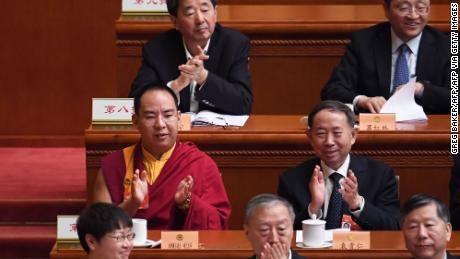
Gedhun Choekyi Nyima has never been heard from since, but on Tuesday, China said he was a college graduate with a job, and that neither he nor his family wished to be disturbed in their “current normal lives.”

The brief comments, made by Chinese Foreign Ministry Spokesperson Zhao Lijian during a regular press briefing, offer a rare window into the apparent life of the now 31-year-old.

Gedhun Choekyi Nyima was identified by the Dalai Lama, the Tibetan spiritual leader, as the 11th Panchen Lama in 1995, six years after the death of his predecessor. But Beijing rejected him and quickly put forward its own candidate, Gyancain Norbu, who the Chinese government claims is the “real” Panchen Lama.

By installing its own choice as the Panchen Lama and disappearing Gedhun Choekyi Nyima, China avoided him becoming another prominent opposition figure in the mold of the Dalai Lama, who has lived in exile since fleeing Beijing-controlled Tibet in 1959 and is regularly denounced by Chinese authorities and blamed for any Tibetan unrest in China. Since becoming an adult, Gyancain Norbu has occupied an increasingly high profile role, joining a top Chinese political body and often appearing at important events in Beijing.
It remains unknown whether Gedhun Choekyi Nyima is aware of his being chosen as the Panchen Lama. In a statement this week marking the 25th anniversary of his disappearance, the Tibetan government in exile said that “China’s abduction of the Panchen Lama and forcible denial of his religious identity and the right to practice in his monastery is not only a violation of religious freedom but also a gross violation of human rights.”

US Secretary of State Mike Pompeo also denounced “China’s persecution” of Gedhun Choekyi Nyima and called on Beijing to “make public the Panchen Lama’s whereabouts” and respect Tibetans’ freedom of religion.

The most important purpose of the Panchen Lama from Beijing’s perspective is the role he traditionally plays in identifying the reincarnation of the Dalai Lama, revered as a living god by Tibetan Buddhists. With the current holder of that title, Tenzin Gyatso, now 84, there’s a strong chance that a successor will be needed sooner rather than later.

Beijing has made it clear for years that it intends to control that process, bringing the top two figures in Tibetan Buddhism under its control. “Reincarnation of living Buddhas, including the Dalai Lama, must comply with Chinese laws and regulations and follow religious rituals and historical conventions,” a representative of the officially-atheist state said last year when the Dalai Lama was hospitalized with a chest infection.
A law passed in 2007 states that the reincarnation of a living Buddha is “subject to an application for approval.”

For his part, the current Dalai Lama has said his successor could be found outside Tibet, and also suggested he may not reincarnate at all, making him the last person to hold that title. In recent years, he has moved to secularize the Tibetan government in exile, ceding non-religious authority to political figures, a stark contrast to the theocratic society once ruled over in Tibet by his predecessors.

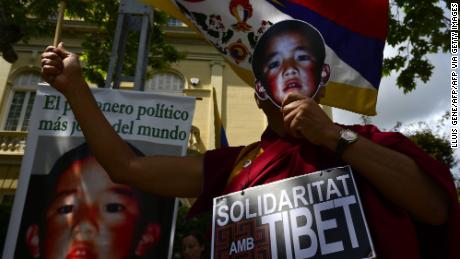
Pro-Tibetan protestors hold picures of Gendun Cheokyi Nyima (recognized by the Dalai Lama as the 11th Panchen Lama) during a demonstration outside the Chinese consulate in Barcelona on May 17, 2013.
In 2011, the Dalai Lama denounced the Chinese government’s attempt at meddling, saying “the person who reincarnates has sole legitimate authority over where and how he or she takes rebirth and how that reincarnation is to be recognized.”

“It is a reality that no one else can force the person concerned, or manipulate him or her,” the Dalai Lama said. “It is particularly inappropriate for Chinese communists, who explicitly reject even the idea of past and future lives, let alone the concept of reincarnate Tulkus, to meddle in the system of reincarnation and especially the reincarnations of the Dalai Lamas and Panchen Lamas.”

Regardless of what the Dalai Lama decides, however, many observers expect that a successor will be put forward, certainly by Beijing and likely by the Tibetan exile community, creating a situation akin to that of the two Panchen Lamas and worsening the divide over who gets to shape the future of Tibetan Buddhism.

CNN’s Steven Jiang contributed to this report.

Source link

Virus Complicates Evacuation Of 2.6 Million People As Cyclone Slams India, Bangladesh

0

NEW DELHI (AP) — A powerful cyclone slammed ashore Wednesday along the coastline of India and Bangladesh where more than 2.6 million people fled to shelters in a frantic evacuation made all the more challenging by the coronavirus pandemic.

Cyclone Amphan, an equivalent of a category-3 hurricane, was packing winds of up to 170 kilometers (105 miles) per hour and maximum gusts of 190 kph (118 mph). Authorities warned it could wreck extensive damage to flimsy houses and a storm surge may push seawater 25 kilometers (15 miles) inland, flooding cities including Kolkata.

The densely populated regions are home to some of the most vulnerable communities in South Asia: poor fishing communities in the Sunderbans and over a million Rohingya refugees living in the crowded camps in Cox’s Bazar in Bangladesh.

The cyclone began to make landfall Wednesday afternoon between Digha, a seaside resort in West Bengal, and Hatiya Islands in Bangladesh. The eye of the storm is likely to pass through the Sunderbans, one of the largest mangrove forests in the world, India’s meteorological department said.

The forests could act as a vital line of defense by dissipating some of the energy from the waves that would otherwise crash into the coastline, said K.J. Ramesh, the department’s former chief.

Bangladesh is attempting to evacuate 2.2 million people to safety. India’s West Bengal state moved nearly 300,000 and Odisha state another 148,486 people, officials said.

In Cox’s Bazar, where the first 10 coronavirus cases were confirmed last week, authorities and U.N. workers prepared 50 shelters and assigned 256 volunteer units. 


Evacuated children wearing masks as a precaution against the spread of coronavirus stand at a relief camp at Paradeep, on the Bay of Bengal coast in Orissa, India, on May 19, 2020. 

Areas at risk of landslides were stabilized with bamboo and concrete walls. But the combination of the virus and cyclone could lead to a “new humanitarian crisis,” said Manuel Pereira, deputy chief of mission for the International Organization for Migration in Bangladesh.

“We know that if people are forced to seek communal shelter, they’ll be unable to maintain physical distancing and run the risk of contracting or transmitting the virus,” said Pereira.

Masks and hand sanitizers were hastily added to emergency items in the shelters.

Sobrato Das, a fisherman in Mousuni Island in India, close to the Sunderbans, described the shelters as crowded and said “very few people are wearing masks.”

He said children were crying and women desperately tried to cover their faces with their saris while trying to maintain some distance from each other.

“I have left all my belongings in my house and hope it doesn’t get washed away in the floods,” he said.

Some cyclone shelters in West Bengal were being used for quarantining COVID-19 patients and migrant workers returning to their homes. The state government asked for trains transporting migrants to be suspended, Chief Minister Mamata Banerjee said. Some schools were turned into shelters, news reports said.

Some in the cyclone’s path saw a choice between the virus and the storm.

In the seaside resort of Digha, many people feared going to the shelters, fisherman Debasis Shyamal said. “They have been home for weeks, and are afraid of going into a crowd where they could get infected,” he said.

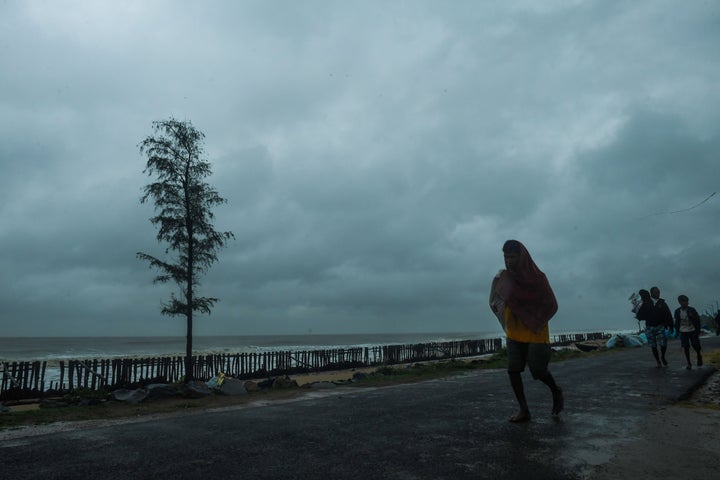
People walk along a road near the Tajpur Beach to take shelter ahead of the expected landfall of cyclone Amphan in Midnapore,


People walk along a road near the Tajpur Beach to take shelter ahead of the expected landfall of cyclone Amphan in Midnapore, West Bengal, on May 20, 2020.

The densely populated city of Kolkata, which has nearly 1,500 coronavirus cases, is likely to see flooding, while some centuries-old buildings in the northern half of the city could collapse due to the strong winds, officials warned.

The cyclone is bearing down during the Islamic holy month Ramadan, and some Bangladeshis who fasted during the day reportedly waited until the early morning hours before heading for the shelters.

The region is no stranger to devastating cyclones. Ramesh, the former chief of India’s weather agency, said it wasn’t the frequency of cyclones but their intensity that has increased due to climate change patterns.

This has to do with the temperature of the sea’s surface. Warm water is the fuel for cyclones. It is where storms get their energy and the amount of heat trapped in the top 700 meters (2,300 feet) of the ocean has increased. “As a result, cyclones are intensifying faster than before,” he said.

Alam reported from Dhaka, Bangladesh. Associated Press writers Sheikh Saaliq and Chonchui Ngashangva in New Delhi contributed to this report.

A HuffPost Guide To Coronavirus


Source link

Man Sentenced To Death In Singapore Via Zoom Call

0

SINGAPORE (Reuters) – A judge in Singapore has sentenced a man to death via a Zoom video-call for his role in a drug deal, one of just two known cases where a capital punishment verdict has been delivered remotely.

Punithan Genasan, a 37-year-old Malaysian, was told on Friday he would be hanged for masterminding a 2011 heroin transaction, court documents showed, as the country was under lockdown to try and curb its coronavirus outbreak.

“For the safety of all involved in the proceedings, the hearing for Public Prosecutor v Punithan A/L Genasan was conducted by video-conferencing,” a spokesperson for Singapore’s Supreme Court said in response to Reuters’ questions, citing restrictions imposed to minimize virus spread.

It was the first criminal case where a death sentence was pronounced by remote hearing in Singapore, the spokesperson added.

Rights groups have criticized the use of video-calls for capital punishment verdicts, including a case in Nigeria earlier this month which criminal justice watchdog Fair Trials said was the first death sentence to be delivered remotely.

Genasan’s lawyer, Peter Fernando, said he did not object to Friday’s judgment being delivered on Zoom.

He said the judge could be heard clearly and as it was the verdict no other legal arguments were presented. However, he said, his client is considering an appeal against the verdict.


A view of the Supreme Court building in the backdrop of the skyline of Singapore’s central business district.

California-based tech firm Zoom did not respond to a request for comment made via its representatives in Singapore. The Attorney General’s Chambers, the public prosecutor in the case, did not immediately have comment.

Many court hearings in Singapore have been adjourned during a lockdown period that started in early April and is due to run until June 1, while cases deemed essential have been held remotely.

Singapore has a zero-tolerance policy for illegal drugs and has hanged hundreds of people ― including dozens of foreigners ― for narcotics offenses over past decades, rights groups say.

“Singapore’s use of the death penalty is inherently cruel and inhumane, and the use of remote technology like Zoom to sentence a man to death makes it even more so,” said Human Rights Watch’s deputy director for Asia, Phil Robertson.

Amnesty International’s death penalty advisor Chiara Sangiorgio said: “Whether via Zoom or in person, a death sentence is always cruel and inhumane.

“This case is another reminder that Singapore continues to defy international law and standards by imposing the death penalty for drug trafficking.”


Source link

#EuropeanSemester – Commission presents Spring Package for a co-ordinated response to #Coronavirus pandemic – EU Reporter

0

The recommendations are structured around two objectives: in the short-term, mitigating the coronavirus pandemic’s severe negative socio-economic consequences; and in the short to medium-term, achieving sustainable and inclusive growth which facilitates the green transition and the digital transformation.

A refocused European Semester package

The Annual Sustainable Growth Strategy outlined the Commission’s growth strategy, based on promoting competitive sustainability to build an economy that works for people and the planet. With the outbreak of the coronavirus crisis this remains of utmost importance. The recommendations cover the four dimensions of competitive sustainability – stability, fairness, environmental sustainability and competitiveness – and also place a specific emphasis on health. The recommendations also reflect the Commission’s commitment to integrating the United Nations’ Sustainable Development Goals into the European Semester as they offer an integrated framework encompassing public health, social, environmental and economic concerns.

The recommendations cover areas such as investing in public health and resilience of the health sector, preserving employment through income support for affected workers, investing in people and skills, supporting the corporate sector (in particular small and medium-sized enterprises) and taking action against aggressive tax planning and money laundering. Recovery and investment must go hand-in-hand, reshaping the EU economy faced with the digital and green transitions.

The fiscal CSRs this year are qualitative, departing from the budgetary requirements that would normally apply. They reflect the activation of the general escape clause, recommending that member states take all necessary measures to effectively address the pandemic, sustain the economy and support the ensuing recovery. When economic conditions allow, fiscal policies should aim at achieving prudent medium term fiscal positions and ensuring debt sustainability, while enhancing investment.

Monitoring fiscal developments

The Commission has also adopted reports under Article 126(3) of the Treaty on the Functioning of the EU for all member states except Romania, which is already in the corrective arm of the Pact.

The Commission is required to prepare these reports for member states that are themselves planning – for reasons related to the coronavirus – or are forecast by the Commission, to breach the 3% deficit limit in 2020. The reports for France, Belgium, Cyprus, Greece, Italy and Spain also assess these Member States’ compliance with the debt criterion in 2019, based on confirmed data validated by Eurostat.

These reports take into account the negative impact of the coronavirus pandemic on national public finances. In light of the exceptional uncertainty related to the extraordinary macroeconomic and fiscal impact of the pandemic, the Commission considers that at this juncture a decision on whether to place member states under the excessive deficit procedure should not be taken.

Next steps

A coordinated European economic response is crucial to relaunch economic activity, mitigate damage to the economic and social fabric, and to reduce divergences and imbalances. The European Semester of economic and employment policy coordination therefore constitutes a crucial element of the recovery strategy.

Against this background, the Commission calls on the Council to adopt these country-specific recommendations and on member states to implement them fully and in a timely manner.

An Economy that Works for People Executive Vice-President Valdis Dombrovskis said: “The Coronavirus has hit us like an asteroid and left a crater-shaped hole in the European economy. This spring semester package has been recast and streamlined to provide guidance to our member states as they navigate their way through the storm. For this immediate phase, our focus is on investing in public health and protecting jobs and companies. As we shift to the recovery, the semester will be essential in providing a coordinated approach to put our economies back on the track to sustainable and inclusive growth – no one should be left behind. We also need reforms to improve productivity and the business environment. Once conditions allow, we will need to strike a balance between achieving fiscal sustainability while also stimulating investment.”

Jobs and Social Rights Commissioner Nicolas Schmit said: “Supporting workers, reinforcing social protection, fighting inequalities and guaranteeing people the right to develop their skills will be top priorities for our economic response to the crisis, as well as to ensure inclusive green and digital transitions. We can only achieve this together. The European Pillar of Social Rights remains our compass in these endeavours. The post-coronavirus recovery must foster resilience and upward convergence by putting people at the centre.”

Economy Commissioner Paolo Gentiloni (pictured) said: “The coronavirus pandemic and the necessary containment measures have dealt a brutal blow to Europe’s economies. These recommendations reflect that unprecedented situation. The priorities today are to strengthen our health care, support our workers, save our businesses. Yet the challenges we faced before this crisis have not gone away. So as we look to the future, our investment and reform objectives must remain focused on making a success of the green and digital transitions and ensuring social fairness. That also means everyone must pay their share: there can be no place for aggressive tax planning in a Europe of solidarity and fairness.”

Surveillance reports for Greece, Spain and Cyprus

The Commission adopted the sixth enhanced surveillance report for Greece. The report concludes that, considering the extraordinary circumstances posed by the Coronavirus outbreak, Greece has taken the necessary actions to achieve its due specific reform commitments.

The Commission has also adopted the post-programme surveillance reports for Spain and Cyprus.

More information

European Semester 2020 Spring Package: Questions and answers

Factsheet: European Semester Spring Package

Communication on the country-specific recommendations

Country-specific recommendations

Reports under Article 126(3)

Sixth enhanced surveillance report for Greece

Post-programme surveillance report for Spain

Post-programme surveillance report for Cyprus

European Semester 2020: Country reports

Spring 2020 Economic Forecast

Stability and Growth Pact

Macroeconomic imbalance procedure

The European Semester


Source by [author_name]

Some signs children may not transmit #COVID-19 two UK epidemiologists say – EU Reporter

0

There are tentative signs that children may not spread the novel coronavirus as much as adults, two top epidemiologists said on Tuesday, though they cautioned that the bad news was that human immunity may not last that long, writes Guy Faulconbridge.

As Europe and the United States try to get back to work after the first deadly wave of the novel coronavirus outbreak, world leaders are trying to work out when it is safe for children and students can get back to their studies.

The signs are that children may not spread it as much as adults, Dr Rosalind Eggo, who is on committees that advise the British government on its infectious disease response, told members of parliament’s upper house.

“We think that children are less likely to get it so far but it is not certain, we are very certain that children are less likely to have severe outcomes and there are hints that children are less infectious but it is not certain,” said Eggo of the London School of Hygiene & Tropical Medicine.

John Edmunds, a member of Britain’s Scientific Advisory Group for Emergencies (SAGE), told the House of Lords’ science committee that it was striking how children did not seem to play much of a role in spreading the novel coronavirus.

“It is unusual that children don’t seem to play much of a role in transmission because for most respiratory viruses and bacteria they play a central role, but in this they don’t seem to,” said Edmunds, a professor at the London School of Hygiene and Tropical Medicine.

“There is only one documented outbreak associated with a school – which is amazing,” Edmunds said.

But he added there was potentially bad news, though, that human immunity to the novel coronavirus may not last long.


Source by [author_name]

#Coronavirus – Commission boosts urgently needed research and innovation with additional €122 million – EU Reporter

0

The new call is the latest addition to a range of EU-funded research and innovation actions to fight the coronavirus. It complements earlier actions to develop diagnostics, treatments and vaccines by strengthening capacity to manufacture and deploying readily available solutions in order to rapidly address the pressing needs. It will also improve understanding of the behavioural and socio-economic impacts of the epidemic.

Innovation, Research, Culture, Education and Youth Commissioner Mariya said: “We are mobilising all means at our disposal to fight this pandemic with testing, treatments and prevention. But to succeed against the coronavirus, we must also understand how it impacts our society and how to best deploy these interventions rapidly. We must explore technological solutions to manufacture medical equipment and supplies faster, to monitor and prevent the spread of the disease, and to better care for patients.”

Internal Market Commissioner Thierry Breton added: “We are supporting the health authorities, healthcare professionals and the general public in all member states in tackling the coronavirus crisis. To this end, we are deploying innovative technologies and tools that can quickly be used to prevent, optimally treat, and recover from this pandemic and prepare for its aftermath. These include digital solutions and technologies such as telemedicine, data, AI, robotics, and photonics.”

The projects funded under this call should repurpose manufacturing for rapid production of vital medical supplies and equipment needed for testing, treatment and prevention, as well as develop medical technologies and digital tools to improve detection, surveillance and patients care. New research will learn from large groups of patients (cohorts) across Europe and better understanding of the behavioural and socio-economic impacts of the coronavirus epidemic could help improve treatment and prevention strategies.

The deadline for submission is 11 June 2020, while the call will focus on delivering results quickly. Europe, and the world at large, urgently need innovative solutions to contain and mitigate the outbreak, and to better care for patients, survivors, vulnerable groups, frontline health care staff and their communities. This is why the Commission aims to enable research work to start as quickly as possible through shorter timelines for the preparation of expressions of interest and for their evaluation.

The new solutions need to be available and affordable for all, in line with the principles of the Coronavirus Global Response. For this purpose, the Commission will include rapid data-sharing clauses in grant agreements, resulting from this new call, to ensure that findings and outcomes can be put to use immediately.

Background

This new special call under Horizon 2020 complements earlier actions to support 18 projects with €48.2m to develop diagnostics, treatments, vaccines and preparedness for epidemics, as well as the €117m invested in 8 projects on diagnostics and treatments through the Innovative Medicines Initiative, and measures to support innovative ideas through the European Innovation Council. It implements Action 3 of the ERAvsCorona Action Plan, a working document resulting from dialogues between the Commission services and national institutions.

The new call will cover five areas with the following indicative budgets:

  1.     Repurposing of manufacturing for vital medical supplies and equipment (€23 million)
  2.     Medical technologies, Digital tools and Artificial Intelligence analytics to improve surveillance and care at high Technology Readiness Levels (€56 million)
  3.     Behavioural, social and economic impacts of the outbreak responses (€20 million)
  4.     Pan-European COVID-19 cohorts (€20 million)
  5.     Collaboration of existing EU and international cohorts of relevance to COVID-19 (€3 million)

Cohort studies typically observe large groups of individuals, recording their exposure to certain risk factors to find clues as to the possible causes of disease. They can be prospective studies and gather data going forward, or retrospective cohort studies, which look at data already collected.

More information


Source by [author_name]

#ECB – Lagarde cheers Franco-German EU recovery fund plan – EU Reporter

0

Closing in on a deal after two months of often bitter talks, the European Union’s biggest powers proposed a fund on Monday that would offer non-repayable grants to EU regions and sectors hit hardest by the pandemic, with the cash borrowed by the bloc as a whole rather than by individual member states.

Although the plan still requires the consent of all EU members, it would be a big step towards debt mutualisation, once a taboo for German governments fearing that their taxpayers might be liable for the fiscal irresponsibility of others.

“The Franco-German proposals are ambitious, targeted and, of course, welcome,” Lagarde said in a joint interview with four European newspapers, after announcement of the plan sent the euro higher and reduced Italian bond yields.

“They pave the way for the European Commission to borrow funds over the long term and, above all, they allow a substantial amount of direct support to be provided to the countries most affected by the crisis,” Lagarde told newspapers Les Echos, Handelsblatt, Corriere della Sera and El Mundo.

Buying 1.1 trillion euros of debt this year, the ECB would be expected to buy any bonds jointly issued by EU members, keeping borrowing costs down and increasing the pool of coveted safe assets.

The euro zone economy is expected to shrink by a tenth this year, and even with many coronavirus restrictions already lifted, the recovery is expected to last well beyond this year.

Reflecting on a recent German Constitutional Court ruling that the ECB exceeded its powers with sovereign bond buys, Lagarde said the German central bank is under obligation to carry out the ECB’s decision.

“According to the Treaty, all national central banks should fully participate in the determination and implementation of monetary policy in the euro area,” she said.

Her comments may foreshadow a legal clash as the German court said the Bundesbank must quit the asset buys unless the ECB can prove they are necessary.

If the ECB fails that test, the Bundesbank is likely to face a conflict between its EU Treaty obligation and a ruling by the nation’s highest court.


Source by [author_name]