Sunday, May 3, 2026

Zak Arogundade, a Musician and Designer From Stockholm

Name: Zak Arogundade (a.k.a. Ecco2K)

Age: 25

Hometown: raised in Stockholm (with his mother) and London (with his father).

Now Lives: in a two-bedroom apartment in Stockholm that he shares with a friend.

Claim to Fame: Mr. Arogundade is a member of the Drain Gang, a fashion-forward Swedish music collective known for its atmospheric rap. Music, however, is just Mr. Arogundade’s “youngest medium,” he said.

He is also a graphic designer (like his father) and started his first fashion brand, Alaska, at 16. His multidisciplinary endeavors have included designing for Eytys, a Swedish sneaker brand, and walking the Alyx runway show in 2018.

Big Break: Mr. Arogundade started what would become Drain Gang in 2013, with three childhood friends: Bladee, Thaiboy Digital and whitearmor. Known then as Gravity Boys, they soon began collaborating with another Stockholm collective called Sad Boys, who were making similarly experimental rap music, and began building a following, especially on Reddit boards like r/sadboys.

In 2018, Mr. Arogundade quit his day job at Eytys and recorded his debut solo album, “E,” released last November. “I’d been doing music for a few years by then, but I didn’t feel like I knew what to say and how to say it until that point,” he said.

Latest Project: In January, he released the music video for “Peroxide,” a futuristic pop song, under his stage name, Ecco2K. The video, which he stars in and directed, was filmed at Lillgrund, a giant wind farm off the coast of southern Sweden that he first saw as a child, flying between Stockholm and London to spend time with each of his parents.

“I would see it from the airplane window, and I never stopped thinking about it,” he said. For much of the video, he stands up in a small boat among the towering turbines. “I had to go into snowboarding mode to not fall in,” he said.

Next Thing: Mr. Arogundade plans to join Yves Tumor, a genre-hopping musician, on tour across North America and Europe. (The tour has been postponed because of the coronavirus pandemic.) “On stage, you disappear and it’s almost like it’s not you,” he said. “It’s one of the most pure ways of expressing myself that I have right now.”

Snowballing: Despite his growing fame, Mr. Arogundade has tried to maintain his privacy and, until two years ago, kept his Instagram profile private.

“For a long time, I wasn’t putting myself out there and that was a choice,” he said. “That I could take time to get to that place, to feel like an artist who has something to say that people want to hear, is something I’m really thankful for.”


Source link

Fancy Cakes? Quarantine Sourdough? Not for These Hapless Home Cooks

There was a silver lining: “I also realized my smoke detectors don’t work,” Mr. David, 34, said.

Certain dishes have emerged as especially popular during quarantine — like the whipped dalgona coffee that has taken social media by storm.

Jennifer Tallman thought the drink might be a way to dip a toe into cooking. She tried making it with an immersion blender at home in the Washington Heights section of Manhattan. “The mixture went everywhere,” she said. “My kitchen ceiling, floor and my shirt.”

She also tried to stage a romantic date night, cooking garlic shrimp pasta for her husband, John. “We had some wine, we were listening to Frank Sinatra,” she said. “I was trying to do it like we see in the movies.”

The pasta came out chewy and not garlicky enough. “There wasn’t an ounce of joy that came from it,” she concluded.

Now, every night, she roasts vegetables and fries some eggs, and for the rest of the evening, her husband snacks on Little Debbie Nutty Buddy bars and Turtle Brownies to fill up. Sometimes the vegetables are raw or burned when they emerge from the oven. She eats them anyway; as an executive assistant and fitness instructor, she has little time to spend in the kitchen.

A lack of enthusiasm for cooking can become even harder to bear when there are children involved.

“I don’t want to feed my son chicken tenders and frozen pizzas,” said Miranda Richardson, an administrator for the police department in Laurel, Md. But what she makes may not pass muster with him. “Kids tell the truth when they don’t like food.”

She pointed out that she is actually a good cook — she recently made a vanilla cake, since so many others are baking — but still dislikes it. “Being in that kitchen just does not make me happy,” she said.

Source link

Twitter Users Spot The Utter Hypocrisy Of Trump’s Past Advice About Protests

President Donald Trump has previously been quick to dish out advice on how to deal with protesters.

But Twitter users are highlighting how he now suddenly doesn’t seem so keen on following it as demonstrations continue nationwide over the death of George Floyd, a Black man who died in Minneapolis last week after a police officer knelt on his neck in a chilling incident that was caught on camera.

Trump in August 2019 suggested Chinese President Xi Jinping should meet personally with anti-government protesters in Hong Kong. “There would be a happy and enlightened ending,” Trump predicted in one post. “I have no doubt.”

“Personal meeting?” he asked in another post:

Then, at the start of May, Trump urged Michigan Gov. Gretchen Whitmer, a Democrat, to “give a little, and put out the fire” with protesters ― some of them armed ― who entered the Michigan Capitol building to protest against stay-at-home orders aimed at slowing the spread of the coronavirus.

The president has struck a markedly different tone amid the current demonstrations. In a telephone call on Monday, he urged governors to “dominate” protesters. He’s also used inflammatory language and suggested protesters should be shot. On Friday, Trump was reportedly rushed to an underground bunker in the White House after demonstrations outside. 

Twitter users noted the hypocrisy of Trump’s past tweets:


Source by [author_name]

Stocks shrug off US unrest, China tensions amid easing of Covid-19 lockdowns – business live


Lockdown leads to historic rise in consumer debt repayments

Updated


Updated


European stocks march higher as markets open


Nationwide data released this morning shows UK house prices fell at the fastest rate since the financial crisis, my colleague Julia Kollewe writes.

It came as would-be buyers said they would wait six months before returning to the housing market.

The average price of a home dropped 1.7% in May from the previous month to £218,902, according to
Nationwide Building Society, one of the UK’s largest mortgage lenders. This comes after April’s 0.9% gain and is the the biggest monthly fall since February 2009.

The annual growth rate slowed to 1.8%, down from 3.7% in April and the slowest since December.

Nationwide said potential buyers were now planning to wait six months on average before looking to enter the market, and that 12% of the population had put off moving because of the lockdown.

Robert Gardner, Nationwide’s chief economist, said:


The raft of policies adopted to support the economy, including to protect businesses and jobs, to support peoples’ incomes and keep borrowing costs down, should set the stage for a rebound once the shock passes, and help limit long-term damage to the economy.


Introduction: US, Hong Kong tensions fail to dampen stock markets


Source link

India hit with worst locust invasion in almost 30 years

0

Waves of desert locusts — millions strong and stretching up to 7 kilometers (4 miles) long — crossed into India’s western state of Rajasthan from neighboring Pakistan in early May and swarms have since pushed into five different states in search of food.

The desert locust is the most destructive of all locust species because of its speed and ability to multiply rapidly, according to the Food and Agriculture Organization (FAO) of the United Nations. Adult locusts can fly up to 150 kilometers (93 miles) a day and eat their own body weight — equal to 2 grams — worth of fresh vegetation in that period.

A swarm can vary from one to several hundred square kilometers — with each square kilometer containing up to 80 million adult locusts.

The FAO said much of the locust movements were driven by the strong westerly winds in the wake of Cyclone Amphan in the Bay of Bengal, which slammed into India and Bangladesh on May 20, killing at least 90 people and causing more than $13.2 billion dollars in damage.

From Rajasthan, the swarm entered Uttar Pradesh — which borders the capital New Delhi — in the north, Madhya Pradesh in central India and Maharashtra and Gujarat in the west on Thursday, according to India’s agriculture minister.

Other states have been put on alert. Jharkhand in the country’s east, issued a state-wide alert to farmers on Sunday to prepare for locust swarms, according to P K Sannigrahi, senior scientist at the Krishi Vigyan Kendra Knowledge Network in the state.

“Lighting a fire, bursting crackers, banging plates and tins, and playing the drums as well can chase locusts away, these insects can’t tolerate loud noises,” the advisory issued to farmers read.

The New Delhi government also issued an advisory to be prepared if the swarms turned toward the national capital.

Controlling the swarm

Hard-hit states have been carrying out locust control operations that include dispersing the flying insects with drones, tractors, and fire engines.

Rajasthan, which was the first to be impacted by the locusts, has been conducting daily operations since May 22.

“The locusts were sitting in an area that was 7 kilometers (4 miles) long and 1.5 kilometers (0.9 miles) wide. We started the control operations around 1 a.m. (Tuesday) along with the Locust Organization team,” said B R Karwa, a deputy director of Rajasthan’s Agriculture Department.

Karwa added that 11 swarms initially entered the state and three followed the winds onwards toward Madhya Pradesh.

State officials are using 100 tractor-mounted sprayers and 20 fire engines across 11 districts to spray water and pesticides. Drones provided by the central government were also used to spray pesticides in two districts in Rajasthan, according to Karwa. He added that about 70% of the locusts there had been destroyed.

Despite dispersal operations, locust infestations could continue into next month.

“Several successive waves of invasions can be expected until July in Rajasthan with eastward surges across northern India as far as Bihar and Orissa followed by westward movements and a return to Rajasthan on the changing winds associated with the monsoon,” according to the Desert Locust Situation Update issued by the FAO.

Breeding season

The locusts have flown into India from their breeding areas in Pakistan, according to Om Prakash, a Rajasthan-based plant protection officer for the Locust Warning Organization.

East Africa is suffering its worst invasion of desert locusts in 25 years

While locust invasions can be devastating for communities because they pose a threat to food security, India has so far appeared to have escaped from the worst as farmers have not yet begun to sow the new season’s crops.

“The locusts were sitting on barren land. The winter crops have been cut and it hasn’t rained yet so the new season’s crops have not been sown. Those who planted fodder crops or vegetables could chase the locusts away. This time, there wasn’t much loss,” said Karwa.

Earlier this year, the Horn of Africa was hit by the worst invasion of desert locusts in 25 years, devastating large swaths of food and pasture in the region.

Source link

JAC 9th board result 2020: Jharkhand board declares results; candidates can check scorecard here jharresults.nic.in – Firstpost

0

JAC 9th board result 2020: Jharkhand Academic Council (JAC) declared the results of Class 9 examination on Tuesday, 2 June. Students can check their result on the website - jac.nic.in, jacresults.com, jac.jharkhand.gov.in and jharresults.nic.in

Representational image. Wikimedia Commons

According to a report by Hindustan Times, JAC Secretary Mahip Kumar Singh said that the results of Class 8 are also ready and they are most likely to be declared on Wednesday, 3 June.

JAC Class 8 and 9 exam 2020 results were earlier scheduled to be declared in March. They were however, postponed due to COVID-19 lockdown.

A report by Jagran Josh said that around 4.2 lakh students had appeared for JAC Class 9 examination this year.

How to check Jharkhand Class 9 exam result 2020 online:

Step 1: Visit the website - jac.jharkhand.gov.in or jacresults.com.

Step 2: Click on Class 9 Result 2020

Step 3: Enter your roll number and other credentials

Step 4: Your JAC Class 9 result 2020 will be displayed on the screen.

The Hindustan Times report mentioned students of class 5 to class 7 in the state have been promoted without any examinations. The final examinations of these classes, scheduled from 30 March, were cancelled due to nationwide COVID-19 lockdown.

Meanwhile, Jharkhand Academic Council has started evaluation of Class 10 and Class 12 exam answer sheets from 28 May. Results are expected to be declared in June itself.


Source link

Prosecution of blogger over Quran parody ignites renewed fears of censorship

Jun 2, 2020

Protesters assembled at a courthouse in central Tunis on the morning of May 28, waving placards as preliminary hearings got underway in a highly charged and unusual criminal case of blasphemy.

On May 6, the Tunis prosecutor for the Court of First Instance charged blogger and student Emna Chargui, 27, with “offending authorized religions” and “inciting hatred between religions” after a Ramadan Facebook post ignited furor across Tunisian social media. The case has roiled Tunisia’s largely conservative society, igniting impassioned protests among human rights activists and exposing deep cultural divides in a nation that has been widely regarded as a bastion of free speech in the Arab world. 

Chargui uploaded a satirical image earlier in the month to her Facebook profile titled “The Sura of Corona,” a post that seemed to imitate a Quranic verse in diction, flow and visual appearance. Lyrically invoking events of the ongoing coronavirus pandemic that has swept the world in recent months, the verse described a virus from China that will eliminate the differences “between kings and slaves,” slipping in a final line about washing your hands with good soap. The piece was reportedly penned by a friend living in neighboring Algeria. 

Online reaction to the post was swift and overwhelming, as enraged messages lit up social media during the Muslim holy month of Ramadan, even drawing condemnation from Issam Chebbi, secretary-general of the Al-Jomhouri party. In a Facebook post, Chebbi urged the judiciary to prosecute Chargui, claiming that “the state is charged with protecting the sacred and prohibiting any infringement.”

According to her lawyer Ines Trabelsi, death threats also swamped Chargui’s inbox.

Amid the furor, public prosecutors quickly took notice. On May 4, two days after the post appeared online, judicial police summoned Chargui for the first in a series of questioning, which culminated in formal charges later that week. She now faces up to three years in prison, and a fine of 2,000 Tunisian dinars ($700).

The case has rippled through the country’s press and civil society, reviving dormant fears of censorship that many young Tunisians associate with a bygone era of authoritarian rule that ended with the Arab Spring of 2011.

”We are really afraid,” said Adel Azouni, a graduate student among the protesters outside the courthouse. “The case of Emna is symbolic, and it’s so important for freedom of expression, and our general social freedom. I had really thought we had advanced beyond this.”

A growing movement has been organizing a public campaign in defense of Chargui, and in support of Tunisians’ right to free speech. A declaration signed by over three dozen Tunisian civil society organizations is urging the state to drop the charges, and condemning the tactics of police and prosecutors against the blogger.

Amnesty International has also taken up Chargui’s case, issuing a statement hours before the May 28 trial was set to begin.

The trial of Chargui echoes a similar case from 2012, when Tunisian bloggers Ghazi Beji and Jabeur Mejri were charged with “transgressing morality” after they posted naked caricatures of the Prophet Muhammad online. Mejri was ultimately sentenced to seven years in prison, while Beji escaped to claim political asylum in Europe and was convicted in absentia. 

Some fear that blasphemy allegations can also be used to silence dissenting voices in the political arena. Fearing prosecution and violence, LGTBQI rights activist and openly gay former presidential candidate Mounir Baatour fled to France late last year, claiming an organized defamation campaign had spread rumors that he insulted the prophet online. 

“Freedom of expression is still not totally protected in Tunisia, and there are existing gaps and contractions between good intentions and reality,” Amna Guellali, the deputy director for North Africa at Amnesty International, told Al-Monitor. “This case has a chilling effect on freedom of expression in Tunisia and says that people who even ironically touch on religion, or do so in a way that isn’t linked by the majority, can be liable to prosecution.”

Tunisia has always walked a fine line between values of secularism and the conservative, Islamic sensibilities of large segments of society. The post-Arab Spring constitution of 2014, enshrining freedom of expression, conscience and press, was heralded as a major victory for civil society and activists. However, the constitution also names the state as the guardian of religion, without specifying what role that implies.

Messaoud Romdhani, a member of the Executive Bureau at Euromed Rights, said the lack of clarity is intentional and was crafted to allow for a constitution that all major parties could ultimately support at the time.

“The constitution was a compromise between the Islamists of Ennahda and all these secular groups that were with them in the national assembly,” he told Al-Monitor. “As a result, freedom of expression is there to a certain extent online and in the media, but it’s less accepted when dealing with religion.”

The ambiguous role of the state in regulating religion also harkens back to another, more restrictive political era. Prosecutors have charged Chargui under Article 52 and Article 53 of the Tunisian Press Code, which predate the 2014 constitution and date back 30 years from the days of censorship under deposed autocrat Zine El Abidine Ben Ali.

In the Arab Spring’s only widely lauded success story, a nationwide civil protest movement ousted Ben Ali in a peaceful uprising, ushering in a new era of political reform that signaled a radical departure from the censorship that had defined Tunisian public life under dictatorship.

While Romdhani said that Tunisian society has grown more culturally conservative in recent decades, he believes the space opened up for free speech has grown dramatically after the Arab Spring, along with a vibrant activist community that is committed to protecting those hard won rights.

“We are lucky to have a civil society that is very vigilant, and who have rallied to support [Chargui],” he added.

The assistant to the public prosecutor of the Tunis court, Mohsen Dali, told the media May 28 that the trial would be adjourned until July 2, leaving the explosive case, and the divides it has exposed in Tunisia’s pluralistic society, to simmer for another month.

Chargui will remain free until the trial reconvenes.


Source link

New Zealand’s Prime Minister Jacinda Ardern ‘horrified’ by George Floyd’s death – CNN Video

0

Prime Minister Jacinda Ardern said that she was “horrified” by George Floyd’s death, and welcomed peaceful solidarity protests in New Zealand, but noted that they flouted social distancing restrictions.


Source link

Opinion | George Floyd, Colin Kaepernick and the racist hypocrisy of the NFL

On Sunday afternoon, almost as one, the brands felt obliged to speak about the killing of George Floyd and the ensuing protests that have rocked America. Television networks spoke to us, sports teams spoke to us, makeup companies spoke to us. These are trying times, global corporations want us to know. But remember, Taco Bell is thinking of you.

It was thus inevitable that the NFL — a massive organization that very much considers itself part of the fabric of Americana and may be right about that in ways that are truer and uglier than it thinks — would follow suit. Unfortunately for NFL Commissioner Roger Goodell, there are few American executives better at sticking their foot in it than Roger Goodell.

Where do you start with this one? The fact that it doesn’t even mention the word “police”? Or, for that matter, “black”? Or even “race”?

But the real outrage, of course, is that the very thing protesters are speaking out about, the thing that Goodell referred rather obliquely to as “systematic issues,” is precisely what San Francisco 49ers quarterback Colin Kaepernick knelt to protest back in 2016. “I am not going to stand up to show pride in a flag for a country that oppresses black people and people of color,” Kaepernick said at the time. “To me, this is bigger than football, and it would be selfish on my part to look the other way. There are bodies in the street and people getting paid leave and getting away with murder.”

Bodies in the street and people getting away with murder. Sound familiar?

But how did Goodell respond to that protest? By allowing his team owners and the heavily white and reactionary fan base (not to mention, ultimately, Donald Trump) to effectively ban Kaepernick from the sport. If Goodell truly cared about police violence, he and the league’s owners have a bizarre way of showing it. To come back now and claim the league is “saddened” feels like height of hypocrisy. And people noticed.

Former NFL spokesperson (and Clinton press secretary) Joe Lockhart wrote a piece for CNN arguing that the NFL owners’ collective decision not to sign Kaepernick was a financial one. According to Lockhart, owners worried that they would lose season ticket holders if they signed the player, which is a rather absurd argument that ignores the fact that a much, much higher percentage of NFL revenue comes from television contracts.

Lockhart sees his piece as a mea culpa — he admits “it was wrong” not to sign Kaepernick, and the point of the piece is that a team should now sign him — but there’s a depressing logic to the way he maps out his own thinking. His justification for his work as a spokesperson for the league was that even though Kaepernick wasn’t brought back into the league (which Lockhart was hoping would happen), there was ultimate good that came out of it. As he puts it, owners “were willing, though, to spend those millions to help address the problem of racial division in the country. For me, while I was uncomfortable with Colin not being signed, I told myself we were righteous in doing the hard work of making progress.” (He now feels differently.)

And that, if anything, describes the mindset not just of the NFL but also of so many of these corporations telling us that they feel the pain of the protesters and African Americans who have been marginalized, profiled and even killed by police for centuries now. You may not actually do anything about injustice or inequality — like, say, signing Kaepernick or using your company to address systematic racism in American society — but if you throw money at think tanks and commissions, it makes up for it.

This is also the mindset that helped get us here in the first place. Goodell and Joe Lockhart can tell themselves that even though Kaepernick’s absence from the league is a disappointment, it’s offset by “initiatives.”

This is the excuse people make when they do not actually want something to change. It’s throwing money at the problem without realizing the problem was never addressed in the first place. Colin Kaepernick spoke out about police violence and was kicked out of his league for it. The backlash to Kaepernick was enabled by the league’s reaction, as well as by the ignorant, bigoted language thrown around by pundits and politicians — and eventually the president.

This is the excuse people make when they do not actually want something to change.

Today, the president speaks of shooting looters. Kaepernick’s protest was peaceful, and it didn’t make a difference. In 2017, Trump said at an Alabama rally: “Wouldn’t you love to see one of these NFL owners, when someone disrespects our flag, to say, ‘Get that son of a b—- off the field right now’?”

The NFL then tried to make up for its mistake — or at least provide public cover for it — by all sorts of flashy commissions and “initiatives,” like its Let’s Listen Together campaign. But it could have saved itself all that by addressing the actual issue in the first place. Everything after that was just wasted noise and hot air. It’s no wonder it didn’t work. It’s no wonder it didn’t make a difference.

This is why Goodell’s statement was so infuriating: He still didn’t seem to get it. He still thought he could corporate-speak his way out of a situation. This sort of “thoughts and prayers” rhetoric and mindset is what caused the whole Kaepernick disaster in the first place. Goodell could have put public pressure on the owners of his league to sign a player who was obviously talented enough to remain in the NFL. (Remember, Kaepernick almost won a Super Bowl in 2013.)

But instead he tried to play it both ways: He claimed he’s for overarching principles of “equality” but refused to sacrifice anything to get them. It didn’t work then, and it’s not going to work this time, either. The protests are, in many ways, about revealing America’s empty platitudes for what they are. Let’s shut down the useless Commissions To Address The Problem and actually address some problems. The true sin of Goodell’s statement isn’t simple hypocrisy. It’s that he keeps doubling down on the same mistake.


Source link

Australian PM Calls For ‘Urgent’ Investigation After Police Assault 2 Reporters At US Protest

Prime Minister Scott Morrison has instructed Australia’s embassy in the United States to “urgently” investigate after a reporter and cameraman were knocked down by police during a protest in Washington DC following George Floyd’s death.

Channel 7 News US correspondent Amelia Brace and cameraman Tim Myers were crossing live to Australian breakfast show ‘Sunrise’ from a protest outside the White House on Monday evening (Tuesday morning in Australia) when the incident occurred and was broadcast on live TV. 

“The Prime Minister has informed us he’s been in touch with our embassy in Washington to have the matter urgently investigated,” Seven’s Network Director of News and Public Affairs, Craig McPherson, said in a statement to HuffPost Australia.

“We are making our own complaints through the appropriate channels.”  

The Prime Minister had spoken to US President Donald Trump on Tuesday morning but was reportedly unaware of this incident. Federal Opposition Leader Anthony Albanese had earlier called for Australia’s ambassador to the US to make an official complaint.

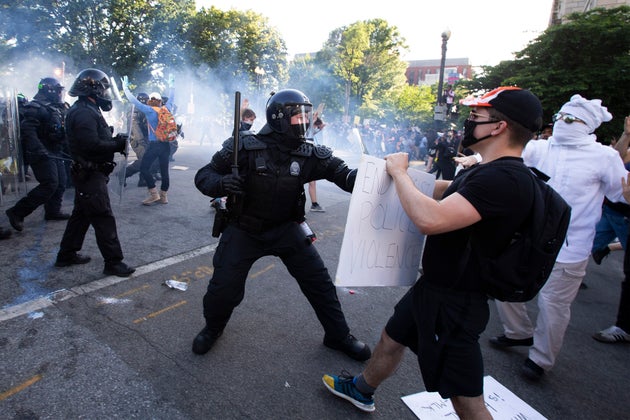
In the footage that aired on television, Brace was reporting live from a protest outside the White House as police began clearing the protestors to make way for the US President by firing projectiles and tear gas upon American citizens protesting peacefully. 

As Brace and Myers tried to take cover behind a wall, police approached, pushed Brace back with a shield and and punched Myers. 

“My cameraman has been hit,” Brace said in the clip. 

“You heard us yelling there that we were media but they don’t care, they’re being indiscriminate at the moment. They chased us down the street as you see.” 

Detailing their injuries, she said, “I actually managed to get a rubber bullet to the backside and Tim got one in the back of the neck so we’ll have a few bruises tomorrow but we’re perfectly safe”. 

“The attack on our reporter and cameraman in Washington today is nothing short of wanton thuggery,” said Seven’s McPherson. 

“They weren’t in anyone’s way just simply doing their job. To be belted with an armoured shield and then our reporter cop a truncheon in the back is abhorrent.”

In a press conference on Tuesday morning, Anthony Albanese called for the Australian government to take action.

“The ambassador certainly should be making representations on behalf of these Australians, who effectively have been assaulted — that’s what it is — for doing their job,” he told reporters. 

“In a democratic society, the role of the media is critical and it’s important that the media are able to report on events, including crises such as we’re seeing in the United States, free from harassment.

“And the violence that has occurred towards members of the media, Australian media and domestic media as well, with tear gas being fired, with media being assaulted, is completely unacceptable.”

While journalists have worked to cover protests in the past few days, some faced arrest while doing their jobs. 

HuffPost reporter Chris Mathias was taken into custody Saturday while covering anti-racism protests in New York City.

Mathias, a senior reporter who covers the far right, disinformation and hate, had been reporting for days on the protests, prompted by the police killing of George Floyd in Minneapolis. He was in the Flatbush area of Brooklyn when police took him into custody.

Mathias was released Sunday around 1 a.m. after being taken to the 72nd Precinct in the Sunset Park area of Brooklyn.

Police arrested CNN correspondent Omar Jimenez, producer Bill Kirkos and photojournalist Leonel Mendez while they covered protests in Minneapolis on Friday morning. Las Vegas police arrested two photojournalists, Las Vegas Review-Journal staff photographer Ellen Schmidt and freelancer Bridget Bennett, on Friday as well, along with about 80 protesters. 

The US president said Monday that he supported peaceful protests, even as federal law enforcement fired tear gas, pepper balls and flash-bang grenades at nonviolent protesters just outside the White House.

He claimed without evidence that peaceful protests had been infiltrated by “professional anarchists, violent mobs, arsonists, looters, rioters, antifa and others.”  

“These are not acts of peaceful protest. These are acts of domestic terror,” Trump added, detailing misleading and sometimes exaggerated examples of property destruction and violence that he linked to the protesters.

“I am mobilising all available federal resources — civilian and military — to stop the rioting and looting, end the destruction and arson, and to protect the rights of law-abiding Americans, including your Second Amendment rights.”

With additional reporting by HuffPost US team. 


Source by [author_name]