How sustainable is the use of #Water in #EUAgriculture, ask auditors

0

How sustainable is the use of #Water in #EUAgriculture, ask auditors

How sustainable is the use of #Water in #EUAgriculture, ask auditorsWith farmers being major consumers of freshwater, the European Court of Auditors is assessing the impact of the EU’s agricultural policy on sustainable water use. The audit, which has just started, will be useful as the EU moves forward with its reform of the common agricultural policy.

Freshwater is one of our most valuable resources. However, the dual pressures of economic activity and climate change are making water increasingly scarce throughout Europe. Agriculture in particular has a major impact. At least one quarter of all freshwater abstracted in the EU is used on farmland. Agricultural activity not only affects the quantity and availability of freshwater resources, but it also affects water quality, for instance through fertiliser and pesticide pollution.

“Farmers are major users of freshwater; they are also among the first to be impacted by water scarcity,” said Joëlle Elvinger, the member of the European Court of Auditors responsible for the audit. “Our audit seeks to determine in particular whether the action of the EU and its Member States in agriculture is suitable and effective in applying and enforcing the principles of sustainable management of this vital resource.”

The EU’s current approach to managing water goes back to the 2000 Water Framework Directive, which introduced, among other things, principles of sustainable water use. It aims to prevent the deterioration of water bodies and achieve good qualitative and quantitative status for all water bodies across the EU.

The common agricultural policy (CAP) plays an important role in water sustainability. It offers some tools that can help reduce the pressures on water resources, but it may also, for example, finance irrigation infrastructure.

This audit of the impact of the EU’s agricultural policy on the sustainable use of water is being launched with a view to contributing to the future CAP.

The auditors will assess whether EU policies promote sustainable water use in agriculture. In particular, they will examine whether:

o      The European Commission has included the principles of sustainable water use in the CAP rules, and;

o      EU member states apply those principles and provide incentives for sustainable water use in agriculture.

Three weeks ago, the European Commission decided not to revise the Water Framework Directive, which requires Member States to ensure that all water bodies are in “good status” by 2027.

The audit preview published on 7 July provides information about an ongoing audit task on the sustainable use of water in EU agriculture, which is expected to be concluded in the second half of 2021. Audit previews are based on preparatory work undertaken before the start of an audit and should not be regarded as audit observations, conclusions or recommendations. The full audit preview is available in English here.

In recent years, the ECA has published several special reports on water-related issues, such as desertification, the Drinking Water Directive, eutrophication in the Baltic Sea and water quality in the Danube river basin. Information on the measures the ECA has taken in response to the COVID-19 pandemic can be found here.


Source by [author_name]

Two accused of painting over Black Lives Matter mural charged with hate crime

Two San Francisco-area residents accused of painting over a “Black Lives Matter” mural are facing hate crime charges.

Nicole Anderson, 42, and David Nelson, 53, both of Martinez, were charged Tuesday with three misdemeanor counts, including a hate crime violation, the Contra Costa County District Attorney’s Office said in a statement.

The July 4 incident was captured on video that shows a woman splattering black paint on the yellow block letters on a downtown Martinez street and then using a roller to cover some of the letters in the mural, which was city approved.

In the video, which had previously been shared on social media and by the Martinez Police Department, a man can be heard saying, “the narrative of police brutality, the narrative of oppression, the narrative of racism, it’s a lie.”

The woman painting says “keep this [expletive] in New York. This is not happening in my town.”

Both are white, and the man is wearing what appears to be a “Make America Great Again” hat and a shirt with the words Trump and “Four More Years.”

Police confirmed that the two people seen in that video are Anderson and Nelson, a spokesman for the district attorney’s office said. Anderson painted over part of the mural, and Nelson “directly aided in the alleged criminal conduct,” the district attorney’s office said.

Both are charged with violation of civil rights; vandalism under $400; and possession of tools to commit vandalism or graffiti; which are all misdemeanors, according to the district attorney’s office.

Police have said that the mural was completed on July 4, and that both went to the mural with the purpose of painting over it.

If convicted, they face up to a year in county jail.

An aerial view of the BLM mural in Martinez, California.Martizians for Black Lives

Phone messages to numbers that appear linked to Anderson or Nelson in public records were not immediately returned Tuesday night. It was not immediately clear if either had an attorney.

Black Lives Matter protests against racial injustice and demonstrations calling for police reforms have been held across the country following the in-custody death of George Floyd in Minneapolis on May 25.

Some cities, including Washington, D.C. and San Francisco, have had the words of that movement painted on streets.

“We must address the root and byproduct of systemic racism in our country. The Black Lives Matter movement is an important civil rights cause that deserves all of our attention,” County District Attorney Diana Becton said in Tuesday’s statement.

“The mural completed last weekend was a peaceful and powerful way to communicate the importance of Black lives in Contra Costa County and the country,” Becton said. “We must continue to elevate discussions and actually listen to one another in an effort to heal our community and country.”

Martinez Mayor Rob Schroder said in a statement Tuesday that permission was granted to the group Martizians for Black Lives to paint the mural on July 2.

That request was made after what the mayor described as “anti-black hateful flyers” that threatened harm against Black Lives Matter supporters were found downtown on June 27.

“Approval of the use of our streets sends a message to all that African-Americans and other people of color are equal members of our community and hateful rhetoric will be actively rejected by our City,” the mayor said.

Martinez is a city of around 38,000 in Contra Costa County, northeast of San Francisco.


Source link

Mary Kay Letourneau, Former 6th Grade Teacher Jailed For Raping Student, Dies

SEATTLE (AP) — Mary Kay Letourneau, who married her former sixth-grade student after she was convicted for raping him, has died. She was 58.

Her lawyer David Gehrke told multiple news outlets Letourneau died Tuesday of cancer. He did not immediately return an email from The Associated Press.


In this 1998, file photo, Mary Kay LeTourneau listens to testimony during a court hearing in Seattle. 

Letourneau was a married mother of four having difficulties with her marriage in 1996 when Vili Fualaau was a precocious 12-year-old in Letourneau’s class at Shorewood Elementary in Burien, a south Seattle suburb.

At about 1:20 a.m. on June 19, 1996, police discovered them in a minivan parked at the Des Moines Marina.

Letourneau, then 34, initially told officers the boy was 18, raising suspicions that something sexual was going on. But back at the police station, Fualaau and Letourneau denied there had been any “touching.” Instead, they said, Letourneau had been babysitting the boy and took him from her home after she and her husband had a fight.

About two months after the marina incident, Letourneau became pregnant with the couple’s first daughter. Their second child was conceived in 1998, after Letourneau had pleaded guilty to child rape and received a 7 1/2-year prison term, which was suspended on condition she have no contact with Fualaau.

Letourneau and Fualaau married on May 20, 2005, in Woodinville, Washington, after she finished serving time in prison.

Fualaau and Letourneau had previously characterized their relationship as one of love, and even wrote a book together — “Un Seul Crime, L’Amour,” or “Only One Crime, Love.” Their story was also the subject of a USA Network movie, “All American Girl.”

King County court records show Fualaau asked the court for a legal separation from Letourneau on May 9, 2017.


Source by [author_name]

Window into Texas virus surge: A widow’s death

COVID-19 hospitalizations in Texas have more than doubled in two weeks, and some city leaders warn health facilities could soon be overwhelmed. The Associated Press visited Houston’s United Memorial Medical Center to see the effect of the surge. (July 8)

AP

Source link

Billie Eilish’s mother reveals extent of star’s devotion to Justin Bieber

0

Billie Eilish’s mother joked she once considered taking the star to therapy over her obsession with Justin Bieber.

op sensation Eilish, 18, has previously spoken of her devotion to the Baby singer and described how her bedroom wall was adorned with his posters.

Now, her parents have revealed how intense her passion was, saying she would cry while listening to his music.

Close

Billie Eilish has opened up on her love of Justin Bieber (Ian West/PA)

During an appearance on Eilish’s me & dad radio Apple Music show, her mother Maggie Baird said: “I just want to say, we did consider taking you to therapy because you were in so much pain over Justin Bieber. It was so intense, it caused you so much pain.”

Eilish said she would become emotional while watching Bieber’s music video for his 2012 hit As Long As You Love Me.

“I would watch the music video for this song and just sob,” the teenage Grammy winner said.

… we did consider taking you to therapy because you were in so much pain over Justin BieberMaggie Baird

Discussing the song, Baird, an actress whose TV credits include Bones, The X-Files and Six Feet Under, added: “I remember this one really well and the video, and Billie talking about it, and being excited it was coming out, and just crying and crying.

“Everyone knows the whole Billie/Justin Bieber thing, but this song was a big part of it.”

Eilish got to meet Bieber, 26, for the first time at Coachella last year. The pair were pictured sharing a hug following Eilish’s lauded debut performance at the festival.

PA

Source link

Covid-19 impact: People are making much longer voice calls, finds Ericsson

0

Written by Nandagopal Rajan
| New Delhi |

Published: July 8, 2020 9:49:55 am


Ericsson’s APAC CTO Dr Magnus Ewerbring told indianexpress.com that they have been seeing how the duration of sessions are increasing.

Among the many behavioural changes the coronavirus pandemic lockdown has induced is the trend that we are now making voice calls that last longer than usual. In fact, up to 70 per cent longer.

Ericsson’s APAC CTO Dr Magnus Ewerbring told indianexpress.com that they have been seeing how the duration of sessions are increasing. “One very clear piece of statistic that we monitor is talktime — how long is a typical come voice communication. And voice calls are now typically 20 to 70 per cent longer than they are traditionally,” he said in an video interaction, adding how this figure has been quite stable for many years. “What been going up is how often you talk, but now we see that that the intensity is there but the duration is increasing, which is a significant change from earlier.”

Dr Ewerbring said that while for Ericsson it has always been very important to follow the commercial implementation of the networks and thereby look at traffic behaviour traffic patterns, in the last few months they have got “extra energy to drive this kind of analysis with the Covid situation”. “So while we have fresher numbers and articulated conclusions in some areas, they are anyway pointing in a direction that we have seen for some years,” he explained, citing the example of when 3G was launched and how they noticed networks were busier in the evening when people where streaming content at home. Now, the traffic pressure has moved to residential areas from business districts as people are working from home across the world, Ericsson studies have found.

“Yes, traffic has shifted more to the residential areas even in June data, and the length has been extended and data volumes have gone up. Those are very interesting facts. But it’s not so that things have been tipped upside down,” said Dr Ewerbring who has been with Ericsson for over three decades. “It’s a continued trend that we have seen for some time and maybe it’s being stronger in certain directions that’s something we will continuously work with and can adapt to.”

READ | Lockdowns triggered rapid shift of network traffic from business to residential areas: Ericsson Mobility Report

Dr Ewerbring, who holds a Ph.D. in Electrical Engineering from Cornell University, said Ericsson always advises customers that when they deploy the networks they need to have strong implementations everywhere, because people will use it wherever they are. Linking it to Ericsson’s prediction that India will have 1 billion smartphones in 2025, he said: “That means you potentially have 1 billion access points to the Internet. People will not only connect when they are in their office or at home, but also when they are on the bus or out and about as well. My recommendation here to operators is to constantly follow where people are and follow their behaviour and make sure that they are well dimensioned for the levels of traffic they see all over the network, because people will always want to be connected.”

In terms of 5G launches across the world, Dr Ewerbring said that while operators need to relate to the pandemic in what they do, it’s not a limiting factor. “I think operators all over the world now are thinking of where they are in this change and when is it possible to launch 5G. And to a very high degree I think there is less of an impact (of the virus) in that sense. There are many things you need to do.”

Giving some context on the impact of 5G on the ecosystem in coming years, he cited the Ericsson Mobility Report which predicts there will 2.8 billion 5G connections in 2025, about 31 per cent of the total subscriptions. But that 31 per cent will generate 45 per cent of the network load. “Now, that 45 per cent in 2025 will be 2.4 times of all the load we had last year in the networks,” Dr Ewerbring put it in perspective, and underlined that there was no reason to hold off the switch to the newer generation of networks.

READ | India will triple data usage by 2025: Ericsson Mobility Report

“5G is the best we have. It’s the newest, it’s the latest, it’s the best. Ericsson started research on 5G in 2010. So it took us 10 years before we had full scale commercial services,” he explained, adding how there was a similar ’10-year-cycle’ for 4G and 3G as well.

“So, 5G contains the best possible knowledge we have. And then over the next 15 years or so 5G will continue to evolve. 4G is still evolving. So, 5G will be the best for a very long time to come. And therefore, there’s always incentive to go up there, but you also have to bear in mind that the other technologies are not fading out overnight,” he said, adding that of the 8.9 billion mobile subscriptions predicted for 20205, 4.4 billion, or about half, will still be on 4G networks.

“The world is not binary, but you certainly see the rise of 5G coming along. And over time devices will be more and more affordable and more people can go into the newest generation. And over time, you know, people will move up the ladder of getting the next G.”

📣 The Indian Express is now on Telegram. Click here to join our channel (@indianexpress) and stay updated with the latest headlines

For all the latest Technology News, download Indian Express App.

© IE Online Media Services Pvt Ltd

Source link

The Inside Story of Why Mary Trump Wrote a Tell-All Memoir

Mary Trump, in response, gave her lawyer a long list of the events they had attended.

In her book, Ms. Trump accuses Robert Trump of telling her and her brother during the will battle that if they did not settle, the family would bankrupt one of the companies in which they had inherited a stake and saddle the two of them with the bill.

Ms. Barry and Robert Trump did not respond to requests for comment.

The Trumps settled their disputes in April 2001, court records show. As part of the deal, Mary and Fred III received an undisclosed cash settlement, and they agreed to turn over the 20 percent stake in Trump assets they had inherited from their father, including seven apartment complexes, ground leases and stakes in a public housing complex and in the company Robert Trump had purportedly threatened to bankrupt.

After The Times reported on the family’s questionable valuations of its real-estate assets in 2018, Mary Trump concluded that she and her brother were duped in the settlement, she has claimed in the run-up to publishing her book.

Even as the court fight over the will was starting to be resolved, Ms. Trump tried to establish her own life.

After working on a master’s degree in English at Columbia University, she switched directions and in 2001 started taking psychology courses at Adelphi University, not far from her home. In 2003, she earned a master’s degree, and by the end of the decade had finished her doctoral studies, writing a dissertation that examined the qualities that made people vulnerable to being stalked by their partners.

Around the same time, she entered into a romantic relationship. Ms. Trump and her partner raised a daughter before separating several years later.

When her uncle Donald announced that he was running for president in June 2015, Ms. Trump did not take it seriously, assuming, she wrote, that he “simply wanted the free publicity for his brand.” Throughout the campaign, which was marked by scandals like the release of the “Access Hollywood” tape, Ms. Trump did not speak out, fearing that her voice would not be heard and that her views would make no difference, she wrote in the book.

Source link

Sarah Palin and Todd Palin Finalized Their Divorce in March


Sarah Palin and Todd Palin Finalized Their Divorce in March | Entertainment Tonight


Source link

JK Rowling and Salman Rushdie among 152 public figures to criticise ‘cancel culture’

0

JK Rowling and Salman Rushdie are among 152 writers and academics who have signed an open letter denouncing the so-called “cancel culture”.

Those who signed the letter have said they “applaud” recent protests for racial justice and greater equality, but added a “reckoning” has weakened tolerance of different opinions in favour of “ideological conformity”.

The writers and academics, including philosopher Noam Chomsky and The Handmaid’s Tale author Margaret Atwood, go on to call Donald Trump a “real threat to democracy” before saying “resistance must not be allowed to harden into its own brand of dogma or coercion”.

“Cancel culture” refers to the online practice of showing opposition to an individual, usually a celebrity or public figure, who has expressed an opinion that is perceived to be offensive.

Former world chess champion Garry Kasparov, the Canadian journalist Malcolm Gladwell and the British novelist Martin Amis also signed the letter, which continues: “The free exchange of information and ideas, the lifeblood of a liberal society, is daily becoming more constricted.

“While we have come to expect this on the radical right, censoriousness is also spreading more widely in our culture: an intolerance of opposing views, a vogue for public shaming and ostracism, and the tendency to dissolve complex policy issues in a blinding moral certainty.

“We uphold the value of robust and even caustic counter-speech from all quarters. But it is now all too common to hear calls for swift and severe retribution in response to perceived transgressions of speech and thought.”

Image:
Salman Rushdie is among those to have signed the open letter

The letter, which was published on the website of Harper’s Magazine on Tuesday, also references editors who are being fired for “running controversial pieces” and professors being “investigated for quoting works of literature in class”.

It continues: “This stifling atmosphere will ultimately harm the most vital causes of our time.

“The restriction of debate, whether by a repressive government or an intolerant society, invariably hurts those who lack power and makes everyone less capable of democratic participation.

“The way to defeat bad ideas is by exposure, argument, and persuasion, not by trying to silence or wish them away.”

Harry Potter author JK Rowling has faced opposition over her tweets about transgender people.

She has criticised the use of the phrase “people who menstruate” and suggested that trans women could pose a threat to cisgender women.

She is also facing criticism after describing hormones and surgery for transgender people as “a new kind of conversion therapy”.

Canadian author Margaret Atwood faced a social media backlash in 2018 when she expressed concerns about the #MeToo movement and called for due process in the case of a former university professor accused of sexual misconduct.

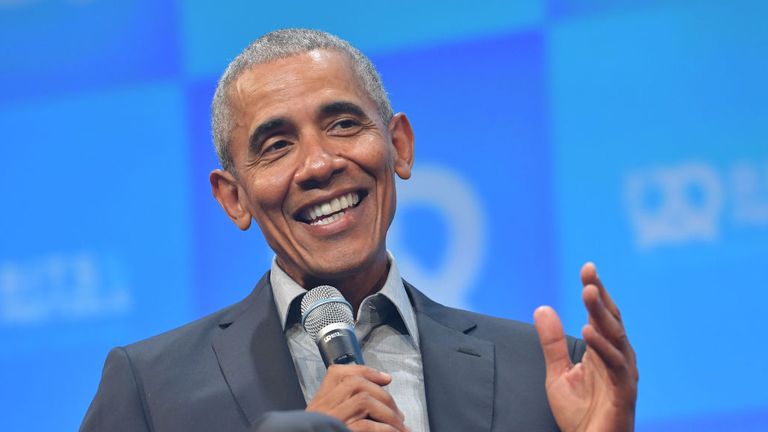
MUNICH, GERMANY - SEPTEMBER 29: Former U.S. President Barack Obama speaks at the opening of the Bits & Pretzels meetup on September 29, 2019 in Munich, Germany. The annual event brings together founders and startups from across the globe for three days of networking, talks and inspiration. during the "Bits & Pretzels Founders Festival" at ICM Munich on September 29, 2019 in Munich, Germany. Bits & Pretzels is an application-only, three-day festival that connects 5,000 founders, investors, startu
Image:
Barack Obama criticised ‘woke’ culture last year

The former US president Barack Obama challenged “woke” culture last year when he said calling people out on social media doesn’t bring about change.

He said: “I get a sense among certain young people on social media that the way of making change is to be as judgemental as possible about other people.

“If I tweet or hashtag about how you didn’t do something right or used the wrong verb, then I can sit back and feel pretty good about myself because ‘man did you see how woke I was? I called you out!'”

He added: “If all you’re doing is casting stones, you are probably not going to get that far.”

The full list of people who signed the letter:

  • Elliot Ackerman, US author
  • Saladin Ambar, associate professor of political science at Rutgers University
  • Martin Amis, British novelist
  • Anne Applebaum, US journalist and historian
  • Marie Arana, Peruvian author
  • Margaret Atwood, Canadian author
  • John Banville, Irish novelist
  • Mia Bay, US historian
  • Louis Begley, US novelist
  • Roger Berkowitz, professor of political studies at Bard College
  • Paul Berman, US writer
  • Sheri Berman, professor of political science at Barnard College
  • Reginald Dwayne Betts, US poet
  • Neil Blair, literary agent
  • David W. Blight, history professor at Yale University
  • Jennifer Finney Boylan, US author
  • David Bromwich, professor of English at Yale University
  • David Brooks, American-Canadian political commentator
  • Ian Buruma, professor of human rights and journalism at Bard College
  • Lea Carpenter, US writer
  • Noam Chomsky, US philosopher and political activist
  • Nicholas A. Christakis, American-Greek sociologist
  • Roger Cohen, British journalist and author
  • Ambassador Frances D. Cook
  • Drucilla Cornell, American philosopher
  • Kamel Daoud, Algerian writer
  • Meghan Daum, American author
  • Gerald Early, American essayist
  • Jeffrey Eugenides, US novelist
  • Dexter Filkins, US journalist
  • Federico Finchelstein, Argentinian historian
  • Caitlin Flanagan, US writer and social critic
  • Richard T. Ford, professor of law at Stanford Law School
  • Kmele Foster, US commentator
  • David Frum, American-Canadian commentator
  • Francis Fukuyama, US political scientist
  • Atul Gawande, US surgeon and writer
  • Todd Gitlin, American sociologist
  • Kim Ghattas, Lebanese journalist
  • Malcolm Gladwell, Canadian journalist
  • Michelle Goldberg, American blogger and author
  • Rebecca Goldstein, American philosopher
  • Anthony Grafton, US historian
  • David Greenberg, professor of history and journalism at Rutgers University
  • Linda Greenhouse, US journalist
  • Rinne B. Groff, US playwright and performer
  • Sarah Haider, American-Pakistani writer activist
  • Jonathan Haidt, American social psychologist
  • Roya Hakakian, Iran-born writer
  • Shadi Hamid, American author
  • Jeet Heer, Canadian author
  • Katie Herzog, podcast host
  • Susannah Heschel, professor of Jewish studies at Dartmouth College
  • Adam Hochschild, US author and journalist
  • Arlie Russell Hochschild, US author
  • Eva Hoffman, Polish writer and academic
  • Coleman Hughes, US writer
  • Hussein Ibish, senior resident scholar at the Arab Gulf States Institute
  • Michael Ignatieff, Canadian author and academic
  • Zaid Jilani, journalist
  • Bill T. Jones, US choreographer
  • Wendy Kaminer, American lawyer and writer
  • Matthew Karp, historian at Princeton University
  • Garry Kasparov, leader of the Renew Democracy Initiative
  • Daniel Kehlmann, German novelist
  • Randall Kennedy, American law professor
  • Khaled Khalifa, Syrian novelist
  • Parag Khanna, Indian-American specialist in international relations
  • Laura Kipnis, American cultural critic
  • Frances Kissling, US activist
  • Enrique Krauze, Mexican historian
  • Anthony Kronman, professor at Yale University
  • Joy Ladin, American poet
  • Nicholas Lemann, professor at Columbia University
  • Mark Lilla, American political scientist
  • Susie Linfield, social and cultural theorist
  • Damon Linker, US writer
  • Dahlia Lithwick, Canadian-American writer
  • Steven Lukes, British political and social theorist
  • John R. MacArthur, American journalist
  • Susan Madrak, Philadelphia-based writer
  • Phoebe Maltz Bovy, US writer
  • Greil Marcus, US author
  • Wynton Marsalis, American trumpeter
  • Kati Marton, Hungarian-American author
  • Debra Maschek, New York-based scholar
  • Deirdre McCloskey, professor at the University of Illinois at Chicago
  • John McWhorter, US professor at Columbia University
  • Uday Mehta, American political scientist
  • Andrew Moravcsik, professor at Princeton University
  • Yascha Mounk, American-German political scientist
  • Samuel Moyn, professor of law and history at Yale University
  • Meera Nanda, Indian writer and historian of science
  • Cary Nelson, professor at the University of Illinois at Urbana-Champaign
  • Olivia Nuzzi, political reporter at New York Magazine
  • Mark Oppenheimer, staff writer at the Christian Century
  • Dael Orlandersmith, American actress and poet
  • George Packer, US journalist
  • Nell Irvin Painter, American historian
  • Greg Pardlo, American poet
  • Orlando Patterson, Jamaican-born American historical and cultural sociologist
  • Steven Pinker, Canadian psychologist
  • Letty Cottin Pogrebin, US author
  • Katha Pollitt, American poet and critic
  • Claire Bond Potter, political historian
  • Taufiq Rahim, senior fellow at the New America Foundation
  • Zia Haider Rahman, British novelist
  • Jennifer Ratner-Rosenhagen, history professor at the University of Wisconsin-Madison
  • Jonathan Rauch, American author and journalist
  • Neil Roberts, political theorist
  • Melvin Rogers, professor of political science at Brown University
  • Kat Rosenfield, pop culture and political writer
  • Loretta J. Ross, African-American academic
  • JK Rowling, British author
  • Salman Rushdie, British Indian novelist
  • Karim Sadjadpour, Iranian-American policy analyst
  • Daryl Michael Scott, professor of US history at Howard University
  • Diana Senechal, teacher and writer
  • Jennifer Senior, author
  • Judith Shulevitz, American journalist
  • Jesse Singal, Brooklyn-based journalist
  • Anne-Marie Slaughter, American politician scientist
  • Andrew Solomon, American writer
  • Deborah Solomon, American art critic and biographer
  • Allison Stanger, political scientist
  • Paul Starr, professor of sociology and public affairs
  • Wendell Steavenson, American journalist and author
  • Gloria Steinem, US writer and activist
  • Nadine Strossen, US civil liberties activist
  • Ronald S. Sullivan Jr, law professor at Harvard Law School
  • Kian Tajbakhsh, Iranian-American scholar
  • Zephyr Teachout, US attorney and author
  • Cynthia Tucker, American journalist
  • Adaner Usmani, assistant professor of sociology and social studies
  • Chloe Valdary, American writer
  • Lucía Martínez Valdivia, professor of English and humanities at Reed College
  • Helen Vendler, American literary critic
  • Judy B. Walzer, American academic administrator
  • Michael Walzer, US political theorist
  • Eric K. Washington, historian and author
  • Caroline Weber, American author and historian
  • Randi Weingarten, president of the American Federation of Teachers
  • Bari Weiss, American writer
  • Sean Wilentz, professor at Princeton University
  • Garry Wills, American author and journalist
  • Thomas Chatterton Williams, American cultural critic
  • Robert F. Worth, US journalist
  • Molly Worthen, journalist and historian of American religion
  • Matthew Yglesias, American blogger
  • Emily Yoffe, US journalist
  • Cathy Young, Russian-born American journalist
  • Fareed Zakaria, American journalist

Source link

‘They find you and shoot you’: Chechens in fear after third Kadyrov critic killed

0

Chechens in Europe have expressed renewed fears for their safety, after a strident critic of the Kremlin-backed Chechnya leader, Ramzan Kadyrov, was shot dead in Vienna on Saturday.

“Everyone is scared. We all left to find safety and forget about home, and they find you and shoot you like a dog,” said a Chechen man who has received asylum in Austria and asked to remain anonymous, shortly after attending a wake for the dead man in Vienna on Monday afternoon.

Saturday’s attack was the latest in a string of brazen killings of critics of Kadyrov, or Chechens with a background in the anti-Russian insurgency, in locations across Europe. It was the fourth violent attack on Chechens living inside the European Union in the past year, three of which ended in murder.

Austrian police have named the victim as 43-year-old “Martin B”, but Austrian media, as well as friends and associates, identified him as Mamikhan Umarov, who was widely known online as “Anzor from Vienna”. He posted foul-mouthed tirades against Kadyrov on YouTube.

Umarov was shot three times on Saturday near a shopping centre on the outskirts of Vienna. Austrian police later apprehended a suspect, also a Chechen man, in the town of Linz. Another Chechen is also in custody. Both have lived in Austria for many years, according to prosecutors. A spokesman for the prosecutors’ office said it had not yet been established whether there was a political motive behind the killing.

In a statement on Monday, Austrian police said the victim had declined police protection, though did not specify when, or why it was offered. A friend of Umarov’s, a Chechen man living in Austria who asked to remain anonymous, said Umarov had in fact agreed to have a 24-hour police patrol stationed outside his house in order to protect his wife and children, after reporting a credible threat on his life in recent months.

“If you went to his house, the police would check your documents, they were always there. But he didn’t want personal security, he turned it down. I told him that it was dangerous, that it was crazy he was going around on his own,” said the friend.

Umarov told friends he left Chechnya in 2005, fearful of attacks against those like himself who had worked in the structures of the briefly independent Chechnya in the late 1990s, before Russia reasserted control after a brutal bombing campaign and installed Kadyrov’s father as head of the republic.

Kadyrov took over in 2007 after his father was killed in a bomb attack, and has been accused of rights abuses, torture, the rounding up of gay men, assassinations of rivals and critics, and revenge attacks on their family members. He has denied the allegations, though frequently makes public threats against his enemies.

Umarov was reportedly given the new identity Martin Beck when he received asylum in Austria, and claimed to be working as an informant for the Austrian security services. He was a witness in the murder in Vienna in 2009 of Umar Israilov, who fled Chechnya and made allegations about Kadyrov’s personal involvement in torture.

“Anzor met with people who came from Chechnya who wanted to plan hits and recorded them, and then handed the recordings over to Austrian intelligence. He claimed he had been working with them for the past decade,” said the friend.

In recent months, Umarov had gone public, posting a series of foul-mouthed monologues on his YouTube channel, criticising Kadyrov. In one video, recorded outside Bratislava airport, Umarov spends several minutes insulting Kadyrov in obscene terms, calling him “the head prostitute of Chechnya” and insulting his parents. He also dared Kadyrov to find him and kill him.

The Chechens targeted in Europe appear to break down into two broad categories: some are outspoken anti-Kadyrov bloggers, while others have a history of supporting the insurgency, which morphed over the years from an independence movement into a more Islamist organisation that used terrorist methods.

In the latter cases, such as the murder of Zelimkhan Khangoshvili in Berlin last August, Russian federal forces may be involved. Khangoshvili, a Georgian citizen of Chechen origin who had fought against Russian forces in the early 2000s, was shot dead in Berlin’s Kleiner Tiergarten. German authorities accused the Russian government of being behind the hit and expelled two Russian diplomats.

In cases where the victims are noisy critics of Kadyrov, the evidence trail seems to point towards Grozny rather than Moscow. In January, 44-year-old blogger Imran Aliev, known as Old Mansur, was murdered in a hotel room in Lille. He had been stabbed repeatedly in the neck.

A few weeks later, the well-known Chechen blogger Tumso Abdurakhmanov reportedly attacked in Sweden, but was able to overpower his attacker. He posted a video online of him standing over the bloodied body of his assailant. “They have my mother,” the man said, when questioned. A year before, the head of the Chechen parliament, Magomed Daudov, known as Kadyrov’s right-hand man, had publicly declared a “blood feud” against Abdurakhmanov.

On Monday, Abdurakhmanov dedicated an episode of his popular video blog to the murder of Umarov. “Nobody was surprised by this. It angered us, it saddened us, but it didn’t surprise us. Everyone understands clearly why he was killed and who is responsible,” he said.

Source link