India has expelled two officials working at the Pakistan High Commission in New Delhi after they were held for espionage, the foreign ministry said.
“Two [Pakistani] officials were apprehended on Sunday by Indian law enforcement,” the ministry said in a statement, adding that the Indian government declared them “persona non grata” for indulging in activities incompatible with their status as members of a diplomatic mission.
More:
Both were expected to leave the country within 24 hours.
In Pakistan’s capital, Islamabad, the foreign ministry condemned India’s decision about the expulsion of two of its embassy officials. In a statement, it said the two staff members of the Pakistani High Commission in New Delhi were lifted by Indian authorities Sunday on false and unsubstantiated charges.
“They were, however, released on intervention by the High Commission. We condemn the detention and torture as well as threatening and pressuring of diplomatic officials to accept false charges,” it said.
Pakistan also summoned an Indian diplomat to lodge a strong protest over the move.
India and Pakistan routinely expel each other’s diplomats on spying charges and Pakistan is also expected to respond by expelling Indian High Commission officials in Islamabad in a tit-for-tat action.
India and Pakistan have a long-running dispute over Kashmir, which was split between them in 1947 when they gained independence from the UK.
The South Asian neighbours have fought three wars against each other since independence, including two over Kashmir.
Kashmir has become a bigger source of tension in the relations between the regional powers after New Delhi last year scrapped the Muslim-majority Himalayan region’s semi-autonomous status and imposed a curfew to quell unrest.
Rebel groups in Indian-administered Kashmir have battled for decades for the region’s independence or its merger with Pakistan and enjoy broad popular support.
The fighting has left tens of thousands dead, mostly civilians, since 1989. India has more than 500,000 troops stationed in Kashmir.
Surveillance video in Minneapolis shows the first moments of George Floyd’s police interaction.
USA TODAY
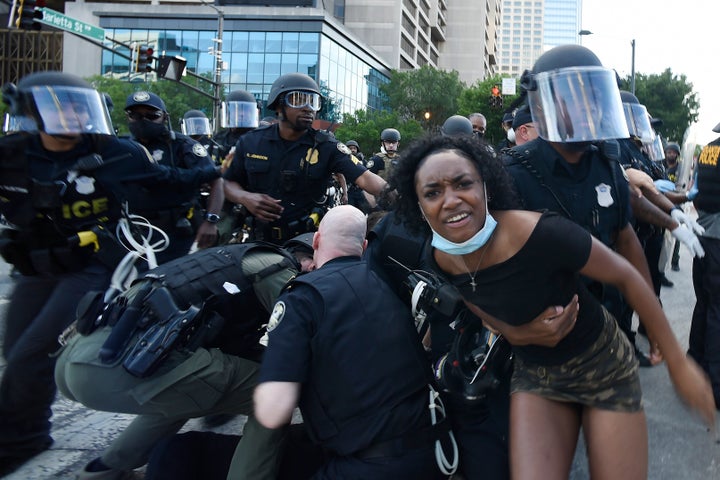
From Portland to Pensacola, violent protests flared in more than 30 cities across the U.S. this weekend in the wake of the death of George Floyd, an African American man who pleaded that he could not breathe after a white police officer kneeled on his neck for more than eight minutes during an arrest.
Why did Floyd’s death spark such widespread, visceral outrage, while three other deaths of African Americans this year – Breonna Taylor in Louisville, Ahmaud Arbery in Georgia and Tony McDade, a black transgender man killed by police officers in Tallahassee – did not?
An array of combustible issues converged to form a “perfect storm†of civil unrest after Floyd’s death and could lead to longer-lasting changes, experts and protest organizers said.
For starters, the coronavirus pandemic that has sequestered most Americans to their homes, forced millions into unemployment and has disproportionately infected African Americans already had many black Americans and white supporters simmering with rage and frustration, said Kristen Clarke, president and executive director of the National Lawyers’ Committee for Civil Rights Under Law.
“The depths of despair are enormous right now for black people in this country,†she said. “You pile on unchecked police violence and it makes for a perfect storm.â€
Throughout the weekend and across the country, police cars and government buildings burned, the National Guard was deployed into major U.S. cities, and some cities instituted curfews. In one Midwest city, a person was killed and at least two more shot.
More than 1,400 people were arrested in 16 cities since Thursday. More than 500 of those happening in Los Angeles on Friday, the Associated Press reported.Â
Fired Minneapolis police officer Derek Chauvin was arrested Friday on charges of third-degree murder and manslaughter after Floyd’s death. A bystander’s video caught more than eight minutes of Chauvin’s knee pinning Floyd’s neck as the suspect lay on the ground and pleaded for help before eventually passing out.
That video, which went viral, is another key reason his death has sparked so much outrage, said Keneshia Grant, a Howard University political scientist. The moments leading to Arbery’s death also were captured on video, but the footage of Floyd’s final moments – with the victim repeatedly saying he couldn’t breathe and asking for his mother while irate bystanders pleaded with police to stop – caused a much deeper emotional wound in those who watched it, she said.
Also, President Donald Trump’s controversial response to the incident and the protests it sparked may have driven more protesters to the streets, Grant said. Trump in a tweet on Friday called the violent protesters “THUGS,†adding that he was ready to send in the military if things got out of control and “when the looting starts, the shooting starts.â€
“America does not have a leader to bring people together,†Grant said. “We didn’t get a tweet that told everyone to Kumbaya and hold hands. We got a tweet about looting and shooting.â€
Calvetta Williams, founder of Mother’s Against Violence in Des Moines, Iowa, normally organizes small rallies of 100 or 200 people for local victims of gun violence. But when she saw the video of Floyd’s demise, she felt she needed to organize something bigger.
She posted an event invite on her group’s Facebook site, which garnered 400 “likes.” On Saturday, more than 1,000 protesters showed up for a peaceful march along University Avenue near downtown.Â
“It was beautiful,” Williams, 49, said. “It felt like I was part of a movement.”
For Williams, it was Floyd’s desperate pleas for his mother while subdued by police that struck a chord with her and prompted her to act. Another rally was scheduled for Sunday.Â
“It hit my spirit, my soul,” Williams said of the viral video. “I was angry. I felt I needed to stand up and show my support.”
The large-scale rallies that spread through nearly every major city in America over the weekend resemble the mass protests that materialized during the 1960s civil rights movement led by the Rev. Martin Luther King Jr., said Jill Savitt, executive director of the National Center for Civil and Human Rights in Atlanta.
Those incidents and the protests that followed led to significant policy shifts, she said. The murders of James Chaney, Andrew Goodman and Michael Schwerner, three  civil rights activists, in 1964 helped push the passage of the Civil Rights Act of 1964, she said. And the 1965 Selma to Montgomery marches, which dissolved into bloody confrontations with local law enforcement, helped propel the signing of the Voting Rights Act of 1965, Savitt said.
Similar policy and systemic changes could result from today’s protests, she said.
“You hate that you need tragedies like this for change, but history tells us that’s what happens,†Savitt said. “We’re having a societal shake of the lapels.â€
Silas Lee, a sociologist at Xavier University of Louisiana, said he has also been impressed by the large number of white and brown protesters taking part in the rallies. Large-scale civil right protests don’t effect change unless widely supported by America’s diverse populations, he said.
“This is not just an African American issue,†he said. “It’s a white issue, it’s a brown issue, it’s a human issue.â€
Grant, the Howard University political scientist, said the protests won’t work without widespread multicultural support. “White people have to figure out why they’re afraid of black people,†she said, “why they’re not appalled by these killings.â€
She added: “Black people have been trying to do something for 400 years: Assert their humanity. And it hasn’t worked.â€
Contributing: Deborah Barfield Berry
Follow Jervis on Twitter: @MrRJervis.
Read or Share this story: https://www.usatoday.com/story/news/nation/2020/05/31/george-floyd-anger-over-his-death-sparked-part-coronavirus/5293446002/
The government has notified new income-tax return forms for 2019-20, making it mandatory for high spenders to file ITR and allowing assesses to avail benefits of extended timelines in view of Covid-19.
People incurring large spending will not be able to escape paying taxes, with the government making filing mandatory in specific cases even in their income is below the taxable limit. With this, those spending over Rs 2 lakh on foreign travel, incurring more than Rs 1 lakh electricity bills, or depositing over Rs 1 crore in current account will have to mandatorily file ITR.
Earlier, an individual was required to file a tax return only if the total income exceeded the minimum threshold.
The Central Board of Direct Taxes (CBDT) on Saturday notified Sahaj (ITR-1), Form ITR-2, Form ITR-3, Form Sugam (ITR-4), Form ITR-5, Form ITR-6, Form ITR-7 and Form ITR-V for the assessment year 2020-21.
The last date for filing of ITR has been extended to November 30 from July 31.
The new ITR forms also require taxpayers to furnish details of tax saving investments or donations made up to June 2020 for 2019-20 separately.
To give relief to taxpayers facing Covid hardships, the deadline for making investment or payments for claiming deduction under Section 80C (LIC, PPF, NSC, ELSS mutual funds, etc.), 80D (Medi claim), 80G (Donations), etc for FY20 was extended till June 30 from March 31. In addition, the due dates for investment, construction, or purchase for claiming rollover benefit for capital gains was also extended till June 30.
The revised ITR forms allow taxpayers to enjoy benefits of their transactions carried out between April 1 and June 30.
Usually, notification for the ITR forms comes in the first week of April, but this time the income tax department notified the two simplified forms ITR-1 (Sahaj) and ITR-4 (Sugam) for the assessment year 2020-21 in the first week of January, which has been further revised now.
Returns in ITR-1 Sahaj can be filed by an ordinary resident individual, whose total income does not exceed Rs 50 lakh, while Form ITR-4 Sugam is meant for resident individuals, HUFs and firms (other than LLP) having a total income of up to Rs 50 lakh and having presumptive income from business and profession.
The government has allowed assesses owning a single house property to file ITR using simple forms — ITR 1 and 4. Besides, the high spenders mandated to file returns have been allowed to use the simple forms.
President Donald Trump on Sunday said the U.S. will designate anti-fascist protesters known as antifa as a terrorist organization amid nationwide protests over the recent death of unarmed Black man George Floyd while in Minneapolis police custody.
Trump, who announced his intentions on Twitter, blamed “radical left anarchists,†as well as the media, for stirring up trouble in various cities and urged local leaders to shut their demonstrations down “before it is too late!â€
“It’s ANTIFA and the Radical Left. Don’t lay the blame on others!†he tweeted Saturday after demonstrators gathered outside the White House over Floyd’s death and the president’s response to it. Many chanted “Black lives matter,†“I can’t breathe†and “No justice, no peace.†Some threw items at police and destroyed local property.Â
The United States of America will be designating ANTIFA as a Terrorist Organization.
— Donald J. Trump (@realDonaldTrump) May 31, 2020
The protesters had “little to do with the memory of George Floyd,†Trump said, adding that they “were just there to cause trouble.â€
An American Civil Liberties Union official, responding to Trump’s terrorism call for antifa on Sunday, called it “abused and misused.â€
“As this tweet demonstrates, terrorism is an inherently political label, easily abused and misused. There is no legal authority for designating a domestic group. Any such designation would raise significant due process and First Amendment concerns,†said ACLU National Security Project Director Hina Shamsi in a statement to HuffPost.
Damairs Carter/MediaPunch/MediaPunch/IPx
Police are seen armed with batons after protesters violated a curfew in effect in Minneapolis on Saturday.
Professor Steve Vladeck of the University of Texas School of Law similarly slapped down Trump’s plans, tweeting: “The United States of America has no legal authority to designate *any* domestic entities as ‘terrorist organizations.’â€
The FBI considers domestic terrorism to be “violent, criminal acts committed by individuals and/or groups to further ideological goals stemming from domestic influences, such as those of a political, religious, social, racial, or environmental nature.â€
The U.S. officially designates only foreign terrorist organizations, and supporting such organizations can trigger federal terrorism charges. Domestic organizations — from antifa to the Ku Klux Klan — enjoy broader First Amendment protections unless members of those organizations violate specific federal statutes.
Still, the federal government has broad powers to investigate organizations it considers criminal enterprises if officials see evidence of a conspiracy to break federal law. The Trump administration is suggesting an aggressive approach against left-wing protesters.
ASSOCIATED PRESS
Police detain demonstrators protesting in Atlanta on Saturday. The protest started peacefully earlier in the day before demonstrators clashed with police.
Trump’s comments, which failed to acknowledge the events that sparked the nation’s ongoing upheaval, came as White House national security adviser Robert O’Brien denied that there is a problem with systemic racism in the nation’s police forces.
“There are some bad apples in there. There are some bad cops that are racist, and there are cops that maybe don’t have the right training. … And they need to be rooted out,†O’Brien said in an interview Sunday with CNN.
Attorney General William Barr on Saturday also backed Trump’s depiction of the demonstrators, calling them “far-left extremist groups†that plan and organize violence across the country while “using antifa-like tactics.â€
“We must have law and order on our streets and in our communities,†Barr said.
AG Barr: it appears the violence is planned, organized, and driven by anarchic and left extremist groups, far left extremist groups using Antifa like tactics… it is a federal crime to cross state lines or to use interstate facilities to incite or participate in violent rioting pic.twitter.com/vZFz4kV9Xp
Antifa is not one organization but rather a loosely linked collection of groups of protesters who take on right-wing demonstrators, sometimes physically, according to the Anti-Defamation League.
Its participants “believe in active, aggressive opposition to far right-wing movements. Their ideology is rooted in the assumption that the Nazi party would never have been able to come to power in Germany if people had more aggressively fought them in the streets in the 1920s and 30s,†the ADL’s website states.
Ryan J. Reilly contributed reporting.
Calling all HuffPost superfans!
Sign up for membership to become a founding member and help shape HuffPost’s next chapter
The father of a mass shooting victim and two gun safety groups petitioned the federal government on Sunday to stop the firearms manufacturer Smith & Wesson from using what they described as “deceptive and unfair†marketing to promote assault-style rifles.
The father, Fred Guttenberg, whose 14-year-old daughter, Jaime, died in the Marjory Stoneman Douglas High School massacre in Parkland, Fla., joined with the advocacy groups Brady and Everytown for Gun Safety to send a complaint to the Federal Trade Commission.
As part of the complaint, Mr. Guttenberg and the gun control groups said that Smith & Wesson mimicked first-person-shooter video games in its advertising materials to attract adolescents and young adults. They added that the marketing of the company’s AR-15-style guns “attracts, encourages and facilitates mass shooters†and “played a significant role†in the Parkland shooting, according to the complaint.
Smith & Wesson didn’t immediately respond.
Smith & Wesson is the maker of the M&P15 .223 rifle used by the 19-year-old shooter in the 2018 Parkland massacre. The complaint urged the federal agency to investigate the company and to require that it include warnings in some of its marketing materials.
Mr. Guttenberg and the two advocacy groups also argued that the commission should prohibit the M&P brand — which stands for “military and police†— from making use of imagery associated with the military and law enforcement to sell its products to civilians.
Gun safety activists have long taken issue with how firearms are marketed. Relatives of the Sandy Hook Elementary School shooting victims have said in a court case that the Remington Arms Company, which made the Bushmaster AR-15-style rifle used in the 2012 massacre, recklessly marketed the gun to disturbed young men through violent video games and aggressive ads.
The Federal Trade Commission regulates marketing from social media influencers, ads from tobacco companies and, more recently, claims about coronavirus cures and loans. Over the last two decades, the agency has dealt with few cases involving how guns are advertised, according to the gun safety groups.
Mr. Guttenberg said in an interview that he turned to the agency after facing “somewhat insurmountable†hurdles trying to raise his concerns about Smith & Wesson in Florida’s court system.
“I’m a realist,†he said. “The F.T.C. may not do much, but others potentially will.â€
With a nudge from the commission, he added, elected officials may be moved to take further action.
“Times are different now,†Mr. Guttenberg said. “There are enough elected people in this country willing to address this topic in ways they were afraid to do in years past.â€
The 34-page complaint accuses Smith & Wesson of cultivating a “halo†of credibility by running ads that appeared to feature active members of the military carrying firearms resembling M&P rifles. It cites the company’s use of slogans that suggested ties to law enforcement and the military such as “To Uphold. To Protect. To Defend†and “The Line of Duty.â€
Most of the rifles are sold to civilians rather than to the military or law enforcement, according to the complaint.
The complaint also faulted Smith & Wesson for marketing to male adolescents and young adults on social media platforms like Instagram, where the company has a million followers, and through ads that evoked video games, with text like “experience more adrenaline†and “experience real-life first person shooting.â€
Federal restrictions prohibit licensed gun merchants from selling long guns to anyone younger than 18, according to the Bureau of Alcohol, Tobacco, Firearms and Explosives. But no federal law exists to block unlicensed sellers from doing business with “a person of any age.â€
The gun industry has suffered in recent years. When President Trump was elected in 2016 after frequent shows of support for the firearms industry, sales slumped. Gun buyers seemed no longer worried about losing access to firearms, leaving sellers with stockpiles of the guns they had amassed in anticipation of a Hillary Clinton victory.
Demand has lately ticked upward. Some gunmakers have adjusted their marketing to be gentler and more inclusive. In March, as the coronavirus pandemic intensified, Americans bought two million guns, the busiest month ever for sales since January 2013.
Smith & Wesson dates back to the 1850s and is based in Springfield, Mass. In March, its parent company said the number of handguns it shipped to distributors and retailers increased 4.7 percent in its most recent quarter. But shipments of long guns sank 31.8 percent, in part because a series of mass shootings put off several major retailers.
Racism-tinged events no longer startle even America’s closest allies, though many have watched coverage of the often-violent protests with growing unease.
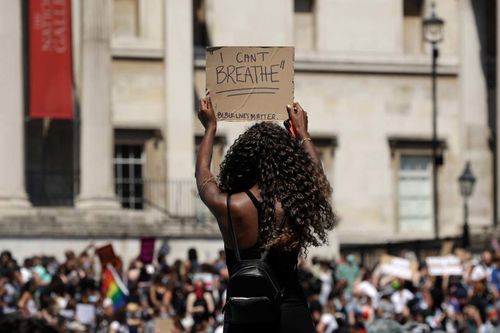
People, some of them kneeling gather in Trafalgar Square in central London. (AP)
Burning cars and riot police in the US featured on newspaper front pages around the globe on Sunday — bumping news of the COVID-19 pandemic to second-tier status in some places.
Floyd’s death on May 25 in Minneapolis was the latest in a series of deaths of black men and women at the hands of police in the US.
People attend a protest rally against racism following the recent death of George Floyd in the USA in Copenhagen, Denmark.. ( Sean Gallup/Getty Images)
Thousands gathered in central London on Sunday to offer support for American demonstrators.
Chanting “No justice! No peace!” and waving placards with the words “How many more?” at Trafalgar Square, the protesters ignored UK government rules banning crowds because of the pandemic. Police didn’t stop them.
Demonstrators then marched to the US Embassy, where a long line of officers surrounded the building. Several hundred milled around in the street and waved placards.
Protesters in Denmark also converged on the US Embassy on Sunday.
Participants carried placards with messages such as “Stop Killing Black People.”
The US Embassy in Berlin was the scene of protests on Saturday under the motto: “Justice for George Floyd.”
A woman holds up a banner as people gather in Trafalgar Square in central London. (AP)
Several hundred more people took to the streets Sunday in the capital’s Kreuzberg area, carrying signs with slogans like “Silence is Violence,” “Hold Cops Accountable,” and “Who Do You Call When Police Murder?” No incidents were reported.
Germany’s top-selling Bild newspaper on Sunday carried the sensational headline “This killer-cop set America ablaze” with an arrow pointing to a photo of now-fired police officer Derek Chauvin, who has been charged with third-degree murder in Floyd’s death, with his knee on Floyd’s neck.
The newspaper’s story reported “scenes like out of a civil war.”
In Italy, the Corriere della Sera newspaper’s senior US correspondent Massimo Gaggi wrote that the reaction to Floyd’s killing was “different” than previous cases of black Americans killed by police and the ensuring violence.
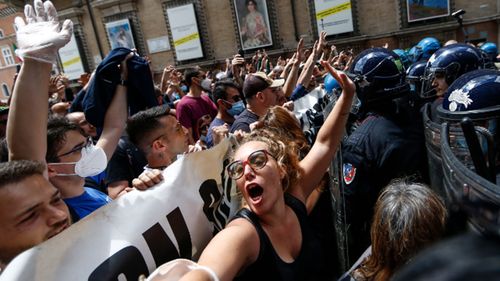
Demonstrators face police during a protest staged by far-right groups against the Italian government, following the economic crisis due to the COVID-19 pandemic, in Rome. (Cecilia Fabiano/LaPresse via AP)
“There are exasperated black movements that no longer preach nonviolent resistance,” Gaggi wrote, noting the Minnesota governor’s warning that “anarchist and white supremacy groups are trying to fuel the chaos.”
In countries with authoritarian governments, state-controlled media have been highlighting the chaos and violence of the US demonstrations, in part to undermine American officials’ criticism of their own nations.
In China, the protests are being viewed through the prism of US government criticism of China’s crackdown on anti-government protests in Hong Kong.
Hu Xijin, the editor of the state-owned Global Times newspaper, tweeted that US officials can now see protests out their own windows: “I want to ask Speaker Pelosi and Secretary Pompeo: Should Beijing support protests in the U.S., like you glorified rioters in Hong Kong?”
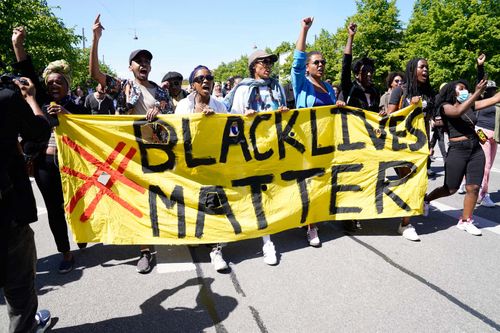
People gather for a Black Lives Matter demonstration in front of the US Embassy in Copenhagen, Denmark. (AP)
Hua Chunying, a Chinese Foreign ministry spokeswoman, pointed out America’s racial unrest by tweeting “I can’t breathe,” which Floyd said before his death.
In Iran, which has violently put down nationwide demonstrations by killing hundreds, arresting thousands and disrupting internet access to the outside world, state television has repeatedly aired images of the US unrest.
One TV anchor discussed “a horrible scene from New York, where police attacked protesters.” Another state TV message accused US police agencies in Washington of “setting fire to cars and attacking protesters,” without offering any evidence.
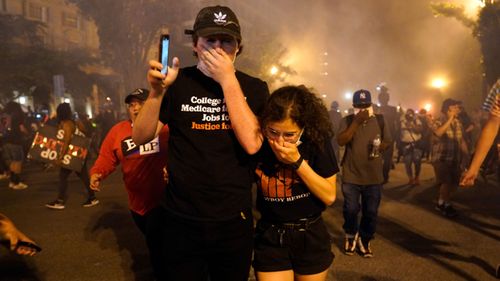
Demonstrators cover their face as people gather to protest the death of George Floyd, near the White House in Washington. (AP Photo/Evan Vucci)
Russia accused the United States of “systemic problems in the human rights sphere.” It denounced Floyd’s death as the latest in a series of police violence cases against African Americans.
“This incident is far from the first in a series of lawless conduct and unjustified violence from US law enforcement,” the Russian Foreign Ministry said in a statement. “American police commit such high-profile crimes all too often.”
Black Lives Matter demonstration in front of the US Embassy in Copenhagen, Denmark. (da Guldbaek Arentsen/Ritzau scanpix via AP)
There also have been expressions of solidarity with the demonstrators.
Over the weekend, Lebanese anti-government protesters flooded social media with tweets sympathetic to U.S. protesters, using the hashtag #Americarevolts.
That’s a play on the slogan for Lebanon’s protest movement — Lebanon revolts — which erupted on Oct. 17 last year. Within 24 hours, the hashtag #Americanrevolts became the No. 1 trending tag in Lebanon.
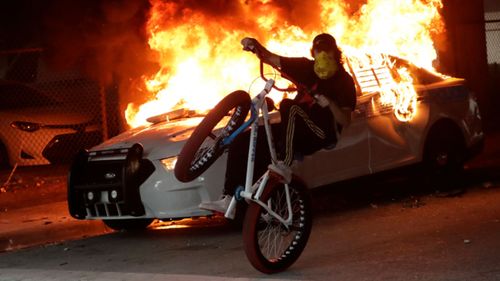
A protester on a bicycle rides past a burning police car during a demonstration next to the city of Miami Police Department. (AP Photo/Wilfredo Lee)
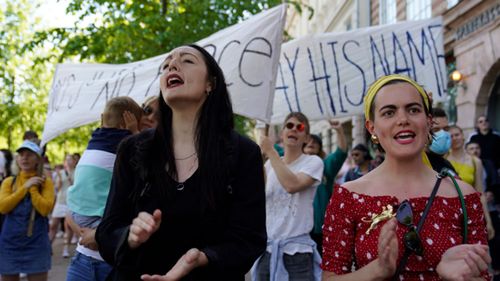
In another expression of solidarity with American protesters, about 150 people marched through central Jerusalem on Saturday to protest the shooting death by Israeli police of an unarmed, autistic Palestinian man earlier in the day.
Israeli police mistakenly suspected that the man, Iyad Halak, was carrying a weapon. When he failed to obey orders to stop, officers opened fire.
Gold and fuel smuggling costs resource-rich Sudan hundreds of millions of dollars a year.
A new report by financial watchdog group Global Financial Integrity(GFI) has revealed the extent of mismanagement in those sectors and its impact on the economy.
Cities across the U.S. were smoldering on Sunday after a largely peaceful day of protests on Saturday turned into a night of chaos and violence.
Hundreds of people were arrested as the police clashed with demonstrators angry over the death, a week ago today, of George Floyd, a black man who was handcuffed and pinned to the ground by a white police officer in Minneapolis.
A first in decades: At least 75 American cities have seen protests in recent days, and mayors in more than two dozen have imposed curfews. It was the first time since 1968, after the assassination of the Rev. Dr. Martin Luther King Jr., that so many local leaders have issued such orders in the face of civic unrest.
President Trump on Friday said he would begin rolling back the special trade and financial privileges that the U.S. extends to Hong Kong after Chinese leaders pushed through their plan to enact a national security law that broadens their power in the territory.
Lawyers, bankers, professors and other professionals interviewed by The Times described a growing culture of fear in offices across Hong Kong. Employees face pressure to support pro-Beijing candidates in local elections and echo the Chinese government’s official line. Those who speak out can be punished or even forced out.
Uncertainty: Hong Kong’s success as a global financial hub stems from its status as a bridge between China’s economy and the rest of the world. Now that balance is looking increasingly precarious.
Quotable: “This looks like a new Cold War, and Hong Kong is being made a new Berlin,†said Claudia Mo, a lawmaker in the city’s pro-democracy camp.
Indian and Chinese troops fought with rocks, clubs and fists in recent episodes along their disputed border in the Himalayas. No shots were fired and no one thinks the two giants are about to go to war, but the escalation is troubling.
Our reporters looked into the border brawls and what might lie behind them: a new assertiveness from China and perhaps roads built by India near Tibet.
Here’s what else is happening
SpaceX docking: The capsule carrying two NASA astronauts docked at the International Space Station on Sunday, less than a day after a launch that marked the first time humans had ever traveled to orbit in a spacecraft built and operated by a private company.
G7 postponed: President Trump pushed back a Group of 7 meeting in the U.S. to September from next month after Chancellor Angela Merkel of Germany said she would not attend in person over concerns about the coronavirus. Mr. Trump said he wanted to include Russia, Australia, South Korea and India to discuss the future of China.
What we’re reading: This essay in The Harvard Review. Lynda Richardson, a story editor, writes: “In a meditation on contact and distance in this age of quarantines, an eloquent writer finally comes to terms with a brutal attack in New York City many years ago.â€
Now, a break from the news
Cook: For these crisp-on-the-outside, tender-on-the-inside scones, you can use an old banana or any frozen or fresh fruit.
Watch:Hou Hsiao-Hsien’s martial-arts movie “The Assassin†played widely, but here’s a look at some lesser-known works by Taiwan’s greatest filmmaker.
Listen: Money is a stressful subject at the best of times, and only more so in these worst of times. These seven podcasts will help you weather the financial storm.
Check out our At Home collection for more ideas on what to read, cook, watch, and do while staying safe at home.
And now for the Back Story on …
My world: a decade working from home
Mike Hale, a Times television critic, has spent 10 years working at home, binge-watching the newest television series. So when the pandemic hit, not that much changed for him. In fact, he discovered, other lives were becoming more like his.
This sense of sameness was buttressed by the ability of the TV industry, relatively speaking, to maintain some semblance of business as usual. Colleagues who covered arts that depended on the physical proximity of audiences — theater, dance, live music, art museums and galleries, even movies, which is to say just about all of them — suddenly found themselves scrambling to find things to write about. On TV, meanwhile, new shows kept coming out.
But the truth, of course, is that everything is changing, and change is quickly catching up to TV. The absence of live sports has been the most obvious effect of the pandemic, but the near-total shutdown of production on most non-news programming is already rejiggering schedules and playing havoc with the fall season (if that designation even means anything now).
Creators are just beginning to explore new and safe methods of making shows. (A leading-edge example, the dramatic anthology “Isolation Stories,†made it on the air this month in Britain and comes to BritBox in America in June.) The next time we do a TV preview, it will probably look a lot different.
And while TV critics have had it easier than just about anyone during this troubling and sometimes terrifying period, we haven’t been untouched. No matter how well-practiced you are at sitting on a couch and staring at a screen, you’re not doing it with the same level of comfort that you had before.
The urge to check the news is stronger. Any susceptibility you might have to feelings of general uselessness is doubled. Worst of all, everyone else in your building is now home during the day too, and instead of watching TV, they’re doing dance aerobics or practicing the cello.
That’s it for this briefing. See you next time.
— Carole
Thank you To Melissa Clark for the recipe, and to Theodore Kim and Jahaan Singh for the rest of the break from the news. You can reach the team at briefing@nytimes.com.
P.S. • We’re listening to “The Daily.†Our latest episode is on the crisis in Minneapolis. • Here’s our Mini Crossword, and a clue: Applaud (four letters). You can find all our puzzles here. • The New York Times Magazine won five National Magazine Awards — known as the Ellies — for Print and Digital Media from the American Society of Magazine Editors, the most for any publication.
Governors, mayors and public health officials across the US are raising fears of a surge in coronavirus cases arising from escalating protests over the death of George Floyd.
Floyd, 46, died in Minneapolis this week during an arrest by four police officers. The killing focused fierce light on police brutality towards African Americans and stoked protest and violence in most major cities.
According to figures from Johns Hopkins University in Maryland, the US has seen nearly 1.8m infections and nearly 104,000 deaths in the Covid-19 pandemic. In a country that does not have universal healthcare, the crisis has disproportionately affected racial minorities, particularly those who live in crowded urban areas.
Images of demonstrators in close proximity, many without masks, have therefore alarmed leaders to the point where some are pleading with those on the streets to protest “the right wayâ€, in order to better protect themselves.
“I’m concerned that we had mass gatherings on our streets when we just lifted a stay at home order and what that could mean for spikes in coronavirus cases later,†Muriel Bowser, the mayor of Washington DC, said in a press conference on Sunday.
“I’m so concerned about it that I’m urging everybody to consider their exposure, if they need to isolate from their family members when they go home and if they need to be tested … because we have worked very hard to blunt the curve.â€
Bowser said protests in her city, which has seen violence several days in a row at the White House and other areas, were a mixed bag.
“While I saw some people with masks last night, others didn’t,†she said. “I saw some people social distancing, other people were right on top of each other. So we don’t want to compound this deadly virus and the impact it’s had on our community.
“We’ve been working hard to not have mass gatherings. As a nation, we have to be concerned about rebound.â€
Bowser’s message was echoed by Larry Hogan, the governor of Maryland, and by Keisha Lance-Bottoms, the mayor of Atlanta, who said she was “extremely concerned†about Covid-19 spreading, and that protests had distracted her from dealing with the pandemic.
On Saturday, Bottoms said at a press conference: “If you were out protesting last night, you probably need to go get a Covid test this week.â€
On Sunday, she told CNN’s State of the Union: “I realised that I hadn’t looked at our coronavirus numbers in two days. And that’s frightening, because it’s a pandemic, and people of color are getting hit harder.
“We know what’s already happening in our community with this virus. We’re going to see the other side of this in a couple of weeks.â€
According to the Georgia health department, more African Americans have contracted Covid-19 in the state than any other race.Â
“The question is how do we do protesting safely?†Dr Ashish Jha, director of the global health institute at Harvard’s TH Chan school of public health, told CNN. “I think masks are a critical part of it.â€
In New York, by far the state hardest hit by Covid-19, Governor Andrew Cuomo reported 56 new coronavirus deaths statewide, the lowest number since 23 March. He did not express fears for a resurgence of the virus as a result of the protests, but figured the lockdown was a contributory factor to their proliferation.
“It’s not a coincidence the unrest happens in the midst of a pandemic,†Cuomo said at his daily press briefing. “People have lost their jobs. They are isolated at home. People are stressed and worried. It is all of that.â€
Bill de Blasio, the mayor of New York City, said he supported the public’s right to demonstrate peacefully, but added that the protests meant an uncertain future.
“You have all the frustrations about injustice, combined with the frustrations about the injustice within the pandemic, because the pandemic displayed immense disparity combined with the fact that people spent two months cooped up indoors,†he said.
“We don’t know what the summer brings.â€
Dr Theodore Long, leading the city’s contact tracing strategy, offered advice.
“We strongly encourage anybody who is out in the protests to wear a mask, practice proper hand hygiene and to the extent possible, socially distance, though we know that’s not always going to be feasible,†he said.
We use cookies on our website to give you the most relevant experience by remembering your preferences and repeat visits. By clicking “Accept”, you consent to the use of ALL the cookies.
This website uses cookies to improve your experience while you navigate through the website. Out of these, the cookies that are categorized as necessary are stored on your browser as they are essential for the working of basic functionalities of the website. We also use third-party cookies that help us analyze and understand how you use this website. These cookies will be stored in your browser only with your consent. You also have the option to opt-out of these cookies. But opting out of some of these cookies may affect your browsing experience.
Necessary cookies are absolutely essential for the website to function properly. These cookies ensure basic functionalities and security features of the website, anonymously.
Cookie
Duration
Description
cookielawinfo-checbox-analytics
11 months
This cookie is set by GDPR Cookie Consent plugin. The cookie is used to store the user consent for the cookies in the category "Analytics".
cookielawinfo-checbox-functional
11 months
The cookie is set by GDPR cookie consent to record the user consent for the cookies in the category "Functional".
cookielawinfo-checbox-others
11 months
This cookie is set by GDPR Cookie Consent plugin. The cookie is used to store the user consent for the cookies in the category "Other.
cookielawinfo-checkbox-necessary
11 months
This cookie is set by GDPR Cookie Consent plugin. The cookies is used to store the user consent for the cookies in the category "Necessary".
cookielawinfo-checkbox-performance
11 months
This cookie is set by GDPR Cookie Consent plugin. The cookie is used to store the user consent for the cookies in the category "Performance".
viewed_cookie_policy
11 months
The cookie is set by the GDPR Cookie Consent plugin and is used to store whether or not user has consented to the use of cookies. It does not store any personal data.
Functional cookies help to perform certain functionalities like sharing the content of the website on social media platforms, collect feedbacks, and other third-party features.
Performance cookies are used to understand and analyze the key performance indexes of the website which helps in delivering a better user experience for the visitors.
Analytical cookies are used to understand how visitors interact with the website. These cookies help provide information on metrics the number of visitors, bounce rate, traffic source, etc.
Advertisement cookies are used to provide visitors with relevant ads and marketing campaigns. These cookies track visitors across websites and collect information to provide customized ads.