Algeria buried the remains of 24 resistance fighters returned from Paris after more than a century and a half as it marked the 58th anniversary of its independence from France.
The skulls of the fighters – shot and decapitated in the early years of the French occupation – were laid to rest on Sunday during an emotional ceremony at El Alia cemetery.
Coffins draped with the national flag were lowered into freshly dug graves in the Martyr’s Square of Algeria’s largest burial ground, alongside national heroes such as top revolt leader Emir Abdelkader.
An elite unit of the Republican Guard presented arms while a funeral march played in the background, an AFP news agency correspondent reported.
The skulls, once viewed as war trophies by French colonial officers, were flown into Algiers international airport on Friday and then moved to the Palace of Culture where they were placed on display.
The return of the skulls was the result of years of efforts by Algerian historians, and comes amid a growing global reckoning with the legacy of colonialism.
President Abdelmadjid Tebboune, who took part in the ceremony, on Saturday said it was time to turn a page on years of frosty relations with France, calling on Paris to apologise for its colonial past.
“We have already had half-apologies. The next step is needed … we await it,” he told news channel France 24 in an interview.
The return of the skulls was the result of years of efforts by Algerian historians [Anadolu]
An apology was necessary to “face the problem of memory that jeopardises many things in the relations between the two countries”, Tebboune said.
It would “make it possible to cool tensions and create a calmer atmosphere for economic and cultural relations”, especially for the more than six million Algerians who live in France, he added.
Long process
Despite stifling heat, a long queue formed outside the palace and some men and women, waiting to pay their respects, wept, according to footage broadcast by several television stations.
“I came as a fighter, as an invalid from the war of liberation, as a citizen who loves his country,” said Ali Zemlat.
The 85-year-old fought in the brutal 1954-1962 war that ended France’s 132 years of colonial rule in Algeria.
The 24 fought French colonial forces who occupied Algeria in 1830 and took part in an 1849 revolt. After they were decapitated, their skulls were taken to France as trophies.
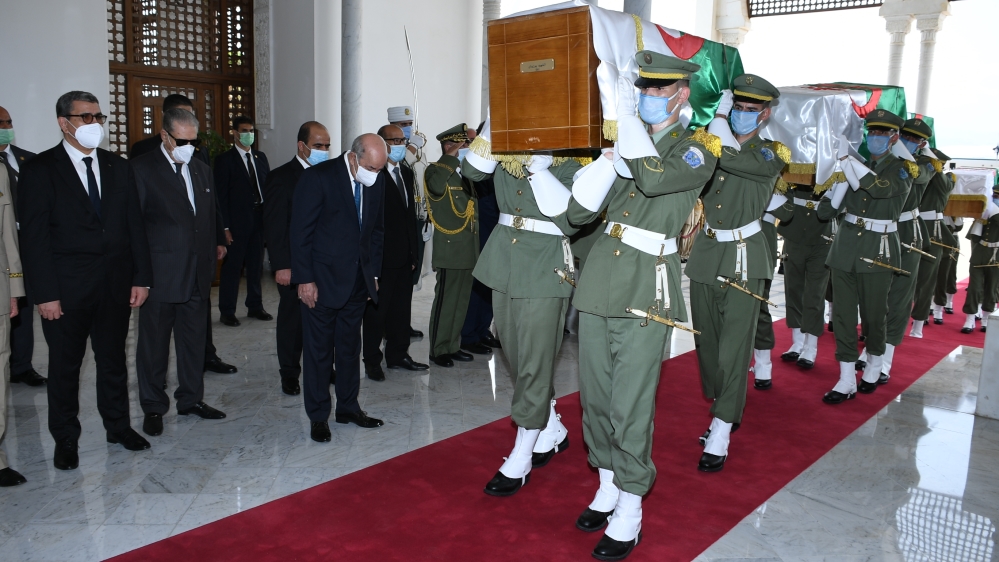
President Macron agreed in 2018 to return the remains but the process was delayed over bureaucratic hurdles [Anadolu]
In 2011, Algerian historian and researcher Ali Farid Belkadi discovered the skulls at the Museum of Man in Paris, across from the Eiffel Tower, and alerted Algerian authorities.
The researcher lobbied for years for their return and Algeria‘s then-President Abdelaziz Bouteflika, eventually launched the formal repatriation request.
French President Emmanuel Macron agreed to the repatriation in 2018 but bureaucratic obstacles resulted in the delay of their return.
“We have recovered part of our memory,” historian Mohamed el-Korso told The Associated Press news agency. “But the fight must continue until the recovery of all the remains of the resistance fighters, which number in the hundreds, and the archives of our revolution.“
Florida surpassed 200,000 coronavirus cases as the state reported another 10,059 new positives on Sunday.
The state has reported more than 10,000 new cases for a fourth straight day as the country sees another surge in the pandemic. Florida is among 11 states where numbers have spiked, at least doubling over the past two weeks.
Let our news meet your inbox. The news and stories that matters, delivered weekday mornings.
New York was considered the epicenter of the coronavirus in the U.S., but has since significantly lowered its cases after extensive lockdown and social distancing measures. New York Gov. Andrew Cuomo announced 533 new cases for the state on Sunday, less than 1 percent of the tests performed the day prior.
DeSantis has yet to issue a statewide face mask order, though he has encouraged residents to wear one and some local governments have issued their own ordinances. Populous areas such as Miami-Dade, Broward, Palm Beach, Duval and Hillsborough counties have already adopted face mask requirements.
Local governments have issued their own rules to try and slow the spread of the disease, like in Miami-Dade County where a new 10 p.m to 6 a.m. curfew began on Friday. County Mayor Carlos A. Gimenez also said he was rolling back the reopening of entertainment venues, including movie theaters, bowling alleys and casinos. The county previously closed its beaches for the Independence Day holiday weekend.
Image caption
Prime Minister Boris Johnson took part in the clap from outside Downing Street
The prime minister has joined a nationwide applause to pay tribute to NHS staff on the 72nd anniversary of the health service.
The round of clapping was inspired by the weekly Clap for Carers initiative to thank key workers during the height of the coronavirus pandemic.
Prince Charles paid tribute to staff working through “the most testing time in the service’s history”.
It is hoped the anniversary applause will become an annual tradition.
On Saturday, UK landmarks were lit up blue in celebration and remembrance.
Downing Street, the Royal Albert Hall, Blackpool Tower, the Shard and the Wembley Arch were all illuminated and a minute’s silence was held to remember those who have died during the pandemic.
The latest government figures, released on Sunday, showed a further 22 people had died in the UK after testing positive for coronavirus, bringing the death toll to 44,220.
People were also asked to place lights in their windows in a show of remembrance on Saturday night, with the Archbishop of Canterbury, the Most Reverend Justin Welby, lighting a candle in Canterbury Cathedral.
Image copyright Getty Images
Image caption
Leeds General Infirmary workers joined in to mark the health service’s 72nd anniversary
Image copyright Kirsty O’Connor/PA Wire
Image caption
Members of the public came together – at a safe distance – to share the moment
A World War Two Spitfire plane with the words “Thank U NHS” painted on its underside tipped its wings above hospitals and the homes of fundraisers and volunteers, recognising the way people have supported the NHS and local communities during the pandemic.
The National Health Service was launched on 5 July 1948, with the core principle that it is free at the point of delivery and is based on clinical need.
Image caption
A World War Two Spitfire plane flew over hospitals in Cambridge
In a video message earlier she said the country was “depending more than ever” on its health and care workers, and thanked them “from the bottom of my heart”.
First Minister of Wales, Mark Drakeford, said NHS staff and social care workers were “all heroes”.
And Captain Tom Moore – who raised more than £32m for the health service by walking laps of his garden during lockdown – shared a video of himself clapping from his armchair at home in Bedfordshire.
The idea for Sunday’s round of applause was inspired by the success of the weekly Clap for Carers which saw households across the country show their appreciation for the NHS and other key workers during the lockdown.
Image copyright Getty Images
Image caption
Earlier, Liverpool FC players applauded key workers ahead of their Premier League match against Aston Villa
Image copyright Huw Fairclough/Getty Images
Image caption
People clapped in Tredegar in south Wales – the birthplace of Aneurin Bevan, the health service’s founding father
Annemarie Plas, who founded the Clap for Carers initiative, joined Prime Minister Boris Johnson outside No 10 for the clap at 17:00 BST.
Speaking on BBC Breakfast earlier, she said: “We have had this first part of the crisis, we don’t know what lies ahead, so if we can have this one moment where we say thank you to each other and recharge our batteries for what may be a heavier time that lies ahead, then I think that is a beautiful moment.”
She said the NHS helped her when she arrived in the UK from the Netherlands as a new mother, “so I feel very happy to be in touch with the NHS this way”.
Image copyright TOLGA AKMEN/Getty Images
Image caption
Annemarie Plas, who founded the Clap for Carers, clapped alongside the prime minister in Downing Street
Image copyright Getty Images
Image caption
Sunday’s applause (pictured) was inspired by the weekly Clap for Carers which took place at the height of the coronavirus lockdown
On Friday, Mr Johnson urged the public to applaud for “those who have worked tirelessly and selflessly to help the nation get through this pandemic”.
The moment was broadcast on BBC One.
‘Silver lining’
In a video message to mark the occasion, Prince Charles spoke of his gratitude and pride for the “costly sacrifices” of NHS staff.
“Despite all that has been endured, there is deep cause for gratitude, and a true reason for pride,” he said.
The prince also said the pandemic had brought out the best in people, adding: “This renewal of our community spirit has been a silver lining during this dark time.”
Image copyright Kirsty O’Connor/PA Wire
Image caption
Two dogs outside Chelsea and Westminster hospital were dressed for the occasion
Image copyright PA Media
Image caption
The Shard in London was one of the many landmarks lit up blue on Saturday
Speaking at a rally celebrating seven decades of the health service, Labour leader Sir Keir Starmer said NHS staff needed a pay rise in the wake of the pandemic.
“It’s very important that we don’t just say thanks, but recognise in a meaningful way what the NHS has done,” he said.
His comments come after unions representing more than 1.3 million nurses, cleaners, physiotherapists, healthcare assistants, dieticians, radiographers, porters, midwives, paramedics and other NHS employees wrote to the chancellor and the prime minister calling for pay talks to start soon.
Meanwhile, about 100 protesters gathered at Marble Arch in London, calling for the end of racial disparity in the health system.
Image copyright JUSTIN TALLIS/Getty Images
Image caption
Protesters gathered at Marble Arch before moving to Downing Street
One of the organisers, Tyrek Morris, 21, told the crowd: “We are protesting for black lives and one of the demands we have is to abolish the racial disparity within the NHS, especially towards black women.
“We need to implement extensive measures to prevent the disproportionate suffering of black women in healthcare and bring to an end the significantly increased black maternal mortality rate.”
Suddenly, as small Covid-19 outbreaks emerge in Victoria, all eyes are on the health status of Melbourne’s northern suburbs. As a frontline GP in Broadmeadows I am keenly aware that Australia is watching.
What many don’t see: the lines of cars at the mobile Covid-19 clinic we urgently set up, and patients calling the clinic, walking up, waiting to be swabbed, anxious about the risks to themselves, their families, their friends. Wanting to do the right thing.
This is a diverse community: older people, new immigrants, low-income workers, people with disabilities and high psychosocial stressors. The socioeconomic data for Broadmeadows is clear: there are higher numbers of people in this region living from pay cheque to pay cheque. They were invisible to many before this. But now we must see them, because in the era of Covid-19 a poor person’s illness can affect all society’s health.
So there are a few things I’d like to show you about the Broadmeadows front line.
There is incredible strength and survivorship here. I see these qualities every day in my practice. Struggling, hard-working new immigrants have found affordable housing in the area and so the community is diverse and multicultural: fierce grandmothers, caring fathers, warrior mothers and ambitious children. But there is also complex, chronic malaise. And as GPs we see a lot of it.
As local industries have collapsed, poverty levels have increased. Unemployment levels are high. Poverty begets illness, and illness begets poverty. And so my patients come in telling me stories of misfortune and pain, their bodies ailing with high blood pressure, diabetes, mental illness, drug dependence, pain and trauma. Most are kind, ordinary, family-oriented people who are battling to survive among higher levels of financial and social stress.
Dominic hasn’t been eating well because he has no money after paying for his daughter’s specialist appointment. Mary was in tears today because her housemate attempted suicide at the weekend. Ahmed is a refugee living in limbo on a temporary visa. Hala has lost her job at the factory, again.
We need to urgently invest in communities like Broadmeadows to break these cycles of socioeconomic dysfunction.
Working in a low socioeconomic community as a frontline GP is hard, and it’s getting harder. Our model of primary care does not serve those on low incomes well, or the GPs who undertake this work. Medicare rebates for general practice services have been stagnant for a decade. In the Australian model of general practice, doctors earn more if we see more patients, quickly. Clinicians who must work more slowly are penalised financially.
Many Australian GPs work around this by implementing a “gap†payment that is needed to provide quality health services. But my patients in Broadmeadows cannot afford to pay a “gapâ€. This deters clinicians from working with already marginalised patients: those who speak English as a second language, those facing social chaos, the poor, and those with a history of trauma or mental illness. They need longer consultations and slower care to maintain their health and wellbeing or they end up in costly crisis situations.
But for GPs this work just doesn’t pay. Bulk-billing incentives exist for GPs who see patients with healthcare cards, but these incentives are nowhere near bridging the gap between Medicare payments and indexed, Australian Medical Association-recommended GP costs.
There has been a lot said about thanking health workers on the frontline of Covid-19. It was even reported that the prime minister, Scott Morrison, would consider a day of thanks for health workers on 26 January. What my frontline colleagues and I would really like is for this country to fund primary care properly. Fund frontline general practice so that it is accessible to all Australians, especially those on low incomes, so that we can recruit and retain high-quality, well-trained GPs to work in low-income areas with the people who need it the most, so they don’t have to rush.
All Australians deserve access to a good GP. Good primary care saves money and saves lives.
There is a trope circulating that people from Broadmeadows don’t care about health – I’ve found the opposite is true. They come into the clinic, beseeching us for compassionate care. I am yet to meet a patient in Broadmeadows who has knowingly breached Covid-19 restrictions. My patients are grateful for any light thrown on a confusing, evolving situation. Everyone wants to live well, and live long.
Caring for the most vulnerable members of society benefits us all. General practice is the backbone of the Australian healthcare system. Done well, it prevents health crises and helps patients survive and break cycles of despair and disability. During this pandemic, and beyond, we need to fund primary care properly.
• Dr Mariam Tokhi is a GP in Broadmeadows, Victoria
Jobseeker should not be lowered to its old rate of $40 a day because the safety net will be required to support people excluded from other payments such as the jobkeeper wage subsidy, Deloitte Access Economics has argued.
In its latest business outlook report, released on Monday, Deloitte praises the speed at which fiscal stimulus has been delivered but warns that withdrawing supports too soon to fight the “phantom menace†of government debt will harm the recovery.
Deloitte strikes a hopeful note that Australia’s “relative success in our virus fight†gives it more scope to re-open the economy, meaning the recession “may well have already passed its worstâ€, although the predictions are based on assumptions virus numbers stay suppressed despite a second spike in Melbourne.
Deloitte is predicting a sharp contraction of -6.4% GDP in the June quarter, before growth rebounds by 2.4% in the September quarter.
It expects employment will contract by 6.6% in the June quarter, and unemployment to rise to 8.5% by March 2021.
The Morrison government is considering the future of the jobkeeper wage subsidy and has indicated it will continue to support the hardest hit industries and regions; while it also considers a $75 a week permanent rise to jobseeker.
Deloitte warns that with 835,000 people already having lost their jobs there is a risk of “generational damage†if governments do not ensure that there is a “smooth transition [in] timing and dollars†of economic supports.
With the $1,500 jobkeeper wage subsidy and doubling of jobseeker to $1,100 a fortnight set to end in September “too much support ends at the same timeâ€, it said.
Deloitte called for an ongoing wage subsidy for businesses still affected by Covid-19 restrictions, such as the closed international border, but said economy-wide subsidies will need to stop otherwise they will simply keep “zombie†jobs alive.
If eligibility for jobkeeper is tightened or wage subsidies are replaced with industry specific packages “keeping jobseeker stronger for longer will be vital in filling the cracks as emergency safety nets morph or disappearâ€, it said.
The Deloitte report warned against promoting the “belief we have to pay off all this new debtâ€, which it labelled a “phantom menace†because debt will shrink relative to the size of the economy if growth returns.
“Another phantom menace is the belief that, even if we don’t pay off the debt, we have to raise taxes and cut spending to fix the budget,†it said.
“That’s completely wrong and it unnecessarily scares the punters. The emergency measures are temporary. So, as Treasury notes, if we can repair the economy, then we’ll repair the budget.â€
Despite the Reserve Bank of Australia effectively printing money by buying government bonds, the report says the “very last thing†Australia has to worry about is inflation, with demand dead and wage gains set to fade further.
Deloitte predicted that record low interest rates and stagnant wages are set to persist.
Its forecast for the wage price index is for growth of just 0.9% in 2020-21, with a significant recovery in wages growth not forecast until 2024-25 (2.3%).
Interest rates will remain at effectively near-zero with the 90-day commercial bank bill rate not expected to lift to 0.9% until 2024-25, it predicts.
Deloitte bases the prediction – in part – on the fact “governments will bow out of their support, leaving it up to central banks to repair economiesâ€.
WASHINGTON — Prince Andrew’s lawyers had discussions with a Washington lobbyist with ties to the Trump administration about the possibility of assisting the prince with fallout from his relationship with the disgraced financier Jeffrey Epstein.
Lawyers from the London-based firm Blackfords consulted the lobbyist, Robert Stryk, who represents international figures with sensitive legal or diplomatic issues, in recent weeks about Prince Andrew’s situation, according to a person familiar with the circumstances.
Mr. Stryk has a history of taking on clients with unsavory reputations. But he expressed discomfort about the possibility of assisting Prince Andrew, and talks about the potential representation appear to have fizzled, according to the person familiar with the situation.
It is not clear precisely what type of assistance Blackfords might have been seeking from Mr. Stryk, who is not a lawyer, or what he could do to help Prince Andrew. Nor is it clear whether Blackfords has reached out to other Washington lobbyists or consultants about the possibility of working on the issue.
Neither Mr. Stryk nor any other American consultant is listed as having registered with the Justice Department to represent Prince Andrew, which could be required under the Foreign Agents Registration Act if a consulting arrangement had been reached involving lobbying or public relations.
Blackfords has been representing Prince Andrew, the Duke of York, in a contentious back-and-forth with federal prosecutors in New York who are investigating allegations of sex trafficking and other crimes by Mr. Epstein and his associates.
Prince Andrew, 60, has not been charged in the case.
The prince denied her claim in an interview with the BBC in August and sought to minimize his long friendship with Mr. Epstein, who killed himself last summer at a federal jail in Manhattan while awaiting trial on sex trafficking and conspiracy charges. He had met Mr. Epstein through Ghislaine Maxwell, a British socialite and Mr. Epstein’s onetime girlfriend, who was arrested on Thursday and charged with luring multiple underage girls into Mr. Epstein’s orbit.
Prince Andrew had indicated a willingness to help American law enforcement officials with their investigations late last year. But since then, prosecutors in New York have publicly criticized him on multiple occasions for offering “zero cooperation†and for stonewalling.
The prince’s lawyers at Blackfords shot back in a statement issued early last month. They accused Geoffrey S. Berman, who had served as the United States attorney in Manhattan until being fired late last month, of making “inaccurate†statements about Prince Andrew, suggesting that the prosecutor and his colleagues were “perhaps seeking publicity rather than accepting the assistance proffered.â€
Blackfords did not respond to requests for comment. Mr. Stryk declined to comment.
Mr. Stryk, who is well connected in Trump administration foreign policy circles, owns a company called Sonoran Policy Group, which casts itself as “global private diplomacy†firm. He has developed a reputation in recent years for taking on clients other Washington lobbyists and consultants shy away from.
This year alone, his firm has signed contracts to represent a jailed Saudi prince who had fallen out of favor with his country’s powerful de facto leader, Crown Prince Mohammed bin Salman, as well as the administration of President Nicolás Maduro of Venezuela, which the Trump administration considers illegitimate.
Mr. Stryk represents Isabel dos Santos, the daughter of Angola’s former president who is accused of embezzling millions of dollars from a state oil company she once headed. And he had represented the government of the former Congolese president Joseph Kabila, which had faced American sanctions for human rights abuses and corruption.
Mali’s president has met the leader of a protest movement that has brought many thousands on to the streets, the presidency said on Sunday.
A video posted on the presidency’s Twitter account showed the meeting between President Ibrahim Boubacar Keita and Mahmoud Dicko, an imam and leading figure of the so-called June 5 movement, in the capital Bamako on Saturday.
It was the first official meeting between the two men since two demonstrations last month drew tens of thousands to the streets.
— Presidence Mali (@PresidenceMali) July 5, 2020
The protests have channelled deep-seated frustration over attacks by armed groups and interethnic violence that have claimed thousands of lives and forced hundreds of thousands to flee their homes since 2012.
“We talked about everything that concerns this crisis and the country in general. I think that with the will of everyone and of all the parties concerned, we will, God willing, find the solution,” Dicko said in the video.
“My role as an imam, as I have said, obliges me to be someone who always considers peace as being essential: peace in our country, the sub-region and in the world.”
Keita, who has been in power since 2013, also met representatives of other political parties with the aim of “easing the political situation”, the presidency said.
Opposition demands
The opposition coalition of religious leaders, politicians and civil society figures said on Wednesday Keita’s resignation would no longer be a condition for talks.
However, they outlined a list of demands including the dissolution of Parliament and the formation of a transitional government whose prime minister would be appointed by the movement and could not be removed by the president.
The slow pace of political reform, a flagging economy, a lack of funding for public services and schools and a widely shared perception of government corruption have fed anti-Keita sentiment.
Last month’s protests followed demonstrations in May over the results of March’s long-delayed parliamentary elections – which Keita’s party won – as well as over coronavirus restrictions.
The 75-year-old president has taken a conciliatory stance since the demonstrations began, mooting a national unity government in a June 14 address to the nation. Protest leaders rejected that offer.
One of the poorest countries in the world, Mali has been engulfed in conflict since 2012 when an uprising by Tuareg separatists erupted and was quickly overtaken by armed groups.Â
Despite the presence of thousands of United Nations and French troops, the conflict has spread to central Mali, neighbouring Burkina Faso and Niger, stirring feuds between ethnic groups and triggering fears for states farther south.Â
Thousands of soldiers and civilians have been killed, hundreds of thousands of people have fled their homes and the economies of the three countries – already among the poorest in the world – have been grievously damaged.
Kabir Khan, Imtiaz Ali, Rima Das, Onir join hands for ‘My Melbourne’ diversity film
 Filmmakers Kabir Khan, Imtiaz Ali, Rima Das and Onir have come together to create four short films on the themes of race, disability, sexuality and gender. The shorts will be compiled into one film titled “My Melbourne”, which will premiere at the Indian Film Festival of Melbourne (IFFM) 2021, before travelling to the international film circuit.
The filmmakers will work with selected filmmaking teams from Victoria, Australia, to mentor and then shoot the short films.
Ali said the last few months have been “full of life lessons” for people and for one to move ahead, it is important to look at the stories of identity.
“Viewing stories of identity in the context of the diverse society that we are all a part of is quintessential for us to chart our path ahead. I am looking forward to meeting a new set of people and understanding their life stories for the screen,” the “Tamasha” director said in a statement.
For Khan, who has helmed films like “Bajrangi Bhaijaan” and the upcoming “’83”, celebration of diversity is a dialogue that should be “fostered in current times.
“In the post-pandemic world, being one with each other in a community should be the single most important takeaway. The virus has shown us the futility of everything else.
I am excited at the opportunity presented by IFFM and looking forward to the experience,” he said.
Each of the four selected teams will be assigned a budget to create an original script. The four filmmakers will do workshop and develop the selected stories and oversee pre-production with the teams via Zoom call..Once travel restrictions are lifted, they will travel to Melbourne to shoot the films.
Das, who has helmed National Award-winning films “Bulbul Can Sing” and “Village Rockstars”, said it is essential for filmmakers to examine the world around them from the prism of its socio-political context.
“The short film will allow us to bring in authentic lived-in stories that often get lost in popular culture,” she said.
Onir, known for films like “My Brother Nikhil” and “I Am”, said the role of a filmmaker is to “trigger a dialogue. “ “The world we are living in calls for fresh discussions on inclusivity and diversity to reiterate strong value systems for our audiences. I am glad for the opportunity and hope it’s a step in the right direction,” he added.
Mitu Bhowmick Lange, Festival Director, IFFM, said the initiative gives Victorian screen practitioners an opportunity to work with some of the world’s best filmmakers.
“I am delighted and thrilled that IFFM has secured four of India’s most diverse voices of independent cinema for these workshops and the creation of four short films on the core values of IFFM – diversity and inclusivity,” Bhowmick Lange added.
The festival recently announced that the 2020 edition was pushed ahead, with dates rescheduled from August to October due to the ongoing coronavirus pandemic.
IFFM 2020’s program will be devised in line with public health guidance, with plans for a compact schedule taking place over a week from October 30 to November 7.
The race, on a sunny afternoon at the scenic Red Bull Ring was held in front of empty grandstands due to the COVID-19 pandemic.
Valtteri Bottas celebrates his win.Credit:Getty Images
Spaniard Carlos Sainz made it a double points haul for McLaren in fifth, with Sergio Perez sixth for Racing Point and Pierre Gasly seventh for AlphaTauri.
Esteban Ocon, who last raced in 2018, took eighth for Renault on his return while Antonio Giovinazzi bagged ninth for Alfa Romeo and Sebastian Vettel, who had another nightmare, completed the top 10 for Ferrari.
Canadian Nicholas Latifi was the last car running with 11th for Williams.
Hamilton breach
There was drama even before the race when stewards performed a U-turn after a Red Bull challenge and dropped Hamilton from the front row to fifth on the grid for a breach in Saturday’s qualifying.
Drivers take a knee on the grid in support of the Black Lives Matter movement.Credit:Getty Images
That also promoted Red Bull’s Max Verstappen to the front row, alongside Bottas on pole position.
Any hopes the Dutch youngster had of completing a hat-trick of Austrian wins, after 2018 and 2019, disappeared when he suffered an early technical problem and became the season’s first retirement.
In a race with three safety car periods, Bottas soon had Hamilton in his mirrors but the Briton’s challenge vanished when he was handed a five-second time penalty for causing a collision with Red Bull’s Alex Albon while defending second place.
The Thai spun off into the gravel, his podium hopes shattered.
Leclerc, whose team had struggled in qualifying with Sebastian Vettel failing even to make the top 10, moved up to third against all expectations, which became second after the chequered flag.
“I did not expect it. A huge surprise, but a good one,” said the Monegasque. “It feels like a victory today.”
Racing Point’s Mexican Perez, who had run as high as third in the 2019 Mercedes lookalike, lost fourth place to Norris two laps from the end but was already carrying a time penalty for exceeding the pit lane speed limit.
Anyone who had feared Mercedes running away in a race of their own, after the champions dominated practice and qualifying, need not have worried.
Mercedes, their cars changed from silver to black as part of an anti-racism campaign, fretted about gearbox sensors and warned both drivers to keep clear of the kerbs.
Criminal gangs have been dressing young drug mules as nurses and Deliveroo workers to deliver cocaine, heroin and illegally acquired prescription drugs during lockdown, according to a senior officer in charge of tackling county lines dealing at one of the UK’s biggest police forces.
Supt Andy O’Connor of Merseyside police said Liverpool drug lords forced to return home during lockdown were operating a “click and collect†service for couriers disguised as key workers to travel in and out of the region with drugs.
He said the looming recession coupled with high unemployment could make it easier for criminal groups to recruit vulnerable people and their families as lockdown is eased.
In an interview with the Guardian to publicise Merseyside police’s Eyes Open education campaign about the tell-tale signs of criminal exploitation, O’Connor said lockdown had made it much harder to move drugs and money around the country.
He said: “The majority of our crime groups had to come back into force, to come back to the Liverpool and Merseyside area. What you still had in the importing forces was the demand for class A drugs. In a way, what we saw was a ‘click and collect’ service for drugs.
“What we had, anecdotally, was people leaving the area to deliver drugs. People were dressed as key workers, we’ve got evidence to show there were people stop-checked purporting to be nurses or Deliveroo drivers. Crime groups are clever and ingenious. They still want to deliver their commodity, there’s still a significant amount of money to make.
County lines dealers have traditionally put couriers on coaches and trains to deliver drugs and money to smaller towns and cities, but with public transport usage reduced during lockdown, the gangs had to change tack, said O’Connor. Some young people were caught by British Transport Police on trains but others were transported by car, sometimes driven by their relatives.
O’Connor said: “If you are a clever crime group you force a woman to drive a car. Put yourself in the shoes of a crime group leader of a drug gang, use vulnerable women to move your drugs and cash. They don’t look like your stereotypical drug dealer wearing dark clothing, North Face coats, hoods up, baseball caps on. That sticks out like a sore thumb. If you force the mothers, the sisters, the grandmothers to do the drug dealing on their behalf, where there’s debts to be paid off, it’s an easy way to move drugs around the country.â€
Young and vulnerable people from Merseyside had been picked up during lockdown as far away as Aberdeen in Scotland and on England’s south coast, he said. Activity increased as lockdown progressed. O’Connor’s force safeguarded two young people in relation to county lines in April, 27 in May and 38 in June. Seventy-four people were arrested during operations over the three months.
Curtailed imports pushed the price of cocaine up from £30,000-£35,000 to £45,000-£50,000 a kilo, he said. Rather than increasing the price at street level, dealers cut the drugs or switched to selling prescription drugs acquired illegally.
“We have seen a significant reduction in the quality and purity,†O’Connor said. In certain locations, outside of Merseyside, we know because of lockdown they have been unable to get hold of class A and class B drugs so some users have been resorting to prescription drugs.â€
There are currently 97 active county lines operating from Merseyside, police figures show. After London, Merseyside’s drug gangs are the second biggest exploiters of young people, grooming children as young as 10, according to the Merseyside Violence Reduction Partnership.
It has launched a public information campaign warning people of the signs of criminal exploitation, how children are groomed by older dealers who buy them targeted gifts of clothes, food and bikes making the children feel in debt to them but also making them feel part of the gang, or “familyâ€.
O’Connor said: “The people need to realise these people are grooming people the same way sex offenders are. They worm their way into people’s lives. ‘I’ll do you a favour,’ that sort of thing. Vulnerable people are being threatened with significant harm, either to themselves or family members. They will threaten to sexually assault family members.â€
Once groomed, the kids are sent away to other parts of the UK to sell their drugs, often hundreds of miles away from home.
The likely recession could put more people at risk of county lines gangs, said O’Connor. “That’s why what we are doing with Eyes Open isn’t just trying to arrest the drug dealers, it’s helping the people who are being threatened, who are being forced to do this, to put these preventative measures in place†he said. “We want to give people different pathways and opportunities to help themselves.â€
We use cookies on our website to give you the most relevant experience by remembering your preferences and repeat visits. By clicking “Accept”, you consent to the use of ALL the cookies.
This website uses cookies to improve your experience while you navigate through the website. Out of these, the cookies that are categorized as necessary are stored on your browser as they are essential for the working of basic functionalities of the website. We also use third-party cookies that help us analyze and understand how you use this website. These cookies will be stored in your browser only with your consent. You also have the option to opt-out of these cookies. But opting out of some of these cookies may affect your browsing experience.
Necessary cookies are absolutely essential for the website to function properly. These cookies ensure basic functionalities and security features of the website, anonymously.
Cookie
Duration
Description
cookielawinfo-checbox-analytics
11 months
This cookie is set by GDPR Cookie Consent plugin. The cookie is used to store the user consent for the cookies in the category "Analytics".
cookielawinfo-checbox-functional
11 months
The cookie is set by GDPR cookie consent to record the user consent for the cookies in the category "Functional".
cookielawinfo-checbox-others
11 months
This cookie is set by GDPR Cookie Consent plugin. The cookie is used to store the user consent for the cookies in the category "Other.
cookielawinfo-checkbox-necessary
11 months
This cookie is set by GDPR Cookie Consent plugin. The cookies is used to store the user consent for the cookies in the category "Necessary".
cookielawinfo-checkbox-performance
11 months
This cookie is set by GDPR Cookie Consent plugin. The cookie is used to store the user consent for the cookies in the category "Performance".
viewed_cookie_policy
11 months
The cookie is set by the GDPR Cookie Consent plugin and is used to store whether or not user has consented to the use of cookies. It does not store any personal data.
Functional cookies help to perform certain functionalities like sharing the content of the website on social media platforms, collect feedbacks, and other third-party features.
Performance cookies are used to understand and analyze the key performance indexes of the website which helps in delivering a better user experience for the visitors.
Analytical cookies are used to understand how visitors interact with the website. These cookies help provide information on metrics the number of visitors, bounce rate, traffic source, etc.
Advertisement cookies are used to provide visitors with relevant ads and marketing campaigns. These cookies track visitors across websites and collect information to provide customized ads.