Georgia Gov. Brian Kemp declares emergency, calls up National Guard troops after 8-year-old killed

CLOSE

Police say 8-year-old Secoriea Turner was shot while in a car with her mom and an adult friend near the Wendy’s where Rayshard Brooks was killed.

Wochit

Georgia Gov. Brian Kemp declared a state of emergency Monday and authorized the deployment of up to 1,000 National Guard troops in the wake of violence in Atlanta over the weekend that left more than 30 people wounded and five dead, including an 8-year-old girl.

“Peaceful protests were hijacked by criminals with a dangerous, destructive agenda,” Kemp said in a statement. “Now, innocent Georgians are being targeted, shot, and left for dead. This lawlessness must be stopped and order restored in our capital city.”

He added that “the measure will allow troops to protect state property and dispatch state law enforcement officers to patrol our streets.”

Among the locations where the Georgia Guard will provide added protection are the Georgia State Capitol, the Georgia Department of Public Safety Headquarters and the Governor’s Mansion.

“Enough with the tough talk,” Kemp said. “We must protect the lives and livelihoods of all Georgians.”

The order went into effect immediately and is justified by “unlawful assemblage, violence, overt threats of violence, disruption of the peace and tranquility of this state and danger existing to persons and property.” It is set to expire July 13.

On Saturday night, police said two people opened fire on a car, killing Secoriea Turner, an eight-year-old Black girl. A reward of up to $10,000 has been offered for information that leads to the arrest of those involved.

More on Secoriea Turner: 8-year-old was fatally shot in Atlanta near Wendy’s restaurant where Rayshard Brooks was killed,

“You can’t blame this on a police officer,” Atlanta May Keisha Lance Bottoms said Sunday in an emotional press conference. “You can’t say this is about criminal justice reform. This is about some people carrying some weapons who shot up a car with an 8-year-old baby in the car for what?”

“Enough is enough,” Bottoms continued. “If you want people to take us seriously and you don’t want us to lose this movement, we can’t lose each other.”

The incident took place near the Wendy’s fast-food restaurant that was the site of the death of Rayshard Brooks, a 27-year-old Black man who was shot twice by a white police officer as he tried to flee after being stopped when he was found sleeping in his car June 12.

More on Rayshard Brooks: Judge grants bond to ex-Atlanta cop charged with murder

Brooks’ death has sparked widespread protests in Atlanta and across the country and came just weeks after the death of George Floyd, a 46-year-old Black man who died Memorial Day in Minneapolis when a white former police officer knelt on his neck for almost nine minutes while Floyd was in custody.

Atlanta police responded late Sunday to investigate another shooting that took place steps from where Turner was killed, leaving one person dead and two injured.

The spate of violence in Atlanta coincided with the holiday weekend celebrating the Fourth of July. On Sunday night, Kemp posted a message to his verified Twitter account denouncing the violence.

This recent trend of lawlessness is outrageous & unacceptable,” Kemp wrote. “Georgians, including those in uniform, need to be protected from crime & violence. While we stand ready to assist local leaders in restoring peace & maintaining order, we won’t hesitate to take action without them.”

Police said Turner was in the car with her mother and another adult, when the driver of the car tried to drive past illegally-placed barricades to enter a parking lot. The car was “confronted by a group of armed individuals who had blocked the entrance,” interim police chief Rodney Bryant said Sunday in a press conference.

Someone from that group opened fire on the car, striking it multiple times and killing Turner, police said. Turner was taken to Atlanta Medical Center where she died from her injuries.

Kemp also said that a 53-year-old man was fatally shot near the Wendy’s over the weekend.

“At that location, city officials have failed to quell ongoing violence with armed individuals threatening citizens, shooting at passersby, blocking streets, destroying local businesses, and defying orders to disperse,” the executive order said.

Kemp also cited vandalism at the Georgia Department of Public Safety headquarters early Sunday, saying several dozen people “armed with rocks, spray paint, and fireworks” broke windows and tried to set fire to the building.

A spokesman for Bottoms didn’t immediately respond to requests for comment about the governor’s authorization of Guard troops.

In Washington, White House press secretary Kayleigh McEnany lamented at Monday’s news briefing that she was not asked by reporters about weekend killings in Atlanta and other major U.S. cities. McEnany said she was asked “probably 12 questions about the Confederate flag” and was dismayed that she did not get one about the weekend shootings. She also said comments by Secoriea’s father “broke my heart.”

Contributing: The Associated Press

Autoplay

Show Thumbnails

Show Captions

Read or Share this story: https://www.usatoday.com/story/news/nation/2020/07/07/georgia-gov-brian-kemp-national-guard-secoriea-turner/5389011002/


Source link

Pilgrims will follow new protocols during Hajj

ISLAMABAD              -          With coronavirus disease (COVID-19) cases still surging throughout the world, Saudi Arabia has limited the number of pilgrims to performing this year’s Hajj and put several protocols in place.

The Saudi Center for Disease Prevention and Control (Weqaya) has set the protocols to decrease the infection rate and ensure pilgrims’ safety.

Saudi Health Minister Dr. Tawfiq Al-Rabiah announced earlier last month that the number of pilgrims would be limited this year. Saudi Minister of Hajj and Umrah Mohammed Saleh Benten said that the decision to limit numbers “aims to protect people above everything else, which has been the priority of the Kingdom since the start of the pandemic,” Arab News reported.

The long list of protocols affects all workers and pilgrims this year. From July 19, authorities will prohibit all entry into Mina, Muzdalifa, and Arafat without permits.

Guides and awareness signs must be placed in all areas and written in various languages that include COVID-19 infection warnings, hand washing protocols, sneezing and coughing etiquette, and the use of hand sanitizers.

Organizers must distribute pilgrims in the Tawaf area around the Kaaba to decrease overcrowding while adhering to a 1.5-meter distance between each person. Organizers at the Holy Mosque must ensure that pilgrims are distributed on all floors of the Saee (ritual walking between Safa and Marwa) and place track lines to maintain social distancing while ensuring that the grounds around the Kaaba and Saee are sanitized by cleaning crews before and after each group performing Tawaf.

Touching the Holy Kaaba and Black Stone will be prohibited, barriers will be set to prevent reaching the sites and the mosque’s carpets are to be removed to allow pilgrims to use their personal prayer rugs instead to decrease the chances of the spread of any infection.


Source link

Watford v Norwich: Premier League – live!

0


The teams!


Source link

Deepika Padukone hits 50 million followers mark on Instagram

Image Source : INSTAGRAM/DEEPIKAPADUKONE_4

Deepika, 34, wrote she was “grateful” for hitting the milestone.

Actor Deepika Padukone on Tuesday crossed 50 million followers mark on Instagram and expressed gratitude for the love and support from fans.

The actor took to social media platform and re-posted a series of Instagram stories by fans, which included her pictures, video montages and even letters to mark the occasion.

Deepika, 34, wrote she was “grateful” for hitting the milestone. The actor was seen earlier this year in director Meghna Gulzar’s drama “Chhapaak”, based on the life of acid attack survivor Laxmi Agarwal.

Her next film is with “Kapoor & Sons” director Shakun Batra and it also features actors Siddhant Chaturvedi and Ananya Panday. The film was scheduled to go on floors in Sri Lanka but got pushed due to the coronavirus pandemic. 

Fight against Coronavirus: Full coverage


Source link

Sweden Has Become the World’s Cautionary Tale

Sweden is exposed to the vagaries of global trade. Once the pandemic was unleashed, it was certain to suffer the economic consequences, said Mr. Kirkegaard, the economist.

  • Updated July 7, 2020

    • What are the symptoms of coronavirus?

      Common symptoms include fever, a dry cough, fatigue and difficulty breathing or shortness of breath. Some of these symptoms overlap with those of the flu, making detection difficult, but runny noses and stuffy sinuses are less common. The C.D.C. has also added chills, muscle pain, sore throat, headache and a new loss of the sense of taste or smell as symptoms to look out for. Most people fall ill five to seven days after exposure, but symptoms may appear in as few as two days or as many as 14 days.

    • Is it harder to exercise while wearing a mask?

      A commentary published this month on the website of the British Journal of Sports Medicine points out that covering your face during exercise “comes with issues of potential breathing restriction and discomfort” and requires “balancing benefits versus possible adverse events.” Masks do alter exercise, says Cedric X. Bryant, the president and chief science officer of the American Council on Exercise, a nonprofit organization that funds exercise research and certifies fitness professionals. “In my personal experience,” he says, “heart rates are higher at the same relative intensity when you wear a mask.” Some people also could experience lightheadedness during familiar workouts while masked, says Len Kravitz, a professor of exercise science at the University of New Mexico.

    • I’ve heard about a treatment called dexamethasone. Does it work?

      The steroid, dexamethasone, is the first treatment shown to reduce mortality in severely ill patients, according to scientists in Britain. The drug appears to reduce inflammation caused by the immune system, protecting the tissues. In the study, dexamethasone reduced deaths of patients on ventilators by one-third, and deaths of patients on oxygen by one-fifth.

    • What is pandemic paid leave?

      The coronavirus emergency relief package gives many American workers paid leave if they need to take time off because of the virus. It gives qualified workers two weeks of paid sick leave if they are ill, quarantined or seeking diagnosis or preventive care for coronavirus, or if they are caring for sick family members. It gives 12 weeks of paid leave to people caring for children whose schools are closed or whose child care provider is unavailable because of the coronavirus. It is the first time the United States has had widespread federally mandated paid leave, and includes people who don’t typically get such benefits, like part-time and gig economy workers. But the measure excludes at least half of private-sector workers, including those at the country’s largest employers, and gives small employers significant leeway to deny leave.

    • Does asymptomatic transmission of Covid-19 happen?

      So far, the evidence seems to show it does. A widely cited paper published in April suggests that people are most infectious about two days before the onset of coronavirus symptoms and estimated that 44 percent of new infections were a result of transmission from people who were not yet showing symptoms. Recently, a top expert at the World Health Organization stated that transmission of the coronavirus by people who did not have symptoms was “very rare,” but she later walked back that statement.

    • What’s the risk of catching coronavirus from a surface?

      Touching contaminated objects and then infecting ourselves with the germs is not typically how the virus spreads. But it can happen. A number of studies of flu, rhinovirus, coronavirus and other microbes have shown that respiratory illnesses, including the new coronavirus, can spread by touching contaminated surfaces, particularly in places like day care centers, offices and hospitals. But a long chain of events has to happen for the disease to spread that way. The best way to protect yourself from coronavirus — whether it’s surface transmission or close human contact — is still social distancing, washing your hands, not touching your face and wearing masks.

    • How does blood type influence coronavirus?

      A study by European scientists is the first to document a strong statistical link between genetic variations and Covid-19, the illness caused by the coronavirus. Having Type A blood was linked to a 50 percent increase in the likelihood that a patient would need to get oxygen or to go on a ventilator, according to the new study.

    • How can I protect myself while flying?

      If air travel is unavoidable, there are some steps you can take to protect yourself. Most important: Wash your hands often, and stop touching your face. If possible, choose a window seat. A study from Emory University found that during flu season, the safest place to sit on a plane is by a window, as people sitting in window seats had less contact with potentially sick people. Disinfect hard surfaces. When you get to your seat and your hands are clean, use disinfecting wipes to clean the hard surfaces at your seat like the head and arm rest, the seatbelt buckle, the remote, screen, seat back pocket and the tray table. If the seat is hard and nonporous or leather or pleather, you can wipe that down, too. (Using wipes on upholstered seats could lead to a wet seat and spreading of germs rather than killing them.)

    • What should I do if I feel sick?

      If you’ve been exposed to the coronavirus or think you have, and have a fever or symptoms like a cough or difficulty breathing, call a doctor. They should give you advice on whether you should be tested, how to get tested, and how to seek medical treatment without potentially infecting or exposing others.


“The Swedish manufacturing sector shut down when everyone else shut down because of the supply chain situation,” he said. “This was entirely predictable.”

What remained in the government’s sphere of influence was how many people would die.

“There is just no questioning and no willingness from the Swedish government to really change tack, until it’s too late,” Mr. Kirkegaard said. “Which is astonishing, given that it’s been clear for quite some time that the economic gains that they claim to have gotten from this are just nonexistent.”

Norway, on the other hand, was not only quick to impose an aggressive lockdown, but early to relax it as the virus slowed, and as the government ramped up testing. It is now expected to see a more rapid economic turnaround. Norway’s central bank predicts that its mainland economy — excluding the turbulent oil and gas sector — will contract by 3.9 percent this year. That amounts to a marked improvement over the 5.5 percent decline expected in the midst of the lockdown.

Sweden’s laissez faire approach does appear to have minimized the economic damage compared with its neighbors in the first three months of the year, according to an assessment by the International Monetary Fund. But that effect has worn off as the force of the pandemic has swept through the global economy, and as Swedish consumers have voluntarily curbed their shopping anyway.

Researchers at the University of Copenhagen gained access to credit data from Danske Bank, one of the largest in Scandinavia. They studied spending patterns from mid-March, when Denmark put the clamps on the economy, to early April. The pandemic prompted Danes to reduce their spending 29 percent in that period, the study concluded. During the same weeks, consumers in Sweden — where freedom reigned — reduced their spending 25 percent.

Strikingly, older people — those over 70 — reduced their spending more in Sweden than in Denmark, perhaps concerned that the business-as-usual circumstances made going out especially risky.

Source link

Southend job could provide ‘pathway’ for BAME coaches, says Craig Fagan

0

Last Updated: 07/07/20 5:27pm


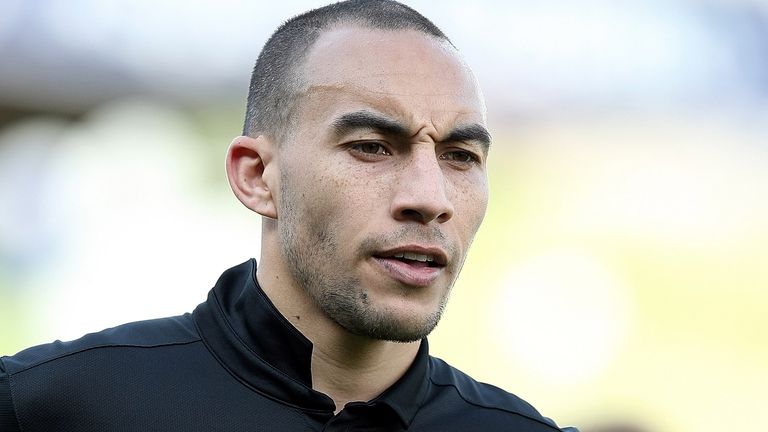
Craig Fagan has applied for the vacant managerial position at Southend

Southend managerial candidate Craig Fagan hopes he can provide a “pathway” for younger black, Asian and minority ethnic (BAME) coaches if he is appointed by the EFL club.

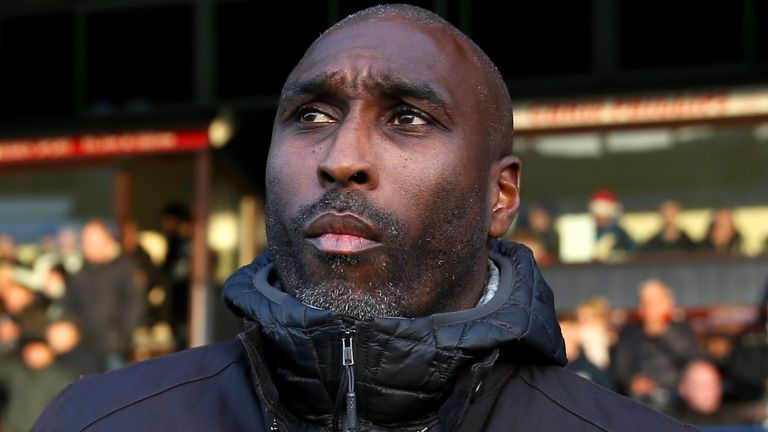
Fagan, who is currently U23s boss at Southend, has applied to replace Sol Campbell, who left the club by mutual consent in June after their relegation from League One had been confirmed.

Campbell’s exit left just five BAME managers in jobs in England’s top four tiers.

“For me it’s not a high enough number,” Fagan told Sky Sports News. “It’s not really good enough in terms of the amount of jobs that are out there.

Sol Campbell left Southend by mutual consent in June

Sol Campbell left Southend by mutual consent in June

“I think, for myself, when I was playing, there wasn’t really a great deal of managers then, and there was no one who I could look up to and try to be like. There were maybe one or two.

“I think that’s what’s needed. So if it takes the likes of myself to try to be the best I can be, to provide a pathway for someone else, I think that’s what we’ve got to be doing.”

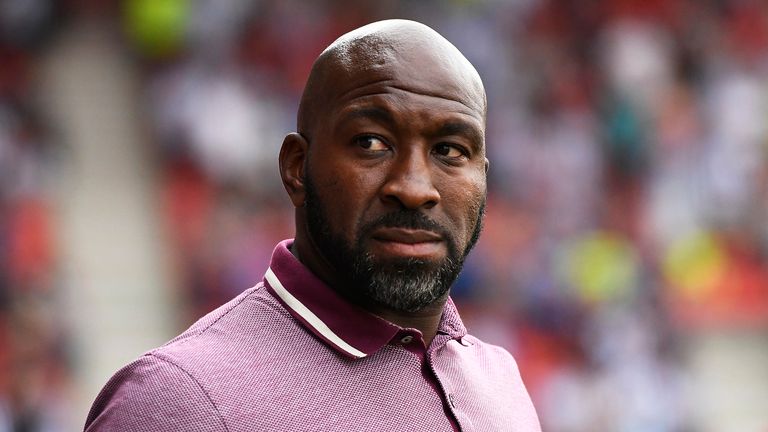
Fagan has praised the influence of Doncaster boss Darren Moore and former Derby team-mate Michael Johnson, who joined the England U21s coaching staff this season as part of the FA’s Elite Coach Placement Programme, which aims to confront BAME under-representation.

As well as sharing coaching experiences, Fagan says he has learned from the difficulties the duo have faced in finding roles.

Fagan says Doncaster boss Darren Moore has been a 'guiding light' during his coaching career

Fagan says Doncaster boss Darren Moore has been a ‘guiding light’ during his coaching career

“I had the likes of Darren Moore, who is at Doncaster, I speak to him quite a lot – he helps me, he’s a guiding light to be fair to him. Michael Johnson as well, who’s now helping out with the U21s with England,” Fagan said.

“Having spoken to those two guys a hell of a lot, they’ve had their struggles in getting jobs. There were times when I spoke to Johnson when I was thinking about giving coaching up, and he was struggling more than me.

“He had top qualifications and couldn’t get interviews, so for someone that’s below him in terms of starting out, it doesn’t send the right message for myself in terms of getting in there. If he’s got all these qualifications, how do I get myself on the coaching ladder?

“But I just think he had to persevere, and he’s got there now coaching the England U21s. So that perseverance and that grit and determination to prove people wrong, and these two guys are now shining lights and a guide for me, and hopefully I can be a guide for others that are coming up.”

A Super 6 for Newcastle?

Do not miss your chance to land the £250,000 jackpot for a sixth time this season on Wednesday. Play for free, entries by 6pm.


Source link

Italy’s ‘mother of all reforms’ will remain childless

0

Alberto Mingardi is director general of Istituto Bruno Leoni in Milan, an adjunct scholar at the Cato Institute, an associate professor at IULM University in Milan and a presidential fellow at Chapman University.

MILAN — The first time I heard an Italian politician promise to slash red tape, I was 13. It was 1994 and, with great fanfare, Silvio Berlusconi had injected the Reagan-esque language of bureaucratic reform into Italian politics.

It was a theme the four-time prime minister and his successors would return to over and over again. As the economist Nicola Rossi recently noted, over the last 30 years, Italy has introduced 10 much-talked-about “simplification reforms” and “reforms of the public administration” in 1990, 1993, 1997, 1998, 1999, 2000, 2003, 2005, 2009, 2014.

And yet, none of these resulted in an actual, substantive deregulation effort.

It’s in this context that Prime Minister Giuseppe Conte’s “mother of all reforms” should be considered. Approved by the Cabinet in the early hours of Tuesday morning, it has been presented as a “revolution” that will “cut red tape” and “get the country moving again.”

There are those in Italy who cheerfully dismiss these rankings as contrivances of an evil neoliberal establishment. Talk with ordinary people, then.

If only.

Italy has long been considered a country where the rule of law is weak and an excessively complex regulatory framework discourages investors. The Heritage Foundation Index of Economic Freedom assigns Italy a score of 51.3 (out of 100) in judicial effectiveness. The World Bank’s Doing Business project periodically reminds Italy of its weakness in how people deal with construction permits (68.3/100) and in the complex procedures related to the payment of taxes (64/100).

There are those in Italy who cheerfully dismiss these rankings as contrivances of an evil neoliberal establishment. Talk with ordinary people, then.

Virtually any Italian who has a little property, let alone a small business, can expound on the many permits and authorizations he had to seek, even for the smallest improvement to his apartment or the simplest innovation in his production method.

Call it the 12 tasks of Mario Rossi (the name Italians give to the everyman).

One task might be to find permit “A-38” in a maze-like building, where the bureaucrats continuously send the citizen from office to office, seeking one document that will lead to another, and then another, along the trail of the document he actually needs. (Some readers might recognize this as the plot of an Asterix comic.)

And yet, that’s not the problem the Conte government has decided to tackle.

Instead of trying to make the lives of businesses easier, the government seems to have decided that it’s the lives of the bureaucrats that ought to be simplified.

The proposed “simplification plan” is 48 articles long and deals with a host of issues. It contains some improvements such as an attempt to introduce digital procedures to streamline approvals for new buildings.

But its essence pertains to public procurement and public tenders. In short, the government wants to make it easier to award contracts without a competitive bidding process. Competitive tenders will still be required for any investment higher than €5 million. Under that threshold, you could have a competition limited to five bidders (for sums of more than €150,000) or award contracts directly for smaller projects.

This is no way to relaunch the Italian economy — unless you believe that it’s public works, and public works only, that will spur growth.

For genuine deregulation, Italy will need clear, simple, certain legislation | Giorgio Cosulich/Getty Images

Don’t expect real change from what is, after all, yet another long, convoluted law. For genuine deregulation, Italy will need clear, simple, certain legislation that makes life easier for business by making it clear and apparent who are their interlocutors in the public administration. Processes need to be streamlined. And the burden of proof for denying permits should be shifted off the shoulders of entrepreneurs and onto the state’s.

But reforms like that would take real political capital and courage, as well as a clear vision for the future of the country — none of which Conte’s government has shown any evidence of having.

“Simplifying” regulations is a euphemism for forcing some people or businesses to relinquish power. Specifically, it implies entrusting more power to individuals and businesses, and less to the government. This requires experience in drafting legislation, but it’s also a clear ideological choice — one that runs counter to the direction Conte is heading.

After all, this is the government that has seized on the coronavirus crisis as an opportunity to increase reliance on the state by Italian citizens, feeding ever-growing expectations of government support that will hopefully be financed by the European Union’s recovery fund.

Berlusconi’s Reagan-esque language ended up being nothing more than words. Given the Conte government’s track record, it would be foolish to expect anything different this time around.


Source by [author_name]

5 hurdles facing Europe’s hydrogen plans

0

A hydrogen storage tank stands at a pumping station for hydrogen-powered cars on June 10, 2020 in Berlin | Sean Gallup/Getty Images

Building a hydrogen economy is going to be a long and dirty process.

The European Commission wants the EU to be the global leader in a new clean hydrogen economy.

That’s supposed to be spelled out Wednesday when it announces its Hydrogen Strategy aimed at laying the foundations for a low carbon economy by 2050.

The Commission’s May 26 hydrogen roadmap emphasized domestic production of hydrogen made with wind and solar electricity, known as green hydrogen. But several recent draft strategies show a growing realization that the transition will be dirtier than expected, and that it will be tough for the EU to be the world’s No. 1 in hydrogen.

Here are five hurdles facing the EU’s hydrogen plans.

1. The EU is already behind

Today, around 70 million tons of pure hydrogen is produced worldwide each year by the chemical, fertilizer and refining industries, according to the International Energy Agency.

It is largely made in dedicated plants near the point of consumption, with the closest supplies at hand. Europe as a whole makes 18 percent of the world’s hydrogen, according to 2018 data from intelligence firm IHS Markit.

A leaked internal Commission strategy reported by POLITICO on June 1 frankly stated the fear that the EU was already being outspent on hydrogen research by Asian and American rivals.

“EU lags behind in terms of public support to hydrogen per capita,” the draft reads, finding that spending on hydrogen was substantially higher in China, Japan and the U.S.

2. Ramped-up demand could outstrip clean hydrogen supply

Global hydrogen production uses some 205 billion cubic meters of natural gas and 107 million tons of coal each year — and emits some 830 million tons of CO2 into the atmosphere, according to the IEA’s Future of Hydrogen report.

To change that, the EU hopes to invest €180 billion in scaling up and improving electrolyzers that will make green hydrogen.

A second leaked hydrogen strategy, dated June 19, estimated Europe would have to also spend some €18 billion in coming years on fossil-based hydrogen to make sure increased demand is met.

“The share of hydrogen in Europe’s energy mix is projected to grow from the current less than 2% to 13-14% by 2050,” the draft strategy states.

The Commission’s latest draft laid out a three-part plan to do that. From 2020 to 2024, the transport and industry sectors would slowly phase in hydrogen. From 2025 to 2030, hydrogen would expand to steelmaking and shipping.

From 2030 onward — the point when it expects clean hydrogen to become cost-competitive — all hard-to-decarbonize sectors would switch to the gas.

3. Not enough CO2 storage

But paying Europe’s current hydrogen producers to clean up by implementing carbon capture and storage (CCS) technology to keep CO2 from escaping into the atmosphere — known as blue hydrogen — creates another wrinkle. Where to store all that carbon?

The EU currently has no large-scale storage facilities.

“What we need to do is look to the North Sea, because we have large storage capacities there,” said Nils Røkke, executive vice president of sustainability at SINTEF, Scandinavia’s largest research organization, and chair of the European Energy Research Alliance.

Norway has two undersea reservoirs than can take 1.7 million tons of CO2 per year. But that is still “decades from what we need” to store carbon from fossil-based hydrogen production, Røkke said.

4. Limited renewable capacity

The Commission’s June 19 draft set targets for green hydrogen: 1 million tons by 2025, and 10 million tons by 2030. It estimated that would require 4 gigawatts of installed renewable capacity by 2025, and 40 GW by 2030.

But the EU also wants to dramatically expand renewable energy as part of its Green Deal push to wean the Continent off fossil fuels by 2050. Existing electricity consumption is currently about one-third renewable, Eurostat data shows.

That’s without adding in the planned explosion of power demand as cars, heating and cooling and other parts of the economy go electric.

In a leaked draft Energy Sector Integration Strategy, also due to be announced Wednesday, the Commission said it aims to boost the share of electricity in final energy consumption from 23 percent today to around 25 percent in 2030, and toward 40 percent to 50 percent by mid-century.

“This growing electricity demand will have to be largely based on renewable energy,” the draft added.

All of that is going to force clean hydrogen to battle for its share of renewable power.

5. Risk of being outpaced once renewable hydrogen catches on

Even if all goes to plan — the EU meets its renewable capacity targets and brings down the cost of electrolyzers — it won’t guarantee global dominance.

Jorgo Chatzimarkakis, secretary-general of industry lobby Hydrogen Europe, said the goal is not to pretend Europe could produce all the world’s hydrogen, but rather “to let Europe become the global marketplace for hydrogen, and let the euro be the currency in which hydrogen is denominated.”

“Every global commodity needs a marketplace, and we see Europe at the brink of developing this global market — the ports of Rotterdam, Antwerp, Sines in Portugal, where hydrogen comes in liquefied as ammonia, is regasified then brought into the European system,” Chatzimarkakis said. “That’s what we see, and that’s what this plan … can do.”

Want more analysis from POLITICO? POLITICO Pro is our premium intelligence service for professionals. From financial services to trade, technology, cybersecurity and more, Pro delivers real time intelligence, deep insight and breaking scoops you need to keep one step ahead. Email pro@politico.eu to request a complimentary trial.


Source by [author_name]

Chinese scientists reveal analysis of weird substance found on the moon’s far side by Yutu 2 rover

0

Chinese scientists have published an analysis of a curious substance on the moon which generated widespread interest following its discovery by the Yutu 2 rover last year. 

The discovery was made by a Yutu 2 drive team member in July 2019, during lunar day 8 of the rover’s mission, which is part of China’s Chang’e 4 mission to explore the far side of the moon. A report by Our Space, a Chinese-language science-outreach publication, revealed the discovery on Aug. 17 and described the substance using the term “胶状物” (“jiao zhuang wu”), which can be translated as “gel-like.” 


Source link

Yale astronomy students speak out against institutional racism

0

Students are leading the charge to make changes at Yale University after a heated debate over systemic racism at the institution went public. 

Last month, in the midst of rising racial tensions in the U.S., a group of professors at the Yale Department of Astronomy sent out an email, since obtained by Buzzfeed News, to the entire department regarding its history with race. 


Source link