Ingraham Lashes Out At Dems Who Dare Question ‘Trump Recovery’ From Coronavirus

Fox News’ Laura Ingraham on Tuesday accused Democrats who talk about the new spike in cases of the coronavirus in multiple states of selling “panic porn.”

The host of “The Ingraham Angle” — in her latest impassioned defense of President Donald Trump’s botched handling of the pandemic and push to kickstart the economy ― argued Democrats were “sacrificing” children’s educations just to defeat Trump in the 2020 election.

“In early April, I began to warn about the damage extended lockdowns would have on America,” Ingraham recalled. “And since then, we have experienced millions of job losses, added trillions to our debt, and experienced terrible riots.

One of the first and worst things to happen, she said, “was how much learning was lost by our kids by being locked out of their classrooms. “

“So, with the Trump recovery fully underway, Democrats are shifting back to their default position: shut the economy down,” Ingraham claimed. “Yes, that is where they are now. That includes, of course, our schools. Now, they cite the rising COVID infection rates in certain states to sell their latest panic porn.”

Ingraham also told viewers of her primetime show to “take it with a grain of salt” when “people say follow the science” and suggested it was “never difficult to find an expert who will try to scare you into giving up your freedom.”

Last month, she described Dr. Anthony Fauci, the nation’s infectious disease expert and member of the White House coronavirus task force, as “the medical deep state” and, without offering any evidence, asked if he is working for presumptive Democratic presidential nominee Joe Biden.

Check out Ingraham’s comment here:

A HuffPost Guide To Coronavirus


Source link

9 details from the new book by Donald Trump’s niece

0

U.S. President Donald Trump | Jim Watson/AFP via Getty Images

Here are some of the most revelatory and incendiary passages from Mary Trump’s new book.

A new book by Donald Trump’s niece Mary Trump describes the U.S. president as a person likely afflicted by multiple psychological disorders who is profoundly unsuited to be president.

Mary Trump is the daughter of the president’s older brother, Fred Trump Jr., an airline pilot who suffered from alcoholism and died of a heart attack at 42. She is a clinical psychologist who holds a Ph.D. from Adelphi University in New York.

The president’s younger brother, Robert Trump, is trying to stop publication of the book, “Too Much and Never Enough: How My Family Created the World’s Most Dangerous Man,” copies of which have already been distributed to the news media. Publisher Simon & Schuster on Monday moved up  the publication date to next Tuesday.

White House press secretary Kayleigh McEnany told reporters on Tuesday that the book is full of “falsehoods and that’s about it.”

Sarah Matthews, another White House spokesperson, said: “Mary Trump and her book‘s publisher may claim to be acting in the public interest, but this book is clearly in the author’s own financial self-interest. President Trump has been in office for over three years working on behalf of the American people — why speak out now?“

A copy of the book was shared with POLITICO. Here are some of its most revelatory and incendiary allegations:

1. Trump cheated on the SAT

Mary Trump, the daughter of the president’s deceased older brother Fred Trump Jr., accuses the president of paying a friend to take the SAT for him when he was applying to college as a teenager.

“That was much easier to pull off in the days before photo IDs and computerized records. Donald, who never lacked for funds, paid his buddy well,” Mary Trump writes in the book. Donald Trump’s sister, Maryanne Trump Barry, also often did his homework for him during high school, the author alleges, which helped get him into the University of Pennsylvania. Matthews, the White House spokesperson, called the SAT allegation “absurd“ and “completely false.“

2. Trump’s sister called him a “clown” after he announced his presidential campaign

Trump Barry, a retired federal appeals court judge in New Jersey, considered her brother Donald “a clown” who could never win the presidency, Mary Trump writes.

At a lunch with the author after Donald Trump announced in 2015 that he would run for president, Trump Barry said her brother had “no principles. None!” and that “the only time Donald went to church was when the cameras were there. It’s mind-boggling.”

Trump Barry also noted that her brother’s businesses had five bankruptcies and was exploiting Mary’s late father, Fred Trump Jr.

“He’s using your father’s memory for political purposes, and that’s a sin, especially since Freddy should have been the star of the family,” the author recalls her aunt saying.

3. Trump said he “barely even knew” his daughter-in-law

At a family dinner at the White House in 2017, Donald Trump said he didn’t know his daughter-in-law Lara Trump well, even though she had been with the president’s son Eric Trump for almost eight years.

“Lara, there. I barely even knew who the fuck she was, honestly, but then she gave a great speech during the campaign in Georgia supporting me,” the president said, according to the book.

4. Trump’s niece says he suffers from multiple psychological issues

Besides believing that her uncle fits the nine criteria of clinical narcissism, Mary Trump believes he also may suffer from antisocial personality disorder, dependent personality disorder and a “long undiagnosed learning disability that for decades has interfered with his ability to process information.”

She also thinks he may suffer from a caffeine-induced sleep disorder, a result of the several Diet Cokes he reportedly drinks on a daily basis. Asked about the narcissism claim, McEnany said on Tuesday: “It’s ridiculous. Absurd allegations that have absolute no bearing in truth.”

5. Trump’s sister also told him to “leave his Twitter at home” before meeting Kim Jong Un

Trump Barry, the retired federal judge, called the White House in June 2018 to warn her brother about his dealings with North Korean dictator Kim Jong Un before he met with him. Her message to the president’s secretary: “Tell him his older sister called with a little sisterly advice. Prepare. Learn from those who know what they are doing. Stay away from Dennis Rodman. And leave his Twitter at home.”

6. Trump’s personality is the product of his relationship with his mother

The author suggests that Donald Trump’s personality is shaped by the weak relationship she says he had as a child with his mother, also named Mary Trump. Because of that, the president’s niece suggests Donald Trump turned as a child to his father, who was not a warm parent.

“Donald suffered deprivations that would scar him for life” and developed personality traits such as “displays of narcissism, bullying [and] grandiosity” as a result, the author writes. Matthews, the White House spokesperson, said in a statement: “The President describes the relationship he had with his father as warm and said his father was very good to him. He said his father was loving and not at all hard on him as a child.“

7. The president’s father used anti-Semitic language

Donald Trump’s father, Fred Trump Sr., who was a New York real estate developer, frequently used the anti-Semitic term “Jew me down.”

Both Fred Trump Sr. and Donald Trump were sued by the U.S. government in the early 1970s for allegedly discriminating against African Americans.

8. Trump’s history of crude remarks about women’s physical appearance extends to his family

When writing a sequel to the bestselling “Art of the Deal,” Trump recorded himself complaining about women who didn’t want to date him.

“It was an aggrieved compendium of women he had expected to date but who, having refused him, were suddenly the worst, ugliest, and fattest slobs he’d ever met,” Mary Trump, who helped on her uncle’s book, writes in “Too Much and Never Enough.”

At another point in their interactions, Trump even made a crass comment about Mary Trump’s breasts after seeing her in a bathing suit. “Holy shit, Mary. You’re stacked,” the president allegedly said. His then-wife, Marla Maples, slapped him lightly on the arm. Mary describes her face reddening after her uncle’s comment.

9. Trump went to the movies instead of the hospital when his older brother died

On the day the president’s brother Fred Trump Jr. was dying in the hospital in 1981, Trump and his sister Elizabeth went to the movies, Mary Trump writes in her book. No one from the family accompanied Fred Trump Jr. to the hospital.


Source by [author_name]

Wrap it, twist it, tuck it: Seven ways to rock a scarf this winter

A scarf is not just an item of clothing designed to keep your neck warm, it is an accessory with many uses that can help you to make a fashion statement.

If it’s a good quality scarf, it will never go out of style and there are lots of combinations to explore.

Apply these tips below to find the right way to tie a scarf for a more elegant and stylish look.

1. The cowl

The cowl is one of the simplest ways to style a scarf

Place your scarf around your neck. With one end shorter than the other, wrap the long end around your neck twice and tuck in the loose ends.

2. The shawl

This is a simplistic yet elegant way to wear your scarf. Simply drape your scarf around your shoulders allowing it to hang down on each side in the front.

3. The French knot

The French knot is perfect for a sophisticated look. Fold your scarf in half and put it around your shoulders. Take one loose end piece and put it over and under the scarf loop. Take the second end piece and go under and over the same loop.

4. Double bandana

This look is perfect for your long scarf. Fold it in half lengthwise and grab the diagonal ends and knot them together. Put the scarf over your neck then twist it and loop again.

5. Slouchy turtleneck

A slouchy turtleneck style is easy to wear

Place your scarf evenly around your neck. Take one end and loop it around your neck and do the same with the other end. Tuck the loose ends up inside the scarf.

6. The tie loop

The tie loop is a popular way to wear a scarf

Wrap your scarf around your neck so the ends are even at the front. Cross the left side over the right, then bring it behind and through the hole around your neck. Now take the right end and pull it towards the left and push it upward through the loop. Adjust the knot until it sits like a loose tie.

7. Single side bow

To achieve this cute side bow look, wrap your scarf around your neck and cross one side over the other. Gather a bit of scarf into a loop using your right hand. Wrap the left side around the loop and down through the hole. Tighten the knot and adjust your scarf until the bow sits at your shoulder.

Scarves can turn a plain outfit into a fashion statement, so try one or more of these styles to find the perfect look for you.

DMCA.com Protection Status


Source link

New rules to allow collective #EU Consumer Action

0

New rules to allow collective #EU Consumer Action

New rules to allow collective #EU Consumer Action

New rules on collective redress will allow EU consumers to come together to fight domestic and cross-border cases of unlawful practices.

The rules will also ensure protection from abusive lawsuits through the “loser pays” principle.

A more globalized and digitalized world has increased the risk of a large number of consumers being harmed by the same unlawful practices. Currently, it is only possible for consumers to join forces when fighting for their rights in a few EU member states and it is virtually impossible in cases spanning more than one country.

New rules on collective redress would give consumers in all member states the right to fight cases involving mass harm together, but also introduce safeguards to prevent the abuse of the procedure.

Following agreement by Parliament and Council negotiators at the end of June, Parliament’s legal affairs committee backed the deal on 7 July. Parliament is expected to vote on it later this year.

How it will work

  • Qualified entities, designated by EU countries, will be able to represent groups of consumers in collective cases.
  • Collective redress will be possible in all EU countries: at least one representative action mechanism must exist in all member states, allowing organizations to represent citizens, with the power to seek sanctions and compensation for the harm caused.
  • They will have to meet specific eligibility criteria: for cross-border representative action criteria are set out in the new rules, while for domestic proceedings the criteria are set out in national law.
  • The defeated party will pay the costs of the proceedings (“loser pays principle”), which aims to protect businesses against baseless lawsuits.
  • In addition to general consumer law, collective action would be allowed in cases involving trader violations in areas such as data protection, financial services, travel and tourism, energy, telecommunications, environment and health, as well as air and train passenger rights.

The European Commission should consider creating a European Ombudsman for collective redress, to deal with cross-border class actions at EU level.

Next steps

Once the whole Parliament and Council have formally approved the agreement, EU countries will have two years to transpose the directive into national law and an additional six months to start applying its provisions.

Source by [author_name]

Accountability court rejects Raja Pervaiz Ashraf’s acquittal plea in third RPP reference

Accused had filed an acquittal plea under the NAB Ordinance amended in 2019 in the case. Photo: File

ISLAMABAD: An accountability court rejected the acquittal plea filed by former prime minister Raja Pervaiz Ashraf in the Naudero II rental power reference filed by the National Accountability Bureau (NAB) on Wednesday.

The bureau had filed the reference against the PPP leader for alleged abuse power when he was serving as the minister for water and power during the Yusuf Raza Gilani government.

Judge Muhammad Bashir issued the verdict on the petition and ordered the trial against the accused to continue.

Ashraf and the others had filed an acquittal plea under the amended NAB Ordinance  in 2019. The reference was filed against the accused in 2013  and NAB had opposed the acquittal plea.

The bureau has alleged that the accused incurred a loss of Rs75 million to the national exchequer.

The anti-corruption watchdog has alleged that the accused tried to transfer the machinery of the Guddu Power Plant to the Naudero II power plant. It added that NEPRA later did not approve the transfer of the machinery.

“The accused had earlier issued a processing fee of Rs 75 million for the transfer of the machinery,” said NAB. It added that the accused inflicted a loss to the national exchequer by paying fees for illegal work.

The PPP leader was hoping to get an acquittal in the third reference that has been filed by NAB.

Last month,  an accountability court had acquitted Ashraf, former finance minister Shaukat Tareen and six others accused in the Pira Ghaib rental power corruption reference.

The former prime minister was also acquitted in the Rental Power Plant reference regarding the Sahiwal-Multan project in June as well, as NAB failed to prove corruption charges against him.

Both the verdicts were issued by Judge Muhammad Bashir who heard today’s acquittal plea filed by the accused in the case.

Source link

Black Lives Matter protesters in New York: ‘Confrontation works’

When the first Black Lives Matter protests reached New York City in 2014, Carlos Williams stood on the periphery – at the literal edge of the action, in fact.

“The closest I ever got was putting my toes on the edge of the sidewalk and facing off with a cop … chanting ‘Black Lives Matter’. I didn’t want to get into the fray,” the 33-year-old who calls himself a “Black kid from Brooklyn” explains from his office in Manhattan’s financial district.

Williams had just started a brand strategy company in 2013, and worried that public association with the protest movement could harm his “image” and his work. “We had some corporate clients; I didn’t know how they’d react if I got arrested and it made the newspaper,” he recalls.

But in the years since, that has changed.

“In the last couple of years, I just don’t care,” he says. “Why would I want your money if you don’t believe I have the right to exist … Why am I courting people who wouldn’t work with me anyway?”

Williams and I walk north, meeting a thousand-person march as it is leaving Washington Square Park. It is just one of the thousands of Black Lives Matter demonstrations happening across the United States in the aftermath of George Floyd’s killing at the hands of Minnesota police in May. We stay on the edge of the crowd as it winds through the city, past Union Square and Madison Square, past businesses shuttered because of COVID-19 or looted during the protests.

New York business owner Carlos Williams has been stopped many times by police [Kate Previte]

The first weekend of protests saw at least 47 police cars torched. Every night during the next week, police beat protesters who stayed out beyond the 8pm curfew. But this protest, like practically every other one in the city since curfew ended, is peaceful.

The crowd eventually heads towards Columbus Circle and Central Park, at which point I walk with Williams back to his downtown home. On the way, we pass two more sizable demonstrations – different people, different protest signs, but all with similar messages addressing decades of police killings and centuries of racial injustice towards Black Americans.

Police in the US have killed about 1,000 people a year between 2015 and 2019, with Black Americans being more than twice as likely as white Americans to be killed, according to the Washington Post’s public database. For contrast, UK police killed 23 people from 2006 to 2016, according to the Independent.

In New York City, the police department (NYPD) typically patrols Black neighbourhoods. Stop and Frisk, known nationally as a Terry Stop, exists in a legal grey area – not quite an arrest, but involuntary detention nonetheless. Started in the 1990s under Mayor Rudy Giuliani, there were more than five million Stop-and-Frisks from 2002 to 2013 under Mayor Michael Bloomberg, whose policing was found by a federal judge to have violated two constitutional amendments regarding illegal search and seizure, and the civil rights of Black Americans and other minorities.

According to the New York Civil Liberties Union, which successfully sued the NYPD for its Stop and Frisk records, young Black and Latino males only made up 4.7 percent of the city’s population but accounted for over 40 percent of Stop-and-Frisks. Despite finding weapons on white people at a higher rate, Bloomberg said in a 2013 radio interview: “I think we disproportionately stop whites too much and minorities too little.”

Black Lives Matter NY - Tucker feature

An upside down US flag with the names of Black people killed by police hangs in New York City [Reuters]

Encounters with police

Williams learned early on about the racial dynamics that determine life in America. He remembers being five or six when the Rodney King riots were on TV in the background in his parents’ living room. He also knew at a very young age that he never wanted to end up like Abner Louima, who was viciously sexually assaulted by police in 1997, or Amadou Diallo, who was shot 19 times by police in 1999.

Like most Black protesters, Williams has had many close encounters with the police. The “craziest” one, he says, happened five years ago when he was on his way back from playing baseball with a team he is a part of in Long Island.

He had got off the shuttle back home in Brooklyn at around 1 or 2am, he says. He was two blocks from home but desperately needed the toilet, so decided to run the rest of the way. He was half-a-block from home when he heard a van door slide open in the darkness beside him.

“I look to the left and there’s a dark unmarked van,” he recounts. “I hear people hopping out. I’m like, oh s*** I’m getting robbed.”

It’s not about what you’re wearing. It’s not about what you’re doing and who you are. It’s about the colour of your skin

Carlos Williams

But it turned out to be two police officers, a man and a woman, who started rapid-fire questioning him about why he was in the area, why he had been running, and where his ID was.

“I had lost my ID, but was carrying my passport,” which they retrieved from his trouser pocket while his hands were in the air. He is grateful to have had something to show them. “A lot of Black people and poor people in general don’t have passports. So if you lose your ID, your life is going to be infinitely worse. If I didn’t have my passport this would’ve gone way different.”

After a second round of questions the officers finally let him go.

“Want to know the kicker?” he asks. “I had changed into light blue pants, a button down shirt, and plaid polo sneakers. The most preppy thing I could’ve been wearing … looking like a Beach Boy.”

“So it’s not about what you’re wearing. It’s not about what you’re doing and who you are. It’s about the colour of your skin.”

Black Lives Matter NY - Tucker feature

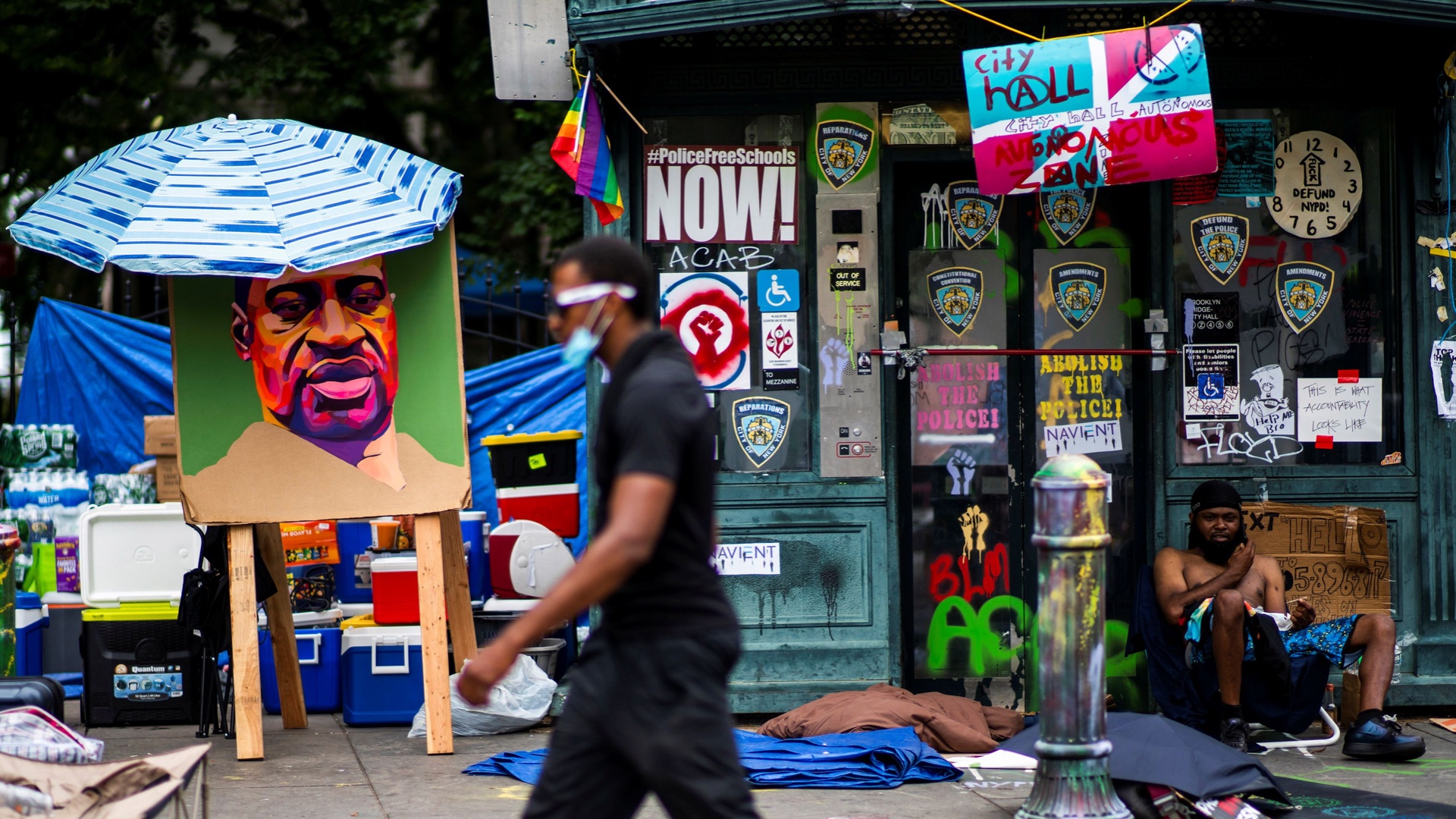
A picture of George Floyd hangs in the ‘City Hall Autonomous Zone’ in New York City that has been established to protest the police and in support of Black Lives Matter [Reuters]

In 2014, after the killing of 18-year-old Michael Brown and the later acquittal of the officer who shot him, the Black Lives Matter movement ignited in Ferguson, Missouri, soon drawing global attention to the extent of police violence against Black people in the US. The protests themselves spread nationally. In New York, throughout 2014-2015, any time a police killing trended on social media, a few hundred protesters gathered in Union Square marching north to Washington Square Park, blocking the Holland Tunnel to New Jersey, or entering Times Square, where their protest slogans would inevitably be drowned out by the bright lights and energy of the tourist mecca.

The protests inspired The Guardian, and later the Washington Post, to keep track of US police killings, which had never been tracked at any level by the US government. Still, for the next six years, politicians did little to address the thousands of annual police killings, or mass incarceration of Black people in the US.

Then, on May 28, after a multi-day stand-off with the police over the killing of George Floyd, the residents of Minneapolis torched the local police station. Emboldened by such an act, the residents of nearly every city in the US have taken to the streets, undeterred even by the pandemic sweeping through the country.

‘The meat in the math’

Raul Serrano, a software engineer who lives in New Jersey, first joined the Black Lives Matter movement in 2014 after Eric Garner was killed. He says he took to the streets of New York again last month after he “started seeing people get taken with our own eyes and on TV”.

“The goal became to try to prevent people from being taken. That was either by de-escalating situations or fighting and trying to break people free,” he says, something he refers to as being “the meat in the math”.

“Officers have to do calculations every second they’re out there. They’re looking at us, wondering if they can take us every second. As long as there’s a lot of meat on this side, they are gonna have to do math on that and it’ll force things to de-escalate and calm down,” he explains.

Black Lives Matter NY - Tucker feature [don't use]

Software engineer Raul Serrano at a Black Lives Matter protest in 2014 [Courtesy of Raul Serrano] 

But that is not always what happens. On June 2, he was assaulted during a protest near the heavily militarised Union Square, he says. Serrano, his wife, and a couple of friends had met up with a large crowd in downtown Manhattan; a few hundred of them stayed out protesting beyond the 8pm curfew. The crowd was followed closely by police, who Serrano says attacked unexpectedly at a point when the march thinned out.

“I got beat by six different officers,” says Serrano, who previously received combat training at the US Military Academy West Point. “They went for the knees so hard. They didn’t strike me in the head or groin, which was nice,” he adds.

I always just understood the police as people who would’ve been criminals if they hadn’t been cops.

Raul Serrano

Police became even more violent after the crowd had been beaten into submission and began to flee, he says. “I’ve known violent people my whole life. If they see somebody express weakness, they want to hurt them more,” Serrano explains. “The entire unit came sprinting down the street and chased us for two blocks, slamming people against cars, tackling people off bikes, beating people down to the ground, five officers to one civilian.”

After a week of mass police violence, only three NYPD officers had been internally disciplined, and none were criminally charged.

Serrano’s family is Puerto Rican and Filipino. Although he joined the military for a while after 9/11, he says he grew up always being wary of the police.

“I was raised around police officers. In my family half the people are soldiers, firefighters, and cops, and half are in prison or have records. And the Venn diagram overlaps. I think I always just understood the police as people who would’ve been criminals if they hadn’t been cops,” he says.

Black Lives Matter NY - Tucker feature [don't use]

A demonstrator stands in front of NYPD officers near City Hall in New York City [Reuters]

The June 2 incident was not his first run-in with the NYPD. As a teenager in Queens, he was stopped and frisked “at least once a month” on his commute to and from Stuyvesant High School, NYC’s premier public school, he says, relaying a conversation he had with a white acquaintance who works in his building.

“He was like ‘Stop and Frisk? Did you ever get stopped and frisked?’ I was like, ‘yeah, like once a month.’ He was like, ‘holy s***, I never got stopped and frisked.’ I was like well, I don’t know what to say. I think the reason is pretty obvious.”

Like Williams, Serrano learned about the harsh realities of life in America at a young age.

“I remember having an argument with my mom when I was 6 [in 1993]…It was about Martin Luther King’s assassination. For some reason I was convinced it happened hundreds of years ago because we didn’t live in a world where I believed overt, systemic racism and the assassination of political leaders was a thing,” he says. When he discovered how wrong he had been, his reaction was: “Tell me how that’s possible!”

‘Judged before they’re known’

In recent years, the experiences of Black Americans have come to light in large part because of Black Lives Matter, and how it has mobilised its message across the world.

“I think a lot of white people, and people in general, didn’t really believe that these things were actually happening. They had glimpses in the past; but now everything is recorded,” says artist Sylvia Hernandez from her Brooklyn home and quilting studio, where she has been holed up for months in the midst of the global COVID-19 pandemic.

Black Lives Matter NY - Tucker feature [don't use]

A self-portrait quilt of Brooklyn-based artist Sylvia Hernandez [Courtesy of Sylvia Hernandez]

During a phone interview in mid-June, Hernandez tells me about growing up in New York in the 1960s. Hernandez has Black, white and Indigenous Caribbean heritage, but identifies and is perceived as being Black according to the US’s centuries-old race dichotomy.

She has never had an encounter with the police, but says she was “always scared” for her sons growing up as teenagers in Brooklyn in the late 1990s. “Right by the train station was a regular place for the police to stop and frisk the kids. It was a regular thing for them… I was like, ‘what is the point of all this?'” she says.

“When we were kids, the police would round up kids on a regular basis. There were a lot of gangs. The police would just round up whoever was around and it would be like, ‘huh, what just happened? Why did everybody just disappear?'”

I think everyone is just finally standing up for themselves and others, pulling away from the me mentality, where it’s all about me.

Sylvia Hernandez

In recent years, Hernandez’s work as an artist and teacher has increasingly taken on themes of police brutality, mass detentions, sexual violence, immigrant detention, and naturally Black Lives Matter, like her 2016 piece Target of Injustice, made in collaboration with AgitArte and El Puente.

“I make social justice quilts that tell some kind of story,” she says.

“If you tell young people, ‘go read about this,’ they look at you like you’re crazy, like, ‘I’m not going to read about it’. But show them this quilt, they may want to look into it. We sit and talk about it. It opens the door of communication,” she says.

“There’s a lot of kids that come from rough backgrounds, and just the simplicity of telling them, ‘it’s going to be okay, we’re going to get through this’. Being someone they need, being an ear for them. I tell them, ‘if you just want to sit and talk, I will sit and listen for as long as you want.’ … Sometimes they don’t have anybody who will listen. They know the situation of being stopped for no apparent reason. They understand all of this, being judged before they’re known.”

Black Lives Matter NY - Tucker feature [don't use]

‘Target of Injustice’ by Sylvia Hernandez [Courtesy of Sylvia Hernandez] 

Hernandez will be travelling to Minneapolis this summer to present quilts related to the Black Lives Matter movement. Talking about anti-Black racism, she says she worries about the ideas some Black children seem to have internalised about their own skin colour.

“I did summer camp a couple years ago and it was mostly Black and brown kids. They were doing self-portraits,” she says. “This little Black girl comes in, a little chubby with braids in her hair. She was just a beautiful little girl. She said, ‘I made a painting in school! I looked in the mirror and painted what I saw!’ I said, ‘great!’ She showed me. She’d drawn a blonde, white princess.”

“I said, ‘oh, that’s beautiful,’ but on the inside I was crying … She made herself a blonde, white princess. All I could think of is who told this beautiful brown girl that what she is is not enough?”

Been a long time coming

The current protest moment has also seen new solidarity across racial lines – especially on the protest front.

When asked if she was surprised by the new white solidarity, Hernandez points to the white people also being shot by American police every year. “White people are being treated, unfortunately, the way that Black and brown people have been treated. It’s across the board now. Everybody’s getting it,” she says.

“I think everyone is just finally standing up for themselves and others, pulling away from the me mentality, where it’s all about me,” Hernandez feels. “It’s more about let’s work with the community and do stuff for each other.”

Black Lives Matter NY - Tucker feature [don't use]

Between 1,000-2,000 protesters gathered outside Prospect Park in Brooklyn on May 30 [Frederick Tucker/Al Jazeera]

Serrano is rejuvenated by the new sense of solidarity out on the streets. “When people scream things like “White allies to the front!” and people are just sprinting to the front [of a protest], that’s incredible. When people are screaming “chain up!” “Hold the line!” and people do it, that’s incredible,” he says.

“When people know they might get beaten, you can see them visibly shaking, you know they’ll be crying for the next two days, and they still want to come out and do this, it’s just incredible. I don’t think I ever would’ve expected it.”

On questions about the protesters also becoming violent, he asks: “Does destroying a cop car hurt a person? If it doesn’t, then is putting cuffs on a peaceful protester more violent?”

This is the only way any population of people has ever figured out how to fight a much more technologically advanced occupying force.

Raul Serrano

“I speak to a lot of people who are much more right-leaning in my everyday life,” he says. “They often seem to conveniently forget the fact that they’d die to defend themselves. They don’t find it easy to abstract that theory out into the real world. This is the only way any population of people has ever figured out how to fight a much more technologically advanced occupying force.”

Sergio Tupac Uzurin, a photographer originally from Queens, has been an organiser for many years, protesting with Black Lives Matter in 2014 and working with Critical Mass and Free Them All Fridays. When the demonstrations kicked off in Minneapolis after Floyd’s death, he says he stayed up for two nights watching it all unfold.

“I was enthralled. I was ecstatic, excited, a little nervous for them. Frankly it’s been a long time coming.”

Black Lives Matter NY - Tucker feature [don't use]

Sergio Tupac Uzurin is an organiser and photographer in New York City [Maureen Drennan]

Talking about one protest he attended in Soho, he recalls the sense of “camaraderie” among people.

“What really struck me is I overheard them shouting, ‘no local businesses!’ They were pointing out businesses, ‘there’s Coach, there’s Balenciaga’. But then they would pass by a bodega and say, ‘no corner stores’. And I’ll never forget this, because the Asian guy who I assume was the owner was standing out front. And they said ‘we love our corner stores’.”

He feels it is “hypocritical” for people to call out protesters more than they do the police who are arresting and beating people. About the demonstrations, he says: “I don’t want to say violent or nonviolent. I want to say effective and not effective.”

The way forward

Confrontation is necessary, Uzurin reminds me nearly every time we meet, multiple times a week now, whether on our bikes at Brooklyn’s McCarren Park, or at the ongoing City Hall encampment that he played a crucial role in organising.

“Confrontation works,” he points out during a phone interview in mid-June, explaining: “In the past 10 days, we’ve passed Breonna’s law in Louisville. The NFL has expressed remorse for treating Colin Kaepernick like s***. The four police officers that killed George Floyd have been arrested. There was a nine-figure budget cut being proposed for the LAPD. The Confederate statues are being removed from the South. And that is in 10 days, half of those days involving rioting nationwide.”

Robert E Lee statue protest

Protesters surrounded the statue of Confederate General Robert E Lee in Richmond, Virginia on June 23 [AP]

Williams holds a similar view. “In school you’re taught nonviolence. And I think that’s on purpose,” he says. “It’s ingrained in you, ‘be a peaceful Black person because that’s how you effect change’. No one says, hey they rioted after Martin Luther King was killed and that’s how the Civil Rights Act of 1968 got passed.”

The call from most protesters in the streets is to defund the police and change their mission. Demands typically centre around reducing police roles as first responders to mental health crises, noise complaints, traffic violations, and drug abuse, removing police from schools and stripping police of all military-grade weaponry that they received during the so-called “war on terror”.

Williams is interested in the idea of splitting off a portion of the police department, including its budget and tools, towards “officers who want to change the mission” to something more akin to education and understanding.

Still, others demand the complete abolition of the police and the US carceral system. “The goal is abolishing the police. The compromise is defunding the police… We have to imagine a world without police, period,” Uzurin says.

Black Lives Matter NY - Tucker feature

Protesters voice their opposition to the current state of policing on June 29 in New York City [AFP]

“I think it is the only way,” Williams says. “Honestly I don’t think we have a path forward. We can’t fire the police force and the next day expect to have new police.”

He hopes for the best, but also worries about next year when things have died down. “I hope 2021’s challenge is not the backlash, like [people thinking] ‘I’m gonna smack a Black person’. That can’t be the 2021 thing,” he says.

At the same time, he emphasises equal access to knowledge and opportunities as a way to help change things in America.

“Education. This is my challenge to racists,” Williams says. “If you want to say Black people are lazy, no good, stupid people, give them equal opportunity. Give them the same schools that you have, and the same opportunities that you have. And then if Black people fail with those same opportunities, like really creating equal opportunity, then you get to be right.”

“But you can’t hold a foot down on them and say, see they can’t get up.”

Source link

Caught on Camera, Gangster Vikas Dubey ‘Spotted’ at Faridabad Hotel, Gives Cops the Slip Again

0

Man suspected to be Vikas Dubey seen at Faridabad Hotel (News18)

According to sources, police have conducted a raid at the Faridabad hotel and have taken three people into custody, who are now being interrogated. Vikas Dubey, the notorious criminal who carries a reward of Rs 2.5 lakh, is still absconding.

  • News18.com
  • Last Updated: July 8, 2020, 12:31 PM IST

Lucknow: History-sheeter Vikas Dubey, whose henchmen gunned down eight UP police personnel, has been ‘spotted’ at a hotel in Haryana’s Faridabad.

According to sources, police have conducted a raid at the hotel and have taken three people into custody, who are now being interrogated.

A source said that Dubey had reached Faridabad and was trying to get a hotel room but he could not get it because of lack of documents. He was captured on CCTV of the hotel

The history-sheeter, however, managed to escape from the location before police could reach him. Meanwhile, two close aides of Dubey have been arrested from Faridabad by UP STF for allegedly helping him. As per information, the gangster was trying to surrender before court in the NCR area.

Eight policemen, including a DSP, were ambushed in Chaubeypur police station area when they were going to arrest Vikas Dubey in Bikru village and fell to bullets fired from rooftops past Thursday midnight.

Seven others, including a civilian, were injured in the attack. The attackers fled, snatching weapons from the dead and the wounded policemen.

Vikas Dubey, the notorious criminal who carries a reward of Rs 2.5 lakh, is still absconding.

More than 25 teams have been formed by the UP Police to nab the history-sheeter Vikas Dubey who was yet to be apprehended.

Police officials also said the surveillance team was scanning over 500 mobile phones and efforts were on to retrieve information pertaining to Dubey, who has faced about 60 criminal cases. The Special Task Force of UP Police has also been roped in.

Earlier on Wednesday, the Uttar Pradesh Special Task Force (STF) killed an aide of the gangster. He is the third member of Vikas Dubey’s gang to be killed in an encounter with the police.

Amar Dubey, who carried a reward of Rs 25,000, was killed in an encounter in Maudaha village in Hamirpur district, STF IG Amitabh Yash was quoted as saying by PTI.

The police had earlier killed criminals Prem Prakash Pandey and Atul Dubey in an encounter in Kanpur on Friday.

Vikas Dubey’s close relative Shama, neighbour Suresh Verma and domestic help Rekha and her husband Dayashankar Agnihotri, a key member of Dubey’s gang, have been arrested by police. Agnihotri was arrested on Sunday after an encounter in which police shot him in the leg.

On Tuesday, all 68 personnel of the Chaubeypur Police Station were shunted to the reserve police lines amid doubts over their professional integrity.

The announcement was made soon after police transferred Anand Deo, DIG STF, who till recently was the Senior Superintendent of Police in Kanpur. Deo was transferred to the Provincial Armed Police (PAC) unit in Moradabad.

Deo was the Kanpur SSP in March when Deputy Superintendent of Police Devendra Mishra purportedly wrote a damning letter, which surfaced on the social media after he was killed in the Bikru ambush.


Source link

Shipping industry must contribute to climate neutrality, say MEPs

0

Aerial view of business port with shore crane loading container in container ship in import/export and business logistics with crane and shipping cargo.International transportation and business concept.

To decarbonize maritime transport, the Environment Committee voted on Tuesday (7 July) to include CO2 emissions from the maritime sector in the EU Emissions Trading System (ETS).

The Commission has put forward a proposal to revise the EU system for monitoring, reporting and verifying CO2 emissions from maritime transport (the EU MRV Regulation) and bring it in line with new obligations under International Maritime Organization (IMO) to monitor emissions from 2019 and report in 2020.

In the legislative report approved (62 votes to 3 and 13 abstentions) on Tuesday, the Environment, Public Health and Food Safety Committee welcomed the proposal but wants to see more ambition and voted to include ships of 5,000 gross tonnage and above in the EU Emissions Trading System (ETS). In addition, MEPs say that market-based emissions reduction policies are not enough, so they also introduced binding requirements for shipping companies to reduce their annual average CO2 emissions per transport work, for all their ships, by at least 40% by 2030.

Rapporteur Jutta Paulus (Greens/EFA) said: “Today, we are sending a strong signal in line with the European Green Deal and the climate emergency: Monitoring and reporting CO2 emissions is important, but statistics alone do not save a single gram of greenhouse gas! That’s why we are going further than the Commission proposal and demanding tougher measures to reduce emissions from maritime shipping”.

Establish an Ocean Fund

The committee calls for an “Ocean Fund” for the period from 2023 to 2030, financed by revenues from auctioning allowances under the ETS, to make ships more energy efficient and to support investment in innovative technologies and infrastructure, such as alternative fuel and green ports, to decarbonise the maritime transport sector. 20% of the revenues under the Fund shall be used to contribute to protecting, restoring and efficiently managing marine ecosystems impacted by global warming.

International efforts needed

MEPs agree that it is important to align the EU and International Maritime Organisation (IMO) reporting obligations, as proposed by the Commission. However, they believe there is insufficient progress in the IMO and ask the Commission to examine the overall environmental integrity of the measures decided upon by the IMO, including the targets under the Paris Agreement. A global ambitious agreement on GHG emissions from shipping is urgently needed, they add.

Next steps

When adopted by the Plenary, which should happen during 14 – 17 September session in Strasbourg, Parliament will be ready to start negotiations with member states on the final shape of the legislation.

Background

Maritime transport remains the only sector with no specific EU commitments to reduce greenhouse gas emissions. Global shipping activity emits significant amounts of GHG emissions, estimated to be around 2-3% of total global GHG emissions. This is more than the emissions of any EU member state. In 2015 in the EU, 13 % of the overall EU greenhouse gas emissions came from the transport sector.

More information

Source by [author_name]

Obamacare Helps Poorer Americans Spot Cancer Earlier: Study

0

By Amy Norton
HealthDay Reporter

MONDAY, July 6, 2020 (HealthDay News)

Medicaid expansion under Obamacare may have decreased the number of poorer Americans diagnosed with advanced cancer, a new study suggests.

The study focused on Ohio, which was among the first states to expand its Medicaid program under the Affordable Care Act (ACA) in 2014.

The researchers found that in the three years after expansion, low-income residents saw a 15% drop in their odds of being diagnosed with metastatic cancer.

That refers to cancers that have spread from the original site to other parts of the body. While metastatic cancer can be treated, it is most often incurable, according to the U.S. National Cancer Institute.

Medicaid is the publicly funded insurance program for the poor. The new findings suggest that its expansion helped prevent some of those late diagnoses.

And it’s “quite likely” that better access to cancer screenings was one reason, said senior researcher Dr. Johnie Rose, of Case Western Reserve University School of Medicine in Cleveland.

“There also might have been a ‘hmm’ factor,” he said. That is, if more people were able to see a primary care doctor, that might have caught some red-flag symptoms that led to timelier cancer diagnoses.

Starting in 2014, the ACA allowed U.S. states to expand their Medicaid programs, making more poor residents eligible for coverage. It’s known that those expanded programs reduced the ranks of the uninsured — and, at least in some cases, improved access to health care.

More recently, studies have been linking expansion to clear health benefits — including declines in deaths from heart disease, stroke and opioid overdose.

The new study, published online July 6 in the journal Cancer, points to another benefit.

“I think for policymakers and for voters, this shows there’s a concrete, demonstrable, life-saving benefit from expanding access to care,” said Rose, an assistant professor at the Case Western Reserve Center for Community Health Integration.

For the study, his team analyzed information on nearly 12,800 Ohio residents, aged 30 to 64, who were diagnosed with breast, cervical, lung or colon cancer between 2011 and 2016. All either had Medicaid or were uninsured.

On average, the study found, people diagnosed after Medicaid expansion were 15% less likely to be diagnosed with metastatic cancer, versus those diagnosed before.

That does not prove Medicaid expansion directly led to the reduction. But, Rose said, there was no similar decrease in metastatic cancer among people who remained uninsured.

And to create a “control” group, the researchers did a separate analysis of privately insured people living in higher-income Ohio communities. Again, there was no change in the odds of being diagnosed with metastatic cancer after 2014.

A decline of 15% might not sound large. But in this context, Rose said, it is.

“Bringing it down that much in three years is really remarkable,” he said.

When it comes to catching cancer at earlier stages, “the gaps between the rich and the poor have been so stubborn for so long,” Rose said.

“This is a rare bit of progress,” he said.

It is a “major finding,” agreed Dr. Hala Borno, an oncologist and assistant clinical professor at the University of California, San Francisco.

Borno, who wrote an editorial published with the study, said the results are “compelling.” But she also pointed out that access to Medicaid — or health insurance in general — does not guarantee that people can afford needed care.

Health insurance, including some states’ Medicaid programs, can come with hefty “cost-sharing” — such as monthly premiums, deductibles and co-pays.

According to Borno, Ohio is one of only 21 states where Medicaid does not charge monthly premiums or enrollment fees. She said the current findings are relevant to those states where cost-sharing is not an issue, but that may not be true in other states.

Besides making sure all Americans have access to health care, Borno said, it’s critical to ensure they have comprehensive coverage.

“Coverage for all is when people can actually obtain the health services they need with necessary financial risk protection,” she said.

As of July 1, 38 states (including Washington, D.C.) have expanded their Medicaid programs under the ACA, according to the Kaiser Family Foundation.

MedicalNews
Copyright © 2020 HealthDay. All rights reserved.


SLIDESHOW


Protect Your Health in a Rough Economy: Pictures
See Slideshow

References


SOURCES: Johnie Rose, MD, PhD, assistant professor, Center for Community Health Integration, Case Western Reserve University School of Medicine, Cleveland, Ohio; Hala Borno, MD, assistant clinical professor, genitourinary oncology program, University of California, San Francisco; Cancer, July 6, 2020, online


Source link

Company Gets $1.6 Billion From U.S. Government for Coronavirus Vaccine

0

TUESDAY, July 7, 2020 (HealthDay News) — Vaccine maker Novavax will receive $1.6 billion from the U.S. government to provide 100 million doses of a coronavirus vaccine by early 2021, the Maryland-based company said Monday.

This is the largest deal announced by the Trump administration to date as part of its attempts to provide coronavirus vaccines and treatments to Americans as soon as possible, The New York Times reported.

The $1.6 billion is coming from a “collaboration” between the Health and Human Services Department and the Defense Department, according to a Novavax spokeswoman.

In May, the Trump administration said it would give up to $1.2 billion to British drugmaker AstraZeneca, which has said it could have a vaccine available by October. Federal funding has also been given to four other companies — Moderna Therapeutics, Johnson & Johnson, Merck and Sanofi — for their experimental coronavirus vaccines, The Times reported.

Novavax has never brought a product to market, the Times reported.


Copyright © 2019 HealthDay. All rights reserved.


SLIDESHOW


Whooping Cough (Pertussis) Symptoms, Vaccine Facts
See Slideshow


Source link