“The View” co-host Meghan McCain is sharing a little detail about her first pregnancy. (Photo: Lou Rocco/ABC via Getty Images)
Meghan McCain is sharing a bit of baby news, despite vowing to keep details of her pregnancy off social media.
The View co-host, 35, who is expecting her first child with husband Ben Domenech, took to Instagram Friday night to share that her unborn child has been kicking. “My baby moves around inside me all day like a wildcat. Wild in the womb,†she wrote in her Instagram Stories. “I should have expected nothing less from the spawn of me and Ben…†She added, “Mothers, this is a truly special and paradigm shifting thing to experience.â€
McCain’s share comes just two weeks after she announced on Instagram that she and Domenech had decided to keep their baby out of the spotlight. “People keep asking and requesting I show pics & details of my pregnancy. Given that people write on photos I put up of my family they are glad my dad got cancer and he’s in hell, I thought I would leave my unborn child out of the social media cesspool as much as is possible.†The co-host’s father Senator John McCain died of at age 81 after developing a malignant brain tumor.
Meghan McCain said on Instagram that her unborn baby has been moving around. (Photo: Instagram/Meghan McCain)
The television host elaborated on the couple’s “conscious decision to guard our (growing) families privacy as much as is possible†in her caption writing, “….I believe children have a right to privacy and hope you will all understand as we navigate this as much as possible going forward without sacrificing our comfort or safety.â€
She continued, “A bunch of inhumane jacka***es have really ruined so much for so many on social media and I learned a lot of hard lessons about cruelty that comes with being open and vulnerable about my personal life during my Dad’s cancer fight. It is a shame. I know this is an unorthodox choice for a talk show host who is on TV five days a week — but I’ve always lived by the beat of my own drum. Thank you for the continued kind words, support and prayers regarding my pregnancy from so many of you who are nothing but kind. It has meant a lot during this crazy time.
And while we may not get too much information about her growing family, McCain is not holding back when it comes to current events. Last month, she shared her frustration over people ignoring social distancing precautions amidst the coronavirus pandemic.
“I expected a slow and responsible rollback to work with social distancing and an understanding of how fast this virus spreads,†she tweeted in May in response to co-host Sunny Hostin sharing footage of a crowd at Missouri’s Lake of the Ozarks. “Compassion for our first responders and victims of COVID. But some people think going to bars and partying is more important than being decent apparently.â€
And in March, McCain said she was “furious†about “a bunch of millennials going out partying and at bars†in the middle of the pandemic.
I expected a slow & responsible roll back to work with social distancing and an understanding of how fast this virus spreads. Compassion for our first responders and victims of covid. But some people think going to bars and partying is more important than being decent apparently. https://t.co/BX7gm2Kcfe
UPDATED:Spike Lee has issued an apology for his comments defending Woody Allen against cancel culture in Hollywood.
“I deeply apologize. My words were wrong. I do not and will not tolerate sexual harassment, assault or violence. Such treatment causes real damage that can’t be minimized,†he posted on Twitter on Saturday.
More from Variety
I Deeply Apologize. My Words Were WRONG. I Do Not And Will Not Tolerate Sexual Harassment, Assault Or Violence. Such Treatment Causes Real Damage That Can’t Be Minimized.-Truly, Spike Lee.
In an interview on New York City radio station WOR’s talk show “In the Morning,†Lee shared his thoughts on how Allen has been treated with hosts Len Berman and Michael Riedel
“I’d just like to say Woody Allen is a great, great filmmaker and this cancel thing is not just Woody. And I think when we look back on it we are going to see that — short of killing somebody — I don’t know you that you can just erase somebody like they never existed,†Lee said.
Lee added, “Woody is a friend of mine, a fellow Knick fan, so I know he’s going through it right now.â€
Despite being asked more about Allen, the conversation turned to the New York Knicks, the NBA team of which Lee has been a longtime fan.
Allen has fallen out of grace with many people in Hollywood after accusations resurfaced that he molested his adoptive daughter Dylan Farrow when she was 7 years old. He has repeatedly denied the allegations and has not been charged with any crime after two police investigations in the ’90s.
You might remember the 2008 disaster movie, Market Meltdown, the one where hitherto mild-mannered suits become superheroes to save the global financial system from the brink of collapse. Now there’s a sequel, Market Meltdown II, in which a virus threatens to destroy the world economy before the suits return to slash interest rates and pump the system full of billions of dollars to save the world and send stock markets soaring back up.
To some, this redemptive plot line illustrates the resilience of the financial system. But a growing number of economists and investors believe that it shows only how broken the system has become, where the big end of town can profit so much while millions face an uncertain life on the dole.
Instead of sitting back and waiting for another post-financial crisis stock market and property bubble to be inflated again by the oceans of cheap money injected into the veins of the economy by central banks, including the Reserve Bank of Australia this time, critics say the situation provides a “once in a lifetime†opportunity to press the economic reset button.
First though, what has happened? Despite fears of a real market meltdown in March, stock markets have recovered almost to pre-crisis levels on the back of all that central bank and government intervention. Schemes like Australia’s jobkeeper to pay the wages of furloughed workers have also helped bolster confidence.
The Reserve Bank has already cut interest rates to 0.25% and with a program of quantitative easing, or money printing, the prospect of negative rates is no longer just the stuff of economic theory. One leading economist, Bill Evans at Westpac, thinks that is where the RBA should be headed.
This policy approach flows from the powerful US Federal Reserve and its ultra-loose monetary policy, which has seen it pump $1.5tn into the financial system since March, and is here to stay, as chairman Jerome Powell made quite clear this week.
The good news for Australia this week was that the country’s economy, although already in recession, according to the treasurer, Josh Frydenberg, could emerge from the coronavirus carnage stronger than most, with gross domestic product shrinking by a mere 5%. In contrast, the UK’s GDP fell more than 20% in April and could contract by a whopping 11.5% over the whole of 2020.
The bad news hidden by this relatively benign forecast is that Australia’s response risks entrenching growing inequality and job insecurity, which were already beginning to drag on growth before the pandemic hit.
Eleanor Creagh, of Saxo Capital Markets in Sydney, says it had not been the intention of the central banks to inflate a bubble in assets but “we have reached a point where the side-effects are producing a risk asset bubble that is decoupled from the economyâ€.Â
Greg McKenna, chief executive of Police Bank and a former market strategist, says the response to every crisis in the markets has been the same for the last 30 years, leading to lower and lower interest rates. But he says a point has been reached where the policy is no longer doing what it says on the tin because people cannot borrow any more and are using any spare cash to pay back debt.
“If they’re not interested in borrowing at these ultra-low rates, then another two-fifths of nothing won’t make any difference. In an uncertain world where savings are low, the policy of negative rates means that people are paying down debt and consuming less – the exact opposite of the paradigm the central banks want to achieve.â€
Central banks have to turn round to governments and shout “no moreâ€, McKenna says, putting into blunt terms what RBA governor Philip Lowe has been trying to say to the government since his tenure began. It no longer matters whether the government can keep its surplus or the country’s AAA credit rating.
‘Who cares about the AAA rating?’ says Greg McKenna, chief executive of Police Bank. ‘We just care about getting as many Australians in work as possible.’ Photograph: William West/AFP via Getty Images
“Who cares about the AAA rating?†McKenna says. “We just care about getting as many Australians in work as possible. Firstly for the societal good and secondly for the economic good.
“We need a more diversified economy, one not just about real estate, banking and minerals. It’s a once in a lifetime opportunity and we should take it. We need to invest more in communities and people.â€
The Coalition in power in Canberra would say they have done just that and – although they will never admit it – will be keen to be compared favourably to the response of the Rudd government in 2008. While much of the bubble-inducing stimulus in Australian markets was the result of the US Fed a decade ago, the direct handouts to households are credited with helping Australia become the only advanced western economy to avoid recession back then.
But the Morrison government is keen to phase out the jobkeeper scheme as soon as possible and get back to its agenda of cutting taxes and delivering a surplus, although the latter seems a long way off now given the billions spent keeping the economy afloat.
For Prof Bill Mitchell, the University of Newcastle economist who developed the radical idea of modern monetary theory, we are living with the consequences of reforms introduced decades ago.
“This is the end point of a long series of legislative and regulatory decisions that have allowed a disproportionate amount of freedom to financial markets,†he says, highlighting the deregulation of banks that have turned once sober lenders into “casinos†and the introduction of negative gearing, which created speculation around real estate.
“We need to revisit these components of neoliberalism in Australia that have enriched a small proportion of the population, just about preserved the middle class, but eaten away at the bottom 40%.â€
Politicians may bridle at the idea of sweeping new regulations but there are calls for change. Greens leader, Adam Bandt, says there is “a real risk†that the massive government coronavirus subsidies would just be used for “speculationâ€, prolonging existing problems and doing nothing to reduce inequality.
“We can’t afford to let this happen,†he says. “The government should spend big on the infrastructure and services we need to address the jobs crisis, the economic crisis and the climate crisis. We need government-led investment in renewable energy, manufacturing, public housing and public transport, as well as expanding the education and training system needed to skill up the workforce.â€
Jim Chalmers, the shadow treasurer, says the government’s “inaction and incompetence†in the lead-up to the crisis left the Reserve Bank to do all the heavy lifting.
“While the Reserve Bank is doing its bit to support the economy, the Morrison government is putting jobs at risk through their bungling of key programs like jobkeeper and having no plan for a stronger, inclusive and sustainable recovery,†he says.
However, there is a wider political difficulty to consider in the wake of the street protests that have erupted in the United States over race and which have spread around the world, including to Australia. They show urban populations in the mood to revolt, so governments face a new challenge: any reform taken now could make economic damage worse in the short-term.
Eleanor Creagh points out that the current system is so skewed by years of cheap money that markets are not functioning properly because capital is not being allocated to productive areas.
But the alternative of reshaping the economy would involve a lot of pain, she says, such as allowing weaker businesses to go bust – the so-called zombie companies that cannot refinance their debts and many of which are surviving the crisis only through government support.
“The alternative might be where you would allow a reset, you allow zombie companies to fail,†she says. “But I don’t think that would be palatable for governments, central banks and other participants.
“There is already a lot of discontent, as the street protests have shown. We expect to see more unrest and more expressions of discontent as underlying problems are exacerbated by economic issues.â€
So as another bubble takes shape and the world lurches back to the status quo, stand by for the third part of the Market Meltdown franchise – perhaps it might be called Zombie Company Apocalypse.
This week the Australian stock market ended a run of seven days of rises, a run that has happened only three times in the past two and half years. It was a nice example that the stock market does not reflect your reality.
The first thing to remember is that you would be hard-pressed to find a major economic measure that correlates with its performance.
From early 1992 through to about 2012 there was a semi-decent relationship with the annual growth of the ASX200 (the best indicator of the Australian stock market) and what would happen to nominal GDP growth nine months later, but since 2012 that relationship has completely broken down.
Movements in the stock market can be as much due to perception as reality. A company can announce a record profit but its share price can fall because investors were expecting a bigger profit.
They are also generally more responsive to the announcement of bad news than to ongoing bad news.
When the coronavirus hit, stock markets around the world sank as fast as they ever have. Both here and in the US, the market fell about 35% in less than a month.
That at least makes sense to people: the economy is about to shut down so you would expect the value of companies’ stocks to fall.
But over the past three months the Australian stock market has risen strongly and by Wednesday was back to where it was in February last year and only about 15% below the peak of February this year.
In the US things were even “betterâ€. The S&P500 was down just 5% on the pre-virus peaks, and the technology based Nasdaq Index had not only recovered all the losses of February and March it was breaking records.
So the bad news is over? We’re back and fully functioning again?
Well, no.
While there may be some link with reality and the value of stocks, a large proportion of what we’re seeing is a reaction to things seemingly not being as bad as first thought, and also a wilful desire to pretend things are not as bad as they are.
In America more than 5,500 people are still dying each week, and 150,000 people each week are still being diagnosed with Covid-19. This week it recorded 2m cases – and half have occurred since the end of April.
The US Federal Reserve’s Weekly Economic Index, which takes into account 20 economic measures, remains at a point that suggests America’s GDP will fall 10% below what it was a year ago.
In Australia, news that things are opening up is certainly based on better health news, but the economy remains profoundly damaged.
This week the secretary of the Treasury told the Senate committee on Covid-19 that it has been “steadily revising down our expectations of how high the unemployment rate will rise, because of the fact that the health scenario has continued to improveâ€.
Treasury now expects the unemployment rate to peak around 8% rather than its previous estimate of 10%. And yet, as I noted last month, had 490,000 people not left the labour force entirely the unemployment rate in April would have hit 9.7%.
The underutilisation rate in April was 1.8 percentage points higher than the previous record set during the 1990s recession.
We remain in a state where large sections of our economy – especially the education and tourism sectors – face precarious futures given ructions with China. And we have a government desperate to wind back stimulus measures and declare victory.
But while reality and the stock market may at time stop conversing, the estrangement can only go on for so long. And thus on Thursday and Friday reality came over for a visit. In America the stock market fell 6%, the ASX 3% and then on Friday the ASX fell another 1.9%.
The stock market gets daily coverage and yes, our superannuation is greatly affected by it. But don’t get sucked into thinking its rises are signs of the economy returning to normal.
• Greg Jericho writes on economics for Guardian Australia
But some experts have argued the move to coordinate economic policies with Australia’s traditional security partners reflects a “very deep misunderstanding†of our modern economic interests given the group excludes Asia and most of Europe.
The government indicated this week that Australia had secured support from the other countries in the Five Eyes pact – the United Kingdom, United States, Canada and New Zealand – to hold “regular†meetings to coordinate economic responses during the Covid-19 pandemic.
The existing intelligence-sharing arrangement has its origins in the 1940s – and during the Cold War was focused on the Soviet Union – but over time the cooperation between partners has broadened beyond signals intelligence to include issues such as terrorism, organised crime, law-enforcement and borders.
While security analysts have voiced support for expanding the group’s focus at a time when China has become increasingly assertive on the world stage, other observers are sceptical.
“Whether it’s a thought bubble or not, the idea reflects a very deep misunderstanding of Australia’s national interests in the world economy which are concentrated heavily in Asia,†Peter Drysdale, emeritus professor of economics at the Australian National University, told Guardian Australia.
“Two-thirds of our external commerce is with non-Five Eyes countries, minus New Zealand. It’s this region where our economic prosperity and political security lies and strategies that effectively engage this region in the multilateral system that protects them both are the top priority.â€
Drysdale, who is head of the East Asian Bureau of Economic Research at the ANU’s Crawford School of Public Policy and whose previous work help paved the way for the establishment of Apec, said he was not arguing against engaging with the Five Eyes.
“But as a major theatre for economic coordination that matters to our future, the international market forces that are important now to us clearly point elsewhere,†he said.
“Australia’s prosperity and security is best secured through the regional Asean+6, East Asian Summit and Apec arrangements and through the G20 globally, even if the United States continues to play spoiler in that global system.â€
Labor’s foreign affairs spokesperson, Penny Wong, also expressed doubts about the substance of the proposal, saying she would expect discussions with Five Eyes partners to be “standard practiceâ€.
“What we haven’t seen is a serious plan to engage with our region – particularly southeast Asia – and in the G20 to rally the world’s largest economies to coordinate a global response to this crisis,†she told Guardian Australia.
The treasurer, Josh Frydenberg, said this week it was sensible that in a challenge such as the Covid pandemic allies should “coordinate and that we again talk to each other on a regular basis about the economic sphereâ€.
He characterised the proposal as being about “coordinating with trusted partners of Australia†amid “new complexities in the geopolitical environmentâ€.
Geoff Miller, a former Australian ambassador to Japan and high commissioner to New Zealand, said the Five Eyes membership evoked the “Anglosphereâ€.
From Australia’s vantage point, it was “a very strange grouping within which to hold important economic discussions†given the exclusion of significant trading partners including China, Japan, India, South Korea, Taiwan and Singapore, Miller wrote in an article for the Pearls and Irritations public policy blog.
But Peter Jennings, head of the Australian Strategic Policy Institute, said it was substantial and welcome for the Five Eyes to discuss economic cooperation and the crossover of economics and security.
“I can imagine them talking about 5G and IT for example,†he said.
“It is significant that Australia is pushing this in the absence of US leadership.â€
Patrick Walsh, a former intelligence analyst and now the associate professor of intelligence and security studies at Charles Sturt University, said he saw the proposal as a necessary push towards stronger strategic coordination after Covid-19.
“Covid-19 really exposed for Australians, but also other Five Eyes partners, the vulnerability of critical supply chains in medical equipment and supplies,†he said.
Walsh said he did not think the intent was to stop trade with China. “It’s more about asking how we can have better risk management around industries that are currently critical or likely to be critical to national security in the future.â€
He said Xi Jinping’s government had taken an increasingly “aggressive†and “muscular†approach to its relations with western countries – including imposing trade restrictions against Australia after its call for a Covid-19 inquiry.
Asked on Friday about the health of the comprehensive strategic partnership with China, Morrison insisted Australia had “done nothing to injure that partnership†and would act in its national interest.
Amid a social media buzz over high cost of coronavirus treatment at a private facility, Delhi Health Minister Satyendar Jain on Saturday said the government has sought fee details from all hospitals and will decide what is to be done after overall observation.
The rate card of Max Hospital had gone viral on social media on Friday, with many users noting that the charges were too high for a common man.
The rate card showed that the facility was charging Rs 72,000 for an ICU with ventilator. On its part, Max Healthcare, which runs the facility, said the viral rate card did not carry “all the facts such as inclusions of routine tests, routine medicines, doctor and nurse chargesâ€.
Delhi recorded 2,137 fresh coronavirus cases on Friday, the highest single-day spike here, taking the Covid-19 tally in the city to over 36,000-mark, and the death toll due to the disease climbed to 1,214, authorities said.
On Seattle’s Capitol Hill, protesters of the police killing of George Floyd have claimed a series of city blocks, now known as the Capitol Hill Autonomous Zone. The police there have boarded up their precinct and given protesters free rein in the area. In recent days, the zone has featured speeches, music and a screening of a film on the criminal justice system.
On Friday, Fox posted on its site a photo of a man armed with a rifle standing in front of the shattered glass of a storefront. The Seattle Times noted that it was a combination of several different photos from Getty Images taken over nearly two weeks.
Also on the website, Fox also posted a nighttime photo of a burning storefront and car, accompanied by the headline “Crazy Town†and a list of articles on the unrest in Seattle. But that image was taken in St. Paul, Minn.
Fox removed both images after inquiries from The Seattle Times.
In an editor’s note now accompanying the articles, Fox said the now-deleted image was a “collage†that “did not clearly delineate between these images, and has since been replaced. In addition, a recent slide show depicting scenes from Seattle mistakenly included a picture from St. Paul, Minnesota. Fox News regrets these errors.â€
The unrest in Seattle has become a focal point for conservative media outlets and for President Trump. In a series of tweets, Mr. Trump has called on local officials to take action.
“Domestic Terrorists have taken over Seattle,†he said in one post last week. “Take back your city NOW,†Mr. Trump later wrote in a tweet directed at the city’s mayor, Jenny Durkan, and Gov. Jay Inslee of Washington.
As is common at other publications, The New York Times editorial standards prohibit adding or rearranging images in a photo except for cropping extraneous portions.
In some sections, and in magazines, where photographs serve as an illustration of an idea or as, say, a demonstration of how a device works, they must be clearly labeled a photo illustration, according to The Times guidelines.
Michael Flor, a Seattle resident, surprised doctors and family members when he recovered from a life-threatening coronavirus infection this spring.
Then he got his own surprise ― a hospital bill for $1,122,501.04.
Flor, 70, shared the 181-page document with The Seattle Times, which noted that he has insurance and Medicare coverage and so may only have to pay a relatively small amount of the whopping total.Â
He may not have to pay anything at all due to steps taken by Congress to protect Americans with private insurance or no insurance from being charged for seeking testing and treatment for COVID-19, the illness caused by the virus. That was the case for Slate writer David Lat, who wrote about being let off the hook for his $320,000 hospital bill this week.
Yet Flor’s bill, technically an “explanation of benefits,†is a stark example of the sky-high cost of health care in the U.S. that has come under increased criticism during the coronavirus pandemic. America spends more per person on health care than any other high-income country, due in part to its reliance on for-profit companies.Â
Flor was hospitalized at Swedish Medical Center near Seattle for 62 days, according to The Seattle Times. His wife told the outlet that, at one point, he woke up and said, “You gotta get me out of here. We can’t afford this.â€
The bill describes nearly 3,000 itemized charges. From the Times:Â
Just the charge for his room in the intensive care unit was billed at $9,736 per day. Due to the contagious nature of the virus, the room was sealed and could only be entered by medical workers wearing plastic suits and headgear. For 42 days he was in this isolation chamber, for a total charged cost of $408,912.
He also was on a mechanical ventilator for 29 days, with the use of the machine billed at $2,835 per day, for a total of $82,215. About a quarter of the bill is drug costs.
The list of charges indirectly tells the story of Flor’s battle. For the two days when his heart, kidneys and lungs were all failing and he was nearest death, the bill runs for 20 pages and totals nearly $100,000 as doctors “were throwing everything at me they could think of,†Flor says.
The congressional measure to shield people from hospital bills has been called an experiment in universal health care for those with one special illness.Â
The nation’s largest insurance companies, including UnitedHealthcare, Aetna, Anthem and Blue Cross Blue Shield, waived “cost-sharing†with patients suffering from COVID-19 earlier this year. Patients may still face hospital bills, however, if they rely on health insurance through their jobs, because the insurance companies allow employers to opt-out of the cost-sharing waiver.
Flor became sick at the start of March, when he developed a bad cough around the time the coronavirus was just beginning to take off and disrupt life in the U.S.
He went to the hospital upon the urging of his wife, Elisa Del Rosario. Over the course of the next several weeks, his lungs, heart and kidneys suffered damage and began shutting down. Doctors later told him they utilized every treatment they could think of for him ― from vitamin C to hydroxychloroquine to remdesivir ― and were shocked that he survived.Â
At one point, hospital staffers helped his family say goodbyes over the phone, as the facility was not allowing any outside visitors.Â
Del Rosario told The Seattle Times that she knew the hospital would call when Flor died, so she fell asleep next to her phone.
Flor left the hospital in a Superman T-shirt, surrounded by applause from doctors and nurses.
A HuffPost Guide To Coronavirus
Calling all HuffPost superfans!
Sign up for membership to become a founding member and help shape HuffPost’s next chapter
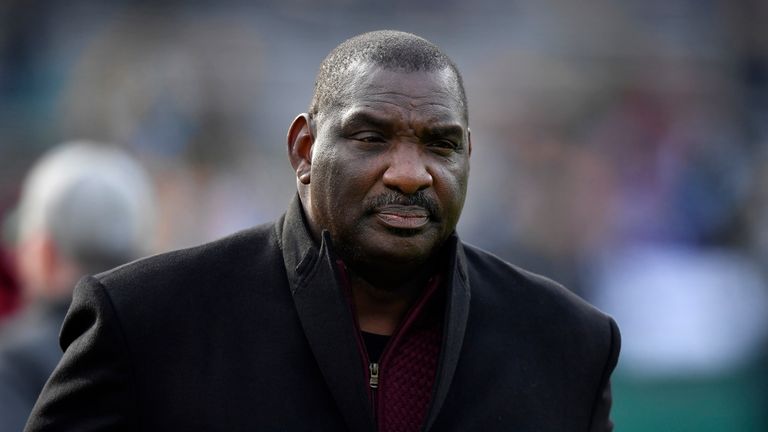
Doug Williams: “[Trump]Â made such a big stink of it, the fans in this area might’ve been a tough situation for both the team and [Kaepernick].
Last Updated: 13/06/20 8:59pm
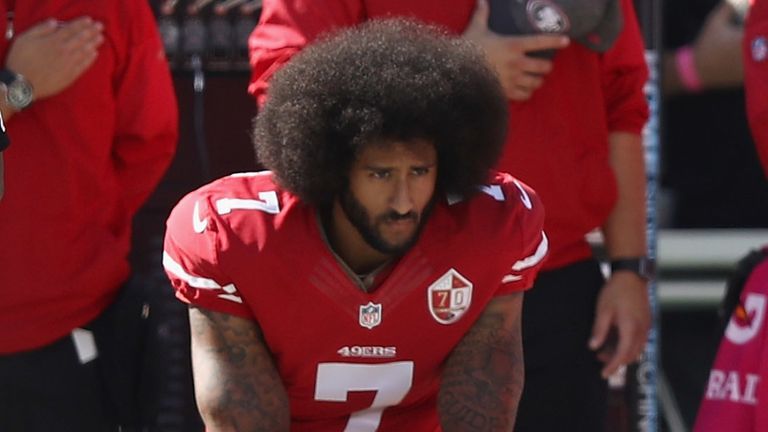
Colin Kaepernick kneeling during the US anthem in 2016
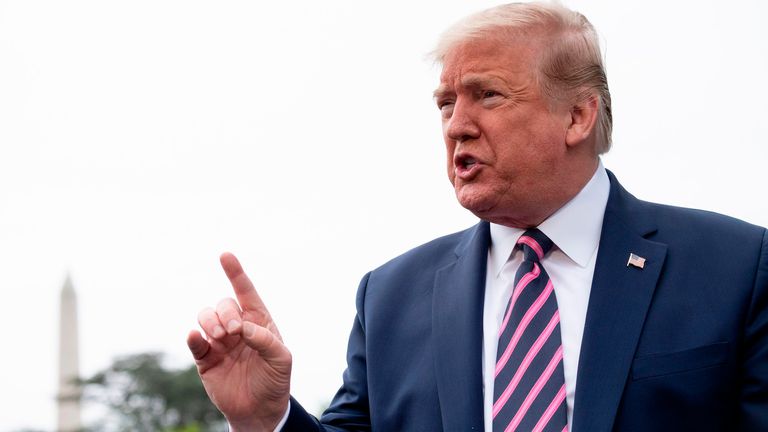
Donald Trump’s opposition to Colin Kaepernick taking a knee during the US anthem made the Washington Redskins reluctant to sign the quarterback, according to Doug Williams.
Kaepernick protested racial injustice in the United States by kneeling during the anthem in the 2016 season.
The 32-year-old has not been signed by an NFL team since opting out of his contract with the San Francisco 49ers in 2017. That year, President Trump urged team owners to fire athletes who take a knee during the anthem.
The Redskins were in need of a quarterback in 2018 before trading for Alex Smith – Kaepernick’s former 49ers teammate – to replace Kirk Cousins.
The team’s senior vice president of player development Williams, who became the first black quarterback to win a Super Bowl in Super Bowl XXII, admits the team were wary about how Kaepernick would have been received by the team’s fans.
“And I think the guy that sits on Pennsylvania Avenue – 1600 Pennsylvania Avenue – made such a big stink of it, the fans in this area might’ve been a tough situation for both the team and [Kaepernick].
“I think the guy that sits on Pennsylvania Avenue – 1600 Pennsylvania Avenue — made such a big stink of it, the fans in this area might’ve been a tough situation for both the team and (Kaepernick).
Redskins senior VP of player development Doug Williams
“You don’t want to bring people into a situation where nobody is going to be happy. I think that’s probably what happened, why he didn’t come up during that time.”
Kaepernick’s stand against police brutality and commitment to social-justice issues is back in the spotlight after the death of George Floyd on May 25 in Minneapolis.
Floyd, a black man, died after white Minneapolis police officer Derek Chauvin kneeled on his neck for more than eight minutes.
Last week, NFL commissioner Roger Goodell said the NFL will encourage players to speak out and protest following the death of Floyd and admitted the NFL was “wrong for not listening to NFL players earlier”.
Donald Trump is an outspoken critic of players kneeling during the national anthem played prior to games
Kaepernick spent six seasons with the 49ers after being a second-round pick in the 2011 NFL Draft. He played in only three games as a rookie, then started 58 games over the next five seasons. He completed 1,011 of 1,692 passes for 12,271 yards, 72 touchdowns and 30 interceptions in 69 career games.
He also rushed for 2,300 yards and 13 scores, averaging 6.1 yards per attempt.
Kaepernick was the 49ers’ quarterback when they lost 34-31 to the Baltimore Ravens in Super Bowl XLVII following the 2012 season.
Confirmed COVID-19 cases in South Africa have risen by 3 809, according to Health Minister Dr Zweli Mkhize, who issued out the latest update on Saturday night.
This sees the cumulative coronavirus cases in the country increase to 65 736, with the death toll now at 1 423 after 69 new fatalities were recorded over the past 24 hours.
The period in question also yielded 27 462 new tests, bringing the total up to 1 087 887, while the number of recoveries now stands at 36 850.
This means that the number of active ccases now tallies at 28 886.
PROVINCIAL COVID-19 CASES AND DEATH TOLL:Â
The following confirmed COVID-19 cases have been detected in each province as of Saturday, 13 June:Â
Gauteng – 9 897 cases;
Western Cape – 40 605 cases;Â
KwaZulu-Natal – 3 763 cases;Â
Free State – 457 cases;Â
Eastern Cape – 9 250 cases;Â
Limpopo – 309 cases;Â
Mpumalanga – 271 cases;Â
North West – 977 cases;Â
Northern Cape – 144 cases; and Â
Unknown – 63 cases.Â
In terms of fatalities, the Western Cape remains the heaviest affected province with the vast majority of deaths reported in the country occuring there.
Along with South Africa’s highest caseload, the province reports the most recoveries out of the nine, but still mainitains the most active cases.
Province
Deaths
Recoveries
Eastern Cape
217
4 559
Free State
9
189
Gauteng
81
3 075
KwaZulu Natal
64
1 810
Limpopo
3
185
Mpumalanga
1
116
North West
5
128
Northern Cape
1
52
Western Cape
1 041
26 736
Total
1 423
36 850
Difficult days loom as COVID-19 peak approaches
The last two weeks have seen a significant rise in hospitalisations related to the virus and, as a result, deaths. Mkhize has however warned that the worst is still yet to come.
“We need to remain focused; we have not quite reached the peak yet. We have a lot of difficult days ahead.â€
Dr Zweli Mkhize
The spike in cases can be attributed to the easing of lockdown, which came into effect at the beginning of the month.
Experts have projected that the peak infection rate will hit South Africa from late July, with thousands of deaths predicted as a result of the coronavirus.
We use cookies on our website to give you the most relevant experience by remembering your preferences and repeat visits. By clicking “Accept”, you consent to the use of ALL the cookies.
This website uses cookies to improve your experience while you navigate through the website. Out of these, the cookies that are categorized as necessary are stored on your browser as they are essential for the working of basic functionalities of the website. We also use third-party cookies that help us analyze and understand how you use this website. These cookies will be stored in your browser only with your consent. You also have the option to opt-out of these cookies. But opting out of some of these cookies may affect your browsing experience.
Necessary cookies are absolutely essential for the website to function properly. These cookies ensure basic functionalities and security features of the website, anonymously.
Cookie
Duration
Description
cookielawinfo-checbox-analytics
11 months
This cookie is set by GDPR Cookie Consent plugin. The cookie is used to store the user consent for the cookies in the category "Analytics".
cookielawinfo-checbox-functional
11 months
The cookie is set by GDPR cookie consent to record the user consent for the cookies in the category "Functional".
cookielawinfo-checbox-others
11 months
This cookie is set by GDPR Cookie Consent plugin. The cookie is used to store the user consent for the cookies in the category "Other.
cookielawinfo-checkbox-necessary
11 months
This cookie is set by GDPR Cookie Consent plugin. The cookies is used to store the user consent for the cookies in the category "Necessary".
cookielawinfo-checkbox-performance
11 months
This cookie is set by GDPR Cookie Consent plugin. The cookie is used to store the user consent for the cookies in the category "Performance".
viewed_cookie_policy
11 months
The cookie is set by the GDPR Cookie Consent plugin and is used to store whether or not user has consented to the use of cookies. It does not store any personal data.
Functional cookies help to perform certain functionalities like sharing the content of the website on social media platforms, collect feedbacks, and other third-party features.
Performance cookies are used to understand and analyze the key performance indexes of the website which helps in delivering a better user experience for the visitors.
Analytical cookies are used to understand how visitors interact with the website. These cookies help provide information on metrics the number of visitors, bounce rate, traffic source, etc.
Advertisement cookies are used to provide visitors with relevant ads and marketing campaigns. These cookies track visitors across websites and collect information to provide customized ads.