Families could soon be allowed to meet up with other households in Northern Ireland under new proposed “social bubbles”.
ustice Minister Naomi Long said that the Executive was due to meet on Thursday to discuss the possibility of allowing families to merge.
Speaking on Good Morning Ulster, Ms Long said that extending social contact was critical to ensuring the well-being of people’s mental health – and to unlocking the economy by allowing people to return to work.
“At the moment, we live in a bubble with our own household and that’s the extent of the indoor contact that we have. The idea would be to join a small number of households together initially and form a slightly larger bubble. By rolling that out over time on a very measured basis, we would be able to start to restore some of the social contact that we have.”
Ms Long added that there would be some rules in place to ensure the virus doesn’t spread.
“If it’s going to work, there has to be some kind of order to it. You need to have a discrete number of families and households involved so you know the extent of people you’ve been in contact with. It makes tracing, if anyone does get sick or gets symptomatic, very quick and simple because you’ll know who you’ve been in contact with.”
She added that it’s also “crucial” that people don’t move between bubbles.
“It’s important that you treat your bubble the way you treated your household, so that people don’t enter or leave it during the period and then over time you’re able to expand on the numbers.”
“No system is going to be perfect. Every system is going to have anomalies that will cause risks but I think it’s really important that as we talk about restoring the economy, we talk about getting people back to work and all those other things, that we look at the impact that it has had on individual people’s lives and their ability to form family relations and be able to be with friends and have that emotional support.”
Ms Long added that extending social bubbles is crucial for childcare.
“We need to allow people to have this childcare bubble so that they’re able to make contact with family or friends who can come to their house for childcare, or they can take their children to their home for childcare. If we’re going to allow people to start going back to work, we’re going to have to look at those informal childcare arrangements as well as the formal ones.
“There’s a real opportunity here to allow people to start rebuilding their personal life, because without that emotional support, it’s going to be very difficult to encourage people to go back in the shops and work. We need to be sensitive that people are crying out for that opportunity, but we do have to do it as safely as we can.”
Prime Minister Imran is chairing a session of the federal cabinet on Tuesday to review countrywide situation and discuss important national matters such as the upcoming budget and measures against the coronavirus.
According to sources, the prime minister took notice of the ‘artificial’ scarcity of petroleum products in the country, ordering strict action against those behind it.
Sources said that the cabinet ordered the petroleum division to form teams for conducting raids.
As per the law, Oil and Gas Regulatory Authority and petroleum division officials can inspect stores of the oil companies, sources quoted the cabinet members as saying.
“OGRA kept on sleeping, while long queues formed outside the petrol pumps,†said federal minister Murad Saeed.
Meanwhile, Federal Minister for Aviation Ghulam Sarwar asked if there was only a stock left for seven days in the entire country of petroleum products, to which Special Assistant to PM Nadeem Babar responded that at this time 215,000 metric tonnes of petrol is in reserve.
Federal Minister for Energy Omar Ayub said that some companies stopped buying of petrol after an increase of $12 in the global market.
“The oil companies which ended the stock, we are cancelling their licenses,†said the minister.
Meanwhile, sources informed that the cabinet also approved action against those named in the sugar crisis inquiry report.
The federal cabinet will also review the decisions taken by the Economic Coordination Committee on June 3, according to its agenda.
The ECC had recommended to let go of 9,350 employees of the Pakistan Steel Mills. The cabinet will take a decision on the matter today.
Earlier this week, it was reported that petrol pumps spread over the country have been facing a shortage of fuel supply, adding to the difficulties of the public as well as transporters.
It was learnt that those stations with petrol, are charging citizens double prices.
As schools across South Africa start to open up with the gradual phasing in of grades, the interest in video and collaboration platforms still remains high, as schools look to get their classrooms online and connect students and teachers remotely. But while some platforms have seen overnight success, many local schools have concerns about security, user-friendliness, and what seems to be an overwhelming array of choices.
StarLeaf offers a secure video-conferencing experience that allows users to connect across a range of platforms
Privacy-minded schools should consider their video-conferencing options carefully, says Renaldo Muregess, who heads product strategy at managed business service provider Itec. There is often a trade-off between security and usability when opting for a single platform, and schools should look for systems that support multiple software options while ensuring the online safety of staff and learners.
Itec is currently running a pilot project with a Johannesburg school using the cloud-based video conferencing provider StarLeaf, which not only offers a more secure video-conferencing experience, but also allows users to connect across a range of platforms and can control bandwidth consumption per user, regardless of location or device, with the existing tools they have in place. StarLeaf’s latest new features include the ability to integrate easily with Microsoft Teams.
“While there’s a plethora of collaboration tools on the market today, Itec shares StarLeaf’s approach that collaboration should not be restricted to one platform. Teachers and students should have the ability to communicate in the way that works best for them, and we should support schools on the journey to creating their own collaboration solution that’s easy and safe,†said Muregess.
Teachers and students should be able to communicate in the way that works best for them
By integrating with other platforms such as Microsoft Teams, StarLeaf enables users to collaborate from a single workspace and increases productivity for schools that have Microsoft Teams or other platforms, with users able to meet with anyone, anywhere and on any device, both internally or remotely.
StarLeaf’s major selling point for many schools across the world has been its focus on security. The platform is secure from would-be attackers intercepting messages or accessing meeting sessions, as it enforces encryption. It owns and manages its own service, so it is not exposed to potential security or reliability issues in third party services, and it does not share user data.Â
“It’s clear that technology and cloud software tools can play a major role in keeping South African companies and educational organisations connected and working as close to business as usual in the face of the Coronavirus,†said Muregess.
To find out more about Itec’s flexible subscription model and StarLeaf packages click here
Itec Group South Africa
Itec is southern Africa’s fastest growing office automation, production printing and tele- communications solutions provider. Through its 47 southern African branches, the company implements total office solutions based on imported, industry-leading, and award-winning products.
Itec serves medium-sized and large businesses in sectors as diverse as financial services and retail –supporting its innovative solutions with proactive service delivery. Some of its 18 000 customers include Value Logistics, Implats, Department of Housing, Business Connexion, ADT, Rand Refinery, First National Bank, Anglogold Ashanti, National Health Laboratory Services and ADvTECH.
KARACHI: Four more bodies were recovered from under the debris of the building that collapsed in Lyari a few days ago, following which the death toll from the incident climbed to 13 on Tuesday.
On Sunday, a multi-storey building collapsed in the metropolis after which a rescue operation began in the area to recover bodies and shift the wounded to the hospital for treatment.Â
The rescue operation is underway for the third consecutive day during which bodies of three women were pulled out from under the rubble.
So far 13 bodies, which include those of four women, have been recovered from the wreckage. A man was rescued alive from the rubble after 24 hours only to succumb to his injuries at the hospital.
PPP Chairman Bilawal Bhutto Zardari expressed regret over the loss of precious lives in the incident.
“I am with the affected families, we will not leave them alone in these difficult times,” Bilawal said, extending his support and adding that concrete steps should be taken to prevent such accidents in the future.
8-10 families were living inside
The Inter-Services Public Relations (ISPR) said Pakistan Army’s rescue team was sent to the incident site and security forces at the site were rescuing and evacuating people in the operation. Engineers with specialised equipment were also sent to clear the debris and evacuate those trapped inside, it added.
Sindh Rangers said their teams, as well as those of the Army, were on site of the collapsed building. A heavy contingent of Rangers was present in the affected area, they added, noting that nearby buildings had also being evacuated, they said.
The five-storey building, located in Liaquat Colony of Lyari, had more than 40 apartments and a penthouse on the top floor. The Sindh Building Control Authority (SBCA) had declared it as dangerous and unstable more than two months ago.
The superintendent of police (SP) for Lyari said initial reports confirmed at least eight to 10 families were living in the building.
Deputy inspector-general (DIG) of police for the South district, Sharjil Karim Kharal, told Geo News that two months ago, authorities had asked for the building to be vacated.
Kharal said the building housed about 200 people before it was vacated. He explained that while many families living in the building had already been evacuated, “we have been informed that the families living on two floors had not vacated”.
It was too early to say how many people were in the building at the time of the accident, he said, while SSP City District Muqaddas Haider said it was it would be premature to comment on how many more people were still buried in the rubble.
Sindh governor takes notice
Taking notice of the incident, Sindh Governor Imran Ismail sought a report from Commissioner Karachi and the SBCA, directing the latter to immediately initiate rescue operations.
“Immediate steps should be taken to evacuate those trapped under the building [debris],” Ismail said.
Sindh minister for municipalities, too, has immediately summoned a report from Commissioner Karachi and SBCA Director-General Dr Nasim-ul-Ghani Sahito.
Sindh Information Minister Syed Nasir Hussain Shah said he had advised that rescue efforts be made effective and coordinated in every way. Heavy machinery to help remove rubble and assist in relief operations was to be sent as soon as possible, he said.
Speaking to Geo News, Commissioner Karachi Iftikhar Ali Shallwani said the building was already in disrepair and that its residents had been advised to evacuate. It was too early to say how many people were buried under the rubble, he added.
MQM-P Convener Khalid Maqbool Siddiqui said rescue workers must immediately ensure the safety of human lives. The lawmaker added he was praying for the recovery of those injured in the accident.
Building started tilting in evening
Residents of the locality say no homes in the building were vacant.
Bricks and pieces of the building had been falling since evening, they said, adding that the structure tilted before suddenly collapsing.
Sources said the residents had been given notices when the building became dilapidated. While many families had already vacated their flats, several more left when another crack appeared in the building Sunday morning.
An eyewitness in the Nayabad locality said the building had started swaying earlier in the day, around 3pm, and that it had felt like it was an earthquake. People living in the building began to vacate their flats, the eyewitness added, noting that some of them could not retrieve their belongings in the hurry to leave.
The building finally collapsed around 8:30pm, the eyewitness mentioned, noting that there were 60 to 65 flats in it and there was a possibility that 40-45 people could be under the debris.
Building declared dangerous on March 18
According to a document from the SBCA, the ground-plus-five storey residential building was declared dangerous and unstable back on March 18.
Its residents, as well as the owners of all the flats, had been given notice that the building was damaged and were instructed to evacuate within 15 days.
The SBCA had also written letters to relevant authorities to disconnect the electricity, gas, and water supplies.
Image caption
A US government study suggested facial recognition algorithms were less accurate at identifying African-American faces
Tech giant IBM is to stop offering facial recognition software for “mass surveillance or racial profiling”.
The announcement comes as the US faces calls for police reform following the killing of a black man, George Floyd.
In a letter to the US Congress, IBM said AI systems used in law enforcement needed testing “for bias”.
One campaigner said it was a “cynical” move from a firm that has been instrumental in creating technology for the police.
In his letter to Congress, IBM chief executive Arvind Krishna said the “fight against racism is as urgent as ever”, setting out three areas where the firm wanted to work with Congress: police reform, responsible use of technology, and broadening skills and educational opportunities.
“IBM firmly opposes and will not condone the uses of any technology, including facial recognition technology offered by other vendors, for mass surveillance, racial profiling, violations of basic human rights and freedoms,” he wrote.
“We believe now is the time to begin a national dialogue on whether and how facial recognition technology should be employed by domestic law enforcement agencies”.
Instead of relying on potentially biased facial recognition, the firm urged Congress to use technology that would bring “greater transparency”, such as body cameras on police officers and data analytics.
Data analytics is more integral to IBM’s business than facial recognition products. It has also worked to develop technology for predictive policing, which has also criticised for potential bias.
‘Let’s not be fooled’
Privacy International’s Eva Blum-Dumontet said the firm had coined the term “smart city”.
“All around the world, they pushed a model or urbanisation which relied on CCTV cameras and sensors processed by police forces, thanks to the smart policing platforms IBM was selling them,” she said.
“This is why is it is very cynical for IBM to now turn around and claim they want a national dialogue about the use of technology in policing.”
She added: “IBM are trying to redeem themselves because they have been instrumental in developing the technical capabilities of the police through the development of so-called smart policing techniques. But let’s not be fooled by their latest move.
“First of all, their announcement was ambiguous. They talk about ending ‘general purpose’ facial recognition, which makes me think it will not be the end of facial recognition for IBM, it will just be customised in the future.”
The Algorithmic Justice League was one of the first activist groups to indicate that there were racial biases in facial recognition data sets.
A 2019 study conducted by the Massachusetts Institute of Technology found that none of the facial recognition tools from Microsoft, Amazon and IBM were 100% accurate when it came to recognising men and women with dark skin.
And a study from the US National Institute of Standards and Technology suggested facial recognition algorithms were far less accurate at identifying African-American and Asian faces compared with Caucasian ones.
Amazon, whose Rekognition software is used by police departments in the US, is one of the biggest players in the field, but there are also a host of smaller players such as Facewatch, which operates in the UK. Clearview AI, which has been told to stop using images from Facebook, Twitter and YouTube, also sells its software to US police forces.
Maria Axente, AI ethics expert at consultancy firm PwC, said facial recognition had demonstrated “significant ethical risks, mainly in enhancing existing bias and discrimination”.
He added: “In order to build trust and solve important issues in society, purpose as much as profit should be a key measure of performance.”
More than three months after a nursing home in Kirkland, Wash., became the center of the country’s first coronavirus outbreak, a majority of nursing home workers believe they’re risking their lives on the job and that their employers are not doing enough to protect them from the virus, according to a new union survey.
Most nursing home workers say their employers (76%) and the federal government (80%) are not doing enough to ensure they have access to protective equipment, free COVID-19 testing and paid sick days. And 78% say their “life is at risk every day†at work because of the virus, according to a survey by the Service Employees International Union (SEIU), which was shared with TIME.
This comes as the pandemic continues to devastate nursing homes and as some states begin to see an uptick in COVID-19 cases as they reopen. There have been more than 43,000 coronavirus deaths in long-term care facilities across 40 states as of June 4, according to data from the Kaiser Family Foundation — accounting for nearly 40% of the country’s coronavirus deaths.
Nursing home workers, who have long faced challenges with low pay, occupational hazards and understaffing, say they feel unprotected and disrespected on the frontlines while caring for people who are among the most vulnerable to COVID-19. Among their main demands since the pandemic swept the country are hazard pay, sick time and more personal protective equipment (PPE). Nursing home residents and their families have also raised concerns about how facilities have responded to the pandemic.
“The worst thing that I get upset about is hearing the word hero, hero, hero being thrown around for us. And no one is treating us as such. We feel disrespected,†Tanya Beckford, a certified nursing assistant (CNA) at a nursing home in Newington, Conn., previously told TIME. She says she had been asking her facility for more masks, gloves and gowns, before she positive for COVID-19 in April. The nursing home denied Beckford’s claims.
Tanya Beckford near her home in Manchester, Conn., on May 27.
Erik Madigan Heck for TIME
In May, the Centers for Medicare and Medicaid Services began requiring nursing homes to report coronavirus cases to the Centers for Disease Control and Prevention, as well as to residents and their families. At the same time, the White House recommended that nursing homes test every resident and employee for COVID-19, but state and industry leaders have said they don’t have the resources to do that — neither enough tests, nor people to administer them.
Keep up to date with our daily coronavirus newsletter by clicking here.
In the SEIU survey, 54% of respondents said they currently have enough PPE to safely do their job and have received clear communication from their employer about suspected cases of COVID-19 in their facility. And 69% of respondents said they’re receiving effective training on protecting themselves and their residents from COVID-19.
SEIU President Mary Kay Henry says if only about half of nursing home workers have enough PPE, “I think that’s cause for alarm.â€
“That is a tragedy,†Henry tells TIME. “We are never going to get this virus under control if we can’t get PPE to the frontline essential workers, like nursing home workers.â€
Related Stories
Nursing home workers who contract COVID-19 have been forced to use sick time or vacation time, or to take unpaid leave, as they recover from the virus. Some workers have lost their jobs. Sixty-four percent of workers who were surveyed said their employer is not providing them with paid sick days if they contract the virus, and 72% said their employer is not providing paid sick time if they have to self-quarantine for two weeks.
Meanwhile, the pandemic has exacerbated existing problems for the long-term care workforce. The median pay for nursing assistants was $29,640 last year, which is just above the national poverty level for a family of four.
A majority of workers (85%) said they would have trouble paying for food or housing if they couldn’t work for two weeks, and 73% said there are not enough staff at their facility to safely care for all residents, according to SEIU survey.
Henry says she’s calling on states and nursing homes to take immediate action to get more PPE and tests to workers, and then to focus on solving the long-term problems within the industry by raising wages and “making these good jobs that people can feed their families on.â€
“It is an outrage, from our perspective, that this far into the pandemic, 80% of nursing home workers feel their lives are at risk every day they go to work,†Henry says. “We want every employer to be held accountable, so that we can end the cycle of poverty in our communities and make sure residents and their family members get the care that they deserve.â€
The SEIU survey of 2,397 nursing workers across the U.S. was conducted online from May 20 to June 7, using Wufoo by Survey Monkey. It has a margin of error of plus or minus 3 percentage points.
The Coronavirus Brief. Everything you need to know about the global spread of COVID-19
Thank you!
For your security, we’ve sent a confirmation email to the address you entered. Click the link to confirm your subscription and begin receiving our newsletters. If you don’t get the confirmation within 10 minutes, please check your spam folder.
Before entering the US Senate last year, Scott served for eight years as governor of Florida, America’s third most populous state. He has been widely discussed as a potential future Republican presidential candidate.
Referring to traditional US allies such as Australia, Scott said: “We ought to do this together. All democracies are going to have to say to themselves: are they going to continue to appease the Communist Party of China, which is clearly focused on world domination and has taken jobs from democracies all over the world and stolen technologies from all over the world?”
Scott said policymakers in Washington had paid close attention to Australia’s push to launch an independent investigation into the origins of the coronavirus pandemic and China’s subsequent decision to impose tariffs on Australian barley.
He also praised Australia’s decision to ban Chinese telco Huawei from its 5G rollout.
“What I admire about Australians is they will stand for their convictions,” Scott said. “Australia, like America, has been working to hold China accountable. We’ve got to find out what happened here, why it happened and make sure it doesn’t happen again. I’m very appreciative of Australia’s push to get the facts, live in reality and hold people accountable for their actions.”
In a letter to Australia’s US Ambassador Arthur Sinodinos last month, 27 US senators and House of Representatives members said that China had made “deeply disturbing” threats to punish Australia for seeking an international inquiry into the origins of COVID-19.
Loading
“This incident is part of a broader and concerning pattern from the Chinese government,” the bipartisan group wrote.
“One decision that is not difficult is to always stand with our Australian mates. No matter the external pressure or coercion, we will always have Australia’s back, just as Australia has always had ours.”
Even in a US Congress that has grown increasingly sceptical towards China over recent years, Scott has stood out for his particularly hardline stance towards the rising superpower. He has called for Americans to boycott all Chinese goods, urged the International Olympic Committee to strip Beijing of the 2022 Winter Olympics and accused China of trying to sabotage US efforts to develop a COVID-19 vaccine.
Elaborating on his views of the Chinese regime, Scott said: “They don’t believe in human rights. They don’t believe in free trade, they don’t believe in fair trade. They don’t believe in the rule of law. They don’t want to be a caring world citizen. They’re willing to take away people’s rights. I’m disgusted with how they treated Uighurs and how they treated Hong Kong citizens.”
Matthew Knott is North America correspondent for The Sydney Morning Herald and The Age.
PROVINCETOWN, Mass. ― Rob Anderson needs to earn $2 million in the next 12 weeks.
Normally, that would be an unremarkable achievement for the co-owner of the Canteen, a popular counter-service restaurant in Provincetown. During a typical summer, as many as 65,000 people fly, ferry or drive 60 miles along the hooked peninsula of Cape Cod to arrive at this three-square-mile oasis of art galleries, bed-and-breakfasts, beaches, and rainbow flags. They stroll down Commercial Street, where the Canteen occupies prime real estate, brushing elbows against the cars brave (or stupid) enough to try to make it down the main drag in the middle of the day.
“We have a saying here,†Anderson told me. “Summer seats pay for winter heat.â€
By October, having brought in some $200 million in tourism during its high season, Provincetown will empty out to less than 3,000 year-round residents and again resemble the small fishing village it once was. Much of the housing stock will lie vacant over the winter. The Soup Kitchen in Provincetown will resume preparing 125 hot lunches every day, eventually serving 15,000 meals by the time it wraps up for the year.
Maddie Meyer/Getty Images
People walk on the beach at Provincetown Harbor on May 25. The country’s unofficial LGBTQ summer playground faces a greater challenge this year because of the coronavirus.
This summer, of course, will be different ― although nobody knows how exactly.Â
Like much of the country, Provincetown is in the throes of figuring out how to safely reopen during a pandemic. But while the shutdown has posed problems everywhere, the beach town and LGBTQ mecca is facing a pressure-cooker version of this dilemma. Workers here log massive overtime during the tourism season and live off savings, reduced wages or unemployment the rest of the year. Provincetown also has an aging population (median age, 57), with a significant number of HIV-positive, immunocompromised residents. The nearest intensive care bed is over an hour’s drive away.
And unlike the monthslong timelines being considered elsewhere for reopening, the runway here is a short one: June has arrived and with it, a roiling debate about what to do next.
Who’s In Charge?
Narrowly speaking, Provincetown is following orders. On May 18, Massachusetts Gov. Charlie Baker (R) released a four-phase reopening plan for the state. At each phase, more business sectors can reopen but with modifications. Advancing to the next phase will depend on public health data. If a spike is observed in COVID-19 cases, the current phase could be paused or even rolled back. Phase one began on May 18. On June 8, the state advanced to phase two, and restaurants, lodging and retail businesses reopened across Massachusetts.
The problem is that the guidelines governing restaurants and lodging, which constitute the majority of Provincetown’s businesses, were not released until May 29, leaving only a little over a week for owners to entirely revamp their establishments in time to open their doors at the start of phase two.
“To effectively execute new systems, new layouts, new protocols, to hire staff, to train staff, it takes time,†said Anderson, who co-owns the Canteen with his husband, Loïc Rossignon.Â
John Tlumacki/The Boston Globe/Getty Images
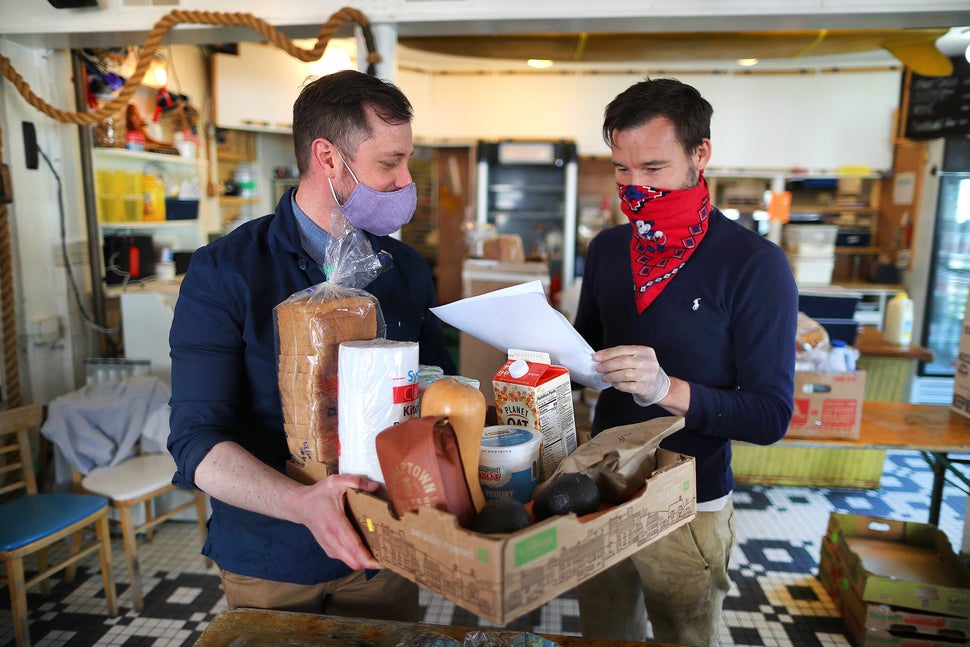
Rob Anderson (left), co-owner of the Canteen, and his partner and co-owner Loïc Rossignon make up a grocery order for delivery inside their Provincetown restaurant on May 13.
Normally, Anderson told me, he would have had 42 people on staff by Memorial Day. On the day we spoke in late May, he had 12. To ramp up by July, he would need to hire dozens of additional workers within weeks — a process that normally takes him several months. And don’t forget, he reminded me, that anyone coming from out of town would need to quarantine for 14 days before they could begin working. That would land the Canteen, and any other local establishments attempting to hire on an accelerated timeline, fully open for business sometime in August — two-thirds of the way into the season.
In the gap left by the state’s guidance, Provincetown’s stakeholders ― business owners, year-round residents, second-home owners and investors, who own 70% of the housing stock ― asked the town to give direction. But the executive arm of the local government, which is led by a five-member elected Select Board, is not designed to respond to global pandemics. The Select Board members, often in concert with the town’s Board of Health, have been debating the many measures being considered — mandatory mask orders, the regulation of whale watch tours, the partial closure of Commercial Street to cars — during meetings broadcast over public conference calls that last several hours. Like the business owners, they are hamstrung by the delay in guidance from the state, at risk of enacting policies today that may be overridden by the governor tomorrow.
All of the proposed stopgaps will likely fail without the resolution of a larger question hanging over every conversation: Should Provincetown focus its energy on welcoming visitors safely in order to plug a $200 million hole? Or should it batten down the hatches until the storm has passed?
A recent survey of the Provincetown community, conducted by the town’s recovery coalition, found that a majority of respondents believed that stopping the coronavirus should be the local government’s priority. But in that same survey, a majority also felt that reopening this summer, including restaurants and inns, would be possible. Clearly, not everyone here agrees on how serious the COVID-19 threat is — or how to protect against it.
‘The Intimacy Of Provincetown Is Deadly This Season’
John Tlumacki/The Boston Globe/Getty Images
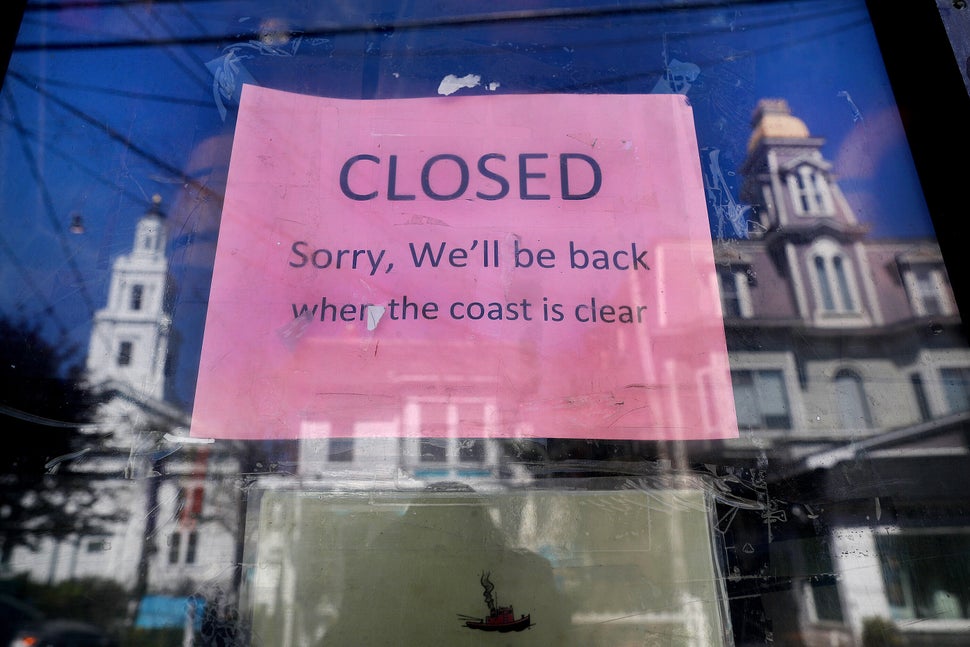
A sign on the Marine Specialties store on Commercial Street in Provincetown tells customers that the store is closed on May 13.
Myra Slotnick, a playwright who has lived in Provincetown for 18 years, stood in front of the town hall every weekend for a month with homemade signs. One sign read: “Protect our town. Shut it down.†Another had a blunter message: “Vacation is a week. Death is forever.â€
“The numbers in Barnstable County today were 1,200,†Slotnick told me on the day we spoke, referring to the number of people who had tested positive for COVID-19, “and over 100 deaths.†(The numbers for the county ― which essentially consists of the Cape Cod peninsula ― have since risen to 1,458 and 123, respectively. In Provincetown, there have been 28 confirmed COVID-19 cases and one death.)
“This is with nobody here,†Slotnick continued. “So imagine: People spill into town. Then you add alcohol, then you add the party atmosphere, the irreverence, the feeling of ownership with some people when they come here. And then they infect two people, who infect four people, who infect 10 people.â€
She paused, as if thinking of another way to say this.
“We’re sitting ducks. People don’t have to come here, but we have no place else to go.â€Â
Slotnick and other residents point to Provincetown’s beloved social life ― the drag shows, dance floors and beach parties that have been part of the town’s appeal for decades ― as a prime risk factor. Commercial Street itself is a vibrant scene. Longtime summer resident Michael Cunningham, in his 2002 book “Land’s End,†compared riding a bike on it to “flying a spaceship through a field of sluggish but erratically moving asteroids.â€
“Provincetown is intimate and that’s its charm,†Slotnick said. “But I really feel that the intimacy of Provincetown is deadly this season. … I don’t think you can social distance on Commercial Street. I don’t think you can safely do any of the things that people flock to Ptown for.â€
Select Board member Lise King has also been one of the most outspoken advocates for prioritizing safety in Provincetown this summer. In late March, a Facebook post of hers warning of the risks of visiting was quoted in The New York Times. “TO ANYONE THINKING ABOUT COMING TO PTOWN,†the post began. “PLEASE make yourself aware of our circumstances and make an informed choice.â€
King’s appearance in the Times garnered a rebuke (also on Facebook) from Select Board Chair David Abramson, who wrote that it had “created an atmosphere of fear, anxiety and animosity.†He described her actions as “unconscionable†and an “act of self-promotion.†(Abramson declined to be interviewed for this article.)
“If this is my political last stand in Provincetown, that’s OK,†King told me. “I have to be able to live with what happens here for the rest of my life. So my decision is a moral one.â€
“Let’s be conservative and say 10 people die over the course of the summer,†she went on. “Which 10 people are you willing to bury in town? We all know each other. Which 10 people are you OK to sacrifice so that we can have a tourist economy?â€
Right In The Coronavirus Bullseye
John Tlumacki/The Boston Globe/Getty Images
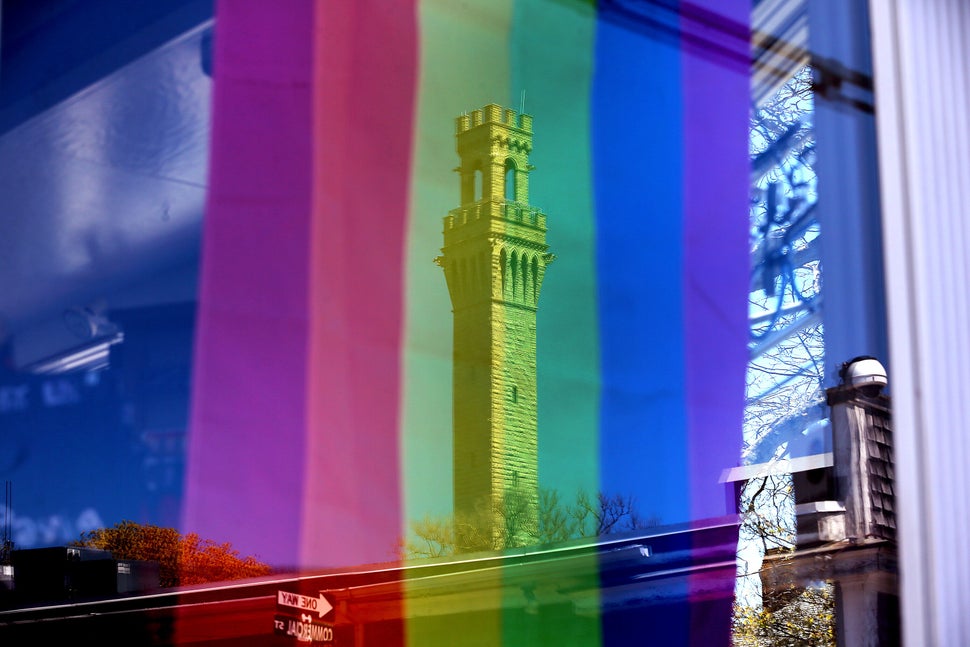
A rainbow flag hangs in a Commercial Street business window that reflects the Pilgrim Monument in Provincetown on May 13.Â
As King pointed out to The New York Times, Provincetown has a health care capacity that corresponds to its small, relatively rural setting. It’s served by Outer Cape Health, a nonprofit that operates three community health centers, none of which have overnight beds. The nearest hospital is more than an hour away in Hyannis, making Provincetown’s community health center the farthest from a hospital in the state of Massachusetts.
In a normal year, Outer Cape Health would significantly increase its staffing in preparation for the summer spike in visitors. But this March, citing losses of up to $1 million in monthly revenue due to COVID-19, it announced that 70 of its 200 staffers had been furloughed. Outer Cape Health laid off a smaller number and reduced hours for others in a “staff reorganization†that impacted half of its workforce. (It has since rehired roughly 20 of the furloughed staff, largely to do COVID-19 contact tracing.) The Provincetown center will remain open this summer, but at reduced capacity, offering telehealth services and in-person visits as needed.
Dr. Andrew Jorgensen, chief medical officer for Outer Cape Health, told me he was “cautiously optimistic about the summer.†He cited his organization’s access to an extensive medical transportation system, which allows the Provincetown center to quickly transfer patients to the hospital, as well as his organization’s robust testing capacity and new contact tracing program.
“We don’t know what’s going to happen in the summer,†Jorgensen said. “If Massachusetts, New York and the rest of New England are doing a really careful job in the reopening process, but then people come on vacation from places where maybe it wasn’t so careful, it could easily infect the population.â€
But there are systems in place, he noted. “If somebody was here in town and was exhibiting symptoms, we’d be able to quickly test them and, if they were positive, deploy the contact tracing process in order to contain it as quickly as possible,†he said.
Adding to the town’s health care situation is its history as a refuge for people with AIDS during the early years of that epidemic. Provincetown’s AIDS Support Group, which lives on today as the AIDS Support Group of Cape Cod, was founded in 1983. As Masha Gessen wrote in The New Yorker in 2018, the town “had low rents in the off-season, many queer landlords who weren’t afraid to rent to the sick, an AIDS support group, a gay magazine full of treatment information (I was the editor), and a lesbian town nurse named Alice Foley. … She would drive sick men two and a half hours to one of the Boston hospitals when necessary.â€
Today, roughly 10% of Provincetown residents are living with HIV — the highest per-capita rate in the state and among the highest in the country. With a population that also skews older — a third of its residents are over 65 — the community is in some ways particularly vulnerable.
“Our demographic is right in the bullseye of the virus,†Slotnick said.
Nadine Licostie, who co-owns the Seaglass Inn & Spa with her wife, Faith Licostie, said they would wait to reopen their hotel until a reliable plan for health care is in place.Â
“Someone is going to come into town who’s going to have the virus,†she said. “And they’re going to spread it. And then how do you start taking care of the people who get sick?â€
She added: “Our number one responsibility is to make sure that Provincetown residents are safe and that our staff is safe. We’ve got 20 people on staff and we want to put them back to work, but we can’t do it until we know there’s some safety for them.â€
AP/GETTY IMAGES
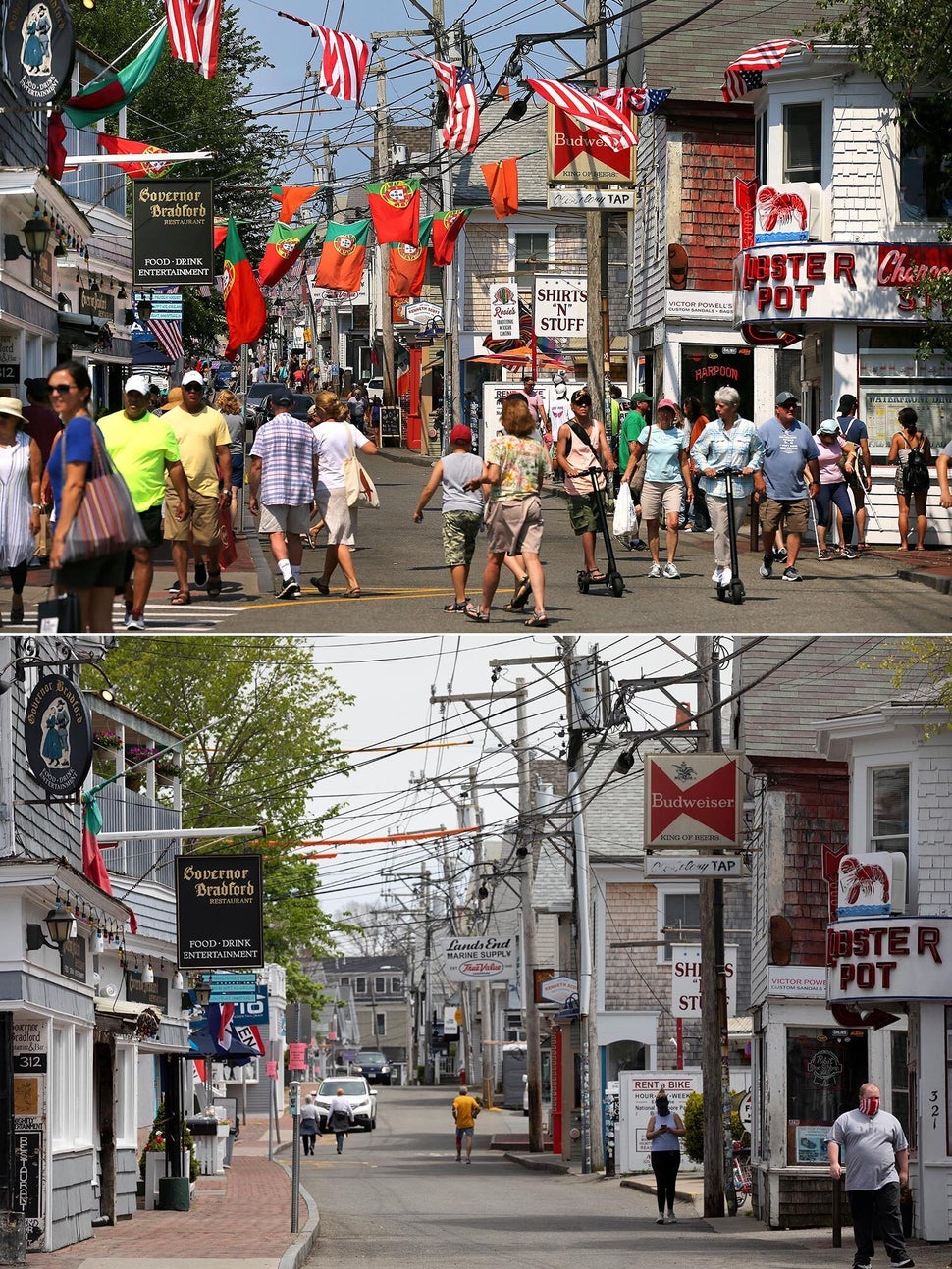
Top image: Crowds fill Commercial Street on July 10, 2019. Bottom image: Closed stores line the usually crowded Commercial Street on May 25, 2020.
Who Polices Wearing Masks?
Some stakeholders in Provincetown, however, are worried about the town’s ability to survive a different threat than a COVID-19 outbreak: an empty summer.Â
“I don’t think anybody in the business community wants to open up the floodgates and invite everybody from the world to come,†said Rick Murray, who owns the Crown & Anchor entertainment complex and the Mussel Beach Health Club. “But we do need to have some semblance of economic activity in order to survive. This is a slow-booming economic tsunami. It’s not just for these eight weeks — this is a two-to-three-year struggle that we’re all going to be in. And I don’t think everybody can see that right now.â€
One of the major drivers of tourism in Provincetown is a series of theme weeks, in which visitors from around the world descend upon the town for events like Bear Week, Girl Splash, Family Week and Carnival. Most of the theme weeks for summer 2020 have been canceled.
“When you take out those big commerce weeks, it’s very different,†Murray said.
The bulk of tourism in Provincetown occurs in July and August, which means that many businesses have a little more than eight weeks to sell enough T-shirts, bowls of clam chowder, jigsaw puzzles and margaritas to pay their gas, insurance, tax, and rent or mortgage bills for the other 10 months of the year. Cities like New York or San Francisco can reopen throughout the fall and winter — but if Provincetown’s economy doesn’t turn profitable in the next two months, it may not have the opportunity again for another year.
The debate about how to balance tourism and safety this summer has crystallized in the discussion about face masks. Currently, Provincetown requires masks to be worn on the busiest section of Commercial Street from 9 a.m. to 9 p.m. Some residents have argued that the order should be extended to require masks at all times and throughout the whole town. Others point out that the 9-to-9 mandatory masking on Commercial Street already goes above and beyond the governor’s order, which only requires masks to be worn when social distancing is not possible. They argue that further expanding regulations is unnecessary and would project an image of Provincetown as an unsafe, inhospitable place, discouraging visits from the very tourists that the economy desperately needs.
Maddie Meyer/Getty Images
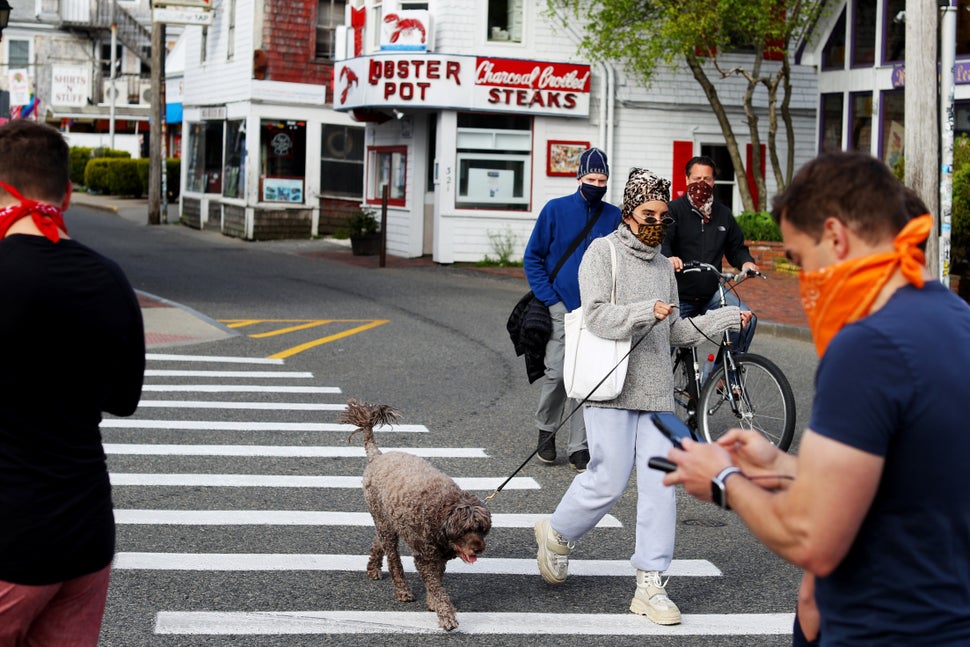
People wearing face masks walk down Commercial Street on May 25.
“Wearing masks all the time is not realistic, or in my opinion, safe,†wrote Michela Murphy, whose family owns the restaurant Sal’s Place, in a letter to the Select Board. She emphasized that she was not “anti-mask†and added that she herself had made and distributed thousands of masks since the pandemic started. But, she wrote, “[h]uman beings are … not meant to wear masks affecting their ability to breathe for most of the hours that they are awake.†Like many business owners, Murphy called for the governor’s order to be clearly explained and advertised in town, but not expanded on.Â
Following on the heels of any discussion of mask policy is the question of how that policy would be enforced. Part of Provincetown’s history as an LGBTQ haven is its protection of free expression. The town is a place where people come to be themselves, and its promise to visitors has long been a respite from shame.Â
For a community of people whose existence was effectively outlawed in some parts of the country as late as 2003 — the year the Supreme Court ruled that anti-sodomy laws were unconstitutional — such an escape is no small thing. Many of the most mundane, and beautiful, sights from a summer day in Provincetown — two women walking with their hands in each other’s back pockets, a drag queen on rollerblades, a throng of men in Daisy Duke shorts who may have had a daiquiri too many with lunch — might draw a stare, a punch or even a summons in another part of the country. In Provincetown, though, “live and let live†practically emanates from the sidewalks ― a commitment, if not explicit then firmly entrenched, to freedom from societal expectations on how a person should dress, look or behave.
Recent town meetings have been peppered with requests for the police to aggressively enforce masks and social distancing, but such a move would be a radical departure from Provincetown’s culture. Not everyone believes it would be a popular or even a practical step.Â
“It’s complicated and I recognize that people are scared,†said Eric Sussman, Provincetown’s emergency management transportation coordinator. “But if the moment comes where bad behavior is exhibited — the kind of bad behavior that requires an enforcement officer — I hope that police officer is available, instead of walking down the street issuing a ticket to a non-mask-wearer.â€
‘There’s No Safety Net’
Lost somewhere between the voices of those calling for caution in Provincetown and those advocating for a faster reopening are those who do not own the businesses but work in them — many of whom survive the winter in seasonal jobs in other parts of the country or on savings accrued during 60- to 80-hour weeks during the summer.Â
Kiki Jackson spends her winters working at a coffee shop in New Orleans and her summers at KoHi Coffee in Provincetown. She arrived back on Cape Cod in April but has not returned to work; her household includes an immunocompromised person, and her job as general manager at KoHi would put her in contact with a large volume of customers. A combination of unemployment benefits and savings will carry her through September, but that marks the end of the season in Provincetown. She doesn’t know what she’ll do next.
Provincetown residents gain and lose roughly 400 jobs every summer as part of the seasonal economy — a 25% fluctuation in the local employment rate. An overwhelming majority of these jobs are in the leisure and hospitality industry, which has been devastated by the pandemic. In April, the sector’s unemployment rate nationwide was almost 40%. And undocumented immigrants, who numbered an estimated 5,000 on the cape in 2016, may be in the direst straits of all. Without access to unemployment benefits, including the additional weekly $600 provided by the pandemic-driven CARES Act, their options for relief have been slim.Â
Michael Dwyer/AP
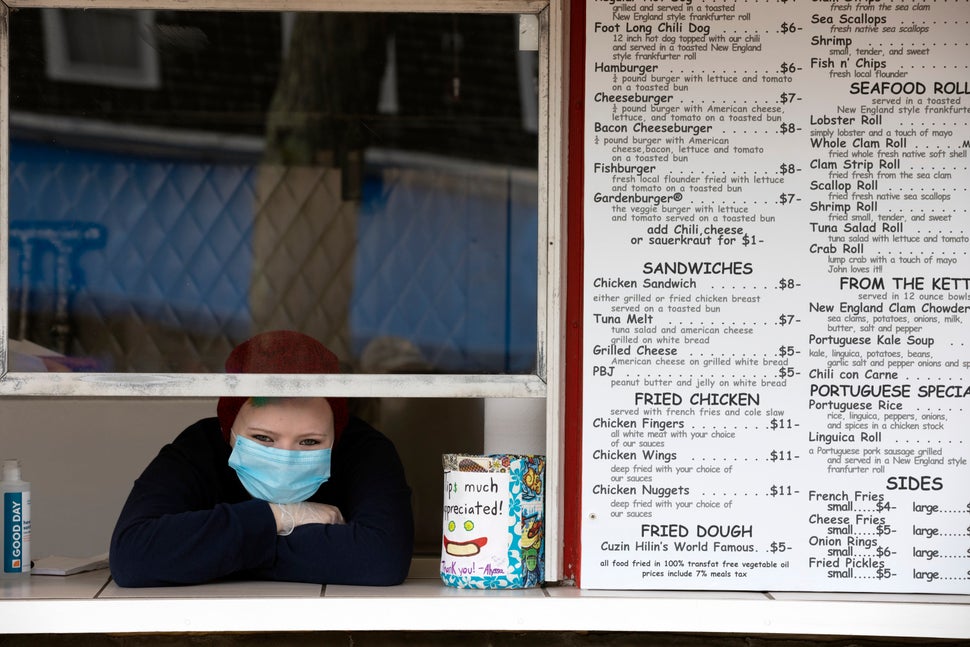
Alyssa Costa waits for customers at a takeout window on May 25 in Provincetown.
The Soup Kitchen in Provincetown usually provides an important bridge to help the community survive the off-season. But even though the organization extended its service this year through May 29 — a full five weeks longer than in a normal year — its doors are now closed until the fall.
One of the modifications that Anderson made to the Canteen’s operations when he was forced to shut down normal service was to turn the restaurant into an ad hoc grocery store that delivers. In addition to providing groceries to paying customers who don’t want to risk visiting the supermarket, he’s also doing two to 10 free grocery orders a day, funded by some $15,000 in donations that he’s collected so far through his website. He said the vast majority of people using the free grocery program were undocumented workers and elderly residents without an income.
“The [business] owners, for the most part, own property. It’ll be hard for everyone, but they have some equity,†said Nadine Licostie, the Seaglass Inn & Spa owner. “But for the workers, there’s no safety net.â€
A Queer Haven
“If you’re lucky in your life,†Paul Lisicky writes in “Later,†his memoir about Provincetown at the height of the AIDS crisis, “a place, or two, will be offered to you. You love this place like a person you can’t stop making love to — you dream about this person when they’re right in front of you. You move through its streets and paths aroused and alert. You can’t get that mischievous smile off your face. You want to put your hands on it, that place, that whole place. You have a secret, and isn’t it lucky that everyone else on the street shares that secret with you?â€Â
When I was a child, my family would drive 14 miles from Wellfleet to spend the day in Provincetown, where my siblings and I would load white paper bags with penny candy at Cabot’s and buy tie-dyed T-shirts at Marine Specialties, the Army-Navy shop on Commercial Street that sells a little bit of everything. Even then, years before I came out, there was something about this place that allowed my shoulders to loosen and my chest to expand, something in the drag queens on bicycles and the handsome women drinking cocktails in the front yards of their B&Bs that made me feel safe.
John Tlumacki/The Boston Globe via Getty Images
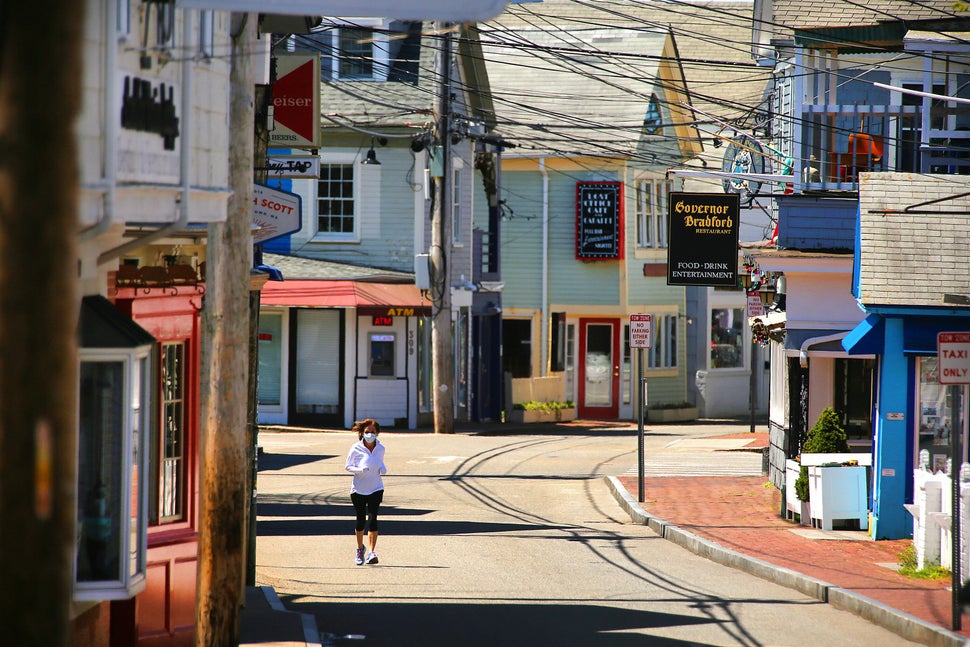
A jogger runs along an empty Commercial Street on May 13.Â
There are vacation destinations across America that will be transformed by COVID-19 and families who, after 20 consecutive visits to a beloved beach town, will stay home this year, their summer radically changed. But there is a particular heartache to the loss of queer space. It was not so long ago that men who were sick made their way to this hamlet from around the country, confident that it was a place that would take them in.Â
My uncle David was one of them. He first came to Provincetown as a recent college graduate in the late 1970s, years before he became HIV-positive. He eventually moved to San Francisco, some 3,000 miles away, but he still managed to come back to town every summer right up through 1992, the year before he died of AIDS. It was a place where he found something. And though I am sure that my something is very different, I return to Provincetown most summers, too.
I struggle to explain why my chest feels more capacious in Provincetown, even as an adult. Maybe it has something to do with the reality that queer space is still geographically rare — one recent study put the total number of gay bars in the country at under 1,000, including just 16 lesbian bars nationwide. Maybe it’s about the fact that even though queer people can now legally marry — and many of them have in Provincetown — a case now sits before the Supreme Court that would give employers carte blanche to fire us when we return from our honeymoons. Or maybe the tug I feel toward this town is something less statistical, more visceral: It’s how totally unremarkable it is to see two women kissing there, how I feel both visible and anonymous when I walk down the street.Â
Lynette Molnar, an event producer who founded Provincetown for Women, had a more straightforward explanation.Â
“I used to live in San Francisco and I was gay-bashed there twice,†she said. “But I can walk down Commercial Street anytime, day or night, hear a man clear his throat, and never even turn around. I have no fear here.â€
“We may not be having any dance parties this summer,†she added. “But we get to see ourselves here and I think that will still be possible.â€
A Resilient And Resourceful Town
“Provincetown is a tough little New England town with smart people in it,†the journalist and part-time resident Mark Harris told me.
Ryan Landry, a writer and performer who has been coming to Provincetown since 1979, echoed this sentiment. He won’t be able to produce any of his long-running shows this summer. But he has always been resourceful, he told me, noting past performances like wrestling in kitty litter and drag queen softball (you had to bring a purse instead of a mitt, he explained). He’s confident that he’ll figure something out, including possibly doing shows outside if it’s safe.
“I’m going to make sure that I have fun this summer and that a lot of people do,†Landry said. “There will be a lot of camaraderie and a lot of goodness. Hopefully, we’ll get back to loving the cape for the cape.â€
The natural beauty of Cape Cod, which has drawn both tourists and artists to the peninsula for more than a century, came up repeatedly when I asked residents what they thought might define Provincetown’s summer this year.
“A part of what I find so special about Provincetown is the bike ride through the trails where I don’t see another human for a few minutes, and the rocks on the beach where if you turn a certain way, you just see water,†said Richard Moore, a second-home owner.
Moore said he hoped those who visited this summer would be able to enjoy a kind of tranquility that’s usually only found in the fall or spring. “Some of the most healing and insightful times that I’ve had in Provincetown have been off-season. To experience Provincetown in the summer in that way is, in a sense, a gift for people who are able.â€
Just how many people will experience Provincetown this summer remains to be seen. June 8 has arrived, and with it, the reopening of dining, lodging and retail businesses, all of which have heavily modified their operations without any certainty about how many customers will be walking in the door.
At the Carpe Diem Guesthouse, owners Stephen Hooper and Paul Graves have designed new systems for room sanitization, contactless check-in and contactless towel service. Josh Patner will offer gloves to visitors at his retail store, Loveland, where he said shopping is normally a “tactile†experience. And over at the Canteen, Rob Anderson and his husband have erected a new wall inside their restaurant so that staff will be able to safely take orders from the updated menu.Â
That is, of course, if there are orders to take.
Calling all HuffPost superfans!
Sign up for membership to become a founding member and help shape HuffPost’s next chapter
Tujhse Hai Raabta stars Sehban Azim and Reem Shaikh in lead roles and their pair has quite the fan-following. Famous by their character names, Malhar Rane and Kalyani, their fans adorably address them as KalMa. Shagun Pandey, who also played a pivotal role in the show has bid adieu to his character Atharva Bapat. He started off his career with reality shows until he got his big break in Badho Bahu and then moved on to Tujhse Hai Raabta.
The actor put out a video on his social media to announce his exit from the show and was grateful for all the love that has been showered on him. He posted the video with the caption, “Reporting ???? from the #tujhsehairaabta set ???? Well crazy 5 years on the same set and in same room #Badhobahu first and then Raabata but now i think ???? its time to say ???????? good bye here . I hope #Atharvabapat entertained you guys . THANK U for all the love thank u each and everyone for making this happen . cheers to #goodtimes …. Stay tuned there’s a lot to come ❤️???????? #Aaishaapat @zeetv. Doston show ki trp kamm nai honi chaiye ????????????????â€
Take a look at it.
The fans are surely going to miss watching Shagun create magic on screen with his versatility.
We use cookies on our website to give you the most relevant experience by remembering your preferences and repeat visits. By clicking “Accept”, you consent to the use of ALL the cookies.
This website uses cookies to improve your experience while you navigate through the website. Out of these, the cookies that are categorized as necessary are stored on your browser as they are essential for the working of basic functionalities of the website. We also use third-party cookies that help us analyze and understand how you use this website. These cookies will be stored in your browser only with your consent. You also have the option to opt-out of these cookies. But opting out of some of these cookies may affect your browsing experience.
Necessary cookies are absolutely essential for the website to function properly. These cookies ensure basic functionalities and security features of the website, anonymously.
Cookie
Duration
Description
cookielawinfo-checbox-analytics
11 months
This cookie is set by GDPR Cookie Consent plugin. The cookie is used to store the user consent for the cookies in the category "Analytics".
cookielawinfo-checbox-functional
11 months
The cookie is set by GDPR cookie consent to record the user consent for the cookies in the category "Functional".
cookielawinfo-checbox-others
11 months
This cookie is set by GDPR Cookie Consent plugin. The cookie is used to store the user consent for the cookies in the category "Other.
cookielawinfo-checkbox-necessary
11 months
This cookie is set by GDPR Cookie Consent plugin. The cookies is used to store the user consent for the cookies in the category "Necessary".
cookielawinfo-checkbox-performance
11 months
This cookie is set by GDPR Cookie Consent plugin. The cookie is used to store the user consent for the cookies in the category "Performance".
viewed_cookie_policy
11 months
The cookie is set by the GDPR Cookie Consent plugin and is used to store whether or not user has consented to the use of cookies. It does not store any personal data.
Functional cookies help to perform certain functionalities like sharing the content of the website on social media platforms, collect feedbacks, and other third-party features.
Performance cookies are used to understand and analyze the key performance indexes of the website which helps in delivering a better user experience for the visitors.
Analytical cookies are used to understand how visitors interact with the website. These cookies help provide information on metrics the number of visitors, bounce rate, traffic source, etc.
Advertisement cookies are used to provide visitors with relevant ads and marketing campaigns. These cookies track visitors across websites and collect information to provide customized ads.