Bands march in local Twelfth parades across NI

0

Image copyright
PAcemaker

Image caption

The public has been urged to celebrate the Twelfth from their own homes this year

Bands have been marching in their own Twelfth of July parades across Northern Ireland.

Large demonstrations have been called off because of Covid-19 and the Orange Order asked people to celebrate the event in their own homes and gardens.

But the Parades Commission was notified of 248 parades from individual bands.

The Order said it did not want people to follow the bands or congregate in groups of more than 30 people due to coronavirus regulations.

Its advice was followed in some areas but clearly ignored in others.

Image caption

A “No surrender to Covid-19” sign was erected in Belfast

In Belfast, a crowd of more than 100 people gathered on the Shankill Road to mark the Twelfth.

People thronged the footpaths and stood outside bars to watch one of the bands which had been playing in the area.

In the south of the city people lined Egmont Gardens, off the Donegall Road, to watch a parade.

The event drew a large crowd and spectators were packed closely together.

Image copyright
Pacemaker

Image caption

The scene at Egmont Gardens off Belfast’s Donegall Road

However, in many other areas in Belfast, people stayed in their homes and watched bands as they passed.

Rev Mervyn Gibson, the grand secretary of the Orange Order, said they had campaigned for people to stay at home.

“The vast majority of people have obeyed that message,” he said.

“The Orange Order normally brings hundreds of thousands of people onto the streets on the Twelfth day and you’re reporting a few hundred around Belfast, which is wrong, I’m not excusing it in any way, it shouldn’t happen.

“But in the perspective of things I think today has been a success with the vast majority of people staying home.”

Image caption

A crowd gathered on the Shankill Road on Monday afternoon

Rev Gibson said if there were crowds of more than 30 people, that should be investigated by the police.

However, Sinn Féin’s Gerry Kelly said social distancing rules were broken at a number of parades.

“Clearly that was a nonsense to say that [social distancing] was going to happen,” he said.

Each year, the Orange Order marks the anniversary of the victory of Protestant William of Orange over Catholic King James II at the Battle of the Boyne in July 1690.

Commemorations are usually held on 12 July but due to the Twelfth falling on a Sunday this year, it is being marked on Monday, 13 July.

On Monday morning, the Orange Order held a religious service and wreath-laying ceremony at the cenotaph in the grounds of Belfast City Hall.

Image copyright
Graham Baalham-Curry

Image caption

The Orange Order held a wreath-laying ceremony at the cenotaph in Belfast

In Armagh, a short wreath-laying ceremony was held at Armagh Orange Lodge on the Mall, in memory of lodge members killed during the Troubles.

BBC News NI’s Mark Simpson: Social distancing started to crumble

It’s been an evolving situation on the Shankill Road today – I first drove up it at 10 o’clock this morning, not a problem, a few people on the streets, you could hear a few bands in local housing estates.

I went back at three o’clock and you could see that social distancing was starting to crumble on parts of the road, mainly outside bars.

By four o’clock a very loud, noisy crowd had developed, you couldn’t get down the road, people either had to turn around and go elsewhere or wait.

A crowd – and this is a conservative estimate – of 100 people, if not more, gathered on the road dancing along with a stationary band.

Any other year it wouldn’t be all that remarkable, but there was virtually no social distancing

But I’ve been all round Belfast today and this is very much the exception to the rule.

In Londonderry, Victor Wray of City of Londonderry Grand Orange Lodge laid a wreath with fellow members in the Fountain estate.

“Its a different type of Twelfth, but one in which we must follow government guidelines and save lives,” he said.

Elsewhere in the county, Twelfth commemorations were brought to the doorstep of local residents in the village of Newbuildings.

Image caption

Families celebrate in their gardens in Newbuildings, County Londonderry

The Pride of Orange and Blue flute band played a number of hymns before parading around the area.

Small groups of people also gathered along the parade route to watch the proceedings.

In County Fermanagh, the Enniskillen Fusiliers Flute Band paraded through the town with small groups of people lining part of the route, while other parts of the town were deserted.

Image caption

In Florencecourt, County Fermanagh, a new arch had been put up this year

A number of Orangemen gathered at the Diamond and applauded those taking part.

Outside the Old Gate Orange Hall in Florencecourt, County Fermanagh, a new arch had been put up this year.

Although unable to march, lodge members gathered outside to display their old banners, including two from the 1930s.

In the Clogher Valley, Orange Order members took to their tractors to parade around local halls.

Around 60 tractors took part and many were decorated with union flags, balloons and orange banners, while others paid tribute to the NHS.

Image caption

Orange Order members paraded in tractors in County Tyrone

“We didn’t want the occasion to pass unmarked so being a rural and agricultural community, what better way to mark it than with a tractor run?” said Ian McClung, district secretary of Fivemiletown District.

“Rather than people coming together in one place for the Twelfth, we brought the Twelfth to the people.

Image copyright
PAcemaker

Image caption

People gathered in their front gardens this year to hear the bands

“We asked people to decorate their tractors appropriately. We have the normal decorations that you see around the Twelfth, but also a number of flags and banners in support of the NHS.

“We are very conscious of the role the NHS and health workers have played in the current crisis and we have many members associated with that ourselves, so we want to just say thank you to them.”

Image copyright
PAcemaker

Image caption

Twelfth of July celebrations took place in Portadown with six local bands parading through streets.

‘If you hear a band, don’t follow it’

Ahead of the Twelfth, the Orange Order repeatedly called on people to celebrate at home this year.

Health Minister Robin Swann said the message had been clear: “Let’s celebrate the Twelfth, it’ll be a different Twelfth this year, stay at home as much as we can.”

Image caption

A drive-in service was held in Ballymena on Sunday

Mr Swann, who attended a drive-in divine Twelfth service organised by the Ballymena District on Sunday, urged people to follow the regulations set by the Northern Ireland Executive.

Drive-in services were held across Northern Ireland, allowing people to mark the occasion in a socially-distanced manner.

Image copyright
Graham Baalham-Curry

Image caption

Grand Master of the Grand Orange Lodge of Ireland Edward Stevenson is encouraging people to enjoy the celebrations at home

Coronavirus restrictions

The latest Covid-19 guidance from the Northern Ireland Executive allows for up to 30 people to meet outdoors while social distancing, so many smaller parades were given the go-ahead.

The Parades Commission said it considered it necessary to impose restrictions on three parades based upon “pre-existing parading tensions in those specific locations”.

It added there had been a “high level of positive engagement with the vast majority of organisers”.
Source link

Hong Kong to Probe Democratic Camp Primaries For Subversion

0

Hong Kong chief executive Carrie Lam on Monday said the authorities are investigating whether or not the weekend’s primaries, which saw more than 600,000 people show up to select pro-democracy candidates in September’s Legislative Council (LegCo) elections, were in breach of a draconian security law recently imposed on the city by the ruling Chinese Communist Party.

“If this so-called primary election’s purpose is to achieve the ultimate goal … of objecting to and resisting every policy initiative of the Hong Kong … government, then it may fall into the category of subverting state power, which is now one of the four types of offenses under the new national security law,” Lam said.

Hong Kong’s Constitutional and Mainland Affairs Bureau (CMAB) said in a statement that the government had received complaints that the primaries “may have allegedly interfered with and manipulated” the elections and jeopardized the integrity of the electoral process.

Article 22 of China’s National Security Law for Hong Kong bans anyone from “seriously interfering in, disrupting or undermining the performance of duties and functions in accordance with the law by the body of central power of the People’s Republic of China or the body of power of the Hong Kong Special Administrative Region by force or threat of force or other unlawful means.”

“The government is now conducting an in-depth investigation and will seek legal advice if necessary,” a CMAB spokesman said in a statement on Monday.

“In case of any violation of the relevant laws and regulations, the Government will immediately refer the case to relevant law enforcement agencies for investigation and apprehension in accordance with the law,” it said.

“If anyone is found to have committed acts of deceit or violated any law during the electoral process, the government will handle the case in a serious manner and there shall be no tolerance,” the statement said, adding that the government doesn’t recognize the “so-called primaries” as an approved part of the democratic process.

Some complaints also claimed that the people standing in line to vote had breached a current ban on large public gatherings.

Pressure from Beijing

The Communist Party-backed Ta Kung Pao newspaper chimed in with an editorial on Monday, likely indicating that the pressure to pursue the organizers of the primaries is coming straight from Beijing.

“The … primary election violated Articles 22 and 29 of the national security law’s provisions on subversion of state power, obstructing government departments and manipulating elections,” the paper said.

Organizers said 610,000 people turned out in Hong Kong over the weekend to vote in the primaries, despite warning notes struck by officials, a raid targeting the poll organizer’s office, and a new spike in coronavirus cases.

People lined up between socially distanced markers over both days at 250 polling stations in diverse locations across the city to cast their votes, which will help pro-democracy parties coordinate their election strategy in a bid to win a majority in the city’s Legislative Council (LegCo).

The high turnout came despite warnings from government officials that the primaries could be in breach of a draconian security law imposed by the ruling Chinese Communist Party on Hong Kong on June 30, bypassing LegCo and undermining the city’s promised freedoms of speech and association.

A police raid on the offices of the Hong Kong Public Opinion Research Institute (PORI), the polling organization tasked with running the election, appeared to have done little to frighten people off.

Chung Kim-wah, assistant professor of social policy at Hong Kong’s Polytechnic University who works with PORI, said the more traditional parties in the pro-democracy camp could lose out to more radical activists in the primaries.

Under a single system

Benson Wong, a political cultural scientist at the Hong Kong Baptist University, said the imposition of the national security law by China had collapsed any distinction between Hong Kong and mainland China in many people’s minds.

“Hongkongers feel that we are now under a single system under the national security law,” Wong said. “So they may think why not vote for someone a bit more radical both in terms of their speech and action to take on the government in LegCo?”

Wong said even the mainstream opposition parties were sounding more radical in the wake of the national security law.

“There are also some regarded as non-traditional pro-democracy parties, and they may resonate more with voters,” he said.

Ma Yue, an associate professor in the department of politics at CUHK, said there will be scant use for traditional parliamentarians in the next LegCo, as the president and security guards have already begun physically removing pro-democracy members who filibuster, protest, or otherwise object to government legislation.

“I think many people think there won’t be much room for debate or deliberation in the next session of LegCo,” Ma said. “So it doesn’t really matter so much … if they vote for [newcomers].”

“I think most people are just happy to find people who are willing to sit in LegCo.”

Taiwan Citizen’s Front founder Jiang Min-yan said the huge turnout for the primaries had sent a strong message to the authorities in a city where constant police violence and thousands of arrests have dampened street protests and where permission for mass rallies and demonstrations is often refused.

“There was so much resistance in the primaries … even if street protests are proving unsustainable,” Jiang said. “This democratic primary was actually a vote of no-confidence in the national security law.”

He said the law has already created a chilling effect in Hong Kong.

Reported by Man Hoi-tsan for RFA’s Cantonese Service, and by Hwang Chun-mei for the Mandarin Service. Translated and edited by Luisetta Mudie.


Source link

First e-scooters trial launched in town

0

Middlesbrough has become the first place in the country to trial e-scooters in a bid to ease pressure on public transport amid the coronavirus crisis.

Fifty rentable electric scooters are available from around the town and can be hired by anyone over the age of 18 with a full or provisional driving licence.

The vehicles, which are banned on pavements, are limited to 11.5mph and cost £2 to hire for 20 minutes.

The pilot, which will run for a year, will be rolled out across all five boroughs of the Tees Valley later this month.

Source link

Trump Suggests A Biden Presidency Would Be ‘Ratings’ Nightmare

0

President Donald Trump warned his social media followers that a Joe Biden presidency could mean “no ratings,” and asked: “Is this what you want for your President???”

Trump, in a familiar Monday morning Twitter tear, quote-tweeted a video of Biden shared by White House social media aide Dan Scavino. If Biden wins in November, Trump added, “media will go down along with our great USA!”

The Trump administration’s unending drama of crises, scandals, leaks and attacks on Democratic institutions over the last three and a half years have driven a surge in news audiences, almost certainly ensuring that the next president’s TV ratings will decrease.

Trump dominates the news with now-familiar storylines: his weak grasp on the coronavirus pandemic, which has led to records in daily infections; his disregard for his own government’s social distancing guidelines with a rally in Tulsa, Oklahoma, that was “likely” responsible for a surge in coronavirus cases; his failure to respond to intelligence reports that Russia offered bounties to the Taliban for killing U.S. troops. 

Trump also has won a central place in coverage of the protests sparked by the police killing of George Floyd, which prompted a movement against racial inequality and police brutality. The president responded by condemning protesters, trying to shift the conversation to Confederate statues and rushing to Mount Rushmore for Fourth of July fireworks ― ignoring concerns about the coronavirus (and the protests of Native Americans who live in the area). 

Books written by people close to Trump ― or who used to be close to him ― also feed the news media machinery. Mary Trump, his niece, alleges that Trump cheated his way into college and threatened to disown his son Donald Trump Jr. if he joined the military (among other things) in her memoir set to be published on Tuesday. Former national security adviser John Bolton’s book is rife with corruption claims, including the allegation that the president sought help from China to win reelection. 

As for whether his prowess as a newsmaker translates to popularity with the public, the latest Gallup poll puts Trump’s approval rating at 38%. A poll by ABC News/Ipsos released last week shows that a record 67% now disapprove of “the way Donald Trump is handling the response to the coronavirus,” while only 33% approve, Politico reported. This is “the widest gulf in public sentiment since ABC News and Ipsos started surveying on the pandemic in March,” the outlet wrote.


Source link

COVID-19 cases soar in US, grow in India, South Africa and Brazil

The United States was grappling with the worst coronavirus outbreak in the world on Monday, as Florida shattered the national record for a state’s largest single-day increase in new confirmed cases.

Meanwhile, two World Health Organization experts went to China for a mission to trace the origin of the pandemic. The virus was first detected in central China’s city of Wuhan late last year. Beijing had been reluctant to allow a probe but relented after dozens of countries called on the WHO to conduct a thorough investigation.

Deaths from the virus have been rising in the US, especially in the South and West, though they are still well below the numbers reached in April, according to a recent Associated Press analysis of data from Johns Hopkins University.

A man wearing a mask outside a restaurant in Beijing [Ng Han Guan/AP Photo/] 

“I really do think we could control this, and it’s the human element that is so critical. It should be an effort of our country. We should be pulling together when we’re in a crisis, and we’re definitely not doing it,” said University of Florida epidemiologist Dr Cindy Prins.

Admiral Brett Giroir, a member of the White House coronavirus task force, called mask-wearing in public, which has been met with resistance in some US states, “absolutely essential”.

Giroir, the assistant secretary at the Health and Human Services Department, told ABC’s This Week on Sunday that “if we don’t have that, we will not get control of the virus”.

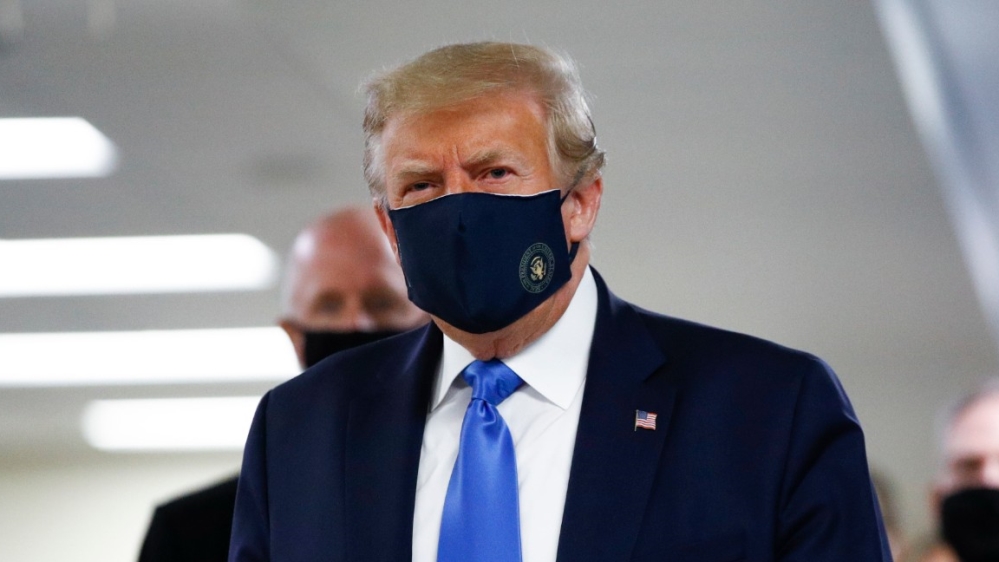
President Donald Trump wore a mask in public for the first time on Saturday, something Democratic House Speaker Nancy Pelosi said on Sunday showed he has “crossed a bridge”.

Trump

US President Donald Trump who had long resisted wearing face coverings donned a mask during his visit to Walter Reed National Military Medical Center in Bethesda, Maryland [AP Photo/Patrick Semansky]

Pelosi told CNN’s State of the Union that she hopes it means the president “will change his attitude, which will be helpful in stopping the spread of the coronavirus”.

In Florida, where parts of Walt Disney World reopened on Saturday, 15,299 people tested positive, for a total of 269,811 cases, and 45 deaths were recorded, according to state Department of Health statistics reported on Sunday.

California had the previous record of daily positive cases – 11,694 – set on Wednesday.

The numbers come at the end of a record-breaking week as Florida reported 514 fatalities – an average of 73 per day. Three weeks ago, the state was averaging 30 deaths per day.

Researchers expect deaths to rise in the US for at least some weeks, but some think the count probably will not go up as dramatically as it did in the spring because of several factors, including increased testing.

Regarding the WHO experts in China, the country’s Foreign Ministry spokeswoman, Hua Chunying, said they would work with Chinese scientists and medical experts on “scientific cooperation on the new coronavirus tracing issue”.

China has argued that the virus might have originated outside of China and has angrily denied allegations that it covered up the scale of the outbreak as infections first began to spread.

World Health Organization (WHO) Chief Scientist Soumya Swaminathan attends a news conference in Geneva

World Health Organization (WHO) Chief Scientist Soumya Swaminathan attending a press conference organised by the Geneva Association of United Nations Correspondents (ACANU). The WHO is working with China to trace the origin of the pandemic [Fabrice Coffrini/Pool via Reuters]

Trump has harshly criticised the WHO over its response to the coronavirus pandemic and accused it of bowing to Chinese influence. The Trump administration formally notified the UN last week of its withdrawal from the WHO, although the pullout will not take effect until July 6, 2021.

“We have a basic consensus with the WHO that virus tracing is a scientific issue, and that requires international scientific research and cooperation of scientists across the world,” ministry spokesperson Hua said at a daily briefing. “WHO also believes that the virus tracing is an issue in progress, which may involve multiple countries and regions, and WHO will also conduct similar inspections in other countries and regions as needed.”

The WHO has confirmed the visit by an epidemiologist and an animal diseases specialist but has not given out information on their agendas while in China. The virus causing the deadly illness COVID-19 is believed to have originated in bats and then jumped to humans via an intermediary species, possibly the anteater-like pangolin that is prized in China for its scales used in Chinese medicine as well as its meat.

In Japan, more than 30 marines tested positive at the Futenma US air station on Okinawa, where infections among American service members have rapidly risen to more than 90 since last week. Okinawa is home to more than half of about 50,000 American troops based in Japan.

Confirmed cases also have been found at three other Okinawa bases: 22 at Camp Hansen, one at Camp Kinser and another one at Camp McTureous. Officials said the movements of people at Futenma and Camp Hansen have since been restricted and large-scale virus testing is being conducted.

In other parts of the world, the number of infections has been rising dramatically in India, South Africa and Brazil, whose virus-denying president has tested positive.

India, which has the most confirmed virus cases after the United States and Brazil, on Monday reported a record daily surge of 28,701 new cases. Authorities in several cities are reinstating strict lockdowns after attempting to loosen things up to revive an ailing economy.

Coronavirus - South Africa

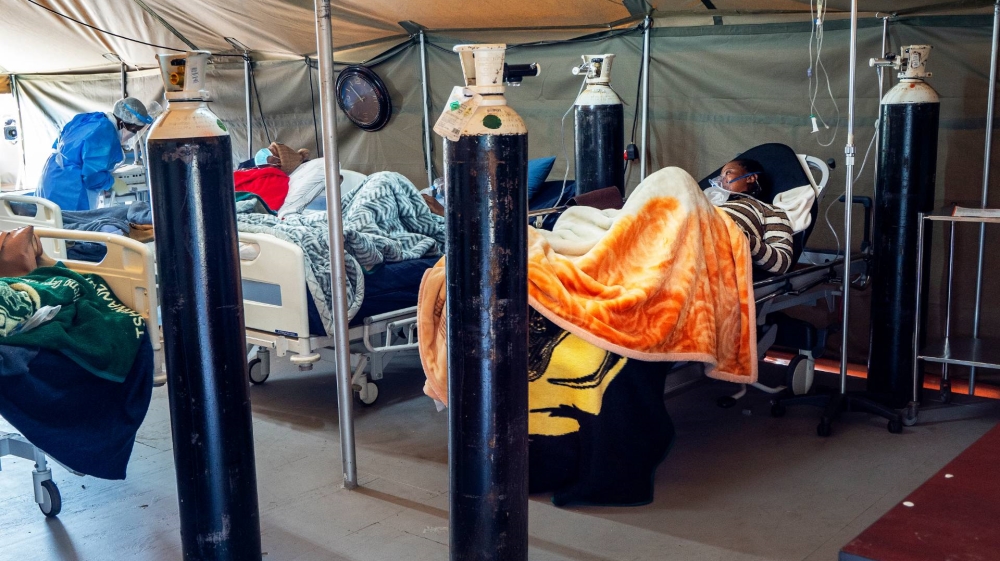
COVID-19 patients being treated with oxygen at the Tshwane District Hospital in Pretoria, South Africa [Jerome Delay/AP Photo]

In South Africa, which accounts for more than 40 percent of all the reported coronavirus cases in Africa, President Cyril Ramaphosa said on Sunday that the country would reimpose a ban on alcohol sales to reduce the volume of people needing emergency treatment so hospitals have more beds to treat COVID-19 patients.

South Africa is also reinstating a nighttime curfew to reduce traffic accidents and has made it mandatory for all residents to wear face masks in public.

“We are taking these measures fully aware that they impose unwelcome restrictions on people’s lives. They are, however, necessary to see us through the peak of the disease,” Ramaphosa said in a letter to the nation on Monday.

“There is no way that we can avoid the coronavirus storm. But we can limit the damage that it can cause to our lives.”

In France, the government was considering requiring the use of masks in all indoor public spaces amid a small rise in virus infections and a big drop in public vigilance. Greece was seeking a ban on church and village fairs and tighter tourism-related checks following a recent increase in confirmed coronavirus cases.

Source link

What Quarantine Is Doing to Your Body’s Wondrous World of Bacteria

0

We may feel isolated now, in our homes, or apart in parks, or behind plexiglass shields in stores. But we are never alone. I’ve spent much of the last 20 years studying the many species with which we live: thousands of them, perhaps hundreds of thousands, including fungi, bacteria on our skin and in our guts, and animals ranging from the several species of Demodex mites that live in our pores to the spiders that ride with us from home to home.

In ordinary times, no person is an island. We are connected to other people through touch and words but also through the exchange of species, most benign, some even beneficial—on our bodies, in our homes, and more generally in our daily lives. These species may be bacteria, fungi, protists, and even small animals. You kiss a loved one and transfer life from your lips to their cheek, a shimmer of species.

But now we are aware that the kiss can be dangerous or even deadly. As we isolate ourselves in order to reduce the connections in the web, what happens to the whole society of viruses, bacteria, and mites that exists on and between us? What happens when each person, or at least each home, becomes an island?

This is something ecologists and evolutionary biologists have studied for several hundred years now. On islands, with enough time, some species become more common, some go extinct, and some evolve. Charles Darwin famously gained insights into the workings of evolution by considering the differences among species of birds isolated on different islands of the Galapagos archipelago. With collaborators, I have looked at similar issues in face mites and bacteria in armpits.

First, there are species that become rarer. We know from thousands of studies of fragments of forest that, as forests are cut into smaller and smaller pieces, species go extinct. For species that live on bodies, it seems likely that the fewer people who live in your home, the more likely it is for any particular body-loving species to go extinct. If it goes extinct on you, it has fewer places from which to recolonize. In normal times, species pass from one person to another, one being to another, when we touch. Roller derby players who bump into each other exchange skin bacteria. The more you bump, the more you share. But in our isolation, we bump and share with fewer people and so colonization is less likely and extinction more permanent. Indeed, this is what we hope happens with the virus that causes COVID-19: that by disconnecting from one another, we give it no island close enough to land upon.

In forest fragments, losses occur in a predictable order: Predators go extinct first, when there are too few prey. Indoors, leopard mites that eat dust mites that eat our skin as it falls from us everywhere we go are almost certainly more likely to go extinct before the dust mites themselves. So too skin or gut microbes that depend on other skin or gut microbes, the wolves of our bodily Yellowstone.

Species evolve more rapidly, as we know from studies of islands, if they have large populations and multiply rapidly. And if these populations become isolated and face different conditions, they tend to diverge. By studying the microbiome, we can see evidence of previous separations among humans. Lice species diverged genetically among populations of Paleolithic humans as they spread around the world. Similarly, I’ve collaborated with my friend and colleague Michelle Trautwein to study divergences among face mites. Of the two most common species of face mites, Demodex brevis nestles deeply in pores, while Demodex folliculorum lives more shallowly. We think that the deep dweller is less able to move among humans, spending so much of its time in its cave. As a result, it is more likely to diverge among human populations during times of separation.

That would take years or even generations in quarantine. But before that, we would expect the bacteria that live inside the mites to diverge on the island of each person. Each mite hosts a large population of rapidly multiplying bacteria in its gut microbiome. And the viruses—even more numerous and rapidly multiplying—that attack the bacteria that live inside the mites that live on your face would diverge even faster still.

We are not only “gardening” our microbes by subtracting from their web, absentmindedly weeding; we are also giving them additional new foods with our new quarantine regimes and hobbies, and lack thereof.

Consider, for a moment, your armpits: They have a special organ called an axillary organ, containing apocrine glands, whose sole function is to feed bacteria. These bacteria produce aromas that wick along the armpit hair (which are different from other body hair and appear to serve no function other than such “wicking”). While we don’t yet understand why the axillary organs evolved (chimpanzees and gorillas also have them), they clearly show a social relationship between primates and bacteria that is somehow about sending messages via smell to other primates.

When you wear antiperspirant, you alter the messages that your armpits send. Specifically, as a study my colleagues and I did several years ago shows, you favor fast growing, weedy Staphylococcus bacteria in your armpit that are not very stinky. Conversely, if you don’t wear antiperspirant, you favor a slow-growing, stinky, old-growth microbial community, like those found in chimpanzee and gorilla armpits—something like the redwoods of the armpit. These two communities, the weeds and the redwoods, send different messages to other people.

What those messages mean and how they are interpreted, we don’t know. We are at the step in the science in which we have discovered a language, but not decoded it. But if you are alone in your apartment and not putting on antiperspirant or deodorant, you are gardening an ancient wilderness of species similar to those found in the armpits of chimpanzees and gorillas. These species aren’t harmful and may even be beneficial, so go ahead and let them blossom.

Then there’s the relationship you may be forming with sourdough bread, which is a great deal more complex and reciprocal than it seems. Several years ago, my colleague Anne Madden and I did an experiment on sourdough starters, the microbial communities composed of bacteria and fungi that are used to leaven bread. Though all leavened breads were once produced using starters, they have a mysterious element: Where did the microbes in them come from? One possibility was that the microbes came from the bodies of the bakers themselves, as is the case with many fermented foods, like beer yeast, which comes from the bodies of wasps.

To test this hypothesis, we had bakers from around the world use the same ingredients to make a sourdough starter. We held all the ingredients constant, except for the hands of the bakers and the air in their bakeries. As it turned out, the individual bakers and/or their bakeries did have a modest effect on the microbes in their starters and thus on the flavors of the resulting bread. In other words, you can taste the baker in the bread.

But we were surprised to find that the story was more complicated than that. We swabbed the hands of the bakers (after they went about their ordinary morning ablutions) to learn what they might be contributing to the bread. Their hands were unlike those of any people yet studied. Lactic acid bacteria are key to the flavor of sourdough starters, making them acidic. In most studies, the proportion of lactic acid bacteria on peoples’ hands is small, around 3 to 6 percent. On the bakers’ hands, though, up to 70 percent of the bacteria were lactic acid bacteria. The baker’s hands also had much more yeast than the hands of other folks. In short, the bakers’ hands looked like sourdough starters. Their daily immersion in bread had changed their microbes. Sure, you could taste the baker in the bread, but the bread had also remade the baker.

The curious reciprocity between the microbial world of our foods and the microbial world of bodies also shows up in yogurt, whose bacteria are originally from human mouths and the guts of mammals. In commercial sourdough bread, the most commonly used bacteria appears to have come from the gut of a rat. Many fermented drinks around the world, such as chicha in the Amazon, rely on human body microbes for fermentation. As with sourdough, these fermentations influence our bodies, changing our microbiomes, affecting what we can digest and how we smell. We forget that we, too, are gardens.

Actual outdoor gardens also have the potential to change the species on our skin. We know from studies in Finland that children whose outdoor environments include a greater variety of plants tend to have more kinds and different kinds of bacteria on their skin, including bacteria that help to keep them healthy. Exposing yourself to the wild microbes of the garden and forest can have a big impact on your body’s wildlife, though we don’t know how much exposure it takes to make a difference. One sample of the skin of a child who grew up in the Amazon rainforest, living a hunter-gatherer lifestyle, found more kinds of skin microbes on the forearm of that child than the total number we observed in a study we did of the belly button microbes of hundreds of Americans. How much would you need to garden to achieve such an effect? I suppose the answer is a lot.

Another big player in your microbial life is your dog, with whom you may be spending more time. Whether or not you have a dog is the single biggest predictor of which bacteria are floating through the air in your house. Children who live with dogs tend to acquire some dog gut microbes. Whether the same occurs with adults is less clear. I don’t advise intentionally acquiring dog microbes. But we know that kids, especially in cities, that grow up with a dog in the house are less likely to develop some allergies and asthma. Something about a dog in the house, microbially, can be good.

As for cats, the jury is still out. One microbe, called Toxoplasma gondii, associated with cat feces, can get into human brains and lead to changes in human behavior. In the garden of your daily life, it is definitely a bad weed.

I look forward to the day in which we can reconnect and share, anew, communities of microorganisms with others. In the meantime, I’m ever more aware of the thousands of species on my own body, in my own house and yard— virtually none of which have been studied, and many of which, though we spend so very much time with them, do not even yet have names.

Rob Dunn is a professor in the department of applied ecology at North Carolina State University. He is the author of six books, including, most recently, Never Home Alone.


Source link

With Robot Deliveries and Outdoor Tents, Campus Dining Will Be Very Different

0

By Becky Vuksta’s calculations, the new socially distanced dining-hall setup at Furman University in Greenville, S.C., will serve 12 students a minute, or 720 students per hour. Not bad, but still not fast enough to feed the school’s 2,700 students in the rush between classes.

So Ms. Vuksta, Furman’s director of auxiliary services, has added two grab-and-go meal stations (one that can accommodate 60 students per hour and another that can handle 180). She also plans a pop-up restaurant outside the main library that will serve street food from around the world, for students and especially staff and faculty, who as a safety precaution will not be allowed to visit the main dining hall.

The number of students that can be served per minute is not a normal concern for college and university dining administrators, who in recent years have tried to distinguish themselves on the quality and variety of their food, and the sense of community that it can bring to a campus. Over the last decade, the food served in college cafeterias has transformed from the butt of jokes into a major perk; the dining hall is often the first stop on campus tours.

Because of the coronavirus, however, nothing about this year is going to be normal. At campuses across the country, self-serve stations, where students can make their own salads or taco bowls, will be eliminated; instead, masked-and-gloved workers, shielded by plexiglass barriers, will serve nearly everything. Gone, too, will be condiment and coffee stations, replaced by single-serving ketchup and salad-dressing packets and paper cups that many schools were triumphantly phasing out in an effort to reduce waste. Several universities are even using robots prepare food and deliver it.

At Furman, where students will return to campus for the fall semester on Aug. 18, Ms. Vuksta plans to offer insulated, reusable grocery bags so students can carry out multiple to-go meals, and is considering adding picnic tables for outdoor eating.

But the only thing that is sure is that plans will change. “You’re trying to read a crystal ball and the fact is no one knows how this is going to pan out,” she said. “It can be stressful.”

At the University of Massachusetts Amherst, Garett DiStefano, the director of dining services, is bracing for what is surely the strangest-ever back-to-school. On June 29, the university announced that nearly all classes will be held virtually, though students may return to live on campus if they choose.

For those who return, dining halls and food courts will continue to offer dishes for students on special diets. But customization is expected to be a victim of the coronavirus. Salad bars will have fewer choices to keep the lines moving. At the make-your-own ramen station, bowls will be premade.

Mr. DiStefano emphasized that while the biggest changes will be seen in traditional dining halls, they are only one part of the college food experience. For example, the university operates two food trucks and a mobile kitchen, from which it serves favorites like burgers and grilled cheese. He plans to expand those menus and create additional options, like a falafel bar, served under a tent outdoors.

“There are things we can do that are quick and fun and still create an experience, but in a different, safe way,” he said.

Things will be different in the kitchen, too. Masks and gloves will be mandatory everywhere, and many schools, including Rice University in Houston, are mandating temperature checks for workers and reducing the number of staff members in the kitchen.

At Rice, those numbers have been cut in half to allow for social distancing. Sodexo, the food service giant that operates at some 600 campuses in the United States, has created a training module called the Six Foot Kitchen, which provides guidance on how to create safe kitchen environments — everything from tape marks on the floor to mark safe distances, to protocols for accepting deliveries and managing storage.

Sodexo is also turning to technology for help. At two of the universities it works with, the company has robots ready to deliver food to students outside dining halls and food courts.

George Mason University, in Fairfax, Va., is one of those schools. When its 36,000 students head back to school on Aug. 24, Sodexo will have 43 robots — essentially high-tech coolers on wheels — ready to deliver meals and snacks from Starbucks, Dunkin’ and other brands. Students order via an app, food workers load the order into the robot, then the robot drives itself to the appointed location, whether that’s a dorm or a bench near the library.

Last fall, Sodexo filled more than 25,000 orders this way at George Mason. Jeff McKinley, a Sodexo district manager who works with the school, expects that number to grow as the robots eliminate the need for students to enter a busy food court. “Robots are definitely part of our safe reopening plan,” he said.

Bon Appétit Management Company, a food service firm operating at more than 100 campuses, including Furman, Reed College in Portland, Ore., the University of Chicago and M.I.T., is also using robots, but in the kitchen.

Before the pandemic, Bon Appétit had installed robots on campuses across the country, including Blendid robots to make custom smoothies; “Sally,” a robot that whips up made-to-order salads; and a so-called pizza A.T.M., which can serve up a hot pie in three minutes. But what was seen as fun and futuristic, a spokeswoman for the company said, is now being looked at as a way to reduce pressure on employees who will be busier than ever with additional serving duties and constant cleaning.

Maisie Ganzler, Bon Appétit’s chief strategy and brand officer, has been overseeing these transitions since campuses shut down in March. Her first task was to become an expert in various types of personal protective equipment, and where to obtain them. She has spent the last few months investigating new types of equipment, such as no-touch coffee urns, and all manner of sustainable packaging.

Ms. Ganzler said the physical and safety changes are the easier parts of the shift. “There’s nothing magical about putting food into a portioned cup. What we can’t lose sight of is the fundamental thing that food delivers on college campuses,” she said. “It’s part of ‘adulting,’ where kids learn to make their own food choices or express their identity through food. How we achieve all that within the restrictions is a more interesting question than whether you will have prewrapped silverware.”

To that end, Bon Appétit dining managers are continuing to emphasize hospitality — signs at service stations read “Allow us to serve you,” rather than an alternative such as “No mask. No Service” — and offering online programming. Butler University in Indianapolis has devised food trivia contests, and at Washington University in St. Louis, a chef has offered virtual cooking demos for dishes like mushroom risotto.

Ethan Hodge, a 21-year-old Asian studies major at Furman, has already seen several iterations of what college food might look like in the age of the coronavirus. Unlike most students, Mr. Hodge did not leave campus this spring because his family is homeless and his college apartment was the safest place for him to be.

For the first few weeks, he and the roughly 80 other students remaining picked up prepared meals at the dining hall. As numbers dwindled, the kitchen began delivering reheatable meals and meal kits, complete with detailed instructions. By June, dining services had switched it up again, allowing Mr. Hodge and other students to order groceries from an online list so they could cook themselves.

“It was by far the best decision they could have made to keep us safe and keep us healthy,” Mr. Hodge said. “A busy dining hall is something the Furman community is going to miss. It’s what makes us able to meet people from other places and learn about them. It’s the whole liberal arts experience.

“I know dining services is going to do what’s best,” he added. “It’s the students being safe that I’m worried about.”


Source link

Driver Purposely Drove Bus Into China Reservoir, Killing 21, Police Say

0

A bus crash in southwest China last week that killed 21 people and injured 15 others was caused by the driver, who deliberately steered into a reservoir because he was angry at the demolition of his home, the police have said.

The crash on Tuesday, which also killed the driver, drew an outpouring of grief; some of the passengers included students traveling to take China’s notoriously difficult college entrance exam.

The police in Anshun, a city in Guizhou Province, said in a statement on Sunday that the 52-year-old driver, identified only by his last name, Zhang, had been aggrieved over the demolition of his home that morning. The driver crashed the passenger bus, the police said, to send a message.

“Due to his dissatisfaction with his life’s circumstances and the demolition of rented public housing and in order to cause a stir, he has committed extreme crimes that endanger public safety,” the police report said.

The authorities said the driver had rented a 430-square-foot unit in a state-owned public housing structure included in a redevelopment scheme. He signed an agreement in June to receive $10,000 in compensation, but did not claim the sum. His applications for public housing were rejected, but plans for the demolition of the building went forward.

The case shines a light on the often-silent victims displaced by China’s urban redevelopment schemes, in which state-sponsored developers tear down older, shabbier buildings in dilapidated neighborhoods to build gleaming office towers, shopping malls and expensive housing.

On Tuesday morning, the bus driver called a government hotline to complain that his home was about to be demolished before he could receive government housing, the police report said.

He then traded shifts with a colleague and bought some baijiu, a colorless alcoholic drink, that he took to work in a water bottle. He left some voice messages for his girlfriend on WeChat, expressing weariness and disgust with the world, and sipped from the bottle before starting his shift, the police report said.

Security video showed the bus cutting across three lanes of oncoming traffic around midday Tuesday as it traveled along Hongshan Lake in Anshun. It then plunged down a series of low terraces and into the lake, becoming submerged by more than 30 feet of water.

Some passengers were students preparing to take the gaokao, the national college placement test, reported The Paper, a state-run online publication based in Shanghai. At least five of those killed were students, officials said.

The gaokao, which began on Tuesday, was delayed for a month because of the coronavirus pandemic. More than 10 million students are participating this year.

Caixin, a Chinese-language magazine, published an article on Friday about the demolition of the bus driver’s home and his efforts to stop it. The story, which drew sympathy for the working-class residents displaced by urban redevelopment projects in China, was later taken offline.

The government authorities in Anshun said in a statement on Sunday that they would investigate the demolition, and any mistakes made in the process.

Austin Ramzy contributed reporting.

Source link

Coronavirus: no return to normal ‘for the foreseeable future’, says WHO – video

Tedros Adhanom Ghebreyesus, the director general of the World Health Organization, has criticised the leaders of countries where ‘mixed messages’ have led to a breakdown in trust over measures to limit the spread of Covid-19.  Tedros said there would be no return to the old normal ‘for the foreseeable future’, adding: ‘there are no short cuts out of this pandemic’.

Source link

Coronavirus crisis may get ‘worse and worse and worse’, WHO warns

0

Tedros, whose leadership has been heavily criticised by US President Donald Trump, said that of 230,000 new cases on Sunday, 80 per cent were from 10 nations, and 50 per cent from just two countries. The US and Brazil are the countries worst hit.

“There will be no return to the old normal for the foreseeable future … There is a lot to be concerned about,” Tedros added, in some of his strongest comments of recent weeks.

Parts of the world, especially the US with more than 3.3 million confirmed cases, are still seeing huge increases in a first wave of COVID-19 infections, while others “flatten the curve” and ease lockdowns.

Some places, such as Leicester in England, are implementing a second round of shutdowns. Chinese-ruled Hong Kong, albeit with a low 1522 cases, is to tighten social distancing measures again amid growing worries about a third wave.

The US reported a daily global record of 69,070 new infections on July 10. In Brazil, 1.86 million people have tested positive, including President Jair Bolsonaro, and more than 72,000 people have died.

The US state of Florida reported a record increase of more than 15,000 new cases in 24 hours on Sunday, more than South Korea’s total since the disease was first identified at the end of last year. Florida tallied 12,624 new cases on Monday.

Coronavirus infections were rising in about 40 US states, according to a Reuters analysis of cases for the past two weeks compared with the prior two weeks.

Yet Trump and White House officials have repeatedly said the disease is under control and that schools must reopen in the autumn.

“The President and his administration are messing with the health of our children,” House Speaker Nancy Pelosi said on CNN’s State of the Union program.

“We all want our children to go back to school, parents do and children do. But they must go back safely.”

Tedros said the WHO had still not received formal notification of the US pullout announced by Trump. The US President says the WHO pandered to China, where the COVID-19 disease was first detected, at the start of the crisis.

A WHO advance team has gone to China to investigate the origins of the new coronavirus, first discovered in the city of Wuhan. The team’s members are in quarantine, as per standard procedure, before they begin work with Chinese scientists, WHO emergencies head Mike Ryan said.

Get our Morning & Evening Edition newsletters

Reuters

Most Viewed in World

Loading

Source by [author_name]