A look at the day’s best photographs from around the world.


Migrants walk to a registration camp after crossing the Greek-Macedonian border | Dimitar Dilkoff /AFP via Getty Images
Commission prepares latest proposal on migration, but old divisions remain.
With the European Commission preparing to put forward its latest proposal on reforming the bloc’s migration rules, countries have resumed fighting over the topic of mandatory relocation.
In three documents seen by POLITICO, EU countries put forward different viewpoints on mandatory relocation of refugees within the bloc, which they’ve been at odds over since the 2015 migration crisis. Then, the Commission led by Jean-Claude Juncker pushed for a mandatory relocation system for asylum seekers but faced resistance from a group of Eastern European countries led by Hungary.
The Commission is now trying again to reform the EU asylum system and is expected to make a presentation later this month — which may be a strategic communication rather than a legislative proposal — on what it wants to do.
The debate is the same as it was in 2015 with the only difference being that “some member states have toughened their positions because of new governments,” said one diplomat, referring to countries such as Estonia, which now has a far-right anti-immigration party, EKRE, in its coalition.
In a two-page document dated June 4, five Mediterranean countries (Cyprus, Greece, Italy, Malta and Spain) call for “a mandatory relocation mechanism entailing the distribution among all Member States of all those who enter the territory†of a European nation, including as a result of search and rescue (SAR) operations at sea.
“We need to find common solutions that will strengthen Europe rather than put forward positions that reawaken old disagreements”— Karl Nehammer, Austria’s interior minister and Mattias Tesfaye, Denmark’s interior minister
The proposal from the Mediterranean countries comes as EU government are negotiating the next long-term EU budget. Frontline states have often accused Eastern European countries of being net beneficiaries of EU money while refusing to take in asylum seekers, while countries from the north and east have accused those in the south of letting migrants irregularly move to other EU countries (so-called “secondary movements”).
In the same document, the five Mediterranean countries touch upon another controversial point when they ask “to overcome the criterion of the responsibility of the country of first entry,” the cornerstone of the so-called Dublin regulation that makes the country of arrival responsible for the asylum claim. “Over the years its application has failed to ensure a fair burden sharing between Member States by concentrating the burden in just a few of them,” they wrote.Â
But, highlighting how divisive the issue is, in a four-page letter also dated June 4 and seen by POLITICO, the interior ministers of Austria and Denmark rejected this call.
“We need to find common solutions that will strengthen Europe rather than put forward positions that reawaken old disagreements,†wrote Karl Nehammer, Austria’s interior minister (from the center-right People’s Party) and his Danish counterpart Mattias Tesfaye (a social democrat who is the face of the center-left party’s new hard line on migration).
“Automatic and mandatory relocation of migrants and asylum seekers, including after SAR operations, is such a position,†they said in the letter sent to Margaritis Schinas and Ylva Johansson, the two commissioners in charge of migration. Mandatory relocation “not only carries the risk of establishing a pull factor which will increase irregular migration to Europe” but it will also “endanger the possibilities of finding common ground on a new asylum and migration policy as a whole.”
The two ministers call for a compromise: “While showing solidarity should be mandatory, Member States should be given flexibility when it comes to concrete solidarity measures,” they said, suggesting solidarity can be provided in other forms and not only by taking in asylum seekers.
That’s also basically the line of many Central European and Baltic countries.
In another four-page letter, dated June 3 and sent to the same commissioners, but this time by the interior ministers of Austria, the Czech Republic, Estonia, Hungary, Latvia, Poland, Slovakia and Slovenia, they don’t deny that they have to provide help but call for the mandatory part to be “border procedures” and not the relocation (“we must reiterate our strong objection to mandatory relocation of asylum seekers and migrants in any shape or form,” they said).
They support the idea of providing solidarity in other forms and talk about “further strengthening of solidarity with the front-line Member States with extended financial, technical, operational and expert support provided by the EU, its agencies and Member States.”

A couple years ago after what was yet another senseless death of a black man who was unarmed at the hands of the police, a good friend of mine sent me a text: “Why is ‘All Lives Matter’ offensive, I don’t understand.â€
Well, before it was en vogue to be “listening and learning,†my buddy was reaching out to listen because he wanted to learn. It defied logic to him. If we are striving for equality why would you differentiate? All lives should matter, right?
It’s a fair question. One I’ll try to answer using recent NBA news as a guide.
You most likely have never heard of Grant Napear, the former play-by-play announcer of the Sacramento Kings. But he has brought the “All Lives Matter†conversation back to the forefront.
Similar comments and questions have come non-stop in my inbox and sliding in my DMs since an unarmed black man, George Floyd, was killed in Minneapolis police custody on May 25.
For some reason the cell phone camera footage of a white police officer, Derek Chauvin, pressing his knee into of Floyd’s neck for more than eight minutes while the 46-year-old lay face down on a Minneapolis street until he died has created an awakening among people.
So, let this be a tutorial on why “All Lives Matter†is somewhere on the spectrum between tone deaf and offensive.
On Sunday, DeMarcus Cousins sent out a tweet asking Napear to clarify his feelings on the Black Lives Matter movement.
He took the bait.
In response to this tweet, former Kings players Chris Webber and Matt Barnes immediately clapped back with a character assassination of Napear on the matter.
Demarcus we know and have known who grant is. The team knows as well. I’ve told them many times. They’ve seen it. They know who he is. https://t.co/4DI4f1DGUp
— Chris Webber (@realchriswebber) June 1, 2020
Napear’s resumé on matters of racial justice isn’t stellar, so it’s hard to give him the benefit of the doubt.
In 2018 he tried to defend Donald Sterling, the former Los Angeles Clippers owner who lost his team after a TMZ video surfaced of him using racial epithets as well as when he went on CNN and embarrassed himself further.
“I don’t want to bring out a can of worms with Donald Sterling, but this always stuck out to me when this whole thing was going on,†Napear said in defence of Sterling in 2014. “This is a man in his 80s that had an African-American general manager, Elgin Baylor, and an African-American coach in Doc Rivers. Think about that for a minute.â€
Napear further put his foot in his mouth going on to say: “To bring a blanket statement that this particular individual is racist because of this racial epithet that they used and yet this is the same guy who has an African-American general manger and an African-American coach running their team. It doesn’t balance out to me is what I’m saying.â€
His concern seemed to be to make the perpetrator the victim at the expense of hurt black people, which is a lot like the “All Lives Matter†movement.
When Twitter inevitably came for him after his tweet, Napear apologized.
“If it came across as dumb, I apologize,†Napear’s apology read. “That was not my intent. That’s how I was raised. It has been engrained in me since I can remember. I’ve been doing more listening than talking the past few days. I believe the past few days will change this country for the better!â€
But it was too late for Napear. According to ESPN, the Kings asked Napear to resign as the team’s play-by-play announcer and local radio station, Sports 1140 KHTK fired Napear on Tuesday for his remarks.
“The timing of Grant’s tweet was particularly insensitive,†said Bonneville International, the media company that owns the radio station, said in a statement. “After reviewing the matter carefully, we have made the difficult decision to part ways with Grant.â€
Napear issued another apology to Marcos Breton of the Sacramento Bee on Monday.
“I’m not as educated on BLM as I thought I was,†Napear said. “I had no idea that when I said, ‘All Lives Matter’ that it was counter to what BLM was trying to get across.â€
“I’m in pain,†Napear continued. “I’m 60 years old and I still have a lot learn.â€
Floyd’s death has sparked nationwide protests in response to racial inequality and police brutality, including in Sacramento, where police killed two unarmed black men, Mikel McIntyre and Stephon Clark in 2017 and 2018, respectively.
So let the learning begin.
Let’s first look at the slogan “Black Lives Matter.†This is an all-encompassing statement meant to signify the fact that black lives matter, also, black lives matter, too and that black lives need to start to matter.
It’s not that only black lives matter. It’s understood that white lives matter. That is the default. Children’s books contain white characters, standardized tests include language geared to white people that coincides with a racist history while our advertising and marketing focuses on white bodies and products are first and foremost made with white consumers in mind – even the colour “nude†for clothing like bras is modelled after white skin. And almost very elected official we’ve ever had has been white.
In all aspects of North American life white lives are the default. White lives are often considered first and often the only lives considered.
Our entire social structure centers around whiteness as a default. Asserting that “All Lives Matter†just reaffirms that reality. Obviously, every life is valuable, but not everyone’s lives are in danger due to their skin colour. There isn’t a disproportionate amount of unarmed white lives being threatened at the hands of police.
Which is why “All Lives Matter†is offensive and counterproductive. It discounts and diminishes the focus on the violence and discrimination black individuals face every day.
If you broke your hand, your response is to talk to the doctor about treating the broken hand. Having that conversation is not disrespectful to your other body parts that are healthier.
Think about this thought experiment: Imagine if you were at a gala raising money, awareness and having a conversation about breast cancer, and then suddenly, a bunch of people stormed the banquet hall and started chanting all cancers matter. Talking about breast cancer doesn’t take away from the legitimate concern about other cancers.
Or imagine if while “Boston Strong†was trending after the Boston marathon bombings in 2013 a bunch of people started tweeting that “All cities are strong.â€
Both are tactless hypothetical examples that would deliberately try act to co-opt those conversations and that is how “All Lives Matter†is received to people who have started, are interested in or appreciate the “Black Lives Matter†movement.
It’s not that all lives don’t have hardship or struggle or face racism, it’s that right now we are trying to talk about black lives, a group of people that are hardly ever considered. And even during the few times they are considered if you then try to drown that conversation out with talk of all lives it feels like a deliberate act to suffocate progress.
To be clear, I know that’s not the intention of many even though it’s the outcome.
A response I’ve often gotten to this sentiment is “All lives matter to me because I don’t see race.â€
Congratulations. That’s a privilege. I wish I could say the same. Anyone who says that has never been unlawfully carded and/or has never been pulled over without having an infraction.
Here’s a personal story to humanize the experience:
When I was a student at Western University I was pulled over while driving upwards of 20 times in four years. I honestly lost count. I was a university football player and every school year I’d rhetorically ask myself if that school year I’d have more Touchdowns or “driving while black†exchanges with the police.
Every year except one the police outscored me. An expired license plate sticker and a flickering break light are the only times I was ever given a legitimate explanation as to why I had the embarrassment of being followed with sirens. One officer said, “Oh, you should’ve told me you were on the football team at Western.†As though my ability to gain admission to an institution of higher learning and take a hand off and break a tackles is an indicator of whether or not I’m capable of breaking the law.
Some university students would drive on the back streets if they had too much to drink to avoid police ride checks. I did that so I could avoid being pulled over by police entirely.
I don’t have the privilege to not see race. Thank God those interactions never became violent, but I was always aware of my race and always aware that “all†people weren’t being stopped that frequently. I was being stopped because my black life was seen as a threat. Because inconveniencing my black life didn’t matter.
So, what Napear doesn’t realize is in the game called life right now some people start on third base while others start with two strikes. While we’re trying to have a deliberate conversation how to equal the playing field, distracting from that conversation is harmful.
“All Lives Matter†is like saying this game called life is already equal and that’s not true.
The “that’s how I was raised†defence doesn’t really work as the “All Lives Matter†wasn’t a slogan when you were a child.
It is one now. Hopefully, as we all are listening and learning it won’t be one for much longer.
The government is under pressure to bring in tougher local lockdowns in some areas, as a new study showed the R value was rising across England and had tipped above 1 in the north-west for the first time since the peak of the coronavirus epidemic.
The development raises concerns that a return to stricter physical distancing may be needed in some areas and that the UK could continue to see hundreds of daily deaths for weeks.
The influential model, from scientists at Public Health England (PHE) and the University of Cambridge, puts R at 1.01 for the north-west and 1 for the south-west. The north-west – including Liverpool and Manchester – is viewed as particularly concerning due to higher numbers of infections there, which would be projected to continue at the current rate.
Regional leaders said they feared the prospect of a second spike in deaths and that the decision to ease lockdown based on the national picture – ignoring regional hotspots – had been a mistake.
However, Matt Hancock, the health secretary, attempted to downplay the new study from Cambridge and PHE, which is part of his own department. He insisted it was right to ease the lockdown and claimed that the government’s overall view after looking at various studies was that the R value was still below 1 in all regions.
Appearing at No 10’s daily press briefing without the usual scientific experts alongside him, Hancock defended himself against an accusation that the government was “cherrypicking†good data in order to justify loosening restrictions.
R, or the ‘effective reproduction number’, is a way of rating a disease’s ability to spread. It’s the average number of people on to whom one infected person will pass the virus. For an R of anything above 1, an epidemic will grow exponentially. Anything below 1 and an outbreak will fizzle out – eventually.
At the start of the coronavirus pandemic, the estimated R for coronavirus was between 2 and 3 – higher than the value for seasonal flu, but lower than for measles. That means each person would pass it on to between two and three people on average, before either recovering or dying, and each of those people would pass it on to a further two to three others, causing the total number of cases to snowball over time.
The reproduction number is not fixed, though. It depends on the biology of the virus; people’s behaviour, such as social distancing; and a population’s immunity. A country may see regional variations in its R number, depending on local factors like population density and transport patterns.
Hannah Devlin Science correspondent
“The [PHE/Cambridge] study you mentioned is one, but the overall assessment that is brought together by Sage that advises the chief medical officer is the one that I look at,†he said. “What I do is look at all of these different studies and the overall view of Sage is that the R is between 0.7 and 0.9 and it is higher in the south-west of England and the north-west but it remains below 1 in each area. That doesn’t take away from the need that we spot and crack down on localised outbreaks.â€
The government’s scientists have consistently said the lockdown can only be eased if the R rate – showing the average number of people to whom one infected person will pass the virus – remains below 1. If it is higher, that suggests exponential spread of the virus.
However, separate figures from the Office of National Statistics suggested there was a halving in the number of people infected across England in the second half of May – although this data did not take into account infections in care homes and hospitals.
In their latest analysis, the Cambridge-PHE team conclude that R has risen in all regions and is hovering just below or around 1, “probably due to increasing mobility and mixing between households and in public and workplace settings†and that based on current estimates, the decline in daily deaths could be arrested by mid-June, at which point there could still be hundreds of deaths a day.
Paul Birrell, of PHE, said: “More worrying is the north-west where the infections are coming up the highest in absolute number, where there are 4,000 [daily infections] but again there’s quite a large band of uncertainty attached to that.â€
Birrell said that an R number of about 1, or above, was “not necessarily a cause for immediate concern†but that further investigation was needed to identify hotspots within the north-west.
The model draws on death rates, meaning it has a built-in lag and does not capture any additional impact of the easing of lockdown this week. It is one of several that feeds into the government’s official estimate of R, which on Friday was between 0.7 and 1, a slight increase on last week’s figure. A separate analysis by the London School of Hygiene and Tropical Medicine’s modelling team also put the R-value at 1 in in the south-west, but gave a lower value of 0.8 for the north-west.
At his weekly press conference on Wednesday, Andy Burnham said weekly cases in Greater Manchester were at their lowest since the start of lockdown, with 190 new positive Covid-19 diagnoses. But there were some “worrying†statistics: there had been a slight increase in Covid-19 hospital admissions and those in intensive care.
Burnham told Sky News: “I’m sure that people across the north-west will be looking at this new information and feeling quite anxious about it. â€
“I think the lockdown was relaxed prematurely and if you combine with that the loss of confidence in the government’s public health messaging with everything that came out of the Dominic Cummings situation, I think this is the situation we are now in.â€
Steve Rotheram, the mayor of the Liverpool city region, said lockdown was eased too quickly by a London-centric government.
He said: “When the infection rate was at its highest in London and it wasn’t as high here, the government locked down in the interests of the country. The government seem to me to be reopening or unlocking the economy or certainly relaxing the restrictions when it might not be in the interests of the whole country.â€
Graham Stringer, a member of the science and technology committee and MP for Blackley and Broughton, said the government had made a fundamental error by concentrating on the national R rate.
The ONS snapshot infection survey, covering the last two weeks in May, found that during that period, an estimated 53,000 people were infected at any time. This puts the daily infection rate at 5,600 compared with almost 8,000 in last week’s figures. Peter Benton, the director of population and public policy operations at the ONS, said: “That, we think, is a real reduction in the number of people being infected.â€
Previously, the ONS had said the trend looked flat and stable, but as more data has accumulated a downward trend is now evident, the analysis said.
Ministers in the UK are under pressure to rethink rules on face masks after the World Health Organization advised that simple coverings offer no protection to the public and that over-60s should wear medical-grade masks.
The new stance from the WHO, which now supports masks for the public for the first time, came a day after face coverings were declared mandatory on public transport in England from 15 June.
Government ministers have said these can be made from simple scarves, T-shirts or other single-layer coverings. But the WHO guidance recommends more complex masks made of three layers of fabric for the general public taking public transport or going into shops or places of worship where they cannot keep their distance. It also says people over 60 or with underlying health conditions should wear medical masks in “settings where physical distancing cannot be achieved†because of “increased risk of infection and/or negative outcomesâ€.
All others should wear the three-layer fabric mask: absorbent cotton closest to the face, followed by a polypropylene layer and then a synthetic layer that is fluid-resistant, the WHO said. It envisages that these masks can be made at home, but that small companies may begin to produce them, also providing jobs.
It comes as the Covid-19 R value, or transmission rate, was shown to be rising across England and tipped above 1 in the north-west for the first time since lockdown, according to a Public Health England model.
R, or the ‘effective reproduction number’, is a way of rating a disease’s ability to spread. It’s the average number of people on to whom one infected person will pass the virus. For an R of anything above 1, an epidemic will grow exponentially. Anything below 1 and an outbreak will fizzle out – eventually.
At the start of the coronavirus pandemic, the estimated R for coronavirus was between 2 and 3 – higher than the value for seasonal flu, but lower than for measles. That means each person would pass it on to between two and three people on average, before either recovering or dying, and each of those people would pass it on to a further two to three others, causing the total number of cases to snowball over time.
The reproduction number is not fixed, though. It depends on the biology of the virus; people’s behaviour, such as social distancing; and a population’s immunity. A country may see regional variations in its R number, depending on local factors like population density and transport patterns.
Hannah Devlin Science correspondent
The development raises concerns that regional lockdowns may be required and that the UK could continue to see hundreds of daily deaths for weeks as the pandemic rumbles on.
The UK toll of those who died after a positive coronavirus test passed 40,000 on Friday, while the total coronavirus death toll surpassed 50,000 earlier in the week, cementing the UK’s position as having one of the worst rates in the world.
In an announcement on Friday, the WHO said that people should be advised to wear masks not only on buses and trains but also wherever physical distancing may be hard – in grocery stores, at work, at social gatherings, at mass gatherings and in closed settings, including schools, churches, mosques and other places of worship.
Until now the global body has been reluctant to advocate the wearing of face coverings by the public because of limited evidence that they offer protection. There were also fears of a rush on masks leading to shortages of medical-grade versions for health workers.
The new guidance follows research commissioned by the organisation into what sort of mask could protect people in the community. It is still unknown whether the wearers are protected, say its experts, but the new design it advocates does give protection to other people if properly used.
Masks are no substitute for physical distancing and hand hygiene, it was emphasised.
The UK largely followed the same line as the WHO until the transport secretary, Grant Shapps, announced on Thursday that face masks on public transport would be compulsory in the UK, with fines for those who disobeyed. The rules come in on the same day that non-essential shops are permitted to reopen, but there is no rule on the need to wear face coverings in shops.
In a further change, Matt Hancock, the health secretary, announced on Friday that it would be compulsory for hospital visitors and outpatients to wear face coverings and for all hospital staff to wear surgical masks in England from 15 June. He told the daily Downing Street press conference: “As the NHS reopens right across the country, it’s critically important to stop the spread amongst staff, patients and visitors too.â€
Following mass protests in the wake of the police killing of George Floyd in the US, Hancock also warned against taking part in demonstrations over the weekend.
He said: “Like so many, I am appalled by the death of George Floyd and I understand why people are deeply upset but we are still facing a health crisis and coronavirus remains a real threat. The reason that it is vital that people stick to the rules this weekend is to protect themselves and their family from this horrific disease.
“So please, for the safety of your loved ones, do not attend large gatherings, including demonstrations of more than six people.â€
Munira Wilson, the Lib Dems’ health spokesperson, said the advice for the public on using face masks should be updated as soon as possible. “The fact this advice is for those over 60 also raises questions about the government’s own advice stating that over 70s are more at risk. For the public to have confidence in the government’s handling of the crisis, they should explain and provide evidence for any difference in approach or departure from the WHO’s recommendations.
“As the government continues to relax lockdown, there are legitimate concerns over the failure for the test, trace and isolate system to be properly in place. The tracing system which is essential in keeping people safe will not even be fully operational until September.â€
Dr Maria Van Kerkhove, technical lead of Covid-19 response and head of the emerging diseases and zoonosis unit at WHO, expressed concerns about masks offering a false sense of security at protests. “There are many gatherings taking place across the globe for different reasons. People who put a homemade mask on feel a sense of protection. It is a false sense of protection,†she said.
“Masks must be part of a comprehensive strategy. They do not work alone. They must be used with a number of measures.â€
When people are out, she said, “physical distancing of at least 1 metre provides protection against transmission. The further the distance, the better, but at least 1 metre.†The UK advocates physical distancing of at least 2 metres.
The WHO director general, Dr Tedros Adhanom Ghebreyesus, said the body’s position that masks alone would not protect people remained the same. But, he said, “in the light of evolving evidence, WHO advises that governments should encourage the general public to wear masks where there is widespread transmission and physical distancing is difficult, such as on public transport, in shops or in either confined or crowded environmentsâ€.
The guidance includes not only the three types of fabric that masks should be made from, but also washing instructions, he said. “People can potentially infect themselves if they use contaminated hands to adjust a mask or to repeatedly take it off and put it on, without cleaning hands in between.â€
People caring for somebody who is sick at home should wear a medical mask, not a fabric mask, the WHO advises.
The Department of Health and Social Care said in a statement that all hospital staff will now be required to wear masks at all times, and outpatients and visitors will also be expected to do so.
It said: “NHS staff already wear face masks in clinical areas within 2 metres of a patient, but this new guidance applies to everyone working in all areas of the hospital. Members of the public are strongly urged to attend hospital wearing a face covering, but no one will be denied care and face masks will be provided by the hospital if necessary.â€
People over 60 or with health issues should wear a medical-grade mask when they are out and cannot socially distance, according to new guidance from the World Health Organization, while all others should wear a three-layer fabric mask.
The announcement on Friday marks a significant change of stance by the WHO, which until now has been reluctant to advocate the wearing of masks by the public because of limited evidence that they offer protection.
The health body’s new guidance document says the over-60s and people with underlying health conditions should wear medical masks in “settings where physical distancing cannot be achieved†because of “increased risk of infection and/or negative outcomesâ€.
All others should wear a three-layer fabric mask: absorbent cotton closest to the face, followed by a polypropylene layer and then a synthetic layer that is fluid-resistant, the WHO said. It envisages that these masks can be made at home, but that small companies may begin to produce them, also providing jobs.
The WHO said people should be advised to wear masks not only on buses and trains but also wherever physical distancing may be hard – in grocery stores, at work, at social gatherings, at mass gatherings and in closed settings, including schools, churches, mosques and other places of worship.
Until now the global body has been reluctant to advocate the wearing of face coverings by the public because of limited evidence that they offer protection. There were also fears of a rush on masks leading to shortages of medical-grade versions for health workers.
The new guidance follows research commissioned by the organisation into what sort of mask could protect people in the community. It is still unknown whether the wearers are protected, say its experts, but the new design it advocates does give protection to other people if properly used.
Masks are no substitute for physical distancing and hand hygiene, it was emphasised.
Dr Maria Van Kerkhove, technical lead of Covid-19 response and the head of emerging diseases and zoonosis unit at WHO, expressed concerns about masks offering a false sense of security at protests, such as those taking place over the killing of George Floyd in the US. “There are many gatherings taking place across the globe for different reasons. People who put a homemade mask on feel a sense of protection. It is a false sense of protection,†she said.
“Masks must be part of a comprehensive strategy. They do not work alone. They must be used with a number of measures. I want to stress that anyone who is unwell should be at home. They should be tested, their contact should be identified and they should be in quarantine.â€
When people are out, she said, “physical distancing of at least 1 metre provides protection against transmission. The further the distance, the better, but at least 1 metre.â€
The WHO director general, Dr Tedros Adhanom Ghebreyesus, said the body’s position that masks alone would not protect people remained the same. But, he said, “in the light of evolving evidence, WHO advises that governments should encourage the general public to wear masks where there is widespread transmission and physical distancing is difficult, such as on public transport, in shops or in either confined or crowded environmentsâ€.
The guidance includes not only the three types of fabric that masks should be made from, but also washing instructions, he said. “People can potentially infect themselves if they use contaminated hands to adjust a mask or to repeatedly take it off and put it on, without cleaning hands in between.â€
People caring for somebody who is sick at home should wear a medical mask, not a fabric mask, WHO advises. “WHO continues to advise that people caring for an infected person at home should wear a medical mask while they are in the same room as a sick person,†said Tedros.

Last Updated: 05/06/20 8:14pm
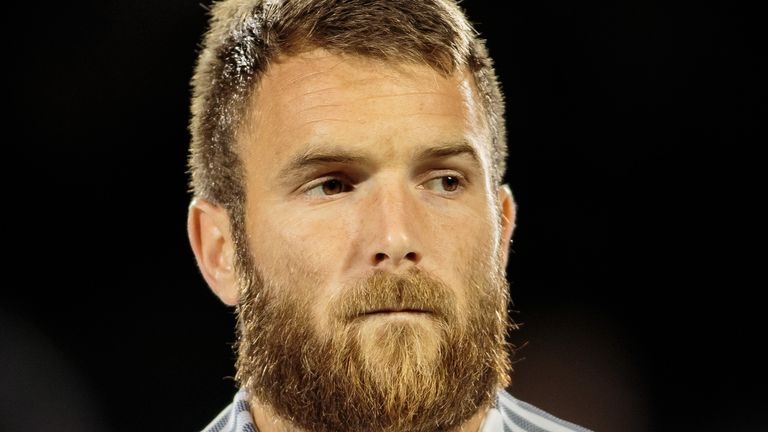
Aleksandar Katai started both MLS matches before the season was suspended
Aleksandar Katai has been released by LA Galaxy, two days after the club was made aware of racist comments posted by his wife on social media.
The MLS franchise announced their decision to mutually part ways with their new Serbian winger on Friday in a one-sentence news release.
On Wednesday, Galaxy had condemned the comments made by Tea Katai, who had posted on Instagram a photo with a caption written in Serbian urging police to kill protesters, another referring to protesters as disgusting cattle and a third sharing a racist meme.
Aleksandar Katai distanced himself from his wife’s posts late Wednesday night before a meeting with the club on Thursday.
Katai, who was signed by LA Galaxy as a free agent on December 31, said he did not share his wife’s views and they were not tolerated by his family.
The club’s fans reacted with online calls for his dismissal and, on Thursday, a handful of fans gathered by the David Beckham statue outside the club’s stadium holding a banner reading ‘No Racists in Our Club’ along with a circle and a red line through Katai’s squad number (7).
The 29-year-old had been participating in voluntary individual workouts this week with his team-mates at their training complex in Carson.
Katai, who had started the first two matches of the MLS season before it was suspended because of the coronavirus pandemic, was expected to be an important part of the team’s attacking line-up alongside Javier ‘Chicharito’ Hernndez and Cristian Pavn.
Katai joined MLS with the Chicago Fire in 2018 after a career in Europe, including time with Serbian’s 1991 Champions League winners Red Star Belgrade.
He had 18 goals in his first two seasons in Chicago, who bought him from Alaves in Spain’s La Liga.
Khiladi also starred Ayesha Jhulka, Deepak Tijori and Sabeeha in important roles.
Akshay Kumar took to Twitter to delight his fans with his Flashback Friday post. When filmmaker duo Abbas-Mustan shared a throwback photo of Khiladi Kumar, the actor couldn’t resist himself from retweeting the same. The trio remembered their blockbuster 1992 film. “Dear @akshaykumar Today it’s 28 years since the release of Khiladi, our first film together. Feeling nostalgic. Remembering the entire team specially @iamjohnylever bhai,” Abbas Mustan tweeted. “How can I forget Abbas Mustan bhai…it’s not just a film for me but a stepping stone in my career, a title which is now synonymous with me. Thank you for giving me #Khiladi,” Aksay Kumar wrote sharing Abbas Mustan’s tweet.Â
How can I forget Abbas Mustan bhai…it’s not just a film for me but a stepping stone in my career, a title which is now synonymous with me. Thank you for giving me #Khiladi 🙏🏻 https://t.co/VEpiUBpQyu
— Akshay Kumar (@akshaykumar) June 5, 2020
Khiladi also starred Ayesha Jhulka, Deepak Tijori and Sabeeha in important roles. For the unversed, it was the first in Akshay’s Khiladi series. Besides Khiladi, Akshay and Abbas-Mustan have also collaborated on films such as Ajnabee and Aitraaz.
Akshay was last seen in 2019 film Good Newwz with Kareena Kapoor Khan, Diljit Dosanjh and Kiara Advani. His next, Sooryavanshi, co-starring Katrina Kaif has been postponed indefinitely. The movie directed by Rohit Shetty is the fourth instalment of his cop universe.
On a related note, Akshay Kumar is the only Indian celebrity to feature on Forbes 2020 list of World’s 100 Highest-Paid celebrities. However, the actor’s rank has witnessed a drop from last year. From the 33rd spot, Akshay has dropped to 52nd spot. Forbes also revealed the actor’s earning and said that Akshay had an estimated $48.5 million earnings this year, compared to $65 million last year.Â
Forbes called Akshay the highest-earning star in Bollywood and wrote, “A bankable movie star, he commands up to $13 million upfront for films like the upcoming Bachan Pandey and Bell Bottom.” They also called him, “one of India’s most philanthropic celebrities who donated $4.5 million to coronavirus relief in the country.”
From deep space missions to alien beings, exotic new worlds and superheroes ranging from “Black Widow” to “Wonder Woman,” this year will be jam-packed with thrilling space and science fiction movies.Â
Here is our list of some of the most interesting sci-fi movies to see in 2020 (and the movies that got delayed to 2021 due to the coronavirus pandemic).
Related: 20 sci-fi movies and TV shows to binge watch on Netflix right now
Wonder Woman’s next big screen adventure finds her up against two new enemies: Maxwell Lord, a wealthy TV personality and Dr. Barbara Minerva (played by Kristen Wiig), an archaeologist turned warrior cheetah. “Wonder Woman 1984” is the sequel to 2017’s “Wonder Woman,” where we saw Diana (played by Gal Gadot) cross the trenches of No Man’s Land in World War I and ultimately destroy Ares. Now, we see her at the end of the Cold War in brand-new gold armor.Â
This will be the third film in the Bill & Ted franchise. Keanu Reeves and Alex Winter will reprise their roles as best friends Theodore “Ted” Logan and William “Bill” Preston, respectively. Bill and Ted are met by a visitor from the future, who instructs them to create a song in 78 minutes in order to save all life on Earth and the entire universe.Â

Set in a post-apocalyptic world, Tom Hanks stars as Finch, an ailing inventor and one of the last men on Earth. Facing his own death, Finch creates a robot named Jeff (played by Caleb Landry Jones) to take care of his dog when he dies. As the trio embarks on a cross-country journey, Finch has to teach the robot to be “human-like” and train his beloved pet to listen to his new master.Â
Natasha Romanoff (played by Scarlett Johannson) finally gets her own standalone Marvel movie. This installment is set shortly after “Captain America: Civil War,” when Romanoff finds herself alone and is forced to confront a dangerous conspiracy with ties to her past as a spy. She also must face the aftermath of broken relationships from before she became an Avenger.Â
Scheduled to be released Dec. 18, 2020, “Dune” is the first of a planned two-part adaptation of the 1965 novel of the same name by Frank Herbert. Set in the future, the movie follows a brilliant and gifted young man named Paul Atreides, who must travel to the most dangerous planet in the universe to ensure the future of his family and his people. The planet, called Arrakis (or Dune), is the only known source of a drug called “the spice,” which extends human life, provides superhuman levels of thought and makes “foldspace” travel possible. Atreides is entrusted to protect the planet and its valuable resources.Â
“Stowaway” follows the crew of a spaceship headed to Mars that discovers an accidental stowaway shortly after launch. With the journey planned for only a certain amount of people, the crew runs into a series of unintended consequences as resources quickly begin to dwindle. Anna Kendrick is set to star as the ship’s medical researcher and voice of reason as the crew decides how to best handle the grim situation. The exact release date for “Stowaway” has not yet been announced.Â
A group of 30 young men and women are sent deep into space on a multi-generational mission in search of a planet to populate and call home. However, the group quickly descends into chaos after the captain of the mission is mysteriously killed. The film stars Colin Farrell, Isaac Hempstead Wright, Tye Sheridan, Lily-Rose Depp and others. It is currently in post-production and is set to release Nov. 25, 2020.Â
In case you missed them, there were a few awesome sci-fi movies released early in 2020, in January and February.
“Underwater” is set on a corporate research rig seven miles beneath the ocean’s surface, where a team will drill to the bottom of the Mariana Trench for resources. When an earthquake hits, the undersea station suffers a breach from the pressure and water starts crashing through the walls. The surviving crew ultimately has to put on pressurized suits and walk across the ocean floor to another drilling station. Along the way, they encounter strange creatures that threaten the crew’s survival.Â
The newest “Harley Quinn” movie is based on the DC Comics team and follows the story of Harley Quinn after her breakup with the Joker. The female squad led by Harley Quinn teams up against Gotham City crime lord Black Mask.Â
Based on the 1952 novel by Ralph Ellison, “Invisible Man” follows the story of Cecilia. She is trapped in a violent, controlling relationship but it seems that she’s escaped when her abusive ex-husband appears to commit suicide, leaving her his fortune. However, Cecilia (played by Elisabeth Moss) suspects his death was a hoax and that he is still alive. Her friends and family start to question her sanity as she tries to prove she is being hunted by someone nobody can see.Â
This new superhero film is based on the Valiant Comics character Bloodshot (played by Vin Diesel). After marine Ray Garrison and his wife are murdered, Ray is resurrected by a team of scientists and enhanced with nanotechnology that makes him a superhuman, biotech killing machine. “Bloodshot” was first released in Switzerland on Feb. 20, and was released in the United States on March 13.Â
This long-awaited Marvel film follows a team of five teenage mutants who are just discovering their superpowers. Due to their unique abilities, the mutants are held in a secret psychiatric facility against their will. As a result, they are faced with sins from the past and encounter strange, seemingly supernatural events.Â
Due to the coronavirus pandemic, several space and scifi movies that were originally scheduled to be released this year have been bumped to 2021. Here’s what we can look forward to watching next year.
The Eternals are a race of ancient alien beings who were created by the Celestials — a powerful extraterrestrial race — and have secretly shared the Earth with humankind for thousands of years. Following “Avengers: Endgame” (2019), the Eternals are forced out of the shadows to reunite against mankind’s most ancient enemy: The Deviants. The Eternals — featuring Thena (Angelina Jolie), Ikaris (Richard Madden) and Black Knight (Kit Harrington) — are among the most powerful characters in the Marvel Universe.
“Venom: Let There Be Carnage,” the sequel to 2018’s Venom, was slated to hit theaters Oct. 2, 2020, and has been delayed to 2021. While the film is still in production and many of the plot details have not been released, it is believed that “Venom 2” will focus on the relationship between protagonists Eddie Brock and Venom. Audiences can also expect to see more of the supervillain Carnage.Â
To fight the war against an alien invasion, scientists have developed a way to draft soldiers from the past. “The Tomorrow War” follows the story of a husband and father (played by Chris Pratt) who is drafted into a war against invading aliens. Set in the future, the fate of humanity relies on Pratt’s character and his ability to correct issues of the past.
Follow Samantha Mathewson @Sam_Ashley13. Follow us on Twitter @Spacedotcom and on Facebook.Â
Global health experts weigh in on the short- and long-term consequences of the U.S. breaking ties with the World Health Organization.
(Image credit: Stephanie Adeline/NPR)

