Tuesday, May 5, 2026

Pennsylvania Democrats: GOP Lawmaker’s Positive COVID-19 Test Kept Secret For A Week

Democrats in Pennsylvania’s House of Representatives were outraged Wednesday after learning one of their Republican colleagues had tested positive for the coronavirus and they weren’t notified of the result or informed that he was self-isolating for a week.

State Rep. Andrew Lewis (R) said in a Facebook post that he tested positive for COVID-19 on May 20 and immediately began self-isolating after contacting the chamber’s human resources department. He said the body followed guidelines released by the Centers for Disease Control and Prevention “to determine exactly who I may have been in contact with, and who I may have possibly exposed to the virus.” He said he was last in the Capitol on May 14.

“I can confirm every member or staff member who met the criteria for exposure was immediately contacted and required to self-isolate for 14 days from their date of possible exposure,” Lewis wrote. “Out of respect for my family, and those who I may have exposed, I chose to keep my positive case private.”

A spokesman for House Republicans, Mike Straub, told Penn Live the chamber “followed data and science” and notified anyone who met CDC and state health guidelines.

But state Democrats accused Republicans, who hold a majority in the House, of withholding the information from the full chamber as the GOP publicly touted a broad reopening of the state. Many noted they only learned of Lewis’ results from the media.

“These same Members were among those leading the daily shouts to reopen the state,” Rep. Brian Sims (D) tweeted of his Republican colleagues. “They yelled and screamed about it being safe for others across the state to gather, while they were testing positive and notifying each other, but none of the Democrats that work with them!”

Sims later called on House Speaker Mike Turzai and other Republican leaders who withheld any information to resign and said the case should be investigated by the state attorney general.

Other Democrats were equally frustrated by the lack of communication. 

“I am livid,” state Rep. Malcolm Kenyatta (D) told The Philadelphia Inquirer. “They were derelict in their duty when they did not alert us to this immediately. … They put our health at risk, they put our families at risk, and Speaker Turzai should resign, period.” 

Another Republican, state Rep. Russ Diamond, said Wednesday that he was contacted on May 21 and asked to self-quarantine but has not developed any symptoms or been tested for the virus. He said he plans to return to the statehouse on Thursday after a 14-day quarantine and defended GOP efforts to reopen the economy.

“I’m angry that even though my self-quarantine was not required, but only recommended under CDC guidelines, that there are plenty of people in Pennsylvania who would wag their fingers at me and try to shame me for simply going about my life peacefully,” Diamond wrote. 

Diamond has vocally opposed wearing masks in public despite federal health recommendations. 

More the 1.6 million Americans have tested positive for the coronavirus. The U.S. passed a bleak milestone on Wednesday, recording 100,000 coronavirus-related deaths.

A HuffPost Guide To Coronavirus


Source by [author_name]

Fox News Host Confronts Trump Spokesperson On Murder Conspiracy Theory

Fox News host Dana Perino asked Trump campaign communications director Tim Murtaugh on Wednesday what President Donald Trump seeks to gain by falsely claiming MSNBC host Joe Scarborough murdered someone.

Perino brought up that baseless conspiracy theory while discussing Trump’s feud with Twitter over its decision to attach a warning about the accuracy of his tweets blasting mail-in voting. However, the platform declined to remove or flag Trump’s other tweets suggesting that Scarborough ― a fierce Trump critic and former Republican congressman ― may have killed 28-year-old Lori Klausutis when she worked as a staffer in his Florida office.

An autopsy concluded Klausutis’ 2001 death was an accident; she had an undiagnosed heart condition that caused her to faint and she hit her head on a table.

“How does this help the president win an election in November?” Perino asked. 

Murtaugh claimed Trump’s supporters “like the way the president expresses himself on Twitter because, they say, ‘Here’s a guy who finally says the things out loud that I’m thinking myself.’”

“He is who he is, and I don’t think that there are too many Americans who are not familiar with the way that he uses Twitter,” Murtaugh added. “So I think all of that is already calculated in when Americans will choose their president this coming November.”

Klausutis’ widowed husband, Timothy Klausutis, implored Twitter to remove the tweets about his wife in a letter to CEO Jack Dorsey last week. He said Trump had taken “the memory of my dead wife and perverted it for perceived political gain.”

“Does it give you any pause about the widower of the young woman who is asking the president to stop because he says it is sullying her memory unnecessarily?” Perino asked her guest.

Murtaugh, claiming first that “we feel for the grieving family,” attempted to justify the president’s behavior because of his grudge with Scarborough.

“I’m not going to get out ahead of the president,” he said. “He’s got this on-running feud with Joe Scarborough and I think it’s plain to see for everybody.”

Watch the interview around the 17-minute mark on “The Daily Briefing” segment below.


Source by [author_name]

George Floyd death: Pressure mounts for US officers to be charged

Pressure is mounting in the US state of Minnesota for prosecutors to bring charges against the Minneapolis police officers involved in an arrest that led to the death of George Floyd, an unarmed Black man.

“What we saw was a public lynching without a rope,” said Leslie Redmond, the president of the Minneapolis chapter of the National Association for the Advancement of Colored People (NAACP).

“Enough is enough. We are done dying,” Redmond told Al Jazeera. “We want to see them prosecuted.”

More:

Bridgett Floyd, George’s sister, told ABC’s Good Morning America programme on Wednesday that she feels “those guys need to be put in jail”.

“They murdered my brother,” she said.

Minneapolis Mayor Jacob Frey echoed those calls in a news conference on Wednesday, asking: “Why is the man who killed George Floyd not in jail?”

He added: “If you had done it, or I had done it, we would be behind bars right now.”

‘I can’t breathe’

Floyd died at the hospital late on Monday after Derek Chauvin, a white police officer, knelt on the 46-year-old’s neck for several minutes as Floyd moaned and yelled: “I can’t breathe.”

A video of the incident shows Floyd pleading with police and eventually appearing motionless as the officer’s knee remained on his neck. Bystanders can be heard urging the officer to get off of Floyd.

Medaria Arradondo, the city’s first Black police chief, swiftly fired the four officers involved, a move community leaders acknowledged as “a win”, but said should only be the first step.

“I don’t want to undermine how big of a win it was to Chief Arradondo to fire those four officers the same day the footage was shown to the public,” the NAACP’s Redmond said, highlighting that while it was only one officer who pinned Floyd to the ground “all of them were responsible and played a role”.

“The next step,” Redmond said, was charges being brought against the four officers – identified as Chauvin, Thomas Lane, Tou Thao and J Alexander Kueng – both locally and federally.

“What we are seeing is a violation of Black people’s human rights,” Redmond said. “Our humanity has always been denied on American soil.”

Protesters gather at the scene where George Floyd, an unarmed black man, was arrested by police officers before dying in hospital in Minneapolis, Minnesota [Eric Miller/Reuters]

The Minnesota Bureau of Criminal Apprehensive (BCA) and the FBI are both investigating the incident.

The Hennepin County Attorney’s Office, which will handle the case, said in a statement it was “shocked and saddened by what appeared in a recent video”.

It added that after the BCA and FBI present their findings, it will make a decision on prosecution.

“We promise a thorough, expedited review consistent with our ongoing commitment to justice,” the statement read. “Every person is entitled to fairness; no person stands above the law.”

Redmond said other Black leaders are pushing for resources to be poured into the community and for police officers to be trained by community members to help bridge the disconnect she says has long existed.

New security camera footage

The Minneapolis Police Department said on Tuesday Floyd “physically resisted officers”.

Security camera footage, obtained by CBS News, shows Floyd sitting on the ground with his hands behind his back and then walking with police out of frame.

“Security cameras captured moments before the murder of #GeorgeFloyd,” tweeted prominent civil rights lawyer, Benjamin Crump, who is representing the Floyd family. “He was clearly NOT RESISTING arrest… So WHY did Minneapolis Police officers use excessive force that ultimately resulted in his death?! WE DEMAND ANSWERS.”

It is unclear what happens between the time Floyd and police walk out of the frame and the time when a bystander’s video shows an officer pinning Floyd down to the ground with his knee.

The Police Officers Federation of Minneapolis issued a statement on Tuesday, saying its officers were cooperating with investigators and urged “now is not the time to rush to judgement”.

‘No justice, no peace’

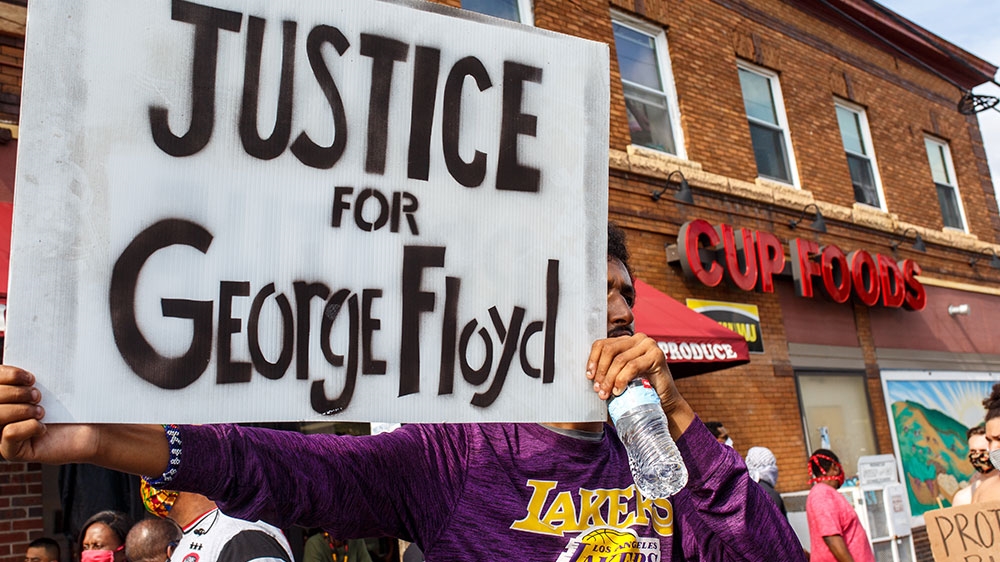
Calls for justice for Floyd have reverberated across the country, with hundreds of protesters taking their demands to the streets of Minneapolis.

On Tuesday night, demonstrators filled the intersection where Floyd was pinned down, chanting “I can’t breathe” and “no justice, no peace”. Floyd’s death has been compared to that of Eric Garner, an unarmed Black man who died in 2014 after being placed in a chokehold by New York City police and pleading: “I can’t breathe.”

Video from Tuesday’s demonstration showed police using tear gas against some protesters who marched to a police precinct. There were also reports of non-lethal projectiles being fired by police. Authorities said some protesters destroyed a window of the precinct and sprayed graffiti on police vehicles.

George Floyd

A man holds a sign while protesting near the area where George Floyd was pinned to the ground by police [Kerem Yucel/AFP] 

US President Donald Trump publicly addressed Floyd’s death for the first time on Wednesday afternoon, calling it a “very sad event”.

“We’re going to look at it, and we’re going to get a report tomorrow when we get back. And we’re going to get a very full report,” Trump said during a visit to the Kennedy Space Center in Florida. “But a very sad day.”

Floyd’s death is the latest case of a Black man or women being killed by police or former law enforcement.

The FBI are also involved in recent investigations in Louisville, Kentucky, and Glynn County, Georgia.

In Kentucky, 26-year-old Breonna Taylor was killed by police on March 13 as they served a warrant in a drug investigation. Police said they were returning fire from Taylor’s boyfriend, who said he fired in self-defence, believing someone was breaking into the apartment. No drugs were found.

In Georgia, the US Justice Department is weighing hate crime charges in the February 23 shooting death of 25-year-old Ahmaud Arbery, a Black man killed while running in a predominantly white neighbourhood. It took more than two months and a viral video for police to arrest Gregory McMichael, a retired investigator for the local prosecutor’s office, and his son, Travis, both of whom are white. The McMichaels claimed they believed Arbery was involved in a burglary and he was shot in a struggle for Travis McMichael’s gun. Arbery’s mother said she believes her son was just going on a jog.

According to the Washington Post Fatal Force database, more than 1,000 people have been shot and killed by police in the last year. According to the database, Black Americans are killed by police at a disproportionate rate. 

African American adults are nearly six times as likely to be imprisoned or jailed than white adults, according to the Sentencing Project watchdog group.

These racial disparities have given rise to Black Lives Matter, which was founded in 2013 and seeks to end police violence and build local power to intervene in violence inflicted on Black communities.


Source link

Russian doctors facing distrust as they battle coronavirus – CNN Video

0

Doctors in Russia are facing distrust as they battle the Covid-19 pandemic. CNN’s Matthew Chance explores why.


Source link

Zuckerberg Says Social Media Giants Shouldn’t Be In Position To Fact-Check Users

Facebook CEO Mark Zuckerberg said his company’s policies differ from those of Twitter when it comes to fact-checking users.

For the first time, Twitter tagged two of President Donald Trump’s tweets on Tuesday with a fact-checking note indicating that his statements were misleading. Angered over the notes, Trump later accused Twitter of attempting to influence the upcoming 2020 presidential election.

During an interview with Fox News’ Dana Perino, Zuckerberg said he disagreed with Twitter’s policy and said he didn’t believe his own company, Facebook, should be “the arbiter of truth.”

“We have a different policy than Twitter on this,” Zuckerberg told Perino when asked about Twitter’s decision to fact-check Trump.

“I just believe strongly that Facebook shouldn’t be the arbiter of truth of everything that people say online,” he said. “I think in general, private companies probably shouldn’t be — especially these platform companies — shouldn’t be in the position of doing that.”

A preview of Zuckerberg’s interview was published Wednesday and is scheduled to air in full on Thursday.

Trump’s tweets warned, without evidence, of “substantially fraudulent” voting in states that plan to use mail-in ballots this November.

Twitter added this note to Trump’s tweets:

“Trump falsely claimed that mail-in ballots would lead to ‘a Rigged Election.’ However, fact-checkers say there is no evidence that mail-in ballots are linked to voter fraud.”

A Twitter spokesperson told HuffPost that Twitter flagged Trump’s tweets because they contained “potentially misleading information about voting processes and have been labeled to provide additional context around mail-in ballots.”

The fact-checking is part of the company’s new policy of labeling false or misleading information about COVID-19. The company also explained that it may expand the fact-checking to topics beyond the pandemic.

In response to Twitter’s action, Trump threatened on Wednesday to use the power of the federal government to regulate social media companies. The office of the president cannot regulate tech companies without congressional approval or help with the Federal Communications Commission.

“We will strongly regulate, or close them down, before we can ever allow this to happen,” Trump said, accusing social media companies of intentionally suppressing conservative opinions.

“Big action to follow,” he added.

Zuckerberg appeared wary of Trump’s warning and said he didn’t believe further censorship was the appropriate action. 

“I have to understand what they actually would intend to do,” Zuckerberg told Fox News. “But in general, I think a government choosing to censor a platform because they’re worried about censorship doesn’t exactly strike me as the right reflex there.”


Source by [author_name]

North Korea to Reopen Classes in June, Raising Coronavirus Fears For Students in Unprepared Schools

0

Residents in North Korea are growing anxious about the approaching June 1 reopening of schools that were shut down to combat the spread of the coronavirus epidemic, worried that the deadly virus could spread among students as they return to classes without necessary sanitization supples.

The schools were supposed to start Feb. 17, but authorities extended winter break to March 23, then April 20, before settling on June 1.

“The Central Committee [of the Korean Workers’ Party] ordered schools in the province to start on June 1, so they are busy preparing for classes,” a resident of North Hamgyong province, who requested anonymity to speak freely, told RFA’s Korean Service May 23.

“After postponing the first day of school four times, due to the coronavirus, they are expected to open this time,” said the source.

According to the source the order was given to all levels of the province’s educational system on May 15.

“According to [their] instructions, educational institution personnel should inspect educational sites with quarantine agencies to prepare for the smooth opening of schools based on the inspection results,” the source said.

“Upon hearing the Ministry of Education’s decision to open up in June, residents are worried that the epidemic will spread among the students,” said the source.

“In educational institutions, such as schools and kindergartens, group activities are essential. [Residents] are worried because [children] do not have necessary basics of personal hygiene and disinfection,” the source said.

But the source said that the government is ordering schools to prepare hygiene measures.

“The Ministry of Education is requiring schools and kindergartens to prepare disinfectant makers and base materials for disinfectant to ensure the students [can use it],” the source said.

“They are not issuing [the schools] any supplies they are only saying the schools should have strict quarantine measures and thoroughly conduct on-site disinfection,” the source added.

Another source who requested anonymity to avoid legal trouble, from Ryanggang province, told RFA on Tuesday, that kindergartens and schools there had also been ordered to start in June.

“Each school here in Hyesan [the province’s largest city], is deeply troubled about how they will prevent the spread of the coronavirus among the students,” the second source said.

The second source also explained that the authorities issued quarantine directives, but did not provide any supplies.

“The provincial education ministry issued guidelines to each school, calling for quarantine preparations and preventative measures so they can respond quickly under unexpected circumstances, and maintain constant pressure against the coronavirus,” said the second source.

“They didn’t provide any quarantine supplies, they just ordered the schools to prepare the base materials for disinfectant and to stockpile emergency medicines on their own, so residents and school officials are criticizing the educational authorities,” the second source added.

The second source said it was likely that the authorities know that their directives are not enough to prepare each school for a reopening, but they have other things to worry about.

“The Central Committee must be aware that it is impossible for each school to secure disinfectant or quarantine supplies on its own, especially when basic living necessities like water and electricity are not properly supplied in Hyesan,” said the second source.

“But under these circumstances, the authorities can still be so brazen to give schools and students orders to strictly follow their quarantine guidelines.”

While North Korea claims to the world that it does not have a single confirmed case of COVID-19 within its borders, RFA reported last month that the government admitted publicly through lectures to neighborhood watch groups that the virus was spreading in three parts of the country including the capital Pyongyang.

Reported by Jieun Kim for RFA’s Korean Service. Translated by Leejin Jun. Written in English by Eugene Whong.


Source link

Coronavirus live news: Trump criticised over ‘preventable’ crisis as US passes 100,000 deaths

A soccer mom in one of Cape Town’s posh suburbs drops off a cardboard box of blankets to a neighbor. Inside the box are several bottles of red wine.

In Johannesburg’s Alexandra township, two men in face masks greet each other on a sunny street. One has surreptitiously sold the other a pack of cigarettes.

“They’ve banned the sale of cigarettes but we’re still able to buy them,” said street vendor Mluleki Mbhele. “We buy cigarettes in the streets in the black market. The officials know about it because they themselves continue to smoke.

Critics describe the prohibitions imposed by President Cyril Ramaphosa as puritanical, hypocritical and unrealistic. Around the world, only Panama and Sri Lanka are reported to be prohibiting the sale of liquor during the pandemic, while India and Thailand temporarily banned it.

South African government officials say the number of admissions to hospital emergency rooms from alcohol-related crimes and vehicle accidents have been reduced significantly. Supporters of the ban on cigarette sales say smoking weakens the respiratory system, which is attacked by the virus.

South Africa has the continent’s highest number of confirmed coronavirus cases with over 24,000. The virus has spread relatively slowly across Africa, whose 54 countries with a population of 1.3 billion have reported a total of over 115,000 cases.

More than 230,000 South Africans have been arrested for breaking the lockdown regulations, including the bans on alcohol and tobacco sales, said national police minister Bheki Cele.

Source link

‘Nothing but soundbites’: UK PM Boris Johnson left isolated

London, United Kingdom – The United Kingdom has one of the world’s worst per capita death tolls from coronavirus, according to Oxford University research based on data from the European Centre for Disease Prevention and Control. 

At the start of this week, it was the world’s worst.

More:

But the countless stories of personal grief echoing around social media have given way to a raw and visceral anger directed at the government’s handling of the crisis, which many see exemplified in the actions of Dominic Cummings, Prime Minister Boris Johnson’s right-hand-man and a principal architect of government strategy, when he flouted lockdown restrictions and refused to apologise.

On Wednesday, Johnson appeared for the first time in front of the Liaison Committee – a sort of supergroup  of parliamentary select committees whose purpose is to hold the prime minister to account.

He had wanted to tout the launching of the long-awaiting test-and-quarantine programme in England, which is to start on Thursday and is key to government plans to ease the lockdown.

It will “unlock the prison”, so the “captivity of a tiny minority for a short time will allow us to release 66 million people from the current situation”, he told MPs in their teleconferenced meeting.

The programme, which launches months after strong calls from experts to institute such a scheme, will not be supported by the mobile phone app currently in testing, but “will be getting steadily better to become a truly world-beating test and trace operation in the course of the next days as we go through June”, Johnson added.

[Source: Our World In Data/Oxford University/European Centre for Disease Prevention and Control]

Johnson’s performance in front of his inquisitors left a lot to be desired, Mark Shanahan, head of the Politics Department at the University of Reading, told Al Jazeera:

“Why is it that when the country’s crying out for a straight man, they send in the clown? Johnson’s bluster in front of the House of Commons Liaison Committee today was not quite a car crash – rather all four wheels on whatever political vehicle he was attempting to drive fell off.”

Johnson has been scheduled to appear for a grilling several times in his 10 months as prime minister, yet each time he has delayed, postponed or cancelled his interrogation.

Focus on Cummings

The first chunk of Wednesday’s appearance was taken up by questions about Cummings.

As 44 of Johnson’s own Conservative MPs joined a majority in overnight polls – even among Conservative voters – calling for the senior aide’s sacking, they were not questions the prime minister was eager to answer.

Cummings has been accused of seriously undermining the nation’s public health strategy by appearing to ignore the lockdown rules when, convinced he had coronavirus, he took his sick wife and their four-year-old son on a 260-mile (418km) journey to isolate at his parents’ farm, instead of abiding by the government’s messaging of “stay home, save lives, protect the NHS”.

“You have a choice between protecting Dominic Cummings and the national interest. Which is it?” Yvette Cooper, a senior Labour member of Parliament who heads the Home Affairs select committee asked the prime minister.

Johnson answered: “Well, I think my choice is the choice the British people all want us to make, Yvette, and that is as far as we possibly can, to lay aside party-political point-scoring and to put the national interest first and to be very clear with the British public about what we want to do and how we want to take this country forward.”

His appearance was emblematic of his handling of the crisis, added Shanahan.

“His rallying cry to ‘move on’ from the Cummings fiasco was woeful,” Shanahan told Al Jazeera.

“He failed to answer any of the questions posed, or to mount any reasonable defence for his senior adviser’s immensely questionable actions. Worse still, he had nothing but soundbites to offer on the science of COVID, on the economy or on anything else posed.

“The questioners were largely forensic, the answers were superficial. And this sums up Johnson – not just today, but throughout his time in Number 10. He’s an eager frontman, strong on boosterism, weak on leadership. It’s not just that he doesn’t do detail, he can’t do seriousness and is simply out of his depth when a calm and steady response is required. Today’s performance? Lamentable. His overall handling of the crisis? Not much better.”

‘Benefit of the doubt’ lost

The government’s decisions during the pandemic have been fiercely criticised. A failure to join a European Union-wide purchasing scheme to bulk-buy medical ventilators was blamed on an email mishap. A lack of tests was blamed on a shortage of certain chemicals, yet chemical producers in the UK said they were never asked to produce more. An attempt to remedy a shortage of Personal Protective Equipment (PPE) by making a huge purchase from Turkey was announced the day before the order was even placed, and when it arrived much of it was unsuitable. 

Until this weekend, however, the British public appeared willing to give Johnson the benefit of the doubt, believing, according to polls, that the government was doing its best in an unprecedented situation.

But as reports of the Cummings family road trip gave a face to the anger felt by many, it was also reported by the Sunday Times that the government’s delay in imposing restrictions saw cases rocket from an estimated 200,000 to more than 1.5 million before the lockdown was introduced.

A poll on Tuesday night saw government support drop by 9 percent, cutting the Conservatives’ lead over Labour from 15 points to six.

Boris on Zoom - reuters

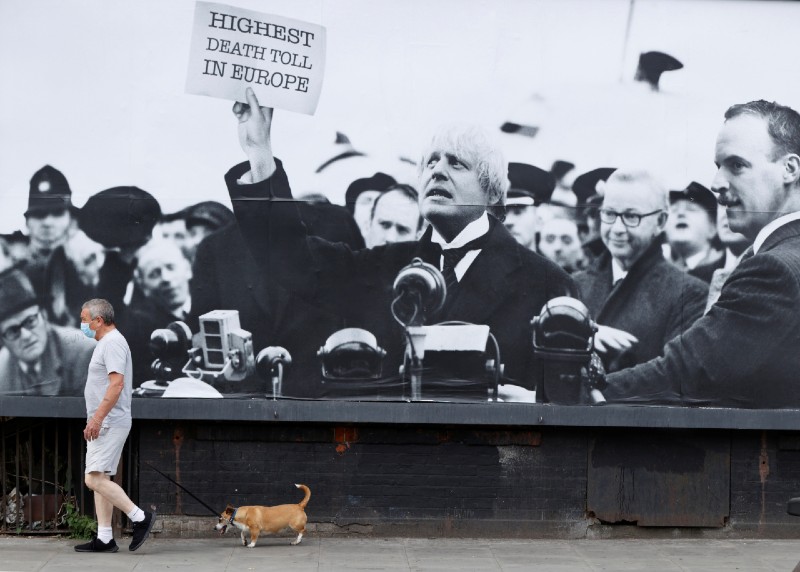
Campaigners have compared Johnson’s reluctance to impose lockdown with 1930s Prime Minister Neville Chamberlain’s policy of appeasement, giving Adolf Hitler what he wanted in the hope of avoiding all-out conflict [John Sibley/Reuters]

Johnson, hostile to the idea of lockdown, had boasted at the beginning of March that he was still shaking people’s hands, even in hospitals where coronavirus patients were being treated. He also said Britons could “take it on the chin”. The Sunday Times investigation found he was eventually convinced of the necessity of lockdown on Saturday, March 14, but it was not imposed until March 23. 

The delay of nine days, at a time when infections were doubling every three days, meant the UK had way more infections when it went into lockdown than any other European nation had when they took the same action. By May 5, the UK had the highest death toll in Europe. On Wednesday, the official death toll stood at 37,460, and is believed to be much higher.

Lockdown delay wasn’t SAGE advice

One reason for the delay, given at the time, was that introducing lockdown restrictions “too early” would result in fewer people adhering to it for the long-term.

“I’m not sure where that came from,” Susan Michie, professor of health psychology at University College London, told Al Jazeera.

“We have a behavioural science subcommittee of SAGE (the government’s Scientific Advisory Group for Emergencies) which I sit on, and we weren’t asked to consider that. There are other behavioural psychology groups around government, but it wasn’t something we were asked about.”

And it’s not guaranteed to be true either, she added.

“Systematic reviews of quarantines in other countries do suggest a trailing off of adherence, associated with financial insecurity, increasing loneliness, frustration, boredom and so on. But if one is warned in advance, one can put things into place to overcome those obstacles and help ensure adherence to lockdown rules for longer.

“I think a lot of people have been amazingly surprised at how well people have adhered to the lockdown. They said it’ll never happen in London, for example. There’s no way to accurately say what will happen when lockdown is imposed, but adherence depends on people’s needs being met – financially, materially, emotionally and socially – and on people having continuing trust in government.”

Not all bad?

But it’s not been all bad. When the government did impose lockdown, its messaging was clear: “Stay at home, save lives, protect the NHS.”

“This was a very good phrase, as it was behaviourally specific,” said Professor Michie. “The first part told you what to do. The second told you why, it provided a rationale. And third – ‘protect the NHS’ – was all about ‘do this for others, do this for your community’ – and that is a powerful emotional pull. All three taken together are important drivers of action.”

And on the economic front, the Treasury’s furlough scheme paid 80 percent of salaries for millions of workers stuck at home across the country.

“New income support programmes, ie: the job retention scheme and the self-employed income protection scheme” were also things the government had done well, said Alfie Stirling, head of economics at the New Economics Foundation.

“But people were always going to fall through the cracks of these schemes, and nowhere near enough has been done to strengthen Universal Credit, which is one of the weakest safety nets among advanced economies,” he told Al Jazeera. “The business loan scheme has also not gone well, as businesses have not been able to take on the risk and interest costs.”

And the financial help has not always gone to where it was most needed.

“Rentier sectors of the economy – landlords and banks, for example – have been relatively protected, whereas households and firms have taken on too much of the economic risk and pain. Banks have been able to profit out of business loans, and while landlords have had access to mortgage holidays, there has been no access to rent holidays. This means much of the government’s financial support into the economy will end up flowing to those who have most economic power, making inequality worse.”

It all comes back to leadership, said Michie.

“The main issue, aside from a lack of preparation and declining infrastructure after 10 years of funding cuts, and the failure to organise a ‘Test, Trace and Isolate’ programme, and to provide adequate PPE – but the main thing from a psychological point of view has been the failure to work with communities and develop partnerships,” she said. “There was too much in the way of top-down edicts.”

“The problem here is that, as is the case now, if the moral authority of the central government is undermined, there is nothing in place to replace and sustain it. When working in partnership with communities, not only do you have joint problem-solving, which is more effective and useful, but also more engagement and ownership in solutions, which means greater adherence and pulling together.

“There is now an urgent need to build up trust in leadership again.”

Follow James Brownsell on Twitter: @JamesBrownsell


Source link

Mangled shipping containers and debris wash up on coast

Debris from a cargo ship that spilled containers off Australia is continuing to wash up on beaches along the coastline.

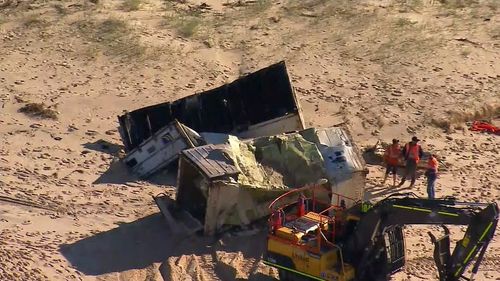
Mangled containers dotted Birdie Beach at Budgewoi on the NSW Central Coast this morning, spilling their contents onto the sand.

Workers are in the process of trying to move the debris after the APL England docked in Brisbane this morning.

Mangled shipping containers are washing up on the NSW Central Coast. (9News)
Workers are trying to clean up the debris.
Workers are trying to clean up the debris. (9News)

The ship rolled and lost 40 shipping containers when it hit heavy seas off the NSW coast earlier this week while en route from China.

The Singapore-flagged container ship experienced a temporary loss of propulsion during heavy seas about 73km south-east of Sydney just after 6.10am, AMSA said in a statement on Sunday.

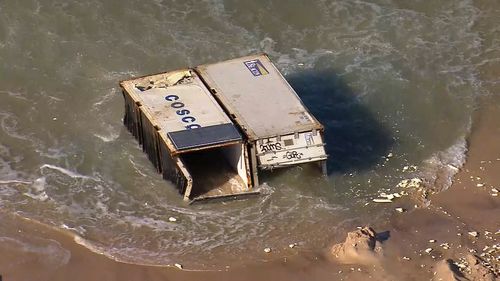
The containers are from the APL England that hit rough seas.
The containers are from the APL England that hit rough seas. (9News)
Surgical masks and plastic containers are among the debris found on beaches.
Surgical masks and plastic containers are among the debris found on beaches. (9News)

The ship was en route from China to Melbourne.

“The ship’s power was restored within a few minutes but during this time the ship reported that it was rolling heavily, causing container stacks to collapse and several containers to fall overboard,” the statement said.

AMSA intends to send a Challenger jet to the area to look for containers and debris, as well as to inspect the ship for signs of damage or pollution.

Source by [author_name]

Top 10 biz headlines: Boeing cuts 12,000 jobs, SBI slashes FD rate and more

0


is cutting more than 12,000 jobs through layoffs and buyouts as the coronavirus pandemic seizes the travel industry, and more cuts are coming. The may shrink five per cent in the current fiscal, and may barely recover the loss next year by growing five per cent, say experts. Here are the top ten business headlines on Thursday


slashes 12,000 jobs as coronavirus impacts travel industry


will lay off 6,770 US employees this week, and another 5,520 workers are taking buyout offers to leave voluntarily as the coronavirus pandemic seizes the travel industry. Read more here


Amrapali case: ED attaches India accounts worth Rs 187 crore


The Enforcement Directorate (ED) has attached India’s accounts to recover the amount identified as the proceeds of crime under the Prevention of Money Laundering Act. Read more here


FMCG capacity utilisation surges to 70-75% as lockdown curbs ease


From levels of 20-40 per cent in April, FMCG capacity utilisation now stands at 70-75 per cent for most firms, conversations with companies. Read more here


Govt to discontinue 7.75% taxable savings bonds scheme from May 28


A popular instrument among the retired, the government will no longer sell its savings bonds that provided returns at 7.75 per cent from today. Read more here


Covid-19 crisis: Govt wants PSUs to ramp up dividends, share buybacks


The government is of the view that since economic activity is low, central public sector enterprises are not spending on capital expenditure as much, which can be used to pay dividends and buy back shares. Read more here


Govt extends Bharat Petroleum privatisation bid deadline to July 31


The government has for the second time extended the deadline for bidding for privatisation of Bharat Petroleum Corp Ltd by over a month to July 31. Read more here


State Bank of India slashes FD rate by 40 bps, second cut in May


State Bank of India on Wednesday has slashed interest rates on retail term deposits by up to 40 basis points across all tenors. Read more here


India can tide over worst recession, but govt must be careful: Experts


The may shrink five per cent in the current fiscal, and may barely recover the loss next year by growing five per cent, say experts. Read more here


allows PNB to hold more than 10% promoter stake in 2 insurance firms


on Wednesday has allowed the Punjab National Bank to hold promoter stake in two life insurance companies – PNB Metlife and Canara HSBC OBC Life Insurance. Read more here


Patanjali to issue debentures worth Rs 250 cr; bidding to start on May 28


A first-ever issuance of debentures by the firm, Patanjali plans to issue debentures worth Rs 250 crore that will be used to meet its working capital requirements. Read more here


Source link