Raytheon’s recent adjustment, which analysts say is rare, reveals the leeway that companies have to shift the goal posts when setting compensation. More than a decade ago, the backdating of stock options at certain companies — when executives picked earlier dates for the price at which their options could be exercised, making then more valuable — created a corporate scandal and led to penalties.
Raytheon representatives say they made the adjustment for the sake of fairness. However, the timing, when a majority of the company’s work force is being called on to make sacrifices, highlights the different standards that can apply to certain employees and top executives. In addition to pay cuts of 10 percent, Raytheon is furloughing many of its 195,000 employees and cutting billions of dollars in costs, after the pandemic brought global air travel to a near standstill. Mr. Hayes has also volunteered to take a 20 percent pay cut — but to his $1.6 million salary, which is a small part of his pay package.
Companies use a variety of stock compensation as part of the pay of senior employees, and these so-called equity awards are usually worth far more than the base salary.
Mr. Hayes’s compensation at United Technologies included performance and restricted stock units, which typically give the holder the right to get shares after certain operating and stock return targets are met, and stock appreciation rights, which are similar to stock options. If, at the time of vesting, the price of the stock is below the price at which the option or appreciation right is set, those awards are considered to be underwater.
That is not expected to happen in Raytheon’s case, because many believe the newly merged defense and aerospace giant will capitalize on its dominant position and do well as the economy recovers. Analysts forecast that earnings at Raytheon will surge 25 percent in 2021 from this year’s level and that its stock will go up 17 percent.
In fact, Raytheon’s stock price jumped 30 percent in the first few days of trading in April. Normally, a rising stock is an unalloyed benefit for executives earning share-based compensation, but because of the intricacies of the United Technologies merger, it left Mr. Hayes and others with less than they hoped to get.
As part of the merger, Raytheon had to recalculate how the United Technologies stock-related awards given to Mr. Hayes and others since 2018 would convert into stock units and appreciation rights issued by the new company. To do that, the United Technologies board initially decided it would base a stock price for the conversion on the fourth and fifth days of trading of the new company — under the assumption that any volatility associated with a new stock would settle by then.
Reliance Industries Ltd has said that Abu Dhabi state fund Mubadala Investment Co will buy a 1.85 per cent stake in its digital unit, Jio Platforms, for Rs 9,093.6 crore.
Reliance has now sold a combined 19% interest in Jio Platforms, which houses movie, music apps and telecoms venture Jio Infocomm, in six fundraising deals including a 9.99% stake sale to Facebook Inc for $5.7 billion.
The interest in Jio Platforms highlights its potential to become the dominant player in India’s digital economy. The telecoms unit has already decimated several rivals with cut-throat pricing and is counting on Reliance’s retail network to expand into e-commerce.
The Jio Platforms investment is the largest in an Indian firm by Mubadala, which is the second-biggest state investor in Abu Dhabi after Abu Dhabi Investment Authority (ADIA), managing about $240 billion in assets.
The other recent investors in Jio Platforms are private-equity firms General Atlantic, Silver Lake, Vista Equity Partners, and KKR & Co Inc .
Morgan Stanley served as a financial adviser to Reliance Industries, the company said in a statement.
Rev. Al Sharpton slammed President Donald Trump’s widely criticized recent photo-op outside a Washington, D.C., church, saying on Thursday that “we cannot use Bibles as a prop†or allow George Floyd to be used as one after his death at the hands of police.
While delivering a eulogy for Floyd in Minnesota, Sharpton did not mention the president by name, but referred to a Monday incident in which federal police aggressively cleared peaceful protesters near the White House to allow Trump’s passage to nearby St. John’s Episcopal Church to pose for photos with a Bible.
“I saw somebody standing in front of a church the other day that had been boarded up as a result of violence, held the Bible in his hand. I’ve been preaching since I was a little boy; I never seen anyone hold a Bible like that. But I’ll leave that alone,†Sharpton said.
“We cannot use bibles as a prop… This family will not let you use George as a prop.â€
Sharpton, who has regularly criticized Trump, also suggested some reading for the president.
“But since he held the Bible, if he’s watching us today, I would like him to open that Bible and I’d like him to read Ecclesiastes 3: ‘To every season there’s a time and a purpose,’†Sharpton said. “And I think that it is our job to let the world know when we see what is going on in the streets of this country, and in Europe, around the world, that you need to know what time it is.â€
“We cannot use Bibles as a prop,†Sharpton added. “And for those that have an agenda that are not about justice, this family will not let you use George as a prop.â€
Religious leaders, including two of D.C.’s top prelates, condemned Trump’s stunt on Monday, but he has defended himself and claimed it was “symbolic†and that “many religious leaders loved it,†pointing to evangelists who praised him.Â
Bishop Mariann Budde, leader of The Episcopal Diocese of Washington, expressed outrage about Trump’s exploit at the time, pledging the church’s support for the demonstrations against racism and deploring the president’s use of “a Bible and one of the churches of my diocese as a backdrop for a message antithetical to the teachings of Jesus and everything that our church stands for.â€
During his Thursday address, Sharpton also called on America to “protest against evil†and join those demonstrating in memory of Floyd ― a Black man killed by police last week as an officer knelt on his neck for more than eight minutes ― to call for an end to injustice.
“We cannot cooperate with evil. We cannot cooperate with injustice. We cannot cooperate with torture, because George Floyd deserved better than that,†Sharpton said.
The memorial concluded with an eight-minute and 46-second silence for Floyd.
Calling all HuffPost superfans!
Sign up for membership to become a founding member and help shape HuffPost’s next chapter
New York and Los Angeles, like hundreds of other cities around the world, canceled their in-person Pride Month celebrations this year because of the coronavirus pandemic.
But on Wednesday, amid protests across the country, the organizers of the annual LA Pride Festival and Parade announced that they would revive their June 14 centerpiece event as a “solidarity protest march” with the black community “in response to racial injustice, systemic racism, and all forms of oppression.”
Thursday, the Reclaim Pride Coalition, the group behind last year’s inaugural alternative pride march, said it, too, would dedicate its Pride Month event to black solidarity, renaming it the Queer Liberation March for Black Lives and Against Police Brutality.
Related
Reclaim Pride, which hosted its first event in large part to exclude police participation, said its June 28 event “will be focused on elevating and protecting Black Lives.”
Jon Carter, one of the group’s organizers, said the New York event will be fully responsive to the evolving pandemic situation.
“Guarding public safety to the best of our ability is our top priority and will be a huge part of any of the plans that we commit to,” Carter said.
The Morning Rundown
Get a head start on the morning’s top stories.
New York City’s big annual pride march, organized by Heritage of Pride, was canceled in April because of the pandemic, with no plans as of now for an in-person revival.
A 50-year history
In Los Angeles, pride march organizers said part of their decision to reorient the march was the history of the LGBTQ community — notably the contributions of queer people of color to the movement.
“Fifty years ago Christopher Street West took to the streets of Hollywood Blvd in order to peacefully protest against police brutality and oppression,” Estevan Montemayor, president of Christopher Street West’s board, was quoted as saying on LA Pride’s website. “It is our moral imperative to honor the legacy of Marsha P. Johnson and Sylvia Rivera, who bravely led the Stonewall uprising, by standing in solidarity with the Black community against systemic racism and joining the fight for meaningful and long-lasting reform.”
Related
The first Los Angeles pride march was held in 1970 just after New York City’s first march, which was then called the Christopher Street Liberation Day march — hence the Los Angeles event’s name, Christopher Street West. This year marks the 50th anniversaries of both cities’ inaugural pride marches.
The first pride marches were held to mark the first anniversary of the Stonewall uprising, widely considered to be a pivotal moment in the LGBTQ rights movement.
Questions remain
In a video posted on Facebook, Ashlee Marie Preston, a Los Angeles-based black trans activist and former Christopher Street West board member, said she and other Los Angeles-based black queer activists were unaware of plans to hold a “Black Lives Matter solidarity march.”
In an interview Thursday, she said it would have been “tone deaf” not to mention the recent protests, and she noted that LA Pride organizers have yet to state whether there will be a police or sheriff’s presence at the march.
LA Pride “has been asked many times, even when I was on the board, to not have the sheriff or police present,” Preston said. “At a time when police brutality is at the center, that guarantee hasn’t been made.”
Raquel Willis, a transgender activist, writer and former editor at Out Magazine, criticized Christopher Street West for invoking the names of Johnson and Rivera, pioneering trans activists of color, “without having any of the Marshas and Sylvias up there today involved with the leadership of their work.”
WASHINGTON — Chinese hackers are targeting the personal email accounts of campaign staff members working for former Vice President Joseph R. Biden Jr., Google said on Thursday, while confirming previous reports that Iran has targeted President Trump’s campaign.
In disclosing the attempts, Google’s chief of threat analysis, Shane Huntley, who oversees the tracking of state-sponsored, sophisticated hacking, said there was no evidence yet that the Chinese hackers had pierced Mr. Biden’s campaign. The attacks appear to be conventional spear-phishing attacks, similar to the Russian breach of John D. Podesta’s personal emails in 2016, when he was Hillary Clinton’s campaign chairman.
But Google’s announcement on Thursday underscored the fact that during the 2020 election, Russian hackers, who combined hacking and disinformation in the last presidential election cycle, will not be alone. Even before Google’s announcement — posted on Twitter — security experts warned that Russian hackers would be joined by those from other American adversaries.
Mr. Biden’s campaign said in a statement that “we are aware of reports from Google that a foreign actor has made unsuccessful attempts to access the personal email accounts of campaign staff.â€
It added: “We have known from the beginning of our campaign that we would be subject to such attacks and we are prepared for them. Biden for President takes cybersecurity seriously, we will remain vigilant against these threats, and will ensure that the campaign’s assets are secured.â€
The motivations for such attempts could be many. China already has major espionage assets aimed at the Trump administration and other parts of the United States government, so going after the president’s campaign infrastructure may be redundant — and less interesting than anything that can be elicited from the Defense Department, the State Department or American intelligence agencies.
But Mr. Biden’s views on China, which have evolved as tensions with Beijing have risen, are more of a mystery to Chinese intelligence.
And if Mr. Biden wins, any success at piercing the emails of his top aides could be useful, especially during a transition of power. Google, Microsoft and other companies have offered campaigns help in securing both their official and private accounts, and in enrolling staff members in security programs that are often used by journalists, aid workers or government officials.
Google has alerted Gmail users to state-sponsored email threats with automated warnings in recent years, but in this case Google employees personally briefed Mr. Biden’s campaign on what they called a “high priority†threat in virtual meetings on Thursday, according to two people familiar with the discussions who were not authorized to discuss them publicly.
The Chinese interest in campaigns is hardly new. In 2008, Justice Department and F.B.I. officials approached Barack Obama’s campaign — at a time when Mr. Biden was chairman of the Senate Foreign Relations Committee and running for vice president — and told the campaign it had been penetrated by Chinese hackers. The same hacking groups went after Senator John McCain, the Republican nominee.
But this time far more is at stake. The relationship between Beijing and Washington has never been more tense since relations between the two countries opened nearly five decades ago. And Mr. Trump and Mr. Biden are in a match to declare which one will be tougher on Beijing over its failures to report quickly about the coronavirus, its new security laws in Hong Kong, its declaration of exclusive territory in the South China Sea, and its efforts to spread its 5G communications networks around the world.
The announcement about Iran’s attempts to get into accounts surrounding the Trump campaign was not new. In October, Microsoft disclosed that Iranian hackers, with apparent backing from that country’s government, made more than 2,700 attempts to identify the email accounts of current and former United States government officials, journalists covering political campaigns, and accounts associated with a presidential campaign. While Microsoft didn’t name the campaign, those involved in the investigation said it was Mr. Trump’s re-election effort. The attacks Google described on Thursday appeared to be along similar lines as to what Microsoft detailed.
Russian hackers are also active this election season. In January, the same Russian hacking group that stole Mr. Podesta’s emails in 2016 began a phishing campaign against Burisma, the Ukrainian company that formerly employed Mr. Biden’s son and was crucial to Mr. Trump’s impeachment.
It is not clear what the Russian hackers were after, but cybersecurity experts surmised at the time that the hackers were looking for “kompromat†— compromising material on the Bidens — or hoping to support Mr. Trump’s claim that Burisma was corrupt and that Ukrainian investigations into the company were warranted.
In February, American intelligence officials warned that Russia was once again actively meddling, though it was unclear whether the goal was simply disruption or support for Mr. Trump. This week he invited President Vladimir V. Putin of Russia to join a Group of 7 meeting scheduled for Washington in the fall, angering European allies and Canada given that Russia was thrown out of the group after it annexed Crimea in 2014.
Mr. Biden has been far more critical of Mr. Putin and indicated he would not let up on sanctions against Russia, unlike Mr. Trump.
Among those who would have been vulnerable to the Russian attacks were the campaign offices of more than 44 American congressmen, including Representative Paul Tonko, Democrat of New York, and three members of the House Armed Services Committee: Jim Banks, Republican of Indiana, Mo Brooks, Republican of Alabama, and Tom Suozzi, Democrat of New York. But there is no evidence their emails were stolen, according to a report by Area 1, a Silicon Valley cybersecurity firm.
David Sanger reported from Washington, and Nicole Perlroth from Palo Alto, Calif.
Hydroxychloroquine is used to treat autoimmune diseases like lupus and is being studied for use in treating and preventing COVID-19.
GEORGE FREY/AFP via Getty Images
hide caption
toggle caption
GEORGE FREY/AFP via Getty Images
Hydroxychloroquine is used to treat autoimmune diseases like lupus and is being studied for use in treating and preventing COVID-19.
GEORGE FREY/AFP via Getty Images
A large study of the drug hydroxychloroquine has been retracted by three of its authors.
The paper, published in the journal the Lancet last month, concluded that hydroxychloroquine, taken either alone or with an antibiotic, to treat patients with COVID-19 was of no benefit and actually increased a patient’s risk of dying.
The publication of the study prompted the World Health Organization (WHO) to halt its own study of hydroxychloroquine. The WHO has now resumed the trial.
The Lancet paper analyzed data, purported to be from COVID-19 patients in more than 600 hospitals around the world. The data were collected by a private company called Surgisphere, whose founder, Sapan Desai, is a co-author on the study.
Concerns were raised about the accuracy of the data and the paper started attracting criticism within days of its publication. In an open letter to the Lancet more than a hundred scientists and clinicians asked the journal to provide details about the data and called for the study to be independently validated.
So the Lancet launched an independent review and asked Surgisphere to transfer their complete database for evaluation. Surgisphere agreed to the review, but the third party reviewers told the Lancet that they were not able to access all the data, because the company said this would violate client agreements and confidentiality requirements.
It was this failure to independently audit the data that prompted three of the study’s authors to retract the paper, saying they “can no longer vouch for the veracity of the primary data sources.”
The Lancet issued a statement saying it takes issues of scientific integrity “extremely seriously,” and there are still many outstanding questions about Surgisphere and the data used in the study.
The company issued a statement on its website pledging transparency, and says it is working to address all questions about the data it provided.
Hydroxychloroquine is used to treat autoimmune diseases like lupus and is being studied for use in treating and preventing COVID-19.
GEORGE FREY/AFP via Getty Images
hide caption
toggle caption
GEORGE FREY/AFP via Getty Images
Hydroxychloroquine is used to treat autoimmune diseases like lupus and is being studied for use in treating and preventing COVID-19.
GEORGE FREY/AFP via Getty Images
A large study of the drug hydroxychloroquine has been retracted by three of its authors.
The paper, published in the journal the Lancet last month, concluded that hydroxychloroquine, taken either alone or with an antibiotic, to treat patients with COVID-19 was of no benefit and actually increased a patient’s risk of dying.
The publication of the study prompted the World Health Organization (WHO) to halt its own study of hydroxychloroquine. The WHO has now resumed the trial.
The Lancet paper analyzed data, purported to be from COVID-19 patients in more than 600 hospitals around the world. The data were collected by a private company called Surgisphere, whose founder, Sapan Desai, is a co-author on the study.
Concerns were raised about the accuracy of the data and the paper started attracting criticism within days of its publication. In an open letter to the Lancet more than a hundred scientists and clinicians asked the journal to provide details about the data and called for the study to be independently validated.
So the Lancet launched an independent review and asked Surgisphere to transfer their complete database for evaluation. Surgisphere agreed to the review, but the third party reviewers told the Lancet that they were not able to access all the data, because the company said this would violate client agreements and confidentiality requirements.
It was this failure to independently audit the data that prompted three of the study’s authors to retract the paper, saying they “can no longer vouch for the veracity of the primary data sources.”
The Lancet issued a statement saying it takes issues of scientific integrity “extremely seriously,” and there are still many outstanding questions about Surgisphere and the data used in the study.
The company issued a statement on its website pledging transparency, and says it is working to address all questions about the data it provided.
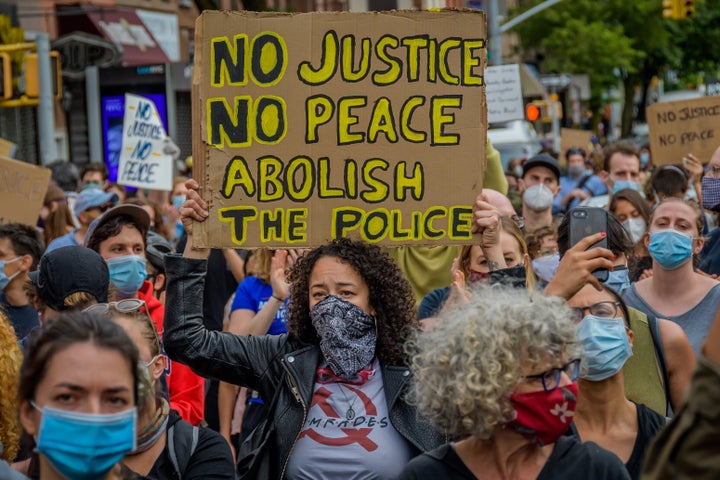
Chants to “Defund the police!†have reverberated around the country, from New York City to Minneapolis and through the streets of Los Angeles, as thousands of people protested racist police violence this past week.
While some may hear the phrase and assume it’s a radical, punitive step to end policing altogether, it’s actually an acknowledgment of a simple point: Police departments typically have way, way more money than other government services that could better serve communities without subjecting them to brutality and violence.Â
Collectively, the U.S. spends $100 billion every year on policing, or $1 trillion in the past decade. The New York City Police Department’s annual budget was nearly $6 billion last year. The federal Centers for Disease Control and Prevention’s annual budget for dealing with infectious diseases budget was about a third of that ($2.55 billion). The average state spending on higher education rose less than 6% between 1986 and 2013, while the average spending on policing increased by 141%, according to a 2018 Freedom to Thrive analysis.Â
Black Lives Matter and other anti-police violence groups have been working to defund the police by cutting agencies’ budgets for years. And these efforts have gained momentum in the wake of the outcries spurred by deaths at the hands of police of George Floyd, Breonna Taylor and others. Last year alone, police in the U.S. killed over 1,000 people, 25% of whom were Black.
“It is important to remember that modern-day policing have their roots in slave catching. These systems were created to hunt, maim, and kill Black people,†Kailee Scales, managing director of Black Lives Matter Global Network, told HuffPost. “As we have seen in the example of George and many others in this month alone, the police are a force of violence that profiles, harasses, and inflicts harm on Black communities without accountability ― and with far too many resources.â€
The police are a force of violence that profiles, harasses, and inflicts harm on Black communities without accountability ― and with far too many resources.†Kailee Scales, managing director of Black Lives Matter Global Network
Over the last decade, states and cities have spent more and more of their budgets on policing, far exceeding funding increases for other fundamental services like mental health care, affordable housing, job programs and education. Researchshows that these services are actually more impactful in reducing crime than more police or prisons.Â
“We need and demand deep investment in education, employment programs, and real, meaningful and equitable universal health care,†Scales said. “We need to divest from police in (public) schools and invest in more teachers and counselors. We need to divest from the criminalization of mental health and provide mental health and restorative services.â€
Floyd, who leaves behind three children, was arrested by police after a store owner accused him of buying cigarettes with a counterfeit $20 bill. Less than 20 minutes after police arrived, Floyd was unconscious on the ground, as police officer Derrick Chavin knelt on his neck for nearly nine minutes. Whether the $20 bill was fake has yet to be confirmed by authorities. Floyd recently lost his job at a restaurant due to the coronavirus outbreak, and a variety of city services might have helped him. The police didn’t.Â
Massive Police Budgets Across the Nation
Although the federal government and states budget for law enforcement agencies, the majority of funds spent on policing come from local municipalities. The majority of that money comes from tax revenue from the public, but other revenue streams include state funding, federal funding and private donations from police foundations, the latter of which is often not disclosed. These funds pay for police buildings, vehicles, officers’ and other police employees’ salaries, and more.Â
Oakland, California, spent over 40% of its total budget on its police department in 2018, according to a 2018 Freedom to Thrive report published by the Center for Popular Democracy, Law for Black Lives and the Black Youth Project. Los Angeles and Chicago have some of the largest police budgets in the country, both topping out at nearly $1.5 billion in 2018 (L.A.’s police budget accounted for 25% of its total budget, while Chicago’s accounted for nearly 40% of its overall budget). In Minneapolis, where Floyd was killed, 35% of the city’s 2018 budget went to the police department.Â
Police budgets seem even more gargantuan when compared to the budget for other social services in cities. In 2019, the New York City Police Department had a budget of nearly $6 billion, which is around 8% of the city’s total budget. The total annual budget for job programs was around $281 million ― 0.3% of the city’s budget. In Oakland, social service programs like youth programs, housing and income support received less than 30 cents to every dollar given to the police in 2018.Â
The disparity in funding between police departments and other human services was on full display when hospitals and doctors across the country were scrambling to find personal protection equipment, ventilators and intensive care unit beds as the coronavirus spread across the U.S. in March. Two months later, police turned out in military-grade equipment to respond to protests and rioters.
David McNew via Getty Images
Fully equipped police in Los Angeles make arrests on Monday after a curfew went into effect during demonstrations spurred by the death of George Floyd at the hands of Minneapolis officers.
“The United States did not have to be the country that had the highest number of [coronavirus] cases and deaths in the world,†said Kumar Rao, co-author of the Freedom to Thrive report and director of Justice Transformation at the Center for Popular Democracy. “The reasons for that are complex, but at least one of them is the fact that we did not invest in public health in this country in the way that other countries do. The issue of how we spend our money is a really, really important one.â€
In some cities, police budgets are used to pay out police misconduct settlements. Chicago spent $113 million in 2018 alone to settle lawsuits alleging police misconduct; in the past decade, the city has paid out more than $500 million in such settlements. Between 2005 and 2018, Los Angeles paid out a total of $880 million in settlements.Â
While it’s important that the families of Eric Garner, Ezell Ford and so many more receive monetary justice for police brutality that took their loved ones from them, this money often comes from taxpayers. What’s more worrisome is that police brutality has no direct financial implications for the departments ― even after highly publicized killings, their budgets keep growing. Â
Meanwhile, the “government continues to sell us this false narrative that we don’t have enough money†for other services like healthcare, education, housing or substance abuse programs, Rao said. “It’s austerity for everything but the military and the police.â€
“In this nation, city budgets illustrate where its priorities lie,†Scales said. “It is time for divestment from violent policing infrastructure and investment in strengthening Black communities. And we can no longer wait.â€Â
Challenging The Idea That More Police Mean Better SafetyÂ
In order to understand why cutting police budgets is beneficial, the country first has to fundamentally shift its approach to and understanding of the police as an American institution. Overpolicing does not actually keep communities safe, said Saye Joseph, policy and advocacy manager at Black Youth Project 100.
“Police, in all forms, have been a way to keep property safe and keep a subsection of society safe but it hasn’t kept all communities safe and healthy,†Joseph said. “We have to break that notion apart that police equals safety.â€
Oftentimes, the very services underfunded by cities become baked into police officers’ jobs.Â
“We over-rely on police to handle a range of social problems that they are simply incapable of addressing,†Seth Stoughton, a former police officer and current associate law professor at the University of South Carolina, said. “They don’t have the expertise, the training, the equipment, the organizational capacity to deal effectively with mental illness or poverty, homelessness, substance abuse, school discipline ― a whole range of things that we socially have made police issues.â€Â
By reallocating parts of massive police budgets back into communities, specifically communities of color, the “constant clarion call for more officers†may begin to lose its appeal, Stoughton added.Â
While some organizers have called to fully abolish the police (and many have said that defunding the police is the first step in doing so), Stoughton urged caution. He fears that if the police as an institution is fully eradicated, private security will simply take their place. Privatized security would most likely have less oversight, less training and less professionalism than the police departments we have now.Â
Erik McGregor via Getty Images
One of Tuesday’s protests in New York City.
The George Zimmermans and Travis McMichaels of the world, Stoughton cautioned, could become the people employed by private security entities. (Zimmerman, the head of his neighborhood watch in a Florida community, fatally shot Trayvon Martin while the 17-year-old was walking in a hoodie because Zimmerman thought Martin looked suspicious; McMichaels is charged with killing Ahmaud Arbery in Georgia after McMichaels and his father believed Arbery was a robbery suspect, chased him in a pickup truck and shot him while he was out for a jog; the father and another man also have been charged in the case.)Â
“If we scrapped police agencies, what may happen is we’re going to see more gated neighborhoods that hire their own armed security forces. That doesn’t seem like a tenable solution to me,†Stoughton said. “At its core to me, policing is a public service. It is and primarily should be a government institution, which shouldn’t be limited to the relatively few wealthy enclaves that can afford to provide it in whatever way they want.â€
What Does Defunding The Police Actually Look Like?
Some cities and localities have already taken steps to stop inflating police budgets. Last year, Jillian Johnson, the mayor pro tem of Durham, North Carolina, decided not to allocate more funding to city police officers.Â
“Like every other community in America, our community is over-invested in policing and incarceration and under-invested in housing, jobs, education, health and all the other investments that make those punitive interventions unnecessary,†she wrote at the time. “The safest communities don’t have the most cops; they have the most resources.â€Â
In 2018, St. Paul, Minnesota, Mayor Melvin Carter rejected a request for more police officers. “Our driving goal shouldn’t be to hire as many officers as possible but to reduce the number of times we have to call police in the first place… As long as we focus more on responding to emergencies than on preventing them in the first place, we’ll never have enough police officers,†he said at the time.Â
Budgets are a really clear way for cities to shrink the size, the scope and the power of policing. Kumar Rao, director of Justice Transformation at the Center for Popular Democracy
Photos of militarized policeassaulting peaceful protesters during the current unrest have led some city officials to question if the police really need this much money and firepower. Los Angeles Mayor Eric Garcetti has been pushing for a 7% overall increase in the city’s police budget. But on Wednesday, Garcetti said he will cut up to $150 million in the LAPD’s budget to invest “in jobs, in health, in education and in healing,†especially in the city’s communities of color.
In a significant move, the Minneapolis school district terminated its contract with the city police department because of Floyd’s death.Â
Few other cities have embraced the idea of cutting police budgets. New York City Mayor Bill de Blasio’s 2021 spending proposal would keep the NYPD’s nearly $6 billion budget mostly intact while cutting funds for other agencies and programs ― some by as much as 80% ― in the wake of the pandemic’s effect on tax revenues. In Philadelphia, the mayor has proposed spending $977 million on police and prisons, while cutting funding for employment development, recreation centers, libraries and youth violence prevention.Â
President Donald Trump, whose desire earlier this week for a photo-op resulted in law officers using tear gas, rubber bullets and flash-bang grenades to disperse peaceful protesters outside the White House, has criticized demands to defund the police.
“The Radical Left Democrats new theme is ‘Defund the Police.’ Remember that when you don’t want Crime, especially against you and your family,†he tweeted. “More money for Law Enforcement!â€Â
Although mayors and other elected officials control the purse strings for their law enforcement agencies, they’re not really in control right now, said Rao of the Center for Popular Democracy.Â
“Part of the reason city officials are in this position is because they have given so much money and power over to police departments, year after year,†he said. “That needs to fracture in order for us to be able to plot a new path forward. Budgets are a really clear way for cities to shrink the size, the scope and the power of policing.â€
CORRECTION: An earlier version of this article misstated that the 2019 New York City Police Department budget was nearly $7 billion, which is the combined budget for corrections and police. The article has been updated to include the correct 2019 budget for just the New York City police, which is nearly $6 billion.Â
Calling all HuffPost superfans!
Sign up for membership to become a founding member and help shape HuffPost’s next chapter
Richard Shotwell/Invision/APRachel Griffiths is apologizing after the backlash over her “shallow” Instagram post.
Rachel Griffiths is acknowledging her “white bitch privilege†after sparking outrage with an insensitive post about getting a manicure, in which she wrote about how “America is burning†and “people are dying.â€
The Australian actor, who’s best known her roles on television series like HBO’s “Six Feet Under†and the ABC soap “Brothers and Sisters,†caught backlash earlier this week for sharing a photo of herself at the nail salon.Â
Absolutely failing to read the room in the wake of the ongoing coronavirus pandemic and protests against racial injustice, Griffiths told her followers that global unrest was “easier on the soul to watch†with a fresh coat of polish.Â
“Shallow I know,†Griffiths wrote alongside the photo with her diamond ring front and center. “America is burning people are dying … but still it just seems easier on the soul to watch all this happening with beautiful nails.â€
“And judging by the line of desperate ladies I am not alone,†she continued. “Shallow people we are but I need to share this important covid update. The manicurists are open!!! Tip generously as they have had not income since COVID lockdown.â€
— Eric Eidelstein (@ericeidelstein) June 3, 2020
Her post quickly caught the attention of people who called the actor out across social media.
“I am continually floored by celebrities who write wildly inappropriate and tone deaf statements and share it online,â€Â one person wrote on Twitter. “Rachel Griffith’s post about her nails, featuring a ring with a stone the size of every semi-precious gemstone ring I’ve ever own combined, IS A CLANGER.â€
“OMG is this Australia’s own Rachel Griffiths? Eeeek,†another added.Â
She has since deleted the post and issued a lengthy apology on Tuesday, going as far to thank her detractors for keeping her in check.Â
“The last few days have been wrenching,†she wrote in the caption. “My post early today leant away from that pain but I understand in doing so it pained others who can’t look away from what’s happening — can’t turn off and check out because it is their lives — their brothers theirs sisters their children. And it’s not over ‘there.’ This our country’s stain also.â€
She continued: “I did not intend to trivialise just escape it. But that I understand is part of the problem. I am sorry. I am sorry that I got this so wrong today. I am sorry that I abdicated any meaningful sense making of what is happening this week and has been happening for centuries.â€
“Thank you to the people who have called me out,†she concluded. “I have a long way to go to truly understand my white bitch privilege.â€
While some readily forgave Griffiths for her misstep, others weren’t so keen on letting her off the hook, especially given her current role in “Total Control,†a political drama exploring racism and the discrimination against Indigenous Australians.
“Come on, you knew better,†one Instagram user commented under the post. “You are the Executive Producer and lead actress in a prime-time indigenous ABC Australia drama, about black deaths in custody, working alongside a prominent indigenous production company. You knew. You even said in the post ‘this is shallow…’, so why did you post it anyway? The spirit in which it was intended was pure ignorant white privilege.â€
Chris Trousdale, a former member of the boy band DreamStreet, died Tuesday from complications of coronavirus, according to reports. He was 34.
A family member said Trousdale died from the effects of COVID-19, TMZ reported. Former bandmate Jesse McCartney confirmed the cause on Instagram. A rep told Billboard Trousdale died of an “undisclosed illness.â€
McCartney wrote about their time together as 12- and 14-year-olds and said Trousdale was the most popular in the group. “I truly envied him as a performer,†he wrote.
“Although we were a band for only 3 years, at that age, it felt like a lifetime and we built a real brotherhood,†McCartney added. “My deepest sympathies go out to his mother whom I know cherished him dearly. RIP Chris.â€
Dream Street played together from 1999 to 2002 before legal hassles between their parents and management reportedly caused a breakup. The group produced a No. 1 self-titled record on Billboard’s independent albums chart. Their biggest song, “It Happens Every Time,†climbed to No. 48.
Trousdale began as a stage actor at age 8, according to Variety, and later played Gavroche in “Les Miserables†on Broadway and Friedrich von Trapp in “The Sound of Music,†Playbill wrote.
He also did guest spots on kid shows like “Shake It Up†and “Austin & Ally†years after his boy-band days.
We use cookies on our website to give you the most relevant experience by remembering your preferences and repeat visits. By clicking “Accept”, you consent to the use of ALL the cookies.
This website uses cookies to improve your experience while you navigate through the website. Out of these, the cookies that are categorized as necessary are stored on your browser as they are essential for the working of basic functionalities of the website. We also use third-party cookies that help us analyze and understand how you use this website. These cookies will be stored in your browser only with your consent. You also have the option to opt-out of these cookies. But opting out of some of these cookies may affect your browsing experience.
Necessary cookies are absolutely essential for the website to function properly. These cookies ensure basic functionalities and security features of the website, anonymously.
Cookie
Duration
Description
cookielawinfo-checbox-analytics
11 months
This cookie is set by GDPR Cookie Consent plugin. The cookie is used to store the user consent for the cookies in the category "Analytics".
cookielawinfo-checbox-functional
11 months
The cookie is set by GDPR cookie consent to record the user consent for the cookies in the category "Functional".
cookielawinfo-checbox-others
11 months
This cookie is set by GDPR Cookie Consent plugin. The cookie is used to store the user consent for the cookies in the category "Other.
cookielawinfo-checkbox-necessary
11 months
This cookie is set by GDPR Cookie Consent plugin. The cookies is used to store the user consent for the cookies in the category "Necessary".
cookielawinfo-checkbox-performance
11 months
This cookie is set by GDPR Cookie Consent plugin. The cookie is used to store the user consent for the cookies in the category "Performance".
viewed_cookie_policy
11 months
The cookie is set by the GDPR Cookie Consent plugin and is used to store whether or not user has consented to the use of cookies. It does not store any personal data.
Functional cookies help to perform certain functionalities like sharing the content of the website on social media platforms, collect feedbacks, and other third-party features.
Performance cookies are used to understand and analyze the key performance indexes of the website which helps in delivering a better user experience for the visitors.
Analytical cookies are used to understand how visitors interact with the website. These cookies help provide information on metrics the number of visitors, bounce rate, traffic source, etc.
Advertisement cookies are used to provide visitors with relevant ads and marketing campaigns. These cookies track visitors across websites and collect information to provide customized ads.