Thursday, May 14, 2026

William Barr’s Vast, Nameless Army Is Being Brought To Bear On D.C. Protesters

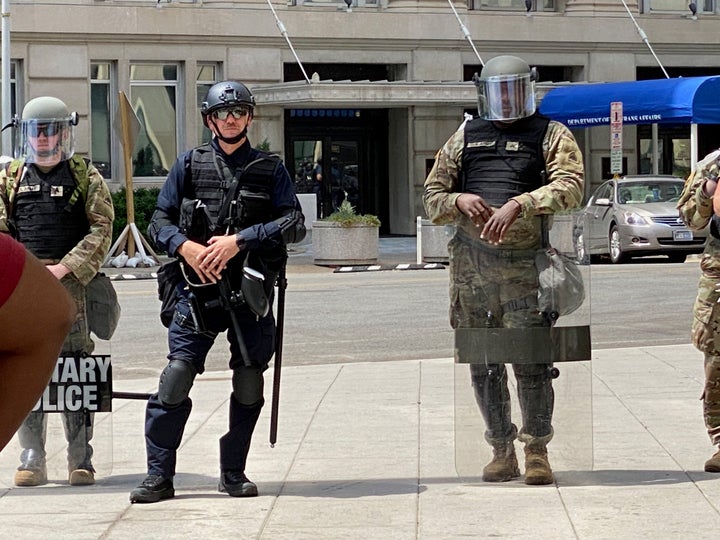
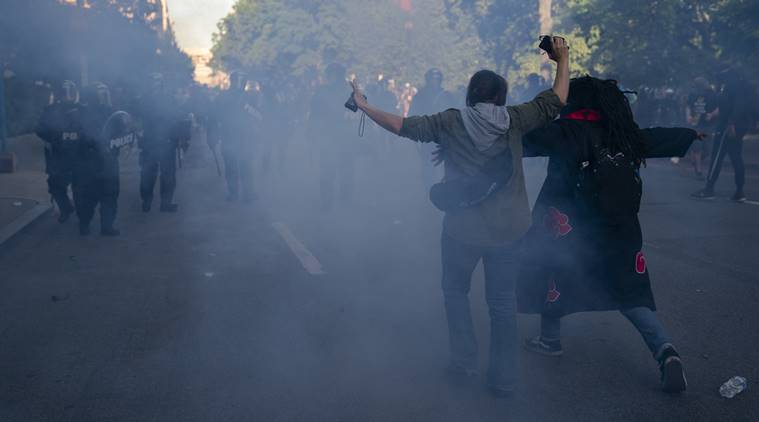
WASHINGTON ― Just a few hundred feet north of the White House on Wednesday afternoon, armed agents of the federal government, dressed in a patchwork of colors and protective gear, stared down peaceful protesters demonstrating for Black lives. Yet what was perhaps most alarming was what was not visible on many of the officers: any insignia revealing their identity or even the name of the agency they work for. 

Some members of the Drug Enforcement Administration and FBI stationed throughout downtown Washington wore outfits that at least identified their agency, even if they weren’t wearing name tags that identified them personally. But the police line just north of the White House on Wednesday afternoon featured a patchwork of colors and agents wearing generic outfits ― sometimes what appeared to be just T-shirts under their protective gear that gave no indication of even their department or military branch. 

Attorney General William Barr is leading this aggressive response that has brought in an alphabet soup of law enforcement agencies to guard federal property and suppress unrest: FBI; the Bureau of Alcohol, Tobacco, Firearms and Explosives (ATF); the Drug Enforcement Administration (DEA); the U.S. Marshals; and the federal Bureau of Prisons. Those Department of Justice forces join Homeland Security officers, the D.C. Metropolitan Police Department, the Capitol Police, the Federal Protective Service, the Secret Service and the District of Columbia National Guard.

Bringing in so many law enforcement agencies has the potential to create problems ― each has its own culture, practices and command structures. Allowing federal law enforcement to operate with anonymity all but eliminates accountability when force is inevitably used against demonstrators. Critics say it also breeds government distrust and is reminiscent of authoritarian regimes.


Members of federal law enforcement line up with riot gear and face shields near the White House on Wednesday.

At least some of the officers on the police line by the White House appeared to be with the Bureau of Prisons, which dispatched Special Operations Response Teams that the BOP told HuffPost are “highly trained tactical units capable of responding to prison disturbances” and “specialize in crowd control scenarios” behind bars. 

A senior Justice Department official credited Barr with the idea of bringing in federal prison corrections officers, calling it an example of Barr’s “outside the box” thinking. “He brought those people in,” the official said, because dealing with riots is “exactly what they do best.”

The senior Justice Department official confirmed that the prison bureau officers were stationed near the White House, though the BOP declined to verify whether the armed men photographed facing off with peaceful demonstrators Wednesday did, in fact, work for BOP. 

“We cannot verify the individuals in the photos you referenced,” the Bureau of Prisons told HuffPost. “For safety and security reasons, we are not providing more specific information about law enforcement operations.”

A Huge Problem For Oversight

Michael Bromwich, the former inspector general of the Justice Department who oversaw internal investigations, said that allowing federal law enforcement officers to operate anonymously “creates a huge problem” for oversight.

“It completely undermines the ability to hold law enforcement personnel who engage in misconduct accountable,” said Bromwich.” You’ve got to know who they are, and certainly which agency they represent.” 

Many of these Justice Department components, especially the BOP, have opaque internal affairs systems that don’t hold federal law enforcement officers accountable even in normal circumstances. But Bromwich said he has never seen a situation in which large numbers of law enforcement personnel haven’t been identifiable by name or even by agency. “I don’t know if there’s any historical precedent for that.”  

The senior Justice Department official said that concerns about officer identity are a “red herring” because surveillance video would make it easy to identify any officers as necessary.

“We’re pulling in people from all over the country to help secure a city,” the senior DOJ official said. “We’re focused on getting them fed… making sure that they have the proper equipment they need. Frankly, the logistical elements that have been done here have been amazing.” 

He downplayed concerns that federal government agents refused to identify their agency to protesters or to journalists. 

‘This is an incredibly volatile scene,” the senior DOJ official said. “So to the extent people are asking ‘Who are you, who are you with, what are you doing?’ I don’t think you should read anything [into it] if people aren’t responding. This is very different than a normal law enforcement function.” 

A member of federal law enforcement stands among members of the National Guard on Wednesday. Without nametags or ID on unifor


A member of federal law enforcement stands among members of the National Guard on Wednesday. Without nametags or ID on uniforms, especially for officers in riot gear, it could be difficult to identify a particular officer in a misconduct complaint.

During the Obama administration, the DOJ said in a letter to the Ferguson Police Department in Missouri that allowing officers to work anonymously creates “mistrust and undermines accountability” and “conveys a message to community members that, through anonymity, officers may seek to act with impunity.” An after-action report of the police response to the Ferguson demonstrations over the police killing of Michael Brown ― a report that former members of law enforcement co-authored ― said that the removal of nameplates “defeated an essential level of on-scene accountability that is fundamental to the perception of procedural justice and legitimacy.”

Christy Lopez, the former Justice Department official who warned Ferguson about the lack of nameplates, said the anonymity of officers on the streets of D.C. was “an indication of how upside-down this administration is.”

“By failing to ensure that their officers are identifiable, and thus more readily held accountable if they violate people’s rights, federal law enforcement officials are acting akin to the bystander officers in Minneapolis: aligning themselves with those who would commit and conceal police abuse rather than sending a clear message to the public and to their own officers that such abuse will not be tolerated,” Lopez said.

Bromwich said it was “very problematic” to send components of the Justice Department with very specific responsibilities into an environment divorced from their typical duties. Members of the FBI hostage team, who have also been spotted on the streets of D.C., are “not used to dealing with mass protests,” Bromwich said.

“They’ve probably never had even an hour training about that,” Bromwich said. “It’s unfair to them and unfair to protesters to have them deployed to do this.” 

Congress Doesn’t Know Either

House Democrats, led by Judiciary Committee Chairman Jerry Nadler (D-N.Y.), have formally requested information on the various agencies policing protesters in D.C. In a letter delivered Wednesday to Barr, Defense Secretary Mark Esper, Interior Secretary David Bernhardt and Acting Secretary of Homeland Security Chad Wolf, Nadler and other Democratic leaders asked which authority the administration used to establish this interagency force, and when.  

Democratic leaders were not informed of the agencies deputized to patrol the protests. A House Democratic aide familiar with the committee’s work said it is in the process of figuring out what each agency has been deployed to do as the scene unfolds around them.  

Members of Congress also asked for specifics on which agencies had officers on the ground Monday, when federal law enforcement advanced on peaceful protesters with pepper spray, smoke canisters and nonlethal projectiles as they cleared the way for President Donald Trump to hold a photo-op outside of St. John’s Church.

Sen. Elizabeth Warren (D-Mass.) also formally requested that the DOJ inspector general investigate Barr’s role in the Monday evening incident.
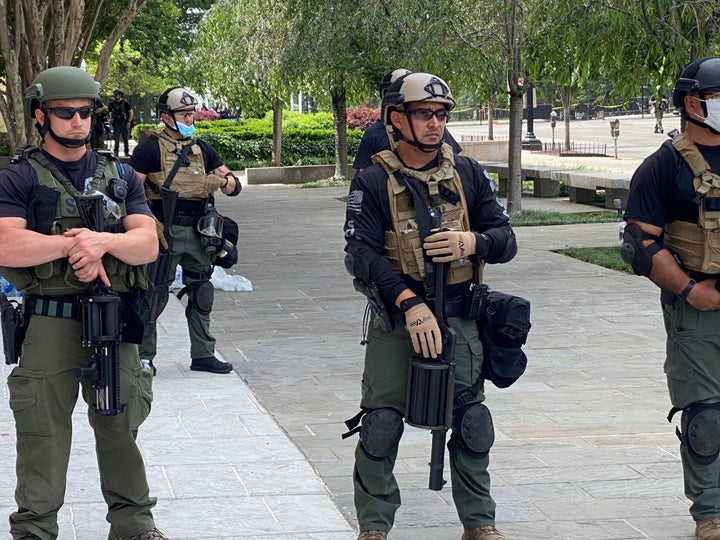
Federal law enforcement officers wear unidentifiable uniforms, some with plain T-shirts under their military-style gear, whil


Federal law enforcement officers wear unidentifiable uniforms, some with plain T-shirts under their military-style gear, while they hold a line near the White House on Wednesday.

Rep. Don Beyer (D-Va.) and Del. Eleanor Holmes Norton (D-D.C.) are working on writing a bill to require federal law enforcement officers in uniform to clearly show their names and agencies when patrolling First Amendment protests. The law wouldn’t apply to undercover law enforcement officers or to military units like the National Guard, which has also been deployed to protests. Beyer said military personnel are typically easily identifiable because of their recognizable fatigues. Beyer and Holmes Norton proposed legislation requiring body cameras on federal law enforcement in 2019; last November, the DOJ started a pilot program allowing federally deputized officers to wear body cameras for the first time. The law enforcement officers at the protests were not seen wearing body cameras.

“When you can’t tell who people are, then there is no accountability at all,” Beyer said. “You can go out and bust any heads you want to because who is going to hold you accountable if you are anonymous — especially with the big face masks.”

Beyer, who has been watching videos of protests, said he could not distinguish federal personnel but that local law enforcement officers were also covering their badge numbers with black tape, a practice that was initially done to honor colleagues who died of the coronavirus. Police in D.C. are required in police guidelines to identify themselves when asked and keep their badge numbers present while on the job. 

“You don’t know who they are, who they represent,” Beyer said. “Are they even allowed to carry weapons in Washington, D.C.?” 

Beyer hopes they can bring the bill up for a vote in the next two months.

Sen. Chris Murphy (D-Conn.) also tweeted Wednesday night that he planned to introduce legislation “to require uniformed federal officers performing any domestic security duties to clearly identify what military branch or agency they represent.”

“We cannot tolerate an American secret police,” the senator wrote.

Bromwich, the former Justice Department watchdog, said that the rhetoric from Trump and Barr could give federal law enforcement officials cover to use excessive force on demonstrators.

“The risk of using excessive force is that you’ll be accused of it and that it will be sustained and it will be punished,” he said. “That risk seems to have been removed.”


Source link

Who is eligible for homebuilder grants, and how much will they have to spend?

On Thursday the Australian government announced the homebuilder stimulus scheme, offering $25,000 grants for new homes or substantial renovations.

But just who is eligible for the cash and what are the strings attached?

Who qualifies?

To be eligible, you must:

  • Be a current or prospective owner-occupier – not an investor

  • Be a natural person, not a company or trust

  • Be an Australian citizen

  • Earn $125,000 or less a year since 2018-19 for singles, or less than $200,000 a year for couples

For context, a single person earning $125,000 is in the top income decile, meaning they earn more than 90% of other Australians.

The income caps are the same that applied to the first home deposit scheme, although the average income of applicants to that program was $67,387 for singles and $109,525 for couples.

How long have I got?

To qualify, participants must enter into a building contract between 4 June and 31 December 2020. Construction must be contracted to commence within three months of the contract date.

What can I spend it on?

Grants must be spent to:

  • Build a new home as a principal place of residence valued at up to $750,000 (including land); or

  • Substantially renovate an existing home as a principal place of residence, with renovations valued at between $150,000 and $750,000 and the dwelling not valued at more than $1.5m before the renovation.

Even the cheapest renovation eligible for the scheme ($150,000) would require a grant recipient to spend at least $125,000 of their own money – meaning the scheme is most likely to be accessed by those with substantial savings or a willingness to borrow.

The renovation can be a combination of works (eg, a kitchen and bathroom renovation) but must be supervised by a registered or licensed builder.

Are there any exclusions?

Homebuilder grants cannot be for used for additions to the property that are not connected to the principle place of residence, such as swimming pools, tennis courts, outdoor spas and saunas, nor detached structures such as sheds, garages or granny flats.

Renovations or building work must be undertaken by a building service contractor registered or licensed at the time the scheme was announced.

How much will it cost the taxpayer?

Homebuilder is expected to cost $688m although it is an uncapped and demand-driven program, meaning it may cost more or less than that depending how many people are eligible and who puts their hand up for the money.

The cost of $688m implies that some 27,520 grants of $25,000 will be made.

Are there any checks against rorting?

The revenue offices of each state and territory will implement the scheme and check for potential fraud.

The purchaser can require the builder to demonstrate that the contract price for the work is no more than for a comparable product (measured by quality, location and size) as at 1 July 2019.

Can I use homebuilder in conjunction with other schemes?

Yes. Homebuilder can be used in conjunction with state and territory first home owner grant programs, stamp duty concessions and other grant schemes, as well as the commonwealth’s first home loan deposit scheme and first home super saver scheme.

Why is the commonwealth offering the scheme?

Wednesday’s March quarter national accounts showed dwelling investment in Australia fell 2.9% in the quarter and by more than 15% over the past 12 months.

The contraction is expected to be worse in the June quarter and construction lobby groups predict new dwelling commencements will decline by 50% by the end of 2020.

The government believes there is a shortfall of 30,000 new dwelling commencements in the second half of 2020.

What about social housing?

When asked about social housing on Thursday, the treasurer, Josh Frydenberg, pointed to existing policies on social housing, including a $1bn national housing infrastructure facility.

“That means there are loans out there that are significantly support more than 1,000 new dwellings as well as nearly 4,000 social and affordable dwellings,” he told Radio National.

Frydenberg said social housing was a “combined responsibility with the states” and noted the Victorian government’s $500m package to upgrade 23,000 social housing dwellings.

What has Labor said?

Labor’s leader, Anthony Albanese, has said the program is “very restrictive” because it is means-tested, contracts must be signed this year and many projects – such as pools – are excluded.

Albanese argued the program was “not particularly well targeted” because “most people don’t have $150,000 in the current climate”.

“There’s nothing in this package for social housing, nothing to provide affordable housing for essential workers, this is a very narrow package,” he told Radio National Breakfast.

Albanese said Labor’s disposition was to support programs that stimulate the economy but it “looks to be a very flawed proposal at first glance”.

Source link

Amid pandemic, investors bet on India’s Jio and its giant-killer playbook

0

MUMBAI (Reuters) – From its Silicon Valley-like campus near Mumbai, Indian billionaire Mukesh Ambani’s Jio telecom carrier is emerging as a winner from changes in the way Indian consumers plug into a digital economy made more urgent by the coronavirus pandemic.

FILE PHOTO: Commuters use their mobile phones as they wait at a bus stop with an advertisement of Reliance Industries’ Jio telecoms unit, in Mumbai, India July 10, 2017. REUTERS/Shailesh Andrade/File Photo

For Indian shoppers who prefer to order online, it is launching a grocery ordering service with Facebook Inc’s (FB.O) popular WhatsApp messaging. For Bollywood fans who would prefer to avoid a crowded theater, it is readying same-day-release on the Jio platform.

Those plans had been in the making for months, but the pandemic has given them a shot in the arm. India’s 10-week lockdown has also led to a surge in demand for data, boosting Jio’s phone and broadband offerings.

And, over the past six weeks, the digital business of Ambani’s Reliance Industries Ltd (RELI.NS), known as Jio Platforms, raised a striking $10 billion from global investors.

The investments, including $5.7 billion from Facebook and money from private equity firms Silver Lake, Vista Equity Partners, General Atlantic and KKR & Co Inc (KKR.N), value Jio Platforms, where Reliance last year announced it was consolidating its digital offerings, at roughly $65 billion.

They also put Jio on track toward a goal Ambani described last year: an eventual listing that would mark a milestone for his effort to unite the digital offerings of his sprawling conglomerate, from set-top boxes to e-commerce and home automation.

Reliance declined to make Ambani, Asia’s richest man, available for interview or respond to a detailed list of questions.

But interviews with a dozen people familiar with the company’s development efforts show how Reliance has pushed aggressive pricing for a one-stop digital commerce platform that incorporates features modeled on the American tech heavyweights it sees as rivals.

When Jio set out to launch a set-top box, it tasked a team with analysing – and in some cases replicating – some 100 features of an Apple TV set-top box last year, according to a person close to the project and internal Jio documents seen by Reuters.

“Presentation and listing of menu items should be similar to Apple TV,” one of the documents says, assigning the task a “Priority 1” rating.

One document compares the products’ features, like average weight. Another includes instructions like “Matching the background theme of Launcher (home screen) to that of Apple TV.”

Jio’s set-top box comes included in its broadband plans, with the cheapest annual deal costing around $110, whereas Apple TV 4K is selling for around $210 to $230 on Indian e-commerce sites.

Apple Inc (AAPL.O) did not respond to requests for comment.

Jio also analysed Amazon’s Alexa voice assistant with the aim of coming up with its own offering, according to one person with knowledge of Jio’s strategy. “They wanted to say: ‘Hey Jio, can you switch on the lights?’,” said the person. Reuters could not determine the status of the project. Amazon declined comment.

In other areas, Ambani has shown a willingness to bet big on emerging technology. In India, Jio was an early adopter of voice-over-LTE, which is more efficient than traditional networks. The company expects that to give it an edge in rolling out 5G services.

“Few companies have the potential to transform a country’s digital ecosystem in the way that Jio Platforms is doing in India,” said KKR’s co-founder Henry Kravis in announcing his investment.

In partnership with Facebook’s WhatsApp, Reliance has launched a new service that allows consumers to order from their local grocery stores at a time when many Indian consumers, like shoppers elsewhere, are trying to minimize trips to stores. The service was rolled out in April in three areas of Greater Mumbai.

“Reliance wants to be a global technology powerhouse,” said Rahul Malhotra, an analyst with Bernstein. “With the Facebook partnership, they will build the WeChat of India,” he added, referring to Tencent Holdings’ (0700.HK) messaging, payments and social media app that is ubiquitous in China.

TOTAL RELIANCE

Ambani dominates a dizzying array of sectors: Jio is India’s leading telecoms carrier, Reliance Retail Limited is its top brick-and-mortar retailer, Reliance’s Network18 Media & Investments Limited is one of its biggest news networks, and Reliance’s Jamnagar is its largest oil complex.

His empire also produces films at Jio Studios and runs India’s top soccer tournament, the Indian Super League.

By providing Indian consumers access to everything from groceries and clothes to banking and home automation via an integrated system running through Jio, Ambani hopes Reliance can become what he calls an “everything company.”

To help back its retail push, Reliance in March asked an Indian logistics provider for some 5 million square feet of warehousing space, according to a person briefed on the plans.

That comes after a 2019 request for service, reviewed by Reuters, that said the company was seeking 1.1 million square feet of warehousing space that would be “expandable in future.”

Reliance has not made public details of its warehousing space. By comparison, Amazon said in 2017 it had warehouses covering about 3 million square feet in India and has expanded since then. Amazon did not provide Reuters with an updated figure.

In addition to an eventual listing for Jio, Ambani has said he would look to list Reliance’s retail operations as well.

Jio’s other planned offerings include home viewings for films on the day of their theater release and networked security systems for cars.

But Jio’s broadband rollout, which is key for many of its planned digital offerings, has hit glitches, in part because the company had not initially set up sufficient customer support services, according to two employees and internal chat messages reviewed by Reuters. And unlike in telecoms, Reliance has not offered steep discounts to attract new customers.

Ambani’s ambition of creating a homegrown tech company took shape when Jio was launched in 2016 with aggressively priced data plans. Suddenly, migrant construction workers were video-chatting with their families, farmers were checking crop prices, and office workers were screening films during their commutes home on crammed trains.

Slideshow (2 Images)

Jio’s competitors, then numbering around a dozen, were forced to slash prices, quit, or merge as Reliance pumped in at least $30 billion in oil-related earnings to subsidize prices. “We have to bleed others to death – I remember that as a refrain,” said one former high-level Reliance executive, who asked not to be named.

Some rivals held out for longer than expected and Reliance ended up investing more than originally planned, according to a half-dozen sources who worked at Reliance or were briefed on the company’s ramp-up.

Last year, Jio became India’s No. 1 carrier by number of users. Meanwhile, rival Vodafone Idea Ltd (VODA.NS), a venture between the Indian unit of Britain’s Vodafone Group Plc (VOD.L) and billionaire Kumar Mangalam Birla’s Idea Cellular, has warned it may not survive having to pay about $4 billion in overdue levies and interest to the government.

Reporting by Alexandra Ulmer and Promit Mukherjee in Mumbai; Editing by Philip McClellan and Kevin Krolicki

Source link

CBA moves to curb abusive online banking

Commonwealth Bank has introduced new rules for online banking after discovering abusive messages in the transaction descriptions of scores of customers.

The issue came to light after the bank noticed disturbing messages in the account of a customer experiencing domestic and family violence.

That instance prompted staff to find that more than 8,000 customers had received multiple payments, often less than $1, with abusive messages in the transaction description, effectively using the bank’s online platform as a messaging service.

Read Next

The messages ranged from innocuous jokes to serious threats, the bank says.

Australia’s biggest bank says under the revised guidelines it may refuse transactions and suspend online access for customers who use its online services to stalk, harass or intimidate others.

“The message is simple: we can see you and we won’t tolerate the use of our digital banking platforms to facilitate abuse,” CBA general manager of community Catherine Fitzpatrick said.

The new approach will not prevent people using other bank’s systems to send potentially abusive messages.

However, a spokeswoman said the bank had shared its findings with industry peers and wanted them to take a similar approach.

Australian Banking Association chief executive Anna Bligh said banks were aware of the issue and were taking steps to tackle it.

Anyone with concerns should contact their bank, she said.

The industry and the Australian government’s financial intelligence unit, AUSTRAC, have also agreed that people suffering domestic violence will be able to prove their identity by ways other than showing a driver’s licence or birth certificate.

Financial abuse was often part of this violence, AUSTRAC said, in which victims were denied access to bank accounts.

Read Next

Source by [author_name]

Anti-Saudi blocs in Iraqi parliament want to sue

Jun 3, 2020

BAGHDAD — While Iraqi Prime Minister Mustafa al-Kadhimi takes steps to improve relations with neighboring Arab countries and seeks to carry out economic projects with them in an attempt to ward off the repercussions of the current economic crisis, a number of parliament blocs are preparing a draft law to hold Saudi Arabia accountable for “dispatching suicide bombers to Iraq.”

Upon taking office, Saudi Arabia was the first destination of Iraq’s new finance minister, Ali Abdul Amir Alawi. Alawi, who also serves as deputy prime minister, arrived in Saudi Arabia at the end of May as Kadhimi’s envoy to discuss the electricity grid connection between the two countries, bring Saudi investments into Iraq and demand that Iraq’s share under April’s OPEC+ deal, which was signed to address the major decline in global oil prices, be increased.

Although the visit was fruitful, some Shiite political parties, including Nouri al-Maliki’s State of Law Coalition and the Popular Mobilization Units’ (PMU) Fatah bloc in parliament, denounced the move taken toward the Gulf States and demanded Saudi Arabia be prosecuted instead. These blocs are seeking a law similar to the Justice Against Sponsors of Terrorism Act (JASTA) passed by the US Congress in 2016, allowing for the prosecution of foreign states, including Saudi Arabia for the 9/11 attacks. They also started a social media campaign to market their draft law. 

The parties in favor of suing Saudi Arabia did not specify the legislation’s mechanisms that would force Riyadh to compensate Baghdad. Saad al-Muttalbi of the State of Law Coalition told Al-Monitor the parliamentary blocs that are part of Al-Binaa Alliance, including the State of Law Coalition and the Fatah bloc, are determined to enact a law to hold accountable Saudi parties that publicly promoted and funded the journey of Saudi suicide bombers in Iraq following the US occupation of Iraq in 2003. He added, “This law, which some blocs seek to pass, does not come as a reaction to the Iraqi-Saudi rapprochement. Rather, it seeks to restore respect to Iraq and compensate the victims of suicide attacks.”

Muttalbi expressed hope that the law or demands for compensation would not affect Iraqi-Saudi economic deals. He said, “We are neither opposing the electricity grid connection nor against the Saudi investments in Iraq. We hope that the two issues (passing the law of compensation and economic ties with Saudi) remain separate.”

The State of Law Coalition is trying to separate Saudi official authorities from religious and commercial institutions in Saudi Arabia, which it accuses of funding terrorism in Iraq. Yet the Fatah bloc, which includes PMU leaders, has opted for a hard-line stance toward Saudi Arabia and sees no harm in severing ties with Riyadh. Abdel Hadi Saadawi, member of parliament for Fatah, has even said “it is the foreign minister’s job to hold Saudi Arabia accountable. He is required to take actions at the international forums and garner international support for a lawsuit to be filed before the [International Criminal Court], and for compensating the families of car bomb and suicide attack victims.”

There are no constitutional articles prohibiting the enactment of a law to prosecute a foreign state or institution. Yet the Iraqi Constitution does not include provisions explaining how such a law would be enacted. Tariq Harb, jurist and chairman of the Legal Culture Association, explained, “The parliamentary parties’ attempt to legislate a law that would hold Saudi Arabia accountable will not be fruitful. No country is able to hold another accountable through domestic law. Also, international law has not touched on the governments’ liability for their citizens’ actions outside their borders. The Saudi government did not send suicide bombers to fight in Iraq.”

Speaking to Al-Monitor over the phone, Harb said JASTA is a special case because Saudi funds are deposited in US banks and 9/11 victims are compensated through a congressional law. If the draft law is passed, Iraq won’t be able to obtain compensation from Riyadh. On the contrary, he added, “Tense Saudi-Iraqi ties and annulment of bilateral trade deals would be harmful to Iraq.”

It is unlikely that such a law passes in parliament due to a lack of support. The majority of Sunni, Kurdish and even Shiite parties are against the expected damage that would be caused by weakened Iraqi-Saudi ties. Also, the law could not achieve the desired goals, especially when it comes to compensation, which would not be binding for Riyadh. Such a thing could be seen as mere political showmanship or an attempt to obstruct Kadhimi’s efforts to promote ties with Saudi Arabia and contain Iraq’s economic crisis.

If those blocs opposing the move to open up to Riyadh manage to annul the agreements Alawi signed during his Saudi visit, especially those regarding the electricity grid connection and supplying Iraq’s thermal power stations, the country would be at risk of US sanctions after the four-month waiver ends. The United States gave Iraq a four-month waiver on May 7 to import electricity and gas from Iran. That would also mean that the issue is part of the US-Iranian conflict, which has heightened in Iraq.

Al-Monitor has learned from sources close to Kadhimi who spoke on condition of anonymity that Shiite blocs are giving him free rein in drawing his foreign policy so as to serve the interests of the country and save it from the economic crisis and US sanctions. Yet these blocs changed their minds after media outlets revealed a US request that Kadhimi promote ties with Saudi Arabia and the United Arab Emirates to minimize dependence on Iranian goods and commodities. That explains why these political blocs are resorting at this time to parliament to oblige Kadhimi to adhere to a specific policy with Riyadh.


Source link

George Floyd death: New charges may give prosecutors clearer path to conviction

0

By: Reuters |

Updated: June 4, 2020 8:24:19 am


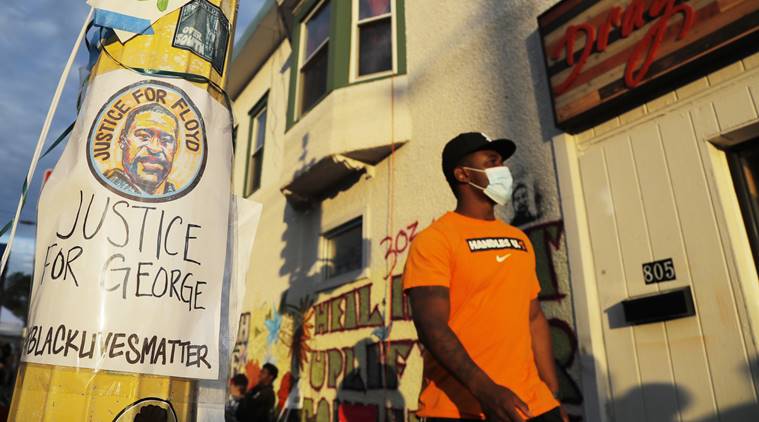
On Wednesday, June 3, 2020 a man walks near the site where George Floyd died in Minneapolis. (AP Photo: Julio Cortez)
Prosecutors seeking to put a former Minneapolis police officer in prison for the death of George Floyd bolstered allegations on the use of force but stopped short of calling the killing intentional in a move legal experts said could ease the path to a conviction.

Minnesota Attorney General Keith Ellison on Wednesday added a more serious second-degree murder charge against Derek Chauvin. Prosecutors last week accused Chauvin of third-degree murder and second-degree manslaughter. He could serve up to 40 years in prison.

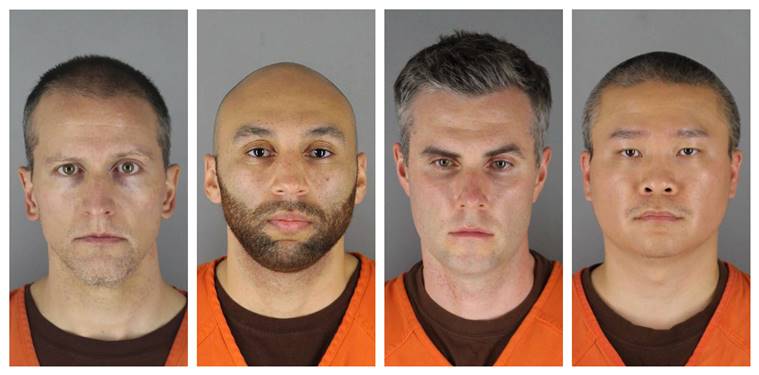
Derek Chauvin, from left, J. Alexander Kueng, Thomas Lane and Tou Thao. (Hennepin County Sheriff’s Office via AP)
Three other officers here who were with Chauvin at the time of Floyd’s death – Thomas Lane, J. Alexander Kueng, and Tou Thao – all face two counts: aiding and abetting second-degree murder and aiding and abetting second-degree manslaughter. Two of those officers helped keep Floyd pinned to the ground.

Christa Groshek, a defense attorney in Minneapolis, said that the second-degree murder charge for Chauvin made more sense than third-degree murder, which she said was a murky statute and requires showing that a defendant evinced “a depraved mind.”

Under Minnesota law, second-degree murder can be charged as an intentional or unintentional act.

Groshek said she believed there was enough evidence to charge Chauvin with intentional murder, but deeming it “unintentional” means prosecutors need only show Chauvin meant to inflict the harm that led to Floyd’s death.

Editorial | Death of George Floyd may or may not be a turning point for America. But protests show wound has cut deeper and wider

“It makes their job a lot easier. They don’t have to prove intent to kill,” Groshek said. “This allows for a jury to return a conviction without having to believe the cop was bad. Juries don’t like to convict cops.”

Eric Nelson, the lawyer representing Chauvin, did not immediately respond to a request for comment.

Floyd, 46, died on May 25 after Chauvin used a knee to pin his neck for nearly nine minutes. A video of the incident led to a week of sometimes violent protests and civil unrest here in dozens of U.S. cities.

The new charges also modify the probable cause statement that was included with Chauvin’s original charging document.

Prosecutors added that force was clearly not needed to control the handcuffed Floyd. They also removed language that said Floyd at one point resisted arrest, and included that he told officers who were attempting to put him in a squad car that he was not trying to resist arrest, but was claustrophobic.

Demonstrators gather to protest the death of George Floyd, Monday, June 1, 2020, near the White House in Washington. (AP Photo: Evan Vucci)

Both versions of Chauvin’s charging document said that police officers receive training that the restraint techniques the defendants used with Floyd are “inherently dangerous” and asserts they caused substantial bodily harm and his death.

Ellison, in announcing the new charges, said that every detail would be crucial in winning convictions.

“Trying this case will not be an easy thing. Winning a conviction will be hard,” Ellison said.

He said Hennepin County Attorney Mike Freeman, who is part of the prosecution team, “is the only prosecutor in the state of Minnesota who has successfully convicted a police officer for murder.”

Minnesota sentencing guidelines suggest that someone convicted for second-degree murder without a criminal history receive between 22 and 30 years in prison. But defense attorney Groshek said prosecutors would likely seek more than that if they secure a conviction against Chauvin.

📣 The Indian Express is now on Telegram. Click here to join our channel (@indianexpress) and stay updated with the latest headlines

For all the latest World News, download Indian Express App.

Source link

George Floyd had coronavirus, autopsy says

George Floyd, whose in-custody death in Minneapolis last week triggered an avalanche of protests over the mistreatment of black people by police, tested positive for the coronavirus weeks before his death, an autopsy report released Wednesday shows.

The 20-page document released by the Hennepin County Medical Examiner’s Office says a test of Floyd on April 3 was positive for the virus’ genetic code, or RNA.

Full coverage of George Floyd’s death and protests around the country

Because that RNA can remain in someone’s body for weeks after the disease is gone, the autopsy says, a second positive test after his death likely meant that Floyd, 46, was asymptomatic from an earlier infection when he died May 25.

The Centers for Disease Control and Prevention has said a positive RNA test doesn’t necessarily mean the person is infectious. It wasn’t immediately clear whether Floyd developed symptoms earlier in the year or was an asymptomatic carrier.

A former Minneapolis police officer, Derek Chauvin, faces second-degree murder and other charges after he pressed his knee into Floyd’s neck for eight minutes while Floyd was lying handcuffed on his stomach. Floyd was suspected of using a counterfeit $20 bill.

Full coverage of the coronavirus outbreak

A bystander’s video of Floyd’s death sparked outrage across the United States and the immediate firing of Chauvin and three other officers who were involved in detaining him.

Charges of aiding and abetting against three other officers, Tou Thao, Thomas Lane and J. Alexander Kueng, were announced Wednesday.

The medical examiner’s office said this week that Floyd’s death was a homicide that occurred while he was being restrained by police. His cause of death was listed as “cardiopulmonary arrest complicating law enforcement subdual, restraint, and neck compression.”

The medical examiner listed other “significant” conditions underlying his death, including hypertensive heart disease, fentanyl intoxication and recent methamphetamine use.

Those conclusions were in contrast with an independent autopsy conducted by pathologists for Floyd’s family.

That autopsy concluded that Floyd had no underlying medical problems that contributed to his death. The pathologists also said he died after blood and air flow were cut off to his brain, causing him to die by mechanical asphyxia.

Source link

Fired watchdog tells Congress he told top officials about Pompeo probe

WASHINGTON — Fired State Department Inspector General Steve Linick told Congress in a private interview Wednesday that before he was ousted, he had informed at least three top aides to Secretary of State Mike Pompeo that he was reviewing Pompeo’s and his wife’s use of government resources, two lawmakers told NBC News.

The revelation potentially undercuts Pompeo’s claim to have been unaware that Linick was looking into that issue when he asked President Donald Trump to fire Linick.

Pompeo has said Linick’s firing couldn’t have been retaliation because he had “no sense of what investigations were taking place inside the inspector general’s office.”

Steve Linick, then the State Department’s inspector general, departs the Capitol on Oct. 2, 2019.Jonathan Ernst / Reuters file

But Linick told congressional committees investigating his ouster that months earlier, he had told Undersecretary of State Brian Bulatao, Executive Secretary Lisa Kenna and Deputy Secretary Stephen Biegun about what Linick described as a “review of use of resources by Pompeo and his wife,” according to one of the lawmakers who participated in the interview.

Linick also told Congress that before he was fired, he had also submitted a formal document request for records related to Pompeo’s and his wife’s use of resources. Document requests are a standard element of an investigation by an inspector general, a federal agency’s independent watchdog.

Linick, who was questioned in a daylong virtual interview by three House and Senate committees, told Congress that he didn’t have specific knowledge of whether those aides had relayed the information to Pompeo, the lawmakers said.

But the three officials whom Linick said he did inform about the review represent Pompeo’s innermost circle at the State Department, where they work with him in the famed executive suite known as the 7th Floor. Bulatao has been a close friend of Pompeo’s since they attended the U.S. Military Academy together more than 30 years ago, and he was made the CIA’s chief operating officer when Pompeo ran the spy agency.

The document request, which undoubtedly would have involved records from the secretary’s office, is another reason it’s implausible Pompeo never heard about the review, said the lawmakers who took part in the interview.

“No reasonable person would believe Pompeo’s statement,” one of them said.

The State Department and the Office of the Inspector General didn’t immediately respond to requests for comment.

Before he was fired, NBC News first reported, Linick had been looking at whether Pompeo made a State Department staffer walk his dog, pick up his dry cleaning and make dinner reservations for Pompeo and his wife, among other personal errands.

Linick was also looking into allegations about leadership problems at the State Department’s Office of the Chief of Protocol. The office was responsible for overseeing a series of lavish dinners hosted by Pompeo and revealed by NBC News that are also now the subject of a congressional inquiry.

Both lawmakers said Linick’s comments are likely to prompt one or more congressional committees to subpoena Bulatao and other top State Department officials as they investigate whether Pompeo had Linick fired in retaliation for investigations Linick was pursuing involving the secretary.

“There’s more information we need,” one of the lawmakers said. “If we are unable to obtain it voluntarily, it should be subpoenaed.”

The three committees — the House and Senate foreign policy committees and the House Oversight Committee — have already requested that Bulatao, Kenna and several other top Pompeo aides voluntarily answer questions from Congress. So far, none has agreed.

“We’re grateful for Mr. Linick’s decades of service to our country and for having the courage to come forward and discuss his sudden and unjustified firing,” the chairs of the House committees and the top Democrat on the Senate Foreign Relations Committee said.

Download the NBC News app for breaking news and politics

In a joint written statement after the interview, they said Linick had testified that Bulatao, the longtime Pompeo friend and adviser, had tried to “bully” the inspector general repeatedly — including telling Linick that it was inappropriate to pursue a separate investigation into a Saudi arms deal.

Linick rejected the administration’s explanations for why he was terminated, according to the committees’ joint statement, stating: “I have not heard any valid reason that would justify my removal.”

Linick also told Congress that public explanations by Pompeo and others were “either misplaced or unfounded,” the committees said, quoting Linick’s comments during the interview.

Pompeo has repeatedly declined to provide any specific reason he asked Trump to fire Linick in mid-May, other than to say Linick wasn’t performing well and was undermining the State Department’s objectives.

“There are claims that this was for a retaliation for some investigation that the inspector general’s office here was engaged in,” Pompeo said last month. “It’s patently false. I have no sense of what investigations were taking place inside the inspector general’s office. It’s all crazy stuff.”

Pompeo said the only exception was a Linick investigation that he became aware of earlier in the year when he answered written questions from the inspector general. Pompeo didn’t elaborate and said he didn’t know what had happened with that inquiry.

NBC News and other news organizations have reported that Pompeo answered written questions from Linick about a Saudi arms deal that Linick was investigating after Pompeo declined the inspector general’s request to interview him. The House Foreign Affairs Committee requested that investigation after Pompeo and the Trump administration circumvented Congress by declaring an emergency to enable an arms sale to the Saudis that lawmakers of both parties opposed.

The lawmakers who participated in the session Wednesday said Linick was cautious in the interview, refusing to disclose specifics about allegations his office had been investigating and declining to speculate on or answer questions he felt went beyond the facts he was in a position to know.

Haley Talbot and Abigail Williams contributed.

Source link

Hong Kong marks Tiananmen massacre for what many fear will be the last time

0

“It was a time of hope,” said Lee Cheuk-yan, a veteran activist and former Hong Kong lawmaker. At that time, the city was eight years out from being handed over from British to Chinese control, and there was a sense that the young protesters across the border could be changing China for the better.

“For many Hong Kongers, we felt that 1997 was really hanging over our heads. But young people in China were demanding democracy, and we thought if they make it, it means Hong Kong will not have to live under an authoritarian regime.”

That hope became despair, however, as the People’s Liberation Army crushed the protests on June 4. No official death toll has ever been released, but rights groups estimate hundreds, if not thousands were killed. The Tiananmen protests and the crackdown have been wiped from the history books in China, censored and controlled, organizers exiled or arrested, and the relatives of those who died kept under tight surveillance.

On Monday, police refused permission for this year’s rally, citing ongoing restrictions on mass gatherings related to the coronavirus pandemic. For many in the democratic opposition, the justification rings hollow: organizers had said they would work with the authorities to ensure a safe and socially-distanced rally, and meanwhile the city’s shopping districts, subway, and public parks have been open for weeks with little issue.

Speaking to reporters after the ban was announced, Lee said the police were “suppressing our vigil under the pretense of executing the gathering ban.”

The decision by police carries extra weight as many already feared this week might be the last opportunity to freely mark the anniversary. Last month, China announced that it would impose a draconian national security law on Hong Kong, in response to widespread and often violent anti-government unrest last year.

The law criminalizes secession, sedition and subversion. It also permits Chinese security services to operate in Hong Kong for the first time — leading to fears among many in the city that members of the PLA could be deployed onto the streets should protests resume.

The Hong Kong Alliance in Support of Patriotic Democratic Movements in China, the group co-founded by Lee which has organized the Tiananmen vigil every year since 1990, has warned that it could be banned under the new law, pointing to its previous support of activists convicted under similar national security laws in China and a longstanding opposition to “one party dictatorship.”
There is good reason to believe the vigil may be banned in future. Last month, CY Leung, the city’s former chief executive and high-ranking member of a Chinese government advisory body, predicted just as much, while a commemoration in neighboring Macao — which already has an national security law on the books — has also been blocked by authorities.

Historic moment

Tiananmen had an indelible effect on Hong Kong’s politics. Rallies were held in solidarity with the pro-democracy demonstrators ahead of the massacre, and many activists in the city traveled north to offer assistance and support.

After the crackdown, “Operation Yellow Bird” helped smuggle Beijing protest organizers and others at risk of arrest to the city, still then a British territory. Some 500 people were extracted from China, according to the Hong Kong Alliance, including student protest leaders such as Wu’er Kaixi, who famously debated Chinese Premier Li Peng at the height of the demonstrations.
In the years after the crackdown, pressure grew on the British to do more to protect Hong Kong under imminent Chinese rule, and in 1994 then Governor Chris Patten made elections to the city’s parliament fully democratic for the first time — a move that was not approved by London and met with outrage in Beijing.
The Legislative Council elected the following year was the first and only time the parliament has had a pro-democratic majority. It was disbanded and replaced by a Beijing-appointed body as soon as Chinese control over the city took force.

In the eight years after Tiananmen, hundreds of thousands of Hong Kongers moved overseas, though many returned soon after handover after a feared crackdown did not pan out and the city enjoyed an economic boom under its new rulers. Most of those returnees came with foreign passports in their back pocket, however, ready to flee again if things took a negative turn.

A renewed exodus may be on the horizon thanks to the new national security law. Following China’s announcement, the UK moved to expand some rights for holders of British National (Overseas) passports, of which there are some 300,000 in Hong Kong and up to 3 million citizens born in the city prior to 1997 eligible to apply. London said that if the law goes ahead, BNO holders will be granted 12-month stay in the UK, up from 6-months, giving them a potential path to British citizenship.

What happens next?

In two decades of Chinese rule, the Tiananmen memorial was always something that set Hong Kong apart, a litmus test for whether the city’s freedoms and autonomy were still protected.

It has also served as an incubator of sorts for political talent, often being among the first demonstrations that many Hong Kongers attend. Many activists, including former Umbrella Movement leaders Nathan Law and Joshua Wong, have spoken of the effect of the June 4 memorial in their own political awakening.

Last year, the city’s leader, Carrie Lam, pointed to the annual rally as proof that “Hong Kong is a very free society.”

“If there are public gatherings to express their views and feelings on a particular historic incident, we fully respect those views,” she said.

Asked this week about whether the gathering would be banned under the new national security law, Lam said “we don’t have the drafted law right now. We can handle this later.”

Hong Kong officials have insisted that concerns over the legislation are overblown, and that the new offenses of sedition, subversion and secession will only apply a tiny handful of people, even as they admit they too are largely in the dark over Beijing’s plans.

In a statement on the law last week, the Hong Kong Alliance warned that it was “like a knife to the neck of all Hong Kong people.”

“Even if it only cuts a few, it threatens the freedom of all 7 million,” the group said. “It is the implementing of rule by fear in Hong Kong.”

For now, they are still defying that fear, even as the coronavirus restrictions have foiled plans for a mass rally. Smaller gatherings will be held across the city, and the Alliance has called on all residents to light candles at 8 p.m., holding them outside their windows to recreate the sea of light that has become a common image of the annual vigil at Victoria Park.
“Will Hong Kongers be able to hold the vigil next year? A year is an eternity in politics, and predictions are hazardous,” wrote China scholar Jerome Cohen this week. “Yet, unless there is an unexpected change in leadership in Beijing, it surely seems likely, especially in light of the forthcoming (national security law), that Hong Kong might follow Macao in succumbing to the amnesia that has long been forced upon the mainland.”

CNN’s Chermaine Lee contributed reporting.

Source link

Lili Reinhart Comes Out As Bisexual, Supports LGBTQ For Black Lives Matter Protest

“Riverdale” star Lili Reinhart has come out as a “proud bisexual woman” in a post urging fans to attend a Black Lives Matter solidarity protest organised by the LGBTQ community. 

The 23-year-old actor posted to Instagram Stories on Wednesday, rallying her nearly 25 million followers to join her at a peaceful demonstration in West Hollywood, California, to stand against racial injustice and police brutality. 

“Although I’ve never announced it publicly before, I am a proud bisexual woman,” Reinhart wrote under information about the rally. “And I will be joining this protest today. Come join.”

Later in the day, the “Hustlers” star shared videos from the demonstration.

Reinhart has been speaking out on social media to share information about anti-racism protests and to demand justice for George Floyd, a Minneapolis man who died after a white police officer kneeled on his neck for nearly nine minutes, as well as others who have died in police custody. 

“I want to say that I am ashamed of the racism that exists in this country. We are taught to look at our police officers as helpful and friendly when we learn about ‘leaders’ in elementary school. Our ‘leaders’ have failed us today,” she tweeted Monday. “I can’t begin to imagine the horror of worrying that you won’t be protected by your ‘leaders’ because of the color of your skin. I know that white privilege exists and I could never fully understand what it’s like to be oppressed because of my race. I don’t have all the right words, but I stand by you. #BlackLivesMatter.”

Reinhart also used her platform earlier this week to open up a dialogue about Black activism with Kenidra R. Woods, a 19-year-old activist and mental health advocate. 

Reinhart was most recently romantically linked to co-star Cole Sprouse, with whom she’s had an on-again, off-again relationship for nearly three years.

Neither star has spoken publicly about splitting, but reports claim they went their separate ways earlier this year. The actors “have been quarantining separately,” an unnamed source told Page Six about the breakup, adding that they “remain good friends.”

Sprouse was arrested with other peaceful protesters during a rally against police brutality in Santa Monica, California, on Sunday.

The Disney Channel alum said he was zip-tied by police and detained, but made it clear in an Instagram post that attention shouldn’t be focused on him. 

“Black Lives Matter,” Sprouse wrote. “Peace, riots, looting, are an absolutely legitimate form of protest.”

“It needs to be stated that as a straight white man, and a public figure, the institutional consequences of my detainment are nothing in comparison to others within the movement,” he added. “This is ABSOLUTELY not a narrative about me, and I hope the media doesn’t make it such.” 


Source by [author_name]