Video of Irons, 40, walking out of the Jefferson City Correctional Center in Missouri was posted on Moore’s Instagram page with the message “FREEDOM.â€
Let our news meet your inbox. The news and stories that matters, delivered weekday mornings.
A lawyer for Irons, Jay Lenox, told NBC affiliate KSDK that prosecutors declined to retry the two-decade-old burglary and assault case.
Irons was 16 when he was tried as an adult and convicted of breaking into a home in O’Fallon, a city outside St. Louis, and twice shooting a homeowner. He was sentenced to 50 years in prison.
On March 9, Cole County Circuit Judge Daniel Green ruled that prosecutors suppressed fingerprint evidence that would have strengthened Irons’ defense and presented no physical proof linking him to the crime.
The testimony of an eyewitness was “dotted with inconsistencies,†the judge said.
Moore, a five-time all-star with the Minnesota Lynx who took a sabbatical to advocate for Irons, first met him in 2007 during a visit to the Jefferson City Correctional Center.
President Trump on Wednesday announced by far his biggest cash haul of the 2020 campaign in June, bringing in $131 million between his campaign and the Republican National Committee, showing that his money machine continues to hum even as he has slipped in the polls.
The monthly haul represented a spike of $57 million more than Mr. Trump had raised in May, which was the first month that former Vice President Joseph R. Biden Jr. had outraised the president.
The Trump campaign said that it now had $295 million in the bank, a formidable financial advantage entering the summer months, and that it had raised nearly $950 million over the last two years.
Mr. Biden has not announced his fund-raising total for June, but people familiar with the figures said his sum in June would be higher than Mr. Trump’s. He raised $80.8 million in May.
Mr. Trump has spent aggressively as well. The figures released by his campaign show that he spent about $100 million in June.
Mr. Trump had a tumultuous June, which began with the nationwide protests in the aftermath of the killing of George Floyd by the Minneapolis police. It included the forceful and widely criticized clearing of peaceful protesters outside the White House for a photo op; the release of a scalding book by Mr. Trump’s former national security adviser John R. Bolton; the ousting of the United State attorney for the Southern District of New York; Mr. Trump’s first rally since the coronavirus pandemic shut down the country, in Tulsa, Okla., which failed to fill the arena; and a series of tweets from the president, including one over the weekend that was later deleted in which a supporter shouted “white power,†that renewed accusations of racism.
Coronavirus cases also began to rise in states that had reopened their economies more fully, including across the South and the Sun Belt.
None of that slowed the flow of money. Nor did multiple national polls showing Mr. Trump trailing by double digits, including a New York Times/Siena College survey that had Mr. Biden at 50 percent and Mr. Trump at 36 percent.
Mr. Trump’s campaign said it had set a single-day record for online fund-raising on his birthday, June 14, collecting $14 million. The full $131 million sum came as Mr. Trump held only two fund-raising events for the month.
The Trump campaign did not break down how much of the money was raised online or came from large donations — his joint committee with the R.N.C. can receive checks of more than $500,000 — but it said the outpouring was “largely fueled by the robust digital, mail and online donor base†of the president.
The total is more than Mr. Trump and the R.N.C. ever raised in a single month in 2016.
“The Trump campaign’s monumental June fund-raising haul proves that people are voting with their wallets, and that enthusiasm behind President Trump’s re-election is only growing,†said Brad Parscale, Mr. Trump’s campaign manager.
In recent days, Mr. Trump’s campaign reserved about $95 million in television ads for the fall, beginning after Labor Day in half a dozen states: Arizona, Florida, North Carolina, Ohio, Pennsylvania and Wisconsin. He also began buying airtime in Michigan on Wednesday.
Fund-raising figures are not required to be publicly released until mid-July. Mr. Trump’s campaign released its numbers on July 1 in what appeared to be a political show of force.
One may accept that Ms Norvill may have endeavoured at relevant times, in the interests of the performance of King Lear as a whole, to maintain good relationships with all cast members …
However, we consider, as counsel for Mr Rush submitted, that Ms Norvill’s relationship with Mr Rush, as described by these witnesses did not sit well with her claims that she had felt “compromisedâ€, “pressuredâ€, “extremely intimidatedâ€, “frightenedâ€, “threatened†and “panickedâ€. That is to say, there was other evidence suggesting that Ms Norvill’s contemporaneous behaviour was not consistent with the claims she made at trial concerning Mr Rush’s conduct.
For these reasons, we do not consider that the erroneous significance which the judge attached to Ms Norvill’s contemporaneous statements to the journalists should be regarded as material.
Other contemporaneous conduct of Ms Norvill, occurring when she was not subject to the same constraints as those applying in the promotional interviews, was also seemingly inconsistent with the conduct of Mr Rush about which she gave evidence, and justified the judge’s assessment.
Several men incarcerated in California’s San Quentin State Prison who have tested positive for COVID-19 have gone on a hunger strike to protest what they call “dismal†living conditions, KNTV in San Jose reported Wednesday.
More than 1,100 active coronavirus cases have been reported at San Quentin, California’s oldest prison and home to the state’s only death row. At least one person, a 71-year-old death row inmate, has died of complications from the coronavirus.Â
The hunger strike at San Quentin, north of San Francisco, began Monday, The Appeal reported. The strikers are protesting inhumane and cramped conditions inside a unit known as the Badger section, where some people with COVID-19 are being housed, two inmates told the publication.Â
“[T]he cells are filthy and we are not being given cleaner to maintain them,†one man said. “Some of us are being housed together when the whole thing is to keep us six feet away from each other.â€Â Â
Sources told the NBC affiliate that inmates infected with the virus, about a third of the prison population, were kept quarantined in their cells all day with little to no access to showers, fresh air or electricity. They also described the medical care available to inmates as inadequate.Â
“It’s bad, it’s bad, please get the word out,†an inmate told The Appeal.Â
Prison officials confirmed to KNTV that seven inmates had begun refusing meals this week. But the TV station, as well as The Appeal, citing sources, said at least 20 inmates had committed to the hunger strike.
A spokesperson for the California Department of Corrections and Rehabilitation told The Appeal that it was “implementing strategies to control the spread of the virus to protect all those who live and work in our state prison.â€
“We understand and share the concerns of COVID-19 cases in the state’s prisons,†the spokesperson said.Â
California as a whole is grappling with a surge in COVID-19 infections.
On Wednesday, Gov. Gavin Newsom (D) put the brakes on the state’s reopening as infections and hospitalizations have spiked across California. A jump in infections in Marin County is largely attributed to the reported 1,113 inmate and 102 staff cases confirmed at San Quentin, according to the Los Angeles Times.
“The bottom line is the spread of this virus continues at a rate that is particularly concerning,†Newsom said in a video conference as he announced the closures of bars and indoor dining, among other measures, in parts of the state.Â
Calling all HuffPost superfans!
Sign up for membership to become a founding member and help shape HuffPost’s next chapter
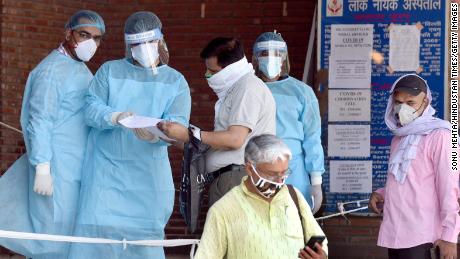
Indian police officers could face murder charges over the deaths of a father and son who were in custody after allegedly breaking coronavirus restrictions, a court has ruled.
On Tuesday, Tamil Nadu’s highest court said there was enough evidence to charge the police officers involved in the case with murder, based on the victims’ injuries and formal statements.
The deaths have renewed outrage in India over police brutality, with the men’s family members, politicians and human rights activists alleging officers tortured the pair before they died.
CNN has tried multiple times to contact local police for comment on the allegations. The initial police report notes that the men sustained their injuries during arrest. The officers have not commented publicly on the allegations.
According to court documents, two officers have been suspended and the state intends to transfer the case to the Central Bureau of Investigation, essentially India’s FBI.
In a statement Monday, non-profit Commonwealth Human Rights Initiative said the case showed the need for India to enact a strong law to prohibit and prosecute police torture and custodial death.
“It sends a chilling message about how broken the system is, the failure of police and political leaders to step up accountability measures for illegality,” India executive committee chair Wajahat Habibullah said in a statement.
Habibullah also called on India to ratify the United Nations Convention Against Torture.
Indian politician Rahul Gandhi offered his condolences to the family and appealed to the government to ensure justice for the two men.
“It’s a tragedy when our protectors turn into oppressors,” he said in a tweet last week.
What happened
On the night of June 19, Jeyaraj and his son Bennicks— who are only identified in court documents by their first names — were selling mobile phones at their shop in Sathankulam, according to court documents.
When they refused police requests to comply with coronavirus lockdown rules stating that stores must shut at night, they were arrested, according to the documents. Tamil Nadu has recorded more than 90,000 coronavirus cases and more than 1,200 deaths, making it one of India’s worst-hit states.
The father and son were remanded in custody the next day after they had a medical examination, according to court documents.
At 7.45 p.m. on June 22, Bennicks was admitted to hospital, where he died less than two hours later, according to court documents. Just over an hour after his son’s death, Jeyaraj was admitted to the same hospital and died early the next morning, the documents say.
It’s not clear how the two men died. The Madras High Court, the highest court in the state, ordered a post-mortem of their bodies, but the results have not yet been released.
In a video statement on local media, Jeyaraj’s daughter Persis — who only uses her first name — claimed her father was pushed to the floor and beaten by the cops.
According to Persis, when her brother, Bennicks, saw her father being beaten, he tried to stop it but was also attacked.
A wider problem
Police in India “routinely use torture and flout arrest procedures with little or no accountability,” according to Human Rights Watch.
CNN has reached out to multiple senior officers in Tamil Nadu on the brutality allegations against the father and son but got no response.
On Tuesday, the Madras High Court said that local police have been “attempting to cause disappearance of evidence.”
“In fact, they were emboldened enough to even intimidate the judicial officer to put spokes in the wheel of his inquiry,” the court said.
In 2018, the last year for which statistics are available, 70 deaths were recorded across India under police custody, according to the National Crime Records Bureau.
Tamil Nadu recorded 12 deaths — a disproportionately high number, given the state makes up about 5% of India’s population.
In India, some on social media have connected the deaths of Jayaraj and Bennicks to the killing of George Floyd by police officers in the United States, which has prompted protests against excessive use of police for against Black people there.
But Shashi Tharoor, a member of parliament and former representative of India to the UN, contrasted the reaction to the deaths in India, where the case has not sparked protests, to the global outpouring after Floyd’s passing.
“Compare the outrage the death of #GeorgeFloyd sparked across the world, w/the lack of national outrage here. Justice denied?” tweeted Tharoor.
President Donald Trump reiterated his belief that the contagion will “at some point… sort of just disappear, I hope.” But the US leader who has yet to be seen in public wearing a face mask during the pandemic added he would have “no problem” doing so.
EU travel ban eased
The rollbacks came as the European Union reopened its borders to visitors from 15 countries. The bloc hopes relaxing restrictions on countries from Algeria to Uruguay will breathe life into its tourism sector, choked by a ban on non-essential travel since mid-March.
Travelers from China, where the virus first emerged late last year, will be allowed to enter the EU only if Beijing reciprocates. And Brazil — which has suffered the most deaths globally for the last week, and is the second-worst affected country overall — was excluded entirely. It topped 60,000 total fatalities Wednesday, after suffering 1,000 deaths in just 24 hours.
However, with over 10 million known infections worldwide and more than 500,000 deaths, the pandemic is “not even close to being over”, the WHO warned.
Data provided by the UN health agency for the seven days from June 25-July 1 showed the highest number of new daily cases ever recorded came on June 28, when over 189,500 new cases were registered worldwide.
‘Dutch brothels reopen’
According to the United Nations, the coronavirus crisis could cost global tourism and related sectors from $1.2 to $3.3 trillion in lost revenue. Greece, which has suffered fewer than 200 virus deaths, has seen its economy hit hard by lockdowns and travel restrictions — all but ending its lucrative tourism season before it began.
Romanian Cojan Dragos was “the first tourist” in one Corfu hotel after driving there with his wife and daughter. “We have the whole hotel just for us,” he told AFP.
Separately, Spain and Portugal held a ceremony as they reopened their land border. The Netherlands also confirmed the reopening Wednesday of another tourist draw — its brothels and red-light districts. “I’m totally booked,” said sex worker Foxxy, adding that she had held a “little party” when she heard restrictions would be lifted.
Clusters spur new lockdowns
Russia did not make the EU’s list of approved countries so its citizens will be absent from the bloc’s tourist hot-spots. The country, however, enjoyed a public holiday Wednesday as it voted in a referendum to approve constitutional changes allowing President Vladimir Putin to stay in power for another 16 years.
Joerg Forbrig is senior fellow and director for Central and Eastern Europe at the German Marshall Fund of the United States think tank.
On the surface, the political repression and police violence ripping through Belarus is nothing out of the ordinary under President Aleksander Lukashenko’s regime. Brutal treatment of dissenters has typically paved the way to previous fraudulent elections in Belarus, where the strongman has ruled since 1994.
But there’s something different about the crackdown that has taken place in the past couple of months. This time, it’s a signal that Lukashenko’s regime is nervous. As the country prepares for the upcoming August election, Belarus’ repressive rulers rightly sense that the sands on which they have been standing are shifting.
Since early May, more than 650 peaceful protesters, journalists and civic activists have been detained across the country for protesting against the Belarus strongman. The situation is increasingly explosive — and, given it is happening on Europe’s doorstep, one the EU needs to pay close attention to.
Belarus is in crisis on multiple fronts.
Lukashenko supporters — typically less qualified, provincial and elderly Belarusians — are finding it ever harder to make ends meet.
Earlier this year, Russia suspended oil and gas supplies to Belarus, opening up an economic abyss in a country already drained by years of stagnation and recession. What used to be a Russian subsidy amounting to one-fifth of Belarusian GDP has now become a tool used by the Kremlin to push Minsk toward deeper political integration with Moscow.
Rejecting such demands out of self-preservation, Lukashenko has desperately sought oil and funds elsewhere, but the regime’s modest financial reserves are dwindling.
Then came COVID-19. Out of fear for his already battered economy, Lukashenko has flatly denied the severity of the pandemic — and other than suggesting vodka and sauna as remedies, he has abandoned his people to their fate.
In a remarkable demonstration of self-organization and autonomy, the Belarusian people adopted preventive measures and supported, through numerous civic initiatives across the country, medical workers and vulnerable groups with donations and supplies.
These twin crises have turned the public against Lukashenko at a delicate time for the regime.
For years, a mix of genuine support among some and passivity among others provided the strongman with sufficient backing to continue to rule. That base is now crumbling.
Lukashenko supporters — typically less qualified, provincial and elderly Belarusians — are finding it ever harder to make ends meet. Previously apolitical citizens are becoming increasingly active as a result of their disillusionment with their eternal leader, concerns about Belarusian independence from Moscow, and the regime’s inept handling of COVID-19.
Official figures put Lukashenko’s approval rating at about one-third of the population. Independent observers say it is likely to be half that number.
To make matters worse, Belarus’ propaganda machine is faltering. Searches for reliable information on the virus have spiked during the pandemic, and people are increasingly looking beyond official channels for coverage of the election campaign. More and more, Belarusians are turning to social media, independent journalists, bloggers and civic activists.
As an ever-larger proportion of Belarusian voters exit the regime’s official indoctrination thanks to online media, Lukashenko is also bleeding support among the elite and technocrats typically loyal to the regime.
Many have long acknowledged the need for economic reform. Now, they feel that time is running out to avert utter economic collapse.
In a school near Minsk during the coronavirus pandemic, workers disinfect a gym | Sergei Gapon/AFP via Getty Images
Local administration officials, health care and social workers, and university and school teachers are increasingly vocal in their dissatisfaction with Lukashenko’s non-handling of the COVID-19 crisis. Journalists from state media and famous athletes are speaking out critically. Even police officers and security personnel have shown dismay over the current crackdown against protesters.
The establishment’s increasing disillusionment with Lukashenko was already apparent in the emergence of political challengers ahead of the election.
For the first time in decades, the elite itself is fielding contenders: Viktar Babaryka, a high-profile banker, and Valery Tsepkalo, a former diplomat and manager of a technology park. Both command considerable support, not only among technocrats and the business elite, but among Belarus’ urban, educated population more broadly.
The blogger and activist Syarhey Tsikhanouski, meanwhile, has made inroads into Lukashenko’s core electorate in the regions. Traveling across the country, he has given voice to the hardship and grievances of rural and small-town folk who feel abandoned by Minsk.
All three are enjoying hitherto unseen levels of support from Belarusian citizens, and have overtaken Lukashenko in the polls. Not surprisingly, Lukashenko has already had Babaryka and Tsikhanouski arrested, hoping to end their candidacies.
The country has entered new, and extremely risky, territory.
Ultimately, it should be the Belarusian people who determine their country’s direction. And Europe should let it be known that it is watching closely.
The Lukashenko regime is clearly preparing to defend its grip on power using all available means. It has reshuffled the government to strengthen the security forces. It is training its riot police to squash all dissent before and after the election. Its propaganda machine has gone into overdrive, variously accusing Russia or the West for attempting to oust Lukashenko.
The regime may well succeed in brutally holding onto power — a scenario that would likely involve an escalation of violence, enraging peaceful protesters and destabilizing the regime, and could even provoke an intervention by Russia.
An alternative to that dramatic and destructive scenario is still possible. It would require Lukashenko and his inner circle to acknowledge that their rule has run its course.
Whether they determine that’s a necessary step will also depend on how the EU responds to developments in Belarus.
The bloc should make it crystal clear that further engagement and cooperation with Minsk is conditional upon an immediate cessation of its brutal crackdown. It should also be ready to consider a freeze of political relations and potential sanctions if Lukashenko does not change course.
Ultimately, it should be the Belarusian people who determine their country’s direction. And Europe should let it be known that it is watching closely.
US president Donald Trump says he hopes the coronavirus will “just disappearâ€, despite states across the country experiencing record numbers of new Covid-19 cases. Speaking to Fox Business, the president was asked if he believed the virus will simply disappear. “Yeah sure. At some point. And I think we’re going to have a vaccine very soon too,” he added. Trump has consistently been criticised for not promoting safety measures such as wearing masks, but told Fox Business he “thinks masks are good” and that when he wore one, he liked the way he looked “like the Lone Ranger”.
A New York state judge closed one chapter on an attempt to block a book by President Donald Trump’s niece, which paints a harsh portrait of Trump and their family’s history, ruling Wednesday that it can hit store shelves.
Mary Trump’s book about her uncle, “Too Much and Never Enough: How My Family Created the World’s Most Dangerous Man,” is a potential bestseller, with tens of thousands of copies having shipped before its July 28 publication. The book has also been at the top of online lists for book presales.
“Too Much and Never Enough,” by Mary L. Trump.Simon & Schuster
Let our news meet your inbox. The news and stories that matters, delivered weekday mornings.
“We support Mary L. Trump’s right to tell her story in ‘Too Much and Never Enough,’ a work of great interest and importance to the national discourse that fully deserves to be published for the benefit of the American public,” said Adam Rothberg, a spokesman for the company. “As all know, there are well-established precedents against prior restraint and pre-publication injunctions, and we remain confident that the preliminary injunction will be denied.”
Robert Trump, the president’s younger brother, filed a suit in late June in Queens County Surrogate’s Court, where the estate of their father, Fred Trump Sr., who died in 1999, was settled. However, the judge tossed the case out because it was not the proper venue.
Lawyers for Robert Trump quickly refiled a claim in state court in Dutchess County in upstate New York, where he lives. Robert Trump has argued that Mary Trump is not allowed to publish anything about her family as part of a settlement agreement in Fred Trump Sr.’s inheritance case.
Judge Hal B. Greenwald initially issued a temporary injunction after Robert Trump refiled.
The publisher, Simon & Schuster, said in a filing Tuesday that it had already printed 75,000 copies and that more copies are being made.
Simon & Schuster said in court documents that it would be unconstitutional to stop publication and that it was unaware that Mary Trump had signed a nondisclosure agreement. The company also said it believes it is not liable if she breached the agreement.
“We did not learn anything about Ms. Trump signing any agreement concerning her ability to speak about her litigation with her family until shortly after press broke concerning Ms. Trump’s Book about two weeks ago, well after the Book had been accepted, put into production, and printing had begun,” CEO Jonathan Karp said in an affidavit. “And we never saw any purported agreement until this action was filed against Ms. Trump and Simon & Schuster.”
Download the NBC News app for breaking news and politics
Karp said in his affidavit that Mary Trump revealed to the company that she leaked the president’s tax returns to The New York Times for a 2018 investigation, which won the Pulitzer Prize. Karp argued that because “no litigation” was taken after the tax returns were leaked, the company was “entirely confident in Ms. Trump’s ability to tell her story regarding her own family.”
Dartunorro Clark
Dartunorro Clark is a political reporter for NBC News.
We use cookies on our website to give you the most relevant experience by remembering your preferences and repeat visits. By clicking “Accept”, you consent to the use of ALL the cookies.
This website uses cookies to improve your experience while you navigate through the website. Out of these, the cookies that are categorized as necessary are stored on your browser as they are essential for the working of basic functionalities of the website. We also use third-party cookies that help us analyze and understand how you use this website. These cookies will be stored in your browser only with your consent. You also have the option to opt-out of these cookies. But opting out of some of these cookies may affect your browsing experience.
Necessary cookies are absolutely essential for the website to function properly. These cookies ensure basic functionalities and security features of the website, anonymously.
Cookie
Duration
Description
cookielawinfo-checbox-analytics
11 months
This cookie is set by GDPR Cookie Consent plugin. The cookie is used to store the user consent for the cookies in the category "Analytics".
cookielawinfo-checbox-functional
11 months
The cookie is set by GDPR cookie consent to record the user consent for the cookies in the category "Functional".
cookielawinfo-checbox-others
11 months
This cookie is set by GDPR Cookie Consent plugin. The cookie is used to store the user consent for the cookies in the category "Other.
cookielawinfo-checkbox-necessary
11 months
This cookie is set by GDPR Cookie Consent plugin. The cookies is used to store the user consent for the cookies in the category "Necessary".
cookielawinfo-checkbox-performance
11 months
This cookie is set by GDPR Cookie Consent plugin. The cookie is used to store the user consent for the cookies in the category "Performance".
viewed_cookie_policy
11 months
The cookie is set by the GDPR Cookie Consent plugin and is used to store whether or not user has consented to the use of cookies. It does not store any personal data.
Functional cookies help to perform certain functionalities like sharing the content of the website on social media platforms, collect feedbacks, and other third-party features.
Performance cookies are used to understand and analyze the key performance indexes of the website which helps in delivering a better user experience for the visitors.
Analytical cookies are used to understand how visitors interact with the website. These cookies help provide information on metrics the number of visitors, bounce rate, traffic source, etc.
Advertisement cookies are used to provide visitors with relevant ads and marketing campaigns. These cookies track visitors across websites and collect information to provide customized ads.