This season, a number of stars, including Manchester City and England striker Raheem Sterling, have spoken out about the racism they’ve experienced both online and during games. On Tuesday Sterling posted a video featuring several big-name soccer stars voicing their opposition to racism.
“Fundamentally, we still have issues that exist in our game that we’ve never eradicated and we need to make a priority,†said Troy Townsend, head of development at Kick it Out, English soccer’s equality and inclusion organization. He is also the father of Andros Townsend, the Crystal Palace and England player who’s played almost 300 professional games.
“When you work in the space that I do, you kind of realize, how far have we really come?†Townsend said.
Both Cleland and Townsend point to the predominantly white crowds visible at most Premier League stadiums — often based in cities with significant racial diversity — as evidence that more needs to be done to ensure Black and minority ethnic fans feel comfortable attending games.
“The Black fan has never really felt safe or comfortable,†Townsend said. “You scan a stadium and you can see the lack of representation.â€
“Football needs to reflect and look at how it encourages more fans from different backgrounds and different ethnicities to be able to feel they can go to a stadium,†he added.
But it’s not just fans, teams and the league itself also need to look at the “structural racism†within their hierarchies, Cleland said.
“There’s a significant number of Black players, but are they being given opportunities to coach or manage at high levels in English football? I think the proof is in the pudding.â€
Nuno Espirito Santo, of Wolverhampton Wanderers, is the only top Black coach in the Premier League at present. The top coaches of the other 19 teams are white. Affirmative action could be required to tackle the lack of representation, Cleland suggested.
Nuno Espirito Santo, the head coach/manager of Wolverhampton Wanderers, watches the training session prior to the UEFA Europa League match between Espanyol Barcelona and Wolverhampton Wanderers on Feb. 27, 2020 in Barcelona, Spain.Matthew Ashton / AMA via Getty Images file
“There has been talk of incorporating this ‘Rooney Rule’ where they have to shortlist at least one minority ethnic candidate candidate per senior coach position, which has been obviously very effective in the NFL,†he said.
“There’s lots of resistance to it,†he added, “but then you’ve only got to look at the governance structure of English football to find that it’s very much populated by white men.â€
Townsend also points to the “embarrassing†low level of Black and minority ethnic representation on Premier League team boards.
“That’s something that the game has to be challenged on and the game has to address.â€
Nevertheless, allowing players to display “Black Lives Matter†is a decisive moment in the fight to address racism in the game, Townsend said.
“It’s a message from the players and the authorities within the game that actually Black lives do matter, and they’ll be making a real change about how they represent those Black lives within their industry,†he said.
Luke Denne is a producer for NBC News based in London.
As the calls to defund police departments echoed across the country, they forced elected officials to reckon with a movement that had suddenly broken into mainstream discussion. The breakthrough came after years of seeing activists’ impact diluted through incremental reform measures or wholesale ignoring of their demands.
“It’s different than the 2013, 2012, 2017 iteration of the Black Lives Matter movement,†Omeoga said. “We’re no longer asking for convictions or folks to be indicted. We’re asking for an actual narrative shift, a seismic shift in the systems of police.â€
Since Floyd’s death, city councils in more than a dozen cities including Minneapolis, New York and Washington have proposed reductions in their police departments’ annual budgets. Los Angeles’ mayor Eric Garcetti has embraced a more limited role for the city’s police department. Congress, too has proposed legislation that addresses police violence and aims to vote on the bill by the end of June. The words “DEFUND THE POLICE†now appear in giant yellow letters along 16th Street in Washington, D.C., mere blocks from the White House and made indelible on street-mapping software.
But perhaps most notably, many Americans who might have never imagined communities without police officers no longer see it as an impossible feat, though most still oppose the idea. A new POLITICO/Morning Consult poll shows that nearly two-thirds of Americans support major reforms in policing, while close to one-third say they are in favor of defunding the police.
“I think what we’re seeing now,†said Kim Burke, a senior fellow at the Center for Policing Equity, “is a renewed call and an increased attention to these fundings as a product of the large-scale and incredibly rapid changes we saw the government take during the corona epidemic.â€
Burke said the recent stampede toward police reform had shown that “government can almost overnight change policy, allocate money differently, change city budgets differently in the name of public safety. And this is what black communities have been asking for years.â€
Even if the sudden discussion of defunding the police has been astonishingly swift, it’s an idea decades in the making. Scholars and activists on police and prison abolition have been pushing an invest-divest model that calls for lower police budgets, removal of officers from schools, demilitarization of police equipment and reallocation of police funds for schools, housing and public health. The Movement for Black Lives, a coalition of more than 50 black-led organizations under the purview of the Black Lives Matter movement, adopted this idea into its core organizing vision in 2016, marking a shift away from a platform that called for fair treatment under the law for black Americans to a focus on stripping police systems altogether.
Andrea Ritchie, who has studied and engaged in movements to defund police as early as the 1991 Rodney King uprisings, said the call has been for “disinvestment not just financially but politically, ideologically and I think for many of us, emotionally.â€
“It’s not time for just budget cuts across the board. That’s not what ‘defund the police’ is calling for,†Ritchie said. “What ‘defund the police’ is calling for is saying, ‘we need to take money, power and equipment and scope of operation away from police and we need to invest that money and more into what people need to survive this pandemic and this economic crisis.’â€
America — plagued by economic turmoil and growing outrage at President Trump’s law-and-order approach to policing — provided a perfect backdrop for the movement to grow. This time, Omeoga argued, instead of repeating a pattern in which all the attention zeroed in a single focal point — such as Minneapolis or Louisville, or Ferguson, Mo., in 2014 — activists are encouraging change within their own communities.
“Now we’re calling for folks not to come to Minneapolis but to see the similarities that are happening in all of these other places and to actually ask your local county, state legislature to make a change and also demand the defunding of their police departments,†Omeoga said.
Organizers say their work now involves helping interested parties understand what a safe community looks like without a police presence. The idea has not fully taken hold in some circles, who say they support police reform but oppose defunding or abolishing police.
Top Democrats who are leading the congressional response to police reform have maintained that they are not interested in defunding the police. South Carolina congressman Jim Clyburn, fully distanced himself from the idea on Sunday, calling instead for a “reimagining†of policing. Other figures have taken issue with the phrasing, saying it alienates those who might be on the fence about how to change police moving forward, while embracing the general concept of shifting resources and responsibilities to other parts of government.
Black activist groups of all kinds are now seeking to capitalize on all the attention and rush of support for their platforms, while coalescing around a shared goal of aggressive police reform, if not outright defunding. Black organizations across the country have seen their membership numbers skyrocket and netted millions in donations.
“I think that this is a great conversation for this country to be having, especially in the middle of a global pandemic,†said Alicia Garza, co-founder of Black Lives Matter. “Especially at the brink of a recession, where we’ve got, I believe, the latest figures of 40 percent black unemployment and facing a massive crisis in our democracy. I think these are absolutely the right questions that this country needs to be grappling with right now.â€
The biggest question that remains, Garza explained, is what the alternative to policing would be in the conversation about community safety.
“You cannot police your way or jail your way, or frankly, kill your way out of crisis.”
ABBOTTABAD – In pursuance of the government’s policy of imposing smart lockdowns, Deputy Commissioner Abbottabad Mughees Sanaullah on Tuesday imposed lockdowns in six union councils (UCs) of Abbottabad.
According to the notification issued by the DC office, the six UCs of Abbottabad are Qalandarabad, Jhangi Seydan, Kehal, Narian, Nathiagali and PMA Road. Besides that Gosht Mandi, another area severely hit by the coronavirus, was also put under the lockdown.
In a video message, the DC said that the above-mentioned areas had reported a large number of COVID-19 cases and suspected individuals and the number of infected people had crossed the set threshold. He further said that in order to prevent the further spread of coronavirus, these areas would be under lockdown for one week.
“Essential services and supplies like pharmacy, ration, patients for medical aid are exceptions to the order,†the DC added.
Similarly, district administration Haripur also imposed smart lockdowns in four UCs to prevent the spread of COVID-19, including in TIP Housing Society, Street No.9 and 20, Mohallah Soha, Mochi Bazaar, Mamahia Chowk, Pakhral Chowk, Sector No.2 and 4 Khalabat.
TUNIS — In an interview with Tunisian Attessia TV on June 7, Tunisian black artist Salah Misbah accused prominent Tunisian artist Lotfi Bouchnak of racism, saying, “On one occasion when the Ministry of Culture honored us, Bouchnak rejected this on the pretext of me being a ‘wasif’ (servant),†referring to his dark skin.
A photo published by the company Nana Tunisie on June 9 caused much controversy on Facebook because it showed the face of a white woman whose face was painted various skin colors. Activists believe this photo is a type of racism in which blackface is used — blackface is considered deeply offensive.
Comments and reactions were mostly negative. Nana Tunisie deleted the photo and published a post June 12, stressing that it is committed to rejecting racism. The company said it supports all Tunisian women and attached a post with pictures of women of different skin colors.
Speaking on racist practices in Tunisia, Yamina Thabet, president of the nongovernmental organization Tunisian Association for the Support of Minorities, told Al-Monitor that African and dark-skinned Tunisian students suffer racism every day through words or other painful behavior. She said one of the most important problems is that people face racism with silence or denial, making it even more difficult to eliminate.
Thabet said African students have difficulties renting houses and in many other aspects of their daily lives, and she called for better, long-term education to eliminate racist tendencies.
Tunisia is only the second African country, after South Africa, to issue a law criminalizing racial discrimination; it was ratified by the Cabinet on Oct. 9, 2018, and includes 11 chapters.
According to Chapter 8 of this law, the perpetrator of the violation or crime is subject to imprisonment for a period ranging from one month to three years, and the fine ranges from 500 dinars ($185) to 3,000 dinars ($1,110). Also, institutions and associations that commit these crimes can be subject to a fine ranging from 5,000 dinars ($1,190) to 15,000 dinars ($3,350).
For his part, Masoud al-Ramadani, former head of the Tunisian Forum for Economic and Social Rights, an independent nongovernmental organization that aims to defend economic and social rights at the national and international levels, told Al-Monitor that many still use abusive words against black people in Tunisia such as “kahlouch” (blackie), noting that some cab drivers refuse to pick up dark-skinned passengers and some stores will not serve dark-skinned people. Some Tunisian families still reject mixed-race relations.
Ziad Rouen, the general coordinator of Mnemty, an association active in the fight against racism, told Al-Monitor that racism is still rooted in the daily practices of some Tunisians. Rouen said the state has not addressed cultural and social problems, as people of color seem absent from the cultural scene and are completely absent from the societal and general fabric of the country and from decision-making centers.
Rouen called on the state to thoroughly address the issue of racism by raising public awareness among Tunisians on the necessity to combat this phenomenon, adding that public awareness must begin at childhood.
Noteworthy is that there is only one female black parliament member, Jamila Ksiksi, in Tunisia’s Assembly of the Representatives of the People. Ksiksi — at the beginning of the current parliamentary period on Dec. 4, 2019 — was subject to a racist online campaign by activists supporting the Free Destourian Party following an argument in the assembly between Ksiksi and the head of that party’s bloc, Abeer Moussa, because of her skin color.
Another flagrant aspect of racism in Tunisia is the allocation of separate buses to transport black people in the Kasba area and Sidi Makhlouf from the southern governorate of Medenine in order to avoid the daily quarrels and differences between black and white people there.
Discrimination does not end there, as separate cemeteries are allocated to black people on the southern Tunisian island of Djerba, located on neglected land and known as the slave cemetery. Meanwhile, light-skinned people have two cemeteries in two different locations, with no regard to the ill treatment and discrimination suffered by Africans in Tunisia.
Mehdi Mabrouk, a specialist in sociology and former minister of culture, told Al-Monitor that Tunisia was one of the first countries to abolish slavery and the slave trade in 1846 (before France did in 1848 and the United States in 1865). Mabrouk said there is no discrimination on the ethnic level or skin color in the Tunisian Constitution, adding, “We must work more on the social level to avoid these problems in some of these behaviors that especially emerge when it comes to [mixed] marriage.â€
Article 21 of the Tunisian Constitution states that “all citizens, male and female, have equal rights and duties, and are equal before the law without any discrimination.â€
Good morning, and welcome to our live coverage of business, economics and financial markets.
Headline news this morning: HSBC will push ahead with 35,000 job cuts, Reuters reports, after getting hold of a memo. The bank is resuming a massive redundancy programme it had put on ice after the Covid-19 outbreak.
The bank will also maintain a freeze on nearly all recruitment from outside, chief executive Noel Quinn said in the memo, which was sent to 235,000 staff worldwide. (Reuters said a spokeswoman confirmed the contents of the memo.)
We could not pause the job losses indefinitely – it was always a question of ‘not if, but when’.
UK consumer price inflation eased for the fourth month in a row in May and came in at an annual rate of 0.5%, as expected, according to the Office for National Statistics. That’s the lowest inflation rate since June 2016 and compares with April’s reading of 0.8%.
Inflation has fallen as the coronavirus pandemic forced the government to impose a nationwide lockdown in late March and caused oil prices to tumble. Economists said this will no doubt add to the debate over whether the Bank of England might at some point be persuaded to take Bank rate below zero.
Stock markets are expected to open flat after yesterday’s rally. In Asia, Japan’s Nikkei dropped 0.56%, Hong Kong’s Hang Seng rose 0.2% while the Shanghai market has lost 0.18%. Beijing shut all schools again and cancelled flights after a spike in new Covid-19 cases, fuelling fears of a second wave.
The UK’s FTSE 100 finished 2.9% higher at 6,242 points yesterday, and on Wall Street the S&P 500 gained 1.89% while the Dow Jones industrial average climbed 2.04%.
Stocks were boosted by reports of a draft $1tn infrastructure spending plan from the Trump administration, targeted mainly at roads and bridges, and news of a 17.7% surge in US retail sales in May after the Covid-19 lockdown was eased.
The stock market rally came despite another cautious message from Federal Reserve chairman Jerome Powell, who warned of a “long road†to recovery that will leave the US economy “well short of†where it was in February for some time.
Stocks came off their highs when Powell, in his semi-annual testimony to the Senate, also said that the Fed’s corporate bond-buying programme could be tapered if the market function improves. On Monday, it was announced the Fed would start to buy individual corporate bonds.
James Knightley, chief international economist at ING, says:
Recent data flow has offered hope of a more vigorous economic rebound than we initially thought possible. The Fed remains wary though, with a renewed wave of infections arguing for caution. As such, Powell again emphasised policy will remain ultra-loose with the potential that they could have to do more to ensure the recovery continues.
He again tries to provide a reality check to the optimism in risk markets, such as equities, which are seemingly seeing only good things ahead. He warned of the risk of insolvencies, particularly in the small business sector and suggested that “until the public is confident that the disease is contained, a full recovery is unlikelyâ€. Given a vaccine appears some way off and fears over a pick-up in Covid-19 cases in several states, he is clearly sitting on the more cautious side of the fence.
The Agenda
10am BST: Eurozone inflation for May (final reading)
1:30pm BST: US Housing starts and building permits
5pm BST: US Fed chair Jerome Powell testifies to House Financial Services Committee
Ahead of this week’s debate and votes on the European Parliament’s Resolution on the People’s Republic of China’s national security law for Hong Kong, the ECR has invited Wong Yik Mo, member of the pro-democracy political party Demosisto and Benedict Rogers, co-founder and Chair of Hong Kong Watch and human rights activist, to remotely take part in the Group Meeting today (17 June) and to exchange views with MEPs.
Both initiators of the exchange of views, Swedish MEP Charlie Weimers, member of the Foreign Affairs Committee, and Polish MEP Anna Fotyga, ECR Foreign Affairs Coordinator, expressed the Group’s serious concerns about the unilateral introduction of national security legislation as representing a grave assault on Hong Kong’s autonomy, rule of law, and fundamental freedoms.
Ahead of the meeting, MEP Charlie Weimers said: “The meeting will serve as a useful interaction and moment of engagement to shed light on the troubling developments from Hong Kong, and China’s continued and deliberate attempts to renege on its agreement of ‘one country, two systems’.
“China has reneged on its agreement of ‘one country, two systems’. The EU must stand for the right of the Hong Kong people to self-determination and self-governance, and as long as the pressure exerted on Hong Kong’s institutions remain EU-China relations will suffer. Europe must never kow-tow to the Chinese Communist Party.â€
MEP Anna Fotyga added: “Hong Kong’s success was built on its freedoms. The ECR is deeply concerned by Beijing’s plan to impose national security legislation on Hong Kong, which is in direct conflict with Article 23 of Hong Kong’s Basic Law and China’s international obligations under the Joint Declaration, a treaty agreed by the UK and China and registered with the United Nations. That’s why we stood firmly behind the people of Hong Kong.
“I welcome the joint text of the Parliament’s Resolution we were able to successfully negotiate on Friday. Its adoption will send a clear message as to what the EU should stand for – international law and the people of Hong Kong.â€
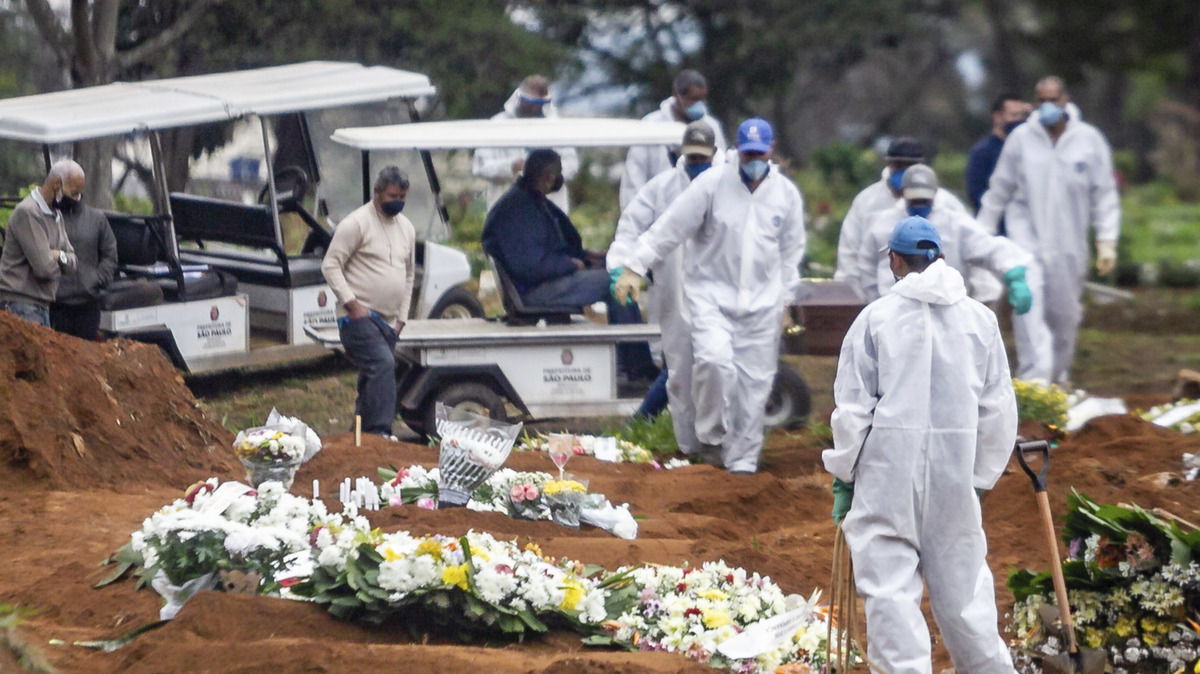
Several COVID-19 burials are performed in the Vila Formosa Cemetery on the east side of São Paulo, Brazil, on Sunday. Brazil, which reported a large spike in cases on Monday, now ranks second after the U.S. for total infections and deaths.
Fotoarena/Sipa USA via AP
hide caption
toggle caption
Fotoarena/Sipa USA via AP
Several COVID-19 burials are performed in the Vila Formosa Cemetery on the east side of São Paulo, Brazil, on Sunday. Brazil, which reported a large spike in cases on Monday, now ranks second after the U.S. for total infections and deaths.
Fotoarena/Sipa USA via AP
Brazil on Tuesday reported a national record of nearly 35,000 new coronavirus cases in a 24-hour period, even as the government has insisted that the outbreak is under control.
The health ministry added 34,918 new cases, but Brazilian media, in collaboration with state health departments, said the figure was probably undercounted by a few thousand. The ministry also announced 1,282 additional COVID-19 deaths, bringing the total to more than 45,000 since the pandemic began.
Meanwhile, Walter Braga Netto, a top Brazilian government official dealing with the response to the outbreak, said Tuesday: “There is a crisis, we sympathize with bereaved families, but it is managed.”
Netto’s statement is in line with President Jair Bolsonaro’s consistent efforts to downplay the danger posed by the disease. The right-wing Bolsonaro, who has called the new coronavirus “a little flu” and campaigned against shutdowns, has been widely accused of endangering the public.
He has said that the economic costs of remaining in lockdown outweigh the risk to public health.
In April, Bolsonaro fired then-Health Minister Luiz Henrique Mandetta over the official’s support of broad isolation measures recommended by the World Health Organization and international medical experts.
Most of the infections in Brazil have been concentrated in the heavily populated states of São Paulo and Rio de Janeiro and in the northeast.
Despite the uptick in cases, Brazil’s towns and cities, urged on by Bolsonaro, have been gradually re-opening for business.
Hannah can’t stop vomiting. The 22-year-old has Ehlers-Danlos syndromes, a complex disability that means she has intestinal failure and uses a feeding tube – and now has a blockage in her bowel. Surgery is her only option, but she’s been told she’ll have to wait eight months to have it because the NHS is focused on the coronavirus pandemic. Hannah has already been on the surgery waiting list for nine months and her condition is worsening: she’s in severe pain and is vomiting most days as she increasingly can’t keep food down.
Hannah doesn’t blame her doctors. “If you had two fires and one consumed a detached house, and the other was rampaging through a packed terrace, and you had limited resources, what would you choose?†she says. But she is “extremely disillusioned†with the government for leaving patients like her stranded during the pandemic.
If Hannah doesn’t have the surgery soon, she tells me, her bowel could rupture. “I fear that many people in my position will die due to a shortfall in care.â€
This is Britain’s second public health emergency: the crisis that is quietly threatening lives alongside coronavirus. The government has spent recent weeks boasting that they have managed to protect the NHS during the pandemic, but what they’ve really done is shut it down. Almost two-thirds of Britons with common life-threatening conditions have been denied care by the NHS because hospitals have focused on fighting Covid-19. That’s people with breathing problems, high blood pressure and cancer.
Tens of thousands of non-urgent surgeries have been cancelled in recent months to free up space for coronavirus patients, while many diagnostic tests and outpatient appointments are on hold. Screening services for cancer have been formally paused in Scotland, Wales and Northern Ireland and are de facto suspended in England. NHS leaders say the waiting list for hospital treatment in England could soar to almost 10 million people by Christmas due to the huge backlog caused by coronavirus disrupting services. That’s double the current figure.
This comes on top of patients who have voluntarily stayed away; there was such concern about empty A&E wards during the height of lockdown that the government set up a campaign in April to encourage people with suspected strokes and heart attacks to still seek help.
The long-term consequences of reduced healthcare during the pandemic are reminiscent of an unexploded bomb, slowly waiting to go off. Greater health problems are being stored for the future, as individuals watch their chronic conditions worsen. In the worst cases, their lives are at risk. Doctors have warned of the likelihood of a “dramatic rise†in bowel cancer cases in Britain in the wake of the coronavirus outbreak. The effective halt to screening in March is predicted to lead to thousands of people dying early from the disease. One man with cancer told the Guardian last week that he is now “fighting for his life†because the pandemic meant he had to wait months for a scan. Sherwin Hall now has a tumour measuring 14cm in his pelvis and 30 small tumours in his lungs. He is 27.
The NHS was always in a deeply difficult situation. Many of the cancellations in recent months were intended to stop patients catching coronavirus by coming into hospitals. Staff had to be freed to help tackle the pandemic. The need for social distancing as well as shortages in PPE have also added further problems to the pile. But after years of being starved of funding, the NHS was in a precarious position to begin with. NHS England was short of about 40,000 nurses even before staff were spread thinner to cope with coronavirus; many patients were already waiting up to a year for treatment. Tackling a pandemic after a decade of cuts was the equivalent of being asked to fight with one hand behind its back.
This is a crisis for people who have become sick during the pandemic but also for those who had health problems before. Overall barely one in five of those who regularly receive NHS help for a long-term health condition were able to have a planned treatment in April. Meanwhile, new ONS research into shielding this week shows two in five report being unable to access certain types of care – such as tests and scans – while 10% are unable to access any care at all. It is the worst of ironies: the rightful rush to protect people from coronavirus has simply put their health at risk in another way.
A few days ago, Hannah got a call from the treatment decision team: her case has been “escalated for considerationâ€. If it is reclassified, she will get her surgery sooner. If not, she stays on the eight-month waiting list. “The pain is unbearable,†she says. “And the only thing that will stop it is the operation.â€
Sushant Singh Rajput’s demise is both a shock and a wake-up call for the entire industry. The actor’s sudden tragic death has left people from the industry questioning where they went wrong. While everybody has been mourning his death, it’s difficult for people to accept the news. A lot of actors have also opened up about their battles with mental health issues and there are also some who are calling out Bollywood for its nasty hierarchy.
Taking to his Twitter, Gulshan Devaiah, who was seen in movies like Ram-Leela and Shaitaan, said, “Really sorry to be doing this but Bollywood is not a family , it never was and never will be . If one thinks it’s a family .. there is the problem. Bollywood is an imaginary name for a place of work that’s it . I am really not trying to put anybody down here & sorry if it seemsâ€.
On hearing of Sushant’s demise’s news, Gulshan had tweeted, “As actors, somewhere deep down inside, we think we know why he did it & that’s why it (is) so disturbing, even if you didn’t know him at all. It’s a hard game to play and he played it very well but the game won in the endâ€.
We use cookies on our website to give you the most relevant experience by remembering your preferences and repeat visits. By clicking “Accept”, you consent to the use of ALL the cookies.
This website uses cookies to improve your experience while you navigate through the website. Out of these, the cookies that are categorized as necessary are stored on your browser as they are essential for the working of basic functionalities of the website. We also use third-party cookies that help us analyze and understand how you use this website. These cookies will be stored in your browser only with your consent. You also have the option to opt-out of these cookies. But opting out of some of these cookies may affect your browsing experience.
Necessary cookies are absolutely essential for the website to function properly. These cookies ensure basic functionalities and security features of the website, anonymously.
Cookie
Duration
Description
cookielawinfo-checbox-analytics
11 months
This cookie is set by GDPR Cookie Consent plugin. The cookie is used to store the user consent for the cookies in the category "Analytics".
cookielawinfo-checbox-functional
11 months
The cookie is set by GDPR cookie consent to record the user consent for the cookies in the category "Functional".
cookielawinfo-checbox-others
11 months
This cookie is set by GDPR Cookie Consent plugin. The cookie is used to store the user consent for the cookies in the category "Other.
cookielawinfo-checkbox-necessary
11 months
This cookie is set by GDPR Cookie Consent plugin. The cookies is used to store the user consent for the cookies in the category "Necessary".
cookielawinfo-checkbox-performance
11 months
This cookie is set by GDPR Cookie Consent plugin. The cookie is used to store the user consent for the cookies in the category "Performance".
viewed_cookie_policy
11 months
The cookie is set by the GDPR Cookie Consent plugin and is used to store whether or not user has consented to the use of cookies. It does not store any personal data.
Functional cookies help to perform certain functionalities like sharing the content of the website on social media platforms, collect feedbacks, and other third-party features.
Performance cookies are used to understand and analyze the key performance indexes of the website which helps in delivering a better user experience for the visitors.
Analytical cookies are used to understand how visitors interact with the website. These cookies help provide information on metrics the number of visitors, bounce rate, traffic source, etc.
Advertisement cookies are used to provide visitors with relevant ads and marketing campaigns. These cookies track visitors across websites and collect information to provide customized ads.