Pompeo’s Human Rights Panel Could Hurt L.G.B.T. and Women’s Rights, Critics Say

0

WASHINGTON — Inside the State Department, the definition of human rights is up for debate.

Secretary of State Mike Pompeo, an evangelical Christian, created a commission last July to provide a new vision for human rights policy that would more closely align with the “nation’s founding principles” and uphold religious freedom as America’s most fundamental value.

Human rights scholars have criticized the panel, saying it is filled with conservatives intent on promoting views against abortion and marriage equality. Critics also warn the commission sidesteps the State Department’s internal bureau tasked with promoting human rights abroad.

And former agency officials caution that elevating the importance of religion could reverse the country’s longstanding belief that “all rights are created equal” — and embolden countries that persecute same-sex couples or deny women access to reproductive health services for religious reasons.

“There are those who would have preferred I didn’t do it, and are concerned about the answers that our foundational documents will provide,” Mr. Pompeo said of the commission last fall to a conservative women’s group at the Trump International Hotel in Washington. “I know where those rights came from. They came from our Lord.”

He added: “Indeed, for years under the last administration, fighting for religious freedom was just an afterthought. But President Trump, our administration, recognizes it as our country’s first freedom, and it’s found at the very top of the Bill of Rights, so we kind of got it right.”

The commission’s report is expected to be released in early July, and is tightly held among Mr. Pompeo’s top aides. Diplomats note the report could be a tool to advance Mr. Pompeo’s religious beliefs and political aspirations, while proving detrimental to preserving the rights of women and gay, lesbian, bisexual and transgender people abroad.

“This is about the only human right they seem to care about,” David Kramer, who was assistant secretary of state for the Bureau of Democracy, Human Rights and Labor in the George W. Bush Administration, said of the commission’s focus on religion. “It seems to be a play for political support domestically, that could rebound to our detriment in foreign policy.”

The panel’s recommendations come as America’s commitment to human rights faces skepticism from organizations like the United Nations. The peacekeeping body issued a resolution on Friday condemning police brutality and “systemic racism” against people of African descent. Diplomats had to drop specific references to the United States to gain passage.

In response to the resolution, Mr. Pompeo on Saturday said bodies like the U.N.’s Human Rights Council should “recognize the strengths of American democracy and urge authoritarian regimes around the world to model” America’s values. (The United States quit the council two years ago after accusing it of bias against Israel.)

Experts warn this type of criticism from Mr. Pompeo will hold less sway if the secretary’s Commission on Unalienable Rights produces a document prioritizing religion above all else. Such a document could also play into the hands of repressive governments like Saudi Arabia and Iran that seek to narrowly define human rights.

The State Department declined to comment on the questions regarding the commission.

Mr. Pompeo’s advisory panel has met five times. The meetings were public and have been minimally attended. Human rights advocates, former State Department officials and academics say they have been alarmed at what has taken place.

“The bottom line: The commission is poised to adversely shape U.S. foreign policy,” experts at Duke University wrote in a recent blog post detailing the panel’s work. In their analysis of the panel’s meetings, they noted that a “a general skepticism” toward international human rights pervaded committee discussions.

Many commission members, they note, believe there are too many human rights, including Mary Ann Glendon, the head of the commission, who has said “if everything is a right, then nothing is.”

If the commission’s report to Mr. Pompeo reflects the panel’s discussions to date, and makes a case to prioritize one human right over another, observers say it could upend diplomatic efforts to stop the Chinese persecution of the Uighur minority and promote women’s rights in places like Iran and Saudi Arabia.

“My hope is that this document doesn’t come close to establishing something that looks like a hierarchy of rights,” said Rob Berschinski, a deputy assistant secretary of state for the Bureau of Democracy, Human Rights and Labor in the Obama administration. “But if it does, repressive governments are going to point to that fact and use it against this, and future administrations, to basically say ‘we are no different than you. You have your priorities, we have ours, now butt out.’”

Committee members were handpicked by Mr. Pompeo’s staff, and most of them are conservatives with strong academic credentials.

In the months after its creation, Mr. Pompeo expressed confidence the panel would create a document that enshrines religious freedom as a central tenant of American human rights policy, which diplomats could refer to for “decades to come.”

The panel is grounded in the vision of Robert George, a Princeton professor and leading proponent of “natural law” theory, a term human rights scholars say is code for “God-given rights” and is commonly deployed in fights to roll back rights for women and L.G.B.T.Q. persons.

“The commission’s charge is not to ‘discover’ new principles,” Mr. George wrote in a document outlining the commission’s vision, “but rather to point the way towards that more perfect fidelity to our nation’s founding principles of natural law and natural rights.”

Early language defining the commission in federal documents echoed Mr. George’s notion, saying the panel would provide “fresh thinking” on human rights discussions, since conversations have “departed from our nation’s founding principles of natural law and natural rights.”

This drew significant criticism from human rights advocates, and since then, the mission has altered to say members will “furnish advice to the secretary for the promotion of individual liberty, human equality, and democracy through U.S. foreign policy.”

The commission is led by Ms. Glendon, a Harvard professor and former ambassador to the Vatican, who has garnered controversy in the past when saying that The Boston Globe receiving the Pulitzer Prize for its investigation into child abuse by priests “would be like giving the Nobel Peace Prize to Osama bin Laden.”

This “is a group of individuals who want to redefine how this country balances human rights interests and to tip the scales in favor of religious freedom, ” said Mark Bromley, chair of the Council for Global Equality, a coalition of 30 human rights groups advocating lesbian, gay, bisexual and transgender rights in American foreign policy.

Two Democratic representatives, Jamie Raskin of Maryland and Joaquin Castro of Texas, warned the commission’s report could “undermine our nation’s ability to lead on critical issues of universal human rights, including reproductive freedom and protections for millions of people globally in the L.G.B.T.Q. community.”

Several human rights organizations have sued the State Department, saying it is violating a federal law that requires advisory panels like the Commission on Unalienable Rights to be “fairly balanced” and transparent with meeting documents at the time of hearings.

The lawsuit is pending, and lawyers representing the State Department said last week the committee would invite public comment on the report before the commission’s work concluded.

Human rights observers warned that any public comment might not change what they predicted to be a preordained outcome to prioritize religious freedom as America’s most valued human right based on Mr. Pompeo’s beliefs and personal interest in the panel.

“Through sheer force of political will and personality,” Mr. Bromley said, “he’s been pushing it forward and has a very clear idea, if you look at his writings and speakings, of where he wants it to end up.”

Source link

An Amazon driver had odd instructions when she dropped off a package off. The moment went viral.

CLOSE

An Amazon delivery woman drops off a package and yells “abra cadabra” before running away.

Delaware News Journal

When Lynn Staffieri, a resident of Magnolia, Delaware, saw her Amazon delivery driver running away from her house, she wondered what she just witnessed.

She received the notification through her Nest doorbell, a service that provides video-capture for home-monitoring and security.

“I saw the Amazon lady running away from the door and I thought ‘Oh, that’s weird,'” Staffieri said. “I didn’t have the audio at first when I saw it so I didn’t know what was going on.”

When she came home and saw the footage in full, she learned that her son was behind it. He added unique delivery instructions to the order.

“I said knock three times, scream abracadabra and run very fast away,” Jacob Staffieri said. 

The video has now gone viral.

“He just thought it would be funny,” Staffieri said. “I think he was surprised it actually worked out.”

Staffieri’s video, originally posted to Facebook, has over 25,000 shares and 3,900 comments.

She said people have been contacting her from all over and telling her which outlets her clip has appeared on. Someone told her they saw her footage on the news in Lebanon and she thought, “Oh wow, that’s crazy.”

The Amazon worker was delivering a playpen for kittens Staffieri is fostering from a local rescue.

“I have six fosters from three different litters,” she said. The kittens can’t share litter-boxes until they are medically tested and cleared, so the playpens keep them separate while still allowing them to get used to people and other animals.

She has yet to find out the identity of the delivery woman but said the local Amazon manager for Delaware saw her post and reached out to try to get them in contact.

“I would love for her to see and say thank you,” she said. “Part of me thinks we’ve been stuck inside for so long and needed something to make us laugh.”

Autoplay

Show Thumbnails

Show Captions

Read or Share this story: https://www.usatoday.com/story/money/2020/06/23/delaware-amazon-driver-screams-abracadabra-and-runs-after-delivery/3241975001/

Source link

Recent Commercial Real Estate Transactions

0

$3 MILLION

70 Seventh Avenue (between Berkeley and Lincoln Places)

Brooklyn

Built in 1920, this 9,255-square-foot building in Park Slope has two commercial units, nine one-bedroom apartments and three two-bedrooms. The apartments are occupied, and the commercial spaces are leased to a shoemaker and a bakery. The building was last sold three years ago.

Buyer: VM Realty 6

Seller: Phyllis Giordano

Brokers: Peter Von Der Ahe, Shaun Riney, Mark Zarrella & Adis Muminovic of the NYM Group of Marcus & Millichap

$1.95 MILLION

89 Wyckoff Avenue (between Hart and Suydam Streets)

Brooklyn

This 3,379-square-foot, three-story building in Bushwick includes a ground-floor retail space, which is occupied by a bar; a three-bedroom apartment; and a studio apartment. It was built in 1925 and last changed hands in 2012.

Buyer: Cycamore Capital

Seller: 89 Bushwack

Brokers: Matt Cosentino, Fred Bijou and Eddie Laboz of TerraCRG

Credit…Cushman & Wakefield

$1.1 MILLION

84-01 101st Avenue (at 84th Street)

Queens

Built in 1931, this 3,200-square-foot, two-story corner building in Ozone Park includes two retail units, two two-bedroom apartments and a garage. One retail unit is leased by a pharmacy; the other is vacant. The property also has 684 square feet of air rights. Recent improvements include a new sewer line.

Seller: 84-01 101 Avenue

Brokers: Stephen R. Preuss and Kevin Schmitz of Cushman & Wakefield

$1.7 MILLION

3801 13th Avenue (at 38th Street)

Brooklyn

Built in 1931, this 3,733-square-foot building in Borough Park includes a ground-floor retail space, three one-bedroom apartments and one two-bedroom. The building will be delivered vacant.

Seller: 3801 LLC

Brokers: Ohad Babo and David Levinson of GFI Realty

Source link

Police Warn Against Posting Footage, Reports of Massive Flooding in China’s Chongqing

0

Authorities in flood-hit southwestern China have prevented state-controlled media from reporting on the true extent of flood damage alongside Yangtze river districts in and around the megacity of Chongqing, RFA has learned.

Video footage posted to social media by residents near Chongqing’s Qijiang river showed murky yellow floodwaters heavy with silt pouring under a bridge as a flood siren wailed in the streets outside, while further footage showed similarly murky and turbulent waters overflowing into riverside residential compounds and pathways.

In the compilation of video shots, at least one three-story village home is shown washed into the river by the flood peak, as someone shouts “This house has been washed into the river, and the railway line washed away by the river!”

A Chongqing resident who gave only her surname Zhu said the city, which sits at the confluence of the Yangtze and Jialing rivers, is reeling under the worst flooding in 80 years.

“There have been heavy rainstorms for the last few days, and a lot of cities and villages are completely under water right now,” Zhu said. “Some internet users have been trying to show what is really happening online, but they are being suppressed and the news covered up by the Chongqing authorities.”

“They see people who try to report the truth about what is going on as criminals, which I think is terrible,” she said.

State-run media in the city have played down the extent of the flooding in recent weeks of large areas of Chongqing and southern China.

Reports that some 40,000 people were evacuated after waters rose in the Qijiang River didn’t make headline news, but were placed in less obvious sections of print and online media.

But social media users have been uploading photos and live video footage of cars drowned on city streets, floodwaters pounding through channels and drainage systems, and low-lying areas of land under water.

Chongqing police have issued an emergency warning that anyone found to have posted news of the flooding online in an “irresponsible” manner will be immediately detained, RFA has learned.

Hard to know what to do

Chongqing-based legal scholar Song Jiansheng said such information blackouts make it harder for people to know what action to take during natural disasters.

“When the authorities block this kind of information, people don’t know how to stay safe,” Song said. “It’s impossible for the government to do a good job of disaster relief under such conditions.”

Song said that any kind of cover-up or suppression of information in China has only one goal: to shore up the ruling Chinese Communist Party’s grip on power by preventing dissent and unrest.

“They hide their own incompetence when they stop information from getting out,” Song said. “But such major disasters often require the government to take reasonable action.”

Meanwhile, state media reported that flooding and mudslides have killed at least three people and forced evacuations for thousands of people in the southwestern province of Guizhou.

China’s national observatory issued a high alert for rainstorms across vast stretches of the country for the next 24 hours, after towns and villages in Guizhou were hit by mudslides, according to state broadcaster CCTV.

Seasonal flooding this year has left more than 20 people dead or missing. Direct economic losses have already been estimated at more than U.S.$500 million, with the crucial tourism industry in the southern Guangxi region particularly hard hit, the Associated Press reported.

Reported by Qiao Long for RFA’s Mandarin Service. Translated and edited by Luisetta Mudie.


Source link

FDA Warns These 9 Hand Sanitizers Could Be Toxic

0

The U.S. Food and Drug Administration (FDA) is warning consumers should avoid using any hand sanitizers from a particular manufacturer because they could contain a toxic ingredient.

The FDA says the products, manufactured by Eskbiochem SA de CV in Mexico, could contain methanol, which can be toxic when ingested or absorbed through the skin.

In a statement on Friday, the FDA said it had identified the following Eskbiochem hand sanitizers:

  • All-Clean Hand Sanitizer (NDC: 74589-002-01)
  • Esk Biochem Hand Sanitizer (NDC: 74589-007-01)
  • CleanCare NoGerm Advanced Hand Sanitizer 75% Alcohol (NDC: 74589-008-04)
  • Lavar 70 Gel Hand Sanitizer (NDC: 74589-006-01)
  • The Good Gel Antibacterial Gel Hand Sanitizer (NDC: 74589-010-10)
  • CleanCare NoGerm Advanced Hand Sanitizer 80% Alcohol (NDC: 74589-005-03)
  • CleanCare NoGerm Advanced Hand Sanitizer 75% Alcohol (NDC: 74589-009-01)
  • CleanCare NoGerm Advanced Hand Sanitizer 80% Alcohol (NDC: 74589-003-01)
  • Saniderm Advanced Hand Sanitizer (NDC: 74589-001-01)

The FDA said it had tested the Lavar Gel sanitizer and found it contained 81% methanol. The agency also said it had tested CleanCare No Germ sanitizer and found it contained 28% methanol.

Methanol — also known as wood alcohol — “is not an acceptable ingredient for hand sanitizers and should not be used due to its toxic effects,” the FDA said in its statement.

If you’ve been exposed to these sanitizers, the FDA recommends seeking immediate treatment as it is “critical for potential reversal of toxic effects of methanol poisoning.” Side effects can include “nausea, vomiting, headache, blurred vision, permanent blindness, seizures, coma, permanent damage to the nervous system or death,” the FDA said. And make sure to throw out the sanitizers in “appropriate hazardous waste containers” rather than pouring them down the drain or flushing them down the toilet, the FDA also advised.

The FDA said it reached out to Eskbiochem on June 17 and recommended the company remove the sanitizers from the market due to their potential danger. As of Friday, the FDA said Eskbiochem had not taken steps to remove the products from the market.

Eskbiochem was not immediately able to be reached for comment. However, Alexander Escamillo, an Eskbiochem representative, told the New York Times that Eskbiochem only learned of the FDA’s warning on Monday. He also told the Times that a broker who does not work for Eskbiochem but “had access to our company” registered it with the FDA and also “registered our labels and shipped sanitizers.” He told the Times the Eskbiochem had not registered itself with the FDA and would be taking action against the broker.

“We would never do that, send a toxic chemical maliciously,” Escamillo told the Times.

While everyone who has been exposed to these products should seek treatment, the FDA says children who accidentally ingest the sanitizers or young people who drink them to substitute alcohol are more at risk of poisoning.

As the COVID-19 pandemic continues around the world, dependence on hand sanitizer has become a necessity for many. In its statement on Friday, the FDA said it is “concerned with false and misleading claims for hand sanitizers,” including that certain sanitizers can provide 24-hour protection against viruses like COVID-19. “[There] is no evidence to support these claims,” the FDA said in its statement.

Related Stories

The FDA and the U.S. Centers for Disease Control and Prevention (CDC) recommends washing your hands often — especially after going to the bathroom, before eating or after coughing or sneezing — using soap and water for at least 20 seconds. The CDC also recommends using hand sanitizer that contains at least 60% alcohol if soap and water are not available.

The FDA said that if you are experiencing any problems with a hand sanitizer you should submit a report to the MedWatch Adverse Event Reporting program online, via a form or via fax at 1-800-FDA-0178.

Write to Madeleine Carlisle at madeleine.carlisle@time.com.

Source link

Yemen’s Houthis fire missiles, drones towards Saudi Arabia

Yemen’s Houthi rebels say they have carried out their largest-ever military operation against neighbouring Saudi Arabia, targeting the defence ministry and a military base in the kingdom’s capital, Riyadh.

Their announcement on Tuesday came after a Saudi-led military coalition battling the rebels in Yemen said it had intercepted and destroyed missiles and drones fired from the Yemeni capital of Sanaa.

“A large number of winged ballistic missiles and drones targeted the capital of the Saudi enemy …  pounding military headquarters and centres including the defence and intelligence ministry and [King] Salman Air Base,” Houthi military spokesman Yahya Sarea said in a televised speech.

The Houthis said they had also targeted military sites in other cities including Jazan and Najran in the south, close to the border with Yemen.

There were no immediate reports of damage or casualties.

Earlier, Saudi-led coalition spokesman Turki al-Malki was quoted by the official Saudi Press Agency as saying: “Joint coalition forces managed … to intercept and destroy a ballistic missile launched by the terrorist Houthi militia from Sanaa towards Riyadh in a deliberate hostile operation.”

The coalition said it had also brought down “eight booby-trapped unmanned aircraft to target civilian objects and civilians in the kingdom”, as well as “three ballistic missiles from Saada governorate towards the kingdom”.

‘Big escalation’

Speaking to Al Jazeera, Mamoun Abu-Nowar – a retired Jordanian air force general – said the latest developments were reason enough to make Saudi Arabia insecure about its military prowess – despite Riyadh’s claims of intercepting missiles.

“Reaching Riyadh with that accuracy and targeting the ministry of defence and some other military [base] is a big escalation because the Houthis are winning now in Jawf and some parts in Yemen,” he said, speaking from Amman.

“This makes the Saudis insecure and unstable for any investment in the future and it’s a big threat for the Saudi defence air system which I feel is a bit weak to intercept such missiles,” he continued. “They need the THAD [Terminal High Altitude Area Defence] system which intercepts missiles beyond the atmosphere.”

The attack came after Saudi Arabia announced on Monday that Yemen’s southern separatists – backed by the United Arab Emirates (UAE) and the country’s internationally-recognised government – agreed to a ceasefire after months of infighting.

The agreement aims to close the rift between the two former allies in the war against the Houthis.

Dust rises from the site of a Saudi-led air raid in Sanaa, Yemen [File: Khaled Abdullah/Reuters]

Yemen has been locked in conflict since 2014 when the Houthis took control of Sanaa, and went on to seize much of the north.

Fighting escalated in March 2015 when the Saudi-UAE-led military coalition intervened to restore the government of President Abd-Rabbu Mansour Hadi.

Saudi Arabia was targeted with dozens of attacks using ballistic missiles or drones last year, including a devastating raid on oil giant Aramco’s facilities that temporarily knocked out half the kingdom’s crude output.

The long-running war has killed tens of thousands of people, mostly civilians, and forced millions from their homes in what the United Nations has called the world’s worst humanitarian crisis.


SOURCE:
Al Jazeera and news agencies

Source link

Pubs and places of worship: what 4 July lockdown rules mean for England

The government’s lockdown rules to control coronavirus are easing on 4 July in England to allow many more businesses, as well as leisure facilities, to reopen by introducing a new “1-metre-plus” concept. This means it is now possible to be 1 metre away from someone outside your household, instead of 2 metres, so long as there is another mitigating factor in place, such as a screen or face-covering, or hand-washing facilities. The changes also allow one household of up to six people to spend time with another household indoors, including staying the night, but they should remain socially distant. Here’s what it will mean for various sectors.

Pubs and restaurants

Pubs and restaurants in England can reopen both outdoors and indoors in what the government calls a “covid-secure way” with more hand-washing, ventilation and table service indoors, rather than customers standing at a shared bar. People may be asked to give their names but pub landlords will not check the exact makeup of an individual household that comes into the venue or request to see identification. They will not be asked to wear face-coverings. A household will be able to meet with one other household at a time in a pub or restaurant, then choose another household on another occasion. Nightclubs will not yet be reopening, nor will casinos, and the government has said there will be taskforces to ensure more businesses can open as quickly as possible.

Accommodation

Hotels, bed and breakfasts, holiday homes and campsites and caravan parks and boarding houses will be able to reopen. Campsites will be given guidance on how to be “covid-secure” in shared areas such as shower, toilet and washing-up facilities. Work remains to be done on how hostels, where there are shared sleeping spaces, can reopen safely and they will not be ready for 4 July.


Boris Johnson ditches 2-metre rule and reveals new lockdown-easing measures for England – video

Public transport

Instead of keeping a distance of 2 metres from other passengers, it will be possible to travel 1 metre apart so long as another mitigating factor is in place, such as a face-coverings which are mandatory. This will help more people get on to trains, buses and trams.

Theatres, museums and galleries, concerts

They will be able to reopen but not for live performances, as the government say they want to protect the health of performers. They could show previous work on a screen. Cafes, bars and restaurants associated with the venue would be able to reopen, however. Museums and galleries can also reopen. Concerts and outdoor music festivals will not be permitted as mass gatherings are still banned.

Exercise

Gyms, indoor studios, indoor sports facilities, swimming pools and water parks will not be reopening yet but outdoor gyms in parks – many of which have been taped up by councils since March – will be. Popular events such as park runs, and large running groups, are not due to make a comeback just yet as they are classed as a mass gathering. The reason gym-like venues are remaining closed for now is the level of breathing involved, which is a risk factor in the virus’ spread.

Places of worship

These have been open for private prayer since 13 June but the changes mean more of the congregation can attend so long as the building’s staff follow guidance on how to control the virus. Singing will be banned, so there could be a Sunday church service but held without the hymns.

Weddings

Weddings can be held as places of worship reopen. However, after the service the couple will only be able to go to a hospitality venue with one other household – making any celebration small-scale and forcing couples to chose between different sides of a family. At the moment, the maximum number of people from one household that can mix with another household in an indoor venue is six.

Beauty

Hairdressers and barbers can open and have been booking in clients for a number of weeks anticipating the change. Nail bars, massage and tattoo parlours will not be reopening because of concerns about the risk of transmission. However, the government says it hopes to get them reopened within weeks and that they are working closely with the sector on how this could be possible.

Entertainment

Funfairs, theme parks, adventure parks, amusement arcades, model villages, aquariums, wildlife centres, zoos and safari parks can all reopen on 4 July, which will give families far more scope for days out. However, bowling alleys, indoor skating, indoor play areas including soft play will not be reopening for now.

Source link

‘I don’t kid’: Trump says he wasn’t joking about slowing coronavirus testing

0

U.S. President Donald Trump at a rally in Tulsa, Okla., on June 20, 2020 | Nicholas Kamm/AFP via Getty Images

Administration officials have attempted to clean up statements the U.S. president made at a rally in Tulsa.

By

Updated

WASHINGTON — U.S. President Donald Trump insisted on Tuesday that he was serious when he revealed that he had directed his administration to slow coronavirus testing in the United States — shattering the defenses of senior White House aides who argued Trump’s remarks were made in jest.

“I don’t kid. Let me just tell you. Let me make it clear,” Trump told reporters, when pressed on whether his comments at a campaign event Saturday in Tulsa, Okla., were intended as a joke.

“We have got the greatest testing program anywhere in the world. We test better than anybody in the world. Our tests are the best in the world, and we have the most of them. By having more tests, we find more cases,” he continued.

Administration officials as high-ranking as Vice President Mike Pence have scrambled in recent days to clean up Trump’s statements last Saturday in Tulsa, Okla., where he reprised his dubious logic regarding testing rates before an arena of supporters.

“When you do testing to that extent, you’re going to find more people,” Trump said during the rally. “You’re going to find more cases. So I said to my people, ‘Slow the testing down, please.’”

White House trade adviser Peter Navarro suggested Sunday the president never issued such an explicit directive, telling CNN Trump’s remarks were “tongue in cheek.”

“It was a comment that he made in jest,” White House press secretary Kayleigh McEnany added at a news briefing Monday, saying: “Any suggestion that testing has been curtailed is not rooted in fact.”

Even Pence sought to help manage the political fallout, telling governors in a conference call Monday that Trump’s testing comments were merely a “passing observation,” according to a CBS News report.

But in an interview Monday, Trump did not deny making the ask of his administration to curtail coronavirus testing, instead contending that “if we did slow it down, we wouldn’t show nearly as many cases.”


Source by [author_name]

Deradicalization Programs for SOSMA, POTA, and POCA Detainees in Malaysia

This essay is part of a series that explores the threat posed by the Islamic State (IS) to Asia and efforts that the governments of the region have taken and could/should take to respond to it. Read More 


Counterterrorism strategies can be made more effective by incorporating deradicalization and rehabilitation measures. Deradicalization is a key element of Malaysia’s counterterrorism and violent extremism strategy. Malaysia’s initiatives in this regard are aimed at addressing the problem of radicalism due to religious misconceptions, with the specific purpose of rehabilitating and subsequently reintegrating militant detainees into society.

Malaysia’s main deradicalization initiative is the Religious Rehabilitation Program, which is based on reeducation and rehabilitation — the former focused on correcting militants’ political and religious misconceptions, and the latter on thorough monitoring of militant detainees after their release.[1] Family members of the detainees are engaged in the process; and are supported financially while the militants are held in detention. Subsequent to their release, militants are assisted in reintegrating into society. [Figure 1 depicts the Malaysian Government’s multi-stage deradicalization process.]

Figure 1. Malaysia’s Deradicalization Process[2]

As illustrated above, the Royal Malaysian Police (PDRM) is the main party responsible for deradicalization programs. The process was initially guided by the Internal Security Act (1960), which was later replaced by the Prevention of Crime Act (POCA) and Prevention of Terrorism Act (POTA) — the latter emerging as a direct response to the rise of Islamic State (IS).

Upon arrest, detainees are taken to the Special Branch Department (RMP) at Bukit Aman, Kuala Lumpur for interrogation and ordered detained. Depending on the information given by detainees, more arrests may be made at this stage. Detainees are put under Restriction Order (RO) after being released, though some are released unconditionally. The Malaysian authorities have also implemented counter strategies, which rely on cooperation between the RMP, the Prime Minister’s Department, the Department of Islamic Development Malaysia, and many others.[3]

Malaysian authorities consider rehabilitation to be the most important tool in countering radicalism. They have employed a religious approach to rehabilitation as a means of tackling what they regard as being the root of the problem. The rehabilitation program, which is conducted by the federal Department of Islamic Development Malaysia (JAKIM), involves counselling, whereby detainees are helped to explore and detect their misinterpretations of Islam. Experts in this area such as Ustazs and Ulama are invited to clarify the aspects of religious doctrine and the belief system that detainees have misconstrued.[4] At the end of the program, the radical ideology based on salafi-wahhabism thinking will have been replaced by more accurate Islamic teachings, especially regarding the real meaning and idea of jihad.

The rehabilitation process is divided into four stages. In the first stage, counsellors from JAKIM  and the police extricate any negative ideology or twisted Islamic perceptions. Next, counsellors play their role in commencing discussions with detainees and addressing their ideological misconceptions. At this point, every counsellor faces a challenging task, as the militants try to defend their misguided perspectives. Counsellors must counter these efforts by demonstrating clear and deep knowledge of Islam. In the third stage, all twisted Islamic concepts and ideologies are replaced with the correct interpretations of the Qur’an and Sunnah. After all of these steps are completed, more comprehensive education about Islam begins.[5]

In addition conducting the rehabilitation process for detainees, the Malaysian government also engages the detainees’ family members in order to break the cycle of indoctrination and to prevent the further spread of radical ideology. Usually, detainees’ family members are in a state of shock, not quite understanding what has transpired. Financial support to the families of detainees undergoing rehabilitation is intended both to help sustain them and to convey a positive impression of the purpose of the deradicalization initative. Other government agencies, such as Jabatan Kebajikan Masyarakat (the Social Welfare Department) and Pusat Zakat (the State Alms Centre), assist in mobilizing funds for detainees’ families.      

Malaysia’s deradicalization and rehabilitation efforts have proved to be effective, as exemplified by the ‘recovery’ of ex-prisoners such as Ahmad Wan Ismail and Suhaimi Mokhtar.[6] According to former PDRM Special Branch Director, Datuk Seri Muhammad Fuzi Harun, these programs have achieved a 95% success rate, and have been very effective in combating terrorist violence in Malaysia.[7] He emphasized that the rehabilitation period must comply with legal provisions under the POCA and POTA in order to provide maximum opportunity for input from detainees and family members, thereby reducing the likelihood of relapse cases that could jeopardize the nation’s security.[8]

The Module for Deradicalization

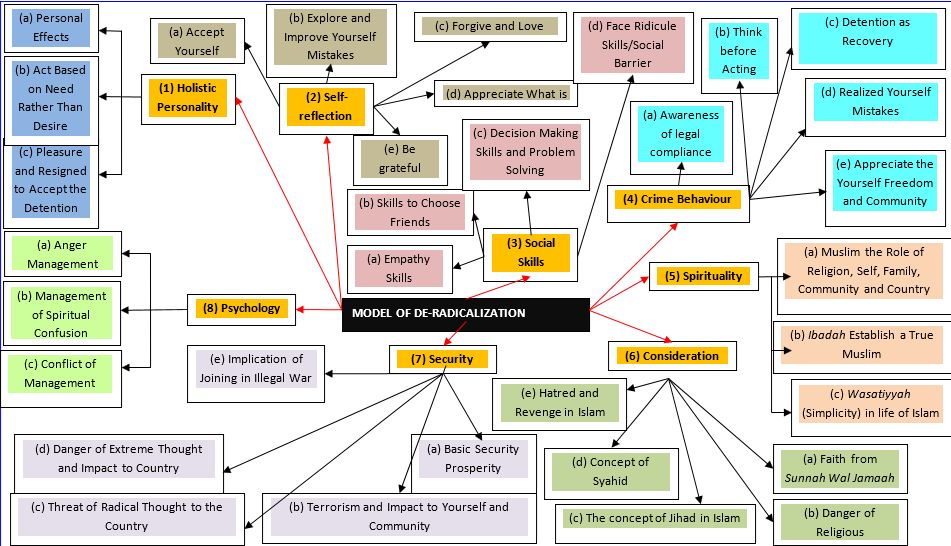
The module for deradicalization was launched with the intention of assisting the government in rehabilitating detained militants and in helping rebuild their personality. The module encompasses eight areas: holistic personality, self-reflection, social skills, crime behavior, spirituality, consideration, security, and psychology. [See Figure 2] Of these, Malaysia places emphasis on the spiritual component. Taken into consideration is the fact that the real meaning of concepts such as jihad, wasatiyyah (moderate) and akidah (faith) has been covered in the rehabilitation programs in prison and community-based engagements. This approach can be implemented in other countries as well.

Figure 2. The Module for Deradicalization

Mizan Fig 2
Source: Mohd Mizan Aslam, 2018.


In 2016 the Ministry of Home Affairs formulated the Integrated Deradicalization Module for Detainees (or Pemulihan), which is a document whose contents are intended to serve as a guide for those agencies, officers and others charged with the task of rehabilitating militant detainees. Pemulihan is described as “a correctional rehabilitation special module intended to develop knowledge and behavioral skills through a set of programs delivered by advisors specialized in different areas of related sciences.”[9]

Administered by the Ministry of Home Affairs, in concert with the Prison Department of Malaysia and Royal Malaysia Police, the module consists of a suite of rehabilitation programs (e.g., psychological, social, history, art therapy, self-development as well as ‘Online Engagement’) offered over a two-year timeframe. On top of that, government also created voluntary program, conducted under the auspices of the Ministry of Home Affairs, this is a program where qualified scholars are hired to enter online chat rooms for holding discussions with users on Islam. This caters especially to those seeking religious knowledge and clarification, wherein, for example, they discuss the dangers of takfiri (apostasy) ideas.

The Malaysian government through this special rehabilitation program also worked closely with the Civil Society Organizations (CSO) to facilitate terrorist rehabilitation. They have rehabilitated and reintegrated hundreds of Syria and Iraq alumni as well as terrorism-related convicts.

The Pemulihan rehabilitation program consists of three main components: psychological rehabilitation, religious rehabilitation, and social rehabilitation. Throughout the detention period, detainees are visited regularly by psychologists who provide counselling and assess their ability to cope with mental stress. This allows psychologists to delve into the detainees’ psychological reasoning, and thereby assess their inclination for hatred and violence as well as susceptibility to radical influences. Trained psychologists are also involved in doing proper assessments of behavioral and cognitive aspects of the detainees’ progress during rehabilitation.

Insights from the Field

Malaysia’s experience with deradicalization and rehabilitation programs has revealed some promising pathways and has exposed some persistent obstacles to making further progress in combating violent extremism in Muslim societies. 

First, the results have shown that in order to fight against terrorism, various methods should be applied and tailored to specific backgrounds and understandings of Islam among the Muslim population.

Second, interactions with militant detainee-participants in deradicalization and rehabilitation programs, including that of Malaysia, have demonstrated that the root causes of worldwide Muslim grievances have not been addressed. Military actions taken by the United States and Israel, for example, have been perceived by radical Muslims as a war against Islam and have stirred not just popular resentment but sparked vendettas.

Specifically within Southeast Asia, it is very difficult for any government to settle issues related to militant ideology and radicalism if they are unaware of or fail to understand the nature of underlying and deeply felt grievances. For example, radical Muslims in Southern Thailand clearly have no relation to terrorism; their struggle lies in an aspiration to reestablish the Malay-Pattani Kingdom. To generalize militant activities in Southeast Asia as being the same as militant activities in Afghanistan or the Middle East is simplistic because the roots of the struggle are different. 

Third, it can be seen that work in the field of radical Islamism and religious terrorism in general suffer from a knowledge gap. Because the phenomenon of religious terrorism crosses a multitude of academic disciplines, it creates a challenge to academicians unaccustomed to collaborating. Furthermore, the distinctive perspectives and modes of research engaged in by scholars in each of those disciplines have led most to rely on familiar perspectives and long-established arguments that are prevalent in each field. 

Fourth and related, in order to surmount this challenge, it is necessary to understand the core problems faced by Islamic communities. Among the crucial issues that should be taken into consideration by various parties is the curriculum of Islamic subjects being taught in schools and universities. The true meaning and exact concept of jihad as well as the broader understanding of jihad should be implemented to avoid misconceptions to take root and spread.

Fifth, clear distinctions should be drawn-out between moderate and extreme in understanding Islam. Muslims in moderate countries in the region, such as Malaysia, Indonesia and Brunei, have shown their ability to accept contemporary issues in their daily life without jeopardizing their beliefs, however for extremists, they will continuously refuse to tolerate in any condition. The majority of Muslims in this region hold moderate beliefs and wish for peace and harmony. Only a small fraction of Muslims are involved in terrorist activities. However, such activities carried out by these individuals tarnish the image of all Muslims and create misconceptions about the true nature of Islam.

Conclusion

Apart from facilitating the recovery and reintegration into mainstream society of militant detainees, deradicalization programs have the potential to reduce the further spread of militant propaganda, which poses a threat to social stability and national as well as international security. However, further improvement of existing deradicalization modules is necessary to ensure that former terrorist prisoners are imbued with patriotic loyalty and young people with whom they come into contact (especially family members) do not follow in their footsteps. Finally, sharing the experiences of former terrorist prisoners can play a valuable role in raising public awareness of the dangers that radicalism poses not just to society but also to the individuals and their families who are sucked into this retrograde culture.


[2] Rohan Gunaratna, Terrorist Rehabilitation and Community Engagement in Souheast Asia (London: Routledge, 2019) 12-15. 
 

[3] Mohd Mizan Aslam, The Threat of DAESH in Malaysian Higher Education Institutions (Kuala Lumpur: MyRISS Special Report to Ministry of Higher Education Malaysia, 2016) 30.
 

[4] Mohamed Bin Ali, Coping With the Threat of Jemaah Islamiyah (Singapore: Taman Bacaan Pemuda Pemudi Melayu Singapore, 2007) 108-115.
 

[6] Mohd Mizan Aslam and Rohan Gunaratna, Terrorist Rehabilitation and Community Engagement in Malaysia and Southeast Asia (London: Routledge, 2019).
 

[9] Government of Malaysia, Ministry of Home Affairs, Integrated Deradicalization Module for Terrorists. 2nd ed. (Selangor: Percetakan Mesbah Sdn. Bhd., 2015).


Source link

Ballpark Peanuts, a Classic Summer Pleasure, Have Been Benched

0

Classic stadium food like garlic fries, Dippin’ Dots and pump-cheese nachos are touchstones of something that feels heartbreakingly far away this summer: the thrill of being part of a huge crowd sharing a singular experience.

Within the pantheon of concessions sidelined by the pandemic, ballpark peanuts stand out. Roasted in their shells and tossed into the stands with great ritual and panache, peanuts have been part of the national pastime for nearly 125 years.

They have more cultural heft than hot dogs, and a more onerous coronavirus saga, too.

Today, most of the 2.3 million pounds of in-shell peanuts consumed during a typical baseball season are languishing in cold storage, waiting — like the fans — for an opening day at the park that is unlikely to come. Baseball teams both minor and major are trying to find a way to schedule a season, but there will be no one in the stands to shell out $4 or $5 for a bag of peanuts.

The pandemic shut down the season before it even started. Teams postponed or canceled orders. Farmers, who had harvested peanuts for the 2020 baseball season in October, had already shipped them to the roasters and been paid.

“We are basically left holding the peanuts,” said Tom Nolan, the vice president of sales and marketing for Hampton Farms, the North Carolina-based peanut and peanut butter company that roasts and packages most of the peanuts sold at baseball stadiums.

The race is on to figure out what to do with all those special peanuts, which are expensive to grow and delicate to harvest.

Only a certain peanut bred for the proper size and the look of its shell makes the cut for the ballpark trade. It’s called the Virginia, grown in that state but also in the Carolinas, Texas and, to a lesser degree, New Mexico. (Only 14 percent of all the nation’s peanut crop are Virginias. Most are runner peanuts, which are ground into peanut butter.)

Of those big Virginias, about one-fifth end up at the ballpark. The rest are sold at grocery stores, gas stations and, at least before the pandemic, restaurants like the Five Guys hamburger chain, which handed them out free.

Peanuts began flirting with baseball in the 1890s, after Harry Stevens, an immigrant from Britain, moved to Ohio and fell in love with the game. He designed and sold its first scorecards. His slogan: “You can’t tell the players without a scorecard.”

A peanut company named Cavagnaros traded bags of peanuts for advertising space on the cards. Mr. Stevens then sold the peanuts to stadiums.

A century later, in the 1990s, the little concession business he started with peanuts, hot dogs and scorecards was purchased by Aramark, which now supplies food to nine major-league ballparks, including about a million bags of peanuts each season.

By the time Jack Norworth wrote the lyrics to “Take Me Out to the Ball Game” as he rode the subway past the Polo Grounds in New York in 1908, the marriage between peanuts and baseball was sealed.

Peanuts are a little more popular in the minor leagues, where about 8 percent of the 40 million spectators each season buy a bag. In the majors, it’s closer to 6 percent, Mr. Nolan said. The difference is probably because it costs less to go to a minor league game and fans have more money for snacks, he said.

Fans might not think too much about how they look or the quality of their oil, but Dan Ward does. A farmer in Clarkton, N.C., he grows jumbo Virginias in the southeast corner of the state.

They’re not the easiest peanut to grow. The delicate shells crack more easily than the runners destined for peanut butter, so pulling them from the ground takes more time and patience. Growing them takes a special touch, too.

“You have to plant them in a loamy soil with enough sand, so the hull is bright,” he said. “I like for them to shine in the bag.”

About 400 of the 1,650 acres he plants every year are given over to ballpark peanuts. Last year’s crop — the one sitting in storage at Hampton Farms right now — was a particularly good one.

“Those peanuts should taste awesome,” he said. “When do get a crop like that, you want people to enjoy them.”

He had already sold that crop when the country began shutting down in March. But he didn’t escape the effects of the shutdown. By late April, with the coronavirus turning agriculture on its head, he had to calculate how many ballpark peanuts to plant in May for the 2021 baseball season.

He also grows corn and soybeans, so his peanut strategy depended in part on the volatile trade war with China and how much that country might buy. He had to figure in the price of other crops grown in his region and how the coronavirus would hit neighboring hog and poultry farmers, who buy some of his corn for feed. “It is a wild picture,” he said.

Peanuts still seemed like a good bet. Though not hugely profitable, they have always been a reliable slice of his business because of his long-term contracts with companies like Hampton Farms and Sachs Peanuts, the other major Virginia peanut processor, whose headquarters is not far from his farm.

“I planted a little bit more this year because I’m trying to be a little aggressive,” he said.

Meanwhile, the companies that bought those in-shell peanuts for what had been a robust baseball and restaurant market are trying to figure out what to do with them all.

“That’s going to be a problem,” said Bob Parker, the chief executive officer of the National Peanut Board. “You can put them in cold storage for a while and hope things will resume, but it doesn’t look so promising.”

The peanut board is scrambling, plotting a round of promotions featuring free bags of in-shell peanuts that will remind armchair baseball fans that they don’t need to wait to return to the stadium to crack some shells. Some grocery stores are planning promotions to move more bags of team-branded peanuts.

There are other rays of hope. During the first months of the pandemic, raw in-shell peanuts started selling out at Walmart and other retailers. Mr. Nolan thinks some of the demand might have come from people who wanted to try roasting their own at home, and from others who have been creating backyard “squirrel restaurants” — tiny picnic tables and bowls of raw shelled peanuts for squirrels.

An even bigger boost came from homebound snackers. Retail sales for shelled Virginias were up nearly 15 percent in May over a year earlier, largely because people bought cans of them in March for what Mr. Parker called “the initial pantry filling.” (“We don’t like to say ‘hoarding,’ ” he said.)

Sales have remained steady, which he said implies that once people realized that the pandemic wasn’t going to bring widespread food shortages, they started eating those peanuts. They liked them enough to go back to the store and re-up.

It didn’t hurt that children were not in school, where eating peanuts and peanut butter is limited to avoid triggering peanut allergies. “The kids could snack on peanuts all day,” he said.

For those who make a living growing and processing peanuts, the real hero of the pandemic is peanut butter. Sales in March jumped by 75 percent over those from the same month a year earlier. They slowed in April, but were still up.

Peanut butter was an easy solution for a nation that found itself suddenly eating every meal at home. It’s also cheap protein at a time when the nation is facing deep unemployment and increased poverty. The Federal Emergency Management Agency and organizations like Feeding America buy a lot of it.

“We can’t make enough peanut butter for FEMA and the food banks,” Mr. Nolan said. “That’s a very sad and sobering comment about our economy.”

In a way, it makes his work more meaningful. “Everyone here feels patriotic in a way about work right now,” he said. “We’re part of what keeps things going.”

Peanut butter sales are helping the industry overall, but it doesn’t make sense to dump Virginias into the grinder. Because they cost more to produce, they need to sell at a premium, canned or in the shell, for the economics to work.

Mr. Nolan is hopeful that what he calls “the rising tide of all peanuts” will carry his company until it figures out what to do with all those peanuts once destined for the ballparks. Or maybe baseball itself will come back.

No one wants to think the unthinkable: that the handsome roasted baseball peanut, the one with a bright shell that cracks easily under gentle pressure from a fan’s thumb, might have to end up in a peanut-butter jar.

“I would liken that to using a really fine beef tenderloin to make ground beef,” Mr. Parker said. “You can do it, and it would make great peanut butter, but it would be a great economic loss.”

Source link