Saturday, May 16, 2026

Amy Klobuchar, under scrutiny in VP stakes, calls for prosecution of Minneapolis cops

Sen. Amy Klobuchar (D-Minn.) called for the prosecution of the Minneapolis police officers involved in the death of George Floyd in her Tuesday appearance on CNN’s Cuomo Prime Time.

Klobuchar appeared on the program to talk about the now-viral video showing officers kneeling on Floyd’s throat. Floyd can be heard in the video telling the officers he can’t breathe; later, he appears to lose consciousness. He was pronounced dead when an ambulance took him to a local medical facility.

Though Klobuchar, former Democratic candidate for president and potential vice presidential nominee, called for the officers in the video to be prosecuted, she has a reputation from her time as a prosecutor of going after light sentences for police officers charged with killing citizens. This reputation has cost her support in African American communities.

“I spent the day talking to the mayor, talking to Attorney General Keith Ellison talking to our African American leaders, and this is the first step,” Klobuchar said on Cuomo Prime Time, calling the Minneapolis police chief’s decision to immediately fire the officers “the right thing to do.”

“These cases can be considered immediately, fairly but swiftly, for criminal charges because you just can’t have something like this. He was pleading for his life and outsiders were telling the officer, very clearly, ‘He can’t breathe, he can’t breathe.’ This was not a sudden mistake or procedure gone bad,” she added.


Sen. Amy Klobuchar (D-Minn.), shown here after the Democratic presidential primary debate on February 19, 2020 in Las Vegas, Nevada, has called for the prosecution of the officers involved in the death of George Floyd.
Ethan Miller/Getty

Klobuchar also referenced the shooting death of Philando Castile, a man killed by police in Minnesota. In that case, Castile was shot by Officer Jeronimo Yanez after informing Yanez that he had a legal firearm. Castile was shot five times by Yanez after reaching to give the officer his license and registration. In that case, though Yanez was fired, he was acquitted of all charges.

“I supported that prosecution. The jury didn’t agree with the prosecutor in that case, but I think what is happening right now is that finally people are starting to see videos of some of these cases. I think over time that changes minds, but it is not enough time to change the life [of the victim],” she said.

Though Klobuchar is now calling for the prosecution of the officers involved in Floyd’s death, when she was prosecutor, she was often seen as taking officers’ side. Nekima Levy Armstrong, a Minnesota civil rights attorney who protested Klobuchar, told Newsweek she felt that Klobuchar’s time as prosecutor was marred by a “failure to hold law enforcement officials accountable for shooting and killing African-Americans.”

Klobuchar has been named a potential running mate for former Vice President Joe Biden, however, during the primary, Klobuchar also didn’t receive much support from the black community. She received 3 percent from black voters in Nevada, and 1 percent support from black voters in South Carolina.

In 2002, as prosecutor, Klobuchar called for, and won, a life sentence for Minnesota teen Myon Burrell for the death of an 11-year-old black girl named Tyesha Edwards. After an investigation by the Associated Press that found several major inconsistencies in the case, Klobuchar asked for an independent investigation into the case in March 2020.

Newsweek reached out to Klobuchar’s office for further comment. This article will be updated with any response.

Source link

Australia Records Youngest Coronavirus Victim With Death Of 30-Year-Old

Australia recorded its youngest victim of COVID-19 after a 30-year-old man with underlying health conditions died in Queensland, having shown symptoms of the disease for weeks but without getting tested, officials said on Wednesday.

The latest case brings to 103 the number of deaths recorded in Australia, from more than 7,100 cases.

Australia has been one of the most successful nations when it comes to containing the coronavirus spread, which officials attribute to early travel restrictions, social distancing measures and widespread testing.

Authorities were tracing a possible link between the man and the Ruby Princess cruise ship which docked in Sydney in March and was responsible for Australia’s biggest outbreak of the virus, Queensland state officials said.

“He was showing symptoms prior to his death but also had other illnesses. He tested positive in the post mortem. His partner is now sick with symptoms. She is now being isolated,” QLD Premier Anastasia Palaszczuk said.

Police and medics who attended the man are now in isolation.

Life is beginning to return to normal with schools returning to face-to-face learning this week and the National Rugby League competition set to resume on Thursday.

“Large parts of the country have had no cases for prolonged periods and the majority of our cases now are returned travellers, with only a handful of people still in intensive care,” Australia’s Chief Medical Officer, Brendan Murphy, told a government enquiry.

If Australia had registered the same death rate as the United Kingdom, it would have had some 14,000 deaths, Murphy added.

“So I think we have done well, we are in a very cautious phase now of trying to move to a living-with-COVID economy.”

Morrison Wants State And Territory Borders Open ASAP, Says Closures ‘Harm Economy’

Still, several state and territory borders remained closed, raising tensions between officials as the focus shifts to reviving the economy, facing its first recession in three decades.

Prime Minister Scott Morrison reiterated the Federal government’s stance that there was no advice for states to keep their borders closed.

“That was never the medical expert advice that came at any time. Premiers and their governments in states, whether it is South Australia, Western Australia, Tasmania, Queensland, have all made their own decisions and so they have got to justify those decisions,” he told Channel Nine’s Today show on Wednesday. 

“There is no doubt that those sort of borders do harm the economy, they do harm jobs and it is important that we get those removed as soon as possible.”

NSW Puts Pay Freeze On Public Sector

Nurses, teachers and police officers in NSW will not get their annual pay increase, Premier Gladys Berejiklian confirmed on Wednesday.  

“There are 410,000 employees in the New South Wales public service, of which the Treasurer and I are, too. And none of us, nobody, will be getting a pay rise from this period onwards for the next 12 months as agreements come up,” she told reporters. 

“The reason for this is that every spare dollar we have and every dollar we don’t have, we need to spend in health and also in jobs and job security.

“Nobody will be forced out of a job in the New South Wales public service.” 


Source by [author_name]

Family’s plea for help after Australian-born boy deemed a taxpayer burden

The Bangladeshi parents of a six-year-old boy born in Australia are calling on the government to intervene after spending more than four years under the threat of deportation.

Adyan bin Hasan is a happy and energetic child who loves to run, play and ride his scooter around his home in Geelong, Victoria.

But Adyan has been deemed a burden on the taxpayer because he has mild cerebral palsy and a mild intellectual disability.

The conditions, caused by a stroke at birth, were so slight most people did not realise Adyan had them, his father Mahedi Bhuiyan said.

However, when Dr Bhuiyan and Adyan’s mother Rebaka Sultana filed for permanent residency in March 2016, their application was denied under Australia’s strict “one fails all fail” visa health criteria.

Dr Bhuiyan, who is a structural engineer, had been nominated to apply for a permanent skilled migration visa after finishing his PhD at Deakin University.

Ms Sultana was a medical doctor in Bangladesh and is currently preparing to sit examinations to be registered to practice in Australia.

Dr Bhuiyan said he had expected their visa application to be a straightforward process and was left in shock when it was rejected.

“I could not sleep for the first week. Even now, I can’t sleep more than one or two hours a night because I feel that I’m dreaming actually. I am thinking everything will go away once I wake up,” he said.

‘All the things I am doing is for the hope of my son,’ Dr Bhuiyan says. (Supplied: Mahedi Bhuiyan)

What followed was a lengthy process of appealing the decision through the Administrative Appeals Tribunal (AAT), which ultimately upheld the Immigration Department’s decision in late 2018.

Not willing to give up on the family’s dream of living in Australia, Dr Bhuiyan applied for a ministerial intervention last August and the case now rests with Assistant Minister for Customs, Community Safety and Multicultural Affairs Jason Wood, who has the discretionary power to grant a visa.

In February this year, the family underwent further police checks and medical assessments at the request of the NSW Ministerial Intervention Office, as well as obtaining letters from Adyan’s paediatrician and school.

Adyan attends a mainstream primary school and his disabilities are so slight most people don't notice them, his dad says.
Adyan attends a mainstream primary school and his disabilities are so slight most people don’t notice them, his dad says. (Supplied: Mahedi Bhuiyan)

Dr Bhuiyan said his son was doing well at his mainstream primary school and only needed a small amount of extra support.

“His condition is good, he can run and read and write. He rides his scooter to school,” he said.

The letter from Adyan’s paediatrician, seen by nine.com.au, states his patient had made “superb progress over the years” and was now fully mobile; able to run, climb stairs and ride a scooter.

Adyan was able to write and draw, had good language skills and would only require modest support going forward, the letter stated.

For the past four years, the family have been living in Australia on a bridging visa, which needs to be extended every two-and-a-half months.

Dr Bhuiyan said waiting for so long and not knowing what would happen to his family had taken an enormous toll.

“We feel that we are unable to breathe. I don’t know how long I will survive. I am tired and my hands are tied,” he said.

Dr Bhuiyan said he feared if they were deported his son would face discrimination in Bangladesh, where people with even mild disabilities can be shunned because of superstitions.

Under the conditions of his bridging visa, only one of Adyan’s parents is able to work and neither are able to get full-time jobs.

Dr Bhuiyan said he was currently working two casual jobs at Coles and 7-Eleven to support his family, but it was a sacrifice he was willing to make.

“It is nothing that I am doing this, all the things I am doing is for the hope of my son,” he said.

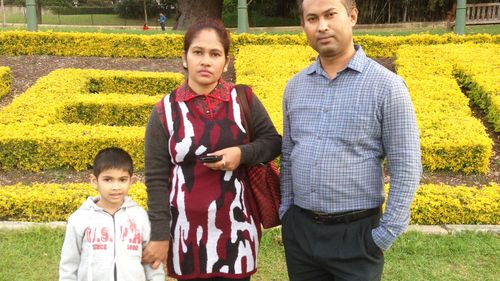
Adyan, with his mum Rebaka Sultana and dad Mahedi Bhuiyan.
Adyan, with his mum Rebaka Sultana and dad Mahedi Bhuiyan. (Supplied: Mahedi Bhuiyan)

Dr Bhuiyan said he still believed the Australia government would show compassion towards his family.

“I understand my son needs some help but he is not a burden. All I am asking is please give us a chance.”

Other families facing deportation under circumstances similar to Adyan’s have been granted a ministerial intervention.

Last year, the Irish parents of Australian-born toddler Darragh Hyde were granted permanent residency after he was initially deemed a taxpayer burden because of his cystic fibrosis.

The Department of Home Affairs is yet to respond to nine.com.au’s request for comment.

While the department does not usually comment on individual cases, it has previously said:

“Most visas require applicants to meet the migration health requirement set out in Australian migration law. The health requirement is not condition-specific and the assessment is undertaken individually for each applicant based on their condition and level of severity.”

“It is an objective assessment to determine whether the care of the individual during their stay in Australia would likely result in significant costs to the Australian community or prejudice the access of Australian citizens and permanent residents to services in short supply.

“For certain visas, primary criteria for the grant of the visa requires that all members of a family unit satisfy certain requirements. If one of the members of a family unit does not satisfy these requirements, then the primary applicant will not meet the criteria for the grant of the visa.”

Contact reporter Emily McPherson at emcpherson@nine.com.au.

Source by [author_name]

Hong Kong on edge before National Anthem Bill: Live updates

Riot police surrounded Hong Kong’s legislature on Wednesday morning as protesters threatened to take to the streets before the second reading of the controversial National Anthem Bill.

The bill would make it a criminal offence to “disrespect” the national anthem of the People’s Republic of China. It would also require that the anthem be taught in schools and sung by organisations. 

The semi-autonomous Chinese territory is also on edge over China’s plans to impose “national security” legislation.

The Legislative Council, known as Legco, is due to start its session at 11am (03:00 GMT). Police have also taken to walkways around the area and are checking passers-by.

02:00 GMT – Five youngsters arrested with petrol bombs, helmets, gas masks

AFP is reporting that the police have arrested five under-18s in three different areas around the city. One group had molotov cocktails, another a screwdriver and the others helmets and gas masks. The youngest is just 14.

00:30 GMT – Trump warns US to have “strong response” to China security legislation

US President Donald Trump says the US will announce its response to China’s plan to impose national security legislation on Hong Kong by the end of this week.

When asked whether the response would include sanctions, Trump responded: “No, it’s something you’re going to be hearing about … before the end of the week, very powerfully, I think.”

You can read more on Trump’s comments and US reaction to China’s recent moves in Hong Kong here.

00:00 GMT – Hundreds of riot police surround Legco

Hundreds of riot police have been deployed around the Legco building, which has been sealed off behind a wall of blue and white water-filled plastic barriers, according to Reuters.


SOURCE:
Al Jazeera and news agencies


Source link

Trump Taunts Reporter For Wearing Mask During White House News Conference

President Donald Trump told a reporter to take off his mask during a White House news conference on Tuesday. 

Trump said he had a hard time hearing Reuters White House correspondent Jeff Mason ask his question. 

Mason said he would just speak louder instead ― and Trump used one of his go-to lines to mock the reporter. 

“Oh, OK, because you want to be politically correct,” the president said at the Rose Garden event. 

“No, sir, I just want to wear the mask,” Mason replied. After the event, the reporter tweeted a link to the Centers for Disease Control and Prevention’s recommendations for face coverings to prevent the spread of the coronavirus. 

Trump’s own task force has recommended face coverings while in public to help stop the spread of the virus.

But Trump himself has simultaneously endorsed the mask guidelines, mocked former Vice President Joe Biden for wearing one and largely avoided donning one himself, although a photo of him wearing a mask during a tour of a Ford facility surfaced last week.

Biden, the presumptive Democratic presidential nominee, called Trump a “fool” for mocking the masks.

“He’s a fool, an absolute fool to talk that way,” Biden told CNN on Tuesday. “This macho stuff, for a guy … I shouldn’t get going. It’s costing people’s lives.”

A HuffPost Guide To Coronavirus


Source by [author_name]

Trump hints at action against China over Hong Kong security law

US President Donald Trump has indicated that the United States was working on a strong response to China’s planned national security legislation for Hong Kong, which would be announced before the end of the week.

China’s parliament is expected to approve a proposed security law that would reduce Hong Kong’s separate legal status on Thursday, calling into question the special economic status the territory currently enjoys under US law.

More:

Hong Kong’s Legislative Council is also expected to complete the second reading on Wednesday of a bill that would make it a criminal offence to “disrespect” China’s national anthem.

At a White House news briefing on Tuesday, Trump was asked if he planned sanctions against China over Hong Kong and if he intended to put restrictions on visas for students and researchers from the country.

“We’re doing something now. I think you’ll find it very interesting … I’ll be talking about it over the next couple of days,” he replied.

Pressed if this would include sanctions, he said: “No, it’s something you’re going to be hearing about … before the end of the week, very powerfully, I think.”

Trump did not elaborate, but White House spokeswoman Kayleigh McEnany said earlier the president was displeased by the proposed security law and found it “hard to see how Hong Kong can remain a financial hub if China takes over”.

Asked if this might mean an end to special economic treatment Washington affords to Hong Kong, McEnany said she had nothing to announce about the precise response.

Beijing’s action ‘very disturbing’

Trump’s economic adviser, Larry Kudlow, earlier called Beijing’s actions “very disturbing.”

“China is making a big mistake, frankly,” he said.

Kudlow said Washington would welcome back any American companies from Hong Kong or China’s mainland.

“We will do what we can for full expensing and pay the cost of moving if they return their supply chains and their production to the United States,” he said.

Trump administration officials and legislators have been exploring ways to encourage US firms to move supply chains for critical products back to the US from China amid steadily worsening ties and bitter recriminations over the coronavirus pandemic, which began in China.

Proposals discussed so far include tax breaks, subsidies including a potential $25bn “re-shoring fund” and new local content rules.

US Secretary of State Mike Pompeo, who is due to release a congressionally mandated assessment on whether Hong Kong enjoys sufficient autonomy to justify continued special economic treatment, said last week the legislation would be the “death knell” for the territory’s autonomy.

If the State Department decides to decertify the territory, Trump would then have to decide whether to end some, all or none of the privileges Hong Kong currently enjoys.

Trump has previously warned of a strong reaction and National Security Adviser Robert O’Brien said the legislation could lead to US sanctions.

Separately, the US House of Representatives is expected on Wednesday to approve legislation to toughen Washington’s response to China’s crackdown on its Uighur Muslim minority, sending it to Trump’s desk, congressional sources said.

Asked if he would sign the bill, which calls for sanctions against senior Chinese officials, Trump said he would hear more about the issue later on Tuesday and would “take a look at it very strongly”. He did not say how he would respond.


SOURCE:
Reuters news agency

Source link

Delhi court extends police custody of two Pinjra Tod members by 2 days in connection with communal violence in Northeast Delhi – Firstpost

0

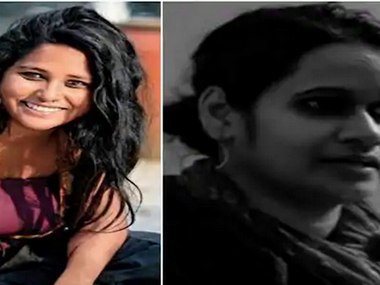
New Delhi: A Delhi court on Tuesday extended by two days the police custody of two women members of the Pinjra Tod group in a case related to the communal violence in northeast Delhi.

The metropolitan magistrate extended the remand of JNU students Natasha Narwal and Devangana Kalita in the case after the police said custodial interrogation was required to unearth the conspiracy behind the case and identify other accused.

The two were arrested on Saturday in connection with a protest against the Citizenship (Amendment) Act in Jaffrabad area in February.

On Sunday, they were granted bail by the court in the case, but moments later the Delhi Police crime branch had moved an application seeking to interrogate them and formally arrest them in a separate case.

They had sought 14 days of custody of the accused. The court had sent them to police custody for two days, saying the investigation was at its initial stage.

Devangana Kalita and Natasha Narwal. Image courtesy: Twitter.

The case, in which they were arrested on Saturday, was registered under sections 147 (rioting), 186 (obstructing public servant), 188 (disobedience of order), 283 (danger or obstruction in public way), 109 (abetment), 341 (wrongful restraint), 353 (assault or criminal force to deter public servant from discharging duty) of the Indian Penal Code.

The case in which they were arrested on Sunday was registered under sections 147 (rioting), 149 (unlawful assembly), 353 (assault or criminal force to deter public servant from discharge of his duty), 283 (danger or obstruction in public way), 323 (voluntarily causing hurt), 332 (causing hurt to deter public servant from his duty), 307 (attempt to murder), 302 (murder), 427, 120-B (criminal conspiracy), 188 (disobedience of public servant’s order) of the IPC, relevant sections of the Arms Act and Prevention of Damage to Public Property Act.

Communal clashes had broken out in northeast Delhi on February 24 after violence between citizenship law supporters and protesters spiralled out of control leaving at least 53 people dead and around 200 injured.


Source link

Why Thailand isn’t reopening to international tourists yet

0

Bangkok (CNN) — With news that many countries in Europe are reopening to tourism in time for summer, travelers with their sights set on Asia are anxiously awaiting word on when they’ll be given the green light to visit their favorite destination.
As of now, those with Thailand in mind will need to wait at least a few more months before packing their bags.
“It is still dependent on the outbreak situation, but I think at the earliest, we may see the return of tourists could be the fourth quarter of this year,” Yutasak Supasorn, governor of the Tourism Authority of Thailand (TAT), tells CNN Travel.

And even then, he says, there will likely be restrictions on who can visit and where they can go.

“We are not going to open all at once,” he adds. “We are still on high alert, we just can’t let our guards down yet. We have to look at the country of origin [of the travelers] to see if their situation has truly improved. And lastly, we have to see whether our own business operators are ready to receive tourists under the ‘new normal’.”

Similar versions of this strategy are already being looked at in the region — referred to as “tourism bubbles.” Basically, a country will open borders reciprocally with destinations that also have their coronavirus situation under control.

Once Thailand does open to international tourists, they’ll likely only be able to visit certain spots, says Yutasak.

“We have studied a possibility of offering special long-stay packages in isolated and closed areas where health monitoring can be easily controlled — for example, Koh Pha Ngan and Koh Samui. This will be beneficial for both tourists and local residents, since this is almost a kind of quarantine.”

Bangkok’s famous street food vendors have reopened, but diners must follow strict social distance rules.

Lauren DeCicca/Getty Images AsiaPac/Getty Images

Yutasak says they’re finishing up a framework to restart tourism, but much of the decision-making lies in the hands of the CCSA — the Center for Covid-19 Situation Administration — which will decide when is the best time to open the border.

Phuket-based Bill Barnett, managing director of Asia-focused consulting firm C9 Hotelworks, says “baby steps are needed” to reignite international tourism.

“The next step is bilateral agreements between countries,” he says. “Thailand’s good standing in the face of the crisis with China, along with strong pent-up demand, make it a logical short-term solution for overseas tourism to return to the Kingdom.”

For now, Thailand isn’t taking any chances and the country’s borders are firmly shut.

The Civil Aviation Authority of Thailand (CAAT) has issued a temporary ban on all international commercial flights into the country until June 30, excluding repatriation flights. The Thais who do return on these flights are put into quarantine facilities for 14 days.

Meanwhile, on May 26, the Thai Cabinet agreed to extend the nationwide state of emergency until June 30.

Thailand has seemingly managed to avoid the ravages of the virus experienced by many other nations around the world.

When this story was published, the country had recorded 3,042 Covid-19 cases and 57 deaths. It’s reporting only a handful of new Covid-19 cases each day — occasionally even zero. Instances of local transmissions are low, with most recent Covid-19 infections discovered in quarantined returnees.

Country kicks off domestic tourism push, eases lockdown measures

Thailand is now focused on reopening to domestic tourism in June, says Yutasak. Resorts and hotels in some tourism destinations throughout the country have already been given the green light to reopen, including in Hua Hin, a popular beach resort about 200 kilometers (124 miles) south of Bangkok.

Nationwide lockdown measures put in place in late March have been easing in stages throughout May.

Malls, markets, museums and some tourist attractions have already reopened and more are slated to follow. Bangkok’s Grand Palace, for instance, will reopen June 4.
National parks, theme parks, stadiums, spas, massage shops and cinemas remain closed, but local media reports some will likely be given the go-ahead reopen in June.

Restaurants — limited to offering only delivery and take-out services in late March — can now allow customers to dine in but are banned from serving alcohol and must adhere to strict social distancing measures. Pubs and night clubs remain closed, and a curfew is in place from 11 p.m. to 4 a.m.

Local transport networks are increasing services, including rail and bus lines, while airlines are upping the number of domestic flights.

Phuket International Airport, however, remains closed until further notice.

Thailand’s most popular tourism island emerged as a coronavirus hotspot in March, facing the highest infection rate per capita out of all of Thailand’s 77 provinces.

As a result, Phuket officials imposed strict lockdown measures and embarked on an intensive drive to test residents.

But with cases slowing to a trickle in recent days, embattled travel industry players question the continued closure of the island’s airport when the rest of the country is opening to domestic flights.

“The Phuket tourism sector at the moment is sad, stunned, annoyed and dismayed at the lack of a defined plan to reopen the airport,” says Barnett.

“The recent 24-hour notice by CAAT of a sustained closure was a hard pill to swallow for a damaged industry. There is no point to open hotels, while the airport is the trigger for reopening. The vague notice and lack of a clarity on when the airport [will reopen] makes it impossible for businesses to plan forward actions.”

Local businesses struggle

Even with domestic tourism starting to kick off in some provinces, it’s only a drop in the bucket.

In 2019, nearly 40 million tourists visited Thailand, according to government data. The TAT estimates only 14 to 16 million will visit this year.

Financially stressed hotels in need of cash flow have already started aggressively selling hotel rooms and vouchers, says Barnett, while also looking to the local market to provide some relief.

“Staycations and road trips are being touted but in a country where tourism represents 12 to 14 percent of the GDP, these small bites are not going to bridge the road to recovery,” he says. “Broader ASEAN bilateral agreements and getting airports open and airlines back in the air is what’s needed.”

Shoppers wearing face masks walk past a sign reminding visitors to observe social distancing at Bangkok's Chatuchak Weekend Market on May 17.

Shoppers wearing face masks walk past a sign reminding visitors to observe social distancing at Bangkok’s Chatuchak Weekend Market on May 17.

CANDIDA NG/AFP/AFP via Getty Images

Bangkok’s Chatuchak Weekend Market, one of the city’s most popular shopping destinations, reopened on May 9. But though Thais and expats have returned, it’s simply not enough foot traffic for vendors to make a sustainable living, says shop owner Tassanee Larlitparpaipune.

“International tourists make up about 50 percent of my customer base,” she says. “Most are from Singapore, Hong Kong and Malaysia.”

Before the Lunar New Year holiday in January, Tassanee owned four clothing shops at the market. She has since closed two and is now considering shuttering a third and shifting her focus to online orders.

Wildlife returns to once busy natural spaces

But the Covid-19 pandemic hasn’t had completely negative consequences. As seen in other once busy global destinations, Thailand’s wildlife has benefited from the global shutdown — particularly marine animals.

Marine biologist Dr. Thon Thammawongsawat says the changes he’s witnessed have been remarkable, with animals returning to destinations once crowded with humans.

“For example, pink dugongs were spotted around Ban Pe, in Koh Samet and green turtles laid eggs for the first time in six years at Koh Samui beaches,” he says.

More than 200 of these turtles were born on the secluded beach of the Banyan Tree Samui resort, with three nests hatching between April 4 and 24, according to hotel staff.

More than 200 baby green turtles hatched at Koh Samui's Banyan Tree resort in April.

More than 200 baby green turtles hatched at Koh Samui’s Banyan Tree resort in April.

Banyan Tree

A giant mother turtle reportedly laid the eggs in late February and early March, which were then protected by the resort’s resident marine biologist and the local Department of Marine and Coastal Resources.

Other species of turtles have returned to Thailand’s shores to lay eggs, too.

“The most crucial indicator of positive side effects from this crisis is that we’ve seen leatherback turtles lay eggs in the highest amount since we began recording statistics eight years ago,” says Thon.

“Last year, we recorded that there were about 100 leatherbacks hatched. This year, up until now, there are more than 300 hatched and returned to the sea.”

The country’s national parks officials say they hope to preserve some of these gains.

“The department has decided to close national parks — both land and marine parks — every year between two to three months a year,” Sompoch Maneerat, director of information for Thailand’s Department of National Parks, tells CNN Travel.

“Durations and dates will be varied depending on the nature of each location. The purpose is to achieve sustainable tourism, where nature can rest during the low season.”

As for popular Maya Bay, where the 2000 movie “The Beach” starring Leonardo DiCaprio was filmed, Sompoch says it will remain closed until at least 2021, as the ecosystem has not yet fully recovered to an acceptable level.

The bay has been closed since June 2018 part of a rejuvenation program aimed at reviving the area’s decimated corals.



Source link

Lessons from coronavirus: Not all jobs are ‘bullshit’

0

David Graeber is professor of anthropology at the London School of Economics and author of “Bullshit Jobs: A Theory” (Simon & Schuster, 2018).

LONDON — Crises tend to reveal unacknowledged truths. In 2008, we learned that the majority of the financial wizards we had been taught to treat with awe for the previous two decades were, in fact, little more than scam artists — and rather clumsy ones, at that.

The coronavirus, and resulting lockdowns, is teaching us an even more startling lesson: that a very large portion of what we call “the economy” is little more than just another scam.

It’s hard to know what else to conclude when literally millions of highly paid office workers have been forced to stay away from the office, to reduce their work to 10 or 15 minutes a day, or often nothing at all, without having the slightest impact on those essential functions that keep the public fed, clothed, distracted and alive.

What actual purpose do leadership consultants, brand managers, marketing researchers, corporate lawyers, lobbyists, strategic deans or vice presidents for creative development (let alone their endless legions of administrative assistants) actually serve? In many areas — notably hospitals — things seem to be running decidedly more smoothly in the absence of the “nonessential workers” at the top of the administrative and managerial food chain.

Those with the power to do the most harm are rewarded most, while those who do the most good are rewarded least.

Perhaps the most telling symbol here: Back in March, there was a debate, including in POLITICO, over whether it might be a good idea to shut down Wall Street entirely, if only for a few weeks, to calm the waters.

Nowhere in the discussion was there any suggestion that shutting down trading would itself have any negative effects on … pretty much anyone (except for the traders).

What does it say of an institution that it can do terrible harm, but no one is quite sure in what way it does them any good?

Economics textbooks of course teach us that “financial markets” are the superior, free market-driven way to do what governments used to try to do by central planning — that they serve us by optimally allocating resources to meet future wants and needs.

And yet, “the market” seems to have failed about as completely as any Soviet five-year plan ever could, creating almost unimaginable divisions between rich and poor, teeing up periodic financial crises, and, apparently, driving us with breakneck speed to destroy the earth.

Maybe efficient allocation was never really the point. Maybe Wall Street just existed for its own sake. Maybe all these glittering towers are just as much vanity projects as the hundreds of in-house corporate magazines. Maybe half the carbon dioxide we’re pumping into the air is ultimately being released so that some executive vice president can wave his hand and say, “behold my empire!”

The people ultimately responsible for this state of affairs are many of those now working from home.

So, what about those actually working — that is those who, as we have newly discovered, actually make our lives possible?

Let’s perform a thought experiment. What if we conceived “the economy” not as a market but as the way we human beings take care of one another, by providing each other with material needs and the basis for satisfying, meaningful lives.

Define productivity in this way and it’s hard to escape the conclusion that the more economically beneficial jobs — fruit-pickers, nurses, delivery workers, electricians, shelf stockers — tend not just to be the least well paid; they are also treated with the least on-the-job respect, and they’re often the most dangerous.

Indeed, at least half, and perhaps most, of the most valuable work isn’t paid at all, but performed out of love, overwhelmingly by women.

It’s commonplace now to celebrate “essential workers” as heroes, in the same way we are accustomed to doing when speaking of soldiers and the police, putting their lives on the line for the sake of all of us.

In reality, farmers, fishermen, drivers, garbage collectors and construction workers have always been more likely to die on the job than police officers; we simply never think about it, in much the same way we never seem to ask ourselves why it is that so many of those who provide our essential needs are forced to wear strange, uncomfortable uniforms for no particular reason.

Construction workers work on a site along the Quays in Dublin City centre in Ireland on May 18, 2020 | Paul Faith/AFP via Getty Images

They were always putting their lives on the line for our benefit. We just never noticed.

The governing principle of our current system seems to be exactly backward: Those with the power to do the most harm are rewarded most, while those who do the most good are rewarded least (“virtue should be its own reward” as the ancient Stoics used to put it).

How about this year we turn it around? How about we give essential workers “special bonuses” worth two or three times their normal annual salary, like we normally do for Wall Street executives, and let the executives make do with occasional waves of applause.

Then we can start thinking of how many of those now working from home actually need to return to their cubicles, and how many of the jobs out there are better left undone.


Source by [author_name]

Demonstrators clash with police as they protest death George Floyd

George Floyd, a black man, died after Minneapolis police officers kneeled on his neck as he was detained. Floyd repeatedly expressed that he couldn’t breathe.


Source link