Friday, May 22, 2026

Cairns boy suffered catastrophic head injuries in alleged park fight

Police are appealing for public help to uncover how a 12-year-old boy died during a fight in Cairns.

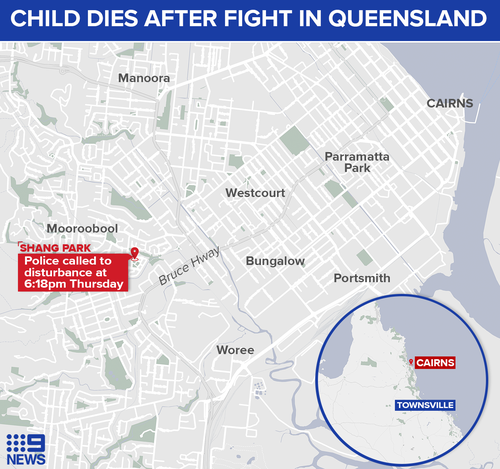
Officers were called to Shang Park in Mooroobool about 6pm on Thursday over reports of a disturbance between a group of young people.

The boy was found unresponsive and taken to Cairns Hospital where he was pronounced dead a short time later.

Police say it’s likely he died of trauma to the head.

It’s believed the boy was with three others when they became involved in a fight with another group.

George Sailor said he provided assistance to the boy in the moments after the incident. (Nine)

Passer-by George Sailor told 9News he heard the fight and rushed over, finding the boy unresponsive.

“I placed him on his back straight away and started CPR. His friends were around but some were in shock, his sister was running up and down was just in pure shock,” he said.

“I sort of haven’t slept, saw the flashbacks it kept running through my mind.”

Detectives have spoken with all involved but, because of gaps in CCTV and a lack of forensic evidence, need public help to discover what happened.

“I’m particularly interested in any other children or particularly adults that might have seen what occurred – anyone who bothered to video or anything like that – to piece together exactly what happened to this poor boy,” Detective Inspector Jason Smith told reporters.

The boy was pronounced dead at Cairns Hospital. (Nine)

He urged the community to maintain the peace as they await the outcome of the police investigation.

“It’s an Indigenous community largely here, a very tight community and well connected community… it will be a very sorry time for everyone in this area,” Det Insp Smith added.

“I call on anyone here just to be reasonable and wait until we can give them information as to how this fella died.”

The death has rocked the tight-knit community, locals left flowers at the park to pay respect to the boy and his family.

Source by [author_name]

Don Lemon Lets Trump Have It On George Floyd: ‘That’s How Black People Feel’

CNN’s Don Lemon says President Donald Trump’s comments ring hollow when it comes to the death of George Floyd, a Black man killed during an arrest in Minneapolis, setting off days of unrest. 

“Nobody wants to hear from the White House or the attorney general right now,” Lemon said. 

Video of the arrest shows Floyd, in handcuffs and on the ground, saying “I can’t breathe” as an officer presses a knee into his neck. 

He was pronounced dead later.

Trump called the footage a “shocking sight” and said the FBI is investigating. 

But Lemon pointed toward Trump’s long history of racist rhetoric as indirectly “contributing” to the situation with a brief recap of the president’s lowlights ― and said “no one wants to hear” from him right now. 

Trump, he reminded, called for the death penalty for the now-exonerated Central Park Five, claimed there were “very fine people on both sides” when white supremacists clashed with protesters in Charlottesville in 2017 and was a leader of the racist “birther” conspiracy that falsely claimed then-President Barack Obama wasn’t born in the county.

And Lemon pointed out that Trump attacked NFL players as “sons of bitches” for taking a knee in silent protest of police violence against Black Americans.

“No one wants to hear from the man who said there are ‘very fine people on both sides.’ Do you understand what I am saying? No one wants to hear from the person that they perceive as contributing to this situation, situations like this, in this society. Not directly, but allowing people like that to think they can get away from this. No one wants to hear from the Birther-in-Chief, from the ‘sons of bitches’-calling person, who says that athletes, who are kneeling for this very reason. No one wants to hear from that.”

“That’s how Black people feel,” Lemon said later. “The person who said, from klansmen and racists and Nazis and anti-Semites, that there were ‘very fine people on both sides,’ no one wants to hear that.”

See more of his discussion below:


Source by [author_name]

Ruling BJD Leader, Two Others Die in Fire Mishap in Odisha

0

Representative Image.(Reuters)

The victims, trapped inside the smoke-filled house, were rescued and rushed to the MKCG Medical College and
Hospital where doctors declared them brought dead, a senior police officer said.

  • PTI
  • Last Updated: May 29, 2020, 12:35 PM IST

A ruling BJD leader and two others died of suspected asphyxiation after a fire broke out in his house in Odisha’s Ganjam district on Friday, police said.

The three including BJD leader Alekh Choudhury (69), a former President of Berhampur Central Cooperative Bank Ltd,

were asleep in the house at Gosaninuagaon, when an air-conditioner caught fire due to an electric short circuit in

the early hours, they said.

The victims, trapped inside the smoke-filled house, were rescued and rushed to the MKCG Medical College and

Hospital where doctors declared them brought dead, a senior police officer said.

All of them were suspected to have died of asphyxiation as smoke triggered by the fire had engulfed the house, he said.

Apart from Choudhury, the two others were identified as his brother-in-law Bhagaban Patra (85) and caretaker Sunil

Behera (19).

The exact reason for the fire will be ascertained after a probe, a fire brigade official said.

Choudhury was also a former president of the Ganjam district Congress committee. He had contested the state assembly elections from Berhampur and Aska thrice but lost.

He had joined BJD before the 2014 elections.


https://pubstack.nw18.com/pubsync/fallback/api/videos/recommended?source=n18english&channels=5d95e6c378c2f2492e2148a2&categories=5d95e6d7340a9e4981b2e10a&query=Ruling,BJD,Leader,,Two,Others,Die,in,Fire,Mishap,in,Odisha,Alekh,Choudhury,Berhampur,&publish_min=2020-05-27T17:03:38.000Z&publish_max=2020-05-29T17:03:38.000Z&sort_by=date-relevance&order_by=0&limit=2

Next Story

Source link

In a First, Jharkhand Govt to Bring Back Migrant Labourers in Leh on Chartered Flights

0

File photo of Jharkhand CM Hemant Soren.

These workers will be brought in from Batalik in Leh to Ranchi and then Dumka. All arrangements to ferry the migrants from Ranchi to Dumka also have been made..

  • CNN-News18
  • Last Updated: May 29, 2020, 12:24 PM IST

New Delhi: In a first by any state, the Jharkhand government will be bringing back 60 migrant labourers stuck in Leh on a chartered flight.

These workers will be brought in from Batalik in Leh to Ranchi and then Dumka. All arrangements to ferry the migrants from Ranchi to Dumka also have been made..

This comes a day after the Supreme Court ordered states to ensure migrants are not charged for their travel back home.

Here is how it happened.

Migrant workers stranded in Batalik-Kargil sector, working in a BRO project, had reached out to the Hemant Soren government. The state immediately touched base with Ladakh UT local admin to provide assistance. Jharkhand Control Room, meanwhile, also registered their details on state portal.

Soren also reached out to the Union government and wrote a letter to Home Minister Amit Shah to allow chartered flights to bring back migrants.

All the 60 workers were checked, thermal screened and transported by BRO to Leh (six hours road journey) in the afternoon of May 28, and were kept in transit camp.

The workers will be flying out by SpiceJet flight departing at 12 pm on 29th May from Leh, arriving in Delhi around 2 pm and further be flying to Ranchi by Indigo flight departing Delhi at 6 pm and reaching Ranchi 8 pm .

This cost of transportation of 60 workers costing approximate 8 lakhs is being borne by the state govt

Yesterday a law school Bangalore Alumni led Initiative helped around 174 workers to be back to Jharkhand by a chartered flight ..

Sources also say that the state government intends to work further on this initiative ..Two flights are being operationalised to get back around 320 workers from Andamans…

165 trains for Shramiks have so far brought back approximately 12 lakh workers home..the cost of which mostly is borne by the state.


https://pubstack.nw18.com/pubsync/fallback/api/videos/recommended?source=n18english&channels=5d95e6c378c2f2492e2148a2&categories=5d95e6d7340a9e4981b2e10a&query=In,a,First,,Jharkhand,Govt,to,Bring,Back,Migrant,Labourers,in,Leh,on,Chartered,Flights,Dumka,Hemant,Soren,&publish_min=2020-05-27T22:25:19.000Z&publish_max=2020-05-29T22:25:19.000Z&sort_by=date-relevance&order_by=0&limit=2

Next Story

Source link

Its Coronavirus Caseload Soaring, India Is Reopening Anyway

0

NEW DELHI — Its coronavirus cases are skyrocketing, putting it among the world’s most worrisome pandemic zones in recent weeks. Nonetheless, India is reopening, lifting its lockdown at what experts fear may be the worst time.

Migrant workers are becoming infected at an alarmingly high rate, leading to fresh outbreaks in villages across northern India. Public hospitals in Mumbai are so overwhelmed that patients have taken to sleeping on cardboard in the hallways.

Doctors fear that the lockdown, which started over two months ago, has been eased too soon, after slowing the virus but failing to flatten the new-case curve as effectively as other nations have. If India does not find a way to curb the virus in high-risk states, epidemiologists project that its total caseload could approach a million within several weeks.

“India is not out of the woods,” said Dr. Ashish Jha, the director of the Harvard Global Health Institute.

“From a public health point of view, I do think the lockdown has brought the disease under control,” he said. “But of course, as restrictions have lifted in the last week or 10 days, the number of cases has started to rise quickly.”

At first, India moved aggressively to contain the coronavirus. In late March, Prime Minister Narendra Modi implemented one of the most severe lockdowns anywhere, ordering all Indians to stay inside, halting transportation and closing most businesses.

But the lockdown was brutally hard on the poorest Indians and those who rely on day labor to survive. And the country’s economy, which had already been ailing, was sustaining deep wounds. Government officials began lifting some restrictions last month, hoping to ease the suffering, and the lockdown may end entirely as soon as Sunday, if Mr. Modi does not decide to extend it.

Infections are rising quickly now, however, with outbreaks in some states that had reported few cases. This month, India’s doubling rate for new infections averaged about 12 days, putting it on par with countries of high concern like Brazil.

That number compares poorly to those of other nations where stay-at-home orders were imposed. In the United States, the doubling rate improved from around 26 days at the start of May to about 50 days on Monday. Italy crossed the 100-day mark early this month.

But in India, a nation of 1.3 billion people, locking down has posed different challenges than in many Western societies. Its metro areas are among the world’s densest, with millions living in packed slums, sometimes sleeping eight to a room.

Almost half of India’s cases have been traced to just four cities: New Delhi, Mumbai, Chennai and Ahmedabad.

“Social distancing is inherently very difficult in India,” Dr. Jha said. “I don’t know if India could realistically get to 26 days, or 50 days.”

Testing has also been severely restricted, making it tough to gauge the scope of the outbreak. India has administered only two tests for every 1,000 people, one of the lowest ratios among the world’s worst-afflicted countries.

Dr. G.C. Khilnani, a public health expert and pulmonologist, said a peak in infections might not be reached until the end of July. He said India’s relatively low number of total cases per capita (about 160,000 infections and 4,706 deaths) should not be taken as a sign that the country had necessarily escaped the worst.

“Nobody can predict to what extent the numbers will go up,” Dr. Khilnani said.

As many parts of India continue to see days with record-high infections, a political consensus on how to fight the virus has deteriorated, giving way to acrimony and finger-pointing.

“We are the only country in the world where the virus is exponentially rising,” Rahul Gandhi, a leader of the opposition Indian National Congress party, said in a video statement. “What India is facing now, in front of us, is the result of a failed lockdown.”

Amit Malviya, a spokesman for Mr. Modi’s Bharatiya Janata Party, fired back in a television interview. He accused Mr. Gandhi of not taking stronger action to contain infections in Maharashtra, India’s hardest-hit state, which is governed by a coalition that includes the Indian National Congress.

“Maharashtra is completely over the top, it’s bleeding, people are dying, the health infrastructure’s crumbled,” Mr. Malviya said. Health officials have traced nearly 40 percent of India’s cases to the state.

Questions have also been raised about whether the lockdown played a role in spreading the virus to remote areas of India.

When Mr. Modi announced the restrictions, he gave Indians just four hours to prepare before they went into effect. Millions of migrant workers were stranded in cities. With bus and train services suspended, some walked hundreds of miles to reach their villages, using dirty pieces of cloth to cover their faces. The human suffering has been staggering.

Shiv Dutt Gupta, a member of a government task force crafting the lockdown exit plan, partially attributed the surge in new cases to laborers bringing the coronavirus into rural India.

Test results for several hundred migrant workers who traveled from New Delhi to the state of Bihar this month found that one in four had contracted Covid-19. Bihar now has one of the steepest infection curves in India, and troubling clusters have also been tracked to laborers traveling to their homes in Uttar Pradesh, the country’s most populous state.

“The rate of positive cases among the migrant workers is very high,” Mr. Gupta said. “That is alarming.”

If the lockdown continues, Mr. Gupta said, “We will be devastated economically.”

Officials have justified loosening rules by pointing out that not all of India has been hit equally, with hopeful improvements in states like Kerala. And doctors note that the lockdown did buy the government time to ramp up infrastructure in the country’s already overburdened health facilities.

“Two months of lockdown has helped us fine-tune our treatment protocols, our isolation protocols, our quarantine protocols,” said Naresh Trehan, a prominent Indian surgeon.

Now, the resumption of cross-country transportation and industry has raised the prospect that previously spared states may find themselves confronted with imported outbreaks.

But many Indians seem ready to venture out, despite the numbers.

After weeks of self-isolating at home, Mujtaba Rizvi, an artist living in Chennai, said he went for a walk last weekend and was stunned by what he saw. Streets were clogged with cars. Shoppers spilled out of crowded shops without wearing masks or observing social distancing.

At this point, Mr. Rizvi said, it appeared there was no turning back.

“Freedom comes at a price, and people seem to be ready to pay,” he said. “Even if more people die now, it would be difficult to send us back into isolation.”

Suhasini Raj contributed reporting.


Source link

Ramaphosa tells smokers to be patient: ‘It’s only a matter of time’

President Cyril Ramaphosa has reiterated the impermanent nature of government’s risk-adjusted approach to lockdown, adding that the prohibition of tobacco would be repealed at lower levels.

In an exclusive late-night interview with SABC on Thursday, President Ramaphosa faced a barrage of questions relating to the COVID-19 outbreak in South Africa and the subsequent lockdown. The president’s responses were tabled just hours after Minister Nkosazana Dlamini-Zuma gazetted Level 3 lockdown regulations and members of the National Coronavirus Command Council (NCCC) expanded on departmental responsibilities.

Lockdown South Africa: The good, the bad and the ugly

The state-backed lockdown, which has been in place for more than two months, has divided public opinion and been the subject of fierce criticism. As noted by Ramaphosa, scientific evidence supported the success of South Africa’s initial lockdown. Stringent regulations, which restricted economic activity and personal freedoms, managed to reduce the coronavirus’ curve. Slowing down the rate of infection afforded a timely reprieve to ready healthcare systems for the inevitable peak.

While lockdown’s medical benefits have been lauded, its impact on the economy has pushed South Africa to the brink of a financial depression. Unemployment rates are expected to increase by more than 20%, and while most industries have been permitted to reopen at Level 3 lockdown, the economic devastation caused by two months of inactivity has proven too much to bear for thousands of small businesses. Many small, medium and micro-enterprises will never reopen their doors.

Critics of government’s lockdown — opposition parties, civil societies, economic analysts, the public and even medical scientists — argue that regulations have been too restrictive for too long and that the NCCC missed its opportunity to balance the cost of lives with livelihoods.

Ramaphosa: ‘No issue between scientists and politicians’

Judging from recent statements issued by Health Minister Zweli Mkhize in response to criticism tabled by Professor Glenda Gray — president of the Medical Research Council (SAMRC) and lead expert on the Ministerial Advisory Committee — scientists and politicians have butted heads over the ongoing lockdown.

Gray claimed that government had gone rogue and was no longer heeding scientific advice from medical experts. The professor added that the continued lockdown was “not based on science” and was “completely unmeasured”.

During his interview with the public broadcaster, Ramaphosa was questioned about possible tensions between scientists and politicians. The president was quick to dispel rumours of disunity between government and the advisory committees, saying:

“Diverse views are to be welcomed, they must never be silenced. People must express themselves. We have said that the medical advisory committee has been advising government extremely well.

We welcome everybody’s input on that medical advisory committee, including the recent ructions that we had, which have now been solved. They’ve been solved and that is now behind us; they are united in their purpose and giving us advice.

I see no problem. There is really no issue between scientists and politicians.”

Cyril Ramaphosa to smokers: This too shall pass

One of the most hotly-contested regulations within the Disaster Management Act which governs the risk-adjusted lockdown, has been the continued prohibition of tobacco products. Since late March, the sale and purchase of cigarettes has been outlawed.

In addition to frustrating millions of South African smokers, this law has given rise to a burgeoning black market. With smokers unwilling to quit and paying hugely inflated prices for cigarettes, it’s expected that the ban has cost government over R35 million a day in lost excise duties.

The ban is currently being fought in court by multiple parties, with the Fair Trade Independent Tobacco Association (Fita) leading the charge.

Ramaphosa, who has been personally listed as a respondent in court orders, has called on South Africans and smokers, in particular, to be patient, noting that lockdown would not last forever. The president said:

“We are not permanently going to be on Level 3. We are going to migrate to another level. Even those who are hankering for tobacco, they must know that it is only a matter of time before their hankering is assuaged or addressed.”

The ongoing legal battle to have the prohibition of tobacco declared unlawful and overturned is expected to be heard before the Pretoria High Court on 9 June 2020.


Source link

‘Extremely Vicious’ Lion Attack Leaves Australian Zookeeper Seriously Injured

A female zookeeper is fighting for her life in hospital after an “extremely vicious” lion attack at an Australian zoo on Friday morning. 

The 35-year-old was cleaning a lion enclosure at Shoalhaven Zoo in New South Wales when two lions attacked her, resulting in lacerations and bites to her head and neck. 

“A 35-year-old woman was treated at the scene by NSW Ambulance paramedics for head and neck injuries, before being airlifted to St George Hospital in a critical but stable condition,” read a statement from NSW Police. 

“Police have been told the woman was cleaning the enclosure at the time.

“Officers from South Coast Police District established a crime scene and commenced inquiries into the circumstances surrounding the incident. SafeWork NSW have been notified.”

Inspector Faye Stockmen, Duty Operations Manager, NSW Ambulance, said the situation was “absolutely harrowing”. 

″This is one of the worst jobs I have ever experienced – I have never come across a job like this in my career,” she said in a statement to HuffPost Australia. 

“It was absolutely harrowing. It is an incredibly dangerous situations, both for the patient and the paramedics. Being the first to walk into the enclosure was one of the most frightening experiences – we literally had to walk into a lion’s den.”

“The attack was extremely vicious and paramedics found the woman with severe injuries.”

“We are trained to deal with extreme or unusual situations, however, we do have support services available to us.”

Shoalhaven Zoo has been closed since March 25 due to COVID-19 restrictions, according to its website.

In a separate statement on its Facebook page, the zoo said: “While we are closed to the public we as a family will continue to live onsite and have key staff coming in to help us ensure the safety & well being, cleaning & feeding of all our animals”. 

Shoalhaven Zoo did not immediately respond to HuffPost’s request for comment. 


Source by [author_name]

Coronavirus LIVE Updates: Lockdown Must be Extended for 15 Days as Covid-19 Graph Rising, Says Goa CM; 2 Floors of Parliament Annexe Sealed as Officer Infected

0

Coronavirus LIVE Updates: As Covid-19 cases surge in West Bengal, the state government has identified five states with high burden which are Maharashtra, Gujarat, Delhi, Madhya Pradesh and Tamil Nadu and mandated that returnees from these will be mandatorily put under 14-day institutional quarantine. The rest will remain in home isolation under state supervision. The cases in Bengal, which is still limping back to normalcy after Cyclone Amphan, have been on the rise. Today, minister for fire and emergency services Sujit Bose also tested positive for the virus.

India crossed yet another milestone in Covid-19 cases today as the country reported the highest spike so far with 7,466 new infections in the last 24 hours taking the total cases to 1,65,799. The death toll rose to 4,706 with 175 deaths reported in a day. While the active cases are 89,987, those cured and migrated add up to 71,105, the Ministry of Health and Family Welfare said. The United States recorded 1,297 coronavirus deaths on Thursday, bringing its total to 101,573 since the global pandemic began. The country has also officially logged 1,720,613 cases of the virus, far more than any other nation. To make matter worse, Republicans in the US state of Pennsylvania faced calls for their resignation Thursday after a lawmaker tested positive for Covid-19 and they did not tell Democratic colleagues for a full week. Democrats in the state’s House of Representatives erupted in anger for having their health and that of their families put at risk, with one calling the chamber’s Republican leadership “callous liars” for withholding the information even as the House remained in session.

Read More


Source link

China is embracing a new brand of wolf warrior diplomacy

0

It’s a phrase that is now used widely in Chinese state-run media as well as Western publications, and it was made clear last weekend that its proponents have the full support of the country’s top diplomat.

Speaking at a press conference in Beijing Sunday, Foreign Minister Wang Yi said that China would now push back against “deliberate insults.”

“We never pick a fight or bully others. But we have principles and guts. We will push back against any deliberate insult, resolutely defend our national honor and dignity, and we will refute all groundless slander with facts,” said Wang, responding to a question from CNN.

But what is “wolf warrior” diplomacy, what does the name mean and where did it originate?

The “wolf warriors” represent a completely different type of diplomat to the famously bland Chinese foreign representatives of the past few decades.

Instead of long, verbose statements, these Chinese officials are taking to Twitter and other social media platforms to hit back directly at any criticism of China or the ruling Communist Party.

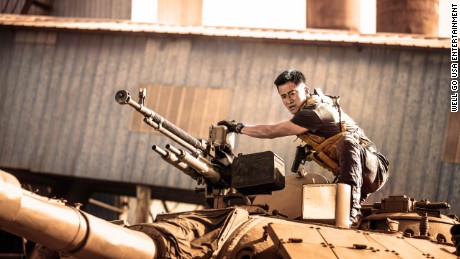
“Wolf Warrior” is actually the title of a hugely-successful series of patriotic action films in China, featuring Rambo-like protagonists who fight enemies at home and abroad to defend Chinese interests. The first film was released in 2015 and made more than $76 million (545 million yuan) at the box office.

It quickly spawned a sequel that became China’s highest grossing film at the time when it was released in 2017. “Wolf Warrior 2″‘ was based around a squad of People’s Liberation Army soldiers sent into an African country to rescue Chinese civilians. The film’s tagline was, “Even though a thousand miles away, anyone who affronts China will pay.”

An early comparison between the film series and China’s diplomats came in July 2019, when Zhao Lijian, then a counselor at the Chinese embassy in Pakistan, began to hit back hard against the US government on Twitter.

In a controversial series of tweets, Zhao claimed the US had no right to criticize China on human rights abuses when it had problems with racism, income inequality and gun violence. Zhao alleged there were places in Washington DC where “the white (people)” never go.

It provoked a furious reaction from former US President Barack Obama’s National Security Adviser Susan Rice, who called Zhao a “racist disgrace.” But one year later, Zhao’s career has only blossomed, and he is now one of the three high-profile spokespeople who hold the Chinese Foreign Ministry’s daily press conference.

Not only that, but Chinese diplomats across the world have begun to mirror Zhao’s aggressive tactics on Twitter, a platform long banned in China.

Zhao’s boss Hua Chunying, director general of the Foreign Ministry’s Department of Information, has frequently lashed out at critics on her Twitter account, which she only opened in October 2019 and now boasts almost 500,000 followers.

“Some politicians ignore the basic facts and make up countless lies and conspiracy theories concerning China,” Hua said on May 24 amid deteriorating relations between the US and China over the coronavirus pandemic.

China’s ambassador to the UK Liu Xiaoming has been another keen “wolf warrior,” regularly using Twitter to hit back against critics of Beijing in Europe.

Speaking to state media on Monday, Liu said that the term “wolf warrior” was a misunderstanding of China’s foreign policy, which he said was an “independent foreign policy of peace,” but added sometimes a strong hand was needed.

“Where there is a ‘wolf,’ there is a warrior,” Liu said in an answer posted to his Twitter.

Despite the comments by Foreign Minister Wang and the ambassador, there still appears to be a degree of indecision in the Chinese government and state media over whether or not to fully embrace the term.

In April, the state-run tabloid Global Times published a story praising China’s “wolf warrior” diplomats for taking the fight to the West, saying it was necessary as Western diplomats “resort to a hysterical hooligan style diplomacy.”
In Hong Kong and beyond, China moves to consolidate position of strength as country emerges from pandemic

But one month later, on May 24, following Foreign Minister Wang’s comments, the tabloid’s editorial claimed it was the US who was actually running a “wolf warrior” foreign policy. “Labeling Chinese diplomacy as ‘wolf warrior’ reflects an extreme ideology,” the paper said.

Richard McGregor, an expert in the Chinese Communist Party and senior fellow at the Lowy Institute, said that there was currently a fierce debate inside China over how aggressive the country’s foreign policy should be.

“There’s clearly a split about how China should conduct its diplomacy. It might only be a tactical split, but at the moment, the ‘wolves’ seem to have the ascendancy,” he said. “I’m not sure that will last.”


Source link

Hezbollah agrees to IMF help, under conditions

May 29, 2020

Hezbollah shifted position regarding aid from the International Monetary Fund in March. The powerful Lebanese group that previously strongly opposed IMF help said in mid-March that it may accept it after all.

“We will not accept submitting to (imperialist) tools … meaning we do not accept submitting to the International Monetary Fund to manage the crisis,” Hezbollah Deputy Secretary General Sheikh Naim Qassem had said in late February.

This statement came after the idea of foreign aid was proposed by the Lebanese government, as Lebanon struggles with its worst economic crisis in its history made even worse by the coronavirus, with the Lebanese currency losing more than half its value against the dollar in three months and the employment rates hitting rock bottom, coupled with a crisis in the banking sector that includes capital control rules that hinders holders from withdrawing money in dollars. On March 12, for the first time in six decades, Iran requested a loan from the IMF to fight a hard-hitting coronavirus outbreak.

Just one day after the Iranian request, Hezbollah leader Hassan Nasrallah said in a televised address that the group could accept IMF funding but under “reasonable conditions.”

Bassam, a 30-year-old electrical and computer engineer in Beirut who asked that only his first name to be used, told Al-Monitor that he identifies as secular but also as a Hezbollah supporter. Though he doesn’t advocate the party’s ideology, Bassam thinks its presence is necessary to protect the country from Israel’s ambition to occupy it.

Asked wether Hezbollah was disregarding its own ideology by agreeing to Western help, Bassam said, “Hezbollah put its ideology aside long ago, since their initial goal was achieving an Islamic republic and that this is out of question now, or else me and other secular people like me wouldn’t have supported them.”

“Though I am not a fan of the IMF because it imposes austerity measures that would affect normal citizens like myself, I believe [Hezbollah] when they say they won’t accept any conditions that would harm Lebanon’s sovereignty.”

On April 30, the Lebanese government endorsed a long awaited rescue plan to pull Lebanon out of economic collapse based largely on foreign injections of dollars, with $10 billion from the IMF in addition to $11 billion previously pledged by international donors at the CEDRE conference in Paris on conditions of financial reforms — which didn’t take place yet.

This time there should be a strong political will to be able to overcome a rhetoric of years of political corruption by some of the same politicians governing Lebanon’s 1989 civil war. Otherwise the IMF will not invest in Lebanon. Some say Hezbollah’s presence stands in the way of Beirut’s aid request to the IMF. The negotiations started on May 13 via video conference with both sides communicating positively about the outcome of the initial discussions. 

“We are comfortable with the atmosphere of these initial discussions, and we expect that the upcoming discussions will be equally constructive,” said Finance Minister Ghazi Wazni in a statement. 

IMF spokesman Gary Rice also said in a statement that he characterizes the talks as constructive and that the IMF staff is trying to better understand the authorities’ plans. “The government’s economic plan represents a good starting point on the ongoing discussions,” Rice added.

Hezbollah was classified as a terrorist organization by Germany in April, a step already taken by many Western countries including the United States, which also imposed strict sanctions on the group.

Sami Nader, director of the Levant Institution for Strategic Affairs, told Al-Monitor that Hezbollah must reconsider its external roles and focus on Lebanon if the party wants to give the Lebanese government any chance of getting aid from the IMF.

“The IMF would ask the Lebanese government to control its borders including land borders, maritime borders, the harbors and the airport. This would certainly affect Hezbollah’s ongoing behavior,” said Nader. Diesel smuggling has recently made headlines as the country attempts to crack down on illicit cross-border movements.

“Similar to funding programs with other countries, the Lebanese government will have to stop subsidizing fuel and wheat, especially when a portion of it is being smuggled to Syria, as we are finding out,” Nader added.

The news of the smuggling operations between Lebanon and Syria has overshadowed news of the economic crisis facing Lebanon amid IMF negotiations. Two trucks carrying camouflaged tanks filled with about 22,000 liters of diesel were seized on May 11 heading to the northern Syrian border area. George Brax, a member of the Syndicate of Owners of Petrol Stations in Lebanon, said in a press statement that the value of the smuggled hydrocarbons is at least over $400 million annually and that the figure could be much higher. 

Smuggling has increased on the Lebanese-Syrian border since the start of the Syrian war in 2011 as Syrian traders strove to access dollars after the depreciation of the Syrian pound and find an alternative market for Syrian products after the sanctions imposed on their country. The director of the Lebanese General Security, Maj. Gen. Abbas Ibrahim, visited Syria on May 19 to discuss border security with Syrian officials. “My visit to Syria is like all visits, and we hope that it will bear fruit and you will see the closing of the crossings file,” Ibrahim said, according to Al Modon newspaper.

Amid talks with the IMF, to which the United States is the largest contributor, Ziad Aswad, a parliamentarian and member of The Free Patriotic Movement — an ally of Hezbollah led by president Michel Aoun — said at a TV interview, “The Americans are giving Lebanon a choice: either carry weapons or live in hunger.”

The Arab Weekly newspaper reported on May 19 that Hezbollah, which provides social welfare for its supporters, is under enormous pressure from a large number of poor supporters who are affected by increasing unemployment. The newspaper says a former Shiite minister stated that wealthy diaspora members, especially those in West Africa who have placed large deposits to Lebanese banks, now stand to lose big in the banking crisis.

In his speech on Al-Quds Day on May 22, Nasrallah warned his supporters not to submit to the Israeli-American efforts to blame Hezbollah for Lebanon’s economic conditions.

In a May 8 press conference addressing corruption, parliament member Hassan Fadlallah said, “I refuse to defame anyone, however we have given the names responsible for corruption to the judiciary authorities and they are the ones who decide who is corrupt and who is not.”


Source link