Norway and Denmark are to drop border controls between the two countries but have excluded their Scandinavian neighbour Sweden, which has taken a lighter-touch approach to the Covid-19 pandemic and suffered a far higher death toll.
The Danish prime minister, Mette Frederiksen, told a news conference in Copenhagen on Friday that restrictions on Norwegian nationals entering the country, as well as on citizens of Iceland and Germany, would be lifted from 15 June.
“Denmark and Sweden have a close relationship and that will continue in the future,†Frederiksen said. There was “a strong desire to find a solution with our neighbour, Swedenâ€, she added, but Denmark and Sweden “are in different places when it comes to the coronavirus, and this affects what we can decide on the borderâ€.Â
Norway’s prime minister, Erna Solberg, said at a simultaneous Oslo event that Norway would admit only Danish citizens for now, but that her government was talking to Sweden, Finland and Iceland about including them at a later date.
Solberg said she had twice spoken to the Swedish prime minister, Stefan Löfven, but had entered a bilateral agreement with Denmark “because we have a similar infection situation … The infection situation looks different in Swedenâ€.
While her objective was “a common Nordic regulatory frameworkâ€, she said, “it is going to be hardest to find a solution for Sweden. But there are regions in Sweden with a low level of infection where we might be able to find a solution.â€
The decision by Denmark and Norway to exclude Sweden from an early Nordic “travel bubble†is a blow to Stockholm. The Swedish foreign minister, Ann Linde, said this week that such a move would be “a political decision†and not justifiable on health grounds.
Anders Tegnell, Sweden’s chief epidemiologist and the main architect of the country’s coronavirus strategy, said dialogue between the Nordic neighbours was “continuous. We can certainly find good solutions to this.â€
An MP from the Swedish border city of Malmö, Niels Paarup-Petersen, told the Local website he had “hoped that we wouldn’t be treated differently. The numbers are a bit different on a national level, but I’d hoped they’d look more at a regional level.â€Â
Sweden has closed schools for the over-16s and banned gatherings of more than 50, but has only asked – rather than ordered – people to avoid non-essential travel and not go out if they are elderly or ill. Shops, restaurants and gyms have remained open.
Polls show a large majority of Swedes support and have generally complied with the government’s less coercive strategy, which starkly contrasts with the mandatory lockdowns in many countries, including Norway and Denmark.
But the policy, which Tegnell has said aimed to slow the spread of the virus enough for health services to cope, has been heavily criticised by some Swedish experts, and the country has recorded a death toll many times higher than its neighbours’.
Sweden’s 4,350 deaths represent a toll of 419 per million inhabitants, compared with 44 in Norway, 98 in Denmark and 57 in Finland. Its per million tally is, however, lower than the corresponding figures of 548, 570 and 580 in Italy, the UK and Spain.
Frederiksen, who placed Denmark in strict lockdown as early as 11 March, said she hoped solutions might be found to allow travel between Denmark and certain Swedish regions. A decision on travel from other countries in Europe’s passport-free Schengen zone would be taken later, she said.
From 15 June, Finnish, Norwegian and Icelandic visitors to Denmark may visit Copenhagen for the day but may not stay overnight, the government said, while visitors to other parts of the country would have to book in advance to stay at least six nights.
Sweden announced on Friday that its senior high schools and universities could begin re-opening from 15 June.
United States Attorney Erica H. MacDonald held a press conference along with police and FBI on their investigation into the death of George Floyd.
Wochit
MINNEAPOLIS – After a police precinct was torched late Thursday, residents awoke to smoke billowing, fires burning and police lining their streets after another intense night of protests following the death of George Floyd, a black man who died in police custody this week after a white officer pinned him with his knee.
Police largely let protesters light fires and loot buildings into the early hours Friday before advancing through the area and creating a perimeter around the burnt precinct. During the clearing of the streets, a CNN reporter and crew were arrested but later released.
Amid the escalating violence, President Donald Trump criticized the city’s mayor, called protesters “thugs” and said “when the looting starts, the shooting starts.” Twitter later put a public interest notice on that tweet saying it violated rules about “glorifying violence.”
Earlier in the deeply shaken city, thousands of peaceful demonstrators marched through the streets calling for justice.
There were also protests and rallies across the country – including New York City, Chicago and Denver. In Louisville, Kentucky, a protest to demand justice for Breonna Taylor, the 26-year-old Louisville ER tech shot and killed by police in March, turned violent. Seven people were shot.
Minneapolis wakes up to burnt buildings, streets heavy with police
Multiple fires were burning across Minneapolis on Friday morning as armed National Guard members and police blocked intersections in the epicenter of the protest zone. A small army of heavily armored Minneapolis State Patrol troopers took back control of the Third Precinct area overnight, after protesters and rioters overran the police substation and set it ablaze.Â
The Minneapolis Fire Department, protected by at least 100 officers, fought to contain a fire at the MIGIZI Native American youth center, doors away from a liquor store that was burned to its framing overnight.
National Guard armored vehicles were patrolling the streets. Minneapolis State Patrol said in a tweet that it had arrested four people early Friday while clearing the streets.
The Minneapolis Police Department said Friday that the areas within three blocks around its Third Precinct building would be closed until further notice “for public safety reasons.”
“It’s just so frustrating to watch things burn. It’s such a feeling of helplessness,†said Andrew Papacosta, 61, who lives in an apartment adjacent to the burned-out liquor store.
Papacosta said he and his neighbors protected their building for the two previous nights but fled the area Thursday when it became too obviously unsafe.Â
“We just knew that once the sun went down … it’s tough because there’s this feeling of dread. I haven’t slept in three days,†he said. “I totally applaud the protesters protesting the death of George Floyd. But I also live in this community and it’s so sad to see the peaceful protests transform overnight into mayhem.â€
Minnesota AG: ‘I anticipate there will be charges’
Minnesota Attorney General Keith Ellison said on CNN Friday morning that he anticipates there will be charges brought against the officers involved in Floyd’s death. His office does not directly handle the charges;Â Hennepin County Attorney Mike Freeman is handling any potential prosecution.
Ellison said Freeman’s office may not have filed any charges yet in order “to make sure they have a case that sticks.” He cited the deaths of Freddie Gray and Philando Castile, both black men killed by police elsewhere in the U.S., and the fact that the officers involved in their killings were acquitted or had charged dropped.
“I believe that everyone wants to see these charges filed as soon as they can be,” Ellison said.
Correspondent Omar Jimenez was reporting live on “New Day” when police advanced toward him and his crew. Jimenez told police that he was a reporter, showed his credentials and asked where they would like him and the crew to stand so they could continue reporting and be out of their way.
“Put us back where you want us. We are getting out of your way,” Jimenez said. “Wherever you want us, we will go. We were just getting out of your way when you were advancing through the intersection.”
A response by police could not be heard as Jimenez explained the scene. An officer then told Jimenez he was under arrest. Jimenez asked why he was under arrest, but was taken from the scene. The rest of the crew was then arrested as the live shot continued with the camera on the ground.
CNN said later Friday that Jimenez had been released and that Minnesota Gov. Tim Walz apologized for his arrest.
“There was a moment, minutes after it happened where things started to sink in a little bit,” Jimenez said on CNN after his release. “I was just as confused as you.”
“They eventually came back with our belongings … unclipped our handcuffs and that is when we were led out,” he said, adding, “There was no, ‘Sorry, this is a big misunderstanding.'”
Hours after hundreds of protesters flooded Minneapolis streets – shouting “I can’t breathe†and “no justice, no peace; prosecute the police†– a group of demonstrators overran MPD’s Third Precinct, setting “several fires” and forcing officers to evacuate “in the interest of the safety,” according to a police statement.
Protesters celebrated – cheering, honking car horns and setting off fireworks – as fires scorched at the precinct. For hours, police ceded the area to the protesters as windows were smashed, fires lit and buildings looted.
Protesters could be seen setting fire to a Minneapolis Police Department jacket, according to the Associated Press.
Video from Minnesota Public Radio reporter Max Nesterak shared on Twitter showed large crowds around the precinct with rubble and debris thrown about. Nesterak tweeted that Postal Service vehicles were being hijacked.
In nearby St. Paul, more than 170 businesses were damaged or looted after dozens of fires were set, the city’s police department said. No serious injuries were reported.
Gunfire erupted after hundreds of protesters took to the streets demanding justice for Taylor – one of several deaths of unarmed African Americans drawing national attention in recent weeks.
It began as a peaceful demonstration with several hundred people marching through downtown, chanting Taylor’s name and calling for the officers involved in her death to face charges. But as the sun set, tensions rose. Police in riot gear clashed with hundreds of protesters outside of Louisville Metro Hall, officers releasing clouds of tear gas and firing a barrage of rubber bullets at the crowd.
By the end of the evening, dozens of vehicles and buildings had sustained property damage. Crowds shook a police prisoner transport van, nearly toppling it.
– Mandy McLaren, Darcy Costello, Cameron Teague Robinson, Bailey Loosemore and Sarah Ladd
Demonstrators gathered across the country Thursday night to demand justice for George Floyd. Denver, Los Angeles, New York, Columbus and Memphis, among other cities, saw crowds convene, chanting “I can’t breathe” and “No justice, no peace.”
In Phoenix, hundreds of peoples rallied around City Hall and then marched through downtown to the state Capitol and back for hours throughout Thursday evening into the early morning hours of Friday. Chants continued through the night with relative calm. Later in the evening, rocks and water bottles were lobbed at police, who fired back with pepper spray and rubber bullets.
New Yorkers massed in Union Square and marched through the streets chanting “I can’t breathe†and waving signs with slogans including “Police brutality and murder must stop.†In Denver, hundreds of demonstrators stood in the downtown streets and chanted as darkness fell outside the Colorado State Capitol, where protesters spray-painted graffiti and broke car windows. Police in riot gear fired gas canisters and used rubber bullets.
– Perry Vandell in Phoenix, Jim Woods in Columbus and The Associated Press
Trump calls Mayor Jacob Frey ‘weak,’ Twitter responds with notice
As the city was erupting, President Donald Trump lashed out on Twitter, calling the city’s mayor “very weak†and saying that “thugs are dishonoring the memory of George Floyd.â€Â
In a tweet just before 1 a.m. ET, Trump said he couldn’t “stand back & watch this happen to a great American City.”
“A total lack of leadership,†Trump tweeted. “Either the very weak Radical Left Mayor, Jacob Frey, get his act together and bring the City under control, or I will send in the National Guard & get the job done right.â€
Twitter later put a public interest notice on that tweet.
“This Tweet violated the Twitter Rules about glorifying violence. However, Twitter has determined that it may be in the public’s interest for the Tweet to remain accessible,” the social media company posted.
Minnesota Gov. Tim Walz earlier Thursday activated the National Guard at the Minneapolis mayor’s request. The Guard tweeted minutes after the precinct burned that it had activated more than 500 soldiers across the metro area.
Photos and video on social media showed the National Guard moving through the streets around the precinct early Friday.
More news on the police death of George Floyd
Target closes 24Â stores in Minneapolis-St. Paul area ‘until further notice’Â
After multiple videos of looters causing chaos inside a Target store circulated on social media Wednesday night, the Minneapolis-based retailers on Thursday announced closures for 24 of its stores in the Minneapolis-St. Paul area.Â
All of the closures are “until further notice,†Target said in a statement.Â
“We are heartbroken by the death of George Floyd and the pain it is causing our community,†the company said. “At this time, we have made the decision to close a number of our stores until further notice. Our focus will remain on our team members’ safety and helping our community heal.â€
Earlier Thursday, dozens of businesses across the Twin Cities boarded up their windows and doors in an effort to prevent looting.
Minneapolis police at center of George Floyd’s death had a history of complaints
Since December 2012, the officers drew a combined 13 complaints. Minneapolis settled at least one lawsuit against Thao. Since 2006, Chauvin has been reviewed for three shootings.Â
They were repeatedly accused of treating victims of crimes with callousness or indifference, failing to file a report when a crime was alleged and, in at least one case, using an unnecessary amount of force in making an arrest.
– Kelley Benham French, Kevin Crowe and Katie Wedell
How did we get here: What happened to George Floyd
Floyd, a 46-year-old black man, was pinned down by a white police officer who held his knee to Floyd’s neck. The incident was recorded on cellphone video that went viral, sparking outrage nationwide.
Floyd died after pleading with officer Derek Chauvin to remove his knee from Floyd’s neck while police were investigating the use of a counterfeit bill at a corner store. Chauvin and the three others officers involved were fired Tuesday.
– Tyler J. Davis
CLOSE
Family and friends want to remember George Floyd as a kind, friendly and goofy man. The 46-year-old security guard was killed after an arrest.
USA TODAY
Rev. Jesse Jackson calls for nationwide protests
“The protests must continue, but around the country … protest until something happens,” the Rev. Jesse Jackson said in a visit to Minneapolis, where he called for murder charges over Floyd’s death. He said protests should respect social distancing protocols to prevent the spread of COVID-19.Â
The Rev. Al Sharpton and Gwen Carr, the mother of Eric Garner who was killed by an NYPD officer, also came to Minneapolis to speak to protesters.Â
Protesters should continue to take action until charges are announced, Jackson said. He said black people have been “brutalized without consequence” for decades.Â
– Tyler J. Davis
CLOSE
Rev. Al Sharpton, alongside the mother of Erica Garner, Gwen Carr, addresses a crowd of mourners and activists on the corner where George Floyd died.
USA TODAY
State and federal authorities promise to investigate Floyd’s death
“That video is graphic and horrific and terrible and no person should do that,” Hennepin County Attorney Mike Freeman said at a press conference. He said investigators needed time to determine if the video showed a criminal offense: “We have to do this right.â€
Investigators took an unusual step in announcing an in-progress federal investigation, U.S. Attorney Erica MacDonald said. She joined Freeman and other officials in offering condolences to Floyd’s family and pleading for peaceful protests.
Calling Floyd’s death a “disturbing†loss of life, MacDonald promised a “a robust and meticulous investigation†and said the Department of Justice is making the case a “top priority.â€
Contributing: Associated Press; Jordan Culver, Joel Shannon, Erick Smith, Cara Richardson and Steve Kiggins, USA TODAY.
Read more about George Floyd, the shooting and other news
Read or Share this story: https://www.usatoday.com/story/news/nation/2020/05/29/minneapolis-death-george-floyd-protests-escalate-police-precinct-fire/5279830002/
In his biggest public event since the beginning of the COVID-19 pandemic, Turkish President Recep Tayyip Erdogan inaugurated an ambitious but controversial project that pays homage to his political idol Adnan Menderes, the center-right prime minister who ended in the gallows after modern Turkey’s first military coup in 1960.
The May 27 inauguration of the giant memorial project on Yassiada, a once-picturesque and uninhabited island 16 kilometers (10 miles) off Istanbul, came at the 60th anniversary of the May 27 military coup that ousted the Democrat Party, which rose to power in Turkey’s first free multi-party elections in 1950 and held the reins of the country for a decade.Â
Yassiada, rebaptized seven years ago as “Democracy and Liberties Island,†was where the putschists jailed and tried the party brass before executing Menderes and his ministers of economy and foreign affairs at the nearby island of Imrali.
“60 years ago, Turkey experienced one of the darkest days of its history with the May 27 coup,” Erdogan said. “It was not only the will of the people that was executed, but the law … Not only Menderes and his aides were tried in Yassiada, but also Turkish history, culture, values and beliefs.â€
Yassiada, or “Flat Island,†has been a place of exile since the fourth century. In the ninth century, exiled Patriarch Ignatius built a church there. Two centuries later, Byzantines used the island to keep political prisoners and built underground cells, four of which remain. The island has also had its share of romance: In the mid-19th century, the British ambassador to the Sublime Porte, Henry Bulwer, bought the island to build a garden and a castle for his lover, Eurydice Aristarchi, the princess of Samos, according to historian Philip Mansel in his book “Constantinople: City of World’s Desire.†Bulwer later sold the island to Ismail Pasha, the khedive of Egypt and Sudan. After the establishment of the modern republic, Turkey took over the island and a naval base was established there in the late 1940s.
But for most Turks, it is the “yasliada†— “mourning island,†a play on its name — because of the kangaroo military court that sent Menderes and his top aides to the gallows on a variety of charges from treason to corruption and bribery, as well as an ill-concocted claim that the premier collaborated with doctors to kill off his illegitimate baby.
“Menderes has been an apostle for the Justice and Development Party and Erdogan in particular,†Tuncay Sur, a researcher at the Paris-based School of Advanced Studies in the Social Sciences, told Al-Monitor. “The party has based its legitimacy and vision largely on the legacy of the Democrat Party, reusing buzzwords and concepts they used half a century ago such as bringing prosperity to the devout rural people, respect for the religious values of the country and empowering people.â€
Erdogan’s long-winded speech at the opening drove home Sur’s last point. “The Democrat Party’s slogan was ‘Enough, people have the say.’ We have taken this slogan further by saying, ‘It is the people who decide,’†he said. “The Turkish people will never forgive not only those who staged coups but also those who encouraged them.â€
Erdogan’s words were a thinly veiled reference to the opposition, which he has been accusing of inciting a coup as well as his ally-turned-arch-enemy, US-based preacher Fethullah Gulen, whom he has been accused of masterminding the coup attempt in 2016.
The plan to turn Yassiada to a hub of tourism and diplomacy has taken five years and some $74 million and razed much of the island’s natural landscape, including hundreds of trees, endangering its archaeological heritage. Ahmet Davutoglu, then the prime minister, laid the groundwork for the project in 2015, saying that the conference halls to be built on the island would be used for international diplomacy.
Davutoglu and other flag-bearers of the project are no longer part of Erdogan’s entourage nor even his party. Ertugrul Gunay, the former minister of culture and tourism who weathered opposition to the project from environmentalists, said last year that the present state of the island was a deviation from the original plans. “The democracy and liberties island has become an isle of tourism and concrete,†he told DW.
Oguz Haksever, an NTV anchor who criticized the project while mistakenly believing his microphone was off, lost his job last year. In a video that went viral, Haksever said, “Island of mourning, my eye. You have totally killed the island,†as the channel broadcast news about the president inspecting the project.
The current project includes a 125-room hotel with nearly 30 concrete bungalows, a conference hall with a capacity to host 600 people, a 1,200-person capacity mosque, a museum with wax figures showing the post-coup trial, cafes, restaurants and a 24-meter lighthouse called “Beacon of Democracy.†The conference hall is named after Adnan Menderes and the huge mosque carries the name of his foreign minister, Fatin Rustu Zorlu, a firm secularist and pro-Western diplomat who snubbed the Non-Aligned movement in the 1955 Bandung Conference and initiated Turkey’s ties with the newly launched Common Market, the predecessor of the European Union.
The inauguration generated praise from the pro-government press, which hailed the project as a “beacon of democracy†while critics raged online. “I have never seen such a useless project,†read a tweet that got 46,400 likes and thousands of shares. “How they have destroyed this green island! What will be the use of these buildings at a time when tourism is at a standstill? Who will use this huge mosque?â€
At the opening, Erdogan said that the island could become “another Camp David,†the country retreat of US presidents, where “key negotiations are made and decisions taken at the top level.†But it is clear that the decision to open it amid the novel coronavirus outbreak is for domestic consumption, rather than international ambitions.
The Competition Commission have announced that they are coming down hard on those trying to take advantage of vulnerable consumers during the nation-wide lockdown by hiking prices of good unfairly , with over R12 million procured in finalised settlements with offending businesses, and a further R30 million expected.Â
A large amount of the settlements is going towards the Solidarity Fund which assists with relief distribution for those burdened by COVID-19’s effect on the economy.Â
Speaking at the Economic Custer Council meeting on Friday 29 May, Commissioner Thembinkosi Bonakele also said that the agreement with major mobile providers MTN and Vodacom prior to the lockdown was fortuitously timed as it had allowed millions of South Africans to access data at affordable rates.Â
Commission received 1 500 complaints during lockdown
Bonakele said that the Commission has received over 1 500 complaints about price gouging since the start of the lockdown, with Gauteng seemingly the home of the country’s most opportunistic exploiters of the pandemic.Â
He said complaints into price fixing on masks and other PPE by Dis-Chem group and Babalegi Supplies remains with a Court tribunal awaiting judgement, however a further R30 million in settlements is expected to be procured in the coming month.Â
“Without declaring victory in the war against price hiking, I think that the work that was done have yielded some positive results,†he said after announcing that prices had stabilised for the most part after a flurry of opportunism saw the consumer having to dig deep in its pocket at the start of the lockdown.Â
“What we’ve seen is that although prices initially spiked due to panic buying and opportunistic behaviours, prices have now stabilised, according to the data, especially with food,†he said. “We are not out of the woods yet though, certain goods we import will see price increases and hikes.â€
“Even where you have price increases, you need a watchdog to ensure that the increase is justified by the cost.â€
“We have already prosecuted and levelled fines of about R30 million. Some of these have been redirected as donations to the Solidarity Fund. We are awaiting judgements on some cases, like the large supplier of masks to Dis-Chem.â€
Settlement to be donated to Solidarity fundÂ
Overall, Bonakele said that the following donations had been made, funded by R7 479 542 penalties levelled against respondent firms.Â
R5 316 990 to the Solidarity Fund; andÂ
R58 162 to public interest organisations.Â
He said that 35 firms are in various stages of settlement at the moment.Â
“The Commission is also monitoring food market pricing to understand retail level inflation and the need for enforcement action,†he said. “We expect the price increases in some staple foods such as bread and flour, due to the rand depreciation which has resulted in price increases for imported crops such as wheat (25%) and rice (30%).â€
“The domestic price of maize has however increased due to season end shortages but will drop significantly as the new bumper crop comes in late May.â€
Mobile data agreement ‘came at the best possible time’Â
Regarding the pre-lockdown agreement between the Commission and MTN, as well as Vodacom and other mobile data providers who have opted to cooperate, consumers have enjoyed lower, more sustainable data rates, as well as zero-rated access to a variety of essential websites.Â
“Just before the lockdown, the Commission completed its work against mobile operators with findings of excessive pricing, especially anti-poor.Â
“We settled the case with both MTN and Vodacom, with consumer prices needing to be dropped by 30-50%. This agreement included free access to certain websites including educational websites covering the syllabus of all public schools.â€
“Little did we know then how important the intervention was going to be in these times.â€
He said that now the commission would continue to monitor the compliance with the agreement and analyse the impact on the consumer’s ability to gain access to previously unattainable resources.Â
“We must now monitor compliance with those commitments. We expect that schools syllabus and home schooling will now be enabled with free access to these sites by all the mobile operators, even those outside the agreement.â€
Days before she tested positive for COVID-19 in early April, Tanya Beckford was already worried about dying because of the conditions in the Connecticut nursing home where she has worked for 23 years. She wasn’t feeling well and says she and her co-workers, facing a shortage of masks, gloves and gowns, had started wearing plastic trash bags over their uniforms for protection as they cared for infected residents.
Beckford, a certified nursing assistant (CNA) in the Alzheimer’s unit at Newington Rapid Recovery Rehab Center in Newington, Connecticut, had been running a low-grade fever but says the facility was only sending workers home if their temperature reached 100.4 degrees Fahrenheit — per Centers for Disease Control and Prevention guidelines. In an effort to ensure there were enough staff to care for all the residents, Beckford says, employees had been told they were not allowed to take any more time off.
“I went to the administrator, like, ‘I am sick, and you guys are still keeping me in here, I don’t have the proper PPE (personal protective equipment) to work with now, and I just don’t want to die,’†says Beckford, 48. Days later, she tested positive for COVID-19.
The coronavirus pandemic has devastated nursing homes across the country. There have been more than 35,000 COVID-19 deaths in long-term care facilities, according to the Associated Press — a figure that accounts for about a third of the country’s coronavirus deaths. The industry has been sharply criticized by relatives of the dead, who’ve accused nursing homes of being slow to take action against the virus and of trying to dodge responsibility for their loved ones’ deaths. But nursing home employees, who face serious occupational hazards even in non-pandemic times, say they’re caught in an impossible situation and being blamed for problems rooted in America’s failed elder-care system.
Keep up to date with our daily coronavirus newsletter by clicking here.
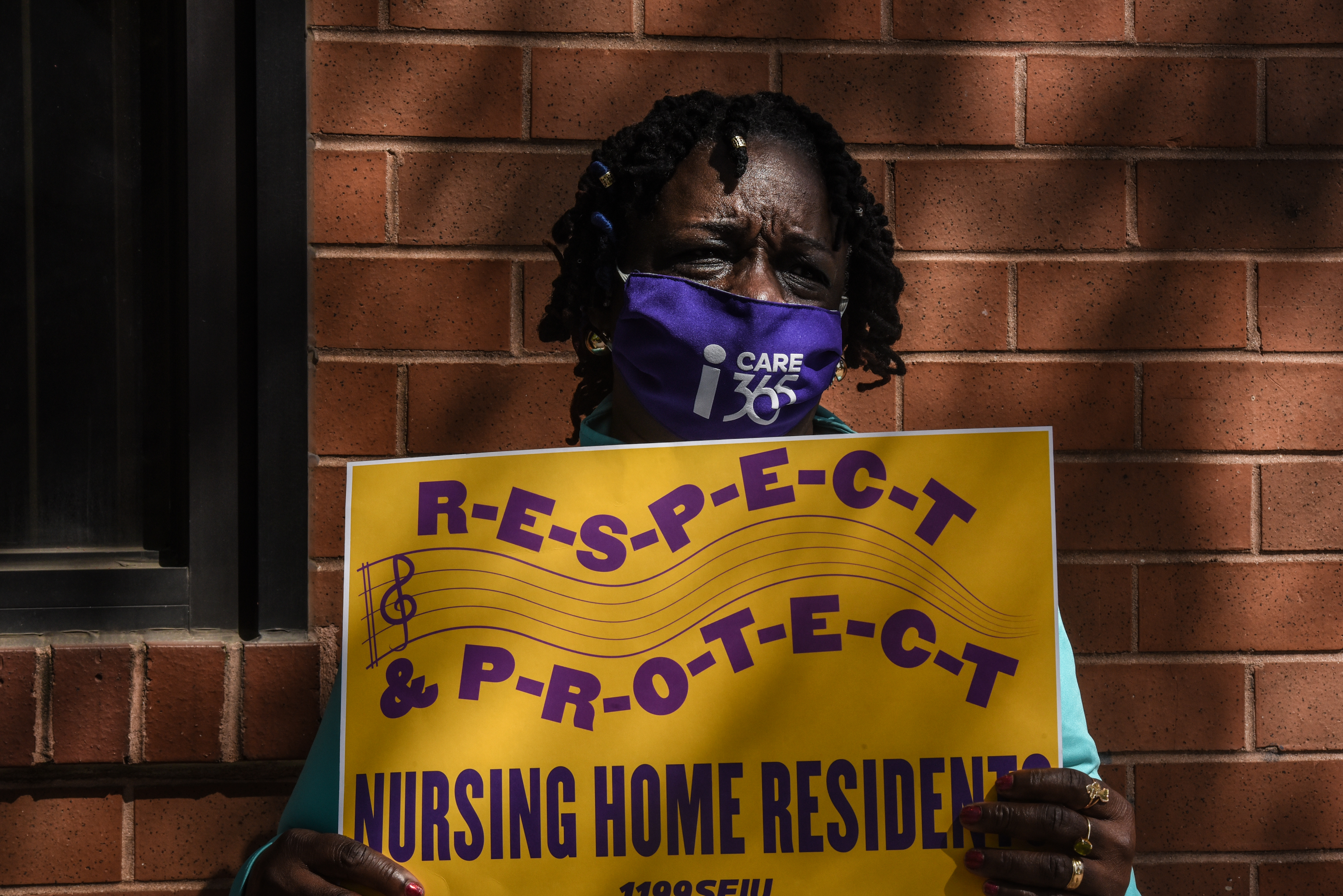
They’re struggling to protect themselves and support their families on menial salaries while caring for a population that is among the most vulnerable to COVID-19. Nursing home employees who contract COVID-19 have been forced to use up their limited sick time or vacation time, go without pay, or lose their jobs entirely. Through it all, they have dealt with grief and despair as elderly residents to whom they’ve become emotionally attached become sick with COVID-19 and die.
Related Stories
“The worst thing that I get upset about is hearing the word hero, hero, hero being thrown around for us. And no one is treating us as such. We feel disrespected,†says Beckford, who has been on sick leave since April 10 and is still recovering from pneumonia caused by the virus. “I would love to see them give us the proper PPE that we need, give us some kind of compensation, and for goodness sake, I don’t have any more vacation or sick time now, and the year is just beginning. Give me back some kind of compensation and put back my time.â€
Newington Rapid Recovery Rehab Center denies Beckford’s allegations, including that employees were forced to use trash bags for protection. “At no time has our staff been without appropriate PPE. The building has been properly staffed throughout the crisis,†it said in a statement, adding: “We have been strictly following the CDC protocol for health care workers.†When she recovers, Beckford plans to return to work there.
But recent lawsuits — brought by relatives of nursing home workers who died of COVID-19 and by former nursing home employees — are drawing attention to the conditions within some facilities that workers say put them and patients at unreasonably high risk.
Carlenia Milanes, a licensed practical nurse, spent weeks unwittingly caring for COVID-19 patients at Alaris Health at Hamilton Park in Jersey City, N.J., while the facility initially prohibited employees from wearing masks, according to a lawsuit filed April 22. The suit claims the nursing home hid coronavirus cases from employees, “refused to test patients and pressured staff to work even if they had symptoms of the highly contagious and deadly disease, all while patients and staff alike were dying of COVID-19.â€
On April 3, Milanes sent an email to Jersey City officials sounding an alarm and saying the nursing home’s strategy “is to put blinders on even at the cost of human life.†“Something needs to be done or more people and staff get sick and possibly die,†Milanes wrote, according to the lawsuit. “I need your help.â€
Milanes, 28, called in sick for the following day after developing symptoms of COVID-19, but her suit alleges that she was told she would be fired if she didn’t present a doctor’s note. In her lawsuit, Milanes also alleges the facility allowed seemingly healthy residents to share rooms with residents who had symptoms of COVID-19.
By May 27, there were 110 COVID-19 cases among the facility’s residents, including 31 deaths, and 42 COVID-19 cases among staff, including two deaths, according to data reported to the state. Milanes was among the affected staff members; the COVID-19 test she took on April 6 came positive.
A nursing home worker participates in a vigil outside of a nursing home in Brooklyn, N.Y. on May 21, 2020. Workers say they need safer conditions to better protect nursing home residents and the people who care for them from the coronavirus.
Stephanie Keith—Getty Images
“I’m not afraid to work. I would take care of anyone, but if I’m sick, how am I going to be any good for a patient?†says Milanes, a single mother whose 7- and 10-year-old daughters have since shown symptoms of COVID-19 as well. “I’m somebody’s mother. I’m somebody’s sister. I’m somebody’s daughter. And granted yes, this is what I signed up for, but protect me.â€
LaDawn Chapman, a CNA at the same facility, also filed a lawsuit against Alaris on April 22 that echoes many of Milanes’ allegations, including that the facility lacked adequate protective gear for employees and did not notify employees about coronavirus cases. The lawsuit says Chapman was likely exposed to COVID-19 through a patient and multiple coworkers and had a doctor’s note advising her to self-isolate for two weeks. She was told that unless she had symptoms of the disease, she had to come to work, her lawsuit alleges.
Both women say they were fired, but Alaris Health denies this. Five days after the suits were filed, Alaris Health sent each woman a letter saying they were “mistaken†about being fired and setting dates that each was expected to return to work. In a statement, Alaris spokesperson Matt Stanton also denied the lawsuits’ other allegations.
“I can tell you that each and every allegation in this case is false,†he said. “No employees were terminated. At no time was information withheld from staff, our residents or their loves ones [sic]. Thankfully, adequate PPE has never been an issue at any of our facilities. In fact Alaris required N95 masks and PPE for all staff well before the (New Jersey Department of Health) and CDC mandates. Finally, no employees were ever pressured to work while sick. Staff showing COVID-19 symptoms were sent home and required to adhere to strict return to work protocols as published by the NJ DOH.â€
In Texas, Maurice Dotson, a CNA at West Oaks Nursing and Rehabilitation Center in Austin, died on April 17 after contracting COVID-19. His mother sued the nursing home on May 13, accusing it of failing to provide staff with protective equipment and exposing workers and patients to “unreasonable risks of serious harm.†A spokesperson for West Oaks said Dotson “touched countless lives and was a respected and comforting presence,†but declined to comment on pending litigation.
Leaders in the long-term care industry have argued that nursing homes need more support and funding from state and federal governments. And the industry has sought immunity from potential lawsuits related to the pandemic, but the laws and executive orders granting them immunity from civil liability in some states, including New Jersey, might not protect them from all legal claims.
“While I understand that you can’t judge a nursing home that’s in the midst of a pandemic by the same standards you would on a regular day, it doesn’t give these nursing homes the license or the right to behave recklessly or engage in willful misconduct,†says Bill Matsikoudis, an attorney who is representing nursing home workers and residents in the lawsuits against Alaris Health at Hamilton Park.
‘It’s not getting better, it’s getting worse’
Infection control has long been a challenge in long-term care facilities, where hands-on care is a necessity, and the pandemic has exacerbated that problem. The U.S. Government Accountability Office, in a report released May 20, said that 82% of nursing homes surveyed from 2013 to 2017 were cited for infection prevention and control deficiencies.
Meanwhile, the median pay for nursing assistants was $29,640 last year — just above the national poverty level for a family of four, which is $26,200. By comparison, the median salary for a full-time worker last year was about $49,000, according to weekly earnings data from the Bureau of Labor Statistics. In part because of that low pay, many nursing home employees work second jobs, which increases their risk of contracting the virus and unwittingly carrying it to residents.
“If the aides were paid a living wage, they would not need to have multiple jobs,†says Joanne Spetz, director of the Health Workforce Research Center for Long-Term Care at the University of California, San Francisco. “That forces the workers to put themselves at more and more risk to support themselves, and that also puts their clients at risk and their residents at risk.â€
And while staff shortages have long been an issue at nursing homes, the problem becomes worse when workers stay home sick. As their colleagues take on the extra work, the care and time they’re able to give patients suffers.
The median pay for nursing assistants was $29,640 last year — just above the national poverty level for a family of four, which is $26,200.
“A lot of nursing homes are worried,†says David Grabowski, a professor of health care policy at Harvard Medical school who focuses on long-term care. “Who steps in here? Maybe it’s the National Guard, maybe it’s contract nurses. But it’s not like these places have a big roster of folks ready to plug into these positions.†In New York City on May 20, Mayor Bill de Blasio announced that the city would provide staff to fill in for nursing home workers who contract COVID-19 and must stay home.
All of this suggests that the looming shortage of elder care workers in the U.S. is likely to worsen, now that the pandemic has laid bare many of the problems in the industry. “It’s a two-way street. We need to pay them a rate commensurate with all we’re asking of them and support them,†Grabowski says. “Otherwise they’re not going to be there to do this.â€
The response to coronavirus outbreaks in nursing homes has varied by state. In Maryland— where nursing home residents and staff account for more than half the state’s coronavirus deaths — Gov. Larry Hogan required in early April that all nursing home workers wear masks at all times and then ordered testing of all residents and workers, whether they showed symptoms or not. In New York, Gov. Andrew Cuomo recently mandated twice-weekly COVID-19 testing of nursing home workers. But he also faced criticism from the nursing home industry and residents for originally directing long-term care facilities to accept back coronavirus patients released from the hospital. He walked back that policy on May 10 amid concerns that it would cause the virus to further spread within nursing homes.
On May 5, Illinois Rep. Jan Schakowsky and New Jersey Sen. Cory Booker introduced legislation that would require nursing homes to provide workers with training in how to avoid COVID-19 exposure, sufficient personal protective equipment, increased testing and at least two weeks of paid sick leave. Parts of the bill were incorporated into the new $3 trillion pandemic relief package that passed the House, but that legislation is unlikely to become law as it faces overwhelming Republican opposition in the Senate.
Following complaints about a lack of transparency within nursing homes, the Centers for Medicare and Medicaid Services is now requiring them to report coronavirus cases to the Centers for Disease Control and Prevention, as well as to residents and their families. The Occupational Safety and Health Administration (OSHA) — which has received at least 230 COVID-19 complaints related to nursing homes — released guidance on May 14 aimed at reducing workers’ exposure to the virus. It recommends that facilities encourage workers to stay home if they’re sick, develop a process for decontamination and reuse of protective gear, and train workers on how to protect themselves.
Debbie Berkowitz, program director for the worker safety and health program at the National Employment Law Project, says there needs to be stronger oversight at state and federal levels and that nursing homes should ramp up training of employees on treating COVID-19 and increase testing of workers and patients within their facilities. She says any solution will also hinge on staffers having enough protective equipment — a consistent obstacle for frontline workers.
“Mentally, physically, emotionally, you’re fighting a disease. And on top of that, we have to fight administrators to give us protective gear,†says Nicole Jefferson, a part-time CNA at Apple Rehab in Rocky Hill, Conn., who thinks of her 3-year-old and 14-year-old daughters each time she enters a COVID-19 room. “I don’t want to die. I don’t want my kids to die. What more can we do?â€
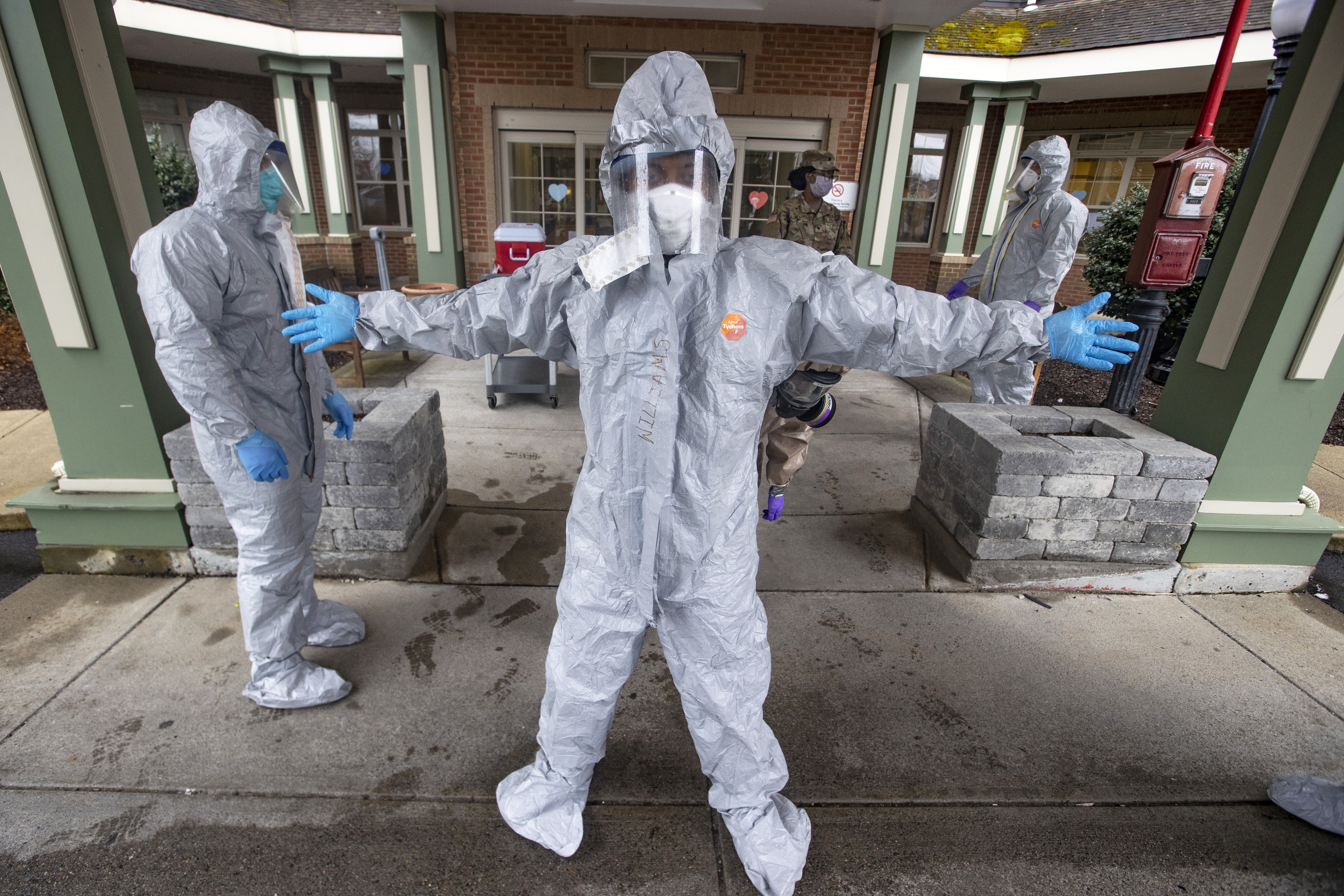
Members of the Massachusetts National Guard are sprayed down as they leave a nursing home and rehabilitation center in Quincy, Mass., on April 9, 2020. They were deployed to assist nursing homes with COVID-19 testing.
Boston Globe via Stan Grossfeld—The Boston Globe/Getty Images
An Apple Rehab administrator reached by phone said “we have plenty of protective gear,†but directed further questions to a spokesperson, who did not respond to a request for comment.
In Illinois, thousands of nursing home employees who are members of the SEIU Healthcare union had voted to strike on May 8, before reaching a last-minute deal on a new contract. It includes an increase in base pay to $15 an hour, an extension of $2 hazard pay and five additional paid sick days for coronavirus.
The new contract also guarantees that staffers won’t be required to work without adequate protective equipment. But Francine Rico, a CNA at the Villa at Windsor Park nursing home in Chicago who was on the bargaining committee, says workers still don’t have enough. Rico says she was given a raincoat to wear for protection and takes care of her N95 mask “like it’s gold.â€
“How do they expect for this virus, this pandemic, to even lift if we’re still wearing the same PPE gear in and out of the rooms?†says Rico, 52. The nursing home has had 143 cases of coronavirus and 33 deaths as of May 23, according to data reported by the state.
In a statement, Villa at Windsor Park called its workers “heroic†and said the facility is screening staff for symptoms at the start and end of their shifts. “In as much as there has been a national shortage of PPE, Villa at Windsor Park has at all times had sufficient levels PPE, including those necessary for infection control and personal protection, to ensure that we meet the needs within the center,†the statement said.
Rico’s sister, Eartha Sears, is a CNA in the same facility and says she recently returned to work after using up all her sick time and vacation time while recovering from COVID-19. “I wish they’d [use] better judgment about safety — not just our safety, the residents’ safety as well,†says Sears, 56. “Because it’s not getting better, it’s getting worse.â€
Meanwhile, employees are contending with the mental and emotional toll of continuing to work in places ravaged by illness, losing residents and coworkers they’ve known for years.
“They teach you when you’re in school as a CNA not to take any of this personally,†says Beckford. “But if you’re a human being with a heart, you’re going to feel something for the people that you’re working with for such a long time.â€
Beckford graduated with a master’s degree in 2018, planning to transition into social work, but she stayed at the nursing home to continue caring for her oldest residents. “Unfortunately, once I return to work, the majority of my residents will not be there,†she says.
Milanes says many of the residents she cared for have died in the past two months. She says she recently received a job offer from a different nursing home, and she plans to start when she tests negative for COVID-19. But everything about the career she once loved has changed.
“Maybe I’m afraid because I cared about them, and I know that they’re all dead,†she says. “I’ve cried, I just don’t think that I’ve had time to really grieve.â€
The Coronavirus Brief. Everything you need to know about the global spread of COVID-19
Thank you!
For your security, we’ve sent a confirmation email to the address you entered. Click the link to confirm your subscription and begin receiving our newsletters. If you don’t get the confirmation within 10 minutes, please check your spam folder.
Retailers had already been struggling, and now they’re bearingthe brunt of coronavirus’ impact. But a large gym brand and a major car rental company have also filed for bankruptcy recently.
A bankruptcy filing doesn’t necessarily mean a company will go out of business. Many use bankruptcy to shed debt and other liabilities while closing unprofitable operations, in hopes of emerging leaner and stronger. Lots of these companies have gone on to post record profits, including automaker General Motors (GM)and many of the nation’s airlines.
Still, many other brands that have filed for bankruptcy with the intention of staying in business didn’t survive. Here are some US-based companies that filed in May:
Gold’s Gym said in its May 5 fling that the virus has affected it “deeply and in many ways,” which includes the temporary closures of many of its 700 global gyms.
Filing for Chapter 11 bankruptcy protection will help it “emerge stronger and ready to grow,” the statement continued.
The 55-year-old company intends to exit bankruptcy by August and said it is “absolutely not going anywhere.” Gold’s did shutter 30 locations in April, but it doesn’t intend to permanently close any more gyms.
Hertz
Car rental giant Hertz(HTZ) filed for bankruptcy on May 22. The company also rents cars under the brands Dollar, Thrifty and Firefly.
The company has been in business since 1918, when it set up shop with a dozen Ford Model Ts. Hertz has survived the Great Depression, World War II’s near-total halt of US auto production and numerous oil price shocks.
By declaring bankruptcy, the rental car company says it intends to stay in business while restructuring its debts so it can emerge financially healthier.
“The impact of Covid-19 on travel demand was sudden and dramatic, causing an abrupt decline in the company’s revenue and future bookings,” the company said in a statement, noting that “uncertainty remains as to when revenue will return and when the used-car market will fully re-open for sales, which necessitated today’s action.”
Hertz was criticized for paying out millions of dollars in bonuses to its executives just before its bankruptcy — and a month after it started laying off thousands of employees.
It paid a total of $16.2 million to 340 executives on May 19 as part of a plan to keep them in place while the company attempts to reorganize, according to a filing with the Securities and Exchange Commission.
JCPenney
Coronavirus could be the final blow for 118-year-old department store stalwart JCPenney. It was already struggling to overcome a decade of bad decisions, executive instability and damaging market trends.
JCPenney(JCP)filed for bankruptcy on May 15. The company has an agreement with most of its lenders that will allow it to attempt a turnaround plan to stay in business.
But it will close 30%, or around 200, of its 846 US stores. The company did not say how many of its 85,000 employees would lose their jobs as a result of the permanent store closings.
“Until this pandemic struck, we had made significant progress rebuilding our company,” CEO Jill Soltau in a statement, adding that the company’s efforts “had already begun to pay off.”
But JCPenney’s problems go back far before the pandemic, with the company having been battered by a decade of bad decisions. Its most recent profitable year was 2010, and its net losses have totaled $4.5 billion since then.
And the entire department store sector has suffered as more consumers shop online. Big-box discounters like Walmart(WMT), Target(TGT) and Costco(COST) have also proved to be competition, offering shoppers lower prices and a selection of items not found in department stores, such as groceries.
J.Crew Group
It’s a distinction no one wants: J. Crew Group became first national US retailer to file for bankruptcy protection since the coronavirus pandemic forced a wave of store closures. It filed on May 4.
The company, which owns the preppy J.Crew and Madewell brands, expects to stay in business and emerge from bankruptcy as a profitable company. And Madewell, the fast-growing denim brand that had been slated for an IPO, will remain part of the business.
J.Crew Group was saddled by a heavy debt load since its 2011 purchase from private equity firms TPG Capital and Leonard Green & Partners in a $3 billion deal.
It had grown rapidly in the nine years since the transaction was completed, nearly doubling the number of stores. But it has also accumulated far more debt. It had $50 million of long-term debt on its books in 2010, before the deal was announced — and as of February of this year that number had ballooned to $1.7 billion.
The company operates nearly 500 stores including J.Crew’s factory outlets.
Neiman Marcus
Luxury retailer Neiman Marcus, which filed for bankruptcy on May 7, said the restructuring agreement with creditors will allow it to “substantially reduce debt and position the company for long-term growth.”
The company’s history goes back 113 years to its first store in Dallas, which is still its home base. The company also operates the Bergdorf Goodman and Last Call chains.
Neimanhad 69 stores among the three brands as of last year. In March, just days before the pandemic prompted mass store closings, the company announced plans to permanently close a “majority” of its 22 Last Call outlet stores.
ITS fate was very possibly sealed in 2013 when Ares Management and the Canada Pension Plan Investment Board paid $6 billion in a leveraged buyout, taking the company private.
“The big issue with Neiman is that the [private equity companies] paid too much and layered on too much debt,” Steve Dennis, a retail consultant and former Neiman executive, previously told CNN Business.
CEO Steve Becker said the business was thriving before the pandemic. But the resulting temporary store closures and employee furloughs had “severe consequences on our business.”
“The complete halt of store operations for two months put the company in a financial position that can be effectively addressed only through a reorganization in Chapter 11,” he said in a statement.
The Dallas-based chain, which filed on May 27, said it will permanently close approximately 230 of its nearly 700 US stores.
–CNN Business’ Chris Isidore and Nathaniel Meyersohn contributed to this report.
As protests intensified in Minneapolis following the death of a Black man pinned down by a white police officer, President Donald Trump issued a naked threat in a pair of tweets.
“I can’t stand back & watch this happen to a great American City, Minneapolis,†he wrote Thursday night. “Either the very weak Radical Left Mayor, Jacob Frey, get his act together and bring the City under control, or I will send in the National Guard & get the job done right.â€
He continued in a second tweet: “These THUGS are dishonoring the memory of George Floyd, and I won’t let that happen. Just spoke to Governor Tim Walz and told him that the Military is with him all the way. Any difficulty and we will assume control but, when the looting starts, the shooting starts. Thank you!â€
Twitter posted a content warning over the latter half of the president’s message, warning users that it violated the platform’s rules about glorifying violence but was still available out of public interest. (The same label was applied to an identical tweet from the official White House account.) It was the second time this week that the company labeled Trump’s tweets with some kind of content warning.Â
I can’t stand back & watch this happen to a great American City, Minneapolis. A total lack of leadership. Either the very weak Radical Left Mayor, Jacob Frey, get his act together and bring the City under control, or I will send in the National Guard & get the job done right…..
— Donald J. Trump (@realDonaldTrump) May 29, 2020
….These THUGS are dishonoring the memory of George Floyd, and I won’t let that happen. Just spoke to Governor Tim Walz and told him that the Military is with him all the way. Any difficulty and we will assume control but, when the looting starts, the shooting starts. Thank you!
— Donald J. Trump (@realDonaldTrump) May 29, 2020
Trump did not coin the phrase “when the looting starts, the shooting starts.†The line is half a century old, and combative Miami Police Chief Walter Headley Jr. originally used it during the height of civil rights protests in the 1960s. Â
Headley led the Florida city’s law enforcement from 1948 until his sudden death in 1968. He attracted national attention and condemnation in December 1967, when he threatened to step up already severe policing practices that included use of tear gas and an aggressive stop-and-frisk policy.
“This is war,†Headley told reporters, according to a United Press International article from the time. He described his problem with “young hoodlums, from 15 to 21, who have taken advantage of the civil rights campaign.â€
“We don’t mind being accused of police brutality,†Headley said. “They haven’t seen anything yet.â€
The police chief then explained that he maintained order by threatening violence: “When the looting starts, the shooting starts.â€Â
His comments angered civil rights leaders at the time. Martin Davies, a spokesman for the NAACP, told UPI: “This man has no place in a position of public trust. If necessary, we will get a lawsuit to keep him from enforcing this type of arbitrary action.â€
Headley’s news conference so alarmed residents that he was put before the Miami City Commission to explain himself, according to his New York Times obituary. He claimed his remarks had been partly misinterpreted, and the publication said he “held his ground on enforcement and gained the commission’s support.†The city council and its mayor were all white men at the time.Â
We don’t mind being accused of police brutality. They haven’t seen anything yet. former Miami Police Chief Walter Headley Jr., in the 1960s
It wasn’t the first time Headley would publicly use the “looting†phrase, either. Facing criticism in August 1968 for remaining on vacation while riots broke out in Liberty City, a majority-Black neighborhood in Miami, Headley said his department could handle the situation without him. “They know what to do. When the looting starts, the shooting starts,†he said, according to the Times obituary.
His officers killed three people. Eighteen were wounded.
Headley’s defenders said he transformed the department, which Miami Herald columnist Charles Whited had once described as being “comprised of more beef than brains.†But it became known for brawny tactics.
In the Headley era, two cops strip-searched a Black teenager suspected of bringing a knife into a pool hall and dangled him by his feet over a bridge crossing the Miami River, according to a Washington Post article about the era’s unrest.
At the time, local leaders claimed Headley was effective, but his authoritarian policies increased distrust between the Black community and law enforcement ― a long trend that has since led to the Black Lives Matter movement.Â
Protesters have demonstrated across the country since George Floyd, a Black man, died Monday after a white police officer restrained him by pinning his neck to the ground with a knee. Video of the incident shows Floyd pleading for his life and saying he could not breathe.
Some of the protesters turned violent on Wednesday night, setting fire to several Minneapolis businesses. They breached a city police station on Thursday, setting it ablaze and smashing windows as officers retreated.Â
Floyd’s brother, Philonise Floyd, called for the violence to end earlier this week.
“I want everybody to be peaceful right now, but people are torn and hurt because they’re tired of seeing Black men die,â€Â he told CNN. “Constantly, over and over again.â€
Calling all HuffPost superfans!
Sign up for membership to become a founding member and help shape HuffPost’s next chapter
As part of Beijing’s broader strategy of seeking out new markets and cultivating strategic partnerships with countries beyond its backyard, China has been seeking to expand its economic and political ties with Black Sea states. While Beijing’s involvement in the region is still at a nascent stage, it has already prompted fears that its economic engagement masks a political agenda that could hurt Western interests. Critics accuse Beijing of “debt-trap diplomacy†whereby China lures developing or underdeveloped countries into borrowing money for infrastructure projects they cannot afford with the aim of extracting economic or political concessions when the country fails to pay off its loans on time. Some Black Sea countries that have prioritized ties with the EU have been cautious about engaging with Beijing, but Turkey, a key regional state and EU candidate country, has actively sought to build closer ties with China.
Economic cooperation has been the backbone of ties between Turkey and China, but efforts on both sides to broaden the relationship — at a time when Ankara’s relations with the West are badly strained — have raised eyebrows in Western circles. Turkish President Recep Tayyip Erdogan’s statement in 2016 that Turkey should not be fixated on joining the EU and could instead seek membership in the Shanghai Cooperation Organization (SCO), of which China is a member, as well as Turkey’s recently launched “Asia Anew†initiative, which aims to develop closer ties with Asia, have fed Western concerns. But fears of a Turkish shift toward China at the expense of the West are overblown. Relations are mainly driven by joint economic interests, not political ones, and even on the economic front, the partnership is far less tight than is often touted.
From trade to the BRI and Middle Corridor
Commercial relations between Turkey and China began during the Cold War years and took off in the 2000s. Bilateral trade expanded from around $1 billion in 2000 to $23 billion in 2018, making China Turkey’s third-largest trading partner. But Turkey has a massive trade deficit with China, accounting for one-third of its total foreign trade deficit of $55.1 billion, and is quite uncomfortable with the imbalance.Â
Since the launch of the Belt and Road Initiative (BRI) in 2013, one of Chinese President Xi Jinping’s signature policy initiatives, efforts to deepen economic ties have intensified. Touted as one of the largest infrastructure and investment projects in history, the BRI was announced as an “economic development initiative that would create new trade corridors across Asia, Europe, and Africa.†With its location at the crossroads of the Middle East, south Caucasus, eastern Mediterranean, and Europe, Turkey occupies an important place in the BRI, and China has already started investing in big-ticket infrastructure projects. It purchased Turkey’s third-largest container terminal, Kumport, and is interested in several other Turkish ports. A Chinese consortium bought Istanbul’s third Bosphorus bridge and Chinese banks are in discussions to refinance billions of dollars of loans for the operation of Istanbul’s new airport.
Turkey sees the BRI as complementary to its own “Middle Corridor†initiative to launch a rail and road network running from Turkey through the Caucasus and Central Asia to China, and the two countries agreed to integrate it into the BRI. Progress has been made to develop the Middle Corridor, but experts are skeptical about the much-touted economic benefits of the BRI and the feasibility of the Middle Corridor. The BRI remains quite vague, without formal agreements, protocols, institutions, or a clear timeline. It has become a catch-all term for everything China does abroad, raising doubts about what it is and what it will mean for its partners.
Optimists are hopeful that China’s financial footprint in Turkey will grow after the coronavirus outbreak. Turkey’s Sovereign Wealth Fund signed a $5 billion agreement in March with the China Export Credit Insurance Corporation, Sinosure. According to the deal, Sinosure would provide financing to Chinese enterprises involved in projects in Turkey’s energy, petrochemicals, and mining sectors, prompting fears that Chinese firms will be “taking much bigger stakes in Turkish companies struggling to cope with the fallout from the pandemic.†In another sign of deepening ties, a recent statement by the Asian Infrastructure Investment Bank, a regionally focused multilateral development bank, said Turkey has “submitted a request for a 500-million-dollar credit line for two of its development banks to help alleviate working capital shortages and liquidity constraints as a result of the pandemic.â€
Potential for expansion
Critics have voiced concerns that the Turkey-China economic partnership could expand into other areas as well. There are worries that Turkey’s strained ties with the U.S. due to its purchase of Russia’s S-400 missile defense system and the subsequent U.S. decision to kick Turkey out of the F-35 fighter jet program could lead to a closer defense partnership between Ankara and Beijing. The fallout from the S-400 and the F-35 has indeed dealt a blow to Turkey’s ability to import key subsystems it needs for its products, leading Ankara to seek new partners as it works to expand its defense industrial base. The two countries already share a history of defense cooperation. Turkey’s Roketsan produced the Yildirim missile based on the Chinese B-611 missile under license. In 2013, Turkey awarded a Chinese defense company a $4 billion contract to help develop a long-range air and missile defense system. Ankara later abandoned the decision, but the incident sowed the seeds of distrust between Turkey and its NATO allies.
China is also trying to expand its cultural influence in Turkey. The number of tourists, Confucius Institutes, university Chinese language departments, and business associations are all on the rise. The China State Council Information Office launched an initiative to donate thousands of books disseminating Chinese culture and philosophy to think tanks, cultural institutions, and universities around the world, including Turkey. The two countries also began hosting “Year of China†and “Year of Turkey†events featuring Chinese intellectuals, folklore, and music.
Despite growing ties, however, Turkey and China are nowhere near forming a strategic alliance. Turkey has significantly dialed down its criticism of the Chinese crackdown of the Uighur minority in Xinjiang province, which share a common linguistic and religious heritage with Turkey, but the sizable Uyghur diaspora in Turkey continues to fuel China’s mistrust of Turkey. The EU and U.S. account for a large percentage of Turkey’s imports and exports and the West remains its main source of foreign direct investment (FDI). By contrast, China accounts for around 1 percent of FDI inflows into the country. Despite tensions over the S-400 and F-35, Turkey remains an important part of the Western security framework. Strained ties with the West have indeed contributed to closer relations with Beijing as Ankara has sought to diversify its foreign policy, but ultimately Turkish policy-makers see Turkey-China relations as a compliment to, not a substitute for, the country’s Western alliance.
Gönül Tol is the Director of MEI’s Turkey Program and a senior fellow for the Frontier Europe Initiative.Â
The current COVID-19 pandemic has had an unprecedented global impact. In many ways, everyone has been affected by this collective crisis, and everyone is at risk. However, both the virus and its aftermath discriminate strongly against women and girls.Â
I have spent my career as a humanitarian aid worker in insecure environments around the world, supporting women to mitigate the risks they face in those settings — notably as a result of a more hidden global pandemic, violence against women. Everywhere I have worked, from Afghanistan to Mali to Haiti, women and girls suffer more. It does not matter whether this is due to a conflict, a natural disaster, or an epidemic.
In the Arab region, where I now work, women were vulnerable before the crisis. And their crisis is just beginning. The Arab region is plagued by a range of socioeconomic instabilities and protracted humanitarian crises, with more than 62.5 million people in need of humanitarian assistance. The pandemic is simply the latest in a series of challenges facing the region. The Arab region also suffers the world’s worst social indicators, with wide gender gaps across health, education, politics, and the economy. All of these are exacerbated by instability, crises, and the current pandemic.
The feminization of women’s work
Worldwide, this pandemic will have greater impacts on women when it comes to work, with more women facing redundancies while more men will find their jobs protected or adjusted to accommodate this new way of working.
In the Arab region, the pandemic is expected to result in the loss of 1.7 million jobs, including approximately 700,000 jobs held by women. But female participation in the labor market is already weak, with unemployment among women reaching 19 percent in 2019, compared with 8 percent for men. The informal sector will be particularly hard hit by the pandemic. 62 percent of active women work in the informal sector, where they have fewer protections and face even greater risks.
Women are the world’s carers — they risk increased exposure to infection both in their personal and professional capacities. Arab women make up the majority of the region’s health care practitioners and family caretakers, performing unpaid labor and exposing themselves to infection in order to care for a sick child, an elderly family member, or a needy member of the community. In the Arab region, women perform nearly five times as much unpaid care work as men. In every emergency I have worked in, women are the ones who know who is in need, what they need, and how to get it to them. They are the world’s social safety net.
There is opportunity in this global crisis — a chance to recognize and value women’s work. The Arab region holds very traditional, largely patriarchal, views of what constitutes “productivity.†Labor, both domestic and professional, is gendered, with women relegated to traditionally “feminine†roles. This feminization of women’s work places both women and men at a disadvantage, creating an artificial juxtaposition between what is valued and what is not. With everyone now working from home, domestic divisions of labor are brought into plain view.
Integrating the personal and the professional
Ideas of work/life balance are now also coming to the fore. Previously, we existed as if our domestic and professional lives were neatly compartmentalized, operating in parallel as two separate entities. Now we have been forced — wonderfully! — to integrate our personal and professional lives. Crying babies are dealt with while on Zoom calls. Dogs jump into view on screens. Family members wander around the house during videoconferences. We are brought into peoples’ homes and lives in unprecedented ways.Â
In the Arab region, there is generally less acceptance for telecommuting, working from home, flexible hours, and so on. These aspects are critical to the creation of woman-friendly work environments and will ensure that more women join — and remain — in the working world. Pre-COVID, our home lives were not “allowed†to interfere during office hours. A sick child or a needy family member had to be dealt with “on our own time.†Women’s premature departure from economic life is also due to the lack of breastfeeding spaces and quality childcare. This is a sector that is staffed almost entirely by women, many of whom are underpaid and undervalued.Â
In the Arab region, there is also less shared housework and parenting. We could use this time at home for men to take on an equal share of household work and childcare — “jobs†previously relegated to women. The global “sudden spike in childcare†is currently being felt by women, but men now have the opportunity to step up and play a greater role in the lives of their children. Will it happen in the Arab region? I’m not so sure. But the opportunity is there. Let us start by ceasing to celebrate husbands for “helping†their wives with housework or occasionally “babysitting†their own children. Let us also recognize that women’s work at home IS work — and should be viewed and valued as such.Â
From patriarchy to feminist economy
And perhaps this new way of working will allow us the space to merge all aspects of our lives, creating a more woman (and family) friendly work environment that is built on flexibility. Let us use this opportunity to un-learn some of the harmful (and not altogether productive) methods of work that prioritizes “busyness†while watching the hours pass until clock-out. Imagine a work/life balance built on the freedom to govern our own time, and to work within a manageable, deliverables-based framework.Â
COVID-19 presents an opportunity for men, families, society, and the economy to reconsider women’s work, to recognize their contributions, and to transform the ecosystems in our home and workplace, transitioning from a patriarchal to a feminist economy that integrates health, family, and informal labor into economic ecologies.Â
The personal is, and will always be, political. This pandemic has exposed our interconnectedness and blurred personal/professional lines. Our lives are no longer siloed, and we all stand to benefit from this cultural pivot — yes, men too. Let’s start by no longer apologizing for having lives outside of work, and by redefining “productivity†to reflect our new reality.  Â
Â
Dr. Lina AbiRafeh is the Executive Director of the Arab Institute for Women (AiW) at the Lebanese American University. Lina spent over 20 years in development and humanitarian contexts in countries such as Afghanistan, Haiti, Democratic Republic of Congo, Nepal, and others. Her specific expertise is in gender-based violence prevention and response, summarized by her TEDx talk and other presentations. She speaks and publishes frequently on a range of gender issues such as gender-based violence, the need for a feminist response to the COVID-19 pandemic and its impact on Arab women and girls. In 2018 and 2019, Lina was listed as one of the Gender Equality Top 100 worldwide. The views expressed in this piece are her own.
The plan of the national unity government to extend Israeli control to the Jordan Valley has elicited much more criticism from abroad than in Israel. The acerbic ideological debate over the future of the territories acquired in 1967 is over. The Sinai Peninsula was relinquished in 1979-82. The security significance of the Golan Heights always been an issue of consensus among Israelis, with over 70% supporting Israel maintaining control of the area. The civil war in Syria only solidified such popular positions, while US recognition of Israeli sovereignty over the Golan Heights in 2019 put this issue to rest. Gaza is similarly no longer a bone of contention after the 2005 unilateral withdrawal.
Concerning Judea and Samaria, there is a majority in favor of partition and retaining the settlement blocs, Jerusalem (the Temple Mount in particular) and the Jordan Valley. A recent poll commissioned by the Jerusalem Institute for Strategy and Security confirmed that over 60% of Israelis (and over 70% among the wider Jewish public) favor extending Israeli law to these areas. The current composition of the Knesset favors incorporation of the Jordan Valley into Israel.
The Oslo process with the Palestinians was fueled by a desire to part from densely-populated Arab areas. The establishment of a Palestinian Authority in 1994 was a de facto partition, albeit a messy one, and very few Israelis advocate reconquering the cities of the West Bank. Moreover, Israel built a security barrier in the West Bank in 2002 marking a potential future border, signaling a determination to disengage from Palestinian population centers.
According to a 2018 poll by the Peace Index, half of the Jewish Israeli public thinks that Palestinians deserve an independent state but believe that the two-state solution would be impossible to implement.
The current territorial debate revolves around the amount of land to be relinquished to Palestinian control. For the most part, it is not couched in ideological reasoning but in a pragmatic assessment of what is needed for Israel’s security. Israelis seem to understand that they are locked in a tragic conflict with the Palestinians and are largely reconciled with the idea that the Jewish state will have to live by its sword for the foreseeable future. Â
The Palestinian rejection of partition proposals (from Prime Minister Ehud Barak in 2000, Prime Minister Ehud Olmert in 2007 and US President Barack Obama in 2014) strengthens the Israeli feeling of having no choice. So far, the criticism from the far left in Israel and abroad has hardly touched the Israeli consensus and solidarity. The parties associated with the failed Oslo peace process have paid dearly in electoral terms.Â
The bridging of many of Israel’s social rifts has created a stronger society able to withstand the inevitable tests of protracted conflict in the future.
Debates over Israel’s optimal economic system have long disappeared. Nearly all Israelis agree that capitalism is the best way to create wealth. Government policies along such lines are widely supported. The Likud, and primarily Prime Minister Benjamin Netanyahu, have been advocating a market economy while in power for most of the last two decades. Most Israeli parties adhere to a free market ideology while Labor, which criticizes the country’s capitalist orientation, has done poorly in recent elections.
Another social rift, the Ashkenazi-Sephardi cleavage, has also become much less divisive. The number of intermarriages is on the rise (over 20%) and is more socially acceptable, obfuscating ethnic differences. The erosion of socialist practices and the privatization of a centralized economy in the post-1977 period contributed to the growth of a non-Ashkenazi middle class. The number of Sephardi politicians at the local and national levels has increased significantly alongside a similar growth in the senior ranks of the IDF.
Social mobility has also been enhanced by greater access to higher learning. The opening of numerous colleges in the last three decades brought a dramatic increase in the proportion of university students of Sephardi origin. The Israel Statistical Bureau has stopped counting them because young people below 40 are categorized not as Sephardi but of Israeli origin, as they were born in the country.
The predictable tensions between newcomers and established members of society in an immigrant-absorbing country such as Israel have not persisted. Most of the immigrants from the former Soviet Union, despite some difficulties, are highly integrated. Ethiopian Jews, from a very different background, have also faced difficulties but are gradually integrating, as seen by rising numbers among junior officers in combat units, university students, Knesset members and ministers in the new national unity government.
Arguably the only rift within Israeli society still of social, cultural and political importance is the religious-secular divide. Yet the conflict is not between two clearly defined camps between which a reasonable modus vivendi might be found. The proportion of Orthodox Jews within society is growing (about 32%), while secularism is losing ground (the number of self-defined secular Jews is about 40%). A large number of Israelis also identify as traditionalist, in the center of the Orthodox-secular continuum. Precisely because there are Jews of different degrees of observance and knowledge means there is room for mediation and understanding. A Van Leer study from 2019 suggests that the discourse on secular-religious polarization in Israel is shallow and does not reflect the complex reality.
Not everything is perfect in Israeli society or the country’s economy. Nevertheless, the standard of living is increasing continuously. As the coronavirus crisis spread in Israel, the annual UN World Happiness Report for 2020 (published in March) reported that Israel ranked 14th in the world. The country slipped one spot from last year’s survey and three spots from its 11th-place finish in 2018. The Israeli Voice Index published in May 2019 showed that 82% of Israelis are proud of their country’s achievements.
Such data refutes the common image of a deeply torn Israeli society and indicates strong social cohesion able to withstand outside pressures against a popular decision.
We use cookies on our website to give you the most relevant experience by remembering your preferences and repeat visits. By clicking “Accept”, you consent to the use of ALL the cookies.
This website uses cookies to improve your experience while you navigate through the website. Out of these, the cookies that are categorized as necessary are stored on your browser as they are essential for the working of basic functionalities of the website. We also use third-party cookies that help us analyze and understand how you use this website. These cookies will be stored in your browser only with your consent. You also have the option to opt-out of these cookies. But opting out of some of these cookies may affect your browsing experience.
Necessary cookies are absolutely essential for the website to function properly. These cookies ensure basic functionalities and security features of the website, anonymously.
Cookie
Duration
Description
cookielawinfo-checbox-analytics
11 months
This cookie is set by GDPR Cookie Consent plugin. The cookie is used to store the user consent for the cookies in the category "Analytics".
cookielawinfo-checbox-functional
11 months
The cookie is set by GDPR cookie consent to record the user consent for the cookies in the category "Functional".
cookielawinfo-checbox-others
11 months
This cookie is set by GDPR Cookie Consent plugin. The cookie is used to store the user consent for the cookies in the category "Other.
cookielawinfo-checkbox-necessary
11 months
This cookie is set by GDPR Cookie Consent plugin. The cookies is used to store the user consent for the cookies in the category "Necessary".
cookielawinfo-checkbox-performance
11 months
This cookie is set by GDPR Cookie Consent plugin. The cookie is used to store the user consent for the cookies in the category "Performance".
viewed_cookie_policy
11 months
The cookie is set by the GDPR Cookie Consent plugin and is used to store whether or not user has consented to the use of cookies. It does not store any personal data.
Functional cookies help to perform certain functionalities like sharing the content of the website on social media platforms, collect feedbacks, and other third-party features.
Performance cookies are used to understand and analyze the key performance indexes of the website which helps in delivering a better user experience for the visitors.
Analytical cookies are used to understand how visitors interact with the website. These cookies help provide information on metrics the number of visitors, bounce rate, traffic source, etc.
Advertisement cookies are used to provide visitors with relevant ads and marketing campaigns. These cookies track visitors across websites and collect information to provide customized ads.