Letter from the editor: Will Australia’s “place” in Asia seem like history for future generations? – New Mandala

0

Recent months have seen dreadful attacks on the value of knowledge about, and from Asia in Australia—indeed in recent days on the pursuit of knowledge in general. While our politicians defend themselves from accusations of endemic and systemic racism on the one hand, on the other successive governments on both sides have trotted out a long running series of education policy changes around Asia literacy in particular,  aid funding diversions and budget cuts that erode the foundations of their professed aspirations to lead in the region.

The National Library of Australia, after a series of, again, long-running budget cuts to cultural institutions, has closed its Asian Collections Room. It has cancelled subscriptions to hundreds of Asian periodicals, and shifted all bar three Asian nations out of its priority list. Those collections, for scholars of Asia, are invaluable. Many of the publications are not available to the public, even in the countries from which they originate.

It’s not an esoteric, academic ivory tower in there. As Tessa Morris-Suzuki pointed out in the Sydney Morning Herald, these texts are fundamental, directly or indirectly, to the education of our current and future journalists, diplomats, politicians, business people, security strategists, economists, humanitarian workers, activists, artists and litterateurs—as well as our historians, anthropologists, tour guides and most importantly, our teachers. They are fundamental to understanding who we are, where we are, where we come from (literally, for many) and what futures might be available to us.

As Ed Aspinall detailed for Inside Story, after many decades of leading Australia’s intellectual engagement with Asia, the NLA has suffered a pincer move comprised of the necessary but expensive shift to digitisation accompanied by reduced funding, staff and expertise. The result is that “collections that have been developed over decades will now wither on the vine of neglect.”

Once upon a time, Australia turned itself outwards to Asia. It’s the story of my family and many others. My grandfather first ventured out of a tiny farming town to sign up for service in the Pacific War. The reality of war and especially his experiences in the repatriation of POWs from Ambon devastated him, but there are too family photos of him leaping joyfully from a jetty into the Banda Sea. In the mid-1970s, at age 16, my mother set off to the Philippines for a year on Rotary exchange. A decade or so later, with 3 children 5 years and under, she and my father returned for my father’s work on an aid project in Zamboanga del Sur. In the late 1980s we spent two years in remote West-Timor.

My sociology class, studying in Indonesia in 2001 at Universitas Gadjah Mada “on ACICIS”. Photo courtesy the author.

For me, these experiences and family history have been formative, but so too were the educational policy and social environment that facilitated our encounters. Many Australians share similar experiences, and many of them have continued that connection in their lives, their careers, their passions. With difficulty, and often at great cost, we’re trying raise our children to understand where they are in the world, Australia’s place in the Asia-Pacific. But it’s getting harder all the time. Anecdotally, fewer Australian schools offer Asian languages, but comprehensive national data has not been collected since 2011. As a country, we’ve come to know less about our nearest neighbours. A Lowy Institute survey revealed that less than half of Australians know that Indonesia is a democracy.

The global pandemic has deepened the impact of long-running reductions in funding for Asia literacy in schools and higher education. It threatens to make casualties of in-country language learning programs, student-exchange opportunities and youth mobility. Some of these will return if and when international travel is viable again, but for programs like the Australian Consortium for In-Country Indonesian Studies (ACICIS), it’s 25th year of introducing Australian university students (over 3,500 so far) to Indonesia may well be its last.

I “went on ACICIS” as a second-year uni student. As it has for so many others, it changed the course of my life, my career and my world-view. For the past four years I’ve also had the privilege of teaching a summer intensive with ACICIS, witnessing students’ horizons expand through an expertly guided learning experience. But ACICIS is funded by student participation, often with the support of New Colombo Plan scholarships. No rescue package has been forthcoming for this small part of the greater higher education sector, and the consortium has resorted to a public fund-raising appeal in the hope it can make it through the uncertainty.
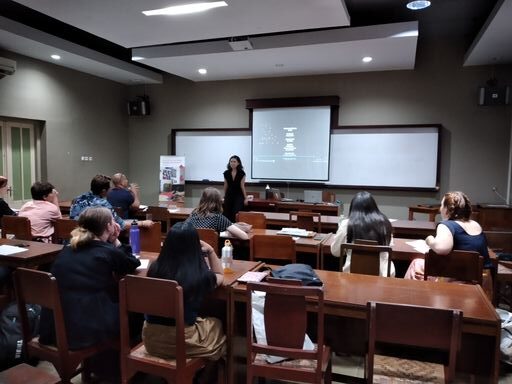
Australian students in Indonesia on an ACICIS program. Photo courtesy of the author.

In-bound student mobility—international students from Asian countries and the rest of the globe—has certainly take a huge blow and carries enormous ongoing financial consequences. Perhaps more importantly, it will also impact the nature of studying at university and living in a university community. It will be a much less linguistically, culturally and ethnically diverse university classroom that students walk back into around the country next semester.

And who will be teaching? Likely fewer of those academics living with the precarity introduced by growing casualisation, who are also now likely to be jettisoned from a sector that has been shut out of government support during the COVID-19 crisis, and now threatened with systematic defunding—fewer women, fewer people of colour, fewer people from Asia.

From late 1980s to the mid-90s, when I was busily exerting my linguistic muscle in high school competitions, Indonesian language university courses were experiencing a surge in popularity stimulated by the influence of the National Policy on Languages, which emphasised Asia’s importance to Australia’s future. By the time I joined the Indonesian studies cohort of the late 90s, a two-decade decline was beginning, according to ACICIS’ founding director, Professor David Hill.

Indonesian studies is not the only field of Asian studies under attack. Hill’s article was penned for a series of short articles reviewing the state of Asian studies in Australian universities, written and researched by leading academics in their fields and published by the Asian Studies Association of Australia’s (ASAA) blog, Asian Currents (of which I am also the editor). It was disturbing reading.

South Asian studies has contracted from nearly 80% of universities offering courses on India in 1989, to just over 17% in 2019. Enrolments in Japanese studies have risen over the past 20 years but these are largely international students, so the field will be disproportionately impacted by the current crisis and remains at risk from the large numbers of casualised positions. Study of Chinese languages has expanded but also suffers from a lack of domestic enrolments, leading Professor Anne Mclaren to note that “Australia still has too few Australian China specialists to meet the national need for expert engagement with our largest trading partner.” Korean studies are flourishing, but due more to the proactive actions of the South Korean government than investments from our own government. Associate Professor Ruth Barraclough of ANU bemoans that, in spite of growing enrolments, “constantly having to make the argument to fund new continuing positions is dispiriting and exhausting.”

Same old story…Asian Studies on the decline


The one field of study to record growth and consolidation, according to the ASAA reviews, is mainland Southeast Asia. The positive outlook is encouraging, but nonetheless, the author of that review writes that studies of mainland Southeast Asia are marginalised by the same challenges facing other humanities faculties in Australia, which are “stubbornly Anglocentric in content and outlook, despite our geography, economy, security considerations and changing demography.”

Penny Wong weighed into this space recently, saying that, “In a time where Australia should be looking to improve and expand our engagement in Asia, the NLA’s decision is alarming, and is counter to our national interest.” In terms familiar to university staff across Australia, the NLA spokesperson conjured up the twin jinn of the “funding envelope” and “efficiency dividends”, stating that the collection has been “much less used” than the funding expended warrants. It’s hardly surprising. Our knowledge of Asia, our learning, our relationships and our expertise have been under fire for the last 20 years. If fewer primary school kids learn Asian languages, fewer high schools teach Asian history and fewer students enrol in Asian studies degrees or take up research or teaching in the field, who is there to do the reading?

Source link

Even Lou Dobbs Admits Trump’s Rally In Tulsa Was ‘A Mess’

0

Fox Business’ Lou Dobbs on Monday took some time out from his regular fawning over Donald Trump to admit that even he thought the president’s underattended campaign rally in Tulsa, Oklahoma, at the weekend was a “mess.”

“This is, no question about it, it’s a mess for the campaign,” Dobbs said of the event at the 19,000-capacity BOK Center that was reportedly at least one-third empty.

“Not necessarily for the president, but it’s a mess for him,” Dobbs confusingly added.

Dobbs, who last month said Trump is “arguably the greatest president in our history,” asked GOP strategist Ed Rollins if there should be a shake-up of Trump’s team.

Rollins expressed his concerns over the lack of experience of Trump campaign manager Brad Parscale, explaining why he’d been naive to claim that 1 million people had registered for tickets to attend.

Check out the segment here:


Source by [author_name]

Pakistan, Saudi Arabia discuss Kashmir issue, Indian aggression

0

ISLAMABAD           -         Pakistan and Saudi Arabia yesterday discussed the Kashmir issue and the growing Indian aggression.

Foreign Minister Makhdoom Shah Mehmood Qureshi held a telephonic conversation with Saudi Arabian Foreign Minister Prince Faisal Al Saud. Matters of mutual interest, including Covid-19 pandemic, enhanced bilateral cooperation and situation in Held Kashmir were discussed.

The Foreign Minister underscored that the fraternal ties between Pakistan and Saudi Arabia were deep-rooted and multi-faceted and the strategic relationship between the two countries was growing in different dimensions.

The Foreign Minister thanked for condolence messages issued by the King and the Crown Prince of Saudi Arabia over PIA plane crash.

In the context of Held Kashmir, Foreign Minister Shah Mahmood Qureshi shared deep concern over the continuing double lockdown as well as the intensification of military crackdown by Indian occupation forces and attempts to change the demographic structure of the occupied territory by introducing new domicile law.

He lauded the recent statements of OIC and other international bodies which showed serious concerns and urged urgent steps to address the situation in Occupied Kashmir.

The Saudi Arabian Foreign Minister reaffirmed Saudi Arabia’s traditional support for the Kashmir cause.

The two Foreign Ministers agreed to remain in close contact to take forward the important bilateral agenda and close cooperation in various fields.


Source link

Rath Yatra 2020 LIVE Updates: King of Puri Arrives at Jagannath Temple to Participate in Festivities

0

Rath Yatra 2020 LIVE Updates: As the Supreme Court permitted the festivities without any public attendance, Puri began preparation for the Jagannath Rath Yatra with the Odisha government launching massive coronavirus test drive for 1,500 who will pull chariots on Tuesday.

Priests gathered early morning at the temple premises to carry out the Rath Yatra, ANI reported. As per Supreme Court’s order, not more than 500 people will be allowed to pull the chariots.

The move came after the apex court directed that all those engaged in pulling chariots during Lord Jagannath’s Rath Yatra must have mandatory Covid-19 negative report. The Rath Yatra involves three chariots — Lord Jagannath’s Nandighosh, Lord Balabhadra’s Taladwaja and Devi Subhadra’s Darpadalan.

Not more than 500 people, including servitors and security personnel, are allowed to pull one chariot, and hence, the administration requires 1,500 people to pull the three chariots. “We will have to collect samples from at least 1,500 people and get them examined by 11 am on Tuesday as chariot pulling is scheduled to start from 12 noon,” a health department official said.

Here are latest updates from the yatra:

1. Odisha priests and ‘sevayats’ take the idol of Lord Balabhadra to chariot for the Rath Yatra from Jagannath Temple in Puri. The nine-day yatra, or the chariot procession, celebrates the annual journey of Lord Jagannath and his two siblings from the 12th-century Jagannath Temple to Gundicha Temple, 2.5km away. The Gundicha Temple is their aunt’s home.

2. Story behind Jagannath rath yatra: Lord Jagannath, Lord Balabhadra, and Goddess Subhadra are worshipped in the sanctum of the famous temple in Puri. They are brought out every year on the second day of the third Hindu month of Asadha onto the Bada Danda street of Puri in three huge chariots accompanied by Sudarshana Chakra.

3.Covid-19 Positive Priest Not Allowed to Participate: Odisha’s Law Minister Pratap Jena said that as per the Supreme Court’s order, test for Covid-19 was conducted for all priests at Puri’s Jagannath Temple. He added that one priest tested positive and he was not allowed to participate in the Rath Yatra, news agency ANI reported.

4. Union Home Minister Amit Shah Extends Greetings: Union Home Minister Amit Shah conveyed his greetings to the people on the occasion of the Rath Yatra. “I extend my warm greetings to all, on the auspicious occasion of Rath Yatra. May Maha Prabhu Jagannath bless everyone with good heath, joy and prosperity. Jai Jagannath!” Shah tweeted.

5. In Ahmedabad, Symbolic ‘Rath Yatra’ at Lord Jagannath Temple: : A symbolic Rath Yatra was organised in the Lord Jagannath temple premises on Tuesday after the Gujarat High Court rejected the state government’s plea to carry out a public procession. For the first time in 143 years, this world-renowned event was held without the accompaniment of troupes, tableaux and public participation in view of the coronavirus outbreak.

6. Sanitisation Conducted at Temple Premises: Sanitisation work was conducted at the Jagannath Temple in Puri today morning.

7. The King of Puri Arrives at Jagannath Temple: The King of Puri Gajapati Maharaj Dibyasingha Deb arrives at the Jagannath Temple in Puri to participate in the Rath Yatra. He will perform the ‘Chhera Pahanra’ ritual where he will sweep the chariots, news agency ANI reports.

8. King of Puri Sweeps the Chariots: : Seen here, the King of Puri, Gajapati Maharaj Dibyasingha Deb sweeping the chariots using a broom with a gold handle, as part of the ‘Chhera Pahanra’ ritual during the Rath Yatra at the Jagannath Temple.

9. PM Modi Greets People: Earlier in the day, Prime Minister Narendra Modi greeted people on the occasion of Lord Jagannath Yatra, hoping that it brings good health and prosperity. “My heartiest greetings on the auspicious occasion of Lord Jagannath’s Rath Yatra,” the prime minister tweeted in Hindi. He wished that the occasion brings happiness, prosperity, good luck and health to the lives of the people.

10. Union Minister Dharmendra Pradhan Visits Sri Jagannath Temple in Delhi: On Tuesday, Union Minister Dharmendra Pradhan visited Sri Jagannath Temple in the national capital with his family.

11. Recap: Decks were cleared for holding the historic Lord Jagannath Rath Yatra at Puri on Tuesday after the Supreme Court modified its stay order, besides directing other precautions in view of the coronavirus pandemic.

——————————–

Earlier, the state’s health and family welfare department had conducted Covid-19 test of 956 persons, including servitors and carpenters, and others engaged in chariot construction.

The servitors whose samples were tested earlier may be engaged in Pahandi – the procession through which the deities will be carried to the chariots from the temple.

The fresh persons whose coronavirus test will be done will pull the chariots, the official said, adding that several teams of technicians are engaged in sample collection and testing.

“We are fully cooperating with the administration and our people are standing in queue to give sample so that they can pull chariots,” said Ramachandra Dasmohapatra, a member of the Daitapati Nijog and also a member of the Temple Managing Committee.

SC Order

Decks were cleared for holding the historic Lord Jagannath Rath Yatra at Puri on Tuesday after the Supreme Court modified its stay order, besides directing other precautions in view of the coronavirus pandemic.

Each of three raths or chariots would to be pulled by no more than 500 people who will be tested for coronavirus, a bench headed by Chief Justice S A Bobde said on Monday, after the Centre and the Odisha government supported holding the Yatra without any mass congregation stressing it is a “matter of faith for crores”.

If Lord Jagannath will not come out tomorrow, he cannot come out for 12 years as per traditions, the Centre had contended.

“Indeed, if it is possible to ensure that there is no public attendance, we see no reason why the Rath Yatra cannot be conducted safely along its usual route from temple to temple,” the bench, also comprising Justices Dinesh Maheshwari and A S Bopanna, said.

The apex court also asked the state government to impose curfew in Puri city during the religious event in which lakhs of people from all over the world participate every year.

In its order, the bench, however, sounded a word of caution that it was informed that in the 18th-19th century a yatra of this kind was responsible for the spread of cholera and plague “like wild fire”.

“We say this in order to remind the authorities concerned that the situation can become dangerous if the rules of caution are ignored,” it said.

Three heavily-built wooden chariots of Lord Jagannath, Lord Balabhadra and Devi Subhadra are traditionally pulled by thousands of devotees over a distance of three kilometres twice during the nine-day festival of the Trinity at Puri. This year the congregations would have been held on June 23 and July 1.

Union Home Minister Amit Shah said the entire country is delighted with the apex court’s decision to permit the Rath Yatra and stressed that Prime Minister Narendra Modi took the initiative for consultations which ensured that the “great traditions of our land are observed”.

Shah said that he had spoken to Shankaracharya of Puri, Swami Nischalananda Saraswati, and Gajapati Maharaja Dibyasingha Deb, the titular king of Puri and Chairman of Shree Jagannath Temple Managing Committee, both of whom had publicly voiced unhappiness earlier over the stalling of the Yatra.

In Odisha, the Supreme Court order was greeted by chants of “Jai Jagannath”. Chief Minister Naveen Patnaik said holding of Lord Jagannath’s Rath Yatra in Puri amidst the COVID-19 pandemic is a big challenge, while the state government imposed a “curfew-like” shutdown in Puri district and appealed to citizens to refrain from stepping out of their homes when the chariots roll out on the Grand Road on June 23.

Asking the people to strike a balance between centuries-old traditions and public health, he said that the state can set an example for the rest of the people across the globe by performing the rituals with discipline and by adhering to social distancing and COVID guidelines. “Shree Jagannath has answered the fervent prayers of countless devotees around the world.

“I am indebted to the Honble Supreme Court for reconsidering its earlier decision and permitting conduct of the world famous Rath Yatra in Puri,” said Deb, who is regarded as the first servitor of Shree Jagannath Temple.

Earlier, Solicitor General Tushar Mehta, appearing for the Centre, mentioned the matter before a bench headed by Justice Arun Mishra saying the yatra can be allowed to be held this year without public participation in view of the coronavirus pandemic. “It is a matter of faith for crores. If Lord Jagannath will not come out tomorrow, he cannot come out for 12 years as per traditions,” Mishra said. The Odisha government also supported the Centre’s stand.

Chief Justice S A Bobde then set up a three-judge bench to hear the pleas seeking modification of its June 18 order in which it had said that this year’s Yatra cannot be allowed due to the COVID-19 pandemic. While hearing a PIL filed by NGO ‘Odisha Vikash Parishad’ the apex court had then said that in the interest of public health and safety of citizens, this year’s Puri Rath Yatra cannot be allowed and that “Lord Jagannath won’t forgive us if we allow” it.

(With PTI inputs)


https://pubstack.nw18.com/pubsync/fallback/api/videos/recommended?source=n18english&channels=5d95e6c378c2f2492e2148a2&categories=5d95e6d7340a9e4981b2e10a&query=coronavirus%2Ccovid-19%2CJagannath+rath+yatra%2CNaveen+Patnaik%2COdisha&publish_min=2020-06-20T00:11:28.000Z&publish_max=2020-06-23T00:11:28.000Z&sort_by=date-relevance&order_by=0&limit=2


Source link

Aaditya Thackeray Write to Javadekar Against Proposed Mine Site Auction Near Tadoba Tiger Reserve

0

File photo of Maharashtra Environment Minister Aaditya Thackerey.

In his letter to Union minister for environment and forests Prakash Javadekar, Thackeray demanded that the area near Tadoba-Andhari Tiger Reserve in be protected.

  • PTI Mumbai
  • Last Updated: June 23, 2020, 12:57 AM IST

Maharashtra Environment Minister Aaditya Thackeray has opposed the proposed auction of a mine site near Tadoba-Andhari Tiger Reserve in Chandrapur district.

In his letter to Union minister for environment and forests Prakash Javadekar, Thackeray demanded that the area be protected.

“I have written to the Union Minister for @moefcc Prakash Javadekar ji on the issue of the proposed auction of a mine site near Tadoba- Andhari Tiger Reserve, opposing the auction. We cannot have such destruction of our wildlife corridors,” Thackeray tweeted.

He also cited two past instances when the auction was scrapped after evaluation in 1999 and 2011.

“Then why once again must we waste time and energy over a futile process when we know that it will destroy the wildlife corridor of Tadoba and Andhari?” he questioned.

Thackeray recalled that then Union minister Jairam Ramesh had stopped such “destruction” almost a decade ago.

“He (Ramesh) had got the area surveyed and reports suggest that the mine site is not suitable at all. I urge union minister @moefcc @PrakashJavdekar ji to protect this area again,” Thackeray added.


https://pubstack.nw18.com/pubsync/fallback/api/videos/recommended?source=n18english&channels=5d95e6c378c2f2492e2148a2&categories=5d95e6d7340a9e4981b2e10a&query=Aaditya+Thackeray%2CJairam+Ramesh%2Cmine+auction%2CPrakash+Javadekar%2CTadoba+Adhari+Tiger+Reserve&publish_min=2020-06-20T00:57:24.000Z&publish_max=2020-06-23T00:57:24.000Z&sort_by=date-relevance&order_by=0&limit=2

Source link

Trevor Noah Makes A Bleak Observation About Trump’s Post-Rally Mood

0

Trevor Noah made a withering observation about President Donald Trump’s apparent low mood after his less-than-successful campaign rally in Tulsa, Oklahoma last weekend. 

Trump and his campaign had boasted of receiving 1 million ticket requests for Saturday night’s event, which was meant to breathe life into the president’s reelection bid despite serious concerns it would further spread the coronavirus. But attendance fell far short of that number.

Local officials estimated roughly 6,200 people showed up at the city’s 19,200-capacity BOK Center. Trump’s second planned appearance at an outdoor crowd overflow area for an additional 40,000 people was also canceled when the crowd did not materialize. Afterward, a video showed a defeated-looking Trump disembarking from Marine One.

“I think this experience was the first time Trump actually felt the full weight and severity of the coronavirus pandemic,” “The Daily Show” host said. “And what finally got to him wasn’t the 122,000 lives lost in America, but instead, the 12,800 empty seats in an arena.”

Watch Noah’s full comments below.

A HuffPost Guide To Coronavirus


Source by [author_name]

Andhra Govt Orders Covid-19 Screening of All Households Within Next 90 Days

0

File photo of Andhra Pradesh Chief Minister Jagan Mohan Reddy.

The officials informed Reddy that as of now, more than 24,000 tests were being conducted everyday, and preference was given to people above 60 years of age and those suffering from chronic ailments.

  • CNN-News18 Hyderabad
  • Last Updated: June 23, 2020, 12:46 PM IST

Andhra Pradesh Chief Minister YS Jagan Mohan Reddy on Monday instructed officials to conduct comprehensive screening and Covid-19 tests covering all households within the next 90 days. He ordered using the 104 ambulance service to carry out the exercise.

The chief minister also told officials to ensure all families are screened in the state within 90 days and take samples wherever necessary. People suffering from diabetes, blood pressure, and other chronic ailments should also be addressed to, and the 104 ambulances should carry adequate equipment and medicines.

For urban areas, a separate strategy should be adopted, and urban health clinics should be planned, he said. These clinics should be fully equipped with medical staff, added the CM.

The officials informed Reddy that as of now, more than 24,000 tests were being conducted everyday, and preference was given to people above 60 years of age and those suffering from chronic ailments. The mortality rate has been on the slide, officials said.

Preference is also being given to those residing in containment zones and high-risk areas. In industrial areas, trade centers, temples, market yards, and other categories, tests are carried out on a random basis, officials said, explaining that truck drivers coming from different places were spreading the virus.

The Chief Minister ordered officials to create awareness, and said that the stigma factor should be removed among people at ground level, and a local protocol should be prepared. Hoardings should be erected to this effect. One 104 vehicle should be available per Mandal, and the team should carry along ANMs, Asha workers, and Village volunteers.

The procedure and details of whom to approach in case of any doubt on coronavirus should be displayed at all village secretariats. With the onset of monsoon, the Health Department should be prepared to meet all contingencies, the CM added.

The medical data of patients should be encrypted in a health card with QR code so that the chip in the medial card can store the entire data of the patients, who will need to carry the reports physically with themselves. Of the 1.42 crore health cards, about 1.20 cards had been distributed, and the rest would be distributed soon, the officials informed.

Meanwhile, the state government has tested around 6,76,828 samples so far, among which 9,372 tested positive for Covid-19 while 4,435 patients had been discharged. Presently, there are 4,826 active cases in the state. A total of 111 Covid-19 victims succumbed to the infection so far.


https://pubstack.nw18.com/pubsync/fallback/api/videos/recommended?source=n18english&channels=5d95e6c378c2f2492e2148a2&categories=5d95e6d7340a9e4981b2e10a&query=andhra%2CAndhra+Pradesh%2Candhra+pradesh+coronavirus+screening%2Candhra+pradesh+covid-19+screening%2CAndhra+Pradesh+news&publish_min=2020-06-20T12:46:32.000Z&publish_max=2020-06-23T12:46:32.000Z&sort_by=date-relevance&order_by=0&limit=2

Source link

Commission approves €40 million Portuguese scheme to support companies affected by the #Coronavirus outbreak in autonomous region of #Madeira

0

The European Commission has approved a €40 million Portuguese scheme to support companies affected by the coronavirus outbreak in the autonomous region of Madeira. The scheme was approved under the state aid Temporary Framework adopted by the Commission on 19 March 2020, as amended on 3 April 2020 and on 8 May 2020.

The support will take the form of direct grants and state guarantees on loans and will be open to all companies that are active in the autonomous region of Madeira. The measure will be implemented by the Sociedade Portuguesa de Garantia Mútua and the public Instituto de Desenvolvimento Empresarial, acting on behalf of the state. The scheme aims at providing liquidity to companies affected by the coronavirus outbreak, thus enabling them to continue their activities, start investments and maintain employment.

The Commission found that the Portuguese measure is in line with the conditions set out in the Temporary Framework. In particular, the direct grants will not exceed €100,000 per company active in the primary agricultural sector, €120,000 per company active in the fishery or aquaculture sectors, and €800,000 per company active in all other sectors. Furthermore, the maturity of the state guarantees on loans will be limited to a maximum of 5 years. The Commission concluded that the measure is necessary, appropriate and proportionate to remedy a serious disturbance in the economy of a member state, also in view of the relevance of the Madeiran economy for Portugal and, therefore, in line with Article 107(3)(b) TFEU. On this basis, the Commission approved the measures under EU state aid rules.

More information on the Temporary Framework and other actions taken by the Commission to address the economic impact of the coronavirus pandemic can be found here. The non-confidential version of the decision will be made available under the case number SA.57494 in the state aid register on the Commission’s competition website once any confidentiality issues have been resolved.

Source by [author_name]

NCPCR Asks UP Govt to Ensure Proper Treatment of 57 Girls Found Covid-Positive at Shelter Home

0

The shelter home, located at Swaroop Nagar, has been sealed by the district administration and the staff has been quarantined.

The statement said that one member of the UP state commission visited the shelter home on June 17 to carry out an inspection.

  • PTI
  • Last Updated: June 23, 2020, 12:41 PM IST

The apex child rights body, NCPCR, has asked the UP government to ensure proper treatment and protection of 57 girls who tested positive for the coronavirus infection at a government-run shelter home in Kanpur.

In a statement, the National Commission for Protection of Child Rights (NCPCR) said its chairperson Priyank Kanoongo on Monday sought details of the matter from the UP State Commission for Protection of Child Rights.

The statement said that one member of the UP state commission visited the shelter home on June 17 to carry out an inspection.

The state commission issued instructions to the authorities concerned for measures to provide treatment and adequate safety to the girls affected by COVID-19, the statement said.

The NCPCR has also asked the UP government to ensure proper treatment and protection to the girls, it said.

The Commission said it is closely monitoring the situation and is in touch with state authorities on the matter.

Five of the girls were pregnant and one HIV positive. The Kanpur district administration on Sunday had clarified that the girls were pregnant at the time they came to the shelter home.


https://pubstack.nw18.com/pubsync/fallback/api/videos/recommended?source=n18english&channels=5d95e6c378c2f2492e2148a2&categories=5d95e6d7340a9e4981b2e10a&query=Coronavirus+cases+in+shelter+home%2CKanpur+shelter+home%2CNCPCR%2CUttar+Pradesh+Shelter+home&publish_min=2020-06-20T12:41:22.000Z&publish_max=2020-06-23T12:41:22.000Z&sort_by=date-relevance&order_by=0&limit=2

Source link

Rajasthan Govt to Launch Indira Rasoi Yojna to ensure ‘No One Sleeps Hungry’: CM Ashok Gehlot

0

File photo of Rajasthan Chief Minister Ashok Gehlot.

Under this scheme, pure and nutritious food on concessional rates will be provided to the needy twice a day, Chief Minister Ashok Gehlot said.

  • PTI
  • Last Updated: June 23, 2020, 12:40 AM IST

Rajasthan Chief Minister Ashok Gehlot on Monday announced that his government will soon launch the Indira Rasoi Yojna for the poor to ensure that “no one sleeps hungry” in the state.

Under this scheme, pure and nutritious food on concessional rates will be provided to the needy twice a day, the chief minister said. He said the state government will spend Rs 100 crore every year on the Indira Rasoi Yojna (Indira Kitchen Scheme).

Local NGOs will also be roped in for the successful implementation of the scheme and its effective monitoring will be done with the help of information technology, Gehlot said.

The chief minister was addressing a state-level inauguration meeting for the COVID-19 awareness campaign through video conference from his official residence.

During the meeting, he launched five different types of posters, audio jingles and video films on the campaign.

He also flagged-off five mobile vans loaded with publicity material and equipment for the awareness campaign by the National Health Mission and UNFPA. People from all over the state attended the virtual meet and listened to the chief minister’s message.

The chief minister said the coronavirus pandemic was not yet over and, therefore, self-discipline and self-control is required to be safe and healthy.


https://pubstack.nw18.com/pubsync/fallback/api/videos/recommended?source=n18english&channels=5d95e6c378c2f2492e2148a2&categories=5d95e6d7340a9e4981b2e10a&query=Ashok+Gehlot%2CIndira+Rasoi+Yojna%2Crajasthan+cm%2CRajasthan+govt%2Csubsidised+food&publish_min=2020-06-20T00:40:32.000Z&publish_max=2020-06-23T00:40:32.000Z&sort_by=date-relevance&order_by=0&limit=2

Source link