Stores in Minneapolis were looted, burned and otherwise damaged as overnight protests over the police killing of George Floyd turned destructive.


Stores in Minneapolis were looted, burned and otherwise damaged as overnight protests over the police killing of George Floyd turned destructive.

Police are piecing together why a distressed man wound up in a stand-off with officers that led to him being fatally shot on a Melbourne freeway.
Officers were called to the on-ramp of the Monash Freeway at the Eastlink interchange in Dandenong North about 9.30am on Thursday, following reports of an armed man in the emergency lane.
Upon arrival, they tried to negotiate with the 53-year-old and calm him down before he produce a knife and advanced on them.
The officers fired a non-lethal beanbag round to try to stop the man before shooting him twice in the chest with a semiautomatic firearm.
The Narre Warren man died at the scene.
Victoria Police Assistant Commissioner Robert Hill told reporters officers initially attempted to reason with the “distressed” man, who had parked his vehicle in the emergency lane of the freeway, but in the end officers were forced to discharge a firearm.
“We tried to negotiate with the male. We tried to actually calm the male down,” he said.
“At a point during that course of negotiation, that male has produced a knife and advanced on police members. Our police attempted a tactical withdrawal.
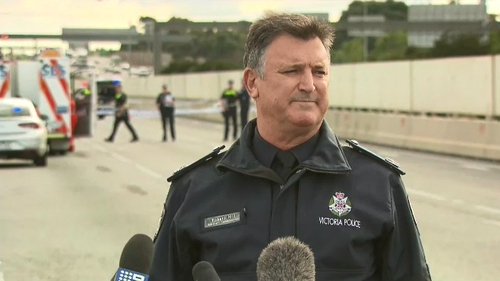
“The male continued the advance. There was then a nonlethal force used upon the male to stop him from advancing. Then police resulted to lethal force.
“A semi-auto firearm was then discharged.”
Asst Comm. Hill described the shooting as “tragic and sad” incident.
“At this point in time, there is nothing to indicate to me that our police members did not do everything they could to resolve the matter,” he said.
“Our members that are involved in this to a certain extent will be scarred by the scenario where through their actions someone lost their life.
“None of us come to work and want to be involved in these situations.
“It is a sad occasion for the family, loved ones and friends of the deceased male. It is a sad occasion for the community of Victoria.”

Multiple police vehicles and paramedics swarmed the scene, with the section of the freeway taped off.
Five police officers were directly involved in the freeway stand-off, with one injured in the altercation. Another seven officers rushed to the scene at its conclusion.
The 53-year-old man was known to police, but the motivations behind the man’s erratic behaviour on the side of the freeway remain unclear.
However it is understood the man was suffering from a mental health episode.
Asst Comm. Hill confirmed officers activated their body cameras, with VicRoads cameras also capturing the events of the shooting.
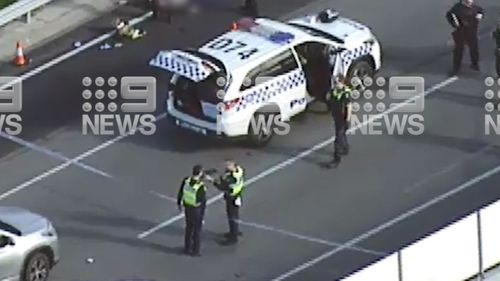
The footage will form part of a broader investigation by Homicide Squad detectives, overseen by the Professional Standards Command and the Independent Broad-based Anti-Corruption Commission (IBAC), as per protocol when a police firearm is discharged.


Up to six people will be allowed to meet outside “as long as they respect social distancing rules,” in gardens and other private outdoor spaces, he said.
“At the moment, as you know, people can meet in parks but not in private gardens — this was a cautious first step — but we know that there is no difference in the health risk,” he added.
However, people from different households should still not meet inside homes. From Monday, they will be permitted to meet outside, he said — “provided those from different households continue strictly to observe social distancing rules by staying two metres apart.”
To the relief of many British parents, schools will reopen to more children, starting with nurseries, pre-school, kindergarten and some grades in elementary schools.
“Closing schools has deprived children of their education and, as so often, it is the most disadvantaged pupils that risk being hardest hit,” Johnson said.
“On Monday, we will start to put this right in a safe way by reopening nurseries and other early-year settings and reception, year one and year six in primary schools. A fortnight later, on 15th of June, secondary schools will begin to provide some face-to-face contact time for years 10 and 12,” he added.
And outdoor markets “where social distancing is easier” and car show rooms can now open. The restrictions will loosen further as of June 15 when retail and nonessential shops can open their doors, as Britain “begins to re-start it’s economy,” Johnson noted.
The relaxation of lockdown rules comes after the death rate in the UK has fallen consistently. From a peak of 943 deaths on April 14, the UK announced 256 coronavirus-related deaths on Thursday — a significant but diminishing toll.
In his speech, Johnson credited citizens for heeding social distancing guidelines when the pandemic was at its height in the UK, and emphasized the need for the virus to remain under control.
“I cannot and will not throw away all the gains we have made together and so the changes we are making are limited and cautious,” he said.

Farmers in Myanmar’s Shan state have complained that their businesses are being undercut by cheaper potatoes smuggled in from nearby China, causing them serious financial losses.
Potatoes are prohibited from regular border trade under measures to protect local growers, but Chinese traders are still able to export them illegally into Myanmar, prompting farmers to urge authorities to take measures to stop the activity.
Potato farmers want the government to shut down the illegal Chinese potato imports to Myanmar, said Aung Chan Aye, a potato trader at Yangon’s Bayint Naung Wholesale Centre.
Many Burmese say they prefer Chinese potatoes because they are better quality and about 10 percent less expensive than those grown in Myanmar.
Half of the more than 90,000 acres under potato cultivation in Myanmar are in 21 townships in southern Shan state, and especially in Naungtayar, Kalaw, Nyaungshwe, Langhko, and Taunggyi townships.
Farmers in Shan State say Myanmar authorities must enforce regulations prohibiting the illegal entry of potatoes from China because they cannot compete and will face greater financial strife and a possible loss of livelihood.
The current price of potatoes is 600-650 kyats (U.S. 42-46 cents) per viss, a unit of measurement equal to 3.6 pounds, which yields a profit of only 100 kyats (U.S. 7 cents) for growers, said Khun San Oo, a potato farmer in Naungtayar township.
But illegally imported China potatoes sell for about 500-550 kyats per viss.
“This is only about a 50-kyat difference, but for thousands of viss, the difference is huge,†he told RFA. “If Chinese potatoes continue to enter Myanmar, we will be in grave trouble.â€
Myanmar farmers also say they cannot compete with Chinese technology which allows Chinese growers produce better potatoes more efficiently than their counterparts.
“Chinese potatoes are different from those grown in Myanmar,†said potato seller Aung Chan Aye.
“Chinese [potatoes] are more beautiful in color and larger in size. Customers prefer them,†he said, adding that Chinese traders also don’t have to pay Myanmar tax on their shipments since they are exporting illegally.
RFA could not reach the Myanmar’s Ministry of Commerce for comment.
Soe Nyunt Lwin, Shan state’s minister for finance and planning, said that the list of items permitted for border trade does not contain potatoes from China.
“Chinese potatoes are not officially allowed into Myanmar’s market,†he said. “We will see to that.â€
Farmers in southern Shan state have complained to state officials in the past about the illegal potato imports in border trade areas undercutting their business and requested that they control the inflow.
Although state authorities pledged to control the sale of potatoes imported illegally into Myanmar as well as provide loans to farmers so they can buy agricultural machines and produce higher quality potatoes, the problem has continued.
Reported by Kyaw Lwin Oo for RFA’s Myanmar Service. Translated by Maung Maung Nyo. Written in English by Roseanne Gerin.

After a full month, they began to feel much better; Dr. Pourfar’s symptoms did not disappear entirely until mid-May. His sense of smell, though, did not return. He understood that losing the ability to enjoy wine was a small price to pay for one’s life and health. Still, he could not help but feel that in a small way he had been diminished.
Like many wine lovers, he had constructed what he called “life’s comforting rituals†around fetching a bottle: “The considered selection, the careful handling, the slow, deliberate opening and thoughtful smelling, the little smile, they were gone,†he said.
Dr. Pourfar, who grew up in Monroe, N.Y., near West Point, discovered wine when, as a high school student, he spent a year in Alsace, France. There, he lived with a family who always had wine on the table. He found himself paying attention to it, and wine became entwined with his time there.
“You don’t realize what a powerful connection these sorts of flavors can have with your life’s experiences and memories,†he said.
From there, in fits and starts, Dr. Pourfar set out on his exploration. In medical school, he fell in with some fans of German wines, and then, when he decided to study wine seriously, he began with Bordeaux, a customary point of departure because of its rich history and the relative simplicity of its structure and geography.
Like many whose wine journey began in the 1990s, Dr. Pourfar first embraced the bold, fruity bottles that were popular and critically acclaimed at the time. As he became more confident in his own tastes, he gravitated toward subtler, more nuanced wines. Eventually, his arc of discovery led him to Burgundy.
“It’s where everybody ends up in this world, and it took me a long time before I got it,†he said.
Any wine at all, however, seemed unthinkable as he recovered from Covid-19. So much of the pleasure of wine and the ability to taste are dependent on the nose. But he could not smell much of anything.

Joshua Boliver and Gali Beeri decided to quarantine together in New York City — after one date.
Gali Beeri
hide caption
toggle caption
Gali Beeri
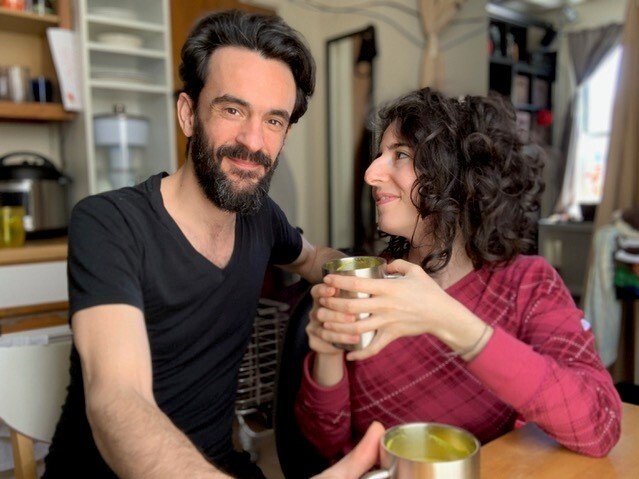
Joshua Boliver and Gali Beeri decided to quarantine together in New York City — after one date.
Gali Beeri
It has been said that disasters are relationship accelerators. They can cause a spike in marriage and babies — and they can also trigger divorce.
Most of us are hunkering down with people we already had some sort of relationship with. But a few have chosen to ride it out with practical strangers.
Gali Beeri is 37 and works as an executive assistant. Joshua Boliver is 42 and creates visual effects for movies. They both live in New York City and met at a dance class in March, as the city was preparing to lock down. At the time, they made the unlikely decision to quarantine together — after their first date.
The couple sat down to interview each other in Boliver’s apartment in Astoria, Queens, which, Gali says, is now “kind of my apartment.”
“Both of us thought it was the other one that suggested it,” Joshua says about how they decided to quarantine together. “We just kind of stumbled into it.”
They didn’t really know much about each other when they started living together, and Joshua says they’ve had to navigate their differences as they came up. Joshua is a meat eater. Gali is a vegetarian. Joshua likes early morning. Gali is a night person.
They have met each other’s parents on video chat. Gali says she remembers having fears: “Is it too soon to meet the family?” Joshua would laugh, she recalls, and say: “What’s too soon? We already live together.”
“The regular patterns don’t really apply to us anymore,” he says.
It has been such a joyful experience that Joshua says he wondered how long it could last.
“At some point, we’re going to get bored or something and the honeymoon period will be over,” he says.
The rough moment came, in dramatic fashion, after the couple had been quarantining together for about three weeks.

It was Gali’s birthday, so they ventured to the grocery store to buy supplies for a celebratory meal. A few days later, she started feeling cold and shivering.
They took her temperature; Gali had a fever. By the next day, it had gone up to 103, then hit 104. They called the nurse hotline and were told that when a fever reaches 104, they should go to the emergency room.
“That’s when I really felt the fear hit,” says Gali. “I do not want to go to a hospital right now.”
They were able to keep her fever down with Tylenol and avoid the ER. The experience prompted them to generate “worst case scenario” lists. Gali remembers asking herself whether she had a “do not resuscitate” order.
Gali says she trusted Joshua to make the right decisions for her, even though they had only known each other for a few weeks.
“Trusting a practical stranger with your health and well-being,” Joshua laughs.

About five days into the fever, Gali had more energy.
“That night was my first shower,” she reminds Joshua. “I washed my hair. It felt amazing. So I got out of the shower and you had made the bed. You put fresh sheets on the bed. I fell asleep. And that night my fever broke.”
That was the first round: Gali’s fever came back after a few days. Only recently has she felt her energy return to normal.
Since that time, Joshua says he finds himself wondering what will happen at the end of quarantine — and realizing that he doesn’t want it to end.
“I’m curious, do you have any thoughts around it?” Joshua shyly asks Gali.
“This cocoon of time has felt like a gift,” she says. “It also feels like living in a fairy tale.”
Gali says that if quarantine goes on much longer, they’ll have to “decide what we’re doing.”
“Maybe outside the constructs of this bubble that we’ve been in, it wouldn’t work,” Joshua says.
Gali is also nervous about what the future holds. “Yes, I have fear. Around walking out that door.”
It’s been 71 days, and Gali still hasn’t been back to her own apartment.
This story was produced by Joe Richman of Radio Diaries, with Sarah Kate Kramer and Nellie Gilles. The editors were Deborah George and Ben Shapiro. We also had help from Jessical Deahl. To hear more stories from the Hunker Down Diaries series, subscribe to the Radio Diaries Podcast.

The Premier League season will restart on June 17 provided all safety requirements have been put in place, the league said on Thursday after meeting with all 20 clubs.
The season will get back under way on that Wednesday with Aston Villa vs Sheffield United and Manchester City vs Arsenal, which are both games in hand.
A full fixture list will then be played on the weekend of June 19-21. All games will be played without fans in attendance.
With the restrictions on the broadcasting of Saturday 3 pm games lifted, the league said all 92 remaining matches will be broadcast live in the UK by its existing broadcast partners: Sky Sports, BT Sport, BBC Sport and Amazon Prime.
Donald Trump said he is asking regulators to reinterpret a law that shields internet companies from lawsuits | Pool photo by Doug MIlls/Getty Images
The president’s long-promised executive order targeting social media companies raises alarm, but may not have the bite he wants.
U.S. President Donald Trump’s attempt to punish companies like Twitter, Google and Facebook for alleged anti-conservative bias takes aim at the online industry’s most-cherished legal protections — but the shot could ultimately be a glancing blow.
Trump announced the action Thursday, signing an executive order that he said would “defend free speech from one of the greatest dangers” — tech platforms that have amassed “unchecked power to censor, restrict, edit, shape, hide, alter virtually any form of communication between private citizens or large public audiences.”
“We can’t allow that to happen,†Trump said in the Oval Office, where he was accompanied by Attorney General William Barr.
Under the order, Trump said he is asking regulators to reinterpret a law that shields internet companies from lawsuits over content on their sites, a safeguard that has allowed Silicon Valley’s giants to generate some of the world’s biggest fortunes.
“My executive order calls for new regulations … to make it that social media companies that engage in censoring or any political conduct will not be able to keep their liability shield,” he said,
But any such action depends on independent agencies and state attorneys general agreeing with the administration’s stance, and would certainly provoke a legal fight that would last long past November’s election.
An early draft of the text drew swift condemnation from both internet industry advocates and civil liberties groups, including some who regularly criticize Silicon Valley, after the language began circulating on social media and news reports. Some called it dangerous; some dismissed it as bluster.
“This reads like a stream of consciousness tweetstorm that some poor staffer had to turn into the form of an Executive Order,” said Daphne Keller, a former Google attorney who now leads the Program on Platform Regulation at Stanford’s Cyber Policy Center.
The order nevertheless adds more ammunition to a talking point that resonates with Trump’s online base and will appease some Washington conservatives who are skeptical of the tech industry’s influence over political discourse. And Trump’s escalation of the issue could have a chilling effect on internet companies weighing whether to make rulings on misinformation or other content as Election Day nears.

Boston police officers ride past the finish line of the Boston Marathon, which was canceled and replaced with a virtual event on Thursday.
Charles Krupa/AP
hide caption
toggle caption
Charles Krupa/AP

Boston police officers ride past the finish line of the Boston Marathon, which was canceled and replaced with a virtual event on Thursday.
Charles Krupa/AP
The 124th annual Boston Marathon has been canceled because of the coronavirus pandemic. The Boston Athletic Association announced the move in a statement on Thursday, saying that the marathon will instead be held as a virtual event.
All participants who were set to run in the event initially slated for April 20 and later pushed back to Sept. 14 will be offered a full refund of their entry fee and have the opportunity to participate in the alternative.
This is the first time the in-person event has been canceled since the race’s inception in 1897, according to ESPN.
According to the statement, participants will be required to complete the full 26.2 miles in six continuous hours or less with proof of timing. The distance can be run any time between Sept. 7 and Sept. 14.
The @BAA, with our input and support, has determined that the traditional, one-day running of the 124th @BostonMarathon is not feasible this year, for public health reasons.
— Mayor Marty Walsh (@marty_walsh) May 28, 2020
The Boston Athletic Association added that the virtual race will be supplemented with exclusive events such as panel discussions and interviews with past champions.
Boston Mayor Marty Walsh said the decision “allows all of us to celebrate the meaning this race has.”
“This is a challenge, but meeting tough challenges is what the Boston Marathon is all about,” Walsh wrote in a tweet. “It’s a symbol of our city and Commonwealth’s resilience.”

Democrats in Pennsylvania’s House of Representatives on Thursday accused Republicans of keeping a lawmaker’s positive coronavirus test a secret to avoid political embarrassment, even at the risk of exposing their Democratic colleagues.
A Republican House member, Andrew Lewis, confirmed on Wednesday that he had received a positive test on May 20 and went into self-isolation. Mr. Lewis said that every lawmaker or staff member he had been in contact with who “met the criteria for exposure†was notified.
But Democrats disputed that, saying none of their own members were alerted even though some were in proximity to Mr. Lewis in committee meetings.
In an emotional and profanity-laced Facebook video recorded in his office at the Capitol, Representative Brian K. Sims, a Democrat from Philadelphia, said Mr. Diamond had “apparently been quarantining himself for weeks†but “didn’t explain that to any of us when he was in committee, talking with us or walking up and down the aisles or bumping into us or letting us hold the door open for him.â€
“How dare you put our lives at risk?†Mr. Sims said, noting that he had recently donated a kidney. “How dare you put our families at risk?â€
Mr. Lewis said that after experiencing “mild flulike symptoms,†he sought a test on May 18. He kept his positive diagnosis private “out of respect for my family, and those who I may have exposed,†he wrote on Facebook. He also said that May 14 had been his last day in the Capitol and that as of Wednesday, he was fully recovered and ended his quarantine.
Representative Kevin J. Boyle, the Democratic chair of the state government committee, said he had sat near Mr. Lewis about a week before his positive test, and had not been told. “The fact the Republican caucus didn’t inform the Democratic caucus is deeply reckless and immoral,†he said.
He speculated on why they did not do so: “The optics are terrible†for Republicans, he said. “Lewis and Diamond have been high-profile members of the anti-shutdown movement. They’ve been consistently telling everyone we’ve overreacted with shutdown orders and Covid-19 is not the danger it is.†Mr. Boyle asked the Pennsylvania attorney general, Josh Shapiro, to investigate whether Republican leaders broke the law.
On Twitter, Mr. Diamond said he had not gotten tested during his self-isolation and he mocked “lefties†who “whine†about it.
Republican lawmakers, including Mr. Lewis, have introduced bills seeking to weaken the emergency shutdown orders of Gov. Tom Wolf, a Democrat. As in many states, Pennsylvania has seen a nasty tug of war between Republican lawmakers concerned about the economy, and sometimes mocking mask-wearing and social distancing, and governors seeking to follow the recommendations of health experts.
A spokesman for the House Republicans, Mike Straub, said that state and federal guidelines were followed in determining whom to notify, specifically anyone in close contact with Mr. Lewis in the 48 hours before his symptoms began. “Rep. Lewis was only in the Capitol for a short period of time within that window — so tracing who he was in contact with was easily verified,†Mr. Straub said in a statement.
On Thursday afternoon, Mr. Sims, speaking on the House floor, disputed both that timeline and when Mr. Lewis was infectious, which he said would have been as early as May 4, two weeks before his positive test. Mr. Lewis was present in the Capitol on six days when he could have been infectious, Mr. Sims said.
He accused Republican leaders of knowing of the positive test and not disclosing it as lawmakers returned to their homes for the Memorial Day holiday. “A massive holiday went by before we were notified, but people here interacted with their families,†he said, adding, “That’s unconscionable.â€
Representative Ryan Bizzarro, a Democrat who went for a test on Thursday in Harrisburg, the capital, said: “The thing that was just infuriating about this whole situation is that we found out the Republican caucus leadership knew about this and tried to bury it.â€
In a party-line vote, Republicans defeated a Democratic motion to adjourn through June 8 to investigate Republicans’ handling of the episode. Late in the day, Democrats proposed new rules to require all lawmakers to wear masks on the House floor and in committees, and to have their temperatures checked before being admitted to the floor or committee rooms.
Some Democrats have called for the House speaker, Mike Turzai, to step down, including Mr. Sims, who ended his floor speech with a flourish, saying, “Mike Turzai, you need to resign immediately.â€
Mr. Turzai responded that he had not been informed at the time of Mr. Lewis’s positive test. He pledged that if he tested positive for the virus, he would immediately disclose the results publicly.
“And I do think that all members should follow the same protocol,†he said, an implicit rebuke of Mr. Lewis.