‘Superforecasters’ Are Making Eerily Accurate Predictions About COVID-19

0

When Dr. Anthony Fauci said in late May that there’s a “good chance” a COVID-19 vaccine will be ready by the end of this year, Steve Roth badly wanted to believe him. Roth, a 74-year-old New Yorker who endured fever, pneumonia and anxiety while fighting the virus, wants life to go back to normal as much as anyone. And he respects Fauci, the longtime head of the National Institute of Allergy and Infectious Diseases (NIAID), ”an awful lot,” he says. But he just doesn’t think Fauci’s timeline is realistic. Instead, he’s putting his proverbial money on mid 2021.

“Like everybody else, I’d like to see a vaccine today,” says Roth. “But what’s the real world?”

Roth is a semi-retired market researcher, not a biostatistician or epidemiologist, and hardly seems to be the kind of person you’d go to for insight into vaccine production. But in his spare time, Roth moonlights as a “superforecaster”— a member of a team of ordinary people who make surprisingly accurate predictions for the forecasting firm Good Judgement, Inc. In recent months, businesses, governments and other institutions have worked with superforecasters like Roth to help them understand how the COVID-19 outbreak might unfold.

That a group of semi-professional forecasters would somehow have accurate insight into anything as complex and important as the coronavirus pandemic sounds like the stuff of science fiction, or even ancient history—like the seers of old who told fortunes to kings and nobles. But the team behind Good Judgement, Inc. and the organization it spun off from (the research initiative Good Judgement Project) say they have established a rigorous system for identifying talented forecasters and sharpening their abilities. The company’s superforecasters undergo years of testing before they’re brought onto the team—in the early days, through tournaments sponsored by the Intelligence Advanced Research Projects Activity, and now on the open-to-the-public forecasting site Good Judgement Open. Under the current model, the best forecasters on Good Judgement Open are invited to an online community of superforecasters, where they can share ideas and contribute their predictions to a system that aggregates their forecasts. Good Judgement’s clients pay for answers to questions that are important to decision-makers; the superforecasters collect a share of the revenue. (Other prediction services, including Metaculus, use similar models, although like Good Judgement Open, Metaculus’ community is open to anyone; Metaculus also weighs all users’ input, giving more weight to better forecasters.)

Open Judgement’s superforecaster team has a track record of success, having made accurate predictions about world events like the approval of the United Kingdom’s Brexit vote in 2020, Saudi Arabia’s decision to partially take its national gas company public in 2019, and the status of Russia’s food embargo against some European countries also in 2019. Lately, they’ve taken their talents to the epidemiology world—in early February, Good Judgement’s team predicted there would be between 100,000 and 200,000 COVID-19 cases reported by March 20; the world hit the 200,000 mark one day earlier.

Related Stories

Unlike history’s prophets, forecasters like Roth do not claim to possess supernatural abilities. Instead, they say their accuracy is a result of using specific techniques to structure their thinking and constantly trying to improve their skills. Superforecasters also tend to share certain personality traits, including humility, reflectiveness and comfort with numbers. These characteristics might mean that they’re better at putting their ego aside, and are willing to change their minds when challenged with new data or ideas.

It’s unlikely that superforecasters like Roth could ever fully replace subject-matter experts. Michael Jackson, an associate scientific investigator at Kaiser Permanente Washington Health Research Institute, cautions that superforecasters are a “black box,” meaning their less-than-scientific methods make it impossible to vet their work in the same way that a scientist’s output would undergo peer review. And Philip Tetlock, a professor at the University of Pennsylvania and a co-founder of Good Judgement, acknowledges that there are times in which expertise is crucial (for example, he notes that some public health experts warned about the possibility of a coronavirus pandemic early in the outbreak.)

However, Tetlock argues that superforecasters have skills that experts may not: for example, they may also be more flexible than traditional scientists, because they’re not bound to a particular discipline or approach. Their predictions incorporate research and hard data, but also news reports and gut feelings. That way of working may increase their overall accuracy, says Tetlock. “Talented amateurs who pay attention to both the science and the news seem to be better at putting accurate probabilities on key outcomes in this phase of the crisis,” he says. “The experts were really good at warning us about the fundamental danger, but they may be less adept at adapting nimbly to the dynamics about this phase of the crisis.”

Superforecasters aren’t just smart, Tetlock says; they also tend to be actively open-minded and curious. They’re in “perpetual beta” mode, as he puts it in his book on the topic, Superforecasting: The Art and Science of Prediction— always striving to update their beliefs and improve themselves. Bryan Hartman, a 36-year-old computer science teacher in Illinois and superforecaster of six years, says that kind of flexibility can improve their predictions.

“[Superforecasters] provide a lot of counter information, which is called ‘red-teaming,’” says Bryan Hartman. “It’s not in a way to press anyone’s buttons. It’s always to make everyone see the whole picture … it’s very collaborative, and very few people take anything personally. We’re just trying to see if we can get it right.”

Superforecasters are particularly good at predicting how people’s choices will affect future outcomes, says Good Judgement Inc. vice president Marc Koehler. That kind of insight that could be particularly helpful during an event like the COVID-19 pandemic, given that people’s adherence to measures like social distancing and mask-wearing can have dramatic effects down the road.

“If you’re wondering how a virus rips through a herd, an epidemiologist is going to give you the best answers about whether it mutates and stuff like that,” says Koehler. “But when the herd turns into human beings who make decisions to comply or not comply with different guidelines, and when governments set policies about stay home or not at home, or keep schools open or not, when all of those different factors get involved, that’s where a group of human forecasters really excels.”

Jackson agrees that it’s possible superforecasters could better predict or accommodate for events like mass protests compared to typical viral modeling approaches. “The challenge is that what’s going to happen in the future isn’t just based on the properties of the virus itself,” he says. “It’s very much driven by human behaviors, and we’ve seen that those can change abruptly and unpredictably even in just the short course of this pandemic so far.”

Furthermore, superforecasters can assist experts in sounding the alarm early in a major crisis—which, in the case of COVID-19, can save lives. Shannon Gifford, a 61-year-old who has been forecasting for more than eight years and is the deputy chief projects officer for the Denver, Colorado mayor’s office, says her colleagues were taken aback when she nudged them as early as January to consider how COVID-19 could affect the city.

“I remember saying in large meetings, ‘Well, whatever’s happening in a couple months could be very different if this virus crashes the economy,’” says Gifford. “And people [were] looking at me blankly, like, ‘You’ve got to be kidding. What are you talking about?’

Gifford says that she wasn’t surprised that people in Denver and elsewhere underestimated the threat of COVID-19, calling it “human nature.”

“Part of it was we simply had no idea, at that point, how much spread had already taken place,” she says. “Because we had so little testing. And I think a lot of people were lulled into inaction believing we didn’t have much of a problem here, when we almost certainly did.”

Officials calling the shots, like mayors and governors, might be skeptical of the entire forecasting enterprise. But even if they ignore the superforecasters’ predictions, they could learn something from their methods. A willingness to change your mind when presented with new information, contend with your biases, challenge one another’s ideas, and break down problems into specific questions are all desirable qualities in people who make big, important decisions. “It’s the combination of thinking about what will happen, and why it will happen, that can be very useful to making decisions,” says Roth.

Correction, June 11

The original version of this story misstated the name of the head of the National Institute of Allergy and Infectious Diseases (NIAID). He is Dr. Anthony Fauci, not Dr. Anthony Facui.

Write to Tara Law at tara.law@time.com.


Source link

GOP-led committee backs renaming bases that honor Confederates, setting up clash with Trump

The Senate Armed Services Committee has approved a proposal to strip Confederate names from military bases and other Defense Department facilities within the next three years, setting up a possible clash with President Donald Trump on the issue.

While a number of Republicans, including committee Chairman Jim Inhofe, R-Okla, expressed some concerns about the way the changes would be implemented, the proposal passed by voice vote Wednesday with only a handful of dissenters.

Sen. Elizabeth Warren, D-Mass., offered the proposal as an amendment to the massive National Defense Authorization Act, which authorizes funds and sets policies for the military every year; the broader bill was approved by the committee in a 25-2 vote. If the language survives the floor vote and is also included in the House version of the package, the president would have to veto the entire bill in order to prevent the names from changing.

Trump said Wednesday that he would “not even consider” renaming Army bases that honor Confederate leaders, despite a nationwide reckoning over racial discrimination in the aftermath of the killing of George Floyd. The Army has 10 military posts named after Confederate military officers, including Fort Bragg in North Carolina, Fort Benning in Georgia and Fort Hood in Texas.

The president tweeted Thursday that Republican senators hopefully wouldn’t “fall for” supporting Warren’s proposal, first reported by Roll Call.

The proposal would set up a commission to make recommendations on the name changes to bases and other military assets, which would be completed within three years, getting input from states and local governments where the bases are located. And there are exceptions, including headstones at Arlington National Cemetery and any assets named for Confederates who later served in wars as part of the U.S. Army after the Civil War.

Sen. Josh Hawley, R-Mo., told reporters he voted against the amendment. Sen. Tom Cotton, R-Ark., also voted no. A source familiar with his decision said Cotton wanted an exception for memorials clearly dedicated to Confederate war dead, and no exception was made.

House Speaker Nancy Pelosi, D-Calif., said at her weekly news conference Thursday that the base names, as well as Confederate statues in the Capitol, “have to go.”

House Minority Leader Kevin McCarthy, R-Calif., said at his own news conference later Thursday that he is “not opposed” to renaming bases, but said he wanted to wait to see how the defense authorization bill shaped up.

The entrance to Fort Bragg in Fayetteville, N.C., in 2014.Chris Keane / Reuters file

Secretary of the Army Ryan McCarthy had said in a statement Wednesday that he was “open to having a bipartisan conversation regarding the renaming of Army bases,” adding that “no decision has been made at this time.”

The Pentagon had also said that the secretary of Defense and the secretary of the Army were “open to a bipartisan discussion on the topic.”


Source link

US response muted as Turkey gives consulate employee harsh prison sentence

Jun 11, 2020

A Turkish court has sentenced an employee of the US Consulate in Istanbul to nearly nine years in prison only days after President Recep Tayyip Erdogan hailed what he called a new era in US-Turkish relations.

Metin Topuz, a Turkish citizen who served as a liaison between the US Drug Enforcement Agency and the Turkish police for three decades, was convicted of “aiding an armed terrorist organization.” An appeals court is due to decide whether to uphold the sentence.

Topuz, who has remained in jail since his arrest in October 2017, is one of three US consulate employees targeted by the Turkish government since the failed July 2016 coup to overthrow Erdogan. The US government has called them political “hostages” and demanded their immediate release.

Hamza Ulucay, a Kurdish translator at the US consular mission in Adana, was arrested in February 2017 on charges of membership of the outlawed Kurdistan Workers Party. Mete Canturk, another Istanbul consulate staffer who worked with the Turkish police, was placed under house arrest in January 2018. Both Canturk and Topuz are accused of links to the US-based Sunni cleric Fethullah Gulen, who Turkey says engineered the abortive coup. All three have protested their innocence.

Ulucay was freed on the day of his January 2019 conviction of “knowingly and willingly aiding an armed terror organization,” though the time he had already served was less than his 4.5-year sentence. It was therefore expected the Topuz would be freed today as well. The US Embassy in Ankara aired its disappointment in a series of tweets, saying, “We have seen no credible evidence to support this conviction and hope it will be swiftly overturned.”

The reaction is markedly milder than the visa sanctions the United States had slapped on Turkey when Topuz was first arrested and speaks to the new balance that has emerged between the NATO allies. The sanctions were lifted in December following Turkey’s apparent promise to free the man. But soon after, Canturk was arrested as well, despite US warnings that it would impose sanctions on Turkish officials deemed responsible for the employees’ detentions.

In what may be a measure of Erdogan’s conviction that President Donald Trump will continue to leave Turkey off the hook, he declared in a June 8 interview following a telephone call with Trump, “To be honest, after our conversation tonight, a new era can begin between the United States and Turkey.” He did not elaborate.

After another phone call between the pair in October last year, Trump ordered US troops to withdraw from northeast Syria, effectively greenlighting Turkey’s assault against the Pentagon’s Syrian Kurdish allies. The move provoked congressional fury and calls for sanctions, forcing Trump to reverse his decision and keep around 500 US forces to protect oil fields in the northeast that help bankroll the Kurdish-led administration.

Asli Aydintasbas, a senior fellow at the European Council on Foreign Relations, believes Washington’s tepid response may be related to the consulate detainees not being Americans. “It’s quite remarkable to me despite the great friendship between Erdogan and Trump, the US administration has not secured Topuz’ release, unlike Brunson and Golge,” Aydintasbas told Al-Monitor. She was referring to North Carolina pastor Andrew Brunson and the NASA scientist and dual US Turkish citizen Serkan Golge, who were also arrested for alleged roles in the coup. Brunson was freed after Trump threatened to wreck the Turkish economy via Twitter, sending the Turkish lira into a tailspin. Golge was freed in May 2019 after three years of imprisonment. Canturk, the Istanbul consulate worker, was freed from house arrest but is still being prosecuted.

“The fact that Washington hasn’t prioritized Topuz’ release in bilateral discussions may have to do with the fact that he isn’t a US citizen, which sends a very chilling message to other Turkish employees at US diplomatic missions in Turkey,” Aydintasbas observed.

Part of Erdogan’s self-assurance stems from Turkey’s recent military gains in Libya, where its intervention on the side of the internationally recognized Government of National Accord resulted in a humiliating defeat of eastern warlord Khalifa Hifter. A former CIA asset who was being backed by Russia, the UAE, Egypt and France was forced to call off a more than year-long campaign to capture Tripoli and retreat from a string of towns and bases after Turkey sent in drones, heavy weapons and its Syrian rebel proxies in a massive counterattack that began in April.

Howard Eissenstat, an associate professor at St. Lawrence University and a senior non-resident fellow at the Project on Middle East Democracy, said, “Erdogan believes that a page is turning with the West in the sense that the West is finally coming to terms with a Turkey that can stand on its own two feet and aggressively defend its interest.”

Eissenstat continued in emailed comments to Al-Monitor, “In this sense he believes the improvement will result in a better relationship because the US and Europe will be less condescending in their response to Turkey. The fact that the United States backed off sanctions, is, in fact, a reflection of a new, more balanced relationship.”

For a while it seemed like Turkey would not, however, manage to avert sanctions under the Countering America’s Adversaries Through Sanctions Act that were finalized by Congress in December over Turkey’s acquisition of Russian S-400 missiles. Turkey bought itself time by parking the Russian kit in a warehouse in April, an idea touted by Trump confidant Senator Lindsey Graham, R-SC, though Turkish officials insist that the measure was due to COVID-19 and that the system will be activated. Turkey has already been effectively sanctioned over the purchase, with Congress prohibiting the transfer of hundreds of state-of-the-art F-35 fighter jets to Ankara and suspending it from the program. The Pentagon says the S-400s pose a direct threat to the F-35s.

Yet at the same time, the State Department’s Syria envoy Jim Jeffrey, who has said it’s “my job” to make Syria “a quagmire for the Russians,” appears to believe that Turkey is serving as something of a counterweight to them in Syria after Turkish forces launched a series of attacks against Moscow’s Syrian regime allies in Idlib in March, killing hundreds of Syrian government forces and their Iranian-backed Shiite proxies. They were retaliating against an airstrike likely carried out by Russia that killed 33 Turkish forces.

Jeffrey told a panel at the Hudson Institute on May 15, “I think that Turkey can be of great benefit to us in Syria. I think the latest round of fighting in Idlib, where the Turks killed a large number — I don’t know the exact number — of Iranian and Hezbollah operatives, shows that Turkey can be a part of or at least be comfortable with a US counter-Iran strategy and counter-Russia strategy in the Middle East in general and particularly in Syria.”

The facts suggest otherwise. Erdogan flew to Moscow soon after, where he agreed to a cease-fire in Idlib largely on President Vladimir Putin’s terms. Yet Ankara appears happy to encourage the belief that it can play with Washington against Moscow, and in doing so, help level the field with Moscow when seeking accommodation with it in Syria and now Libya.

It was in this vein that Turkish Foreign Minister Mevlut Cavusoglu called on the United States today to “play a more active role in Libya, both for achieving a cease-fire and in the political process.”

“The trick is that relations between Turkey and the United States and between Turkey and the European Union are unlikely to result in anything clean,” said Eissenstat. “The institutional framework of NATO assumes that we all are in fact on the same team. Erdogan has so far been able to manage that ambiguity very well and has maximized his independence.” Eissenstat cautioned, however, “But as the advertisements always say, ‘past performance is not necessarily an indicator of future gains,’ and the S-400s will really test Erdogan’s strategy.”


Source link

‘Paw Patrol’ canceled? Twitter erupts as people debate whether cop dog is problematic

Ryder and his team of pups on Paw Patrol. (Everett Collection)

Black Lives Matter protests continue to erupt around the United States nearly three weeks after a police officer killed George Floyd. The call to end racist violence by defunding the police has never been louder — and Hollywood is quickly having to adapt.

After 32 seasons, it was announced on Tuesday Cops was canceled. A&E just pulled its controversial show Live PD from the schedule. Could Paw Patrol really next? Yes, some people are questioning whether the popular Nickelodeon children’s cartoon should be “canceled,” culturally speaking.

Paw Patrol follows a little boy, Ryder, and his team of pups, who save the day in their fictional town. There’s Marshall, a firefighting dalmatian, and Skye, the fearless cockapoo who flies around on lookout. But one of the most popular characters is the German shepherd Chase, who happens to be a cop.

Last week the show’s Twitter account announced it was muting content “for Black voices to be heard so we can continue to listen and further our learning.” And Twitter did its thing in the replies.

One person linked to a 2018 article on the satirical website the Onion, “Paw Patrol Writers Defend Episode Where German Shepherd Cop Shoots Unarmed Black Lab 17 Times in Back.”

“Defund the paw patrol,” someone replied, while another added, “Euthanize the police dog.”

“For a paramilitary organization Chase breaks so many privacy laws it’s ridiculous. Sky also in direct violation of international standards preventing dogs from flying helicopters,” another Twitter user wrote.

The comments were mostly in jest — although some took dark humor to a new level. However, it ended up sparking a wider debate about how good cops, like the lovable Chase, should be portrayed on television.

The New York Times published an article on Thursday titled “The Protests Come for Paw Patrol,” and while it acknowledged people calling for the show to be “canceled” weren’t really serious, it basically pointed out why a character like Chase could be problematic.

“It’s a joke, but it’s also not,” the author wrote. “As the protests against racist police violence enter their third week, the charges are mounting against fictional cops too. Even big-hearted cartoon police dogs — or maybe especially big-hearted cartoon police dogs — are on notice. The effort to publicize police brutality also means banishing the good-cop archetype, which reigns on both television and in viral videos of the protests themselves. Paw Patrol seems harmless enough, and that’s the point: The movement rests on understanding that cops do plenty of harm.”

Other outlets came to the cartoon’s defense, like the Federalist, with its article, “Paw Patrol and Chase the Police Dog Are Good Examples of ‘To Protect and Serve.’”

Suddenly the idea that some could find Paw Patrol too problematic took off on Twitter with conservative politicians and commentators quickly weighing in.

Dean Cain called the notion Paw Patrol should be canceled “insanity.”

Megyn Kelly tweeted a link to the New York Times article and said it’s “beyond parody.”

The idea of Paw Patrol actually getting canceled is a long shot. The show was renewed for an eighth season earlier this year, and the film, Paw Patrol: The Movie, should hit theaters in August 20201. Then again, people probably thought Gone With the Wind would last more than a few weeks on HBO Max too.

Read more from Yahoo Entertainment:


Source link

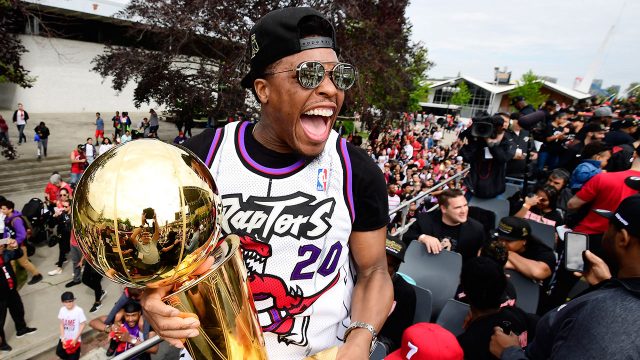
Why Raptors are well-suited to navigate NBA’s return-to-play challenges – Sportsnet.ca

0

While the NBA continues its precarious tightrope walk, straddling the line between a successful return to action and all of the unsettling uncertainties that lie below, few questions are more pertinent than what happens if a player contracts COVID-19, or if a player doesn’t want to enter the bubble for any reason — and few teams are better-equipped to navigate that question than the Toronto Raptors.

As ESPN’s Adrian Wojnarowski and Bobby Marks have detailed, the plan is not to suspend games. Players who test positively for the virus (and there will be daily testing) would be forced to quarantine for at least 10 days, and teams would then be allowed to implement replacement players as necessary. Additionally, for any player who may not want to enter the Disney bubble, it’s been reported that teams may request replacement players for them, too.

These replacements would reportedly be sourced either from the eligible free agent pool (consisting only of players who were signed to NBA, G League, or training camp deals this season) or via players on two-way contracts. And so, taking a closer look at the options available to them, here’s why the Raptors are set up well to combat any ill fate (including serious injuries) that may befall them.

Sign up for Raptors newsletters

Get the best of our Raptors coverage and exclusives delivered directly to your inbox!

Free agents

The first and, admittedly, most lacklustre option is for the Raptors to seek out a player from the aforementioned free-agent pool. But due to the criteria that must be met to be considered a part of that pool, teams are left with significantly limited options.

Some bigger free agent names that might have drawn interest in a scenario such as this, like Jamal Crawford, are unavailable thanks to not having been signed to any NBA-or-related deal this season. That also means that guys like Jeremy Lin (signed with the Beijing Ducks) or Jordan Loyd (signed with Valencia Basket), who the Raptors alone may be interested in due to their understanding of the team’s system and culture, aren’t options either.

What remains are, essentially, the equivalent of buyout players, the vast majority of whom have an underwhelming history when it comes to making a notable mark for the team that signs them. The major difference, though, is that unlike buyout players, who are at least typically given the chance to integrate into a team’s system for the latter half of a season, free agents signed this summer would be coming directly into the fray, without any rapport having been built up at all.

Still, there are some break-glass players on the market. DeMarcus Cousins, who was working his way back from a torn ACL before the Lakers released him in February, is sure to be a name on many teams’ minds if something happens to one of their bigs, and the Raptors specifically could look to a guy like Tyler Ennis, who they already know well due to his play for Raptors 905 this season, to fill guard depth.

A positive for the Raptors in all of this is their pliability, which all but ensures they won’t have to probe the free agent market at all. They have plus-defenders across the board to such a degree that they have been able to successfully plug holes created by injury already this season, even when those holes are obscene – think OG Anunoby guarding Nikola Jokic in place of Marc Gasol and Serge Ibaka in the last Raptors-Nuggets matchup. In almost any context, Toronto is versatile enough that it should be able to avoid feeling the pressure of needing to go after a free agent should something unfortunate happen.

If there is a podcasting odd couple, this might be it. Donnovan Bennett and JD Bunkis don’t agree on much, but you’ll agree this is the best Toronto Raptors podcast going.

In-house options

This is the option that, should the Raptors find themselves in a position where they require emergency manpower, makes the most sense in terms of bringing a new player into the fold. Selecting either a two-way player or another training camp invitee ensures that Toronto would be absorbing someone who has been a part of the organization already to some degree, and therefore wouldn’t need to do as much on-the-fly learning.

Along with their two-way players in Oshae Brissett and Paul Watson Jr., the Raptors’ list of training camp invitees includes: Devin Robinson, Sagaba Konate, Cameron Payne, and Isaiah Taylor. Robinson had been having a solid season with the 905 as an explosive, rim-rattling finisher; Konate suffered a bone fracture in his foot back in October and had just started playing for the 905 (looking very much like someone returning from a major injury) on a minutes restriction; Payne is signed with the Shanxi Loongs in China; and Taylor had been playing decently as a moderate-efficiency point guard for the Rio Grande Valley Vipers (Houston’s G League affiliate).

One would imagine if the Raptors were to call upon one of these names, though, it would be one of the two-ways. Brissett has already proven that he can be valuable as an energetic, defensive-minded spark coming off the bench for an NBA team, and has thus far spent 19 games (or, more importantly, an estimated 43 of the allotted 45 days his contract allows him to spend with the parent club) with Toronto this season. Watson has received substantial praise for his growth with the 905 and only had a brief three-game stint with the Raptors.

The league has established a transaction period (June 22 to July 1) that will allow teams to convert two-ways to full deals, but the Raptors’ roster is full, and so they can’t convert either Brissett or Watson, even if they wanted to.

Just like those who are part of the free-agent pool, two-way players are also being excluded from entering the bubble initially with the rest of the club’s 15 members (something teams have reportedly pushed back on and is subject to change). This is being done to limit the number of people within the confined space, and evidently means that if the Raptors were to bring in Brissett or Watson, they would be forced to quarantine before they would be able to join the team, making their arrival slow and their time needed to catch up fairly lengthy.

Still, if it comes down to the Raptors absolutely needing a replacement player to fill a void, then expect to see them send out a signal to one of Brissett or Watson, especially since, once the playoffs arrive, only two-way players will be eligible to act as replacements.

Do nothing

Of course, the simplest choice is often the most preferable. Despite the Raptors having limited options available to them, it’s abundantly transparent that there would be nothing they could do to truly replace the impact of one of their key players. And if they were to replace one of them, there’s a possibility that said player would become ineligible to return at all, meaning that the team would have to traverse the remainder of the season/playoffs without a core piece.

Not only that, but any replacement player entering the bubble would have to be flown in and quarantined themselves before even getting the opportunity to assimilate into their new team.

It would seem to make more sense, then, for the Raptors to just wait out the recovery time for any infected player, and hope that they can stave off elimination long enough to allow that player to return.

But even with that in mind, taking stock of alternative available precautions and generating backup plans is essential. In a situation like the one the NBA and all its teams are beginning to wade into, it’s impossible to be too careful.

The Raptors will have a full roster heading into Orlando. When the playoffs arrive, the rotation will likely shrink as per usual, meaning that only about eight players of the 15 on the team will be seeing regular minutes. If someone were to go down, then there will be immediate options waiting in the wings.

That may be an easier task for Toronto to handle as compared to other franchises, too, since the team dealt with injuries throughout the entirety of the regular season and yet managed to thrive by effectively utilizing a team-oriented offence (one that saw a number of players unexpectedly take advantage of their opportunities) and relying on a stifling, scrambling defence.

The flexibility that has become not only the Raptors’ players’ collective trademark, but Nick Nurse’s as well, may have, in a bizarre way, unknowingly set the team up better for a stretch run than could possibly have been anticipated prior to the league’s hiatus.


Source link

NI police identify gun used in journalist Lyra McKee’s murder

0

A handgun found during police searches in Derry last weekend is the weapon used to kill journalist Lyra McKee, police have confirmed.

The Police Service of Northern Ireland said after forensic tests on the Hammerli X-Esse pistol they have established it was the gun that fired the fatal shots which killed the 29-year-old reporter during riots in Derry last year.

Anti-peace process dissident republican group, the New IRA, was behind the shooting in the city’s Creggan area where McKee lost her life.

The PSNI said confirmation that the pistol discovered during a search in Derry marked “a significant moment in the investigation” into the New IRA killing.

The gun was uncovered during two days of searches over a site covering 38 acres.

Detective Superintendent Jason Murphy, the senior investigation officer into the McKee murder, said one line the PSNI was pursuing was that the gun had been stolen some time ago.

He said several New IRA figures were involved in producing the weapon on the night the journalist was killed when the terror group fired on police lines during disturbances in the Creggan.

“I know who they are and the public know who they are and I also know who the gunman is,” Dt Supt Murphy said.

The senior PSNI officer said he was “grateful and relived” to learn that police now have the murder weapon.

He added: “For the New IRA the net is tightening. One positive result will have significant consequences for the New IRA.”

Paul McIntyre, who is from Derry is currently being held in Maghaberry prison and is charged with murdering Lyra McKee. The 52-year-old denies the charges.

Lyra McKee’s partner, Sarah Canning, and her family have been informed about the discovery of the murder weapon, the PSNI confirmed.

The pistol was discovered along with a fully primed bomb which the PSNI believe was planned to have been used to murder police officers. Alongside the bomb police found command wire for triggering bombs and a quantity of ammunition.

Source link

Egypt to reopen tourist destinations less hard-hit by coronavirus

0

Egypt will reopen select tourist destinations to international charter flights starting July 1, allowing travellers from around the world to return to parts of the country less hard-hit by coronavirus.

he government hopes to draw tourists to popular yet remote attractions that have been spared the ravages of the virus.

Those include the southern part of the Sinai Peninsula, home to the major resort and beach destination of Sharm el Sheikh, the Red Sea resort areas of Hurghada and Marsa Alam, as well as Marsa Matrouh, on the Mediterranean coast.

The decision comes even as the pandemic surges in the densely populated capital of Cairo and other major cities, where many people say they cannot find a hospital bed.

The health ministry has recorded over 39,000 cases of Covid-19 in Egypt, including 1,377 deaths — the highest confirmed death toll in the Arab world.

However, the Cairo airport will remain closed to international commercial flights until further notice. Public parks and beaches will also stay closed until the end of June, said Cabinet spokesman Nader Saad.

Despite rapidly increasing infections, Egypt will also shorten its curfew hours slightly, enforcing it from 8pm to 4am, starting Sunday and until the end of the month.

Hotels that implement social-distancing rules and other precautionary measures began to reopen to domestic tourists last month.

Egypt’s economy depends heavily on tourism, which accounts for some 12% of the gross domestic product. The government fears a prolonged lockdown could be devastating economically, as the grounded international flights and empty hotels have taken a heavy toll.

Egypt has secured a 2.8 billion US dollars bailout from the International Monetary Fund, and last week agreed with the IMF on another 5.2 billion dollar agreement to stave off the pandemic’s worst economic effects.

PA


Source link

MycoTechnology raises $39M to grow its functional ingredients platform

0

Dive Brief:

  • Colorado-based organic food technology company MycoTechnology raised $39 million in a Series D funding round with the participation of Greenleaf Foods, Tyson Ventures, Kellogg’s investment arm and S2G Ventures, among others. The latest infusion of capital will help expand the company’s functional ingredients platform.
  • The company’s platform uses the filament-like roots of more than 60 types of fungi to produce better-for-you products. However, the firm is best known for its ClearTaste off-flavor blocking ingredient and PureTaste plant protein ingredient, both of which are mushroom-based.
  • CEO Alan Hahn told Food Navigator he is looking to take the company public with an IPO in the second half of 2022.

Dive Insight:

Demand for sustainable, plant-based protein is growing and companies are looking for ways to fulfill consumers’ requests for more alternatives. MycoTechnology developed a food processing platform to turn agricultural materials into functional ingredients, and it has attracted big-name investors. Its total funding now stands at $120 million.

This funding round is the third one Kellogg’s VC arm Eighteen94 Capital has participated in. Initially, Kellogg participated in a $35 million round in fall 2017 and then again in last year’s $30 million funding round. In previous releases, company leaders indicated MycoTechnology’s commitment to creating a sustainable protein source and its “cutting edge” mushroom fermentation platform as the reasons behind its continued support.

While pea protein and soy are staple alternatives in the plant-based market, mushrooms are just beginning to shine as a viable source of nutrients and protein for manufacturers. The global market is projected to jump from $34.1 billion in 2015 to $69.3 billion by the end of 2024 as more applications for mushrooms are discovered, according to Transparency Market Research.

Already, MycoTechnology claims its PureTaste ingredient — which is low in calories, fat and carbohydrates, and high in vitamins and minerals — can be used in baked goods and cereals. The company says it can also create juicier meats because of its water and oil retention properties, and it can impart a smooth mouthfeel in dairy applications. If these claims hold up in taste tests, the large CPG conglomerates that have invested in the technology will be interested in introducing it into their manufacturing processes.  

Not only does this food technology company produce plant-based protein, but the ClearTaste ingredient has also shown it can reduce the amount of salt needed in lunch meat without changing the taste. Should this application be extended further to other typically salty products, including soup, sauces and frozen foods, more CPG companies will likely show interest in testing it out.

The company’s investment partners may also be looking into launching products made with these ingredients as they work toward achieving the FDA’s voluntary sodium-reduction guidelines. However, Hahn told Food Navigator ClearTaste’s No. 1 use is for sugar reduction strategies, since the off-taste masking solution can counteract the metallic aftertaste of stevia.

The Colorado company is clearly making waves in the functional ingredients space by enabling companies with all different flavors to create more clean-label and functional solutions. While there are many working toward ingredients that limit salt and sugar and provide another protein alternative option to the market, few companies are looking to tackle all these issues simultaneously, let alone with fungi.

This unique differentiator makes MycoTechnology stick out from the crowd and draw the attention of big-name investors. Its dedication to mycology and mushroom solutions will likely also gain the attention of the public and other firms as the company builds up to its IPO in the next two years.

While IPOs can be notorious for stripping companies of autonomy and creativity as they become beholden to shareholders, Hahn told Food Navigator that going public will allow the company to better control its mission and assist in the widespread launch of new products that are in the pipeline. 

Source link

Driving across the country in a pandemic – Harvard Health Blog

0

Thinking about traveling during the pandemic? Before heading out, there’s a lot to think about, including:

  • Do you have risk factors for severe COVID-19, such as advanced age or chronic medical conditions?
  • What about your co-travelers’ health and risk factors? Are your co-travelers part of your household or tight social circle?
  • Is the virus spreading in the places you’re going?
  • Who are you going to see along the way, and what’s their health risk profile?
  • If you get sick while traveling, will healthcare be available? And do you have the supports you need in case you have to quarantine for two weeks when you return home — or in a state you’ll be staying in?

Depending on your answers, you might decide it’s better to stay home! Or you may decide the risks are acceptable given some preparation and precautions, as we recently did.

Fly or drive?

“Please be careful when you drive out of the airport today, as you begin the most dangerous part of your trip.” Ever hear a flight attendant say that when your plane lands? It suggests that driving is riskier than the flight you just took. And the statistics support that.

But this may not be true during a pandemic. Tight seating and exposure to lots of people whose behavior you can’t control might be riskier than driving between cities. For many, driving may be safer than flying precisely because you have more control over potentially risky exposures.

We just drove from Denver to Boston. We chose to drive rather than fly because we’d be traveling with our large dog. Yes, he could have traveled in the cargo hold, but let’s just say that option was vetoed. Having just made the reverse trip from Boston to Denver in January, right before the pandemic began, it’s fair to say the return trip was quite different.

Preparing for the trip

We carefully planned our route, choosing stopping points that had open hotels (some were reserved for healthcare workers and first responders) and making reservations at a chain that had a reputation for being particularly conscientious about COVID-19 safety. Fortunately, many hotels are taking a number of steps to keep their lodgers safe during the pandemic, as a recent article in Forbes notes.

Then we loaded the car up with

  • hand sanitizer, disinfectant wipes, paper towels, and spray disinfectant
  • food and water, so we could avoid stopping at restaurants
  • supplies to allow bathroom breaks in the woods, in case we could not find suitable public restrooms
  • masks
  • the dog (of course), along with his food, toys, and bed.

Heading out into the world

As we left Denver, we knew some potentially risky situations would be hard to avoid. We’d have to stop for gas, walking the dog, walking me (I needed to stretch often), and of course bathroom breaks.

Friends told us to “just go in the woods,” but there are no woods along much of I-70 in Kansas! We were pleased to find plenty of truck stops, rest areas, and gas station restrooms that were clean and easy to use without touching nearly anything (though we took disinfectant wipes in case a door handle or soap dispenser had to be touched). I also used disinfectant wipes to touch gas pumps. Once back in the car, we used lots of hand sanitizer before resuming the trip.

We did notice masks were worn more in some areas than in others. One mask-free man saw our masks and asked us, “Do you really think there’s something to this virus thing?” I said yes, I thought there was something to it indeed! Clearly, there are a range of perspectives on the seriousness of the pandemic.

The hotels we stayed at seemed safe as well. Lots of wipes and sanitizer in the lobby, a protective shield at the front desk, masks on all the employees, and a two-person limit in the elevators. Once in the room, we wiped everything down: lamp switches, surfaces, door handles, bathroom, and of course, the TV remote. The hotel gave us the option of having no one enter the room (such as for maid service) during our stay, and we accepted.

It was easy to socially distance: there was almost no one in the hotel or in nearby streets, so going for a walk seemed safe.

Seeing family

Halfway home, we visited family at an independent living facility. Waving and talking through a glass door and wearing masks, our hugless greeting was far different from normal but much better than nothing. At another gathering of six people, we sat outside six feet apart and wondered if beer could kill viruses. (It can’t.)

The bottom line

After five days on the road, we arrived home weary but, hopefully, uninfected. We appreciated that most of our fellow travelers and all of our hosts took the pandemic seriously. While nothing is risk-free, our efforts and those of people we encountered made the trip feel like a low-risk undertaking. If you’re healthy, symptom-free, and need to drive a long way, I think there are ways to do it safely, even during a pandemic.

Source link

Michael McCarter named Managing Editor, Standards, Ethics and Inclusion at USA TODAY

USA TODAY Network staff report
Published 1:46 p.m. ET June 11, 2020 | Updated 2:27 p.m. ET June 11, 2020

Michael McCarter has been named Managing Editor, Standards, Ethics and Inclusion at USA TODAY.

McCarter previously served as executive editor of Evansville Courier & Press of the USA TODAY Network, and also coordinated coverage with editors and reporters across Indiana and Kentucky.

In his new role, McCarter will work closely with USA TODAY journalists across the country focusing on five building blocks that include ethics, standards, mentoring, education and inclusion. 

“I look forward to working with the talented and dedicated journalists at USA TODAY to ensure our coverage is fair to all communities.” McCarter said.

“I’m thrilled that Michael will join USA TODAY in this important role,” said Nicole Carroll, USA TODAY editor in chief. “He has extensive experience upholding the highest standards and quality in journalism, including as a top editor. He will also help lead our critical efforts to make sure our staff and our content reflects the diverse communities we serve.”

“Michael has been a strong advocate for his staff and for ensuring that his newsrooms’ coverage reflects the voices of all, and not just a select few. The news organizations under his purview have benefited greatly from his leadership.” said Katrice Hardy, Executive Editor of the Indianapolis Star and Midwest Regional Editor for Gannett.

Prior to his time in Evansville, where he has worked since October, 2018, McCarter worked for 10 years at the Cincinnati Enquirer, where he served as senior news director and director of photography before that.

A graduate of the University of Southern Mississippi, McCarter took an unconventional path into journalism through an elective photography class. Eventually, he scored a photo internship at the Pensacola (Florida) News Journal and began his career as a photographer at The Shreveport (Louisiana) Times while pursuing a master’s in psychology at Louisiana State University-Shreveport.

Later, he moved to the Atlanta Journal-Constitution where he served as photo editor. He oversaw historic photo coverage of the Iraq and Afghanistan wars, hurricanes Katrina and Rita, and a special section commemorating the life and death of Coretta Scott King.

Autoplay

Show Thumbnails

Show Captions

Read or Share this story: https://www.usatoday.com/story/news/nation/2020/06/11/usa-today-names-michael-mccarter-standards-ethics-inclusion-editor/5343405002/

Source link