‘Make it stop’: George Floyd brother calls on Congress to act over police violence

0

Hours after George Floyd was laid to rest in Houston, his younger brother made an impassioned plea to Congress to prevent his death from becoming just “another name” on an ever-growing list of black Americans killed by police.

Philonise Floyd testified before a House hearing in Washington on Wednesday amid a national reckoning over race and policing that has drawn millions to the street in protest and cries for action to be taken in every institution of American life, including government, military, media and entertainment, sports, academia, business, science and tech.

“I’m tired. I’m tired of the pain I’m feeling now, and I’m tired of the pain I feel every time another Black person is killed for no reason,” he said, his voice rising with emotion as he addressed the committee. “I’m here today to ask you to make it stop. Stop the pain.”

The room fell silent as he testified, gripped by the rawness of his grief. Many wore masks while some attended the hearing virtually because of the coronavirus pandemic.

Lawmakers also heard testimony from national civil rights leaders, including the Floyd family lawyer, Benjamin Crump, who advocated for a range of reforms to police practices and accountability. Some witnesses seized on calls by protesters to “defund the police” – an effort to reimagine public safety by cutting budgets for police departments and redirecting the funding toward social services – to warn that lawmakers risked going too far and impeding public safety.

George Floyd died in custody after a Minneapolis police officer knelt on his neck for nearly nine minutes, ignoring his protests of “I can’t breathe.” 

The Memorial Day encounter on 25 May, which began with a call about an alleged attempt to use a counterfeit $20 bill at a local market, touched off demonstrations around the world that have already prompted local leaders to act to curb the powers of police as public support for the Black Lives Matter movement surges. 

“Is that what a Black man’s life is worth? Twenty dollars?” Philonise Floyd said. “This is 2020. Enough is enough.” 

“Be the leaders that this country, this world, needs,” he continued. “Do the right thing.”

Democrats unveiled sweeping legislation this week aimed at combating excessive use of force by police and limiting legal protections for officers accused of misconduct.

Republicans have scrambled to respond to the growing calls for reform. Senator Tim Scott of South Carolina, the lone Black Republican in the chamber, has been tasked with drafting a conservative legislative response. 

But their efforts are complicated by the president, whose incendiary response to the protests – and blunt calls for “LAW AND ORDER” – have only inflamed tensions.

On Wednesday, he tweeted that he would “not even consider” renaming military bases named after Confederate leaders, even though the Pentagon said it would consider the move.

This week, thousands of mourners attended vigils and memorials for George Floyd, which culminated in his funeral in Houston on Tuesday. In his eulogy, the Rev Al Sharpton, the civil rights leader, called George Floyd an “ordinary brother” who had become the “cornerstone of a movement that’s going to change the whole wide world”.

In death, George Floyd became an international symbol of police violence and injustice. But in life he was a father, a brother, a “gentle giant”, Philonise Floyd told lawmakers on Wednesday. 

While the video of Floyd pinned to the street under the knee of a police officer started a distinct new wave in the justice movement, the family is clearly finding it deeply painful to constantly relive his final moments in what seems like an unending loop on TV and online. 

“I just think about that video over and over again,” Philonise Floyd said, wiping tears from his face. “You don’t do that to a human being, you don’t even do that to an animal.”

 “Justice has to be served,” he said. “Those officers have to be convicted.”

The four officers involved in Floyd’s death have been fired from the force and have been charged by the state attorney general. But activists want more – they are demanding systemic changes to policing to prevent future deaths at the hands of police. 

In response to the protests, Minneapolis city council pledged to dismantle and restructure the city’s police department, and other cities are proposing reforms, infuriating some powerful police unions.

In testimony on Wednesday, the Houston police chief, Art Acevedo, said there was “no denying that changes in policing must be made”.


Philonise Floyd with Democratic congresswoman Sheila Jackson Lee at Wednesday’s hearing. Photograph: Michael Reynolds/AFP/Getty Images

Yet the hearing laid bare the political divide that has long stood as a barrier to policing reform in America.

The committee chair and Democrat Jerrold Nadler urged Congress to adopt the Democrats’ Justice in Policing Act of 2020, which he says would create a “guardian – not warrior – model of policing”.

Republican Jim Jordan of Ohio, agreed that it was “time for a real discussion” about police misconduct and discrimination. But he tried to tie Democrats to calls for defunding, which he called “pure insanity”.

Among witnesses called by Republicans was Angela Underwood Jacobs, the sister of Dave Patrick Underwood, an African American security officer contracted by the Federal Protective Service who was fatally shot while guarding a courthouse in California during the unrest after Floyd’s death.

Speaking to Philonise Floyd, Jacobs said she mourned with his family. But despite most protests being peaceful, she said discrimination was no excuse to “loot and burn our communities” and “kill our officers of the law”.

Meanwhile, the congresswoman Lucy McBath of Georgia told Philonise Floyd: “I know your pain.”

McBath’s son, Jordan Davis was murdered at 17 by a white man after refusing to turn down rap music in his car.

Philonise Floyd urged Congress to at least make his brother’s killing a catalyst for reform.

“If his death ends up changing the world for the better – and I think it will, I think it has – then he died as he lived,” he said in closing. “It is on you to make sure his death isn’t in vain.”

Source link

Where’s our George Floyd?

0

Written by Suhas Palshikar
| New Delhi |

Published: June 11, 2020 3:39:01 am


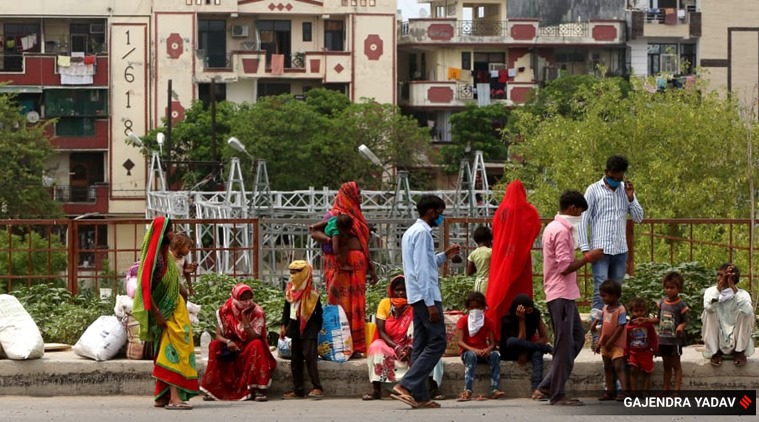
For the past two months, all media is abuzz with images of the suffering of migrant workers… There was no public outcry over this human tragedy and the victims themselves chose to mostly suffer in silence.

Will there be a George Floyd moment in India’s public life? Surely, it is not merely about outrage over an act of injustice. It is about comprehending the urgency of aligning with the victim; it is about realising systemic bias against the marginalised; it is about crossing the threshold of “we” and “them”. Above all, it is a moment of citizen initiative. Of late, India seems to have lost that urge to consistently relate to injustice as an assault on democracy.

For the past two months, all media is abuzz with images of the suffering of migrant workers. Two things about this suffering have been striking. There was no public outcry over this human tragedy and the victims themselves chose to mostly suffer in silence. They may have grumbled, or cursed under their breath, but our democracy does not seem to have encouraged them to really assert or demand their rights. Not just migrants, minorities too have been subjected to the untold misery of being excluded from the idea of the public. And more routinely, women, rural poor, Dalits and Adivasis have been objects of humiliation.

This begs the question: How does India’s democracy afford to victimise large sections and manage to ensure that victims will remain docile? This docility of India’s democracy needs to become a subject of introspection and examination. Three sets of answers can be imagined — answers that are generic about democracy; answers that are historical about the nature of the Indian state and answers that take us to the contemporary moment.

The practice of democracy has the notorious tendency to become paradoxical. It begins in the name of the “demos” but goes on to construct the demos rather narrowly; oftentimes, sections of the population manage to ensconce themselves as “the people”, they count as the public, their ideas masquerade as the people’s ideas. This inevitably produces a layered citizenry. Democracy also starts off by investing agency in the individuals but sooner or later divests them of that agency as interference by the ignorant. Democracy inspires ideas of rights but allows the taming of rights for purposes of order. In short, it is these tensions between the elite and the masses, between active citizens and obedient citizens, between rights and order, that mark the life of democracies. This is not merely about the distance between theory and practice, between concept and its concrete life. It is about imagining that the course of democracy is predetermined. Democratic politics needs to be carved out with effort, rather than believing that adopting formal democracy automatically ensures vibrant democratic practice.

The approach of the Indian state to citizen participation has always been based on arrogance. It is also informed by overemphasis on the rhetoric of law and order. The former leads the state to believe that citizens are not, and should not be, active agents. This means that citizens must wait for leaders to mobilise them and guide and supervise their actions. Similarly, citizens must depend on the largesse of the state in deciding what is good for them. This gives rise to the syndrome of government as caretaker/parent and leaders as political chaperons. The Indian state also privileges the idea of law and order. If a parental state negates the idea that people have agency, the emphasis on law and order legitimises that negation. Thus, the discourse of rights and individual dignity becomes permissible only if it is subservient to the statist idea of “order”.

Legislative imagination, judicial interpretation and public perception are all stacked against the idea of the citizen as protestor. In contrast to the legacy of the freedom movement, democracy and popular participation are seen, both theoretically and legally, as inconsistent with, and often even opposed to, an orderly society. Whether it be the AK Gopalan case (1950) or the many legal monuments against individual liberty such as the currently infamous UAPA, the emphasis has been twofold: That the state knows, the state is right, the state must be privileged, and that citizen action is suspect, potentially disruptive and liable to punishment.

It is in the backdrop of this subdued rights discourse and de-legitimised agency of the people that the current moment has unfolded wherein criticism is almost seditious, claiming rights for marginalised sections can be termed as waging war against the state and empathising with victims of social injustice is ridiculed or forbidden. The current regime has converted the penchant for sub-democratic state action into a fearsome art.

Since we are discussing this in the month of June, one cannot but forget the somewhat amateurish takeover of the entire state apparatus by the government in 1975. A much more concerted and systematic mechanism of silencing citizens is underway today. But it is not the repressive aspect of the state apparatus unleashed on protesting citizens that adequately answers why citizens choose to remain quiet in moments of acute injustice to “someone else”.

This might appear ironic, but in spite of a comparatively higher degree of repression, the lack of popular protest is more because of the success of the regime in constructing and popularising a narrative that not just delegitimises but simply denies the existence of suffering, injustice and victimhood. This is the narrative of subverting reality into its opposite.

In this world of alternative reality, the victim is the offender (as in case of Muslims), suffering is sacrifice if not ill-informed exaggeration (as in the case of migrants’ plight) and marginalisation or exclusion are outcomes of past politics (as in the case of Dalits or Adivasis). This narrative posits two contrasting social camps. One is the nation. It represents unity, progress and a possible millennium. All else is fragmentary and divisive. So any voice speaking of a particular group’s suffering becomes a hurdle in the march of the nation; any coalition of the marginalised by definition assumes an anti-national tenor.

Such is the power of the narrative that the facts of suffering, humiliation or injustice lose their evocative potential; they cease to scandalise, they are unable to evoke a moral response. Democracy can thus afford the co-existence of multiple injustices and a quiet citizenry when such narratives are able to reconstruct facts and convince the masses of the validity of that reconstruction. The silence today is a result of the popular acceptance of reconstructed reality and adherence to an alternative morality.

When US president Donald Trump says that George Floyd “is looking down” and saying (decline in unemployment) “is a great thing… happening to our country”, he represents the subversion of the fate of Floyd, he is rewriting the grammar of democracy. Not the killing of Floyd but the small decline of unemployment is the significant fact of the moment; Floyd would not be angry at his murderer, he would be angry at the economy; what needs to be fixed therefore, is not institutional bias against a community but the dishonour caused by the protests.

A careful reading of this response should tell us that India is truly living in its own Floyd moment.

The writer, based in Pune, taught political science and is currently chief editor of Studies in Indian Politics

📣 The Indian Express is now on Telegram. Click here to join our channel (@indianexpress) and stay updated with the latest headlines

For all the latest Opinion News, download Indian Express App.

Source link

Public Opinion On Taking Down Confederate Monuments Hasn’t Budged In The Last Three Years

0

Americans disapprove of flying the Confederate flag, but remain opposed to removing monuments and changing the names of buildings that honor the Confederacy, a new HuffPost/YouGov poll finds. Views on the issue have remained largely unmoved in recent years, a contrast to shifting opinions recently seen on some issues regarding racism and policing.

The anti-racism protests mounting across the U.S. in past weeks have also spurred a new wave of efforts to uproot tributes to the Confederacy. In Virginia, which houses a lion’s share of such monuments, Gov. Ralph Northam (D) has pledged to take down a statute of Robert E. Lee “as soon as possible,” and the mayor of Richmond has introduced a resolution to remove additional statues. The Marine Corps has barred its troops from displaying the Confederate battle flag, saying the symbol “presents a threat to our core values, unit cohesion, security and good order and discipline”; NASCAR also announced it would ban the flag from events. The Army has signaled an openness to renaming bases named for Confederate generals, which President Donald Trump opposes.

“The symbols help sustain racist policies and racist policies help sustain the symbols … To take down those statues is to make a statement about how a community’s values are changing.” James Grossman, the executive director of the American Historical Association, told HuffPost’s Travis Waldron.  

Americans say, 51% to 34%, that they disapprove of displaying the Confederate flag in public places. 

Just one-third, however, say they favor removing statues and memorials of Confederate leaders, with 49% opposed and the rest unsure. There’s an identical divide on changing the names of streets, schools and public buildings named after Confederate leaders.

A 57% majority of Black Americans, but just 28% of whites, favor removing Confederate statues and memorials. A 52% majority of Black Americans strongly favor such a move, while just 19% of white Americans say the same.

A 54% majority of Democrats favor removal, compared to 17% of Republicans. Republicans are considerably more likely to express strong opposition than Democrats are to register strong support.


Polling on Confederate symbols has proved to be especially sensitive to the way survey questions are framed. In the summer of 2017, support polls placed support for keeping Confederate memorials at anywhere from 62% (when asked as a choice between letting statues “remain as a historical symbol” and removing them “because they are offensive to some people”) to just 26% (when the choice was between keeping monuments on government property or relocating them “to museums or other historic sites where they can be viewed in proper historical context.”) 

But comparing back to a 2017 HuffPost/YouGov poll, which posed the same set of questions, the new survey finds that opinions have not significantly changed in the intervening years. Then, support for taking down Confederate monuments also stood at just 33% in the aftermath of a violent white nationalist rally in Charlottesville, Virginia, which opposed efforts to remove a statue of Confederate Gen. Robert E. Lee.


Chart showing the results of a new HuffPost/YouGov survey on Confederate symbols.

Opinions on the Confederate flag did shift considerably in 2015, following the murder of nine black churchgoers by a white supremacist in Charleston, South Carolina. Prior to the shooting, Americans said by a 10-point margin that the flag was a “symbol of Southern pride” rather than one of racism; three months later, they said by a 6-point margin that it was a symbol of racism. That wave of condemnation, however, appeared to ebb. In the most recent survey, Americans call the flag a racist symbol by only a 3-point margin.

The HuffPost/YouGov poll consisted of 1,000 completed interviews conducted June 4-6 among U.S. adults, using a sample selected from YouGov’s opt-in online panel to match the demographics and other characteristics of the adult U.S. population.

HuffPost has teamed up with YouGov to conduct daily opinion polls. You can learn more about this project and take part in YouGov’s nationally representative opinion polling. More details on the polls’ methodology are available here.

Most surveys report a margin of error that represents some but not all potential survey errors. YouGov’s reports include a model-based margin of error, which rests on a specific set of statistical assumptions about the selected sample rather than the standard methodology for random probability sampling. If these assumptions are wrong, the model-based margin of error may also be inaccurate.


Source link

Nurturing South Africa’s future professionals – The Mail & Guardian

0

SPONSORED

The Professional Provident Society (PPS) Foundation demonstrated the power of nurturing the potential of the next wave of economically empowered young professionals in its 2019 annual report, its second since inception in 2016. In particular, this addressed the National Development Plan (NDP) 2030 goal to improve the quality of education, skills development and innovation that will ultimately enable future professionals to realise their full potential.

The outcomes of the Foundation’s strategic focus were achieved by contributing and improving access to tertiary education through funding of bursaries and refurbishment of learning facilities, but by also addressing the social issues of tertiary students beyond the lecture room. These included tackling food insecurities within the student community, the enhancement of learning and experiences for students, and empowerment of young talent on the cusp of entering the job market after graduation through the LEAP (Learned, Engaged, Accelerated, Professionals) work-readiness programme.

In 2019, the PPS Foundation achieved its target of funding 60 students across various universities and institutes of technology through its bursary programme.

“The selection of candidates who are awarded the bursary was based on their history of academic excellence and merit, with the group comprising students pursuing qualifications from an eclectic mix of faculties and specialised fields. Most of the beneficiaries who receive comprehensive funding were those in STEM-related fields that complement the national agenda and socioeconomic context of South Africa,” says Masenyane Molefe, Executive Trustee of the PPS Foundation.

For the first time, through stringent financial planning, the PPS Foundation was able to wipe out the historical debt of eight beneficiaries who were burdened by outstanding fees that predated their PPS Foundation bursaries, thus allowing them to fully focus on their studies.

During the year, the PPS Foundation also supported public universities and universities of technology with work-study programmes and other development initiatives in a bid to address the challenges that impact teaching and learning experiences.

“The PPS Foundation’s effort to improve access to quality tertiary education has grown from strength to strength over the past three years. Our greatest obligation is to continue creating and maintaining the partnerships that enable our work to be done successfully in educating South Africa’s future professionals. Since the inception of the foundation, over 250 students have benefited from the bursary programme and 12 institutions and organisations have benefited from the university support programme, and we can only hope to do more in years to come,” says Molefe.

Looking beyond the funding initiative, every student needs to be fully prepared to face the reality of work in order to become a South African business leader. In 2019, 25 graduates who were placed in various positions within businesses successfully completed their tenure as part of the 12-month long Graduate Internship Development Programme. The programme was a priceless opportunity for the selected graduates to be embedded in a professional working environment and acclimate to the expectations of the world beyond their university walls.

Preparing for the world of work

More than 1 000 students from various academic institutions have been provided with skills and tools through the LEAP work-readiness programme. The programme is extremely useful for students entering the job market, because it raises awareness about the importance of personal branding through self-reflection. Students who completed the programme were able to master their first job interviews due to skills gained in communication and presentation skills, CV and interview preparation, understanding what their strengths and weaknesses are and, most importantly, what their career motives are. 

Engaging closely with the student community and academic institutions, the PPS Foundation saw the need for more than financial aid for studies and the refurbishment of learning facilities. In partnership with non-profit company Rise Against Hunger Africa, the Foundation spearheaded a food drive to fight food insecurity on campuses across the country. This entailed packaging over 100 000 nutritious meals for thousands of underprivileged students as part of the Employee Volunteerism and University Support Programme.

In 2019, PPS Insurance (PPS) partnered with the Thabo Mbeki African Leadership Institute in an effort to nurture future leaders using the Africanised concept of leadership. About 60 young leaders were part of this insightful programme and were encouraged to continue to solve problems in their communities.

PPS is a significant contributor to the PPS Foundation, which is a public benefit organisation that relies on attracting and broadening its base of donors; it is proud to also be a beneficiary of the MySchool MyVillage MyPlanet Programme.  “We encourage members and beneficiaries of the Foundation’s programme to pass the baton of excellence and empowerment to those who have followed in the trail they blazed,” concludes Molefe.

Commenting on the PPS Foundation’s performance, Izak Smit, Chief Executive Officer of PPS, says: “We are inspired by the achievements of the PPS Foundation over the past three years. As a company that embraces the ethos of mutuality, we do not have shareholders; we have members from across the spectrum of professions and economic sectors.  We care about the professional community. We care about the positive impact that this special community can make on the world around us. We also care about the future of this community, and we’re adding to our ranks new talented members who are beneficiaries of PPS Foundation’s efforts.”

About PPS

PPS boasts in excess of 150 000 members who enjoy access to a comprehensive suite of financial and healthcare products that are specifically tailored to meet the needs of graduate professionals.

PPS is the largest South African company of its kind, exclusively for graduate professionals, that embraces an ethos of mutuality, which means that it exists solely for the benefit of its members. Thus, PPS members with qualifying products from PPS Insurance, PPS Investments and Profmed share in the profits of PPS Insurance, PPS Investments and PPS Healthcare Administrators via annual allocations to the unique PPS Profit-Share Account.

PPS membership provides access to the following tried, tested and trusted products and services: PPS Life Insurance, PPS Short-Term Insurance, PPS Financial Advisory, PPS Investments and Profmed Medical Scheme. PPS is an authorised financial service provider.

Visit www.pps.co.za for more information.


Source link

Rohingya Boat Off Thailand Has Been at Sea Four Months: Malaysian Official

0

A boat carrying hundreds of Rohingya that has been at sea four months is currently off southern Thailand and has been blocked from entering Malaysia’s waters multiple times, a senior Malaysian maritime official said Wednesday.

The Rohingya on board the boat have been supplied with food and fuel by syndicates from Thailand and Myanmar, the chief of the Malaysian Maritime Enforcement Agency (MMEA) told BenarNews, an RFA-affiliated online news service.

“The boat carrying about 300 people is in Koh Adang island (waters). We believe that the vessel departed from Cox’s Bazar in February together with the one that successfully landed,” said Mohd Zubil Mat Som, the MMEA director-general, referring to a boat towed ashore at Langkawi, an island in northern Malaysia, on Monday.

The second vessel “made many attempts to enter Malaysian waters previously but failed because it was detected by our patrols,” he said.

A Thai naval official denied that any Rohingya boats were present in Thai waters in the Andaman Sea off Koh Adang, an island near the border with Malaysia.

“Based on ship and helicopter patrolling, I don’t see any reports that we spotted (Rohingya boats). We saw none,” a Navy officer told BenarNews on condition of anonymity because he was not authorized to talk to media directly.

Malaysian officials, for their part, have insisted that no unauthorized boats would be allowed to enter Malaysian territory. The boat that reached Langkawi was brought to shore only after dozens of its passengers jumped overboard and began swimming toward the island. Officials later reported that the boat’s engine had been “sabotaged.”

70 percent cannot walk

The Malaysian coast guard chief confirmed that both Rohingya boats had sailed from Cox’s Bazar, a district in southeastern Bangladesh where close to 1 million Rohingya refugees from nearby Rakhine state in Myanmar have been sheltering at sprawling refugee camps.

“The syndicates provided food and gas for the vessels. No vessel can last in the sea for four months without aid,” Mohd Zubil said.

Authorities have begun screening the 269 Rohingya who were on board the boat that landed on June 8, including for the coronavirus, the MMEA head said.

He noted that 70 percent of them could not walk properly because they had been sitting and squatting for months aboard the boat.

On Wednesday, officials with the U.N.’s refugee agency said they were still trying to access the 269 Rohingya who have been held at a detention center on Langkawi since Monday.

“At this early stage, UNHCR has no first-hand information about the group, and is therefore unable to confirm their origin or provide information about their situation,” a spokesperson in Kuala Lumpur for the U.N. agency said in response to questions from BenarNews.

“UNHCR has sought immediate access to this group of arrivals in order to assess their protection needs and has offered to support, together with its partners, the Government of Malaysia by providing immediate humanitarian assistance and protection services in line with international standards,” the official said.

The U.N. also commended Malaysia for its “positive humanitarian action” through allowing the boat to land at Langkawi – the first time in more than two months that Malaysian authorities permitted a boatload of Rohingya refugees to enter territorial waters after the country sealed its borders to guard against the further spread of COVID-19.

“Allowing for the timely and safe disembarkation of refugees and asylum-seekers is a critical and life-saving act, consistent with international norms for the protection of asylum-seekers and persons at risk at sea including the principle of non-refoulement,” UNHCR said.

‘Malaysia should send the Rohingyas to Myanmar’

A day earlier, Malaysian Defense Minister Ismail Sabri Yaacob said that Malaysia would send the boat’s passengers back to Bangladesh if it was determined that their trip began in Cox’s Bazar.

In Dhaka, Bangladeshi Foreign Minister A.K. Abdul Momen said that his government would not take in the Rohingya who came ashore in Malaysia.

“Rohingyas are the citizens of Myanmar and Malaysia should send the Rohingyas to Myanmar instead of Bangladesh. Otherwise, they (Malaysia) can keep Rohingyas in their own country,” the foreign minister told BenarNews. Rohingya are members of a stateless minority group in Myanmar.

Meanwhile in Bangkok, human rights advocacy group Fortify Rights called on Asian countries to allow Rohingya boats to land.

“Countries in the region should urgently allow Rohingya refugees and trafficking survivors to disembark. Rohingya people are genocide survivors and need protection, not to be left to die at sea,” Putthanee Kangkun, a researcher with the group, told BenarNews on Wednesday.

The refugees from the boat should not be detained indefinitely, she said.

“We know there are more boats at sea,” she added, citing information passed on by a colleague in Bangladesh.

“We know from previous interviews from two other recent boats that Rohingya died at sea, and conditions are awful on the boats. For example deprivation of food and water,” she said.

In mid-April hundreds of Rohingya men, women and children were said to be “starving” when they were brought ashore in Cox’s Bazar after a failed attempt to reach Malaysia by sea, with witnesses saying that Malaysian authorities had turned away their boat.

During the sea crossing dozens of passengers died and their bodies were thrown overboard, people who survived the journey said.

Reported by BenarNews, an RFA-affiliated online news service.


Source link

Indian Hotels’ Q4 consolidated profit before tax drops 69% to Rs 58.1 crore

0


Tata group arm Indian Company (IHCL) on Wednesday reported a consolidated profit before tax (PBT) and exceptional items of Rs 58.1 crore for the March quarter.


This is drop of 69.3 per cent year-on-year. Its consolidated net profit at Rs 76.29 crore was down 37.75 per cent. It posted a net profit (PAT) of Rs 122.56 crore for the corresponding period of the previous fiscal.


The profit would have been lower but for the jump in exceptional items including profit on sale of land, change in fair value of derivative contracts, etc.


Source link

‘The last thing we need right now’: States, cities hemorrhage jobs

0

“These layoffs are happening as we speak,” Murphy said. “It’s not theoretical.”

Many of these municipal and state layoffs are disproportionately affecting black Americans, adding pressure on Congress to act as protests over racism and police brutality roil the country. The public sector employs a higher proportion of black workers than other U.S. industries do, and its decline explains in part Friday’s jobs report, which showed that while the unemployment rate declined overall, it continued to tick upward for black workers.

“African Americans tend to have those kinds of jobs that are the service jobs where they’re going into work and risking their lives every single day, and then going back home and risking their families’ lives,” said Lee Saunders, president of the American Federation of State, County and Municipal Employees union. The government “has historically been one of the most dependable employers of African Americans.”

“So those who are getting laid off disproportionately are African American, and they’re going to be hurt the most.”

Congress allocated $150 billion to state and local governments under the CARES Act in March, but officials were restricted in how they could spend it, permitted to use it only for coronavirus-related costs rather than to cover budget shortfalls due to a loss of tax and fee revenue. The National Governors Association, composed of both Democrats and Republicans, has for two months now been calling for an additional $500 billion in flexible aid and for a loosening of restrictions on the CARES Act funding, but lawmakers have yet to act.

House Democrats set aside at least $915 billion in state and local aid in the HEROES Act they passed in mid-May, only for Senate Majority Leader Mitch McConnell to dismiss it as a “laundry list of pet priorities.” More recently, McConnell told Fox News his chamber “may later do more” to help states by allocating aid but that he wants to wait and see how things are looking after more of them begin to open up. Some conservative lawmakers have made clear they have no interest in providing further aid, arguing that would simply reward primarily Democratic-led states that have, in their minds, mismanaged their budgets.

“We’re just seeing so much incompetence in blue state management, it’s going to be hard to make the case to any Republican that for some reason people in Utah should pay for Bill de Blasio’s incompetence,” said Stephen Moore, a conservative economist and outside adviser to the White House, referring to the mayor of New York City. He advocated instead for states to quickly reopen their doors so they can start collecting tax revenue.

In the meantime, negotiations on the Hill are essentially at a standstill.

“There’s no serious conversation happening,” Sen. Chris Van Hollen (D-Md.), who serves on the Appropriations Committee, said of state and local aid. “There should be, but Senate Republicans are slow-walking this process.”

“Maybe they’re trying to figure out what they want,” he added. “There doesn’t seem to be any consensus.”

Governors and mayors are urging Congress not to delay sending aid that is sorely needed. “The timeline is now,” said Teryn Zmuda, chief economist at the National Association of Counties.

Should layoffs continue on their current trajectory, they could lead to a dramatic cutback of essential services at a time when they are in greater demand than ever.

“You will see disaster occur if in fact there are continued layoffs in the public sector,” Saunders said, listing health, education and sanitation services as some that will see major cutbacks without additional aid.

And in many cases, the populations benefiting from those services are communities of color that the pandemic has already hit hardest.

Source link

Cambodia’s Top Rights Body Wants Tariff-Free EU Trade, But Won’t Budge on Political Reforms

0

Cambodia’s top human rights body said Wednesday that the country does not want to lose preferential trade status in the European Union but is unable to comply with the bloc’s requirements on rights reforms to retain those privileges, citing its status as a sovereign nation.

The EU in mid-February announced plans to suspend tariff-free access to its market under the “Everything But Arms” (EBA) scheme for around one-fifth of Cambodia’s exports, citing rollbacks on human rights—a decision that would reinstate taxes on garments and footwear beginning Aug. 12, unless it is overturned by the bloc’s governments or its parliament.

The suspension, which Prime Minister Hun Sen has shrugged off and called an attack on Cambodia’s sovereignty, will result in a loss of around U.S. $1.1 billion of the country’s annual U.S. $5.8 billion in exports to the bloc, some 75 percent of which are made up of clothing and textiles.

On Wednesday, Cambodian Human Rights Committee Deputy President and Ministry of Justice spokesman Chhin Malin told RFA’s Khmer Service that Cambodia does not want to lose EBA status and that the government is “negotiating” with the bloc to ensure it maintains full EBA status.

However, he said that Cambodia cannot fully comply with EU’s requirements, especially those related to human rights and political issues.

“Cambodia will continue to cooperate with the EU Commission to resolve the EBA issue,” he said.

“Cambodia will continue to maintain its position of implementing the law and maintain its sovereignty and will not exchange them for aid.”

Chhin Malin said that “different people have different assessments” on human rights issues in Cambodia based on their political preferences, suggesting that his government would not bow to demands over how the country should be run.

He did not provide any details on negotiations or how Cambodia might expect to sway the EU on its decision to withdraw EBA status without instituting reforms.

While the coronavirus outbreak has thrown production for Cambodia’s key garment industry into disarray, factories and workers have endured a significant economic hit amid a decline in orders from buyers in the EU anticipating a return to tariffs on some Cambodian imports when trade status is withdrawn.

Government to blame

Ath Thon, president of the Cambodian Labour Confederation, told RFA that if the government of Cambodia had positively responded the EU Commission’s recommendations during an earlier assessment period, they would not be in danger of losing trade preferences on 20 percent of its exports.

He acknowledged that Cambodia had improved some issues—such as the rights of workers, the indigenous population, and land ownership—but crucial requirements, including the status of political rights, remain unchanged.

“As a union, we want the government to resolve all of the issues recommended by the EU,” he said.

Among the reforms the EU has called for is the reinstatement of the opposition Cambodia National Rescue Party (CNRP), which the Supreme Court banned in November 2017 for its role in an alleged plot to topple the government.

The move to ban the CNRP was part of a wider crackdown by Hun Sen on the political opposition, NGOs, and the independent media that paved the way for his ruling Cambodian People’s Party (CPP) to win all 125 seats in parliament in the country’s July 2018 general election.

Am Sam Ath of the Cambodia-based human rights group Licadho told RFA that there had been little improvement of human rights or political rights since the EU announced its decision in February.

He expressed concern that if the situation in Cambodia continues to deteriorate, the country will lose EBA status on all of its exports to the EU.

“The EU has [announced plans to] partially withdraw the EBA because of the CNRP dissolution and persecution,” he said.

“Currently, we have observed that arrests have resumed. I am concerned that the EU will remove full EBA status if the government does not restore democracy and respect for human rights.”

Since the beginning of the year, nearly 20 CNRP opposition officials or activists have been arrested and thrown in prison—most without arrest warrants.

During the same period, 17 former and active CNRP officials and supporters have been the victims of assault by unidentified men, and police have yet to make any arrests in the cases.

Call for postponement

Chhin Malin’s comments came after the Garment Manufacturers Association in Cambodia (GMAC) issued an open letter to the EU Commission and other European stakeholders last week calling for a one-year postponement to the EBA withdrawal, citing the economic impact of the coronavirus pandemic that has infected 126 people in Cambodia since March, according to official statistics.

GMAC said that some 250 companies making apparel, footwear, and travel goods have been forced to suspend operations because of the outbreak, while others are operating at reduced capacity, leading to layoffs for around 130,000 workers—most of whom are women.

While there was a significant drop off in orders in the first quarter of 2020, the manufacturer’s association said that it expects a decline in sales for the three industries to fall by 50 to 60 percent, year over year, in the second quarter, putting “hundreds of thousands” at risk of job loss and “millions” under the threat of a return to poverty.

Furthermore, it warned, a return of tariffs would encourage buyers to turn their business to other producers in the region that still benefit from the EBA scheme, while undermining improvements in labor rights and working conditions Cambodia has achieved in partnership with stakeholders such as the International Labour Organization.

China trade deal

Cambodia could find some relief from any burden that comes with withdrawal of EBA status if it inks a free trade agreement with China, which the Chinese Embassy in Phnom Penh said in a Tuesday statement posted on its Facebook page had reached a third round of negotiations.

“The trade deal agreement to be signed between Cambodia and China will be implemented according to a consensus of the two countries’ leaders and will promote the joint destiny of Phnom Penh and Beijing,” the statement said, without providing further details.

No date has been set for the finalization and signing of the agreement, which is expected to come “later this year.”

Cambodia’s Ministry of Commerce also issued a statement Tuesday detailing a teleconference between Minister Pan Sorasak and Yang Zhengwei, deputy director-general of the Department of International Trade and Economic Affairs under China’s commerce ministry.

“Negotiations focused on opening markets for products, services, investment, and economic cooperation, while boosting imports from Cambodia and attracting more investment,” the statement said, adding that the agreement is expected to boost trade between the two countries well beyond the average growth rate of 20 percent over the past three years.

Commerce ministry spokesman Seang Thai confirmed that no schedule has been set to sign the deal, adding that the two sides are “negotiating to reduce taxes for certain products.”

News of the negotiations came on the same day that Cambodia’s Ministry of Agriculture announced it had signed an agreement with China to export mangoes, which Hun Sen said in a statement posted to his Facebook account is “a good sign for farmers and investors concerned over reduced demand and low prices.”

Agricultural expert Yang Saing Koma told RFA that Cambodia’s government should be wary of signing any deals with China, particularly ones that he warned could negatively impact small and medium Cambodian enterprises and the agricultural sector.

“I welcome free trade, but we must be prudent,” he said, recommending that Cambodia ensure any such deal be “balanced.”

“We must also maintain local capacity to compete in the free market.”

Trade between Cambodia and China has steadily increased from U.S. $5.16 billion in 2016 to just over U.S. $6 billion in 2017 and U.S. $7.4 billion in 2018, according to government figures. The two countries aim to reach U.S. $10 billion in bilateral trade annually by 2023.

Reported by RFA’s Khmer Service. Translated by Samean Yun. Written in English by Joshua Lipes.


Source link

NASCAR bans Confederate flag from its races

0

“The presence of the confederate flag at NASCAR events runs contrary to our commitment to providing a welcoming and inclusive environment for all fans, our competitors and our industry,” NASCAR said. “Bringing people together around a love for racing and the community that it creates is what makes our fans and sport special. The display of the confederate flag will be prohibited from all NASCAR events and properties.”

The move was announced before Wednesday night’s race at Martinsville Speedway where Wallace, an Alabama native, was driving a Chevrolet with a #BlackLivesMatter paint scheme. Wallace got a shoutout on Twitter from several athletes, including NBA star LeBron James, for using the paint scheme in the race.

The flag issue has been a thorny one for NASCAR. Former chairman Brian France in 2015 tried to ban the flying of Confederate flags at race tracks, angering many fans.

NASCAR did not address how it would enforce the policy or indicate any penalties for fans who violate it by bringing the Confederate flag to the track. NASCAR has not raced with fans since the sport resumed last month amid the pandemic and was expected to have minimal fans allowed at races this month in Florida and Georgia.

Confederate flags still fly high atop infield RVs and are waved by fans in the grandstands at most tracks. NASCAR has been more open in recent times to the eradication of the Confederate flag. Several drivers — including two-time Daytona 500 champion Denny Hamlin — said they supported Wallace in his quest to rid the sport of the flag.

The predominantly white field of drivers united over the weekend for a video promoting social change. A black NASCAR official, Kirk Price, took a knee before Sunday’s race near Atlanta in what may have been a first for the series. Wallace wore a black T-shirt with the words “I Can’t Breathe” at the race.

Source link

George Floyd: Complicated life, notorious death

In the Houston housing projects where he grew up, George Floyd was respected as a man who spoke from hard, but hardly extraordinary, experience. He had nothing remotely like the stature he has gained in death. (June 10)


Source link