Smart lockdowns imposed in two districts of Hazara

0

ABBOTTABAD  – In pursuance of the government’s policy of imposing smart lockdowns, Deputy Commissioner Abbottabad Mughees Sanaullah on Tuesday imposed lockdowns in six union councils (UCs) of Abbottabad.

According to the notification issued by the DC office, the six UCs of Abbottabad are Qalandarabad, Jhangi Seydan, Kehal, Narian, Nathiagali and PMA Road. Besides that Gosht Mandi, another area severely hit by the coronavirus, was also put under the lockdown.

In a video message, the DC said that the above-mentioned areas had reported a large number of COVID-19 cases and suspected individuals and the number of infected people had crossed the set threshold. He further said that in order to prevent the further spread of coronavirus, these areas would be under lockdown for one week.

“Essential services and supplies like pharmacy, ration, patients for medical aid are exceptions to the order,” the DC added.

Similarly, district administration Haripur also imposed smart lockdowns in four UCs to prevent the spread of COVID-19, including in TIP Housing Society, Street No.9 and 20, Mohallah Soha, Mochi Bazaar, Mamahia Chowk, Pakhral Chowk, Sector No.2 and 4 Khalabat.


Source link

Tunisia still has much to do to eliminate racism

Jun 17, 2020

TUNIS — In an interview with Tunisian Attessia TV on June 7, Tunisian black artist Salah Misbah accused prominent Tunisian artist Lotfi Bouchnak of racism, saying, “On one occasion when the Ministry of Culture honored us, Bouchnak rejected this on the pretext of me being a ‘wasif’ (servant),” referring to his dark skin.

A photo published by the company Nana Tunisie on June 9 caused much controversy on Facebook because it showed the face of a white woman whose face was painted various skin colors. Activists believe this photo is a type of racism in which blackface is used — blackface is considered deeply offensive.

Comments and reactions were mostly negative. Nana Tunisie deleted the photo and published a post June 12, stressing that it is committed to rejecting racism. The company said it supports all Tunisian women and attached a post with pictures of women of different skin colors.

Speaking on racist practices in Tunisia, Yamina Thabet, president of the nongovernmental organization Tunisian Association for the Support of Minorities, told Al-Monitor that African and dark-skinned Tunisian students suffer racism every day through words or other painful behavior. She said one of the most important problems is that people face racism with silence or denial, making it even more difficult to eliminate.

Thabet said African students have difficulties renting houses and in many other aspects of their daily lives, and she called for better, long-term education to eliminate racist tendencies.

Tunisia is only the second African country, after South Africa, to issue a law criminalizing racial discrimination; it was ratified by the Cabinet on Oct. 9, 2018, and includes 11 chapters.

According to Chapter 8 of this law, the perpetrator of the violation or crime is subject to imprisonment for a period ranging from one month to three years, and the fine ranges from 500 dinars ($185) to 3,000 dinars ($1,110). Also, institutions and associations that commit these crimes can be subject to a fine ranging from 5,000 dinars ($1,190) to 15,000 dinars ($3,350).

For his part, Masoud al-Ramadani, former head of the Tunisian Forum for Economic and Social Rights, an independent nongovernmental organization that aims to defend economic and social rights at the national and international levels, told Al-Monitor that many still use abusive words against black people in Tunisia such as “kahlouch” (blackie), noting that some cab drivers refuse to pick up dark-skinned passengers and some stores will not serve dark-skinned people. Some Tunisian families still reject mixed-race relations.

Ziad Rouen, the general coordinator of Mnemty, an association active in the fight against racism, told Al-Monitor that racism is still rooted in the daily practices of some Tunisians. Rouen said the state has not addressed cultural and social problems, as people of color seem absent from the cultural scene and are completely absent from the societal and general fabric of the country and from decision-making centers.

Rouen called on the state to thoroughly address the issue of racism by raising public awareness among Tunisians on the necessity to combat this phenomenon, adding that public awareness must begin at childhood.

Noteworthy is that there is only one female black parliament member, Jamila Ksiksi, in Tunisia’s Assembly of the Representatives of the People. Ksiksi — at the beginning of the current parliamentary period on Dec. 4, 2019 — was subject to a racist online campaign by activists supporting the Free Destourian Party following an argument in the assembly between Ksiksi and the head of that party’s bloc, Abeer Moussa, because of her skin color.

Another flagrant aspect of racism in Tunisia is the allocation of separate buses to transport black people in the Kasba area and Sidi Makhlouf from the southern governorate of Medenine in order to avoid the daily quarrels and differences between black and white people there.

Discrimination does not end there, as separate cemeteries are allocated to black people on the southern Tunisian island of Djerba, located on neglected land and known as the slave cemetery. Meanwhile, light-skinned people have two cemeteries in two different locations, with no regard to the ill treatment and discrimination suffered by Africans in Tunisia.

Mehdi Mabrouk, a specialist in sociology and former minister of culture, told Al-Monitor that Tunisia was one of the first countries to abolish slavery and the slave trade in 1846 (before France did in 1848 and the United States in 1865). Mabrouk said there is no discrimination on the ethnic level or skin color in the Tunisian Constitution, adding, “We must work more on the social level to avoid these problems in some of these behaviors that especially emerge when it comes to [mixed] marriage.”

Article 21 of the Tunisian Constitution states that “all citizens, male and female, have equal rights and duties, and are equal before the law without any discrimination.”


Source link

HSBC to push ahead with 35,000 job cuts; UK inflation eases for fourth month – business live

0

Good morning, and welcome to our live coverage of business, economics and financial markets.

Headline news this morning: HSBC will push ahead with 35,000 job cuts, Reuters reports, after getting hold of a memo. The bank is resuming a massive redundancy programme it had put on ice after the Covid-19 outbreak.

The bank will also maintain a freeze on nearly all recruitment from outside, chief executive Noel Quinn said in the memo, which was sent to 235,000 staff worldwide. (Reuters said a spokeswoman confirmed the contents of the memo.)


We could not pause the job losses indefinitely – it was always a question of ‘not if, but when’.

UK consumer price inflation eased for the fourth month in a row in May and came in at an annual rate of 0.5%, as expected, according to the Office for National Statistics. That’s the lowest inflation rate since June 2016 and compares with April’s reading of 0.8%.

Inflation has fallen as the coronavirus pandemic forced the government to impose a nationwide lockdown in late March and caused oil prices to tumble. Economists said this will no doubt add to the debate over whether the Bank of England might at some point be persuaded to take Bank rate below zero.

Office for National Statistics (ONS)
(@ONS)

The consumer price inflation including owner occupiers’ costs (CPIH) 12-month rate was 0.7% in May, down from 0.9% in April 2020 https://t.co/77sI2VzPV3 pic.twitter.com/UHupTM9uxN


June 17, 2020

Stock markets are expected to open flat after yesterday’s rally. In Asia, Japan’s Nikkei dropped 0.56%, Hong Kong’s Hang Seng rose 0.2% while the Shanghai market has lost 0.18%. Beijing shut all schools again and cancelled flights after a spike in new Covid-19 cases, fuelling fears of a second wave.

The UK’s FTSE 100 finished 2.9% higher at 6,242 points yesterday, and on Wall Street the S&P 500 gained 1.89% while the Dow Jones industrial average climbed 2.04%.

Stocks were boosted by reports of a draft $1tn infrastructure spending plan from the Trump administration, targeted mainly at roads and bridges, and news of a 17.7% surge in US retail sales in May after the Covid-19 lockdown was eased.

The stock market rally came despite another cautious message from Federal Reserve chairman Jerome Powell, who warned of a “long road” to recovery that will leave the US economy “well short of” where it was in February for some time.

Stocks came off their highs when Powell, in his semi-annual testimony to the Senate, also said that the Fed’s corporate bond-buying programme could be tapered if the market function improves. On Monday, it was announced the Fed would start to buy individual corporate bonds.

James Knightley, chief international economist at ING, says:


Recent data flow has offered hope of a more vigorous economic rebound than we initially thought possible. The Fed remains wary though, with a renewed wave of infections arguing for caution. As such, Powell again emphasised policy will remain ultra-loose with the potential that they could have to do more to ensure the recovery continues.

He again tries to provide a reality check to the optimism in risk markets, such as equities, which are seemingly seeing only good things ahead. He warned of the risk of insolvencies, particularly in the small business sector and suggested that “until the public is confident that the disease is contained, a full recovery is unlikely”. Given a vaccine appears some way off and fears over a pick-up in Covid-19 cases in several states, he is clearly sitting on the more cautious side of the fence.

The Agenda

  • 10am BST: Eurozone inflation for May (final reading)
  • 1:30pm BST: US Housing starts and building permits
  • 5pm BST: US Fed chair Jerome Powell testifies to House Financial Services Committee


Source link

ECR Group displays its support for #HongKong with an exchange of views with pro-democracy activists

0

Ahead of this week’s debate and votes on the European Parliament’s Resolution on the People’s Republic of China’s national security law for Hong Kong, the ECR has invited Wong Yik Mo, member of the pro-democracy political party Demosisto and Benedict Rogers, co-founder and Chair of Hong Kong Watch and human rights activist, to remotely take part in the Group Meeting today (17 June) and to exchange views with MEPs.

Both initiators of the exchange of views, Swedish MEP Charlie Weimers, member of the Foreign Affairs Committee, and Polish MEP Anna Fotyga, ECR Foreign Affairs Coordinator, expressed the Group’s serious concerns about the unilateral introduction of national security legislation as representing a grave assault on Hong Kong’s autonomy, rule of law, and fundamental freedoms.

Ahead of the meeting, MEP Charlie Weimers said: “The meeting will serve as a useful interaction and moment of engagement to shed light on the troubling developments from Hong Kong, and China’s continued and deliberate attempts to renege on its agreement of ‘one country, two systems’.

“China has reneged on its agreement of ‘one country, two systems’. The EU must stand for the right of the Hong Kong people to self-determination and self-governance, and as long as the pressure exerted on Hong Kong’s institutions remain EU-China relations will suffer. Europe must never kow-tow to the Chinese Communist Party.”

MEP Anna Fotyga added: “Hong Kong’s success was built on its freedoms. The ECR is deeply concerned by Beijing’s plan to impose national security legislation on Hong Kong, which is in direct conflict with Article 23 of Hong Kong’s Basic Law and China’s international obligations under the Joint Declaration, a treaty agreed by the UK and China and registered with the United Nations. That’s why we stood firmly behind the people of Hong Kong.

“I welcome the joint text of the Parliament’s Resolution we were able to successfully negotiate on Friday. Its adoption will send a clear message as to what the EU should stand for – international law and the people of Hong Kong.”

Source by [author_name]

Brazil Reports Big Surge In Coronavirus Infections

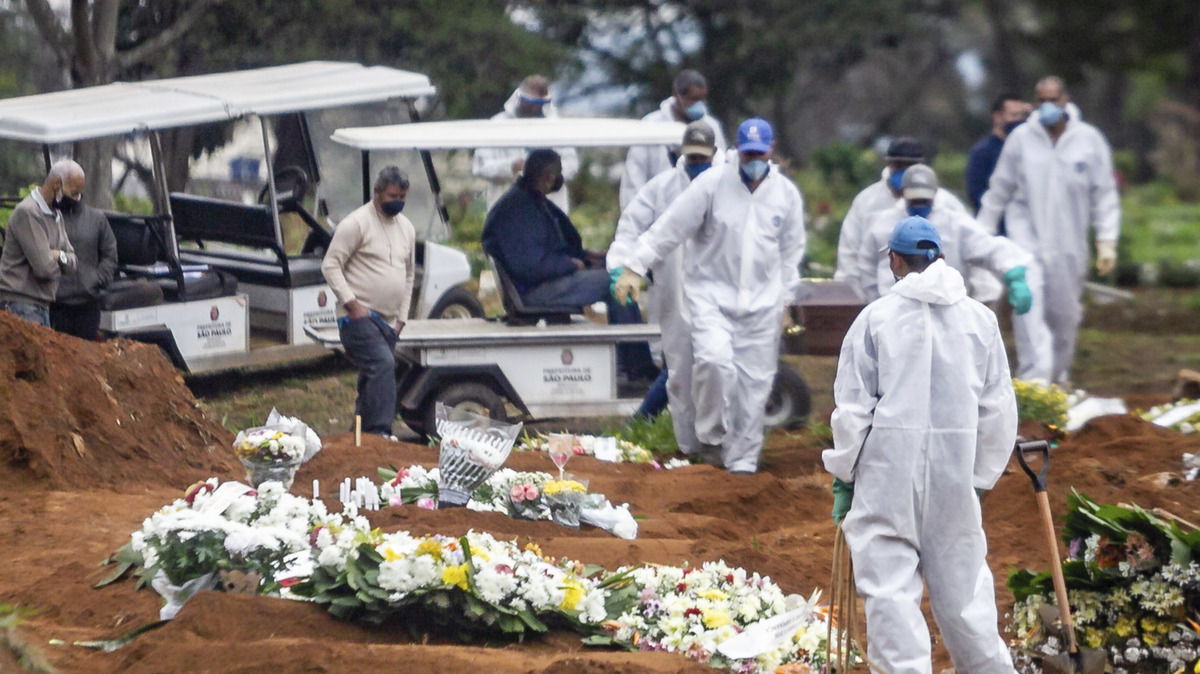
Several COVID-19 burials are performed in the Vila Formosa Cemetery on the east side of São Paulo, Brazil, on Sunday. Brazil, which reported a large spike in cases on Monday, now ranks second after the U.S. for total infections and deaths.

Fotoarena/Sipa USA via AP


hide caption

toggle caption

Fotoarena/Sipa USA via AP

Several COVID-19 burials are performed in the Vila Formosa Cemetery on the east side of São Paulo, Brazil, on Sunday. Brazil, which reported a large spike in cases on Monday, now ranks second after the U.S. for total infections and deaths.

Fotoarena/Sipa USA via AP

Brazil on Tuesday reported a national record of nearly 35,000 new coronavirus cases in a 24-hour period, even as the government has insisted that the outbreak is under control.

The health ministry added 34,918 new cases, but Brazilian media, in collaboration with state health departments, said the figure was probably undercounted by a few thousand. The ministry also announced 1,282 additional COVID-19 deaths, bringing the total to more than 45,000 since the pandemic began.

In the number of confirmed cases and deaths attributed to the disease, Brazil now ranks second only to the U.S.

Meanwhile, Walter Braga Netto, a top Brazilian government official dealing with the response to the outbreak, said Tuesday: “There is a crisis, we sympathize with bereaved families, but it is managed.”

Netto’s statement is in line with President Jair Bolsonaro’s consistent efforts to downplay the danger posed by the disease. The right-wing Bolsonaro, who has called the new coronavirus “a little flu” and campaigned against shutdowns, has been widely accused of endangering the public.

He has said that the economic costs of remaining in lockdown outweigh the risk to public health.

In April, Bolsonaro fired then-Health Minister Luiz Henrique Mandetta over the official’s support of broad isolation measures recommended by the World Health Organization and international medical experts.

Most of the infections in Brazil have been concentrated in the heavily populated states of São Paulo and Rio de Janeiro and in the northeast.

Despite the uptick in cases, Brazil’s towns and cities, urged on by Bolsonaro, have been gradually re-opening for business.

NPR’s Philip Reeves contributed to this report.

Source link

There’s a hidden crisis threatening lives alongside Covid-19: the lack of routine treatment | Frances Ryan

Hannah can’t stop vomiting. The 22-year-old has Ehlers-Danlos syndromes, a complex disability that means she has intestinal failure and uses a feeding tube – and now has a blockage in her bowel. Surgery is her only option, but she’s been told she’ll have to wait eight months to have it because the NHS is focused on the coronavirus pandemic. Hannah has already been on the surgery waiting list for nine months and her condition is worsening: she’s in severe pain and is vomiting most days as she increasingly can’t keep food down.

Hannah doesn’t blame her doctors. “If you had two fires and one consumed a detached house, and the other was rampaging through a packed terrace, and you had limited resources, what would you choose?” she says. But she is “extremely disillusioned” with the government for leaving patients like her stranded during the pandemic.

If Hannah doesn’t have the surgery soon, she tells me, her bowel could rupture. “I fear that many people in my position will die due to a shortfall in care.”

This is Britain’s second public health emergency: the crisis that is quietly threatening lives alongside coronavirus. The government has spent recent weeks boasting that they have managed to protect the NHS during the pandemic, but what they’ve really done is shut it down. Almost two-thirds of Britons with common life-threatening conditions have been denied care by the NHS because hospitals have focused on fighting Covid-19. That’s people with breathing problems, high blood pressure and cancer.

Tens of thousands of non-urgent surgeries have been cancelled in recent months to free up space for coronavirus patients, while many diagnostic tests and outpatient appointments are on hold. Screening services for cancer have been formally paused in Scotland, Wales and Northern Ireland and are de facto suspended in England. NHS leaders say the waiting list for hospital treatment in England could soar to almost 10 million people by Christmas due to the huge backlog caused by coronavirus disrupting services. That’s double the current figure.

This comes on top of patients who have voluntarily stayed away; there was such concern about empty A&E wards during the height of lockdown that the government set up a campaign in April to encourage people with suspected strokes and heart attacks to still seek help.

The long-term consequences of reduced healthcare during the pandemic are reminiscent of an unexploded bomb, slowly waiting to go off. Greater health problems are being stored for the future, as individuals watch their chronic conditions worsen. In the worst cases, their lives are at risk. Doctors have warned of the likelihood of a “dramatic rise” in bowel cancer cases in Britain in the wake of the coronavirus outbreak. The effective halt to screening in March is predicted to lead to thousands of people dying early from the disease. One man with cancer told the Guardian last week that he is now “fighting for his life” because the pandemic meant he had to wait months for a scan. Sherwin Hall now has a tumour measuring 14cm in his pelvis and 30 small tumours in his lungs. He is 27.

The NHS was always in a deeply difficult situation. Many of the cancellations in recent months were intended to stop patients catching coronavirus by coming into hospitals. Staff had to be freed to help tackle the pandemic. The need for social distancing as well as shortages in PPE have also added further problems to the pile. But after years of being starved of funding, the NHS was in a precarious position to begin with. NHS England was short of about 40,000 nurses even before staff were spread thinner to cope with coronavirus; many patients were already waiting up to a year for treatment. Tackling a pandemic after a decade of cuts was the equivalent of being asked to fight with one hand behind its back.

This is a crisis for people who have become sick during the pandemic but also for those who had health problems before. Overall barely one in five of those who regularly receive NHS help for a long-term health condition were able to have a planned treatment in April. Meanwhile, new ONS research into shielding this week shows two in five report being unable to access certain types of care – such as tests and scans – while 10% are unable to access any care at all. It is the worst of ironies: the rightful rush to protect people from coronavirus has simply put their health at risk in another way.

A few days ago, Hannah got a call from the treatment decision team: her case has been “escalated for consideration”. If it is reclassified, she will get her surgery sooner. If not, she stays on the eight-month waiting list. “The pain is unbearable,” she says. “And the only thing that will stop it is the operation.”

• Frances Ryan is a Guardian columnist

Source link

Gulshan Devaiah on Sushant Singh Rajput’s demise, says Bollywood is an imaginary name for a place of work : Bollywood News – Bollywood Hungama

0

Sushant Singh Rajput’s demise is both a shock and a wake-up call for the entire industry. The actor’s sudden tragic death has left people from the industry questioning where they went wrong. While everybody has been mourning his death, it’s difficult for people to accept the news. A lot of actors have also opened up about their battles with mental health issues and there are also some who are calling out Bollywood for its nasty hierarchy.

Taking to his Twitter, Gulshan Devaiah, who was seen in movies like Ram-Leela and Shaitaan, said, “Really sorry to be doing this but Bollywood is not a family , it never was and never will be . If one thinks it’s a family .. there is the problem. Bollywood is an imaginary name for a place of work  that’s it . I am really not trying to put anybody down here & sorry if it seems”.

On hearing of Sushant’s demise’s news, Gulshan had tweeted, “As actors, somewhere deep down inside, we think we know why he did it & that’s why it (is) so disturbing, even if you didn’t know him at all. It’s a hard game to play and he played it very well but the game won in the end”.

Also Read: Koena Mitra calls out the nepotism in the industry after Sushant Singh Rajput’s suicide

BOLLYWOOD NEWS

Catch us for latest Bollywood News, Bollywood Movies update, Box office collection, New Movies Release & upcoming movies info only on Bollywood Hungama.

Loading…

Source link

Trump Gets Hit With Blunt Fact-Check Over AIDS Vaccine Falsehood

0

Twitter users let out a collective sigh of despair at President Donald Trump’s latest falsehood.

Trump claimed during a White House speech on police reform Tuesday that scientists have “come up with the AIDS vaccine.”

Medical professionals, celebrities, journalists, political commentators and others were quick to fact-check the president’s erroneous claim, reminding him there is currently no vaccine available to prevent people from contracting HIV, the virus that causes AIDS.

In response, many of Trump’s critics highlighted his appalling record of telling lies. The Washington Post notes that Trump, as of May 29, had made 19,127 false or misleading claims since his inauguration in January 2017.

“Too bad there isn’t a vaccine for serial liars,” one person responded to the president’s latest fabrication.

Added another: “Fortunately, there is a vaccine for protecting yourself from ignorant, unprepared, emotionally-stunted, racist presidents: Vote.”


Source by [author_name]

Book By Trump’s Niece To Reveal He ‘Derided’ Father’s Alzheimer’s Struggles

0

An upcoming book by President Donald Trump’s niece will detail his “appalling” treatment of his father, Fred Trump, during the years he battled Alzheimer’s disease. 

Mary Trump, a clinical psychologist and the president’s only niece, has remained largely silent during her uncle’s rise to the presidency. But her book, Too Much and Never Enough: How My Family Created the World’s Most Dangerous Man, is promising “unsparing detail” about the president and his relationship with his family when it’s released in this summer. 

A description posted online by publisher Simon & Schuster noted: 

“She explains how specific events and general family patterns created the damaged man who currently occupies the Oval Office, including the strange and harmful relationship between Fred Trump and his two oldest sons, Fred Jr. and Donald.”

Mary Trump will also detail “the appalling way Donald, Fred Trump’s favorite son, dismissed and derided him when he began to succumb to Alzheimer’s.”

Mary Trump is the daughter of Fred Trump Jr., the president’s brother, who battled alcoholism and died in 1981 at the age of 42. Her grandfather, Fred Trump, is the president’s father, who died in 1999 at the age of 93 after suffering from Alzheimer’s disease. His death triggered a bitter family legal battle over the will. 

Earlier this week, The Daily Beast reported that Mary Trump was the source of a New York Times report on the financial tricks the president used during the 1990s to help his parents duck millions in taxes, which also benefitted him financially. 

Trump is considering a lawsuit in an attempt to block the publication of the book, The Times reported.

“[Mary Trump] alone can recount this fascinating, unnerving saga, not just because of her insider’s perspective but also because she is the only Trump willing to tell the truth about one of the world’s most powerful and dysfunctional families,” the Simon & Schuster description stated. 

Too Much and Never Enough: How My Family Created the World’s Most Dangerous Man is set for release on July 28. 


Source link

Samsung Galaxy A21s with 5000 mAh battery launched: Price, specs, and more

0


South Korean electronics maker on Wednesday launched the Galaxy A21s in India. The smartphone will be available in black, white and blue colours, from June 17 at retail stores, Opera House, com and online e-commerce platforms. The Galaxy A21s comes in 4GB and 6GB RAM variants, both with 64GB internal storage, priced at Rs 16,499 and Rs 18,499, respectively.


Samsung Galaxy A21s specifications


The Galaxy A21s has a 6.5-inch screen of HD+ resolution, stretched in 20:9 aspect ratio. The screen has punch-hole on the top left corner, accommodating the phone’s 13-megapixel front camera. On the back, the phone has a quad-camera set-up, featuring a 48MP primary sensor, an 8MP ultra-wide sensor, a 2MP macro sensor and a 2MP depth sensor.


ALSO READ: Samsung launches Galaxy Tab S6 Lite in LTE and Wi-Fi variants: Price, specs


Powering the phone is a Exynos 850 system-on-chip, paired with up to 6GB RAM and 64GB internal storage. The dualSIM phone has a dedicated microSD card slot for storage expansion (up to 512GB). The phone ships with Android 10 operating system based OneUI 2.0 user interface. Powering the phone is a 5000 mAh battery and the phone comes with 15W fast charger.


The Galaxy A21s comes with Samsung Knox security platform. It supports face recognition and fingerprint sensor phone unlock mechanism. The Galaxy A21s comes with ‘Make for India’ Alive Intelligence feature – Useful Cards. This feature helps reduce clutter in the SMS Inbox and lets users find useful information quickly and easily.


Source link