NHS deal with Microsoft will ‘save hundreds of millions of pounds’

0

Members of clinical staff work at computers in the Accident and Emergency department of the ‘Royal Albert Edward Infirmary’ in Wigan, north west England (Oli Scarff/AFP/Getty Images)

A new deal with Microsoft to supply its digital tools to hospitals and medical services across England will save hundreds of millions of pounds, the NHS has said.

As many as 1.2 million staff across the NHS will gain access to the tech giant’s productivity and collaboration apps, in a move designed to ease the administrative burden on doctors and nurses.

The health service said the move will create a ‘truly joined-up NHS’, allowing various organisations within the system to work more seamlessly together.

Microsoft 365 includes its instant messaging and calling platform Microsoft Teams, which has already been used more widely by workers since the coronavirus pandemic began.

The deal between the tech firm, NHSX – the health service’s innovation arm – and NHS Digital ‘guarantees significant cost savings for both individual NHS organisations and the NHS as a whole’, the NHS said.

‘Adopting the most up-to-date digital tools and operating systems are crucial for a modern-day NHS – allowing staff to work as efficiently as possible, which will deliver even better care for patients,’ said Health Secretary Matt Hancock.

‘We have seen incredible, innovative uses of technology throughout the NHS during the Covid-19 pandemic and this new deal with Microsoft will pave the way for that to continue by ensuring we get the basics right.’

Microsoft is supplying the NHS with its Office 365 suite of productivity tools (Microsoft)

It follows an agreement in 2018 between the pair, when Microsoft provided greater protection from cyber attacks, in response to the WannaCry ransomware which crippled computer systems in several NHS trusts the previous year.

NHS organisations that have already made their own arrangements with Microsoft will benefit from the new contract.

‘Since Covid-19, the NHS has rapidly accelerated its adoption of digital tools to enable clinicians and support staff to perform their life-saving work more effectively,’ said Cindy Rose, chief executive of Microsoft UK.

‘This agreement ensures NHS organisations across England have access to modern productivity tools and solutions necessary to delivering better patient outcomes now and in the future.’


Source link

New Jim Carrey Art Warns Voters To Look For This Pre-Election Sign

0

Actor Jim Carrey warned with his latest politically charged cartoon how President Donald Trump could make history ahead of the 2020 election.

Carrey depicted Russian President Vladimir Putin with Air Force One in his hands. In the caption, the “Kidding” star urged voters to “be wary of diplomatic missions to Moscow” before November, suggesting Trump “may be the first American President to defect.”

Many of Carrey’s 18 million followers lapped up the new artwork, his latest in a very long line of artistic critiques of the Trump White House.


Source by [author_name]

Marcus Rashford speaks of experience with childhood poverty in bid for free school meals – video

Manchester United and England footballer Marcus Rashford has stepped up his campaign for the government to fund free meals for struggling children through the summer, a measure he says he had to rely on as a boy.

The 22-year-old has helped to raise million of pounds with charity FareShare UK to supply meals to families who are ‘existing on a knife’s edge’ and written an open letter to MPs to reconsider the decision to cancel the government’s food voucher scheme over the summer holidays.

Speaking on BBC Breakfast on Monday, Rashford said: ‘What families are going through now, I’ve once had to go through that and it’s very difficult to find a way out. It’s very important for me to help people who are struggling’

Source link

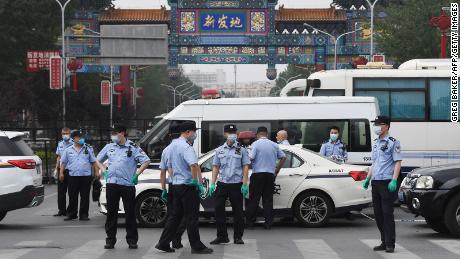
Beijing extends residential lockdowns as coronavirus infections spread

0

The Beijing Municipal Health Commission reported 27 fresh Covid-19 cases Tuesday — taking the five-day total to 106 following a flare-up at Xinfadi, the city’s largest wholesale food market.

The sprawling, bustling market in Beijing’s southwestern Fengtai district occupies 277 acres and has more than 2,000 stalls, selling mainly fruit and vegetables as well as meat and seafood. It supplies about 70% of the city’s vegetables and 10% of its pork, according to officials.

The market has been shut down since Saturday, but its sheer size and the amount of people who work or visit there from in and outside of Beijing have heightened the risk of the outbreak spreading.

Via door-to-door visits and calls, authorities have tracked down nearly 200,000 people who had been to the market during the two weeks prior to its closure. They have been told to stay at home for medical observation and are being tested for the coronavirus, a city official told a news conference on Monday.

Residential lockdown

Two other Beijing food markets have been shut down due to confirmed cases linked to Xinfadi, leading to strict residential lockdowns in their vicinity.

On Tuesday, Xicheng district — which neighbors Fengtai — announced that seven residential communities around the Tiantao Honglian market will be locked down following the discovery of a coronavirus case on Sunday.

This follows similar lockdowns on residential compounds near Xinfadi and the Yuquandong market in Haidian district. In total, 29 residential communities have been locked down across the city.

The residential lockdown measures are similar to the ones imposed earlier in the city of Wuhan, the original epicenter of the coronavirus outbreak.

Wang Du, who lives in one of the communities under lockdown near Yuquandong market, said residents couldn’t leave the compound to buy groceries, and had to order food online or buy from a truck that came to the compound once a day with potatoes, fresh vegetables and eggs.

She said all residents in her community had nucleic acid tests for the coronavirus yesterday.

“To be honest, I’m not too worried,” she said. “I think we have a lot of experience in containment measures, and we’re able to react very swiftly (to the new outbreak).”

As of Tuesday morning, 276 agricultural produce markets and 33,173 restaurants across the city had also been disinfected, officials said.

Outbound travel restricted

The outbreak has also spread beyond Beijing, with the nearby provinces of Liaoning and Hubei reporting a total of eight coronavirus cases linked to the capital clusters.

On Tuesday, Sichuan province in the country’s southwest also reported a confirmed case — a woman who returned from Beijing on June 9. She was infected while visiting her husband, who worked at Xinfadi market.

Unlike Wuhan, the epicenter of China’s original outbreak, Beijing has not completely cut off travel. However outbound taxi and car-hailing services, and some long-distance bus routes between Beijing and neighboring provinces have been suspended, according to the state-run Beijing Daily.

Municipal authorities also banned high-risk groups, such as close contacts of confirmed cases, from leaving the city, officials said Monday.

On Tuesday, Shanghai announced that travelers from areas with medium-to-high coronavirus risk would be required to be quarantined for 14 days. Beijing had one neighborhood designated as high-risk and 22 as medium-risk as of Monday.

CNN’s Steven Jiang and Shawn Deng contributed to reporting.

Source link

‘So True!’ Trump Mocked For Retweeting Himself, Then Agreeing With Himself

0

President Donald Trump fired off an unusual tweet on Monday, not only sharing a message from himself but also agreeing with it. 

“Silent majority” is a term that Trump ― like President Richard Nixon ― uses to characterize his supporters, suggesting they don’t show up in polls but will turn up at the ballot box. 

Trump’s message ― and his agreement with himself ― came after several polls showed him trailing former Vice President Joe Biden. Trump’s campaign even issued a cease-and-desist order to CNN over a poll that showed the president behind by 14 points.

CNN stood by its poll.   

Trump occasionally retweets himself, and at times adds a “so true” in self-agreement. But Monday evening’s message brought out the snark, with many of his critics adding “so true” statements of their own: 


Source link

Tribes become more involved in anti-terrorism operations in Sinai Peninsula

Jun 16, 2020

With the assistance of a large number of local tribal members fighting alongside the Egyptian army, Egyptian authorities have expanded their coordination with the tribes when confronting armed organizations in the Sinai Peninsula.

An agreement was reached in May among tribal elders and sovereign security agencies in which the elders would secure the return of tribal members who were involved with Wilayat Sinai, the Islamic State’s (IS) branch in Sinai, who would then be pardoned upon interrogation.

The Sinai Tribal Union, a group of tribesmen cooperating with Egyptian authorities on security operations in the northern Sinai Peninsula, announced June 7 that one of its members had been brutally murdered by Wilayat Sinai in southern Rafah two months after he was kidnapped.

The union had revealed in late May “the killing of two civilians from the Tarabin tribe during security operations in Sinai [as they fought] members of Wilayat Sinai.”

Adel al-Munaii, of the Sawarka tribe, told Al-Monitor over the phone that after Eid al-Fitr, tribal youths began assisting security services; this led to the escalation of IS attacks on residents of some villages known to cooperate with the army.

Munaii said the military campaign was led by tracking experts from the Sinai Tribal Union. He stressed that the goal of this campaign, whose operations are ongoing, is to besiege the organization’s members from the south and the north.

A local resident of Sheikh Zuweid told Al-Monitor on condition of anonymity that participants in this operation are from the Tarabin, Sawarka and Rumailat tribes, in addition to members of several separate families in Sheikh Zuweid and Rafah. The resident said the businessmen who founded the Sinai Tribal Union are funding the campaign and have provided tribes with weapons, vehicles and other necessary support.

Asked about the latest developments in Sinai, Munaii said armed forces operations have achieved a qualitative shift in controlling territory, limiting the movement of foreign elements into Sinai and targeting senior IS leaders. He said this hindered the armed organization’s ability to carry out major operations and forced them to resort to sniper attacks while kidnapping citizens or detonating explosive devices.

According to a tribal source who spoke to the Egyptian online newspaper Mada Masr on June 7, the cooperation included the aforementioned agreement between the leaders of these tribes and sovereign security agencies, according to which the tribes would hand their sons involved in the fighting alongside Wilayat Sinai over to the security services in return for their sons being granted amnesty.

The tribal source, who spoke to Mada Masr on condition of anonymity, said 23 members so far have surrendered to security services through mediation by tribal elders mainly from the Sawarka and Rumailat tribes; they were transferred to security headquarters outside Sinai for investigation. The security services had allowed them to see their families as a goodwill gesture, with promises of being released after several months, the source added.

Ahmed Kamel al-Buhairi, a researcher at Al-Ahram Center for Political and Strategic Studies, told Al-Monitor over the phone that cooperation with locals who are represented by tribes and clans is the most efficient way to undermine terrorism in border areas such as Sinai.

He said tribal elders are an important source of information, as they know the rugged, mountainous terrain well.

Buhairi, a specialist in terrorism affairs, said the qualitative shift in the relationship between tribes and the state of Egypt unfolded following the terrorist attack on Al-Rawda Mosque, as the state swiftly developed a plan to care for the local environment, provided a large number of job opportunities in the public sector to citizens and paid substantial compensation to those affected by the operations of the armed forces.

In November 2017, Wilayat Sinai carried out an armed attack in the village of Rawda in the northern Sinai Peninsula when its members stormed the village mosque during the Friday prayers and opened fire on worshippers, killing 311 and wounding 120 others.

Buhairi said the reason the relationship was tense between the tribes and the state is that “the measures taken by the state to establish security have hindered some commercial activities such as smuggling. Also, the residential areas in Sinai have turned into a stage for military operations, and this has affected their herding and cultivation activities, among other economic activities. Add to this that there is a history of a tense relationship between the two sides given the stereotyping promoted in the official media about the inhabitants of the Sinai over the past decades.

Asked about reports of the agreement between tribes and the Egyptian army to secure the return of tribal members affiliated with IS, Buhairi said the experience of reviews conducted by Islamic groups to revise their doctrines was one of the most successful methods in combating terrorism during the 1990s.

He said the state has the right to pardon a person based on a comprehensive assessment conducted by the competent authorities regarding their willingness to cooperate with the state and provide information. Also, he added, this depends on whether such members participated in previous operations.

About 20 years ago, Egypt’s imprisoned Gamaa Islamiya’s leaders issued a series of doctrinal reviews in which they gave up their old ideas and presented new visions, which eventually resulted in the gradual release of some of them.


Source link

Health Officials Worry Trump’s Tulsa Rally Will Pose COVID-19 Risks

0

President Trump is set to hold a campaign rally in Oklahoma on Saturday — the first since March when coronavirus restrictions put a stop to large gatherings. Is there a safe way to hold rallies now?


Source link

Stock Markets Jump Globally After Wall Street’s Rally: Live Updates

0

Global markets jump after Wall Street’s late surge.

Markets jumped around the world on Tuesday, one day after U.S. Federal Reserve said it would take steps to keep credit flowing.

European markets were up about 2 percent in morning trading after an even stronger rise in Asia, where stocks in Japan and South Korea ended roughly 5 percent higher. The good cheer spread to other financial markets, too, sending oil futures higher and hitting prices for U.S. Treasury bonds, which typically fall when investors are feeling optimistic.

The exuberance could flag a bit by the time U.S. stocks open, however. Futures markets were predicting the S&P 500 index would open 0.7 percent higher.

Markets were cheered after the U.S. central bank said on Monday that it would soon start to buy debt issued by individual companies in a new effort to keep credit flowing. The S&P 500 stock index, which had been lower before the Federal Reserve announced its plan, ended about 1 percent higher on Monday as a result.

Global stocks were also reacting to a Bloomberg News report that the Trump administration was considering more infrastructure spending.

Earlier on Monday, Wall Street and other global markets had been hit by signs that the authorities around the world are facing new coronavirus outbreaks, sending stocks seesawing since late last week.

May’s retail sales data is expected to show a rebound.

Economists expect data to show that retail sales rebounded in May, as thousands of stores and restaurants reopened after lockdowns were lifted and federal stimulus checks and tax refunds fueled a burst of spending.

But many of the stores and restaurants that welcomed back customers last month did so with fewer employees, reflecting a permanently altered retail landscape and an ominous sign for the economy as it tries to recover from the coronavirus pandemic.

Total sales, which include retail purchases in stores and online as well as money spent at bars and restaurants, will be released by the Commerce Department on Tuesday morning. The agency reported a 16.4 percent drop in April, the largest monthly decline on record, and an 8.3 percent decline in March.

Economists expect sales in May to have bounced back from a grim April, when retail sales were the lowest since 2012, driven by widespread business closures.

After more than a month of quarantine, May brought a tentative restart of brick-and-mortar retail across most of the country, with major chains like Macy’s and Gap reopening hundreds of stores. Some restaurants that had either closed or shifted their business to delivery and curbside pickup also reopened for in-person dining.

There was also stimulus money — totaling $1,200 per recipient — that will run out in the coming months, with no indications that Congress intends to pass another round of assistance.

No matter how fleeting, the rebound in May will be seen as a welcome boost, especially for small businesses.

Still, the monthly sales jump was off “a pretty low hurdle,” said Aneta Markowska, the chief financial economist for the investment bank Jefferies. The bigger question was the sustainability of any improvement, because consumer spending was bolstered from tax refunds and government stimulus efforts.

“By the time we get into July, those tax refunds will probably be largely spent, and then you’re back to, ‘Hey, what’s the underlying employment growth?’ because that’s going to have to be the key driver of spending going forward,” she said.

After being criticized for not doing enough to make passengers wear masks, the nation’s biggest airlines said on Monday that they would get tougher on people who refused to cover their faces.

Airlines for America, a trade association, said that its members would take masks more seriously, including by not letting people without face coverings get on planes. But many big airlines have said that before, and passengers concerned about their health have pointed out that enforcement on board has often been lax.

“U.S. airlines are very serious about requiring face coverings on their flights,” Nicholas Calio, the chief executive of Airlines for America, said in a statement. “Face coverings are one of several public health measures recommended by the C.D.C. as an important layer of protection for passengers and customer-facing employees.”

According to the association, all of four of the largest U.S. airlines — Southwest Airlines, American Airlines, Delta Air Lines and United Airlines — have agreed to communicate their mask policies to customers before flying, reiterate the requirements in onboard announcements and enforce them when customers refuse to comply. Southwest issued a separate statement saying that it would “deny boarding” to passengers that refused to comply with its face covering requirement.

United said that, starting Thursday, any passenger who openly disregarded its rules could face a temporary travel ban on future flights. The airline, like others, grants exceptions for those with a medical condition or disability that prevents them from wearing a mask, as well as those who cannot put on or remove a mask themselves and small children. Customers may remove their masks to eat and drink.

The airline association said each airline would establish its own punishment for passengers who refuse to comply, “up to and including suspension of flying privileges.”

Airlines have so far been reluctant to publicly establish clear consequences for failure to wear face coverings, and many passengers have chided the companies on social media with photos of planes filled with people not wearing masks and sitting close to each other.

24 Hour Fitness closes 100 gyms and files for bankruptcy protection.

The fitness chain 24 Hour Fitness filed for Chapter 11 bankruptcy protection on Monday, after the coronavirus pandemic forced its clubs to shut for nearly two months.

“Put simply, the Covid-19 pandemic upended the debtors’ operating model, leaving the debtors without a source of revenue to fund their operations,” the filing stated.

The national gym chain said in its bankruptcy filing that it had permanently closed 100 locations across 14 states. But the chain is expected to re-emerge: It has secured $250 million in funding to reopen some of its clubs, and expects a majority of its remaining 300 locations to be open by the end of June.

The pandemic has been particularly devastating to the gym industry. Also on Monday, Town Sports International said that it was considering bankruptcy because of revenue losses as a result of the shutdown. The company, which owns about 200 gyms including New York Sports Club and Boston Sports Club, said in a regulatory filing that the “scope and duration of the interruption to our operations has substantially reduced our cash flow.”

Catch up: Here’s what else is happening.

  • The Academy of Motion Picture Arts and Sciences said on Monday that it would push back the next Oscars ceremony to April 25 from Feb. 28, citing the coronavirus pandemic. The postponement, the fourth since the Academy Awards were introduced in 1929, could prompt the Golden Globes and other entertainment award shows to recalibrate.

Reporting was contributed by Mohammed Hadi, Niraj Chokshi, Sapna Maheshwari, Gillian Friedman, Carlos Tejada and Brooks Barnes.

Source link

What Does Pride Mean Now?

0

Later that same year, when I visited New York, I took an afternoon walk with no agenda and found myself standing in front of the Stonewall Inn. I remember looking up at the edifice, jaw agape. It was the early afternoon but the door was open, and when I looked inside, I don’t know what I’d expected but I hadn’t expected that. It just looked like any old dingy bar, though I was a certified goody-two-shoes and hadn’t been in many bars, dingy or otherwise. I realized I had to use the bathroom and asked the tired woman behind the bar if I could, and she said sure, and I sat down on the toilet thinking, I’m peeing in the Stonewall! Much in the same way I’d once thought, I’m peeing in Canada!, because for me the moment I urinate in a new place is the moment it becomes real.

Here, I thought, looking around me, is where it all changed, because I was still too young to understand that history is not simply made up of moments of triumph strung together like pearls. I didn’t know that large changes were made up of many small ones, and of moments of suffering and backsliding and incremental, selective progress; unnecessary sacrifices and the opportunistic, privileged and lucky walking forward over the vulnerable and the dead.

Years later, when I moved to Iowa City, I loved the way its Pride parade felt different from San Francisco’s, and yet just as lovely — the way every person could stand with arm’s length between them if they chose to, how it only lasted for 15 minutes or so, the fact that after it was over I could easily walk home through quiet, tree-lined streets. But in those years, I also learned that queerness does not protect you — not from domestic violence, not from racism or sexism or transphobia. I cowered before my abusive girlfriend; I smiled thinly at the people who did not believe me; I was groped by a gay man in a gay bar for no reason except he could; I watched as cisgender queers threw transgender folks under the bus for a chance at state-sanctioned marriage; I saw the machinations of racism in the queer community. I began to understand: Not only does queerness not protect you, it does not absolve you. You are not made better by your body, but what you choose to do with that body, and your life.

Much ink has been spilled on the topic of corporate endorsements during large Pride parades, the way that capitalism has sprawled itself over the day and co-opted Pride from its radical queer roots. There is a reason that the Philly Dyke March — held the Saturday before Pride — is my and my partner’s event of choice. Dyke marches, unlike Pride parades, are unsanctioned protests: no permits, just queer folks filling the streets and disrupting business as usual. Pride was a protest. Many people have said it, and they are right. It began as a police riot, violence against queer bodies, the bravery of activists like Sylvia Rivera and Marsha P. Johnson, and it has since lost its way. José Esteban Muñoz, a queer Latinx academic, called queerness “that thing that lets us feel that this world is not enough, that indeed something is missing.” If only the queer community’s most privileged citizens — white queers, cis queers — saw their queerness as the call to action it has always been.

I write this piece as my city, Philadelphia, and my country burns around me. People are protesting a society that does not value black lives, a government that lets one group of citizens murder another group of citizens with near-impunity, a nation that would rather cede its power to a white-supremacist police force than hold itself accountable. It feels important, somehow, that a pandemic abolished the old Pride — the one boasting corporate floats and swag and friendly police officers, the one with a schedule and a permit — and gave us a call to action: room to reimagine what it means to be queer, and to act accordingly.

Source link

Why Protest Movements Are ‘Civil’ Only in Retrospect

0

“There’s always going to be a group that attempts to demonize that which is being done — and for their own purposes, not because it’s right, good or just, but just because they want to foster a different position,” said Martin Luther King III, Dr. King’s oldest son. “Dad totally used the method of nonviolence, and he was consistently criticized.”

Bernice King, Dr. King’s daughter and chief executive of the King Center, said she believed the sanitized version of his work “reflects attempts to not only diminish my father’s courage and tenacity in speaking truth to power, but also reflects attempts to diminish the power of nonviolence.”

Whether they involve a rally, a raised fist or a bent knee, protests have always drawn a public backlash. In fact, the very tactics some point to as models now were considered too confrontational then — leading Dr. King, in his “Letter From a Birmingham Jail,” to denounce “the white moderate, who is more devoted to ‘order’ than to justice; who prefers a negative peace which is the absence of tension to a positive peace which is the presence of justice; who constantly says: ‘I agree with you in the goal you seek, but I cannot agree with your methods of direct action.’”

Carol Faulkner, a historian at Syracuse University, reeled off a list of brutal public responses to peaceful protests as far back as the 1830s, when a white mob tied a rope around the abolitionist William Lloyd Garrison’s waist and dragged him through the streets of Boston, and more than 10,000 people descended on a meeting site for abolitionists in Philadelphia and burned it to the ground.

Nineteenth-century women’s suffragists “went out of their way to present themselves as very middle-class, very respectable, and used the tools of respectable politics,” Dr. Faulkner added. But their message made them targets even when their tools were petitions and town-hall meetings, and those tools were not always effective.

In 1860, the suffragist Elizabeth Cady Stanton addressed the House Judiciary Committee for two hours, after which The New York Times reported, “She was earnest, and eloquent, and plausible, but she must have felt that she was not convincing her audience — and she did not.”

Source link