‘I Just Don’t Want to Die.’ Nursing Home Workers Face Risks in Facilities Devastated by Coronavirus

0

Days before she tested positive for COVID-19 in early April, Tanya Beckford was already worried about dying because of the conditions in the Connecticut nursing home where she has worked for 23 years. She wasn’t feeling well and says she and her co-workers, facing a shortage of masks, gloves and gowns, had started wearing plastic trash bags over their uniforms for protection as they cared for infected residents.

Beckford, a certified nursing assistant (CNA) in the Alzheimer’s unit at Newington Rapid Recovery Rehab Center in Newington, Connecticut, had been running a low-grade fever but says the facility was only sending workers home if their temperature reached 100.4 degrees Fahrenheit — per Centers for Disease Control and Prevention guidelines. In an effort to ensure there were enough staff to care for all the residents, Beckford says, employees had been told they were not allowed to take any more time off.

“I went to the administrator, like, ‘I am sick, and you guys are still keeping me in here, I don’t have the proper PPE (personal protective equipment) to work with now, and I just don’t want to die,’” says Beckford, 48. Days later, she tested positive for COVID-19.

The coronavirus pandemic has devastated nursing homes across the country. There have been more than 35,000 COVID-19 deaths in long-term care facilities, according to the Associated Press — a figure that accounts for about a third of the country’s coronavirus deaths. The industry has been sharply criticized by relatives of the dead, who’ve accused nursing homes of being slow to take action against the virus and of trying to dodge responsibility for their loved ones’ deaths. But nursing home employees, who face serious occupational hazards even in non-pandemic times, say they’re caught in an impossible situation and being blamed for problems rooted in America’s failed elder-care system.

Keep up to date with our daily coronavirus newsletter by clicking here.

They’re struggling to protect themselves and support their families on menial salaries while caring for a population that is among the most vulnerable to COVID-19. Nursing home employees who contract COVID-19 have been forced to use up their limited sick time or vacation time, go without pay, or lose their jobs entirely. Through it all, they have dealt with grief and despair as elderly residents to whom they’ve become emotionally attached become sick with COVID-19 and die.

Related Stories

“The worst thing that I get upset about is hearing the word hero, hero, hero being thrown around for us. And no one is treating us as such. We feel disrespected,” says Beckford, who has been on sick leave since April 10 and is still recovering from pneumonia caused by the virus. “I would love to see them give us the proper PPE that we need, give us some kind of compensation, and for goodness sake, I don’t have any more vacation or sick time now, and the year is just beginning. Give me back some kind of compensation and put back my time.”

Newington Rapid Recovery Rehab Center denies Beckford’s allegations, including that employees were forced to use trash bags for protection. “At no time has our staff been without appropriate PPE. The building has been properly staffed throughout the crisis,” it said in a statement, adding: “We have been strictly following the CDC protocol for health care workers.” When she recovers, Beckford plans to return to work there.

But recent lawsuits — brought by relatives of nursing home workers who died of COVID-19 and by former nursing home employees — are drawing attention to the conditions within some facilities that workers say put them and patients at unreasonably high risk.

Carlenia Milanes, a licensed practical nurse, spent weeks unwittingly caring for COVID-19 patients at Alaris Health at Hamilton Park in Jersey City, N.J., while the facility initially prohibited employees from wearing masks, according to a lawsuit filed April 22. The suit claims the nursing home hid coronavirus cases from employees, “refused to test patients and pressured staff to work even if they had symptoms of the highly contagious and deadly disease, all while patients and staff alike were dying of COVID-19.”

On April 3, Milanes sent an email to Jersey City officials sounding an alarm and saying the nursing home’s strategy “is to put blinders on even at the cost of human life.” “Something needs to be done or more people and staff get sick and possibly die,” Milanes wrote, according to the lawsuit. “I need your help.”

Milanes, 28, called in sick for the following day after developing symptoms of COVID-19, but her suit alleges that she was told she would be fired if she didn’t present a doctor’s note. In her lawsuit, Milanes also alleges the facility allowed seemingly healthy residents to share rooms with residents who had symptoms of COVID-19.

By May 27, there were 110 COVID-19 cases among the facility’s residents, including 31 deaths, and 42 COVID-19 cases among staff, including two deaths, according to data reported to the state. Milanes was among the affected staff members; the COVID-19 test she took on April 6 came positive.
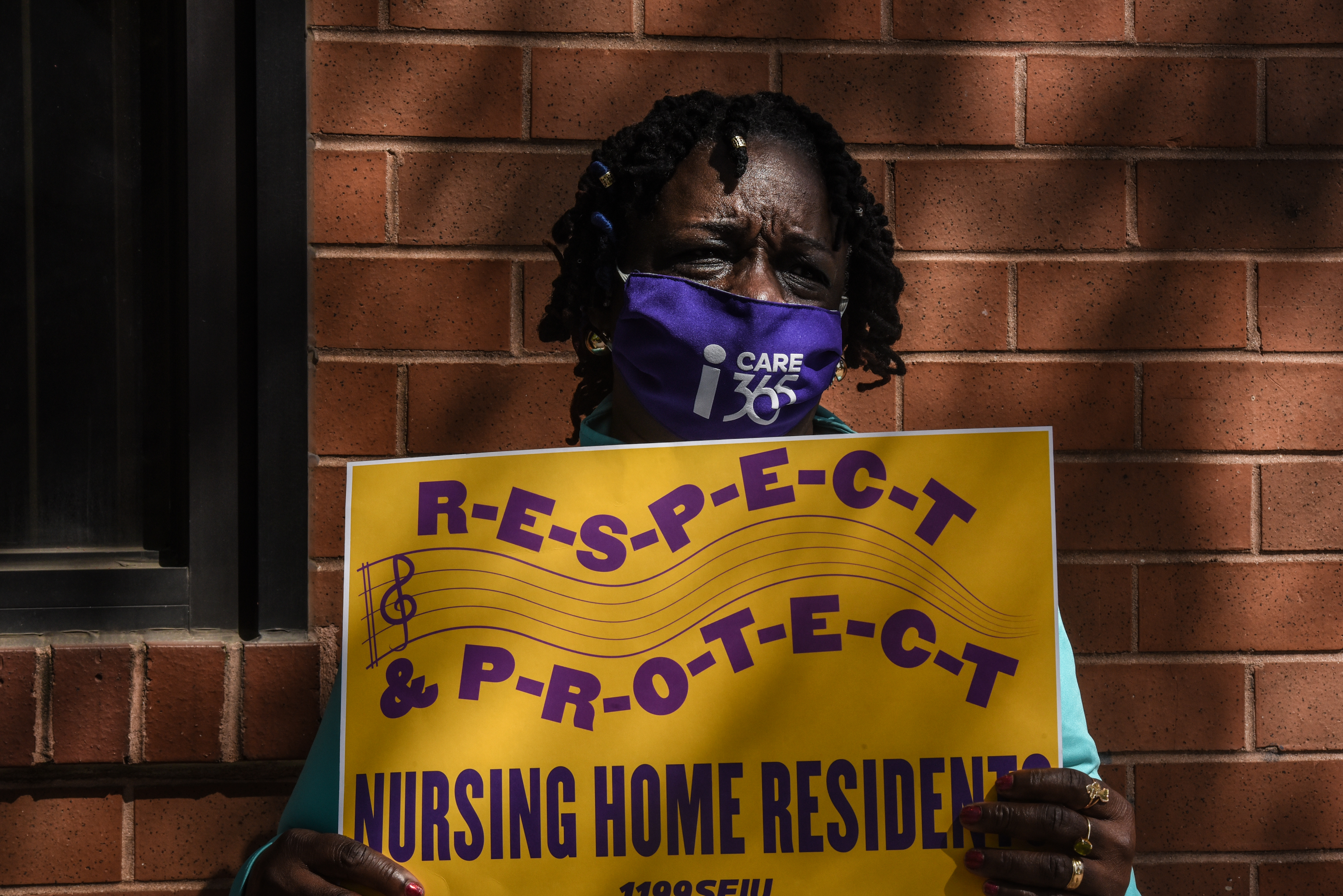
A nursing home worker participates in a vigil outside of a nursing home in Brooklyn, N.Y. on May 21, 2020. Workers say they need safer conditions to better protect nursing home residents and the people who care for them from the coronavirus.

A nursing home worker participates in a vigil outside of a nursing home in Brooklyn, N.Y. on May 21, 2020. Workers say they need safer conditions to better protect nursing home residents and the people who care for them from the coronavirus.

Stephanie Keith—Getty Images

“I’m not afraid to work. I would take care of anyone, but if I’m sick, how am I going to be any good for a patient?” says Milanes, a single mother whose 7- and 10-year-old daughters have since shown symptoms of COVID-19 as well. “I’m somebody’s mother. I’m somebody’s sister. I’m somebody’s daughter. And granted yes, this is what I signed up for, but protect me.”

LaDawn Chapman, a CNA at the same facility, also filed a lawsuit against Alaris on April 22 that echoes many of Milanes’ allegations, including that the facility lacked adequate protective gear for employees and did not notify employees about coronavirus cases. The lawsuit says Chapman was likely exposed to COVID-19 through a patient and multiple coworkers and had a doctor’s note advising her to self-isolate for two weeks. She was told that unless she had symptoms of the disease, she had to come to work, her lawsuit alleges.

Both women say they were fired, but Alaris Health denies this. Five days after the suits were filed, Alaris Health sent each woman a letter saying they were “mistaken” about being fired and setting dates that each was expected to return to work. In a statement, Alaris spokesperson Matt Stanton also denied the lawsuits’ other allegations.

“I can tell you that each and every allegation in this case is false,” he said. “No employees were terminated. At no time was information withheld from staff, our residents or their loves ones [sic]. Thankfully, adequate PPE has never been an issue at any of our facilities. In fact Alaris required N95 masks and PPE for all staff well before the (New Jersey Department of Health) and CDC mandates. Finally, no employees were ever pressured to work while sick. Staff showing COVID-19 symptoms were sent home and required to adhere to strict return to work protocols as published by the NJ DOH.”

In Texas, Maurice Dotson, a CNA at West Oaks Nursing and Rehabilitation Center in Austin, died on April 17 after contracting COVID-19. His mother sued the nursing home on May 13, accusing it of failing to provide staff with protective equipment and exposing workers and patients to “unreasonable risks of serious harm.” A spokesperson for West Oaks said Dotson “touched countless lives and was a respected and comforting presence,” but declined to comment on pending litigation.

Leaders in the long-term care industry have argued that nursing homes need more support and funding from state and federal governments. And the industry has sought immunity from potential lawsuits related to the pandemic, but the laws and executive orders granting them immunity from civil liability in some states, including New Jersey, might not protect them from all legal claims.

“While I understand that you can’t judge a nursing home that’s in the midst of a pandemic by the same standards you would on a regular day, it doesn’t give these nursing homes the license or the right to behave recklessly or engage in willful misconduct,” says Bill Matsikoudis, an attorney who is representing nursing home workers and residents in the lawsuits against Alaris Health at Hamilton Park.

‘It’s not getting better, it’s getting worse’

Infection control has long been a challenge in long-term care facilities, where hands-on care is a necessity, and the pandemic has exacerbated that problem. The U.S. Government Accountability Office, in a report released May 20, said that 82% of nursing homes surveyed from 2013 to 2017 were cited for infection prevention and control deficiencies.

Meanwhile, the median pay for nursing assistants was $29,640 last year — just above the national poverty level for a family of four, which is $26,200. By comparison, the median salary for a full-time worker last year was about $49,000, according to weekly earnings data from the Bureau of Labor Statistics. In part because of that low pay, many nursing home employees work second jobs, which increases their risk of contracting the virus and unwittingly carrying it to residents.

“If the aides were paid a living wage, they would not need to have multiple jobs,” says Joanne Spetz, director of the Health Workforce Research Center for Long-Term Care at the University of California, San Francisco. “That forces the workers to put themselves at more and more risk to support themselves, and that also puts their clients at risk and their residents at risk.”

And while staff shortages have long been an issue at nursing homes, the problem becomes worse when workers stay home sick. As their colleagues take on the extra work, the care and time they’re able to give patients suffers.

“A lot of nursing homes are worried,” says David Grabowski, a professor of health care policy at Harvard Medical school who focuses on long-term care. “Who steps in here? Maybe it’s the National Guard, maybe it’s contract nurses. But it’s not like these places have a big roster of folks ready to plug into these positions.” In New York City on May 20, Mayor Bill de Blasio announced that the city would provide staff to fill in for nursing home workers who contract COVID-19 and must stay home.

All of this suggests that the looming shortage of elder care workers in the U.S. is likely to worsen, now that the pandemic has laid bare many of the problems in the industry. “It’s a two-way street. We need to pay them a rate commensurate with all we’re asking of them and support them,” Grabowski says. “Otherwise they’re not going to be there to do this.”

The response to coronavirus outbreaks in nursing homes has varied by state. In Maryland— where nursing home residents and staff account for more than half the state’s coronavirus deaths — Gov. Larry Hogan required in early April that all nursing home workers wear masks at all times and then ordered testing of all residents and workers, whether they showed symptoms or not. In New York, Gov. Andrew Cuomo recently mandated twice-weekly COVID-19 testing of nursing home workers. But he also faced criticism from the nursing home industry and residents for originally directing long-term care facilities to accept back coronavirus patients released from the hospital. He walked back that policy on May 10 amid concerns that it would cause the virus to further spread within nursing homes.

On May 5, Illinois Rep. Jan Schakowsky and New Jersey Sen. Cory Booker introduced legislation that would require nursing homes to provide workers with training in how to avoid COVID-19 exposure, sufficient personal protective equipment, increased testing and at least two weeks of paid sick leave. Parts of the bill were incorporated into the new $3 trillion pandemic relief package that passed the House, but that legislation is unlikely to become law as it faces overwhelming Republican opposition in the Senate.

Following complaints about a lack of transparency within nursing homes, the Centers for Medicare and Medicaid Services is now requiring them to report coronavirus cases to the Centers for Disease Control and Prevention, as well as to residents and their families. The Occupational Safety and Health Administration (OSHA) — which has received at least 230 COVID-19 complaints related to nursing homes — released guidance on May 14 aimed at reducing workers’ exposure to the virus. It recommends that facilities encourage workers to stay home if they’re sick, develop a process for decontamination and reuse of protective gear, and train workers on how to protect themselves.

Debbie Berkowitz, program director for the worker safety and health program at the National Employment Law Project, says there needs to be stronger oversight at state and federal levels and that nursing homes should ramp up training of employees on treating COVID-19 and increase testing of workers and patients within their facilities. She says any solution will also hinge on staffers having enough protective equipment — a consistent obstacle for frontline workers.

“Mentally, physically, emotionally, you’re fighting a disease. And on top of that, we have to fight administrators to give us protective gear,” says Nicole Jefferson, a part-time CNA at Apple Rehab in Rocky Hill, Conn., who thinks of her 3-year-old and 14-year-old daughters each time she enters a COVID-19 room. “I don’t want to die. I don’t want my kids to die. What more can we do?”

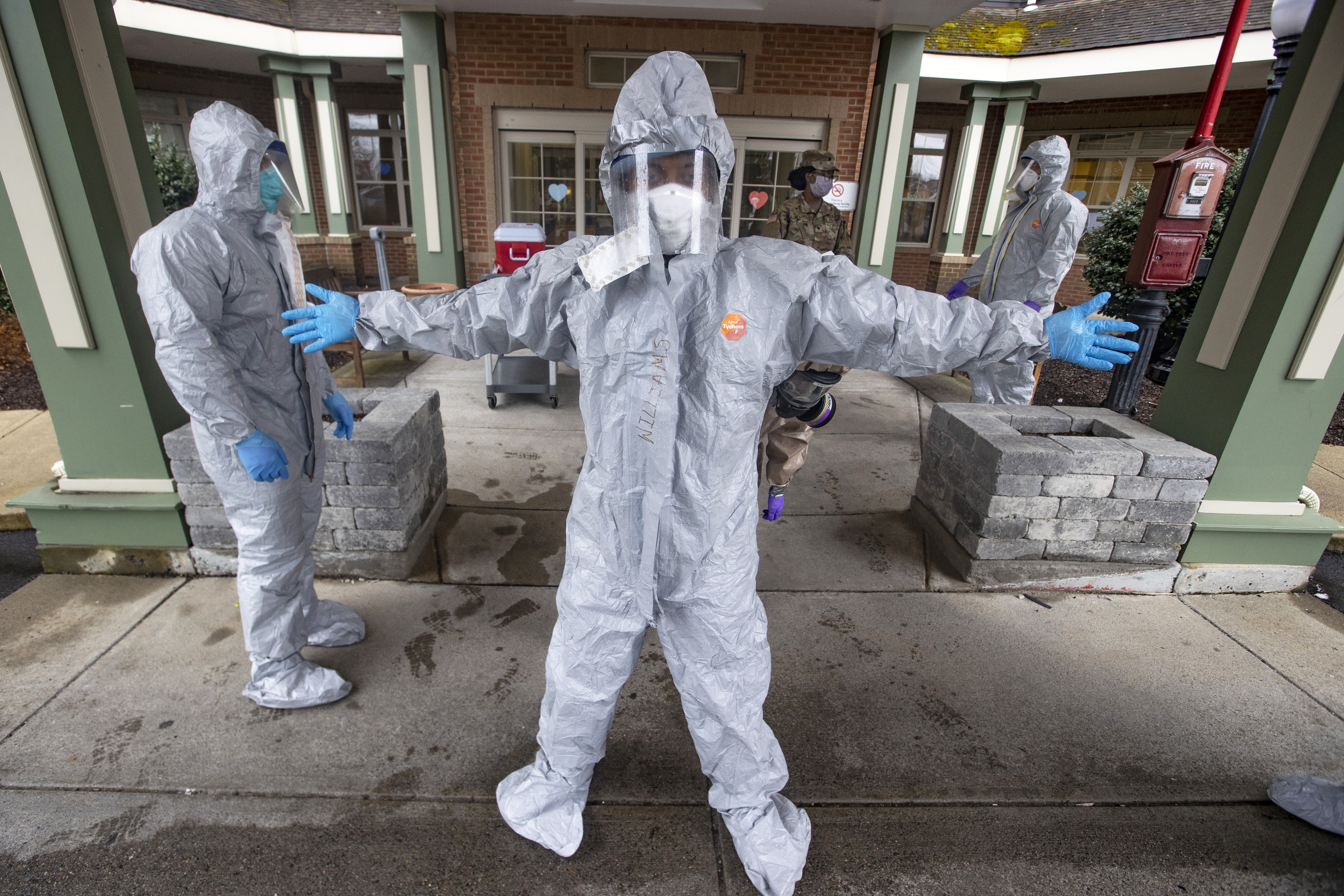
Members of the Massachusetts National Guard are sprayed down as they leave a nursing home and rehabilitation center in Quincy, Mass., on April 9, 2020. They were deployed to assist nursing homes with COVID-19 testing.

Members of the Massachusetts National Guard are sprayed down as they leave a nursing home and rehabilitation center in Quincy, Mass., on April 9, 2020. They were deployed to assist nursing homes with COVID-19 testing.

Boston Globe via Stan Grossfeld—The Boston Globe/Getty Images

An Apple Rehab administrator reached by phone said “we have plenty of protective gear,” but directed further questions to a spokesperson, who did not respond to a request for comment.

In Illinois, thousands of nursing home employees who are members of the SEIU Healthcare union had voted to strike on May 8, before reaching a last-minute deal on a new contract. It includes an increase in base pay to $15 an hour, an extension of $2 hazard pay and five additional paid sick days for coronavirus.

The new contract also guarantees that staffers won’t be required to work without adequate protective equipment. But Francine Rico, a CNA at the Villa at Windsor Park nursing home in Chicago who was on the bargaining committee, says workers still don’t have enough. Rico says she was given a raincoat to wear for protection and takes care of her N95 mask “like it’s gold.”

“How do they expect for this virus, this pandemic, to even lift if we’re still wearing the same PPE gear in and out of the rooms?” says Rico, 52. The nursing home has had 143 cases of coronavirus and 33 deaths as of May 23, according to data reported by the state.

In a statement, Villa at Windsor Park called its workers “heroic” and said the facility is screening staff for symptoms at the start and end of their shifts. “In as much as there has been a national shortage of PPE, Villa at Windsor Park has at all times had sufficient levels PPE, including those necessary for infection control and personal protection, to ensure that we meet the needs within the center,” the statement said.

Rico’s sister, Eartha Sears, is a CNA in the same facility and says she recently returned to work after using up all her sick time and vacation time while recovering from COVID-19. “I wish they’d [use] better judgment about safety — not just our safety, the residents’ safety as well,” says Sears, 56. “Because it’s not getting better, it’s getting worse.”

Meanwhile, employees are contending with the mental and emotional toll of continuing to work in places ravaged by illness, losing residents and coworkers they’ve known for years.

“They teach you when you’re in school as a CNA not to take any of this personally,” says Beckford. “But if you’re a human being with a heart, you’re going to feel something for the people that you’re working with for such a long time.”

Beckford graduated with a master’s degree in 2018, planning to transition into social work, but she stayed at the nursing home to continue caring for her oldest residents. “Unfortunately, once I return to work, the majority of my residents will not be there,” she says.

Milanes says many of the residents she cared for have died in the past two months. She says she recently received a job offer from a different nursing home, and she plans to start when she tests negative for COVID-19. But everything about the career she once loved has changed.

“Maybe I’m afraid because I cared about them, and I know that they’re all dead,” she says. “I’ve cried, I just don’t think that I’ve had time to really grieve.”

Write to Katie Reilly at Katie.Reilly@time.com.

Source link

Big chains filed for bankruptcy every week in May. Here are 6 of them

0

Retailers had already been struggling, and now they’re bearing the brunt of coronavirus’ impact. But a large gym brand and a major car rental company have also filed for bankruptcy recently.

A bankruptcy filing doesn’t necessarily mean a company will go out of business. Many use bankruptcy to shed debt and other liabilities while closing unprofitable operations, in hopes of emerging leaner and stronger. Lots of these companies have gone on to post record profits, including automaker General Motors (GM)and many of the nation’s airlines.

Still, many other brands that have filed for bankruptcy with the intention of staying in business didn’t survive. Here are some US-based companies that filed in May:

Gold’s Gym said in its May 5 fling that the virus has affected it “deeply and in many ways,” which includes the temporary closures of many of its 700 global gyms.

Filing for Chapter 11 bankruptcy protection will help it “emerge stronger and ready to grow,” the statement continued.

The 55-year-old company intends to exit bankruptcy by August and said it is “absolutely not going anywhere.” Gold’s did shutter 30 locations in April, but it doesn’t intend to permanently close any more gyms.

Hertz

Car rental giant Hertz (HTZ) filed for bankruptcy on May 22. The company also rents cars under the brands Dollar, Thrifty and Firefly.

The company has been in business since 1918, when it set up shop with a dozen Ford Model Ts. Hertz has survived the Great Depression, World War II’s near-total halt of US auto production and numerous oil price shocks.

By declaring bankruptcy, the rental car company says it intends to stay in business while restructuring its debts so it can emerge financially healthier.

“The impact of Covid-19 on travel demand was sudden and dramatic, causing an abrupt decline in the company’s revenue and future bookings,” the company said in a statement, noting that “uncertainty remains as to when revenue will return and when the used-car market will fully re-open for sales, which necessitated today’s action.”

Hertz was criticized for paying out millions of dollars in bonuses to its executives just before its bankruptcy — and a month after it started laying off thousands of employees.

It paid a total of $16.2 million to 340 executives on May 19 as part of a plan to keep them in place while the company attempts to reorganize, according to a filing with the Securities and Exchange Commission.

JCPenney

Coronavirus could be the final blow for 118-year-old department store stalwart JCPenney. It was already struggling to overcome a decade of bad decisions, executive instability and damaging market trends.

JCPenney (JCP) filed for bankruptcy on May 15. The company has an agreement with most of its lenders that will allow it to attempt a turnaround plan to stay in business.
But it will close 30%, or around 200, of its 846 US stores. The company did not say how many of its 85,000 employees would lose their jobs as a result of the permanent store closings.

“Until this pandemic struck, we had made significant progress rebuilding our company,” CEO Jill Soltau in a statement, adding that the company’s efforts “had already begun to pay off.”

But JCPenney’s problems go back far before the pandemic, with the company having been battered by a decade of bad decisions. Its most recent profitable year was 2010, and its net losses have totaled $4.5 billion since then.
And the entire department store sector has suffered as more consumers shop online. Big-box discounters like Walmart (WMT), Target (TGT) and Costco (COST) have also proved to be competition, offering shoppers lower prices and a selection of items not found in department stores, such as groceries.

J.Crew Group

It’s a distinction no one wants: J. Crew Group became first national US retailer to file for bankruptcy protection since the coronavirus pandemic forced a wave of store closures. It filed on May 4.

The company, which owns the preppy J.Crew and Madewell brands, expects to stay in business and emerge from bankruptcy as a profitable company. And Madewell, the fast-growing denim brand that had been slated for an IPO, will remain part of the business.

J.Crew Group was saddled by a heavy debt load since its 2011 purchase from private equity firms TPG Capital and Leonard Green & Partners in a $3 billion deal.

It had grown rapidly in the nine years since the transaction was completed, nearly doubling the number of stores. But it has also accumulated far more debt. It had $50 million of long-term debt on its books in 2010, before the deal was announced — and as of February of this year that number had ballooned to $1.7 billion.

The company operates nearly 500 stores including J.Crew’s factory outlets.

Neiman Marcus

Luxury retailer Neiman Marcus, which filed for bankruptcy on May 7, said the restructuring agreement with creditors will allow it to “substantially reduce debt and position the company for long-term growth.”

The company’s history goes back 113 years to its first store in Dallas, which is still its home base. The company also operates the Bergdorf Goodman and Last Call chains.

Neiman had 69 stores among the three brands as of last year. In March, just days before the pandemic prompted mass store closings, the company announced plans to permanently close a “majority” of its 22 Last Call outlet stores.

ITS fate was very possibly sealed in 2013 when Ares Management and the Canada Pension Plan Investment Board paid $6 billion in a leveraged buyout, taking the company private.

“The big issue with Neiman is that the [private equity companies] paid too much and layered on too much debt,” Steve Dennis, a retail consultant and former Neiman executive, previously told CNN Business.

Tuesday Morning

Discount home goods retailer Tuesday Morning (TUES) blamed the virus for prolonged store closures that caused an “insurmountable financial hurdle.”

CEO Steve Becker said the business was thriving before the pandemic. But the resulting temporary store closures and employee furloughs had “severe consequences on our business.”

“The complete halt of store operations for two months put the company in a financial position that can be effectively addressed only through a reorganization in Chapter 11,” he said in a statement.

The Dallas-based chain, which filed on May 27, said it will permanently close approximately 230 of its nearly 700 US stores.

–CNN Business’ Chris Isidore and Nathaniel Meyersohn contributed to this report.

Source link

The Racist Origins Of Trump’s ‘When The Looting Starts, The Shooting Starts’ Quote

As protests intensified in Minneapolis following the death of a Black man pinned down by a white police officer, President Donald Trump issued a naked threat in a pair of tweets.

“I can’t stand back & watch this happen to a great American City, Minneapolis,” he wrote Thursday night. “Either the very weak Radical Left Mayor, Jacob Frey, get his act together and bring the City under control, or I will send in the National Guard & get the job done right.”

He continued in a second tweet: “These THUGS are dishonoring the memory of George Floyd, and I won’t let that happen. Just spoke to Governor Tim Walz and told him that the Military is with him all the way. Any difficulty and we will assume control but, when the looting starts, the shooting starts. Thank you!”

Twitter posted a content warning over the latter half of the president’s message, warning users that it violated the platform’s rules about glorifying violence but was still available out of public interest. (The same label was applied to an identical tweet from the official White House account.) It was the second time this week that the company labeled Trump’s tweets with some kind of content warning. 

Trump did not coin the phrase “when the looting starts, the shooting starts.” The line is half a century old, and combative Miami Police Chief Walter Headley Jr. originally used it during the height of civil rights protests in the 1960s.  

Headley led the Florida city’s law enforcement from 1948 until his sudden death in 1968. He attracted national attention and condemnation in December 1967, when he threatened to step up already severe policing practices that included use of tear gas and an aggressive stop-and-frisk policy.

“This is war,” Headley told reporters, according to a United Press International article from the time. He described his problem with “young hoodlums, from 15 to 21, who have taken advantage of the civil rights campaign.”

“We don’t mind being accused of police brutality,” Headley said. “They haven’t seen anything yet.”

The police chief then explained that he maintained order by threatening violence: “When the looting starts, the shooting starts.” 

His comments angered civil rights leaders at the time. Martin Davies, a spokesman for the NAACP, told UPI: “This man has no place in a position of public trust. If necessary, we will get a lawsuit to keep him from enforcing this type of arbitrary action.”

Headley’s news conference so alarmed residents that he was put before the Miami City Commission to explain himself, according to his New York Times obituary. He claimed his remarks had been partly misinterpreted, and the publication said he “held his ground on enforcement and gained the commission’s support.” The city council and its mayor were all white men at the time. 

We don’t mind being accused of police brutality. They haven’t seen anything yet.
former Miami Police Chief Walter Headley Jr., in the 1960s

It wasn’t the first time Headley would publicly use the “looting” phrase, either. Facing criticism in August 1968 for remaining on vacation while riots broke out in Liberty City, a majority-Black neighborhood in Miami, Headley said his department could handle the situation without him. “They know what to do. When the looting starts, the shooting starts,” he said, according to the Times obituary.

His officers killed three people. Eighteen were wounded.

Headley’s defenders said he transformed the department, which Miami Herald columnist Charles Whited had once described as being “comprised of more beef than brains.” But it became known for brawny tactics.

In the Headley era, two cops strip-searched a Black teenager suspected of bringing a knife into a pool hall and dangled him by his feet over a bridge crossing the Miami River, according to a Washington Post article about the era’s unrest.

At the time, local leaders claimed Headley was effective, but his authoritarian policies increased distrust between the Black community and law enforcement ― a long trend that has since led to the Black Lives Matter movement. 

Protesters have demonstrated across the country since George Floyd, a Black man, died Monday after a white police officer restrained him by pinning his neck to the ground with a knee. Video of the incident shows Floyd pleading for his life and saying he could not breathe.

Some of the protesters turned violent on Wednesday night, setting fire to several Minneapolis businesses. They breached a city police station on Thursday, setting it ablaze and smashing windows as officers retreated. 

Floyd’s brother, Philonise Floyd, called for the violence to end earlier this week.

“I want everybody to be peaceful right now, but people are torn and hurt because they’re tired of seeing Black men die,” he told CNN. “Constantly, over and over again.”


Source link

The Middle Kingdom and the Middle Corridor: Prospects for China-Turkey ties

As part of Beijing’s broader strategy of seeking out new markets and cultivating strategic partnerships with countries beyond its backyard, China has been seeking to expand its economic and political ties with Black Sea states. While Beijing’s involvement in the region is still at a nascent stage, it has already prompted fears that its economic engagement masks a political agenda that could hurt Western interests. Critics accuse Beijing of “debt-trap diplomacy” whereby China lures developing or underdeveloped countries into borrowing money for infrastructure projects they cannot afford with the aim of extracting economic or political concessions when the country fails to pay off its loans on time. Some Black Sea countries that have prioritized ties with the EU have been cautious about engaging with Beijing, but Turkey, a key regional state and EU candidate country, has actively sought to build closer ties with China.

Economic cooperation has been the backbone of ties between Turkey and China, but efforts on both sides to broaden the relationship — at a time when Ankara’s relations with the West are badly strained — have raised eyebrows in Western circles. Turkish President Recep Tayyip Erdogan’s statement in 2016 that Turkey should not be fixated on joining the EU and could instead seek membership in the Shanghai Cooperation Organization (SCO), of which China is a member, as well as Turkey’s recently launched “Asia Anew” initiative, which aims to develop closer ties with Asia, have fed Western concerns. But fears of a Turkish shift toward China at the expense of the West are overblown. Relations are mainly driven by joint economic interests, not political ones, and even on the economic front, the partnership is far less tight than is often touted.

From trade to the BRI and Middle Corridor

Commercial relations between Turkey and China began during the Cold War years and took off in the 2000s. Bilateral trade expanded from around $1 billion in 2000 to $23 billion in 2018, making China Turkey’s third-largest trading partner. But Turkey has a massive trade deficit with China, accounting for one-third of its total foreign trade deficit of $55.1 billion, and is quite uncomfortable with the imbalance. 

Since the launch of the Belt and Road Initiative (BRI) in 2013, one of Chinese President Xi Jinping’s signature policy initiatives, efforts to deepen economic ties have intensified. Touted as one of the largest infrastructure and investment projects in history, the BRI was announced as an “economic development initiative that would create new trade corridors across Asia, Europe, and Africa.” With its location at the crossroads of the Middle East, south Caucasus, eastern Mediterranean, and Europe, Turkey occupies an important place in the BRI, and China has already started investing in big-ticket infrastructure projects. It purchased Turkey’s third-largest container terminal, Kumport, and is interested in several other Turkish ports. A Chinese consortium bought Istanbul’s third Bosphorus bridge and Chinese banks are in discussions to refinance billions of dollars of loans for the operation of Istanbul’s new airport.

Turkey sees the BRI as complementary to its own “Middle Corridor” initiative to launch a rail and road network running from Turkey through the Caucasus and Central Asia to China, and the two countries agreed to integrate it into the BRI. Progress has been made to develop the Middle Corridor, but experts are skeptical about the much-touted economic benefits of the BRI and the feasibility of the Middle Corridor. The BRI remains quite vague, without formal agreements, protocols, institutions, or a clear timeline. It has become a catch-all term for everything China does abroad, raising doubts about what it is and what it will mean for its partners.

Optimists are hopeful that China’s financial footprint in Turkey will grow after the coronavirus outbreak. Turkey’s Sovereign Wealth Fund signed a $5 billion agreement in March with the China Export Credit Insurance Corporation, Sinosure. According to the deal, Sinosure would provide financing to Chinese enterprises involved in projects in Turkey’s energy, petrochemicals, and mining sectors, prompting fears that Chinese firms will be “taking much bigger stakes in Turkish companies struggling to cope with the fallout from the pandemic.” In another sign of deepening ties, a recent statement by the Asian Infrastructure Investment Bank, a regionally focused multilateral development bank, said Turkey has “submitted a request for a 500-million-dollar credit line for two of its development banks to help alleviate working capital shortages and liquidity constraints as a result of the pandemic.”

Potential for expansion

Critics have voiced concerns that the Turkey-China economic partnership could expand into other areas as well. There are worries that Turkey’s strained ties with the U.S. due to its purchase of Russia’s S-400 missile defense system and the subsequent U.S. decision to kick Turkey out of the F-35 fighter jet program could lead to a closer defense partnership between Ankara and Beijing. The fallout from the S-400 and the F-35 has indeed dealt a blow to Turkey’s ability to import key subsystems it needs for its products, leading Ankara to seek new partners as it works to expand its defense industrial base. The two countries already share a history of defense cooperation. Turkey’s Roketsan produced the Yildirim missile based on the Chinese B-611 missile under license. In 2013, Turkey awarded a Chinese defense company a $4 billion contract to help develop a long-range air and missile defense system. Ankara later abandoned the decision, but the incident sowed the seeds of distrust between Turkey and its NATO allies.

China is also trying to expand its cultural influence in Turkey. The number of tourists, Confucius Institutes, university Chinese language departments, and business associations are all on the rise. The China State Council Information Office launched an initiative to donate thousands of books disseminating Chinese culture and philosophy to think tanks, cultural institutions, and universities around the world, including Turkey. The two countries also began hosting “Year of China” and “Year of Turkey” events featuring Chinese intellectuals, folklore, and music.

Despite growing ties, however, Turkey and China are nowhere near forming a strategic alliance. Turkey has significantly dialed down its criticism of the Chinese crackdown of the Uighur minority in Xinjiang province, which share a common linguistic and religious heritage with Turkey, but the sizable Uyghur diaspora in Turkey continues to fuel China’s mistrust of Turkey. The EU and U.S. account for a large percentage of Turkey’s imports and exports and the West remains its main source of foreign direct investment (FDI). By contrast, China accounts for around 1 percent of FDI inflows into the country. Despite tensions over the S-400 and F-35, Turkey remains an important part of the Western security framework. Strained ties with the West have indeed contributed to closer relations with Beijing as Ankara has sought to diversify its foreign policy, but ultimately Turkish policy-makers see Turkey-China relations as a compliment to, not a substitute for, the country’s Western alliance.

Gönül Tol is the Director of MEI’s Turkey Program and a senior fellow for the Frontier Europe Initiative. 

Photo by Turkish Presidency / Murat Cetinmuhurdar / Handout/Anadolu Agency/Getty Images

Source link

Patriarchy and the pandemic: Rethinking “women’s work” in a post-COVID world

The current COVID-19 pandemic has had an unprecedented global impact. In many ways, everyone has been affected by this collective crisis, and everyone is at risk. However, both the virus and its aftermath discriminate strongly against women and girls. 

I have spent my career as a humanitarian aid worker in insecure environments around the world, supporting women to mitigate the risks they face in those settings — notably as a result of a more hidden global pandemic, violence against women. Everywhere I have worked, from Afghanistan to Mali to Haiti, women and girls suffer more. It does not matter whether this is due to a conflict, a natural disaster, or an epidemic.

In the Arab region, where I now work, women were vulnerable before the crisis. And their crisis is just beginning. The Arab region is plagued by a range of socioeconomic instabilities and protracted humanitarian crises, with more than 62.5 million people in need of humanitarian assistance. The pandemic is simply the latest in a series of challenges facing the region. The Arab region also suffers the world’s worst social indicators, with wide gender gaps across health, education, politics, and the economy. All of these are exacerbated by instability, crises, and the current pandemic.

The feminization of women’s work

Worldwide, this pandemic will have greater impacts on women when it comes to work, with more women facing redundancies while more men will find their jobs protected or adjusted to accommodate this new way of working.

In the Arab region, the pandemic is expected to result in the loss of 1.7 million jobs, including approximately 700,000 jobs held by women. But female participation in the labor market is already weak, with unemployment among women reaching 19 percent in 2019, compared with 8 percent for men. The informal sector will be particularly hard hit by the pandemic. 62 percent of active women work in the informal sector, where they have fewer protections and face even greater risks.

Women are the world’s carers — they risk increased exposure to infection both in their personal and professional capacities. Arab women make up the majority of the region’s health care practitioners and family caretakers, performing unpaid labor and exposing themselves to infection in order to care for a sick child, an elderly family member, or a needy member of the community. In the Arab region, women perform nearly five times as much unpaid care work as men. In every emergency I have worked in, women are the ones who know who is in need, what they need, and how to get it to them. They are the world’s social safety net.

There is opportunity in this global crisis — a chance to recognize and value women’s work. The Arab region holds very traditional, largely patriarchal, views of what constitutes “productivity.” Labor, both domestic and professional, is gendered, with women relegated to traditionally “feminine” roles. This feminization of women’s work places both women and men at a disadvantage, creating an artificial juxtaposition between what is valued and what is not. With everyone now working from home, domestic divisions of labor are brought into plain view.

Integrating the personal and the professional

Ideas of work/life balance are now also coming to the fore. Previously, we existed as if our domestic and professional lives were neatly compartmentalized, operating in parallel as two separate entities. Now we have been forced — wonderfully! — to integrate our personal and professional lives. Crying babies are dealt with while on Zoom calls. Dogs jump into view on screens. Family members wander around the house during videoconferences. We are brought into peoples’ homes and lives in unprecedented ways. 

In the Arab region, there is generally less acceptance for telecommuting, working from home, flexible hours, and so on. These aspects are critical to the creation of woman-friendly work environments and will ensure that more women join — and remain — in the working world. Pre-COVID, our home lives were not “allowed” to interfere during office hours. A sick child or a needy family member had to be dealt with “on our own time.” Women’s premature departure from economic life is also due to the lack of breastfeeding spaces and quality childcare. This is a sector that is staffed almost entirely by women, many of whom are underpaid and undervalued. 

In the Arab region, there is also less shared housework and parenting. We could use this time at home for men to take on an equal share of household work and childcare — “jobs” previously relegated to women. The global “sudden spike in childcare” is currently being felt by women, but men now have the opportunity to step up and play a greater role in the lives of their children. Will it happen in the Arab region? I’m not so sure. But the opportunity is there. Let us start by ceasing to celebrate husbands for “helping” their wives with housework or occasionally “babysitting” their own children. Let us also recognize that women’s work at home IS work — and should be viewed and valued as such. 

From patriarchy to feminist economy

And perhaps this new way of working will allow us the space to merge all aspects of our lives, creating a more woman (and family) friendly work environment that is built on flexibility. Let us use this opportunity to un-learn some of the harmful (and not altogether productive) methods of work that prioritizes “busyness” while watching the hours pass until clock-out. Imagine a work/life balance built on the freedom to govern our own time, and to work within a manageable, deliverables-based framework. 

COVID-19 presents an opportunity for men, families, society, and the economy to reconsider women’s work, to recognize their contributions, and to transform the ecosystems in our home and workplace, transitioning from a patriarchal to a feminist economy that integrates health, family, and informal labor into economic ecologies. 

The personal is, and will always be, political. This pandemic has exposed our interconnectedness and blurred personal/professional lines. Our lives are no longer siloed, and we all stand to benefit from this cultural pivot — yes, men too. Let’s start by no longer apologizing for having lives outside of work, and by redefining “productivity” to reflect our new reality.   


Dr. Lina AbiRafeh is the Executive Director of the Arab Institute for Women (AiW) at the Lebanese American University. Lina spent over 20 years in development and humanitarian contexts in countries such as Afghanistan, Haiti, Democratic Republic of Congo, Nepal, and others. Her specific expertise is in gender-based violence prevention and response, summarized by her TEDx talk and other presentations. She speaks and publishes frequently on a range of gender issues such as gender-based violence, the need for a feminist response to the COVID-19 pandemic and its impact on Arab women and girls. In 2018 and 2019, Lina was listed as one of the Gender Equality Top 100 worldwide. The views expressed in this piece are her own.

Photo by ANWAR AMRO/AFP via Getty Images

Source link

Despite criticism from abroad, Israelis united over annexation

May 29, 2020

The plan of the national unity government to extend Israeli control to the Jordan Valley has elicited much more criticism from abroad than in Israel. The acerbic ideological debate over the future of the territories acquired in 1967 is over. The Sinai Peninsula was relinquished in 1979-82. The security significance of the Golan Heights always been an issue of consensus among Israelis, with over 70% supporting Israel maintaining control of the area. The civil war in Syria only solidified such popular positions, while US recognition of Israeli sovereignty over the Golan Heights in 2019 put this issue to rest. Gaza is similarly no longer a bone of contention after the 2005 unilateral withdrawal.

Concerning Judea and Samaria, there is a majority in favor of partition and retaining the settlement blocs, Jerusalem (the Temple Mount in particular) and the Jordan Valley. A recent poll commissioned by the Jerusalem Institute for Strategy and Security confirmed that over 60% of Israelis (and over 70% among the wider Jewish public) favor extending Israeli law to these areas. The current composition of the Knesset favors incorporation of the Jordan Valley into Israel.

The Oslo process with the Palestinians was fueled by a desire to part from densely-populated Arab areas. The establishment of a Palestinian Authority in 1994 was a de facto partition, albeit a messy one, and very few Israelis advocate reconquering the cities of the West Bank. Moreover, Israel built a security barrier in the West Bank in 2002 marking a potential future border, signaling a determination to disengage from Palestinian population centers.

According to a 2018 poll by the Peace Index, half of the Jewish Israeli public thinks that Palestinians deserve an independent state but believe that the two-state solution would be impossible to implement.

The current territorial debate revolves around the amount of land to be relinquished to Palestinian control. For the most part, it is not couched in ideological reasoning but in a pragmatic assessment of what is needed for Israel’s security. Israelis seem to understand that they are locked in a tragic conflict with the Palestinians and are largely reconciled with the idea that the Jewish state will have to live by its sword for the foreseeable future.  

The Palestinian rejection of partition proposals (from Prime Minister Ehud Barak in 2000, Prime Minister Ehud Olmert in 2007 and US President Barack Obama in 2014) strengthens the Israeli feeling of having no choice. So far, the criticism from the far left in Israel and abroad has hardly touched the Israeli consensus and solidarity. The parties associated with the failed Oslo peace process have paid dearly in electoral terms. 

The bridging of many of Israel’s social rifts has created a stronger society able to withstand the inevitable tests of protracted conflict in the future.

Debates over Israel’s optimal economic system have long disappeared. Nearly all Israelis agree that capitalism is the best way to create wealth. Government policies along such lines are widely supported. The Likud, and primarily Prime Minister Benjamin Netanyahu, have been advocating a market economy while in power for most of the last two decades. Most Israeli parties adhere to a free market ideology while Labor, which criticizes the country’s capitalist orientation, has done poorly in recent elections.

Another social rift, the Ashkenazi-Sephardi cleavage, has also become much less divisive. The number of intermarriages is on the rise (over 20%) and is more socially acceptable, obfuscating ethnic differences. The erosion of socialist practices and the privatization of a centralized economy in the post-1977 period contributed to the growth of a non-Ashkenazi middle class. The number of Sephardi politicians at the local and national levels has increased significantly alongside a similar growth in the senior ranks of the IDF.

Social mobility has also been enhanced by greater access to higher learning. The opening of numerous colleges in the last three decades brought a dramatic increase in the proportion of university students of Sephardi origin. The Israel Statistical Bureau has stopped counting them because young people below 40 are categorized not as Sephardi but of Israeli origin, as they were born in the country.

The predictable tensions between newcomers and established members of society in an immigrant-absorbing country such as Israel have not persisted. Most of the immigrants from the former Soviet Union, despite some difficulties, are highly integrated. Ethiopian Jews, from a very different background, have also faced difficulties but are gradually integrating, as seen by rising numbers among junior officers in combat units, university students, Knesset members and ministers in the new national unity government.

Arguably the only rift within Israeli society still of social, cultural and political importance is the religious-secular divide. Yet the conflict is not between two clearly defined camps between which a reasonable modus vivendi might be found. The proportion of Orthodox Jews within society is growing (about 32%), while secularism is losing ground (the number of self-defined secular Jews is about 40%). A large number of Israelis also identify as traditionalist, in the center of the Orthodox-secular continuum. Precisely because there are Jews of different degrees of observance and knowledge means there is room for mediation and understanding. A Van Leer study from 2019 suggests that the discourse on secular-religious polarization in Israel is shallow and does not reflect the complex reality.

Not everything is perfect in Israeli society or the country’s economy. Nevertheless, the standard of living is increasing continuously. As the coronavirus crisis spread in Israel, the annual UN World Happiness Report for 2020 (published in March) reported that Israel ranked 14th in the world. The country slipped one spot from last year’s survey and three spots from its 11th-place finish in 2018. The Israeli Voice Index published in May 2019 showed that 82% of Israelis are proud of their country’s achievements.

Such data refutes the common image of a deeply torn Israeli society and indicates strong social cohesion able to withstand outside pressures against a popular decision.


Source link

Afterpay Launches Fund-raising Effort to Help Fashion Industry, Those in Need

0

As the COVID-19 pandemic continues to impact the fashion industry and its 1.8 million workers, Afterpay said this week that it is teaming with two organizations to help those in need. The “buy now, pay later,” solution provider said the goal is to help industry entrepreneurs and businesses as well as individuals “rebound from the virus impact.” Afterpay said it was partnering with ​A Common Thread​, a philanthropic effort involving Vogue and the CFDA, and ​Baby2Baby​, “which provides children living in poverty with diapers, clothing and all the basic necessities that every child deserves,” Afterpay said in a statement.
Afterpay’s initiative allows shoppers who use Afterpay “to ‘top-up’ their purchases by adding a $1 donation” to ​A Common Thread​ and ​Baby2Baby,” the company said, adding that these two organization are the “top-up” program’s initial launch partners. Separately, Afterpay said it has also committed to “donating more than $200,000 to several COVID-19 related charities around the world, including ​A Common Thread​ and ​Baby2Baby.”
Afterpay said it choose these two organizations for the launch of its program because of “their strong contributions to helping our community recover from this challenging economic climate.” Afterpay said grants that are made by A Common Thread​ are being

Follow WWD on Twitter or become a fan on Facebook.


Source link

The Shooting Of Black Americans Started Long Before The Looting

When protests turned into civil unrest in Minneapolis as folks demanded the arrest of the four officers responsible for George Floyd’s death, I knew to prepare for the same cycle we saw in Ferguson and Baltimore just a few years ago.

Another Black life is taken by the hands of those who are supposed to protect and serve us. The cops are fired, but not arrested despite video evidence that they’re responsible for someone’s death. Folks, mostly Black people, protest. Police bring out the riot squad and throw tear gas at the protesters. Tired of a system in which their lives are always at stake, Black protesters turn to civil unrest.

So it shouldn’t come as a surprise when you see folks running out of Target — which funded surveillance cameras around downtown Minneapolis in a move that some called predatory — with carts full of merchandise. Twitter users allege that same Target closed its doors on them to prevent protesters from buying supplies. It shouldn’t be a surprise that the Minneapolis Police Department’s 3rd Precinct station was set ablaze. And there’s nothing novel about political analysts and folks on social media expressing more anger about destroyed property than a lost life. Protesters aren’t criminals; they’re tired of waiting for change in a system that continues to deny them justice. And this country’s leaders continue to fail them.

Early Friday, President Donald Trump sent a tweet that used racist language and threatened those engaged in civil unrest.

“These THUGS are dishonoring the memory of George Floyd, and I won’t let that happen,” he tweeted as protesters cheered and watched the police station burn down. “Just spoke to Governor Tim Walz and told him that the Military is with him all the way. Any difficulty and we will assume control but, when the looting starts, the shooting starts.”

Shortly after, Twitter noted on the post that the president’s tweet violated the platform’s rules about “glorifying violence” but that the tweet would remain accessible in consideration of the public interest. Hours later, the White House Twitter account doubled down with a tweet repeating Trump’s earlier words.

With his phrase “when the looting starts, the shooting starts,” Trump was evoking the words of former Miami Police Chief Walter Headley. As racial tension grew in Miami in the 1960s, Headley vowed to control Black protesters and crack down on “hoodlums.”

“We don’t mind being accused of police brutality,” he said in December 1967. “They haven’t seen anything yet.” By the time civil unrest erupted and lasted for three days in August 1968, three people died at the hands of police, 18 were wounded, and 222 were arrested, according to The Washington Post.

But what Trump gets blatantly wrong is that the “shooting” — or state-sanctioned killing in general — was going on long before the incidents at Target. Black people’s lives have long been threatened by white people with more privilege and power who still manage to see us as a threat. That holds true for Floyd, who was killed by Derek Chauvin, an officer with 18 prior complaints filed against him before he suffocated the 46-year-old unarmed Black man.

Same goes for Breonna Taylor, Ahmaud Arbery, Trayvon Martin, Tamir Rice, Aiyana Stanley-Jones, Philando Castile, Rekia Boyd, Michael Brown, Oscar Grant, Sean Bell, Walter Scott, Terence Crutcher, Eric Garner, Samuel Dubose and so many other names we may never know. And as I write this, I learn we have to add to this list Tony McDade, who was shot and killed by police in Tallahassee, Florida, this week.

What Trump said should surprise no one. This is the man who placed a full-page ad in The New York Times calling for the death of the Central Park Five (now the Exonerated Five). What was shocking was the fact that a president who has been notoriously quiet when it comes to Black Americans dying at the hands of cops finally said something. He was quiet after the death of Stephon Clark in Sacramento, with his press secretary at the time calling it “a local matter.”

When he finally does address a case, he calls Black protesters “thugs,” a term often weaponized against Black people to make them out to be a threat, while actively threatening their lives with the use of more state-sanctioned violence. (A totally different tone than the one he used on May 1 when addressing a heavily armed group protesting stay-at-home orders meant to prevent the spread of COVID-19.)

It is unfair to deny those who built this country the freedom of knowing for sure they will make it home safe and then call them crazy when they burn it down. I would have been more content had Trump stuck with the 10 unmoving words he uttered at a press conference on Thursday: “I feel very, very badly. That’s a very shocking sight.”

In a 1966 interview, Martin Luther King Jr. was asked about some Black activists’ departure from the peaceful approach he advocated to address racial injustice.

“The cry of Black power is at bottom a reaction to the reluctance of white power to make the kind of changes necessary to make justice a reality for the Negro,” he said. In that interview, he called a riot “the language of the unheard.”

Civil unrest is happening because Black people in this country are fed up with being killed. We’re tired of watching videos of our brothers and sisters die at the hands of police. We’re tired of having to deal with racism — especially amid a pandemic that disproportionately affects Black people — while some white people aren’t even aware of the mourning taking place. And it’s utterly exhausting to live under oppressive structures that expect us to stand by idly as we watch people who look like us be killed because some cop (or civilian) sees them as a thug.

We’re mad as hell. And if you care about Black people, you should be, too.


Source by [author_name]

As Brazil’s COVID-19 Cases Continue To Climb, Some Areas Prepare To Ease Restrictions

Commuters at the Luz station in São Paulo. Brazil has the world’s second-highest number of COVID-19 cases after the U.S.

Pacific Press/Pacific Press/LightRocket via Ge


hide caption

toggle caption

Pacific Press/Pacific Press/LightRocket via Ge

Commuters at the Luz station in São Paulo. Brazil has the world’s second-highest number of COVID-19 cases after the U.S.

Pacific Press/Pacific Press/LightRocket via Ge

Brazil reported a record spike of daily coronavirus infections Thursday, as widespread criticism continues to dog President Jair Bolsonaro for playing down the outbreak. The country has confirmed more than 438,000 cases, the world’s second-highest number after the United States.

The rise in cases comes as São Paulo, the state with the highest number of registered deaths, prepares to ease restrictions in some areas.

Brazil’s Health Ministry reported 26,417 new confirmed cases in the previous 24 hours. For the third consecutive day, the country’s official tally of newly registered COVID-19 deaths — 1,156 — topped 1,000, although many of the deaths occurred days earlier and were not logged until now.

The virus has killed 26,754 Brazilians, according to the official count. Just under a quarter of those fatalities were in São Paulo, considered the national epicenter of the pandemic. Despite this, the governor has announced a gradual loosening of restrictions, even as medical researchers warn infections have not yet peaked in Brazil.

In the city of São Paulo, Brazil’s business capital, shopping centers and some stores will be permitted to open beginning Monday. Numerous social distancing measures and the wearing of masks will be required. Bars, restaurants, theaters and sports centers will remain closed.

A group of mayors in neighboring municipalities, where nonessential businesses are still closed, has complained to state authorities, saying the governor’s move could bring more cases of infection into their neighborhoods.

Until now, Gov. João Doria has urged São Paulo state residents to stay home, with patchy results. His approach put him at loggerheads with Bolsonaro, who has scoffed at the virus as a “little flu” and wants social distancing measures to be restricted to people older than 60.

While some parts of Brazil are under lockdown, others are moving to ease restrictions, including the vast rainforest state of Amazonas, one of the areas hardest hit by the coronavirus.

Its governor has announced certain nonessential businesses can reopen on Monday. That decision has drawn criticism from Arthur Virgílio Neto, mayor of the Amazonas capital Manaus.

A surge of COVID-19 cases last month collapsed Manaus’ health system. Authorities buried the dead in mass graves because cemeteries were overwhelmed.

Virgílio Neto is warning that although the number of deaths in Manaus has since gone down, it is too soon to start reopening the local economy — because a potential second wave of COVID-19 could prove even more deadly than the first.

Source link

South Korean Ends Yearlong Tower Protest After Samsung Apologizes

0

The man, Kim Yong-hee, 60, climbed the 82-foot tower near Samsung’s headquarters​ in Seoul on June 10, demanding that the tech giant apologize and offer compensation for what he called its illegal decision to fire him ​25 years ago ​for union activism. He chose his midair protest site, ​overlooking the busiest intersection in the South Korean capital, to highlight his ​grievance against the country’s​ most powerful conglomerate.

“I hope my struggle helps Samsung build a new management-labor relationship,” Mr. Kim ​told the South Korean news media after climbing down on Friday.

He decided to end his protest after Samsung agreed to meet some of his demands. But other than the apology, the details of the signed agreement between Samsung and Mr. Kim’s representatives were not disclosed.

“The company expresses its apology to Mr. Kim Yong-hee for not resolving the issue sooner and also offers a word of consolation to his family,” Samsung said in ​its apology sent to the news media. “We will continue to try to communicate with the society in a humble attitude.”

Samsung’s apology was part of a broader attempt to address growing pressure to reform its management.

This month, Lee Jae-yong, Samsung’s vice chairman and son of its chairman, Lee Kun-hee, apologized for ​corruption scandals that have bedeviled his conglomerate, declaring that he would be the last of his relatives to lead Samsung. ​The heir is on trial on charges of bribing Park Geun-hye, the country’s former president, who was impeached and ousted for corruption and abuse of power.

Mr. Lee — known as J.Y. Lee in the West — ​also ​apologized for “all those who have been hurt in labor issues,” renouncing Samsung’s decades-old “no union” philosophy and vowing to respect its workers’ right to organize independent labor unions. Samsung’s tight control of labor activism was often cited as a key reason the company was able to grow so rapidly while other conglomerates, like Hyundai, were often crippled by militant labor activism at their work sites. ​

But in two court rulings in December, 39 people — most current or former Samsung managers — were convicted of illegally conspiring for years to sabotage efforts to organize independent unions at two Samsung affiliates and their subcontractors, and of plotting to keep the conglomerate free of union activism. Several top Samsung figures were sent to prison.

Mr. Kim said Samsung had fired him in 1995 for trying to organize an independent labor union. Since then, his life has been an endless series of sit-ins and hunger strikes near the company’s headquarters​, demanding his job back, compensation and an apology.

“This is my last stand against that evil behemoth,” he said in an April interview from atop the tower, explaining why he had decided to climb it.

Source link