Even before the first case of Covid-19 was confirmed in March 2020, Zambia’s flight from being a model of democracy in Africa to a disguised authoritarianism had already taken off. Â
The erosion of democratic principles started under president Michael Sata, who led the Patriotic Front (PF) to victory in 2011. This trajectory has however worsened under President Edgar Lungu, who was first elected in 2015 after Sata died in office before a disputed vote returned him to power in 2016.
As well as successfully pressuring the Constitutional Court to allow him to run for a third term, Lungu has presided over the shutdown of the main independent newspaper, almost succeeded in muzzling civil society, removed the vestiges of autonomy in nearly all state institutions, and created a general climate of fear.Â
Amidst this changing political character of Zambia’s democratic tradition, the arrival of Covid-19 proved, for the authorities, to be a blessing in disguise in two main ways.
First, it threw a lifeline to Lungu’s power push ahead of the 2021 elections. At the time, when the first few cases of Covid-19 were reported, Parliament was debating the Constitution of Zambia (Amendment) Bill that would weaken institutions — such as elections, the judiciary and the Constitution itself — that offer the long-term hope for democratic consolidation.Â
After failing to raise the two-thirds majority required to pass it, the PF, fearful that the Bill would be defeated, asked the Speaker to abruptly suspend Parliament using the coronavirus as the pretext.
Since then, the confirmed number of Covid-19 cases in the country has soared to 1358 (as of June 15), but the authorities planned to resume parliamentary sittings presumably after having enough time to mobilise the required support. If passed, the Bill will consolidate the PF’s stay in power, making it effectively impossible to remove President Lungu from office.
Second, the PF have manipulated the pandemic to bury authoritarian abuse under the guise of fighting it. In April, the broadcasting licence of Zambia’s leading private television station was cancelled, days after it declined a government request to broadcast Covid-19 adverts for free.Â
Radio stations that host opposition figures who highlight the government’s failings have also been violently attacked by ruling party supporters, who insist that no form of campaigning should happen until the pandemic is past.Â
Meanwhile, public meetings by civil society and opposition parties remain proscribed on health concerns, even when the PF continues to hold theirs. A series of repressive measures that curtail civil liberties have also been enacted. In the words of one government minister, ‘when it comes to fighting Covid-19, human rights are suspended’!
With the official death toll standing at 11, the major casualty of the coronavirus disease in Zambia is not human life but the country’s democratic tradition. Only the election vaccine may be enough to end the pandemic.
Sishuwa Sishuwa is a lecturer in history at the University of Zambia, post-doctoral research fellow in the Institute for Democracy at the University of Cape Town and senior researcher at the Southern African Institute for Policy and Research. This article was produced in partnership with Democracy in Africa and was first published in The Continent, the new pan-African weekly newspaper designed to be read and shared on WhatsApp. Download your free copy here.
CureVac is developing a coronavirus vaccine based on messenger RNA technology | Matthias Hangst/Getty Images
Berlin will acquire the stake via its KfW bank.
Germany is acquiring 23 percent of the biotech company CureVac for €300 million, the economy ministry said Monday.
CureVac is developing a coronavirus vaccine based on messenger RNA technology. In May, the company announced “positive pre-clinical results” that suggested its candidate is able to create strong antibody responses.
However, the company hasn’t yet entered human clinical trials, which it said it would launch in June. Other European vaccine developers like German biotech company BioNTech began clinical trials at the end of April.
The economy ministry, CureVac and its current majority owner dievini Hopp Biotech Holding, which is owned by Dietmar Hopp, announced the deal in a joint statement.
“The funds from the capital increase will be used by CureVac for the further development of the Company’s proprietary pipeline and mRNA platform technology and the expansion of business activities,” they said.
Berlin will acquire the stake via its KfW bank.
Economy Minister Peter Altmaier said the government had “decided to invest in this promising company because it expects that this will accelerate the development programs.” But he stopped short of saying whether Berlin thought CureVac was close to developing a coronavirus vaccine.
CureVac made headlines in March when Berlin said the United States had tried to purchase exclusive access to its candidate vaccine.
Asked about that episode, Hopp neither confirmed nor denied any actual offers. But he said he read about the American attempts in media reports.
“I called the then managing director and said that was out of the question for me,” he insisted.
“Germany is not for sale, we do not sell our silverware,” said Altmaier.
CureVac was also the first company to be singled out by the EU. Commission President Ursula von der Leyen highlighted its work in March and said a loan was on the way. In April, the European Investment Bank approved a a €75 million equity investment in the company.
Jillian Deutsch contributed reporting.
Want more analysis from POLITICO? POLITICO Pro is our premium intelligence service for professionals. From financial services to trade, technology, cybersecurity and more, Pro delivers real time intelligence, deep insight and breaking scoops you need to keep one step ahead. Email pro@politico.eu to request a complimentary trial.
If you find yourself tired of streaming services, reading the news or video-chatting with friends, maybe you should consider becoming a citizen scientist. Though it’s true that many field research projects are paused, hundreds of scientists need your help sifting through wildlife camera footage and images of galaxies far, far away, or reading through diaries and field notes from the past.
Plenty of these tools are free and easy enough for children to use. You can look around for projects yourself on Smithsonian Institution’s citizen science volunteer page, National Geographic’s list of projects and CitizenScience.gov’s catalog of options. Zooniverse is a platform for online-exclusive projects, and Scistarter allows you to restrict your search with parameters, including projects you can do “on a walk,†“at night†or “on a lunch break.â€
To save you some time, Smithsonian magazine has compiled a collection of dozens of projects you can take part in from home.
A huron caught on a trail cam.
(Bement3_LFCC via eMammal under Creative Commons Attribution-NonCommercial-ShareAlike 4.0 International License)
American Wildlife
If being home has given you more time to look at wildlife in your own backyard, whether you live in the city or the country, consider expanding your view, by helping scientists identify creatures photographed by camera traps. Improved battery life, motion sensors, high-resolution and small lenses have made camera traps indispensable tools for conservation.These cameras capture thousands of images that provide researchers with more data about ecosystems than ever before.
“Spend your time at home virtually exploring the Minnesota backwoods,†writes the lead researcher of the Cedar Creek: Eyes on the Wild project. “Help us understand deer dynamics, possum populations, bear behavior, and keep your eyes peeled for elusive wolves!”
A baby elephant stands between the legs of an adult elephant.
(Snapshot Serengeti via Creative Commons Attribution 4.0 International License)
On Safari
If being cooped up at home has you daydreaming about traveling, Snapshot Safari has six active animal identification projects. Try eyeing lions, leopards, cheetahs, wild dogs, elephants, giraffes, baobab trees and over 400 bird species from camera trap photos taken in South African nature reserves, including De Hoop Nature Reserve and Madikwe Game Reserve.
With South Sudan DiversityCam, researchers are using camera traps to study biodiversity in the dense tropical forests of southwestern South Sudan. Part of the Serenegeti Lion Project, Snapshot Serengeti needs the help of citizen scientists to classify millions of camera trap images of species traveling with the wildebeest migration.
Classify all kinds of monkeys with Chimp&See. Count, identify and track giraffes in northern Kenya. Watering holes host all kinds of wildlife, but that makes the locales hotspots for parasite transmission; Parasite Safari needs volunteers to help figure out which animals come in contact with each other and during what time of year.
Mount Taranaki in New Zealand is a volcanic peak rich in native vegetation, but native wildlife, like the North Island brown kiwi, whio/blue duck and seabirds, are now rare—driven out by introduced predators like wild goats, weasels, stoats, possums and rats. Estimate predator species compared to native wildlife with Taranaki Mounga by spotting species on camera trap images.
(Smithsonian Environmental Research Center’s Invader ID via CC0)
Under the Sea
Researchers use a variety of technologies to learn about marine life and inform conservation efforts. Take, for example, Beluga Bits, a research project focused on determining the sex, age and pod size of beluga whales visiting the Churchill River in northern Manitoba, Canada. With a bit of training, volunteers can learn how to differentiate between a calf, a subadult (grey) or an adult (white)—and even identify individuals using scars or unique pigmentation—in underwater videos and images. Beluga Bits uses a “beluga boat,†which travels around the Churchill River estuary with a camera underneath it, to capture the footage and collect GPS data about the whales’ locations.
Many of these online projects are visual, but Manatee Chatneeds citizen scientists who can train their ear to decipher manatee vocalizations. Researchers are hoping to learn what calls the marine mammals make and when—with enough practice you might even be able to recognize the distinct calls of individual animals.
Several groups are using drone footage to monitor seal populations. Seals spend most of their time in the water, but come ashore to breed. One group, Seal Watch, is analyzing time-lapse photography and drone images of seals in the British territory of South Georgia in the South Atlantic. A team in Antarctica captured images of Weddell seals every ten minutes while the seals were on land in spring to have their pups. TheWeddell Seal Countproject aims to find out what threats—like fishing and climate change—the seals face by monitoring changes in their population size. Likewise, the Año Nuevo Island – Animal Count asks volunteers to count elephant seals, sea lions, cormorants and more species on a remote research island off the coast of California.
With Floating Forests, you’ll sift through 40 years of satellite images of the ocean surface identifying kelp forests, which are foundational for marine ecosystems, providing shelter for shrimp, fish and sea urchins. A project based in southwest England, Seagrass Explorer, is investigating the decline of seagrass beds. Researchers are using baited cameras to spot commercial fish in these habitats as well as looking out for algae to study the health of these threatened ecosystems. Search for large sponges, starfish and cold-water corals on the deep seafloor in Sweden’s first marine park with the Koster seafloor observatoryproject.
The Smithsonian Environmental Research Center needs your help spotting invasive species withInvader ID. Train your eye to spot groups of organisms, known as fouling communities, that live under docks and ship hulls, in an effort to clean up marine ecosystems.
If art history is more your speed, two Dutch art museums need volunteers to start “fishing in the past†by analyzing a collection of paintings dating from 1500 to 1700. Each painting features at least one fish, and an interdisciplinary research team of biologists and art historians wants you to identify the species of fish to make a clearer picture of the “role of ichthyology in the past.â€
Pictured is a Zerene eurydice specimen, or California dogface butterfly, caught in 1951.
(CalBug image via Essig Museum, University of California Berkeley)
Interesting Insects
Notes from Nature is a digitization effort to make the vast resources in museums’ archives of plants and insects more accessible. Similarly, page through the University of California Berkeley’s butterfly collection on CalBug to help researchers classify these beautiful critters. The University of Michigan Museum of Zoology has already digitized about 300,000 records, but their collection exceeds 4 million bugs. You can hop in now and transcribe their grasshopper archives from the last century. Parasitic arthropods, like mosquitos and ticks, are known disease vectors; to better locate these critters, the Terrestrial Parasite Tracker project is working with 22 collections and institutions to digitize over 1.2 million specimens—and they’re 95 percent done. If you can tolerate mosquito buzzing for a prolonged period of time, the HumBug project needs volunteers to train its algorithm and develop real-time mosquito detection using acoustic monitoring devices. It’s for the greater good!
Pelicans coming in for landing via PELIcam. Researchers call it a pelican “dance party.”
(Great Salt Lake Institute at Westminster College and the Utah Division of Wildlife Resources)
For the Birders
Birdwatching is one of the most common forms of citizen science. Seeing birds in the wilderness is certainly awe-inspiring, but you can birdwatch from your backyard or while walking down the sidewalk in big cities, too. With Cornell University’s eBird app, you can contribute to bird science at any time, anywhere. (Just be sure to remain a safe distance from wildlife—and other humans, while we social distance). If you have safe access to outdoor space—a backyard, perhaps—Cornell also has a NestWatchprogram for people to report observations of bird nests. Smithsonian’s Migratory Bird Center has a similar Neighborhood Nest Watchprogram as well.
Birdwatching is easy enough to do from any window, if you’re sheltering at home, but in case you lack a clear view, consider these online-only projects. Nest Quest currently has a robin databasethat needs volunteer transcribers to digitize their nest record cards.
Or record the coloration of gorgeous feathers across bird species for researchers at London’s Natural History Museum with Project Plumage.
A pressed Wister’s coralroot below a letter and sketch of the flower.
(Image courtesy of C.V. Starr Virtual Herbarium of The New York Botanical Garden)
Pretty Plants
If you’re out on a walk wondering what kind of plants are around you, consider downloading Leafsnap, an electronic field guide app developed by Columbia University, the University of Maryland and the Smithsonian Institution. The app has several functions. First, it can be used to identify plants with its visual recognition software. Secondly, scientists can learn about the “the ebb and flow of flora†from geotagged images taken by app users.
What is older than the dinosaurs, survived three mass extinctions and still has a living relative today? Ginko trees! Researchers at Smithsonian’s National Museum of Natural History are studying ginko trees and fossils to understand millions of years of plant evolution and climate change with the Fossil Atmospheres project. Using Zooniverse, volunteers will be trained to identify and count stomata, which are holes on a leaf’s surface where carbon dioxide passes through. By counting these holes, or quantifying the stomatal index, scientists can learn how the plants adapted to changing levels of carbon dioxide. These results will inform a field experiment conducted on living trees in which a scientist is adjusting the level of carbon dioxide for different groups.
Help digitize and categorize millions of botanical specimens from natural history museums, research institutions and herbaria across the country with the Notes from Nature Project. Did you know North America is home to a variety of beautiful orchid species? Lend botanists a handby typing handwritten labels on pressed specimens or recording their geographic and historic origins for the New York Botanical Garden’s archives. Likewise, the Southeastern U.S. Biodiversity project needs assistance labeling pressed poppies, sedums, valerians, violets and more. Groups in California, Arkansas, Florida, Texas and Oklahoma all invite citizen scientists to partake in similar tasks.
Become a transcriber forProject PHaEDRA and help researchers at the Harvard-Smithsonian Center for Astrophysics preserve the work of Harvard’s women “computers†who revolutionized astronomy in the 20th century. These women contributed more than 130 years of work documenting the night sky, cataloging stars, interpreting stellar spectra, counting galaxies, and measuring distances in space, according to the project description.
More than 2,500 notebooks need transcription on Project PhaEDRA – Star Notes. You could start with Annie Jump Cannon, for example. In 1901, Cannon designed a stellar classification system that astronomers still use today. Cecilia Payne discovered that stars are made primarily of hydrogen and helium and can be categorized by temperature. Two notebooks from Henrietta Swan Leavitt are currently in need of transcription. Leavitt, who was deaf, discovered the link between period and luminosity in Cepheid variables, or pulsating stars, which “led directly to the discovery that the Universe is expanding,†according to her bio on Star Notes.
Volunteers are also needed to transcribe some of these women computers’ notebooks that contain references to photographic glass plates. These plates were used to study space from the 1880s to the 1990s. For example, in 1890, Williamina Flemming discovered the Horsehead Nebula on one of these plates. With Star Notes, you can help bridge the gap between “modern scientific literature and 100 years of astronomical observations,†according to the project description. Star Notes also features the work of Cannon, Leavitt and Dorrit Hoffleit, who authored the fifth edition of the Bright Star Catalog, which features 9,110 of the brightest stars in the sky.
Learn how to identify white blood cells to help researchers study rhesus macaque monkey health.
(Monkey Health Explorer via North Carolina Museum of Natural Sciences)
Microscopic Musings
Electron microscopes have super-high resolution and magnification powers—and now, many can process images automatically, allowing teams to collect an immense amount of data. Francis Crick Institute’s Etch A Cell – Powerhouse Hunt project trains volunteers to spot and trace each cell’s mitochondria, a process called manual segmentation. Manual segmentation is a major bottleneck to completing biological research because using computer systems to complete the work is still fraught with errors and, without enough volunteers, doing this work takes a really long time.
For the Monkey Health Explorer project, researchers studying the social behavior of rhesus monkeys on the tiny island Cayo Santiago off the southeastern coast of Puerto Rico need volunteers to analyze the monkeys’ blood samples. Doing so will help the team understand which monkeys are sick and which are healthy, and how the animals’ health influences behavioral changes.
Using the Zooniverse’s app on a phone or tablet, you can become a “Science Scribbler†and assist researchers studying how Huntington disease may change a cell’s organelles. The team at the United Kingdom’s national synchrotron, which is essentially a giant microscope that harnesses the power of electrons, has taken highly detailed X-ray images of the cells of Huntington’s patients and needs help identifying organelles, in an effort to see how the disease changes their structure.
Oxford University’s Comprehensive Resistance Prediction for Tuberculosis: an International Consortium—or CRyPTIC Project, for short, is seeking the aid of citizen scientists to study over 20,000 TB infection samples from around the world. CRyPTIC’s citizen science platform is called Bash the Bug. On the platform, volunteers will be trained to evaluate the effectiveness of antibiotics on a given sample. Each evaluation will be checked by a scientist for accuracy and then used to train a computer program, which may one day make this process much faster and less labor intensive.
Help astronomers locate and identify supermassive black holes and star-forming galaxies on Radio Galaxy Zoo: LOFAR.
(RADIO GALAXY ZOO: LOFAR)
Out of This World
If you’re interested in contributing to astronomy research from the comfort and safety of your sidewalk or backyard, check out Globe at Night. The project monitors light pollution by asking users to try spotting constellations in the night sky at designated times of the year. (For example, Northern Hemisphere dwellers should look for the Bootes and Hercules constellations from June 13 through June 22 and record the visibility in Globe at Night’s app or desktop report page.)
For the amateur astrophysicists out there, the opportunities to contribute to science are vast. NASA’s Wide-field Infrared Survey Explorer (WISE) mission is asking for volunteers to search for new objects at the edges of our solar system with the Backyard Worlds: Planet 9 project.
Galaxy Zoo on Zooniverse and its mobile app has operated online citizen science projects for the past decade. According to the project description, there are roughly one hundred billion galaxies in the observable universe. Surprisingly, identifying different types of galaxies by their shape is rather easy. “If you’re quick, you may even be the first person to see the galaxies you’re asked to classify,†the team writes.
With Radio Galaxy Zoo: LOFAR, volunteers can help identify supermassive blackholes and star-forming galaxies. Galaxy Zoo: Clump Scout asks users to look for young, “clumpy†looking galaxies, which help astronomers understand galaxy evolution.
If current events on Earth have you looking to Mars, perhaps you’d be interested in checking out Planet Four and Planet Four: Terrains—both of which task users with searching and categorizing landscape formations on Mars’ southern hemisphere. You’ll scroll through images of the Martian surface looking for terrain types informally called “spiders,†“baby spiders,†“channel networks†and “swiss cheese.â€
Gravitational waves are telltale ripples in spacetime, but they are notoriously difficult to measure. With Gravity Spy, citizen scientists sift through data from Laser Interferometer GravitationalÂ-Wave Observatory, or LIGO, detectors. When lasers beamed down 2.5-mile-long “arms†at these facilities in Livingston, Louisiana and Hanford, Washington are interrupted, a gravitational wave is detected. But the detectors are sensitive to “glitches†that, in models, look similar to the astrophysical signals scientists are looking for. Gravity Spy teaches citizen scientists how to identify fakes so researchers can get a better view of the real deal. This work will, in turn, train computer algorithms to do the same.
Similarly, the project Supernova Huntersneeds volunteers to clear out the “bogus detections of supernovae,†allowing researchers to track the progression of actual supernovae. In Hubble Space Telescope images, you can search for asteroid tails with Hubble Asteroid Hunter. And with Planet Hunters TESS, which teaches users to identify planetary formations, you just “might be the first person to discover a planet around a nearby star in the Milky Way,†according to the project description.
Help astronomers refine prediction models for solar storms, which kick up dust that impacts spacecraft orbiting the sun, with Solar Stormwatch II. Thanks to the first iteration of the project, astronomers were able to publish seven papers with their findings.
With Mapping Historic Skies, identify constellations on gorgeous celestial maps of the sky covering a span of 600 years from the Adler Planetarium collection in Chicago. Similarly, help fill in the gaps of historic astronomy withAstronomy Rewind, a project that aims to “make a holistic map of images of the sky.â€
Australia’s
most recent wildfire season was so severe that smoke from the fires reached new
heights in the atmosphere — and showed some very weird behavior while it was up
there.
A
particularly intense series of bushfires in southeastern Australia from
December 29 to January 4 spurred the formation of huge pyrocumulonimbus, or pyroCb, clouds (SN: 10/22/10). Those
fire-fueled thunderstorms launched between 300,000 and 900,000 metric tons of
smoke into the stratosphere, which was more than any seen from a previous inferno.
One especially large, long-lasting smoke plume rose to a record altitude while spinning
and wrapping itself in rotating winds.
Those winds have never been observed around similar plumes, researchers report
online May 30 in Geophysical Research Letters.
This vast
puff of smoke, which still hasn’t fully dissipated, spanned roughly 1,000
kilometers — about the width of Montana. That made it one of the largest, if
not the largest, wildfire smoke plume that satellites have ever seen in the
stratosphere, says atmospheric scientist Jessica Smith of Harvard University,
who was not involved in the study. “Any perturbation to the stratosphere has
implications for … stratospheric ozone,†which shields Earth from the sun’s
harmful ultraviolet radiation
(SN: 4/7/20).
It
remains to be seen whether a blob of pyroCb smoke like this could leave a
chemical scar on the stratosphere. But observing the plume’s behavior may give
insight into what could happen if much more smoke — say, from a nuclear war —
were pumped into the atmosphere.
Mike
Fromm, a meteorologist at the U.S. Naval Research Laboratory in Washington,
D.C., and colleagues kept tabs on the unusual pyroCb smoke plume with
satellites and weather balloons. One of the most striking things about the
plume is how high it rose, says coauthor George “Pat†Kablick III, an
atmospheric scientist also at the U.S. Naval Research Laboratory. In less than
two months, it was buoyed up from the lower stratosphere, about 15 kilometers
off the ground, to over 31 kilometers high.
A massive smoke plume was injected into the stratosphere by wildfire-driven thunderclouds in Australia around New Year 2020. Over several weeks, the plume rose to a record altitude of 31 kilometers. In a satellite image taken on January 6, the smoke (brownish-gray, center) is seen north of New Zealand (bottom left).Space Science and Engineering Center at the Univ. of Wisconsin pyroCb blog
Dark
particles in the smoke absorbed sunlight and heated up the plume to make it
rise, Kablick explains. Atmospheric scientists first observed such self-lofting
behavior in pyroCb
smoke from Pacific Northwest wildfires in 2017, but that smaller mass of smoke
ascended only from an initial altitude of about 13 to about 23 kilometers above
the ground (SN: 8/8/19).
The
smoke from the Australian plume largely resisted mixing with surrounding air for
months after its formation, perhaps shielded by 15-meter-per-second winds seen
whirling around the plume as it rotated, the researchers say. The team is still
trying to figure out what whipped up this newly discovered wind phenomenon.
Sign Up For the Latest from Science News
Headlines and summaries of the latest Science News articles, delivered to your inbox
As the
plume rose through the stratosphere, it lifted up unprecedented amounts of
water and carbon monoxide. The concentrations of those gases in the plume were
several hundred percent higher than normal stratospheric air and displaced the
ozone-rich air that typically makes up gas at these altitudes.
Lots of
sun-warmed smoke rising through the atmosphere has the potential to damage the
ozone layer not only by displacing the stratosphere’s normal, ozone-rich gas,
but also by triggering chemical reactions that destroy ozone. Future satellite
or weather balloon observations could reveal whether this plume has had any noticeable
impact on stratospheric chemistry, says Pengfei Yu, a climate scientist at
Jinan University in Guangzhou,
China who studied the 2017 plume but was not involved in the new work. Â
Even if
this one wildfire-driven plume doesn’t leave a lasting mark on the stratosphere,
the smoke does offer clues about the fate of much larger quantities of smoke
that would result from a nuclear war, says Alan Robock, a climate scientist at
Rutgers University in New Brunswick, N.J., who was part of the team that
analyzed the 2017 plume.
The
smoke released by Pacific Northwest wildfires in 2017 helped validate nuclear
warfare simulations, which predict that smoke from burning cities would heat up
in the stratosphere and ascend to extremely high altitudes — where it could last
for years and damage the ozone layer.
“We
called that [2017 event] ‘the mother of all pyrocumulonimbus,’†because it injected
so much smoke into the stratosphere, Robock says. The fact that the larger
Australian smoke plume reached even greater heights now gives the researchers
“much more confidence†that their computer simulations are accurate, he says.
Renewed fears of fresh coronavirus outbreaks around the world sent U.S. stock futures tumbling on Monday, following global markets lower.
Futures markets were predicting sharp losses on Wall Street at the start of trading, and oil prices were lower. Stocks in London, Frankfurt and Paris were 1 to 2 percent lower, after markets fell in the Asia-Pacific region.
The pullback in stocks is not unexpected. A gain of as much as 45 percent for the S&P 500 from March lows had left stock prices somewhat disconnected from reality. On Thursday, the S&P 500 plunged by about 6 percent, its sharpest drop since mid-March, before recovering the next day.
Sentiment in financial markets has been shifting, as investors seem to acknowledge the risks to the economy from pandemic-related shutdowns earlier this year and the prospect of a second-wave of coronavirus infections.
On Monday, investors were reacting in part to bad news out of China, where some monthly economic indicators were weaker than expected, and where officials are battling a new spate of coronavirus cases in Beijing. In the United States, Arizona, Texas and Florida have also reported higher infection numbers, and Gov. Andrew M. Cuomo of New York said that the state might have to reinstate lockdown conditions.
In Europe, governments continued to loosen economic restrictions on Monday, with nonessential retailers in Britain now allowed to open their doors and travel restrictions easing among several European Union countries.
Here’s the business news to watch this week.
🗣 Jay Powell, the Fed chairman, discusses the central bank’s latest economic report to committees at the Senate (Tuesday) and House (Wednesday). His downbeat outlook spooked markets last week, and he will most likely hint that lawmakers should be as aggressive as the Fed in propping up the U.S. economy.
🏦 In other central banking news, the Bank of Japan isn’t expected to unveil any new stimulus measures at its policymaking meeting on Tuesday, while the Bank of England will probably announce on Thursday a boost to its bond-buying program.
📈 On Tuesday, data for U.S. retail sales and industrial production are expected to show increases in May, following steep declines in April.
📅 Friday is Juneteenth, the annual holiday celebrating the end of slavery in the U.S. It has gained new resonance during the protests against racial discrimination and police brutality. Several companies, including Nike and Twitter, have made it an official company holiday.
💵 We’re headed into a quiet stretch for company earnings, with this week’s noteworthy reports coming from Oracle on Tuesday and Kroger on Thursday.
BP told shareholders on Monday that the company expected to write off $13 billion to $17.5 billion of the value of its oil and gas holdings when it reports second-quarter earnings on Aug. 4.
The write downs — a reflection that oil and gas fields have fallen in value — come as Bernard Looney, who became chief executive in February, pursues a rapid makeover of the London-based oil giant.
A reorganization led by Mr. Looney is expected to result in a reduction of 10,000 jobs, or nearly 15 percent of the company’s work force. He also wants to change the way BP does business in order to meet a commitment to become carbon neutral by 2050.
The company said that the write downs of up to 12 percent of the previous book value were partly a result of a reduction in its long-term forecasts of the price of oil by about 30 percent, to $55 a barrel. It is also similarly downgrading its long-term price for natural gas.
The company said it assumed that the pandemic would have “an enduring impact†on the global economy and accelerate a shift to lower-carbon energy consumption as countries seek to rebuild their economies.
The write downs will come both from existing oil and gas fields and from those in places like the Gulf of Mexico and Canada where the company has undeveloped holdings that it may decide not to exploit in the current circumstances.
As China tries to rebound, its movie theaters remain closed.
China appeared to have nearly eradicated the coronavirus within its borders last month, but that was not enough to get people in the country spending again — and with a new outbreak in Beijing over the past several days, a full economic recovery could be even further away.
Restaurants, bars and shopping malls were open across China last month except for in a small area near the border with North Korea and Russia, which had a coronavirus outbreak in May. But retail sales nonetheless fell 2.8 percent nationwide in May compared with a year ago.
That result, which was worse than most economists expected, is likely to prompt renewed discussion over a politically difficult question: whether to reopen the country’s cinemas, which are practically the only large category of retail spending that remains completely closed.
The closure of cinemas has been a big blow to shopping malls at a time when buying is increasingly moving online.
Malls in China and around the world rely heavily on cinemas to draw people out of their homes, with the hope that they will stay after the movies to dine or shop. Unlike the malls, car dealerships had a fairly good month in May, with sales up 1.9 percent from an already strong month last year.
But Xi Jinping, the country’s leader, said at the end of March that cinemas were not needed, and no one has dared to challenge his decision publicly since then. “If anyone wants to watch a movie, just watch it online,†Mr. Xi said during a visit on March 31 to Zhejiang Province.
Exports were also weak in May. Beijing said last week that they had fallen 3.3 percent.
Industrial production was up 4.4 percent last month compared with a year ago, also slightly below expectations. Factory output has consistently run well ahead of retail sales this spring, raising worries that unsold inventories may pile up and set off another round of production cutbacks.
‘Tenet’ is pushed back, delaying Hollywood’s return to the theaters.
Warner Bros. on Friday pushed back the release of “Tenet,†a $200 million-plus movie from Christopher Nolan that was supposed to arrive in theaters on July 17 and jump-start the pandemic-stricken movie business. Instead, “Tenet†will be released on July 31.
The move means that theaters will largely sit fallow for an extra week. Disney’s extravagant “Mulan,†directed by Niki Caro, will now signal the return of megawatt Hollywood movies when it comes out on July 24 — unless Disney also decides that market conditions are too harsh. A Disney spokesman had no immediate comment.
After being closed for months by the pandemic, movie theaters around the world are reopening, albeit with limited attendance and heightened safety requirements.
AMC Theaters, the world’s largest cineplex operator, said on Tuesday that “almost all†of its locations in the United States and Britain would reopen next month. Over all, theaters in 90 percent of overseas markets are due to be running again by mid-July, according to the National Association of Theater Owners, a trade organization for movie exhibitors in 98 countries.
It is unclear whether people will feel safe from the coronavirus, the spread of which rose to a worldwide high on Sunday, as measured by new cases.
As the United States has started to reopen public life, new virus hot spots have emerged. Texas, Florida and California all recently reported their highest daily tallies of new virus cases. And mass protests against police violence and racism have raised the specter of a coronavirus surge in the coming weeks.
People who might typically bet on sports are playing a sizable role in the market’s recent surge, some Wall Street analysts say — a shift that has helped largely erased its losses for the year.
Millions of small-time investors have opened trading accounts in recent months, a flood of new buyers unlike anything the market had experienced in years, just as lockdown orders halted entire sectors of the economy and sent unemployment soaring.
It is unclear exactly how many of the new arrivals are sports bettors, but many are behaving like aggressive gamblers. There has been a jump in small bets in the stock options market, where wagers on the direction of share prices can produce thrilling scores and gut-wrenching losses. And transactions that make little economic sense — like buying up the nearly valueless shares of bankrupt companies — are off the charts.
Even with modest investments, these newcomers can move the market, because stock prices are set by just a sliver of shareholders.
On most days, the overwhelming majority do nothing, while the buyers and sellers establish the prices. So even a small influx of hyperactive speculators can have a significant effect.
“Investors are increasingly asking us about the participation of individual investors in the shares and options market,†analysts from Goldman Sachs wrote in a note published late last month. “Our data suggests that individual investors are indeed a significant proportion of daily volume.â€
The federal government’s multibillion-dollar aid program to help small businesses hurt by the pandemic prompted outrage after billions went to public companies while mom-and-pop businesses were sidelined.
Now, another group of recipients is being scrutinized for taking the money: independent wealth management firms, some of which manage billions of dollars on behalf of affluent Americans. Their fees, which are typically 1 percent, can bring in tens of million annually regardless of market fluctuations.
Now, a divide is growing between advisory firms that took the money and those that declined because of ethical concerns. The issue is more than a tempest in a teapot. Some firms could lose millions in fees if their clients start pulling their wealth out.
“We didn’t think it was very credible that these firms actually needed the money,†said Gary Ribe, the chief investment officer of Accretive Wealth Partners, which manages $130 million and did not apply a loan from the Paycheck Protection Program. “Getting it out of an abundance of caution — that didn’t seem credible, either.â€
Catch up: Here’s what else is happening.
SAS, the Scandinavian airline, said on Monday that it would need an additional 12.5 billion Swedish krona, or $1.3 billion, to continue operating. The airline said that part of that sum was expected to come from the Swedish authorities, who will submit to Parliament a proposal to invest 5 billion krona. The Swedish and Danish governments last month agreed to back aloan facility valued at 3.3 billion krona for the ailing airline.
A bankruptcy court judge on Friday allowed Hertz to sell up to $1 billion in new stock, granting the car rental agency’s request as investors improbably bought up shares in recent days. The company’s stock price ended the day at $2.83 per share, up from a low of 40 cents after it filed for bankruptcy protection last month.
Reporting was contributed by Matt Phillips, Mohammed Hadi, Keith Bradsher, Stanley Reed, Jason Karaian, Carlos Tejada, Brooks Barnes, Nicole Sperling, Paul Sullivan, Niraj Chokshi and Kevin Granville.
In the last two years, Kerby Jean-Raymond, the founder of Pyer Moss, has become something of a New York Fashion Week star, famous for taking the African-American experience and putting it front and center on the runway, using such inspiration figures as the black cowboy and Sister Rosetta Tharpe. He has won the CFDA/Vogue Fashion Fund award, become artistic director of Reebok Studies__ and collaborated with Hennessy.
But in 2015, he almost went out of business after a show that opened with a 12-minute video about police brutality titled “This Is an Intervention.†It featured interviews with the relatives of many of the black men who had been killed by police: Eric Garner, Marlon Brown, Sean Bell. Praised and excoriated in almost equal measure, the show thrust the then largely unknown label into the spotlight, and was the first time a designer forced fashion to grapple with its own culpability regarding race.
This is its story — and the first time the video has been shared since that time.
Kerby Jean-Raymond, founder and creative director of Pyer Moss
In July we had done a standing presentation in TriBeCa for men’s wear called “Ota Benga.†At the time, the case of Mike Brown was getting public attention, and Trayvon Martin and Eric Garner. Ota Benga was an African man who was kept in the Bronx zoo ’til 1906. We wanted to juxtapose this story with the modern-day prison system and police brutality, to show we shouldn’t be repeating these mistakes.
But at the event I realized it was going over everyone’s heads. People were having a good time. They were reacting, but they weren’t reacting the way I wanted them to. So that night at dinner we were like, “Let’s turn this into a runway and do a second show.†Two months later, we did a women’s collection for the first time.
Brittney Escovedo, show producer, Beyond 8
We spoke a lot about the fact this industry is in a lot of ways, and especially at that point, not penetrated by these stories. They’re not talking about it. The editors, the journalists, the influencers that come to these fashion shows aren’t thinking about these issues. So we have 20 minutes of people’s attention, and we can use it as an opportunity.
Kerby Jean-Raymond
Before that, we were strictly a men’s wear brand. The company wasn’t doing well. I was in a partnership with a backer, and they were pretty much fed up. I knew I wouldn’t be able to sleep at night if I didn’t address these issues. I was prepared for it to be my last show.
Dario Calmese, show director, then casting director
So much of one’s existence in the fashion space was trying not to ruffle too many feathers. For you to take a stand as a quote-unquote black person would kind of eliminate you.
Kerby Jean-Raymond
I knew I wanted a video, knew I wanted an experiential element. A live art element. Wanted Brenmar to do the music live. There were a lot of moving parts. It was probably the most complicated thing I had done. We started shooting a guerilla-style documentary that featured Usher, people in the fashion industry and the family members of victims of police brutality. I think we shot the whole thing for $1,500.
Brittney Escovedo
It wasn’t hard for me to reach out to the families because I felt like it was important, but it was hard for them to trust us and to understand what our motives were. I remember having multiple conversations sharing who I am, who Kerby is, what the brand stands for and that this wasn’t just about death and loss. It was about what this could be: education, love, so much more than just being shot.
Shikeith, artist and one of the “This Is an Intervention†editors
Kerby and his team handled the principal photography for the project — they had shot the footage of the interviews. There was a decision to include YouTube clips of police brutality, to project light on what was happening all around this country. There were hours and hours of footage of various public figures. I remember sitting with all of that in front of me, at 24.
Dario Calmese
We knew that we were all taking a risk, and it was very important that we all do it together — the entire team. It was almost like a pact that we signed up for, because although Kerby wanted to make a statement, we were all part of that statement.
Clara Jeon, publicist
Then we lost a venue.
Brittney Escovedo
We had talked to the New Museum about potentially having it there, and once we shared what the show was about, they just declined and said we couldn’t have the event there.
Kerby Jean-Raymond
We had to scramble and ended up with a venue that was too big and way out of our price range, the Altman Building on 18th Street. We ended up paying close to $20,000, which was definitely money we didn’t have.
Clara Jeon
I remember thinking, “Wow, maybe this is a sign that we’re not supposed to do this.†I was really scared about what people would say. We already had some people we thought were partners backing out before anything had even gone public. What if fashion media — who at the time weren’t even covering Pyer Moss widely — what if this is the thing that makes them not take us seriously as a fashion brand? I don’t think people realize how close we came to not doing this show and canceling it altogether.
Kerby Jean-Raymond
Then, right before we did the show, right outside my apartment in Southside Jamaica, Queens, I had a cast on my hand, was talking to my sister on the phone, was coming in from buying a beef patty, and I look up and I hear, “Put it down, put it down!†And these cops had their guns drawn on me.
Clara Jeon
He told me the next day, when we were walking around SoHo. He said, “I could have gotten shot last night.†That was the time — I’m not black — when I felt what the black community must feel all the time, that fear of losing your friend or your son or your husband at any given moment over just living your life. That was when my mind was made up. I was like, we need to do this.
Kerby Jean-Raymond
I wanted to invite the families of the victims. Editors and whomever was coming to the show — they would have another opportunity to be at a show, but these people deserved to be honored. So I was like: The front row is yours. Press and editors can sit second row.
Clara Jeon
Seating is extremely stressful for publicists, because it is very political. It is the way a brand communicates to editors and publishers their relationship with them or priorities. I pre-emptively tried to explain that it would be the families of victims in the first row, so the second row is the best seating available. The majority of press understood. A couple would not come to the show.
Kerby Jean-Raymond
It was crazy, because most of the I’m-not-comings came from black stylists.
Dario Calmese
We really wanted a diverse cast. I don’t think we were at the point where we were making a statement with casting all-black models. But we definitely wanted to open with one and make sure they had a substantial presence on the runway. The casting job continued all the way up until the show because one model was stuck in fittings for, I believe, Alexander Wang, and I actually had to pull a blogger from the audience and put her in the show. I told her: “Give us your Venmo. We’ll send you some cash.†I didn’t know her name. She just came to enjoy the show.
Jon Reyman, hairstylist, Aveda
Kerby and I had talked about what he wanted a few days before — whether it should be big, or small, or sort of like a flat top — but right before the show he called me and said he just wanted it as simple as possible, so it would almost disappear. So it wouldn’t call any attention to itself, or be part of the story.
Kerby Jean-Raymond
What I initially wanted to do was not even have clothes and put everyone in tights. I wanted everyone to feel a sense of nakedness, to put black bodies on display.
Clara Jeon
That had actually been a discussion in the days leading up to the show: Do we even show clothes? Is that still something we do? But it’s a fashion show. People come to see clothes. And we wanted to make it clear that we wanted to be at the forefront of a conversation in fashion, within the industry, where this was just not talked about ever.
Shikeith
Outside of the show, there was a truck that had a projection of one of the designs that I made, a globe that said “Pyer Moss News.†As it pertains to the media, and how black life and blackness is portrayed, there’s a sort of a reductive lineage that is caught up in caricature and stereotype — all racist, all symptoms of white supremacy. For the show, it was important to emphasize the control we had over the narrative through this signifier of “Pyer Moss News,†to represent taking control of the narrative and speaking to truth.
Gregory Siff, artist who spray-painted the collection live
Everything is dark. The audience is out there. The film goes on, and it’s like a punch to your gut.
Clara Jeon
We didn’t really tell people what to expect. We maybe should have, but I would say 99.9 percent of that room had no idea what they were sitting down to watch. After the video, there was 2 to 3 seconds of complete silence before people started to applaud.
Kerby Jean-Raymond
After the movie, people were gasping, some people were crying, some people walked out, and I started to get cold feet about what we were doing. I told Dario not to send the models out. And he got so combative with me and was like: “I’m sending them out! I’m sending them out!†I was just standing behind the projector screen. I was like a little kid in trouble because of what we’d just shown everyone.
Gregory Siff
Then Kerby whispers to me — he was next to me — “Now, go out there and shake the can.†It was all silent, in the dark, and then the lights come on, and I am shaking this can.
Brittney Escovedo
The models all stood on a U-shaped runway, and they stayed there, straight-faced, and you could actually feel the life and souls of those we had lost in the models that were standing there.
Dario Calmese
We’re always trying to marry runway and presentation. So the models were coming out in this really kind of militaristic style, but in rehearsal I didn’t have enough time to figure out how to cue them to move to the next spot. So I was like, “I’ll just stand in the middle of the runway, and scream ‘Go!’†And every time I did, the models would move.
Gregory Siff
I think there were three to five models I painted. For me, it all happened so quickly. I was reacting in the moment. I had painted all the boots beforehand: a lot of repetition of “I can’t breathe,†which was Eric Garner. “Call my Mama.†Some of the shoes had black overspray. But having written so many times on the shoes, “I can’t breathe,†I felt like I needed to write the opposite. So the last line I painted was “breathe, breathe, breathe†on the back of one of the jackets.
Dario Calmese
The last model didn’t get the instruction right — Gregory had spray-painted on the back of her jacket, but you couldn’t see it. So I walked onto the runway and grabbed her shoulders and threw her around. I think I might have made the last picture on Style.com.
Kerby Jean-Raymond
I was watching the crowd reaction from the side of the stage, and everyone was off their phones. There’s very little video footage from that show because people were off their phones. At the end, people wanted to clap, but we shut the lights off and you heard Oscar Grant’s mom — she had sent us audio because she couldn’t come — and that put everyone back in their seat.
Jon Reyman
Charity events, galas are used to celebrate and bring awareness and raise money. But this was the first time I saw a designer really using his fashion as a platform to speak out against injustice, and so overtly. It was very much: I have you captured in the audience, you’ve shown up, and I am going to show you something you may not know about.
Clara Jeon
While there was a lot of public positivity in the press that covered it, a lot of support in terms of sympathizing with the black victims and wanting to help address the issue, it also opened us up to direct attacks on social media: backlash from white supremacists, people who thought that our message was an attack on police and would send us #bluelivesmatter messages, who said we had no business showing something like this at a fashion show.
Kerby Jean-Raymond
I started getting death threats. They had me on a watch list for stormfront.org, a white supremacy forum. I was getting emails like “I’m going to kill you nigger.†Lots of stores dropped their orders. It put me in a really dark place.
Brittney Escovedo
Kerby didn’t know if his business would stay around or if he was going to make it. And once he did, and got through, that set the tone for him understanding the importance and significance of being a black man in America, a black designer, and solidified his voice and all of our purpose.
Dario Calmese
A big question is: What was the impact? How are we moving forward? What lessons have been learned? Have there been any lessons learned?
Watch Tottenham vs Manchester United live on Sky Sports Premier League on June 19; kick-off is at 8.15pm
By PA Media
Last Updated: 15/06/20 1:27pm
All of the Premier League’s remaining matches will be played behind closed doors
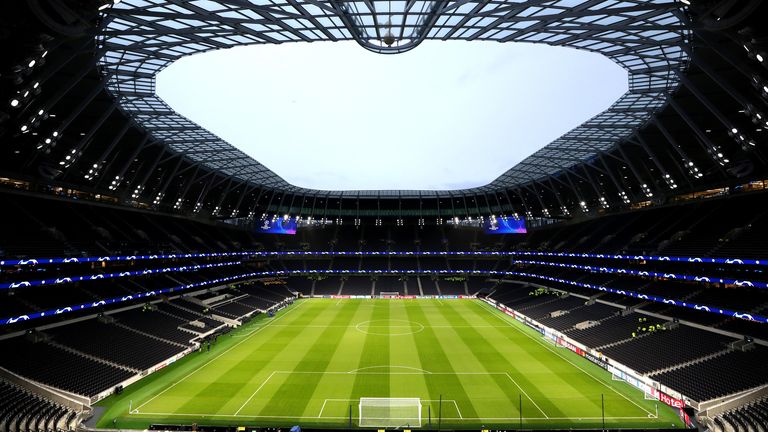
Tottenham are giving their fans the chance to appear on a live video fan wall that will be streamed into the stadium for their game against Manchester United, live on Sky Sports Premier League on Friday.
All of the Premier League’s remaining matches will be played behind closed doors so clubs are looking for ways to gain an advantage for their home matches, with Spurs set to feed in video footage of their supporters at various points.
Fans must enter a competition, showing themselves kitted out on the sofa and will be encouraged to react to events in the game as they happen, though no audio will be played into the stadium.
A club statement read: “We are giving supporters the chance to be part of a live video fan wall during our first ever behind-closed-doors Premier League match against Manchester United on Friday night.
“Spurs Inside is another first for the club, streamed live on our giant video screens in the stadium bowl intermittently throughout the match so that the players will know fans are watching and cheering them on.
“We are providing a select number of Season Ticket Holders and Executive Members – our regular match attenders – the opportunity to be part of this unique experience.”
0:36 Former Tottenham and England goalkeeper Paul Robinson says players will need to be looked after when the Premier League returns – particularly those like Harry Kane who are returning after injury
Former Tottenham and England goalkeeper Paul Robinson says players will need to be looked after when the Premier League returns – particularly those like Harry Kane who are returning after injury
Tottenham – on a poor run of form before football was suspended by the coronavirus pandemic – have a huge amount of work to do to qualify for next season’s Champions League.
Spurs are eighth in the table, seven points behind fourth-placed rivals Chelsea, and four behind Manchester United in fifth place, which could be a Champions League slot given Manchester City’s current ban, pending appeal.
On the face of it, their nine-game run in looks less daunting than it might, with only Manchester United – their first game live on Sky Sports behind closed doors on June 19 – and arch-rivals Arsenal their traditional top opponents remaining.
But they also face Champions League-chasing Leicester, Sheffield United, who are deservedly in the hunt for Europe, and two sides battling against relegation in Bournemouth and another local rival in West Ham.
Newcastle and Crystal Palace away will not be easy either, while they also host Everton at the Tottenham Hotspur Stadium.
Sky Sports will show 64 live Premier League games when the season resumes. In addition to the 39 matches already scheduled to be broadcast exclusively live on Sky Sports before the coronavirus interruption, 25 more matches will be available on both Sky Sports Premier League and Sky’s free-to-air Pick channel, allowing the whole nation to be part of the return of live sport.
The bizarre White House attack on the federally funded VOA said “much of the U.S. media takes its lead from China.†The broadside was so odd that many initially thought hackers had posted it on the White House website, The New York Times reported.
The Voice of America’s director on Sunday angrily responded to the CDC, calling the freeze on its reporters “shocking†and “troubling†and comparing the action to authoritarian nations without a free press — like China.
In the April 30 CDC email, obtained by Just Security and released Friday, Michawn Rich informs the organization’s press staff: “As a rule, do not send up [press interview] requests from [VOA reporter] Greta von Susteren or anyone working for VOA because of this†— and links to the White House statement. Rich, communications director for Agriculture Secretary Sonny Perdue, was assigned to the CDC in March to shape the CDC’s press response to the coronavirus pandemic.Â
The White House statement posted in early April accused the Voice of America of amplifying “Beijing’s propaganda.†As an example, the statement cited a comment in a VOA article that China’s strict lockdown at the beginning of the COVID-19 outbreak was successful in stemming the spread of the disease — a view widely held by scientists around the world.
At the time the statement was issued, the U.S. COVID-19 death toll had surpassed China, and President Donald Trump had begun to accuse the Chinese government of lying about its figures — and blaming China for the pandemic.
The VOA responded to the White House statement with a long list of its articles critical of China based on what it called “verifiable facts.â€Â It also bitingly pointed out the difference between “state-controlled†media — compelled to follow the party line — and “publicly-funded independent media,†like the VOA, which “shows all sides of an issue.â€Â
On Sunday, the VOA issued a scathing response to the CDC email.
“We were shocked to read the internal CDC documents instructing the agency’s media relations office to refuse media requests from ‘anyone associated with Voice of America,’ citing White House†accusations that the VOA was spreading “Chinese propaganda,†director Amanda Bennett, a Pulitzer Prize-winning investigative journalist, said in a statement. “VOA, a federally funded independent news organization, strongly rejects the accusations and calls on the CDC to immediately withdraw the instructions.â€Â
For a “federal agency’s public affairs office to categorically deny in advance interview requests from VOA journalists … based on a White House opinion statement … is even more troubling,†Bennett continued.Â
The attack on the VOA is occurring as Trump is making a power play to control the organization and force it to spin positive coverage for his administration. The Senate early this month voted to make conservative filmmaker and Steve Bannon pal Michael Pack head of the U.S. Agency for Global Media, the federal agency that oversees the VOA.Â
VOA is commendably rejecting Trump’s call for VOA to be his own personal propaganda outlet. But Trump’s newly appointed CEO, Michael Pack, could change that. Pack is an associate of Steve Bannon and has collaborated with him in the past. He could remake VOA a the new Brietbart./2
A search and rescue operation is underway after a U.S. fighter jet crashed into the North Sea off the east coast of England during a training mission on Monday, the U.S. Air Force in Europe said in a statement.
The status of the pilot as well as cause of the crash are unknown, according to a statement from 48th Fighter Wing, based at the RAF Lakenheath base in eastern England.
The jet took off from RAF Lakenheath, the largest U.S. Air Force-operated base in England. RAF spokesman Wing Commander Martin Tinworth confirmed to NBC News that the plane crashed off the coast of England near Middlesbrough, around 250 miles north of London.
A @usairforce F-15C Eagle crashed at approximately 0940 today in the North Sea. The aircraft was from the 48th Fighter Wing, the aircraft was on a routine training mission with one pilot on board. https://t.co/1Psg3N1JCz
“A U.S. Air Force F-15C Eagle crashed at approximately 0940 today in the North Sea. The aircraft was from the 48th Fighter Wing, RAF Lakenheath, United Kingdom,” the statement said.
According to the RAF Lakenheath website, aircraft based there have played counter-terrorism roles across the Middle East since September 11, 2001.
The U.K. Coastguard confirmed it has sent a helicopter and several boats into the suspected crash area to look for the pilot.
This is a developing story, check back here for updates.
Rachel Elbaum
Rachel Elbaum is a London-based editor, producer and writer.Â
SHANGHAI — To the long list of obstacles holding back the Chinese economy when the world needs it most, add one more: padlocked movie theaters.
The country’s more than 12,000 cinemas have remained stubbornly closed. Reopening them is politically difficult, as the order to keep them shut came from none other than Xi Jinping, China’s top leader.
The rest of the country is trying to get back to business as usual after a devastating coronavirus outbreak earlier this year. Factories, shops, restaurants and bars reopened as much as three months ago and are trying to recapture business lost during China’s biggest crisis in a generation.
Some shop owners and mall operators say they keenly miss the business of moviegoers, who once filled restaurants and retail outlets with after-show business.
“The merchants around the theater are now miserable,†Gao Dezhi, a movie theater manager in Liaoning Province in northeastern China, wrote on the microblogging service Weibo in late May. “The original cinema visitor flow is gone.â€
New data released on Monday showed that Beijing is still struggling to get the country’s economy, the world’s second largest after the United States, back in business, although conditions are less grim than they were earlier this spring.
Retail sales in May fell for the fifth month in a row, China’s National Bureau of Statistics said, dropping an unexpected 2.8 percent compared with May of last year. The fall came despite increases in sales of cars and groceries and a rise in online purchases, though it was a strong improvement over sharper drops in recent months.
Industrial production statistics for May, also announced on Monday, showed slow but steady improvement. Export statistics for May, released last week, indicated a deterioration since April as overseas demand withered with the spread of the virus.
China is one of the world’s most important growth engines. Getting the world economy back on its feet will be exceedingly difficult if Beijing cannot get China back up to full speed. But widespread job losses have shaken the public’s confidence after the country shut down vast swaths of the economy to contain the outbreak. Many are less willing or able to spend.
The country’s workers will face further challenges in coming months as a global economic slowdown, triggered by the pandemic, reduces the world’s demand for the smartphones, appliances, clothes and other goods churned out by China’s factories.
China itself still faces risks from the coronavirus. A new outbreak in Beijing has prompted the authorities to lock down parts of the city.
With those risks in mind, officials have appeared nervous about reopening movie theaters. Cinemas closed in late January, as the coronavirus raced out of the city of Wuhan to hit other parts of the country.
Their continued closure seemed assured after Mr. Xi said they were not needed. Except for a few brief experiments in several provinces, they have stayed shut ever since.
“If anyone wants to watch a movie, just watch it online,†Mr. Xi said during a visit on March 31 to Hangzhou in Zhejiang Province in east-central China.
In a country that is gradually drifting toward one-man rule, no one has dared to challenge that decision publicly. It is part of a pattern of sometimes extreme deference to Mr. Xi that has repeated itself with increasing frequency in recent years.
Just about everything else has opened up across practically all of China. Even live theater has reopened, with customers allowed to occupy every other seat as part of social distancing. In Shanghai, a play has just opened that celebrates how people in Wuhan carried on everyday life as the coronavirus epidemic started there and was then eventually brought under control.
Malls around the world rely to some extent on cinemas to draw people out of their homes, with the hope that they will stay after the movies to dine or go shopping. But regulatory peculiarities have made Chinese shopping malls especially reliant on cinemas to generate foot traffic.
Shopping malls in the United States and Europe often sprawl across many acres in suburban locations where land is fairly cheap. Visitors frequently come by car. People may come and go from cinemas without ever walking past or through another business at the same mall.
But China has stringent regulations to limit low-rise urban sprawl. Car ownership is also far less widespread. So shopping malls need to be tall and located close to mass transit.
Malls in China typically occupy five to nine floors of a tall building. Cinemas are often on the top floor of the mall. Moviegoers pass many shops and restaurants on their way to and from cinemas, ascending and descending a seemingly interminable series of escalators.
Updated June 12, 2020
Does asymptomatic transmission of Covid-19 happen?
So far, the evidence seems to show it does. A widely cited paper published in April suggests that people are most infectious about two days before the onset of coronavirus symptoms and estimated that 44 percent of new infections were a result of transmission from people who were not yet showing symptoms. Recently, a top expert at the World Health Organization stated that transmission of the coronavirus by people who did not have symptoms was “very rare,†but she later walked back that statement.
What’s the risk of catching coronavirus from a surface?
Touching contaminated objects and then infecting ourselves with the germs is not typically how the virus spreads. But it can happen. A number of studies of flu, rhinovirus, coronavirus and other microbes have shown that respiratory illnesses, including the new coronavirus, can spread by touching contaminated surfaces, particularly in places like day care centers, offices and hospitals. But a long chain of events has to happen for the disease to spread that way. The best way to protect yourself from coronavirus — whether it’s surface transmission or close human contact — is still social distancing, washing your hands, not touching your face and wearing masks.
How does blood type influence coronavirus?
A study by European scientists is the first to document a strong statistical link between genetic variations and Covid-19, the illness caused by the coronavirus. Having Type A blood was linked to a 50 percent increase in the likelihood that a patient would need to get oxygen or to go on a ventilator, according to the new study.
How many people have lost their jobs due to coronavirus in the U.S.?
The unemployment rate fell to 13.3 percent in May, the Labor Department said on June 5, an unexpected improvement in the nation’s job market as hiring rebounded faster than economists expected. Economists had forecast the unemployment rate to increase to as much as 20 percent, after it hit 14.7 percent in April, which was the highest since the government began keeping official statistics after World War II. But the unemployment rate dipped instead, with employers adding 2.5 million jobs, after more than 20 million jobs were lost in April.
Will protests set off a second viral wave of coronavirus?
Mass protests against police brutality that have brought thousands of people onto the streets in cities across America are raising the specter of new coronavirus outbreaks, prompting political leaders, physicians and public health experts to warn that the crowds could cause a surge in cases. While many political leaders affirmed the right of protesters to express themselves, they urged the demonstrators to wear face masks and maintain social distancing, both to protect themselves and to prevent further community spread of the virus. Some infectious disease experts were reassured by the fact that the protests were held outdoors, saying the open air settings could mitigate the risk of transmission.
How do we start exercising again without hurting ourselves after months of lockdown?
Exercise researchers and physicians have some blunt advice for those of us aiming to return to regular exercise now: Start slowly and then rev up your workouts, also slowly. American adults tended to be about 12 percent less active after the stay-at-home mandates began in March than they were in January. But there are steps you can take to ease your way back into regular exercise safely. First, “start at no more than 50 percent of the exercise you were doing before Covid,†says Dr. Monica Rho, the chief of musculoskeletal medicine at the Shirley Ryan AbilityLab in Chicago. Thread in some preparatory squats, too, she advises. “When you haven’t been exercising, you lose muscle mass.†Expect some muscle twinges after these preliminary, post-lockdown sessions, especially a day or two later. But sudden or increasing pain during exercise is a clarion call to stop and return home.
My state is reopening. Is it safe to go out?
States are reopening bit by bit. This means that more public spaces are available for use and more and more businesses are being allowed to open again. The federal government is largely leaving the decision up to states, and some state leaders are leaving the decision up to local authorities. Even if you aren’t being told to stay at home, it’s still a good idea to limit trips outside and your interaction with other people.
What are the symptoms of coronavirus?
Common symptoms include fever, a dry cough, fatigue and difficulty breathing or shortness of breath. Some of these symptoms overlap with those of the flu, making detection difficult, but runny noses and stuffy sinuses are less common. The C.D.C. has also added chills, muscle pain, sore throat, headache and a new loss of the sense of taste or smell as symptoms to look out for. Most people fall ill five to seven days after exposure, but symptoms may appear in as few as two days or as many as 14 days.
How can I protect myself while flying?
If air travel is unavoidable, there are some steps you can take to protect yourself. Most important: Wash your hands often, and stop touching your face. If possible, choose a window seat. A study from Emory University found that during flu season, the safest place to sit on a plane is by a window, as people sitting in window seats had less contact with potentially sick people. Disinfect hard surfaces. When you get to your seat and your hands are clean, use disinfecting wipes to clean the hard surfaces at your seat like the head and arm rest, the seatbelt buckle, the remote, screen, seat back pocket and the tray table. If the seat is hard and nonporous or leather or pleather, you can wipe that down, too. (Using wipes on upholstered seats could lead to a wet seat and spreading of germs rather than killing them.)
Should I wear a mask?
The C.D.C. has recommended that all Americans wear cloth masks if they go out in public. This is a shift in federal guidance reflecting new concerns that the coronavirus is being spread by infected people who have no symptoms. Until now, the C.D.C., like the W.H.O., has advised that ordinary people don’t need to wear masks unless they are sick and coughing. Part of the reason was to preserve medical-grade masks for health care workers who desperately need them at a time when they are in continuously short supply. Masks don’t replace hand washing and social distancing.
What should I do if I feel sick?
If you’ve been exposed to the coronavirus or think you have, and have a fever or symptoms like a cough or difficulty breathing, call a doctor. They should give you advice on whether you should be tested, how to get tested, and how to seek medical treatment without potentially infecting or exposing others.
A study four years ago by the RET China Commercial Real Estate Research Center found that more than half of the people who went to movies at a shopping mall in China bought food and drinks at the mall. More than 40 percent of moviegoers also go shopping, the study found.
Shopping malls and the stores inside are not the only businesses that are hurting these days because of the closure of cinemas.
According to Tianyancha, a Chinese data service on businesses, at least 1,542 cinema companies and movie studios have gone out of business so far this year. More than 8,000 movie production firms, movie consulting companies and other businesses related to the industry have also failed so far this year, according to the data.
The mysterious death of a Chinese movie mogul captured national attention late last week. Bona Film Group, a Chinese movie studio and cinema chain that is still in business, announced that one of its best-known executives, Huang Wei, had fallen to his death in an affluent Beijing neighborhood.
The company’s announcement said that he had suffered from insomnia and depression and that there was no sign of foul play. The police confirmed his death in a statement but provided no details.
Once Mr. Xi makes a decision these days, implementation by lower-ranking officials is sometimes so swift that new difficulties pop up. The closure of cinemas is not the only example.
When Mr. Xi ordered northern Chinese provinces to cut smog in late summer of 2017, cadres junked coal-fired school stoves without checking if enough natural gas would be available to provide heat instead. When Mr. Xi also ordered weeks later that Beijing’s population be reduced, local officials bulldozed the homes of tens of thousands of migrant workers with little notice.
A bitterly cold early winter followed, producing nationwide anger over scenes of shivering schoolchildren and homeless migrants.
If the cinema order does not end soon, said Mr. Gao, the movie theater manager, the collateral economic damage could be significant. “If they do not open again,†he said, “many merchants around theaters will face the danger of closing.â€
We use cookies on our website to give you the most relevant experience by remembering your preferences and repeat visits. By clicking “Accept”, you consent to the use of ALL the cookies.
This website uses cookies to improve your experience while you navigate through the website. Out of these, the cookies that are categorized as necessary are stored on your browser as they are essential for the working of basic functionalities of the website. We also use third-party cookies that help us analyze and understand how you use this website. These cookies will be stored in your browser only with your consent. You also have the option to opt-out of these cookies. But opting out of some of these cookies may affect your browsing experience.
Necessary cookies are absolutely essential for the website to function properly. These cookies ensure basic functionalities and security features of the website, anonymously.
Cookie
Duration
Description
cookielawinfo-checbox-analytics
11 months
This cookie is set by GDPR Cookie Consent plugin. The cookie is used to store the user consent for the cookies in the category "Analytics".
cookielawinfo-checbox-functional
11 months
The cookie is set by GDPR cookie consent to record the user consent for the cookies in the category "Functional".
cookielawinfo-checbox-others
11 months
This cookie is set by GDPR Cookie Consent plugin. The cookie is used to store the user consent for the cookies in the category "Other.
cookielawinfo-checkbox-necessary
11 months
This cookie is set by GDPR Cookie Consent plugin. The cookies is used to store the user consent for the cookies in the category "Necessary".
cookielawinfo-checkbox-performance
11 months
This cookie is set by GDPR Cookie Consent plugin. The cookie is used to store the user consent for the cookies in the category "Performance".
viewed_cookie_policy
11 months
The cookie is set by the GDPR Cookie Consent plugin and is used to store whether or not user has consented to the use of cookies. It does not store any personal data.
Functional cookies help to perform certain functionalities like sharing the content of the website on social media platforms, collect feedbacks, and other third-party features.
Performance cookies are used to understand and analyze the key performance indexes of the website which helps in delivering a better user experience for the visitors.
Analytical cookies are used to understand how visitors interact with the website. These cookies help provide information on metrics the number of visitors, bounce rate, traffic source, etc.
Advertisement cookies are used to provide visitors with relevant ads and marketing campaigns. These cookies track visitors across websites and collect information to provide customized ads.