Tuesday, June 2, 2026

When dieting doesn’t work – Harvard Health Blog

0

At any given time, more than a third of Americans are on a specific diet, with weight loss as a leading reason. Most are going to be disappointed, because even when successful, lost weight is frequently regained within a few months.

While most weight-loss diets can help you lose weight, they may be unsuccessful over the long run for a number of reasons. Some people don’t follow their diets carefully and don’t lose much weight even from the start. Others may go off the diet entirely after a while, because it’s too restrictive or the foods aren’t appealing. Some may engage in less physical activity as they consume fewer calories. But who hasn’t heard of someone doing everything right and still losing minimal weight, or regaining lost weight over time? Perhaps that someone is you.

Even when research studies confine study subjects to a research setting — with carefully-controlled calories, food types, and physical activity, and with intensive counselling, teaching, and monitoring — the lost weight and other health benefits (such as improved cholesterol and reduced blood pressure) tend to disappear soon after the study ends.

You can’t pick the right diet if none of them work

According to a new study, popular diets simply don’t work for the vast majority of people. Or more accurately, they are modestly effective for a while, but after a year or so the benefits are largely gone.

In a large systematic review and meta-analysis, recently published in the medical journal The BMJ, researchers analyzed 121 trials that enrolled nearly 22,000 overweight or obese adults who followed one of 14 popular diets, including the Atkins diet, Weight Watchers, Jenny Craig, DASH, and the Mediterranean diet, for an average of six months. The diets were grouped into one of three categories: low-carbohydrate, low-fat, and moderate-macronutrient (diets in this group were similar to those in the low-fat group, but with slightly more fat and slightly less carbohydrate). Loss of excess weight and cardiovascular measures (including cholesterol and blood pressure) while on one of these diets were compared with other diets or usual diets (one in which the person continued to eat as they usually do).

While weight, blood pressure, and cholesterol measures generally improved at the six-month mark, results at the 12-month mark were disappointing, to say the least.

  • While low-carbohydrate and low-fat diets both resulted in weight loss of about 10 pounds at six months, most of the lost weight was regained within one year. People in the moderate macronutrient group tended to lose less weight than those following the other diets.
  • Blood pressure and cholesterol results improved modestly at six months, but generally returned to where they started after a year. One exception was noted: reduced LDL (“bad”) cholesterol levels while on the Mediterranean diet persisted at one year.
  • There were no major differences in other health benefits between the various diet programs.

All is not lost

Based on this new report, you might be tempted to throw up your hands and give up on weight-loss diets altogether. But there’s another way of looking at this: it probably matters less which plan you pick (whether low-carb, low-fat, or something in between) than whether you stick with it.

The average duration of the studies included in this analysis was six months. What if they’d lasted 12 months, or two years, or a lifetime? The benefit would likely have been greater and more long-lasting. The trick is to pick a diet with foods you actually like so that it’s not so hard to stick with it.

In addition, there are factors other than diet that can have a big impact on weight. For example, everyday physical activity, regular exercise, and sleep are important in helping to maintain a healthy weight.

Rather than following a highly restrictive or named diet, I endorse the Mediterranean diet. It’s among the best studied, performs well when compared with other diets (as in this analysis), and was the only diet in this analysis to have long-lasting effects on LDL cholesterol levels.

The bottom line

Losing weight is not easy. If you’re struggling with your weight, talk to your doctor, a nutritionist, and perhaps a health coach. Review this study with them and, together, decide on dietary and other lifestyle changes that appeal to you. Then stick with them. Remember, you’re most likely to stick with lifestyle changes you actually like.

Follow me on Twitter @RobShmerling

Source link

EU commissioner: Coronavirus immunity certificates aren’t reliable

0

Stella Kyriakides emphasized that easing travel restrictions should be first done by coordinating between regions in similar situations | Pool photo by John Thys/AFP via Getty Images

People ‘deserve a break, a breath of fresh air, a chance to travel,’ says health commissioner.

The EU can’t count on immunity certification when lifting border restrictions within the bloc, Health Commissioner Stella Kyriakides told health ministers on Monday.

“[Citizens] deserve a break, a breath of fresh air, a chance to travel and to visit family and friends,” Kyriakides said, according to a readout of the call. “We must make sure that they can do so safely.”

But immunity certification isn’t reliable, she said, emphasizing instead prevention measures like maintaining physical distancing; developing “robust” testing strategies; and ensuring sufficient health care capacity in EU countries — especially those that are tourist destinations.

Contact tracing, including contact tracing apps, are also important, Kyriakides said, but noted they must be interoperable so that people can be warned of an infection wherever they are, with whatever app they are using.

She also emphasized that easing travel restrictions should be first done by coordinating between regions in similar and “positively evolving” epidemiological situations, and welcomed the Baltic nations’ initiative to restart travel in a three-country bubble.

“I urge you all to monitor the situation as you ease restrictions and keep other member states informed of any epidemiological developments,” she said.

She encouraged countries to share their data with the European Centre for Disease Prevention and Control (ECDC), which has been an issue. The ECDC was lacking national data to create an interactive map detailing the level of coronavirus transmission inside EU countries earlier this month, when the Commission published its guidelines on reopening internal borders.

Paola Tamma contributed reporting.


Source by [author_name]

Smaller Target puts Big W in crosshairs

“There are only so many people buying at that price point and going to department stores, but it should help them marginally,” he said. “But the whole group’s got the same challenges as Target, in some ways.”

Loading

“It’s not quite as well-positioned as Kmart. Big W has a bit of the [cheaper] Kmart end and also some of the [more expensive] Target end.”

Big W has been a laggard in Woolworths’ portfolio since 2016, booking numerous losses and $286 million in impairments. In April last year, the Woolworths announced it would shutter 30 stores in an effort to make the chain viable, incurring a cost of $270 million.

But market watchers expect more than the mooted 30 stores will shut, as the coronavirus crisis exacerbates the pressures facing the department store sector. It could even kick off a long-term trend away from big-box retailing, White Funds managing director Angus Gluskie said.

“Department stores see benefits in shrinking their floor space, lowering staff numbers and condensing their offering. They are hoping that this more compact offering is not only more structurally cost efficient, but is more clearly defined for consumers,” the Woolworths shareholder said.

“It is highly likely that Woolworths would be coming to similar conclusions.”

Argo Investments managing director Jason Beddow.Credit:Jessica Hromas

Shutting more unprofitable stores and condensing their offering would be the most likely options Woolworths is considering, Mr Gluskie said.

Mr Beddow agreed, saying the 30 stores slated to close would be just the “tip of the iceberg”. So far, four stores have been closed. “As leases expire, unless they’re profitable [they’ll shut],” he said.

However, any major changes at Big W will likely wait until Woolworths decides its plans for its Endeavour hotels and drinks division, Mr Beddow said. The company has left the door open for nixing the much-anticipated demerger altogether following the coronavirus crisis.

Loading

In February, Big W posted a $50 million profit before interest and tax, its first since 2016 and an indication to analysts the department store was beginning to turn a corner after years of being valued at near-zero within Woolworths’ portfolio.

Analysts now believe the chain may post a profit, with Merrill Lynch analyst David Errington telling clients in late April full-year earnings before interest and tax for the department chain would be $20 million.

Woolworths has told investors it expects to make a small profit in the full financial year. A spokesperson told The Age and The Sydney Morning Herald the company had been pleased with its recent efforts to turn Big W around.

“Our customers tell us they like what we’re doing and our focus remains on meeting their needs to build a strong and sustainable business for the future,” they said.

On Monday, Woolworths shares rose 1.1 per cent to $34.55 and Wesfarmers jumped 1.7 per cent to $39.50. The broader market leapt more than 2 per cent.

Most Viewed in Business

Loading

Source by [author_name]

Europe’s elite skewered for lockdown double standards

0

One rule for them. Another for the rest of us.

As U.K. Prime Minister Boris Johnson and his chief aide Dominic Cummings have discovered to their cost, with public opinion on a hair trigger for hypocrisy the charge of double standards is currently the most toxic in British politics.

Brexit mastermind Cummings has been a polarizing figure for years. But the revelations over the weekend that he apparently broke lockdown rules have gone down extremely badly with many Brits, regardless of where their political loyalties lie.

The PM defended the actions of his aide on Sunday, saying he acted “responsibly and legally,” apparently calculating that the furious political backlash would be worth it to retain the services of his most trusted adviser.

But it isn’t just in the U.K. that the perception of double standards for the powerful has ignited a sharp public reaction. Politicians and officials ignoring lockdown rules have irritated citizens right across Europe. Some of them have decided that asking for forgiveness is a better strategy than trying to tough it out.

Austria

Austria’s President Alexander Van der Bellen apologized on Sunday after he and his wife were caught by police breaking curfew rules at a restaurant.

The country’s coronavirus restrictions include the mandatory closing of restaurants and bars at 11 p.m., but police said the couple still had drinks at their table after midnight Van der Bellen said on Twitter that he had gone out to eat for the first time since lockdown began with his wife and two friends.

“We lost track of the time while chatting and unfortunately overlooked the hour,” he wrote. “I am sincerely sorry. It was a mistake. If the restaurant host suffers any damage from this, I will take responsibility for it.”

Van der Bellen’s transgression came days after Austrian Chancellor Sebastian Kurz was forced to apologize for appearing unmasked among a crowd of people in a village near the German border.

“There are certain things that you cannot plan,” Kurz said later, acknowledging that some people had failed to practice social distancing.

Germany

Earlier this month in Germany, the liberal FDP party leader Christian Lindner was caught hugging a friend outside Borchardt, a restaurant that is a favorite of the Berlin elite.

After the incident was widely reported in German media, Lindner apologized on Twitter.

“The spontaneous farewell hug on Friday was a mistake, as they unfortunately occur among friends after a private evening,” he said. “It was not intentional … in the end we are all human. I’m sorry!”

Lindner was not the first German politician to violate coronavirus rules.

Earlier, Saxony’s state premier Michael Kretschmer was spotted engaging in a debate with protesters in Dresden without wearing a face mask, while Thuringia’s state premier Bodo Ramelow admitted to having broken the rules when he attended the funeral of a neighbor. Not every politician has broken the rules when it comes to funerals. It was revealed on Monday that the mother of Dutch Prime Minister Mark Rutte died on May 13 but he was unable to visit her in her final weeks.

Romania

Meanwhile in Romania, thousands of people attended the funeral of the Archbishop Pimen Zainea of Suceava and Radauti last week.

Some mourners even kissed the coffin.

According to local media, the Romanian Orthodox Church had previously obtained special approval from the Department for Emergencies and the National Institute of Public Health.

Some Romanians reacted angrily to the news because COVID-19 rules in the country mandated that funerals can go ahead only with a maximum of eight attendees.

Poland

Last month in Poland, Prime Minister Mateusz Morawiecki and many other officials from the ruling Law and Justice party (PiS) gathered to commemorate the anniversary of the death of the country’s then president Lech Kaczyński in a plane crash in 2010.

At the wreath-laying ceremony, neither the prime minister nor the other officials were wearing face masks or following social distancing guidelines.

The same day, Jarosław Kaczyński, the leader of PiS and twin brother of Lech, was taken by limousine to a Warsaw cemetery at a time when graveyards were closed for regular citizens. Popular discontent with the apparent double standard found voice in a satirical song poking fun at Kaczyński called “Your pain is greater than mine.” It was subsequently dropped from the playlist of a government controlled radio station in what some in the country see as an act of censorship.

Poland’s Prime Minister Mateusz Morawiecki | Aris Oikonomou/AFP via Getty Images

In yet another controversial incident, the prime minister last week ate at a newly reopened restaurant without maintaining the 1.5-meter social distancing rule.

He explained over the weekend that “a certain distance is suggested but not required” by the government’s coronavirus rules, but was later contradicted by a government spokesman who said Morawiecki had been “misinformed” about the guidelines.

Spain

Spanish Vice President Pablo Iglesias was criticized in March for breaking self isolation recommendations and turning up to government meetings. Iglesias’s partner, Equality Minister Irene Montero, had tested positive for the coronavirus and was in quarantine at the time, leading to worries that Iglesias could inadvertently infect other members of the government at the weekly meetings.

In April he was also censured for ignoring government recommendations on face masks and going to his local supermarket without one.

And last week, the funeral of Julio Anguita, former leader of the Communist Party of Spain, drew thousands of people to the Spanish city of Córdoba. Anguita, who served as mayor of Córdoba from 1979 to 1986, died unexpectedly of a heart attack on May 16.

Scenes of the crowds attending his funeral prompted considerable outrage among many Spaniards who complained that social distancing was not adhered to at the large ceremony. Many ordinary people who have died in recent weeks had to be buried in solitude, with family member unable to attend.

Jan Cienski contributed reporting.


Source by [author_name]

CDC Warns Of ‘Aggressive Rodent Behavior’ As Lockdown Eases

Rats! Restaurants that closed or scaled back during the coronavirus pandemic have riled up hungry rodents, the Centers for Disease Control and Prevention has warned.

Lockdown measures to curb COVID-19 have created a food shortage for the vermin, and people should be prepared to confront the desperate critters.

“Environmental health and rodent control programs may see an increase in service requests related to rodents and reports of unusual or aggressive rodent behavior,” the CDC wrote in a bulletin last week. 


The agency urged residents and business owners to seal up points of entry and keep trash cans firmly closed.

And as if we didn’t already have enough to worry about, the CDC cautioned against rodent-borne diseases.


“Follow established guidelines when cleaning up after rodent infestations to prevent exposure to rodent-borne diseases,” the advisory said. “Fleas are common on rodents. In areas of heavy rodent infestations, workers should consider using a repellent registered by the U.S. Environmental Protection Agency.”


Reports of possible rat army wars and rat cannibalism have emerged, as the pests have been essentially cut off from their street buffets during shelter-in-place orders.

“They’re mammals just like you and I, and so when you’re really, really hungry, you’re not going to act the same — you’re going to act very bad, usually,” urban rodentologist Bobby Corrigan told NBC News last month. “So these rats are fighting with one another, now the adults are killing the young in the nest and cannibalizing the pups.”


Source by [author_name]

I Traveled To Texas During The Pandemic To Provide Abortion Care. Here’s What I Saw.

As I flew out of Texas in February, I never imagined the tragedy and upheaval that would take place before I was able to return eight weeks later. 

I travel monthly from Seattle to Texas to help provide abortion care. But at the end of March — as the coronavirus pandemic was ramping up —Republican Texas Gov. Greg Abbott issued an executive order halting such care, deeming it nonessential — an order reinforced by the state’s attorney general.

My anguish warred with my outrage as I thought of all the patients going through a mandated but medically unnecessary day of ultrasound and counseling 24 hours before their abortion only to be told that, because of this order, they would not be able to obtain an abortion the next day or in the days following.

Abortion care is essential health care that cannot be delayed. Though parenting should be a choice, once a person decides to pursue an abortion, it becomes medically necessary. When facing unwarranted delays, care becomes more complex for patients to coordinate and more expensive.

Despite all the legal battles creating emotional and logistical challenges over the weeks after the virus began to spread, a federal appeals court offered a beacon of hope that we would at least be able to provide medication abortion ― something that I could have provided over a telehealth visit from my home in Washington if Texas didn’t already have a ban in place preventing abortion specifically via telemedicine. 

On April 21, the governor issued a new executive order that allowed surgical abortions to resume at our clinic if some additional measures were agreed upon. The details were up to our administrative and legal teams, which would allow me to focus solely on my clinical care of patients.

So when I was due to travel to the clinic at the end of April, I knew that I would go, despite the potential risks to my own health. There were no local providers available for the week I was scheduled to work because of years of medically unnecessary laws regulating abortions (known as TRAP laws, for targeted regulation of abortion providers), as well as the hostile environment for physicians offering care. 

One woman told me, ‘I’m so glad you all are open again, I was going to have to travel to Colorado or New Mexico.’ I shared that I was glad also, that I knew of folks who had gone as far as Iowa to obtain care.

The vast majority of patients who came to the clinic in April ended up obtaining the medication to have a medical abortion ― likely in part because of what happened in the courts during the previous weeks and because it was the only option available at the time. Under the latest executive order, the only difference was that when I diagnosed a pregnancy beyond 10 weeks (the limit by law for a medical abortion in Texas), I could offer the surgical option rather than having to turn someone away.

Basically, messaging in April about abortion services available in Texas seemed just as murky as that about protective measures against the coronavirus. The Seattle airport was relatively deserted, but a disturbing majority of people traveling were not wearing masks. The airport PA system rang out with frequent social distancing reminders for groups of people who were huddling together and forming close lines, as though we were all going on vacation together.

I am the only person in my friend circles who traveled during this time. I started texting group threads: “I’m worried I’m traveling with people who don’t believe a pandemic is happening.” Everyone wrote back with words of encouragement, and I felt a surge of support and solidarity.

Upon landing in Texas, I was warned of a mandated 14-day quarantine. I had a letter explaining I was an essential worker, which exempted me from the quarantine, but was still told I had to fill out a form with the address of where I’d be staying while in Texas. This all felt as if it contradicted the recent announcement from the governor that the state would be reopening.

I woke up the next morning to a beautiful, hot and sunny Texas day ― a stark contrast to the weather back in rainy Seattle. The few moments I had outside would be the only time I’d think about something as mundane as the weather.

When I arrived at the clinic, I was greeted by staff wearing masks, and I had a sense of unease about the certainty of providing abortion care. “We have 45 patients scheduled today,” I was told. Almost everyone came for their ultrasound and counseling ― a few asked, as they usually do, “Is there any way I can get the abortion pill today so I don’t have to come back?”

I wish I could have given them a different answer. But the arbitrary 24-hour waiting period remains a requirement, even though patients often have to travel to the clinic, take time off work, find child care and, now, risk exposure to an ongoing public health threat. Closing clinics, banning telehealth and enforcing restrictions like these waiting periods is dangerous and burdensome at any time, but especially during this pandemic. 

One woman told me, “I’m so glad you all are open again. I was going to have to travel to Colorado or New Mexico.” I shared that I was also glad and that I knew of folks who had gone as far as Iowa to obtain care.

“I just want this to be done,” said another patient whose care had already been delayed in prior weeks by the ban on abortion procedures. 

By the end of the long day, no new bans had been put in place, and I felt relief that we would be able to provide care the following day without any political barriers.

This trip — and each time I make the journey — I’ll be left wondering if it will affect my health in any way. But I know one thing ― abortion care is, and always has been, essential care.

During my three days of providing care, no patient said “COVID-19” or “the coronavirus” out loud. I heard “because of everything that is going on” or “the current situation” multiple times. Patients listed the names of the places they were employed, often writing “before the pandemic” in the margins ― the uncertainty of their future frightfully clear to them.

One patient cried, a tear rolling from her cheek to her surgical mask and down to her chin. She told me, “I thought I was really careful. I’m so sorry to have to be here. Thank y’all for being so nice.” I responded, “I’d typically offer you a hug, and I’m really sorry I can’t right now. But I hope you can be as kind and gentle to yourself as you would be to a best friend in this situation.”

We saw 32 patients on my last day at the clinic. As in the days prior, I emphasized that their decisions and care plans sounded right and reasonable. “We trust that you are the expert in your life,” I told my patients. It’s a common refrain I rely on when someone walks me through their expected schedule or child care plans. More than usual, patients were comforted to know they could call the clinic anytime if they had questions.

After getting only a glimpse of my patients’ faces over those three days because of their masks, I wondered if my eyes showed when I was smiling or expressing concern, as I hoped they were. I always wear yellow rose earrings when I’m in the clinic, but relied on them more to carry my identity over each day. My socks — which were decorated with hedgehogs — were a frequent topic of conversation and led to a few lighthearted discussions.

The unpredictability of travel then and now has also been challenging and a focus of concern as I decide whether or not to travel. My direct flight home was canceled, and finding a route back to Seattle without at least a three-hour layover proved impossible. Luckily, I was able finally to arrange a journey back so that I could continue to care for my local community, where I am a primary care physician.  

As my plane took off, I could see the sparsely occupied airport parking lot out the window ― at least the cars were social distancing. I secured my mask with its blue polka-dotted ribbon and the heart-shaped buttons one of the staff at the clinic made to help relieve our ears of the discomfort of ear loops. I found myself tearing up with gratitude, recalling the stories of the past three days, the hard work of the staff and the support of my friends and colleagues.

On this trip — and on each journey I make — I’ll be left wondering if it will affect my health in any way. But I know one thing for sure: Abortion care is and always has been essential care.

Clinics across the country remain open. It is important to check websites and/or call ahead to see what protocols may be in place as they adjust to conditions with the pandemic.

Dr. Glenna Martin is a family physician in Seattle, an abortion provider with Whole Woman’s Health in Texas, and a member of Physicians for Reproductive Health. You can find her on Twitter at @DrGlennaMartin.

Do you have a compelling personal story you’d like to see published on HuffPost? Find out what we’re looking for here and send us a pitch! 

A HuffPost Guide To Coronavirus


Source by [author_name]

U.S. Memorial Day Kicks Off Amid Lockdowns As Some Countries Begin Reopening

Americans prepared to mark a Memorial Day like no other as the coronavirus pandemic upended traditional commemorations, while Greece sought to revive its crucial tourism sector by restoring ferry services to its popular Aegean islands.

U.S. authorities warned beach-goers to heed social distancing rules to avoid a resurgence of the virus that has infected 5.4 million people worldwide and killed over 345,000, including nearly 100,000 Americans, according to a tally by Johns Hopkins University.


People gather on the beach for the Memorial Day weekend in Port Aransas, Texas, Saturday, May 23, 2020. Beachgoers are being urged to practice social distancing to guard against COVID-19. (AP Photo/Eric Gay)

Japanese Prime Minister Shinzo Abe lifted a coronavirus state of emergency in Tokyo and four other remaining areas on Monday, but said that does not mean the end of the outbreak. He also unveiled a new stimulus package worth about 100 trillion yen ($930 billion) to provide financial support for pandemic-hit companies. That’s on top of an initial, 117 trillion yen package.

In New York City, honoring fallen military members will be done with car convoys and small ceremonies this year instead of parades to conform with coronavirus lockdown restrictions.

“It’s something we’re upset about, but we understand,” said Raymond Aalbue, chairman of the United Military Veterans of Kings County, which usually puts on a parade in Brooklyn.

There’s “no reason to put anybody in harm’s way,” he said, adding “it’s really cutting quick to the heart of all the veterans.”

Veterans, along with nursing home residents, have made up a significant portion of those who died in the U.S. outbreak.

After two days of playing golf, President Donald Trump is scheduled to make Memorial Day appearances at Arlington National Cemetery, where he will lay a wreath at the Tomb of the Unknown Soldier, and then heads off to speak at a historic fort in Baltimore.

Baltimore Mayor Bernard C. “Jack” Young has criticized Trump’s visit, saying the city can’t afford the costs and the trip sends the wrong message about stay-at-home directives.

The Dome of the U.S. Capitol Building and the Washington Monument are visible behind the U.S. Marine Corps War Memorial on Me


The Dome of the U.S. Capitol Building and the Washington Monument are visible behind the U.S. Marine Corps War Memorial on Memorial Day, Monday, May 25, 2020, in Arlington, Va. (AP Photo/Andrew Harnik)

The White House, meanwhile, slapped a travel ban on Latin America’s most populous nation, saying it would deny admission to foreigners who have recently been in Brazil. The ban, which takes effect Thursday, does not apply to U.S. citizens or legal permanent residents. With over 363,000 reported infections, Brazil is second only to the U.S. despite limited testing.

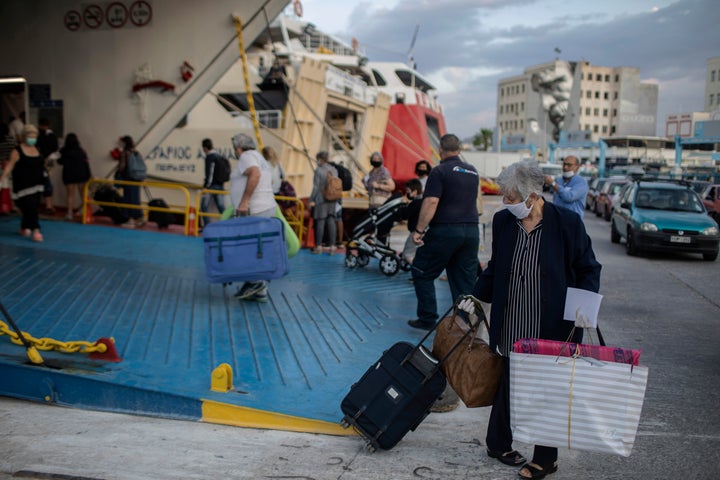
Greece’s low COVID-19 infection rate allowed the government to restart the summer holiday season three weeks earlier than previously planned. In addition to resuming ferries with new passenger limits, it allowed cafes and restaurants to reopen under new social distancing rules. All this, of course, was for Greek holidaymakers as foreign tourists aren’t expected until after June 15.

“We will implement exactly what the state has told us, whatever the doctors have told us, first and foremost for the safety of our customers,” said Spiros Bairaktaris, owner of an Athens restaurant that was reducing capacity from 100 customers to 30.

“Many will come to Greece because we had the fewest number of deaths compared to other countries. And thank God for that,” he added.

Passengers wearing mask to reduce the spread of the coronavirus board a ferry at the Piraeus port near Athens on Monday, May


Passengers wearing mask to reduce the spread of the coronavirus board a ferry at the Piraeus port near Athens on Monday, May 25, 2020. Greece restarted Monday regular ferry services to the islands as the country accelerated efforts to salvage its tourism season.(AP Photo/Petros Giannakouris)

Greece, which shut down quickly, has only 171 of Europe’s nearly 170,000 coronavirus deaths and depends on tourism for 10% of its economy.

Islands such as Santorini, Mykonos, Corfu and Samos are major draws for tourists but have been mostly off-limits since late March when the country’s lockdown took effect.

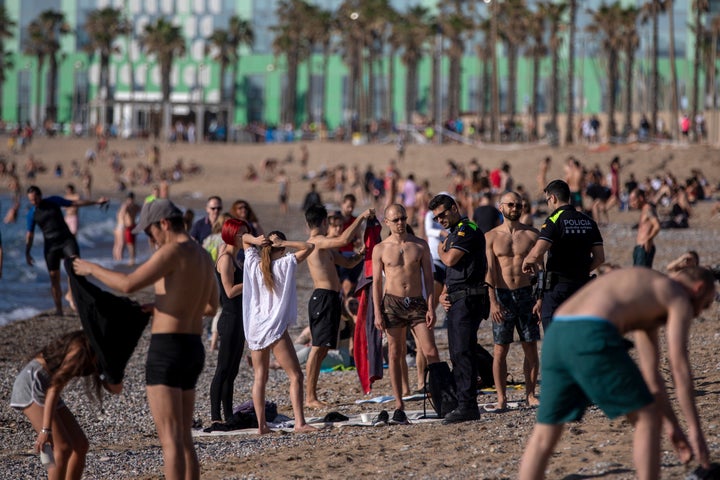
Hard-hit Spain reached a milestone Monday as half the population — including those in the two biggest cities, Madrid and Barcelona — were finally allowed to gather, albeit in limited numbers. Outdoor seating at bars and restaurants also reopened.

Madrid coffee bar owner Roberto Fernández said the mood was bittersweet.

“We are also a little sad today, as we have lost two of our more elderly regular customers,” Fernández said. “They use to come every day but now they have left us.”

Relaxations went a step further in the rest of Spain, where people can now visit beaches and nursing homes and hold weddings. Spain has recorded 28,700 virus deaths.

Police officers ask people to not sit while patrolling at the beach in Barcelona, Spain, Wednesday, May 20, 2020. (AP Photo/E


Police officers ask people to not sit while patrolling at the beach in Barcelona, Spain, Wednesday, May 20, 2020. (AP Photo/Emilio Morenatti)

But as lockdown restrictions were rolled back across Europe, fresh outbreaks were reported in a Czech coal mine and a Dutch slaughterhouse.

The Darkov mine near the Czech Republic’s border with Poland halted operations after 212 people — mostly miners and family members — tested positive for coronavirus. Testing was carried out on 2,400 people.

Meanwhile, an outbreak among 657 employees of a meat processing plant in the Dutch city of Groenlo has spilled over into Germany. Dutch authorities said Monday that 19 of the 147 employees who had tested positive live in Germany.

After seeing several coronavirus clusters among abattoir employees in Germany, the government has pledged to crack down on poor working conditions.

In Russia, infections topped 350,000 — the third highest in the world — as health officials reported 9,000 new cases and 92 new deaths, bringing the overall death toll to 3,633. Russia denies allegations that its death rate is suspiciously low, insisting that’s due to its effective containment measures.

As millions of Australian children returned to school, Queensland Premier Annastacia Palaszczuk said Monday that students and teachers had to observe one key message: Stay home if you are sick.

“We’re not out of the woods yet. We have to take each day as it comes, each week as it comes and we keep our fingers crossed that Queenslanders will continue to flatten that curve,” Palaszczuk said.

Chinese state media reported Monday that more than 6.5 million coronavirus tests were conducted in the city of Wuhan — the country’s virus epicenter — over a 10-day period in a bid to test all its 11 million residents.

No new COVID-19 cases have been reported since the 10-day campaign started, although some people with no symptoms tested positive. More than 3 million people had been tested prior to the campaign, the official Xinhua News Agency said.

Boaters and paddle boarders use a harbor Sunday, May 24, 2020, in Newport Beach, Calif. (AP Photo/Marcio Jose Sanchez)


Boaters and paddle boarders use a harbor Sunday, May 24, 2020, in Newport Beach, Calif. (AP Photo/Marcio Jose Sanchez)

The U.S. Memorial Day weekend saw tens of thousands of Americans head to beaches and parks, relieved to shake off some pandemic restrictions.

But Dr. Deborah Birx, coordinator of the White House coronavirus task force, said she was “very concerned” about scenes of people crowding together. In the Tampa area along Florida’s Gulf Coast, the crowds were so big that authorities closed parking lots to stem the flood. In Missouri, people packed bars and restaurants at the Lake of the Ozarks.

Officials in California said most people were covering their faces and keeping their distance as they ventured out. Many Southern California beaches were open only for swimming, running and other activities, not sunbathing.

At New York’s Orchard Beach in the Bronx, kids played with toys and people sat in folding chairs, wrapped up in sweaters and masks.

“Fresh air. Just good to enjoy the outdoors,” said Danovan Clacken.

Hadjicostis reported from Nicosia, Cyprus. Associated Press writers around the world contributed to this report.


Source by [author_name]

‘Hitler’s Alligator’ Dies In Moscow Zoo At The Age Of 84

An alligator named Saturn that survived a bombing raid on Berlin in World War II and was rumored to have once belonged to Nazi tyrant Adolf Hitler died at the Moscow Zoo on Friday. 

He was 84. 

The zoo said in a statement online that the alligator was a picky eater who loved a massage with a brush ― and was given the “the utmost care and attention.”

Saturn was born in the United States in 1936 and gifted to the Berlin Zoo “almost immediately,” the statement said. 

The Berlin Zoo was hit during several bombing raids in WWII and in 1943 was destroyed by one, killing many of the animals and releasing the others.

It’s not clear where Saturn went for the next three years.

In 1946, Saturn was gifted by British forces in Berlin to the Soviets, who delivered the gator to the Moscow Zoo. 

“Almost immediately, the myth was born that he was allegedly in the collection of Hitler, and not in the Berlin Zoo,” the zoo said in its news release. 

No direct connection to Hitler has ever been substantiated. 

The zoo said that even if the alligator had belonged to Hitler, “animals are not involved in war and politics, it is absurd to blame them for human sins.”

Guinness World Records says the oldest alligator in captivity is another WWII survivor, Muja, gifted to the Belgrade Zoo in Serbia in 1936. Muja was already an adult at the time and is believed to be possibly in his 90s. 

The Smithsonian said alligators in the wild typically live to the age of 50.


Source by [author_name]

Brian May Reveals He Was Recently Rushed To Hospital After Suffering A Heart Attack

Queen star Brian May has revealed he was recently rushed to hospital after suffering what he has described as a “small heart attack”.

Earlier this month, the acclaimed guitarist raised eyebrows when he revealed he’d suffered an injury to his buttocks that had left him in “relentless” pain.

However, in a new Instagram video, he admitted that he’d suffered a far more serious health scare “in the middle of the whole saga”.

“The rest of the story is a little more bizarre,” Brian explained. “A bit more shocking. Well, I was shocked because I thought I was a pretty healthy guy and everyone says ’you’ve got great blood pressure, you’ve got a great heart rate… but anyway, in the middle of the whole saga of the painful backside, I had a small heart attack.”

He continued: “I say small, it’s not something that did me any harm, it was about 40 minutes of pain in my chest and tightness and that feeling in the arms, and sweating, you kinda know, you’ve heard, ‘is this a heart attack?’.”

He was then driven to hospital by his doctor, where after an angiogram, he was then taken to a second facility as an emergency patient.

While some doctors told Brian he should undergo open heart surgery and a triple bypass, others told him he would need three stents put in his heart, opting for the latter.

The procedure, he noted, was a success, adding: “I thank them from the bottom of my heart. I think I’m in good shape for some time to come.

“I didn’t die, I came out and I would have been full of beans if it wasn’t for the leg… I was very near death because of this, but the pain I had was from something completely different. ’But I’m good, I’m here, and I’m ready to rock.”

In the video caption, he also joked about the Queen album Sheer Heart Attack, commenting: “I think I always worried a little bit about that album title. I wondered if it might upset some people who had actually had heart attacks.

“I’m actually quite relieved now that I’m in that club – and I don’t find it upsetting at all!”

Brian has been a member of Queen since the early 1970s, and continued to perform with the group and guest vocalist Adam Lambert, including earlier this year, where they recreated their iconic Live Aid set at a benefit concert for the Australian bushfires crisis.

In 2018, he was portrayed by Gwilym Lee in the biopic Bohemian Rhapsody, which earned a Best Picture nomination at the Academy Awards, despite a decidedly mixed reception from critics.


Source by [author_name]

Tas eyes fast-tracked infrastructure build

Tasmania is expected to next week unveil details of a fast-tracked infrastructure program aimed at kickstarting the state’s economy amid COVID-19.

State Treasury is examining the $3.7 billion program, announced last year, to determine which projects can be brought forward.

“I expect to announce the reprofiled construction and infrastructure program next week,” Premier Peter Gutwein said on Monday.

“This will be the first major step in our rebuild program.”

Projects include school and government building upgrades, affordable housing and roads.

An economic and fiscal update released by Treasury this month showed that instead of growing by three per cent, the state’s economy will contract by 1.75 per cent this financial year.

It also forecast an unemployment rate of 12 per cent in June and for the predicted $11 million 2019/20 budget surplus to become a $716 million deficit.

“We have rebuilt our economy once before when we first came to government in 2014,” Mr Gutwein said.

“We have had the most confident businesses in the nation and the most engaged community, and we will do it again.”

The state has gone 10 days without recording a new coronavirus case, with just 10 of 226 confirmed cases remaining active as of Monday night.

There are no active cases in the south and north, with all 10 in the northwest.

Restrictions on visits to aged care homes eased on Monday, bringing the state in line with the national standard of two people once a day.

Source by [author_name]