New York City EMS Workers Allege Retaliation After Speaking About Pandemic

0

New York City Fire Department paramedic Elizabeth Bonilla (center) wears personal protective equipment after an emergency call in April in the Bronx borough of New York City. Bonilla is suing the city for allegedly retaliating against her and other EMS workers who spoke to the news media about responding to the COVID-19 pandemic.

John Minchillo/AP


hide caption

toggle caption

John Minchillo/AP

New York City Fire Department paramedic Elizabeth Bonilla (center) wears personal protective equipment after an emergency call in April in the Bronx borough of New York City. Bonilla is suing the city for allegedly retaliating against her and other EMS workers who spoke to the news media about responding to the COVID-19 pandemic.

John Minchillo/AP

A group of New York City emergency medical service workers who gave interviews to the news media, including NPR, are suing the city for allegedly retaliating against them after speaking about their experiences responding to the COVID-19 pandemic.

In a federal lawsuit filed Wednesday with the federal court in Manhattan, four EMS workers allege the city is violating their right to speak on issues of public concern under the First Amendment, as well as their due process rights.

In late April, the New York City Fire Department sent letters notifying three paramedics — including Elizabeth Bonilla, who spoke to NPR earlier that month — that they were restricted from treating patients, according to the complaint. Workers on restricted status are not allowed to receive overtime or work for any other emergency medical services in the city’s 911 system. The letters, the complaint says, gave no reason why they were put under restrictions.

EMT John Rugen, a union officer of FDNY EMS Local 2507, was put on restricted status after the fire department first suspended him without pay for 30 days, claiming that he violated the FDNY’s social media policy and patient privacy laws without providing any evidence, according to the complaint.

The fire department referred NPR’s request for comment to the city’s law department, which declined to answer questions about why Rugen, Bonilla and the other EMS workers who filed the lawsuit were put on restricted status and if any other workers who have spoken to the media have been restricted.

“The FDNY respects the First Amendment rights of its employees but those rights must be carefully balanced to respect the privacy rights granted under the law to patients receiving emergency medical care,” Nicholas Paolucci, spokesperson for New York City’s law department, said in an email.

Paolucci also declined to answer NPR’s question about whether the city has received any complaints that the plaintiffs’ interviews disclosed any patient’s protected health information.

“We don’t litigate these matters in the press,” Paolucci added.

Terry Meginniss, one of the attorneys representing the EMS workers in the lawsuit, says any implication that they have not respected their patients’ privacy is “absolute hogwash.”

“If the fire department isn’t really motivated by its interest in stopping the union from publicizing what’s going on in the streets, then it would behoove the fire department to tell these individuals exactly what they think they did wrong and give them a chance to say something because these folks are the heroes of the city,” Meginniss says. “These are the people who go out and treat people, and they have been living through incredibly difficult times.”

All of the paramedics who filed the lawsuit are union members of Local 2507, which has been fielding interview requests from journalists during the pandemic to help promote the work of paramedics and EMTs as the union continues contract negotiations with the city.

“Every agency likes to take pride of itself. However, EMS is known to be the stepchild of the fire department,” says Oren Barzilay, the president of Local 2507 who is also among the lawsuit’s plaintiffs. “We always get the crumbs of the pie, so when we decided to do this campaign on our own, this is when it became a problem.”

Source link

Facebook Brings Back a Former Top Lieutenant to Zuckerberg

0

SAN FRANCISCO — Facebook said on Thursday that Chris Cox, a former top executive, was returning to the company as chief product officer.

Mr. Cox had left the social network in March 2019 over disagreements with Mark Zuckerberg, Facebook’s chief executive. In coming back as chief product officer, Mr. Cox, 37, who was previously at the company for more than a decade, will again become one of the highest-ranking executives at Facebook.

“Facebook and our products have never been more relevant to our future,” Mr. Cox said in a statement to his Facebook page announcing his return. “It’s the place I know best, it’s a place I’ve helped to build, and it’s the best place for me to roll up my sleeves and dig in to help.”

Mr. Cox is returning at a turbulent time for Facebook, which has been rocked by internal dissent over its recent decisions not to take any action on incendiary posts from President Trump. Facebook has also been under strain as the coronavirus pandemic has thrown its work force into overdrive to keep the site online as people flock to its services.

In his previous stint at Facebook, Mr. Cox also held the title of chief product officer. At the time, he was seen as a mitigating force to Mr. Zuckerberg internally, according to people who have worked with both executives, and was popular with many rank-and-file employees. Mr. Cox oversaw efforts around Facebook’s main app and its other apps, including Instagram, WhatsApp and Messenger.

Last spring, Mr. Cox and Mr. Zuckerberg disagreed on the future of the apps, including a “unified messaging” project intended to connect Facebook’s multiple apps. Mr. Zuckerberg wanted to tie the apps together more, while Mr. Cox was concerned about the difficulties of that effort. Mr. Cox later announced his departure.

The company continues to work on encrypting all of its messaging apps.

On his Facebook page, Mr. Cox said he reached out to Mr. Zuckerberg about a month ago as world issues — the pandemic, racial tensions and other issues — mounted.

“In the past month the world has grown more chaotic and unstable, which has only given me more resolve to help out,” Mr. Cox wrote. “Our most important decisions and products are ahead of us.”

Source link

Twitter uncovers state-backed networks linked to China, Russia, Turkey

0

Twitter said it removed 23,750 accounts “tweeting predominantly in Chinese languages and spreading geopolitical narratives favorable to the Communist Party of China (CCP), while continuing to push deceptive narratives about the political dynamics in Hong Kong” | Olivier Douliery/AFP via Getty Images

Earlier this week, the European Commission accused Moscow and Beijing of peddling disinformation.

By

Updated

Twitter permanently removed more than 32,000 accounts linked to three distinct operations attributed to China, Russia and Turkey violating the platform’s manipulation policies, the social media company said Friday.

Earlier this week, the European Commission accused Moscow and, for the first time, Beijing of peddling disinformation.

Twitter said it removed 23,750 accounts “tweeting predominantly in Chinese languages and spreading geopolitical narratives favorable to the Communist Party of China (CCP), while continuing to push deceptive narratives about the political dynamics in Hong Kong.” About 150,000 additional accounts were designed to amplify the content of the core network.

The Chinese network was caught early and failed to gain traction, Twitter said. Albeit new, the network’s activities were modeled after similar behavior spotted by the company in August last year.

With help from researchers and “peer companies,” Twitter uncovered 1,152 accounts associated with Current Policy, a media engaging in state-backed political propaganda within Russia, that promoted Vladimir Putin’s United Russia party and attacked political opponents. The network was suspended for “cross-posting and amplifying content in an inauthentic, coordinated manner for political ends.” Twitter declined to disclose the “peer companies.”

The U.S. social media platform also removed 7,340 accounts engaging in “coordinated inauthentic activity” targeted at users in Turkey. The network was used to “amplify political narratives favorable to the AK Parti, and demonstrated strong support for President [Recep Tayyip] ErdoÄŸan.”

Twitter archived the suspended accounts and shared data with the Australian Strategic Policy Institute (ASPI) and Stanford Internet Observatory (SIO).


Source by [author_name]

Vietnam Objects to China’s Undersea Cable Construction in Paracels

0

Vietnam objected Thursday to China’s recent reported laying of undersea cables in the disputed Paracel Islands, saying it was a violation of Vietnamese sovereignty.

The Foreign Ministry comment came as Vietnam deployed a coastguard vessel into another contested island chain in the South China Sea, the Spratlys, in apparent response to the presence of Chinese maritime militia around a Vietnamese outpost there.

In Hanoi, Foreign Ministry spokeswoman Le Thi Thu Hang was asked about a BenarNews report on Monday, also carried by Radio Free Asia, that a Chinese ship was laying or repairing undersea cables near Chinese outposts in the Paracels.

The reporting was based on commercial satellite imagery and vessel-tracking software, and was cited extensively by Vietnamese state media this week.

“Vietnam has sufficient historical evidence and legal grounds affirming its sovereignty over the Hoang Sa (Paracel) and Truong Sa (Spratly) archipelagoes in accordance with international law,” Hang told reporters, according to the state-run Vietnam News Agency.

“Therefore, any activity relating to the two archipelagoes conducted without Vietnam’s permission are violations of its sovereignty and of no value,” she said.

U.S.-based experts interviewed by RFA said the cable work suggested that China was installing an undersea surveillance system for its occupied features in the Paracels, further militarizing the region.

Vietnam and China both claim the Paracel Islands, a series of rocks and reefs in the north of the South China Sea.

Vietnamese coast guard enters disputed area

Meanwhile, RFA and BenarNews have detected that a Vietnamese coastguard vessel has entered the Union Banks, an area in the Spratlys that hosts four Vietnamese and two Chinese-occupied military outposts.

The coastguard vessel, identifiable as the CSB-8005 on vessel-tracking software and spotted on satellite imagery, entered the area on June 4 and is currently patrolling nearby the Vietnamese outpost on Sinh Ton Dong/Sin Cowe East Island.

It appears likely that the Vietnamese coastguard ship was sent to scare off Chinese maritime militia vessels. There has been a near-continuous presence of the maritime militia in the Union Banks area since March.

Satellite imagery shows what appears to be at least 30 Chinese fishing vessels located directly north of Sinh Ton Dong as of June 5, and vessel-tracking software indicates that at least five maritime militia ships are in the area too.

As of Thursday, the software showed the maritime militia were still in the Union Banks area, but had moved farther east.

In Union Banks, China occupies Johnson South Reef and Hughes Reef. Vietnam occupies Collins Reef, Sin Cowe Island/Dao Sinh Ton, Sin Cowe East/Sinh Ton Dong, and Lansdowne Reef.

China maintains it has “historic rights” to the entirety of the South China Sea,  a claim that Vietnam and others claimants strongly object to.


Source link

AI gladiators fight thousands of duels so we can learn how weaponry evolves in nature

0

Naturally occurring violence in the animal kingdom has fascinated scientists, military strategists, and stoned people watching the National Geographic channel for as long as humans have been observing it.

Understanding these systems – how and why animals fight – helps us to work out theories about the evolution of species. On the grand scale, it’s fairly easy to theorize that big critters, such as great white sharks and lions, eat little critters that can’t get away. But our theories become less certain when we’re dealing with less cut-and-dry displays of aggression.

We can assume a duel to the death between a shark and a seal will always end in either the seal’s death or escape – unless we postulate the shark is elderly and has a serious heart condition. But what happens when a seal fights a seal or a shark fights a shark? And, more importantly, in species that do regularly duel, how does the way these duels play out effect “survival of the fittest” and the evolution of that species?

Researchers from New Zealand and the US recently conducted a series of experiments using “cybernetic combatants” (StarCraft units) as a proxy for biological gladiators. They were trying to determine what role duels play in the evolution of “extreme weaponry.” Per the team’s research paper:

A current evolutionary hypothesis predicts that the most extreme forms of animal weaponry arise in systems where combatants fight each other one-to-one, in duels. It has also been suggested that arms races in human interstate conflicts are more likely to escalate in cases where there are only two opponents. However, directly testing whether duels matter for weapon investment is difficult in animals and impossible in interstate conflicts.

In other words: it’s really hard to study one-on-one animal violence at a scale that’s big enough to provide a representative amount of data. There’s ethical reasons against it: forcing animals to fight is an illegal practice in most civilized countries because creatures such as dogs and roosters can’t consent to such activity and don’t normally hold gladiator matches in the wild.

And there are also scientific reasons against creating animal-world pit fights. For starters, we can’t go around starting fights or forcing animals into situations where they’ll fight if we want to learn anything. If we’re altering the natural path a subject would take, we’re no longer studying evolution. And there’s little to be learned about a species if we only look at the data relevant to a single DNA iteration.

However some species do have a natural habit of fighting to the death in one-on-one battles – humans are one of them. Some creatures have duels for social or non-explicit reasons, such as when bucks lock antlers to determine mating status or nematodes rip each other apart just because they can. And others fight to the death for territory or food – spiders and pumas, for example. But these kinds of duels tend to be the exception in nature.

The reason it’s important to understand these systems is simple: the more we understand how arms races work, the better we’ll be able to understand the limits of binary thinking. As anyone who’s seen the classic 1983 film “War Games” knows, the only way to win an arms race is not to play the game.

Humans went from smacking each other on the heads with sticks to mutually assured destruction via global thermonuclear detonation in a relatively short amount of time, so we’re not a very good test case. Also, we don’t tend to glorify one-on-one death matches anymore.

The researchers used StarCraft to get around this problem. The real-time strategy game is popular among AI researchers because, just like AI models, you can tweak the game’s units’ parameters and then run simulations until your heart’s content.

To test out the evolutionary theory that duels play a significant role in how animal species evolve natural weapons, the team gave certain units combat advantages. According to the researchers:

We found that combatants with experimentally improved fighting power had a large advantage in duels, but that this advantage deteriorated as the complexity of the battlefield was increased by the addition of further combatants.

This indicates, experimentally at least, that the underlying binary systems responsible for such evolutionary paradigms are severely limited in their ability to influence outcomes beyond the individual level. In other words: individual units with superior weaponry found their advantages nullified once duels became multi-front engagements. The researchers believe this systemic review could provide insight in myriad related domains:

Because our results arose in a non-biological system, they suggest that duels may feed arms races not only in the context of exaggerated weaponry and animal contests but also in other systems as well. These might include evolutionary arms races such as those between parasites and hosts, or arms races in non-biological systems such as human technology, business, military escalation, trade wars or cyber warfare.

It’ll be interesting to see where this research goes. We live in a world where everything is an arms race and success is measured at the individual level. This forces us into a binary “first or last” model where the impetus is on finding the fastest solution to any given problem, not necessarily the one that provides the greatest good.

Maybe it’s time to shift our collective focus away from building the next bigger, better, binary machine and into developing quantum computing systems that can see solutions humans and classical AI can’t.

H/t: Anthony Cuthbertson, The Independent

Published June 11, 2020 — 20:53 UTC


Source link

#EIB approves €7.5 billion for #COVID-19 response and investment in health, private sector, clean transport, education and energy

0

#EIB approves €7.5 billion for #COVID-19 response and investment in health, private sector, clean transport, education and energy

#EIB approves €7.5 billion for #COVID-19 response and investment in health, private sector, clean transport, education and energyThe European Investment Bank today (11 June) approved €7.5 billion of new financing for projects across Europe and around the world. This includes investment to improve public health, hospital and elderly care facilities and dedicated new business lending programmes to support sectors most impacted by the COVID-19 pandemic.

Meeting by video conference the EIB Board also approved support for renewable energy, energy efficiency and biogas, and new clean transport investment.

“The COVID 19 pandemic makes support for the public health sector and business desperately urgent,   and the EIB Group is responding without delay. At the same time we continue to support a green recovery of the European economy. Sustainability and the fight against global warming remain priorities for the EU Bank. I was glad to receive support from the EIB governors, the EU finance ministers, earlier this week for this combination of crisis response and long-term investment into a green and digital future. Europe needs a sustainable recovery. The EIB Group is discussing with EU member states how to step up its efforts even further, as proposed by the European Commission,” said European Investment Bank President Werner Hoyer.

€3.2bn backing for public health and business investment

The Board approved €3.2bn of new financing to support private sector and public health investment.

This includes targeted credit lines in Spain, Mexico, Uzbekistan, the Maldives and through regional initiatives with partners across Africa to help companies in sectors most impacted by the COVID-19 pandemic, a climate action business financing programme in Greece and financing for innovative companies in Italy.

New hospital and health-care financing approved today will support the emergency response to COVID-19 in Spain and Portugal, and construction of a new hospital and improvement of existing intensive care facilities in Antwerp. The EIB also agreed to finance a new programme to improve care facilities for elderly people across Portugal.

The Board also approved a regional initiative to strengthen the public health-care response to COVID-19 in Morocco, Tunisia, Egypt and Jordan, as well as Moldova, Belarus and Uzbekistan.

€1.5bn for clean transport and improving electric vehicle charging

Commuters and travellers across Europe will benefit from improved air quality and more sustainable transport following EIB support for new rail, electric car and public transport investment agreed today.

The Board approved financing for new regional trains in Baden-Württemberg in Germany and investment in the Spanish high-speed rail network, alongside a new financing programme to accelerate use of zero emission hydrogen and electricity powered buses across the Netherlands.

New EIB financing to expand the network of electric vehicle charging stations in Spain and Portugal will encourage adoption of electric cars in the two countries.

Scaling up use of renewable energy and ensuring security of energy supply

Two new projects approved today will help to increase the use of renewable energy in France through support for small-scale renewable energy schemes and biogas technology.

The EIB Board also approved financing for a new cross-border gas interconnector between Serbia and Bulgaria and a gas import facility in Cyprus.

Supporting energy efficiency in urban development and social housing

Thousands of families will benefit from EIB backing agreed today for more than 1,500 new near zero emission affordable homes in towns across France and improvements to district heating in the Lithuanian city of Kaunas.

The Board also backed financing for the construction of near zero energy office buildings in Latvia.

Improving higher education and research

Future generations of students and researchers will benefit from redevelopment at University College Dublin and higher education institutions across Romania, along with new EIB financing for three new specialist oceanographic climate research ships in Italy.

Video

Background

The European Investment Bank (EIB) is the long-term lending institution of the European Union owned by its member states. It makes long-term finance available for sound investment in order to contribute towards EU policy goals.

Overview of projects approved by the EIB Board

Overview of projects approved by the EIB Board of Directors following positive assessment by the EFSI Investment Committee


Source by [author_name]

Bringing sea otters back to the Pacific coast pays off, but not for everyone

0

Sea otters are staging a comeback
along Canada’s North Pacific coast, but not everyone is happy about it.

The disappearance of otters, once trapped for their fur, allowed their food supplies — sea urchins, crabs and clams — to flourish. Now, otters threaten to deplete these profitable invertebrate fisheries, which have sustained coastal indigenous communities. But a new analysis shows that the benefits of bringing back otters may outweigh those costs, researchers report June 11 in Science.

With more otters and thus fewer kelp-grazing urchins, kelp forests can thrive, storing carbon and sheltering salmon, ling cod and other fishes. Plus, tourists will pay to snap photos of adorable otters snoozing on beds of kelp. In all, such increased sources of revenue could total $46 million Canadian dollars (equivalent to nearly $34 million in U.S. dollars on June 11) a year if sea otters fully recover along Canada’s Pacific coast, the study suggests.

Sea otters, which can grow as big
as a medium-sized dog, were common from the Baja Peninsula to the Aleutian
Islands of Alaska until the fur trade of the 18th and 19th centuries nearly
wiped them out. As top predators in coastal ecosystems, these furry floaters gobble
down a quarter of their body weight in urchins, crabs and clams each day.

Safe from the capable paws of otters,
urchins and other invertebrates ballooned along the Pacific coast, both in body
size and number, enabling profitable invertebrate fisheries and sustaining many
First Nations communities that rely on this resource for food.

Since being reintroduced in the 1970s, this population of sea otters (Enhydra lutris) has grown from just thousands to about 150,000 by 2019, gradually reclaiming parts of their range and radically transforming these ecosystems. The otters’ resurgence comes at a significant cost — $7.3 million Canadian dollars a year — to the humans who depend on the otters’ prey, especially indigenous communities, which weren’t consulted in reintroduction plans. Rooted to the coasts they’ve inhabited for centuries, these communities, some of which are 50 kilometers from the nearest grocery store, can’t always easily shift to another source of food or business.

But the otters also affect positive
change, too. It can be difficult to compare the clear loss of shellfish stock
revenue to the more diffuse benefits of having more kelp and sea otters, says
Inge Liekens, an environmental economist at Vito, a research institution in
Mol, Belgium who wasn’t involved in the study.

“It’s easy to just focus on the
negative, but this study does a good job broadening the view and incorporating
biological, economic and social factors,” she says, and relating them to a common
currency: money. Their framework is applicable to other ecosystems too, she
says. “But some losses are emotional or cultural, and you can’t put those in
the numbers.”

To tally benefits and losses in
otter-free versus otter-full sites, the researchers compared total biomass, the
sheer amount and diversity of biological material present. “The best-known
effect of sea otters is an increase in kelp,” says Jane Watson, a marine
ecologist at Vancouver Island University in Nanaimo. Kelp forests were on
average 20 times larger in areas where sea otters have lived for decades on
Vancouver Island, compared with bays where the otters were absent, Watson and
her colleagues found. With fewer urchins, different kinds of kelp could thrive,
creating a more diverse and resilient forest.

Robust kelp forests boost the
overall productivity of the ecosystem by providing shelter and food to a whole
host of organisms, including commercially valuable finfish like halibut and
rockfish. Overall, biomass was 37 percent higher where sea otters thrived.
Urchin, Dungeness crab and clam biomass fell when otters were present, but
these losses were offset by gains in fish and other invertebrates that rely on
kelp.

Using these biological data, the
researchers developed a statistical model to estimate the range of possible
payoffs of having otters around for fisheries, carbon sequestration and
tourism. The team found that with the full recovery of sea otter populations
along the Canadian Pacific coast, an increase in commercial fish such as salmon
and halibut could provide $9.4 million Canadian dollars annually, while additional
carbon stored by kelp forests equates to about $2.2 million Canadian dollars per
year, based on European carbon market pricing. 

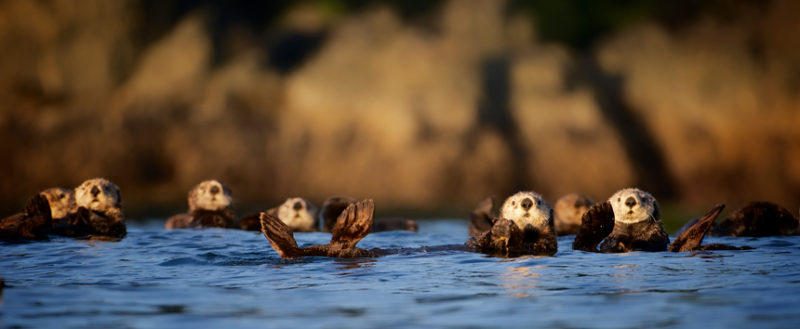
A raft of sea otters floats along the west coast of Vancouver Island, British Columbia. Sea otters don’t have much blubber, so to keep warm they must eat a quarter of their body weight each day.James Thompson Photography

The biggest monetary payoff from
sea otters was from increased tourism. The researchers combined park visitation
data with surveys detailing people’s willingness to pay to see otters, and estimated
that otter-dominated ecosystems could generate an additional $41.5 million
dollars a year in tourism revenue.

Of course, there is a lot of
uncertainty around these estimates. Tourism can dry up due to unforeseen events
(like the COVID-19 pandemic). And
market prices for fish can change with demand. But the researchers present a
range of possible futures, and in all scenarios, the benefits outweigh the lost
revenue from shellfish harvesting. 

This study represents “a beacon of
hope,” says coauthor Kai Chan, a conservation scientist at the University of
British Columbia in Vancouver. “It shows that when people invest in restoring
ecosystems, including by restoring top predators like sea otters, it can have
large positive benefits for people,” though he and his colleagues acknowledge
that those benefits won’t always be shared equally.

“This is a beautifully done study,” says Anne Salomon, a marine ecologist at Simon Fraser University in Burnaby, Canada. But she notes it doesn’t factor in the effects of climate change, which threatens kelp forests with more frequent and intense ocean heat waves (SN: 4/10/18). Nor does it account for the deep history between sea otters and First Nations communities. For thousands of years, sea otters enabled rich kelp forests in some areas, and indigenous communities managed productive shellfish beds through traditional hunting practices. The researchers “start from this assumption that historically the coasts weren’t exploited, but that’s not the case,” she says.

Moving forward, “indigenous
communities need to have the collaborative authority with federal governments
to manage their relationship with sea otters,” Salomon says, which could lessen
the costs for indigenous communities. “Incorporating traditional knowledge can
help us maintain resilient otter and kelp populations as well as shellfish
fisheries,” she says. “We can have both.”

Source link

Whichever way you slice it, golden papaya is a healthy fruit

0

Papaya – or pawpaw as it is called in South Africa – is a fruit rich in Vitamin C and it has many other health benefits as well. In fact, there are many reasons to indulge in a slice of two of sweet, juicy papaya this winter.

A delicious and healthy tropical fruit, papaya is rich in antioxidants that can help to fight disease and inflammation.

Nine health benefits of papaya:

1. Lowers cholesterol

Papaya is rich in Vitamin C and fibre as well as antioxidants that can help to prevent cholesterol build-up in your arteries. Bad cholesterol can lead to heart disease, so eating papaya may help to reduce the risk of heart attacks and hypertension. Vitamin C is good for your immune system which helps to protect the body from illnesses.

2. Weight loss

Because papaya is low in calories and rich in fibre it will leave you feeling fuller for longer so you may not feel the urge to snack as much.

3. Great for your eyes

Papaya is rich in Vitamin A which helps to protect your vision from degenerative eye conditions like macular degeneration.

4. Improves digestion

Eating papaya daily improves digestion and can add to the relief of constipation and other symptoms of painful irritable bowel syndrome, also known as IBS.

5. Protects against skin damage

Papaya can help your skin to look toned and youthful. The plentiful vitamin C and lycopene in papaya may defend your skin from developing wrinkles as well as help combat sun damage. Papaya can also be mashed and applied to burn wounds to prevent infection and to promote healing.

6. Promotes bone health

Papaya is a great source of vitamin K which promotes calcium absorption, which in turn is needed for  stronger and healthier bones.

7. Good for diabetics

Papaya is a suitable choice for diabetics as it contains lots of fibre yet has a relatively low sugar content, which may lead to more stable blood sugar levels.

8. Promotes hair health

The Vitamin A found in papaya is great for keeping your hair in good shape. This vitamin is also necessary for the growth of other body tissue such as your skin.

9. Anti-inflammatory

The vitamins and antioxidants in papaya can also work to prevent chronic inflammation.

When you are next looking for fresh fruit, remember these nine benefits. A slice of this golden fruit is good for your skin and hair, promotes digestion, treats constipation, promotes bone health and can help to prevent heart disease. What’s not to love about healthy and tasty papaya?


Source link

Hollywood Celebs Get Dragged For Cringeworthy Anti-Racism Video

0

An anti-racism video featuring 14 Hollywood celebrities may have done the impossible and brought together a divided nation.

Of course, the reason people are coming together is to make fun of the video, which, while it makes valuable points, is chock full of actors acting “actorly” in a manner that The Daily Beast called “cringeworthy.”

The public service announcement is titled “I Take Responsibility,” and features appearances from white celebrities like Sarah Paulson, Aaron Paul, Kesha, Kristen Bell, Justin Theroux, Debra Messing, Bryce Dallas Howard, Julianne Moore and Stanley Tucci.

The celebrities, all filmed in black and white, then recite the following:

I take responsibility for every unchecked moment, for every time it was easier to ignore than to call it out for what it was. Every not-so-funny joke. Every unfair stereotype. Every blatant injustice no matter how big or small. Every time I remained silent. Every time I explained away police brutality or turned a blind eye.

I take responsibility. Black people are being slaughtered in the streets. Killed in their own homes. These are our brothers and sisters. Our friends. Our family. We are done watching them die. We are no longer bystanders; we will not be idle. Enough is enough.

The script’s good intentions are muted by its reliance on cliches meant to lend gravitas.

You know they’re serious because the video is in black and white. You know they’re serious because it’s a montage. You know they’re serious because they pointedly repeat phrases like “I take responsibility” and “I stand against hate.”

Oh, and because Paulson is wearing thick glasses, the website added.

Although the video may have been well-intentioned, the “performative” nature reminded many people of the celebrity-filled and much-maligned “Imagine” video actor Gal Gadot created at the start of the COVID-19 lockdown earlier this year.

Naturally, Twitter users took responsibility for their own reactions to the PSA.

Some people pointed out the celebrities in the video had other options besides making cringeworthy PSAs.


Source by [author_name]

Inmate ‘threatened to kill PM and eat Theresa May’

0

Image copyright
Getty Images

Image caption

The court heard a letter sent to Boris Johnson stated: “I’m going to kill you and your girlfriend”

A prisoner threatened to eat former prime minister Theresa May’s corpse, kill Boris Johnson and bomb an MP on behalf of “Jihadis of England”.

Rakeem Malik had admitted sending the threats in letters to the current and former prime ministers and West Lancashire MP Rosie Cooper.

The 52-year-old also threatened Birmingham Yardley MP Jess Phillips, Birmingham Crown Court heard.

Malik, already in jail for attempted murder, is due for sentence on 18 June.

The HMP Birmingham inmate admitted last month to four counts of making threats to kill and four of malicious communication.

He is said to have a psychopathic sub-type of anti-social personality disorder, the court heard.

Image caption

Jess Phillips and Rosie Cooper were also targeted

Prosecutor Simon Davis said a letter destined for Mrs May – MP for Maidenhead and then prime minister – was received at the Cabinet Office in September 2018.

It stated, he said: “Jihadis of Britain are going to kill the police at the gates. Then I’m going to kill you and then eat your corpse.”

The letter and another addressed to her were not delivered to Mrs May personally, the court heard.

It emerged an envelope franked in Birmingham was opened at Ms Cooper’s office in May last year, which stated: “You will die the same way as Jo Cox.”

The letter also made a rape threat towards Ms Cooper, who had previously been the target of a murder plot by a neo-Nazi terrorist.

A threat to put a bomb in her car made her feel “very scared”, Mr Davis said.

‘Rantings of disturbed individual’

Within days of Malik being charged with six of the offences in December 2019, two further letters sent by him were intercepted at HMP Birmingham, including one addressed to the prime minister.

The court heard the letter sent to Mr Johnson stated: “I’m going to kill you and your girlfriend. I’m going to blow you both up.

“I’m going to do it by Christmas.”

Andrew Jackson, for the defence, said Malik – who is registered blind – described the letters as “the rantings of a disturbed individual who frankly wallows in attention seeking”.

Mr Jackson added: “He is a physical wreck – he is a 52-year-old diabetic with heart disease and asthma.”

Malik is serving a life sentence imposed in 1999 for the attempted murder of his “cell-mate” at Merseyside’s Ashworth high security hospital.

He had previously been convicted of possessing an offensive weapon, indecent assault and assaulting a police officer.

Follow BBC West Midlands on Facebook, Twitter and Instagram. Send your story ideas to:


Source link