‘The last thing we need right now’: States, cities hemorrhage jobs

0

“These layoffs are happening as we speak,” Murphy said. “It’s not theoretical.”

Many of these municipal and state layoffs are disproportionately affecting black Americans, adding pressure on Congress to act as protests over racism and police brutality roil the country. The public sector employs a higher proportion of black workers than other U.S. industries do, and its decline explains in part Friday’s jobs report, which showed that while the unemployment rate declined overall, it continued to tick upward for black workers.

“African Americans tend to have those kinds of jobs that are the service jobs where they’re going into work and risking their lives every single day, and then going back home and risking their families’ lives,” said Lee Saunders, president of the American Federation of State, County and Municipal Employees union. The government “has historically been one of the most dependable employers of African Americans.”

“So those who are getting laid off disproportionately are African American, and they’re going to be hurt the most.”

Congress allocated $150 billion to state and local governments under the CARES Act in March, but officials were restricted in how they could spend it, permitted to use it only for coronavirus-related costs rather than to cover budget shortfalls due to a loss of tax and fee revenue. The National Governors Association, composed of both Democrats and Republicans, has for two months now been calling for an additional $500 billion in flexible aid and for a loosening of restrictions on the CARES Act funding, but lawmakers have yet to act.

House Democrats set aside at least $915 billion in state and local aid in the HEROES Act they passed in mid-May, only for Senate Majority Leader Mitch McConnell to dismiss it as a “laundry list of pet priorities.” More recently, McConnell told Fox News his chamber “may later do more” to help states by allocating aid but that he wants to wait and see how things are looking after more of them begin to open up. Some conservative lawmakers have made clear they have no interest in providing further aid, arguing that would simply reward primarily Democratic-led states that have, in their minds, mismanaged their budgets.

“We’re just seeing so much incompetence in blue state management, it’s going to be hard to make the case to any Republican that for some reason people in Utah should pay for Bill de Blasio’s incompetence,” said Stephen Moore, a conservative economist and outside adviser to the White House, referring to the mayor of New York City. He advocated instead for states to quickly reopen their doors so they can start collecting tax revenue.

In the meantime, negotiations on the Hill are essentially at a standstill.

“There’s no serious conversation happening,” Sen. Chris Van Hollen (D-Md.), who serves on the Appropriations Committee, said of state and local aid. “There should be, but Senate Republicans are slow-walking this process.”

“Maybe they’re trying to figure out what they want,” he added. “There doesn’t seem to be any consensus.”

Governors and mayors are urging Congress not to delay sending aid that is sorely needed. “The timeline is now,” said Teryn Zmuda, chief economist at the National Association of Counties.

Should layoffs continue on their current trajectory, they could lead to a dramatic cutback of essential services at a time when they are in greater demand than ever.

“You will see disaster occur if in fact there are continued layoffs in the public sector,” Saunders said, listing health, education and sanitation services as some that will see major cutbacks without additional aid.

And in many cases, the populations benefiting from those services are communities of color that the pandemic has already hit hardest.

Source link

Cambodia’s Top Rights Body Wants Tariff-Free EU Trade, But Won’t Budge on Political Reforms

0

Cambodia’s top human rights body said Wednesday that the country does not want to lose preferential trade status in the European Union but is unable to comply with the bloc’s requirements on rights reforms to retain those privileges, citing its status as a sovereign nation.

The EU in mid-February announced plans to suspend tariff-free access to its market under the “Everything But Arms” (EBA) scheme for around one-fifth of Cambodia’s exports, citing rollbacks on human rights—a decision that would reinstate taxes on garments and footwear beginning Aug. 12, unless it is overturned by the bloc’s governments or its parliament.

The suspension, which Prime Minister Hun Sen has shrugged off and called an attack on Cambodia’s sovereignty, will result in a loss of around U.S. $1.1 billion of the country’s annual U.S. $5.8 billion in exports to the bloc, some 75 percent of which are made up of clothing and textiles.

On Wednesday, Cambodian Human Rights Committee Deputy President and Ministry of Justice spokesman Chhin Malin told RFA’s Khmer Service that Cambodia does not want to lose EBA status and that the government is “negotiating” with the bloc to ensure it maintains full EBA status.

However, he said that Cambodia cannot fully comply with EU’s requirements, especially those related to human rights and political issues.

“Cambodia will continue to cooperate with the EU Commission to resolve the EBA issue,” he said.

“Cambodia will continue to maintain its position of implementing the law and maintain its sovereignty and will not exchange them for aid.”

Chhin Malin said that “different people have different assessments” on human rights issues in Cambodia based on their political preferences, suggesting that his government would not bow to demands over how the country should be run.

He did not provide any details on negotiations or how Cambodia might expect to sway the EU on its decision to withdraw EBA status without instituting reforms.

While the coronavirus outbreak has thrown production for Cambodia’s key garment industry into disarray, factories and workers have endured a significant economic hit amid a decline in orders from buyers in the EU anticipating a return to tariffs on some Cambodian imports when trade status is withdrawn.

Government to blame

Ath Thon, president of the Cambodian Labour Confederation, told RFA that if the government of Cambodia had positively responded the EU Commission’s recommendations during an earlier assessment period, they would not be in danger of losing trade preferences on 20 percent of its exports.

He acknowledged that Cambodia had improved some issues—such as the rights of workers, the indigenous population, and land ownership—but crucial requirements, including the status of political rights, remain unchanged.

“As a union, we want the government to resolve all of the issues recommended by the EU,” he said.

Among the reforms the EU has called for is the reinstatement of the opposition Cambodia National Rescue Party (CNRP), which the Supreme Court banned in November 2017 for its role in an alleged plot to topple the government.

The move to ban the CNRP was part of a wider crackdown by Hun Sen on the political opposition, NGOs, and the independent media that paved the way for his ruling Cambodian People’s Party (CPP) to win all 125 seats in parliament in the country’s July 2018 general election.

Am Sam Ath of the Cambodia-based human rights group Licadho told RFA that there had been little improvement of human rights or political rights since the EU announced its decision in February.

He expressed concern that if the situation in Cambodia continues to deteriorate, the country will lose EBA status on all of its exports to the EU.

“The EU has [announced plans to] partially withdraw the EBA because of the CNRP dissolution and persecution,” he said.

“Currently, we have observed that arrests have resumed. I am concerned that the EU will remove full EBA status if the government does not restore democracy and respect for human rights.”

Since the beginning of the year, nearly 20 CNRP opposition officials or activists have been arrested and thrown in prison—most without arrest warrants.

During the same period, 17 former and active CNRP officials and supporters have been the victims of assault by unidentified men, and police have yet to make any arrests in the cases.

Call for postponement

Chhin Malin’s comments came after the Garment Manufacturers Association in Cambodia (GMAC) issued an open letter to the EU Commission and other European stakeholders last week calling for a one-year postponement to the EBA withdrawal, citing the economic impact of the coronavirus pandemic that has infected 126 people in Cambodia since March, according to official statistics.

GMAC said that some 250 companies making apparel, footwear, and travel goods have been forced to suspend operations because of the outbreak, while others are operating at reduced capacity, leading to layoffs for around 130,000 workers—most of whom are women.

While there was a significant drop off in orders in the first quarter of 2020, the manufacturer’s association said that it expects a decline in sales for the three industries to fall by 50 to 60 percent, year over year, in the second quarter, putting “hundreds of thousands” at risk of job loss and “millions” under the threat of a return to poverty.

Furthermore, it warned, a return of tariffs would encourage buyers to turn their business to other producers in the region that still benefit from the EBA scheme, while undermining improvements in labor rights and working conditions Cambodia has achieved in partnership with stakeholders such as the International Labour Organization.

China trade deal

Cambodia could find some relief from any burden that comes with withdrawal of EBA status if it inks a free trade agreement with China, which the Chinese Embassy in Phnom Penh said in a Tuesday statement posted on its Facebook page had reached a third round of negotiations.

“The trade deal agreement to be signed between Cambodia and China will be implemented according to a consensus of the two countries’ leaders and will promote the joint destiny of Phnom Penh and Beijing,” the statement said, without providing further details.

No date has been set for the finalization and signing of the agreement, which is expected to come “later this year.”

Cambodia’s Ministry of Commerce also issued a statement Tuesday detailing a teleconference between Minister Pan Sorasak and Yang Zhengwei, deputy director-general of the Department of International Trade and Economic Affairs under China’s commerce ministry.

“Negotiations focused on opening markets for products, services, investment, and economic cooperation, while boosting imports from Cambodia and attracting more investment,” the statement said, adding that the agreement is expected to boost trade between the two countries well beyond the average growth rate of 20 percent over the past three years.

Commerce ministry spokesman Seang Thai confirmed that no schedule has been set to sign the deal, adding that the two sides are “negotiating to reduce taxes for certain products.”

News of the negotiations came on the same day that Cambodia’s Ministry of Agriculture announced it had signed an agreement with China to export mangoes, which Hun Sen said in a statement posted to his Facebook account is “a good sign for farmers and investors concerned over reduced demand and low prices.”

Agricultural expert Yang Saing Koma told RFA that Cambodia’s government should be wary of signing any deals with China, particularly ones that he warned could negatively impact small and medium Cambodian enterprises and the agricultural sector.

“I welcome free trade, but we must be prudent,” he said, recommending that Cambodia ensure any such deal be “balanced.”

“We must also maintain local capacity to compete in the free market.”

Trade between Cambodia and China has steadily increased from U.S. $5.16 billion in 2016 to just over U.S. $6 billion in 2017 and U.S. $7.4 billion in 2018, according to government figures. The two countries aim to reach U.S. $10 billion in bilateral trade annually by 2023.

Reported by RFA’s Khmer Service. Translated by Samean Yun. Written in English by Joshua Lipes.


Source link

NASCAR bans Confederate flag from its races

0

“The presence of the confederate flag at NASCAR events runs contrary to our commitment to providing a welcoming and inclusive environment for all fans, our competitors and our industry,” NASCAR said. “Bringing people together around a love for racing and the community that it creates is what makes our fans and sport special. The display of the confederate flag will be prohibited from all NASCAR events and properties.”

The move was announced before Wednesday night’s race at Martinsville Speedway where Wallace, an Alabama native, was driving a Chevrolet with a #BlackLivesMatter paint scheme. Wallace got a shoutout on Twitter from several athletes, including NBA star LeBron James, for using the paint scheme in the race.

The flag issue has been a thorny one for NASCAR. Former chairman Brian France in 2015 tried to ban the flying of Confederate flags at race tracks, angering many fans.

NASCAR did not address how it would enforce the policy or indicate any penalties for fans who violate it by bringing the Confederate flag to the track. NASCAR has not raced with fans since the sport resumed last month amid the pandemic and was expected to have minimal fans allowed at races this month in Florida and Georgia.

Confederate flags still fly high atop infield RVs and are waved by fans in the grandstands at most tracks. NASCAR has been more open in recent times to the eradication of the Confederate flag. Several drivers — including two-time Daytona 500 champion Denny Hamlin — said they supported Wallace in his quest to rid the sport of the flag.

The predominantly white field of drivers united over the weekend for a video promoting social change. A black NASCAR official, Kirk Price, took a knee before Sunday’s race near Atlanta in what may have been a first for the series. Wallace wore a black T-shirt with the words “I Can’t Breathe” at the race.

Source link

George Floyd: Complicated life, notorious death

In the Houston housing projects where he grew up, George Floyd was respected as a man who spoke from hard, but hardly extraordinary, experience. He had nothing remotely like the stature he has gained in death. (June 10)


Source link

Premiership Rugby players may strike over salary cap reduction

0

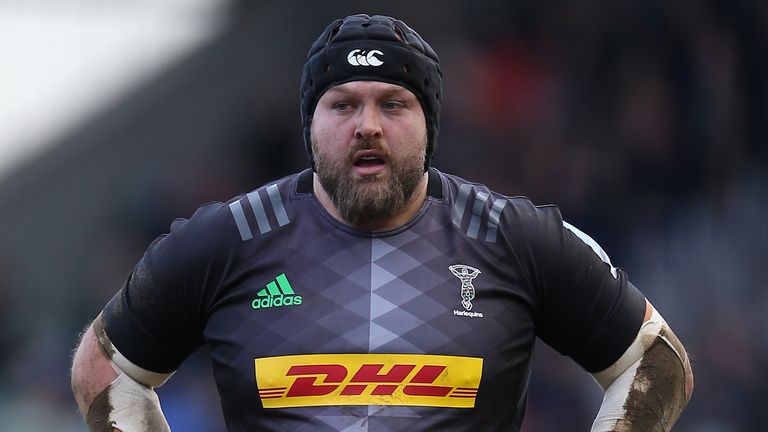
RPA chairman Mark Lambert: “We very much see it [a strike] in any walk of life as the last action…but it’s difficult for us to entirely rule out any options.”

Last Updated: 10/06/20 10:51pm


Harlequins prop Mark Lambert says the Rugby Players’ Association cannot rule out strike action over the salary cut reduction

Premiership players could go on strike over contractual issues arising from the reduction of next season’s salary cap by more than 20 per cent.

Premiership Rugby has confirmed clubs unanimously voted to cut the cap on senior wage bills from £6.4m to £5m from the start of the 2021-22 season, before being restored to current levels by the 2024-25 season at the latest.

The measures were taken to help clubs weather the coronavirus crisis but Rugby Players’ Association (RPA) chairman and Harlequins prop Mark Lambert says some of his members are being “strong-armed” into accepting reduced contracts as a result, and could not rule out players withdrawing their labour.

1:09
Mark Lambert, chairman of the Rugby Players Association says players are being forced into signing deals ahead of a deadline next Thursday against their will.

Mark Lambert, chairman of the Rugby Players Association says players are being forced into signing deals ahead of a deadline next Thursday against their will.

“We don’t see that [strike action] as an optimum outcome for anyone, certainly not for players, but players are also not obliged to accept changes to their contracts,” Lambert told Sky Sports News reporter James Cole.

“The clubs require their agreement to make any changes to their salaries or terms of their contracts.

“So if they force that through without a player’s agreement, then that is a breach of contract and players need to be aware of where they stand from a legal point of view.

“It’s not our intention to move to strike action because there are obviously downsides to that for players as well.”

Lambert also pointed to a breakdown in communication between players and the league.

1:14
James Cole reports that while Premiership clubs have clarity with a plan to restart the season on August 15, there are still many questions to be answered over the schedule

James Cole reports that while Premiership clubs have clarity with a plan to restart the season on August 15, there are still many questions to be answered over the schedule

“Our attitude has been to be very open to a collective, collaborative consultation on how to get through this [the coronavirus pandemic],” he added.

“Now players are essentially being strong-armed into signing amendments to their contracts and being made to feel they have no option but to do that, and that’s very much not the case.”

LISTEN: The Curry twins on Will Greenwood’s podcast

Sale Sharks stars Tom and Ben Curry join Will and Rupert to discuss being identical twins, England and their all-time back row.

Premiership players have already undertaken 25 per cent wage cuts during the coronavirus lockdown, and face the prospect of the reductions being made permanent under the new arrangement.

The salary cap reduction was agreed partly as a consequence of a review by Lord Myners, commissioned by Premiership Rugby, in the wake of the breaches by Saracens.

Myners’ review found the current level of the cap to be broadly unsustainable, with only one Premiership club recording a profit last season, and called for tougher sanctions for clubs breaching the limit in future.

On top of the new £5m ceiling, clubs are able to nominate two players whose salaries fall outside the total, but this will reduce to one from 2022-23.

Clubs will still be able to spend an extra £600,000 on homegrown players and have no restrictions on homegrown academy players.


Source link

Georgia’s Primary Election Was A National Scandal

0

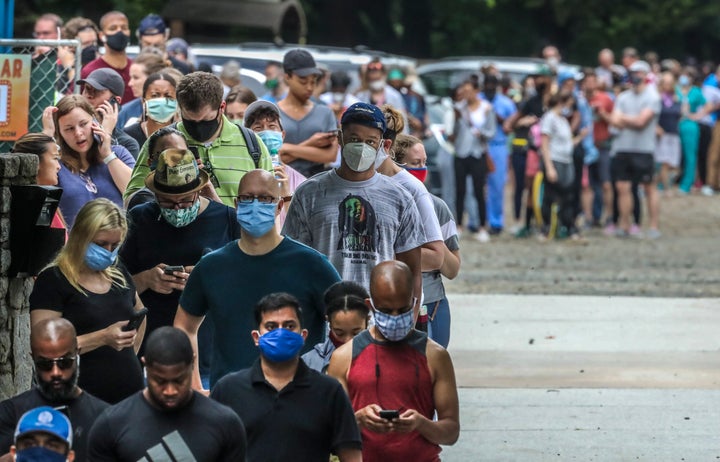
Thousands of Georgia voters waited for up to seven hours in lines that stretched blocks during the state’s primary election on Tuesday, and many left before voting.

The state’s new voting machines did not work, because of either mechanical failure or poor training of poll workers. Many voters came to wait in line after failing to receive absentee ballots they requested to avoid the in-person threat of coronavirus. And many voters left the lines without having cast their ballots.

The worst problems were concentrated in counties and localities with higher Black populations.

Even for a state marred by a recent history of malice and incompetence in its administration of elections, Tuesday’s election was a calamity. It was neither free nor fair, critics said.

The election drew national attention as former Democratic presidential candidate Hillary Clinton tweeted that Georgia’s failure was “voter suppression.”

“Many Republicans don’t want certain people to vote,” former Attorney General Eric Holder tweeted. And L.A. Lakers star LeBron James asked whether it revealed “structurally racist” barriers to voting.

“Yesterday was completely avoidable,” said Nse Ufot, executive director for the New Georgia Project. “It was a direct attack on our democracy.”

“Maybe the Carter Center should send monitors to monitor Georgia elections,” said Jerry Gonzalez, executive director of Georgia Association of Latino Elected Officials, referencing the organization founded by former President Jimmy Carter that monitors foreign elections.

President Donald Trump and former Vice President Joe Biden are expected to be competitive in Georgia in the general election. The state is also in the rare position of holding races to fill two U.S. Senate seats, either one of which could decide which party holds the balance of power in that body. 


People wait in line to vote in Georgia’s primary election at Park Tavern on Tuesday.

If the problems revealed on Tuesday recur on Nov. 3, it could throw the entire country into chaos.

The state’s primary election was one of many across the country that have revealed the challenges of holding elections during a viral pandemic, which may remain an obstacle for the November general election.

As have many other states, Georgia consolidated polling places and urged voters to request an absentee ballot. Secretary of State Brad Raffensperger even sent absentee ballot applications to all active voters. 

An unprecedented 1.5 million Georgians requested absentee ballots. But thousands did not receive their ballots or had other problems and instead went in person to the limited number of open polling sites. 

And Georgia experienced problems that other states have not while trying to adjust to the effects of the pandemic. At some polling sites, voting machines had not even been delivered by the time the polls were supposed to open. At others, unprepared poll workers could not turn them on. And there were too few provisional ballots for voters who suddenly learned their names had been purged from the rolls. Others discovered that they were no longer listed as U.S. citizens.

Georgia’s absentee ballot problem even affected 2018 Democratic Party gubernatorial candidate Stacey Abrams. She said on Tuesday that she was forced to vote in person after her absentee ballot arrived with a defective return envelope.

“We received tons of calls from voters around the state reflecting, frankly, chaos,” said John Powers, voting rights counsel for the Lawyers’ Committee for Civil Rights Under Law.

Voting rights advocates said on Wednesday that their concerns about these exact problems had been relayed to Raffensperger and county election administrators prior to the election.

“We urged the secretary of state’s office to change election procedures that would have had a huge impact on yesterday’s elections,” said Aunna Dennis, executive director of Common Cause Georgia.

Raffensperger and administrators in the counties that saw the worst problems on Tuesday ― including Cobb, Gwinnett, DeKalb and Fulton counties ― blamed each other for what happened.

Raffensperger announced an investigation into the election administration in Fulton and DeKalb counties. DeKalb County CEO Michael Thurmond, meanwhile, called for an investigation into Raffensperger’s own election preparations.

“Instead of leading in this moment, the secretary of state’s office decided to use the kind of finger-pointing that cowards use,” said James Woodall, president of the Georgia NAACP.

Other advocates called for Raffensperger and county election officials to either resign or be fired.

“The secretary of state needs to resign,” Ufot said. “The director of elections for Fulton County should resign or be terminated.”

“I also think our secretary of state should resign in disgrace,” Gonzalez said.

Even before Tuesday’s debacle, Georgia was in the spotlight for its recent history of voter suppression and malicious election administration.  

Voters wait in line to vote at the Park Tavern polling place in Atlanta on Tuesday.


Voters wait in line to vote at the Park Tavern polling place in Atlanta on Tuesday.

The state closed more than 200 polling locations, mostly in Black and brown communities, after the Supreme Court gutted the Voting Rights Act in 2013. That led to long lines snaking out of voting centers in Black neighborhoods.

In 2018, then-Secretary of State Brian Kemp, a Republican, used his position to purge hundreds of thousands of voters from the rolls — possibly illegally — during his successful campaign for governor against Stacey Abrams. Days before the 2018 election, he falsely accused the Democratic Party of “hacking” election information.

Kemp had previously pushed a politically motivated and failed prosecution of Black politicians on trumped-up charges of voter fraud. 

Now, the state legislature is considering legislation that opponents call “the anti-voting rights bill of 2020.”

Voting rights advocates are calling for lawmakers to oppose that bill and also for the secretary of state’s office to extend the deadline by which absentee ballots can be returned; provide prepaid postage for absentee ballot return envelopes; offer better training and adequate personal protective equipment for poll workers; and implement a new communications strategy to inform voters about absentee ballot drop boxes and polling locations, among other things.

“This cannot happen in November,” said Helen Butler, Georgia Coalition for the People’s Agenda executive director. “We’ve got to do those changes. We’ve got to train the poll workers better. We’ve got to ensure our election officials do their job with the proper planning they should have done. We will not tolerate the same things that happened yesterday.”


Source by [author_name]

Critics Warn of Deception as Myanmar Military Returns to Facebook After 2018 Purge

0

Myanmar’s military has resurfaced on Facebook nearly two years after the social media giant removed numerous army accounts for spreading hatred following a United Nations fact-finding report that accused the armed forces of war crimes for its expulsion of 740,000 Rohingya Muslims.

The army’s reappearance on the popular platform in Myanmar, which was condemned by human rights groups, came as authorities extended until August a controversial internet shutdown in parts of conflict-affected Rakhine and Chin states, citing security reasons.

The military has opened two Burmese-language Facebook accounts called “Tatmadaw True News Information Team” and “Zaw Min Tun,” military spokesman Brigadier General Zaw Min Tun told RFA on Wednesday.

The military opened the accounts on Facebook — the most popular social media platform in the country, with 33 million users — to counter what he called misinformation and fake news, he said, adding that the army would follow Facebook’s community standards.

No agreements were made between the military and Facebook prior to the creation of the two new accounts, he said.

“Facebook is popular in Myanmar, [and] media and civil society groups release information via Facebook,” Zaw Min Tun said. “We decided to use Facebook to provide timely and accurate information related to the Tatmadaw [Myanmar military] because real and fake news are being mixed together on Facebook.”

No one at Facebook’s headquarters in California or on its Myanmar team in Singapore was available for comment on the two new military accounts.

In August 2018, Facebook removed 18 accounts and 50 pages associated with the military, including the account of defense forces chief Senior General Min Aung Hlaing, accused of war crimes for being the architect of a brutal military-led crackdown in 2017 that left thousands of Rohingya dead and drove hundreds of thousands of others out of the country.

At the time, Facebook had been criticized for allowing posts that spread hatred against the Rohingya, a persecuted Muslim minority in predominantly Buddhist Myanmar.

The Myanmar military turned to Russian social media service VK, available in multiple languages, following Facebook’s ban on its accounts. The army also continued to maintain websites for the military chief and information team, as well as the defense forces-owned Myawaddy television network.

‘Propaganda pages’

Rights activists have raised concern over the military’s reappearance on Facebook, saying that the top brass will use the platform to try to sway public opinion as it faces international war crimes charges.

“This is more about trying to get back into the information stream that Burmese people are looking at to try to influence their opinions about what is happening in Rakhine state, Kachin state, and Shan state, and other areas where the Tatmadaw is involved in conflicts with armed insurgency groups,” said Phil Robertson, deputy Asia director of Human Rights Watch (HRW).

Mark Farmaner, director of Burma Campaign UK, said the military has set up the two new “propaganda pages to spread lies” as it faces legal action on genocide-related charges in three international courts, including the U.N.’s International Court of Justice (ICJ).

“They are under pressure, and obviously they want to convince people in Myanmar that the evidence against them is not true,” he said. “They want to build more support for their actions.”

On Wednesday, attorneys bringing a case before the ICJ accusing Myanmar of genocide against the Rohingyas asked a U.S. district court to order Facebook to release posts and communications of the country’s military and police, Reuters news agency reported.

Nickey Diamond, a Myanmar human rights specialist with the Southeast Asia-based NGO Fortify Rights, said the Myanmar military can issue information to the public via other means such as news conferences.

“Using Facebook to release information appears to be a move to counter news reported by the media rather than to provide accurate information,” he said.

“We can’t trust the military and its capacity to provide genuine information,” he added.

Internet shutdown extended

The Myanmar government, meanwhile, is extending the suspension of mobile data network services in eight townships in northern Rakhine state and in Paletwa township of neighboring Chin state until the beginning of August, said Soe Thein, permanent secretary of the Ministry of Transportation and Communications, on Tuesday.

“Since we have imposed the internet shutdown because of a situation that can harm the public interest, as defined in the Telecommunications Law, we will reopen once we are certain that it will not harm the public interest,” he told reporters at a news conference in Naypyidaw.

“The shutdown will continue until Aug. 1,” he said. “We will lift the shutdown depending on the situation with conflicts on the ground.”

Rights groups have criticized the move, saying that the communications shutdown places civilians at risk by preventing them from accessing coronavirus information and from contacting humanitarian aid organizations amid intensified fighting between the Myanmar military and AA soldiers during the past 17 months.

The government-ordered shutdown of mobile internet traffic affects roughly 1 million people, according to HRW.

Khin Saw Wai, a lawmaker from Rathedaung township, urged the government to end the internet service block so people can use their cell phones to receive information about the COVID-19 pandemic and how to prevent its spread.

“It is not acceptable that the internet shutdown will be lifted only when the conflicts are over,” she said.

“We would like to appeal to the authorities to end the internet shutdown for the sake of the local people, so they can have access to information about COVID-19 and the latest news about the armed conflicts,” she said.

Reported by Thiha Tun, Thet Su Aung, and Nandar Chann for RFA’s Myanmar Service. Translated by Ye Kaung Myint Maung and Nandar Chann. Written in English by Roseanne Gerin.


Source link

Missguided Sale: 50% Off Everything and an Extra 10% Off with Code


Missguided Sale: 50% Off Everything and an Extra 10% Off with Code | Entertainment Tonight


Source link

Rocket Lab to launch satellites for US spysat agency and NASA tonight. Here’s how to watch.

0

The small-satellite launch company Rocket Lab will loft a mini-fleet of payloads for NASA, a U.S. spy satellite agency and universities in the wee hours of the morning this Thursday (June 11) and you can watch it live online. 

An Electron rocket will launch the mission, called “Don’t Stop Me Know” after a song by the rock band Queen, at 12:43 a.m. EDT (0443 GMT) from Rocket Lab’s Launch Complex 1 on the Mahia Peninsula of New Zealand. The flight, originally scheduled for March 30, has been delayed over two months due to closures from the ongoing COVID-19 pandemic. 


Source link

England’s Nikita Parris apologises to Eni Aluko over Mark Sampson support

0

“Eni, I am sorry that my thoughtless actions caused you hurt, never is it in my conscious intentions to make another human feel devalued.”

Last Updated: 10/06/20 11:17pm


Nikita Parris has taken to twitter to apologise to Eni Aluko for being part of the group of players who celebrated with Mark Sampson

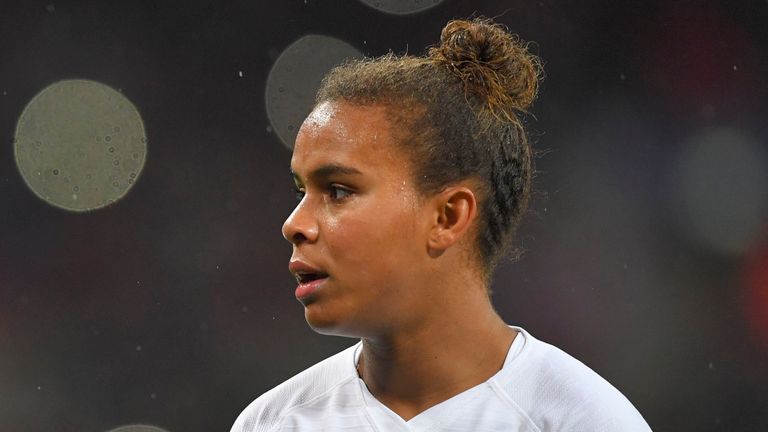
Nikita Parris has apologised to Eni Aluko for showing support for former England Women boss Mark Sampson in 2017.

Sampson was at the centre of discrimination allegations made by then Chelsea and England striker Aluko. He was initially cleared but the FA later apologised to Aluko and team-mate Drew Spence for racially discriminatory remarks made by Sampson.

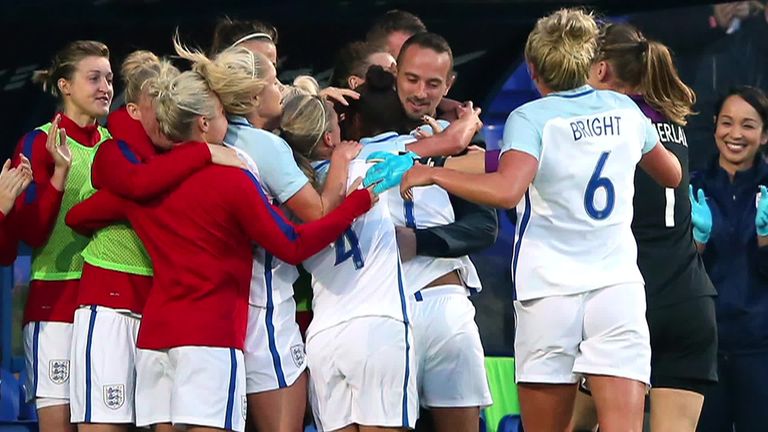
Nikita Parris and the England squad celebrate with Mark Sampson during a 6-0 win over Russia in September 2017

Nikita Parris and the England squad celebrate with Mark Sampson during a 6-0 win over Russia in September 2017

At Sampson’s final game in charge, a 6-0 win over Russia in September 2017, every member of the starting XI raced to the bench to celebrate with the manager after Parris’ opening goal.

Former England player Lianne Sanderson says the celebration still makes her “sick to her stomach”.

Lyon forward Parris has now offered a heartfelt apology to her former England team-mate Aluko.

Posting an open letter on Twitter, Parris said: “In order to grow we must have difficult conversations with ourselves and each other to understand where we have gone wrong for so long.

“During a very sensitive time where it would have mattered most, my actions left specific fellow professionals feeling alone and segregated.

“It showed a lack of empathy, understanding and ignorance by singling out a voice who needed an ear to listen and a support system to help.

“After a lot of growth, maturity and education I am now able to understand how I have been part of the problem which I aim to fight and eradicate’

“Eni, I am sorry that my thoughtless actions caused you hurt, never is it in my conscious intentions to make another human feel devalued.”

1:11
Lianne Sanderson says the decision by England players to celebrate with Mark Sampson following allegations of racism, harassment and bullying in 2017 still makes her

Lianne Sanderson says the decision by England players to celebrate with Mark Sampson following allegations of racism, harassment and bullying in 2017 still makes her

‘They don’t realise how much that hurt’

Speaking exclusively to Sky Sports News’ The Football Show about her experiences of racism in the game, Sanderson said: “Everyone knows what Eniola Aluko went through and that wasn’t a nice moment for anyone.

“The players scored and they celebrated with Mark Sampson and that still makes me sick to my stomach to think about now.

“I don’t think the girls realised how much that hurt myself, Eni and Anita [Asante]. It almost became them against us when it didn’t need to be that way.

“I definitely think the girls could have done more in that situation. I don’t hold it against them but this comes down to enabling. Those girls didn’t think they’d be picked again if they went against him.

“After a few conversations with the players, they say they didn’t really know what was going on.”

Super 6: Bayern to sail past Gladbach?

Do not miss your chance to land the £50,000 jackpot on Saturday. Play for free, entries by 2:30pm.

Super 6: Bayern to sail past Gladbach?

Do not miss your chance to land the £50,000 jackpot on Saturday. Play for free, entries by 2:30pm.


Source link