Reddit Ireland turns off at midnight to stop trolls

0

Image copyright
Getty Images

Reddit Ireland has taken the “difficult decision” to shut down in the early hours of the morning, to limit the racist and extremist content posted from the US during daytime hours there.

A multitude of accounts using false identities were to blame, it said.

Moderators said having to check every comment on the social network’s forums had pushed them to “breaking point”.

The page is now seeking to expand its team of moderators and add filters that can spot posts “hateful” comments.

In a post on the page, which has 280,000 members, it said: “We’re taking the very difficult decision today to shut down Reddit Ireland temporarily between midnight and 08:00 each day in order to stem the flow of racist/extremist content which is being posted at these times.”

‘White supremacy’

“The vast majority of hateful comments submitted over the past while have been solely directed towards someone’s skin colour,” Reddit Ireland said.

But the filters it would install would also spot “common phrases used against traveller communities and any other minority groups”.

Former Reddit chief executive Ellen Pao has said the platform “nurtures and monetises white supremacy and hate all day long”.

And co-founder Alexis Ohanian recently resigned from its board of directors, urging the company to replace him with a black candidate.

Source link

Bimbo Bakeries facing wage lawsuits from delivery drivers

0

HORSHAM, PA. — Bimbo Bakeries USA, a division of Grupo Bimbo SAB de CV, is facing several wage lawsuits brought by delivery drivers who are challenging what they consider to be the unlawful misclassification of them as independent contractors instead of employees.

Over the past two months, BBU has been sued in multiple states in connection with the wage dispute, with the most recent case involving Andre Roberts, who delivered bread and baked foods for Bimbo in Massachusetts between 2012 and 2019.

According to the lawsuits, Bimbo’s relationship with its drivers is more than just as independent contractors, who are not entitled to the protections of state and federal employment laws.

Instead, many of Bimbo’s drivers are required to form independent corporations to obtain distribution rights for certain sales territories, the lawsuits said.

“The work of plaintiff and other IBPs falls squarely within defendants’ usual course of business, and their work is integral to defendants’ baked goods distribution business, and defendants also directly employ delivery drivers who perform the same work for defendants but who are treated as W2 employees,” the lawsuit filed on behalf of Mr. Roberts said.

The lawsuit continued, “Plaintiff and other IBPs are not engaged in independent businesses. Rather, plaintiff and IBPs generally work exclusively for defendants, and (where applicable) their associated corporate entities generally exist for the sole purpose of working for defendants. In fact, plaintiff and other IBPs are prohibited from performing any similar delivery work for another company.

“Defendants exercise virtually unlimited control over plaintiff’s and IBP’s work, dictating all prices, requiring plaintiff and IBPs to deliver to stores that are not profitable, employing supervisors who travel to stores in plaintiff’s territories to review their work, and threatening to terminate plaintiff and IBPs whose work does not satisfy defendants’ standards.”

Mr. Roberts and the other plaintiffs in the lawsuits are seeking reimbursement for overtime pay, saying Bimbo violated the Fair Labor Standards Act that requires that employees receive overtime premium compensation calculated at 150% of their regular pay rate for all hours worked over 40 per week.

“Defendants are employers required to comply with the FLSA’s overtime pay mandate, and plaintiff is an employee entitled to the mandate’s protections,” Mr. Roberts lawsuit said.

Bimbo has not commented on the lawsuits.

Source link

‘Chinese students will not go there’: Beijing education agents warn Australia

0

“I hope Australia can change its attitude toward China. If a country loves Chinese money but doesn’t like Chinese people, China surely is not willing to do business with it.”

Ms Mo, who sends 2000 students to Australia a year, said she would consider “opening up the UK market” unless relations improved.

Chinese students account for about 60 per cent of international enrolments at the Group of Eight overall, including 69 per cent at the University of Sydney, 66 per cent at UNSW, 56 per cent at the University of Melbourne and 57 per cent at Monash University. They make up 37 per cent at RMIT and 53 per cent at UTS. Education agents are responsible for 73 per cent of Chinese student enrolments at Australian education providers.

Analysis of enrolment figures and university financial results indicates around 110,000 Chinese enrolments were worth approximately $3.1 billion to these 10 universities in 2018, the bulk of a total $5.4 billion they took in from international student fees.

Loading

Luke Sheehy, executive director of the Australian Technology Network of universities, including RMIT and UTS, said the sector had prioritised the welfare of students during the COVID-19 crisis and campuses were “vibrant, safe and welcoming places”.

“International students are an important part of our communities. We look forward to welcoming all students back, including those from China and overseas as soon as possible,” he said.

The sector felt the brunt of coronavirus restrictions early after Australia shut its borders to non-Australian residents travelling from China on February 1. Three years of strained relations between the two countries deteriorated further after Australia called for a global independent inquiry into the origins of the coronavirus in March.

China accused Australia of being a puppet advancing US interests in the region and launched two trade strikes on $1 billion worth of beef and barley in April. It followed up this week by warning tourists to reconsider travelling to Australia due to “an alarming increase” in racial discrimination and violence during the pandemic. The allegations have been rejected by the Australian government.

Ma Yu, an education marketing consultant at Aoji.cn, said the ministry of education’s warning would “definitely bring a huge impact to their willingness to study abroad”. “Parents are keen on the safety of their children and put safety as priority,” she said.

Salvatore Babones, adjunct scholar at the Centre for Independent Studies and associate professor at the University of Sydney, said the escalation was the latest step in the Chinese government’s push to discourage citizens from going overseas to study.

“I think our universities should expect very few new Chinese commencements throughout the 2020s,” he said, arguing that the Chinese government wanted to get people studying at domestic universities and to prevent capital flight from the country.

Trade Minister Simon Birmingham said a withdrawal of Chinese students would be a loss to both economies.

“For the long term, it would do nothing to help further the mutual understanding between our two nations,” he said.

Loading

The University of Wollongong was the first Australian university to have its ratings outlook cut to negative on Wednesday. Global ratings agency S&P warned its finances could deteriorate if it is unable to mitigate the revenue loss caused by a decline in onshore international student enrolments. S&P reaffirmed the University of Melbourne’s stable rating, but warned downward pressure could occur if travel restrictions persist well into 2021.

John Manning, the vice president of Moody’s Investors Service, said China’s recent travel advice for students highlights the vulnerability of Australia’s higher education sector to geopolitical tensions between Australia and China.

“Next year, revenues will largely depend on whether coronavirus-related travel restrictions are eased,” he said. “In the longer term, with a number of universities ranked among the best in the world, we expect Australia’s institutions will remain attractive for international students.”

A survey of 400 education agents across 63 countries by education provider Navitas found Australia’s successful containment of COVID-19 had made it a more attractive study destination, while the reputations of Britain and the United States have suffered.

China’s Ambassador to Australia Cheng Jingye warned in April that consumers could boycott Australian products including beef, wine, tourism and universities over its pursuit of the inquiry. Of the three sectors hit by Chinese infringements since, wine is the only export yet to be targeted.

Most Viewed in Politics

Loading

Source by [author_name]

Iraqi Sunnis seek answers for those displaced in time of fighting Islamic State

Jun 10, 2020

In an attempt to pressure the Mustafa al-Kadhimi government to reveal the fate of Sunnis who disappeared during the operations to liberate the country from the Islamic State (IS), Iraqis rolled out the hashtag Waiyoun (“Where Are They”) on social media. The demands also include revealing the fate of those who went missing during the October 2019 protests. As it went viral among Iraqis, international organizations such as Human Rights Watch also interacted with the hashtag and joined the popular demand. 

The issue of Sunnis who disappeared during the fight against IS has always been sensitive, as one rarely dared to talk about it because of militia involvement. It was also a demand made by just the Sunni political forces and was included in their political talks with the Shiite forces who consider the post of prime minister — the top executive post in the Iraqi administration — to be strictly theirs.

Those who were forcibly disappeared in Iraq are the ones who went missing when IS occupied nearly a third of Iraqi territory in 2014. Others disappeared during the operations conducted by official security forces affiliated with the ministries of the interior and defense and the Popular Mobilization Units (PMU) to liberate the country from IS. The issue now also includes those who went missing in the protests that were held in 11 Iraqi provinces in October 2019. 

The International Commission on Missing Persons estimates that the number of missing persons ranges between 250,000 to 1 million since the 2003 invasion of Iraq.

Since he took office, Kadhimi promised that the forcibly disappeared persons’ fates would be revealed. Both former Prime Minister Haider al-Abadi and former Prime Minister Adel Abdul-Mahdi who resigned in November following the protests had made the same promise. Neither Abadi nor Abdul-Mahdi kept their promises. Today, there is a fear that Kadhimi will also fail to resolve this issue.

Wahda al-Jumaili, a member of the Iraqi parliament and rapporteur of the parliamentary human rights committee, is a staunch defender of resolving this issue in Iraq. She had even conditioned giving Kadhimi a vote of confidence if he added it to his agenda.

Jumaili told Al-Monitor, “None of the Sunni or Shiite political parties has been serious in espousing this issue.” She said the issue will be resolved when the popular movement demanding the fate of missing persons be revealed grows bigger and is able to pressure the government and the United Nations.

This particular issue is thorny and complex, as Kadhim al-Shimary, a member of parliament for the National Coalition, and Haibat al-Halbousi, a member of parliament for the Iraqi Forces Alliance, said. Yet while Shimary perceives that the issue is only linked to the judiciary, Halbousi affirmed that it is political.

Jumaili, Shimary and Halbousi believe that armed factions were involved in the disappearance of residents in Iraq’s northern and western Sunni areas — Anbar, Salahuddin and Ninevah provinces in particular. But they did not name these factions, and no one has the official figures in this regard.

Shimary indicated that thousands of persons have gone missing and their families know who is responsible for their disappearance.

He said the residents of Jurf al-Sakhar, south of Baghdad — who were displaced following the 2014 military operations and never allowed to return — told him there are forcibly disappeared persons in the armed factions’ secret prisons. Shimary told Al-Monitor, “I cannot confirm whether this information is correct or not, in my legal capacity of representative, because I do not have sufficient evidence.”

Shimary, who is part of a secular coalition close to Sunni Arabs, added, “There is nothing new about the forcibly disappeared persons’ issue. Yet the political and popular pressure to resolve this issue is mounting.”

“The prevailing political environment is in favor of the opening of files,” he noted, adding, “Some parties have been negligent and must be condemned. The fate of thousands of persons is still unknown. It is unknown whether they are dead or still alive in the militias’ secret prisons.”

Shimary stressed the need to refer this issue to the judiciary and “the need to protect the judiciary in conducting urgent investigations away from any pressure.”

Halbousi, who is part of the Iraqi Forces Alliance that represents Sunni Arabs in parliament, said, “The judiciary was supposed to be inquiring into this case for months now in order to identify what happened to the forcibly disappeared persons.” He told Al-Monitor, “The forcibly disappeared persons’ issue is political in the first place before taking on any other character.”

Halbousi is skeptical about resolving this issue and holding those involved accountable. He said Abadi and Abdul-Mahdi had promised in the past that this issue would be resolved, but nothing ever changed. He added, “Kadhimi also promised that this issue would be over and those involved would be held accountable. Yet I cannot tell how serious he is in the absence of practical measures.”

Although Sunnis in parliament are skeptical about Kadhimi’s moves to resolve the issue, Human Rights Watch’s senior Iraq researcher Belkis Wille told Al-Monitor that the Kadhimi government has an opportunity to reveal the fate of those who were forcibly disappeared, given that this government paves the way for the elections and is not involved in the forced disappearance of persons. He noted that Kadhimi formed a committee in this regard.

Al-Monitor could not obtain a statement from Kadhimi’s office regarding the committee.

Nevertheless, Kadhimi’s mission is seemingly complicated. Wille said that “many of the security forces divisions are involved in the issue of forced disappearance, including federal forces, the Ministry of Interior and PMU.” In addition, some of these forces have a strong presence in parliament and a major influence in the state’s key departments.


Source link

Alia Bhatt kick starts her diet: Check out the video

0

Alia Bhatt just started dieting: Check out video

Indian actress Alia Bhatt celebrated the birthday of their house help Rashida on Tuesday but refused to have cake as she revealed that she has just started dieting.

Rashida shared the video on her Instagram on Tuesday with a sweet caption: “My dream birthday.”

In the video, the Raazi actor could be seen cutting the cake with Rashida while Alia’s sister Shaheen and others sang happy birthday.

“No no I can’t have the cake, I have just started dieting,” Alia could be heard saying in the video when Rashida serves her a piece of cake.

Earlier, Alia Bhatt and Ranbir Kapoor spent their Saturday night with Riddhima Kapoor Sahni and Shaheen Bhatt at Neetu Kapoor’s residence in Mumbai.

On the work front, Alia will next be seen in Ayan Mukerji’s directorial Brahmastra opposite Ranbir Kapoor.

The film is set to release in December 2020.

Source link

South Durban chokes as Engen refinery starts up – The Mail & Guardian

0

Elevated levels of sulphur dioxide emitted by Durban’s Engen refinery since it resumed operations last month, after it shut down when the Covid-19 lockdown started, have sparked a wave of respiratory illness and other health problems among residents of Wentworth and the Bluff.

The excessive releases of the foul-smelling gas at the refinery in Tara Road, Wentworth, took place on May 23, May 27, June 7 and June 8, according to residents, who reported the matter to the eThekwini municipality.

About 135 000 barrels of oil a day are produced at the Engen refinery. The Durban South Basin is one of the most polluted areas in the country and hosts a vast petrochemical and chemical industry. .

The municipality this week confirmed that residents adjacent to the refinery had been exposed to “elevated concentrations” of sulfur dioxide while the 24-hour national ambient standard for particulate matter smaller than 10 and 2.5 microns had been exceeded on May 27.

Engen halted operations on March 27 because of a lower demand for fuel caused by the Covid-19 lockdown, saying that “stringent safety measures” would be maintained during the temporary controlled shutdown, during which about 600 employees were sent home. The refinery re-started operations on May 16 and returned to full production on May 26. 

Wentworth resident Liz Gamble said she and her pregnant daughter had been affected twice, once during late May and most recently on Sunday.

“The first time was about two weeks ago or so. There was a heavy gas smell at around six or seven in the evening. Everybody was complaining about the smell, running inside and closing their doors and windows. I started getting a headache and feeling nauseous, like I wanted to vomit,” she said.

Then at about 4am on Sunday “that same smell woke me up. I woke up my daughter, who is pregnant, and she also said it was the same smell.’’

Later the same day, Gamble, her daughter and her niece’s son became ill. 

“We had to take my niece’s little boy to the doctor. My daughter started getting sick with a running stomach. She was vomiting and was batting with her chest. We had to go to the hospital. She’s pregnant and we can’t take a chance with the baby.”

Another resident, who asked not to be named, said she had been hit by a wheezing attack.

“I never had a chest problem before. Now I have a wheeze and other chest problems. When the smell comes I get dizzy and my chest closes up. They release the gas at night or when it’s raining. It makes you dizzy and then you want to puke from it,’’ she said.

Desmond D’Sa, chairperson of the South Durban Community Environmental Alliance, said the renewed high levels of sulphur dioxide and other pollutants were placing people at increased risk, particularly in the light of the Covid-19 virus.

He said they were concerned that proper maintenance and repair work may not have been carried out ahead of Engen resuming operations because the company had laid off its casual maintenance staff during April and May.

D’Sa said he had reported the weekend incident to the municipality, which had sent out inspectors. 

“The emissions carried on for at least six hours, affecting people in Wentworth, Bluff, Austerville and Treasure Beach. We called the municipal inspectors but they couldn’t solve the problem,” D’Sa said.

“When the lockdown started, the industries stopped operating completely. We had clear skies and no smell here,” D’Sa said.

Gavin Smith, Engen’s external relations manager, said the refinery had been “‘safely shutdown” in March and “safely restarted” on May 16. “The Engen refinery maintains constant engagement with local authorities and operates in strict accordance with its atmospheric emissions licence and all applicable laws and permits.” 

eThekwini municipality spokesperson Msawakhe Mayisela confirmed receiving complaints about emissions from the refinery since it started operating again in terms of a permit that allowed it to do so from May 12. eThekwini’s health unit responded to complaints on May 23. 

Mayisela said: “The municipality did address concerns regarding the pollution impacting on the community with Engen refinery and has requested additional information.” 

Mayisela said air quality monitoring at two sites near the refinery showed elevated sulphur dioxide levels and higher levels of particulate matter than permitted by legislation.

He said a report was expected later this month regarding Engen’s startup and shutdown permit, which required monitoring of pollution levels at the refinery and downwind of it to prevent people being exposed to higher levels of pollutants.

The Durban South Basin houses a big petrochemical and chemical industry and is one of the country’s most polluted areas. Residents and local organisations have for decades been at loggerheads with a number of the factories over high pollution levels.

“Once again the government is not acting in the interests of the people of South Durban. We already have a threat to our lives in terms of Covid-19. The threat to our wellbeing is being increased by the refinery being allowed to emit gases into our lungs and our homes,” D’Sa said.


Source link

National capitals question EU’s pandemic preparedness

0

A growing number of voices are calling for the EU to do more on health | Kenzo Tribouillard/AFP via Getty Images

Six countries pushing for ‘common European approach’ to handle emergencies.

Six countries have raised questions over the EU’s response to the coronavirus and called for the bloc to improve its pandemic preparedness, according to a letter obtained by POLITICO.

“The present situation has raised questions about Europe’s preparedness for pandemics and underlined the need for a common European approach,” read the letter initiated by Denmark and signed by France, Germany, Spain, Belgium and Poland, sent to the Commission on Tuesday.

The countries pointed out issues with medical-supply shortages and uncoordinated responses to the coronavirus by member countries. One key proposal is to create a stockpile of critical medicines, protective gear, medical devices and vaccines that could supply the entire EU for three months in an emergency.

The six countries also proposed coordinating the development of a coronavirus vaccine, “possibly” with EU funds, “as this would accommodate the urgent need of enabling EU to speed up the time from the outbreak of a future pandemic to the successful deployment of a vaccine.”

They raised the possibility of guaranteed public purchasing of a coronavirus vaccine, and said Brussels should consider using EU money for large-scale clinical trials of possible COVID treatments.

The move comes as a growing number of voices are calling for the EU to do more on health. The Commission is pushing for more power — within the framework of current treaties — through its planned new €9.4 billion EU4Health program.

The letter backs more pandemic preparedness while staying within Brussels’ current competence. “The stakes are high and a solution will require a holistic approach that draws on a wide range of instruments in the EU toolbox including industrial policy, research, digitization and EU funding,” it read.

Commission chief spokesperson Eric Mamer told reporters Wednesday that the Commission welcomed the letter and had done much to tackle many issues it raised. The Commission will discuss a vaccine strategy next week, and proposed ideas to increase European drug manufacturing in its industrial strategy, he said.

“We think that the letter goes in the direction of what the Commission is putting in place and has proposed to member states to put in place, in particular through Next Generation EU and the next [seven-year EU budget],” Mamer said.

The letter presented some ideas for handling drug shortages, which have increased during the coronavirus outbreak, especially with emergency room drugs.

Those include using incentives to relocate the production of active pharmaceutical ingredients to Europe; requiring companies to diversify their supply chains; and setting more “permanent antitrust guidelines” in times of crisis to increase production of goods.

The countries also called for an “efficient division of labor within the EU in order to optimize European production,” including through legal commitments and cooperation agreements so expertise from certain countries gets to the rest of the EU.

“Amidst growing global trade tensions, preventing protectionism will be key,” the countries wrote, especially for “important trading partners” and developing countries that rely on EU imports.

The countries also asked the EU to examine existing mechanisms, such as the EU’s Civil Protection Mechanism, rescEU and joint procurement agreement, to see if they can be improved.

Another key proposal would widen the mandate of the European Centre for Disease Prevention and Control (ECDC) “to coordinate, with national health authorities, prevention and reaction plans against future epidemics within a future EU health task force.”


Source by [author_name]

Astronaut becomes first person to walk in space and visit ocean’s deepest point

0

Just eight people have reached Challenger Deep, the deepest point of the ocean. More than 550 people have visited space.

But only one person has done both: Kathy Sullivan.

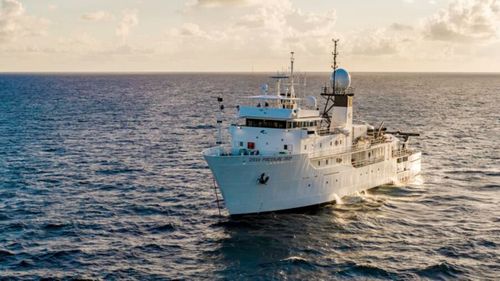
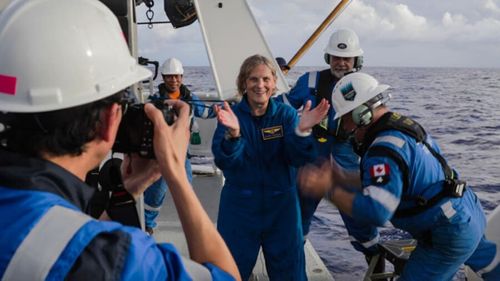
On Sunday, the NASA astronaut and oceanographer visited Challenger Deep, which sits at a depth of 10,928 metres in the western Pacific Ocean, as part of the Ring of Fire Expedition organised by bespoke adventure company EYOS Expeditions and undersea technology specialist Caladan Oceanic.

NASA astronaut and oceanographer Kathy Sullivan has become the first person to walk in space and also visit the ocean’s deepest point in the Mariana Trench. (Supplied – EYOS Expeditions)

Ahead of the expedition, EYOS invited three intrepid explorers, which they call “Mission Specialists,” to venture to the bottom of the Mariana Trench, where Challenger Deep is located.

About 321 kilometres from the trench, Guam is the nearest land mass.

Sullivan is the first of the three explorers to finish the roughly 10-hour mission, with two more to follow this week.

“I know (Challenger Deep) as a bathymetric feature on a chart, a tectonic feature, and a seismic feature … but that’s all data-based understanding. To see it in person – it makes all the difference in the world,” Sullivan told CNN Travel.

NASA Kathy Sullivan astronaut Mariana Trench deep dive exploration 200610
Sullivan is the first of the three explorers to finish the roughly 10-hour mission. (Supplied – EYOS Expeditions)

“No self-respecting marine biologist would be able to pass up an invitation.”

Leading up to the dives, the three explorers underwent full briefs on the mission, schedule and research initiatives.

But in terms of physical training, Rob McCallum, the co-founder of EYOS Expeditions and the Ring of Fire expedition leader, says it’s not quite like climbing Mount Everest or training for a space voyage.

“These people are all adventurous, but you don’t have to be an athlete to participate,” he said.

“This is something new, but not something to be feared.”

NASA Kathy Sullivan astronaut Mariana Trench deep dive exploration 200610
Leading up to the dives, the three explorers – including Sullivan – underwent full briefs on the mission, schedule and research initiatives. (Supplied – EYOS Expeditions)

Ever since she was a young girl, Sullivan has been inspired by explorers.

“I was always following the early astronauts, Jacques Cousteau and the early aquanauts. They were inquisitive people. They were clever people that could figure out how to go make things happen,” she said.

“That inquisitiveness, that sense of adventure, of curiosity that drives explorers. I could feel that resonating in me as I watched them.”

A US Navy captain, Sullivan first learned about Challenger Deep and the Mariana Trench during college at the University of California, Santa Cruz.

NASA Kathy Sullivan astronaut Mariana Trench deep dive exploration 200610
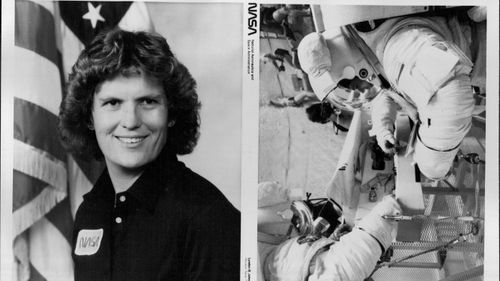
Sullivan became the first American woman to walk in space during a Space Shuttle Challenger mission in 1984. (Supplied – EYOS Expeditions)

Though she originally intended to study Russian, she took a few science classes “quite against her will” that forever changed her perception of the ocean.

“Suddenly, there was so much history, so many stories of exploration, and then all the knowledge of how the ocean works geologically, the currents and the creatures. It all fascinated me.”

Mesmerised by the ocean, Sullivan continued her studies at Dalhousie University, where she earned a PhD in geology, focusing her research on the North Atlantic.

“As I went through my studies, I found that I really liked the planning, design and execution of expeditions,” she says.

NASA Kathy Sullivan astronaut Mariana Trench deep dive exploration 200610
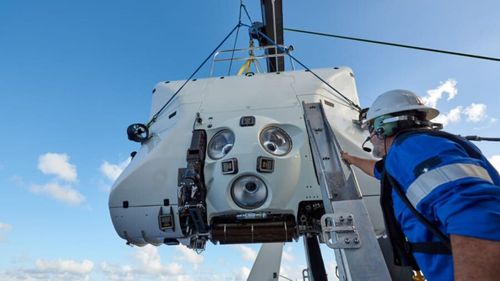
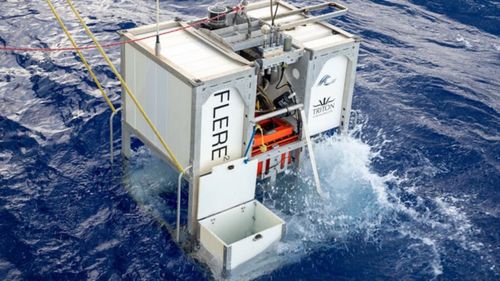
Sullivan rode inside the 11.5 tonne DSV “Limiting Factor,” the only certified vehicle in the world that can repeatedly dive to any depth in the world’s oceans. (Supplied – EYOS Expeditions)

So when she heard NASA was hiring, she jumped at the opportunity to become an expedition operator.

After graduating in 1978, she joined NASA, eventually becoming the first American woman to walk in space during a Space Shuttle Challenger mission in 1984.

Sullivan also partook in two other missions – Space Shuttle Discovery in 1990 and Space Shuttle Atlantis in 1992 – during her NASA career.

She later served as the administrator of the National Oceanic and Atmospheric Administration and wrote a book, “Handprints on Hubble: An Astronaut’s Story of Invention,” amongst other contributions to the science community.

“We wanted the first woman to dive the Challenger Deep to be someone who would really use the opportunity for the benefit of the ocean,” says McCallum.

“Kathy has an impeccable track record. She is only the eighth human being to do this – it is genuine exploration.”

NASA Kathy Sullivan astronaut Mariana Trench deep dive exploration 200610
Prior to descent, the EYOS team dispatches scientific “landers” to the bottom of the ocean. (Supplied – EYOS Expeditions)

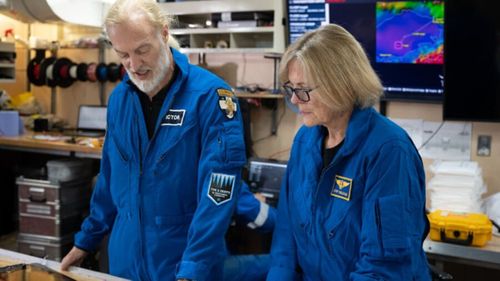
On June 7, Sullivan prepared for her Challenger Deep mission with fellow scientist Victor Vescovo, who is the founder of Caladan Oceanic and a decorated explorer himself.

Amongst his many accomplishments, Vescovo is the first person to have visited the top of every continent, both poles, and the deepest point of the ocean.

Before their departure, the EYOS team dispatched several scientific “landers” to the bottom of the ocean to understand the conditions – like water temperature and salinity and establish references to aid navigation since the vehicle must travel in the dark.

Once the landers are in place, the crew adjusts the trim and ballast of the submersible to control the buoyancy, then prepares for the “drop” when the submersible begins its descent.

NASA Kathy Sullivan astronaut Mariana Trench deep dive exploration 200610
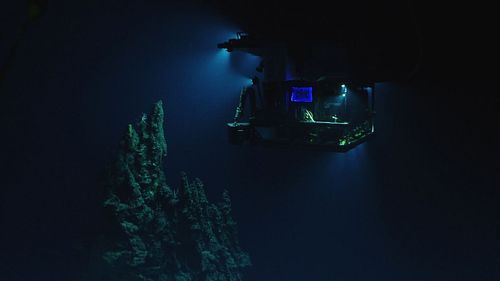
Sullivan described the experience inside the trench as ‘otherworldly’, similar to exploring another planet. (NOAA)

It’s not the first time the Limiting Factor, as the square-shaped vehicle is known, has visited Challenger Deep.

Engineered by civil submarine producer Triton Submarines, the submersible vehicle carries its own life support and features a 90-millimetre-thick titanium sphere, which protects the explorers from the 2200 metric tons of pressure amassed at the bottom of the ocean.

During each dive, the explorers also collect samples from the seafloor and aid in geographical research, as very little is known about the ocean at this depth.

“Terrestrial exploration is very advanced, but I think the ocean offers the opportunity to explore the last frontier. The ocean is untapped,” McCallum says.

“We know so very little about life below 6000 metres that we barely understand what questions to ask, let alone understand the answers. Almost every dive we do is yielding something new to science, be it biological or geographical or geological. We’re essentially a pathfinder into the last frontier of exploration on Earth.”

NASA Kathy Sullivan astronaut Mariana Trench deep dive exploration 200610
The exploration descent took the team four hours to reach the bottom of the trench. (NOAA)

As the submersible glided deeper and deeper, Sullivan and Vescovo sat side-by-side in a compact but comfortable cabin, with enough space to stretch their legs, pull on a sweater or do some seated yoga moves.

“It’s kind of like a long-haul flight in Economy or Premium Economy,” says Sullivan.

A few hours into the four-hour descent, Sullivan says it became much colder in the cabin but, otherwise, there were no notable physical changes.

“Two things are really distinctly different in the experience of going out into space or going down into the ocean. One is energy intensity. I mean, you’re basically riding a bomb when you strap onto a rocket and launch off the planet. It’s hugely energetic, loud, noisy, lots of acceleration.”

NASA Kathy Sullivan astronaut Mariana Trench deep dive exploration 200610
Sullivan sat in a compact but comfortable cabin, with enough space to stretch her legs, pull on a sweater or do some seated yoga moves. (Supplied – EYOS Expeditions)

But heading into the deep sea, she says, is like “a magic elevator ride.”

“It’s very, very serene, she says.

“You’re not in some clumsy spacesuit; you can basically be in street clothes if you wanted to. And it’s this slow, smooth, steady descent.”

On their way down, the pair watched the light dissipate while they dined on tuna salad sandwiches, a bag of chips and the ship chef’s signature Apple strudel.

“Lunch at 31,000 feet below sea level. Doesn’t everybody do that?” she quips.

Like her in-flight meal, the view from the cabin was also memorable.

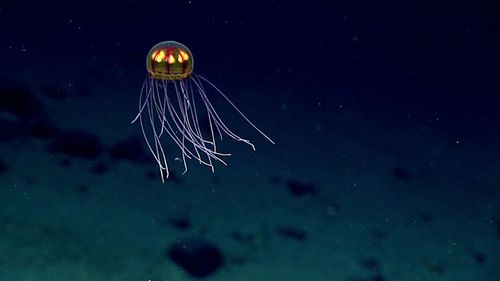
“The ocean is endlessly alive. Even as you’re descending through the water columns, life forms scoot by. The immense array and variety of life in the ocean really entrances and fascinates me. And then, of course, at the seafloor, there really are fascinating geological features.”

After about four hours, they finally reached the bottom of the trench and had about 15 minutes to check in with the surface ship, orient themselves, check their support systems… and then enjoy the moment.

“We then did a little giggle, a smile, a handshake and a moment of hooray,” she recalls.

“I felt like I was flying over a moonscape as we went along the bottom. I think I was probably seeing in my mind’s eye or remembering some of the Apollo images from those missions, flying over this austere landscape. But this amazing moonscape is at the very bottom of our ocean on my home planet.”

Another space image flew into her mind, as the vehicle started exploring the trench.

“When we finally saw the first of our scientific landers, it was as if I was an astronaut on Mars and I discovered some deep space probe that had gotten there before me. It just sort of came up out of the darkness. It’s was very otherworldly,” she says.

Source by [author_name]

Unnatural: Conservation is yet another legacy of colonialism – The Mail & Guardian

0

Across the globe over the past few weeks, social media platforms have lit up and blacked out in support of #BlackLivesMatter. Closer to home, activists highlighted the death of Collins Khosa and Elma Robyn Montsumi as examples of military and police brutality against black, poor and vulnerable persons. 

In this context of hypervisibility, mobilisation and critical conversations on black lives and experience, we came across a recently published article in the South African Journal of Science: Why are black South African students less likely to consider studying biological sciences? by Nicoli Nattrass of the Institute for Communities and Wildlife in Africa at the University of Cape Town (UCT).

The commentary makes bold statements about what it means to be a black student and the question which frames the commentary is an important one. Since the #FeesMustFall and #RhodesMustFall movements, higher education institutions have been forced to confront the ways in which we are complicit in racist and colonial logics. 

We were perplexed by the article’s simplistic application of a racial lens (if we can call it that) in relation to the important question about access to the curriculum. At UCT, the Curriculum Change Working Group (CCWG) has posed important questions, debated and intellectually framed the need for an appropriate and contextually relevant curriculum which resists coloniality. 

Therefore, one would have expected that the author would have grappled with the critical conversations about race, proposals which have emerged through student protest or contemporary scholarship as part of the analysis. 

By not doing so, the author essentially trivialises and simplifies race in the study. It caused us to wonder: if this is the manner in which we treat race in our scholarship, how will we ever be able to grapple with, hold, listen to and respond to race and racism within our classrooms?  

The commentary begins with the necessary acknowledgement of the persisting inequalities in schooling as a barrier to meeting entrance requirements in courses such as the biological sciences. We all know and acknowledge this fact all the time in higher education. Hiding underneath this statement, however, is the acknowledgement that certain departments are not doing much to engage, encourage and include students who “don’t meet the criteria”, while knowing that the criteria is skewed by our social realities. There is nothing “excellent” (a term often invoked by institutions) about excluding capable and smart black students. 

How does this study understand race? How is “black” defined?  Who are the “other students”? 

The title and the opening line of Nattrass’s study both ponder the inclusion of black students, however the commentary doesn’t share a definition or framework for race. It is unclear what may constitute being black or the lived experience of black students. 

From this starting point it becomes clear that a set of unquestioned assumptions underpin this approach; one which takes for granted that poor folk have “materialist values and aspirations” and associates #FeesMustFall automatically with negative attitudes towards conservation biology and the national parks. 

For example, there is a difference between a decolonial critique of conservation and calling for the scrapping of the national parks. The use of the word “black” in relation to “materialist values” and not having pets; and “Fallist” as incompatible with conservation struggles, suggests at best an oversimplification of complex racial experiences and struggles, and at worst a reliance on a racist trope. 

In addition, there is no explanation on how the biological sciences have been made appropriate or responsive to the needs of the targeted communities. Although the department has participated in open days at schools, it is unclear if these engagements expose black and other students of colour to the utility of the discipline to meet their community’s needs. 

Furthermore, at no point does the commentary reflect on useful anti-racist criticisms posed towards conservation struggles and activism. Even as people outside this field, the coding of popular movements such as the #SaveTheRhinos campaign as white, or the history of national parks like Kruger and the displacement of local communities, seem like easy starting points. 

Lastly black folks and people of colour are experts on their own experience. It’s strange to see a study on race which cites no people of colour and doesn’t engage with theory and contemporary debates on systemic racism in South Africa.  

Why these questions? Why this survey?

Nattrass’s controversial survey uses the World Values Surveys materialist index. Asa Lundgren (2015) studied the use of this tool to investigate values in the Arab/Muslim world. Lundgren argues that the  “eagerness within this perspective to produce measurable data may lead to a simplifying of complex social and political realities to the extent that the results become superficial and sometimes distorted.” 

This survey tool focuses on measuring a phenomena (in this case race) at the expense of understanding complex social realities leading to possibly ethno-centric conclusions. Through inbuilt biases, selective choices of variables and ethnocentric bias of the survey tool, research may confirm the “superiority” of the Western world (in Lundgren’s case) and the “other students” group in this study. In simple terms, colonial tools may confirm colonial logics. 

The survey design and, more specifically, the leading questions that were posed tells us more about the researcher’s views on race than the experience of the black students.

Incidentally, the executive committee of WVS is also a shining example of a lack of diversity in research spaces. 

Why those conclusions? 

“So, conservation is for the middle class? But we know this mos.” We say this in jest, but in order to understand what it means to be middle class in South Africa we need to acknowledge the capitalist exploits of empire and colonialism which led to the destruction of natural environments and the subsequent efforts to conserve them. 

To understand what it means to be middle class is to acknowledge the migrant labour system which destroyed rural economies and bolstered the extractive industry which continues to harm our planet. Conservation exists because capitalist intrusions have destroyed ecosystems, and current and historic inequity ensures that poor, indigenous and black people are often excluded from the decision-making table when it comes to the natural environment. 

The fact that black students are not present in classrooms might have something to do with this history of land dispossession and exclusion. Without advocacy, socially responsive programmes, or at the very least, community appropriate communications about biological sciences in schools, there will be limited appreciation of the opportunities the discipline offers.

In a context of awful anti-black violence, we all need to take a stance. Although not critically engaging with race within higher education is significantly different from police brutality, it encourages an environment where we may become complacent. Uncritically adopting research tools from the Global North and framing race while relying on assumptions add up  to conclusions which reify racist tropes: Racist assumptions + racist tools = racist conclusions. 

We would encourage the author to reflect on the following questions: what barriers exist for school learners in accessing information about biological sciences? How does the university (and the department of biological sciences) actively remove these barriers for school learners? And when or if, black learners choose UCT, how do we as staff, ensure that the content is relevant and our harmful prejudices are in check? If we are to be serious about including black students, we need to be serious about including their voices, affirming them and creating an environment where they can flourish. 

Gabriel Hoosain Khan is  the inclusivity capacity building specialist at the Office for Inclusivity and Change (OIC) at UCT and Sianne Alves is the director 


Source link

#Huawei says it will not betray #UK’s trust

0

Divisive global politics should not trump evidence and shared history. We ask for a debate based on facts – says Huawei’s vice president Victor Zhang.

In an open public letter, he says:

“We’ve taken the step of writing to the British public to make it clear we are committed to the UK. We’ve done so because Britain now faces critical choices, while seeking to maintain its leading global position as an early adopter of 5G, placing it in the technological fast lane and enabling the economic recovery. This is why it’s important that a sensible discussion around Huawei takes place , one driven by facts, rather than fiction.

Our commitment today highlights the fact Huawei has been part of the fabric of the UK for 20 years. As a private company owned by its employees, we’ve worked with the UK’s mobile and broadband companies to provide the 3G and 4G technology that is a crucial part of people’s lives. It’s why we now employ 1,600 people across the country.

Now we want to play our part in helping Britain to realise the full potential of 5G. More than 10 million people have been left with slow connections that make it harder than it should be to get online, work remotely or run a business.

We want to make sure millions more people get connected by 2025 to meet the Government’s commitment to bring gigabit broadband to the entire country. There’s much work still to be done.But despite our strong track record of partnership in the UK, there are those who argue that divisive global politics should matter more than evidence and shared history. They say that the UK Government should reverse the evidence-based decision taken earlier this year, approving Huawei as a supplier for 5G and fibre broadband. This makes no sense. Our technology hasn’t changed. Our commitment to the UK hasn’t changed. We think the Government’s view of Huawei shouldn’t change either.

We support the conclusions of the Telecoms Supply Chain review: higher security standards, more resilient network and more diversified supply chain. It’s why in January, the Government saw no reason to ban Huawei on security grounds. Britain’s security experts have had access to our software for 10 years at the Cyber Security and Evaluation Centre in Banbury. Huawei equipment is subject to the most robust inspections in the world. This strict oversight continues and we welcome transparency.We’re committed to the UK because we’ve been here a long time and we believe Huawei and the UK is a world-beating combination. We want to see UK lead the fourth industrial revolution.

We want you to know we have the UK’s interests at heart and have no interest in betraying the trust our customers have placed in us for 20 years.

We ask for level heads and a debate based upon facts and evidence.”

Victor Zhang is Vice-President of Huawei

Source by [author_name]