Army Chief Gen Bajwa discusses peace process with Afghan leadership during Kabul trip

‘Both sides discussed current developments in Afghan Peace Process and necessary steps to be undertaken to facilitate an Afghan led and Afghan owned peace process,’ DG ISPR said in a statement. ISPR/Handout via The News

RAWALPINDI/KABUL: Pakistan Army Chief General Qamar Javed Bajwa discussed the Afghan peace process with Kabul’s leadership during a visit to the neighbouring country, the military’s media wing said Tuesday.

In the statement, Director-General Inter-Services Public Relations (ISPR) Major General Babar Iftikhar said the army chief held one-on-one meetings with Afghan President Ashraf Ghani and High Council for National Reconciliation Chairperson Dr Abdullah Abdullah.

Gen Bajwa was accompanied by Prime Minister Imran Khan’s Special Representative for Afghanistan Affairs, Ambassador Mohammad Sadiq, Maj Gen Iftikhar added.

“Both sides discussed current developments in Afghan Peace Process and necessary steps to be undertaken to facilitate an Afghan led and Afghan owned peace process.

“Issues related to facilitation of trade and connectivity also came under discussion. Both sides agreed that a dignified and time-bound return of Afghan Refugees from Pakistan is key towards normalcy,” the statement added.

The Afghan president expressed his appreciation for PM Imran for opening the Torkham and Chaman borders and “allowing Afghan transit goods and facilitating stranded Afghans to return to Afghanistan by land and air routes.”

“The President was also appreciative of the role being played by Pakistan for Afghan Peace Process,” the statement noted.

Source link

Brazil Must Be Open With Its Coronavirus Data, Supreme Court Justice Rules

Brazilian President Jair Bolsonaro, seen greeting supporters late last month in Brasilia, has argued that the economic fallout from stay-at-home orders is worse than the virus itself.

Evaristo Sa/AFP via Getty Images


hide caption

toggle caption

Evaristo Sa/AFP via Getty Images

Brazilian President Jair Bolsonaro, seen greeting supporters late last month in Brasilia, has argued that the economic fallout from stay-at-home orders is worse than the virus itself.

Evaristo Sa/AFP via Getty Images

A justice on Brazil’s top court has ordered the president’s administration to make its coronavirus data publicly available.

Supreme Court Justice Alexandre de Moraes said in an order dated Monday that Brazil’s Health Ministry must resume publishing the running totals for confirmed deaths and infections — a practice the department recently halted to widespread criticism.

Brazil’s government, caught in the throes of South America’s worst coronavirus outbreak, abruptly ended public access to much of its past data earlier this month, instead sharing only the number of new confirmed cases each day.

But de Moraes said that concealing such information may hobble efforts to understand the virus, interfere with the public interest and, in general, have “disastrous consequences” for the country’s response to the pandemic. Plus, it violates the government’s “constitutional duty” to seek to protect “the life and health of all Brazilians.”

So he is telling the Health Ministry to resume its coronavirus updates as they were delivered until last Thursday with regularity and make past data again available.

The legal drama is unfolding against a backdrop of increasing urgency in Brazil, which has suffered the world’s third-highest confirmed COVID-19 death toll, behind the United States and United Kingdom.

Its more than 700,000 confirmed cases are surpassed only by the U.S., and none of its neighbors in South America has suffered devastation from the disease on the scale that Brazil has.

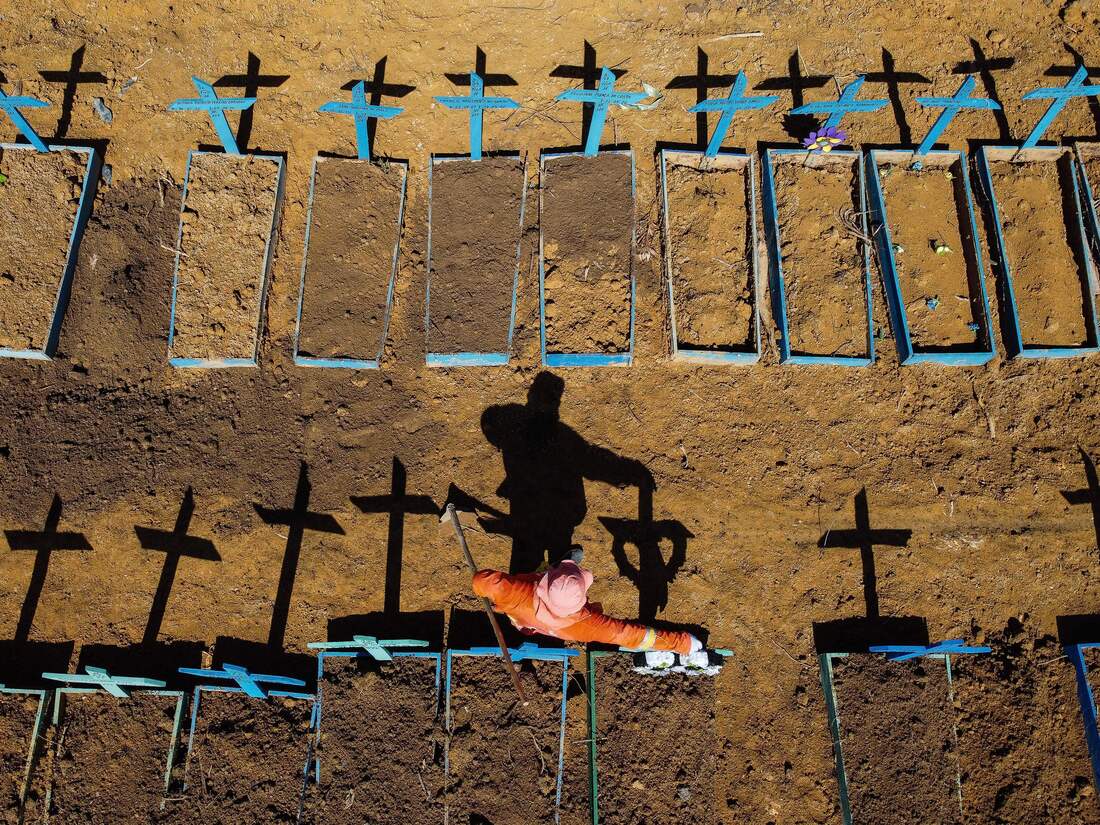
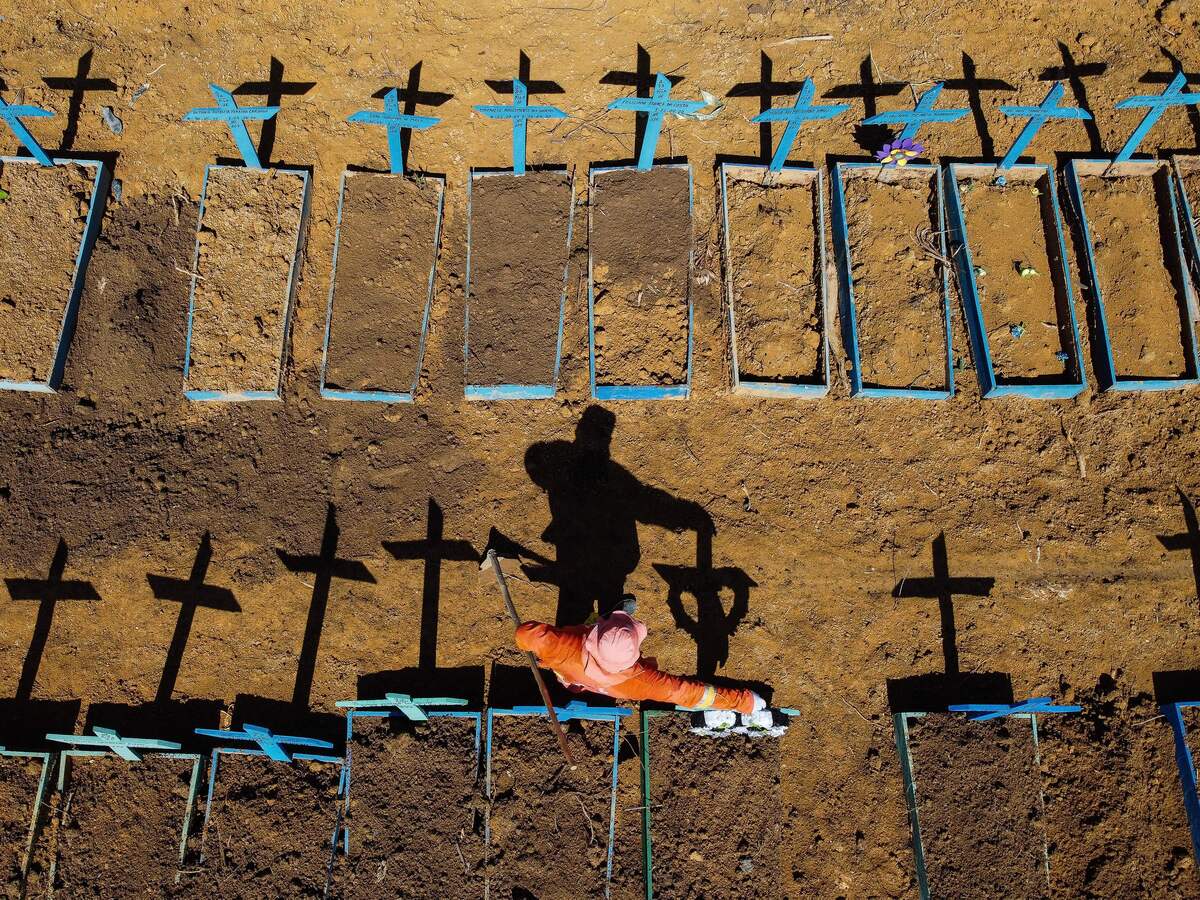
A gravedigger stands at a cemetery in Manaus, Brazil, where COVID-19 victims have been buried in recent weeks. The pandemic has killed more people in Brazil than nearly any other country in the world.

Michael Dantas/AFP via Getty Images


hide caption

toggle caption

Michael Dantas/AFP via Getty Images

A gravedigger stands at a cemetery in Manaus, Brazil, where COVID-19 victims have been buried in recent weeks. The pandemic has killed more people in Brazil than nearly any other country in the world.

Michael Dantas/AFP via Getty Images

With rampant deficiencies in testing and questions about the country’s overall response, Brazil’s toll also is likely far higher than the official numbers reflect.

Despite recent spikes — including a record number of new daily cases shortly before the public data was pulled — President Jair Bolsonaro, a close political ally of U.S. President Trump, has continued to push local leaders to ease their coronavirus restrictions and reopen their economies. He has encouraged large rallies of his supporters and repeatedly questioned the measures implemented across the country.

In the midst of this controversy, the Health Ministry’s decision to remove older numbers from its publicly available data was met over the weekend with protests from demonstrators and condemnations from medical experts who called the decision dangerous.

Others, including another Supreme Court justice, Gilmar Mendes, likened it to authoritarianism. “Manipulation of statistics,” he tweeted, “is a maneuver of totalitarian regimes.”

In a statement posted last weekend to Bolsonaro’s Facebook account explaining the Health Ministry’s decision to yank archival data from its official website, the president said the older information was simply “not representative” of the situation in the country.

“The dissemination of 24-hour data,” the statement explained, “allows you to monitor the reality of the country at this time and determine appropriate strategies for public service.”

The Health Ministry appeared partly to walk back its decision by Sunday, publishing cumulative tallies again, albeit with a different presentation. The main dashboard still presents only new confirmed cases, new deaths and new recovered cases.

In his court order, de Moraes gave the ministry 48 hours to resume providing public access to its data on the coronavirus as it had before.

NPR’s Philip Reeves contributed to this report.


Source link

The Stark Racial Inequity of Personal Finances in America

We cannot quantify the injustice of a white policeman holding his knee on the neck of a handcuffed, dying black man. And mere numbers cannot fully express the power imbalance involved in the deaths of George Floyd and too many others like him.

But we can measure the economic inequity that serves as their backdrop.

Dollars are like air — crucial to vitality. And when it comes to wealth, black Americans have less at nearly every juncture of life, from birth to death.

Perversely, having less can cost more. Black students borrow more to go to college, don’t finish as often and more frequently default on their student loans. They earn less, and generally have lower credit scores — so they pay higher interest rates. It’s harder for them to save for retirement, and they leave less to the next generation when they die.

An imbalance of societal power cannot be separated from cradle-to-grave economic inequality. This is what that looks like.

From board books for toddlers to quality care, it can be costly to get a child started in life. And black families typically have fewer financial resources to draw on.

Black families with a new baby have a median household income of $36,300, according to an analysis of 2018 census data by the Center on Poverty & Social Policy. For white families, it was more than twice as much: $80,000.

Black families were behind other groups, too. For Asian-Americans and Pacific Islanders, the median income was $105,600. Among multiracial families, the figure was $64,000. Hispanic families had $48,400 in income, and Native American and Alaskan Native families had $41,000.

Starting with less makes many things in the future that much harder. For example, every unspent dollar of earnings can potentially be saved for higher education.

Once a child enrolls in college, graduating with a bachelor’s degree isn’t a given. But here, too, blacks have it worse than nearly any other group.

Their six-year completion rate through June 2017 for students starting at a four-year institution was 38.9 percent, according to data from the National Center for Education Statistics. For whites, it was 64.8 percent — even though both groups graduate from high school at roughly the same rate.

Asian-Americans (72.1 percent), mixed-race students (54.5 percent) and Hispanics (50.5 percent) were also ahead of blacks. Only Native Americans and Alaskan Natives finished at a lower rate: Just 26.3 percent within six years.

Starting but not finishing is often the worst of both worlds: Large numbers of these students end up with debt, but they don’t get the degree and the earnings boost that usually come with it.

A college education is supposed to help pave a path to financial security. For many black students, that’s far from guaranteed: They tend to borrow significantly more than their white peers, and they’re more likely to default on their loans.

Twenty-one percent of black graduates with bachelor’s degrees default. That’s more than five times the rate of their white peers (4 percent). Even white dropouts (18 percent) are less likely to default, according to a 2018 analysis by Judith Scott-Clayton, an associate professor of economics and education in the Economics and Education program at Teachers College, Columbia University.

She looked at data for people who started school for the first time in the 2003-4 academic year and analyzed their experiences over the next dozen years. Only 1.4 percent of Asian bachelor’s degree graduates defaulted during that period, with Hispanic graduates defaulting 8.6 percent of the time.

Black students who earned bachelor’s degrees also accumulated more debt than whites. They borrowed $21,149 on average, nearly twice as much as whites, by the time they left school. (This includes students who didn’t borrow at all.) But it got worse after that: By the end of the 12-year period that Ms. Scott-Clayton examined, blacks owed $64,142 — three times as much as whites. That’s because black degree-holders had both higher levels of graduate school borrowing and lower rates of repayment.

Even with a college degree, black Americans can’t count on getting a paycheck of the same size.

The black/white wage gap was significantly wider in 2019 than at the start of the century — even as Hispanic workers have slightly narrowed their own gap with white workers, according to research from the Economic Policy Institute.

But the gap isn’t a function of differences in education levels. Even among those who attain advanced degrees, blacks were paid 82.4 cents for every dollar earned by their white peers. Hispanics do better, at 90.1 cents on the dollar.

And the gender pay gap expands the racial gap into a chasm: Black women, on average, earn 64 cents for every dollar a white man earns, according to another report from the institute.

The home is the largest asset for many American families, which may help build wealth over time. Paying down a mortgage often serves as a forced savings plan, enabling families to build equity that they can tap in retirement or leave to their heirs.

Black families have long been behind their white peers in homeownership, but that gap is the largest it has been in a half-century, according to the Urban Institute.

In 2018, about 72 percent of white households owned homes, compared with nearly 41.7 percent of blacks, 47.5 percent of Hispanics and 59.5 percent of Asians, according to the institute, using the 2018 American Community Survey. In 1960, nearly 65 percent of whites owned homes, compared with 38.1 percent of blacks, 45.2 percent of Hispanics and 42.8 percent of Asians, according to an analysis of census data.

“The gap in the homeownership rate between black and white families in the U.S. is bigger today than it was when it was legal to refuse to sell someone a home because of the color of their skin,” the Urban Institute wrote.

The science of measuring retirement assets is imperfect, because older Americans can draw on any number of resources if they have them, including home equity, a pension and Social Security.

Those assets aren’t as flexible, however, as a workplace savings plan like a 401(k) or an individual retirement account. Blacks are less likely to have such accounts, and tend to have less in them when they do.

Sixty percent of white families have at least one retirement account, while just 34 percent of black families do, according to the most recent Federal Reserve Survey of Consumer Finances, which drew on data from 2016. Hispanic families have even fewer, at 30 percent. (The survey does not break other groups into distinct categories.)

Families with white heads of household have balances that dwarf the holdings of families headed by blacks, according to the Employee Benefit Research Institute, which looked at the same Federal Reserve data and measured families with family heads between the ages of 55 and 64.

The median balance was $151,000 for whites and $46,100 for blacks. Hispanics had the lowest numbers here, too, with a median of $43,000.

The imbalance in homeownership and retirement accounts makes it unsurprising that white households are more likely to receive an inheritance than black ones. In fact, they are about two and a half times as likely to do so, according to research from two Fed economists, Jeffrey P. Thompson and Gustavo A. Suarez.

They looked at households headed by people ages 30 to 59 in 2013 and 2016. Twenty-three percent of white families reported having received an inheritance. Just 9 percent of black families answered affirmatively, and only 5 percent of Hispanic families did so.

Whites received more, too: The median inheritance in white families was $56,217, while blacks received $38,224 and Hispanics were just behind at $37,124.

So even if white families had fallen behind in the first part of adulthood, they had a better chance of catching up with a single boost. And those who are already doing better widen the gap further when a relative dies.

At that point, the process begins anew for their kids. And their kids’ kids.

And here we are.

Source link

Amir Khan and Faryal Makhdoom amass £13,769 for Zohra Shah’s family

Amir Khan and Faryal Makhdoom amass £13,769 for Zohra Shah’s family

British boxer with Pakistani origins, Amir Khan and his wife Faryal Makhdoom have come forth extending support to the family of a minor maid from Pakistan who was ‘beaten to death’ by her employers.

The athlete, 33 and his wife, 28, pledged to support eight-year-old Zohra Shah’s family as revealed by them on their official Instagram accounts.

The couple said that they were in contact with the late minor’s father and had promised to give him financial assistance.

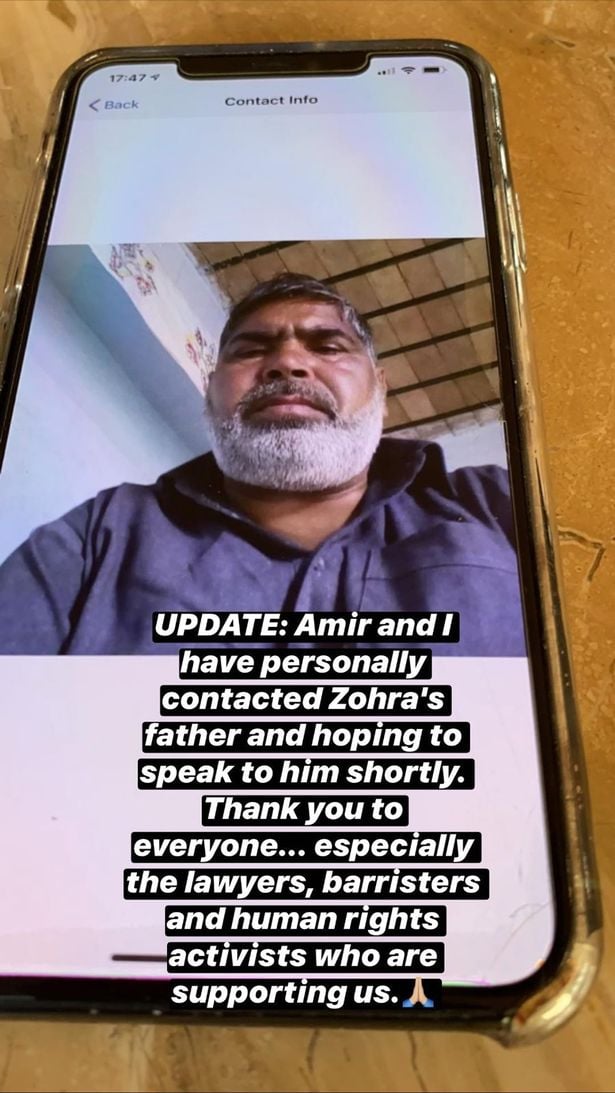
“Amir and I have personally contacted Zohra’s father and hoping to speak to him shortly. Thank you to everyone… especially the lawyers, barristers and human rights activists who are supporting us,” Makhdoom said on her Instagram Story.

“Loads of messages asking why they sent their 8 year old daughter to work.. they didn’t. The father has told us he has 6 kids… the father sent the daughter (Zohra Shah) to Islamabad with her Khala (aunty) to study there. The khala then put Zohra Shah to work… where she was beaten to death.”

“I am sending a member of the @amirkhanfoundation tomorrow to visit Zohra Shah’s father’s home, give our donations. We will take responsibility [for] the family… schooling the children & providing their needs,” Faryal added.

Photo: Instagram
Photo: Instagram

The couple has thus far, amassed £13,769 of donations for Zohra’s family.

The eight-year-old domestic labourer was tortured to death in Rawalpindi by her employers after she accidentally freed two expensive parrots, local media reported on Wednesday.

According to reports, Zohra who hailed from Muzaffargarh, was hired to look after the child of a man identified as Hassan Siddiqui who worked in buying and selling birds and property.

Police officials told The Independent, Siddiqui confessed that he and his wife beat up the girl, who was working for them as a maid, in a fit of rage. 


Source link

China is not a military threat, EU top diplomat says

0

China may be a systemic rival to the European Union but it’s not a threat to world peace, EU foreign affairs chief Josep Borrell said Monday.

Borrell emerged from a three-hour video discussion with Chinese Foreign Minister Wang Yi to defend what he called a “realistic” approach to Beijing. His sanguine view of China’s military ambitions puts him at odds with the United States and some of China’s neighbors, ranging from Japan to India, which are increasingly worried that Beijing is flexing its military muscle from the Himalayas to the South China Sea.

Borrell’s discussion with Wang took place as EU-China relations are under intense scrutiny after China moved to strengthen its legal grip on Hong Kong and as some member countries have called on the EU to tackle more aggressively disinformation from China and Russia related to the coronavirus.

Borrell said Hong Kong, as well as human rights, were part of the “open and frank” talks. And among the main points of discussion was the decision last year by the EU to call China a “systemic rival.”

“I understand that for China to be presented as a systemic rival is something that looked a little bit controversial” he told reporters in a videoconference after the talks. “We talked a lot about it, … words matter and sometimes they matter a lot,” he added.

Chinese Premier Li Keqiang | Hwee Young-Pool/Getty Images

But Borrell stressed that the term does not mean the EU sees Beijing as a security threat. “China has a global ambition but at the same time I don’t think that China is playing a role that can threaten the world peace,” he argued.

“They committed once again that they want to be present in the world and to play a global role but they don’t have military ambitions and they don’t want to use the force to participate in military conflicts,” he added.

A number of countries have made clear they are much more wary of China’s increasing military power.

A top U.S. defense official, John C. Rood, said last year that China is “promoting an authoritarian model, one that doesn’t respect the sovereignty of others.”

“You’re starting to see China develop overseas military bases, overseas intelligence collection locations,” Rood noted.

Japan, India, Vietnam and Taiwan are among other countries to have expressed deep concern about China’s military ambitions. Tokyo signaled last year that China is the country’s biggest security threat — bigger than nuclear-armed North Korea.

Borrell underlined that the EU had many points in common with China such as continued support for the Iran nuclear deal, from which the U.S. withdrew in 2018.

Tuesday’s discussion was also intended to prepare for an upcoming video meeting expected later this month between European Council President Charles Michel, Commission President Ursula von der Leyen and Chinese Premier Li Keqiang.

Borrell said the summit could finalize a document setting out cooperation with Beijing, called Agenda 2025. He said an investment agreement “will not be ready for the summit, that’s clear.”

The investment agreement is intended by the EU to push Beijing to deliver on promises of equal treatment for European companies and end a practice of forcing foreign firms to share know-how when operating in China.

A bigger EU-China summit — involving leaders of the bloc’s member countries and Chinese President Xi Jinping — was due to take place in September in the German city of Leipzig but it has been was postponed due to the coronavirus.

“For sure we have to allocate more resources in the fight against disinformation”— EU foreign affairs chief Josep Borrell

Borrell is expected to present on Wednesday a proposal with Commission Vice President Vĕra Jourová on how to step up the EU response to disinformation on the pandemic. The EU has pointed the finger of blame at both China and Russia for such disinformation.

Borrell said the EU’s foreign policy arm is ready to do more to fight disinformation from China and elsewhere if member countries provide the means. “For sure we have to allocate more resources in the fight against disinformation,” he said. “I’m happy to devote more resources but the member states have to agree on that, not only preaching but providing.”


Source by [author_name]

Tan France Celebrates “Monumental” Moment as He Becomes U.S. Citizen

Tan France is officially a United States citizen.

The fashion designer and star of Netflix’s Queer Eye series, who was born and raised in England, took to Instagram on Tuesday to share the emotional moment with his fans.

“A few minutes ago, I officially became an U.S citizen!!” France wrote alongside a series of photos from the U.S. Citizenship and Immigration Services center. “For me, this is monumental. It’s something I’ve been working towards for literally 20 years, which makes this all the more emotional.”

“And now, I will exercise my constitutional right as an American. Today, I will register to vote, and vote for the change I wish to see in OUR nation,” the 37-year-old continued.

France has been a vocal supporter of the Black Lives Matter movement, calling on his social media followers to speak out about racism following the death of George Floyd at the hands of Minnesota police. 

Celebrities Attending Protests Over George Floyd’s Death

“No, I’m not saying you have to get out and protest, but take action in your immediate lives at the very least,” France wrote on Instagram on June 1. “Call out racist bulls–t in your family. Stop acts of racism when you see them, and teach your kids to do the same….and stop telling Black people how they should protest.”

Explaining why the comments section had been turned off on his post, France wrote, “No comments needed, this isn’t a conversation.”

Just days before being a U.S. citizen, France spoke to his followers about “voting for change” and shared June election dates.

“VOTE FOR CHANGE. COMPLETE YOUR CENCUS [sic]. BE COUNTED,” the author urged his followers. “IF YOU’RE NOT COUNTED, YOU’RE TELLING THEM THAT IT’S OK TO NOT LISTEN TO YOU.”

Just yesterday, France also spoke out about equality, writing to his social media followers, “We must all be aligned in the movement towards equality for it to be successful.”


Source link

Sports News: World and National Sports Headlines, Score Updates, Highlights, Stats & Results – Sportsnet.ca

0

{* mergeAccounts *}


Source link

Kaizer Chiefs vs Mamelodi Sundowns exhibition game called off

The 2020 edition of the Shell Helix Cup has been called off, according to Stadium Management SA (SMSA).

Gauteng giants Kaizer Chiefs and Mamelodi Sundowns have, over the past two seasons, met at FNB Stadium for the exhibition match which has taken place on the early stage of the campaign.

Shell Helix Cup called off

The ongoing pandemic crisis has interrupted the global sporting calendar, with the local soccer scheduled also impacted.

On Thursday, SMSA, who are the organisers of the game confirmed that it has been held off indiefinitely.

“We will share updates as soon as new information becomes available.”

Stadium Management South Africa

The previous two editions of the competitions have seen the two competitors share the spoils as they boast a win apiece.

The inaugural tournament saw Mamelodi Sundowns come off victorious after overcoming Kaizer Chiefs, with Jeremy Brockie and Themba Zwane giving the Pretoria outfit a two-nil lead before a late consolation goal from Bernard Parker made it 2-1.

Twice as many goals were scored in the latest edition of the friendly match, where Amakhosi exacted revenge with a 4-2 win.

On that occasion, former ‘Downs striker Leonardo Castro netted a hat-trick against his old side, with Khama Billiat – another ex-Brazilian – netting the fourth before the break, prior to a failed comeback which saw South Americans Jose Ali Meza and Gaston Sirino half the deficit.

The two sides are competing for the 2019/20 league title, with Chiefs four points above Sundowns, who have a game in hand.

It’s yet unclear whether or not the league will resume in the coming weeks, with a PSL Joint Liason Committee expected to provide clarity in the next few days.


Source link

France’s Aerospace Industry to Get $17 Billion in Government Support

The French government announced an enormous financial support program on Tuesday for its flagship aviation industry as global travel restrictions from the coronavirus pandemic slash passenger flights and orders for new planes, putting tens of thousands of jobs at risk.

The 15 billion euro package (almost $17 billion), which includes some previously announced measures, includes aid for Air France, Airbus and major French parts suppliers through direct government investment, subsidies, loans and loan guarantees. It also includes a special fund jointly financed by the government, Airbus and other big manufacturers to support small suppliers.

In exchange for the support, companies will be required to invest more in low-emission aircraft, powered by electricity, hydrogen and other means, as the government capitalizes on the opportunity to make the French aviation industry the “cleanest in the world.”

“We are declaring a state of emergency to save our aeronautical industry to allow it to be more competitive,” Bruno Le Maire, the finance minister, said at a news briefing with France’s defense and environment ministers. He said the plan would allow France to set new global standards for low-carbon aircraft, with €1.5 billion earmarked over the next three years on research and development to develop a carbon-neutral aircraft by 2035.

The aeronautical sector is one of the biggest employers in France, providing 300,000 direct and indirect jobs in manufacturing, research and development. A third of those would have been wiped out if the government did not step in, Mr. LeMaire said, adding that preserving jobs was the top priority.

Air France and Airbus have announced that they are examining job cuts as airlines operate at a small fraction of their normal capacity and orders for planes crater. The money would come with no rules forbidding layoffs, but Mr. LeMaire called on companies receiving aid not to resort to job cuts.

France has spent hundreds of billions of euros on paid furlough programs intended to prevent mass unemployment. The measures announced Tuesday would allow employers to tap government-paid furlough schemes, and come on top of an ‎‎€18 billion support package for the battered tourism industry and ‎€8 billion in aid to Renault and other French manufacturers in the auto sector.

  • Updated June 5, 2020

    • Does asymptomatic transmission of Covid-19 happen?

      So far, the evidence seems to show it does. A widely cited paper published in April suggests that people are most infectious about two days before the onset of coronavirus symptoms and estimated that 44 percent of new infections were a result of transmission from people who were not yet showing symptoms. Recently, a top expert at the World Health Organization stated that transmission of the coronavirus by people who did not have symptoms was “very rare,” but she later walked back that statement.

    • How does blood type influence coronavirus?

      A study by European scientists is the first to document a strong statistical link between genetic variations and Covid-19, the illness caused by the coronavirus. Having Type A blood was linked to a 50 percent increase in the likelihood that a patient would need to get oxygen or to go on a ventilator, according to the new study.

    • How many people have lost their jobs due to coronavirus in the U.S.?

      The unemployment rate fell to 13.3 percent in May, the Labor Department said on June 5, an unexpected improvement in the nation’s job market as hiring rebounded faster than economists expected. Economists had forecast the unemployment rate to increase to as much as 20 percent, after it hit 14.7 percent in April, which was the highest since the government began keeping official statistics after World War II. But the unemployment rate dipped instead, with employers adding 2.5 million jobs, after more than 20 million jobs were lost in April.

    • Will protests set off a second viral wave of coronavirus?

      Mass protests against police brutality that have brought thousands of people onto the streets in cities across America are raising the specter of new coronavirus outbreaks, prompting political leaders, physicians and public health experts to warn that the crowds could cause a surge in cases. While many political leaders affirmed the right of protesters to express themselves, they urged the demonstrators to wear face masks and maintain social distancing, both to protect themselves and to prevent further community spread of the virus. Some infectious disease experts were reassured by the fact that the protests were held outdoors, saying the open air settings could mitigate the risk of transmission.

    • How do we start exercising again without hurting ourselves after months of lockdown?

      Exercise researchers and physicians have some blunt advice for those of us aiming to return to regular exercise now: Start slowly and then rev up your workouts, also slowly. American adults tended to be about 12 percent less active after the stay-at-home mandates began in March than they were in January. But there are steps you can take to ease your way back into regular exercise safely. First, “start at no more than 50 percent of the exercise you were doing before Covid,” says Dr. Monica Rho, the chief of musculoskeletal medicine at the Shirley Ryan AbilityLab in Chicago. Thread in some preparatory squats, too, she advises. “When you haven’t been exercising, you lose muscle mass.” Expect some muscle twinges after these preliminary, post-lockdown sessions, especially a day or two later. But sudden or increasing pain during exercise is a clarion call to stop and return home.

    • My state is reopening. Is it safe to go out?

      States are reopening bit by bit. This means that more public spaces are available for use and more and more businesses are being allowed to open again. The federal government is largely leaving the decision up to states, and some state leaders are leaving the decision up to local authorities. Even if you aren’t being told to stay at home, it’s still a good idea to limit trips outside and your interaction with other people.

    • What’s the risk of catching coronavirus from a surface?

      Touching contaminated objects and then infecting ourselves with the germs is not typically how the virus spreads. But it can happen. A number of studies of flu, rhinovirus, coronavirus and other microbes have shown that respiratory illnesses, including the new coronavirus, can spread by touching contaminated surfaces, particularly in places like day care centers, offices and hospitals. But a long chain of events has to happen for the disease to spread that way. The best way to protect yourself from coronavirus — whether it’s surface transmission or close human contact — is still social distancing, washing your hands, not touching your face and wearing masks.

    • What are the symptoms of coronavirus?

      Common symptoms include fever, a dry cough, fatigue and difficulty breathing or shortness of breath. Some of these symptoms overlap with those of the flu, making detection difficult, but runny noses and stuffy sinuses are less common. The C.D.C. has also added chills, muscle pain, sore throat, headache and a new loss of the sense of taste or smell as symptoms to look out for. Most people fall ill five to seven days after exposure, but symptoms may appear in as few as two days or as many as 14 days.

    • How can I protect myself while flying?

      If air travel is unavoidable, there are some steps you can take to protect yourself. Most important: Wash your hands often, and stop touching your face. If possible, choose a window seat. A study from Emory University found that during flu season, the safest place to sit on a plane is by a window, as people sitting in window seats had less contact with potentially sick people. Disinfect hard surfaces. When you get to your seat and your hands are clean, use disinfecting wipes to clean the hard surfaces at your seat like the head and arm rest, the seatbelt buckle, the remote, screen, seat back pocket and the tray table. If the seat is hard and nonporous or leather or pleather, you can wipe that down, too. (Using wipes on upholstered seats could lead to a wet seat and spreading of germs rather than killing them.)

    • Should I wear a mask?

      The C.D.C. has recommended that all Americans wear cloth masks if they go out in public. This is a shift in federal guidance reflecting new concerns that the coronavirus is being spread by infected people who have no symptoms. Until now, the C.D.C., like the W.H.O., has advised that ordinary people don’t need to wear masks unless they are sick and coughing. Part of the reason was to preserve medical-grade masks for health care workers who desperately need them at a time when they are in continuously short supply. Masks don’t replace hand washing and social distancing.

    • What should I do if I feel sick?

      If you’ve been exposed to the coronavirus or think you have, and have a fever or symptoms like a cough or difficulty breathing, call a doctor. They should give you advice on whether you should be tested, how to get tested, and how to seek medical treatment without potentially infecting or exposing others.


Under the plan announced Tuesday, France’s public investment bank, Bpifrance, will provide a total of around ‎€500 million in loans to Airbus; Safran, a maker of jet engines and other components; Dassault Aviation, a military and commercial aircraft manufacturer; and Thales, which makes aerospace electrical systems.

Additionally, France’s defense and interior departments will speed up orders for ‎€600 million worth of Airbus aircraft.

The plan also calls for the French military to double its spending to around ‎€100 million at small and midsize companies that develop light surveillance planes and drones to ensure the preservation of thousands of additional jobs over three years.

Source link

NASA astronaut from historic spacewalk becomes first woman to reach deepest point in ocean

CLOSE

NASA uses SpaceX Falcon 9 to launch US astronauts into space from US soil for the first time in nearly 9 years, since the last space shuttle mission.

USA TODAY

Former NASA astronaut Kathryn D. Sullivan, the first American woman to walk in space, is now also the first woman to reach the deepest point in the ocean.

Sullivan, an oceanographer and veteran of three space shuttle flights, is the first person to achieve both feats. After returning from a nearly 7 mile dive to Challenger Deep in the Mariana Trench, Sullivan called her colleagues at the International Space Station, which is in orbit 254 miles above Earth.

“As a hybrid oceanographer and astronaut this was an extraordinary day, a once in a lifetime day, seeing the moonscape of the Challenger Deep and then comparing notes with my colleagues on the ISS about our remarkable reusable inner-space outer-spacecraft,” Sullivan said in a statement released Monday by EYOS Expeditions, the company coordinating the mission. 

Start the day smarter: Get USA TODAY’s Daily Briefing in your inbox

Sullivan became the first American woman to walk in space in a 1984 mission on the space shuttle Challenger and later left NASA to become administrator at the National Oceanic and Atmospheric Administration, according to NASA.

She traveled to the deepest point in the ocean, located in the Western Pacific Ocean, on a submersible called the Limiting Factor piloted by Victor Vescovo of Caladan Oceanic before returning to its mothership the Pressure Drop. Vescovo, who has also piloted the Limiting Factor on a recent dive to the Titanic, became the fourth person to reach Challenger Deep last year.

Historic dive: The first manned dive to the Titanic in 14 years found a wreck in ‘shocking’ decay. The photos are spooky

Eight people have reached the bottom of Challenger Deep, including Vescovo, Sullivan and film maker James Cameron who reached the bottom in 2012, according to EYOS Expeditions.

Vescovo congratulated Sullivan on being “the first woman to the bottom of the ocean” on Twitter.

“We made some more history today,” he said in a statement. “And then got to share the experience with kindred spirits in the ISS. It was a pleasure to have Kathy along both as an oceanographer during the dive, and then as an astronaut to talk to the ISS.”

Follow N’dea Yancey-Bragg on Twitter: @NdeaYanceyBragg

Autoplay

Show Thumbnails

Show Captions

Read or Share this story: https://www.usatoday.com/story/news/nation/2020/06/09/former-nasa-astronaut-kathryn-sullivan-reaches-deepest-spot-ocean/5325153002/


Source link