European stocks open lower despite a strong day in Asia.
Major European markets opened lower on Monday despite a moderately strong day in Asia and a booming Friday on Wall Street.
Stocks in Britain, France and Germany were down, though by less than 1 percent, in morning trading. The sluggish performance came after markets in Japan and Taiwan rose more than 1 percent, leading a rally in the Asia-Pacific region. Futures markets signaled that Wall Street would open slightly lower.
Further demonstrating investor indecision, prices for U.S. Treasury bonds were mixed during early trading.
Stocks got a boost on Friday after U.S. jobs figures came in much stronger than expected. But investor worries seemed to return on Monday. Global stocks have risen strongly in recent days on government stimulus efforts and signs of recovery in some of the places hit hardest by the coronavirus pandemic. Some investors now wonder how long governments will be willing to give the global economy a push, and how long it will take for the world’s growth engines to come back to full speed.
Something remarkable is percolating in the commercial real estate market: Investors may end up losing millions in tax savings on gains from the sale of their properties because of the coronavirus pandemic.
Like-kind real estate exchanges, also known as 1031 exchanges (after the provision in the Internal Revenue Code), allow investors to sell a commercial property and pay no tax on the gains as long as the money from that sale is reinvested in other real estate. It could be a similar building, land or even air rights.
To reap the benefit, real estate investors need to identify a replacement property 45 days after the sale of the original property and close on the purchase within 180 days. If the criteria are met, the investors can defer taxes on the gains from the sale of the property. The deferral can extend until the investor’s death, at which point the capital gains tax is wiped out.
If the criteria are not met, the investors face not only an enormous tax bill for the gains but additional taxes for deductions taken while they owned the building. That can amount to millions of dollars for some properties.
As lockdowns complicated closing deals, the real estate industry lobbied the Treasury Department to get extensions on those dates. But once the relief was granted, deals began to fall apart.
Mortgage rates may be appealingly low, but people shopping for a new home this spring face a challenging market.
Demand, which was pent up during coronavirus stay-at-home orders, and a dearth of homes for sale are keeping prices high and setting off bidding wars in some areas as states continue to reopen for business. Some buyers may also find it tougher to qualify for mortgages, as lenders require higher credit scores and bigger down payments in response to higher unemployment and economic uncertainty in the pandemic.
Nationally, the median price for a home, excluding new construction, was about $287,000 in April, up more than 7 percent from a year earlier, the National Association of Realtors reported.
Now, with many states lifting restrictions on home tours, the housing market is reawakening. Shoppers are feeling more comfortable visiting properties: About two-thirds of people who attended an open house within the past year said they would attend an open house now “without hesitation,†a separate survey from the Realtors association found.
But some sellers remain cautious. They want to show homes by appointment only, and they want offers from serious buyers who have been preapproved for financing, said Lawrence Yun, chief economist with the association. “They don’t want casual shoppers,†he said.
Catch up: Here’s what else is happening.
An aviation dispute between the Trump administration and China appears to be softening, with the United States on Friday saying it will allow Chinese carriers to collectively operate two weekly round-trip flights to the United States. The announcement comes two days after the Transportation Department said it would ban all such flights in response to a similar ban on American passenger flights to and from China. After the department made that announcement, the Chinese government said it would allow two American airlines to operate weekly flights, paving the way for the reversal on Friday.
Reporting was contributed by Ann Carrns, Matt Phillips, Paul Sullivan and Carlos Tejada.
(CNN) — Almost all coronavirus restrictions in New Zealand will be lifted tomorrow, Prime Minister Jacinda Ardern has announced, after the country reported no active cases.
Social distancing, however, is still encouraged and Ardern said New Zealand’s international borders will remain shut to non-residents to prevent new outbreaks. Residents arriving in New Zealand will still have to quarantine for two weeks.
New Zealand currently has no active coronavirus cases, and no positive cases reported in the past 17 days. There has been no one receiving treatment in hospital for Covid-19 for the past 12 days and it has been 40 days since the last case of community transmission.
“This freedom from restrictions relies though heavily on the ongoing role that our border controls will play in keeping the virus out … The virus will be in our world for some time to come,” Ardern said at a press conference Monday.
The announcement came as the global number of confirmed coronavirus infections surpassed 7 million on Monday, according to Johns Hopkins University’s tally, with more than 402,000 people killed. New Zealand has had 1,504 confirmed cases and 22 deaths.
New Zealand’s lockdown timetable
The first case of coronavirus was confirmed in New Zealand on February 28 — more than a month after the United States confirmed its first infection.
On March 14, when the country had six cases, Ardern announced that anyone entering the country would need to self isolate for two weeks, which at the time was among the toughest border restrictions in the world. Foreign nationals were banned from entering the country on March 20.
Days later, on March 23 — with no deaths and when there were 102 confirmed cases — Ardern announced the country was entering “level three” lockdown. Non-essential businesses were closed, events and gatherings canceled and schools closed to all children except those of essential workers.
Employers were told to allow working from home where possible, public transport was reserved for essential workers, and discretionary domestic air travel between regions was banned.
At midnight on March 25, New Zealand moved to the strictest level 4 lockdown, with people told not to leave home except for essential exercise near the home, while maintaining social distancing.
On April 9, despite a decline in cases, Ardern tightened border restrictions so that all citizens and permanent residents arriving in New Zealand were required to spend two weeks quarantined in an approved facility rather than at home.
Travel bubble looms?
New Zealand and Australia have been in discussions to establish a “travel bubble,” which would allow residents to travel freely between the neighboring nations without a need for quarantine.
Both countries have mostly controlled their local coronavirus outbreaks and have large tourism industries which have been severely impacted by widespread travel restrictions.
However, Ardern warned Monday that such a corridor could still be months away.
“I don’t want New Zealand businesses or even Kiwis who want to travel across the ditch to be given a false start. I’d rather share timelines when we have much more certainty,” she said.
“(Australia is) making progress state by state, but it’s not universal.”
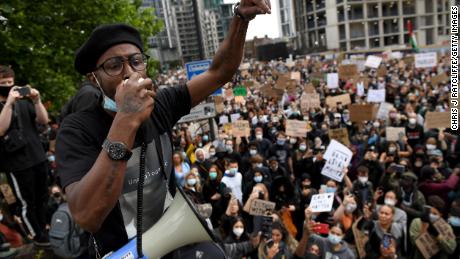
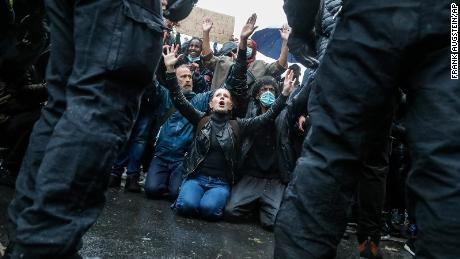
In the UK capital, largely peaceful protests turned heated in the evening on Sunday as activists and police clashed near Downing Street. Officers were seen pushing and using their batons, with some even punching and grabbing protesters as they approached the line of police.
Prime Minister Boris Johnson later claimed that the “demonstrations have been subverted by thuggery” and said he will hold those responsible to account.
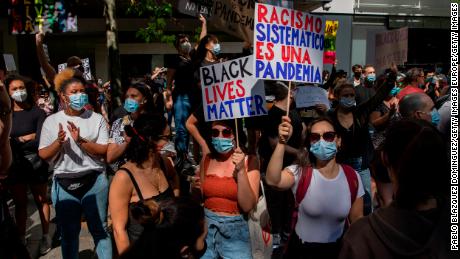
Some defied coronavirus lockdowns and warnings from politicians to do so. Many protesters wore masks during the weekend’s rallies, while some carried messages that racial inequality is also a public health crisis.
They marched in solidarity with tens of thousands in the US, whose protests on Saturday were the biggest yet since video of Floyd’s death at the hands of a white police officer ignited a wave of anger and action.
But they turned out to draw attention to racial injustice in their own nations, too.
Colonial-era statues ripped down with ropes
In London, thousands congregated outside the US Embassy on Sunday despite British ministers saying that public protests ran the risk of increasing the spread of Covid-19.
Chants of “No Justice, No Peace” and “Black Lives Matter” bounced off the building in the Vauxhall region of the city, with a jubilant atmosphere for much of the day.
“Together, we will let our voices be heard. Enough is Enough. Black people cannot keep suffering,” one protester addressed the crowd.
At times, the activists chanted “The UK is not innocent.” Others had messages for the US President, with one sign reading: “Black lives trump your ego, Mr. President.”
The previous day, activists had descended onto Parliament Square in the center of the city. Protests were peaceful for several hours, but turned heated in the evening when police and crowds faced off outside Downing Street.
In one incident, video posted online showed a police horse suddenly bolting, causing its officer to crash into a street light and fall to the ground. The loose horse then caused panic as it ran through groups of protesters, before making its way back to police stables.
“I stand with you. George Floyd’s brutal killing must lead to immediate and lasting change everywhere,” London Mayor Sadiq Khan said in a Sunday message to protesters, while condemning the minority who turned violent and reminding activists to try to limit physical interactions.
A number of Boris Johnson’s government ministers had previously urged protesters to avoid gathering at all for public health reasons, with Home Secretary Priti Patel saying on Saturday: “I would say to those that want to protest, please don’t.”
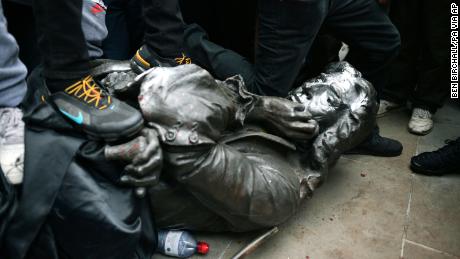
Similar protests took place in Edinburgh, Scotland — and a dramatic scene unfolded in Bristol, southwest England, where activists tore down a statue of 17th century slave owner Edward Colston.
The monument had stood in the city center since 1895 but had become increasingly controversial, with petitions created to demand its removal. On Sunday it was ripped down with ropes to loud cheers from a crowd of demonstrators.
Europe’s streets filled after months of lockdown
The messages of those protesters were echoed by thousands more around the world.
In Spain, permission was given for demonstrators to assemble outside the US Embassy but, after defying orders from the government, protesters marched through the city to Puerta del Sol — one of the best-known and busiest places in the city.
Demonstrators were seen holding placards and chanting phrases including “Donald Trump is a criminal.”
According to figures released by the government’s delegation in Madrid, approximately 2,000 protesters were in attendance; organizers say 4,000 people attended.
Lisa Okpala, a spokeswoman for CNAAEB — an anti-racism platform in Spain — told CNN that the purpose of the demonstration was to show support for the Black Lives Matter movement in the US and to “denounce and demonstrate against structural and institutional racism” in the country.
“We felt not only sad because, as I said, racism is a problem here also, but also we felt the rage that the people in the United States are feeling now, especially the black community. So, there is a mix between sadness and rage,” Okpala said.
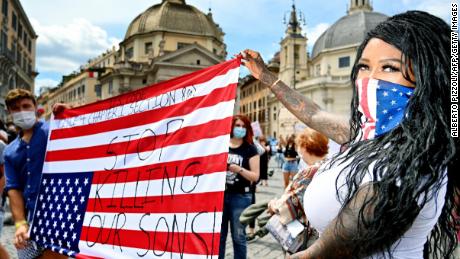
Thousands more gathered in Rome’s Piazza del Popolo — the major square that just weeks ago had sat empty, a defining image of Italy’s devastating coronavirus outbreak.
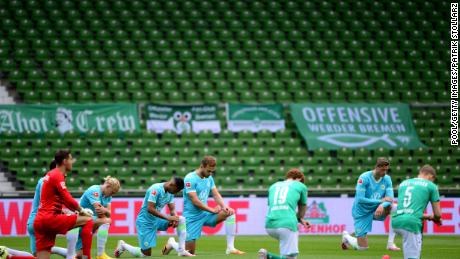
Activists there took a knee in silence for a full eight minutes in a symbolic tribute to Floyd, who died after police officer Derek Chauvin pressed his knee on his neck for 8 minutes and 46 seconds.
During the demonstration, the protesters were addressed by representatives of Italy’s migrant community and American expatriates; the names of all those killed in the US as a result of police brutality were listed and commemorated by the crowd.
While the large gathering made it difficult for protesters to adhere to the government’s social distancing guidelines, those demonstrating in the piazza were seen to be attempting to maintain a one-meter gap between themselves, with many also wearing masks and face coverings.
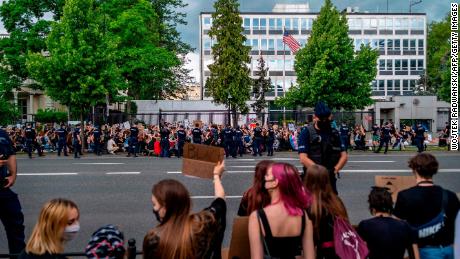
Meanwhile in Warsaw, streets were lined outside the American embassy. The previous day, crowds have swarmed through Paris and other French cities like Lille, Marseille, and Nice.
Court allows Sydney protests to go ahead
Hours earlier, cities in Australia had been similarly active.
A court in the country overturned an injunction that banned a march and rally in Sydney on Saturday, allowing thousands to gather in the city.
Performances from Aboriginal protesters took place, and demonstrators held banners calling for an end to deaths in police custody both in the US and in Australia.
New South Wales state officials had sought to ban the protest due to social distancing concerns and received an injunction Friday night. The New South Wales Court of Appeals overturned it in time for the actions to take place.
Another rally took place in Brisbane and Melbourne.
In Hong Kong, smaller crowds gathered outside the Consulate General of the United States. And in Seoul, South Korea, activists in face masks held up signs on Saturday to commemorate Floyd’s death.
CNN’s Laura Perez Maestro, Al Goodman, Duarte Mendonca, Ben Wedeman and Alessandro Gentile contributed reporting.
Republicans are recruiting an estimated 50,000 volunteers to act as “poll watchers” in November, part of a multimillion-dollar effort to police who votes and how.
That effort, coordinated by the Republican National Committee and President Donald Trump’s re-election campaign, includes a $20 million fund for legal battles as well as the GOP’s first national poll-patrol operation in nearly 40 years.
While poll watching is an ordinary part of elections — both parties do it — voting rights advocates worry that such a moneyed, large-scale offensive by the Republicans will intimidate and target minority voters who tend to vote Democratic and chill turnout in a pivotal contest already upended by the coronavirus pandemic.
Some states allow poll monitors to challenge a voter’s eligibility, requiring that person’s ballot undergo additional vetting to be counted. In Michigan, for example, a challenged voter will be removed from line and questioned about their citizenship, age, residency and date of voter registration if, according to election rules, a vote challenger has “good reason” to believe they are not eligible. They are required to take an oath attesting that their answers are true and are given a special ballot.
The poll-watch operation is part of a “voter suppression war machine,” said Lauren Groh-Wargo, CEO of Fair Fight Action, the voting rights group founded by Democrat Stacey Abrams. Abrams lost her 2018 bid for governor in Georgia in a tight race clouded by allegations of voter suppression that drew national attention to issues of ballot access.
Groh-Wargo said the full “machine” includes everything from Trump’s rhetoric on voter fraud to Republican-led state legislatures passing laws that may make voting more difficult for certain groups, as well as spending taxpayer dollars looking for the voter fraud the president and other Republicans claim occurs. Georgia, for example, established a voter fraud task force in April.
But a coordinated poll-watch effort, advocates warned, is particularly dangerous because of the GOP’s history of using monitors to intimidate minority voters.
“We know that the targets of these actions, as we’ve seen in the past at our polls, are voters of color,” said Barbara Arnwine, president and founder of Transformative Justice Coalition, in testimony to Congress in early June, in reference to the poll watchers.
While many states are working to expand mail voting to respond to the public health threat of the novel coronavirus, poll watchers can also monitor — and sometimes challenge — absentee ballots, too.
Freed from court restrictions, Trump team seizes ‘new opportunity’
After the Democratic National Committee sued the RNC for allegedly sending armed, off-duty police officers to patrol the polls in minority neighborhoods in a 1981 election, a federal “consent decree” put in place a year later sharply curtailed the Republican Party’s ability coordinate poll watchers by requiring prior judicial approval.
Let our news meet your inbox. The news and stories that matters, delivered weekday mornings.
“What we haven’t seen in a long time — in decades — is large-scale efforts to try to question and challenge voters’ eligibility at the polls,” said Wendy Weiser, who directs the Democracy Program at the Brennan Center for Justice at New York University School of Law. “The reports and the announcements that the RNC has been making suggest that that is part of the program that they’re trying to mount.”
At a panel about “defeating the left’s voter fraud machine” at the Conservative Political Action Conference in February, Trump campaign senior counsel Justin Clark said the GOP had been hamstrung for decades by the legal ruling.
“For about 40 years, the Republican Party has been fighting this battle with one hand tied behind its back,” he said. “In 2020, we have a brand-new opportunity to be able to activate an Election Day operation program that’s really robust.”
(Weiser noted the GOP wasn’t barred from doing the work of poll watching — it was barred from doing it without getting court approval to ensure the efforts weren’t discriminatory.)
Clark told the audience that the campaign and the party hoped to “leverage about 50,000 volunteers to be able to watch the polls” with the goal of preventing “systemic failures” and “malicious” fraud — people voting multiple times.
“Everybody in this country who wants to vote and is eligible to vote, should be able to vote — once,” he said to a chuckling crowd.
Clark and the Trump campaign did not respond to requests for interviews.
History of intimidation and discrimination
“Lifting of the consent decree allows the RNC to play by the same rules as Democrats. Now the RNC can work more closely with state parties and campaigns to do what we do best — ensure that more people vote through our unmatched field program,” RNC spokesperson Mandi Merritt told NBC News.
She also said the idea “that this is somehow a Republican suppression effort is completely bogus.”
But voting rights advocates say conservative activists and Republicans have a worrisome history, such as the allegation that the RNC sent armed, off-duty police officers to patrol polls in minority neighborhoods. Additionally, the party posted signs warning that ”it is a crime to falsify a ballot or to violate election laws,” according to contemporaneous news reports.
Adell Adams of the South Carolina Elections Commission talks with Rep. Jim Clyburn, D-S.C., as hundreds of students wait to vote at Benedict College in Columbia, S.C., on Nov. 2, 2004. Democratic leaders alleged that Republican Party poll watchers targeted the precinct at the predominantly black college to discourage young black people from voting.Mary Ann Chastain / AP file
In 2004, Ohio Republicans citing fraud sent 3,500 poll watchers into polling locations with plans to challenge voters they deemed ineligible; a court ruling noted that the poll challengers in Hamilton County, which includes Cincinnati, were heavily concentrated in minority-majority polling places.
True the Vote, a group that grew out of the tea party movement in Texas and has ties to the conservative movement, was accused of intimidating voters with its poll-watching operation in 2010.
Groh-Wargo, whose group is partnering with Democratic state parties, said she had no doubt that GOP poll-watching efforts would have an effect.
“We fully expect that they’re targeting all precincts that have students, Native Americans, Latinos, African Americans, refugee communities,” she said, noting her group was seeking to counter the effort with voter hotlines and poll watchers of their own.
“It’s completely unprecedented,” she said, decrying it as a “burn it down, win at all costs, institutions be damned, they’re gonna do whatever it takes” strategy.
Marc Elias, a top elections lawyer who frequently litigates on behalf of Democrats, said he expects the GOP’s 2020 poll watchers will challenge individual ballots and voters — arguing that a signature doesn’t match on an absentee ballot or using public records to allege a voter’s registration is inaccurate or out of date.
“They’re not going to sit idly by and ensure the lines move swiftly. They’re recruiting these folks so they go to polls and either intimidate voters, or at a minimum slow the process,” he said.
The pandemic raises the stakes even further.
“What we saw in Wisconsin during COVID shows how much worse it can get,” Elias said, referring to hourslong lines that resulted from a reduced number of polling locations during the state’s April presidential primary. Democrats, citing health concerns, had fought unsuccessfully to postpone the election.
Long lines will be made longer by cleaning protocols. High rates of absentee-ballot rejections will disenfranchise more people, while absentee-ballot systems will be tested by a surge of mail ballots, and already-tight budgets will be tested by printing and postage costs. New York officials recently pointed to a national envelope shortage as another unexpected issue.
Trump, who lost the popular vote in 2016 by nearly 3 million votes, also said mail-in voting — a system election officials say and research has shown increases participation in elections — posed an existential threat to the GOP itself.
“MAIL-IN VOTING WILL LEAD TO MASSIVE FRAUD AND ABUSE. IT WILL ALSO LEAD TO THE END OF OUR GREAT REPUBLICAN PARTY,” Trump tweeted.
Written by Oscar Holland, CNNEdward Scott-Clarke, CNNCullercoats, UK
Contributors Nina Avramova, CNN
Off the coast of Cullercoats, in northeast England, researchers Max Kelly and Priscilla Carrillo-Barragan send a long tubular net into the depths of the North Sea.
Known as a vertical tow, the net is used to collect samples of microscopic zooplankton, whose health can serve as a bellwether for an ocean’s overall wellbeing.
Newcastle University’s Dove Marine Laboratory has been collecting microorganisms from these waters for the last 50 years, shedding light on the impact of changing nutrient levels and global warming. But now experts are studying the samples to examine a growing but almost invisible threat to our seas: plastic microfibers.
Microplastics (those measuring up to 5 millimeters in diameter) make up almost a fifth of the 8 million tons of plastic that ends up in the oceans each year. Of these, miniscule strands known as microfibers — which largely come from synthetic clothing — are the most common, according to Kelly, who researches marine biotechnology at the university.
“A lot of our work is focused on polyester, and polyester is the most widely used synthetic fiber in the textile industry,” he says. “So we’re … looking at (what happens) when we wash clothes, what polyester fibers come off and wash down the drain pipes into the ocean where they can be ingested by a wide range by animals.”
Max Kelly, left, with Newcastle University marine microbiologist James Grant Burgess. Credit: Owen Humphreys/PA Images/Getty Images
Every time we do our laundry, our clothes shed millions of microfibers. Although wastewater treatment plants are able to catch as much as 99% of them, the rest can eventually flow into rivers, waterways and, ultimately, the ocean.
“You go from washing machine into environment pretty easily,” Kelly adds.
Invisible threat
With Monday marking World Oceans Day, much attention will be paid to the impact of plastic bags, bottles and discarded fishing nets on marine life. But while these pollutants pose serious threats to larger animals, it’s microplastics that disrupt life at the very bottom of the food chain.
According to Carrillo-Barragan, a research associate at Dove Marine Laboratory, the fibers have an immediate impact on the microorganisms themselves, on aspects such as feeding behavior, reproduction and larval development. This could, in turn, affect the health of the whole marine ecosystem.
“It’s been reported that instead of eating what they need, (microorganisms) are eating plastic so they don’t get the nutrients they need,” she explains. “And then, what the studies mention, is they don’t develop as they should.
“If you think of these (microorganisms) being at the base of the food web, then … they are food for other bigger species, and then they are not getting the nutrients they need. So it is, overall, a less nutritious cycle.”
Polymer yarn produced at a manufacturing facility in Lopburi, Thailand. Credit: Nicholas Axelrod/Bloomberg via Getty Images
There are fears that these plastic particles may eventually end up on our dinner tables. And while there are still many unanswered questions about bioaccumulation — a process whereby potentially toxic particles make their way up the food chain — Carrillo-Barragan sees worrying signs in the nascent research.
“It’s an early science,” she says. “We are just starting to do experiments on the possible effects that (microplastics) might have in all levels of life — including us.
“We don’t know exactly what is going to happen, or what will be the consequences. But we can tell that just by the abundance of (microfibers in the ocean) … that there might be something.”
Fast fashion’s impact
At the root of the problem is a global textile industry that Kelly says produces more than 40 million tons of synthetic fabrics a year. The vast majority of this is polyester clothing, he explains, while acknowledging the material’s many benefits.
“It’s a great material to make clothing,” he concedes. “It’s very breathable. It is used a lot for sports and outdoor activity. They dry really well and it’s a cheap material as well. It is very durable and lightweight.
“So it is ideal in terms of clothing. However … that durability makes it very difficult to degrade.”
The British researcher has been working with multinational corporation Proctor & Gamble, which makes detergents among much else, to investigate how individuals’ laundry habits may impact the number of microfibers released per wash. Their studies have found that delicate wash cycles can produce 800,000 more microfibers than regular ones.
Workers in Rwanda’s capital, Kigali, prepare polyester polo shirts. Credit: The Washington Post/Getty Images
Neil Lant, a research fellow at the American firm, says that cold, quick wash cycles can help people reduce their plastic footprint. He also recommends only running full loads and using a high-efficiency washing machine.
The use of chemical detergents, fabric softener and stain removers, as well as the synthetic dyes released from clothes during washing, can all have a negative impact on the environment. But cutting down the amount of new clothing we buy may, in addition reducing textile waste, have the added benefit of lessening microfiber pollution.
“We found new clothing, was shedding much more fiber than older fabrics,” Lance says. “And we did testing of 60 washes to confirm this. That’s really important because it’s telling consumers another way that they can slow down fiber loss, and to significantly reduce the amount of fibers (released), is to buy less new clothing.
“It’ll help people financially and it’ll also be great for the environment. So we think everyone’s a winner. But it does involve a culture change for sure.”
Kelly adds, “People should care because we’ve all got to play our part. (If) we play our part, it’s going to equate to a big overall positive impact on the ocean.”
Watch the video above to learn more about Newcastle University’s research into the environmental impact of microfibers.
Werner was persuaded to join Chelsea after receiving almost daily phone calls from Frank Lampard over the last few weeks (The Times, June 6); Frank Lampard and Petr Cech made an undercover pre-lockdown trip to Germany that helped Chelsea leapfrog Liverpool and Manchester United to convince Timo Werner to move to Stamford Bridge. (Daily Telegraph, June 6).
Chelsea plan to balance the books this summer with a series of outgoings after sealing the £54m signing of Werner. (Daily Star, June 6); Chelsea’s bid for player pay cuts looks doomed after landing Werner. (The Sun, June 6)
The latest players linked with a move to Chelsea…
Philippe Coutinho has been linked with a move to Chelsea
Ben Chilwell – Leicester are employing the same tactic over Ben Chilwell that they used to secure a record fee for Harry Maguire (Daily Mirror, June 8)
Leicester are ready to resist any bids for Ben Chilwell this summer and will insist that the England international is not for sale (Daily Telegraph, June 6); Chilwell is tempted by a huge move to Chelsea later this summer but has not yet demanded to quit Leicester (Daily Mirror, June 5)
Jadon Sancho – Real Madrid have entered the race for Manchester United and Chelsea target Jadon Sancho, according to reports (Daily Mail, June 3)
Federico Bernardeschi – Juventus winger Bernardeschi is eyeing a move to the Premier League this summer with Chelsea, Manchester United and Arsenal all monitoring the situation (Gazzetta dello Sport, June 1)
Philippe Coutinho – Chelsea could snap up Coutinho on loan as Barcelona face up to the possibility of not being able to sell the Brazilian this summer (Daily Express, May 31)
Other players recently linked with a move to Stamford Bridge…
Ajax goalkeeper Andre Onana has been linked with a move to Stamford Bridge
Jesus Corona (The Sun, May 30)
Said Benrahma (The Sun, May 28)
Roman Burki (The Sun, May 28)
Nicolas Tagliafico (Daily Star, May 27)
Andre Onana (Sunday Express, May 24)
Kaan Kurt (The Sun, May 23)
Kai Havertz (CalcioMercato, May 20)
Lamare Bogarde (Football Insider, May 17)
Jeremie Boga (Daily Express, May 16)
Miralem Pjanic(Metro, May 14)
Angel Gomes (Daily Mirror, May 14)
Dries Mertens (Daily Express, May 11)
Declan Rice (Daily Mirror, May 11)
Moussa Dembele (Daily Star, May 11)
Thomas Meunier (Sunday Express, May 10)
Boubacar Kamara (Le 10 Sport, May 5)
Max Bird (Football Insider, May 5)
Orkun Kokcu (Daily Express, May 5)
Marc-Andre ter Stegen (Daily Star, May 4)
Houssem Aouar (Football.London, April 28)
The latest players linked with a Chelsea exit…
Pedro is in constant contact with his family as they remain in lockdown in Spain.
Pedro – Chelsea are sweating on the winger signing a temporary deal to help the club through Project Restart (The Sun, June 8)
Willian – Willian remains in contract talks with Chelsea, despite rumours over a possible exit (Sky Sports News, June 1), while Real Madrid have rejected the chance to sign Willian on a free transfer (Daily Mirror, June 2).
PSG are to battle with Arsenal and Tottenham over the Chelsea winger (Le10Sport, May 30); Tottenham and Arsenal are both planning for a summer in which they will not be able to spend any money, as they compete over the free transfer signing of Willian (Daily Telegraph, May 27); The Brazilian has made his clearest indication yet that his time at Chelsea is coming to an end after conceding the club will not change their mind on their contract offer (Daily Mirror, May 23)
Jorginho – Chelsea have been offered three Juventus players by Maurizio Sarri as the Italian seeks a reunion with Jorginho this summer (Daily Express, May 31)
Chelsea could offload Jorginho this summer if the right offer comes in, claims his agent Joao Santos (Daily Mirror, May 29); Jorginho’s agent has added to previous comments about his future, saying, “If an important team gives him a call, well, why not?” in response to reported interest from Juventus (Tuttosport, May 26).
Jorginho’s agent Santos said “any player would like to play” for Juventus amid links with a move back to Italy (Goal, May 21); Juventus have reportedly contacted Chelsea about the possibility of signing midfielder Jorginho (The National, May 7); Chelsea have demanded at least £58m for Jorginho should Juventus firm up their interest. (Daily Star, May 18)
Other players linked with a move away from Stamford Bridge…
Tiemoue Bakayoko (The Sun, May 28)
Ross Barkley (Football Insider, May 26).
Kepa Arrizabalaga (Sunday Express, May 24; DailyExpress, May 22).
Emerson Palmieri (Daily Express, May 16)
Charlie Webster (Daily Telegraph, May 12)
Tiemoue Bakayoko(Calciomercato, May 8; France Football, May 3)
N’Golo Kante (Bleacher Report, May 5).
Michy Batshuayi (The Sun, May 1)
Pedro (Corriere dello Sport, April 30; Daily Mirror, April 10; Daily Star, April 7)
Emerson Palmieri (Gazzetta dello Sport, March 24)
Ethan Ampadu (Daily Express, March 18)
The latest Chelsea contract talk…
Jorginho – The midfielder’s agent says they will enter talks about a contract renewal with Chelsea after there were rumours he would follow former manager Maurizio Sarri to Juventus (Calciomercato, April 22)
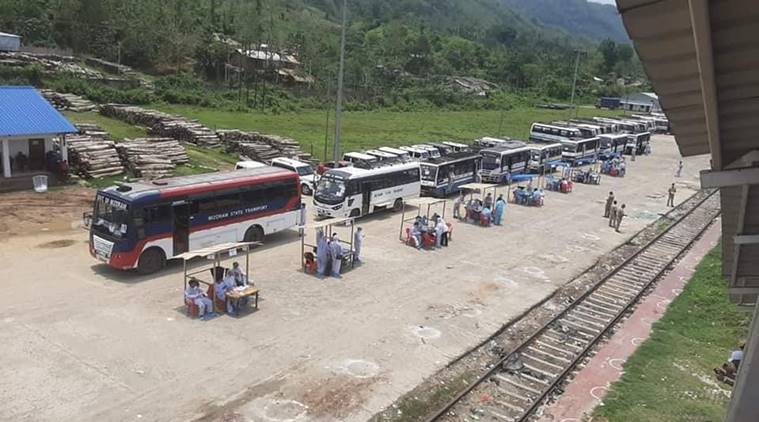
Those avoiding or attempting to evade quarantine will be fined Rs 3,000. (Representational)
More than Rs 18 lakh has been collected as fine from 8,107 people for violating the Mizoram (Containment and Prevention of COVID-19) Ordinance 2020, police said.
The fine was collected from 8,107 people arrested since May 4 for violating the ordinance and other lockdown rules, a police statement said on Sunday.
Of the 8,107 people, 1,355 were caught by volunteers of local or village level task forces, it said.
So far, 3,381 people have been arrested in Aizawl district, 731 in Lawngtlai district, 701 in Lunglei district, 646 in Serchhip district, 508 in Mamit district, 476 in Champhai district, 354 in Hnahthial district, 345 in Saitual district, 329 in Siaha district, 162 in Khawzawl district and 90 in Kolasib district following the implementation of the ordinance, they said.
According to the Containment and Prevention of COVID- 19 Ordinance 2020 promulgated by the state government on May 3, any person, who exposes the identity of coronavirus patients in print, electronic or social media without prior permission from competent authority will be punished with imprisonment of three months or with a fine up to Rs 5,000 or both.
Besides, Rs 5,000 fine will be imposed on people who cross border or enter the state, or organise a social or religious event without permission or escape from quarantine facility, as per the ordinance.
A fine of Rs 300 will be imposed for spitting in public, Rs 200 for failing to maintain social distancing protocol and Rs 100 for failing to wear a mask in a public place. Persons failing to comply with any other instruction or guidelines issued by the Centre or the state government, including lockdown guidelines issued from time to time, will be fined Rs 1,000.
Those avoiding or attempting to evade quarantine will be fined Rs 3,000. A fine of Rs 500 will be slapped against those who fail to comply with instruction or guidelines and endangering the safety of others while staying at the designated quarantine facility.
Iranian physician Majid Taheri returned home on Monday after his release from jail in the United States as part of a prisoner exchange.
Taheri was greeted at Tehran’s Imam Khomeini International Airport by Deputy Foreign Minister Hossein Jaberi Ansari, reported the semi-official news agency, ISNA, which published a picture of the pair speaking to reporters.
More:
The doctor, who had been detained in the US for 16 months, was freed on Thursday as Iran released US Navy veteran Michael White, who was imprisoned in July 2018 after being convicted of insulting Iran’s supreme leader and posting private information online.
“I hope to see the release of [other Iranians imprisoned abroad] in the near future,” Ansari said, adding his ministry would do its best to achieve this.
Taheri thanked Iran’s Foreign Minister Mohammad Javad Zarif.
“I thank the government of the Islamic Republic of Iran and dear officials, including Mr Zarif, who worked hard, and other officials who took months to help release me, as an Iranian physician accused of circumventing US sanctions on medicine,” he was quoted as saying.
US Navy veteran released by Iran arrives in Switzerland
Taheri was the second Iranian to return in a week after being detained in the US.
Cancer vaccine
A US federal judge issued an order to free Taheri – an Iranian-American dermatologist who had been working at a clinic in Tampa, Florida – on time served.
Taheri had been accused of violating US sanctions by attempting to export a filter to Iran that he said was for vaccine research, but that US authorities said required a licence because it could be used for chemical and biological warfare purposes.Â
He was also accused of structuring a series of bank deposits below $10,000 to evade reporting requirements under federal law. In December he pleaded guilty to charges he violated financial reporting requirements by depositing $277,344 at a bank, according to court documents.
On Monday he rejected accusations against him as “unfair and false”, according to Iran’s Fars news agency.
“I was helping the University of Tehran to develop a cancer vaccine, especially for women,” he was quoted as saying.
Earlier last week, an Iranian scientist named Sirous Asgari returned to Tehran after being acquitted in a federal trade secrets case and deported. Asgari’s departure had been delayed by the coronavirus pandemic and his supporters say the scientist contracted the virus while being held.
Iran-US tensions have soared in recent years as President Donald Trump has pursued a campaign of “maximum pressure” against the US’s arch enemy.
Since unilaterally withdrawing the US from the Iran nuclear deal in 2018, Trump has hit the Islamic republic with sweeping sanctions.
The two sides appeared to come to the brink of war for the second time in less than a year in January, when Trump ordered an air strike that killed one of Iran’s top generals, Qassem Soleimani, in Baghdad, Iraq, and Iran responded with a missile attack targeting US troops there.
Please note: these are government figures on numbers of confirmed cases – some people who report symptoms are not being tested, and are not included in these counts.
These figures come from data published by Public Health England, working with the Department for Health and Social Care and Health Protection Scotland. Some of the numbers are updated daily, though others may be updated more regularly.
About Covid-19
Since first being identified as a new coronavirus strain in patients from the city of Wuhan in Hubei province, China, late last year, Covid-19 has spread around the globe.
The virus can cause pneumonia. Those who have fallen ill are reported to suffer coughs, fever and breathing difficulties. You can find out more about the symptoms and the latest government guidance here.
Due to the unprecedented and ongoing nature of the coronavirus outbreak, this article is being regularly updated to ensure that it reflects the current situation as best as possible. Any significant corrections made to this or previous versions of the article will continue to be footnoted in line with Guardian editorial policy.
NEW ORLEANS (AP) — Tropical Storm Cristobal continued to weaken early Monday, after the lopsided storm crashed ashore in Louisiana and ginned up dangerous weather farther east, sending waves crashing over Mississippi beaches, swamping parts of an Alabama island town and spawning a tornado in Florida.
Cristobal made a Saturday afternoon landfall between the mouth of the Mississippi River and the since-evacuated barrier island resort community of Grand Isle, with 50-mph (85-kph) winds.
Making landfall well under hurricane strength, the storm had begun weakening as it moved inland late Sunday night — but heavy rainfall and a storm surge were continuing along the Gulf Coast, posing a threat across a wide area into the Florida Panhandle.
At 1 a.m. CDT Monday, the storm was centered about 35 miles (56 kilometers) northwest of New Orleans, packing slowed winds of 40 mph (64 kmph). With its drenching rains, Cristobal — moving north-northwest at 10 mph (16 kmph) — was expected to keep inundating the northern Gulf Coast well into Monday but the National Hurricane Center in Miami said it would likely weaken into a tropical depression within the “next several hours.â€
Cristobal’s forecast path takes it inland through southeast Louisiana Monday, continuing north into Arkansas and Missouri by Tuesday, moving over Wisconsin on Tuesday night and into Canada by Wednesday, according to the latest advisory.
In New Orleans, the question was how much rain would fall and whether there would be enough breaks in the bands of heavy weather for the beleaguered pumping system to meet its latest test of keeping streets free of flood waters.
Coastal Mississippi news outlets reported stalled cars and trucks as flood waters inundated beaches and crashed over highways. On the City of Biloxi Facebook page, officials said emergency workers helped dozens of motorists through flood waters, mostly on U.S. 90 running along the coast.
In Alabama, the bridge linking the mainland to Dauphin Island was closed much of Sunday. Police and state transportation department vehicles led convoys of motorists to and from the island when breaks in the weather permitted.
Forecasters said up to 12 inches (30 centimeters) of rain could fall in some areas, with storm surges up to 5 feet (1.5 meters). The weather service warned that the rain would contribute to rivers flooding on the central Gulf Coast and up into the Mississippi Valley.
“It’s very efficient, very tropical rainfall,†National Hurricane Center Director Ken Graham said in a Facebook video. “It rains a whole bunch real quick.â€
Rising water on Lake Pontchartrain near New Orleans pushed about 2 feet of water into the first floor of Rudy Horvath’s residence — a boathouse that sits on pilings over the brackish lake. Horvath said he and his family have lived there a year and have learned to take the occasional flood in stride. They’ve put tables on the lower floor to stack belongings above the high water.
“We thought it would be pretty cool to live out here, and it has been,†Horvath said. “The sunsets are great.â€
Elsewhere in south Louisiana, water covered the only road to Grand Isle and in low-lying parts of Plaquemines Parish at the state’s southeastern tip. “You can’t go down there by car,†shrimper Acy Cooper said Sunday of one marina in the area. “You have to go by boat.â€
SOPA Images via Getty Images
People clean up debris from their damaged apartments during the aftermath of Tropical Storm Cristobal.Â
In Florida, a tornado — the second in two days in the state as the storm approached — uprooted trees and downed power lines Sunday afternoon south of Lake City near Interstate 75, the weather service and authorities said. There were no reports of injuries.
The storm also forced a waterlogged stretch of Interstate 10 in north Florida to close for a time Sunday.
Rain fell intermittently in New Orleans famed French Quarter on Sunday afternoon, but the streets were nearly deserted, with many businesses already boarded up due to the coronavirus.
Daniel Priestman said he didn’t see people frantically stocking up as in previous storms. He said people may be “overwhelmed†by the coronavirus and recent police violence and protests. They seemed “resigned to whatever happens — happens,†he said.
At one New Orleans intersection, a handmade “Black Lives Matter†sign, wired to a lamppost, rattled in a stiff wind as the crew of a massive vacuum truck worked to unclog a storm drain.
The Sewerage & Water Board of New Orleans said the city’s aging street drainage system had limits, so residents should avoid underpasses and low-lying areas prone to inevitable street flooding.
Jefferson Parish, a suburb of New Orleans, had called for voluntary evacuations Saturday of some low-lying communities because of threatened storm surge, high tides and heavy rain.
President Donald Trump agreed to issue an emergency declaration for Louisiana, officials said.
Associated Press reporter Curt Anderson in St. Petersburg, Florida, contributed to this report.
Calling all HuffPost superfans!
Sign up for membership to become a founding member and help shape HuffPost’s next chapter
We use cookies on our website to give you the most relevant experience by remembering your preferences and repeat visits. By clicking “Accept”, you consent to the use of ALL the cookies.
This website uses cookies to improve your experience while you navigate through the website. Out of these, the cookies that are categorized as necessary are stored on your browser as they are essential for the working of basic functionalities of the website. We also use third-party cookies that help us analyze and understand how you use this website. These cookies will be stored in your browser only with your consent. You also have the option to opt-out of these cookies. But opting out of some of these cookies may affect your browsing experience.
Necessary cookies are absolutely essential for the website to function properly. These cookies ensure basic functionalities and security features of the website, anonymously.
Cookie
Duration
Description
cookielawinfo-checbox-analytics
11 months
This cookie is set by GDPR Cookie Consent plugin. The cookie is used to store the user consent for the cookies in the category "Analytics".
cookielawinfo-checbox-functional
11 months
The cookie is set by GDPR cookie consent to record the user consent for the cookies in the category "Functional".
cookielawinfo-checbox-others
11 months
This cookie is set by GDPR Cookie Consent plugin. The cookie is used to store the user consent for the cookies in the category "Other.
cookielawinfo-checkbox-necessary
11 months
This cookie is set by GDPR Cookie Consent plugin. The cookies is used to store the user consent for the cookies in the category "Necessary".
cookielawinfo-checkbox-performance
11 months
This cookie is set by GDPR Cookie Consent plugin. The cookie is used to store the user consent for the cookies in the category "Performance".
viewed_cookie_policy
11 months
The cookie is set by the GDPR Cookie Consent plugin and is used to store whether or not user has consented to the use of cookies. It does not store any personal data.
Functional cookies help to perform certain functionalities like sharing the content of the website on social media platforms, collect feedbacks, and other third-party features.
Performance cookies are used to understand and analyze the key performance indexes of the website which helps in delivering a better user experience for the visitors.
Analytical cookies are used to understand how visitors interact with the website. These cookies help provide information on metrics the number of visitors, bounce rate, traffic source, etc.
Advertisement cookies are used to provide visitors with relevant ads and marketing campaigns. These cookies track visitors across websites and collect information to provide customized ads.












 Those avoiding or attempting to evade quarantine will be fined Rs 3,000. (Representational)